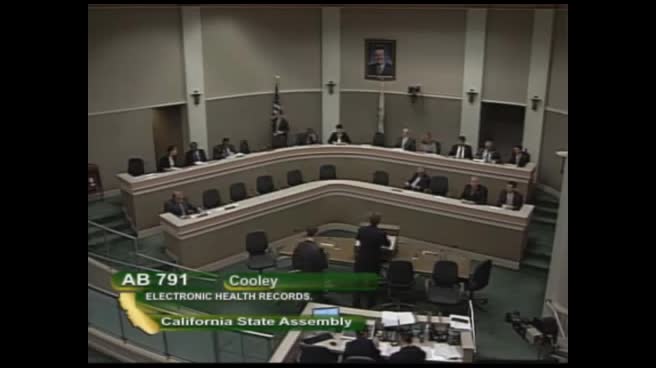
AB 791: Electronic health records.
- Session Year: 2015-2016
- House: Assembly
- Latest Version Date: 2015-02-25
Existing law establishes the Medi-Cal program, which is administered by the State Department of Health Care Services, under which basic health care services are provided to qualified low-income persons. The Medi-Cal program is, in part, governed and funded by federal Medicaid provisions.
Existing law, until July 1, 2021, and only to the extent that federal participation is available, requires the department to establish and administer the Medi-Cal Electronic Health Records Incentive Program to provide federal incentive payments to Medi-Cal providers for the implementation and use of electronic health records systems. Existing law requires the department to develop the State Medicaid Health Information Technology Plan, as specified, for federal approval, and requires the department to accept applications from, and make incentive payments to, eligible professionals and facilities that meet all of the standards of the federal Electronic Health Record Technology Program. Existing law requires the state plan to specify criteria for enrollment, eligibility, and data collection, and to specify a process for provider outreach and department coordination with established regional extension centers in the state, among other plan components.
This bill would additionally require the State Medicaid Health Information Technology Plan to specify the process by which patient advance health care directive information would be managed, including the secure preparation, storage, printing, and display of the patients advance health direction information, as prescribed.
(a)The program shall be administered in accordance with the State Medicaid Health Information Technology Plan, as developed by the department and approved by the federal Centers for Medicare and Medicaid Services. Upon federal approval, the department shall provide copies of the plan to the appropriate fiscal and policy committees of the Legislature.
(b)The State Medicaid Health Information Technology Plan shall address all of the following:
(1)Identify and establish the planning, policies, and procedures required to operationalize the Medi-Cal Electronic Health Record Incentive Program.
(2)Specify the criteria for enrollment, eligibility, and data collection.
(3)Specify timeframes for technology modifications.
(4)Specify the process for provider outreach and department coordination with established regional extension centers in the state, established to provide technical support to providers.
(5)Establish the audit and appeals processes.
(6)Participate in the National Level Registry.
(7)Specify the process by which patient advance health care directive information shall be managed, including all of the following:
(A)The ability for an individual to securely complete an online advance health care directive form expressing the individuals end-of-life care treatment decisions.
(B)The ability to securely print a paper form, memorializing those end-of-life decisions, for physical signature by the individual and a witness.
(C)The ability to securely upload, verify, and store an image of the signed signature page or pages.
(D)The ability to securely display information fields from a patients online advance health care directive form to authorized users.
|
Date
|
Status
|
|---|---|
| Feb 25, 2015 | Read first time. To print. |
| Feb 26, 2015 | From printer. May be heard in committee March 28. |
| Mar 12, 2015 | Referred to Com. on HEALTH. |
| Apr 14, 2015 | In committee: Hearing postponed by committee. |
| Apr 21, 2015 | In committee: Set, first hearing. Hearing canceled at the request of author. |
| Jan 31, 2016 | Died pursuant to Article IV, Sec. 10(c) of the Constitution. |
| Feb 1, 2016 | From committee: Filed with the Chief Clerk pursuant to Joint Rule 56. |
This list shows positions taken on this bill by organizations on the date displayed, which is linked to the original source.
Positions by individuals are not included.
|
Organization
|
Position
|
Date
|
|---|---|---|
| American Federation Of State, County And Municipal Employees, Afl-Cio | ** Support | Apr 21, 2015 |
| California Academy Of Family Physicians | ** Support | Apr 21, 2015 |
| California Chapter American College Of Emergency Physicians | * Support | Apr 21, 2015 |
| McGeorge School of Law and Public Policy and Legislation Clinic | * Support | Apr 21, 2015 |
AB 791
Page 5
Date of Hearing: April 21, 2015
ASSEMBLY COMMITTEE ON HEALTH
Rob Bonta, Chair
AB 791
(Cooley) – As Introduced February 25, 2015
SUBJECT: Electronic health records.
SUMMARY: Requires the State Medicaid Health Information Technology Plan to specify the process by which patient advance health care directives (AHCD) information would be managed. Specifically, this bill:
Requires the Department of Health Care Services (DHCS) to change the Medi-Cal electronic health record (EHR) incentive program to process and store patient AHDC information.
Requires the program to allow an individual to securely complete an online AHDC form expressing the individual’s end of life care treatment decisions.
Requires the program to allow an individual to print end of life decisions for signatures by the individual and a witness.
Requires the program to allow for uploading signed end of life decision documents.
Directs the program to display information to authorized users.
EXISTING LAW:
Enacts the Health Care Decisions Law, which governs health care for adults deprived of decision-making capacity. Codifies a form for AHCDs.
Allows a surrogate to make a health care decision in accordance with the patient’s individual health care instructions to the extent known to the surrogate.
Requires the Secretary of State (SoS) to establish a registry for people who have a written AHCD.
Requires SoS to issue a registrant an AHCD registry identification card indicating that an AHCD, or information regarding an AHCD, has been deposited with the registry. Costs associated with issuance of the card shall be offset by the fee charged by the SoS to receive and register information at the registry.
Requires SoS to provide the information about the AHCD to any health care provider, the public guardian or legal representative of the person who registered by the close of the next business day.
Requires hospitals, within 24 hours to contact a person who can make health care decisions for a patient who is unconscious or otherwise incapable of communication. Establishes a hospital has met its duty if it attempts specified actions including contacting the SoS to determine if the patient has registered an AHCD with SoS.
FISCAL EFFECT: This bill has not yet been analyzed by a fiscal committee.
COMMENTS:
PURPOSE OF THIS BILL. According to the author, in numerous conversations with the author’s constituents, people have agreed the problem is a real one and this bill would afford families a very valuable improvement and solution. The author explains this bill was introduced in response to research by the students in the Elder Law Clinic and the Legislative and Public Policy Clinic at McGeorge School of Law. The lack of an easily accessible and widely utilized system for recording and retrieving patient decisions for end-of-life care has resulted in confusion and misunderstandings. When medical practitioners are faced with ambiguous or conflicting reports, they err on the side of caution and prolonging life. One recent study suggests that as many as 20% of patients in an emergency setting receive unwanted treatment.
The author states this bill relies on an existing system making it far less expensive to add onto an existing Hospital and HMO database than to create one from the ground up and it charges the EHRs system provider, the expert in this technology, with the responsibility for developing the system rather than a state agency that may not have the same level of expertise. The author also notes this approach takes advantage of federal funds since the allocation has already been made to implement an electronic health records database. The author concludes this approach grants physicians and emergency-service providers access to this vital information within the same system that they are gathering other vital information.
BACKGROUND. An AHDC is a set of written instructions that a person gives that specifies what actions should be taken for their health, if they are no longer able to make decisions because of illness or incapacity. The document can take many forms, including a living will, personal directive, advance directive, or advance decision. California does not provide for a living will in law, only an AHCD.
The California Probate Code defines AHCD as an individual health care instruction or a power of attorney for health care. Current law codifies a statutory AHCD form that includes an explanation of each part, an explanation of the duties of a designated agent, and instructions for signing the form, including an explanation of witnessing requirements or notarization requirements. The use of this form is optional, and does not preclude the use of additional or different forms.
The demand and need for AHCDs in partly in response to the increasing sophistication and prevalence of medical technology. The improvements in health care have led to significant changes in the death experience of many Americans. Of U.S. deaths, 50%-75% occur in health care facilities. People are more likely to die of a chronic condition with their deterioration and eventual death occurring after a prolonged period rather than the result of a sudden incident, such as a fatal heart attack or accident. Researchers have documented that medical care for the dying can be unnecessarily prolonged, painful, expensive, and emotionally burdensome to both patients and their families.
AHDCs gained widespread usage among health care professionals when it appeared in the Patient Self-Determination Act (PSDA), a federal statute enacted as part of the federal Omnibus Budget Reconciliation Act of 1990. The PSDA required health care facilities receiving Medicare funding to provide each patient with information about AHDCs.
“Physician Orders for Life-Sustaining Treatment” (POLST) is a form that contains a doctor’s orders to ensure that a patient’s wishes are honored regarding medical treatment towards the end of life. Currently, the POLST form is a paper document, and as such, is oftentimes a key barrier to its effectiveness given that it can be misplaced. Furthermore, there isn’t a central database or registry that first responders can access in an emergency situation. The POLST is a product of a clinical process to facilitate communication between health care professionals and patients with serious illness or frailty (or their authorized surrogate) where the health care professional would not be surprised if the patient died within the next year. The process encourages shared, informed medical decision-making leading to a set of portable medical orders that respects the patient’s goals for care in regard to the use of cardiopulmonary resuscitation and other medical interventions, is applicable across health care settings, and can be reviewed and revised as needed.
REGISTRY EXPERIENCE. Currently, the SoS holds the responsibility for the operation of California’s AHDC Registry. The registry allows a person that has completed an AHDC to register information about the directive with the SOS. The SOS, upon written request, makes the advanced health care directive available to the registrant's health care provider, public guardian, or legal representative. This largely paper-based process currently takes approximately one week to respond to a physician inquiry, resulting in the advance directives being unavailable to physicians in emergency rooms and other crisis settings where death may be imminent. Moreover, the registry is woefully underutilized with only 450 directives filed annually and, at most, 93 requests for information per year.
Because there are so few registered AHCDs, the registry is rarely used and many physicians are unaware of its existence. California is not the only state facing difficulties establishing a registry. The State of Washington ended its living well registry in 2011. Only 2500 people had registered and the fees could not support the program operations.
SUPPORT. Supporters argue this bill will speed up the process by which doctors receive important information about a patient's treatment and medical care wishes via an AHCD. They all cite problems with the hardcopy process the SoS uses in the current registry.
The California Academy of Family Physicians has a position of support if amended. They agree with the intent of this bill, citing the problems with the current SoS's registry of hardcopy AHCDs. They request an amendment that all important end-of-life forms, such as POLST be included in this bill, so that all forms patients may have regarding end of life health care decisions are accessible to providers.
OPPOSITION. The California Right to Life Committee opposes AB 791 unless amended to address their concerns regarding privacy. They are seeking amendment to clarify the patient is the only person with the right to complete and submit a health form and not health care providers.
RELATED LEGISLATION. SB 19 (Wolk) Establishes a POLST Registry operated by the California Health and Human Services Agency (CHHS) for the purpose of collecting a POLST form received from a physician, or his or her designee, and disseminating the information in the form to persons authorized by CHHS. This bill is awaiting hearing in Senate Judiciary.
PREVIOUS LEGISLATION.
AB 2452 (Pan) of 2014 would have required the SoS to establish an electronic process for submittal and retrieval of AHDCs. AB 2452 was held in the Senate Judiciary Committee.
SB 1357 (Wolk) would have developed an online database for the POLST form only. SB 1357 was held under submission on the Senate Appropriations Committee's suspense file.
AB 2445 (Canciamilla), Chapter 882, Statutes of 2004, authorized issuing an identification card and allowed the SoS to charge a fee for the AHDC registry.
AB 891 (Alquist), Chapter 658, Statutes of 1999, establishes the Health Care Decisions Law, which also governs AHDCs, including establishing the program at the SoS.
SB 945 (Committee on Health), Chapter 433, Statutes of 2011, creates the requirements for the State Medicaid Health Information Technology Plan.
POLICY COMMENTS.
Two ADHC Directories. This bill creates a second state system that holds an inventory of end of life directives. Although the program administered by the SoS is small and unsuccessful, a second program would lead to confusion and duplication of effort.
Administrative Agency Fit. This bill probably places the program in the wrong agency. DHCS is an administrator and payor of health care programs for specified populations, chiefly Medi-Cal. The AHCDs program is not a health care program and could be better placed in another agency.
Information technology issues. This bill makes the newly created system part of the state’s plan for increasing EHRs use among Medi-Cal providers. If, as the bill requires, individuals will have to access for purposes of uploading and downloading documents, this is likely to require redesign of the system and raises security issues of public access to a system limited to health care providers.
Possible fiscal issues. The plan that is being amended by this bill is a Medi-Cal administrative function that is paid for by state and federal funds. It is part of the Medi-Cal program. This bill requires the plan to develop procedures and requirements for processing advanced health care decisions, presumably to all Californians and not just Medi-Cal beneficiaries. Federal requirements do not allow for federal funds to be used for program for individuals who are not Medi-Cal beneficiaries. The federal match is not available for this program. Indeed enactment of the bill would jeopardize further federal funding and may necessitate paying the federal government back for some of the funds used to develop and administer the plan.
REGISTERED SUPPORT / OPPOSITION:
Support
American Federation of State, County and Municipal Employees, AFL-CIO
California Academy of Family Physicians
California Chapter of the American Academy of Emergency Physicians
Opposition
California Right to Life Committee
Analysis Prepared by: Roger Dunstan / HEALTH / (916) 319-2097
Bill Author

Bill Co-Author(s):