SB 281: Boards and commissions: salaries.
- Session Year: 2015-2016
- House: Senate
- Latest Version Date: 2015-04-21
Existing law establishes the annual salary of the members of the Agricultural Labor Relations Board, the State Energy Resources Conservation and Development Commission, the Public Employment Relations Board, the California Unemployment Insurance Appeals Board, the Workers Compensation Appeals Board, the State Water Resources Control Board, the Board of Parole Hearings, the Occupational Safety and Health Appeals Board, the Alcoholic Beverage Control Appeals Board, the State Personnel Board, the State Air Resources Board, and the Central Valley Flood Protection Board.
This bill would, for nonelected members of these state boards and commissions appointed on or after January 1, 2016, set the annual salary at $12,000.
Existing law establishes the annual salary of the members of the Agricultural Labor Relations Board, the State Energy Resources Conservation and Development Commission, the Public Employment Relations Board, the Unemployment Insurance Appeals Board, the Workers Compensation Appeals Board, the State Water Resources Control Board, the Board of Parole Hearings, the Occupational Safety and Health Appeals Board, the Alcoholic Beverage Control Appeals Board, the State Personnel Board, the State Air Resources Board, and the Central Valley Flood Protection Board.
This bill would for nonelected members of these state boards and commissions appointed on or after January 1, 2016, set the annual salary at $12,000.
Notwithstanding Sections 11553, 11553.5, 11555, 11556, 11563.7, 11564, 11565.5, and 11569, for nonelected members of state boards and commissions specified in Sections 11553, 11553.5, 11555, 11556, 11563.7, and 11564, other than nonelected members of the Board of Parole Hearings, the Public Utilities Commission Commission, and the Fair Political Practices Commission, who are appointed on or after January 1, 2016, the annual salary shall be twelve thousand dollars ($12,000).
Notwithstanding Sections 11553, 11553.5, 11555, 11556, 11563.7, 11564, 11565.5, and 11569, for nonelected members of state boards and commissions specified in Sections 11553, 11553.5, 11555, 11556, 11563.7, and 11564, other than nonelected members of the Public Utilities Commission and the Fair Political Practices Commission, who are appointed on or after January 1, 2016, the annual salary shall be twelve thousand dollars ($12,000).
|
Date
|
Status
|
|---|---|
| Feb 19, 2015 | Introduced. Read first time. To Com. on RLS. for assignment. To print. |
| Feb 20, 2015 | From printer. May be acted upon on or after March 22. |
| Mar 5, 2015 | Referred to Com. on G.O. |
| Mar 19, 2015 | Set for hearing April 14. |
| Apr 6, 2015 | April 14 set for first hearing canceled at the request of author. |
| Apr 7, 2015 | Set for hearing April 28. |
| Apr 21, 2015 | From committee with author's amendments. Read second time and amended. Re-referred to Com. on G.O. |
| Apr 28, 2015 | April 28 hearing postponed by committee. |
| Apr 30, 2015 | Joint Rule 61(a)(2) suspended. (Ayes 34. Noes 0. Page 844.) |
| Apr 30, 2015 | Joint Rule 61(a)(2) suspended. (Ayes 34. Noes 0.) |
| May 1, 2015 | Set for hearing May 12. |
| May 12, 2015 | May 12 set for second hearing. Testimony taken. Further hearing to be set. |
| Feb 1, 2016 | Returned to Secretary of Senate pursuant to Joint Rule 56. |
This list shows positions taken on this bill by organizations on the date displayed, which is linked to the original source.
Positions by individuals are not included.
|
Organization
|
Position
|
Date
|
|---|---|---|
| Glendale City Employees Association | ** Against | May 12, 2015 |
| Howard Jarvis Taxpayers Association | ** Support | May 12, 2015 |
| Organization Of Smud Employees | ** Against | May 12, 2015 |
| San Bernardino Public Employees Association | ** Against | May 12, 2015 |
| San Luis Obispo County Employees Association | ** Against | May 12, 2015 |
| Santa Rosa City Employees Association | ** Against | May 12, 2015 |
SB 281 (Stone) Page 4 of 4
SENATE COMMITTEE ON GOVERNMENTAL ORGANIZATION
Senator Isadore Hall, III
Chair
2015 - 2016 Regular
Bill No: SB 281 Hearing Date: 5/12/2015
Author: |
Stone |
||
Version: |
4/21/2015 |
||
Urgency: |
No |
Fiscal: |
Yes |
Consultant: |
Felipe Lopez |
||
SUBJECT: Boards and commissions: salaries.
DIGEST: This bill sets an annual salary of $12,000 for nonelected members of various state boards and commissions appointed on or after January 1, 2016.
ANALYSIS:
Existing law establishes the annual salary of the members of the Agricultural Labor Relations Board, the State Energy Resources Conservation and Development Commission, the Public Employment Relations Board, the Unemployment Insurance Appeals Board, the Workers’ Compensation Appeals Board, the State Water Resources Control Board, the Board of Parole Hearings, the Occupational Safety and Health Appeals Board, the Alcoholic Beverage Control Appeals Board, the State Personnel Board, the State Air Resources Board, and the Central Valley Flood Protection Board.
This bill:
Sets an annual salary of $12,000 for nonelected members of the Agricultural Labor Relations Board, the State Energy Resources Conservation and Development Commission, the Public Employment Relations Board, the Unemployment Insurance Appeals Board, the Workers’ Compensation Appeals Board, the State Water Resources Control Board, the Occupational Safety and Health Appeals Board, the Alcoholic Beverage Control Appeals Board, the State Personnel Board, the State Air Resources Board, and the Central Valley Flood Protection Board.
Exempts non-elected members of the Public Utilities Commission, the Board of Parole Hearings and the Fair Political Practices Commission.
Provides that the annual salary of $12,000 applies to board and commission members appointed after January 1, 2016.
Background
Purpose of the bill: According to the author, with our budget facing uncertainty in the coming years and students in our University of California system facing tuition hikes, it seems tone-deaf to offer six figure salaries to members of several boards and commissions in California. The author further contends that most of the members of these boards and commissions are doing a great service to the people of California, but people who serve in these largely part-time posts should treat their appointments as public service instead of full time patronage positions. The author concludes that California must send a signal that our limited tax dollars should be directed towards the most needy and most vulnerable, not on six figure salaries to sit on a state board.
Current salaries: Below are salary ranges for members of the boards and commissions to which this bill applies. Some of these salaries were obtained through public information available on the State Controller’s Government Compensation in California Web site. It is important to note that these numbers are based on salaries for 2013. Some of these salaries were also obtained through the Sacramento Bee’s State Worker Salary Database.
Agricultural Labor Relations Board: $119,128 - $134,431
State Energy Resources Commission: $125,529 - $127,082
Public Employees Relations Board: $122,638 - $127,638
Unemployment Insurance appeals Board: $103,000 – $133,000
Workers’ Compensation Appeals Board: $133,000 - $134,000
State Water Resources Control Board: $93,332 - $126,551
Occupational Safety and Health Appeals Board: $116,000 -$118,000
Alcoholic Beverage Control Appeals Board: $15,300 – $24,311
State Personnel Board: $41,475 - $41,941
State Air Resources Board: $39,867 - $41,941
Central Valley Flood Protection Board: $40,236 - $41,941
Prior/Related Legislation
SB 153 (Strickland, 2012) would have prohibited members from various boards and commissions from receiving a salary and would have instead authorized for members of these various boards and commissions to receive $100 per diem. (Failed Passage in Senate Governmental Organization Committee)
SB 1368 (Anderson, 2012) would have limited the salaries of state officers and employees, including overtime, to no more than the salary received by the Governor, and would have recommended that the University of California also limit salaries for officers and employees to no more than the salary received by the Governor. (Failed passage in Senate Governmental Organization Committee)
SB 685 (Strickland, 2010) would have prohibited members from various boards and commissions from receiving a salary and would have instead authorized for members of these various boards and commissions to receive $100 per diem. (Failed Passage in Senate Governmental Organization Committee)
FISCAL EFFECT: Appropriation: No Fiscal Com.: Yes Local: No
SUPPORT:
Howard Jarvis Taxpayers Association
OPPOSITION:
California Labor Federation
Glendale City Employees Association
Organization of SMUD Employees
San Bernardino Public Employees Association
San Luis Obispo County Employees Association
Santa Rosa City Employees Association
ARGUMENTS IN SUPPORT: According to the Howard Jarvis Taxpayers Association, regardless of whether these salaries are paid for out of general or special funds, the issue is restoring the public trust and ensuring that taxpayer dollars are well spent. They further argue that while some of these boards and commissions exist for legitimate purposes, others perform functions that could be performed by existing administrative agencies. They conclude that while limiting salaries to $12,000 will not end all criticism, it certainly will address the perception by the voting public and taxpayers that these offices are little more than parking places for termed out legislators.
ARGUMENTS IN OPPOSITION: Opponents of the bill are particularly concerned about the impact that this bill would have on the compensation of members of the Public Employment Relations Board (PERB). They argue that while the PERB only meets formally once a month, the Board members work full time to administer the collective bargaining statutes covering employees of California’s public schools, colleges, and universities, employees of the State of California, employees of California local public agencies (cities, counties, and special districts), trial court employees and supervisory employees of the Los Angeles County Metropolitan Transportation Authority. They argue that the impact of leaving the administrative and adjudicatory responsibilities of the PERB unfinished could be far reaching and have significant negative impacts on local and state government, the unions that represent the employees, and the individual employees who are authorized to file their own unfair labor practice charges. Opponents conclude by stating that the relatively miniscule state savings cannot be justified in severely restricting the salaries of PERB board members who have a charge to protect workers.
The California Labor Federation argues that salaries of state board members are already dictated by existing law and reducing the budget of these boards in such a way would leave the working people of California more vulnerable. The California Labor Federation further argues that such a reduction would mean that only independently wealthy or unqualified individuals could work to protect vital California interest. This could result in complaints regarding unsafe working conditions going uninvestigated, workers injured on the job could face delays in receiving relief, and administrative court proceedings on key worker issues could become even more back logged.
SB 281 (Stone) Page 4 of 4
SENATE COMMITTEE ON GOVERNMENTAL ORGANIZATION
Senator Isadore Hall, III
Chair
2015 - 2016 Regular
Bill No: SB 281 Hearing Date: 4/28/2015
Author: |
Stone |
||
Version: |
4/21/2015 |
||
Urgency: |
No |
Fiscal: |
Yes |
Consultant: |
Felipe Lopez |
||
SUBJECT: Boards and commissions: salaries.
DIGEST: This bill sets an annual salary of $12,000 for nonelected members of various state boards and commissions appointed on or after January 1, 2016.
ANALYSIS:
Existing law establishes the annual salary of the members of the Agricultural Labor Relations Board, the State Energy Resources Conservation and Development Commission, the Public Employment Relations Board, the Unemployment Insurance Appeals Board, the Workers’ Compensation Appeals Board, the State Water Resources Control Board, the Board of Parole Hearings, the Occupational Safety and Health Appeals Board, the Alcoholic Beverage Control Appeals Board, the State Personnel Board, the State Air Resources Board, and the Central Valley Flood Protection Board.
This bill:
Sets an annual salary of $12,000 for nonelected members of the Agricultural Labor Relations Board, the State Energy Resources Conservation and Development Commission, the Public Employment Relations Board, the Unemployment Insurance Appeals Board, the Workers’ Compensation Appeals Board, the State Water Resources Control Board, the Occupational Safety and Health Appeals Board, the Alcoholic Beverage Control Appeals Board, the State Personnel Board, the State Air Resources Board, and the Central Valley Flood Protection Board.
Exempts non-elected members of the Public Utilities Commission, the Board of Parole Hearings and the Fair Political Practices Commission.
Provides that the annual salary of $12,000 applies to board and commission members appointed after January 1, 2016.
Background
Purpose of the bill: According to the author, with our budget facing uncertainty in the coming years and students in our University of California system facing tuition hikes, it seems tone-deaf to offer six figure salaries to members of several boards and commissions in California. The author further contends that most of the members of these boards and commissions are doing a great service to the people of California, but people who serve in these largely part-time posts should treat their appointments as public service instead of full time patronage positions. The author concludes that California must send a signal that our limited tax dollars should be directed towards the most needy and most vulnerable, not on six figure salaries to sit on a state board.
Current salaries: Below are salary ranges for members of the boards and commissions to which this bill applies. Some of these salaries were obtained through public information available on the State Controller’s Government Compensation in California Web site. It is important to note that these numbers are based on salaries for 2013. Some of these salaries were also obtained through the Sacramento Bee’s State Worker Salary Database.
Agricultural Labor Relations Board: $119,128 - $134,431
State Energy Resources Commission: $125,529 - $127,082
Public Employees Relations Board: $122,638 - $127,638
Unemployment Insurance appeals Board: $103,000 – $133,000
Workers’ Compensation Appeals Board: $133,000 - $134,000
State Water Resources Control Board: $93,332 - $126,551
Occupational Safety and Health Appeals Board: $116,000 -$118,000
Alcoholic Beverage Control Appeals Board: $15,300 – $24,311
State Personnel Board: $41,475 - $41,941
State Air Resources Board: $39,867 - $41,941
Central Valley Flood Protection Board: $40,236 - $41,941
Prior/Related Legislation
SB 153 (Strickland), 2011-2012 Legislative Session. The bill would have prohibited members from various boards and commissions from receiving a salary and would have instead authorized for members of these various boards and commissions to receive $100 per diem. (Failed Passage in Senate Governmental Organization Committee)
SB 1368 (Anderson) 2011-2012 Legislative Session. The bill would have limited the salaries of state officers and employees, including overtime, to no more than the salary received by the Governor, and would have recommended that the University of California also limit salaries for officers and employees to no more than the salary received by the Governor. (Failed passage in Senate Governmental Organization Committee)
SB 685 (Strickland), 2009-2010 Legislative Session. The bill would have prohibited members from various boards and commissions from receiving a salary and would have instead authorized for members of these various boards and commissions to receive $100 per diem. (Failed Passage in Senate Governmental Organization Committee)
FISCAL EFFECT: Appropriation: No Fiscal Com.: Yes Local: No
SUPPORT:
Howard Jarvis Taxpayers Association
OPPOSITION:
Glendale City Employees Association
Organization of SMUD Employees
San Bernardino Public Employees Association
San Luis Obispo County Employees Association
Santa Rosa City Employees Association
ARGUMENTS IN SUPPORT: According to the Howard Jarvis Taxpayers Association, regardless of whether these salaries are paid for out of general or special funds, the issue is restoring the public trust and ensuring that taxpayer dollars are well spent. They further argue that while some of these boards and commissions exist for legitimate purposes, others perform functions that could be performed by existing administrative agencies. They conclude that while limiting salaries to $12,000 will not end all criticism, it certainly will address the perception by the voting public and taxpayers that these offices are little more than parking places for termed out legislators.
ARGUMENTS IN OPPOSITION: Opponents of the bill are particularly concerned about the impact that this bill would have on the compensation of members of the Public Employment Relations Board (PERB). They argue that while the PERB only meets formally once a month, the Board members work full time to administer the collective bargaining statutes covering employees of California’s public schools, colleges, and universities, employees of the State of California, employees of California local public agencies (cities, counties, and special districts), trial court employees and supervisory employees of the Los Angeles County Metropolitan Transportation Authority. They argue that the impact of leaving the administrative and adjudicatory responsibilities of the PERB unfinished could be far reaching and have significant negative impacts on local and state government, the unions that represent the employees, and the individual employees who are authorized to file their own unfair labor practice charges. Opponents conclude by stating that the relatively miniscule state savings cannot be justified in severely restricting the salaries of PERB board members who have a charge to protect workers.
Discussed in Hearing
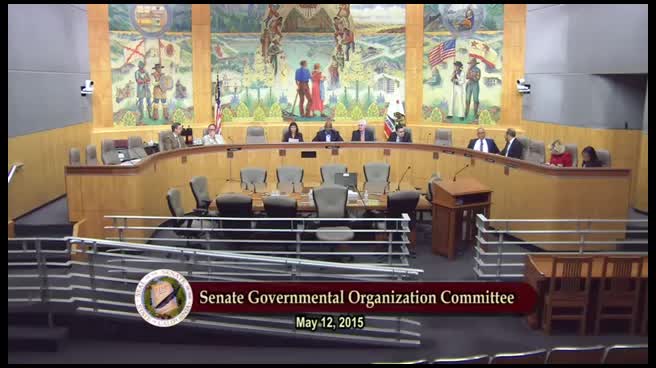 17MIN
Senate Standing Committee on Governmental Organization
Bill Author

Bill Co-Author(s):