SB 318: Education technology and digital resources training pilot program.
- Session Year: 2015-2016
- House: Senate
- Latest Version Date: 2015-04-23
(1)Existing law establishes a system of public elementary and secondary schools in this state, and authorizes local educational agencies throughout the state to operate schools and provide instruction to pupils in kindergarten and grades 1 to 12, inclusive.
This bill would appropriate, for the 201516 fiscal year, $1,000,000 from the General Fund to the Superintendent of Public Instruction to be allocated to specified applicant local educational agencies for the purpose of implementing a pilot program in the County of San Bernardino County to train kindergarten and grades 1 to 12, inclusive, teachers to more effectively utilize technology and digital resources within their instructional day, while also measuring and teaching the critical 21st century skills pupils need to succeed on Californias next-generation online assessments, as well as to prepare pupils for college and career objectives, thereby making an appropriation. The bill would require the Superintendent to develop an application process for the allocation of funds appropriated for the implementation of the pilot program to be limited that gives priority to applicant local educational agencies servicing the County of San Bernardino. that serve a large percentage of pupils eligible for free or reduced-price meals. The bill would authorize any local educational agency servicing the County of San Bernardino in the state to apply to the Superintendent for funding to implement the pilot program, as specified. The bill would repeal these provisions on January 1, 2020.
(2)This bill would make legislative findings and declarations as to the necessity of a special statute for the county of San Bernardino.
(3)
(2)Funds appropriated by this bill would be applied toward the minimum funding requirements for school districts and community college districts imposed by Section 8 of Article XVI of the California Constitution.
(1)Existing law establishes a system of public elementary and secondary schools in this state, and authorizes local educational agencies throughout the state to operate schools and provide instruction to pupils in kindergarten and grades 1 to 12, inclusive.
This bill would appropriate, for the 201516 fiscal year, $1,000,000 from the General Fund to the Superintendent of Public Instruction to be allocated to specified local educational agencies for the purpose of implementing a pilot program in the County of San Bernardino County to train kindergarten and grades 1 to 12, inclusive, teachers to more effectively utilize technology and digital resources within their instructional day, while also measuring and teaching the critical 21st century skills pupils need to succeed on Californias next-generation online assessments, as well as to prepare pupils for college and career objectives, thereby making an appropriation. The bill would require the Superintendent to develop an application process for the allocation of funds appropriated for the implementation of the pilot program to be limited to local educational agencies servicing the County of San Bernardino. The bill would authorize any local educational agency servicing the County of San Bernardino to apply to the Superintendent for funding to implement the pilot program, as specified. The bill would repeal these provisions on January 1, 2020.
(2)This bill would make legislative findings and declarations as to the necessity of a special statute for the county of San Bernardino.
(3)Funds appropriated by this bill would be applied toward the minimum funding requirements for school districts and community college districts imposed by Section 8 of Article XVI of the California Constitution.
(a)Notwithstanding any other law, for the 201516 fiscal year, one million dollars ($1,000,000) shall be appropriated from the General Fund to the Superintendent to be allocated to local educational agencies servicing the County of San Bernardino who apply for the purpose of implementing a pilot program to train kindergarten and grades 1 to 12, inclusive, teachers to more effectively utilize technology and digital resources within their instructional day, while also measuring and teaching the critical 21st century skills pupils need to succeed on Californias next-generation online assessments, as well as to prepare pupils for college and career objectives.
(b)(1)The Superintendent shall develop an application process for the allocation of funds appropriated pursuant to subdivision (a) limited that gives priority to applicant local educational agencies servicing the County of San Bernardino. that serve a large percentage of pupils eligible for free or reduced-price meals.
(2)Any local educational agency servicing the county of San Bernardino in the state may apply for funding from the Superintendent to implement the pilot program described in subdivision (a), and subject to the requirements of subdivision (c).
(c)(1)The pilot program shall be operated in the County of San Bernardino County and focus on teachers working with underserved populations.
(2)The pilot program shall may include the ability to measure 21st century skills of teachers and pupils using the international standards defined by the International Society for Technology in Education. The skills to be measured shall may include, but shall not be limited to, all of the following:
(A)Creativity and innovation.
(B)Communication and collaboration.
(C)Research and information fluency.
(D)Critical thinking and problem solving.
(E)Digital citizenship.
(F)Technology operations and concepts.
(3)The pilot program shall provide professional development for teachers to ensure that these 21st century skills are met developed and that assistance is provided when these skills are not met. developed.
(d)This section shall remain in effect only until January 1, 2020, and as of that date is repealed, unless a later enacted statute, that is enacted before January 1, 2020, deletes or extends that date.
SEC. 2.The Legislature finds and declares that this act, which is applicable only to the County of San Bernardino, is necessary because this act will serve as a pilot program for training kindergarten and grades 1 to 12, inclusive, teachers to, among other things, more effectively utilize technology and digital resources within their instructional day.
SEC. 3.The Legislature finds and declares that a special law is necessary and that a general law cannot be made applicable within the meaning of Section 16 of Article IV of the California Constitution because of the need to enact this act on a trial basis only, applied to one appropriately large and diverse county, before extending the act to every county in the state.
(a)Notwithstanding any other law, for the 201516 fiscal year, one million dollars ($1,000,000) shall be appropriated from the General Fund to the Superintendent to be allocated to local educational agencies servicing the County of San Bernardino who apply for the purpose of implementing a pilot program to train kindergarten and grades 1 to 12, inclusive, teachers to more effectively utilize technology and digital resources within their instructional day, while also measuring and teaching the critical 21st century skills pupils need to succeed on Californias next-generation online assessments, as well as to prepare pupils for college and career objectives.
(b)(1)The Superintendent shall develop an application process for the allocation of funds appropriated pursuant to subdivision (a) limited to local educational agencies servicing the County of San Bernardino.
(2)Any local educational agency servicing the county of San Bernardino may apply for funding from the Superintendent to implement the pilot program described in subdivision (a), and subject to the requirements of subdivision (c).
(c)(1)The pilot program shall be operated in the County of San Bernardino County and focus on teachers working with underserved populations.
(2)The pilot program shall include the ability to measure 21st century skills of teachers and pupils using the international standards defined by the International Society for Technology in Education. The skills to be measured shall include, but not be limited to, all of the following:
(A)Creativity and innovation.
(B)Communication and collaboration.
(C)Research and information fluency.
(D)Critical thinking and problem solving.
(E)Digital citizenship.
(F)Technology operations and concepts.
(3)The pilot program shall provide professional development for teachers to ensure that these skills are met and that assistance is provided when these skills are not met.
(d)This section shall remain in effect only until January 1, 2020, and as of that date is repealed, unless a later enacted statute, that is enacted before January 1, 2020, deletes or extends that date.
SEC. 2.The Legislature finds and declares that this act, which is applicable only to the County of San Bernardino, is necessary because this act will serve as a pilot program for training kindergarten and grades 1 to 12, inclusive, teachers to, among other things, more effectively utilize technology and digital resources within their instructional day.
SEC. 3.The Legislature finds and declares that a special law is necessary and that a general law cannot be made applicable within the meaning of Section 16 of Article IV of the California Constitution because of the need to enact this act on a trial basis only, applied to one appropriately large and diverse county, before extending the act to every county in the state.
|
Date
|
Status
|
|---|---|
| Feb 23, 2015 | Introduced. Read first time. To Com. on RLS. for assignment. To print. |
| Feb 24, 2015 | From printer. May be acted upon on or after March 26. |
| Mar 5, 2015 | Referred to Com. on ED. |
| Mar 20, 2015 | Set for hearing April 8. |
| Mar 26, 2015 | April 8 set for first hearing canceled at the request of author. |
| Apr 2, 2015 | Set for hearing April 15. |
| Apr 22, 2015 | From committee: Do pass as amended and re-refer to Com. on APPR. (Ayes 7. Noes 0. Page 647.) (April 15). |
| Apr 23, 2015 | Read second time and amended. Re-referred to Com. on APPR. |
| May 1, 2015 | Set for hearing May 11. |
| May 11, 2015 | May 11 hearing: Placed on APPR. suspense file. |
| May 23, 2015 | Set for hearing May 28. |
| May 28, 2015 | May 28 hearing: Held in committee and under submission. |
| Feb 1, 2016 | Returned to Secretary of Senate pursuant to Joint Rule 56. |
|
Date
|
Description
|
Location
|
Votes
|
|
|---|---|---|---|---|
| May 11, 2015 | Placed on suspense file | Senate Standing Committee on Appropriations |
Passed |
|
| Apr 15, 2015 | Do pass as amended, but first amend, and re-refer to the Committee on [Appropriations] | Senate Standing Committee on Education |
Passed |
This list shows positions taken on this bill by organizations on the date displayed, which is linked to the original source.
Positions by individuals are not included.
|
Organization
|
Position
|
Date
|
|---|---|---|
| California Teachers Association | * Indeterminate | May 11, 2015 |
| Learning.Com | * Indeterminate | May 11, 2015 |
| u None received. | ** Against | May 11, 2015 |
SB 318 (Morrell) Page 2 of 2
SENATE COMMITTEE ON APPROPRIATIONS
Senator Ricardo Lara, Chair
2015 - 2016 Regular Session
SB 318 (Morrell) - Education technology and digital resources training pilot program.
|
|
Version: April 23, 2015 |
Policy Vote: ED. 7 - 0 |
Urgency: No |
Mandate: No |
Hearing Date: May 11, 2015 |
Consultant: Jillian Kissee |
This bill meets the criteria for referral to the Suspense File.
Bill Summary:
This bill appropriates $1 million General Fund to the Superintendent of Public Instruction (Superintendent) to be allocated to local educational agencies (LEAs) that apply to participate in a pilot program to train kindergarten and grades 1 through 12 teachers. The purpose of the pilot is to train teachers to use technology in their instructional day, and to teach students skills needed to succeed on state’s computer-based assessments and prepare them for college and careers. This bill requires the focus of this pilot program to be on teachers working with underserved populations.
Fiscal Impact:
This bill appropriates $1 million Proposition 98 General Fund to the Superintendent. This bill also creates a cost pressure to provide ongoing funding for this program.
The California Department of Education (CDE) indicates the need for 3 additional positions at a cost of $325,000 General Fund to develop and administer this program for its duration. Actual workload would depend on the number of applicants received.
Background:
The Local Control Funding Formula (LCFF), enacted as part of the 2013-14 Budget Act, was a significant reform to the state’s system of financing K-12 public schools. It replaced the prior system of revenue limits and restricted funding for a multitude of categorical programs with a new funding formula that provides base funding for the core educational needs of all students and supplemental funding for the additional educational needs of low-income students, English learners, and foster youth. Because the LCFF funds have limited spending restrictions, local educational agencies (LEAs) have considerable flexibility to direct LCFF resources to best meet their students’ needs.
One
of the previous categorical programs included the California
Technology Assistance Project (CTAP), which provided a regionalized
network of technical assistance to schools and school districts on
the implementation of education technology. The CTAP was composed of
regional consortia that worked collaboratively with school districts
and county offices of education to meet locally defined technology
based needs. Its functions included technical services to support
access, planning, and use of high-speed telecommunications networks
as well as providing technology planning and implementation
assistance to rural and technologically underserved school districts
and county offices of education.
California joined the Smarter Balanced Assessments Consortium (SBAC) as a governing state in 2011, for the purpose of developing assessments that are aligned to the Common Core State Standards. California committed to administering the SBAC assessments to pupils beginning in the 2014-15 school year. The state adopted the new standards, it has also updated curricular frameworks, professional development modules, supplemental instructional materials, and is working on the adoption of instructional materials. LEAs have been provided significant funding to implement the instruction aligned to the new standards, including funding for technology necessary for computer-based assessments and professional development.
Proposed Law:
This bill appropriates $1 million General Fund to the Superintendent to be allocated to LEAs who apply for funds to implement the implementation of a pilot program to train kindergarten and grades 1 through 12 teachers. The purpose of this pilot is to train teachers working with underserved populations to use technology in their instructional day, and to teach students skills needed to succeed on state’s computer-based assessments and prepare them for college and careers.
Specifically, this bill requires that the Superintendent give priority to LEAs that apply for funding that serve a large percentage of students eligible for free or reduced-price meals. This bill requires the pilot to provide professional development for teachers to ensure that 21st century skills, as specified, are developed and that assistance is provided when they are not developed.
Finally, the provisions of this bill will become inoperable January 1, 2020.
Staff Comments: Though not expressly stated, the appropriation included in this bill is likely to be counted towards the Proposition 98 minimum guarantee as it would be General Fund revenues appropriated for school districts consistent with Section 8 of Article XVI of the California Constitution.
-- END --
SB 318 (Morrell) Page 4 of 4
SENATE COMMITTEE ON EDUCATION
Senator Carol Liu, Chair
2015 - 2016 Regular
Bill No: SB 318
Author: |
Morrell |
||
Version: |
February 23, 2015 Hearing Date: April 15, 2015 |
||
Urgency: |
No |
Fiscal: |
Yes |
Consultant: |
Lenin Del Castillo |
||
Subject: Education technology and digital resources training pilot program
SUMMARY
This bill would establish a new pilot program to train teachers in the County of San Bernardino to more effectively utilize technology and digital resources and appropriate $1 million in Proposition 98 General Fund for this purpose.
BACKGROUND
The Local Control Funding Formula (LCFF), enacted as part of the 2013-14 Budget Act, was a significant reform to the state’s system of financing K-12 public schools. It replaced the prior system of revenue limits and restricted funding for a multitude of categorical programs with a new funding formula that provides base funding for the core educational needs of all students and supplemental funding for the additional educational needs of low-income students, English learners, and foster youth. Because the LCFF funds have limited spending restrictions, local educational agencies (LEAs) have considerable flexibility to direct LCFF resources to best meet their students’ needs.
Under the old system, revenue limits provided LEAs with discretionary (unrestricted) funding for general education purposes, and categorical program (restricted) funding was provided for specialized purposes, with each program having unique allocation and spending requirements. Revenue limits made up about two-thirds of state funding for schools, while categorical program funding made up the remaining one-third portion. For some time, that system was criticized as being too state-driven, bureaucratic, complex, inequitable, and based on outdated allocation methods that did not reflect current student needs.
The previous categorical programs included the California Technology Assistance Project (CTAP), which provided a regionalized network of technical assistance to schools and school districts on the implementation of education technology. The CTAP was composed of regional consortia that work collaboratively with school districts and county offices of education to meet locally defined technology based needs. Its functions included technical services to support access, planning, and use of high-speed telecommunications networks as well as providing technology planning and implementation assistance to rural and technologically underserved school districts and county offices of education. The CTAP program is no longer operative in light of the LCFF.
ANALYSIS
This bill:
Appropriates $1 million in Proposition 98 General Fund to the Superintendent of Public Instruction (SPI) to be allocated to local educational agencies (LEAs) servicing the County of San Bernardino who apply for the purpose of implementing a pilot program to train kindergarten and grades 1 to 12, inclusive, teachers to more effectively utilize technology and digital resources within their instructional day, while also measuring and teaching the critical 21st century skills pupils need to succeed on California’s next-generation online assessments, as well as to prepare pupils for college and career objectives.
Requires the SPI to develop an application process for the allocation of funds appropriated by the bill, limited to LEAs servicing the County of San Bernardino.
Allows LEAs servicing the county of San Bernardino to apply for funding to implement the pilot program.
Requires the pilot program to be operated in the County of San Bernardino and focus on teachers working with underserved populations.
Requires the pilot program to include the ability to measure 21st century skills of teachers and pupils using the international standards defined by the International Society for Technology in Education. The skills to be measured shall include, but not be limited to, all of the following:
Creativity and innovation
Communication and collaboration
Research and information fluency
Critical thinking and problem solving
Digital citizenship
Technology operations and concepts
Requires the pilot program to provide professional development for teachers to ensure that these skills are met and that assistance is provided when these skills are not met.
Provides that the program shall remain in effect only until January 1, 2020.
STAFF
COMMENTS
Need for the bill. According to the author’s office, the new assessments associated with English language arts and mathematics will require digital literacy skills to demonstrate core content knowledge, which many students do not presently have. It is critical that students have the necessary skills to take these tests, which utilize computers and technology that students and teachers may not have access to. The author’s office indicates that there has not been a consistent effort to prepare students and teachers for these changes. There is broad concern that this lack of preparation might be reflected in the test results once the tests are in full effect. This bill is intended to ensure that teachers have the resources and understanding to teach their students the digital literacy skills needed to succeed on the new assessments, as well as prepare them for college and careers.
A new categorical program? The Committee may wish to consider whether the pilot program proposed by this measure is consistent with the new Local Control Funding Formula (LCFF). This new funding formula restructured the existing K-12 finance system and eliminated over 40 existing programs. The statutory and programmatic requirements for these programs were eliminated, thereby rendering any related activities to be dependent on local district discretion. In other words, school districts already have the ability to utilize their LCFF allotments to provide the technology related training proposed by this bill.
In addition, the 2013-14 Budget Act provided $1.25 billion in one-time Proposition 98 funds to assist K-12 school districts in implementing the new Common Core standards. These funds allowed school districts to make significant one-time investments in professional development, instructional materials, and enhancements to technology. School districts are required, on or before July 1, 2015, to report detailed information to the California Department of Education (CDE), including, but not limited to, specific purchases made and the number of teachers, administrators, or paraprofessional educators that received professional development. However, the CDE has estimated that based on the cost of implementing previous content standards, successful implementation of the Common Core could cost approximately $3 billion. Additionally, the Association of California School Administrators has conducted a survey on the expenditure of the $1.25 billion for Common Core implementation and found a relatively even distribution of expenditures in the three allowable categories (professional development, instructional materials, and technology, with slightly more interest in professional development. When asked about how any new funds provided would be spent, the priorities of the district respondents were again fairly evenly distributed among the three categories.
Too prescriptive? Notwithstanding the potential need for additional resources for school districts to implement the Common Core standards, it is unclear why the proposed pilot program should be limited to only local educational agencies in the San Bernardino County when other school districts in the state may have similar technology related needs. Further, the bill requires the pilot program to use the international standards defined by the International Society for Technology in Education. Would it be more prudent to leave this to the discretion of the program recipients?
SBAC assessments and Common Core. California joined the Smarter Balanced Assessments Consortium (SBAC) as a governing state in 2011, for the purpose of developing assessments that are aligned to the Common Core standards. California committed to administering the SBAC assessments to pupils beginning in the 2014-15 school year. The State is not currently bound by statutes or fiscal requirements to fulfill the commitments made to SBAC. However, the State has adopted the Common Core standards and as a result, has updated curricular frameworks, professional development modules, supplemental instructional materials, and is working on the adoption of instructional materials. School districts have been required to provide instruction on the Common Core standards for several years now and have spent resources to do so.
SUPPORT
None received.
OPPOSITION
None received.
-- END --
Discussed in Hearing
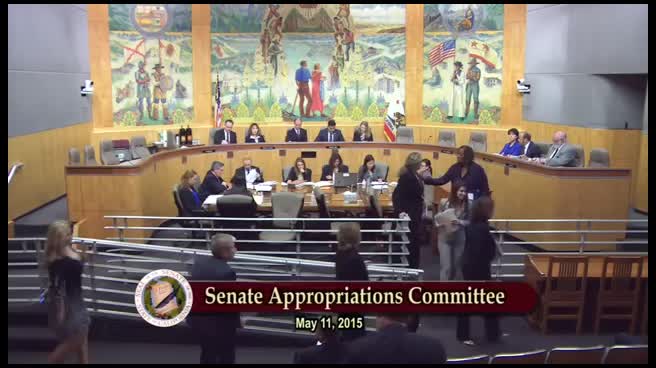 2MIN
Senate Standing Committee on Appropriations
Bill Author