SB 341: Housing: Department of Housing and Community Development: local fees.
- Session Year: 2015-2016
- House: Senate
- Latest Version Date: 2015-03-26
Existing law authorizes the Department of Housing and Community Development to make take specified actions related to housing that include, among other things, investigations of housing and community development in the state.
This bill would require the department to take these actions.
Existing law requires fees charged by a local agency for specified purposes, including zoning variances, zoning changes, use permits, building inspections, building permits, the processing of maps under the provisions of the Subdivision Map Act, and planning services, to not exceed the estimated reasonable cost of providing the service for which the fee is charged, unless a question regarding the amount of the fee charged in excess of this cost is submitted to, and approved by, 2/3 of the electors.
This bill would require, by January 1, 2017, and every 5 years thereafter, the department to conduct a statewide survey of cities and counties to determine the total amount of fees and charges imposed on new home construction by local jurisdictions and submit the survey to specified committees of the Legislature.
Existing law authorizes the Department of Housing and Community Development to make investigations of housing and community development in the state.
Existing law requires fees charged by a local agency for specified purposes, including zoning variances, zoning changes, use permits, building inspections, building permits, the processing of maps under the provisions of the Subdivision Map Act, and planning services, to not exceed the estimated reasonable cost of providing the service for which the fee is charged, unless a question regarding the amount of the fee charged in excess of this cost is submitted to, and approved by, 2/3 of the electors.
This bill would require, by January 1, 2017, and every 5 years thereafter, the department to conduct a statewide survey of cities and counties to determine the total amount of fees and charges imposed on new home construction by local jurisdictions and submit the survey to specified committees of the Legislature.
The Legislature hereby finds and declares the following:
(a)According to the most recent United States Census, Californias poverty rate is 16 percent, 1.4 percent higher than the national rate of 14.6 percent. However, under an alternative method, also calculated by the United States Census Bureau, called the Supplemental Poverty Measure, California has the highest poverty rate in the nation at 23.4 percent, well above the national alternative rate of 15.5 percent.
(b)The median value of a home in California of $383,900 $437,800 is 111.6 144.3 percent higher than the national median home value of $181,400, $179,200, yet the median household income of $61,400 in California is only 15.7 percent higher than the national average of $53,046. This may help to explain why only 56 54 percent of Californians own a home, far behind the national average of 65.5 64 percent. Fourty-six percent of Californians rent. By national standards, Californias homeownership rate of 54 percent is the third lowest in the nation.
(c)According to the Department of Housing and Community Developments 2001 report on local development fees, Californias high residential development fees significantly contribute to its high housing costs and prices. In fact, 15 years ago, local fees accounted for 10 to 15 percent of the cost of building a home. At that time, it was estimated that a reduction of local fees by half could increase home ownership by as much as 14 percent. Today, data from the California Building Industry Association shows local fees may account for 30 percent of the cost of a new home.
SEC. 2.Section 50464 of the Health and Safety Code is amended to read:50464.The department may: shall do all of the following:
(a) Make investigations of housing and community development in California.
(b) Call conferences of representatives of all levels of government, industry, and private groups, to discuss housing and community development problems of California.
(c) Investigate and report upon substandard housing and the problems resulting therefrom and the work being done to remedy such these conditions.
(d) Study the operation and enforcement of housing, building, zoning, and subdivision laws and regulations, of housing finance, taxes, redevelopment programs and public housing projects, as related to housing and community development.
(e) Examine the records of housing authorities and redevelopment agencies, and secure from them reports and copies of their records at any time.
(f) Promote the formation of organizations intended to increase the supply of adequate housing and the proper living environment for all the people of the state.
(g) With the Department of Transportation, investigate and report upon the consistency between state, local, and federal housing plans and programs and state, local, and federal transportation plans and programs.
SEC. 2.SEC. 3.Section 50464.5 is added to the Health and Safety Code, to read:50464.5.(a)The department shall conduct a statewide survey of cities and counties to determine the total amount of fees and charges imposed on new home construction by local jurisdictions. The survey shall include the fees and charges imposed by at least 150 cities, at least one city within each county, and all 58 counties. These fees and charges shall include, but not be limited to, all of the following:
(1)Planning and zoning fees.
(2)Environmental documentation fees.
(3)Building permit fees.
(4)Plan check fees.
(5)School fees.
(6)School mitigation fees.
(7)Highway, road, traffic, and transit fees.
(8)Water, wastewater, sewer, and drainage fees.
(9)Utility or water connection fees.
(10)Public safety fees.
(11)Capital facilities fees.
(12)Affordable housing fees and assessments.
(13)Parks and recreation fees.
(b)The department shall complete this survey and submit its findings to the Senate Committee on Transportation and Housing and the Assembly Committee on Housing and Community Development by January 1, 2017, and every five years thereafter.
The Legislature hereby finds and declares the following:
(a)According to the most recent United States Census, Californias poverty rate is 16 percent, 1.4 percent higher than the national rate of 14.6 percent. However, under an alternative method, also calculated by the United States Census Bureau, called the Supplemental Poverty Measure, California has the highest poverty rate in the nation at 23.4 percent, well above the national alternative rate of 15.5 percent.
(b)The median value of a home in California of $383,900 is 111.6 percent higher than the national median home value of $181,400, yet the median household income of $61,400 in California is only 15.7 percent higher than the national average of $53,046. This may help to explain why only 56 percent of Californians own a home, far behind the national average of 65.5 percent.
(c)According to the Department of Housing and Community Developments 2001 report on local development fees, Californias high residential development fees significantly contribute to its high housing costs and prices. In fact, 15 years ago, local fees accounted for 10 to 15 percent of the cost of building a home. At that time, it was estimated that a reduction of local fees by half could increase home ownership by as much as 14 percent. Today, data from the California Building Industry Association shows local fees may account for 30 percent of the cost of a new home.
SEC. 2.Section 50464.5 is added to the Health and Safety Code, to read:50464.5.(a)The department shall conduct a statewide survey of cities and counties to determine the total amount of fees and charges imposed on new home construction by local jurisdictions. The survey shall include the fees and charges imposed by at least 150 cities, at least one city within each county, and all 58 counties. These fees and charges shall include, but not be limited to, all of the following:
(1)Planning and zoning fees.
(2)Environmental documentation fees.
(3)Building permit fees.
(4)Plan check fees.
(5)School fees.
(6)School mitigation fees.
(7)Highway, road, traffic, and transit fees.
(8)Water, wastewater, sewer, and drainage fees.
(9)Utility or water connection fees.
(10)Public safety fees.
(11)Capital facilities fees.
(12)Affordable housing fees and assessments.
(13)Parks and recreation fees.
(b)The department shall complete this survey and submit its findings to the Senate Committee on Transportation and Housing and the Assembly Committee on Housing and Community Development by January 1, 2017, and every five years thereafter.
|
Date
|
Status
|
|---|---|
| Feb 23, 2015 | Introduced. Read first time. To Com. on RLS. for assignment. To print. |
| Feb 24, 2015 | From printer. May be acted upon on or after March 26. |
| Mar 5, 2015 | Referred to Com. on RLS. |
| Mar 26, 2015 | From committee with author's amendments. Read second time and amended. Re-referred to Com. on RLS. |
| Apr 7, 2015 | Re-referred to Com. on T. & H. |
| Apr 21, 2015 | Set for hearing April 28. |
| Apr 29, 2015 | From committee: Do pass and re-refer to Com. on APPR. with recommendation: To consent calendar. (Ayes 10. Noes 0. Page 825.) (April 28). Re-referred to Com. on APPR. |
| Apr 29, 2015 | From committee: Do pass and re-refer to Com. on APPR. with recommendation: To consent calendar. (Ayes 10. Noes 0.) (April 28). Re-referred to Com. on APPR. |
| May 5, 2015 | Set for hearing May 11. |
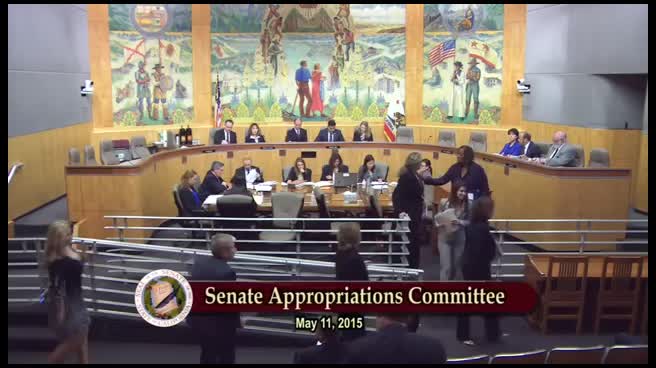
| May 11, 2015 | May 11 hearing: Placed on APPR. suspense file. |
| May 23, 2015 | Set for hearing May 28. |
| May 28, 2015 | May 28 hearing: Held in committee and under submission. |
| Feb 1, 2016 | Returned to Secretary of Senate pursuant to Joint Rule 56. |
|
Date
|
Description
|
Location
|
Votes
|
|
|---|---|---|---|---|
| May 11, 2015 | Placed on suspense file | Senate Standing Committee on Appropriations |
Passed |
|
| Apr 28, 2015 | Do pass, but first be re-referred to the Committee on [Appropriations] with the recommendation: To Consent Calendar | Senate Standing Committee on Transportation and Housing |
Passed |
This list shows positions taken on this bill by organizations on the date displayed, which is linked to the original source.
Positions by individuals are not included.
|
Organization
|
Position
|
Date
|
|---|---|---|
| California Building Industry Association | ** Support | May 11, 2015 |
SB 341 (Nguyen) Page 3 of 3
SENATE COMMITTEE ON APPROPRIATIONS
Senator Ricardo Lara, Chair
2015 - 2016 Regular Session
SB 341 (Nguyen) - Housing: Department of Housing and Community Development: local fees.
|
|
Version: March 26, 2015 |
Policy Vote: T. & H. 10 - 0 |
Urgency: No |
Mandate: No |
Hearing Date: May 11, 2015 |
Consultant: Mark McKenzie |
This bill meets the criteria for referral to the Suspense File.
Bill Summary:
SB 341 would require the Department of Housing and Community Development (HCD) to conduct a periodic statewide survey of cities and counties to determine the total amount of fees and charges that local agencies impose on new home construction. The bill would also require HCD to take a number of mandatory actions relating to housing that are currently specified as discretionary actions HCD may take under its general authority.
Fiscal Impact:
HCD costs of approximately $267,000, and similar costs every five years thereafter, to survey local agency residential development fees. (General Fund)
Unknown, but potentially significant costs related to provisions that require, rather than authorize, HCD to conduct specified general activities. (General Fund)
Background:
Existing law authorizes local agencies to charge fees associated with local development. Except for school fees, which are capped in the Sterling Act, local agencies have fairly broad discretion over the number, type, and amount of local development fees, but there must generally be a nexus between the amount of the fee and purpose for which the fee is charged. Cities and counties typically charge more than two dozen different types of development-related fees, most of which fall into three broad categories: (1) planning fees, which cover administrative costs of reviewing planning documents; (2) building permit, plan check, and inspection fees, which cover site-specific review requirements; and (3) capital facilities fees, which cover up-front costs of providing capital infrastructure. The largest component is usually capital facilities fees and may cover on-site costs of connecting to utilities, broader off-site impact fees associated with providing infrastructure to serve residential development, mitigation fees, and in-lieu fees. Local development fees may vary significantly by jurisdiction for a variety of reasons (density, land use, location, etc.), and these fees may be a sizable component of housing production costs.
Existing law provides HCD with the general authority to do any of the following:
Make investigations of housing and community development in the state.
Call conferences of representatives of all levels of government, industry, and private groups to discuss housing and community development problems in California.
Investigate and report on substandard housing, the resulting problems, and the work being done to remedy those conditions.
Study the operation and enforcement of housing, building, zoning, and subdivision laws and regulations, of housing finance, taxes, redevelopment programs and public housing projects, as related to housing and community development.
Examine the records of housing authorities and redevelopment agencies, and secure reports and copies of their records at any time.
Promote the formation of organizations intended to increase the supply of adequate housing and the proper living environment for all people of the state.
Investigate and report, with the California Department of Transportation, on the consistency among state, federal, and local housing and transportation plans and programs.
Proposed Law:
SB 341 would require, rather than authorize, HCD to conduct those actions noted above. The bill would also require HCD to conduct a statewide survey of cities and counties to determine the total amount of fees and charges imposed by local jurisdictions on new residential construction. The survey must include data on fees and charges from at least 150 cities, with at least one city within each county, and all 58 counties. The fees and charges surveyed must at least include the following:
Planning and zoning fees.
Environmental documentation fees.
Building permit fees.
Plan check fees.
School fees.
School mitigation fees.
Highway, road, traffic, and transit fees.
Water, wastewater, sewer, and drainage fees.
Utility or water connection fees.
Public safety fees.
Capital facilities fees
Affordable housing fees and assessments.
Parks and recreation fees.
The bill would require HCD to complete the survey and submit a report of findings to the Legislature by January 1, 2017, and every five years thereafter.
Staff Comments:
In 2001, HCD commissioned a study in cooperation with the University of California to examine the development fees charged by local agencies throughout the state (Pay to Play: Residential Development Fees in California Cities and Counties, 1999). This bill would require HCD to conduct an updated statewide survey of the fees and charges imposed by local agencies by January 1, 2017, and to update that study every five years thereafter.
HCD would incur an estimated $267,000 in staffing costs in the 2016 calendar year to design the survey, identify sample jurisdictions, coordinate with local agency planning staff, compile and analyze results, and produce the report and accompanying exhibits. These costs would recur every five years.
SB 341 would also require, rather than authorize, HCD to conduct a variety of general activities related to housing and community development. Considering the lack of specificity regarding the listed activities, such as the frequency and duration of the duties, and the specific duties to be investigated, studied, or examined, the fiscal impacts of these provisions is indeterminable, but potentially significant.
-- END --
SB 341 (Nguyen) Page 4 of 4
SENATE COMMITTEE ON TRANSPORTATION AND HOUSING
Senator Jim Beall, Chair
2015 - 2016 Regular
Bill No: SB 341 Hearing Date: 4/28/2015
Author: |
Nguyen |
||
Version: |
3/26/2015 |
||
Urgency: |
No |
Fiscal: |
Yes |
Consultant: |
Alison Dinmore |
||
SUBJECT: Department of Housing and Community Development: local fees survey
DIGEST: This bill requires the California Department of Housing and Community Development, by January 1, 2017, and every five years thereafter, to conduct a statewide survey of cities and counties to determine the total amount of fees and charges imposed on new home construction by local jurisdictions.
ANALYSIS:
Existing law states that the California Department of Housing and Community Development (HCD) may do the following:
Make investigations of housing and community development in California
Call conferences with local, industry, and private housing stakeholders to discuss housing and community development problems in California
Investigate and report on substandard housing and the problems resulting therefrom and the work to remedy those conditions
Study the operation and enforcement of housing, building, zoning, and subdivision laws and regulations, of housing finance, taxes, redevelopment programs, and public housing projects, as related to housing and community development
Examine the records of housing authorities and redevelopment agencies, including reports and copies of records at any time
Promote the formation of organizations intended to increase the supply of adequate housing and the proper living environment
Investigate and report, with the California Department of Transportation, the consistency between state, federal, and local housing and transportation plans and programs
This bill would require HCD to take the above actions. This bill would also require HCD to conduct a statewide survey of cities and counties to determine the total amount of fees and charges imposed on new home construction by local jurisdictions. HCD shall complete the survey and submit the findings to the Senate Transportation and Housing Committee and the Assembly Housing and Community Development Committee by January 1, 2017, and every five years thereafter.
The survey shall include the fees and charges imposed by at least 150 cities, at least one city within each county, and all 58 counties. The fees and charges shall include, but not be limited to, all of the following:
Planning and zoning fees
Environmental documentation fees
Building permit fees
Plan check fees
School fees
School mitigation fees
Highway, road, traffic, and transit fees
Water, wastewater, sewer, and drainage fees
Utility or water connection fees
Public safety fees
Capital facilities fees
Affordable housing fees and assessments
COMMENTS:
Purpose of the bill. According to the author, California residents face extremely high housing costs, with the median value of a home costing 144.3% more than the national median home value, while the median California household income is only 15.7% higher than the national average. One reason for the high prices is residential development fees associated with new housing developments. These high costs significantly inflate housing costs and may account for why only 56% of Californians own a home, far behind the national average of 65.5%.
A report released by HCD 15 years ago revealed that these costs were approximately 10-15% of a new home cost. Recent data from the California Building Industry Association, however, estimates that local fees now comprise up to 30% of the value of a newly built home. For example, the city and county fees associated with a single-family home in Rancho Cordova in 2011 were approximately $80,000, while the lot and construction costs of $162,500 accounted for 61% of the costs. Recently adopted building standards have increased the average home prices by thousands of dollars. Elevated local fees discourage new construction due to the margin between the cost of production compared to market value, which in turn limits the housing supply and job creation. Additionally, this makes it more difficult for Californians to purchase a home. All Californians should be concerned about the high cost of housing and an audit of local fees assists in creating housing that is truly affordable.
Update similar 1999 study. Existing law authorizes HCD to make investigations of housing and community development in the state. In 1999, pursuant to this authority, HCD conducted a survey and released a report, Pay to Play: Residential Development Fees in California Cities and Counties, 1999, that, based upon the responses to the survey, analyzed California’s residential development fees statewide. The report identified typical fee amounts for homes in a 25-unit subdivision, individual “infill” houses, and for a 45-unt apartment building. It identified the types of fees surveyed and evaluated overall how much these fees contributed to new home prices. The report also provided examples of how local governments could improve administration of permit fees and set forth policy issues and options related to broader local development of long-term capital improvement plans and programs and improving financial mechanisms.
This bill would require HCD to conduct a similar statewide study and submit its findings to the legislature by January 1, 2017 and every five years thereafter.
3) Unintended consequences. The bill would require, instead of authorize, HCD to: make investigations and call stakeholder meetings to discuss housing and community development problems in California; investigate and report on substandard housing; study the operation and enforcement of housing, building, zoning, and subdivision laws and regulations, and of housing finance, taxes, redevelopment programs, and public housing projects; examine the records of housing authorities and redevelopment agencies; promote the formation of organizations intended to increase the supply of adequate housing and the proper living environment; and investigate and report, with the California Department of Transportation, the consistency between state, federal, and local housing and transportation plans and programs.
The general practice in the Senate Rules Committee is not to release bills that merely require studies. For this reason, the author accepted an amendment in the Senate Rules Committee that changed the existing departmental discretionary authority to a mandate in this bill. HCD is a department that receives funding from the general fund. It is not clear to what extent the impacts of these changes will have on the HCD and their existing practices, but these changes will most certainly have a fiscal impact to the state.
4) Locals are not required to respond to the survey. While this bill requires HCD to conduct a statewide survey, there is no requirement for locals to respond. The author points out that the cities who responded to the 1999 survey were similarly not required to respond; of the 145 cities that received the survey, 89 responded.
FISCAL EFFECT: Appropriation: No Fiscal Com.: Yes Local: No
POSITIONS: (Communicated to the committee before noon on Wednesday,
April 22, 2015.)
SUPPORT:
California Building Industry Association
OPPOSITION:
None received
-- END --
Discussed in Hearing
 4MIN
Senate Standing Committee on Appropriations
Bill Author

Bill Co-Author(s):