SB 638: Developmental services: funding.
- Session Year: 2015-2016
- House: Senate
- Latest Version Date: 2015-04-21
The Lanterman Developmental Disabilities Services Act requires the State Department of Developmental Services to contract with regional centers to provide services and supports to individuals with developmental disabilities. Under existing law, the regional centers purchase needed services for individuals with developmental disabilities through approved service providers or arrange for those services through other publicly funded agencies.
This bill would require the department to submit a plan to the Legislature by August 1, 2016, to ensure the sustainability, quality, and transparency of community-based services for individuals with developmental disabilities. The bill would require the department to regularly consult with stakeholders in developing the plan and would require the plan to address specified topics, including, among others, recommendations for a comprehensive approach to funding regional center operations in a sustainable and transparent manner that provides incentives for enables regional centers to deliver high-quality services to consumers.
Existing law requires that contracts or agreements between regional centers and service providers in which the rates between the regional center and the service provider are determined through negotiations to ensure that not more than 15% of regional center funds be spent on administrative costs, as described.
This bill would instead provide that the percentage of the funds that may be spent on administrative costs varies depending on the total value, annually, of the agreements between the regional center and each service provider. payments received by a service provider from all regional centers.
Existing law establishes specified rates to be paid to certain service providers and the rates to be paid for certain developmental services. Existing law requires that rates to be paid to other developmental service provider providers either be set by the department or negotiated between the regional center and the service provider. Existing law prohibits certain provider rate increases, but authorizes increases to those rates as necessary to adjust employee wages to meet the state minimum wage law.
This bill would increase the rates established by existing law, as specified, and would require an increase to the rates set by the department and the rates negotiated between regional centers and service providers, as specified. The bill would also require the department, when setting rates for community care facilities serving people with developmental disabilities, to ensure that the rates permit the viability of those facilities by establishing different rates for each facility size, as determined by the number of beds available, that reflect reasonable differences in the cost structure of facilities with differing numbers of beds. The bill would require the department to adopt emergency regulations implementing that provision by July 1, 2016.
Existing law requires each regional center to submit, on or before August 1 of each year, to the department and the State Council on Developmental Disabilities a program budget plan for the subsequent budget year. Existing law provides that, to the extent feasible, all funds appropriated for developmental disabilities programs be allocated to those programs by August 1 of each year and designates the department as the agency responsible for the processing, audit, and payment of funds made available to regional centers.
This bill would require the department to increase the funding paid to a regional center for the regional centers operating budget, beginning January 1, 2016, by 5% July 1, 2015, by 10% above the amount the regional center otherwise would have received under the departments core staffing formula, and, beginning July 1, 2016, by 10% above the amount the regional center otherwise would have received under the departments core staffing formula. formula, plus a percentage equal to the percentage of any increase in the California Consumer Price Index since July 1, 2015. The bill would also require the department to increase the funding provided to a regional center to enable the regional center and the regional centers purchase-of-service vendors to fund certain costs related to minimum wage requirements.
The Lanterman Developmental Disabilities Services Act requires the State Department of Developmental Services to contract with regional centers to provide services and supports to individuals with developmental disabilities. Under existing law, the regional centers purchase needed services for individuals with developmental disabilities through approved service providers or arrange for those services through other publicly funded agencies.
This bill would require the department to submit a plan to the Legislature by August 1, 2016, to ensure the sustainability, quality, and transparency of community-based services for individuals with developmental disabilities. The bill would require the department to regularly consult with stakeholders in developing the plan and would require the plan to address specified topics, including, among others, recommendations for a comprehensive approach to funding regional center operations in a sustainable and transparent manner that provides incentives for regional centers to deliver high-quality services to consumers.
Existing law requires that contracts or agreements between regional centers and service providers in which the rates between the regional center and the service provider are determined through negotiations to ensure that not more than 15% of regional center funds be spent on administrative costs, as described.
This bill would instead provide that the percentage of the funds that may be spent on administrative costs varies depending on the total value, annually, of the agreements between the regional center and each service provider.
Existing law establishes specified rates to be paid to certain service providers and the rates to be paid for certain developmental services. Existing law requires that rates to be paid to other developmental service provider either be set by the department or negotiated between the regional center and the service provider. Existing law prohibits certain provider rate increases, but authorizes increases to those rates as necessary to adjust employee wages to meet the state minimum wage law.
This bill would increase the rates established by existing law, as specified, and would require an increase to the rates set by the department and the rates negotiated between regional centers and service providers, as specified. The bill would also require the department, when setting rates for community care facilities serving people with developmental disabilities, to ensure that the rates permit the viability of those facilities by establishing different rates for each facility size, as determined by the number of beds available, that reflect reasonable differences in the cost structure of facilities with differing numbers of beds. The bill would require the department to adopt emergency regulations implementing that provision by July 1, 2016.
Existing law requires each regional center to submit, on or before August 1 of each year, to the department and the State Council on Developmental Disabilities a program budget plan for the subsequent budget year. Existing law provides that, to the extent feasible, all funds appropriated for developmental disabilities programs be allocated to those programs by August 1 of each year and designates the department as the agency responsible for the processing, audit, and payment of funds made available to regional centers.
This bill would require the department to increase the funding paid to a regional center for the regional centers operating budget, beginning January 1, 2016, by 5% above the amount the regional center otherwise would have received under the departments core staffing formula, and, beginning July 1, 2016, by 10% above the amount the regional center otherwise would have received under the departments core staffing formula. The bill would also require the department to increase the funding provided to a regional center to enable the regional center and the regional centers purchase-of-service vendors to fund certain costs related to minimum wage requirements.
(a)The Legislature finds and declares all of the following:
(1)Californias vision to promote fulfilling lives for persons with developmental disabilities launched in 1969 with the passage of the Lanterman Developmental Disabilities Services Act, authored by Assembly Member Frank Lanterman and signed by Governor Ronald Reagan. However, the Lanterman Acts vision is now threatened by neglect of the community service system and wasteful spending on outdated state institutions.
(2)The current funding system for regional center operations and for community-based services is inadequate and outdated. The funding currently provided has not kept pace with the cost of delivering high-quality services. Funding formulas and ratesetting methods are archaic and ill-suited to promote an effective and efficient community system that delivers high-quality services to consumers.
(3)The result of inadequate funding for community services and onerous requirements on providers can be seen in the decline of the number of vendors serving the community. As documented in the January 2015 Fact Book issued by the State Department of Developmental Services, the number of vendors declined by 30 percent from 200910 to 201314, inclusive inclusive, despite an increase of 12 percent in the number of consumers served in the community. The Association of Regional Center Agencies also reports that 435 licensed residential homes and 57 day and work programs have closed since July 2011.
(4)California must recommit itself to vibrant and sustainable community services that maximize opportunities for persons with developmental disabilities to thrive in their own neighborhoods.
(5)It is imperative that the Legislature take action to ensure the viability of the community service system by paying sustainable reimbursement rates, streamlining requirements for community service providers, and fairly funding the regional center system to administer services.
(b)Accordingly, it is the intent of the Legislature to enact short-term increases in reimbursement rates for community services providers while undertaking a stakeholder process with specific deadlines to develop and implement long-term reforms to accomplish these goals. It is also the intent of the Legislature to establish requirements for greater regional center transparency with respect to rates paid to vendors and the amount and type of services provided to consumers across the spectrum of regional center services. It is further the intent of the Legislature that the provisions added by this act only remain in place until a revised, comprehensive rate system that provides adequate and transparent funding for community-based services, including supported employment, is implemented.
SEC. 2.Section 4519.8 is added to the Welfare and Institutions Code, immediately following Section 4519.7, to read:4519.8.The department shall submit a plan to the Legislature to ensure the sustainability, quality, and transparency of community-based services for individuals with developmental disabilities. The department shall regularly consult with stakeholders in developing the plan. The department shall submit the plan to the Legislature by August 1, 2016. The plan shall include, but not be limited to, all of the following:
(a)For each community services cost savings measure adopted through the budget process from 2008 through 2014, inclusive, that is still in effect as of July 1, 2015, an estimate of the savings generated and the number of program enrollees affected by that budget savings action. The plan shall recommend whether or not to continue implementing each savings measure.
(b)
(a)An assessment of the effectiveness of the methods used to pay each category of community service provider. This assessment shall include consideration of the following consideration factors for each type category of service provider:
(1)Whether the current method of ratesetting for a service category is ensuring an adequate supply of providers in that category. category, including, but not limited to, whether there is a sufficient supply of providers to enable a consumer to have a choice of providers.
(2)For service categories whose rates are not currently negotiated rates, A comparison of the likely fiscal effects of shifting the rate methodology to negotiated rates for that using the following methodologies for each service provider category. category:
(3)Options for basing a portion of the reimbursement for a provider category on consumer satisfaction, as measured by surveys, consumer-generated ratings, or other recognized methods for measuring consumer satisfaction in a statistically representative manner.
(c)
(A)Negotiated rates, which may be limited to regional medians or other limits.
(B)Rates established through regulations on either a statewide or regionally adjusted basis.
(C)Alternate rate methodologies that may use combinations of negotiated or regulatory rates on either a statewide or regionally adjusted basis.
(b)An evaluation of the appropriateness of the number and type of billing service codes for regional center services, including, but not limited to, recommendations for making billing service codes more reflective of the level and type of services provided. provided and for reducing the number and type of services that are billed with a service code of Miscellaneous.
(d)
(c)Recommendations for a comprehensive purchase-of-services rate structure that would ensure a sustainable, high-quality, and transparent community services system.
(e)For regional center operations, an estimate of the median cost per consumer to staff each regional center at appropriate levels.
(f)
(d)An assessment of the adequacy of the number and locations of regional centers for providing timely service to consumers. This assessment shall consider consider, at a minimum, all of the following: following factors:
(1)The waiting time for consumers to obtain appointments with regional center personnel.
(2)The distance consumers must travel for in-person meetings with regional center personnel.
(3)The type and frequency of interactions between consumers and regional center personnel that can be accommodated remotely through electronic means, including including, but not limited to, electronic mail, video conferencing, or telehealth.
(4)Whether the number of consumers and the geographic size of the catchment area served by each regional center are reasonable for delivering high-quality service to consumers and their families.
(4)
(5)Whether additional regional centers or regional center locations are necessary to address any identified deficiencies in access to regional center personnel, or whether technology-enabled means of access or other solutions are warranted.
(g)Development and evaluation of options for basing a portion of the funding for regional centers on consumer satisfaction, as measured by surveys, consumer-generated ratings, or other recognized methods for measuring consumer satisfaction in a statistically representative manner.
(h)
(e)Recommendations for a comprehensive approach to funding regional center operations in a sustainable and transparent manner that provides incentives for enables regional centers to deliver high-quality services to their consumers. consumers, including, but not limited to, recommendations and estimated costs for increasing the number of regional centers or altering catchment areas.
SEC. 3.Section 4629.7 of the Welfare and Institutions Code is amended to read:4629.7.(a)Notwithstanding any other law, all regional center contracts or agreements with service providers in which rates are determined through negotiations between the regional center and the service provider shall expressly require that not more than the amount of funds specified in paragraphs (1) to (3), inclusive, be spent on administrative costs.
(1)For service providers whose regional center agreements total who receive payments from one or more regional centers totaling two million dollars ($2,000,000) or more annually, annually from those regional centers, 15 percent of regional center funds.
(2)For service providers whose regional center agreements total who receive payments from one or more regional centers totaling less than two million dollars ($2,000,000), but more than one million dollars ($1,000,000), annually, 17.5 five hundred thousand dollars ($500,000), annually from those regional centers, 20 percent of regional center funds.
(3)For service providers whose regional center agreements total one million dollars ($1,000,000) or less, annually, 20 who receive payments from one or more regional centers totaling five hundred thousand dollars or less annually from those regional centers, 25 percent of regional center funds.
(b)For purposes of this subdivision, direct service expenditures are those costs immediately associated with the services to consumers being offered by the provider. Funds spent on direct services shall not include any administrative costs. Administrative costs include, but are not limited to, any of the following:
(1)Salaries, wages, and employee benefits for managerial personnel whose primary purpose is the administrative management of the entity, including, but not limited to, directors and chief executive officers.
(2)Salaries, wages, and benefits of employees who perform administrative functions, including, but not limited to, payroll management, personnel functions, accounting, budgeting, and facility management.
(3)Facility and occupancy costs, directly associated with administrative functions.
(4)Maintenance and repair.
(5)Data processing and computer support services.
(6)Contract and procurement activities, except those provided by a direct service employee.
(7)Training directly associated with administrative functions.
(8)Travel directly associated with administrative functions.
(9)Licenses directly associated with administrative functions.
(10)Taxes.
(11)Interest.
(12)Property insurance.
(13)Personal liability insurance directly associated with administrative functions.
(14)Depreciation.
(15)General expenses, including, but not limited to, communication costs and supplies directly associated with administrative functions.
(c)Notwithstanding any other law, all contracts between the department and the regional centers shall require that not more than 15 percent of all funds appropriated through the regional centers operations budget shall be spent on administrative costs. For purposes of this subdivision, direct services includes, but is not limited to, service coordination, assessment and diagnosis, monitoring of consumer services, quality assurance, and clinical services. Funds spent on direct services shall not include any administrative costs. For purposes of this subdivision, administrative costs include, but are not limited to, any of the following:
(1)Salaries, wages, and employee benefits for managerial personnel whose primary purpose is the administrative management of the regional center, including, but not limited to, directors and chief executive officers.
(2)Salaries, wages, and benefits of employees who perform administrative functions, including, but not limited to, payroll management, personnel functions, accounting, budgeting, auditing, and facility management.
(3)Facility and occupancy costs, directly associated with administrative functions.
(4)Maintenance and repair.
(5)Data processing and computer support services.
(6)Contract and procurement activities, except those performed by direct service employees.
(7)Training directly associated with administrative functions.
(8)Travel directly associated with administrative functions.
(9)Licenses directly associated with administrative functions.
(10)Taxes.
(11)Interest.
(12)Property insurance.
(13)Personal liability insurance directly associated with administrative functions.
(14)Depreciation.
(15)General expenses, including, but not limited to, communication costs and supplies directly associated with administrative functions.
(d)Consistent with subdivision (a), service providers and contractors, upon request, shall provide regional centers with access to any books, documents, papers, computerized data, source documents, consumer records, or other records pertaining to the service providers and contractors negotiated rates.
SEC. 4.Section 4681.1 of the Welfare and Institutions Code is amended to read:4681.1.(a)The department shall adopt regulations that specify rates for community care facilities serving persons with developmental disabilities. The implementation of the regulations shall be contingent upon an appropriation in the annual Budget Act for this purpose. These rates shall be calculated on the basis of a cost model designed by the department that ensures that aggregate facility payments support the provision of services to each person in accordance with his or her individual program plan and applicable program requirements. The cost model shall reflect cost elements that shall include, but are not limited to, all of the following:
(1)Basic living needs include utilities, furnishings, food, supplies, incidental transportation, housekeeping, personal care items, and other items necessary to ensure a quality environment for persons with developmental disabilities. The amount identified for the basic living needs element of the rate shall be calculated as the average projected cost of these items in an economically and efficiently operated community care facility.
(2)Direct care includes salaries, wages, benefits, and other expenses necessary to supervise or support the persons functioning in the areas of self-care and daily living skills, physical coordination mobility, and behavioral self-control, choice making, and integration. The amount identified for direct care shall be calculated as the average projected cost of providing the level of service required to meet each persons functional needs in an economically and efficiently operated community care facility. The direct care portion of the rate shall reflect specific service levels defined by the department on the basis of relative resident need and the individual program plan.
(3)Special services include specialized training, treatment, supervision, or other services that a persons individual program plan requires to be provided by the residential facility in addition to the direct care provided under paragraph (2). The amount identified for special services shall be calculated for each individual based on the additional services specified in the persons individual program plan and the prevailing rates paid for similar services in the area. The special services portion of the rate shall reflect a negotiated agreement between the facility and the regional center in accordance with Section 4648.
(4)Indirect costs include managerial personnel, facility operation, maintenance and repair, other nondirect care, employee benefits, contracts, training, travel, licenses, taxes, interest, insurance, depreciation, and general administrative expenses. The amount identified for indirect costs shall be calculated as the average projected cost for these expenses in an economically and efficiently operated community care facility.
(5)Property costs include mortgages, leases, rent, taxes, capital or leasehold improvements, depreciation, and other expenses related to the physical structure. The amount identified for property costs shall be based on the fair rental value of a model facility that is adequately designed, constructed, and maintained to meet the needs of persons with developmental disabilities. The amount identified for property costs shall be calculated as the average projected fair rental value of an economically and efficiently operated community care facility.
(b)The cost model shall take into account factors that include, but are not limited to, all of the following:
(1)Facility size, as defined by the department on the basis of the number of facility beds licensed by the State Department of Social Services and vendorized by the regional center.
(2)Specific geographic areas, as defined by the department on the basis of cost of living and other pertinent economic indicators.
(3)Common levels of direct care, as defined by the department on the basis of services specific to an identifiable group of persons as determined through the individual program plan.
(4)Positive outcomes, as defined by the department on the basis of increased integration, independence, and productivity at the aggregate facility and individual consumer level.
(5)Owner-operated and staff-operated reimbursement, which shall not differ for facilities that are required to comply with the same program requirements.
(c)The rates established for individual community care facilities serving persons with developmental disabilities shall reflect all of the model cost elements and rate development factors described in this section. The cost model design shall include a process for updating the cost model elements that address variables, including, but not limited to, all of the following:
(1)Economic trends in California.
(2)New state or federal program requirements.
(3)Changes in the state or federal minimum wage.
(4)Increases in fees, taxes, or other business costs.
(5)Increases in federal supplemental security income/state supplementary program for the aged, blind, and disabled payments.
(d)Rates established for persons with developmental disabilities who are also dually diagnosed with a mental health disorder may be fixed at a higher rate. The department shall work with the State Department of Health Care Services to establish criteria upon which higher rates may be fixed pursuant to this subdivision. The higher rate for persons with developmental disabilities who are also dually diagnosed with a mental health disorder may be paid when requested by the director of the regional center and approved by the Director of Developmental Services.
(e)By January 1, 2001, the department shall prepare proposed regulations to implement the changes outlined in this section. The department may use a private firm to assist in the development of these changes and shall confer with consumers, providers, and other interested parties concerning the proposed regulations. By May 15, 2001, and each year thereafter, the department shall provide the Legislature with annual community care facility rates, including any draft amendments to the regulations as required. By July 1, 2001, and each year thereafter, contingent upon an appropriation in the annual Budget Act for this purpose, the department shall adopt emergency regulations that establish the annual rates for community care facilities serving persons with developmental disabilities for each fiscal year.
(f)During the first year of operation under the revised rate model, individual facilities shall be held harmless for any reduction in aggregate facility payments caused solely by the change in reimbursement methodology.
(g)(1)The department shall ensure that rates established for community care facilities serving persons with developmental disabilities permit the viability of those facilities, including, but not limited to, four-bed facilities, by establishing different rates for each facility size, as determined by the number of beds available, that reflect reasonable differences in the cost structure of facilities with differing numbers of beds.
(2)The department shall adopt emergency regulations by July 1, 2016, to implement this subdivision. The adoption, amendment, repeal, or readoption of a regulation authorized by this paragraph is deemed to be necessary for the immediate preservation of the public peace, health and safety, or general welfare, for purposes of Sections 11346.1 and 11349.6 of the Government Code, and the department is hereby exempted from the requirement that it describe specific facts showing the need for immediate action.
SEC. 5.Section 4681.2 is added to the Welfare and Institutions Code, to read:4681.2.(a)Notwithstanding any other law, commencing July 1, 2015, the department shall increase the rates set for community care facilities serving persons with developmental disabilities by 5 10 percent above the levels that otherwise would have been in effect as of July 1, 2015, and, commencing 2015. Commencing July 1, 2016, except as specified in subdivision (b), the department shall increase those rates by 5 percent above the level in effect on a percentage equal to the percentage of any increase in the California Consumer Price Index since July 1, 2015.
(b)The rate increase described in subdivision (a) that is required to commence July 1, 2016, shall only be made if the Budget Act of 2016 does not implement alternative rate increases or rate reforms based on the plan required by Section 4519.8.
(b)
(c)The funding increases authorized in this section shall only be made if the percentage increase would not result in a reduction to the amount of federal matching funds available does not change. for these services.
SEC. 6.Section 4681.6 of the Welfare and Institutions Code is amended to read:4681.6.(a)Notwithstanding any other law, commencing July 1, 2008:
(1)A regional center shall not pay an existing residential service provider, for services where rates are determined through a negotiation between the regional center and the provider, a rate higher than the rate in effect on June 30, 2008, unless the increase is required by a contract between the regional center and the vendor that is in effect on June 30, 2008, or the regional center demonstrates that the approval is necessary to protect the consumers health or safety and the department has granted prior written authorization.
(2)A regional center shall not negotiate a rate with a new residential service provider, for services where rates are determined through a negotiation between the regional center and the provider, that is higher than the regional centers median rate for the same service code and unit of service, or the statewide median rate for the same service code and unit of service, whichever is lower. The unit of service designation shall conform with an existing regional center designation or, if none exists, a designation used to calculate the statewide median rate for the same service. The regional center shall annually certify to the department its median rate for each negotiated rate service code, by designated unit of service. This certification shall be subject to verification through the departments biennial fiscal audit of the regional center.
(b)Notwithstanding subdivision (a), commencing July 1, 2014, regional centers may negotiate a rate adjustment with residential service providers regarding rates that are otherwise restricted pursuant to subdivision (a), if the adjustment is necessary in order to pay employees no less than the minimum wage as established by Section 1182.12 of the Labor Code, as amended by Chapter 351 of the Statutes of 2013, and only for the purpose of adjusting payroll costs associated with the minimum wage increase. The rate adjustment shall be specific to the unit of service designation that is affected by the increased minimum wage, shall be specific to payroll costs associated with any increase necessary to adjust employee pay only to the extent necessary to bring pay into compliance with the increased state minimum wage, and shall not be used as a general wage enhancement for employees paid above the minimum wage. Regional centers shall maintain documentation on the process to determine, and the rationale for granting, any rate adjustment associated with the minimum wage increase.
(c)(1)Notwithstanding subdivision (a), commencing July 1, 2015, regional centers shall increase the rates paid to residential service providers, for services where rates are determined through a negotiation between the regional center and the provider, by 5 10 percent above the levels that otherwise would have been in effect on July 1, 2015, and, commencing 2015. Commencing July 1, 2016, except as specified in paragraph (2), the regional centers shall increase those rates by 5 percent above the level in effect on a percentage equal to the percentage of any increase in the California Consumer Price Index since July 1, 2015.
(2)The rate increase described in paragraph (1) that is required to commence July 1, 2016, shall only be made if the Budget Act of 2016 does not implement alternative rate increases or rate reforms based on the plan required by Section 4519.8.
(2)
(3)The funding increases authorized in this subdivision shall only be made if the percentage increase would not result in a reduction to the amount of federal matching funds available does not change. for these services.
(d)For purposes of this section, residential service provider includes Adult Residential Facilities for Persons with Special Health Care Needs, as described in Section 4684.50.
(e)This section shall not apply to those services for which rates are determined by the State Department of Health Care Services, or the State Department of Developmental Services, or are usual and customary.
SEC. 7.Section 4689.8 of the Welfare and Institutions Code is amended to read:4689.8.(a)Notwithstanding any other law, commencing July 1, 2008:
(1)A regional center shall not pay an existing supported living service provider, for services where rates are determined through a negotiation between the regional center and the provider, a rate higher than the rate in effect on June 30, 2008, unless the increase is required by a contract between the regional center and the vendor that is in effect on June 30, 2008, or the regional center demonstrates that the approval is necessary to protect the consumers health or safety and the department has granted prior written authorization.
(2)A regional center shall not negotiate a rate with a new supported living service provider, for services where rates are determined through a negotiation between the regional center and the provider, that is higher than the regional centers median rate for the same service code and unit of service, or the statewide median rate for the same service code and unit of service, whichever is lower. The unit of service designation shall conform with an existing regional center designation or, if none exists, a designation used to calculate the statewide median rate for the same service. The regional center shall annually certify to the State Department of Developmental Services its median rate for each negotiated rate service code, by designated unit of service. This certification shall be subject to verification through the departments biennial fiscal audit of the regional center.
(b)(1)Notwithstanding subdivision (a), commencing July 1, 2015, regional centers shall increase the rates paid to supported living service providers, for services where rates are determined through a negotiation between the regional center and the provider, by 5 10 percent above the levels that otherwise would have been in effect on July 1, 2015, and, commencing 2015. Commencing July 1, 2016, except as specified in paragraph (2), the regional centers shall increase those rates by 5 percent above the level in effect on a percentage equal to the percentage of any increase in the California Consumer Price Index since July 1, 2015.
(2)The rate increase described in paragraph (1) that is required to commence July 1, 2016, shall only be made if the Budget Act of 2016 does not implement alternative rate increases or rate reforms based on the plan required by Section 4519.8.
(2)
(3)The funding increases authorized in this subdivision shall only be made if the percentage increase would not result in a reduction to the amount of federal matching funds available does not change. for these services.
SEC. 8.Section 4690.7 is added to the Welfare and Institutions Code, to read:4690.7.(a)Notwithstanding any other law, commencing July 1, 2015, the department shall increase the rates set for nonresidential service providers by 5 10 percent above the levels that otherwise would have been in effect on July 1, 2015, and, commencing 2015. Commencing July 1, 2016, except as specified in subdivision (b), the department shall increase those rates by 5 percent above the level in effect on a percentage equal to the percentage of any increase in the California Consumer Price Index since July 1, 2015.
(b)The rate increase described in subdivision (a) that is required to commence July 1, 2016, shall only be made if the Budget Act of 2016 does not implement alternative rate increases or rate reforms based on the plan required by Section 4519.8.
(b)
(c)The funding increases authorized in this section shall only be made if the percentage increase would not result in a reduction to the amount of federal matching funds available does not change. for these services.
SEC. 9.Section 4691.9 of the Welfare and Institutions Code is amended to read:4691.9.(a)Notwithstanding any other law, commencing July 1, 2008:
(1)A regional center shall not pay an existing service provider, for services where rates are determined through a negotiation between the regional center and the provider, a rate higher than the rate in effect on June 30, 2008, unless the increase is required by a contract between the regional center and the vendor that is in effect on June 30, 2008, or the regional center demonstrates that the approval is necessary to protect the consumers health or safety and the department has granted prior written authorization.
(2)A regional center shall not negotiate a rate with a new service provider, for services where rates are determined through a negotiation between the regional center and the provider, that is higher than the regional centers median rate for the same service code and unit of service, or the statewide median rate for the same service code and unit of service, whichever is lower. The unit of service designation shall conform with an existing regional center designation or, if none exists, a designation used to calculate the statewide median rate for the same service. The regional center shall annually certify to the State Department of Developmental Services its median rate for each negotiated rate service code, by designated unit of service. This certification shall be subject to verification through the departments biennial fiscal audit of the regional center.
(b)Notwithstanding subdivision (a), commencing July 1, 2014, regional centers may negotiate a rate adjustment with providers regarding rates if the adjustment is necessary in order to pay employees no less than the minimum wage as established by Section 1182.12 of the Labor Code, as amended by Chapter 351 of the Statutes of 2013, and only for the purpose of adjusting payroll costs associated with the minimum wage increase. The rate adjustment shall be specific to the unit of service designation that is affected by the increased minimum wage, shall be specific to payroll costs associated with any increase necessary to adjust employee pay only to the extent necessary to bring pay into compliance with the increased state minimum wage, and shall not be used as a general wage enhancement for employees paid above the increased minimum wage. Regional centers shall maintain documentation on the process to determine, and the rationale for granting, any rate adjustment associated with the minimum wage increase.
(c)Notwithstanding any other law, commencing January 1, 2015, rates for personal assistance and supported living services in effect on December 31, 2014, shall be increased by 5.82 percent, subject to funds specifically appropriated for this increase for costs due to changes in federal regulations implementing the federal Fair Labor Standards Act of 1938 (29 U.S.C. Sec. 201 et seq.). The increase shall be applied as a percentage, and the percentage shall be the same for all applicable providers. As used in this subdivision, both of the following definitions shall apply:
(1)Personal assistance is limited only to those services provided by vendors classified by the regional center as personal assistance providers, pursuant to the miscellaneous services provisions contained in Title 17 of the California Code of Regulations.
(2)Supported living services are limited only to those services defined as supported living services in Title 17 of the California Code of Regulations.
(d)(1)Notwithstanding subdivision (a), commencing July 1, 2015, regional centers shall increase the rates paid to service providers, for services where rates are determined through a negotiation between the regional center and the provider, by 5 10 percent above the levels that otherwise would have been in effect on July 1, 2015, and, commencing 2015. Commencing July 1, 2016, except as specified in paragraph (2), the regional centers shall increase those rates by 5 percent above the level in effect on a percentage equal to the percentage of any increase in the California Consumer Price Index since July 1, 2015.
(2)The rate increase described in paragraph (1) that is required to commence July 1, 2016, shall only be made if the Budget Act of 2016 does not implement alternative rate increases or rate reforms based on the plan required by Section 4519.8.
(2)
(3)The funding increases authorized in this subdivision shall only be made if the percentage increase would not result in a reduction to the amount of federal matching funds available does not change. for these services.
(e)This section shall not apply to those services for which rates are determined by the State Department of Health Care Services, or the State Department of Developmental Services, or are usual and customary.
SEC. 10.Section 4793 is added to the Welfare and Institutions Code, to read:4793.(a)The department shall increase the funding provided to a regional center for the regional centers operating budget as follows:
(1)Beginning January 1, 2016, July 1, 2015, increase the amount paid under the core staffing formula by 5 10 percent.
(2)Beginning July 1, 2016, increase the amount paid under the core staffing formula by 10 percent. percent, plus a percentage equal to the percentage of any increase in the California Consumer Price Index since July 1, 2015.
(b)The rate increase described in paragraph (2) of subdivision (a) that is required to commence July 1, 2016, shall only be made if the Budget Act of 2016 does not implement alternative rate increases or regional center funding reforms based on the plan required by Section 4519.8.
(b)
(c)The funding increases authorized in this section shall only be made if the percentage increase would not result in a reduction to the amount of federal matching funds available does not change. for these services.
SEC. 11.Section 4794 is added to the Welfare and Institutions Code, to read:4794.(a)The department shall increase the funding provided to a regional center to enable the regional center and regional centers purchase-of-service vendors to fund all of the following costs associated with minimum wage requirements:
(a)
(1)The costs necessary to comply with a statewide minimum wage requirement.
(b)
(2)The costs necessary to comply with minimum wage requirements enacted by local governments that exceed the statewide minimum wage.
(c)
(3)The costs necessary to increase compensation for exempt, salaried employees to comply with wage orders issued by the Industrial Welfare Commission or any other state regulatory agency.
(d)
(4)Any other wage adjustments that vendors are required to make in response to minimum wage increases mandated by state or federal statutes, regulations, or other authorities.
(b)The funding increases required by this section shall be in addition to the funding increases required by Sections 4681.2, 4681.6, 4689.8, 4690.7, 4691.9, 4793, and 4860, as those sections were added or amended by the act that added this section.
SEC. 12.Section 4860 of the Welfare and Institutions Code is amended to read:4860.(a)(1)Except as provided in subdivision (f), the hourly rate for supported employment services provided to consumers receiving individualized services shall be thirty-four dollars and twenty-four cents ($34.24).
(2)Job coach hours spent in travel to consumer worksites may be reimbursable for individualized services only when the job coach travels from the vendors headquarters to the consumers worksite or from one consumers worksite to another, and only when the travel is one way.
(b)Except as provided in subdivision (f), the hourly rate for group services shall be thirty-four dollars and twenty-four cents ($34.24) regardless of the number of consumers served in the group. Consumers in a group shall be scheduled to start and end work at the same time, unless an exception that takes into consideration the consumers compensated work schedule is approved in advance by the regional center. The department, in consultation with stakeholders, shall adopt regulations to define the appropriate grounds for granting these exceptions. When the number of consumers in a supported employment placement group drops to fewer than the minimum required in subdivision (r) of Section 4851, the regional center may terminate funding for the group services in that group, unless, within 90 days, the program provider adds one or more regional centers, or Department of Rehabilitation-funded supported employment consumers to the group.
(c)Job coaching hours for group services shall be allocated on a prorated basis between a regional center and the Department of Rehabilitation when regional center and Department of Rehabilitation consumers are served in the same group.
(d)When Section 4855 applies, fees shall be authorized for the following:
(1)A four-hundred-dollar ($400) fee shall be paid to the program provider upon intake of a consumer into a supported employment program. No fee shall be paid if that consumer completed a supported employment intake process with that same supported employment program within the previous 12 months.
(2)An eight-hundred-dollar ($800) fee shall be paid upon placement of a consumer in an integrated job, except that no fee shall be paid if that consumer is placed with another consumer or consumers assigned to the same job coach during the same hours of employment.
(3)An eight-hundred-dollar ($800) fee shall be paid after a 90-day retention of a consumer in a job, except that no fee shall be paid if that consumer has been placed with another consumer or consumers, assigned to the same job coach during the same hours of employment.
(e)Notwithstanding paragraph (4) of subdivision (a) of Section 4648, the regional center shall pay the supported employment program rates established by this section.
(f)(1)Commencing July 1, 2016, the rates established by subdivisions (a) and (b) shall be thirty-seven dollars and sixty-six cents ($37.66).
(2)Commencing July 1, 2017, the rates established by subdivisions (a) and (b) shall be forty-one dollars and forty-three cents ($41.43).
(2)The rate increase described in paragraph (1), shall only be made if the Budget Act of 2016 does not implement alternative rate increases or regional center funding reforms based on the plan required by Section 4519.8.
SEC. 13.The Legislature declares that the changes made by this act are not intended to result in the substantial impairment of any contract. To the extent any contract would be substantially impaired as a result of the application of any change made by this act, it is the intent of the Legislature that the change apply only to contracts renewed or entered into on or after January 1, 2016.
(a)The Legislature finds and declares all of the following:
(1)Californias vision to promote fulfilling lives for persons with developmental disabilities launched in 1969 with the passage of the Lanterman Developmental Disabilities Services Act, authored by Assembly Member Frank Lanterman and signed by Governor Ronald Reagan. However, the Lanterman Acts vision is now threatened by neglect of the community service system and wasteful spending on outdated state institutions.
(2)The current funding system for regional center operations and for community-based services is inadequate and outdated. The funding currently provided has not kept pace with the cost of delivering high-quality services. Funding formulas and ratesetting methods are archaic and ill-suited to promote an effective and efficient community system that delivers high-quality services to consumers.
(3)The result of inadequate funding for community services and onerous requirements on providers can be seen in the decline of the number of vendors serving the community. As documented in the January 2015 Fact Book issued by the State Department of Developmental Services, the number of vendors declined by 30 percent from 200910 to 201314, inclusive despite an increase of 12 percent in the number of consumers served in the community.
(4)California must recommit itself to vibrant and sustainable community services that maximize opportunities for persons with developmental disabilities to thrive in their own neighborhoods.
(5)It is imperative that the Legislature take action to ensure the viability of the community service system by paying sustainable reimbursement rates, streamlining requirements for community service providers, and fairly funding the regional center system to administer services.
(b)Accordingly, it is the intent of the Legislature to enact short-term increases in reimbursement rates for community services providers while undertaking a stakeholder process with specific deadlines to develop and implement long-term reforms to accomplish these goals. It is also the intent of the Legislature to establish requirements for greater regional center transparency with respect to rates paid to vendors and the amount and type of services provided to consumers across the spectrum of regional center services. It is further the intent of the Legislature that the provisions added by this act only remain in place until a revised, comprehensive rate system that provides adequate and transparent funding for community-based services, including supported employment, is implemented.
SEC. 2.Section 4519.8 is added to the Welfare and Institutions Code, immediately following Section 4519.7, to read:4519.8.The department shall submit a plan to the Legislature to ensure the sustainability, quality, and transparency of community-based services for individuals with developmental disabilities. The department shall regularly consult with stakeholders in developing the plan. The department shall submit the plan to the Legislature by August 1, 2016. The plan shall include, but not be limited to, all of the following:
(a)For each community services cost savings measure adopted through the budget process from 2008 through 2014, inclusive, that is still in effect as of July 1, 2015, an estimate of the savings generated and the number of program enrollees affected by that budget savings action. The plan shall recommend whether or not to continue implementing each savings measure.
(b)An assessment of the effectiveness of the methods used to pay each category of community service provider. This assessment shall include the following consideration for each type of service provider:
(1)Whether the current method of ratesetting for a service category is ensuring an adequate supply of providers in that category.
(2)For service categories whose rates are not currently negotiated rates, the likely fiscal effects of shifting the rate methodology to negotiated rates for that service provider category.
(3)Options for basing a portion of the reimbursement for a provider category on consumer satisfaction, as measured by surveys, consumer-generated ratings, or other recognized methods for measuring consumer satisfaction in a statistically representative manner.
(c)An evaluation of the appropriateness of the number and type of billing codes for regional center services, including, but not limited to, recommendations for making billing codes more reflective of the level and type of services provided.
(d)Recommendations for a comprehensive purchase-of-services rate structure that would ensure a sustainable, high-quality, and transparent community services system.
(e)For regional center operations, an estimate of the median cost per consumer to staff each regional center at appropriate levels.
(f)An assessment of the adequacy of the number and locations of regional centers for providing timely service to consumers. This assessment shall consider all of the following:
(1)The waiting time for consumers to obtain appointments with regional center personnel.
(2)The distance consumers must travel for in-person meetings with regional center personnel.
(3)The type and frequency of interactions between consumers and regional center personnel that can be accommodated remotely through electronic means, including electronic mail, video conferencing, or telehealth.
(4)Whether additional regional centers or regional center locations are necessary to address any identified deficiencies in access to regional center personnel, or whether technology-enabled means of access or other solutions are warranted.
(g)Development and evaluation of options for basing a portion of the funding for regional centers on consumer satisfaction, as measured by surveys, consumer-generated ratings, or other recognized methods for measuring consumer satisfaction in a statistically representative manner.
(h)Recommendations for a comprehensive approach to funding regional center operations in a sustainable and transparent manner that provides incentives for regional centers to deliver high-quality services to their consumers.
SEC. 3.Section 4629.7 of the Welfare and Institutions Code is amended to read:4629.7.(a)Notwithstanding any other provision of law, all regional center contracts or agreements with service providers in which rates are determined through negotiations between the regional center and the service provider shall expressly require that not more than 15 percent of regional center funds the amount of funds specified in paragraphs (1) to (3), inclusive, be spent on administrative costs. For
(1)For service providers whose regional center agreements total two million dollars ($2,000,000) or more annually, 15 percent of regional center funds.
(2)For service providers whose regional center agreements total less than two million dollars ($2,000,000), but more than one million dollars ($1,000,000), annually, 17.5 percent of regional center funds.
(3)For service providers whose regional center agreements total one million dollars ($1,000,000) or less, annually, 20 percent of regional center funds.
(b)For purposes of this subdivision, direct service expenditures are those costs immediately associated with the services to consumers being offered by the provider. Funds spent on direct services shall not include any administrative costs. Administrative costs include, but are not limited to, any of the following:
(1)Salaries, wages, and employee benefits for managerial personnel whose primary purpose is the administrative management of the entity, including, but not limited to, directors and chief executive officers.
(2)Salaries, wages, and benefits of employees who perform administrative functions, including, but not limited to, payroll management, personnel functions, accounting, budgeting, and facility management.
(3)Facility and occupancy costs, directly associated with administrative functions.
(4)Maintenance and repair.
(5)Data processing and computer support services.
(6)Contract and procurement activities, except those provided by a direct service employee.
(7)Training directly associated with administrative functions.
(8)Travel directly associated with administrative functions.
(9)Licenses directly associated with administrative functions.
(10)Taxes.
(11)Interest.
(12)Property insurance.
(13)Personal liability insurance directly associated with administrative functions.
(14)Depreciation.
(15)General expenses, including, but not limited to, communication costs and supplies directly associated with administrative functions.
(b)
(c)Notwithstanding any other provision of law, all contracts between the department and the regional centers shall require that not more than 15 percent of all funds appropriated through the regional centers operations budget shall be spent on administrative costs. For purposes of this subdivision, direct services includes, but is not limited to, service coordination, assessment and diagnosis, monitoring of consumer services, quality assurance, and clinical services. Funds spent on direct services shall not include any administrative costs. For purposes of this subdivision, administrative costs include, but are not limited to, any of the following:
(1)Salaries, wages, and employee benefits for managerial personnel whose primary purpose is the administrative management of the regional center, including, but not limited to, directors and chief executive officers.
(2)Salaries, wages, and benefits of employees who perform administrative functions, including, but not limited to, payroll management, personnel functions, accounting, budgeting, auditing, and facility management.
(3)Facility and occupancy costs, directly associated with administrative functions.
(4)Maintenance and repair.
(5)Data processing and computer support services.
(6)Contract and procurement activities, except those performed by direct service employees.
(7)Training directly associated with administrative functions.
(8)Travel directly associated with administrative functions.
(9)Licenses directly associated with administrative functions.
(10)Taxes.
(11)Interest.
(12)Property insurance.
(13)Personal liability insurance directly associated with administrative functions.
(14)Depreciation.
(15)General expenses, including, but not limited to, communication costs and supplies directly associated with administrative functions.
(c)
(d)Consistent with subdivision (a), service providers and contractors, upon request, shall provide regional centers with access to any books, documents, papers, computerized data, source documents, consumer records, or other records pertaining to the service providers and contractors negotiated rates.
SEC. 4.Section 4681.1 of the Welfare and Institutions Code is amended to read:4681.1.(a)The department shall adopt regulations that specify rates for community care facilities serving persons with developmental disabilities. The implementation of the regulations shall be contingent upon an appropriation in the annual Budget Act for this purpose. These rates shall be calculated on the basis of a cost model designed by the department that ensures that aggregate facility payments support the provision of services to each person in accordance with his or her individual program plan and applicable program requirements. The cost model shall reflect cost elements that shall include, but are not limited to, all of the following:
(1)Basic living needs include utilities, furnishings, food, supplies, incidental transportation, housekeeping, personal care items, and other items necessary to ensure a quality environment for persons with developmental disabilities. The amount identified for the basic living needs element of the rate shall be calculated as the average projected cost of these items in an economically and efficiently operated community care facility.
(2)Direct care includes salaries, wages, benefits, and other expenses necessary to supervise or support the persons functioning in the areas of self-care and daily living skills, physical coordination mobility, and behavioral self-control, choice making, and integration. The amount identified for direct care shall be calculated as the average projected cost of providing the level of service required to meet each persons functional needs in an economically and efficiently operated community care facility. The direct care portion of the rate shall reflect specific service levels defined by the department on the basis of relative resident need and the individual program plan.
(3)Special services include specialized training, treatment, supervision, or other services that a persons individual program plan requires to be provided by the residential facility in addition to the direct care provided under paragraph (2). The amount identified for special services shall be calculated for each individual based on the additional services specified in the persons individual program plan and the prevailing rates paid for similar services in the area. The special services portion of the rate shall reflect a negotiated agreement between the facility and the regional center in accordance with Section 4648.
(4)Indirect costs include managerial personnel, facility operation, maintenance and repair, other nondirect care, employee benefits, contracts, training, travel, licenses, taxes, interest, insurance, depreciation, and general administrative expenses. The amount identified for indirect costs shall be calculated as the average projected cost for these expenses in an economically and efficiently operated community care facility.
(5)Property costs include mortgages, leases, rent, taxes, capital or leasehold improvements, depreciation, and other expenses related to the physical structure. The amount identified for property costs shall be based on the fair rental value of a model facility that is adequately designed, constructed, and maintained to meet the needs of persons with developmental disabilities. The amount identified for property costs shall be calculated as the average projected fair rental value of an economically and efficiently operated community care facility.
(b)The cost model shall take into account factors that include, but are not limited to, all of the following:
(1)Facility size, as defined by the department on the basis of the number of facility beds licensed by the State Department of Social Services and vendorized by the regional center.
(2)Specific geographic areas, as defined by the department on the basis of cost of living and other pertinent economic indicators.
(3)Common levels of direct care, as defined by the department on the basis of services specific to an identifiable group of persons as determined through the individual program plan.
(4)Positive outcomes, as defined by the department on the basis of increased integration, independence, and productivity at the aggregate facility and individual consumer level.
(5)Owner-operated and staff-operated reimbursement, which shall not differ for facilities that are required to comply with the same program requirements.
(c)The rates established for individual community care facilities serving persons with developmental disabilities shall reflect all of the model cost elements and rate development factors described in this section. The cost model design shall include a process for updating the cost model elements that address variables, including, but not limited to, all of the following:
(1)Economic trends in California.
(2)New state or federal program requirements.
(3)Changes in the state or federal minimum wage.
(4)Increases in fees, taxes, or other business costs.
(5)Increases in federal supplemental security income/state supplementary program for the aged, blind, and disabled payments.
(d)Rates established for persons with developmental disabilities who are also dually diagnosed with a mental health disorder may be fixed at a higher rate. The department shall work with the State Department of Health Care Services to establish criteria upon which higher rates may be fixed pursuant to this subdivision. The higher rate for persons with developmental disabilities who are also dually diagnosed with a mental health disorder may be paid when requested by the director of the regional center and approved by the Director of Developmental Services.
(e)By January 1, 2001, the department shall prepare proposed regulations to implement the changes outlined in this section. The department may use a private firm to assist in the development of these changes and shall confer with consumers, providers, and other interested parties concerning the proposed regulations. By May 15, 2001, and each year thereafter, the department shall provide the Legislature with annual community care facility rates, including any draft amendments to the regulations as required. By July 1, 2001, and each year thereafter, contingent upon an appropriation in the annual Budget Act for this purpose, the department shall adopt emergency regulations that establish the annual rates for community care facilities serving persons with developmental disabilities for each fiscal year.
(f)During the first year of operation under the revised rate model, individual facilities shall be held harmless for any reduction in aggregate facility payments caused solely by the change in reimbursement methodology.
(g)(1)The department shall ensure that rates established for community care facilities serving persons with developmental disabilities permit the viability of those facilities, including, but not limited to, four-bed facilities, by establishing different rates for each facility size, as determined by the number of beds available, that reflect reasonable differences in the cost structure of facilities with differing numbers of beds.
(2)The department shall adopt emergency regulations by July 1, 2016, to implement this subdivision. The adoption, amendment, repeal, or readoption of a regulation authorized by this paragraph is deemed to be necessary for the immediate preservation of the public peace, health and safety, or general welfare, for purposes of Sections 11346.1 and 11349.6 of the Government Code, and the department is hereby exempted from the requirement that it describe specific facts showing the need for immediate action.
SEC. 5.Section 4681.2 is added to the Welfare and Institutions Code, to read:4681.2.(a)Notwithstanding any other law, commencing July 1, 2015, the department shall increase the rates set for community care facilities serving persons with developmental disabilities by 5 percent above the levels that otherwise would have been in effect as of July 1, 2015, and, commencing July 1, 2016, the department shall increase those rates by 5 percent above the level in effect on July 1, 2015.
(b)The funding increases authorized in this section shall only be made if the percentage of federal matching funds available does not change.
SEC. 6.Section 4681.6 of the Welfare and Institutions Code is amended to read:4681.6.(a)Notwithstanding any other law or regulation, law, commencing July 1, 2008:
(1)A regional center shall not pay an existing residential service provider, for services where rates are determined through a negotiation between the regional center and the provider, a rate higher than the rate in effect on June 30, 2008, unless the increase is required by a contract between the regional center and the vendor that is in effect on June 30, 2008, or the regional center demonstrates that the approval is necessary to protect the consumers health or safety and the department has granted prior written authorization.
(2)A regional center shall not negotiate a rate with a new residential service provider, for services where rates are determined through a negotiation between the regional center and the provider, that is higher than the regional centers median rate for the same service code and unit of service, or the statewide median rate for the same service code and unit of service, whichever is lower. The unit of service designation shall conform with an existing regional center designation or, if none exists, a designation used to calculate the statewide median rate for the same service. The regional center shall annually certify to the department its median rate for each negotiated rate service code, by designated unit of service. This certification shall be subject to verification through the departments biennial fiscal audit of the regional center.
(b)Notwithstanding subdivision (a), commencing July 1, 2014, regional centers may negotiate a rate adjustment with residential service providers regarding rates that are otherwise restricted pursuant to subdivision (a), if the adjustment is necessary in order to pay employees no less than the minimum wage as established by Section 1182.12 of the Labor Code, as amended by Chapter 351 of the Statutes of 2013, and only for the purpose of adjusting payroll costs associated with the minimum wage increase. The rate adjustment shall be specific to the unit of service designation that is affected by the increased minimum wage, shall be specific to payroll costs associated with any increase necessary to adjust employee pay only to the extent necessary to bring pay into compliance with the increased state minimum wage, and shall not be used as a general wage enhancement for employees paid above the minimum wage. Regional centers shall maintain documentation on the process to determine, and the rationale for granting, any rate adjustment associated with the minimum wage increase.
(c)(1)Notwithstanding subdivision (a), commencing July 1, 2015, regional centers shall increase the rates paid to residential service providers, for services where rates are determined through a negotiation between the regional center and the provider, by 5 percent above the levels that otherwise would have been in effect on July 1, 2015, and, commencing July 1, 2016, the regional centers shall increase those rates by 5 percent above the level in effect on July 1, 2015.
(2)The funding increases authorized in this subdivision shall only be made if the percentage of federal matching funds available does not change.
(c)
(d)For purposes of this section, residential service provider includes Adult Residential Facilities for Persons with Special Health Care Needs, as described in Section 4684.50.
(d)
(e)This section shall not apply to those services for which rates are determined by the State Department of Health Care Services, or the State Department of Developmental Services, or are usual and customary.
SEC. 7.Section 4689.8 of the Welfare and Institutions Code is amended to read:4689.8.(a)Notwithstanding any other provision of law or regulation, law, commencing July 1, 2008:
(a)No
(1)A regional center may shall not pay an existing supported living service provider, for services where rates are determined through a negotiation between the regional center and the provider, a rate higher than the rate in effect on June 30, 2008, unless the increase is required by a contract between the regional center and the vendor that is in effect on June 30, 2008, or the regional center demonstrates that the approval is necessary to protect the consumers health or safety and the department has granted prior written authorization.
(b)No
(2)A regional center may shall not negotiate a rate with a new supported living service provider, for services where rates are determined through a negotiation between the regional center and the provider, that is higher than the regional centers median rate for the same service code and unit of service, or the statewide median rate for the same service code and unit of service, whichever is lower. The unit of service designation shall conform with an existing regional center designation or, if none exists, a designation used to calculate the statewide median rate for the same service. The regional center shall annually certify to the State Department of Developmental Services its median rate for each negotiated rate service code, by designated unit of service. This certification shall be subject to verification through the departments biennial fiscal audit of the regional center.
(b)(1)Notwithstanding subdivision (a), commencing July 1, 2015, regional centers shall increase the rates paid to supported living service providers, for services where rates are determined through a negotiation between the regional center and the provider, by 5 percent above the levels that otherwise would have been in effect on July 1, 2015, and, commencing July 1, 2016, the regional centers shall increase those rates by 5 percent above the level in effect on July 1, 2015.
(2)The funding increases authorized in this subdivision shall only be made if the percentage of federal matching funds available does not change.
SEC. 8.Section 4690.7 is added to the Welfare and Institutions Code, to read:4690.7.(a)Notwithstanding any other law, commencing July 1, 2015, the department shall increase the rates set for nonresidential service providers by 5 percent above the levels that otherwise would have been in effect on July 1, 2015, and, commencing July 1, 2016, the department shall increase those rates by 5 percent above the level in effect on July 1, 2015.
(b)The funding increases authorized in this section shall only be made if the percentage of federal matching funds available does not change.
SEC. 9.Section 4691.9 of the Welfare and Institutions Code is amended to read:4691.9.(a)Notwithstanding any other law or regulation, law, commencing July 1, 2008:
(1)A regional center shall not pay an existing service provider, for services where rates are determined through a negotiation between the regional center and the provider, a rate higher than the rate in effect on June 30, 2008, unless the increase is required by a contract between the regional center and the vendor that is in effect on June 30, 2008, or the regional center demonstrates that the approval is necessary to protect the consumers health or safety and the department has granted prior written authorization.
(2)A regional center shall not negotiate a rate with a new service provider, for services where rates are determined through a negotiation between the regional center and the provider, that is higher than the regional centers median rate for the same service code and unit of service, or the statewide median rate for the same service code and unit of service, whichever is lower. The unit of service designation shall conform with an existing regional center designation or, if none exists, a designation used to calculate the statewide median rate for the same service. The regional center shall annually certify to the State Department of Developmental Services its median rate for each negotiated rate service code, by designated unit of service. This certification shall be subject to verification through the departments biennial fiscal audit of the regional center.
(b)Notwithstanding subdivision (a), commencing July 1, 2014, regional centers may negotiate a rate adjustment with providers regarding rates if the adjustment is necessary in order to pay employees no less than the minimum wage as established by Section 1182.12 of the Labor Code, as amended by Chapter 351 of the Statutes of 2013, and only for the purpose of adjusting payroll costs associated with the minimum wage increase. The rate adjustment shall be specific to the unit of service designation that is affected by the increased minimum wage, shall be specific to payroll costs associated with any increase necessary to adjust employee pay only to the extent necessary to bring pay into compliance with the increased state minimum wage, and shall not be used as a general wage enhancement for employees paid above the increased minimum wage. Regional centers shall maintain documentation on the process to determine, and the rationale for granting, any rate adjustment associated with the minimum wage increase.
(c)Notwithstanding any other law or regulation, law, commencing January 1, 2015, rates for personal assistance and supported living services in effect on December 31, 2014, shall be increased by 5.82 percent, subject to funds specifically appropriated for this increase for costs due to changes in federal regulations implementing the federal Fair Labor Standards Act of 1938 (29 U.S.C. Sec. 201 et seq.). The increase shall be applied as a percentage, and the percentage shall be the same for all applicable providers. As used in this subdivision, both of the following definitions shall apply:
(1)Personal assistance is limited only to those services provided by vendors classified by the regional center as personal assistance providers, pursuant to the miscellaneous services provisions contained in Title 17 of the California Code of Regulations.
(2)Supported living services are limited only to those services defined as supported living services in Title 17 of the California Code of Regulations.
(d)(1)Notwithstanding subdivision (a), commencing July 1, 2015, regional centers shall increase the rates paid to service providers, for services where rates are determined through a negotiation between the regional center and the provider, by 5 percent above the levels that otherwise would have been in effect on July 1, 2015, and, commencing July 1, 2016, the regional centers shall increase those rates by 5 percent above the level in effect on July 1, 2015.
(2)The funding increases authorized in this subdivision shall only be made if the percentage of federal matching funds available does not change.
(d)
(e)This section shall not apply to those services for which rates are determined by the State Department of Health Care Services, or the State Department of Developmental Services, or are usual and customary.
SEC. 10.Section 4793 is added to the Welfare and Institutions Code, to read:4793.(a)The department shall increase the funding provided to a regional center for the regional centers operating budget as follows:
(1)Beginning January 1, 2016, increase the amount paid under the core staffing formula by 5 percent.
(2)Beginning July 1, 2016, increase the amount paid under the core staffing formula by 10 percent.
(b)The funding increases authorized in this section shall only be made if the percentage of federal matching funds available does not change.
SEC. 11.Section 4794 is added to the Welfare and Institutions Code, to read:4794.The department shall increase the funding provided to a regional center to enable the regional center and regional centers purchase-of-service vendors to fund all of the following costs associated with minimum wage requirements:
(a)The costs necessary to comply with a statewide minimum wage requirement.
(b)The costs necessary to comply with minimum wage requirements enacted by local governments that exceed the statewide minimum wage.
(c)The costs necessary to increase compensation for exempt, salaried employees to comply with wage orders issued by the Industrial Welfare Commission or any other state regulatory agency.
(d)Any other wage adjustments that vendors are required to make in response to minimum wage increases mandated by state or federal statutes, regulations, or other authorities.
SEC. 12.Section 4860 of the Welfare and Institutions Code is amended to read:4860.(a)(1)The Except as provided in subdivision (f), the hourly rate for supported employment services provided to consumers receiving individualized services shall be thirty dollars and eighty-two cents ($30.82). thirty-four dollars and twenty-four cents ($34.24).
(2)Job coach hours spent in travel to consumer worksites may be reimbursable for individualized services only when the job coach travels from the vendors headquarters to the consumers worksite or from one consumers worksite to another, and only when the travel is one way.
(b)The Except as provided in subdivision (f), the hourly rate for group services shall be thirty dollars and eighty-two cents ($30.82), thirty-four dollars and twenty-four cents ($34.24) regardless of the number of consumers served in the group. Consumers in a group shall be scheduled to start and end work at the same time, unless an exception that takes into consideration the consumers compensated work schedule is approved in advance by the regional center. The department, in consultation with stakeholders, shall adopt regulations to define the appropriate grounds for granting these exceptions. When the number of consumers in a supported employment placement group drops to fewer than the minimum required in subdivision (r) of Section 4851, the regional center may terminate funding for the group services in that group, unless, within 90 days, the program provider adds one or more regional centers, or Department of Rehabilitation-funded supported employment consumers to the group.
(c)Job coaching hours for group services shall be allocated on a prorated basis between a regional center and the Department of Rehabilitation when regional center and Department of Rehabilitation consumers are served in the same group.
(d)When Section 4855 applies, fees shall be authorized for the following:
(1)A three-hundred-sixty-dollar ($360) four-hundred-dollar ($400) fee shall be paid to the program provider upon intake of a consumer into a supported employment program. No fee shall be paid if that consumer completed a supported employment intake process with that same supported employment program within the previous 12 months.
(2)A seven-hundred-twenty-dollar ($720) An eight-hundred-dollar ($800) fee shall be paid upon placement of a consumer in an integrated job, except that no fee shall be paid if that consumer is placed with another consumer or consumers assigned to the same job coach during the same hours of employment.
(3)A seven-hundred-twenty-dollar ($720) An eight-hundred-dollar ($800) fee shall be paid after a 90-day retention of a consumer in a job, except that no fee shall be paid if that consumer has been placed with another consumer or consumers, assigned to the same job coach during the same hours of employment.
(e)Notwithstanding paragraph (4) of subdivision (a) of Section 4648, the regional center shall pay the supported employment program rates established by this section.
(f)(1)Commencing July 1, 2016, the rates established by subdivisions (a) and (b) shall be thirty-seven dollars and sixty-six cents ($37.66).
(2)Commencing July 1, 2017, the rates established by subdivisions (a) and (b) shall be forty-one dollars and forty-three cents ($41.43).
SEC. 13.The Legislature declares that the changes made by this act are not intended to result in the substantial impairment of any contract. To the extent any contract would be substantially impaired as a result of the application of any change made by this act, it is the intent of the Legislature that the change apply only to contracts renewed or entered into on or after January 1, 2016.
|
Date
|
Status
|
|---|---|
| Feb 27, 2015 | Introduced. To Com. on RLS. for assignment. To print. |
| Mar 2, 2015 | From printer. May be acted upon on or after April 1. |
| Mar 2, 2015 | Read first time. |
| Mar 12, 2015 | Referred to Com. on HUMAN S. |
| Mar 27, 2015 | Set for hearing April 28. |
| Apr 21, 2015 | From committee with author's amendments. Read second time and amended. Re-referred to Com. on HUMAN S. |
| Apr 29, 2015 | From committee: Do pass and re-refer to Com. on APPR. (Ayes 4. Noes 0. Page 817.) (April 28). Re-referred to Com. on APPR. |
| Apr 29, 2015 | From committee: Do pass and re-refer to Com. on APPR. (Ayes 4. Noes 0.) (April 28). Re-referred to Com. on APPR. |
| May 1, 2015 | Set for hearing May 11. |
| May 11, 2015 | May 11 hearing: Placed on APPR. suspense file. |
| May 23, 2015 | Set for hearing May 28. |
| May 28, 2015 | May 28 hearing: Held in committee and under submission. |
| Feb 1, 2016 | Returned to Secretary of Senate pursuant to Joint Rule 56. |
|
Date
|
Description
|
Location
|
Votes
|
|
|---|---|---|---|---|
| May 11, 2015 | Placed on suspense file | Senate Standing Committee on Appropriations |
Passed |
|
| Apr 28, 2015 | Do pass, but first be re-referred to the Committee on [Appropriations] | Senate Standing Committee on Human Services |
Passed |
This list shows positions taken on this bill by organizations on the date displayed, which is linked to the original source.
Positions by individuals are not included.
|
Organization
|
Position
|
Date
|
|---|---|---|
| 6BEDS, Inc. | * Indeterminate | May 11, 2015 |
SB 638 (Stone) Page 3 of 3
SENATE COMMITTEE ON APPROPRIATIONS
Senator Ricardo Lara, Chair
2015 - 2016 Regular Session
SB 638 (Stone) - Developmental services: funding
|
|
Version: April 21, 2015 |
Policy Vote: HUMAN S. 4 - 0 |
Urgency: No |
Mandate: No |
Hearing Date: May 11, 2015 |
Consultant: Brendan McCarthy |
This bill meets the criteria for referral to the Suspense File.
Bill Summary:
SB 638 would raise a variety of rates paid by regional centers to vendors who provide services to developmentally disabled consumers, authorize certain vendors to spend additional funds provided by regional centers for administrative costs, and increase funding to regional centers for staffing. The bill would require the Department of Developmental Services to develop a report on the funding of the regional center system.
Fiscal Impact:
Ongoing costs of about $420 million per year for the initial increase in rates paid to vendors of certain services 10% (General Fund and federal funds).
Additional annual costs in future years of about $100 million per year to adjust vendor rates for inflation (General Fund and federal funds).
Ongoing costs in the tens of millions per year for additional purchase of services to offset the redirection of regional center funding to administrative purposed by vendors. The bill authorizes vendors to increase the amount of regional center funding they may use to pay for their administrative costs. As funds are redirected from providing services towards administration, the regional centers will most likely need to purchase additional services from those vendors to ensure consumers’ needs are being met. For example, if half of the existing regional center vendors (by revenue) increase their use of funding for administration by five percent, total costs would be about $100 million per year.
Ongoing costs of about $50 million per year to provide additional funding to the regional centers to support their core staffing (General Fund and federal funds).
Ongoing costs of about $64 million per year to provide additional funding to vendors to offset the increase of the state’s minimum wage to $10 per hour (General Fund and federal funds). Note that the Governor’s Budget Proposal includes funding for this cost.
Ongoing costs of $10 million per year to pay increased rates for supportive employment services (General Fund and federal funds).
Unknown costs to ensure that the rates for community care facilities permit the viability of those services (General Fund and federal funds).
One-time costs, likely in the hundreds of thousands to develop a plan regarding the provision of services for the developmentally disabled (General Fund).
Background:
California provides community-based services to approximately 250,000 persons with developmental disabilities and their families through a statewide system of 21 regional centers. Regional centers are private, nonprofit agencies under contract with the Department of Developmental Services for the provision of various services and supports to people with developmental disabilities. As a single point of entry, regional centers provide diagnostic and assessment services to determine eligibility; convene planning teams to develop an Individual Program Plan for each eligible consumer; and either provide or obtain from generic agencies appropriate services for each consumer in accordance with the Individual Program Plan.
In recent year, a variety of rate freezes and rate reductions were imposed on the regional center system to help balance the state budget.
Currently, the Secretary of the Health and Human Services Agency is leading a taskforce to study the state’s system for providing services in the community to individuals with developmental disabilities.
Proposed Law:
SB 638 would raise a variety of rates paid by regional centers to vendors who provide services to developmentally disabled consumers, authorize certain vendors to spend additional funds provided by regional centers for administrative costs, and increase funding to regional centers for staffing. The bill would require the Department of Developmental Services to develop a report on the funding of the regional center system.
Specific provisions of the bill would:
Require the Department of Developmental Disabilities to develop a plan to ensure the sustainability, quality, and transparency of community-based services for individuals with developmental disabilities;
Relax an existing limit on the use of regional center funds for administrative costs by vendors (currently 15%), allowing vendors who receive between $500,000 and $2,000,000 to spend 20% on administration, and vendors who receive less than $250,000 to spend 25% on administration;
Require the Department to ensure that rates established for community care facilities permit the viability of those facilities;
Require the Department to adopt emergency regulations to set rates for those facilities;
Require the Department to increase rates for specified services by 10%, including community care facilities, residential service providers with negotiated rates, supported living services with negotiated rates, non-residential service providers, service providers with negotiated rates;
Require the Department to subsequently increase the rates (listed immediately above) every year in accordance with increases in California Consumer Price Index;
Require the Department to increase funding to regional centers for their core staffing by 10%;
Require the Department to provide funding to regional centers to pay for the costs of state-wide minimum wage increases, local minimum wage increases, increased compensation to exempt employees relating to minimum wage increases, and other, related wage adjustments;
Increase the rates paid for supported employment services to specified levels.
Related Legislation:
AB 1626 (Maienschein, 2014) would have raised rates for supported employment services, similar to those in this bill. That bill was held on this committee’s Suspense File.
-- END --
SB 638 (Stone) Page 10 of 10
SENATE COMMITTEE ON HUMAN SERVICES
Senator McGuire, Chair
2015 - 2016 Regular
Bill No: SB 638
Author: |
Stone |
||
Version: |
April 21, 2015 |
Hearing Date: |
April 28, 2015 |
Urgency: |
No |
Fiscal: |
Yes |
Consultant: |
Mareva Brown |
||
Subject: Developmental services: funding
SUMMARY
This bill requires the Department of Developmental Services (DDS) to submit a plan to the Legislature by August 1, 2016, to ensure the sustainability, quality, and transparency of community-based services for individuals with developmental disabilities. It requires DDS to regularly consult with stakeholders in developing the plan, and to address specified topics including recommendations for a comprehensive approach to funding regional center operations in a sustainable and transparent manner that enables regional centers to deliver high-quality services to consumers. The bill also relaxes the percentage of funds that vendors may spend on administrative costs, based on various factors, and increases rates for services that are established in statute. Additionally, the bill requires an increase to the rates set by the department through various methodologies and requires that DDS ensure that the rates permit the viability of certain residential facilities by establishing different rates for each facility size, as specified. Additionally, this bill requires DDS to increase funding for regional center operating budgets, by 10% by July 1, 2015, and, beginning July 1, 2016, to increase operations funding based on a calculation using the California Consumer Price Index. The bill also requires DDS to increase regional center vendor funding to cover costs related to minimum wage requirements.
ABSTRACT
Existing law:
Defines “developmental disability” as a disability that originates before the age of 18, continues, or can be expected to continue, indefinitely, and constitutes a substantial disability. This term also includes autism. (WIC 4512)
Establishes the California Department of Developmental Services (DDS) as the agency that oversees the state’s developmental centers, and specifies the duties of the department and developmental center employees. (WIC 4400 et seq.)
Establishes that DDS contracts with private non-profit regional centers to provide fixed points of contact in the community for persons with developmental disabilities and their families, so that these persons may have access to the services and supports best suited to them throughout their lifetime. (WIC 4620)
Prohibits any contract or agreement with a service provider in which rates are determined through negotiations between the regional center and the service provider from spending more than 15 percent of regional center funds on administrative costs. (WIC 4629.7)
Requires DDS to adopt regulations that specify rates for community care facilities serving persons with developmental disabilities and specifies elements of the cost model, including facility size, geographic cost of living variables, and common direct-care services specific to an identifiable group of persons, among many factors. (WIC 4681.1. (a))
Prohibits a regional center from paying an existing residential provider, supported living provider or service provider a negotiated rate any rate higher than the rate that was in effect on June 30, 2008, with limited exceptions. (WIC 4681.6 (a)(1)) (WIC 4689.8(a)(1)) (WIC 4691.9 (a)(1))
Additionally, prohibits a regional center from negotiating a rate with a new residential provider, supported living provider, or service provider that is higher than the regional center’s median rate for the same service, as defined, or the statewide median rate – whichever is lower. (WIC 4681.6 (a)(2)) (WIC 4689.8 (a)(2)) (WIC 4691.9 (a)(2))
Defines habilitation services as activities purchased for regional center consumers, including services provided under the Work Activity and Supported Employment programs to prepare and maintain consumers at their highest level of vocation functioning or to prepare them for referral to vocational rehabilitation services. (WIC 4851)
Establishes the hourly rate for supported employment services at $30.82. (WIC 4860)
Establishes a series of fees to be paid to supported employment providers upon completion of a consumer’s progress in the program, as follows:
A $360 fee to be paid to a program provider upon intake of a consumer into a supported employment program, as specified.
A $720 fee to be paid upon placement of a consumer in an integrated job, as specified.
A $720 fee to be paid after a 90-day retention of a consumer in a job, as specified.
This bill:
Makes a variety of uncodified findings and declarations about the effects of cuts, rate freezes and outdated funding formulas.
Adds section 4519.8 to the Welfare and Institutions code requiring DDS submit a plan to the Legislature by August 1, 2016, to ensure the sustainability, quality, and transparency of community-based services for individuals with developmental disabilities.
Requires the department to regularly consult with stakeholders in developing the plan.
Requires the plan to include, but not be limited to, all of the following:
An assessment of the effectiveness of the methods used to pay each category of community service provider, including consideration of the following factors for each category of service provider:
Whether the current method of ratesetting for a service category is ensuring an adequate supply of providers in that category, including, but not limited to, whether there is a sufficient supply of providers to enable a consumer to have a choice of providers.
A comparison of the likely fiscal effects of using the following methodologies for each service provider category:
Negotiated rates, which may be limited to regional medians or other limits.
Rates established through regulations on either a statewide or regionally adjusted basis.
Alternate rate methodologies that may use combinations of negotiated or regulatory rates on either a statewide or regionally adjusted basis.
An evaluation of the appropriateness of the number and type of service codes for regional center services, including, but not limited to, recommendations for making service codes more reflective of the level and type of services provided and for reducing the number and type of services that are billed with a service code of “Miscellaneous.”
Recommendations for a comprehensive purchase-of-services rate structure that would ensure a sustainable, high-quality, and transparent community services system.
An assessment of the adequacy of the number and locations of regional centers for providing timely service to consumers. This assessment shall consider, at a minimum, all of the following factors:
The waiting time for consumers to obtain appointments with regional center personnel.
The distance consumers must travel for in-person meetings with regional center personnel.
The type and frequency of interactions between consumers and regional center staff that can be accommodated remotely through electronic means, including, but not limited to, electronic mail, video conferencing, or telehealth.
Whether the number of consumers and the geographic size of the catchment area served by each regional center are reasonable for delivering high-quality service to consumers and their families.
Whether additional regional centers or regional center locations are necessary to address any identified deficiencies in access to regional center personnel, or whether technology-enabled means of access or other solutions are warranted.
Recommendations for a comprehensive approach to funding regional center operations in a sustainable and transparent manner that enables regional centers to deliver high-quality services to their consumers, including, but not limited to, recommendations and estimated costs for increasing the number of regional centers or altering catchment areas.
Amends existing law which mandated a 15 percent cap on administrative costs for all service providers receiving negotiator rates from a regional center. Instead, it requires:
For service providers who receive payments from one or more regional centers totaling $2 million or more annually, 15 percent of regional center funds may be spent on administrative costs.
For service providers who receive payments from one or more regional centers totaling less than $2 million but more than $500,000 annually, 20 percent of regional center funds may be spent on administrative costs.
For service providers who receive payments from one or more regional centers totaling $500,000 or less annually, 25 percent of regional center funds may be spent on administrative costs.
Requires DDS to ensure that rates established for community care facilities serving persons with developmental disabilities permit the viability of those facilities, including, but not limited to, four-bed facilities, by establishing different rates for each facility size, as determined by the number of beds available, that reflect reasonable differences in the cost structure of facilities with differing numbers of beds.
Requires DDS to adopt emergency regulations by July 1, 2016, to implement the establishment of different rates for each facility size and deems any adoption, amendment, repeal, or re-adoption of a regulation to be necessary for the immediate preservation of the public peace, health and safety, or general welfare, and therefore DDS is exempted from the requirement that it describe specific facts showing the need for immediate action, as required for regulations under Gov Codes 11346.1 and 11349.6.
Requires DDS to increase by 10 percent rates for various regional center services, effective July 1, 2015. It further requires that, commencing July 1, 2016, DDS shall increase those rates in accordance with the California Consumer Price Index, unless the Budget Act of 2016 includes alternative rate increases or rate reforms, as specified, or the increase would not imperil the amount of federal matching funds available for these services. The rate categories include:
Community care facilities
Residential service providers with negotiated rates
Supported Living Services providers with negotiated rates
Non-residential service providers
Service providers with negotiated rates
The regional centers’ core staffing formula.
Requires DDS to increase the funding to enable a regional center to fund all of the following costs associated with minimum wage requirements for the centers and purchase-of service vendors:
Costs necessary to comply with a statewide minimum wage requirement.
Costs necessary to comply with minimum wage requirements enacted by local governments that exceed the statewide minimum wage.
Costs necessary to increase compensation for exempt, salaried employees to comply with wage orders issued by the Industrial Welfare Commission or any other state regulatory agency.
Any other wage adjustments that vendors are required to make in response to minimum wage increases mandated by state or federal statutes, regulations, or other authorities.
Requires that funding increases related to minimum wage mandates be in addition to the 10 percent and Consumer Price Index funding increases mandated in other sections of this bill, and the increases to Supported Employment Rates set in statute.
Increases the hourly rate paid to providers of individualized and group-supported employment services from $30.82 to $34.24, and increases the fees paid to program providers from $360 to $400 and from $720 to $800, respectively, for achieving various client milestones in employment.
Effective July 1, 2016, increases the hourly rate paid to providers of individualized and group-supported employment services to $37.66, providing the Budget Act of 2016 does not implement alternative rate increases or regional center funding reforms.
States codified Legislative intent that the changes made by this act are not intended to result in the substantial impairment of any contract, and that if any contract is substantially impaired as a result of the application of any change made by this act, it is the intent of the Legislature that the change apply only to contracts renewed or entered into on or after January 1, 2016.
FISCAL IMPACT
This bill has not been analyzed by a fiscal committee.
BACKGROUND AND DISCUSSION
Purpose of the bill:
According to the author, neglect of the community service system in the past decade has shut down some small businesses and non-profits that serve developmentally disabled individuals. State budget actions in recent years reduced or froze reimbursement levels for service providers, and imposed mandates and administrative hurdles that added little or no value, the author states. Additionally, the author states, archaic methods for funding and overseeing services through the non-profit regional centers have resulted in understaffing at those centers, which has created challenges for persons with developmental disabilities and their families to identify and obtain the services they need.
According to the author, these obstacles continue to threaten the viability of the community system. SB 638 takes both short-term and long-term steps to sustain the promise that individuals with developmental disabilities can thrive in their own communities, the author states.
The Lanterman Act
The Lanterman Developmental Disabilities Services Act establishes an entitlement to services and supports for Californians with developmental disabilities who are living in their communities. A developmental disability is one that originates before the age of 18, continues, or can be expected to continue, indefinitely, and constitutes a substantial disability. Approximately 280,000 children and adults with developmental disabilities are served in community-based programs and supported by state- and federally funded services that are coordinated by local, nonprofit regional centers. An additional 1,100 individuals are served in four state-run institutions, including three Developmental Centers. About 74 percent of consumers live in the home of a parent or guardian, according to 2014 DDS data.
The state’s 21 nonprofit regional centers vary considerably in size and organization, from Redwood Coast Regional Center, which serves approximately 3,300 consumers, to Inland Regional Center, with a caseload of nearly 29,000. The average is around 12,000 consumers. Services are developed locally and regional centers “vendorize” providers to deliver services in local catchment areas. Approximately 45,000 agencies provide services in more than 150 service category types including residential care, day programs, behavioral therapies, independent and supported living, supported employment, respite, transportation and many others. The Governor’s January budget includes funding for DDS of $5.7 billion.
Determination of service needs
Determining and coordinating the services for an individual consumer is done through the process of developing an Individualized Program Plan (IPP), or an Individual Family Service Plan (IFSP), if the consumer is an infant or toddler three years of age or younger. The IPP or IFSP is prepared jointly by an interdisciplinary team consisting of the consumer, a parent or guardian, persons who have important roles in evaluating or assisting the consumer, and representatives from the Regional Center. The IPP or IFSP includes a description of the consumer’s needs and of the services to be provided to meet those needs.
Cost-saving measures
Although consumers have an entitlement to services that meet their needs, a variety of restrictions on service provision have been implemented over the past 10 years. Since 2009, the state has reduced costs to developmental services programs by more than $1 billion (GF) including restrictions on payments for specific services, caps on costs or provided for other services, across-the-board reductions, mandated holidays and other cuts. Prior to the 2009 cost-containment measures, the state had frozen rates to providers in order to contain costs.
A Senate Human Services Committee oversight hearing in Los Angeles on October 9, 2014, focused on the sustainability of the Regional Center system in the wake of significant cuts and freezes.1 Panelists and members of the public testified that years of rate freezes and payment cuts have left the system fragile and unable to withstand even minor fiscal challenges. The Association of Regional Center Agencies reports that 435 licensed residential homes and 57 day and work programs have closed since July 2011, and while the exact cause of these closures is unclear and may be related to other factors, some of these are a result of unsustainable reimbursement rates.
Widespread rate freezes began in 2003-04 for community-based and similar day programs, in-home respite care, supported living services and transportation. In 2008-09, as a part of Recession-prompted rate controls, new regional center vendors statewide were no longer permitted to negotiate a rate higher than the statewide median rate or regional center median rate for the same service – whichever was lower. In 2011-12, a new rate survey was conducted resulting in lower median rates for new providers. This practice continues today.
Provider payment reductions also were imposed as cost savings mechanisms. In 2009-10, providers were required to take a 3 percent across the board reduction to save an estimated $51 million annually. In the following two fiscal years, provider payments were reduced by 4.25 percent, to save an estimated $75 million and $94 million respectively, and in 2012-13, providers phased out the payment reductions with a 1.25 percent decrease. Rates returned to their 2008-09 levels in 2013-14.
In 2009-10, at the height of the recessionary cutbacks, a DDS budget workgroup discussed the importance of using generic resources before tapping into regional center funds to serve consumers. The state imposed the requirement that year. Increased use of private insurance, for example, was estimated to save $51 million annually, increased use of public transportation saved $37 million, and the increased use of public education for consumers between ages 18 and 22 saved $14 million, among other examples.
The 2011 developmental service budget trailer bill (SB 74, Chapter 9, Statutes of 2011) additionally capped administration costs for all negotiated rate providers and contractors at 15 percent and defined what must be included in administrative costs.
Regional Center caseloads
Regional centers struggled with heavy caseloads and low salary reimbursements during this time period. Caseloads are statutorily mandated to be no higher than 1:62 for most consumers, or 1:45 for consumers who have moved out of a developmental center in the previous 12 months, and 1:66 for consumers not receiving federally reimbursed waiver services and who had not recently moved from a developmental center.
Some regional center caseworkers have testified of caseloads substantially higher than 62 and ARCA reports one regional center in 2014 reported a ratio of 1:136 for consumers without waiver services. In 2007, before the recession began, 11 regional centers were reportedly out of compliance with the caseload ratio requirements. In 2014, all 21 regional centers reported being out of compliance in at least one category. As part of the cost cutting solutions, the mandated ratio of 1:66 for some consumers was statutorily lifted between February 2009 and June 2013. As a comparison, the National Association of State Directors of Developmental Disabilities Services (NASDDDS) surveyed states about their caseloads and found that 32 out of 37 states had caseload ratios below 1:59, and more than half of the 37 had caseloads below 1:39.2
The persistent inability of regional centers to adhere to caseload mandates has caused some concern. A similar lack of oversight in 1997 drew a federal rebuke and significant restrictions on the use of the federal Home and Community Based Services (HCBS) waiver, which provides matched funding to many services for consumers who qualify for subsidized benefits. After extensive state compliance efforts, in which regional centers had to certify compliance one by one, the federal waiver enrollment freeze was gradually lifted. The six-year freeze cost California $933 million in lost reimbursements.
Central to the caseload conversation is the regional centers’ “core staffing formula” which defines the way regional centers are funded. The core staffing formula has not been updated since 1991, meaning that regional centers are funded for positions at significantly lower rates than the actual salaries they are paying. One consequence of this is that regional centers will hire fewer staffers in order to pay the staffers they have a competitive wage. Additionally, the core staffing formula does not fully reflect current demands on mid-level managers and other staff.
Rate Restructuring
In 2001, DDS and its stakeholders completed a four-year review of the community based service delivery system and released a 67-page document with that year’s May budget revision. The report, prompted by SB 1038 (Chapter 1043, Statutes of 1998), underscored the need to shift the current system to one of quality-based outcomes. Inherent in this process was the need restructure rates to reflect the actual cost of providing services. A recession in late 2001, forced the state to postpone implementation, although DDS committed to continue focusing on the effort with workgroups.
In 2014, the Legislature again tried to establish a rate reform process in its budget bill, however the Governor rejected the language, noting that the issue would be taken up by a task force convened by the Health and Human Services Agency.
Agency task force
In July 2014, Health and Human Services Secretary Diana Dooley convened a task force to study the community service delivery system and to recommend reforms. The Developmental Services task force and its subcommittees have met several times since fall, including last week. The task force will be considering whether to revise the existing rate structure and rate-setting methodology, how to streamline billing codes, how to allow more flexible rates, establish standards of quality and outcome measurements and consider other new state, local and federal mandates. It also is looking into staffing levels and the core staffing formula at the 21 regional centers. The task force has no specific end date for its work.
The task force was convened as a follow up to the work of a similar task force that looked into the state’s developmental centers and produced a report on “The Plan for the Future of Developmental Centers in California.” That task force’s report included a request to “develop recommendations to strengthen the community system in the context of a growing and aging population, resource constraints and availability of community resources to meet the specialized needs of clients and past reductions to the community system.”7
New federal HCBS requirements
In March 2014, the federal Centers for Medicaid and Medicare Services (CMS) released new regulations for federal reimbursement of home and community based services. Among the changes are requirements for consumers to live in and receive services in the most integrated setting possible, leaving open, for now, exact definitions of what changes could be required in California to comply. The new regulations affect federal HCBS waivers used by DDS to pay for consumer services. California and other states are required to submit state transition plans and DDS has begun a stakeholder process to identify service types that may be out of compliance. The state is required to have its plan in place and to shift consumers to the more-integrated models of care in 2019.
Related legislation:
SB 490 (Beall, 2015) revises the threshold for vendor financial audit requirements imposed as budget cost savings measures.
AB 1400 (Santiago, 2015) requires that all regional center contracts with in-home respite providers expressly require that at least 85 percent of regional center funds be spent on direct service expenditures, as defined.
AB 1626 (Maienschein, 2014) would have made identical increases to the supported employment rates and fees. It died in the Senate Appropriations Committee. An Appropriations committee analysis estimated the cost of these rate and fee increases to be at least $10.1 million (GF) per year.
AB 954 (Maienschein, 2013) would have made identical increases to the supported employment rates and fees. It died in the Assembly Appropriations Committee. A committee analysis estimated the cost of these rate and fee increases to be approximately $12.5 million (GF) per year.
SB 468 (Emmerson, Chapter 683, Statutes of 2013) established the self-determination program which gives consumers the option of having an individual budget with which to purchase services as they choose, with defined approval processes, rather than having services coordinated by the regional center.
AB 1041 (Chesbro, Chapter 677, Statures of 2013) established the Employment First policy, requiring the state to prioritize integrated, competitive employment when planning activities for working age adults with developmental disabilities.
COMMENTS
A series of reports issued by the Association of Regional Center Agencies (ARCA) in the past several years have described systemic underfunding of the system. In its February 2015 report, “On the Brink of Collapse: The Consequences of Underfunding California’s Developmental Services System,” ARCA concludes that erosion of funding coupled with additional unfunded mandates have left it struggling to maintain many consumers, rather than providing them with the robust supports and services they need to thrive.3
To the degree that this bill overlaps efforts already in place by the Health and Human Services Agency’s task force, the language in SB 638 imposes a time line on completion of the evaluation of service rates and regional center staffing formulas. This bill also reflects advocacy efforts for a 10 percent increase to provider rates, satisfies the regional center’s request for a 10 percent increase to its core staffing formula and includes a statutory rate increase to supported employment providers that was attempted last year in SB 1626 (Maienschein).
Should the author need to trim costs in this bill, he may want to consider prioritizing language that remedies identified needs in the system that are not being addressed by the task force or in the budget committee, such as restructuring rates for four-bed facilities to comply with new federal integrated setting requirements, or to identify the most critical rate stabilization efforts. The Autism Society of Los Angeles, which did not take a position on this bill, submitted a letter encouraged the author to consider prioriting funding for purchase of services for consumers to improve individual outcomes.
POSITIONS
Support:
California Association of State Hospital Parent Councils for the Retarded
California Disability Services Association
Futures Explored, Inc.
ResCoalition
Opposition:
None received
-- END --
1 The Lanterman Act: Promises and Challenges, Senate Human Services Committee, Edward R. Roybal Board of Public Works Session Room, October 9, 2014
2 “On the Brink of Collapse: The Consequences of Underfunding California’s Developmental Services System,” Association of Regional Center Agencies, February 2015, pg 31.
3 Ibid P 55
Discussed in Hearing
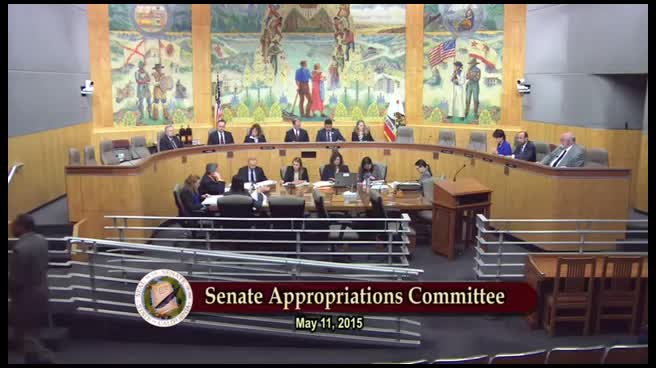 9MIN
Senate Standing Committee on Appropriations
Bill Author

Bill Co-Author(s):