SB 737: Vehicles: electronic wireless communication devices: penalties.
- Session Year: 2015-2016
- House: Senate
- Latest Version Date: 2015-04-30
Under existing law, it is an infraction for any person to drive a motor vehicle while using an electronic wireless communications device to write, send, or read a text-based communication, unless the device is configured to allow hands-free operation. A person under 18 years of age is prohibited from driving a motor vehicle while using an electronic wireless communications device, even if equipped with a hands-free device. Under existing law, a violation of these provisions is an infraction punishable by a fine of $20 for a first offense and $50 for each subsequent offense, but does not result in the assessment of a violation point against the drivers record for purposes of suspension or revocation of the privilege to drive.
This bill would require that one point be assessed for a violation of the prohibitions on driving a motor vehicle while using an electronic wireless communications device to write, send, or read a text-based communication. This bill would also increase the base fine to $40 for a first offense and to $100 for each subsequent offense.
Notwithstanding subdivision (f) of Section 12810, a violation point shall not be given for a conviction of a violation of subdivision (a) of Section 23123 or paragraph (1) or (3) of subdivision (b) of Section 23124.
SEC. 2.Section 23123.5 of the Vehicle Code is amended to read:23123.5.(a)A person shall not drive a motor vehicle while using an electronic wireless communications device to write, send, or read a text-based communication, unless the electronic wireless communications device is specifically designed and configured to allow voice-operated and hands-free operation to dictate, send, or listen to a text-based communication, and it is used in that manner while driving.
(b)As used in this section section, write, send, or read a text-based communication means using an electronic wireless communications device to manually communicate with any person using a text-based communication, including, but not limited to, communications referred to as a text message, instant message, or electronic mail.
(c)For purposes of this section, a person shall not be deemed to be writing, reading, or sending a text-based communication if the person reads, selects, or enters a telephone number or name in an electronic wireless communications device for the purpose of making or receiving a telephone call or if a person otherwise activates or deactivates a feature or function on an electronic wireless communications device.
(d)A violation of this section is an infraction punishable by a base fine of forty dollars ($40) for a first offense and one hundred dollars ($100) for each subsequent offense.
(e)This section does not apply to an emergency services professional using an electronic wireless communications device while operating an authorized emergency vehicle, as defined in Section 165, in the course and scope of his or her duties.
SEC. 3.Section 23124 of the Vehicle Code is amended to read:23124.(a)This section applies to a person under 18 years of age.
(b)Notwithstanding Sections 23123 and 23123.5, a person described in subdivision (a) shall not drive a motor vehicle while using either of the following, a wireless telephone or an electronic wireless communications device for any of the following, even if equipped with a hands-free device:
(1)A wireless telephone.
(2)An electronic wireless communications device.
(1)Verbal communication.
(2)Writing, sending, or reading a text-based communication.
(3)Any use other than those described in paragraphs (1) and (2).
(c)(1)A violation of paragraph (1) or (3) of subdivision (b) is an infraction punishable by a base fine of twenty dollars ($20) for a first offense and fifty dollars ($50) for each subsequent offense.
(2)A violation of paragraph (2) of subdivision (b) is an infraction punishable by a base fine of forty dollars ($40) for a first offense and one hundred dollars ($100) for each subsequent offense.
(d)A law enforcement officer shall not stop a vehicle for the sole purpose of determining whether the driver is violating subdivision (b).
(e)Subdivision (d) does not prohibit a law enforcement officer from stopping a vehicle for a violation of Section 23123 or 23123.5.
(f)This section does not apply to a person using a wireless telephone or a mobile service device for emergency purposes, including, but not limited to, an emergency call to a law enforcement agency, health care provider, fire department, or other emergency services agency or entity.
(g)For the purposes of this section, electronic wireless communications device includes, but is not limited to, a broadband personal communication device, specialized mobile radio device, handheld device or laptop computer with mobile data access, pager, and two-way messaging device.
Notwithstanding subdivision (f) of Section 12810, a violation point shall not be given for a conviction of a violation of subdivision (a) of Section 23123, subdivision (a) of Section 23123.5, or paragraph (1) of subdivision (b) of Section 23124.
SEC. 2.Section 23123.5 of the Vehicle Code is amended to read:23123.5.(a)A person shall not drive a motor vehicle while using an electronic wireless communications device to write, send, or read a text-based communication, unless the electronic wireless communications device is specifically designed and configured to allow voice-operated and hands-free operation to dictate, send, or listen to a text-based communication, and it is used in that manner while driving.
(b)As used in this section write, send, or read a text-based communication means using an electronic wireless communications device to manually communicate with any person using a text-based communication, including, but not limited to, communications referred to as a text message, instant message, or electronic mail.
(c)For purposes of this section, a person shall not be deemed to be writing, reading, or sending a text-based communication if the person reads, selects, or enters a telephone number or name in an electronic wireless communications device for the purpose of making or receiving a telephone call or if a person otherwise activates or deactivates a feature or function on an electronic wireless communications device.
(d)A violation of this section is an infraction punishable by a base fine of twenty dollars ($20) forty dollars ($40) for a first offense and fifty dollars ($50) one hundred dollars ($100) for each subsequent offense.
(e)This section does not apply to an emergency services professional using an electronic wireless communications device while operating an authorized emergency vehicle, as defined in Section 165, in the course and scope of his or her duties.
SEC. 3.Section 23124 of the Vehicle Code is amended to read:23124.(a)This section applies to a person under the age of 18 years of age.
(b)Notwithstanding Sections 23123 and 23123.5, a person described in subdivision (a) shall not drive a motor vehicle while using a wireless telephone or an electronic wireless communications device, either of the following, even if equipped with a hands-free device. device:
(1)A wireless telephone.
(2)An electronic wireless communications device.
(c)(1)A violation of this section paragraph (1) of subdivision (b) is an infraction punishable by a base fine of twenty dollars ($20) for a first offense and fifty dollars ($50) for each subsequent offense.
(2)A violation of paragraph (2) of subdivision (b) is an infraction punishable by a base fine of forty dollars ($40) for a first offense and one hundred dollars ($100) for each subsequent offense.
(d)A law enforcement officer shall not stop a vehicle for the sole purpose of determining whether the driver is violating subdivision (b).
(e)Subdivision (d) does not prohibit a law enforcement officer from stopping a vehicle for a violation of Section 23123 or 23123.5.
(f)This section does not apply to a person using a wireless telephone or a mobile service device for emergency purposes, including, but not limited to, an emergency call to a law enforcement agency, health care provider, fire department, or other emergency services agency or entity.
(g)For the purposes of this section, electronic wireless communications device includes, but is not limited to, a broadband personal communication device, specialized mobile radio device, handheld device or laptop computer with mobile data access, pager, and two-way messaging device.
|
Date
|
Status
|
|---|---|
| Feb 27, 2015 | Introduced. To Com. on RLS. for assignment. To print. |
| Mar 2, 2015 | From printer. May be acted upon on or after April 1. |
| Mar 2, 2015 | Read first time. |
| Mar 19, 2015 | Referred to Com. on T. & H. |
| Apr 14, 2015 | Set for hearing April 28. |
| Apr 29, 2015 | From committee: Do pass as amended and re-refer to Com. on APPR. (Ayes 8. Noes 1. Page 826.) (April 28). |
| Apr 29, 2015 | From committee: Do pass as amended and re-refer to Com. on APPR. (Ayes 8. Noes 1.) (April 28). |
| Apr 30, 2015 | Read second time and amended. Re-referred to Com. on APPR. |
| May 8, 2015 | Set for hearing May 18. |
| May 18, 2015 | May 18 hearing: Placed on APPR. suspense file. |
| May 23, 2015 | Set for hearing May 28. |
| May 28, 2015 | May 28 hearing: Held in committee and under submission. |
| Feb 1, 2016 | Returned to Secretary of Senate pursuant to Joint Rule 56. |
|
Date
|
Description
|
Location
|
Votes
|
|
|---|---|---|---|---|
| May 18, 2015 | Placed on suspense file | Senate Standing Committee on Appropriations |
Passed |
|
| Apr 28, 2015 | Do pass as amended, but first amend, and re-refer to the Committee on [Appropriations] | Senate Standing Committee on Transportation and Housing |
Passed |
This list shows positions taken on this bill by organizations on the date displayed, which is linked to the original source.
Positions by individuals are not included.
|
Organization
|
Position
|
Date
|
|---|---|---|
| California Teamsters Public Affairs Council | ** Against | Apr 28, 2015 |
| Impact Teen Drivers | ** Support | Apr 28, 2015 |
SB 737 (Stone) Page 3 of 3
SENATE COMMITTEE ON APPROPRIATIONS
Senator Ricardo Lara, Chair
2015 - 2016 Regular Session
SB 737 (Stone) - Vehicles: electronic wireless communication devices: penalties
|
|
Version: April 30, 2015 |
Policy Vote: T. & H. 8 - 1 |
Urgency: No |
Mandate: No |
Hearing Date: May 18, 2015 |
Consultant: Mark McKenzie |
This bill meets the criteria for referral to the Suspense File.
Bill Summary:
SB 737 would double the base fines for texting while driving (from $20 to $40 for a first offense, and from $50 to $100 for a subsequent offense), and impose a violation point for those violations.
Fiscal Impact:
DMV programming costs of several million dollars in 2015-16 to assign a violation point for a violation with an eight byte reportable code section. (Motor Vehicle Account) See staff comments.
Unknown penalty revenues gains, likely in the low millions annually. (General Fund, special funds, local funds)
Background:
Existing law generally prohibits a person from using a handheld wireless phone, unless equipped with hands-free technology, or engaging in text-based communication while operating a motor vehicle. A driver who is under the age of 18 is prohibited from using a cell phone to talk or text, even if the device is hands-free. The base fine for a violation of these prohibitions is $20 for an initial offense and $50 for each subsequent offense. Current law prohibits the imposition of a violation point for a conviction of these offenses. After all penalty assessments, fees, and surcharges are added to the base fine, the total bail for a base fine of $20 is $162 and the total bail for a base fine of $50 is $285, not including fees for traffic violator school (According to the Administrative Office of the Courts 2015 Final Bail Schedule).
DMV assigns violation points against a driver’s license for certain traffic offenses to identify an individual as a negligent operator. Violation points vary with the gravity of the offense; for example, a “fix-it” ticket does not count for any violation points, a speeding ticket counts for one violation point, and driving while under the influence of alcohol or drugs counts for two violation points. DMV may suspend a driver’s license for six months if a person receives four points in one year, six points in two years, or eight points in three years.
Proposed Law:
SB 737 would increase the base fines for using an electronic communication device to write, send, or read a text-based communication while driving from $20 to $40 for a first offense, and from $50 to $100 for a subsequent offense, and impose a violation point for convictions related to texting while driving. These increased penalties and fines would apply to both adults and minors.
Related Legislation:
AB 1646 (Frazier, 2014) would have assessed a violation point on convictions for using a wireless communication device while driving. Governor Brown vetoed the bill last year, stating the following:
I certainly support taking
reasonable steps to curb cell phone use and texting while driving,
but I don't believe this bill is necessary at this time to achieve
that goal.
I'm instructing the Department of Motor
Vehicles to add a question about the dangers of using a communication
device on the driver license exam. Additionally, the department is
beginning a review and analysis of data on distracted driving in
California. Let's wait to see the results before enacting a law
requiring a violation point.
The Governor has also vetoed other bills that sought to increase the base fines for distracted driving and other vehicle code violations. Both SB 1310 (Simitian) and SB 28 (Simitian) from the 2011-12 Session would have increased the base fines for using a wireless communication device while driving. The Governor vetoed both bills, stating objections to the increases in base fines. For example, his veto message on SB 1310 stated the following:
I believe the current fines and penalties of $213 and $336 for cell phone use and texting while driving are a powerful deterrent. I have found even a $50 ticket unpleasant enough. My point here is that the current fines are not trivial but do in fact get drivers' attention. Upping the fines may satisfy the punitive instincts of some, but I severely doubt that it will further reduce violations.
Staff Comments:
According to DMV statistics, there were 399,153 handheld cellphone convictions, and 27,207 texting convictions in 2013. While the number of handheld cellphone convictions has decreased in each of the last few years, the number of texting convictions has increased every year since 2009. The increase in base fines for convicted drivers would result in significant increases in penalty revenues that would benefit the General Fund, certain special funds, and local funds pursuant to statutory formulas.
DMV indicates that the costs to make programming changes related to the imposition of a violation point for convictions of texting while driving would be substantial because its antiquated IT infrastructure can only support violation code sections of less than eight characters. Programming to accept eight bytes (such as a code citation of A23124b2 for minors convicted of a violation) would be several million dollars.
Staff notes that DMV has a significant programming backlog of federal and state mandates. These include federally-mandated changes to the Commercial Driver License System, compliance with which is tied to federal transportation funding, and state mandates such as programming for the veteran designation on driver’s licenses and IDs (AB 935, Chap 644/2014) and the issuance of free ID cards for homeless applicants (AB 1733, Chap 764/2014). Given the backlog, it would be difficult for DMV to complete the programming necessary to implement this bill by the January 1, 2016 operative date without impacting currently scheduled programming priorities.
Recommended Amendments:
Staff recommends an amendment to make technical drafting corrections to ensure that provisions of the bill that are subject to a violation point are in a reportable code section with fewer than eight bytes.
-- END --
SB 737 (Stone) Page 5 of 5
SENATE COMMITTEE ON TRANSPORTATION AND HOUSING
Senator Jim Beall, Chair
2015 - 2016 Regular
Bill No: SB 737 Hearing Date: 4/28/2015
Author: |
Stone |
||
Version: |
2/27/2015 |
||
Urgency: |
No |
Fiscal: |
Yes |
Consultant: |
Christine Hochmuth |
||
SUBJECT: Penalties for texting while driving
DIGEST: This bill increases penalties (fine and violation points) for texting while driving for both adults and minors.
ANALYSIS:
Existing law:
Prohibits a person from driving a motor vehicle while writing, sending, or reading text-based communication (texts), unless they are doing so on a device that allows voice-operated and hands-free operation to dictate, send, or listen to the text-based communication.
Prohibits a person below the age of 18 (minor) from driving a motor vehicle while using a wireless telephone or other electronic wireless communications device even if the device is equipped with a hands-free option.
Sets the penalty for violating the above provisions as an adult or as a minor at $20 for the first offense and $50 for subsequent offenses.
Assigns violation point counts to convictions of specified violations of the Vehicle Code. Most moving violations, such as speeding, causing a traffic accident, or failing to restrain a child properly, are considered an infraction and subject to one violation point. More serious offenses are given a value of two violation points. A person whose driving record shows a violation point count of four or more points in 12 months, six or more points in 24 months, or eight or more points in 36 months is presumed to be a negligent operator and the Department of Motor Vehicles (DMV) may either suspend or revoke his or her driver’s license. A conviction of talking or texting while driving does not currently result in a point.
This bill:
Increases the penalty for adults and minors who use an electronic wireless communications device to write, send, or read texts while driving to a base fine of $40 for a first offense and $100 for subsequent offenses.
Allows the assignment of violation points to adults and minors upon a conviction of driving a motor vehicle while texting.
Does not increase the penalty for minors in the case of violation of the use of a wireless telephone while driving. This fine would remain at $20/$50.
Prohibits the assignment of a violation point to minors upon conviction of driving a motor vehicle while using a wireless telephone.
COMMENTS:
Purpose. The author contends that distracted driving is the cause of numerous accidents in California and has serious, if not fatal, consequences. The author states that the current fines for texting while driving have led to a decrease in distracted driving, but more must be done as the problem still persists in California.
Distracted driving. According to the Office of Traffic Safety, 80% of vehicle crashes involve some sort of driver inattention. Up to 3,000 people yearly are killed nationwide in crashes where driver distractions are involved.
In 2014, more than 50% of Californians surveyed said that texting while driving is the most serious distraction for drivers and that it posed the biggest safety problem on California roadways. Despite the recognition of the seriousness of the problem, many California drivers participate in this activity. In 2014, nearly 53% of California drivers admitted to making a driving mistake while talking on a cell phone. A nationwide Harris poll last year found that 59% of adult drivers admitted to talking on a handheld cellphone while behind the wheel, and 37% said they engaged in texting.
In 2013, the DMV reported more than 426,000 handheld cell phone and texting convictions, with more than 57,000 tickets issued in April alone. However, these incidents are decreasing. The total percentage of distracted driving due to electronic devices observed decreased from 7.4% in 2013 to 6.4% in 2014, a 13.5% reduction and the lowest since surveys began in 2011.
Small fines can lead to big problems for some Californians. The base fines for a conviction of texting while driving have remained constant since they were instituted in 2008. However, penalty assessments, fees, and surcharges do not remain the same, so the out-of-pocket costs for violations have been steadily increasing each year. Since 2008, the overall payment for a base fine of $50 has gone up almost 200%, while the payment for a base fine of $20 has increased almost 300%. Even without considering the additional burden of increased fines, the hardship that many people face in paying off fines and late fees for traffic violations has driven legislators to propose legislation for amnesty (SB 405, Hertzberg, 2015).
-
-
YEAR
Cost of $20 base fine
Cost of $50 base fine
2008
$ 76
$ 190
2011
$ 208
$ 328
2012
$ 211
$ 331
2015
$ 213
$ 336
-
Wireless telephones versus electronic wireless communications device. The author states that the intent of this bill is to increase the penalty for all persons who text while driving, but not to increase the penalty for minors that talk on a cell phone while driving, which the author purports is a less dangerous activity. To this end the author establishes a distinction in statute between using a wireless telephone and an electronic wireless communications device and imposes increased penalties for operating the latter. Electronic wireless communications devices are defined in statute to include: a broadband personal communication device, specialized mobile radio device, handheld device or laptop computer with mobile data access, pager, and two-way messaging device. The language of the current bill may lead to some confusion as most texting occurs on smartphones or other mobile phones, which should be categorized as wireless telephones, not separate devices solely intended for texting. In other words, the use of a wireless telephone is not limited to talking, but this language does not distinguish this fact.
The committee may wish to amend this bill to clarify the intent.
Fourth time’s the charm? The legislature has passed similar bills but all were vetoed by the Governor. A proposal to increase fines from $20 to $50 and $50 to $100 (SB 28, Simitian, 2011) and a similar proposal of smaller increases of $20 to $30 and $50 to $60 (SB 1310, Simitian, 2012) were both vetoed by Governor Brown. In his veto messages, the Governor stated his support of discouraging cell phone use while driving, but did not agree with the increase of penalties that the legislation mandated. Governor Brown also vetoed a bill that would have assessed a violation point for texting while driving (SB 1646, Frazier, 2014), stating that it would adversely affect a driver’s ability to obtain affordable insurance.
Arguments in support. Impact Teen Drivers emphasizes the danger of texting, stating that the activity takes a driver’s eyes off the road for an average of five seconds, long enough to travel the length of a football field at 55 miles per hour. They assert that this bill will hold the offender accountable and serve as a deterrent, which will reduce the number of offenders over time and hopefully save lives.
Arguments in opposition. The California Teamsters Public Affairs Council agrees with Governor Brown that the fines are already too high at the present level when the penalty assessments are included. Also, they contend that adding points to a license puts more drivers at risk of losing their licenses, which they believe to be an excessive punishment.
RELATED LEGISLATION:
AB 1646 (Frazier, 2014) — would have assessed a violation point for conviction of using a wireless communication device while operating a vehicle. AB 1646 was vetoed by Governor Brown.
SB 194 (Galgiani, Chapter 754, Statutes of 2013) — prohibits a person who is under 18 years of age from using an electronic wireless communications device, as defined, even if it is equipped with a hands-free device. This statute also imposes a base fine of $20 for a first offense and $50 for subsequent offenses.
AB 313 (Frazier, 2013) — would have prohibited the use of voice-operated, hands-free texting devices while driving. AB 313 failed in Assembly Appropriations.
SB 1310 (Simitian, 2012) — would have increased the penalties related to using a wireless communications device while operating a vehicle from $20 to $30 for a first offense and from $50 to $60 for subsequent offenses. SB 1310 was vetoed by Governor Brown.
SB 28 (Simitian, 2011) — would have increased the penalties related to using a wireless communications device while operating a vehicle from $20 to $50 for a first offense and from $50 to $100 for subsequent offenses. SB 28 was vetoed by Governor Brown.
SB 28 (Simitian, Chapter 270, Statutes of 2008) — prohibits a person from writing, sending, or reading text-based communications while operating a motor vehicle. This statute makes a violation an infraction subject to a base fine of $20 for a first offense and $50 for each subsequent offense, but specifies these offenses do not result in a violation point being added to the person's driving record.
SB 33 (Simitian, Chapter 214, Statutes of 2007) — prohibits a driver under the age of 18 from using a wireless telephone or any other mobile service device while operating a motor vehicle. This statute also imposes a base fine of $20 for a first offense and $50 for subsequent offenses.
SB 1613 (Simitian, Chapter 290, Statutes of 2006) — prohibits a person from using a cell phone while operating a motor vehicle, and subjects violators to base fines of $20 and $50 for first and subsequent violations, respectively.
FISCAL EFFECT: Appropriation: No Fiscal Com.: Yes Local: No
POSITIONS: (Communicated to the committee before noon on Wednesday,
April 22, 2015.)
SUPPORT:
Impact Teen Drivers
OPPOSITION:
California Teamsters Public Affairs Council
-- END --
Discussed in Hearing
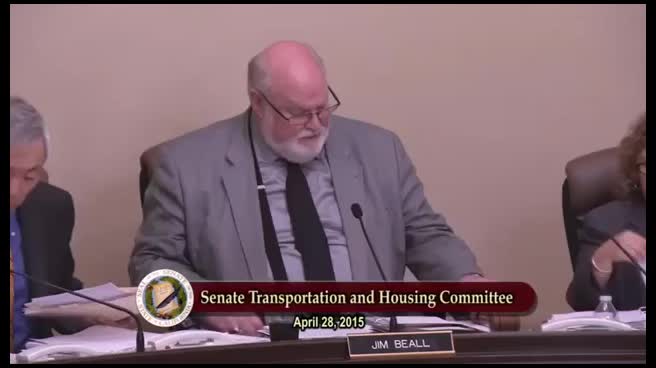 2MIN
Senate Standing Committee on Transportation and Housing
Bill Author

Bill Co-Author(s):