AB 1585: Planning and zoning: affordable housing: single application.
- Session Year: 2017-2018
- House: Assembly
- Latest Version Date: 2017-04-20
The Planning and Zoning Law requires a city or county to adopt a general plan for land use development within its boundaries that includes, among other things, a housing element. Existing law provides for various reforms and incentives intended to facilitate and expedite the construction of affordable housing. Existing law requires the Department of Housing and Community Development, in consultation with each council of governments, to determine existing and projected needs for housing for each region and requires each council of governments or, for cities and counties without a council of governments, the department to adopt a final regional housing need plan that allocates a share of the regional housing need to each city, county, or city and county and is consistent with specified objectives.
This bill would establish in each city, county, and city and county in the state an affordable housing zoning board and procedures by which a public agency or nonprofit organization proposing to build affordable housing units, as defined, or a developer proposing to build a housing project that meets specified affordability criteria, could submit to that board a single application for a comprehensive conditional use or other discretionary permit. The bill would require the board to conduct a public hearing, as provided, and issue a decision approving, approving with conditions, or denying the application and to issue a comprehensive permit if the application is approved or approved with conditions. The bill would require the board to consider the general plan and zoning ordinances of the affected local agency, the share of the regional housing needs of the affected local agency, whether the applicant has made specified certifications relating to the payment of prevailing wages and employment of a skilled and trained workforce, as provided, on the affordable housing units or housing project development, documents or other evidence presented at the hearing, and the recommendations of experts or consultants, if any, retained by the board. The bill would provide that the comprehensive permit would have the same force and effect as a conditional use or other discretionary permit issued by an affected local agency, but would prohibit the board from abrogating a provision of the general plan or zoning ordinances of the affected local agency except to grant a density bonus, as provided.
The bill would require the Department of Housing and Community Development to establish a housing appeals committee. The bill would establish procedures by which an applicant for a comprehensive permit could appeal the decision of an affordable housing zoning board to either deny the application or approve the application with conditions in a manner rendering it infeasible for the development of the affordable housing units or housing project. The bill would provide that the committee would not have jurisdiction if the affected local agency has permitted construction of unspecified percentages of its allocation of units for very low, low-, and moderate-income households in the previous regional housing needs allocation plan cycle. The bill would authorize the committee, following a public hearing conducted according to specified procedures, to affirm, modify, or reverse the decision of the board. The bill would limit the review of the committee to whether, in the case of a denial, the decision was unreasonable and not consistent with local needs or, in the case of approval with conditions, whether the conditions imposed render it infeasible for the development of the affordable housing units or housing project and are not consistent with local needs. The bill would require the committee to affirm the decision of the board if it finds that the denial or conditions are consistent with local needs. The bill would provide that a decision of the committee to modify or reverse a decision of the board may be reviewed in the superior court for the county in which the affordable housing units or housing project are proposed to be built.The bill would make findings that encouraging and streamlining the development of affordable housing throughout the state is a matter of vital statewide concern and declare that its provisions would apply to all cities and counties, including charter cities.
By imposing new duties on local agencies with respect to the issuance of comprehensive permits for affordable housing developments, this bill would impose a state-mandated local program.
The California Constitution requires the state to reimburse local agencies and school districts for certain costs mandated by the state. Statutory provisions establish procedures for making that reimbursement.
This bill would provide that, if the Commission on State Mandates determines that the bill contains costs mandated by the state, reimbursement for those costs shall be made pursuant to the statutory provisions noted above.
The Planning and Zoning Law requires a city or county to adopt a general plan for land use development within its boundaries that includes, among other things, a housing element. Existing law provides for various reforms and incentives intended to facilitate and expedite the construction of affordable housing. Existing law requires the Department of Housing and Community Development, in consultation with each council of governments, to determine existing and projected needs for housing for each region and requires each council of governments or, for cities and counties without a council of governments, the department to adopt a final regional housing need plan that allocates a share of the regional housing need to each city, county, or city and county and is consistent with specified objectives.
This bill would establish in each city, county, and city and county in the state an affordable housing zoning board and procedures by which a public agency or nonprofit organization proposing to build affordable housing units, as defined, or a developer proposing to build a housing project that meets specified affordability criteria, could submit to that board a single application for a comprehensive conditional use or other discretionary permit. The bill would require the board to conduct a public hearing, as provided, and issue a decision approving, approving with conditions, or denying the application and to issue a comprehensive permit if the application is approved or approved with conditions. The bill would require the board to consider the general plan and zoning ordinances of the affected local agency, the share of the regional housing needs of the affected local agency, whether the applicant has made specified certifications relating to the payment of prevailing wages and employment of a skilled and trained workforce, as provided, on the affordable housing units or housing project development, documents or other evidence presented at the hearing, and the recommendations of experts or consultants, if any, retained by the board. The bill would provide that the comprehensive permit would have the same force and effect as a conditional use or other discretionary permit issued by an affected local agency, but would prohibit the board from abrogating a provision of the general plan or zoning ordinances of the affected local agency except to grant a density bonus, as provided.
The bill would require the Department of Housing and Community Development to establish a housing appeals committee. The bill would establish procedures by which an applicant for a comprehensive permit could appeal the decision of an affordable housing zoning board to either deny the application or approve the application with conditions in a manner rendering it infeasible for the development of the affordable housing units or housing project. The bill would provide that the committee would not have jurisdiction if the affected local agency has permitted construction of unspecified percentages of its allocation of units for very low, low-, and moderate-income households in the previous regional housing needs allocation plan cycle. The bill would authorize the committee, following a public hearing conducted according to specified procedures, to affirm, modify, or reverse the decision of the board. The bill would limit the review of the committee to whether, in the case of a denial, the decision was unreasonable and not consistent with local needs or, in the case of approval with conditions, whether the conditions imposed render it infeasible for the development of the affordable housing units or housing project and are not consistent with local needs. The bill would require the committee to affirm the decision of the board if it finds that the denial or conditions are consistent with local needs. The bill would provide that a decision of the committee to modify or reverse a decision of the board may be reviewed in the superior court for the county in which the affordable housing units or housing project are proposed to be built.
The bill would make findings that encouraging and streamlining the development of affordable housing throughout the state is a matter of vital statewide concern and declare that its provisions would apply to all cities and counties, including charter cities.
By imposing new duties on local agencies with respect to the issuance of comprehensive permits for affordable housing developments, this bill would impose a state-mandated local program.
The California Constitution requires the state to reimburse local agencies and school districts for certain costs mandated by the state. Statutory provisions establish procedures for making that reimbursement.
This bill would provide that, if the Commission on State Mandates determines that the bill contains costs mandated by the state, reimbursement for those costs shall be made pursuant to the statutory provisions noted above.
The Legislature finds and declares that it has provided reforms and incentives to facilitate and expedite the construction of affordable housing. Those reforms and incentives can be found in the following provisions:
(a)Housing element law (Article 10.6 (commencing with Section 65580) of Chapter 3).
(b)Extension of statute of limitations in actions challenging the housing element and brought in support of affordable housing (subdivision (d) of Section 65009).
(c)Restrictions on disapproval of housing developments (Section 65589.5).
(d)Priority for affordable housing in the allocation of water and sewer hookups (Section 65589.7).
(e)Least cost zoning law (Section 65913.1).
(f)Density bonus law (Section 65915).
(g)Accessory dwelling units (Sections 65852.150 and 65852.2).
(h)By-right housing, in which certain multifamily housing are designated a permitted use (Section 65589.4).
(i)No-net-loss-in zoning density law limiting downzonings and density reductions (Section 65863).
(j)Requiring persons who sue to halt affordable housing to pay attorney fees (Section 65914) or post a bond (Section 529.2 of the Code of Civil Procedure).
(k)Reduced time for action on affordable housing applications under the approval of development permits process (Article 5 (commencing with Section 65950) of Chapter 4.5).
(l)Limiting moratoriums on multifamily housing (Section 65858).
(m)Prohibiting discrimination against affordable housing (Section 65008).
(n)California Fair Employment and Housing Act (Part 2.8 (commencing with Section 12900) of Division 3).
(o)Community redevelopment law (Part 1 (commencing with Section 33000) of Division 24 of the Health and Safety Code, and in particular Sections 33334.2 and 33413).
(p)Establishing a streamlined process for the approval of affordable housing units, including the opportunity to appeal a denial of a permit to the department units (Section 65584.7).
SEC. 2.Section 65584.7 is added to the Government Code, to read:65584.7.(a)For purposes of this section, the following definitions shall apply:
(1)Affected local agency means a city, county, or city and county, including a charter city, charter county, or charter city and county, with jurisdiction over the proposed affordable housing units or housing project that would be subject to a comprehensive permit issued by an affordable housing zoning board.
(2)Affordable housing unit means a single-family or multifamily residential development with an affordable housing cost, as defined in Section 50052.5 of the Health and Safety Code, or an affordable rent, as defined in Section 50053 of the Health and Safety Code, for very low, low-, and moderate-income households.
(3)Affordable housing zoning board or board means the entity established within a city, county, or city and county authorized to issue a comprehensive permit in accordance with this section.
(4)Applicant means either of the following:
(A)A public agency or nonprofit organization proposing to build affordable housing units that will receive full or partial funding through a state or federal program, including, but not limited to, the following:
(i)The United States Housing Act of 1937 (42 U.S.C. Section 1437 et seq.).
(ii)The Housing Authorities Law (Part 2 (commencing with Section 34200) of Division 24 of the Health and Safety Code).
(iii)Programs administered by the Department of Housing and Community Development pursuant to Part 2 (commencing with Section 50400) of Division 31 of the Health and Safety Code for the purpose of providing grants and other financing for housing.
(iv)Financial assistance received from the California Housing Finance Agency pursuant to Part 3 (commencing with Section 50900) of Division 31 of the Health and Safety Code.
(B)A developer proposing to build a housing project.
(5)Comprehensive permit means a conditional use or other discretionary permit issued by an affordable housing zoning board in accordance with subdivision (b) that allows for the development of affordable housing units by a public agency or nonprofit organization or a housing project by a developer.
(6)Consistent with local needs means reasonable with respect to the determination of regional housing needs as determined pursuant to Section 65584, the number of very low, low-, and moderate-income households within a city, county, or city and county, and the health and safety of the residents of the city, county, or city and county.(7)Housing appeals committee or committee means the committee established within the department for the purpose of hearing appeals from a decision of the affordable housing zoning board with respect to an application for a comprehensive permit.(8)(6)Housing project means a residential development of which 5 percent of the units are affordable to persons making 60 percent or less of the area median income and 10 percent of the units are affordable to persons making 80 percent or less of the area median income. These units shall be subject to a recorded affordability restriction for at least 55 years. This paragraph shall not be construed to nullify an inclusionary zoning ordinance requiring a greater percentage of the residential units within a project to be affordable to low and very low income households.
(9)Infeasible for the development of the affordable housing units or housing project means that it is impossible for a public agency or nonprofit organization to build or operate the affordable housing units, or for a developer to build or operate the housing project, as applicable, without financial loss without substantially changing the cost of the housing or unit sizes.(b)(1)(A)There is hereby established within each city, county, and city and county in this state an affordable housing zoning board. Members of the planning commission of the city, county, or city and county shall serve ex officio as members of the affordable housing zoning board.
(B)Proceedings of the board shall be subject to the Ralph M. Brown Act (Chapter 9 (commencing with Section 54950) of Part 1 of Division 2 of Title 5) and the board shall comply with the California Public Records Act (Chapter 3.5 (commencing with Section 6250) of Division 7 of Title 1).
(C)The board shall be deemed the lead agency for purposes of the California Environmental Quality Act (Division 13 (commencing with Section 21000) of the Public Resources Code) with respect to the issuance of a comprehensive permit pursuant to this section.
(2)Notwithstanding any other law, an applicant may submit to the affordable housing zoning board a single application for a comprehensive permit. The board shall transmit a copy of the application to each affected local agency.
(3)The board shall conduct a public hearing on the application for a comprehensive permit within 30 days of receipt of the application. The applicant, representatives of any affected local agencies, and any persons who would be substantially affected by the issuance of the comprehensive permit shall have the right to appear at the hearing. The public hearing shall be completed in no more than 180 days. The board shall, by majority vote, approve, approve with conditions, or deny an application for a comprehensive permit within 40 days after the conclusion of the public hearing.
(4)(A)In making its decision, the board shall consider all of the following:
(i)The general plan and zoning ordinances of the affected local agency that apply to the proposed affordable housing units or housing project. The board shall not abrogate a provision of the general plan or zoning ordinances of an affected local agency as they apply to the proposed affordable housing units or housing project, except that the board may grant the applicant a density bonus in accordance with Section 65915.
(ii)The share of the regional housing needs as determined pursuant to Section 65584 for the jurisdiction in which the applicant proposes to build affordable housing units or housing project.
(iii)Whether the applicant has made the certifications required by subdivision (e). (c).
(iv)Any documents or other evidence presented at the public hearing by the applicant, the representatives of the affected local agencies, or other persons who would be substantially affected by the issuance of the comprehensive permit.
(v)The recommendations of experts or consultants retained by the board, if any, pertaining to the proposed affordable housing units or housing project.
(B)If the board approves or approves with conditions an application for a comprehensive permit, the board shall issue the permit to the applicant. A comprehensive permit issued pursuant to this subdivision shall have the same force and effect as a conditional use or other discretionary permit issued by the affected local agency.
(C)If the board does not approve, approve with conditions, or deny an application for a comprehensive permit within 40 days after the conclusion of the public hearing, as required by paragraph (3), the application shall be deemed approved and the board shall issue the comprehensive permit.
(c)(1)(A)The department shall establish a housing appeals committee. The Director of Housing and Community Development shall annually appoint the members of the committee and designate a chair.(B)Membership on the committee shall be as follows:(i)Three representatives of the department.(ii)Four public members who shall be appointed so as to promote geographic diversity and balance urban and rural interests and who shall each be representative of, or have experience in, one or more of the following areas:(I)Private sector lending institutions.(II)For-profit housing development.(III)Nonprofit housing development.(IV)Public sector housing development.(V)Local or regional planning.(VI)Architecture.(VII)Local community development.(VIII)Local government.(IX)Housing consultation.(X)Academia as related to housing issues.(C)Members of the committee shall serve without compensation, but shall be reimbursed for all actual and necessary expenses incurred in the performance of their duties.(D)The committee shall hear appeals pursuant to this subdivision at a public hearing held at least quarterly. The committee shall conduct the public hearing in accordance with any applicable rules and regulations adopted by the department.(E)The department shall provide space and clerical or other assistance that the committee may require.(2)(A)If the board denies an application for a comprehensive permit submitted pursuant to subdivision (b) or grants it with conditions in a manner rendering it infeasible for the development of the affordable housing units or housing project, the applicant may, within 20 days of the final decision of the board, appeal the decision to the committee by submitting a statement of appeal, which shall state the grounds for the appeal and the relief sought, to the committee.(B)The committee shall transmit a notice of the appeal to the board and any affected local agency. No later than 10 days following receipt of the notice of appeal, the board shall transmit a copy of its final decision to the committee for review.(C)The committee shall not have jurisdiction over the appeal if the affected local agency has permitted construction of at least ____ percent of its allocation of units for very low-income households, ____ percent of its allocation of units for low-income households, and ____ percent of its allocation of units for moderate-income households in the previous regional housing needs allocation plan cycle developed pursuant to Section 65584.(3)The committee shall conduct a hearing on the appeal within 30 days of receipt of the statement of appeal. The committee shall, by majority vote and consistent with paragraph (4), affirm, modify, or reverse the decision of the board within 30 days after the conclusion of the hearing.(4)The review of the committee shall be limited as follows:(A)(i)If the board denied the application for a comprehensive permit, whether that denial was reasonable and consistent with local needs.(ii)If the committee determines that a denial of the application for a comprehensive permit is both unreasonable and not consistent with local needs, the committee shall reverse the decision of the board and remand the matter with instructions that the application be approved consistent with the decision of the committee.(B)(i)If the board approved the application with conditions, whether the conditions imposed render it infeasible for the development of the affordable housing units or housing project and are consistent with local needs.(ii)If the committee determines that one or more of the conditions imposed on the proposed affordable housing units or housing project render it infeasible for the development of the affordable housing units or housing project and that those conditions are not consistent with local needs, the committee shall modify the permit so that it no longer renders infeasible the development of the affordable housing units or housing project and the conditions are consistent with local needs. The committee shall remand the matter to the board with instructions to issue the permit as modified by the committee.(C)The committee shall affirm the decision of the affordable housing zoning board if it finds that the decision is consistent with local needs.(5)Once the committee has issued its final decision, the board shall not have any discretion to modify the permit other than as directed in the decision of the committee. Implementation of the final decision of the committee shall be deemed a ministerial duty of the board.(d)A decision of the committee modifying or reversing a decision of the board may be reviewed in the superior court for the county in which the affordable housing units or housing project are proposed to be built.(e)(c)An applicant for a comprehensive permit shall do the following, as applicable:
(1)Certify to the affordable housing zoning board that either of the following is true, as applicable:
(A)That the entirety of the proposed affordable housing units or housing project development is a public work for purposes of Chapter 1 (commencing with Section 1720) of Part 7 of Division 2 of the Labor Code.
(B)If the proposed affordable housing units or housing project development is not in its entirety a public work, that all construction workers employed in the execution of the project will be paid at least the general prevailing rate of per diem wages for the type of work and geographic area, as determined by the Director of Industrial Relations pursuant to Sections 1773 and 1773.9 of the Labor Code. If the board approves the application, then for those portions of the proposed affordable housing units or housing project development that are not a public work all of the following shall apply:
(i)The applicant shall include the prevailing wage requirement in all contracts for the performance of the work.
(ii)Contractors and subcontractors shall pay to all construction workers employed in the execution of the work at least the general prevailing rate of per diem wages.
(iii)Except as provided in clause (iv), the obligation of the contractors and subcontractors to pay prevailing wages may be enforced by the Labor Commissioner through the issuance of a civil wage and penalty assessment pursuant to Section 1741 of the Labor Code, which may be reviewed pursuant to Section 1742 of the Labor Code, within 18 months after the completion of the affordable housing units or housing project, or by an underpaid worker through an administrative complaint or civil action. If a civil wage and penalty assessment is issued, the contractor, subcontractor, and surety on a bond or bonds issued to secure the payment of wages covered by the assessment shall be liable for liquidated damages pursuant to Section 1742.1 of the Labor Code.
(iv)Clause (iii) shall not apply if all contractors and subcontractors performing work on the affordable housing units or housing project are subject to a project labor agreement that requires the payment of prevailing wages to all construction workers employed in the execution of the project and provides for enforcement of that obligation through an arbitration procedure. For purposes of this clause, project labor agreement has the same meaning as set forth in paragraph (1) of subdivision (b) of Section 2500 of the Public Contract Code.
(v)Notwithstanding subdivision (c) of Section 1773.1 of the Labor Code, the requirement that employer payments not reduce the obligation to pay the hourly straight time or overtime wages found to be prevailing shall not apply if otherwise provided in a bona fide collective bargaining agreement covering the worker. The requirements of paragraph (2) of subdivision (c) of Section 1773.1 of the Labor Code do not preclude use of an alternative workweek schedule adopted pursuant to Section 511 or 514 of the Labor Code.
(2)For proposed affordable housing units or housing project development with a cost exceeding ____ dollars ($____), certify to the affordable housing zoning board that a skilled and trained workforce will be used to complete the affordable housing units or housing project. For purposes of this paragraph, skilled and trained workforce has the same meaning as provided in subdivision (d) of Section 2601 of the Public Contract Code. If the board approves the application, the following shall apply:
(A)The applicant shall require in all contracts for the performance of work that every contractor and subcontractor at every tier will individually use a skilled and trained workforce to complete the affordable housing units or housing project.
(B)Every contractor and subcontractor shall use a skilled and trained workforce to complete the affordable housing units or housing project.
(C)Except as provided in subparagraph (D), the applicant shall provide to the board, on a monthly basis while the project or contract is being performed, a report demonstrating compliance with this paragraph. A monthly report provided to the board pursuant to this subparagraph shall be a public record under the California Public Records Act (Chapter 3.5 (commencing with Section 6250) of Division 7 of Title 1) and shall be open to public inspection. An applicant that fails to provide a monthly report demonstrating compliance with this paragraph shall be subject to a civil penalty of ten thousand dollars ($10,000) per month for each month for which the report has not been provided. Any contractor or subcontractor that fails to use a skilled and trained workforce shall be subject to a civil penalty of two hundred dollars ($200) per day for each worker employed in contravention of the skilled and trained workforce requirement. Penalties may be assessed by the Labor Commissioner within 18 months of completion of the affordable housing units or housing project using the same procedures for issuance of civil wage and penalty assessments pursuant to Section 1741 of the Labor Code, and may be reviewed pursuant to the same procedures in Section 1742 of the Labor Code. Penalties shall be paid to the State Public Works Enforcement Fund.
(D)Subparagraph (C) shall not apply if all contractors and subcontractors performing work on the affordable housing units or housing project are subject to a project labor agreement that requires compliance with the skilled and trained workforce requirement and provides for enforcement of that obligation through an arbitration procedure. For purposes of this subparagraph, project labor agreement has the same meaning as set forth in paragraph (1) of subdivision (b) of Section 2500 of the Public Contract Code.
(f)(d)The Legislature finds and declares that encouraging and streamlining the development of affordable housing throughout the state is a matter of vital statewide concern and that this section applies to all cities and counties, including charter cities.
SEC. 3.If the Commission on State Mandates determines that this act contains costs mandated by the state, reimbursement to local agencies and school districts for those costs shall be made pursuant to Part 7 (commencing with Section 17500) of Division 4 of Title 2 of the Government Code.
The Legislature finds and declares that it has provided reforms and incentives to facilitate and expedite the construction of affordable housing. Those reforms and incentives can be found in the following provisions:
(a)Housing element law (Article 10.6 (commencing with Section 65580) of Chapter 3).
(b)Extension of statute of limitations in actions challenging the housing element and brought in support of affordable housing (subdivision (d) of Section 65009).
(c)Restrictions on disapproval of housing developments (Section 65589.5).
(d)Priority for affordable housing in the allocation of water and sewer hookups (Section 65589.7).
(e)Least cost zoning law (Section 65913.1).
(f)Density bonus law (Section 65915).
(g)Accessory dwelling units (Sections 65852.150 and 65852.2).
(h)By-right housing, in which certain multifamily housing are designated a permitted use (Section 65589.4).
(i)No-net-loss-in zoning density law limiting downzonings and density reductions (Section 65863).
(j)Requiring persons who sue to halt affordable housing to pay attorney fees (Section 65914) or post a bond (Section 529.2 of the Code of Civil Procedure).
(k)Reduced time for action on affordable housing applications under the approval of development permits process (Article 5 (commencing with Section 65950) of Chapter 4.5).
(l)Limiting moratoriums on multifamily housing (Section 65858).
(m)Prohibiting discrimination against affordable housing (Section 65008).
(n)California Fair Employment and Housing Act (Part 2.8 (commencing with Section 12900) of Division 3).
(o)Community redevelopment law (Part 1 (commencing with Section 33000) of Division 24 of the Health and Safety Code, and in particular Sections 33334.2 and 33413).
(p)Establishing a streamlined process for the approval of affordable housing units, including the opportunity to appeal a denial of a permit to the department (Section 65584.7).
SEC. 2.Section 65584.7 is added to the Government Code, to read:65584.7.(a)For purposes of this section, the following definitions shall apply:
(1)Affected local agency means a city, county, or city and county, including a charter city, charter county, or charter city and county, with jurisdiction over the proposed affordable housing units or housing project that would be subject to a comprehensive permit issued by an affordable housing zoning board.
(2)Affordable housing unit means a single-family or multifamily residential development with an affordable housing cost, as defined in Section 50052.5 of the Health and Safety Code, or an affordable rent, as defined in Section 50053 of the Health and Safety Code, for very low, low-, and moderate-income households.
(3)Affordable housing zoning board or board means the entity established within a city, county, or city and county authorized to issue a comprehensive permit in accordance with this section.
(4)Applicant means either of the following:
(A)A public agency or nonprofit organization proposing to build affordable housing units that will receive full or partial funding through a state or federal program, including, but not limited to, the following:
(i)The United States Housing Act of 1937 (42 U.S.C. Section 1437 et seq.).
(ii)The Housing Authorities Law (Part 2 (commencing with Section 34200) of Division 24 of the Health and Safety Code).
(iii)Programs administered by the Department of Housing and Community Development pursuant to Part 2 (commencing with Section 50400) of Division 31 of the Health and Safety Code for the purpose of providing grants and other financing for housing.
(iv)Financial assistance received from the California Housing Finance Agency pursuant to Part 3 (commencing with Section 50900) of Division 31 of the Health and Safety Code.
(B)A developer proposing to build a housing project.
(5)Comprehensive permit means a conditional use or other discretionary permit issued by an affordable housing zoning board in accordance with subdivision (b) that allows for the development of affordable housing units by a public agency or nonprofit organization or a housing project by a developer.
(6)Consistent with local needs means reasonable with respect to the determination of regional housing needs as determined pursuant to Section 65584, the number of very low, low-, and moderate-income households within a city, county, or city and county, and the health and safety of the residents of the city, county, or city and county.
(7)Housing appeals committee or committee means the committee established within the department for the purpose of hearing appeals from a decision of the affordable housing zoning board with respect to an application for a comprehensive permit.
(8)Housing project means a residential development of which 5 percent of the units are affordable to persons making 60 percent or less of the area median income and 10 percent of the units are affordable to persons making 80 percent or less of the area median income. These units shall be subject to a recorded affordability restriction for at least 55 years. This paragraph shall not be construed to nullify an inclusionary zoning ordinance requiring a greater percentage of the residential units within a project to be affordable to low and very low income households.
(9)Infeasible for the development of the affordable housing units or housing project means that it is impossible for a public agency or nonprofit organization to build or operate the affordable housing units, or for a developer to build or operate the housing project, as applicable, without financial loss without substantially changing the cost of the housing or unit sizes.
(b)(1)(A)There is hereby established within each city, county, and city and county in this state an affordable housing zoning board. Members of the planning commission of the city, county, or city and county shall serve ex officio as members of the affordable housing zoning board.
(B)Proceedings of the board shall be subject to the Ralph M. Brown Act (Chapter 9 (commencing with Section 54950) of Part 1 of Division 2 of Title 5) and the board shall comply with the California Public Records Act (Chapter 3.5 (commencing with Section 6250) of Division 7 of Title 1).
(C)The board shall be deemed the lead agency for purposes of the California Environmental Quality Act (Division 13 (commencing with Section 21000) of the Public Resources Code) with respect to the issuance of a comprehensive permit pursuant to this section.
(2)Notwithstanding any other law, an applicant may submit to the affordable housing zoning board a single application for a comprehensive permit. The board shall transmit a copy of the application to each affected local agency.
(3)The board shall conduct a public hearing on the application for a comprehensive permit within 30 days of receipt of the application. The applicant, representatives of any affected local agencies, and any persons who would be substantially affected by the issuance of the comprehensive permit shall have the right to appear at the hearing. The public hearing shall be completed in no more than 180 days. The board shall, by majority vote, approve, approve with conditions, or deny an application for a comprehensive permit within 40 days after the conclusion of the public hearing.
(4)(A)In making its decision, the board shall consider all of the following:
(i)The general plan and zoning ordinances of the affected local agency that apply to the proposed affordable housing units or housing project. The board shall not abrogate a provision of the general plan or zoning ordinances of an affected local agency as they apply to the proposed affordable housing units or housing project, except that the board may grant the applicant a density bonus in accordance with Section 65915.
(ii)The share of the regional housing needs as determined pursuant to Section 65584 for the jurisdiction in which the applicant proposes to build affordable housing units or housing project.
(iii)Whether the applicant has made the certifications required by subdivision (e).
(iv)Any documents or other evidence presented at the public hearing by the applicant, the representatives of the affected local agencies, or other persons who would be substantially affected by the issuance of the comprehensive permit.
(v)The recommendations of experts or consultants retained by the board, if any, pertaining to the proposed affordable housing units or housing project.
(B)If the board approves or approves with conditions an application for a comprehensive permit, the board shall issue the permit to the applicant. A comprehensive permit issued pursuant to this subdivision shall have the same force and effect as a conditional use or other discretionary permit issued by the affected local agency.
(C)If the board does not approve, approve with conditions, or deny an application for a comprehensive permit within 40 days after the conclusion of the public hearing, as required by paragraph (3), the application shall be deemed approved and the board shall issue the comprehensive permit.
(c)(1)(A)The department shall establish a housing appeals committee. The Director of Housing and Community Development shall annually appoint the members of the committee and designate a chair.
(B)Membership on the committee shall be as follows:
(i)Three representatives of the department.
(ii)Four public members who shall be appointed so as to promote geographic diversity and balance urban and rural interests and who shall each be representative of, or have experience in, one or more of the following areas:
(I)Private sector lending institutions.
(II)For-profit housing development.
(III)Nonprofit housing development.
(IV)Public sector housing development.
(V)Local or regional planning.
(VI)Architecture.
(VII)Local community development.
(VIII)Local government.
(IX)Housing consultation.
(X)Academia as related to housing issues.
(C)Members of the committee shall serve without compensation, but shall be reimbursed for all actual and necessary expenses incurred in the performance of their duties.
(D)The committee shall hear appeals pursuant to this subdivision at a public hearing held at least quarterly. The committee shall conduct the public hearing in accordance with any applicable rules and regulations adopted by the department.
(E)The department shall provide space and clerical or other assistance that the committee may require.
(2)(A)If the board denies an application for a comprehensive permit submitted pursuant to subdivision (b) or grants it with conditions in a manner rendering it infeasible for the development of the affordable housing units or housing project, the applicant may, within 20 days of the final decision of the board, appeal the decision to the committee by submitting a statement of appeal, which shall state the grounds for the appeal and the relief sought, to the committee.
(B)The committee shall transmit a notice of the appeal to the board and any affected local agency. No later than 10 days following receipt of the notice of appeal, the board shall transmit a copy of its final decision to the committee for review.
(C)The committee shall not have jurisdiction over the appeal if the affected local agency has permitted construction of at least ____ percent of its allocation of units for very low-income households, ____ percent of its allocation of units for low-income households, and ____ percent of its allocation of units for moderate-income households in the previous regional housing needs allocation plan cycle developed pursuant to Section 65584.
(3)The committee shall conduct a hearing on the appeal within 30 days of receipt of the statement of appeal. The committee shall, by majority vote and consistent with paragraph (4), affirm, modify, or reverse the decision of the board within 30 days after the conclusion of the hearing.
(4)The review of the committee shall be limited as follows:
(A)(i)If the board denied the application for a comprehensive permit, whether that denial was reasonable and consistent with local needs.
(ii)If the committee determines that a denial of the application for a comprehensive permit is both unreasonable and not consistent with local needs, the committee shall reverse the decision of the board and remand the matter with instructions that the application be approved consistent with the decision of the committee.
(B)(i)If the board approved the application with conditions, whether the conditions imposed render it infeasible for the development of the affordable housing units or housing project and are consistent with local needs.
(ii)If the committee determines that one or more of the conditions imposed on the proposed affordable housing units or housing project render it infeasible for the development of the affordable housing units or housing project and that those conditions are not consistent with local needs, the committee shall modify the permit so that it no longer renders infeasible the development of the affordable housing units or housing project and the conditions are consistent with local needs. The committee shall remand the matter to the board with instructions to issue the permit as modified by the committee.
(C)The committee shall affirm the decision of the affordable housing zoning board if it finds that the decision is consistent with local needs.
(5)Once the committee has issued its final decision, the board shall not have any discretion to modify the permit other than as directed in the decision of the committee. Implementation of the final decision of the committee shall be deemed a ministerial duty of the board.
(d)A decision of the committee modifying or reversing a decision of the board may be reviewed in the superior court for the county in which the affordable housing units or housing project are proposed to be built.
(e)An applicant for a comprehensive permit shall do the following, as applicable:
(1)Certify to the affordable housing zoning board that either of the following is true, as applicable:
(A)That the entirety of the proposed affordable housing units or housing project development is a public work for purposes of Chapter 1 (commencing with Section 1720) of Part 7 of Division 2 of the Labor Code.
(B)If the proposed affordable housing units or housing project development is not in its entirety a public work, that all construction workers employed in the execution of the project will be paid at least the general prevailing rate of per diem wages for the type of work and geographic area, as determined by the Director of Industrial Relations pursuant to Sections 1773 and 1773.9 of the Labor Code. If the board approves the application, then for those portions of the proposed affordable housing units or housing project development that are not a public work all of the following shall apply:
(i)The applicant shall include the prevailing wage requirement in all contracts for the performance of the work.
(ii)Contractors and subcontractors shall pay to all construction workers employed in the execution of the work at least the general prevailing rate of per diem wages.
(iii)Except as provided in clause (iv), the obligation of the contractors and subcontractors to pay prevailing wages may be enforced by the Labor Commissioner through the issuance of a civil wage and penalty assessment pursuant to Section 1741 of the Labor Code, which may be reviewed pursuant to Section 1742 of the Labor Code, within 18 months after the completion of the affordable housing units or housing project, or by an underpaid worker through an administrative complaint or civil action. If a civil wage and penalty assessment is issued, the contractor, subcontractor, and surety on a bond or bonds issued to secure the payment of wages covered by the assessment shall be liable for liquidated damages pursuant to Section 1742.1 of the Labor Code.
(iv)Clause (iii) shall not apply if all contractors and subcontractors performing work on the affordable housing units or housing project are subject to a project labor agreement that requires the payment of prevailing wages to all construction workers employed in the execution of the project and provides for enforcement of that obligation through an arbitration procedure. For purposes of this clause, project labor agreement has the same meaning as set forth in paragraph (1) of subdivision (b) of Section 2500 of the Public Contract Code.
(v)Notwithstanding subdivision (c) of Section 1773.1 of the Labor Code, the requirement that employer payments not reduce the obligation to pay the hourly straight time or overtime wages found to be prevailing shall not apply if otherwise provided in a bona fide collective bargaining agreement covering the worker. The requirements of paragraph (2) of subdivision (c) of Section 1773.1 of the Labor Code do not preclude use of an alternative workweek schedule adopted pursuant to Section 511 or 514 of the Labor Code.
(2)For proposed affordable housing units or housing project development with a cost exceeding ____ dollars ($____), certify to the affordable housing zoning board that a skilled and trained workforce will be used to complete the affordable housing units or housing project. For purposes of this paragraph, skilled and trained workforce has the same meaning as provided in subdivision (d) of Section 2601 of the Public Contract Code. If the board approves the application, the following shall apply:
(A)The applicant shall require in all contracts for the performance of work that every contractor and subcontractor at every tier will individually use a skilled and trained workforce to complete the affordable housing units or housing project.
(B)Every contractor and subcontractor shall use a skilled and trained workforce to complete the affordable housing units or housing project.
(C)Except as provided in subparagraph (D), the applicant shall provide to the board, on a monthly basis while the project or contract is being performed, a report demonstrating compliance with this paragraph. A monthly report provided to the board pursuant to this subparagraph shall be a public record under the California Public Records Act (Chapter 3.5 (commencing with Section 6250) of Division 7 of Title 1) and shall be open to public inspection. An applicant that fails to provide a monthly report demonstrating compliance with this paragraph shall be subject to a civil penalty of ten thousand dollars ($10,000) per month for each month for which the report has not been provided. Any contractor or subcontractor that fails to use a skilled and trained workforce shall be subject to a civil penalty of two hundred dollars ($200) per day for each worker employed in contravention of the skilled and trained workforce requirement. Penalties may be assessed by the Labor Commissioner within 18 months of completion of the affordable housing units or housing project using the same procedures for issuance of civil wage and penalty assessments pursuant to Section 1741 of the Labor Code, and may be reviewed pursuant to the same procedures in Section 1742 of the Labor Code. Penalties shall be paid to the State Public Works Enforcement Fund.
(D)Subparagraph (C) shall not apply if all contractors and subcontractors performing work on the affordable housing units or housing project are subject to a project labor agreement that requires compliance with the skilled and trained workforce requirement and provides for enforcement of that obligation through an arbitration procedure. For purposes of this subparagraph, project labor agreement has the same meaning as set forth in paragraph (1) of subdivision (b) of Section 2500 of the Public Contract Code.
(f)The Legislature finds and declares that encouraging and streamlining the development of affordable housing throughout the state is a matter of vital statewide concern and that this section applies to all cities and counties, including charter cities.
SEC. 3.If the Commission on State Mandates determines that this act contains costs mandated by the state, reimbursement to local agencies and school districts for those costs shall be made pursuant to Part 7 (commencing with Section 17500) of Division 4 of Title 2 of the Government Code.
|
Date
|
Status
|
|---|---|
| Feb 1, 2018 | From committee: Filed with the Chief Clerk pursuant to Joint Rule 56. |
| Jan 31, 2018 | Died pursuant to Art. IV, Sec. 10(c) of the Constitution. |
| Apr 25, 2017 | In committee: Set, first hearing. Hearing canceled at the request of author. |
| Apr 24, 2017 | Re-referred to Com. on L. GOV. |
| Apr 20, 2017 | From committee chair, with author's amendments: Amend, and re-refer to Com. on L. GOV. Read second time and amended. |
| Apr 19, 2017 | From committee: Do pass and re-refer to Com. on L. GOV. (Ayes 4. Noes 2.) (April 19). Re-referred to Com. on L. GOV. |
| Apr 17, 2017 | Assembly Rule 56 suspended. (Page 1005.) |
| Mar 16, 2017 | Referred to Coms. on H. & C.D. and L. GOV. |
| Feb 19, 2017 | From printer. May be heard in committee March 21. |
| Feb 17, 2017 | Read first time. To print. |
|
Date
|
Description
|
Location
|
Votes
|
|
|---|---|---|---|---|
| Apr 19, 2017 | Do pass and be re-referred to the Committee on [Local Government] | Assembly Standing Committee on Housing and Community Development |
Passed |
This list shows positions taken on this bill by organizations on the date displayed, which is linked to the original source.
Positions by individuals are not included.
|
Organization
|
Position
|
Date
|
|---|---|---|
| American Planning Association, California Chapter | ** Against | Apr 25, 2017 |
| California State Association Of Counties | ** Against | Apr 25, 2017 |
| Construction Employers Association | ** Against | Apr 25, 2017 |
| Construction Employers' Association | ** Against | Apr 25, 2017 |
| League Of California Cities | ** Against | Apr 25, 2017 |
| Rural County Representatives of California | ** Against | Apr 25, 2017 |
| Urban Counties Caucus | ** Against | Apr 25, 2017 |
| Urban Counties of California | ** Against | Apr 17, 2017 |
| Western Center On Law And Poverty Inc. | * Indeterminate | Apr 19, 2017 |
Date of Hearing: April 26, 2017
ASSEMBLY COMMITTEE ON LOCAL GOVERNMENT
Cecilia Aguiar-Curry, Chair
ABPCA Bill Id:AB 1585 (
Author:Bloom) – As Amended Ver:April 20, 2017
SUBJECT: Planning and zoning: affordable housing: single application.
SUMMARY: Establishes an affordable housing zoning board in each city and county to process a comprehensive permit for specified housing developments that include affordable housing units. Specifically, this bill:
- Adds, to the list of reforms and incentives that facilitate and expedite the construction of affordable housing contained in existing law, the establishment of a streamlined process for the approval of affordable housing units, pursuant to the bill’s provisions.
- Defines the following terms:
- “Affected local agency” to mean a city, county, or city and county, including a charter city, charter county, or charter city and county (hereafter referred to as “city or county”), with jurisdiction over the proposed affordable housing units or housing project that would be subject to a comprehensive permit issued by an affordable housing zoning board;
- “Affordable housing unit” to mean a single-family or multifamily residential development with an affordable housing cost, as defined, or an affordable rent, as defined, for very low-, low-, and moderate-income households;
- “Affordable housing zoning board” or “board” to mean the entity established within a city or county authorized to issue a comprehensive permit, as specified.
- “Applicant” means either of the following:
- A public agency or nonprofit organization proposing to build affordable housing units that will receive full or partial funding through a state or federal program, including, but not limited to, the following:
- The United States Housing Act of 1937 (42 U.S.C. Section 1437 et seq.);
- The Housing Authorities Law (Part 2 (commending with Section 34200) of Division 24 of the Health and Safety Code);
- Programs administered by the Department of Housing and Community Development pursuant to Part 2 (commencing with Section 50400) of Division 31 of the Health and Safety Code for the purpose of providing grants and other financing for housing; and,
- Financial assistance received from the California Housing Finance Agency pursuant to Part 3 (commencing with Section 50900) of Division 31 of the Health and Safety Code.
- A developer proposing to build a housing project;
- A public agency or nonprofit organization proposing to build affordable housing units that will receive full or partial funding through a state or federal program, including, but not limited to, the following:
- “Comprehensive permit” means a conditional use or other discretionary permit issued by an affordable housing zoning board in accordance with 3), below, that allows for the development of affordable housing units by a public agency or nonprofit organization or a housing project by a developer; and,
- “Housing project” to mean a residential development of which 5% of the units are affordable to persons making 60% of less of the area median income and 10% of the units are affordable to persons making 80% of less of the area median income. Specifies that these units shall be subject to a recorded affordability restriction for at least 55 years. Specifies that this shall not be construed to nullify an inclusionary zoning ordinance requiring a greater percentage of the residential units within a project to be affordable to low- and very low- income households.
- Establishes, within each city and county, an affordable housing zoning board (board), and requires members of the planning commission of the city or county to serve ex official as members of the affordable housing zoning board.
- Requires proceedings of the board to be subject to the Ralph M. Brown Act, and requires the board to comply with the California Public Records Act.
- Provides that the board shall be deemed the lead agency for purpose of the California Environmental Quality Act (CEQA) with respect to the issuance of a comprehensive permit.
- Allows an applicant to submit to the board a single application for a comprehensive permit. Requires the board to transmit a copy of the application to each affected local agency.
- Requires the board to conduct a public hearing on the application for a comprehensive permit within 30 days of receipt of the application. Allows the applicant, representatives of any affected local agencies, and any persons who would be substantially affected by the issuance of the comprehensive permit to have the right to appear at the hearing. Specifies that the public hearing shall be completed in no more than 180 days.
- Requires the board, by majority vote, to approve, approve with conditions, or deny an application for a comprehensive permit within 40 days after the conclusion of the public hearing.
- Requires the board to consider all of the following, in making its decision:
- The general plan and zoning ordinances of the affected local agency that apply to the proposed affordable housing units or housing project. Prohibits the board from abrogating a provision of the general plan or zoning ordinances of an affected local agency as they apply to the proposed affordable housing units or housing project, except that the board may grant the applicant a density bonus in accordance with existing law;
- The share of the region housing needs as determined pursuant to existing law for the jurisdiction in which the applicant proposes to build affordable housing units or housing project;
- Whether the applicant has made the certifications required by 12), below;
- Any documents or other evidence presented at the public hearing by the applicant, the representatives of the affected local agencies, or other persons who would be substantially affected by the issuance of the comprehensive permit; and,
- The recommendations of experts or consultants retained by the board, if any, pertaining to the proposed affordable housing units or housing project.
- Requires, if the board approves or approves with conditions, an application for a comprehensive permit, the board to issue the permit to the applicant. Specifies that a comprehensive permit shall have the same force and effect as a conditional use or other discretionary permit issued by the affected local agency.
- Requires, if the board does not approve, or approve with conditions, or deny an application for a comprehensive permit within 40 days after the conclusion of the public hearing, as required, the application to be deemed approved and the board to issue the comprehensive permit.
- Requires an applicant for a comprehensive permit to do all the following, as applicable:
- Certify to the affordable housing zoning board that either of the following is true, as applicable:
- That the proposed affordable housing units or housing project development is a public work for purposes of existing law requiring prevailing wage; and,
- If the proposed affordable housing units or housing project development is a public work, that all construction workers employed in the execution of the project will be paid at least the general prevailing rate of per diem wages for the type of work and geographic area, as determined by the Director of Industrial Relations, as specified. Requires, if the board approves the application, then for those portions of the affordable housing units or housing project development that are not a public work, all of the following shall apply:
- The applicant shall include the prevailing wage requirement in all contracts for the performance of the work;
- Contractors and subcontractors shall pay to all construction workers employed in the execution of the work at least the general prevailing rate of per diem wages;
- Except as provided in 5), below, the obligation of the contractors and subcontractors to pay prevailing wages may be enforced by the Labor Commissioner through the issuance of a civil wage and penalty assessment, as specified, which may be reviewed, as specified, within 18 months after the completion of the affordable housing units or housing project, or by an underpaid worker through an administrative complaint of civil action. Specifies that if a civil wage and penalty assessment is issued, the contractor, subcontractor and surety on a bond or bonds issued to secure the payment of wages covered by the assessment shall be liable for liquidated damages pursuant to existing law contained in the Labor Code;
- Proves that 3), above, shall not apply if all contractors and subcontractors performing work on the affordable housing units or housing project are subject to a project labor agreement that requires the payment of prevailing wages to all construction workers employed in the execution of the project and provides for the enforcement of that obligation through an arbitration procedure, as specified; and,
- Notwithstanding existing law, the requirement that employer payments not reduce the obligation to pay the hourly straight time or overtime wages found to be prevailing shall not apply if otherwise provided in a bona fide collective bargaining agreement coving the worker, as specified.
- For proposed affordable housing units or housing project development with a cost exceeding ___ dollars, certify to the affordable housing zoning board that a skilled and trained workforce will be used to complete the affordable housing units or housing project, as defined. Requires, if the board approves the application, the following to apply:
- The applicant shall require in all contracts for the performance of work that every contractor and subcontractor at every tier will individually use a skilled and trained workforce to complete the affordable housing units or housing project;
- Every contractor and subcontractor shall use a skilled and trained workforce to complete the affordable housing units or housing project;
- Except as provided below in iv), the applicant shall provide to the board, on a monthly basis while the project or contract is being performed, a report demonstrating compliance, as specified. Requires the monthly report to be a public record under the California Public Records Act and shall be open to public inspection. Specifies that an applicant that fails to provide a monthly report demonstrating compliance shall be subject to a civil penalty of $10,000 per month for each month for which the report has not been provided. Requires any contractor or subcontractor that fails to use a skilled and trained workforce to be subject to a civil penalty of $200 per day for each worker employed in contravention of the skilled and trained workforce requirement. Allows penalties to be assessed by the Labor Commission within 18 months of completion of the affordable housing units or housing project using the same procedures for issuance of civil wage and penalty assessments pursuant to existing law, and requires penalties to be paid to the State Public Works Enforcement Fund; and,
- Specifies that iii), above, shall not apply if all contractors and subcontractors performing work and the affordable housing units or housing project are subject to a project labor agreement that requires compliance with the skilled and trained workforce requirement and provides for enforcement of that obligation through an arbitration procedure, as specified.
- Certify to the affordable housing zoning board that either of the following is true, as applicable:
- States that the Legislature finds and declares that encouraging and streamlining the development of affordable housing throughout the state is a matter of vital statewide concern, thereby applying the provisions of the bill to charter cities.
- Declares that reimbursement to local agencies shall be made, if the Commission on State Mandates determines that this act contains costs mandated by the state.
EXISTING LAW:
- The Permit Streamlining Act requires no later than 30 calendar days after a public agency receives an application for a development, the agency to determine in writing whether the application is complete and immediately transmit the determination to the applicant. Provides that if the application is not deemed approved within 30 days after receipt of the application, the application is deemed approved. Provides that upon receipt of any resubmittal of an application, a new 30-day period begins during which the public agency must determine the completeness of the application.
- The Housing Accountability Act provides that if a locality denies approval or imposes restrictions, design changes, a reduction of allowable densities or the percentage of a lot that may be occupied by a building or structure under the applicable planning and zoning in force at the time the application is deemed complete, that have a substantial adverse effect on the viability or affordability of housing development for very low-, low- or moderate-income households, and the denial of that development or the imposition of restrictions on the development is the subject of a court action which challenges the denial, then the burden of proof shall be on the locality to show that its decision is consistent with its findings disapproving the development.
FISCAL EFFECT: This bill is keyed fiscal and contains a state mandated local program.
COMMENTS:
- Bill Summary. This bill would establish a single permit application process for housing developments that receive state, federal or local funding for affordable housing or housing developments that include at least 15% affordable units (5% for individuals that make 60% of the area median income (AMI) and 10% for those that make 80% of the AMI). A permit would be reviewed and processed by a local affordable housing zoning board made up of the members of the planning commission, who would serve in an ex officio capacity. The board would be required to conduct a public hearing on a permit application within 30 days of receipt of the application. The developer, any local agencies affected by the permit and any other person who would be substantially affected by the permit would have the right to appear at the hearing. The public hearing would have to be completed within 180 days and the board would be required to approve, deny, or approve the permit with conditions by majority vote within 40 days after the public hearing is concluded. The board cannot approve a development that nullifies the general plan or zoning ordinances of a local government, but may grant a density bonus to the development.
This bill is an author-sponsored measure.
- Background on Massachusetts 40B. In 1969, Massachusetts adopted the Massachusetts Comprehensive Permit Act or Chapter 40B to respond to exclusionary zoning practice that prevent low-and moderate-income housing from being constructed. Chapter 40B entitles developers to an expedited approval process for projects that contain housing units affordable to households making less than 80% of the AMI, as well as a state appeals process in the event that a local zoning board denies an application.
- Author’s Statement. According to the author, “Fixing California’s housing crisis will require a multi-pronged approach, in addition to protecting rental and affordable stock we need to also be able to build affordable and workforce housing reliably and easily. It is estimated that the state needs over 1.5M newly constructed homes to meet the demand of the housing crisis. Currently the state is way below that goal barely building 80, 000 new units a year. AB 1585 offers a responsible streamlined process that will help us achieve our housing need goals.”
- Policy Considerations. The Committee may wish to consider the following:
- How will CEQA review work? AB 1585 does not address how CEQA would be treated within the single application process. A limited number of developments could qualify for an existing CEQA exemption for infill sites or may be subject to ministerial approval as part of a rezoning program in a local government’s housing element. To expedite this limited group of developments, the process created by this bill would need to include an exemption or expedited review under CEQA.
- Why create an affordable housing zoning board? The bill’s provisions establish an affordable housing zoning board in each city and county and specifies that members of the planning commission of the city or county shall serve ex officio as members of the affordable housing zoning board. Questions from a coalition in opposition to the bill, including the Urban Counties of California, the Rural County Representatives of California, the California State Association of Counties, and the League of California Cities (coalition), note that it is unclear in the bill who will serve on the Board as voting members, and who will make the decision regarding board membership.
The Committee may wish to consider why the existing planning commission or city council and board of supervisors process is not adequate, and whether this bill duplicates processes already in place to review development applications.
- Vague and undefined terminology. The coalition notes that the language in the bill does not specifically detail what a “comprehensive permit” means, what is included in the permit, and if this replaces other permits issued at the local level.
- Arguments in Support. None on file.
- Arguments in Opposition. The coalition believes this bill would make “sweeping changes to the current process under which housing developments are approved at the local level and seems to duplicate processes already in place, not to mention removing local control by elected [city and county officials] regarding housing projects.”
- Double-Referral. This bill was heard in the Housing and Community Development Committee on April 19, 2017 and passed on a 4-2 vote.
REGISTERED SUPPORT / OPPOSITION:
Support
None on file
Opposition
American Planning Association, California Chapter (unless amended)
California State Association of Counties
Construction Employers’ Association (unless amended)
League of California Cities
Rural County Representatives of California
Urban Counties Caucus
Analysis Prepared by: Debbie Michel / L. GOV. / (916) 319-3958
Date of Hearing: April 19, 2017
ASSEMBLY COMMITTEE ON HOUSING AND COMMUNITY DEVELOPMENT
David Chiu, Chair
ABPCA Bill Id:AB 1585 (
Author:Bloom) – As Introduced Ver:February 17, 2017
SUBJECT: Planning and zoning: affordable housing: single application
SUMMARY: Establishes a single application process for housing developments that include affordable housing units and creates a state appeals body if those developments are denied. Specifically, this bill:
- Finds and declares that the Legislature has provided reforms and incentives to facilitate and expedite the construction of affordable housing through the following provisions:
- Housing element law;
- Extension for the statute of limitations in actions challenging housing elements brought in support of affordable housing;
- Restrictions on disapproving housing developments;
- Priority for affordable housing in the allocation of water and sewer hookups;
- Least cost zoning law;
- Density bonus law;
- Accessory dwelling units;
- By right housing in which certain multifamily housing are designated a use permit;
- No-net-loss in zoning density bonus limiting down zonings and density reductions;
- Requiring people who sue to halt affordable housing to pay attorney fees;
- Reduced time for action on affordable housing applications under the approval of the development process;
- Limiting moratoriums on multifamily housing;
- Prohibiting discrimination against affordable housing;
- California Fair Employment and Housing Act; and
- Community Redevelopment Law.
- Defines "affected local agency" as a city, county, or city and county, including a charter city, or charter city and county within the jurisdiction of the proposed affordable housing units or housing project subject to a comprehensive permit issued by an affordable housing zoning board.
- Defines "affordable housing unit" to mean a single-family or multifamily residential development with an affordable housing cost or an affordable rent for very low, low-, and moderate-income households.
- Defines "affordable housing zoning board" as the entity established within the city, county or city and county authorized to issue a comprehensive permit.
- Defines "applicant" to mean either of the following:
- A public agency or nonprofit organization proposing to build affordable housing units that will receive full or partial funding through a state or federal program; or
- A developer proposing to build a housing project.
- Defines "comprehensive permit" to mean a conditional use or other discretionary permit issued by an affordable housing zoning board that allows for the development of affordable housing units by a public agency, nonprofit organization or a housing project by a developer.
- Defines "consistent with local needs" to mean reasonable with respect to the determination of the regional housing needs, the number of very low, low-, and moderate-income households in the city, county, or city and county and the health and safety of the residents of the city, county, or city and county.
- Defines "housing appeals committee" to mean the committee established within the Department of Housing and Community Development (HCD) for the purpose of hearing appeals from a decision of the affordable housing zoning board with respect to an application for a comprehensive permit.
- Defines "housing project" to mean a residential development of which 5% of the units are affordable to persons making 60% or less of the area median income (AMI) and 10% of the units are affordable to person making 80% or less of the AMI. Requires these units to be subject to recorded affordability restrictions for 55 years.
- Defines "infeasible for the development of the affordable housing units or housing project" to mean that it is impossible for a public agency or nonprofit organization to build or operate the affordable housing units, or for a developer to build or operate the housing project without substantially changing the cost of the housing or unit size.
- Establishes within each city, county, and city and county in the state an affordable housing zoning board and provides that the planning commission of the city, county, or city and county will serve as members of the board.
- Provides that the affordable housing zoning board is subject to the Ralph M. Brown Act and the California Public Records Act.
- Providse that the affordable housing zoning board is deemed the lead agency for the purposes of the California Environmental Quality Act (CEQA) with respect to the issuance of a comprehensive permit.
- Provides that an applicant may submit a single application for a comprehensive permit to the affordable housing zoning board and the board shall transmit a copy of the application to each affected local agency.
- Requires the affordable housing zoning board to conduct a public hearing on the application for a comprehensive permit within 30 days of receiving the application.
- Provides that the applicant, representatives of any affected local agencies, and any persons who will be substantially affected by the issuance of the comprehensive permit shall have the right to appear at a hearing.
- Requires a public hearing to be completed in no more than 180 days.
- Requires the affordable housing zoning board by majority vote to approve, approve with conditions, or deny an application for a comprehensive permit within 40 days of the conclusion of the public hearing.
- Requires the affordable housing zoning board to consider the following in making a decision on the application for a comprehensive permit:
- The general plan and local zoning ordinances of the affected local agency that apply to the proposed housing units or housing project;
- The share of the regional housing needs in which the applicant proposes to build affordable housing units or housing project;
- Whether or not an applicant has certified that the project will be subject to specified wage standards; and
- Any documents or other evidence presented at the public hearings by the applicant, the representatives of the affected agencies, or other persons who would be substantially affected by the issuance of the comprehensive permit.
- Recommendations of experts or consultants retained by the board.
- Provides that if the affordable housing zoning board approves or approves with conditions an application for a comprehensive permit, the board shall issue the permit to the applicant.
- Provides that a comprehensive permit will have the same force and effect as a conditional use or other discretionary permit issued by the affected local agency.
- Provides that if the affordable housing zoning board does not approve, approve with conditions, or deny an application within 40 days the application will be deemed approved.
- Provides that the affordable housing zoning board shall not nullify a provision of the general plan or zoning ordinance of an affected local agency as they apply the proposed affordable housing units or housing project except that the board may grant a density bonus to an applicant.
- Requires HCD to establish a housing appeals committee (committee).
- Requires the Director of HCD to annually appoint members of the committee and designate a chair.
- Provides that membership of the committee will include the following:
- Three representatives of the HCD;
- Four public members who will be appointed so as to promote geographic diversity and balance urban and rural interests and who are representatives of or have experience in the following areas:
- Private sector lending institutions;
- For-profit housing development;
- Non-profit housing development;
- Public sector housing development;
- Local or regional planning;
- Architecture;
- Local community development;
- Local government;
- Housing consultation; and
- Academia as related to housing issues.
- Provides that members of the committee serve without compensation and shall be reimbursed for all actual and necessary expenses incurred in the performance of their duties.
- Requires the committee to hear appeals at a public hearing held at least quarterly in accordance with the rules and regulations adopted by HCD.
- Requires HCD to provide space and clerical or other assistance as needed.
- Provides that if the affordable housing zoning board denies an application for a comprehensive permit or grants it with conditions that render it infeasible for the development of the affordable housing units or housing project the applicant may appeal the decision to the committee by submitting a statement of appeal stating the grounds for the appeal and the relief sought to the committee.
- Requires the committee to transmit a notice of the appeal to the affordable housing zoning board and any affected local agency.
- Requires the affordable housing zoning board to transmit a copy of its final decision to the committee for review no later than 10 days following receipt of the notice of appeal.
- Provides that the committee shall not have jurisdiction over appeals if the affected local agency has permitted construction of an unspecified number of its allocation of very low-income, low-income, and moderate-income households in the previous regional housing needs allocation plan cycle.
- Requires the committee to conduct a hearing on the appeal within 30 days of receipt of the statement of appeal.
- Requires the committee to conduct a hearing on the appeal within 30 days of receipt of the statement of appeal.
- Provides that the review of the committee shall be limited to the following:
- If the affordable housing zoning board denied the application for a comprehensive permit, whether or not the denial was reasonable and consistent with local needs;
- Provides that if the committee determines that a denial of the application for a comprehensive permit is both unreasonable and not consistent with local needs then the committee may reverse the decision of the affordable housing zoning board and remand the matter with instructions that the application be approved consistent with the decision of the committee.
- If the affordable housing zoning board approved the application with conditions, whether or not the conditions render it infeasible for the development of the affordable housing units or housing project consistent with local needs.
- Provides that the committee shall modify the permit so that it no longer renders the infeasible the development of the affordable housing units or housing project and the conditions are consistent with local needs and remand the matter to the affordable housing zoning board with instructions to issue the permit as modified.
- Provides that the committee shall affirm the decision of the affordable housing zoning board if it finds that the decision was consistent with local needs.
- Provides that once the committee has issued its final decision, the affordable housing zoning board shall not have any discretion to modify the permit other than as directed in the decision of the committee and implementation of the decision of the committee shall be deemed a ministerial duty of the board.
- Provides that a decision of the committee modifying or reversing a decision of the affordable housing zoning board may be reviewed in the superior court for the county in which the affordable housing units or housing project are proposed to be built.
- Require that an applicant for a comprehensive permit for a project to do the following, as applicable:
- Certify to the approving authority that either of the following is true, as applicable:
- The entirety of the project is a public work for purposes of state prevailing wage laws; or,
- If the project is not in its entirety a public work, that all construction workers employed in the execution of the project will be paid at least the general prevailing rate of per diem wages for the type of work and geography, as determined by the Director of Industrial Relations, as specified. If the approving authority approves the application, then for those portions of the project that are a public work, all of the following shall apply:
- The applicant shall include prevailing wage requirements in all contracts for the performance of the work;
- Contractors and subcontractors shall pay to all construction workers employed in the execution of the work at least the general prevailing rate or per diem wages;
- The obligation of the contractors and subcontractors to pay prevailing wages may be enforced by the Labor Commissioner through the issuance of a civil wage and penalty assessment, as specified, except as provided for in (d) below;
- If all contractors and subcontractors performing work on the project are subject to a project labor agreement that requires the payment of prevailing wages to all construction workers employed in the execution of the project and provides for enforcement of that obligation through an arbitration procedure, then (c) above does not apply; and,
- The requirement that employer payments not reduce the obligation to pay the hourly straight time or overtime wages found to be prevailing shall not apply if otherwise proved in a bona fide collective bargaining agreement to cover the worker, as specified.
- For projects with a cost exceeding an unspecified dollar amount, certify to the approving authority that a skilled and trained workforce, as specified, will be used to complete the project. If the approving authority approves the application, the following shall apply:
- The applicant shall require in all contracts for the performance of work that every contractor and subcontractor at every tier will individually use a skilled and trained workforce to complete the project;
- Every contractor and subcontractor shall use a skilled and trained workforce to complete the project;
- The applicant shall provide to the approving authority, on a monthly basis while the project or contract is being performed, a report demonstrating compliance, as specified, and except as provided in 4), below. States that a monthly report shall be a public record under the California Public Records Act and shall be open to public inspection. Failure to provide a monthly report demonstrating compliance shall be subject to a civil penalty of $10,000 per month for each month for which the report has not been provided. Any contactor or subcontractor that fails to use a skilled and trained workforce shall be subject to a civil penalty of $200 per day for each worker employed in contravention of the skilled and trained workforce requirement. Penalties may be assessed by the Labor Commissioner, as specified;
- Specifies that iii), above, shall not apply if all contractors and subcontractors performing work on the project are subject to a project labor agreement (PLA) that requires compliance with the skilled and trained workforce requirement and provides for enforcement of that obligation through an arbitration procedure; and,
- Provides for relocation assistance for persons and families displaced from their residences due to development within the district.
- Certify to the approving authority that either of the following is true, as applicable:
- Declares that encouraging and streamlining the development of affordable housing throughout the state is a matter of vital statewide concern and that the law created by this bill applies to all cities and counties including charter cities.
- Provides that if the Commission of State Mandates determines that this act contains costs mandated by the state, local agencies and school districts shall be reimbursed.
EXISTING LAW:
- The Permit Streamlining Act requires no later than 30 calendar days after a public agency receives an application for a development, the agency to determine in writing whether the application is complete and immediately transmit the determination to the applicant. Provides that if the application is not deemed approved within 30 days after receipt of the application the application is deemed approved. Provides that upon receipt of any resubmittal of an application a new 30 day period begins during which the public agency must determine the completeness of the application. (Government Code Section 65943)
- The Housing Accountability Act provides that if a locality denies approval or imposes restrictions, design changes, a reduction of allowable densities or the percentage of a lot that may be occupied by a building or structure under the applicable planning and zoning in force at the time the application is deemed complete, that have a substantial adverse effect on the viability or affordability of housing development for very low-, low- or moderate-income households, and the denial of that development or the imposition of restrictions on the development is the subject of a court action which challenges the denial, then the burden of proof shall be on the locality to show that its decision is consistent with its findings disapproving the development. (Government Code Section 65589.5)
FISCAL EFFECT: Unknown.
COMMENTS:
Background: According to a report by the McKinsey Global Institute, A Tool Kit to Close California's Housing Gap: 3.5 Million Homes By 2025, the state now has a $50 to $60 billion annual affordability gap. Virtually none of California's low income and very-low income households can afford the cost of housing. California ranks forty-ninth in the nation for housing units per capita. Benchmarked against other states on a housing unit per capita, California is short about two million units.
California has reduced its funding for the creation of affordable homes by 69%, from approximately $1.7 billion a year to nearly nothing. According to the California Housing Consortium, California has a shortfall of 1.7 million affordable units for extremely low and very-low income renter households. The Public Policy Institute of California reports that 32% of mortgaged homeowners and 47% of renters spend more than one-third of their total household income on housing and that while California has 12% of the nation’s population, it has 20% of the nation’s homeless.
In its draft assessment, California's Housing Future: Challenges and Opportunities, HCD lists barriers and constraints to housing development in the permitting phase including: multiple levels of discretionary review at the local level, community resistance to new affordable housing, and environmental permit process reviews which can be used to stop, or limited housing development for various reasons. In addition, during California's most recent housing element cycle not one region built enough housing to meet its regional demand. The two most populous regions in the state, the Southern California Association of Governments region produced 46% and the Association of Bay Area Governments produced 53% of their respective regional needs. Statewide 47% of the housing required to meet projected need was constructed during this time-period.
Massachusetts Chapter 40B: In 1969, Massachusetts adopted the Massachusetts Comprehensive Permit Act or Chapter 40B to respond to exclusionary zoning practice that prevent low and moderate income housing from being constructed. Chapter 40B entitles developers to an expedited approval process for projects that contain housing units affordable to households making less than 80% of the AMI as well as a state appeals process in the event that a local zoning board denies an application.
Permit Streamlining Act and CEQA: The California Permit Streamlining Act sets a timeline for a local government to respond to a permit request. The Act requires the planning staff of a local agency to determine within 30 days of receiving an application whether or not the request is complete. If a decision is not made within this time, the application will be “deemed complete” and the agency must approve or deny the project on the basis of submitted information alone. If the application is not complete, the agency must detail the application’s deficiencies. Applicants may appeal an incomplete determination to the planning commission, governing body, or both, and the agency must issue a final decision on the appeal within 60 days. Once the application is determined to be complete, the agency has an additional 30 days to determine what level of environmental review is required under CEQA. The agency may determine whether the project is exempt, requires either a negative declaration, or requires a full environmental impact report (EIR). CEQA has its own timelines for making environmental determinations. For example, local agencies have a year to complete and certify an EIR. Unlike the Permit Streamlining Act, however, these CEQA timelines are “directory,” not “mandatory,” meaning that a project is not “deemed approved” if the CEQA timeline is not met. Instead, the applicant’s remedy is to sue to enforce the CEQA time limits.
AB 1585 does not address how CEQA would be treated within the single application process. A limited number of developments could qualify for an existing CEQA exemption for infill sites or may be subject to ministerial approval as part of a rezoning program in a local governments housing element. To expedite this limited group of developments, the process created by this bill would need to include an exemption or expedited review under CEQA.
Purpose of this bill: This bill would establish a single permit application process for housing developments that receive state, federal or local funding for affordable housing or housing developments that include at least 15% affordable units (5% for individuals that make 60% of the AMI and 10% for those that make 80% of the AMI). A permit would be reviewed and processed by a local affordable housing zoning board (board) made up of the members of the planning commission. The board would be required to conduct a public hearing on a permit application within 30 days of receipt of the application. The developer, any local agencies affected by the permit and any other person who would be substantially affected by the permit would have the right to appear at the hearing. The public hearing would have to be completed within 180 days and the board would be required to approve, deny, or approve the permit with conditions by majority vote within 40 days after the public hearing is concluded. As a result the timeline for action on a permit would be at the most 250 days or 8 months. The board cannot approve a development that nullifies the general plan or zoning ordinances of a local government but may grant a density bonus to the development.
If a development is denied by the board, the developer has the right to appeal to a state housing appeals committee housed at the HCD made up of representatives of for- and non- profit housing developers, local and regional planning, local government, lenders and others. The committee would have the authority to review the denial and modify, affirm, or reverse the decision of the board. In determining how to act, the committee is limited to considering whether or not the denial was reasonable and consistent with local need. Consistent with local needs means reasonable with respect to the regional housing needs and the health and safety of the residents of the city, county or city and county.
Exemption from the state appeals committee: The bill would exempt cities that have permitted construction of a percentage of housing affordable to very low-, low- and moderate- income individuals from the appeals body. The percentage of units that a jurisdiction would be required to permit to qualify for the exemption has been left blank. Each local government is given a RNHA number that they must plan for based on projected population growth. Local governments are required to report to HCD each year on changes in their RNHA, however charter cities are exempt and compliance is mixed, leaving the state with a lack of accurate information on whether cities are meeting their RNHA goals. Some Councils of Governments do their own analysis of whether local jurisdictions are meeting their RNHA and generally speaking local governments meet or exceed their production of market rate housing, have some production at the lower income level and little production of moderate income housing.
Arguments in opposition: The League of California Cities, Urban Counties of California, Rural Counties Representatives of California is opposed to AB 1585. They are concerned that the bill eliminates local control by usurping the current role of the local planning committees and the Board of Supervisors in approving housing developments and the ability to appeal to a state committee would result in delays for projects or approve projects that have significant community concerns.
The American Planning Association raises concerns with how the state appeals committee would work with existing remedies available to developers when a project is denied, including the Housing Accountability Act. Under the Housing Accountability Act, if a court finds that the local agency disapproved, or conditioned approval in a manner that renders infeasible the project or emergency shelter without making the required findings or without making sufficient finding, the Act requires the court to issues an order or judgement compelling compliance with its provisions within 60 days, including and order that the local agency take action on the development project or emergency shelter.
Staff comments: Several issues have been raised regarding this proposal that could be addressed to make it more useful. The benefit of the streamlined permitting process will be limited without some expansion of existing CEQA exemptions or streamlining for projects with some level of CEQA review. To address this issue, the Committee may wish to consider providing a more streamlined approval process for smaller sized projects that have high levels affordable units for low- and very- low income residents, that have had some type of CEQA review, through for example the housing element process.
Concerns have been raised with how the state appeals committee would interact with the Housing Accountability Act. Although developers have the option to sue under the Housing Accountability Act they may not be inclined to do so because they want to work with local governments on future projects. The experience in Massachusetts showed that just the existence of a state appeals committee resulted in higher approvals of developments. One option would be to only allow developers to pursue one remedy -- the Housing Accountability Act or the state appeals committee.
Double referral: If AB 1585 passes out of this committee, the bill will be referred to the Committee on Local Government.
REGISTERED SUPPORT / OPPOSITION:
Support
None on File
Opposition
American Planning Association, California Chapter (unless amended)
League of California Cities
Rural County Representatives of California
Urban Counties of California
Analysis Prepared by: Lisa Engel / H. & C.D. / (916) 319-2085
Discussed in Hearing
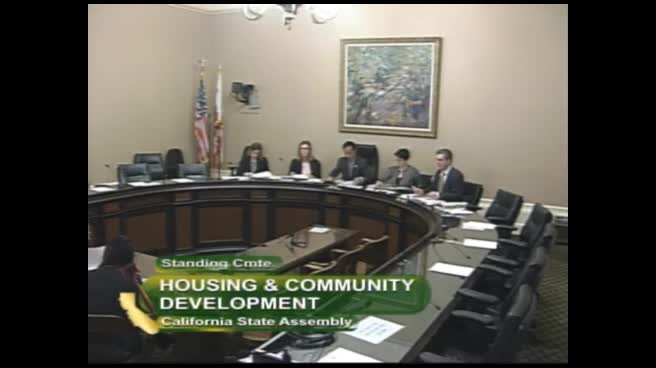 6MIN
Assembly Standing Committee on Housing and Community Development
Bill Author

Bill Co-Author(s):
