AB 1758: Personal income taxes: gross income exclusion: homeownership savings accounts.
- Session Year: 2017-2018
- House: Assembly
- Latest Version Date: 2018-04-03
The Personal Income Tax Law, in modified conformity with federal income tax laws, allows various exclusions from gross income.
This bill, on and or after January 1, 2018, would exclude from gross income any income earned on the moneys contributed to a homeownership savings account, as described.
This bill would take effect immediately as a tax levy.
The Personal Income Tax Law, in modified conformity with federal income tax laws, allows various exclusions from gross income.
This bill, on and after January 1, 2018, would exclude from gross income any income earned on the moneys contributed to a homeownership savings account, as described.
This bill would take effect immediately as a tax levy.
(a)For taxable years beginning on or after January 1, 2018, gross income does not include any income accruing during the taxable year to a homeownership savings account.
(b)For purposes of this section:
(1)Homeownership savings account means a trust that meets all of the following requirements:
(A)Is designated as a homeownership savings account by the trustee for the benefit of any person.
(B)Is established by a person, or by persons who are spouses, where the written governing instrument creating the account provides for the following:
(i)All contributions to the account are required to be in cash, including any refunds of taxes paid, and can be made by any person. person, including, but not limited to, contributions from relatives, employers, or crowdfunding Internet Web sites.
(ii)The account is established to pay, pursuant to the requirements and limitations of this section, for qualified homeownership savings expenses of the person who is the beneficiary of the account.
(C)Is, except as otherwise required or authorized by this section, subject to the same requirements and limitations as an individual retirement account established under Section 408 of the Internal Revenue Code, relating to individual retirement accounts, and any regulations adopted thereunder.
(D)Is the only homeownership savings account established by the person who established the account.
(E)The balance of the homeownership savings account does not exceed the maximum balance established for the account. The maximum balance of a homeownership savings account shall be 20 percent of the median home value within the state, as determined by the Department of Housing and Community Development and posted on its Internet Web site, for the year in which the account is created. The Department of Housing and Community Development shall post the annual median home value on or before ____ 1, 2018, and each ____ 1 January 1, 2018, and each year thereafter.
(2)Person means any individual, or individuals spouse, who had no present ownership interest in a principal residence within the meaning of Section 121 of the Internal Revenue Code, relating to exclusion of gain from sale of principal residence, during the preceding three-year period ending either on the date the homeownership savings account is established or on the date of the individuals, or individuals spouses, purchase of the principal residence for which any amount is withdrawn from the homeownership savings account.
(3)Qualified homeownership savings expenses means expenses, including a downpayment or closing costs, paid or incurred in connection with the purchase of a persons principal residence within the meaning of Section 121 of the Internal Revenue Code, relating to exclusion of gain from sale of principal residence, in this state for use by the person who is the beneficiary of the homeownership savings account.
(4)Trustee shall have the same meaning as that term has under Section 408 of the Internal Revenue Code, relating to individual retirement accounts, and any regulations adopted thereunder.
SEC. 2.This act provides for a tax levy within the meaning of Article IV of the California Constitution and shall go into immediate effect.
(a)For taxable years beginning on or after January 1, 2018, gross income does not include any income accruing during the taxable year to a homeownership savings account.
(b)For purposes of this section:
(1)Homeownership savings account means a trust that meets all of the following requirements:
(A)Is designated as a homeownership savings account by the trustee for the benefit of any person.
(B)Is established by a person, or by persons who are spouses, where the written governing instrument creating the account provides for the following:
(i)All contributions to the account are required to be in cash, including any refunds of taxes paid, and can be made by any person.
(ii)The account is established to pay, pursuant to the requirements and limitations of this section, for qualified homeownership savings expenses of the person who is the beneficiary of the account.
(C)Is, except as otherwise required or authorized by this section, subject to the same requirements and limitations as an individual retirement account established under Section 408 of the Internal Revenue Code, relating to individual retirement accounts, and any regulations adopted thereunder.
(D)Is the only homeownership savings account established by the person who established the account.
(E)The balance of the homeownership savings account does not exceed the maximum balance established for the account. The maximum balance of a homeownership savings account shall be 20 percent of the median home value within the state, as determined by the Department of Housing and Community Development and posted on its Internet Web site, for the year in which the account is created. The Department of Housing and Community Development shall post the annual median home value on or before ____ 1, 2018, and each ____ 1 thereafter.
(2)Person means any individual, or individuals spouse, who had no present ownership interest in a principal residence within the meaning of Section 121 of the Internal Revenue Code, relating to exclusion of gain from sale of principal residence, during the preceding three-year period ending either on the date the homeownership savings account is established or on the date of the individuals, or individuals spouses, purchase of the principal residence for which any amount is withdrawn from the homeownership savings account.
(3)Qualified homeownership savings expenses means expenses, including a downpayment or closing costs, paid or incurred in connection with the purchase of a persons principal residence within the meaning of Section 121 of the Internal Revenue Code, relating to exclusion of gain from sale of principal residence, in this state for use by the person who is the beneficiary of the homeownership savings account.
(4)Trustee shall have the same meaning as that term has under Section 408 of the Internal Revenue Code, relating to individual retirement accounts, and any regulations adopted thereunder.
SEC. 2.This act provides for a tax levy within the meaning of Article IV of the California Constitution and shall go into immediate effect.
|
Date
|
Status
|
|---|---|
| Apr 11, 2018 | In committee: Set, first hearing. Hearing canceled at the request of author. |
| Apr 4, 2018 | Re-referred to Com. on H. & C.D. |
| Apr 3, 2018 | From committee chair, with author's amendments: Amend, and re-refer to Com. on H. & C.D. Read second time and amended. |
| Jan 16, 2018 | Referred to Coms. on H. & C.D. and REV. & TAX. |
| Jan 5, 2018 | From printer. May be heard in committee February 4. |
| Jan 4, 2018 | Read first time. To print. |
This list shows positions taken on this bill by organizations on the date displayed, which is linked to the original source.
Positions by individuals are not included.
|
Organization
|
Position
|
Date
|
|---|---|---|
| California Association Of Realtors | * Support | Apr 11, 2018 |
| California Building Industry Assoc. | * Support | Apr 11, 2018 |
| California Council For Affordable Housing | ** Support | Apr 9, 2018 |
| California Credit Union League | ** Support | Apr 9, 2018 |
| California Professional Firefighters | * Against | Apr 11, 2018 |
| Habitat For Humanity California | * Support | Apr 11, 2018 |
| League Of California Cities | * Support | Apr 11, 2018 |
| Southern California Legislative Council | ** Support | Apr 9, 2018 |
| The Greenlining Institute | * Support | Apr 11, 2018 |
Date of Hearing: April 11, 2018
ASSEMBLY COMMITTEE ON HOUSING AND COMMUNITY DEVELOPMENT
David Chiu, Chair
ABPCA Bill Id:AB 1758 (
Author:Steinorth) – As Amended Ver:April 3, 2018
SUBJECT: Personal income taxes: gross income exclusion: homeownership savings accounts
SUMMARY: Creates a homeownership savings account (HSA) to provide similar tax benefits to an individual retirement account (IRA) and allows for contributions from a taxpayer, relatives, employers, or Internet crowdfunding Web sites. Specifically, this bill:
- Exempts from gross income any income that accrues from a HSA beginning January 1, 2018.
- Defines a "homeownership savings account" to mean a trust that meets all of the following requirements:
- Designated as a HSA by the trustee for the benefit of any person;
- Established by a person, or by persons who are spouses;
- All contributions to the account are required to be in cash including any refunds of taxes paid and can be made by any person including relatives, employers, and Internet crowdfunding Web sites;
- The account is established to pay for the "qualified homeownership savings" expenses of the person who is the beneficiary of the account;
- Except as otherwise stated, is subject to the same requirements and limitations as an IRA;
- The only HSA established by the person who established the account;
- The balance of the HSA does not exceed the maximum balance; and
- The maximum balance of the HSA shall be 20% of the median home value in the state as determined by the Department of Housing and Community Development (HCD).
- Requires HCD to post the annual median home value on its website, on or before January 1, 2018, and each year thereafter.
- Defines "person" to mean any individual, or individual's spouse who does not own a principal residence nor has owned one in the last three years from the date the HSA is established or on the date the individual or individual's spouse purchase a principal residence using the funds from the HSA.
- Defines "qualified homeownership savings expenses" to mean expenses, including a downpayment or closing costs, for the purchase of a principal residence in California for the person who is the beneficiary of the HSA.
- Defines "trustee" to mean the same as for individual retirement accounts.
- Provides that this act creates a tax levy and takes effect immediately.
EXISTING LAW:
- Provides for two types of IRAs under federal law, to which state law automatically conforms: traditional IRAs and Roth IRAs. The total amount of qualified contributions to both traditional and Roth IRAs are limited to the lesser of $5,500 ($6,500 for taxpayers 50 years of age or older), or the taxpayer's taxable compensation for the year.
- Allows an income tax deduction for contributions (other than a rollover contribution) made only to a traditional IRA. In contrast, contributions made to a Roth IRA are not deductible and are subject to tax.
- Provides that amounts held in a traditional IRA are generally includible as gross income when withdrawn. In contrast, qualified distributions from a Roth IRA are excludable from gross income (although interest earned on contributions is taxable if withdrawn for a non-qualified distribution).
- Provides that withdrawals from a traditional IRA and non-qualified withdrawals of interest income from a Roth IRA are generally subject to an additional tax of 10% under federal law and 2.5% under state law if withdrawn prior to age 59 ½, death, or disability, with some exceptions. Most notably, the taxpayer is not subject to the early withdrawal tax if the withdrawal is used for first-time homebuyer expenses of up to $10,000. Such first-time homebuyer expenses of up to $10,000 are also included as "qualified distributions" from a Roth IRA.
- Allows various other deductions and exclusions under federal law, to which state law generally conforms, in computing taxable income. Individuals may claim the standard deduction, a fixed dollar amount intended to approximate deductible living expenses, or itemized deductions for various specific expenses, including miscellaneous itemized deductions that are only allowed to the extent that they exceed 2% of adjusted gross income (AGI). Contributions to or withdrawals from a savings account for homeownership expenses are not generally deductible or excludible from income under federal or state law.
- Specifies that the California Housing Finance Agency (CalHFA) provide down payment assistance in the form of deferred payment, low-interest; and junior mortgage loans which are designed to reduce principle and interest payments to make financing affordable for first time low and moderate income homebuyers. In most cases, CalHFA programs may be used in conjunction with other first-time homebuyer programs, including programs offered by nonprofit entities.
FISCAL EFFECT: Unknown.
COMMENTS:
Background: California has the third lowest homeownership rate in the country. Between 2006 and 2014, the number of housing units that were owner-occupied fell by almost 250,000 while the number of renter-occupied units increased by about 850,000. According to the Public Policy Institute of California, “much of the increase in rental units occurred among formerly owned single family detached housing units." Despite this trend the state continues to make its most significant investment in housing through the mortgage interest deduction on primary residences. The Franchise Tax Board (FTB) estimates that the impact of the mortgage interest deduction on state revenues for 2016-2017 was $5 billion dollars.
Funds for homeownership programs: Last year, the Legislature passed a package of bills to address the housing affordability crisis that includes SB 3 (Beall) Chapter 365, Statutes of 2017, the Veterans and Affordable Housing Bond Act of 2018, which will go before the voters in November of 2018. The bond includes a total of $450 million for homeownership programs. If approved, $150 million will go to CalHFA for downpayment assistance for first-time homebuyers and $300 million for the CalHOME program to fund homeownership programs, including self-help mortgage assistance. SB 2 (Atkins) Chapter 364, Statutes of 2017, which creates a permanent funding source for affordable housing program through a $75 recording fee on real estate documents (excluding those at the time of sale of a property) directs 70% of the funding in year two and beyond to locals to address affordable housing needs, including homeownership.
This bill would allow for the creation of a HSA and would exclude from a taxpayer's gross income any income accruing during the taxable year to a HSA, similar to an IRA. The bill would allow anyone to set up a HSA on behalf of another person and anyone to contribute to the savings account including a beneficiary, relative, employer, or Internet crowd funding site. The savings account is limited to purchase of a principal residence in California by an individual who has not owned a home in the last three years. The amount that can be deposited in the account is capped at 20% of the state median home value as determined by HCD. In 2016, according to the California Association of Realtors, the statewide median, existing single-family home sale price was $526,580. As of the first quarter of 2016, the California Association of Realtors estimates that only 34% of households in California can afford to purchase the median priced home in the state. Based on a median home sales price of $526,580, an individual could save over $100,000 in a HSA under this bill.
Tax-Advantaged Savings Accounts and Retirement Plans: Congress has authorized several types of retirement savings plans that qualify for reduced or deferred income taxes to encourage workers to save for retirement. For example, traditional IRAs allow for investment of a portion of wages on a pre-tax basis that remains untaxed until the money is withdrawn. Roth IRA investment contributions are made on an after-tax basis, but allow for tax-free qualified distributions (with interest earned on contributions subject to tax and penalty if withdrawn for a non-qualified distribution).
Existing federal law imposes a 10% withdrawal penalty on early distributions made from an IRA to a taxpayer under the age of 59 ½. California imposes a similar penalty but at the rate of 2.5%. However, recognizing that some significant event might require people to withdraw money from their retirement accounts earlier than expected, Congress has provided for a waiver of the early withdrawal penalty in some situations, to which California has conformed. Most notably, an exception from the penalty applies to distributions up to $10,000 that are used for first-time home purchases, and such distributions are also included as a "qualified distribution" from a Roth IRA.
The "First-Time Homebuyer" Exception: Under federal and state law, first-time homebuyers are authorized to make penalty-free withdrawals of up to $10,000 of IRA funds. The $10,000 limitation applies on an individual basis, meaning that both the taxpayer and the taxpayer's spouse may qualify individually for this first-time homebuyer exception, potentially doubling the amount of money withdrawn without penalty. The definition of "first-time homebuyer" is broad and includes a taxpayer who previously owned a home, so long as the taxpayer has no present interest in a main home during the two-year period ending on the date of acquisition of the home which the distribution is being used to buy. Furthermore, the taxpayer does not have to purchase the residence for her/himself, as the penalty-free withdrawal could be used to help a child, grandchild, or parent buy a home. Given the existing allowance of penalty-free withdrawals from IRAs for first-time homebuyers, the Committee may wish to consider whether creating a new tax-advantaged savings account for homeownership is necessary.
Purpose of this bill: According to the author, "AB 1758 will increase access to affordable housing by allowing Californians to deposit money from multiple contributors into a HSA designated for a specific beneficiary. The interest accrued in these accounts is excluded from gross income and must be put toward qualified expenses, such as a down payment or closing costs. Specifically, first-time homebuyers in California will be allowed to save up to 20% of the median home value in California the year the account is opened. This will be posted on the California Department of Housing and Community Development’s website, and updated annually. In order to increase homeownership, these accounts are available to first-time homebuyers in California."
Arguments in support: The California Association of Realtors is in support of this bill because, "the cost of housing in California has proven to be a significant impediment to homeownership. Increased housing costs often lead to significant trade-offs for California families, such as living in more crowded housing, commuting further to work each day, or choosing to work and live in an area where housing costs have not increased significantly. AB 1758 presents a significant opportunity for homeownership to individuals and families who have not owned a home in the last three years and who have likely been priced out of the housing market in recent years."
Arguments in opposition: The California Professional Firefighters are opposed to this bill, because "several state and federal programs already exist that are designed to assist homebuyers. AB 1758 is unlikely to increase homeownership outside of the population of California taxpayers who are already likely to purchase a home. Any policy impacting state or local revenue must be measured against the need to properly fund essential government services such as fire protection services. "
Committee amendments: Unlike other homeownership programs the state administers, like the programs operated by CalHFA, the funding for this program would come from a reduction in state revenues and would be a one-time investment in one individual rather than function as a revolving loan fund. The committee may wish to consider if this is the right investment considering the affordable housing challenges facing the state. The committee may wish to consider whether an individual who would benefit from a HSA would already purchase a home without this program. The committee may wish to consider whether there should be some income limitation on those who can qualify for a HSA to focus this bill on lower income individuals.
- Only allow taxpayers that make up to 80% of AMI qualify to create a HSA. If a taxpayer's income exceeds 80% AMI in any given year they cannot contribute to the HSA.
- Change the definition of "first time homebuyers" from taxpayers that have not owned a home within the last three years to a taxpayer who has never owned a home.
- The bill would allow both an individual and their spouse to set up a HSA for the purchase of the same home. The committee may wish to clarify that a couple is only eligible to set up one HSA.
- The definition of "qualified homeownership savings expenses" is overly broad and could include expenses for repairs, renovations, the purchase of new appliances and soft goods, and moving expenses in addition to potentially on-going mortgage payments. The committee may wish to clarify that "qualified homeownership savings expenses" is limited to down payment and closing costs.
- The bill does not specify that a HSA must be closed once a purchase is made. The committee may wish to consider an amendment to clarify that once a home is purchased it must be closed.
Related legislation: AB 1979 (Bonta) (2018) would create an individual HSA that would include income tax benefits similar to an IRA. The bill is pending hearing in this committee.
Prior legislation:
AB 53 (Steinorth) (2017) would have created an individual HSA that would have included income tax benefits similar to an IRA. This bill failed passage in the Assembly Appropriations Committee.
AB 1736 (Steinorth) (2016) would have created an individual HSA that would have included income tax benefits similar to an IRA. This bill failed passage in the Assembly Appropriations Committee.
Double-Referred: If AB 1758 passes out of this committee, the bill will be referred to the Committee on Revenue and Taxation.
REGISTERED SUPPORT / OPPOSITION:
Support
California Association of Realtors
California Building Industry Association
California Council for Affordable Housing
California Credit Union League
Habitat for Humanity California
Southern California Legislative Council
Opposition
California Professional Firefighters
Analysis Prepared by: Lisa Engel / H. & C.D. / (916) 319-2085
Discussed in Hearing
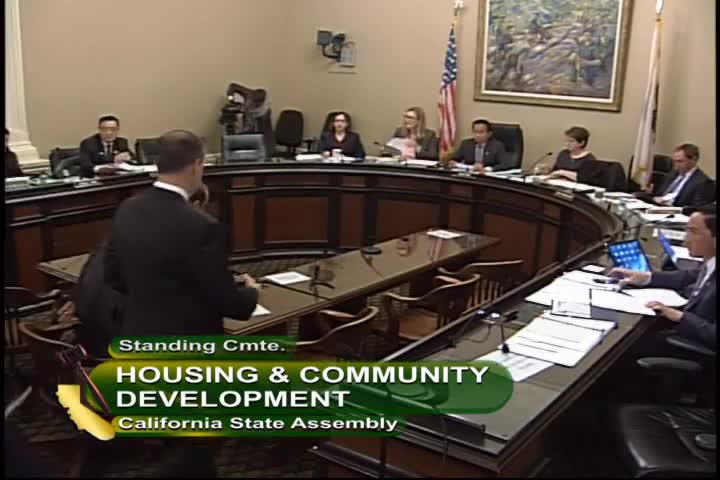 16MIN
Assembly Standing Committee on Housing and Community Development
Bill Author

Bill Co-Author(s):