AB 2010: Juvenile facilities: chemical agents.
- Session Year: 2017-2018
- House: Assembly
- Latest Version Date: 2018-02-01
Existing law makes it a misdemeanor or a felony to bring tear gas or a tear gas weapon into a juvenile hall or camp, or to possess tear gas or a tear gas weapon in a juvenile hall or camp, except as authorized by law, or when authorized by the person in charge or an officer of the of the juvenile hall or camp. Existing law makes it a felony to use tear gas or a tear gas weapon in a juvenile hall or camp except as authorized.
This bill would prohibit an officer or employee of a juvenile facility, as defined, from possessing any chemical agent, as defined, in a juvenile facility. The bill would allow pepper spray to be used in a juvenile facility as a last resort when necessary to suppress a riot when authorized by a juvenile facility administrator or designee. The bill would require that all use of pepper spray be documented, as provided.
(a)For purposes of this section, the following definitions apply:
(1)Juvenile facility includes any of the following:
(A)A juvenile hall, as described in Section 850.
(B)A juvenile camp or ranch, as described in Article 24 (commencing with Section 880).
(C)A facility of the Department of Corrections and Rehabilitation, Division of Juvenile Justice.
(D)A regional youth educational facility, as described in Section 894.
(E)A youth correctional center, as described in Article 9 (commencing with Section 1850) of Chapter 1 of Division 2.5.
(F)A juvenile regional facility as described in Section 5695.
(G)Any other local or state facility used for the confinement of minors or wards.
(2)Chemical agent means a chemical-based agent designed to debilitate or incapacitate a person, or to cause a temporary burning sensation and inflammation of mucous membranes and eyes leading to involuntary closure, including, but not limited to, tear gas, mace, oleoresin capsicum, or pepper spray.
(b)Except as described in subdivision (c), an officer or employee of a juvenile facility may not have in his or her possession or use any chemical agent in a juvenile facility.
(c)Pepper spray may be used in a juvenile facility only in accordance with the following:
(1)Pepper spray may be used only as a last resort when necessary to suppress a riot and only when deescalation techniques have been unsuccessful or are not reasonably possible.
(2)Officers and employees of a juvenile facility may not carry pepper spray on their persons.
(3)Use of pepper spray must be authorized by a juvenile facility administrator or designee.
(4)All use of pepper spray shall be documented, including reasons for use, authorization for use, decontamination procedures, and followup visits with medical professionals. Incidents of the use of pepper spray shall be regularly reviewed by the facility administrator, and each incident shall be debriefed by the facility administrator or designee with all parties involved.
|
Date
|
Status
|
|---|---|
| Apr 17, 2018 | In committee: Set, second hearing. Held without recommendation. |
| Apr 3, 2018 | In committee: Hearing postponed by committee. |
| Mar 20, 2018 | In committee: Set, first hearing. Hearing canceled at the request of author. |
| Feb 16, 2018 | Referred to Com. on PUB. S. |
| Feb 2, 2018 | From printer. May be heard in committee March 4. |
| Feb 1, 2018 | Read first time. To print. |
This list shows positions taken on this bill by organizations on the date displayed, which is linked to the original source.
Positions by individuals are not included.
|
Organization
|
Position
|
Date
|
|---|---|---|
| #cut50 | ** Support | Apr 16, 2018 |
| ACLU of California | * Support | Apr 17, 2018 |
| All of Us or None | * Support | Apr 17, 2018 |
| Arts for Incarcerated Youth Network | ** Support | Apr 16, 2018 |
| Asian Americans Advancing Justice | * Support | Apr 17, 2018 |
| Asian Law Alliance | ** Support | Apr 16, 2018 |
| Association Of Orange County Deputy Sheriffs | ** Against | Apr 16, 2018 |
| Bend The Arc Jewish Action | ** Support | Apr 16, 2018 |
| California Association Of Code Enforcement Officers | ** Against | Apr 16, 2018 |
| California College And University Police Chiefs Association | ** Against | Apr 16, 2018 |
| California Correctional Peace Officers Association | * Against | Apr 17, 2018 |
| California Narcotic Officers Association | ** Against | Apr 16, 2018 |
| California Public Defenders Association | * Support | Apr 17, 2018 |
| California State Association Of Counties | * Against | Apr 17, 2018 |
| California State Sheriffs' Association | ** Against | Apr 16, 2018 |
| California Statewide Law Enforcement Association | ** Against | Apr 16, 2018 |
| Center on Juvenile and Criminal Justice | ** Support | Apr 16, 2018 |
| Ceres Policy Research | ** Support | Apr 16, 2018 |
| Chief Probation Officers Of California | * Against | Apr 17, 2018 |
| Children Now | ** Support | Apr 16, 2018 |
| Children'S Defense Fund | ** Support | Apr 16, 2018 |
| Children'S Law Center Of California | ** Support | Apr 16, 2018 |
| Coalition for Justice and Accountability | ** Support | Apr 16, 2018 |
| Communities United for Restorative Justice | * Support | Apr 17, 2018 |
| Consortium For Children | ** Support | Apr 16, 2018 |
| Del Norte County Probation Department | ** Against | Apr 16, 2018 |
| Disability Rights California | ** Support | Apr 16, 2018 |
| Ella Baker Center For Human Rights | * Support | Apr 17, 2018 |
| Fathers & Families of San Joaquin | ** Support | Apr 16, 2018 |
| Fraternal Order of Police | * Against | Apr 17, 2018 |
| Juvenile Justice Commission County Of Santa Clara | ** Support | Apr 16, 2018 |
| Kern County Probation Officers Association | ** Against | Apr 16, 2018 |
| Legal Services for Children | ** Support | Apr 16, 2018 |
| Long Beach Police Officers Association | ** Against | Apr 16, 2018 |
| Los Angeles County Professional Peace Officers' Association | ** Against | Apr 16, 2018 |
| Los Angeles Probation Officer's Union | * Against | Apr 17, 2018 |
| Madera Probation Peace Officers' Association | ** Against | Apr 16, 2018 |
| Motivating Individual Leadership for Public Advancement | * Support | Apr 17, 2018 |
| National Center for Lesbian Rights | ** Support | Apr 16, 2018 |
| National Center for Youth Law | ** Support | Apr 16, 2018 |
| Nevada County Juvenile Hall | ** Against | Apr 16, 2018 |
| Pacific Juvenile Defender Center | ** Support | Apr 16, 2018 |
| PORAC | * Against | Apr 17, 2018 |
| Probation And Corrections Peace Officer Association | ** Against | Apr 16, 2018 |
| Public Counsel | ** Support | Apr 16, 2018 |
| Resilience Orange County | ** Support | Apr 16, 2018 |
| Riverside Sheriff's Association | * Against | Apr 17, 2018 |
| Root and Rebound | ** Support | Apr 16, 2018 |
| Sacramento County Deputy Sheriffs' Association | ** Against | Apr 16, 2018 |
| Sacramento County Probation Association | * Against | Apr 17, 2018 |
| San Bernadino Sheriffs | * Against | Apr 17, 2018 |
| San Diego County Probation Officers Association | ** Against | Apr 16, 2018 |
| San Francisco Deputy Probation Officers Association | ** Against | Apr 16, 2018 |
| San Joaquin Probation Officers Association | ** Against | Apr 16, 2018 |
| San Mateo County'S Probation And Detention Association | ** Against | Apr 16, 2018 |
| Silicon Valley De-Bug | ** Support | Apr 16, 2018 |
| State Coalition Of Probation Organizations | * Against | Apr 17, 2018 |
| The Friends Committee on Legislation in California | * Support | Apr 17, 2018 |
| Ventura County Professional Peace Officers' Association | ** Against | Apr 16, 2018 |
| W. Haywood Burns Institute | ** Support | Apr 16, 2018 |
| Youth Forward | ** Support | Apr 16, 2018 |
| Youth Law Center | * Support | Apr 17, 2018 |
Date of Hearing:
Counsel: David Billingsley
ASSEMBLY COMMITTEE ON PUBLIC SAFETY
Reginald Byron Jones-Sawyer, Sr., Chair
ABPCA Bill Id:AB 2010
Author:(Chau) – As Introduced Ver:February 1, 2018
As Proposed to be Amended in Committee
SUMMARY:
Prohibits an officer or employee of a juvenile facility, as defined, from possessing and using any chemical agent, such as pepper spray, in a juvenile facility, with limited exceptions, as of January 1, 2021. Requires training for employees at juvenile facilities on alternatives to use of pepper spray. Specifically, this bill:
- States that, as of January 1, 2021, an officer or employee of a juvenile facility may not have in his or her possession or use any chemical agent in a juvenile facility, except as specified.
- Allows the use of pepper spray in a juvenile facility, as of January 1, 2021, only in accordance with the following:
- Pepper spray may be used only as a last resort when necessary to suppress a riot and only when de-escalation techniques have been unsuccessful or are not reasonably possible;
- Officers and employees of a juvenile facility may not carry pepper spray on their persons;
- Use of pepper spray must be authorized by a juvenile facility administrator or designee;
- All use of pepper spray shall be documented, including reasons for use, authorization for use, decontamination procedures, and follow up visits with medical professionals. Incidents of the use of pepper spray shall be regularly reviewed by the facility administrator, and each incident shall be debriefed by the facility administrator or designee with all parties involved; and
- All youth who have come into contact with pepper spray shall be seen by a medical professional upon completion of decontamination.
- Pepper spray may be used only as a last resort when necessary to suppress a riot and only when de-escalation techniques have been unsuccessful or are not reasonably possible;
- Specifies that prior to January 1, 2021, county probation departments shall provide training on de-escalation and crisis intervention techniques that rely on alternatives other than physical force and are trauma informed, to supervisors, officers, and employees authorized to use force, at juvenile facilities operated by a county.
- Specifies that prior to January 1, 2021, the Department of Corrections and Rehabilitation shall provide training on de-escalation and crisis intervention techniques that rely on alternatives other than physical force and are trauma-informed, to supervisors, officers, and employees authorized to use force, at juvenile facilities operated by the state.
- Requires training to include review of use of force incidents.
- Defines the following terms for purposes of this bill:
- “Juvenile facility” includes any of the following:
- A county juvenile hall;
- A county juvenile camp or ranch;
- A facility of the Department of Corrections and Rehabilitation, Division of Juvenile Justice;
- A regional youth educational facility, as specified;
- A youth correctional center, as specified;
- A juvenile regional facility; or
- Any other local or state facility used for the confinement of minors or wards.
- A county juvenile hall;
- “Chemical agent” means a “chemical-based agent designed to debilitate or incapacitate a person, or to cause a temporary burning sensation and inflammation of mucous membranes and eyes leading to involuntary closure, including, but not limited to, tear gas, mace, oleoresin capsicum, or pepper spray.”
- “Juvenile facility” includes any of the following:
EXISTING LAW:
- States that minors under the jurisdiction of the juvenile court who are in need of protective services shall receive care, treatment, and guidance consistent with their best interest and the best interest of the public. (Welf. and Inst. Code, § 202, subd. (c).)
- Specifies that minors under the jurisdiction of the juvenile court as a consequence of delinquent conduct shall, in conformity with the interests of public safety and protection, receive care, treatment, and guidance that is consistent with their best interest, that holds them accountable for their behavior, and that is appropriate for their circumstances. This guidance may include punishment that is consistent with the rehabilitative objectives of this chapter. (Welf. and Inst. Code, § 202, subd. (c).)
- States that when the minor is no longer a ward of the juvenile court, the guidance he or she received should enable him or her to be a law-abiding and productive member of his or her family and the community. (Welf. and Inst. Code, § 202, subd. (c).)
- Provides that the juvenile hall shall not be in, or connected with, any jail or prison, and shall not be deemed to be, nor be treated as, a penal institution. It shall be a safe and supportive homelike environment. (Welf. and Inst. Code, § 851.)
- In order to provide appropriate facilities for the housing of wards of the juvenile court in the counties of their residence or in adjacent counties so that those wards may be kept under direct supervision of the court, and in order to more advantageously apply the salutary effect of a safe and supportive home and family environment upon them, and also in order to secure a better classification and segregation of those wards according to their capacities, interests, and responsiveness to control and responsibility, and to give better opportunity for reform and encouragement of self–discipline in those wards, juvenile ranches or camps may be established, as provided in this article. (Welf. and Inst. Code, § 880.)
- States that the juvenile facility administrator, in cooperation with the responsible physician, shall develop and implement written policies and procedures for the use of force, which may include chemical agents. Force shall never be applied as punishment, discipline or treatment. (Code of Regulations, Title 15, § 1357.)
- Specifies that at a minimum, each facility shall develop policy statements which: (Code of Regulations, Title 15, § 1357, subd. (a)(1)-(4).)
- Define the term "force," and address the escalation and appropriate level of force, while emphasizing the need to avoid the use of force whenever possible and using only that force necessary to ensure the safety of youth, staff and others;
- Describe the requirements for staff to report the use of force, and to take affirmative action to stop the inappropriate use of force;
- Define the role, notification, and follow-up procedures of medical and mental health staff concerning the use of force; and,
- Define the training which shall be provided and required for the use of force, which shall include: known medical conditions that would contraindicate certain types of force; acceptable chemical agents; methods of application; signs or symptoms that should result in immediate referral to medical or mental health staff; requirements of the decontamination of chemical agents, if such agents are utilized; and appropriate response if the current use of force is ineffective.
- Define the term "force," and address the escalation and appropriate level of force, while emphasizing the need to avoid the use of force whenever possible and using only that force necessary to ensure the safety of youth, staff and others;
- Requires that policies and procedures be developed which include, but are not limited to, the types, levels and application of force, documentation of the use of force, a grievance procedure, a system for investigation of the use of force and administrative review, and discipline for the improper use of force. Such procedures shall address:
- The specific use of physical, chemical agent, lethal, and non-lethal force that may, or may not, be used in the facility;
- The limitations regarding use of force on pregnant youth; and,
- A standardized format, time period, and procedure for reporting the use of force, including the reporting requirements of management and line staff.
- The specific use of physical, chemical agent, lethal, and non-lethal force that may, or may not, be used in the facility;
FISCAL EFFECT:
Unknown
COMMENTS:
- Author’s Statement: According to the author, “The use of chemical spray on young people not only produces physical and mental health effects, but it also interferes with their rehabilitation, because it can have serious effects on the relationship between youth and staff. By limiting the use of chemical sprays in juvenile detention facilities, we are adopting accepted professional practices that will provide a safe and supportive environment for the rehabilitation of our youth.”
- Pepper Spray: Pepper spray, or oleoresin capsicum (OC) spray, is a type of chemical restraint that contains capsaicinoids extracted from the resin of hot peppers. According to a report published by the National Institute of Justice, pepper spray, “incapacitates subjects by inducing an almost immediate burning sensation of the skin and burning, tearing, and swelling of the eyes. When it is inhaled, the respiratory tract is inflamed, resulting in a swelling of the mucous membranes…and temporarily restricting breathing to short, shallow breaths. (http://cjca.net/attachments/article/172/CJCA.Issue.Brief.OCSpray.pdf)
In U.S. v. Neill (1999), 166 F.3rd 943, the 9th Circuit Court of Appeal held that, "Pepper spray qualifies as a 'dangerous weapon' because it may cause 'serious injury,' namely 'extreme physical pain or the protracted impairment of a function of a bodily member, organ or mental faculty'...." - Purpose of California’s Juvenile Justice System: The juvenile justice system in California is intended to promote rehabilitation and seeks to further the best interest of the minor.
“Minors under the jurisdiction of the juvenile court as a consequence of delinquent conduct shall, in conformity with the interests of public safety and protection, receive care, treatment, and guidance that is consistent with their best interest, that holds them accountable for their behavior, and that is appropriate for their circumstances. This guidance may include punishment that is consistent with the rehabilitative objectives of this chapter.” (Welf. and Inst. Code, § 202, subd. (c).)
California law also emphasizes the distinction between juvenile halls and adult penal facilities.
“. . ., the juvenile hall shall not be in, or connected with, any jail or prison, and shall not be deemed to be, nor be treated as, a penal institution. It shall be a safe and supportive homelike environment.” (Welf. and Inst. Code, § 851.) - Use of Pepper Spray in Juvenile Facilities: While pepper spray is widely accepted and used by law enforcement and adult corrections agencies across the country, its use is not common in juvenile correctional agencies. There is concern about the health hazards of pepper spray and concern about the negative impact on staff-youth relationships, the key to successful juvenile rehabilitative programming. Very few states authorize its use and in the states that allow its use in policy, most prohibit the use except as a last resort and with many conditions and few facilities put it into practice. Thirty-five states no longer allow pepper spray in juvenile detention halls. Only California, Illinois, Indiana, Minnesota, South Carolina and Texas allow employees to routinely carry canisters. The remaining states allow its use in some capacity, but employees do not routinely carry it. (http://sanfrancisco.cbslocal.com/2018/02/07/california-considers-barring-pepper-spray-youth-detention-facilities/)
The Council of Juvenile Corrective Administrators (Council) explored the use of pepper spray in juvenile facilities in an issue brief published in 2011. The Council concluded that overreliance on restraints, whether they are chemical, physical, mechanical or other, compromised relationships between staff and youths, one of the critical features of safe facilities. (http://cjca.net/attachments/article/172/CJCA.Issue.Brief.OCSpray.pdf) The issue brief examined the policies of State’s regarding use of pepper spray in juvenile facilities and reviewed studies on the use of pepper spray. The Council noted that while few academic studies have focused specifically on pepper spray use in juvenile settings, recent research on other types of restraint use (physical and mechanical) in juvenile confinement settings shows that applying restraints disrupts correctional climates by creating anger and feelings of unfair use of authority, in addition to negatively impacting staff. One recent study found that restraints are often applied as punishment rather than in response to immediate threats of violence. Youth in juvenile facilities have described incidents of restraint as causing physical and emotional pain. Another study found that facilities with high numbers of restraint incidents are more likely to have higher rates of safety problems, including youth and staff injury, suicidal behavior, youths injured by staff and fear among youths. (Id.) - Potential Concerns About Prohibiting the Use of Chemical Restraints in Juvenile Facilities: The following are potential concerns related to prohibiting the use of chemical restraints in juvenile facilities:
- Eliminating the use of pepper spray will increase reliance on physical force, as opposed to de-escalation techniques;
- De-escalation might not be effective in situations where pepper spray might provide control of the situation; and,
- Elimination of pepper spray might raise the chance that a situation could result in harm to a juvenile or a staff member, because physical force would be needed.
- Eliminating the use of pepper spray will increase reliance on physical force, as opposed to de-escalation techniques;
Santa Cruz County provides a potential example that concerns about prohibition of chemical restraints in juvenile facilities can be successfully navigated. In Santa Cruz County, staff does not carry pepper spray in the juvenile facility. Staff in the Santa Cruz juvenile facility stress de-escalation as an alternative to chemical restraints. Jurisdictions that do not use pepper spray emphasize that the best safety tool is a positive relationship between youth and staff. A positive relationship between youth and staff can foster an atmosphere which makes it less likely for there to be conflicts within the juvenile facility. If there is a physical confrontation, youth are physically separated.
If de-escalation is not emphasized or not effective, then it is likely that probation officers will rely on other uses of physical force or physical restraints. Other methods of force or restraint can be equally damaging to youth as pepper spray, and also damage the relationship between staff and youth. To meet the goals of this bill, juvenile facilities that are currently relying on chemical restraints would need to ensure that they don’t simply switch to other forms of physical restraints.
The California juvenile justice system is intended to provide a safe and supportive homelike environment. To the extent that other states have effectively maintained safe juvenile environments without the use of chemical restraints, such practices are consistent with the stated goals of the California juvenile justice system.
- Distinction Between County Juvenile and State Juvenile Facilities: State juvenile facilities are part of the Division of Juvenile Justice (DJJ). DJJ only houses juveniles who have been charged and found responsible for more serious and violent crimes. To the extent that restricting/and or eliminating the use of chemical restraints is appropriate in county juvenile facilities, it is worth considering whether the differences in populations between county juvenile facilities and DJJ should result in any differences in policy on the use of chemical restraints.
- Amendments Proposed to be Taken in Committee:
- Delay the prohibition on use of pepper spray, and other chemical restraints, in juvenile facilities until January 1, 2021.
- Specify that prior to January 1, 2021, county probation departments shall provide training on de-escalation and crisis intervention techniques that rely on alternatives other than physical force and are trauma informed, to supervisors, officers, and employees authorized to use force, at juvenile facilities operated by a county.
- Specify that prior to January 1, 2021, the Department of Corrections and Rehabilitation shall provide training on de-escalation and crisis intervention techniques that rely on alternatives other than physical force and are trauma-informed, to supervisors, officers, and employees authorized to use force, at juvenile facilities operated by the state.
- Requires training to include review of use of force incidents.
- Require all youth who have come into contact with pepper spray to be seen by a medical professional upon completion of decontamination when the provisions of this bill become effective.
- Delay the prohibition on use of pepper spray, and other chemical restraints, in juvenile facilities until January 1, 2021.
- Argument in Support: According to the Youth Law Center “The use of chemical agents should be restricted in juvenile detention facilities, as their use is physically and psychologically harmful to young people. The most commonly used chemical agent – oleoresin capsicum (OC) or pepper spray – poses significant health risks to everyone exposed to it. These risks may be exacerbated by medical contraindications, mental illness, insufficient air circulation, and repeated exposure – all conditions that exist in juvenile facilities. A 2009 literature review indicated that the effects of pepper spray are exacerbated in confined areas and areas with poor ventilation, two characteristics of many juvenile facilities.
“Children with compromised respiratory systems, from common childhood conditions such as asthma or bronchitis, may be at particular risk for respiratory arrest resulting from OC spray exposure. The risks involved in using OC spray may also be exacerbated when a youth is under the influence of psychotropic drugs. Many young people incarcerated in juvenile facilities are prescribed psychotropic medication that can increase the risks of OC spray.
“Beyond the physical and mental health effects of chemical agents discussed above, the use of chemical spray can have serious effects on the relationship between youth and staff – a relationship that is crucial to rehabilitation. Young people thrive when they are in healthy, trusting, relationships with committed, caring adults. In the absence of these relationships, efforts at rehabilitation, and supportive programming suffer. As the Office of Juvenile Justice and Delinquency Prevention has observed, “youth distrust of facility staff and conflict with them can undermine program efforts to alter delinquent career paths and elevate discipline, control, and safety issues.
“The use of chemical agents impedes the development of a trusting relationship between staff and youth that is crucial for youth rehabilitation and overall facility safety. The Council of Juvenile Correctional Administrators (CJCA) has noted that over-reliance on chemical restraints can harm relationships between youth and staff and that the states authorizing the use of chemical restraints tend to have adopted a more punitive, adult-corrections-like approach to juvenile detention. A survey conducted by CJCA demonstrated that where OC spray is used, staff and youth fear for their safety more than average.
“Further, national best practices for juvenile detention counsel against the use of chemical agents. The Annie E. Casey Foundation’s Juvenile Detention Alternatives Initiative’s detention facility assessment standards, recognized as representing best practices for juvenile detention, prohibit the use of chemical agents. California can and should join the majority of states in placing strict limits on the use of chemical agents, and should take the steps outlined in AB 2010 to come more closely in line with national best practice on this issue.” - Argument in Opposition: According to the Del Norte County Probation Department, “We recognize that pepper spray should be used in our facility only under limited circumstances, but AB 2010 would effectively ban its use altogether. If passed, your bill will endanger both the minors in our custody and our probation peace officers responsible for their care. The only tool officers will have left to protect juveniles and staff from violent attacks will be the use of significant physical force.
“Our juvenile facilities house juvenile offenders convicted of crimes such a as murder, rape, assault with a deadly weapon, carjacking, home invasion and terrorist threats, to name just a few of the serious and violent offenses committed by juvenile offenders. A high percentage of these offenders are gang members who bring to our juvenile institutions the same violent mentality they display on the streets. These juveniles have the knowledge and sophistication to create dangerous weapons to use against other juveniles or probation peace officers.
“Pepper spray allows our officers to respond to a violent attack rapidly because it can be dispersed from a distance and end altercations quickly. You should be aware that a 6 foot, 220 pound juvenile – not an uncommon size and weight of incarcerated minors – can inflict serious injury on another juvenile or a probation peace officer in a matter of seconds. By banning the use of pepper spray, these violent attack will last longer resulting in more serious injuries to their victims.
“Your bill will force officers to go ‘hands on’ in every encounter, thus increasing the risk of injury to both the juveniles and the officers involved. Undoubtedly, this increase in physical restraints will result in increased injuries to officers triggering higher workers’ comp costs, missed work and increased overtime to cover the lost shifts.”
- Related Legislation: AB 2657 (Weber), would specify that an educational provider not use specified restraint on a pupil at risk for positional asphyxiation as a result of risk factors that are known to the provider, including exposure to pepper spray. AB 2657 is awaiting hearing in the Assembly Education Committee.
- Prior Legislation: AB 1042 (Parra), of the 2003-2004 Legislative Session, would have required the Department of Mental Health (DMH) to issue pepper spray to medical technical assistants working in DMH facilities while on duty. AB 1042 was vetoed by the Governor.
REGISTERED SUPPORT / OPPOSITION:
Support
Children’s Defense Fund (Sponsor)
Youth Law Center (Sponsor)
#cut50
American Civil Liberties Union of California
Arts for Incarcerated Youth Network
Asian Law Alliance
Bend the Arc Jewish Action
California Public Defenders Association
Center on Juvenile and Criminal Justice
Ceres Policy Research
Children’s Law Center of California
Children Now
Coalition for Justice and Accountability
Consortium for Children
Disability Rights California
Ella Baker Center for Human Rights
Fathers & Families of San Joaquin
Juvenile Justice Commission County of Santa Clara
Legal Services for Children
National Center for Lesbian Rights
National Center for Youth Law
Pacific Juvenile Defender Center
Public Counsel
Resilience Orange County
Root and Rebound
Silicon Valley De-Bug
W. Haywood Burns Institute
Youth Forward
Opposition
Association of Orange County Deputy Sheriffs
Association of Probation Supervisors, SEIU 721 – BU 702
California Association of Code Enforcement Officers
California College and University Police Chiefs Association
California Correctional Peace Officers Association
California Narcotic Officers Association
California Statewide Law Enforcement Association
California State Association of Counties
California State Sheriffs’ Association
Chief Probation Officers of California
Del Norte County Probation Department
Fraternal Order of Police N. California Probation, Lodge 19
Fraternal Order of Police, Silicon Valley Lodge 52
Fraternal Order of Police, California State Lodge
Kern County Probation Officers Association
Long Beach Police Officers Association
Los Angeles County Deputy Probation Officers’ Union, AFSCME Local 685
Los Angeles County Professional Peace Officers’ Association
Madera Probation Peace Officers’ Association
Nevada County Juvenile Hall
Peace Officers Research Association of California
Probation and Corrections Peace Officer Association
Riverside Sheriffs’ Association
Sacramento County Deputy Sheriffs’ Association
Sacramento County Probation Association
San Diego County Probation Officers Association
San Francisco Deputy Probation Officers Association
San Joaquin Probation Officers Association
San Mateo County’s Probation and Detention Association
Santa Clara County Probation Peace Officers Union, AFSCME Local 1587
State Coalition of Probation Organizations
Ventura County Professional Peace Officers’ Association
Analysis Prepared by:
David Billingsley / PUB. S. / (916) 319-3744
Date of Hearing:
Counsel: David Billingsley
ASSEMBLY COMMITTEE ON PUBLIC SAFETY
Reginald Byron Jones-Sawyer, Sr., Chair
ABPCA Bill Id:AB 2010
Author:(Chau) – As Introduced Ver:February 1, 2018
SUMMARY:
Prohibits an employee of a juvenile facility, as defined, from possessing and using any chemical agent, such as pepper spray, in a juvenile facility, with limited exceptions. Specifically, this bill:
- States than an officer or employee of a juvenile facility may not have in his or her possession or use any chemical agent in a juvenile facility, except as specified.
- Allows the use of pepper spray in a juvenile facility only in accordance with the following:
- Pepper spray may be used only as a last resort when necessary to suppress a riot and only when de-escalation techniques have been unsuccessful or are not reasonably possible;
- Officers and employees of a juvenile facility may not carry pepper spray on their persons;
- Use of pepper spray must be authorized by a juvenile facility administrator or designee; and
- All use of pepper spray shall be documented, including reasons for use, authorization for use, decontamination procedures, and follow up visits with medical professionals. Incidents of the use of pepper spray shall be regularly reviewed by the facility administrator, and each incident shall be debriefed by the facility administrator or designee with all parties involved.
- Pepper spray may be used only as a last resort when necessary to suppress a riot and only when de-escalation techniques have been unsuccessful or are not reasonably possible;
- Defines the following terms for purposes of this bill:
- “Juvenile facility” includes any of the following:
- A county juvenile hall;
- A county juvenile camp or ranch;
- A facility of the Department of Corrections and Rehabilitation, Division of Juvenile Justice;
- A regional youth educational facility, as specified;
- A youth correctional center, as specified;
- A juvenile regional facility; or
- Any other local or state facility used for the confinement of minors or wards.
- A county juvenile hall;
- “Chemical agent” means a “chemical-based agent designed to debilitate or incapacitate a person, or to cause a temporary burning sensation and inflammation of mucous membranes and eyes leading to involuntary closure, including, but not limited to, tear gas, mace, oleoresin capsicum, or pepper spray.”
- “Juvenile facility” includes any of the following:
EXISTING LAW:
- States that minors under the jurisdiction of the juvenile court who are in need of protective services shall receive care, treatment, and guidance consistent with their best interest and the best interest of the public. (Welf. and Inst. Code, § 202, subd. (c).)
- Specifies that minors under the jurisdiction of the juvenile court as a consequence of delinquent conduct shall, in conformity with the interests of public safety and protection, receive care, treatment, and guidance that is consistent with their best interest, that holds them accountable for their behavior, and that is appropriate for their circumstances. This guidance may include punishment that is consistent with the rehabilitative objectives of this chapter. (Welf. and Inst. Code, § 202, subd. (c).)
- States that when the minor is no longer a ward of the juvenile court, the guidance he or she received should enable him or her to be a law-abiding and productive member of his or her family and the community. (Welf. and Inst. Code, § 202, subd. (c).)
- Provides that the juvenile hall shall not be in, or connected with, any jail or prison, and shall not be deemed to be, nor be treated as, a penal institution. It shall be a safe and supportive homelike environment. (Welf. and Inst. Code, § 851.)
- In order to provide appropriate facilities for the housing of wards of the juvenile court in the counties of their residence or in adjacent counties so that those wards may be kept under direct supervision of the court, and in order to more advantageously apply the salutary effect of a safe and supportive home and family environment upon them, and also in order to secure a better classification and segregation of those wards according to their capacities, interests, and responsiveness to control and responsibility, and to give better opportunity for reform and encouragement of self–discipline in those wards, juvenile ranches or camps may be established, as provided in this article. (Welf. and Inst. Code, § 880.)
- States that the juvenile facility administrator, in cooperation with the responsible physician, shall develop and implement written policies and procedures for the use of force, which may include chemical agents. Force shall never be applied as punishment, discipline or treatment. (Code of Regulations, Title 15, § 1357.)
- Specifies that at a minimum, each facility shall develop policy statements which: (Code of Regulations, Title 15, § 1357, subd. (a)(1)-(4).)
- Define the term "force," and address the escalation and appropriate level of force, while emphasizing the need to avoid the use of force whenever possible and using only that force necessary to ensure the safety of youth, staff and others;
- Describe the requirements for staff to report the use of force, and to take affirmative action to stop the inappropriate use of force;
- Define the role, notification, and follow-up procedures of medical and mental health staff concerning the use of force; and,
- Define the training which shall be provided and required for the use of force, which shall include: known medical conditions that would contraindicate certain types of force; acceptable chemical agents; methods of application; signs or symptoms that should result in immediate referral to medical or mental health staff; requirements of the decontamination of chemical agents, if such agents are utilized; and appropriate response if the current use of force is ineffective.
- Define the term "force," and address the escalation and appropriate level of force, while emphasizing the need to avoid the use of force whenever possible and using only that force necessary to ensure the safety of youth, staff and others;
- Requires that policies and procedures be developed which include, but are not limited to, the types, levels and application of force, documentation of the use of force, a grievance procedure, a system for investigation of the use of force and administrative review, and discipline for the improper use of force. Such procedures shall address:
- The specific use of physical, chemical agent, lethal, and non-lethal force that may, or may not, be used in the facility;
- The limitations regarding use of force on pregnant youth; and,
- A standardized format, time period, and procedure for reporting the use of force, including the reporting requirements of management and line staff.
- The specific use of physical, chemical agent, lethal, and non-lethal force that may, or may not, be used in the facility;
FISCAL EFFECT:
Unknown
COMMENTS:
- Author’s Statement: According to the author, “The use of chemical spray on young people not only produces physical and mental health effects, but it also interferes with their rehabilitation, because it can have serious effects on the relationship between youth and staff. By limiting the use of chemical sprays in juvenile detention facilities, we are adopting accepted professional practices that will provide a safe and supportive environment for the rehabilitation of our youth.”
- Pepper Spray: Pepper spray, or oleoresin capsicum (OC) spray, is a type of chemical restraint that contains capsaicinoids extracted from the resin of hot peppers. According to a report published by the National Institute of Justice, pepper spray, “incapacitates subjects by inducing an almost immediate burning sensation of the skin and burning, tearing, and swelling of the eyes. When it is inhaled, the respiratory tract is inflamed, resulting in a swelling of the mucous membranes…and temporarily restricting breathing to short, shallow breaths. (http://cjca.net/attachments/article/172/CJCA.Issue.Brief.OCSpray.pdf)
In U.S. v. Neill (1999), 166 F.3rd 943, the 9th Circuit Court of Appeal held that, "Pepper spray qualifies as a 'dangerous weapon' because it may cause 'serious injury,' namely 'extreme physical pain or the protracted impairment of a function of a bodily member, organ or mental faculty'...." - Purpose of California’s Juvenile Justice System: The juvenile justice system in California is intended to promote rehabilitation and seeks to further the best interest of the minor.
“Minors under the jurisdiction of the juvenile court as a consequence of delinquent conduct shall, in conformity with the interests of public safety and protection, receive care, treatment, and guidance that is consistent with their best interest, that holds them accountable for their behavior, and that is appropriate for their circumstances. This guidance may include punishment that is consistent with the rehabilitative objectives of this chapter.” (Welf. and Inst. Code, § 202, subd. (c).)
California law also emphasizes the distinction between juvenile halls and adult penal facilities.
“. . ., the juvenile hall shall not be in, or connected with, any jail or prison, and shall not be deemed to be, nor be treated as, a penal institution. It shall be a safe and supportive homelike environment.” (Welf. and Inst. Code, § 851.) - Use of Pepper Spray in Juvenile Facilities: While pepper spray is widely accepted and used by law enforcement and adult corrections agencies across the country, its use is not common in juvenile correctional agencies. There is concern about the health hazards of pepper spray and concern about the negative impact on staff-youth relationships, the key to successful juvenile rehabilitative programming. Very few states authorize its use and in the states that allow its use in policy, most prohibit the use except as a last resort and with many conditions and few facilities put it into practice. Thirty-five states no longer allow pepper spray in juvenile detention halls. Only California, Illinois, Indiana, Minnesota, South Carolina and Texas allow employees to routinely carry canisters. The remaining states allow its use in some capacity, but employees do not routinely carry it. (http://sanfrancisco.cbslocal.com/2018/02/07/california-considers-barring-pepper-spray-youth-detention-facilities/)
The Council of Juvenile Corrective Administrators (Council) explored the use of pepper spray in juvenile facilities in an issue brief published in 2011. The Council concluded that overreliance on restraints, whether they are chemical, physical, mechanical or other, compromised relationships between staff and youths, one of the critical features of safe facilities. (http://cjca.net/attachments/article/172/CJCA.Issue.Brief.OCSpray.pdf) The issue brief examined the policies of State’s regarding use of pepper spray in juvenile facilities and reviewed studies on the use of pepper spray. The Council noted that while few academic studies have focused specifically on pepper spray use in juvenile settings, recent research on other types of restraint use (physical and mechanical) in juvenile confinement settings shows that applying restraints disrupts correctional climates by creating anger and feelings of unfair use of authority, in addition to negatively impacting staff. One recent study found that restraints are often applied as punishment rather than in response to immediate threats of violence. Youth in juvenile facilities have described incidents of restraint as causing physical and emotional pain. Another study found that facilities with high numbers of restraint incidents are more likely to have higher rates of safety problems, including youth and staff injury, suicidal behavior, youths injured by staff and fear among youths. (Id.) - Potential Concerns About Prohibiting the Use of Chemical Restraints in Juvenile Facilities: The following are potential concerns related to prohibiting the use of chemical restraints in juvenile facilities:
- Eliminating the use of pepper spray will increase reliance on physical force, as opposed to de-escalation techniques;
- De-escalation might not be effective in situations where pepper spray might provide control of the situation; and,
- Elimination of pepper spray might raise the chance that a situation could result in harm to a juvenile or a staff member, because physical force would be needed.
- Eliminating the use of pepper spray will increase reliance on physical force, as opposed to de-escalation techniques;
Santa Cruz County provides a potential example that concerns about prohibition of chemical restraints in juvenile facilities can be successfully navigated. In Santa Cruz County, staff does not carry pepper spray in the juvenile facility. Staff in the Santa Cruz juvenile facility stress de-escalation as an alternative to chemical restraints. Jurisdictions that do not use pepper spray emphasize that the best safety tool is a positive relationship between youth and staff. A positive relationship between youth and staff can foster an atmosphere which makes it less likely for there to be conflicts within the juvenile facility. If there is a physical confrontation, youth are physically separated.
If de-escalation is not emphasized or not effective, then it is likely that probation officers will rely on other uses of physical force or physical restraints. Other methods of force or restraint can be equally damaging to youth as pepper spray, and also damage the relationship between staff and youth. To meet the goals of this bill, juvenile facilities that are currently relying on chemical restraints would need to ensure that they don’t simply switch to other forms of physical restraints.
The California juvenile justice system is intended to provide a safe and supportive homelike environment. To the extent that other states have effectively maintained safe juvenile environments without the use of chemical restraints, such practices are consistent with the stated goals of the California juvenile justice system.
- Distinction Between County Juvenile and State Juvenile Facilities: State juvenile facilities are part of the Division of Juvenile Justice (DJJ). DJJ only houses juveniles who have been charged and found responsible for more serious and violent crimes. To the extent that restricting/and or eliminating the use of chemical restraints is appropriate in county juvenile facilities, it is worth considering whether the differences in populations between county juvenile facilities and DJJ should result in any differences in policy on the use of chemical restraints.
- Argument in Support: According to the Youth Law Center “The use of chemical agents should be restricted in juvenile detention facilities, as their use is physically and psychologically harmful to young people. The most commonly used chemical agent – oleoresin capsicum (OC) or pepper spray – poses significant health risks to everyone exposed to it. These risks may be exacerbated by medical contraindications, mental illness, insufficient air circulation, and repeated exposure – all conditions that exist in juvenile facilities. A 2009 literature review indicated that the effects of pepper spray are exacerbated in confined areas and areas with poor ventilation, two characteristics of many juvenile facilities.
“Children with compromised respiratory systems, from common childhood conditions such as asthma or bronchitis, may be at particular risk for respiratory arrest resulting from OC spray exposure. The risks involved in using OC spray may also be exacerbated when a youth is under the influence of psychotropic drugs. Many young people incarcerated in juvenile facilities are prescribed psychotropic medication that can increase the risks of OC spray.
“Beyond the physical and mental health effects of chemical agents discussed above, the use of chemical spray can have serious effects on the relationship between youth and staff – a relationship that is crucial to rehabilitation. Young people thrive when they are in healthy, trusting, relationships with committed, caring adults. In the absence of these relationships, efforts at rehabilitation, and supportive programming suffer. As the Office of Juvenile Justice and Delinquency Prevention has observed, “youth distrust of facility staff and conflict with them can undermine program efforts to alter delinquent career paths and elevate discipline, control, and safety issues.
“The use of chemical agents impedes the development of a trusting relationship between staff and youth that is crucial for youth rehabilitation and overall facility safety. The Council of Juvenile Correctional Administrators (CJCA) has noted that over-reliance on chemical restraints can harm relationships between youth and staff and that the states authorizing the use of chemical restraints tend to have adopted a more punitive, adult-corrections-like approach to juvenile detention. A survey conducted by CJCA demonstrated that where OC spray is used, staff and youth fear for their safety more than average.
“Further, national best practices for juvenile detention counsel against the use of chemical agents. The Annie E. Casey Foundation’s Juvenile Detention Alternatives Initiative’s detention facility assessment standards, recognized as representing best practices for juvenile detention, prohibit the use of chemical agents. California can and should join the majority of states in placing strict limits on the use of chemical agents, and should take the steps outlined in AB 2010 to come more closely in line with national best practice on this issue.” - Argument in Opposition: According to the Del Norte County Probation Department, “We recognize that pepper spray should be used in our facility only under limited circumstances, but AB 2010 would effectively ban its use altogether. If passed, your bill will endanger both the minors in our custody and our probation peace officers responsible for their care. The only tool officers will have left to protect juveniles and staff from violent attacks will be the use of significant physical force.
“Our juvenile facilities house juvenile offenders convicted of crimes such a as murder, rape, assault with a deadly weapon, carjacking, home invasion and terrorist threats, to name just a few of the serious and violent offenses committed by juvenile offenders. A high percentage of these offenders are gang members who bring to our juvenile institutions the same violent mentality they display on the streets. These juveniles have the knowledge and sophistication to create dangerous weapons to use against other juveniles or probation peace officers.
“Pepper spray allows our officers to respond to a violent attack rapidly because it can be dispersed from a distance and end altercations quickly. You should be aware that a 6 foot, 220 pound juvenile – not an uncommon size and weight of incarcerated minors – can inflict serious injury on another juvenile or a probation peace officer in a matter of seconds. By banning the use of pepper spray, these violent attack will last longer resulting in more serious injuries to their victims.
“Your bill will force officers to go ‘hands on’ in every encounter, thus increasing the risk of injury to both the juveniles and the officers involved. Undoubtedly, this increase in physical restraints will result in increased injuries to officers triggering higher workers’ comp costs, missed work and increased overtime to cover the lost shifts.”
- Related Legislation: AB 2657 (Weber), would specify that an educational provider not use specified restraint on a pupil at risk for positional asphyxiation as a result of risk factors that are known to the provider, including exposure to pepper spray. AB 2657 is awaiting hearing in the Assembly Education Committee.
- Prior Legislation: AB 1042 (Parra), of the 2003-2004 Legislative Session, would have required the Department of Mental Health (DMH) to issue pepper spray to medical technical assistants working in DMH facilities while on duty. AB 1042 was vetoed by the Governor.
REGISTERED SUPPORT / OPPOSITION:
Support
Children’s Defense Fund (Sponsor)
Youth Law Center (Sponsor)
#cut50
American Civil Liberties Union of California
Arts for Incarcerated Youth Network
Asian Law Alliance
Bend the Arc Jewish Action
California Public Defenders Association
Center on Juvenile and Criminal Justice
Ceres Policy Research
Children’s Law Center of California
Children Now
Coalition for Justice and Accountability
Consortium for Children
Disability Rights California
Ella Baker Center for Human Rights
Fathers & Families of San Joaquin
Juvenile Justice Commission County of Santa Clara
Legal Services for Children
National Center for Lesbian Rights
National Center for Youth Law
Pacific Juvenile Defender Center
Public Counsel
Resilience Orange County
Root and Rebound
Silicon Valley De-Bug
W. Haywood Burns Institute
Youth Forward
Opposition
Association of Orange County Deputy Sheriffs
Association of Probation Supervisors, SEIU 721 – BU 702
California Association of Code Enforcement Officers
California College and University Police Chiefs Association
California Narcotic Officers Association
California Statewide Law Enforcement Association
California State Association of Counties
California State Sheriffs’ Association
Chief Probation Officers of California
Del Norte County Probation Department
Fraternal Order of Police N. California Probation, Lodge 19
Fraternal Order of Police, Silicon Valley Lodge 52
Fraternal Order of Police, California State Lodge
Kern County Probation Officers Association
Long Beach Police Officers Association
Los Angeles County Deputy Probation Officers’ Union, AFSCME Local 685
Los Angeles County Professional Peace Officers’ Association
Madera Probation Peace Officers’ Association
Nevada County Juvenile Hall
Peace Officers Research Association of California
Probation and Corrections Peace Officer Association
Riverside Sheriffs’ Association
Sacramento County Deputy Sheriffs’ Association
Sacramento County Probation Association
San Diego County Probation Officers Association
San Francisco Deputy Probation Officers Association
San Joaquin Probation Officers Association
San Mateo County’s Probation and Detention Association
Santa Clara County Probation Peace Officers Union, AFSCME Local 1587
State Coalition of Probation Organizations
Ventura County Professional Peace Officers’ Association
Analysis Prepared by:
David Billingsley / PUB. S. / (916) 319-3744
Discussed in Hearing
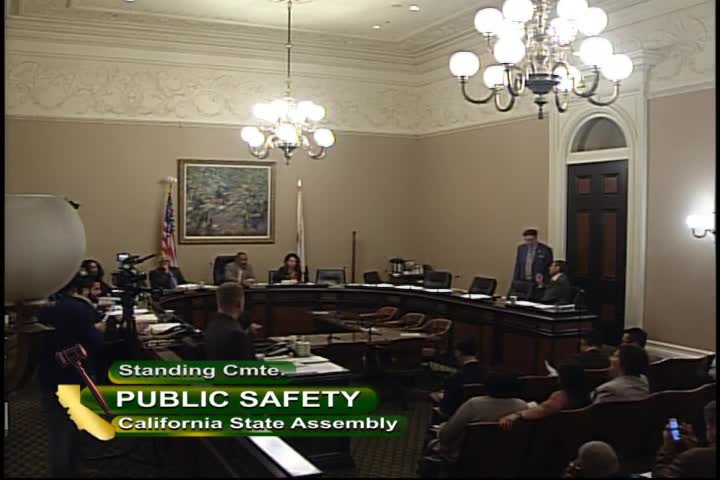 42MIN
Assembly Standing Committee on Public Safety
Bill Author

Bill Co-Author(s):