AB 2728: Replacement of corroded or lead-containing plumbing or service lines: loans.
- Session Year: 2017-2018
- House: Assembly
- Latest Version Date: 2018-02-15
Existing law, the Safe Drinking Water State Revolving Fund Law of 1997, establishes the Safe Drinking Water State Revolving Fund to provide grants or revolving fund loans for the design and construction of projects for public water systems that will enable those systems to meet safe drinking water standards.
This bill would, to the extent funding is made available, authorize the State Water Resources Control Board to establish a grant program to provide funding to a county or qualified nonprofit organization, as specified, to provide low-interest loans to defined property owners for the replacement of corroded or lead-containing plumbing and service lines that adversely impact drinking water standards or for the installation of a point-of-use or point-of-entry water treatment system, as specified. The bill would require a county or qualified nonprofit organization that receives a grant pursuant to these provisions to annually provide to the state board specified information relating to the loans awarded and projects funded. The bill would authorize the state board to use a funding source that is authorized for and consistent with the purposes of the program.
(a)To the extent that funding is made available, the state board may establish a grant program to provide funding to counties and qualified nonprofit organizations to provide low-interest loans to property owners for the replacement of corroded or lead-containing plumbing and service lines that adversely impact drinking water quality and, if replacement of corroded or lead-containing plumbing or service lines is not feasible or is cost-prohibitive, for the installation of a point-of-use or point-of-entry water treatment system.
(b)(1)To fund the program authorized in this section, the state board may use a funding source that is authorized for and consistent with the purposes of this section.
(2)The state board shall use reasonable and feasible efforts to secure local matching funds for the purposes of providing a grant pursuant to this section.
(3)The state board may advance funds pursuant to an agreement with a county or qualified nonprofit organization in accordance with this section. Section 11019 of the Government Code does not apply to an advance made pursuant to this paragraph.
(c)(1)A county or qualified nonprofit organization may apply to the state board for a grant to provide low-interest loans pursuant to this section.
(2)A county may enter into a contract with a private financial institution to provide loans consistent with the purposes of this section.
(3)The state board may award a grant to a qualified nonprofit organization only if it is located in a county that has not been awarded a grant pursuant to this section.
(d)A county or qualified nonprofit organization that receives a grant pursuant to this section shall annually provide the following information to the state board:
(1)The number of loans awarded.
(2)The types of projects funded.
(3)Project costs.
(4)Whether there is demand for additional funding.
(e)Any loan provided shall be secured by appropriate collateral, which may include a mortgage on the residence, and shall be repaid within 10 to 30 years in accordance with terms established by the state board. The interest rate on the loan shall not exceed 3 percent. Throughout the useful life of the improvement, a loan recipient shall furnish evidence of and continually maintain homeowners insurance on the security residence to protect the county or qualified nonprofit organizationss interest in the residence.
(f)The state board may adopt any guidelines it determines are necessary to carry out the purposes of this section. A guideline adopted pursuant to this subdivision shall not be subject to the rulemaking requirements of Chapter 3.5 (commencing with Section 11340) of Part 1 of Division 3 of Title 2 of the Government Code.
(g)As used in this chapter:
(1)Property owner means either of the following:
(A)An individual who meets all of the following requirements:
(i)Has a household income at or below 120 percent of the statewide median household income.
(ii)Has an ownership interest in the residence.
(iii)Is unable to obtain financial assistance at reasonable terms and conditions from private lenders and lacks the resources to undertake these improvements.
(iv)Demonstrates an ability to repay the loan. This requirement may be satisfied by having another party join the application as a cosigner.
(B)A local educational agency, to the extent authorized by law.
(2)Qualified nonprofit organization means an organization with experience in providing financial and technical assistance to disadvantaged communities and that is qualified to operate in California and is qualified for tax exempt status under Section 501(c)(3) of the Internal Revenue Code.
REVISIONS: HeadingLine 1.|
Date
|
Status
|
|---|---|
| May 25, 2018 | In committee: Held under submission. |
| May 2, 2018 | In committee: Set, first hearing. Referred to APPR. suspense file. |
| Apr 11, 2018 | From committee: Do pass and re-refer to Com. on APPR. (Ayes 7. Noes 0.) (April 10). Re-referred to Com. on APPR. |
| Mar 14, 2018 | Coauthors revised. |
| Mar 8, 2018 | Referred to Com. on E.S. & T.M. |
| Feb 16, 2018 | From printer. May be heard in committee March 18. |
| Feb 15, 2018 | Read first time. To print. |
|
Date
|
Description
|
Location
|
Votes
|
|
|---|---|---|---|---|
| Apr 10, 2018 | Do pass and be re-referred to the Committee on [Appropriations] | Assembly Standing Committee on Environmental Safety and Toxic Materials |
Passed |
This list shows positions taken on this bill by organizations on the date displayed, which is linked to the original source.
Positions by individuals are not included.
|
Organization
|
Position
|
Date
|
|---|---|---|
| California Apartment Association | ** Support | Apr 8, 2018 |
| California Association Of Realtors | ** Support | Apr 8, 2018 |
Date of Hearing: May 2, 2018
ASSEMBLY COMMITTEE ON APPROPRIATIONS
Lorena Gonzalez Fletcher, Chair
ABPCA Bill Id:AB 2728
Author:(Chen) – As Introduced Ver:February 15, 2018
Policy Committee: | Environmental Safety and Toxic Materials | Vote: | 7 - 0 |
|
| ||
|
|
Urgency: No State Mandated Local Program: No Reimbursable: No
SUMMARY:
This bill, to the extent funding is available, authorizes the State Water Resources Control Board (State Water Board) to establish a grant program for counties and qualified nonprofit organizations to provide low-interest loans to property owners for the replacement of lead-containing plumbing and service lines, or the installation of a point-of-use (POU) or point-of-entry (POE) water treatment systems. Additionally, this bill:
- Requires the State Water Board to use reasonable and feasible efforts to secure local matching funds. Authorizes the State Water Board to award a grant to a qualified nonprofit organization only if it is located in a county that has not received a grant.
- Authorizes the State Water Board to advance funds, as specified. Requires grant recipients to provide specified annual information to the State Water Board.
- Requires individual loans to be secured by appropriate collateral and to be repaid within 10 to 30 years. Prohibits the loan interest rate from exceeding 3%.
- Requires the State Water Board to develop guidelines for the grant program, but exempts the grant program from the Administrative Procedures Act.
- Defines property owner as either of the following:
- An individual who has a household income at or below 120% of the statewide median household income; has an ownership interest in the residence; is unable to obtain financial assistance at reasonable terms and conditions from private lenders and lacks the resources to undertake these improvements; and, demonstrates an ability to repay the loan.
- A local educational agency, to the extent authorized by law.
FISCAL EFFECT:
- Unknown annual cost pressures, likely in the millions of dollars, to fund the grant program (GF, bond, or other special fund).
- Unknown administrative costs, including one-time costs to develop grant guidelines, and ongoing costs in the range of 3% to 5% of the total amount available for grants (GF, bond, or other special fund).
COMMENTS:
- Purpose. According to the author, “Although the State Water Board has made attempts to combat water quality on private property, they have no existing authority to provide financial assistance for these purposes.”
This bill allows counties and qualified nonprofit organizations to receive grants from the State Water Board and then provide low-interest loans for the replacement of corroded or lead-containing plumbing or service lines, or if that is not feasible or cost-effective, the installation of a POU or POE water treatment system.
- Background. The most prevalent sources of lead in drinking water are from pipes, fixtures, and associated hardware from which lead can leach. According to “Lead in Drinking Water and Human Blood Levels in the United States”, published by the National Center for Environmental Health in 2012, nearly all lead in users' tap water does not come from the primary water source or from the municipal treatment plant, but is a result of corrosion resulting from materials containing lead coming into contact with water after it leaves the treatment plant. Lead can enter a building's drinking water by leaching from lead service connections, from lead solder used in copper piping, and from brass fixtures.
The amount of lead in tap water depends on several factors, including the age and material of the pipes, concentration of lead in water delivered by the public utility, and corrosiveness of the water. More corrosive water can cause greater leaching from pipes.
Costs to replace pipes and plumbing vary, depending on the amount of plumbing, location, and type of replacement plumbing. According to the National Association of Realtors, replacing old pipes in a 1,500 square foot, two-bathroom home costs $4,000 to $10,000. These costs can be prohibitive for many homeowners, especially those in low-income homeowners.
- Existing state financing programs. The State Water Board administers the Drinking Water State Revolving Fund (DWSRF), which is a self-perpetuating financial assistance program to assist public water systems in financing the cost of drinking water infrastructure projects needed to achieve or maintain compliance with the SDWA requirements.
Eligible applications for DWSRF funding include counties and nonprofit organizations, but the projects that would be eligible for grants under this bill would not be eligible for DWSRF funding. The author contends the bill is needed to address the hole in public financing available to individual property owners. However, the State Water Board indicates service lines are available for funding under the program regardless of ownership.
- Corroded v. Lead-Containing. This bill allows for grants to replace corroded or lead-containing plumbing or service lines. Corroded plumbing, such as fixtures and faucets, while a problem, are not necessarily a public health problem, and are likely not a state issue. One could argue, even lead-containing fixtures and faucets should be the responsibility of the individual property owner. Lead-containing service lines, which are a public health and state issue, as noted above, are currently eligible for DWSRF funds.
Analysis Prepared by: Jennifer Galehouse / APPR. / (916) 319-2081
Date of Hearing: April 10, 2018
ASSEMBLY COMMITTEE ON ENVIRONMENTAL SAFETY AND TOXIC MATERIALS
Bill Quirk, Chair
ABPCA Bill Id:AB 2728 (
Author:Chen) – As Introduced Ver:February 15, 2018
SUBJECT: Replacement of corroded or lead-containing plumbing or service lines: loans
SUMMARY: Authorizes the State Water Resources Control Board (State Water Board) to establish a grant program to provide funding for the replacement of corroded or lead-containing plumbing and service lines that adversely impact drinking water standards. Specifically, this bill:
- Authorizes the State Water Board, to the extent that funding is available, to establish a grant program to provide funding to counties and qualified nonprofit organizations to provide low-interest loans to property owners for the replacement of corroded or lead-containing plumbing and service lines that adversely impact drinking water quality and for the installation of a point-of-use (POU) or point-of-entry (POE) water treatment system if replacement of corroded or lead-containing plumbing or service lines is not feasible or is cost-prohibitive.
- Authorizes the State Water Board to use a funding source that is authorized for and consistent with the purposes of this grant program.
- Requires the State Water Board to use reasonable and feasible efforts to secure local matching funds for the purposes of providing a grant.
- Authorizes the State Water Board to advance funds pursuant to an agreement with a county or qualified nonprofit organization. Exempts this authorization from current law requiring advances to qualified nonprofit organizations not to exceed 25 percent of the annual allocation from being made during the fiscal year.
- Authorizes a county or qualified nonprofit organization to apply to the State Water Board for a grant to provide low-interest loans.
- Authorizes a county to enter into a contract with a private financial institution to provide loans.
- Authorizes the State Water Board to award a grant to a qualified nonprofit organization only if it is located in a county that has not been awarded a grant.
- Requires a county or qualified nonprofit organization that receives a grant under this program to annually provide the following information to the State Water Board:
- The number of loans awarded;
- The types of projects funded;
- Project costs; and,
- Whether there is demand for additional funding.
- Requires any loan to be secured by appropriate collateral, which may include a mortgage on the residence, and requires the loan to be repaid within 10 to 30 years in accordance with terms established by the State Water Board. Prohibits the interest rate on the loan from exceeding 3-percent.
- Requires a loan recipient to furnish evidence of and continually maintain homeowner's insurance on the security residence to protect the county or qualified nonprofit organization's interest in the residence throughout the useful life of the improvement.
- Authorizes the State Water Board to adopt guidelines it determines are necessary to carry out and establish this grant program.
- Defines "Property owner" as either of the following:
- An individual who has a household income at or below 120 percent of the statewide median household income; has an ownership interest in the residence; is unable to obtain financial assistance at reasonable terms and conditions from private lenders and lacks the resources to undertake these improvements; and, demonstrates an ability to repay the loan; or,
- A local educational agency, to the extent authorized by law.
- Defines "qualified nonprofit organization" as an organization with experience in providing financial and technical assistance to disadvantaged communities and that is qualified to operate in California and is qualified for tax exempt status under Section 501(c)(3) of the Internal Revenue Code.
EXISTING LAW:
- Requires, pursuant to the federal Safe Drinking Water Act (SDWA) and California SDWA, drinking water to meet specified standards for contamination (maximum contaminant levels (MCL)) as set by the United States Environmental Protection Agency (US EPA) or the State Water Board. (Health and Safety Code (HSC) § 116270)
- Provides, pursuant to authority under the federal Safe Drinking Water Act (SDWA) (42 U.S.C. Sec. 300j et seq.), for the establishment of a perpetual drinking water revolving fund, which will be partially capitalized by federal contributions. Authorizes California to enact the Safe Drinking Water State Revolving Fund (DWSRF) law to authorize the state to establish and implement a state drinking water revolving fund that will meet federal conditions for receipt of federal funds. (HSC § 116760.10 (a))
- Defines "lead free" in plumbing as not more than 0.2 percent lead when used with respect to solder and flux, not more than a weighted average of 0.25 percent when used with respect to the wetted surfaces of pipes and pipe fittings, plumbing fittings, and fixtures, and not more than 8 percent when used with respect to pipes and pipe fittings. (HSC § 116875(e)-(f))
- Requires, by July 1, 2018, a public water system to compile an inventory of known lead user service lines in use in its distribution system and identify areas that may have lead user service lines in use in its distribution system. (HSC § 116885 (a))
FISCAL EFFECT: Unknown.
COMMENTS:
Need for the bill: According to the author:
"In recent years, there have been reports of discolored water and lead-containing pipes and fixtures in private homes throughout California. In 2014, residents of the city of Gardena experienced a discoloration and odor of the drinking water in their homes. Water officials in Gardena said the problem was caused by aging infrastructure, including pipes that needed to be replaced. In 2016, the US EPA investigated reports of discolored water in the city of Fresno. Water officials said the source of discoloration was from corrosion found in galvanized pipes or lead-containing fixtures that were used to build these properties in the 1990s and 2000s. Parts of Northeast Fresno had water samples test at lead levels above the federal threshold requiring corrective action.
Though cities work with property owners to encourage them to make changes to the plumbing on their property that is likely the source of discoloration, there are few to no programs in place to assist property owners plumbing maintenance projects aimed at improving water quality on private property. Many of these property owners are unable to afford higher-interest, private loans for these purposes. Although the State Water Board has made attempts to combat water quality problems on private property, they have no existing authority to provide financial assistance for these purposes. By allowing the program to be administered locally, California can expect rapid improvements to dangerous water conditions in private homes throughout the state."
Lead in water: The most prevalent sources of lead in drinking water are from pipes, fixtures, and associated hardware from which the lead can leach. According to Lead in Drinking Water and Human Blood Levels in the United States, published by the National Center for Environmental Health in 2012, nearly all lead in users' tap water does not come from the primary water source or from the municipal treatment plant, but is a result of corrosion resulting from materials containing lead coming into contact with water after it leaves the treatment plant. Lead can enter a building's drinking water by leaching from lead service connections, from lead solder used in copper piping, and from brass fixtures.
The amount of lead in tap water can depend on several factors, including the age and material of the pipes, concentration of lead in water delivered by the public utility, and corrosiveness of the water. More corrosive water can cause greater leaching from pipes.
Flint, Michigan: Flint is located along the Flint River northwest of Detroit, Michigan. In April 2014, Flint switched its water supply from Lake Huron (via Detroit) to the Flint River. The Flint River water is corrosive (high pH and low salinity levels), which, absent a corrosion inhibitor additive, can erode the pipes or solder exposing lead. As a cost-saving measure, water officials opted not to add the corrosion inhibitor chemicals. The corrosive Flint River water caused lead from aging pipes to leach into the water supply, causing extremely elevated levels of lead.
As a result of the Flint lead crisis, the rest of the nation has become more cognizant of and eager to inventory and replace aging and potentially lead-bearing plumbing.
Federal lead testing requirements: In 1991, the US EPA adopted the Lead and Copper Rule (LCR), which established "action levels" for lead of 15 μg/L (0.015 mg/L). The LCR requires a public water system to test water at the tap at a sample of their customers served for lead levels. Sample sizes vary based on population served. For example, if a school serves between 500-3,300 students, its sample size under the LCR is 20 tap sites (water fountains). If more than 10 percent of the samples collected are at or above the action level for lead, it can trigger 'actions' that include public education, water quality parameter monitoring, corrosion control treatment, source water monitoring/treatment, public education, and lead service line replacement. The LCR requires lead samples to be collected every 6 months.
Given the relatively small sample sizes, the LCR is far from exhaustive for identifying lead pipes in residential plumbing.
Galvanized pipes: Galvanized pipes are steel pipes that have been dipped in a protective zinc coating to prevent corrosion and rust. Galvanized piping was commonly installed in homes built before 1960. When it was invented, galvanized pipe was an alternative to lead pipe for water supply lines. Today, however, we have learned that decades of exposure to water will cause galvanized pipes to corrode and rust on the inside.
Many galvanized pipes were dipped in molten, naturally occurring zinc. Naturally occurring zinc is impure, so these pipes were bathed in zinc that also contained lead and other impurities. The zinc coating elongated the life of the steel pipes, but added small amount of lead and other substances that could potentially be harmful. Any galvanized pipes ever connected to lead plumbing (including service lines) would create more cause for concern. The corrosion inside galvanized steel pipes could have trapped small pieces of the lead. Even if the lead plumbing was removed years ago, the galvanized steel pipes could still periodically release the trapped lead into the water flow.
The only way to ensure that lead is not mobilized from plumbing to a tap in a home is to fully replace the galvanized plumbing and any lead service lines.
Fresno: In 2018, residents in northeast Fresno reported discoloration of their water coming from corroded galvanized pipes. The homes that are in that area of the city are served by canal water processed by the city’s Northeast Surface Water Treatment plant. Unstable water chemistry in their galvanized pipes accelerated corrosion of the protective zinc layer on the inside of iron pipes. As a result, the water showed signs of iron and zinc, as well as the lead introduced through the zinc galvanizing process.
Since January, residents of 1,531 homes in northeast Fresno have submitted complaints or concerns about discolored water coming from their faucets, or asked for their water to be tested. The city is continuing to run tests on water samples from those homes.
In August 2017, the Fresno City Council banned zinc-coated metal (galvanized) pipe for plumbing in new residential and commercial construction and major renovation work. However, this ban does not help any resident that currently has galvanized pipes do anything about replacing those pipes.
Current lead service line replacement efforts: SB 1398 (Leyva, Chapter 731, Statutes of 2016) requires community water systems to compile an inventory of all known leaded service lines used in their systems, identify areas that may have lead service lines in use in their systems, and establish a timeline for replacing those known leaded service lines.
The requirements of SB 1398 do not extend to water lines (plumbing) on the customer’s side of the meter or the meter itself, but would include, for example, certain plumbing fixtures, like lead goose necks, associated with the user service line on the water system side of the meter.
If the water system determines that a lead service line is also on the customer side of the meter, the State Water Board highly recommends that the water system notify the customer of the lead service line and if possible, assist in the replacement.
Costs to replace galvanized plumbing: Costs to replace pipes and plumbing certainly vary, depending on the amount of plumbing, location, and type of plumbing with which its being replaced. According to the National Association of Realtors, replacing old pipes in a 1,500 square foot, two-bathroom home costs $4,000 to $10,000. These costs can be prohibitive to many homeowners, especially those in low-income and disadvantaged communities.
Existing state financing programs: The State Water Board administers the DWSRF, which is a self-perpetuating financial assistance program to assist public water systems in financing the cost of drinking water infrastructure projects needed to achieve or maintain compliance with the SDWA requirements.
Eligible applications for DWSRF funding include counties and nonprofit organizations, but the projects that would be eligible for grants under this bill would not be eligible for DWSRF funding. The author contends the bill is needed to address the hole in public financing available to individual property owners.
The Legislature has established precedent for creating state financing programs for individual home owners.
AB 277 (Mathis, Chapter 438, Statutes of 2017) authorizes the State Water Board to implement low-interest loan and grant programs for counties and qualified nonprofit organizations to fund water and wastewater facilities and improvements for households and small water systems, to the extent funds are available. To date, though, this has not been funded for implementation.
Treatment devices: AB 2728 would allow counties and qualified nonprofit organizations that received grants from the State Water Board to provide low-interest loans for the installation of a POU and POE water treatment system if replacement of corroded or lead-containing plumbing or service lines is not feasible or is cost-prohibitive.
POU water treatment units are designed to treat small amounts of drinking water for use in the home. These devices can sit on the counter, attach to the faucet, or be installed under the sink. They differ from POE devices, which are installed on the water line as it enters the home and treats all the water in the building.
There are several POU devices on the market that treat for lead, including reverse-osmosis devices, usually installed underneath the sink; distillers, which can sit on top of a counter; tap filters; under-sink filters; and, countertop filters, which typically have a hose that attaches to the faucet. Likewise, POE technologies, including Reverse Osmosis and Cation Exchange, are available for use to treat lead.
However, as it relates to POE use for water treatment, the US EPA's April 2006 report Point-of-Use or Point-of-Entry Treatment Options for Small Drinking Water Systems states that, "Unit installation can be a complicated and time-consuming process, particularly for POE devices. Improper installation can lead to unit malfunction, a decrease in the unit’s effective life, leaks, and difficulties with maintenance and sampling."
Therefore, the author may wish to consider including requirements in the bill, or suggest the State Water Board include requirements in any subsequent regulations adopted pursuant to this bill, that a county or qualified nonprofit providing POE treatment devices install and monitor them appropriately.
Related legislation: AB 277 (Mathis, Chapter 438, Statutes of 2017). Authorizes the State Water Board to establish the Water and Wastewater Loan and Grant Program to provide funding to eligible applicants for drinking water and wastewater treatment improvements. Authorizes a county or qualified nonprofit organization to apply to the board for a grant to award loans or grants, or both, to an eligible applicant.
REGISTERED SUPPORT / OPPOSITION:
Support
California Apartment Association
California Association of Realtors
Opposition
None on file.
Analysis Prepared by: Paige Brokaw / E.S. & T.M. /
Discussed in Hearing
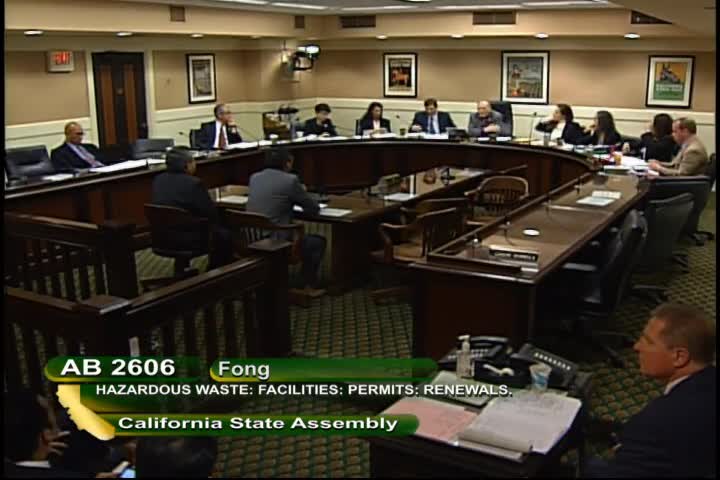 4MIN
Assembly Standing Committee on Environmental Safety and Toxic Materials


Bill Co-Author(s):