AB 775: Vote by mail ballots.
- Session Year: 2017-2018
- House: Assembly
- Latest Version Date: 2017-02-15
Existing law requires that all vote by mail ballots cast be received by the elections official from whom they were obtained or by the precinct board no later than the close of the polls on election day or no later than 8 p.m. on election day, as specified.
Notwithstanding this requirement, existing law provides that a vote by mail ballot is considered timely cast if it is received by the voters election official via the United States Postal Service or a bona fide private mail delivery company, as defined, no later than 3 days after election day if a specified requirement is met.
This bill would additionally require that a ballot delivered to the elections official by a bona fide private mail delivery company include documentation that the company received the ballot on or before election day.
(a)All vote by mail ballots cast under this division shall be received by the elections official from whom they were obtained or by the precinct board no later than the close of the polls on election day.
(b)Notwithstanding subdivision (a), any vote by mail ballot cast under this division shall be timely cast if it is received by the voters elections official via the United States Postal Service or a bona fide private mail delivery company no later than three days after election day and either of the following is satisfied:
(1)The ballot is postmarked on or before election day or is time stamped or date stamped by a bona fide private mail delivery company on or before election day.
(2)If the ballot has no postmark, a postmark with no date, or an illegible postmark, the vote by mail ballot identification envelope is date stamped by the elections official upon receipt of the vote by mail ballot from the United States Postal Service or a bona fide private mail delivery company, and is signed and dated pursuant to Section 3011 on or before election day.
(c)In addition to the requirements of subdivision (b), a ballot delivered to the elections official by a bona fide private mail delivery company shall include documentation that the company received the ballot on or before election day.
(c)(d)For purposes of this section, bona fide private mail delivery company means a courier service that is in the regular business of accepting a mail item, package, or parcel for the purpose of delivery to a person or entity whose address is specified on the item.
SEC. 2.Section 4103 of the Elections Code is amended to read:4103.(a)Notwithstanding Section 3020, ballots cast under this chapter shall be returned to the elections official from whom they were obtained no later than 8 p.m. on election day.
(b)Notwithstanding subdivision (a), any vote by mail ballot cast under this chapter shall be timely cast if it is received by the voters elections official via the United States Postal Service or a bona fide private mail delivery company no later than three days after election day and either of the following is satisfied:
(1)The ballot is postmarked on or before election day or is time stamped or date stamped by a bona fide private mail delivery company on or before election day.
(2)If the ballot has no postmark, a postmark with no date, or an illegible postmark, the vote by mail ballot identification envelope is date stamped by the elections official upon receipt of the vote by mail ballot from the United States Postal Service or a bona fide private mail delivery company, and is signed and dated pursuant to Section 3011 on or before election day.
(c)In addition to the requirements of subdivision (b), a ballot delivered to the elections official by a bona fide private mail delivery company shall include documentation that the company received the ballot on or before election day.
(c)(d)For purposes of this section, bona fide private mail delivery company means a courier service that is in the regular business of accepting a mail item, package, or parcel for the purpose of delivery to a person or entity whose address is specified on the item.
REVISIONS: HeadingLine 2.|
Date
|
Status
|
|---|---|
| Feb 1, 2018 | From committee: Filed with the Chief Clerk pursuant to Joint Rule 56. |
| Jan 31, 2018 | Died pursuant to Art. IV, Sec. 10(c) of the Constitution. |
| May 10, 2017 | In committee: Set, first hearing. Failed passage. Reconsideration granted. |
| Apr 5, 2017 | Coauthors revised. |
| Mar 2, 2017 | Referred to Com. on E. & R. |
| Feb 16, 2017 | From printer. May be heard in committee March 18. |
| Feb 15, 2017 | Read first time. To print. |
|
Date
|
Description
|
Location
|
Votes
|
|
|---|---|---|---|---|
| May 10, 2017 | Reconsideration. | Assembly Standing Committee on Elections and Redistricting |
Passed |
|
| May 10, 2017 | Do pass. | Assembly Standing Committee on Elections and Redistricting |
Failed |
This list shows positions taken on this bill by organizations on the date displayed, which is linked to the original source.
Positions by individuals are not included.
|
Organization
|
Position
|
Date
|
|---|---|---|
| ACLU of California | * Against | May 10, 2017 |
| Election Integrity Project | * Support | May 10, 2017 |
| Howard Jarvis Taxpayers Association | * Support | May 10, 2017 |
Date of Hearing: May 10, 2017
ASSEMBLY COMMITTEE ON ELECTIONS AND REDISTRICTING
Marc Berman, Chair
ABPCA Bill Id:AB 775 (
Author:Harper) – As Introduced Ver:February 15, 2017
SUBJECT: Vote by mail ballots.
SUMMARY: Requires a vote by mail (VBM) ballot envelope delivered to an elections official by a bona fide private mail delivery company to include documentation that the company received the ballot on or before election day in order for the ballot to be counted in order for the ballot to be counted.
EXISTING LAW:
- Provides that a VBM ballot is timely cast if it is received by the voter's elections official via the United States Postal Service (USPS) or a bona fide private mail delivery company no later than three days after election day and either of the following is satisfied:
- The ballot is postmarked or is time stamped or date stamped by a bona fide private mail delivery company on or before election day; or,
- If the ballot has no postmark, a postmark with no date, or an illegible postmark, the VBM ballot identification envelope is date stamped by the elections official upon receipt of the VBM ballot from the USPS or a bona fide private mail delivery company, and is signed and dated by the voter on or before election day.
- Defines "bona fide private mail delivery company," for the purposes of these provisions, to mean a courier service that is in the regular business of accepting a mail item, package, or parcel for the purpose of delivery to a person or entity whose address is specified on the item.
- Requires a VBM ballot identification envelope to include specified information, including the following:
- A declaration, under penalty of perjury, stating that the voter resides within the precinct in which he or she is voting and is the person whose name appears on the envelope;
- The signature of the voter; and,
- The date of signing.
- Permits a VBM voter who is unable to return his or her ballot to designate any person to return the ballot to the elections official from whom it came or to a precinct board before the close of the polls on election day. Prohibits a designated person from receiving any form of compensation based on the number ballots that person returns, as specified.
- Provides that any person in charge of a VBM ballot who knowingly and willingly engages in criminal acts related to that ballot as described under current law, including, but not limited to, fraud, bribery, intimidation, and tampering with or failing to deliver the ballot in a timely fashion, is subject to the appropriate punishment pursuant to existing law.
FISCAL EFFECT: None. This bill is keyed non-fiscal by the Legislative Counsel.
COMMENTS:
- Purpose of the Bill: According to the author:
Assembly Bill (AB) 775 will require courier services that deliver vote-by-mail (VBM) ballots to elections officials after an election, to provide documentation that they received the ballot from the voter on or before Election Day.
The Legislature passed SB 29 (Correa) in 2014 to allow elections officials to count VBM ballots that arrive up to three days after the election, even if they are not post-marked. The bill also allows non-postal service third parties to deliver VBM ballots after the election, including ballots with no postmark or other documentation to prove that they were voted on or before Election Day.
Elections experts agree that VBM ballots are far more susceptible to fraud than traditional ballots, due to the separation of both ballot and voter from the polling place. Rick Hasen, the Chancellor’s Professor of Law at the U.C. Irvine School of Law, has noted that a smart way to steal an election “is through the sale of absentee ballots. That transaction can be done in private. The person buying the ballots can buy blank ones from cheating voters, then cast the votes herself. … It is easy to find cases throughout the country every year of fraud or attempted fraud with absentee ballots.”
Unfortunately, the lack of a postmark requirement in SB 29 opened the door for unscrupulous political operatives, in elections where the results are very close, to purchase unvoted VBM ballots after Election Day and deliver them to elections officials in order to cast the deciding votes. Ironically, the author of SB 29 subsequently claimed that he himself was the victim of a VBM fraud scheme after he narrowly lost an election for local office in 2015. Other cases of organized VBM ballot fraud have been noted in recent years in the cities of Compton, Bell, and East Hollywood, California.
In 2016, the Legislature partially remedied the flaws of SB 29 by passing AB 2071 (Harper) to specify that elections officials may accept VBM ballots from non-postal third parties after Election Day only if they are courier services in the regular business of accepting and delivering mail and parcels.
Assembly Bill 775 will go one step further to ensure that no fraudulent post-election ballots are added to the count, by requiring these courier services to also provide documentation that they received the ballot from the voter on or before Election Day.
- VBM Ballot Fraud Allegations: While the author has indicated that there have been allegations of VBM ballot fraud in certain jurisdictions, the author has not provided the committee with any evidence to substantiate that voter fraud of the type that would be prevented by requiring bona fide private mail delivery companies to include documentation that the company received the ballot on or before election day. Furthermore, committee staff is not aware of any cases of VBM fraud with bona fide private mail delivery companies that have been prosecuted.
- "Postmark Plus Three" and Previous Legislation: In 2014, the Legislature approved and the Governor signed SB 29 (Correa), Chapter 618, Statutes of 2014, which allowed VBM ballots to be counted if they were cast by election day and received by the elections official by mail no later than three days after the election. Specifically, SB 29 provides that any VBM ballot is timely cast if it is received by the voter's elections official via the USPS or a bona fide delivery company not later than three days after election day, as specified. Prior to the enactment of SB 29, VBM ballots in California could be counted only if they were received by the elections official by election day.
SB 29 was introduced in response to the fact that an increasing number of VBM ballots that were returned to elections officials were arriving too late to be counted. Furthermore, given a number of recently enacted and planned USPS facility closures, there was a fear that the number of ballots arriving too late to be counted would continue to rise. According to a September 2014 report by the California Civic Engagement Project at the University of California at Davis Center for Regional Change, nearly 69,000 VBM ballots that were received by county election offices in California for the November 2012 general election were rejected during ballot processing, with 47.8 percent of uncounted ballots being rejected because they arrived too late. Arriving late was the number one reason why a VBM ballot was rejected.
Last year the Legislature passed and the Governor signed AB 2071 (Harper), Chapter 225, Statutes of 2016, which defined the term "bona fide private mail delivery company" for the purposes of a VBM ballot received after election day. Specifically, AB 2071 defined a "bona fide private mail delivery company" to mean a courier service that is in the regular business of accepting a mail item, package, or parcel for the purpose of delivery to a person or entity whose address is specified on the item. According to the author's statement, the goal of AB 2071 was to "protect the integrity of California's election system by providing that only legitimate courier services that are in the regular business of delivering parcels may handle and deliver VBM ballots on behalf of voters after Election Day…[AB 2071] will ensure that only legitimate votes are counted, and that no California voter is disenfranchised by the counting of ballots that have been illegally harvested or tampered with in the days following an election."
The author's office contends the definition of bona fide private mail delivery company placed into law last year is insufficient and as a result, further requirements are needed. This bill requires a bona fide private mail delivery company that delivers a VBM envelope to an elections official to present documentation that the company received the ballot on or before election day. If the bona fide private mail delivery company is unable to show documentation that the company received the ballot on or before election day the ballot will not be counted. The practical effect of this bill is that a ballot will not be counted and a voter will be disenfranchised due to circumstances that are out of the voter's control. - Logistical Issues: As mentioned above, this bill requires a VBM envelope delivered to an elections official by a bona fide private mail delivery company to present documentation that the company received the ballot on or before election day. According to the author's office, documentation is supposed to mean a date stamp or time stamp or some sort of receipt that the bona fide private mail delivery company can present to the elections officials that proves there is a record that shows the voter's request for delivery was made on or before election day. The bill, however, does not provide any guidance or detail on what constitutes satisfactory documentation. Without any guidance, it is conceivable that ballots will be treated differently across the state.
Furthermore, according to the author's office the intent of the bill is to apply to VBM ballots delivered by bona fide private mail delivery company that does not have a postmark or has an illegible postmark. As written, the bill, however, can be interpreted to apply to all ballots delivered by a bona fide private mail delivery company, regardless of whether the ballot does or does not have a postmark, or date or time stamp on or before election day. - VBM Ballot Deadlines in Other States: Each state has its own deadlines for the return of VBM ballots. In some states, the deadline varies depending on whether the individual submitting the ballot is a civilian living in the United States (US), or a military or overseas voter covered under the Uniformed and Overseas Citizens Absentee Voting Act (UOCAVA).
According to information from the National Association of Secretaries of State, for the 2014 general election, three states required mail ballots from civilians living in the US to be returned prior to election day in order to be counted, while 36 states (including California at the time) required such ballots to be received by election day. Eleven states and the District of Columbia allowed mail ballots from civilians living in the US to arrive after election day and still be counted.
For active duty military and overseas citizens who are covered under UOCAVA, for the 2014 general election, 28 states (including California at the time) required ballots to be received by election day. Twenty-two states and the District of Columbia allowed VBM ballots from at least some voters who are covered under UOCAVA to arrive after election day and still be counted.
In all, 22 states and the District of Columbia allow VBM ballots from at least some voters to arrive after election day and be counted. Among the jurisdictions that allow ballots received after election day to be counted, at least 14 appear to allow ballots that lack legible postmarks to be counted, and some jurisdictions even allow ballots to be counted if they are postmarked after election day, provided that the ballot is dated on or before election day by the voter.
- Arguments in Support: In support, the Howard Jarvis Taxpayers Association writes:
The integrity of vote by mail ballots has been an ongoing issue of concern to HJTA. While we don’t desire to see any eligible voter disenfranchised, there also needs to be a straight-forward way to determine which ballots should actually be counted. The Legislature created this ambiguity when they approved SB 29 (Correa, 2014). That bill allowed absentee ballots to be counted as long as they were received three days after an election, even if they had an illegible or non-existent postmark. AB 2071 resolved some of this problem by allowing vote by mail ballots to be submitted by courier services who regularly deliver parcels. AB 775 expands these provisions by requiring courier services to provide documentation that the ballots were received on Election Day. This provision is important if the chain of custody for absentee ballots is to be protected.
- Arguments in Opposition: In opposition, the American Civil Liberties Union of California writes:
California Elections Code Section 3020(b)(1) already requires a ballot delivered by a bona fide private mail delivery company to be time-stamped or date-stamped on or before Election Day in order to be accepted. AB 775 does not specify what additional documentation would need to accompany these ballots in addition to the required time or date stamp. This may lead to confusion over how to treat these ballots, and different counties may apply different documentation standards throughout the state. The confusion could lead to voter disenfranchisement. Further, we are aware of no policy justification to merit this additional burden on vote-by-mail voters.
- Previous Legislation: AB 2071 (Harper), Chapter 225, Statues of 2016, defined the term "bona fide private mail delivery company" for the purposes of a VBM ballot received after election day, as specified.
AB 1271 (Grove) of 2015, would have required the disqualification of VBM ballots that were received after election day if those ballots were delivered by a bona fide private mail delivery company or if those ballots had no postmark, a postmark with no date, or an illegible postmark, as specified. AB 1271 failed passage in this committee on a 3-4 vote.
REGISTERED SUPPORT / OPPOSITION:
Support
Election Integrity Project, California, Inc.
Howard Jarvis Taxpayers Association
Opposition
American Civil Liberties Union of California
Analysis Prepared by: Nichole Becker / E. & R. / (916) 319-2094
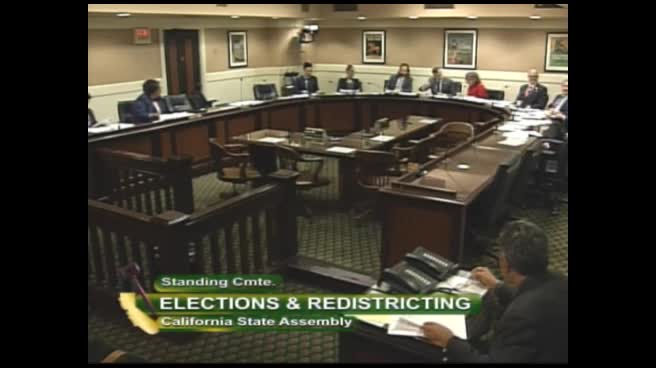
Discussed in Hearing
 9MIN
Assembly Standing Committee on Elections and Redistricting
Bill Author