SB 1044: State Responsibility Area Fire Prevention Fees.
- Session Year: 2017-2018
- House: Senate
- Latest Version Date: 2018-02-08
Existing law provides that the state has the primary financial responsibility for preventing and suppressing fires in areas that the State Board of Forestry and Fire Protection has determined are state responsibility areas, as defined. Existing law until July 1, 2017, required that a fire prevention fee be charged on each habitable structure on a parcel that is within a state responsibility area, to be used for specified fire prevention activities, and prescribed procedures for the collection and processing of the fees by the California Department of Tax and Fee Administration. Existing law repeals those provisions requiring the payment of the fee on January 1, 2031.
This bill would instead repeal those provisions on January 1, 2019. The bill would also require the California Department of Tax and Fee Administration, no later than January 1, 2020, to develop and implement a process for providing for refunds of any fire prevention fees collected by the department, commencing in the 2011-2012 fiscal year until July 1, 2017, from each owner of a habitable structure located in a state responsibility area pursuant to those provisions. The bill would also require the department to adopt regulations setting forth requirements for the application, review, and refund of those fees paid by the owner of a habitable structure, as provided.
This chapter shall remain in effect only until January 1, 2031, 2019, and as of that date is repealed, unless a later enacted statute that is enacted on or before January 1, 2031, 2019, deletes or extends that date.
SEC. 2.Chapter 1.6 (commencing with Section 4230) is added to Part 2 of Division 4 of the Public Resources Code, to read:1.6.Fire Prevention Fee Refund4230.(a)The California Department of Tax and Fee Administration shall, no later than January 1 2020, develop and implement a process for providing for a refund of any fire prevention fees collected by the department, commencing in the 2011-12 fiscal year until July 1, 2017, from each owner of a habitable structure located in a state responsibility area pursuant to Chapter 1.5 (commencing with Section 4210).
(b)The department shall adopt regulations setting forth requirements for the application, review, and refund of any fee paid by the owner of a habitable structure as provided in subdivision (a).
|
Date
|
Status
|
|---|---|
| Apr 18, 2018 | April 18 hearing: Testimony taken. Hearing postponed by committee. |
| Apr 6, 2018 | Set for hearing April 18. |
| Feb 22, 2018 | Referred to Com. on GOV. & F. |
| Feb 9, 2018 | From printer. May be acted upon on or after March 11. |
| Feb 8, 2018 | Introduced. Read first time. To Com. on RLS. for assignment. To print. |
This list shows positions taken on this bill by organizations on the date displayed, which is linked to the original source.
Positions by individuals are not included.
|
Organization
|
Position
|
Date
|
|---|---|---|
| Boe Chairman George Runner, Howard Jarvis Taxpayers Association. | ** Support | Apr 13, 2018 |
| Howard Jarvis Taxpayers Association | * Support | Apr 18, 2018 |
| Unknown. | ** Against | Apr 13, 2018 |
SENATE COMMITTEE ON GOVERNANCE AND FINANCE
Senator Mike McGuire, Chair
2017 - 2018 Regular
Bill No: | SB 1044 | Hearing Date: | 4/18/18 |
Author: | Berryhill | Tax Levy: | No |
Version: | 2/8/18 | Fiscal: | Yes |
Consultant: | Grinnell | ||
State Responsibility Area Fire Prevention Fees
Requires CDTFA to develop and implement a process for providing a refund of any previously imposed SRA Fees.
Background
The California Department of Forestry and Fire Protection (CALFIRE) provides wildland fire protection on non-federal lands outside cities. To meet this duty, every five years, the State Board of Forestry and Fire Protection classifies all lands within the state for the purpose of determining areas in which the financial responsibility of preventing and suppressing fires is primarily the responsibility of the state (these areas are known as “state responsibility areas” or “SRAs”)
In 2010, the Legislature imposed a fee on owners of structures in SRAs to pay for the state’s costs of protecting them against fires, and directed the State Board of Equalization (now the California Department of Tax and Fee Administration, or CDTFA) to collect it, commencing in the 2011-12 fiscal year (ABx1 29, Blumenfield). Owners of habitable structures in SRAs were liable for the fee within 30 days of receiving BOE’s assessment, which totaled $152.33 per structure from 2014 to 2017. If the habitable structure is also within the boundaries of a local agency that provides fire protection services, the property owner receives a $35.00 reduction for each habitable structure.
SRA fees were deposited in the State Responsibility Area Fire Prevention Fund, which is available to the Board and CDF to expend for fire prevention activities that benefit the owners of structures within the SRA who are required to pay the fee. Authorized fire prevention activities are limited to:
- Local assistance grants established by the Board;
- Grants to Fire Safe Councils, the California Conservation Corps, or certified local conservation corps for fire prevention projects and activities in the SRA;
- Grants to a qualified nonprofit organization with a demonstrated ability to satisfactorily plan, implement, and complete a fire prevention project applicable to the SRA;
- Inspections by CALFIRE for compliance with defensible space requirements around structures in the SRA;
- Public education to reduce fire risk in the SRA;
- Fire severity and fire hazard mapping by CALFIRE in the SRA; and
- Other fire prevention projects in the SRA that are authorized by the Board.
Last year, the Legislature suspended the SRA fee for ten years, effective for the 2017-18 fiscal year, and set a repeal date of January 1, 2031, as part of legislation extending and modifying the Global Warming Solutions Act of 2009 (AB 398, E. Garcia). The author wants CDTFA to create a process to refund all previously collected SRA fees.
Proposed Law
Senate Bill 1044 requires CDTFA to develop and implement a process for providing a refund of any SRA fees collected from the 2011-12 fiscal year until July 1, 2017. CDTFA must adopt regulations setting forth requirements for the application, review, and refund of any fee paid by the owner of a habitable structure.
State Revenue Impact
No estimate.
Comments
1. Purpose of the bill. According to the author, “Legislation in 2011 required the Board of Forestry to establish a ‘fee’ of up to $150 on inhabited structures within the State’s Responsibility Area to pay for fire prevention activities. Pursuant to Proposition 26, this new ‘fee’ should have been deemed a tax requiring a 2/3 vote because it supports general purpose programs such as public education, fuels management on public land, and ‘other prevention projects.’ Not only was this tax unfair to the homeowners who pay it, as their special tax revenue goes to supporting homeowners who don’t pay the tax, but it was approved through an unconstitutional vote threshold. Last year, as part of the cap and trade extension, the tax was suspended through January 1, 2031, at which time it would be repealed. However, there’s nothing to prevent future Legislatures from revoking the suspension before then. This bill would not only repeal the tax officially, effective Jan. 1, 2019, but it would also task the California Department of Tax and Fee Administration to develop and implement a process for providing for refunds of any fire prevention fees collected by the department, commencing in the 2011-2012 fiscal year until July 1, 2017. Since the fire tax is unconstitutional, the refund does not constitute a gift of state funds.”
2. Free ride. AB 398 suspended SRA fees, effective July 1, 2017, and repeals it on January 1, 2031. As a result, CDTFA won’t be sending out any future bills, but SRA fees imposed during the period in which the law was effective remain due and payable. SB 1044 repeals SRA fees retroactive to its enactment, and directs CDTFA to develop and implement a process to refund all of them. CALFIRE reports that a total of $484,006,809 in SRA fees have been collected since the Legislature enacted the program, most of which has already been spent on its specified purposes. While the SRA fee has been more administratively problematic, and arguably less fair, than other state taxes and fees, the funds to pay SB 1044’s would have to come from somewhere. The Committee may wish to consider whether redirecting funds from other state purposes to pay SRA fee refunds is merited.
3. Missing parts. In 1990, the Legislature enacted the smog impact fee, seeking to pay for the pollution caused by out-of-state vehicles, whuch generated approximately $50 million per year, (AB 1109, Katz). In October 1999, the Third District of the California Court of Appeals ruled in Jordan v. Department of Motor Vehicles (DMV), 75 Cal.App.4th 449, that the smog impact fee unconstitutionally discriminated against interstate commerce, as a similar fee did not apply to in-state motorists. In response, the Legislature enacted SB 215 (Karnette, 1999) and AB 809 (Lowenthal, 1999), which set forth a comprehensive structure for the state to issue refunds. The measures:
- Made legislative findings and declarations,
- Repealed the fee,
- Required DMV to search its records to identify everyone who paid the fee, notify them that he or she was owed a refund, and include a form to return to DMV verifying their refund eligibility,
- Pay a refund to individuals who completed the form of fees and penalties paid, with interest,
- Created the Smog Impact Fee Refund Account to pay refunds, and appropriated almost $665 million from the General Fund to the Account to do so, plus $11 million for DMV’s administrative costs.
While the measure directs CDTFA to issue regulations to implement the bill, SB 1044 contains neither an appropriation, nor the other administrative provisions necessary the last time the state was compelled to issue refunds. To the extent that refunding previously paid fees is desirable, CDTFA could not actually implement the measure’s direction to pay refunds without an appropriation.
4. Absolution. As mentioned above, SRA fees imposed during the period in which the law was effective remain due and payable. SB 1044 would cancel the liability of anyone who failed to pay the SRA fee of their liability, and are now delinquent, as of January 1, 2019. The Committee may wish to consider the precedent set by legislative absolution of delinquent taxes.
5. Stay tuned. The SRA Fee has been controversial since enactment, and has given rise to several bills to repeal, reduce, or modify the fee. Additionally, the Howard Jarvis Taxpayers’ Association (HJTA) filed suit against CALFIRE arguing that the SRA fee is a tax, and therefore invalid because the Legislature approved ABx1 29 by majority vote, not a 2/3 vote as required by Section Three of Article XIIIA of the California Constitution for taxes. HJTA and BOE Members have told SRA fee payers to file petitions for redetermination to preserve eligibility for a refund should the Court rule in their favor, and note on the check that the fee is paid “under protest.” While the Sacramento Superior Court dismissed the case in December, 2017, HJTA plans on appealing this decision. If HJTA eventually prevails in court, the Legislature may be compelled to issue refunds similar to the smog impact fee.
Support and Opposition
(4/13/18)
Support: BOE Chairman George Runner, Howard Jarvis Taxpayers Association.
Opposition: Unknown.
-- END --
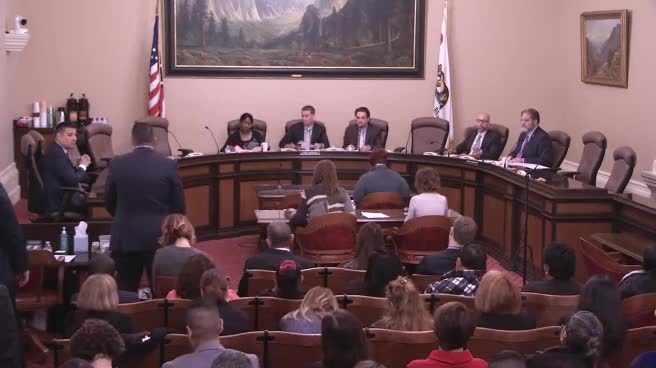
Discussed in Hearing
 6MIN
Senate Standing Committee on Governance and Finance
Bill Author