SB 1049: Public contracts: local public entities: project labor agreements.
- Session Year: 2017-2018
- House: Senate
- Latest Version Date: 2018-02-08
Existing law sets forth the requirements for the solicitation and evaluation of bids and the awarding of contracts by public entities and requires a project labor agreement for a construction project used or entered into by a public entity, or required of contractors by the public entity, to include specified provisions.
Existing law authorizes members of the governing board of a local public entity to choose by majority vote whether to use, enter into, or require contractors to enter into such a project labor agreement for a specific project or projects awarded by that entity and whether to allocate funding to a specific project covered by such an agreement. Existing law prohibits a charter provision, initiative, or ordinance from preventing the governing board of a local public entity, other than a charter city, from exercising this authority on a project-specific basis.
Existing law prohibits the use of state funding or financial assistance to support a charter city project if a charter provision, initiative, or ordinance prohibits the governing boards consideration of such a project labor agreement for the project or prohibits the governing board from considering whether to allocate funds to a city-funded project covered by such an agreement. Existing law also prohibits the use of state funding or financial assistance to support any construction projects awarded by a charter city if a charter provision, initiative, or ordinance prohibits, limits, or constrains in any way the governing boards consideration of authority or discretion to adopt, require, or utilize such a project labor agreement for some or all of the construction projects to be awarded by the city, as specified.
This bill would delete all of the above prohibitions.
The members of the governing board of a local public entity may choose by majority vote whether to use, enter into, or require contractors to enter into a project labor agreement that includes all the taxpayer protection provisions of Section 2500 for a specific project or projects awarded by that entity and whether to allocate funding to a specific project covered by such an agreement. A charter provision, initiative, or ordinance shall not prevent the governing board of a local public entity, other than a charter city, from exercising this authority on a project-specific basis.
SEC. 2.Section 2502 of the Public Contract Code is repealed.2502.If a charter provision, initiative, or ordinance of a charter city prohibits the governing boards consideration of a project labor agreement that includes all the taxpayer protection provisions of Section 2500 for a project to be awarded by the city, or prohibits the governing board from considering whether to allocate funds to a city-funded project covered by such an agreement, then state funding or financial assistance shall not be used to support that project. This section shall not be applicable until January 1, 2015, for charter cities in which a charter provision, initiative, or ordinance in effect prior to November 1, 2011, would disqualify a project from receiving state funding or financial assistance.SEC. 3.Section 2503 of the Public Contract Code is repealed.2503.If a charter provision, initiative, or ordinance of a charter city prohibits, limits, or constrains in any way the governing boards authority or discretion to adopt, require, or utilize a project labor agreement that includes all the taxpayer protection provisions of Section 2500 for some or all of the construction projects to be awarded by the city, then state funding or financial assistance shall not be used to support any construction projects awarded by the city. This section shall not be applicable until January 1, 2015, for charter cities in which a charter provision, initiative, or ordinance in effect prior to November 1, 2011, would disqualify a construction project from receiving state funding or financial assistance.|
Date
|
Status
|
|---|---|
| Apr 25, 2018 | April 25 set for first hearing. Failed passage in committee. (Ayes 2. Noes 4. Page 3910.) Reconsideration granted. |
| Apr 10, 2018 | Set for hearing April 25. |
| Feb 22, 2018 | Referred to Com. on GOV. & F. |
| Feb 9, 2018 | From printer. May be acted upon on or after March 11. |
| Feb 8, 2018 | Introduced. Read first time. To Com. on RLS. for assignment. To print. |
|
Date
|
Description
|
Location
|
Votes
|
|
|---|---|---|---|---|
| Apr 25, 2018 | [04-25-2018] hearing: Motion to Reconsider. [Reconsideration Granted.] | Senate Standing Committee on Governance and Finance |
Passed |
|
| Apr 25, 2018 | Do pass, but first be re-referred to the Committee on [Appropriations] | Senate Standing Committee on Governance and Finance |
Failed |
This list shows positions taken on this bill by organizations on the date displayed, which is linked to the original source.
Positions by individuals are not included.
|
Organization
|
Position
|
Date
|
|---|---|---|
| Associated Builders and Contractors | * Against | Apr 25, 2018 |
| Estate Building and Construction Trades Council | * Against | Apr 25, 2018 |
| Labor Issue Solutions | * Support | Apr 25, 2018 |
| Western Electrical Contractors Association | * Support | Apr 25, 2018 |
SENATE COMMITTEE ON GOVERNANCE AND FINANCE
Senator Mike McGuire, Chair
2017 - 2018 Regular
Bill No: | SB 1049 | Hearing Date: | 4/25/18 |
Author: | Moorlach | Tax Levy: | No |
Version: | 2/8/18 | Fiscal: | Yes |
Consultant: | Favorini-Csorba | ||
Public contracts: local public entities: project labor agreements
Allows local agencies to adopt bans on project labor agreements and repeals the prohibition on the use of state funds for city projects by charter cities that have adopted project labor agreement bans.
Background
A project labor agreement (PLA) is an agreement that a construction project’s managers and its workers complete before a project starts. PLAs establish the wage rates and benefits of all employees working on the project and prevent strikes, lockouts, or other work stoppages during the project. The terms of the agreement apply to all contractors and subcontractors, union or non-union, who successfully bid on the project, and supersede any existing collective bargaining agreements.
Generally, the Local Agency Public Construction Act requires local officials to invite bids for construction projects and then award contracts to the lowest responsible bidder. Some critics of PLAs want to ban their use for public construction projects, arguing that PLA requirements are inconsistent with the principle of awarding public contracts to the lowest bidder. In recent years, voter-approved initiatives have banned PLAs in San Diego County and in the Cities of Chula Vista, Oceanside, and San Diego. Ordinances adopted by the Fresno City Council, and Boards of Supervisors in Orange County, Placer County, and Stanislaus County have also banned PLAs.
In response to local bans on PLAs, the Legislature enacted SB 922 (Steinberg, 2011). SB 922 authorizes a local public entity’s governing board to choose by majority vote whether to use, enter into, or require contractors to enter into a PLA that includes required taxpayer protection provisions for a specific project or projects awarded by that entity. Local governments’ governing boards can choose whether to allocate funding to a specific project covered by such a PLA. SB 922 prohibits any charter provision, initiative, or ordinance that prevents the local public entity’s governing board from exercising this authority on a project-specific basis, except in charter cities. When SB 922 took effect on January 1, 2012, it eliminated counties’ existing PLA bans. At the time, PLAs remain banned in three charter cities: Chula Vista, Oceanside, and El Cajon.
SB 922 also included provisions that apply only to charter cities. The California Constitution lets charter cities control their municipal affairs. The 120 charter cities must follow statewide laws only for issues of statewide concern when the Legislature has fully occupied the field. But because cities’ contracting processes are generally considered to be a municipal affair, state law can’t directly eliminate charter cities’ PLA bans. Instead, SB 922 took a different tack: if a charter provision, initiative, or ordinance prohibits a charter city’s city council from considering a PLA for a city-awarded project or allocating funds to a city-funded project covered by a PLA, SB 922 prohibits state funding or financial assistance from being used to support that project.
The next year, as the City of San Diego considered adopting a charter amendment banning PLAs at the June 2012 election, the Legislature extended the prohibition on the use of state funds to all city construction projects where a charter provision, initiative, or ordinance precludes the use of PLAs for some or all of the construction projects awarded by a city (SB 829, Rubio, 2012). The provisions of SB 922 and SB 829 that apply to charter cities went into effect on January 1, 2015 for charter cities that adopted their ban prior to November 1, 2011. However, for cities that adopted their bans after that date, state funds ceased immediately. Although voters in the City of San Diego adopted the PLA ban, the city council subsequently overturned that ban in 2014. The bans in El Cajon, Chula Vista, and Oceanside remain in effect.
The author wants to reauthorize local governments to adopt bans on PLAs.
Proposed Law
Senate Bill 1049 repeals SB 922’s prohibition on PLA bans for local public entities. SB 1049 also repeals the prohibition on the use of state funds for projects in charter cities where PLAs have been banned for those projects, and all city projects where PLAs have been banned on some or all of the construction projects in a charter city.
State Revenue Impact
No estimate.
Comments
1. Purpose of the bill. Local voters elect county supervisors, city council members, and special district board members to make public policy in response to local needs. Decisions about how local governments contract for public construction projects are best made by local officials and the voters who elect them. A local ordinance banning PLAs can be amended or repealed by the local governing board that adopted the ordinance. But current law ties local officials’ hands by prohibiting PLA bans by most local governments, except charter cities. Voter-approved local initiatives can still prohibit local officials from using PLAs in charter cities, but current law uses state funding as leverage to discourage local voters from weighing in on the rules that apply to their local governments’ construction contracts. SB 1049 puts these decisions back in the hands of local voters and elected officials by repealing the prohibition against PLA bans by local public entities and eliminating the onerous penalty that befalls a charter city whose voters decide that PLAs aren’t for them. By doing so, SB 1049 promotes open and fair competition for construction contracts and lowers costs for cities, counties, special districts, and, ultimately, taxpayers.
2. Important job protections. PLAs are valuable tools for creating local jobs, encouraging open and fair competition, and ensuring the efficient use of public funds. They are good for both project proponents and workers: they promote the efficient and timely completion of construction projects by establishing common work rules, schedules, and dispute resolution processes before construction starts and by barring strikes, lockouts, and other disruptions. At the same time, PLAs protect workers by preventing the use of substandard labor and the payment of bottom-dollar wages. These benefits show up in workers’ paychecks and flow back into local economies. Because PLAs are project-specific agreements that are crafted to meet each community’s particular needs, it makes sense to consider their use on a case-by-case basis. When it passed SB 922 and SB 829, the Legislature recognized the value that PLAs provide to communities and taxpayers in the form of high quality local jobs, risk management on capital projects, and high-quality work. These bills ensured that local officials will have the option to use a PLA for a particular project if they want to. SB 1049 would undo this progress and allow over-broad bans on PLAs to be enacted by ordinance, initiative, or charter amendment, even when local officials conclude that an agreement would benefit taxpayers.
Support and Opposition
(4/19/18)
Support: Associated Builders and Contractors, Northern California Chapter; Plumbing-Heating-Cooling Contractors Association of California; Southern California and Central California Chapters of Associated Builders and Contractors; Western Electrical Contractors Association.
Opposition: California Federation of Teachers, AFT, AFL-CIO; California State Association of Electrical Workers; California State Pipe Trades Council; State Building and Construction Trades Council; Western States Council of Sheet Metal Workers.
-- END --
Discussed in Hearing
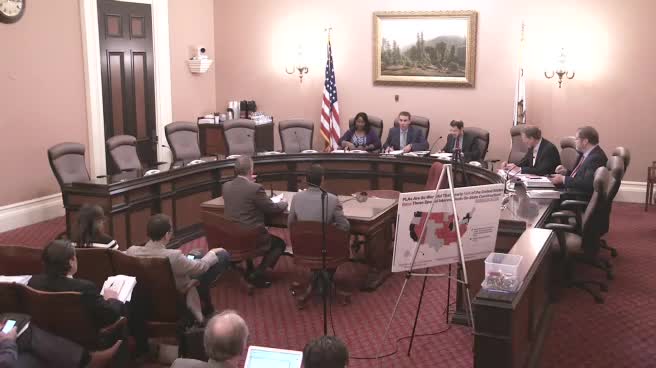 17MIN
Senate Standing Committee on Governance and Finance
Bill Author

Bill Co-Author(s):