SB 1296: Department of Housing and Community Development: database of local fees.
- Session Year: 2017-2018
- House: Senate
- Latest Version Date: 2018-04-05
Existing law requires the Department of Housing and Community Development to collect, publish, and make available to the public information about laws regarding housing and community development and authorizes the department to provide a statistics and research service for the collection and dissemination of information affecting housing and community development. Existing law also requires the department, by June 30, 2019, to complete a study to evaluate the reasonableness of local fees charged to new developments, as provided.
This bill, by December 31, 2019, would additionally require the department to collect, publish, collect information from cities, counties, and special districts on the fees imposed for new developments and to publish and make available a database of the fees, as defined, fees charged by those public agencies to new developments by jurisdiction. The bill would also require the department to periodically update this database. The bill would require each special district to annually report to the department the fees that the special district charges to new developments.
The Planning and Zoning Law requires a city or county to adopt a general plan for land use development within its boundaries. Existing law requires the planning agency of each city and county, after the legislative body has adopted all or part of a general plan, to annually report specified information to the legislative body, the Office of Planning and Research, and the Department of Housing and Community Development, including the status of the plan and progress in its implementation.
This bill would require the planning agency to also include in its annual report the fees charged to new developments.
By imposing new reporting duties on local agencies, the bill would impose a state-mandated local program.
The California Constitution requires the state to reimburse local agencies and school districts for certain costs mandated by the state. Statutory provisions establish procedures for making that reimbursement.
This bill would provide that, if the Commission on State Mandates determines that the bill contains costs mandated by the state, reimbursement for those costs shall be made pursuant to the statutory provisions noted above.
Existing law requires the Department of Housing and Community Development to collect, publish, and make available to the public information about laws regarding housing and community development and authorizes the department to provide a statistics and research service for the collection and dissemination of information affecting housing and community development. Existing law also requires the department, by June 30, 2019, to complete a study to evaluate the reasonableness of local fees charged to new developments, as provided.
This bill, by December 31, 2019, would additionally require the department to collect, publish, and make available a database of the fees, as defined, charged by public agencies to new developments by jurisdiction. The bill would also require the department to periodically update this database.
Existing law requires the Department of Housing and Community Development to collect, publish, and make available to the public information about laws regarding housing and community development and authorizes the department to provide a statistics and research service for the collection and dissemination of information affecting housing and community development. Existing law also requires the department, by June 30, 2019, to complete a study to evaluate the reasonableness of local fees charged to new developments, as provided.
This bill, by December 31, 2019, would additionally require the department to collect, publish, and make available a database of fees, as defined, charged by public agencies to new developments by jurisdiction. The bill would also require the department to periodically update this database.
(a)After the legislative body has adopted all or part of a general plan, the planning agency shall do both of the following:
(1)Investigate and make recommendations to the legislative body regarding reasonable and practical means for implementing the general plan or element of the general plan, so that it will serve as an effective guide for orderly growth and development, preservation and conservation of open-space land and natural resources, and the efficient expenditure of public funds relating to the subjects addressed in the general plan.
(2)Provide by April 1 of each year an annual report to the legislative body, the Office of Planning and Research, and the Department of Housing and Community Development that includes all of the following:
(A)The status of the plan and progress in its implementation.
(B)The progress in meeting its share of regional housing needs determined pursuant to Section 65584 and local efforts to remove governmental constraints to the maintenance, improvement, and development of housing pursuant to paragraph (3) of subdivision (c) of Section 65583.
The housing element portion of the annual report, as required by this paragraph, shall be prepared through the use of standards, forms, and definitions adopted by the Department of Housing and Community Development. The department may review, adopt, amend, and repeal the standards, forms, or definitions, to implement this article. Any standards, forms, or definitions adopted to implement this article shall not be subject to Chapter 3.5 (commencing with Section 11340) of Part 1 of Division 3 of Title 2. Before and after adoption of the forms, the housing element portion of the annual report shall include a section that describes the actions taken by the local government towards completion of the programs and status of the local governments compliance with the deadlines in its housing element. That report shall be considered at an annual public meeting before the legislative body where members of the public shall be allowed to provide oral testimony and written comments.
The report may include the number of units that have been substantially rehabilitated, converted from nonaffordable to affordable by acquisition, and preserved consistent with the standards set forth in paragraph (2) of subdivision (c) of Section 65583.1. The report shall document how the units meet the standards set forth in that subdivision.
(C)The number of housing development applications received in the prior year.
(D)The number of units included in all development applications in the prior year.
(E)The number of units approved and disapproved in the prior year.
(F)The degree to which its approved general plan complies with the guidelines developed and adopted pursuant to Section 65040.2 and the date of the last revision to the general plan.
(G)A listing of sites rezoned to accommodate that portion of the citys or countys share of the regional housing need for each income level that could not be accommodated on sites identified in the inventory required by paragraph (1) of subdivision (c) of Section 65583 and Section 65584.09. The listing of sites shall also include any additional sites that may have been required to be identified by Section 65863.
(H)The number of net new units of housing, including both rental housing and for-sale housing, that have been issued a completed entitlement, a building permit, or a certificate of occupancy, thus far in the housing element cycle, and the income category, by area median income category, that each unit of housing satisfies. That production report shall, for each income category described in this subparagraph, distinguish between the number of rental housing units and the number of for-sale units that satisfy each income category. The production report shall include, for each entitlement, building permit, or certificate of occupancy, a unique site identifier which must include the assessors parcel number, but may include street address, or other identifiers.
(I)The number of applications submitted pursuant to subdivision (a) of section 65913.4, the location and the total number of developments approved pursuant to subdivision (b) of section 65913.4, the total number of building permits issued pursuant to subdivision (b) of section 65913.4, the total number of units including both rental housing and for-sale housing by area median income category constructed using the process provided for in subdivision (b) of section 65913.4.
(J)The fees charged by the city or county to new developments. For purposes of this subparagraph, fee has the same meaning as that term is defined in subdivision (b) of Section 66000.
(J)(b)The Department of Housing and Community Development shall post a report submitted pursuant to this paragraph (2) of subdivision (a) on its Internet Web site within a reasonable time of receiving the report.
(b)(c)If a court finds, upon a motion to that effect, that a city, county, or city and county failed to submit, within 60 days of the deadline established in this section, the housing element portion of the report required pursuant to subparagraph (B) of paragraph (2) of subdivision (a) that substantially complies with the requirements of this section, the court shall issue an order or judgment compelling compliance with this section within 60 days. If the city, county, or city and county fails to comply with the courts order within 60 days, the plaintiff or petitioner may move for sanctions, and the court may, upon that motion, grant appropriate sanctions. The court shall retain jurisdiction to ensure that its order or judgment is carried out. If the court determines that its order or judgment is not carried out within 60 days, the court may issue further orders as provided by law to ensure that the purposes and policies of this section are fulfilled. This subdivision applies to proceedings initiated on or after the first day of October following the adoption of forms and definitions by the Department of Housing and Community Development pursuant to paragraph (2) of subdivision (a), but no sooner than six months following that adoption.
SECTION 1.SEC. 2.Section 50456 of the Health and Safety Code is amended to read:50456.(a)The department shall collect, publish, and make available to the public information about federal, state, and local laws regarding housing and community development. The department may provide a statistics and research service for the collection and dissemination of information affecting housing and community development.
(b)By June 30, 2019, the department shall complete a study to evaluate the reasonableness of local fees charged to new developments as defined by subdivision (b) of Section 66000 of the Government Code. developments. The study shall include findings and recommendations regarding potential amendments to the Mitigation Fee Act (Chapter 5 (commencing with Section 66000), Chapter 6 (commencing with Section 66010), Chapter 7 (commencing with Section 66012), Chapter 8 (commencing with Section 66016), and Chapter 9 (commencing with Section 66020) of Division 1 of Title 7 of the Government Code) to substantially reduce fees for residential development.
(c)By December 31, 2019, the department shall collect, publish, collect data submitted by special districts pursuant to subdivision (d) and by cities and counties pursuant to subparagraph (J) of paragraph (2) of subdivision (a) of Section 65400 of the Government Code and shall publish and make available a database of the fees, as defined by subdivision (b) of Section 66000 of the Government Code, fees charged by those public agencies to new developments by jurisdiction. The department shall periodically update the database required by this subdivision.
(d)Each special district shall report to the department by April 1 of each year the fees charged by the special district to new developments.
(e)For purposes of this section, the following definitions apply:
(1)Fee has the same meaning as that term is defined in subdivision (b) of Section 66000 of the Government Code.
(2)Special district has the same meaning as that term is defined in Section 53835 of the Government Code.
SEC. 3.If the Commission on State Mandates determines that this act contains costs mandated by the state, reimbursement to local agencies and school districts for those costs shall be made pursuant to Part 7 (commencing with Section 17500) of Division 4 of Title 2 of the Government Code.
(a)The department shall collect, publish, and make available to the public information about federal, state, and local laws regarding housing and community development. The department may provide a statistics and research service for the collection and dissemination of information affecting housing and community development.
(b)By June 30, 2019, the department shall complete a study to evaluate the reasonableness of local fees charged to new developments as defined by subdivision (b) of Section 66000 of the Government Code. The study shall include findings and recommendations regarding potential amendments to the Mitigation Fee Act (Chapter 5 (commencing with Section 66000), Chapter 6 (commencing with Section 66010), Chapter 7 (commencing with Section 66012), Chapter 8 (commencing with Section 66016), and Chapter 9 (commencing with Section 66020) of Division 1 of Title 7 of the Government Code) to substantially reduce fees for residential development.
(c)By December 31, 2019, the department shall collect, publish, and make available a database of the fees, as defined by subdivision (b) of Section 66000 of the Government Code, charged by public agencies to new developments by jurisdiction. The department shall periodically update the database required by this subdivision.
(a)The department shall collect, publish, and make available to the public information about federal, state, and local laws regarding housing and community development. The department may provide a statistics and research service for the collection and dissemination of information affecting housing and community development.
(b)By June 30, 2019, the department shall complete a study to evaluate the reasonableness of local fees charged to new developments as defined by subdivision (b) of Section 66000 of the Government Code. The study shall include findings and recommendations regarding potential amendments to the Mitigation Fee Act (Chapter 5 (commencing with Section 66000), Chapter 6 (commencing with Section 66010), Chapter 7 (commencing with Section 66012), Chapter 8 (commencing with Section 66016), and Chapter 9 (commencing with Section 66020) of Division 1 of Title 7 of the Government Code) to substantially reduce fees for residential development.
(c)By December 31, 2019, the department shall collect, publish, and make available a database of fees, as defined by subdivision (b) of Section 66000 of the Government Code, charged by public agencies to new developments by jurisdiction. The department shall periodically update the database required by this subdivision.
|
Date
|
Status
|
|---|---|
| May 25, 2018 | May 25 hearing: Held in committee and under submission. |
| May 18, 2018 | Set for hearing May 25. |
| May 7, 2018 | May 7 hearing: Placed on APPR. suspense file. |
| Apr 27, 2018 | Set for hearing May 7. |
| Apr 25, 2018 | From committee: Do pass and re-refer to Com. on APPR. (Ayes 7. Noes 0.) (April 25). Re-referred to Com. on APPR. |
| Apr 20, 2018 | Set for hearing April 25. |
| Apr 19, 2018 | Re-referred to Com. on GOV. & F. |
| Apr 18, 2018 | From committee: Do pass and re-refer to Com. on RLS. (Ayes 13. Noes 0.) (April 17). Re-referred to Com. on RLS. |
| Apr 10, 2018 | Set for hearing April 17. |
| Apr 5, 2018 | From committee with author's amendments. Read second time and amended. Re-referred to Com. on T. & H. |
| Apr 2, 2018 | From committee with author's amendments. Read second time and amended. Re-referred to Com. on T. & H. |
| Mar 1, 2018 | Referred to Com. on T. & H. |
| Feb 20, 2018 | From printer. May be acted upon on or after March 22. |
| Feb 16, 2018 | Introduced. Read first time. To Com. on RLS. for assignment. To print. |
|
Date
|
Description
|
Location
|
Votes
|
|
|---|---|---|---|---|
| May 7, 2018 | Placed on suspense file | Senate Standing Committee on Appropriations |
Passed |
|
| Apr 25, 2018 | Do pass, but first be re-referred to the Committee on [Appropriations] | Senate Standing Committee on Governance and Finance |
Passed |
|
| Apr 17, 2018 | Do pass, but first be re-referred to the Committee on [Rules] | Senate Standing Committee on Transportation and Housing |
Passed |
This list shows positions taken on this bill by organizations on the date displayed, which is linked to the original source.
Positions by individuals are not included.
|
Organization
|
Position
|
Date
|
|---|---|---|
| Association of California Cities - Orange County | ** Support | Apr 12, 2018 |
| Bay Area Council | * Support | Apr 17, 2018 |
| BRIDGE Housing | * Support | Apr 25, 2018 |
| Cal Chamber | * Support | Apr 17, 2018 |
| California Apartment Association | * Support | Apr 25, 2018 |
| California Association Of Realtors | * Support | Apr 17, 2018 |
| California Business Properties Association | * Support | Apr 25, 2018 |
| California EMB | * Support | Apr 17, 2018 |
| California Housing Consortium | * Support | Apr 17, 2018 |
| California Yimb | ** Support | Apr 12, 2018 |
| Habitat For Humanity | * Support | Apr 25, 2018 |
| UC Berkeley Terner Center for Housing Innovation | * Support | Apr 17, 2018 |
| Unknown. | ** Against | Apr 23, 2018 |
SENATE COMMITTEE ON APPROPRIATIONS
Senator Ricardo Lara, Chair
2017 - 2018 Regular Session
SB 1296 (Glazer) - Department of Housing and Community Development: database of local fees
Version: April 5, 2018 | Policy Vote: T.& H. 13 - 0, GOV.& F. 7 - 0 |
Urgency: No | Mandate: Yes |
Hearing Date: May 7, 2018 | Consultant: Mark McKenzie |
This bill meets the criteria for referral to the Suspense File.
Bill Summary:
SB 1296 would require the Department of Housing and Community Development (HCD) to collect information from local governments by December 31, 2019 on the fees imposed for new developments and post the data in a report on its website, as specified.
Fiscal Impact:
- HCD estimates one-time costs of approximately $200,000 for systems upgrades and database development. (General Fund)
- HCD estimates costs of up to approximately $385,000 in 2019-20 and $350,000 annually ongoing for 2 PY of new staff to administer the data collection and reporting. (General Fund)
- HCD estimates additional administrative costs, potentially in excess of $750,000 annually, to perform data collection. These costs are primarily associated with collection of required data from special districts and other local entities that do not currently submit annual reports to HCD. (General Fund) ----see staff comments----
- Unknown, potentially significant reimbursable mandate costs, to the extent that local agencies file a successful reimbursement claim with the Commission on State Mandates. Generally, increased local planning mandates are not viewed as reimbursable due to local agency authority to adjust fees related to increased costs, but it is unclear that additional reporting of data to the state would be a cost that is recoverable through local fees. The reporting requirement would apply to over 4,500 local agencies, so statewide costs could be significant if reimbursement claims are approved by the Commission on State Mandates. (General Fund)
Background:
Since the passage of Proposition 13 and other measures limiting local agencies' general revenue sources, local agencies have increasingly required development projects to bear their own costs within the community. Existing law, the Mitigation Fee Act (Act), defines a “fee” as a monetary exaction (other than a tax or special assessment) that is charged by a local agency to an applicant in connection with approval of a development project for the purposes of defraying all or a portion of the cost of public facilities related to the project. When establishing, increasing, or imposing a fee as a condition of approving a development project, existing law requires local officials to identify the purpose of the fee and public facilities to be financed, and determine a reasonable relationship between the development project and use of the fee, as well as the relationship between need for the public facility and the type of project on which the fee is imposed.
When imposing a fee as a condition of approving a development project, the Act also requires local officials to determine a reasonable relationship between the fee's amount and the cost of the public facility or portion of the facility attributable to the development. As a result of court decisions and the Act, local governments must conduct a nexus study to ensure that any proposed development fees meet “essential nexus” and “rough proportionality” legal tests to ensure that conditions on development are related to a project’s impacts. Other requirements in the Mitigation Fee Act ensure that development fees are appropriately levied and spent.
Existing law requires each city and county to submit a progress report to HCD and the Governor’s Office of Planning and Research by April 1 of each year that includes the status of a jurisdiction’s general plan and its implementation, the progress in meeting its share of regional housing needs, and additional data on housing production. Existing law requires HCD, by June 30, 2019, to complete a study evaluating the reasonableness of local fees charged to new developments. The study shall include findings and recommendations regarding potential amendments to the Mitigation Fee Act to substantially reduce fees for residential development.
Proposed Law:
SB 1296 would require cities and counties to include information on the fees charged to new developments in its annual progress report to HCD, and require special districts to report to HCD by April 1 of each year on the fees they charge to new developments.
The bill would require HCD, by December 31, 2019, to collect data submitted by cities, counties, and special districts and to publish and periodically update a database of the development fees by jurisdiction.
Related Legislation:
AB 879 (Grayson), Chap. 374/2017, among other things, required HCD to complete a study by July 1, 2019 to evaluate the reasonableness of local fees charged to new developments.
Staff Comments:
This bill would require cities and counties to include additional data on development fees when they submit annual progress reports to HCD each year, and require special districts to annually submit development fee information to HCD in a stand-alone report. HCD would develop a database to compile the reported data by jurisdiction, at a one-time cost of approximately $200,000, and indicates it would need two additional staff to administer the collection and publishing of the information, at an annual cost of up to $350,000. HCD anticipates that the collection of information from special districts, none of which currently provide reports to HCD, will drive significant new workload for outreach to over 4,000 entities, resulting in additional costs, likely in excess of $750,000 annually. The Committee may wish to consider whether the efforts associated with compiling a statewide development fee database by jurisdiction provide a benefit that justifies the workload and costs.
-- END --
SENATE COMMITTEE ON GOVERNANCE AND FINANCE
Senator Mike McGuire, Chair
2017 - 2018 Regular
Bill No: | SB 1296 | Hearing Date: | 4/25/18 |
Author: | Glazer | Tax Levy: | No |
Version: | 4/5/18 | Fiscal: | Yes |
Consultant: | Favorini-Csorba | ||
Department of Housing and Community Development:database of local fees
Requires local governments to submit information on developer fees to the Department of Housing and Community Development.
Background
Mitigation Fee Act. When approving development projects, counties and cities can require the applicants to mitigate the project's effects by paying fees. The California courts have upheld these mitigation fees for sidewalks, parks, school construction, and many other public purposes.
When establishing, increasing, or imposing a fee as a condition of approving a development project, the Mitigation Fee Act requires local officials to:
- Identify the fee's purpose.
- Identify the fee's use, including the public facilities to be financed.
- Determine a reasonable relationship between the fee's use and the development.
- Determine a reasonable relationship between the public facility's need and the development.
When imposing a fee as a condition of approving a development project, the Act also requires local officials to determine a reasonable relationship between the fee's amount and the cost of the public facility. In its 1987 Nollan decision, the U.S. Supreme Court said that there must be an "essential nexus" between a project's impacts and the conditions for approval. In the 1994 Dolan decision, the U.S. Supreme Court said that conditions on development must have a "rough proportionality" to a project's impacts.
In the 1996 Ehrlich decision, the California Supreme Court distinguished between "legislatively enacted" conditions that apply to all projects and "ad hoc" conditions imposed on a project-by-project basis. Ehrlich applied the "essential nexus" test from Nollan and the "rough proportionality" test from Dolan to "ad hoc" conditions. The Court didn't apply the Nollan and Dolan tests to the conditions that were "legislatively enacted." In other words, local officials face greater scrutiny when they impose conditions on a project-by-project basis.
As a result of these decisions and the Mitigation Fee Act, local governments must conduct a nexus study to ensure that any proposed development fees meet these legal tests. Other requirements in the Mitigation Fee Act ensure that development fees are appropriately levied and spent, including that a local agency must:
- Hold at least one open and public meeting prior to levying a new fee or increasing an existing one.
- Adopt capital improvement plans.
- Deposit and spend the fees within five years of collecting them.
- Refund fees if they aren’t spent within five years of collection, or make specific findings on when and how the fees will be spent for construction.
Cities and counties can’t collect developer fees before they conduct the final inspection or issue a certificate of occupancy, although developer fees for utilities may be collected earlier. Local officials must produce a report annually that summarizes the amount of developer fees collected and expended for capital projects. In addition, any person may request an independent audit of how the fees have been collected and spent, including an assessment of whether the fees exceed the amount reasonably necessary to cover the costs of the stated projects or services. A local agency must adjust its fees if the audit finds that the fees are set too high.
School facility fees. The Leroy F. Greene School Facilities Act of 1998 (SB 50, Greene) limits the impact fees that schools may charge to new developments. Under the School Facilities Act, school districts may impose developer fees at one of three levels:
- Level 1 fees are set by the State Allocation Board, which adjusts a statutory rate every two years. The current rate is set at $3.79 per square foot for residential development and $0.61 per square foot for commercial and industrial development.
- Level 2 fees allow a school district to charge up to 50 percent of the cost of school construction associated with new residential development if the school district conducts a needs analysis, has applied for and is eligible to receive state bond funds, and meets additional conditions pertaining to school facilities and district financing.
- Level 3 fees allow a school district to charge up to 100 percent of the cost of school construction associated with new residential development if state bond funds are available and the State Allocation Board is no longer approving funding requests.
Although state school bond funds briefly ran out in 2016, voters approved an initiative measure at the November 2016 election, which made available $9 billion in new bond funds for school facilities (Proposition 51). Accordingly, school districts can only impose up to Level 2 fees. The School Facilities Act also prohibits schools from levying fees on residential improvements of fewer than 500 square feet.
Development agreements. Development agreements are contracts negotiated between project proponents and public agencies that govern the land uses that may be allowed in a particular project, as well as the fees and procedures that govern the approval. Neither the applicant nor the public agency is required to enter into a development agreement. When they do, the terms of approval are negotiated between the parties, subject to the public agencies’ ultimate approval. Since the project proponents agree to the fees under a development agreement, local agencies have greater freedom to charge developers for the cost of infrastructure. For example, the local agency can ask that the project proponent agree to finance public facilities and improvements without the specter of a regulatory takings claim. Similarly, the local agency may ask the project proponent to construct a new school without fear that school facility fee limitations will be invoked. The project proponent must agree to such requirements before they may become enforceable.
Housing-related studies. Cities and counties must report annually to the Governor’s Office of Planning and Research and the Department of Housing and Community Development (HCD) on the progress they have made in implementing their general plan and their regional housing needs, as well as a host of other data on housing production in the jurisdiction.
Last year, as part of the 2017 Housing Package, the Legislature passed AB 879 (Grayson), which requires HCD to complete a study to evaluate the reasonableness of local feels charged to new developments. The study, which is due to the Legislature by June 30th, 2019, must include findings and recommendations regarding amendments to existing law to substantially reduce fees for residential development. AB 879 recognized that, in order to address the statewide housing shortage, more units need to be built at a lower per-unit cost. This requirement is expected to help inform the Legislature of ways to reduce feeds for residential development in a comprehensive manner.
A 2018 report by the Terner Center for Housing Innovation found that impact fees vary widely by jurisdiction and can range from 6 percent to 18 percent of the cost of a new unit. They also found that fees can be unpredictable, in part because connection fees and other similar charges for utilities are often project specific, and that some jurisdictions don’t have fee schedules that make it easy for developers to identify the costs for their projects. The author wants to establish a database of impact fees and to better identify the fees that special districts charge to new developments.
Proposed Law
Senate Bill 1296 requires a special district to report by April 1st of each year the fees it charges to new developments. SB 1296 also requires cities and counties to include the fees that the local government charges on new developments in their annual general plan reports. The bill directs HCD, by December 31st, 2019, to collect the data submitted by special districts and cities and counties related to the fees imposed on new developments and to establish and periodically update a database of development fees.
State Revenue Impact
No estimate.
Comments
1. Purpose of the bill. Housing is extremely costly in California. According to the Legislative Analyst’s Office, the average home in California now costs two and a half times as much as the average house in the rest of the country, and rent is 50 percent more expensive. As a result, low-income Californians can’t afford adequate housing, leading to overcrowding and onerous commutes. Housing costs are also a drag on the economy: businesses are hard pressed to attract and retain skilled workers if those workers can’t afford to live in the state. One significant component of new housing costs is the amount of fees that local governments charge to new developments. A recent study found that developer fees can make up as much as 18% of the cost of a new unit of housing—topping $150,000 in some cities, and these numbers don’t even include fees charged by special districts to connect utilities. While some local governments make it easy for developers to know their fees, others do not. This creates significant uncertainty for builders. SB 1296 requires local governments, including special districts, to share data on their fees with HCD to incorporate into HCD’s ongoing study, and requires HCD to create a database of fees so that builders know what to expect.
2. How high is too high? SB 1296 relies on the premise that impact fees are too high and that they are contributing to high home prices. There are several reasons to doubt this premise. First, developer fees are already limited by state statute and the federal constitution. They can’t exceed the reasonable cost of constructing the project or funding the service for which they are imposed. Local governments must go through elaborate nexus studies to determine the impacts, and developers—or anyone else—can request an audit of the fees to ensure that they are reasonable. Second, housing construction costs are not necessarily a driver of housing prices because existing homes are a close substitute for new housing. The market dynamics in a particular area dictate the relationship between housing costs and housing prices. For example, a 1997 study of developer fees in Contra Costa County by the Public Policy Institute of California found that in some cases, developer fees are passed on to homebuyers, but in other cases developers must absorb the costs. Third, developers often pay fees in excess of those that are allowed under the Mitigation Fee Act as part of the terms of a development agreement, indicating that they are willing to pay higher fees for greater certainty. Finally, developers recently backed a $9 billion bond on the 2016 ballot to avoid paying full freight on school fees—ensuring that those fees are further limited to 50 percent of the cost of construction. While fees can be an added cost for developers, the extent to which they raise home prices is uncertain.
3. Law of unintended consequences. A series of propositions have drastically cut into local revenue sources, requiring local governments to look elsewhere to fund services that the public demands. Proposition 13 capped property tax rates at 1% of assessed value (which only changes when ownership changes) and required 2/3rds voter approval for special taxes, so local governments turned to general taxes. When Proposition 62 (1986) required majority voter approval of general taxes, local governments imposed assessments that were more closely tied to the benefit that an individual property owner receives. Subsequently, Proposition 218 (1996) required voter approval of parcel taxes, assessments, and property-related fees. The result of these initiatives is that it has become harder and harder for local governments to spread the cost of infrastructure and services over the entire community: instead the cost burden is pushed onto new construction. In addition, local governments already face a disincentive to approve housing—commercial development generates more revenue through sales taxes and demands fewer public services than residential development. Limiting developer fees may only exacerbate that dynamic. The solution to California’s housing crisis may not be further cutting into local government revenues by slashing developer fees, but instead loosening some of the constraints on local revenues to ensure that the broader community pays its fair share of the cost of public services.
4. Context. Cities adopt different fee schedules to incentivize different types of building over others. Those incentives may be driven by the make-up of current housing stock in the jurisdiction, expectations for future growth, or environmental concerns. For example, some jurisdictions set impact fees higher for single-family homes and lower for multi-family housing to encourage compact development. In addition, communities have differing priorities for the types of amenities and public services that residents demand. SB 1296 requires a report and database on fees, but does not provide any additional information on the context around those fees. A more complete database would include relevant information on what those fees pay for and what informs local decisions to set fees at the levels that they do. In addition, SB 1296’s requirement on local governments to report “fees charged to new developments” is subject to multiple interpretations. A local government might interpret this to mean their fee schedule, the total amount of fees charged to new developments, the specific fees charged to each development, an average cost of fees per unit, or something else. The utility of these metrics depends on the goal for the study, and each metric has advantages and shortcomings, raising important questions about the goals of this bill and how to present this information fairly.
5. Mandate. The California Constitution requires the state to reimburse local governments for the costs of new or expanded state mandated local programs. Because SB 1296 requires local governments to report new information to HCD, Legislative Counsel says that it imposes a new state mandate. The measure states that if the Commission on State Mandates determines that the bill imposes a reimbursable mandate, reimbursement must be made pursuant to existing statutory provisions.
6. Incoming! On April 17th, the Senate Transportation and Housing Committee approved SB 1296 by a vote of 13 to 0. The Committee on Governance and Finance is hearing the measure as the committee of second reference.
Support and Opposition
(4/19/18)
Support: California Apartment Association; California Association of Realtors; California Housing Consortium; California YIMBY; Habitat for Humanity California.
Opposition: Unknown.
-- END --
SENATE COMMITTEE ON TRANSPORTATION AND HOUSING
Senator Jim Beall, Chair
2017 - 2018 Regular
Bill No: SB 1296 Hearing Date: 4/17/2018
Author: | Glazer | ||
Version: | 4/5/2018 Amended | ||
Urgency: | No | Fiscal: | Yes |
Consultant: | Alison Hughes | ||
SUBJECT: Department of Housing and Community Development: database of local fees
DIGEST: This bill requires local governments and special districts to annually report their fees on new developments to the Department of Housing and Community Development (HCD), and for HCD to collect and publish the data in a database.
ANALYSIS:
Existing law:
- Requires HCD, by June 30, 2019, to complete a study evaluating the reasonableness of local fees charged to new developments. The study shall include findings and recommendations regarding potential amendments to the Mitigation Fee Act to substantially reduce fees for residential development.
- Requires localities to include specified information as part of the annual general plan report to the legislative body, the Governor’s Office of Planning and Research, and HCD.
- Establishes the Mitigation Fee Act, which requires any city that establishes, increases, or imposes a fee as a condition of approval of a development project to do all of the following:
- Identify the purpose of the fee;
- Identify how the fee will be used;
- Demonstrate there is a reasonable relationship between the purpose of the fee and the type of development project on which the fee imposed;
- Demonstrate that there is a reasonable relationship between the need for the public facility and the type of development project on which the fee is imposed.
- Requires, prior to levying a new fee or service charge, or prior to approving an increase in an existing fee or service charge, a local agency to hold at least one open and public meeting, at which oral or written presentations can be made, as part of a regularly scheduled meeting. The local agency shall also provide notice, as specified.
- Requires a city to deposit, invest, account for, and expend such fees to make findings once every fifth year regarding any portion of the fee remaining unexpended or uncommitted; to identify within 180 days of determining that sufficient funds have been collected, an approximate date of commencing construction of improvements, or else to refund unexpended fees; and to adopt capital improvement plans.
- Permits a developer to challenge the imposition of a fee, dedication, or other exaction if the developer follows a specified procedure that includes protesting the fee in writing.
This bill:
- Requires cities and counties, as part of the annual general plan report, to include the fees that the local government charges on new developments.
- Requires special districts to report to HCD by April 1 of each year the fees charged by the special district to new developments.
- Requires HCD, by December 31st, 2019 to collect the data submitted by special districts and cities and counties related to the fees imposed on new developments and publish the data in a database. HCD shall periodically update the database.
COMMENTS
- Purpose. According to the author, “this bill would require HCD to create a database of fees associated with housing development by jurisdiction. One of the biggest cost drivers of housing construction is local fees levied on housing projects. Each local jurisdiction and special district can assess these fees as a condition of development within their jurisdiction. Requiring HCD to develop a comprehensive fee database allows the public to compare fees across jurisdictions and analyze the reasonableness of such fees in relation to housing costs.”
- Development fees. Development fees serve many purposes and can be broadly divided into two categories: service fees and impact fees. Service fees cover staff hours and overhead, and are used to fund the city’s role in the development process such as paying for plan reviews, permit approvals, inspections, and any other services related to a project moving through city departments. Impact fees refer generally to fees that offset the public costs of new infrastructure incurred by the larger community. Some examples include adding lanes to roads or supporting additional traffic, or other public benefits such as new parks, schools, or affordable housing. Aside from local governments, other entities, such as school districts and utility companies, also have the authority to levy development fees. School fees to charge a specific amount to new development based on a per-square-foot calculation, while utility fees are related to connectivity to services including water and sewer and may not exceed the estimated reasonable costs of providing the service for which the fee or charge is imposed.
In the wake of the passage of Proposition 13 in 1978 and the loss of significant property tax revenue, local governments have also turned to development fees as a means to pay for new infrastructure. Given that California cities have tightly restricted funding sources, fees are one of the few ways that cities can pay for the indirect cost of growth.
According to a March 2018 report by the UC Berkeley Terner Center for Housing Innovation, entitled It All Adds Up: The Cost of Housing Development Fees in Seven California Cities, between 2008 and 2015, California fees rose 2.5%, while the national average decreased by 1.2%. The report points to studies that have found that fees can comprise 17% of the total development costs of new housing; in California development fees were nearly three times the national average in 2015.
- Mitigation Fee Act. The Mitigation Fee Act sets specific requirements that a city must follow in establishing or imposing development fees. This includes: identifying the purpose of the fee and how the fee will be used; demonstrating there is a reasonable relationship between the purpose of the fee and the type of development project on which the fee imposed; and demonstrating that there is a reasonable relationship between the need for the public facility and the type of development project on which the fee is imposed. Additionally, it sets forth a process by which a developer may challenge the imposition of a fee. Anecdotally, the League of California Cities and the California State Association of Counties pointed to some of their member jurisdictions that post their fee schedules to their web sites as a courtesy to the public, even though it is not required.
This bill requires HCD to create a database that will be made publicly available and updated periodically, that contains the fees imposed on new developments for all 482 cities, 58 counties, and 4,000 special districts in California.
Last year, the Legislature passed and the governor signed a package of 15 housing bills as a comprehensive package. Together, this package provided an ongoing source of funding for affordable housing construction, a $4 billion housing bond to provide an immediate infusion of funds into housing for veterans, and low- and moderate-income families, as well as several streamlining and land use measures designed to facilitate and foster opportunities for increased housing production. In order to implement that package, the Department of Housing and Community Development is requesting about 81 new staff in this year’s budget, as well as 65 additional staff in the next two budget years.
Creating a fee database and updating it periodically will likely require a significant use of public resources and time. Given the workload HCD is already under, the committee may wish to consider whether creating a statewide database is a priority at this time. The author moving forward may wish to consider instead requiring the local agencies to make the information available on their web sites.
- Ongoing Fee Cost Study. Last year, as part of the 2017 Housing Package, the Legislature passed AB 879 (Grayson, Chapter 374), which requires HCD to complete a study to evaluate the reasonableness of local feels charged to new developments. The study, which is due to the Legislature by June 30th, 2019, must include findings and recommendations regarding amendments to existing law to substantially reduce fees for residential development. This bill recognized that, in order to address the statewide housing shortage, more units need to be built at a lower per-unit cost. This bill will help inform the legislature of ways to reduce feeds for residential development in a comprehensive manner. The committee may wish to consider whether it is premature to invest valuable public resources to a new statewide database when a study is already underway to provide policy recommendations for reducing housing cost, overall in a little over a year from now.
Related Legislation:
AB 879 (Grayson, Chapter 374, Statutes of 2017) — required HCD to complete a study to evaluate the reasonableness of local feels charged to new developments.
FISCAL EFFECT: Appropriation: Fiscal Com.: Local:
POSITIONS: (Communicated to the committee before noon on Wednesday,
April 11, 2018.)
SUPPORT:
Association of California Cities – Orange County
Bridge Housing
California Apartment Association
California Association of Realtors
California Housing Consortium
California YIMB
Habitat for Humanity California
OPPOSITION:
None received.
-- END --
Discussed in Hearing
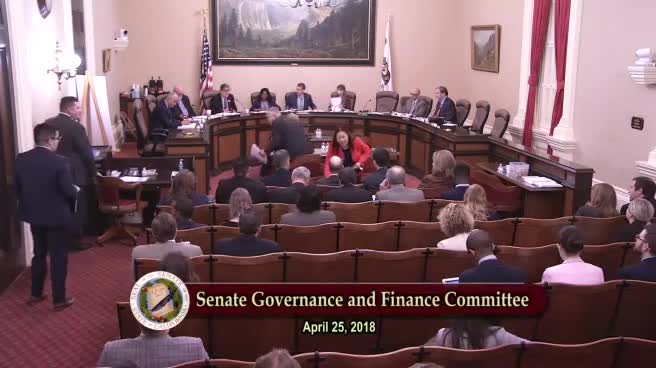 1MIN
Senate Standing Committee on Governance and Finance
 9MIN
Senate Standing Committee on Transportation and Housing
Bill Author