SB 326: Postsecondary education: Middle Class Scholarship Program.
- Session Year: 2017-2018
- House: Senate
- Latest Version Date: 2017-03-16
Under existing law, the Middle Class Scholarship Program provides that an undergraduate student enrolled at the University of California or the California State University, or enrolled in upper division coursework in a community college baccalaureate program, and meeting certain requirements, is eligible for a scholarship award that, combined with other federal, state, and institutionally administered grants and fee waivers, totals up to 40% of the systemwide tuition and fees.
Existing law, for the 201718 fiscal year and each fiscal year thereafter, transfers, upon order of the Director of Finance, $117,000,000 from the General Fund to the Middle Class Scholarship Fund, and appropriates that sum to the Student Aid Commission for purposes of the scholarship program.
This bill would instead require, for the 201819 fiscal year and each fiscal year thereafter, that the amount of $117,000,000 or the total amount appropriated from the General Fund for allocation for the 201718 fiscal year for purposes of the program, whichever amount is larger, be appropriated from the General Fund and transferred to the Middle Class Scholarship Fund. The bill would delete the requirement that the Director of Finance order the transfer of the appropriated funds from the General Fund to the Middle Class Scholarship Fund. The bill would further require that, on and after July 1, 2018, the funds in the Middle Class Scholarship Fund would be continuously appropriated to the Student Aid Commission for allocation for purposes of the program, thereby making an appropriation.
Existing law establishes the University of California, under the administration of the Regents of the University of California, the California State University, under the administration of the Trustees of the California State University, the California Community Colleges, under the administration of the Board of Governors of the California Community Colleges, independent institutions of higher education, and private postsecondary educational institutions as the segments of postsecondary education in this state.Existing law expresses the intent of the Legislature that each resident of California who has the capacity and motivation to benefit from higher education should have the opportunity to enroll in an institution of higher education. Existing law also reaffirms the commitment of the State of California to provide an appropriate place in California public higher education for every student who is willing and able to benefit from attendance.This bill would make nonsubstantive changes in this statement of the intent of the Legislature and the commitment of the State of California.Existing law establishes the University of California, under the administration of the Regents of the University of California, the California State University, under the administration of the Trustees of the California State University, the California Community Colleges, under the administration of the Board of Governors of the California Community Colleges, independent institutions of higher education, and private postsecondary educational institutions as the segments of postsecondary education in this state.
Existing law expresses the intent of the Legislature that each resident of California who has the capacity and motivation to benefit from higher education should have the opportunity to enroll in an institution of higher education. Existing law also reaffirms the commitment of the State of California to provide an appropriate place in California public higher education for every student who is willing and able to benefit from attendance.
This bill would make nonsubstantive changes in this statement of the intent of the Legislature and the commitment of the State of California.
(a)For each academic year, the commission shall determine an amount sufficient, when combined with other federal, state, or institutionally administered student grants or fee waivers received by eligible students from other sources, to provide scholarships to eligible students in the amounts described in paragraphs (2) and (3) of subdivision (a) of Section 70022. The University of California, the California State University, and the Office of the Chancellor of the California Community Colleges shall provide the commission with any financial aid data that are necessary for the determination of these amounts.
(b)The commission shall annually determine if the amounts appropriated under this section in each fiscal year are sufficient to cover the costs of the scholarships as projected to be awarded pursuant to the program. If those amounts are not sufficient for this purpose, the scholarships shall be reduced proportionately by an equal percentage for all recipients of scholarships under this article.
(c)The commission may adopt regulations necessary to carry out the purposes of this article under subdivision (b) as emergency regulations in accordance with Chapter 3.5 (commencing with Section 11340) of Part 1 of Division 3 of Title 2 of the Government Code. For purposes of the Administrative Procedure Act, including Section 11349.6 of the Government Code, the adoption of those regulations shall be deemed to be an emergency and necessary for the immediate preservation of the public peace, health and safety, or general welfare, notwithstanding subdivision (e) of Section 11346.1 of the Government Code. Notwithstanding subdivision (e) of Section 11346.1 of the Government Code, any regulation adopted pursuant to this section shall not remain in effect more than 180 days unless the commission complies with all provisions of Chapter 3.5 (commencing with Section 11340) of Part 1 of Division 3 of Title 2 of the Government Code, as required by subdivision (e) of Section 11346.1 of the Government Code.
(d)The unencumbered balance, as of June 30 of each fiscal year, of the amount appropriated from the Middle Class Scholarship Fund pursuant to paragraph (1) of subdivision (e) shall revert to the General Fund.
(e)(1)Upon order of the Director of Finance, the following amounts shall be transferred from the General Fund to the Middle Class Scholarship Fund, and are hereby appropriated to the commission for allocation pursuant to this article:
(A)For the 201415 fiscal year, one hundred seven million dollars ($107,000,000).
(B)For the 201516 fiscal year, eighty-two million dollars ($82,000,000).
(C)For the 201617 fiscal year, seventy-four million dollars ($74,000,000).
(D)For the 201718 fiscal year and for each fiscal year thereafter, year, one hundred seventeen million dollars ($117,000,000).
(2)An annual appropriation to the commission is hereby established in the amounts and for the fiscal years described in paragraph (1) to carry out the purposes of this section and Section 70022.
(3)It is the intent of the Legislature that any savings realized from changes made to the allocations under this subdivision by a bill providing for appropriations related to the Budget Bill for the 201516 fiscal year shall be used to support higher education.
(4)The funds transferred and appropriated pursuant to paragraph (1) shall only be available for encumbrance in the fiscal year in which they are transferred, and the General Fund shall have no liability or any obligation beyond the transfers explicitly authorized in paragraph (1) unless a subsequent transfer or allocation is required pursuant to statute.
(5)In any fiscal year, additional appropriations may be enacted pursuant to statute to carry out the purposes of this article.
(6)(A)Beginning with the Governors Budget proposal for the 201415 fiscal year, and in the Governors Budget for each fiscal year thereafter, the Department of Finance shall include a fund condition statement for the Middle Class Scholarship Fund for the fiscal year of the proposed budget and the two immediately preceding fiscal years prepared in accordance with existing law.
(B)Upon order of the Director of Finance and commencing with the 201314 fiscal year, if the May Revision projects a budget deficit for the next fiscal year, the amount specified in paragraph (1) for the fiscal year for which the budget deficit is projected may be reduced by up to 33 percent.
(7)(A)Notwithstanding any other law, for the 201819 fiscal year and each fiscal year thereafter, the amount of one hundred seventeen million dollars ($117,000,000) or the total amount appropriated to the commission for allocation pursuant to this article for the 201718 fiscal year, whichever amount is larger, shall be appropriated from the General Fund and transferred to the Middle Class Scholarship Fund.
(B)Notwithstanding Section 13340 of the Government Code, on and after July 1, 2018, the moneys transferred to the Middle Class Scholarship Fund pursuant to subparagraph (A) shall be continuously appropriated to the commission for allocation for purposes of this article.
(f)Subject to an appropriation in the annual Budget Act for its purposes, the commission may begin implementation of, and establish outreach services relating to, this article.
SECTION 1.Section 66201 of the Education Code is amended to read:66201.(a)It is the intent of the Legislature that each resident of California who has the capacity and motivation to benefit from higher education should have the opportunity to enroll in an institution of higher education. Once enrolled, each individual should have the opportunity to continue as long and as far as his or her capacity and motivation, as indicated by academic performance and commitment to educational advancement, will lead him or her to meet academic standards and institutional requirements.(b)The Legislature hereby reaffirms the commitment of the State of California to provide an appropriate place in California public higher education for every student who is willing and able to benefit from attendance.It (a)It is the intent of the Legislature that each resident of California who has the capacity and motivation to benefit from higher education should have the opportunity to enroll in an institution of higher education. Once enrolled, each individual should have the opportunity to continue as long and as far as his or her capacity and motivation, as indicated by academic performance and commitment to educational advancement, will lead him or her to meet academic standards and institutional requirements.
The(b)The Legislature hereby reaffirms the commitment of the State of California to provide an appropriate place in California public higher education for every student who is willing and able to benefit from attendance.
|
Date
|
Status
|
|---|---|
| Feb 1, 2018 | Returned to Secretary of Senate pursuant to Joint Rule 56. |
| May 25, 2017 | May 25 hearing: Held in committee and under submission. |
| May 19, 2017 | Set for hearing May 25. |
| May 1, 2017 | May 1 hearing: Placed on APPR. suspense file. |
| Apr 21, 2017 | Set for hearing May 1. |
| Apr 20, 2017 | From committee: Do pass and re-refer to Com. on APPR. (Ayes 7. Noes 0. Page 782.) (April 19). Re-referred to Com. on APPR. |
| Mar 28, 2017 | Set for hearing April 19. |
| Mar 23, 2017 | Re-referred to Com. on ED. |
| Mar 16, 2017 | From committee with author's amendments. Read second time and amended. Re-referred to Com. on RLS. |
| Feb 23, 2017 | Referred to Com. on RLS. |
| Feb 14, 2017 | From printer. May be acted upon on or after March 16. |
| Feb 13, 2017 | Introduced. Read first time. To Com. on RLS. for assignment. To print. |
|
Date
|
Description
|
Location
|
Votes
|
|
|---|---|---|---|---|
| May 1, 2017 | Placed on suspense file | Senate Standing Committee on Appropriations |
Passed |
|
| Apr 19, 2017 | Do pass, but first be re-referred to the Committee on [Appropriations] | Senate Standing Committee on Education |
Passed |
This list shows positions taken on this bill by organizations on the date displayed, which is linked to the original source.
Positions by individuals are not included.
|
Organization
|
Position
|
Date
|
|---|---|---|
| Sierra Club | * Support | May 1, 2017 |
| University of California Davis | * Support | Apr 19, 2017 |
SENATE COMMITTEE ON APPROPRIATIONS
Senator Ricardo Lara, Chair
2017 - 2018 Regular Session
SB 326 (Nguyen) - Postsecondary education: Middle Class Scholarship Program
Version: March 16, 2017 | Policy Vote: ED. 7 - 0 |
Urgency: No | Mandate: No |
Hearing Date: May 1, 2017 | Consultant: Lenin Del Castillo |
This bill meets the criteria for referral to the Suspense File.
Bill Summary:
Beginning in the 2018-19 fiscal year, this bill appropriates $117 million, or another amount provided in the annual Budget Act, whichever is greater, to the California Student Aid Commission (CSAC) for the Middle Class Scholarship program.
Fiscal Impact:
The bill contains an ongoing and continuous appropriation of $117 million General Fund for the Middle Class Scholarship program, which is the same amount currently authorized in statute. However, the 2017-18 Governor’s budget proposes a phase-out of the program with only existing participants being funded.
Background:
Existing law establishes the Middle Class Scholarship program which provides an undergraduate student enrolled at the University of California (UC) or the California State University (CSU), or enrolled in upper division coursework in a community college baccalaureate program, and meets certain requirements, is eligible for a scholarship award that, combined with other federal, state, and institutionally administered grants and fee waivers, totals up to 40 percent of the systemwide tuition and fees. For the 2017–18 fiscal year and each fiscal year thereafter, existing law transfers, upon order of the Director of Finance, $117,000,000 from the General Fund to the Middle Class Scholarship Fund, and appropriates that sum to the CSAC for purposes of the Middle Class Scholarship program.
Proposed Law:
This bill appropriates $117 million, or another amount provided in the annual Budget Act, whichever is greater, to the Middle Class Scholarship Fund beginning in the 2018-19 fiscal year for the Middle Class Scholarship program. The bill provides that by July 1, 2018, the funds in the Middle Class Scholarship Fund shall be continuously appropriated to the CSAC for purposes of the program.
Staff Comments:
The 2017-18 Governor’s budget proposes a phase‑out of the Middle Class Scholarship and specifies that awards will be renewed only for approximately 37,000 students who received awards in 2016‑17, with no new awards being provided for the program. By 2020‑21, the Governor’s proposal seeks to reduce annual General Fund costs by $115.8 million.
This bill seeks to provide permanent funding for the program by appropriating $117 million General Fund beginning in the 2018-19 fiscal year.
-- END --
SENATE COMMITTEE ON EDUCATION
Senator Benjamin Allen, Chair
2017 - 2018 Regular
Bill No: Hearing Date: April 19, 2017
Author: | Nguyen | ||
Version: |
| ||
Urgency: | Fiscal: | ||
Consultant: | |||
Subject:
SUMMARY
This bill appropriates $117 million, or another amount provided in the Annual Budget Act, whichever is greater, to the Middle Class Scholarship program beginning in the 2018-19 fiscal year.
BACKGROUND
Existing law:
- Establishes the MCS Program which provides an undergraduate student enrolled at the University of California (UC) or the California State University (CSU), or enrolled in upper division coursework in a community college baccalaureate program, and meets certain requirements, is eligible for a scholarship award that, combined with other federal, state, and institutionally administered grants and fee waivers, totals up to 40 percent of the systemwide tuition and fees. (Education Code § 70022)
- For the 2017–18 fiscal year and each fiscal year thereafter, transfers, upon order of the Director of Finance, $117,000,000 from the General Fund to the MCS Fund, and appropriates that sum to the California Student Aid Commission (CSAC) for purposes of the scholarship program. (EC § 70023)
ANALYSIS
This bill:
- This bill appropriates $117 million, or another amount provided in the annual Budget Act, whichever is greater, to the Middle Class Scholarship fund beginning in the 2018-19 fiscal year for the purposes of administering the MCS program. This bill notwithstands any other law in the application of this provision.
- By July 1, 2018, statutorily requires that the funds in the MCS Fund be continuously appropriated to the CSAC for allocation for purposes of the program, thereby making an appropriation.
STAFF COMMENTS
- Rationale for the bill. The Governor’s 2017-18 budget proposes a phase‑out of the Middle Class Scholarship (MCS) Program. According to the author, as academic, housing and food costs raise, middle class families are disproportionately impacted and forced to pay more for their education without necessary financial assistance. The author asserts that if the MCS Program ends there would be a disproportionate impact on middle class students.
This bill seeks to secure permanent funding for the MCS program.
- Related budget activity. Noting the state’s overall financial condition and current efforts related to continuing the Administration’s support for long-term stable growth in funding for the University of California (UC) and the California State University (CSU) and to maintain the broad Cal Grant entitlement for the state’s neediest students, the Governor’s 2017-2018 budget proposes a phase-out of the MCS Program. This proposal, beginning in 2017‑18, specifies that awards will be renewed only for approximately 37,000 students who received awards in 2016‑17, with no new awards for the program. By 2020‑21, the proposal seeks to reduce annual General Fund costs by $115.8 million. Awards that already have been awarded to students for 2016-17 will be funded under the Governor’s proposal.
- Middle Class Scholarship background. The MCS provides a scholarship to an undergraduate student enrolled in UC, CSU or a community college who is enrolled in a B.A. pilot program with family incomes of up to $150,000 and household assets of up to $156,000. The scholarship amount is limited to no more than 40 percent of the UC or CSU, California Community Colleges (CCC) mandatory system-wide tuition and fees. The individual award amount is determined after any other publicly-funded financial aid is received. In addition, grant recipients must be a California resident, or have AB 540 status; not be incarcerated; not be in default on a student loan; maintain a 2.0 GPA.
According to the California Student Aid Commission, over 49,000 MCS grants were paid during the 2015-16 academic year which resulted in a 94.2 percent paid rate. The current paid rate is at 84 percent after the completion of the 2016-17 fall term. Current law requires the unencumbered balance in the MCS to revert to the General Fund. However, through the budget process savings from MCS have been used to support other higher education costs. Recent budgets have identified specific allocations from these savings to be $97 million in 2015-16, $15 million in 2016-17, and $26 million in 2017-18.
- Policy trade-offs. Securing general fund dollars for the MCS Program as proposed by this bill, could mean a reduction in the amount of funding available for other legislative priorities. For example, the state’s Cal Grant program provides college access for low-income Californians by covering tuition and some non-tuition costs. However, students who meet income and assets standards but have been out of high school for more than one year, do not meet GPA and/or age requirements, are not eligible for the high school entitlement award. Instead, these students must seek a competitive Cal Grant award. While the Budget Act of 2015 increased the number of annual competitive Cal Grants to 25,750, this number still falls far short of meeting demand.
The California Student Aid Commission estimates that in 2015-16, students at any college living off campus without their parents incurred about $18,000 in non-tuition costs such as living expenses, housing, books, and transportation. Under the Cal Grant program, only the Cal Grant B Entitlement award provides a modest annual award of $1,656 for these non-tuition costs, which fail to cover the identified need.
While helping middle-class students bear the cost of their higher education through a state scholarship is reasonable, the committee may wish to consider whether financial aid policy should focus on expansion of the Cal Grant program or other types of financial assistance to support the neediest students.
SUPPORT
None received.
OPPOSITION
None received.
-- END --
Discussed in Hearing
 48MIN
Senate Standing Committee on Appropriations
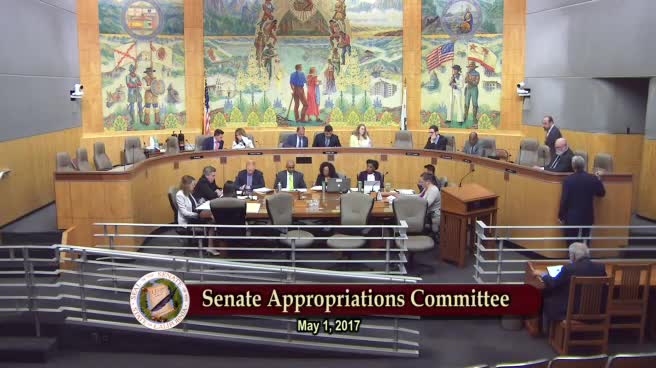 2MIN
Senate Standing Committee on Appropriations
 10MIN
Senate Standing Committee on Education
Bill Author

Bill Co-Author(s):