SB 683: State finance: budget process: budget format and availability.
- Session Year: 2017-2018
- House: Senate
- Latest Version Date: 2017-04-05
The California Constitution requires the Governor to submit a budget for the ensuing fiscal year to the Legislature within the first 10 days of each regular session. Existing law requires that budget to contain a complete plan and itemized statement of all proposed expenditures of the state provided by existing law or recommended by the Governor, and of all estimated revenues, as specified. Existing law requires the budget to be prepared in a specified manner.
This bill would require the budget to be machine readable with flexible data entry points. budget to be made available, on or before July 1, 2019, on the Department of Finance Internet Web site in a prescribed downloadable spreadsheet format. The bill would require the budget for each budget year to be posted and maintained on the site for a period of at least 10 years following the release of that budget.
The California Constitution requires the Governor to submit a budget for the ensuing fiscal year to the Legislature within the first 10 days of each regular session. Existing law requires that budget to contain a complete plan and itemized statement of all proposed expenditures of the state provided by existing law or recommended by the Governor, and of all estimated revenues, as specified. Existing law requires the budget to be prepared in a specified manner.
This bill would require the budget to be machine readable with flexible data entry points.
(a)The budget required by the State Constitution to be submitted by the Governor at each regular session of the Legislature shall be submitted within the first 10 days of each regular session and shall contain a complete plan and itemized statement of all proposed expenditures of the state provided by existing law or recommended by him or her, and all of its institutions, departments, boards, bureaus, commissions, officers, employees, and other agencies, and of all estimated revenues, for the ensuing fiscal year, together with a comparison, as to each item of revenues and expenditures, with the actual revenues and expenditures for the last completed fiscal year, the estimated revenues, and expenditures for the existing fiscal year and the budgeted revenue and expenditures for the next fiscal year.
(b)The budget shall, in accordance with Chapter 2 (commencing with Section 41200) of Part 24 of Division 3 of Title 2 of the Education Code, include a section that specifies the percentages and amounts of General Fund revenues that must be set aside and applied for the support of school districts, as defined in Section 41302.5, and community college districts, as required by subdivision (b) of Section 8 of Article XVI of the California Constitution.
(c)The Governor, or the Department of Finance acting on his or her behalf, shall make appropriate changes in the budget request to reflect any modification in the organization or functions of state government proposed under Article 7.5 (commencing with Section 12080) of Chapter 1 of Part 2 before the passage of the budget.
(d)The Governors Budget shall be prepared in accordance with guidelines and instructions adopted by the Department of Finance.
(e)In order to provide meaningful comparisons, the Governors Budget shall be prepared in such a manner that the information presented provides for such comparisons between the fiscal years.
(f)The Department of Finance shall submit to the committee in each house which considers appropriations and to the Joint Legislative Budget Committee copies of budget material submitted to it by agencies pursuant to Article 2 (commencing with Section 13320).
(g)The Governors Budget shall also include a coding structure that indicates for each budget entity the categorization of expenditures and revenues.
(h)Before submitting the Governors Budget to the Legislature, the Department of Finance may conduct public hearings regarding any portion of any budget.
(i)The Governor, or the Department of Finance acting on his or her behalf, shall, at the same time the Governors Budget is submitted to the Legislature, submit to the Legislature copies of the material for the purposes of subdivision (j).
(j)The Department of Finance shall develop a fiscal information system that will provide timely and uniform fiscal data needed to formulate and monitor the budget, including, but not limited to, online inquiry capacity and the ability to simulate budget expenditures and forecast revenues. This system may include, among other things, data on encumbrances and expenditures by line item, governmental unit, and fund source. The system shall also include expenditures and encumbrances by program, as required. This system shall also include a coding structure that indicates the categorization of expenditures and revenues. This system and the data shall be available to the legislative and executive branches. The system may contain separate programs accessible by only one branch, designed to provide for distinct application of the data, but the basic system data shall be available on an equal basis to the legislative and executive branches of government.
(k)The Governors Budget shall be machine readable with flexible data entry points.(k)On or before July 1, 2019, the Governors Budget shall be made available on the Department of Finance Internet Web site in a downloadable spreadsheet format that may include, but is not limited to, a comma-separated values file or a tab-separated values file and that is compatible with a spreadsheet software application that is widely used at the time of the posting. The Governors Budget for each budget year shall be posted and maintained on the Department of Finance Internet Web site for a period of at least 10 years following the release of that budget.
(a)The budget required by the State Constitution to be submitted by the Governor at each regular session of the Legislature shall be submitted within the first 10 days thereof of each regular session and shall contain a complete plan and itemized statement of all proposed expenditures of the state provided by existing law or recommended by him or her, and all of its institutions, departments, boards, bureaus, commissions, officers, employees, and other agencies, and of all estimated revenues, for the ensuing fiscal year, together with a comparison, as to each item of revenues and expenditures, with the actual revenues and expenditures for the last completed fiscal year, the estimated revenues, and expenditures for the existing fiscal year and the budgeted revenue and expenditures for the next fiscal year.
(b)The budget shall, in accordance with Chapter 2 (commencing with Section 41200) of Part 24 of Division 3 of Title 2 of the Education Code, include a section that specifies the percentages and amounts of General Fund revenues that must be set aside and applied for the support of school districts, as defined in Section 41302.5, and community college districts, as required by subdivision (b) of Section 8 of Article XVI of the California Constitution.
(c)The Governor, or the Department of Finance acting on his or her behalf, shall make appropriate changes in the budget request to reflect any modification in the organization or functions of state government proposed under Article 7.5 (commencing with Section 12080) of Chapter 1 prior to of Part 2 before the passage of the budget.
(d)The Governors Budget shall be prepared in accordance with guidelines and instructions adopted by the Department of Finance.
(e)In order to provide meaningful comparisons, the Governors Budget shall be prepared in such a manner that the information presented provides for such comparisons between the fiscal years.
(f)The Department of Finance shall submit to the committee in each house which considers appropriations and to the Joint Legislative Budget Committee copies of budget material submitted to it by agencies pursuant to the provisions of Article 2 (commencing with Section 13320).
(g)The Governors Budget shall also include a coding structure which that indicates for each budget entity the categorization of expenditures and revenues.
(h)Prior to the submission of Before submitting the Governors Budget to the Legislature, the Department of Finance may conduct public hearings regarding any portion of any budget.
(i)The Governor, or the Department of Finance acting on his or her behalf, shall, at the same time the Governors Budget is submitted to the Legislature, submit to the Legislature copies of the material for the purposes of subdivision (j).
(j)The Department of Finance shall develop a fiscal information system which that will provide timely and uniform fiscal data needed to formulate and monitor the budget, including, but not limited to, on-line online inquiry capacity and the ability to simulate budget expenditures and forecast revenues. This system may include, among other things, data on encumbrances and expenditures by line item, governmental unit, and fund source. The system shall also include expenditures and encumbrances by program, as required. This system shall also include a coding structure which that indicates the categorization of expenditures and revenues. This system and the data shall be available to both the legislative and executive branches. The system may contain separate programs accessible by only one branch, designed to provide for distinct application of the data, but the basic system data shall be available on an equal basis to both the legislative and executive branches of government.
(k)The Governors Budget shall be machine readable with flexible data entry points.
|
Date
|
Status
|
|---|---|
| Feb 1, 2018 | Returned to Secretary of Senate pursuant to Joint Rule 56. |
| May 25, 2017 | May 25 hearing: Held in committee and under submission. |
| May 19, 2017 | Set for hearing May 25. |
| May 1, 2017 | May 1 hearing: Placed on APPR. suspense file. |
| Apr 21, 2017 | Set for hearing May 1. |
| Apr 20, 2017 | April 24 hearing postponed by committee. |
| Apr 18, 2017 | Set for hearing April 24. |
| Apr 17, 2017 | Withdrawn from committee. |
| Apr 5, 2017 | Read second time and amended. Re-referred to Com. on RLS. |
| Apr 4, 2017 | From committee: Do pass as amended and re-refer to Com. on RLS. (Ayes 7. Noes 0. Page 538.) (March 29). |
| Mar 15, 2017 | Set for hearing March 29. |
| Mar 9, 2017 | Referred to Coms. on GOV. & F. and RLS. |
| Feb 21, 2017 | From printer. May be acted upon on or after March 23. |
| Feb 17, 2017 | Introduced. Read first time. To Com. on RLS. for assignment. To print. |
|
Date
|
Description
|
Location
|
Votes
|
|
|---|---|---|---|---|
| May 1, 2017 | Placed on suspense file | Senate Standing Committee on Appropriations |
Passed |
|
| Mar 29, 2017 | Do pass as amended, but first amend, and re-refer to the Committee on [Rules] | Senate Standing Committee on Governance and Finance |
Passed |
This list shows positions taken on this bill by organizations on the date displayed, which is linked to the original source.
Positions by individuals are not included.
|
Organization
|
Position
|
Date
|
|---|---|---|
| Unknown. | ** Against | Mar 24, 2017 |
| Unknown. | ** Support | Mar 24, 2017 |
SENATE COMMITTEE ON APPROPRIATIONS
Senator Ricardo Lara, Chair
2017 - 2018 Regular Session
SB 683 (Stern) - State finance: budget process: budget format and availability
Version: April 5, 2017 | Policy Vote: GOV. & F. 7 - 0 |
Urgency: No | Mandate: No |
Hearing Date: May 1, 2017 | Consultant: Mark McKenzie |
This bill meets the criteria for referral to the Suspense File.
Bill Summary:
SB 683 would require the Department of Finance (DOF) to make the Governor’s Budget available in a downloadable spreadsheet format by July 1, 2019, as specified, and require that information to be posted and maintained on DOF’s website for each budget year for at least 10 years following the release of that budget.
Fiscal Impact:
- Unknown significant one-time and ongoing DOF costs beginning in 2018-19 (General Fund) to convert budget data into a downloadable spreadsheet format, and post and maintain that information on its website. (see staff comments)
Background:
Section 12 of Article IV of the California Constitution requires the Governor to submit a budget to the Legislature within the first 10 days of each calendar year that contains itemized statements for recommended state expenditures and estimated state revenues for the ensuing fiscal year. Existing law requires the Governor’s Budget to be prepared in accordance with guidelines and instructions adopted by DOF, and to contain a comparison of actual revenues and expenditures for the last completed fiscal year, the estimated revenues and expenditures for the existing fiscal year, and budgeted revenues and expenditures for the next fiscal year. The Governor’s Budget must also include coding structure that indicates the categorization of expenditures and revenues for each budget entity. DOF’s eBudget website contains California state budget information on the Governor’s Proposed Budget, May Revision, and Enacted Budget in HTML and PDF formats from the 2007-08 fiscal year through current year.
In recent years, computer technology has advanced to allow electronic documents to be searched and indexed electronically. This searchability is enhanced by posting documents and other data in “open format,” meaning one that is: (1) made available to the public without restrictions that would impede the reuse of that information; (2) platform independent, meaning that the information can be accessed regardless of the type of operating system employed by a user; and (3) machine readable, meaning that the information can be processed and understood by a computer. Some common formats used to present information on government websites, such as PDF or HTML, may contain searchable text that is machine readable, but the information is not easily imported into formats commonly used for data analysis.
Proposed Law:
SB 683 would require the Governor’s Budget to be made available on DOF’s website by July 1, 2019 in a downloadable spreadsheet format that may include, but is not limited to, comma-separated or tab-separated values files. The format must be compatible with a spreadsheet software application that is widely used at the time of the posting. The bill would also require the Governor’s Budget for each budget year to be posted and maintained on the DOF website for a period of at least 10 years following the release of that budget.
Related Legislation:
AB 813 (Melendez), Chap. 112/2013, required the Secretary of State and county elections officials to post a certified statement of election results on their respective websites in a downloadable spreadsheet format that is compatible with widely used software, and to maintain that information for at least 10 years, as specified.
Staff Comments:
DOF would incur significant costs for staff and equipment required to develop and implement an IT solution capable of converting comprehensive budget data into a downloadable format that is compatible with spreadsheet software that is widely available. Staff notes that DOF’s current internal systems are not in a tabular or comma-separated value format, so the bill would require either manual conversion of substantial budget data into a spreadsheet format, or the development of that capability within its current systems. Although detailed information was unavailable at the time of this analysis, staff estimates that initial costs to develop and implement an IT solution could be in the high hundreds of thousands, and potentially over $1 million.
Staff notes that the term “Governor’s Budget” is not defined in statute, but generally refers to the Governor’s Proposed Budget, which is submitted to the Legislature by January 10 of each year, pursuant to requirements in the California Constitution. As noted in the background section above, DOF’s eBudget website contains current and historical budget information on the Governor’s Proposed Budget, the May Revision (or adjustments to the Governor’s Budget), and the Enacted Budget approved by the Legislature and signed by the Governor. It appears that this bill would only require the Governor’s Proposed Budget to be made available in a downloadable spreadsheet format. Staff notes that DOF would incur additional costs to make data and information regarding the May Revision and Enacted Budget available in a downloadable spreadsheet format.
The bill requires the Governor’s Budget for each budget year to be posted and maintained on the DOF website for a period of at least 10 years following the release of that budget. This requirement could be interpreted to require DOF to provide budget information in a downloadable spreadsheet format going back to the 2010-11 fiscal year.
Recommended Amendments:
The bill should be amended to clarify that the requirement to post and maintain the Governor’s Budget for each budget year in a downloadable spreadsheet format applies prospectively, beginning with the 2019-20 fiscal year.
-- END --
SENATE COMMITTEE ON GOVERNANCE AND FINANCE
Senator Mike McGuire, Chair
2017 - 2018 Regular
Bill No: | SB 683 | Hearing Date: | 3/29/17 |
Author: | Stern | Tax Levy: | No |
Version: | 2/17/17 | Fiscal: | Yes |
Consultant: | Favorini-Csorba | ||
State finance: budget process: machine readable budget
Requires the Governor’s Budget to be machine readable with flexible data entry points.
Background
State Budget Process. Article IV, Section 12 of the California Constitution requires that the Governor submit a budget containing itemized statements for recommended state expenditures and estimated state revenues to the Legislature within the first 10 days of each calendar year. The Governor’s Budget must also itemize actual expenditures and revenues from the prior budget year and estimated expenditures and revenues for the current budget year.
Financial Information System for California (FI$Cal). Since 2005, the administration has been engaged in the design, development, and implementation of the Financial Information System for California (FI$Cal) Project. This information technology (IT) project will replace the state’s aging and decentralized IT financial systems with a new system integrating state government processes in the areas of budgeting, accounting, cash management, and procurement.
When fully rolled out across state government, Fi$Cal will eliminate the need for over 2,500 department–specific applications and enable the state financial systems and workforce to function in an integrated environment. It will automate processes that are currently highly manual, minimize manual reconciliations among control agencies and various separate financial systems, make information more readily available to the public and the state’s business partners, generally improve tracking of statewide expenditures, and standardize the state’s financial practices. This integrated system will be utilized in some way by every state department, the Legislature, and the public, allowing greater transparency of the state’s financial data and management. According to the Legislative Analyst’s Office, such transparency currently does not exist given the state’s fractured financial management infrastructure.
Fi$Cal’s development is nearly complete, but has only been rolled out to 58 mostly small departments, with an additional 115 departments expected to be using it by July 2018. Fi$Cal’s capabilities will include a public transparency website that is expected to be accessible to the public by July 2019.
Open Data. The California Public Records Act requires public records to be open to inspection during office hours and gives every person a right to inspect public records, with specific exceptions. The Public Records Act also specifies procedures for requesting copies of public records. When a person seeks a record in an electronic format, an agency must, upon request, make the information available in any electronic format in which it holds the information (AB 2799, Shelley, 2000). This information must generally be provided at the actual cost to the agency of producing the record.
In recent years, computer technology has advanced to allow electronic documents to be searched and indexed electronically. This searchability is enhanced by posting documents and other data in “open format,” meaning one that is: (1) made available to the public without restrictions that would impede the reuse of that information; (2) platform independent, meaning that the information can be accessed regardless of the type of operating system employed by a user; and (3) machine readable, meaning that the information can be processed and understood by a computer. Some common formats for government documents are often not machine readable. For example, government reports or other data may be posted in PDF format, but this format may simply be an image of a physical document, making the underlying data inaccessible to a computer program.
The Legislature began considering open data bills in 2015, enacting statutes that (1) require local agencies to create an inventory of their enterprise systems and make it available to the public (SB 272, Hertzberg, 2015); and (2) establish standards for local agency agendas hosted on websites (AB 2257, Maienschein, 2016) and any local agency websites that bill themselves as “open data” (AB 169, Maienschein, 2015). Under these standards, data must be posted in an open format that is:
- Retrievable, downloadable, indexable, and electronically searchable by commonly used Internet search applications.
- Platform independent and machine readable.
- Available to the public free of charge and without any restriction that would impede the reuse or redistribution of the public record.
- Able to retain the data definitions and structure present when the data was compiled, if applicable.
Other transparency efforts have focused on making elections results available in a form that is more easily usable by the public. Specifically, AB 813 (Melendez, 2013) required the Secretary of State and all local elections officials to post the results of the election on their Internet Web sites in a downloadable spreadsheet format that is compatible with widely used software.
Currently, the Governor’s Budget is available online in HTML or PDF format through the Department of Finance’s eBudget website. These formats may not be easily imported into a spreadsheet application or otherwise used to perform additional calculations on the data by laypersons. The author wants to make it easier for the public to access and work with the data contained in Governor’s Budget.
Proposed Law
Senate Bill 683 requires the Governor’s Budget to be machine readable with flexible data entry points and makes several minor technical changes.
State Revenue Impact
No estimate.
Comments
1. Purpose of the bill. The public’s confidence in government depends on open and transparent processes. Yet the Governor’s Budget, the main source of data on state expenditures, is not currently available in a format that permits civic innovators to conduct deeper analysis on the data the Budget contains. Instead, these data are locked away in PDF or HTML formats that require specialized software to extract and work with—software that the average person may not have access to. For example, if someone needed to find the money allocated to marijuana regulation, in the proposed 2017 - 2018 budget, they must first search for the relevant documents “marijuana regulation” or “cannabis regulation,” copy the relevant amounts of funding—potentially across dozens of pages—and only then add up the separate amounts. SB 683 closes this transparency gap by requiring the Governor’s Budget to be available in a format that is easily analyzed by interested individuals. SB 683 is a small yet integral step towards opening up state expenditures to public scrutiny.
2. Existing transparency protocols. One of the main goals for the Fi$Cal system is public transparency. Specifically, Government Code Section 11854 declares the Legislature’s intent that the Fi$Cal system “improve access and transparency of California’s financial management information allowing the implementation of increased auditing, compliance reporting, and fiscal accountability while sharing information between the public, the Legislature, external stakeholders, state, federal, and local agencies.” To that end, the most recent status update for the development of Fi$Cal—Special Project Report (SPR) #6, released in December 2015—states that Fi$Cal’s public transparency website will allow for quick reporting of State expenditures and other key financial data as required. The SPR also indicates that the main reason for the 2019 implementation date of the public transparency website is to build public confidence in the website by ensuring that a full year’s worth of financial transactions is accessible from the moment it goes live. In addition, the administration indicates that the files hosted on the eBudget website could be made available in a downloadable spreadsheet format within a year and without the need for legislation. The Committee may wish to consider whether existing and planned transparency features associated with the Governor’s Budget are sufficient in the absence of this bill.
3. Let’s be specific. Some of the terms used in SB 683 are ambiguous. Specifically, the bill requires the Governor’s budget to be “machine readable” with “flexible data entry points,” but it does not define those terms. Furthermore, it is not clear that making the Governor’s Budget available in a format that meets these requirements would necessarily make it easier for a layperson to access and work with the data contained in the Budget. For example, the Governor’s eBudget website currently provides access to the Budget in PDF and HTML formats. These formats contain searchable text and therefore are already machine readable, but they are not easily imported into applications that are commonly used to explore data, such as Microsoft Excel. To ensure that SB 683’s provisions are implemented uniformly in the manner intended, the Committee may wish to consider amending SB 683 to require the Budget be provided in a format that can easily be downloading into commonly-used spreadsheet applications.
4. Too soon? As currently written, SB 683 would go into effect on January 1, 2018, meaning that the Governor’s Budget submitted no more than nine days later would have to meet the requirements in this bill. This implementation schedule may be challenging given the complexity of the Fi$Cal project. The Committee may wish to consider amending SB 683 to contain an effective date that is aligned with the expected roll-out of Fi$Cal’s public transparency website in July 2019.
Support and Opposition
(3/23/17)
Support: Unknown.
Opposition: Unknown.
-- END --
Discussed in Hearing
 48MIN
Senate Standing Committee on Appropriations
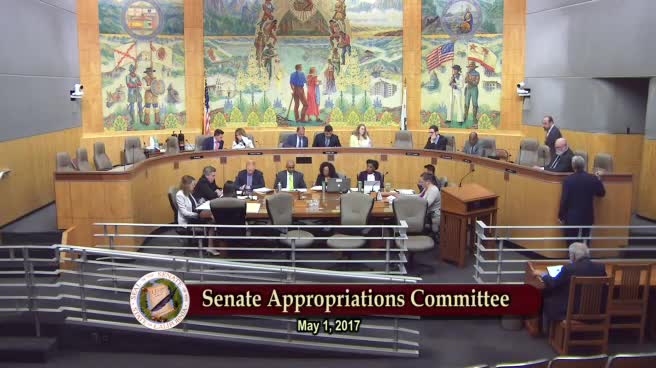 44SEC
Senate Standing Committee on Appropriations
Bill Author