SB 922: Surplus state property: affordable student housing.
- Session Year: 2017-2018
- House: Senate
- Latest Version Date: 2018-04-02
Existing law requires the Department of General Services to dispose of surplus state real property in a specified manner. Existing law requires the department to offer surplus state real property to a local agency and then to nonprofit affordable housing sponsors, prior to offering the property for sale to private entities or individuals, for use for open space, public parks, affordable housing projects, or development of local government-owned facilities.
The California Environmental Quality Act (CEQA) requires a lead agency, as defined, to prepare, or cause to be prepared, and certify the completion of, an environmental impact report on a project that it proposes to carry out or approve that may have a significant effect on the environment, or to adopt a negative declaration if it finds that the project will not have that effect. CEQA also requires a lead agency to prepare a mitigated negative declaration for a project that may have a significant effect on the environment if revisions in the project would avoid or mitigate that effect and there is no substantial evidence that the project, as revised, would have a significant effect on the environment. CEQA establishes a procedure by which a person may seek judicial review of the decision of the lead agency made pursuant to CEQA.
This bill would would, until January 1, 2029, authorize the Department of General Services to dispose of surplus state real property located within 2 miles of a campus of the University of California, California State University, or California Community Colleges by first offering the property to a local agency or nonprofit organization for the development of affordable student housing. housing, as defined. The bill would provide that ownership of the property transferred reverts back to the state if the transferee fails to commence the development of affordable student housing on the property within 2 years of the transfer. The bill would would, until January 1, 2029, exempt from the requirements of CEQA the transfer of the property and the development of affordable student housing on the property. Because a lead agency would be required to determine the applicability of this exemption, this bill would impose a state-mandated local program. The bill would require the Judicial Council, by July 1, 2019, to adopt a rule of court establishing procedures applicable to actions or proceedings seeking judicial review pursuant to CEQA of a lead agencys action, as specified, for those affordable student housing projects. The bill would, until January 1, 2029, prohibit the court, in an action or proceeding brought alleging a violation of CEQA, from staying or enjoining the siting, construction, or operation of those affordable student housing projects, except as provided.
The California Constitution requires the state to reimburse local agencies and school districts for certain costs mandated by the state. Statutory provisions establish procedures for making that reimbursement.
This bill would provide that no reimbursement is required by this act for a specified reason.
Existing law requires the Department of General Services to dispose of surplus state real property in a specified manner. Existing law requires the department to offer surplus state real property to a local agency and then to nonprofit affordable housing sponsors, prior to offering the property for sale to private entities or individuals, for use for open space, public parks, affordable housing projects, or development of local government-owned facilities.
The California Environmental Quality Act (CEQA) requires a lead agency, as defined, to prepare, or cause to be prepared, and certify the completion of, an environmental impact report on a project that it proposes to carry out or approve that may have a significant effect on the environment, or to adopt a negative declaration if it finds that the project will not have that effect. CEQA also requires a lead agency to prepare a mitigated negative declaration for a project that may have a significant effect on the environment if revisions in the project would avoid or mitigate that effect and there is no substantial evidence that the project, as revised, would have a significant effect on the environment.
This bill would authorize the Department of General Services to dispose of surplus state real property located within 2 miles of a campus of the University of California, California State University, or California Community Colleges by first offering the property to a local agency or nonprofit organization for the development of affordable student housing. The bill would provide that ownership of the property transferred reverts back to the state if the transferee fails to commence the development of affordable student housing on the property within 2 years of the transfer. The bill would exempt from the requirements of CEQA the transfer of the property and the development of affordable student housing on the property. Because a lead agency would be required to determine the applicability of this exemption, this bill would impose a state-mandated local program.
The California Constitution requires the state to reimburse local agencies and school districts for certain costs mandated by the state. Statutory provisions establish procedures for making that reimbursement.
This bill would provide that no reimbursement is required by this act for a specified reason.
Existing law, the Cortese-Knox-Hertzberg Local Government Reorganization Act of 2000, makes certain findings and declarations relating to local government organizations, including, among other things, the encouragement of orderly growth and development, and the logical formation and modification of the boundaries of local agencies, as specified. This bill would make nonsubstantive changes to these findings and declarations.Existing law, the Cortese-Knox-Hertzberg Local Government Reorganization Act of 2000, makes certain findings and declarations relating to local government organizations, including, among other things, the encouragement of orderly growth and development, and the logical formation and modification of the boundaries of local agencies, as specified.
This bill would make nonsubstantive changes to these findings and declarations.
(a)The Legislature finds and declares all of the following:
(1)According to the California State University, one in five students attending the California State University experience chronic hunger, and one in 10 students experience homelessness or housing insecurity.
(2)Housing insecurity and hunger affect a students health and academic performance, and can cause a student to withdraw from class, risking his or her graduation potential.
(3)The first priority for the disposal of state surplus surplus state real property is the development of affordable student housing in California.
(b)It is the intent of the Legislature to decrease the incidence of hunger and homelessness for college students in California.
SEC. 2.Section 11011.30 is added to the Government Code, to read:11011.30.(a)(1)Notwithstanding paragraph (2) of subdivision (b) of Section 11011.1, the Department of General Services may dispose of surplus state real property located within two miles of a campus of the University of California, California State University, or California Community Colleges by first offering the property to a local agency, as defined in Section 54221, or a nonprofit organization, for the development of affordable student housing. The Department of General Services shall dispose of surplus state real property pursuant to an offer made pursuant to this paragraph at below the fair market value of the surplus state real property.
(2)If no local agency or nonprofit organization is interested in developing the property for affordable student housing, the Department of General Services shall dispose of the property in compliance with paragraph (2) of subdivision (b) of Section 11011.1.
(b)Ownership of surplus state real property transferred pursuant to an offer made under this section shall revert back to the state if the transferee fails to commence the development of affordable student housing on the property within two years of the date of the transfer.
(c)For purposes of this section, the following definitions apply:
(1)Affordable student housing means student housing with rents that are below the fair market value.
(2)Commence the development of affordable student housing means any action undertaken by a lead agency intended to lead to a determination of whether or not the development of affordable student housing qualifies as a project for purposes of the California Environmental Quality Act (Division 13 (commencing with Section 21000) of the Public Resources Code).
(d)This section shall remain in effect only until January 1, 2029, and as of that date is repealed.
SEC. 3.Section 21080.40 is added to the Public Resources Code, to read:21080.40.(a)This division does not apply to the transfer of property pursuant to an offer made under Section 11011.30 of the Government Code or the development of affordable student housing on the property transferred. Code.
(b)This section shall remain in effect only until January 1, 2029, and as of that date is repealed.
SEC. 4.Section 21168.16 is added to the Public Resources Code, to read:21168.16.(a)On or before July 1, 2019, the Judicial Council shall adopt a rule of court to establish procedures applicable to actions or proceedings brought to attack, review, set aside, void, or annul the certification of the environmental impact report for an affordable student housing project built upon former surplus state real property disposed of pursuant to Section 11011.30 of the Government Code or the granting of any approvals for an affordable housing project to be built upon former surplus state real property disposed of pursuant to Section 11011.30 of the Government Code that require the actions or proceedings, including any potential appeals therefrom, be resolved, to the extent feasible, within 365 days of the lodging with the court of the certified record of proceedings.
(b)(1)Notwithstanding any other law, in granting relief in an action or proceeding brought pursuant to this division challenging an affordable student housing project built upon former surplus state real property disposed of pursuant to Section 11011.30 of the Government Code, the court shall not stay or enjoin the siting, construction, or operation of the affordable student housing project unless the court finds either of the following:
(A)The continued construction or operation of the project presents an imminent threat to public health and safety.
(B)The project site contains unforeseen important Native American artifacts or unforeseen important historical, archaeological, or ecological values that would be materially, permanently, and adversely affected by the continued construction or operation of the project unless the courts stays or enjoins the construction or operation of the project.
(2)If the court finds that subparagraph (A) or (B) of paragraph (1) is satisfied, the court shall only enjoin those specific activities associated with the project that present an imminent threat to public health and safety or that materially, permanently, and adversely affect unforeseen important Native American artifacts or unforeseen important historical, archaeological, or ecological values.
(c)This section shall remain in effect only until January 1, 2029, and as of that date is repealed.
SEC. 4.SEC. 5.No reimbursement is required by this act pursuant to Section 6 of Article XIIIB of the California Constitution because a local agency or school district has the authority to levy service charges, fees, or assessments sufficient to pay for the program or level of service mandated by this act, within the meaning of Section 17556 of the Government Code.
(a)The Legislature finds and declares all of the following:
(1)According to the California State University, one in five students attending the California State University experience chronic hunger, and one in 10 students experience homelessness or housing insecurity.
(2)Housing insecurity and hunger affect a students health and academic performance, and can cause a student to withdraw from class, risking his or her graduation potential.
(3)The first priority for the disposal of state surplus property is the development of affordable student housing in California.
(b)It is the intent of the Legislature to decrease the incidence of hunger and homelessness for college students in California.
SEC. 2.Section 11011.30 is added to the Government Code, to read:11011.30.(a)(1)Notwithstanding paragraph (2) of subdivision (b) of Section 11011.1, the Department of General Services may dispose of surplus state real property located within two miles of a campus of the University of California, California State University, or California Community Colleges by first offering the property to a local agency, as defined in Section 54221, or a nonprofit organization, for the development of affordable student housing.
(2)If no local agency or nonprofit organization is interested in developing the property for affordable student housing, the Department of General Services shall dispose of the property in compliance with paragraph (2) of subdivision (b) of Section 11011.1.
(b)Ownership of surplus state real property transferred pursuant to an offer made under this section shall revert back to the state if the transferee fails to commence the development of affordable student housing on the property within two years of the date of the transfer.
SEC. 3.Section 21080.40 is added to the Public Resources Code, to read:21080.40.This division does not apply to the transfer of property pursuant to an offer made under Section 11011.30 of the Government Code or the development of affordable student housing on the property transferred.
SEC. 4.No reimbursement is required by this act pursuant to Section 6 of Article XIIIB of the California Constitution because a local agency or school district has the authority to levy service charges, fees, or assessments sufficient to pay for the program or level of service mandated by this act, within the meaning of Section 17556 of the Government Code.
SECTION 1.Section 56001 of the Government Code is amended to read:56001.The Legislature finds and declares it is the policy of the state to encourage orderly growth and development which are essential to the social, fiscal, and economic well-being of the state. The Legislature recognizes that the logical formation and determination of local agency boundaries is an important factor in promoting orderly development and in balancing that development with sometimes competing state interests of discouraging urban sprawl, preserving open-space and prime agricultural lands, and efficiently extending government services. The Legislature also recognizes that providing housing for persons and families of all incomes is an important factor in promoting orderly development. Therefore, the Legislature further finds and declares that this policy should be effected by the logical formation and modification of the boundaries of local agencies, with a preference granted to accommodating additional growth within, or through the expansion of, the boundaries of those local agencies that can best accommodate and provide necessary governmental services and housing for persons and families of all incomes in the most efficient manner feasible.The Legislature recognizes that urban population densities and intensive residential, commercial, and industrial development necessitate a broad spectrum and high level of community services and controls. The Legislature also recognizes that when areas become urbanized to the extent that they need the full range of community services, priorities are required to be established regarding the type and levels of services that the residents of an urban community need and desire; that community service priorities be established by weighing the total community service needs against the total financial resources available for securing community services; and that those community service priorities are required to reflect local circumstances, conditions, and limited financial resources. The Legislature finds and declares that a single multipurpose governmental agency is accountable for community service needs and financial resources and, therefore, that agency may be the best mechanism for establishing community service priorities especially in urban areas. Nonetheless, the Legislature recognizes the critical role of many limited purpose agencies, especially in rural communities. The Legislature also finds, whether governmental services are proposed to be provided by a single-purpose agency, several agencies, or a multipurpose agency, responsibility should be given to the agency or agencies that can best provide government services.The Legislature finds and declares that it is the policy of the state to encourage orderly growth and development which are essential to the social, fiscal, and economic well-being of the state. The Legislature recognizes that the logical formation and determination of local agency boundaries is an important factor in promoting orderly development and in balancing that development with sometimes competing state interests of discouraging urban sprawl, preserving open-space and prime agricultural lands, and efficiently extending government services. The Legislature also recognizes that providing housing for persons and families of all incomes is an important factor in promoting orderly development. Therefore, the Legislature further finds and declares that this policy should be effected by the logical formation and modification of the boundaries of local agencies, with a preference granted to accommodating additional growth within, or through the expansion of, the boundaries of those local agencies which that can best accommodate and provide necessary governmental services and housing for persons and families of all incomes in the most efficient manner feasible.
The Legislature recognizes that urban population densities and intensive residential, commercial, and industrial development necessitate a broad spectrum and high level of community services and controls. The Legislature also recognizes that when areas become urbanized to the extent that they need the full range of community services, priorities are required to be established regarding the type and levels of services that the residents of an urban community need and desire; that community service priorities be established by weighing the total community service needs against the total financial resources available for securing community services; and that those community service priorities are required to reflect local circumstances, conditions, and limited financial resources. The Legislature finds and declares that a single multipurpose governmental agency is accountable for community service needs and financial resources and, therefore, that agency may be the best mechanism for establishing community service priorities especially in urban areas. Nonetheless, the Legislature recognizes the critical role of many limited purpose agencies, especially in rural communities. The Legislature also finds that, whether governmental services are proposed to be provided by a single-purpose agency, several agencies, or a multipurpose agency, responsibility should be given to the agency or agencies that can best provide government services.
|
Date
|
Status
|
|---|---|
| Apr 10, 2018 | April 10 set for first hearing. Failed passage in committee. (Ayes 5. Noes 5.) Reconsideration granted. |
| Apr 6, 2018 | Set for hearing April 18 in EQ. pending receipt. |
| Apr 2, 2018 | From committee with author's amendments. Read second time and amended. Re-referred to Com. on G.O. |
| Mar 23, 2018 | Set for hearing April 10. |
| Mar 15, 2018 | Re-referred to Coms. on G.O. and EQ. |
| Mar 1, 2018 | From committee with author's amendments. Read second time and amended. Re-referred to Com. on RLS. |
| Feb 1, 2018 | Referred to Com. on RLS. |
| Jan 24, 2018 | From printer. May be acted upon on or after February 23. |
| Jan 23, 2018 | Introduced. Read first time. To Com. on RLS. for assignment. To print. |
|
Date
|
Description
|
Location
|
Votes
|
|
|---|---|---|---|---|
| Apr 10, 2018 | [First] hearing set for [04-10-2018]: Failed passage in Committee. Reconsideration granted | Senate Standing Committee on Governmental Organization |
Passed |
|
| Apr 10, 2018 | Do pass, but first be re-referred to the Committee on [Environmental Quality] | Senate Standing Committee on Governmental Organization |
Passed |
This list shows positions taken on this bill by organizations on the date displayed, which is linked to the original source.
Positions by individuals are not included.
|
Organization
|
Position
|
Date
|
|---|---|---|
| California Apartment Association | ** Support | Apr 6, 2018 |
| California State Student Association | * Indeterminate | Apr 10, 2018 |
| Habitat For Humanity California | * Support | Apr 10, 2018 |
| Judicial Council of California | ** Against | Apr 6, 2018 |
| Sierra Club California | * Against Unless Amend | Apr 10, 2018 |
| University of California, Davis | * Support | Apr 10, 2018 |
SENATE COMMITTEE ON GOVERNMENTAL ORGANIZATION
Senator Bill Dodd
Chair
2017 - 2018 Regular
Bill No: SB Hearing Date: 4/10/2018
Author: | Nguyen | ||
Version: | Amended | ||
Urgency: | Fiscal: | ||
Consultant: | |||
SUBJECT:
DIGEST: This bill authorizes, until January 1, 2029, the Department of General Services (DGS) to dispose of surplus state property located within two miles of a campus of the University of California (UC), California State University (CSU), or California Community Colleges (CCC) by first offering the property to a local agency or a nonprofit organization for the development of affordable student housing. In addition, the bill would require the Judicial Council to adopt a rule of court establishing procedures applicable to actions or proceedings seeking judicial review pursuant to the California Environmental Quality Act (CEQA) seeking a judicial review of an environmental impact report for specified affordable student housing. Finally, the bill eliminates the power of courts to stay or enjoin challenged projects except in two limited circumstances for projects pursuant to the provisions of this bill.
ANALYSIS:
Existing law:
- Requires DGS to dispose of surplus state property in a specified manner.
- Requires DGS to offer surplus state real property to a local agency and then to nonprofit affordable housing sponsors, prior to offering the property for sale to private entities or individuals, for use for open space, public parks, affordable housing projects, or development of local government-owned facilities.
- Defines “surplus state real property” to mean real property declared surplus by the Legislature and directed to be disposed of by DGS, including any property previously declared surplus by the Legislature but not yet disposed of by DGS.
- Requires, under CEQA, a lead agency, as defined, to prepare and certify the completion of, an environmental impact report on a project that it proposes to carry out or approve that may have a significant effect on the environment, or to adopt a negative declaration if it finds that the project will not have that affect.
- Requires, under CEQA, a lead agency to prepare a mitigated negative declaration for a project that may have a significant effect on the environment if revisions in the project would avoid or mitigate that effect and there is no substantial evidence that the project, as revised, would have a significant effect on the environment.
- Establishes, under CEQA, a procedure by which a person may seek judicial review of the decision of the lead agency made pursuant to CEQA.
This bill:
- Authorizes DGS to dispose of surplus state property located within two miles of a campus of the UC, CSU or CCC by first offering the property to a local agency, as defined, or a nonprofit organization, for the development of affordable student housing.
- Requires DGS to dispose of surplus property pursuant to an offer made under this bill at below the fair market value of the surplus property.
- Defines “affordable student housing” to mean student housing with rents that are below fair market value.
- Specifies that if no local agency or nonprofit organization is interested in developing the property for affordable student housing, DGS shall dispose of the property under the current process.
- Requires that the ownership of surplus state property to be transferred pursuant to an offer made back to the state if the transferee fails to commence the development of affordable student housing on the property within two years of the date of the transfer.
- Defines “commence the development of affordable student housing” to mean any action undertaken by a lead agency intended to lead to a determination of whether or not the development of affordable student housing qualifies as a project for purposes of CEQA.
- Requires, on or before July 1, 2019, the Judicial Council to adopt a rule of court to establish procedures applicable to actions or proceedings seeking judicial review pursuant to CEQA seeking judicial review of an environmental impact report for specified affordable student housing projects.
- Requires that the actions or proceedings, including any potential appeals therefrom, be resolved, to the extent feasible, within 365 days of the lodging with the court of the certified record of proceedings.
- Prohibits, until January 1, 2029, the court, in an action or proceeding brought alleging a violation of CEQA, from staying or enjoining the siting, construction, or operation of those affordable student housing project unless the court finds either of the following:
- The continued construction or operation of the project presents an imminent threat to public health and safety.
- The project site contains unforeseen important Native American artifacts or unforeseen important historical, archaeological, or ecological values that would be materially, permanently, and adversely affected by the continued construction or operation of the project unless the court stays or enjoins the construction or operation of the project.
- Specifies if the court finds that either of the two exceptions have been satisfied, the court shall only enjoin those specific activities associated with the project that present an imminent threat to public health and safety or that materially, permanently, and adversely affect unforeseen important Native American artifacts or unforeseen important historical, archaeological, or ecological values.
- Includes a sunset date of January 1, 2029.
Background
Purpose of the bill. According to the author’s office, “recent assessments of both the UC and CSU identified significant homeless and housing insecure populations of students in each respective institution. The CSU claims that one in 10 Cal State students are homeless. The UC claims that one in four UC students are forced to choose between paying for food and paying for housing. In many cases, students are forced to withdraw from classes or drop out of school all together because the cost of living on or near a campus is too high. Also, the lack of affordable housing can affect student’s overall health and academic performance.”
The author’s office further argues that, “it is important that the Legislature pass legislation to decrease the incidences of hunger and homelessness among college students. This bill would help with the development of stable, affordable student housing in communities to better equip students for success.”
Current process. Once a specific state property, or part of a particular state property, has been determined by DGS not to be needed by any state agency, current law requires the Legislature to pass, and the Governor to sign legislation that declares that specific property as state surplus property. Because of this process, it is difficult to predict when a particular state property could become state surplus property.
Following this declaration by the Legislature, DGS is required to first offer the property to a local agency. If the local agency has no interest in the property DGS is then required to offer the property to a nonprofit affordable housing sponsor. If both refuse, DGS is authorized to sell the property to private entities or individuals.
To be considered a potential priority buyer, a local agency or nonprofit affordable housing sponsor, is required to notify DGS of its interest in the surplus property within 90 days of the posting of the availability of the property on the department’s Internet Web site. The local agency or nonprofit affordable housing sponsor is then required to demonstrate, to the satisfaction of DGS, that the property, or portion of that property, is to be for open space, public parks, affordable housing projects, or development of local government-owned facilities.
When more than one local agency expresses an interest in the property, priority is required by law to be given to the local agency that intends to use the surplus property for affordable housing. If more than one nonprofit affordable housing sponsor desires the surplus property, DGS is required to transfer the property to the nonprofit offering the greatest number of affordable housing units.
In addition, DGS is authorized to sell surplus property, or portion of surplus property to a local agency or nonprofit affordable housing sponsor, if no local agency is interested in the property, at a sales price less than fair market value if DGS determines that such a discount will enable the provision of housing for persons and families of low or moderate income. In practice, this does include affordable student housing.
It should be noted that while the initial transfer of the property is not purview to any CEQA requirements, any future project on that property must follow any and all CEQA requirements, unless otherwise exempted.
Unknown impact. Nothing in this bill changes the process of how a property is declared state surplus property. In other words, if this bill were to become law, the Legislature would still be required to pass legislation declaring any future state property as state surplus property. Furthermore, because the bill includes a sunset date of January 1, 2029, it is impossible to determine the number of state properties, if any, that this bill would be applicable to in the coming years. However, if a state property, that is within two miles of a UC, CSU, or CCC, is declared surplus property in the next 10 years, this bill could have a significant impact on the types of projects that could be built on that property.
Under this bill, priority would be given to a local agency or nonprofit organization, but only for the development of affordable student housing without knowing the specific property, or the specific needs of the local community. This priority would supersede the current requirement that a local agency enjoys. Therefore, if a local agency was interested in building a school, park, or even affordable housing projects for non-students, this bill could eliminate that option.
Unfortunately, it is difficult to determine the overall impact of the bill because of the unknown number of state properties, located within two miles of the current 10 UC campuses, 23 CSU campuses, and 114 campuses, which could become surplus properties in the next 10 years. Without knowing what specific properties this bill would impact, it is therefore difficult to determine whether the best use for that property is affordable student housing.
CEQA judicial review. In short, CEQA provides a process for evaluating the environmental effect of projects, unless exempted, undertaken or approved by public agencies. An initial study is prepared that determines if the project will have a significant effect on the environment. If the study determines that the project will have significant effects, the lead agency must prepare an environmental impact report that describes the proposed project, identifies the impact of the project and describes mitigation measures to reduce those impacts.
To enforce the requirements of CEQA, a civil action may be taken to attack, review, set aside, void, or annul the acts or decisions of a public agency for noncompliance with the act. This bill would require the Judicial Council to develop rules of court applicable to such challenges that require the actions to be resolved within 365 days of the certification of the record of proceedings to the extent feasible. The bill would also eliminate the power of courts to stay or enjoin challenged projects except in two limited circumstances. This is a dramatic shift from the current process which requires any future project, unless otherwise exempted, built on surplus properties, to follow all of the requirements of CEQA.
In addition, opponents of the bill argue that the 365-day timeline is problematic because CEQA actions are already entitled to calendar preference in both the superior courts and the Courts of Appeals. They argue that the timeline is arbitrary and likely unworkable in practice. Furthermore, opponents argue that this undermines equal access to justice.
Prior/Related Legislation
SB 1340 (Glazer, 2018) requires the Judicial Council to adopt a rule of court to establish procedures requiring courts to fully adjudicate CEQA actions and proceedings in connection with any housing projects within 270 days of certifying the record of proceedings, to the extent feasible and prohibits courts from staying or enjoining challenged projects with to narrow exceptions. (Pending in the Senate Judiciary Committee)
AB 1905 (Grayson, 2018) imposes limits on the court’s ability to issue injunctive relief in CEQA cases challenging specified transportation projects. (Pending in the Assembly Natural Resources Committee)
AB 2279 (Fong, 2018) imposes limits on the court’s ability to issue injunctive relief in CEQA cases challenging specified housing projects. (Pending in the Assembly Natural Resources Committee)
AB 2856 (Melendez, 2018) imposes limits on the court’s ability to issue injunctive relief in CEQA cases challenging specified housing projects. (Pending in the Assembly Natural Resources Committee)
AB 1709 (Veterans Affairs, Chapter 304, Statutes of 2017) required that an armory be offered for sale to a local agency, as defined, prior to being offered for sale to private entities or individuals.
SB 814 (Governmental Organization, Chapter 815, Statutes of 2017) authorized DGS to dispose of a specified parcel of state property, consisting of approximately 65 acres, known as a a portion of the Department of Corrections and Rehabilitation’s Preston Youth Correctional Facility in Amador County.
SB 1057 (Weber, Chapter 147, Statutes of 2017) required the Director of DGS, with the approval of the Adjutant General, to offer an option to purchase a portion of the California Military Department’s San Diego Armory, as specified, to the San Diego Center for Children, a nonprofit organization. (Pending in Senate Veterans Affairs Committee)
AB 2247 (Williams, Chapter 382, Statutes of 2016) required the Director of DGS, with the approval of the Adjutant General, to grant specified cities and school districts an option to purchase the Santa Barbara Armory, Brawley Armory, Indio Armory, Lynwood Armory, and Ponoma Armory, as defined.
SB 273 (Hueso, Chapter 233, Statutes of 2015) authorized DGS to dispose of two surplus state properties, a Department of Conservation field office in Fresno County and a Department of Forestry conservation camp in Shasta County.
SB 536 (Roth, Chapter 355, Statutes of 2015) authorized DGS, with the approval of the Adjutant General, to sell seven specified state armory properties that are no longer considered needed by the California Military Department.
AB 2174 (Committee on Accountability and Administrative Review, Chapter 337, Statutes of 2014) authorized DGS to dispose of certain state surplus property, subject to specified conditions.
SB 743 (Steinberg, Chapter 386, Statutes of 2013) established specified administrative and judicial review procedures for review of the EIR and public agency approvals granted for a project related to the development of an entertainment and sports center in the City of Sacramento. Additionally, this bill provided that aesthetic and parking impacts of a residential, mixed-use residential, or employment center project on an infill site within a transit priority area shall not be considered significant impacts on the environment under CEQA, as specified.
SB 292 (Padilla, Chapter 353, Statutes of 2011) established specified administrative and judicial review procedures for review of the EIR and public agency approvals granted for a project related to the development of a stadium in the City of Los Angeles.
AB 900 (Buchanan, Chapter 354, Statutes of 2011), the Jobs and Economic Improvement Through Environmental Leadership Act of 2011, established specified administrative and judicial review procedures for the review of the EIR and public agency approvals granted for designated residential, retail, commercial, sports, cultural, entertainment, or recreational use projects, or clean renewable energy or clean energy manufacturing projects.
SB 1167 (Cogdill, Chapter 324, Statutes of 2010) authorized DGS to dispose of all or any portion of two specified properties.
SB 1481 (Governmental Organization, Chapter 528, Statutes of 2010) required that the proceeds from the sale of armories must be deposited in the Armory Fund and are not required to be used to retire bond debt resulting from the 2004 Economic Recovery Bond Act.
SB 136 (Huff, Chapter 166, Statutes of 2009) authorized DGS to dispose of all or any portion of three parcels of real property.
AB 600 (Hall, 2009) would have authorized DGS to lease the Compton Armory to the City of Compton at fair market value for a period not to exceed five years, with an option to extend the lease to 25 years. (Vetoed by Governor Schwarzenegger)
SB 901 (Governmental Organization, Chapter 610, Statues of 2001) added various parcels, including approximately five acres of the San Diego Armory, to the list of surplus properties included for sale, exchange, or lease by the Director of DGS, as specified.
FISCAL EFFECT: Appropriation: No Fiscal Com.: Yes Local: Yes
SUPPORT:
California Apartment Association
Habitat for Humanity California
OPPOSITION:
Judicial Council of California
ARGUMENTS IN SUPPORT: According to Habitat for Humanity California, “young Californians, attending institutions of higher education to advance themselves and contribute to our economy as professionals are struggling to meet their basic needs and find affordable housing. By prioritizing the grant of unused lands to nonprofits or local entities to build affordable housing for students, we believe this will ultimately increase the supply of housing units overall and our ability to provide more homeownership opportunities for local families in these vibrant communities.”
ARGUMENTS IN OPPOSITION: According to the Judicial Council of California, “the expedited judicial review for the specific housing projects covered by SB 922 will likely have an adverse impact on other cases. Like other types of calendar preferences, which the Judicial Council has historically opposed, setting an extremely tight timeline for deciding this particular type of case has the practical effect of pushing other cases on the courts’ dockets to the back of the line. This means that other cases, including cases that have statutorily mandated calendar preferences, such as juvenile cases, criminal cases, and civil cases in which a party is at risk of dying, will take longer to decide.”
In addition, the Judicial Council argues that, “the provision in SB 922 that significantly limits the forms of relief that the court may use in any action challenging the housing projects covered by this bill interferes with the inherent authority of a judicial officer and raises a serious question of separation of powers question.”
DUAL REFERRAL: Senate Environmental Quality Committee
Discussed in Hearing
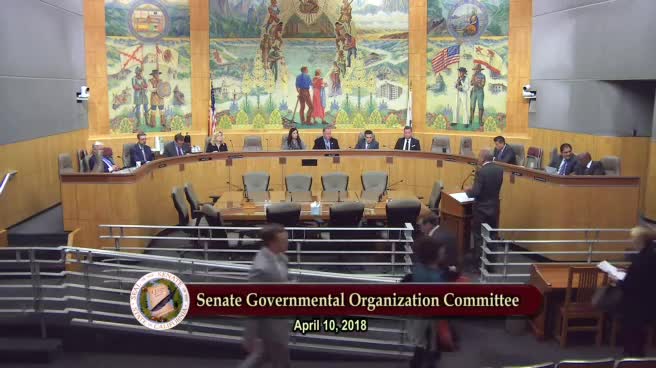 27MIN
Senate Standing Committee on Governmental Organization
Bill Author

Bill Co-Author(s):