SB 936: Office of Planning and Research: Automated Vehicles Smart Planning Task Force.
- Session Year: 2017-2018
- House: Senate
- Latest Version Date: 2018-04-26
Existing law establishes the Office of Planning and Research in the Governors office, which serves the Governor and his or her cabinet for long-range planning and research and constitutes the comprehensive state planning agency. Existing law permits the operation of an automated vehicle on public roads for testing purposes by a driver who possesses the proper class of license for the type of vehicle being operated if specified requirements are met.
This bill would require the Office of Planning and Research in the Governors office to convene an Automated Vehicles Smart Planning Task Force, consisting of representatives from the University of California, local government, and specified others, and would require the task force, on or before January 1, 2021, to submit to relevant policy committees of the Legislature recommendations to ensure that deployment of automated light-duty vehicles promotes and does not hinder specified state policies and objectives. The bill would state various findings and declarations of the Legislature relating to automated vehicles.
Existing law establishes the Office of Planning and Research in the Governors office, which serves the Governor and his or her cabinet for long-range planning and research and constitutes the comprehensive state planning agency. Existing law permits the operation of an autonomous automated vehicle on public roads for testing purposes by a driver who possesses the proper class of license for the type of vehicle being operated if specified requirements are met.
This bill would require the Office of Planning and Research in the Governors office to convene an Autonomous Automated Vehicles Smart Planning Task Force, consisting of representatives from the University of California, local government, and specified others, and would require the task force, on or before January 1, 2021, to submit to relevant policy committees of the Legislature recommendations to ensure that deployment of autonomous automated light-duty vehicles promotes and does not hinder specified state policies. policies and objectives. The bill would state various findings and declarations of the Legislature relating to automated vehicles.
Existing law establishes the Office of Planning and Research in the Governors office, which serves the Governor and his or her cabinet for long-range planning and research and constitutes the comprehensive state planning agency. Existing law permits the operation of an autonomous vehicle on public roads for testing purposes by a driver who possesses the proper class of license for the type of vehicle being operated if specified requirements are met.
This bill would require the Office of Planning and Research in the Governors office to convene an Autonomous Vehicles Smart Planning Task Force, consisting of representatives from the University of California, local government, and specified others, and would require the task force, on or before January 1, 2021, to submit to relevant policy committees of the Legislature recommendations to ensure that deployment of autonomous vehicles does not hinder specified state policies.
Existing law requires manufacturers, vendors, or other nongovernmental entities contracting with the Department of General Services to certify in writing that any environmental attribute claims they make concerning their products and services are consistent with specified guidelines.This bill would require the certification to be made in writing or electronically.Existing law requires manufacturers, vendors, or other nongovernmental entities contracting with the Department of General Services to certify in writing that any environmental attribute claims they make concerning their products and services are consistent with specified guidelines.
This bill would require the certification to be made in writing or electronically.
The Legislature finds and declares all of the following:
(a)California, as a technological hub for innovation, should support the continued research and development of automated vehicle technology, as it has the potential to provide enormous environmental, economic, and social equity benefits.
(b)Automated vehicle technology is also poised to transform Californias entire transportation system, affecting both mobility and land use patterns across the state.
(c)Depending on how automated vehicle technology develops, this technology could help California attain its greenhouse gas reduction and air quality improvement goals or could potentially hinder them.
(d)According to research conducted by the Institute of Transportation Studies at the University of California at Davis, automated vehicles will make travel less onerous, which could increase vehicle travel by 15 to 20 percent by 2050. This would contribute to more greenhouse gas emissions.
(e)An increase in vehicle miles traveled by automated vehicles could lead to increased traffic congestion and sprawl, effects that could impact regions, cities, and neighborhoods disproportionately.
(f)Research funded through the National Cooperative Highway Research Program Project 20-102, Impacts of Connected Vehicles and Automated Vehicles on State and Local Transportation Agencies, confirmed that automated vehicles will lead to changes in land use patterns that could either support or undermine efforts to fight climate change and reduce sprawl and vehicle miles traveled.
(g)According to research conducted by the National Center for Sustainable Transportation, active transportation (walking and bicycling) makes an important potential contribution to the reduction of vehicle miles traveled while also creating significant health benefits. Evidence also indicates that a barrier to increased active transportation is fear of being struck by a motor vehicle. Therefore, a primary goal of automated vehicles should be to reduce the risk of harm to those undertaking active transportation.
(h)Negative impacts resulting from automated vehicles can be mitigated and, in some cases, eliminated if policies are adopted to guide their development and use. Strategies include commercializing automated electric vehicles, minimizing private vehicle ownership, encouraging ride sharing, and expanding high-quality public transportation and infrastructure and programs for active transportation.
(i)Research from the University of California at Davis has shown that widespread on-demand travel, when supported by substantial ride sharing and electric vehicles, can reduce car travel by over 50 percent, reduce carbon emissions from transportation by 80 percent, and cut the cost of transportation infrastructure and operations by 40 percent by 2050.
(j)To ensure automated vehicle technology fulfills the promise of environmental sustainability, economic prosperity, and social equity for all Californians, the state must further research the potential externalities of automated vehicles and develop policy recommendations that fully mitigate negative impacts without hindering the development of the technology.
SEC. 2.Article 5.5 (commencing with Section 65053) is added to Chapter 1.5 of Division 1 of Title 7 of the Government Code, to read:5.5. Automated Vehicles Smart Planning Task Force65053.(a)The Office of Planning and Research shall convene an Automated Vehicles Smart Planning Task Force, which shall include representatives from the University of California and other academic institutions, local government and metropolitan planning organizations, transit agencies, automated vehicle and electric vehicle manufacturers, transportation network companies, labor organizations, clean transportation organizations, and environmental organizations, property casualty companies or property casualty insurance trade organizations, and disability rights organizations.
(b)Members of the task force shall have expertise in automated vehicles, land use planning, traffic congestion, greenhouse gas emissions, air pollution, clean transportation, or other topics as necessary to submit the recommendations specified in Section 65053.1.
65053.1.(a)On or before January 1, 2021, the task force shall submit to the relevant policy committees of the Legislature recommendations to ensure that deployment of automated light-duty vehicles promotes and does not hinder any of the following policies and objectives:
(1)Achievement of Californias clean air and climate goals.
(2)Reduction in vehicle miles traveled, consistent with Section 65080.
(3)Reduction in traffic congestion.
(4)Adoption of electric vehicles and other zero emission vehicles to meet Californias goal of five million zero emission vehicles on the road by 2030.
(5)Increased travel mode share of, and integration with, existing and future public transportation and transit networks.
(6)Increased travel mode share of bicycling and walking and integration with local, regional, and state policies that support this aim.
(7)Achievement of sustainable community strategies and priorities, including infill and compact development.
(8)Shared rather than single passenger mobility.
(9)Accessibility for persons with disabilities.
(10)Environmental, economic, and social justice equity, including equitable access to clean transportation and mobility.
(b)Pursuant to Section 10231.5, this section is repealed on January 1, 2025.
The Legislature finds and declares all of the following:
(a)California, as a technological hub for innovation, should support the continued research and development of automated vehicle technology, as it has the potential to provide enormous environmental, economic, and social equity benefits.
(b)Automated vehicle technology is also poised to transform Californias entire transportation system, affecting both mobility and land use patterns across the state.
(c)Depending on how automated vehicle technology develops, this technology could help California attain its greenhouse gas reduction and air quality improvement goals or could potentially hinder them.
(d)According to research conducted by the Institute of Transportation Studies at the University of California at Davis, automated vehicles will make travel less onerous, which could increase vehicle travel by 15 to 20 percent by 2050. This would contribute to more greenhouse gas emissions.
(e)An increase in vehicle miles traveled by automated vehicles could lead to increased traffic congestion and sprawl, effects that could impact regions, cities, and neighborhoods disproportionately.
(f)Research funded through the National Cooperative Highway Research Program Project 20-102, Impacts of Connected Vehicles and Automated Vehicles on State and Local Transportation Agencies, confirmed that automated vehicles will lead to changes in land use patterns that could either support or undermine efforts to fight climate change and reduce sprawl and vehicle miles traveled.
(g)According to research conducted by the National Center for Sustainable Transportation, active transportation (walking and bicycling) makes an important potential contribution to the reduction of vehicle miles traveled while also creating significant health benefits. Evidence also indicates that a barrier to increased active transportation is fear of being struck by a motor vehicle. Therefore, a primary goal of automated vehicles should be to reduce the risk of harm to those undertaking active transportation.
(h)Negative impacts resulting from automated vehicles can be mitigated and, in some cases, eliminated if policies are adopted to guide their development and use. Strategies include commercializing automated electric vehicles, minimizing private vehicle ownership, encouraging ride sharing, and expanding high-quality public transportation and infrastructure and programs for active transportation.
(i)Research from the University of California at Davis has shown that widespread on-demand travel, when supported by substantial ride sharing and electric vehicles, can reduce car travel by over 50 percent, reduce carbon emissions from transportation by 80 percent, and cut the cost of transportation infrastructure and operations by 40 percent by 2050.
(j)To ensure automated vehicle technology fulfills the promise of environmental sustainability, economic prosperity, and social equity for all Californians, the state must further research the potential externalities of automated vehicles and develop policy recommendations that fully mitigate negative impacts without hindering the development of the technology.
SECTION 1.SEC. 2.Article 5.5 (commencing with Section 65053) is added to Chapter 1.5 of Division 1 of Title 7 of the Government Code, to read:5.5.Autonomous Automated Vehicles Smart Planning Task Force65053.(a)The Office of Planning and Research shall convene an Autonomous Automated Vehicles Smart Planning Task Force, which shall include representatives from the University of California and other academic institutions, local government, autonomous government and metropolitan planning organizations, transit agencies, automated vehicle and electric vehicle manufacturers, transportation network companies, labor organizations, clean transportation organizations, and environmental organizations.
(b)Members of the task force shall have expertise in autonomous automated vehicles, land use planning, traffic congestion, greenhouse gas emissions, air pollution, clean transportation, or other topics as necessary to submit the recommendations specified in Section 65053.1.
65053.1.(a)On or before January 1, 2021, the task force shall submit to the relevant policy committees of the Legislature recommendations to ensure that deployment of autonomous automated light-duty vehicles promotes and does not hinder any of the following policies: policies and objectives:
(1)Achievement of Californias clean air and climate goals.
(2)Reduction in vehicle miles traveled. traveled, consistent with Section 65080.
(3)Reduction in traffic congestion.
(4)Adoption of electric vehicles and other zero emission vehicles to meet Californias goal of five million zero emission vehicles on the road by 2030.
(5)Integration with Increased travel mode share of, and integration with, existing and future public transportation and transit networks.
(6)Increased travel mode share of bicycling and walking and integration with local, regional, and state policies that support this aim.
(7)Achievement of sustainable community strategies and priorities, including infill and compact development.
(6)(8)Shared rather than single passenger mobility.
(7)(9)Accessibility for persons with disabilities.
(8)(10)Environmental Environmental, economic, and social justice equity. equity, including equitable access to clean transportation and mobility.
(b)Pursuant to Section 10231.5, this section is repealed on January 1, 2025.
(a)The Office of Planning and Research shall convene an Autonomous Vehicles Smart Planning Task Force, which shall include representatives from the University of California and other academic institutions, local government, autonomous vehicle and electric vehicle manufacturers, transportation network companies, and environmental organizations.
(b)Members of the task force shall have expertise in autonomous vehicles, land use planning, traffic congestion, greenhouse gas emissions, air pollution, or other topics as necessary to submit the recommendations specified in Section 65053.1.
65053.1.(a)On or before January 1, 2021, the task force shall submit to the relevant policy committees of the Legislature recommendations to ensure that deployment of autonomous vehicles does not hinder any of the following policies:
(1)Achievement of Californias clean air and climate goals.
(2)Reduction in vehicle miles traveled.
(3)Reduction in traffic congestion.
(4)Adoption of electric vehicles and other zero emission vehicles to meet Californias goal of five million zero emission vehicles on the road by 2030.
(5)Integration with existing and future public transportation and transit networks.
(6)Shared rather than single passenger mobility.
(7)Accessibility for persons with disabilities.
(8)Environmental and social justice equity.
(b)Pursuant to Section 10231.5, this section is repealed on January 1, 2025.
SECTION 1.Section 12404 of the Public Contract Code is amended to read:12404.Manufacturers, vendors, or other nongovernmental entities contracting with the Department of General Services shall certify in writing or electronically that any environmental attribute claims they make concerning their products and services are consistent with the Federal Trade Commissions Guidelines for the Use of Environmental Marketing Terms.Manufacturers, vendors, or other nongovernmental entities contracting with the Department of General Services shall certify in writing or electronically that any environmental attribute claims they make concerning their products and services are consistent with the Federal Trade Commissions Guidelines for the Use of Environmental Marketing Terms.
|
Date
|
Status
|
|---|---|
| May 25, 2018 | May 25 hearing: Held in committee and under submission. |
| May 18, 2018 | Set for hearing May 25. |
| May 14, 2018 | May 14 hearing: Placed on APPR. suspense file. |
| May 4, 2018 | Set for hearing May 14. |
| Apr 26, 2018 | Read second time and amended. Re-referred to Com. on APPR. |
| Apr 25, 2018 | From committee: Do pass as amended and re-refer to Com. on APPR. (Ayes 12. Noes 0.) (April 24). |
| Apr 16, 2018 | From committee with author's amendments. Read second time and amended. Re-referred to Com. on T. & H. |
| Apr 11, 2018 | Set for hearing April 24. |
| Apr 4, 2018 | Re-referred to Com. on T. & H. |
| Apr 2, 2018 | Withdrawn from committee. |
| Mar 21, 2018 | From committee with author's amendments. Read second time and amended. Re-referred to Com. on G.O. |
| Feb 8, 2018 | Referred to Com. on G.O. |
| Jan 26, 2018 | From printer. May be acted upon on or after February 25. |
| Jan 25, 2018 | Introduced. Read first time. To Com. on RLS. for assignment. To print. |
|
Date
|
Description
|
Location
|
Votes
|
|
|---|---|---|---|---|
| May 14, 2018 | Placed on suspense file | Senate Standing Committee on Appropriations |
Passed |
|
| Apr 24, 2018 | Do pass as amended, but first amend, and re-refer to the Committee on [Appropriations] | Senate Standing Committee on Transportation and Housing |
Passed |
This list shows positions taken on this bill by organizations on the date displayed, which is linked to the original source.
Positions by individuals are not included.
|
Organization
|
Position
|
Date
|
|---|---|---|
| American Insurance Association | ** Against | Apr 20, 2018 |
| California Transit Association | * Support | Apr 24, 2018 |
| Calstar | * Support | Apr 24, 2018 |
| Calstart | ** Support | Apr 20, 2018 |
| National Association of Mutual Insurance Companies | ** Against | Apr 20, 2018 |
| Pacific Association Of Domestic Insurance Companies | ** Against | Apr 20, 2018 |
| Personal Insurance Federation Of California | * Support | Apr 24, 2018 |
| Plug In America | ** Support | Apr 20, 2018 |
| Property Casualty Insurers Association Of California | ** Against | Apr 20, 2018 |
| Union Of Concerned Scientists | * Support | Apr 24, 2018 |
SENATE COMMITTEE ON APPROPRIATIONS
Senator Ricardo Lara, Chair
2017 - 2018 Regular Session
SB 936 (Allen) - Office of Planning and Research: Automated Vehicles Smart Planning Task Force
Version: April 26, 2018 | Policy Vote: T. & H. 12 - 0 |
Urgency: No | Mandate: No |
Hearing Date: May 14, 2018 | Consultant: Mark McKenzie |
This bill meets the criteria for referral to the Suspense File.
Bill Summary:
SB 936 would require the Governor’s Office of Planning and Research (OPR) to convene an Autonomous Vehicles Smart Planning Task Force (AV task force), and submit recommendations to the Legislature by January 1, 2021 to ensure that the deployment of autonomous vehicles promotes specified policies and objectives.
Fiscal Impact:
- OPR staffing costs, potentially over $100,000 annually for two years, to convene task force meetings, conduct research, and draft policy recommendations. (General Fund) ----see staff comments----
Background:
Existing law authorizes the operation of autonomous vehicles on public roads for testing and non-testing purposes under certain circumstances subject to regulations adopted by the Department of Motor Vehicles (DMV), as specified.
Existing law establishes OPR within the Governor’s Office to assist the Governor and the Administration in planning, research, policy development, and legislative analysis. Among other responsibilities, OPR formulates long-range state goals and policies to address land use, climate change, population growth and distribution, urban expansion, and infrastructure development. Within OPR, the Strategic Growth Council coordinates interagency efforts and partners with local and regional government stakeholders to promote sustainable development, improving air and water quality, protecting natural resources and agricultural lands, and reducing greenhouse gas emissions.
The UC Davis Institute of Transportation Studies (ITS) recently issued a series of policy briefs on what it characterizes as the three “revolutions” in transportation: automation, shared mobility, and electrification. According to ITS’s research, through the convergence of these three revolutions, “there is a potential to mitigate the negative externalities of 20th century auto-oriented sprawl, negate any additional sprawl associated with automation, and provide rapid responses to enable sharing and electrification.” Beyond the individual benefits offered by these technologies, such as enhanced safety and mobility, a unified, state-level policy on these “revolutions” could have benefits that include avoiding undesirable increases in vehicle-miles-traveled and greenhouse gas emissions and encouraging sustainable land use decisions and adoption of ZEV technology.
Existing law, pursuant to SB 1 (Beall), Chap. 5/2107, allocates $5 million to the University of California for transportation-related research.
Proposed Law:
SB 936 would require OPR to convene the AV task force, consisting of specified representatives with expertise in automated vehicles, land use planning, traffic congestion, greenhouse gas emissions, air pollution, clean transportation, or other topics as necessary. The bill requires the AV task force to submit to the Legislature policy recommendations on or before January 1, 2021 to ensure that deployment of automated light-duty vehicles promotes and does not hinder any of the following policies and objectives:
- Achievement of California’s clean air and climate goals.
- Reduction in vehicle miles traveled.
- Reduction in traffic congestion.
- Adoption of electric vehicles and other zero emission vehicles to meet California’s goal of five million zero emission vehicles on the road by 2030.
- Increased travel mode share of, and integration with, existing and future public transportation and transit networks.
- Increased travel mode share of bicycling and walking and integration with local, regional, and state policies that support this aim.
- Achievement of sustainable community strategies and priorities, including infill and compact development.
- Shared rather than single passenger mobility.
- Accessibility for persons with disabilities.
- Environmental, economic, and social justice equity, including equitable access to clean transportation and mobility.
The bill’s provisions would be repealed on January 1, 2025.
Related Legislation:
SB 802 (Skinner), which was held on the Assembly Appropriations Committee’s Suspense File last year, would have required OPR to convene a specified advisory group to review and advise the Legislature on policies pertaining to new types of motor vehicles operating in California, including autonomous vehicles and shared-use vehicles, as specified.
Staff Comments:
This bill is intended to provide guidance to the Legislature to ensure California plans responsibly for the potential wide-scale introduction of automated vehicles to ensure that deployment does not compound our serious climate, clean air, and traffic challenges.
OPR estimates that the duties associated with this bill will require 1 full-time PY of staff time for a transportation planner to select task force members, convene meetings, prepare meeting materials, conduct research, and produce final recommendations, plus an additional ½ PY of staff to provide administrative support. It is unclear that the duties related to convening the AV task force and providing recommendations would require that level of OPR staff support. Staff estimates OPR costs could exceed $100,000 annually for two years. Ultimately, any requests for additional resources would be considered through the annual budget process.
-- END --
SENATE COMMITTEE ON TRANSPORTATION AND HOUSING
Senator Jim Beall, Chair
2017 - 2018 Regular
Bill No: Hearing Date: 4/24/2018
Author: | Allen | ||
Version: | 4/16/18 Amended | ||
Urgency: | No | Fiscal: | Yes |
Consultant: | Jeffery Song | ||
SUBJECT:
DIGEST: This bill requires the Office of Planning and Research (OPR) to convene an Autonomous Vehicles Smart Planning Task Force. This bill directs the Task Force to recommend policies on the deployment of autonomous vehicles, related to clean air and climate goals, reducing vehicle miles traveled and traffic congestion, shared mobility, integration with other transportation and transit networks, and equity.
ANALYSIS:
Existing law:
- Authorizes the operation of autonomous vehicles on public roads for testing and non-testing purposes under certain circumstances subject to regulations adopted by the Department of Motor Vehicles (DMV), as specified.
- Establishes within the Governor’s Office, OPR to serve the Governor and his or her Cabinet as staff for long-range planning and research, and to constitute the comprehensive state planning agency.
- Requires OPR to accept and allocate or expend grants and gifts from any source, public or private, for the purpose of state planning and to undertake other planning and coordinating activities that will implement the policy and intent of the Legislature, as specified.
This bill:
- Requires the Office of Planning and Research to convene an Automated Vehicles Smart Planning Task Force, consisting of representatives from the University of California, local government and metropolitan planning organizations (MPO), transit agencies, automated vehicle and electric vehicle manufacturers, transportation network companies (TNC), labor organizations, clean transportation organizations, and environmental organizations.
- Specifies that the members of the Task Force should have expertise in automated vehicles, land use planning, traffic congestion, greenhouse gas emissions, air pollution, clean transportation, or other topics to make the specified recommendations.
- Requires the Task Force to submit to the Legislature policy recommendations on or before January 1, 2021 to ensure that deployment of automated light-duty vehicles promotes and does not hinder any of the following:
- Achievement of California’s clean air and climate goals.
- Reduction in vehicle miles traveled.
- Reduction in traffic congestion.
- Adoption of electric vehicles and other zero emission vehicles to meet California’s goal of five million zero emission vehicles on the road by 2030.
- Increased travel mode share of, and integration with, existing and future public transportation and transit networks.
- Increased travel mode share of bicycling and walking and integration with local, regional, and state policies that support this aim.
- Achievement of sustainable community strategies and priorities, including infill and compact development.
- Shared rather than single passenger mobility.
- Accessibility for persons with disabilities.
- Environmental, economic, and social justice equity, including equitable access to clean transportation and mobility.
- Repeals the requirement on January 1, 2025.
COMMENTS:
- Purpose. According to the author, this bill would ensure California plans responsibly for the potential wide-scale introduction of automated vehicles and prevents this innovative new technology from adding to our serious climate, clean air, and traffic challenges. This bill calls on the Office of Planning and Research to convene an Automated Vehicles Smart Planning Task Force to develop recommendations to ensure that the deployment of automated vehicles supports our state’s environmental and equity goals.
- Background. In 2012, SB 1298 (Padilla) established conditions for the operation of automated vehicles (AV) in California. In 2014, the DMV adopted regulations for the testing of AVs on public roads requiring a test driver and established an application and approval process for a testing permit. As of April 1, 2018, there are 52 manufacturers that have this permit. In early 2018, the DMV adopted regulations for testing AVs without a driver at the wheel and for deployment of AVs in California. DMV began accepting applications for these permits on April 1, 2018.
- Uncertainty about AVs. AVs have the potential to transform every sector of transportation. However, much is uncertain about these impacts. AVs could enhance vehicle safety by removing human error from the driving task and improve access to mobility for many people. On the other hand, AVs could create more congestion and sprawl, as it becomes more convenient to use the “free” time of riding in AVs for other tasks such as work. AVs could replace transit trips, or it could provide better first- and last-mile connectivity to increase transit use. Currently, the Legislature has limited understanding of how to plan for a “driverless” world. This bill directs OPR to convene a wide range of stakeholders and experts to provide the Legislature with policy recommendations on how to guide this burgeoning technology.
- Policy Coordination Needed. The UC Davis Institute of Transportation Studies (ITS) recently issued a series of policy briefs characterizing AVs as one of the three “revolutions” in transportation, along with electrification and shared mobility (i.e., the shared use of a vehicle on as-needed basis).[1] According to ITS, these must happen concurrently in order to bring about increased access to mobility, more affordable transportation, and major reductions in greenhouse gas emissions. However, if there is just automation without shared mobility or electrification (e.g., people primarily riding in personal, gas-powered AVs), then CA could end up in a future of more vehicle miles traveled, more vehicles on the road, more sprawl, and more greenhouse gas emissions and energy use. ITS states that achieving all three revolutions together will require unprecedented levels of policy support. This bill provides the Legislature with that policy support to help coordinate how AV technology should be deployed to help improve how all Californians get around and meet the state’s climate goals.
- Legislation Needed? This bill may be unnecessary. The Governor could direct OPR to convene a study group to advise policymakers on these issues without authorizing legislation.
- Task Force Membership. The task force includes experts and AV stakeholders from many different perspectives, such as environmental groups, labor groups and vehicle manufacturers, to help provide recommendations to the Legislature. However, there are stakeholders currently not included that have a key interest and influence in how AVs will be deployed in California. The author may wish to consider adding a representative from the insurance industry and a representative from the disability rights organizations to the Task Force.
Related Legislation:
SB 802 (Skinner, 2017) — required OPR to convene an Emerging Vehicle Advisory Study Group to provide recommendations to the Legislature on emerging vehicle technology, including autonomous vehicles. This bill was held last year in the Assembly Appropriations Committee.
SB 1298 (Padilla, Chapter 570, Statutes of 2012) — established conditions for the operation of autonomous vehicles upon public roadways.
FISCAL EFFECT: Appropriation: No Fiscal Com.: Yes Local: No
POSITIONS: (Communicated to the committee before noon on Wednesday,
4/18/2018.)
SUPPORT:
CalSTART (sponsor)
Plug In America
OPPOSITION:
American Insurance Association
National Association of Mutual Insurance Companies
Pacific Association of Domestic Insurance Companies
Personal Insurance Federation of California
Property Casualty Insurers Association of California
-- END --
https://3rev.ucdavis.edu/policybriefs/ ↑
Discussed in Hearing
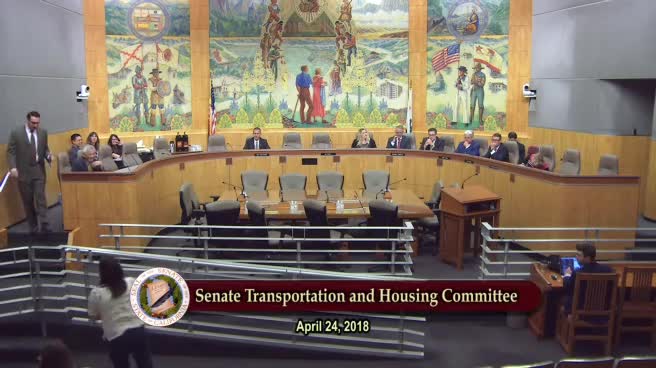 11MIN
Senate Standing Committee on Transportation and Housing
Bill Author

Bill Co-Author(s):