SB 995: Personal income taxes: standard deduction: annual increase.
- Session Year: 2017-2018
- House: Senate
- Latest Version Date: 2018-04-05
The Personal Income Tax Law imposes taxes based upon taxable income, at specified rates, and allows a taxpayer to elect to take a standard deduction in lieu of itemizing deductions, as provided, and provides for inflation adjustment to the standard deduction amount.
This bill, for each taxable year beginning on or after January 1, 2018, would add either $1,500 or $3,000, as provided, to the standard deduction amount, as adjusted for inflation.
This bill would take effect immediately as a tax levy.
The Personal Income Tax Law imposes taxes based upon taxable income, at specified rates, and allows a taxpayer to elect to take a standard deduction in lieu of itemizing deductions, as provided, and provides for inflation adjustment to the standard deduction amount.
This bill, for each taxable year beginning on or after January 1, 2018, would add either $1,500 or $3,000, as provided, to the standard deduction amount, as adjusted for inflation.
This bill would take effect immediately as a tax levy.
The Personal Income Tax Law imposes taxes on the entire taxable income of California residents and on the taxable income of nonresidents derived from sources in California.This bill would make nonsubstantive changes to the provision that names that law.The Personal Income Tax Law imposes taxes on the entire taxable income of California residents and on the taxable income of nonresidents derived from sources in California.
This bill would make nonsubstantive changes to the provision that names that law.
(a)For each taxable year beginning on or after January 1, 2018, the standard deduction amount determined pursuant to Section 17073.5 shall be supplemented as follows:
(1)In the case of a taxpayer, other than a head of a household or a surviving spouse, as defined in Section 17046, or a married couple filing a joint return, the standard deduction shall be increased by one thousand five hundred dollars ($1,500).
(2)In the case of a head of household or a surviving spouse, as defined in Section 17046, or a married couple filing a joint return, the standard deduction shall be increased by three thousand dollars ($3,000).
(b)This section shall supplement the standard deduction amount determined pursuant to Section 17073.5 and shall not affect the inflation adjustment to the standard deduction amount required by subdivision (d) of Section 17073.5.
SEC. 2.This act provides for a tax levy within the meaning of Article IV of the California Constitution and shall go into immediate effect.
(a)For each taxable year beginning on or after January 1, 2018, the standard deduction amount determined pursuant to Section 17073.5 shall be supplemented as follows:
(1)In the case of a taxpayer, other than a head of a household or a surviving spouse, as defined in Section 17046, or a married couple filing a joint return, the standard deduction shall be increased by one thousand five hundred dollars ($1,500).
(2)In the case of a head of household or a surviving spouse, as defined in Section 17046, or a married couple filing a joint return, the standard deduction shall be increased by three thousand dollars ($3,000).
(b)This section shall supplement the standard deduction amount determined pursuant to Section 17073.5 and shall not affect the inflation adjustment to the standard deduction amount required by subdivision (d) of Section 17073.5.
SEC. 2.This act provides for a tax levy within the meaning of Article IV of the California Constitution and shall go into immediate effect.
SECTION 1.Section 17001 of the Revenue and Taxation Code is amended to read:17001.This part shall be known, and may be cited, as the Personal Income Tax Law.This part is known shall be known, and may be cited cited, as the Personal Income Tax Law.
|
Date
|
Status
|
|---|---|
| May 16, 2018 | May 16 hearing: Heard for testimony only. |
| May 8, 2018 | Set for hearing May 16. |
| May 3, 2018 | May 9 hearing postponed by committee. |
| May 2, 2018 | Set for hearing May 9. |
| Apr 5, 2018 | From committee with author's amendments. Read second time and amended. Re-referred to Com. on GOV. & F. |
| Apr 4, 2018 | Re-referred to Com. on GOV. & F. |
| Mar 21, 2018 | From committee with author's amendments. Read second time and amended. Re-referred to Com. on RLS. |
| Feb 14, 2018 | Referred to Com. on RLS. |
| Feb 6, 2018 | From printer. May be acted upon on or after March 8. |
| Feb 5, 2018 | Introduced. Read first time. To Com. on RLS. for assignment. To print. |
This list shows positions taken on this bill by organizations on the date displayed, which is linked to the original source.
Positions by individuals are not included.
|
Organization
|
Position
|
Date
|
|---|---|---|
| California Tax Reform Association | * Against | May 16, 2018 |
| Howard Jarvis Taxpayers Association | * Support | May 16, 2018 |
| Unknown. | ** Against | May 14, 2018 |
SENATE COMMITTEE ON GOVERNANCE AND FINANCE
Senator Mike McGuire, Chair
2017 - 2018 Regular
Bill No: | SB 995 | Hearing Date: | 5/16/18 |
Author: | Gaines | Tax Levy: | Yes |
Version: | 4/5/18 | Fiscal: | Yes |
Consultant: | Brown | ||
Personal income taxes: standard deduction: annual increase
Increases the standard deduction by either $1,500 or $3,000, depending on the taxpayer’s filing status.
Background
Standard and itemized deductions. Both federal and state laws allow taxpayers to claim either the standard deduction or itemized their deductions when calculating personal taxable income. The standard deduction is the government’s built-in deduction that taxpayers can take to decrease their taxable income. The amount depends on the taxpayer’s filing status and both the federal and state standard deductions are indexed to inflation annually.
The federal standard deduction amounts for the 2017 taxable year are as follows:
- $6,350 for a taxpayer who is single or married filing separately;
- $9,350 for a taxpayer who is a head of household; and
- $12,700 for a taxpayer who is married filing jointly or a surviving spouse.
However, on December 22nd, 2017, President Trump signed HR 1, which enacted fundamental changes to the federal income tax. One of these changes includes doubling the standard deduction for taxable years beginning after December 30th, 2017, and before January 1st, 2026.
The state standard deduction amounts for the 2017 taxable year are as follows:
- $4,236 for a taxpayer who is single or married filing separately; and
- $8,472 for a taxpayer who is married filing jointly, a head of household, or a surviving spouse.
A taxpayer can further reduce his or her taxable income when his or her itemized deductions exceed the standard deduction. Itemized deductions include the mortgage interest deduction, the medical expense deduction, and the charitable contributions deduction among others. Additionally, itemized deductions are phased out for taxpayers above a certain income threshold.
Taxpayers add together all their itemized deductions, compare this total to the standard deduction, and then generally claim the larger of the two deductions to decrease their overall tax liability. The author would like to increase the state standard deduction.
Proposed Law
Senate Bill 995 increases the standard deduction for taxable years beginning on or after January 1st, 2018. Specifically, this bill:
- Increases the standard deduction by $1,500 for taxpayers who are single or married filing separately; and
- Increases the standard deduction by $3,000 for taxpayers who are married filing jointly, a head of household, or a surviving spouse.
The increased standard deduction would not affect the annual inflation adjustment which would still be required.
State Revenue Impact
According to FTB, SB 995 results in revenue losses of $1.1 billion in 2018-19, $750 million in 2019-20, and $750 million in 2020-21.
Comments
1. Purpose of the bill. According to the author, “SB 995 seeks to aid California taxpayers in this time when the cost-of-living is skyrocketing in our state. The bill would add a simple increase to the standard personal deduction for every taxpayer, enabling people to have just a little more disposable income to take care of the necessities of life. Nearly 22 percent of Californians are reported to be at, or below, the poverty level. While my bill will not solve this poverty problem, it may help a few individuals and families from falling into a deeper financial situation. By increasing the standard deduction amounts in California and increasing the percentage of filers who claim the standard deduction, the state would accomplish multiple desirable policy outcomes beyond those already mentioned. Increasing the standard deduction may move more tax filers away from itemization, which could benefit tax functions. Among the functional improvements could be: 1) lower error rates, 2) lower compliance costs, and 3) lower processing times reducing high-impacts faced by FTB.”
2. Revenue loss. Existing tax law provides various credits, deductions, exclusions, and exemptions for certain taxpayers. Since these items are enacted to accomplish some governmental purpose and have a cost — in the form of foregone revenues — state law refers to them as "tax expenditures." This bill would increase an existing tax expenditure, costing the General Fund $1.1 billion in foregone revenue in the first year alone. Without General Fund moneys, the government has less funding to pay for important public services such as education and public safety. As a result, the state will have to reduce spending or increase taxes to match the foregone revenue. The Committee may wish to consider weather SB 995 is worth the spending cuts and/or tax increases.
3. Who takes the standard deduction? Taxpayers are allowed to take either the standard deduction or to itemize their deductions. They cannot do both. Typically, most taxpayers take the standard deduction. In 2014, California taxpayers claimed just under $60 billion in state standard deductions, of which 98 percent were claimed by taxpayers with an adjusted gross income of $150,000 or less.[1] Additionally, due to the state’s progressive income tax, many lower-income taxpayers do not pay any income tax. Thus, SB 995 would provide many taxpayers — generally of moderate income — immediate tax relief.
3. Federal tax reform. On December 22nd, 2017, President Trump signed HR 1, which enacted fundamental changes to the federal income tax. One of those changes was doubling the standard deduction. Since the federal government has already provided California families with tax relief, is an increase in the state standard deduction also necessary?
Support and Opposition
(5/14/18)
Support: Howard Jarvis Taxpayers Association.
Opposition: Unknown.
-- END --
Taylor, Mac. “Volatility of California' Personal Income Tax Structure.” Legislative Analyst's Office, Sept. 2017, www.lao.ca.gov/reports/2017/3703/volatility-Cal-PIT-structure-092817.pdf. ↑
Discussed in Hearing
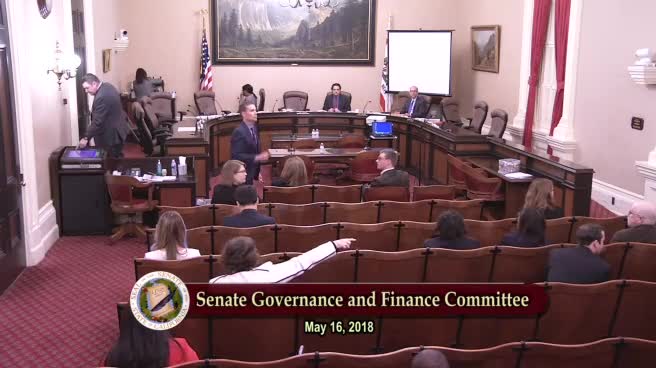 11MIN
Senate Standing Committee on Governance and Finance
Bill Author

Bill Co-Author(s):