AB 1902: Prescription drug labels: accessibility.
- Session Year: 2023-2024
- House: Assembly
- Latest Version Date: 2024-09-21
Current Status:
Passed
(2024-09-21: Chaptered by Secretary of State - Chapter 330, Statutes of 2024.)
Introduced
In Committee
First Chamber
In Committee
Second Chamber
Enacted
Existing law, the Pharmacy Law, provides for the licensure and regulation of pharmacists, pharmacy technicians, and pharmacies by the California State Board of Pharmacy. Existing law requires the board to promulgate regulations that require a standardized, patient-centered, prescription drug label on all prescription medicine dispensed to patients in California. Existing law prohibits a pharmacist from dispensing a prescription except in a container that meets the requirements of state and federal law and is correctly labeled with prescribed information. Existing law makes a violation of its provisions a crime.
Existing law requires a dispenser, upon request, to provide translated directions for use, as prescribed. Existing law authorizes a dispenser to use translations made available by the board pursuant to specified regulations of the board and provides that a dispenser is not required to provide translated directions for use beyond the languages that the board has made available or beyond the directions that the board has made available in translated form. Existing law authorizes a dispenser to provide their own translated directions for use to comply with these provisions and prohibits the provisions from being construed to prohibit a dispenser from providing translated directions for use in languages beyond those that the board has made available or beyond the directions that the board has made available in translated form.
This bill would also expressly require a dispenser to provide translated directions for use in the languages the board has made available.
This bill, except as specified, would require a dispenser, if a person informs a pharmacy that the person identifies as a person who is blind, has low-vision, or is otherwise print disabled, to provide to the person or their authorized representative, at no additional cost, an accessible prescription label affixed to the container that meets prescribed requirements. If the accessible prescription label does not fit on the container, the bill would require the dispenser, upon dispensing the prescription drug, to provide the patient or their authorized representative with a supplemental document that otherwise meets those prescribed requirements. The bill would not apply to prescriptions issued by a veterinarian. The bill would require the board to promulgate regulations necessary to implement the bill.
By imposing new requirements on dispensers, the violation of which would be a crime, the bill would impose a state-mandated local program.
The California Constitution requires the state to reimburse local agencies and school districts for certain costs mandated by the state. Statutory provisions establish procedures for making that reimbursement.
This bill would provide that no reimbursement is required by this act for a specified reason.
Existing law, the Pharmacy Law, provides for the licensure and regulation of pharmacists, pharmacy technicians, and pharmacies by the California State Board of Pharmacy. Existing law requires the board to promulgate regulations that require a standardized, patient-centered, prescription drug label on all prescription medicine dispensed to patients in California. Existing law prohibits a pharmacist from dispensing a prescription except in a container that meets the requirements of state and federal law and is correctly labeled with prescribed information. Existing law makes a violation of its provisions a crime.
Existing law requires a dispenser, upon request, to provide translated directions for use, as prescribed. Existing law authorizes a dispenser to use translations made available by the board pursuant to specified regulations of the board and provides that a dispenser is not required to provide translated directions for use beyond the languages that the board has made available or beyond the directions that the board has made available in translated form. Existing law authorizes a dispenser to provide their own translated directions for use to comply with these provisions and prohibits the provisions from being construed to prohibit a dispenser from providing translated directions for use in languages beyond those that the board has made available or beyond the directions that the board has made available in translated form.
This bill would also expressly require a dispenser to provide translated directions for use in the languages the board has made available.
This bill, except as specified, would require a dispenser, if a person informs a pharmacy that the person identifies as a person who is blind, has low-vision, or is otherwise print disabled, to provide to the person, person or their authorized representative, at no additional cost, an accessible prescription label affixed to the container that meets prescribed requirements. If the accessible prescription label does not fit on the container, the bill would require the dispenser, upon dispensing the prescription drug, to provide the patient or their authorized representative with a supplemental document that otherwise meets those prescribed requirements. For purposes of these provisions, the The bill would specify that a dispenser does not include not apply to prescriptions issued by a veterinarian. The bill would require the board to promulgate regulations necessary to implement the bill.
By imposing new requirements on dispensers, the violation of which would be a crime, the bill would impose a state-mandated local program.
The California Constitution requires the state to reimburse local agencies and school districts for certain costs mandated by the state. Statutory provisions establish procedures for making that reimbursement.
This bill would provide that no reimbursement is required by this act for a specified reason.
Existing law, the Pharmacy Law, provides for the licensure and regulation of pharmacists, pharmacy technicians, and pharmacies by the California State Board of Pharmacy. Existing law requires the board to promulgate regulations that require a standardized, patient-centered, prescription drug label on all prescription medicine dispensed to patients in California. Existing law prohibits a pharmacist from dispensing a prescription except in a container that meets the requirements of state and federal law and is correctly labeled with prescribed information. Existing law makes a violation of its provisions a crime.
Existing law requires a dispenser, upon request, to provide translated directions for use, as prescribed. Existing law authorizes a dispenser to use translations made available by the board pursuant to specified regulations of the board and provides that a dispenser is not required to provide translated directions for use beyond the languages that the board has made available or beyond the directions that the board has made available in translated form. Existing law authorizes a dispenser to provide their own translated directions for use to comply with these provisions and prohibits the provisions from being construed to prohibit a dispenser from providing translated directions for use in languages beyond those that the board has made available or beyond the directions that the board has made available in translated form.
This bill would also expressly require a dispenser to provide translated directions for use in the languages the board has made available.
This bill, except as specified, would require a dispenser, if a person informs a pharmacy that the person identifies as a person who is blind, has low-vision, or is otherwise print disabled, to provide to the person, at no additional cost, an accessible prescription label affixed to the container that meets prescribed requirements. If the accessible prescription label does not fit on the container, the bill would require the dispenser, upon dispensing the prescription drug, to provide the patient or their authorized representative with a supplemental document that otherwise meets those prescribed requirements. For purposes of these provisions, the bill would specify that a dispenser does not include a veterinarian. The bill would require the board to promulgate regulations necessary to implement the bill.
By imposing new requirements on dispensers, the violation of which would be a crime, the bill would impose a state-mandated local program.
The California Constitution requires the state to reimburse local agencies and school districts for certain costs mandated by the state. Statutory provisions establish procedures for making that reimbursement.
This bill would provide that no reimbursement is required by this act for a specified reason.
Existing law, the Pharmacy Law, provides for the licensure and regulation of pharmacists, pharmacy technicians, and pharmacies by the California State Board of Pharmacy. Existing law requires the board to promulgate regulations that require a standardized, patient-centered, prescription drug label on all prescription medicine dispensed to patients in California. Existing law prohibits a pharmacist from dispensing a prescription except in a container that meets the requirements of state and federal law and is correctly labeled with prescribed information. Existing law makes a violation of its provisions a crime.
Existing law requires a dispenser, upon request, to provide translated directions for use, as prescribed. Existing law authorizes a dispenser to use translations made available by the board pursuant to specified regulations of the board and provides that a dispenser is not required to provide translated directions for use beyond the languages that the board has made available or beyond the directions that the board has made available in translated form. Existing law authorizes a dispenser to provide their own translated directions for use to comply with these provisions and prohibits the provisions from being construed to prohibit a dispenser from providing translated directions for use in languages beyond those that the board has made available or beyond the directions that the board has made available in translated form.
This bill would also expressly require a dispenser to provide translated directions for use in the languages the board has made available.
This bill would require a dispenser to notify each person to whom a prescription drug is dispensed that an accessible prescription label is available to the person upon request at no additional cost. TheThis bill, except as specified, would require a dispenser, if a person informs a pharmacy that the person identifies as a person who is blind, visually impaired, has low-vision, or is otherwise print disabled, or limited English proficient, to provide to the person, at no additional cost, an accessible prescription label affixed to the container that meets prescribed requirements. For purposes of these provisions, the bill would specify that a dispenser does not include a veterinarian. The bill would require the board to promulgate regulations necessary to implement the bill.
By imposing new requirements on dispensers, the violation of which would be a crime, the bill would impose a state-mandated local program.
The California Constitution requires the state to reimburse local agencies and school districts for certain costs mandated by the state. Statutory provisions establish procedures for making that reimbursement.
This bill would provide that no reimbursement is required by this act for a specified reason.
Existing law, the Pharmacy Law, provides for the licensure and regulation of pharmacists, pharmacy technicians, and pharmacies by the California State Board of Pharmacy. Existing law requires the board to promulgate regulations that require a standardized, patient-centered, prescription drug label on all prescription medicine dispensed to patients in California. Existing law prohibits a pharmacist from dispensing a prescription except in a container that meets the requirements of state and federal law and is correctly labeled with prescribed information. Existing law makes a violation of its provisions a crime.
Existing law requires a dispenser, upon request, to provide translated directions for use, as prescribed. Existing law authorizes a dispenser to use translations made available by the board pursuant to specified regulations of the board and provides that a dispenser is not required to provide translated directions for use beyond the languages that the board has made available or beyond the directions that the board has made available in translated form. Existing law authorizes a dispenser to provide their own translated directions for use to comply with these provisions and prohibits the provisions from being construed to prohibit a dispenser from providing translated directions for use in languages beyond those that the board has made available or beyond the directions that the board has made available in translated form.
This bill would also expressly require a dispenser to provide translated directions for use in the languages the board has made available.
This bill would require a dispenser to notify each person to whom a prescription drug is dispensed that an accessible prescription label is available to the person upon request at no additional cost. The bill, except as specified, would require a dispenser, if a person informs a pharmacy that the person identifies as a person who is blind, visually impaired, otherwise print disabled, or limited English proficient, to provide to the person, at no additional cost, an accessible prescription label affixed to the container that meets prescribed requirements. The bill would require the board to promulgate regulations necessary to implement the bill.
By imposing new requirements on dispensers, the violation of which would be a crime, the bill would impose a state-mandated local program.
The California Constitution requires the state to reimburse local agencies and school districts for certain costs mandated by the state. Statutory provisions establish procedures for making that reimbursement.
This bill would provide that no reimbursement is required by this act for a specified reason.
(a)Upon the request of a patient or patients representative, a dispenser shall provide translated directions for use, which shall be printed on the prescription container, label, or on a supplemental document. If translated directions for use appear on a prescription container or label, the English-language version of the directions for use shall also appear on the container or label, whenever possible, and may appear on other areas of the label outside the patient-centered area. When it is not possible for the English-language directions for use to appear on the container or label, it shall be provided on a supplemental document.
(b)A dispenser may use translations made available by the board pursuant to subdivision (b) of Section 1707.5 of Title 16 of the California Code of Regulations to comply with this section.
(c)A dispenser shall provide translated directions for use in the languages the board has made available, but shall not be required to provide translated directions for use beyond the languages that the board has made available or beyond the directions that the board has made available in translated form.
(d)A dispenser may provide their own translated directions for use to comply with the requirements of this section, and nothing in this section shall be construed to prohibit a dispenser from providing translated directions for use in languages beyond those that the board has made available or beyond the directions that the board has made available in translated form.
(e)A dispenser shall be responsible for the accuracy of the English-language directions for use provided to the patient. This section shall not affect a dispensers existing responsibility to correctly label a prescription pursuant to Section 4076.
(f)This section does not include prescriptions issued by a veterinarian.
SEC. 2.Section 4076.8 is added to the Business and Professions Code, to read:4076.8.(a)If a person informs a pharmacy that the person identifies as a person who is blind, has low-vision, or is otherwise print disabled, the dispenser shall provide to the person or their authorized representative, at no additional cost, an accessible prescription label affixed to the container that is all of the following:
(1)Available to the person in a timely manner comparable to other patient wait times and lasting for at least the duration of the prescription.
(2)Appropriate to the disability and language of the person making the request through use of audible, large print, Braille, or translated directions as required pursuant to Section 4076.6.
(3)Conforms to the format-specific best practices established by the United States Access Board and the National Standards for Culturally and Linguistically Appropriate Services (CLAS) in Health and Health Care, also referred to as the National CLAS Standards.
(b)A dispenser shall ensure that the prescription label is compatible with the prescription reader if a reader is provided.
(c)If the accessible prescription label cannot be affixed to the container because it does not fit on the container, the dispenser, upon dispensing the prescription drug, shall provide the patient or their authorized representative with a supplemental document that meets the requirements specified in this section.
(d)This section does not apply to prescription drugs dispensed and administered by an institutional pharmacy, correctional institution, or licensed correctional pharmacy. However, this section does apply to an institutional pharmacy when providing prescription drugs to a person with a disability for use by the individual upon their release from the health care facility.
(e)This section does not include prescriptions issued by a veterinarian.
(f)The board shall promulgate regulations necessary to implement this section.
(g)As used in this section:
(1)Institutional pharmacy means a pharmacy that is part of, or is operated in conjunction with, a health care facility, as defined in Section 1250 of the Health and Safety Code, with the exception of a licensed correctional pharmacy.
(2)Prescription reader means a device that is designed to audibly convey the information contained on the label of a prescription drug.
SEC. 3.No reimbursement is required by this act pursuant to Section 6 of Article XIIIB of the California Constitution because the only costs that may be incurred by a local agency or school district will be incurred because this act creates a new crime or infraction, eliminates a crime or infraction, or changes the penalty for a crime or infraction, within the meaning of Section 17556 of the Government Code, or changes the definition of a crime within the meaning of Section 6 of Article XIIIB of the California Constitution.
(a)Upon the request of a patient or patients representative, a dispenser shall provide translated directions for use, which shall be printed on the prescription container, label, or on a supplemental document. If translated directions for use appear on a prescription container or label, the English-language version of the directions for use shall also appear on the container or label, whenever possible, and may appear on other areas of the label outside the patient-centered area. When it is not possible for the English-language directions for use to appear on the container or label, it shall be provided on a supplemental document.
(b)A dispenser may use translations made available by the board pursuant to subdivision (b) of Section 1707.5 of Title 16 of the California Code of Regulations to comply with this section.
(c)A dispenser shall provide translated directions for use in the languages the board has made available, but shall not be required to provide translated directions for use beyond the languages that the board has made available or beyond the directions that the board has made available in translated form.
(d)A dispenser may provide their own translated directions for use to comply with the requirements of this section, and nothing in this section shall be construed to prohibit a dispenser from providing translated directions for use in languages beyond those that the board has made available or beyond the directions that the board has made available in translated form.
(e)A dispenser shall be responsible for the accuracy of the English-language directions for use provided to the patient. This section shall not affect a dispensers existing responsibility to correctly label a prescription pursuant to Section 4076.
(f)For purposes of this section, a dispenser This section does not include prescriptions issued by a veterinarian.
SEC. 2.Section 4076.8 is added to the Business and Professions Code, to read:4076.8.(a)If a person informs a pharmacy that the person identifies as a person who is blind, has low-vision, or is otherwise print disabled, the dispenser shall provide to the person or their authorized representative, at no additional cost, an accessible prescription label affixed to the container that is all of the following:
(1)Available to the person in a timely manner comparable to other patient wait times and lasting for at least the duration of the prescription.
(2)Appropriate to the disability and language of the person making the request through use of audible, large print, Braille, or translated labels directions as required pursuant to Section 4076.6.
(3)Conforms to the format-specific best practices established by the United States Access Board and the National Standards for Culturally and Linguistically Appropriate Services (CLAS) in Health and Health Care, also referred to as the National CLAS Standards.
(b)A dispenser shall ensure that the prescription label is compatible with the prescription reader if a reader is provided.
(c)If the accessible prescription label cannot be affixed to the container because it does not fit on the container, the dispenser, upon dispensing the prescription drug, shall provide the patient or their authorized representative with a supplemental document that meets the requirements specified in this section.
(d)This section does not apply to prescription drugs dispensed and administered by an institutional pharmacy or correctional institution. pharmacy, correctional institution, or licensed correctional pharmacy. However, this section does apply to an institutional pharmacy when providing prescription drugs to a person with a disability for use by the individual upon their release from the health care facility.
(e)For purposes of this section, a dispenser This section does not include prescriptions issued by a veterinarian.
(f)The board shall promulgate regulations necessary to implement this section.
(g)As used in this section:
(1)Institutional pharmacy means a pharmacy that is part of, or is operated in conjunction with, a health care facility, as defined in Section 1250 of the Health and Safety Code. Code, with the exception of a licensed correctional pharmacy.
(2)Prescription reader means a device that is designed to audibly convey the information contained on the label of a prescription drug.
SEC. 3.No reimbursement is required by this act pursuant to Section 6 of Article XIIIB of the California Constitution because the only costs that may be incurred by a local agency or school district will be incurred because this act creates a new crime or infraction, eliminates a crime or infraction, or changes the penalty for a crime or infraction, within the meaning of Section 17556 of the Government Code, or changes the definition of a crime within the meaning of Section 6 of Article XIIIB of the California Constitution.
(a)Upon the request of a patient or patients representative, a dispenser shall provide translated directions for use, which shall be printed on the prescription container, label, or on a supplemental document. If translated directions for use appear on a prescription container or label, the English-language version of the directions for use shall also appear on the container or label, whenever possible, and may appear on other areas of the label outside the patient-centered area. When it is not possible for the English-language directions for use to appear on the container or label, it shall be provided on a supplemental document.
(b)A dispenser may use translations made available by the board pursuant to subdivision (b) of Section 1707.5 of Title 16 of the California Code of Regulations to comply with this section.
(c)A dispenser shall provide translated directions for use in the languages the board has made available, but shall not be required to provide translated directions for use beyond the languages that the board has made available or beyond the directions that the board has made available in translated form.
(d)A dispenser may provide their own translated directions for use to comply with the requirements of this section, and nothing in this section shall be construed to prohibit a dispenser from providing translated directions for use in languages beyond those that the board has made available or beyond the directions that the board has made available in translated form.
(e)A dispenser shall be responsible for the accuracy of the English-language directions for use provided to the patient. This section shall not affect a dispensers existing responsibility to correctly label a prescription pursuant to Section 4076.
(f)For purposes of this section, a dispenser does not include a veterinarian.
SEC. 2.Section 4076.8 is added to the Business and Professions Code, to read:4076.8.(a)If a person informs a pharmacy that the person identifies as a person who is blind, has low-vision, or is otherwise print disabled, the dispenser shall provide to the person, person or their authorized representative, at no additional cost, an accessible prescription label affixed to the container that is all of the following:
(1)Available to the person in a timely manner comparable to other patient wait times and lasting for at least the duration of the prescription.
(2)Appropriate to the disability and language of the person making the request through use of audible, large print, Braille, or translated labels as required pursuant to Section 4076.6.
(3)Conforms to the format-specific best practices established by the United States Access Board and the National Standards for Culturally and Linguistically Appropriate Services (CLAS) in Health and Health Care, also referred to as the National CLAS Standards.
(b)A dispenser shall ensure that the prescription label is compatible with the prescription reader if a reader is provided.
(c)If the accessible prescription label cannot be affixed to the container because it does not fit on the container, the dispenser, upon dispensing the prescription drug, shall provide the patient or their authorized representative with a supplemental document that meets the requirements specified in this section.
(c)(d)This section does not apply to prescription drugs dispensed and administered by an institutional pharmacy or correctional institution. However, this section does apply to an institutional pharmacy when providing prescription drugs to a person with a disability for use by the individual upon their release from the health care facility.
(d)(e)For purposes of this section, a dispenser does not include a veterinarian.
(e)(f)The board shall promulgate regulations necessary to implement this section.
(f)(g)As used in this section:
(1)Institutional pharmacy means a pharmacy that is part of, or is operated in conjunction with, a health care facility, as defined in Section 1250 of the Health and Safety Code.
(2)Prescription reader means a device that is designed to audibly convey the information contained on the label of a prescription drug.
SEC. 3.No reimbursement is required by this act pursuant to Section 6 of Article XIIIB of the California Constitution because the only costs that may be incurred by a local agency or school district will be incurred because this act creates a new crime or infraction, eliminates a crime or infraction, or changes the penalty for a crime or infraction, within the meaning of Section 17556 of the Government Code, or changes the definition of a crime within the meaning of Section 6 of Article XIIIB of the California Constitution.
(a)Upon the request of a patient or patients representative, a dispenser shall provide translated directions for use, which shall be printed on the prescription container, label, or on a supplemental document. If translated directions for use appear on a prescription container or label, the English-language version of the directions for use shall also appear on the container or label, whenever possible, and may appear on other areas of the label outside the patient-centered area. When it is not possible for the English-language directions for use to appear on the container or label, it shall be provided on a supplemental document.
(b)A dispenser may use translations made available by the board pursuant to subdivision (b) of Section 1707.5 of Title 16 of the California Code of Regulations to comply with this section.
(c)A dispenser shall provide translated directions for use in the languages the board has made available, but shall not be required to provide translated directions for use beyond the languages that the board has made available or beyond the directions that the board has made available in translated form.
(d)A dispenser may provide their own translated directions for use to comply with the requirements of this section, and nothing in this section shall be construed to prohibit a dispenser from providing translated directions for use in languages beyond those that the board has made available or beyond the directions that the board has made available in translated form.
(e)A dispenser shall be responsible for the accuracy of the English-language directions for use provided to the patient. This section shall not affect a dispensers existing responsibility to correctly label a prescription pursuant to Section 4076.
(f)For purposes of this section, a dispenser does not include a veterinarian.
SEC. 2.Section 4076.8 is added to the Business and Professions Code, to read:4076.8.(a)A dispenser shall notify each person to whom a prescription drug is dispensed that an accessible prescription label is available to the person upon request at no additional cost.(b)If4076.8.(a)If a person informs a pharmacy that the person identifies as a person who is blind, visually impaired, has low-vision, or is otherwise print disabled, or limited English proficient, the dispenser shall provide to the person, at no additional cost, an accessible prescription label affixed to the container that is all of the following:
(1)Available to the person in a timely manner comparable to other patient wait times and lasting for at least the duration of the prescription.
(2)Appropriate to the disability, preference, disability and language of the person making the request through use of audible, large print, Braille, or translated labels as required pursuant to Section 4076.6.
(3)Conforms to the format-specific best practices established by the United States Access Board and the National Standards for Culturally and Linguistically Appropriate Services (CLAS) in Health and Health Care, also referred to as the National CLAS Standards.
(4)Contains all the label information required by state statute and federal law, including cautions, warnings, and any information available to sighted and English-proficient persons reading the printed label. (c)(b)A dispenser shall ensure that the prescription label is compatible with the prescription reader if a reader is provided.
(d)(c)This section does not apply to prescription drugs dispensed and administered by an institutional pharmacy or correctional institution. However, this section does apply to an institutional pharmacy when providing prescription drugs to a person with a disability for use by the individual upon their release from the health care facility.
(d)For purposes of this section, a dispenser does not include a veterinarian.
(e)The board shall promulgate regulations necessary to implement this section.
(f)As used in this section:
(1)Institutional pharmacy means a pharmacy that is part of, or is operated in conjunction with, a health care facility, as defined in Section 1250 of the Health and Safety Code.
(2)Prescription reader means a device that is designed to audibly convey the information contained on the label of a prescription drug.
SEC. 3.No reimbursement is required by this act pursuant to Section 6 of Article XIIIB of the California Constitution because the only costs that may be incurred by a local agency or school district will be incurred because this act creates a new crime or infraction, eliminates a crime or infraction, or changes the penalty for a crime or infraction, within the meaning of Section 17556 of the Government Code, or changes the definition of a crime within the meaning of Section 6 of Article XIIIB of the California Constitution.
(a)Upon the request of a patient or patients representative, a dispenser shall provide translated directions for use, which shall be printed on the prescription container, label, or on a supplemental document. If translated directions for use appear on a prescription container or label, the English-language version of the directions for use shall also appear on the container or label, whenever possible, and may appear on other areas of the label outside the patient-centered area. When it is not possible for the English-language directions for use to appear on the container or label, it shall be provided on a supplemental document.
(b)A dispenser may use translations made available by the board pursuant to subdivision (b) of Section 1707.5 of Title 16 of the California Code of Regulations to comply with this section.
(c)A dispenser shall provide translated directions for use in the languages the board has made available, but shall not be required to provide translated directions for use beyond the languages that the board has made available or beyond the directions that the board has made available in translated form.
(d)A dispenser may provide his or her their own translated directions for use to comply with the requirements of this section, and nothing in this section shall be construed to prohibit a dispenser from providing translated directions for use in languages beyond those that the board has made available or beyond the directions that the board has made available in translated form.
(e)A dispenser shall be responsible for the accuracy of the English-language directions for use provided to the patient. This section shall not affect a dispensers existing responsibility to correctly label a prescription pursuant to Section 4076.
(f)For purposes of this section, a dispenser does not include a veterinarian.
SEC. 2.Section 4076.8 is added to the Business and Professions Code, to read:4076.8.(a)A dispenser shall notify each person to whom a prescription drug is dispensed that an accessible prescription label is available to the person upon request at no additional cost.
(b)If a person informs a pharmacy that the person identifies as a person who is blind, visually impaired, otherwise print disabled, or limited English proficient, the dispenser shall provide to the person, at no additional cost, an accessible prescription label affixed to the container that is all of the following:
(1)Available to the person in a timely manner comparable to other patient wait times and lasting for at least the duration of the prescription.
(2)Appropriate to the disability, preference, and language of the person making the request through use of audible, large print, Braille, or translated labels as required pursuant to Section 4076.6.
(3)Conforms to the format-specific best practices established by the United States Access Board and the National Standards for Culturally and Linguistically Appropriate Services (CLAS) in Health and Health Care, also referred to as the National CLAS Standards.
(4)Contains all the label information required by state statute and federal law, including cautions, warnings, and any information available to sighted and English-proficient persons reading the printed label.
(c)A dispenser shall ensure that the prescription label is compatible with the prescription reader if a reader is provided.
(d)This section does not apply to prescription drugs dispensed and administered by an institutional pharmacy or correctional institution. However, this section does apply to an institutional pharmacy when providing prescription drugs to a person with a disability for use by the individual upon their release from the health care facility.
(e)The board shall promulgate regulations necessary to implement this section.
(f)As used in this section:
(1)Institutional pharmacy means a pharmacy that is part of, or is operated in conjunction with, a health care facility, as defined in Section 1250 of the Health and Safety Code.
(2)Prescription reader means a device that is designed to audibly convey the information contained on the label of a prescription drug.
SEC. 3.No reimbursement is required by this act pursuant to Section 6 of Article XIIIB of the California Constitution because the only costs that may be incurred by a local agency or school district will be incurred because this act creates a new crime or infraction, eliminates a crime or infraction, or changes the penalty for a crime or infraction, within the meaning of Section 17556 of the Government Code, or changes the definition of a crime within the meaning of Section 6 of Article XIIIB of the California Constitution.
|
Date
|
Status
|
|---|---|
| Sep 21, 2024 | Chaptered by Secretary of State - Chapter 330, Statutes of 2024. |
| Sep 21, 2024 | Approved by the Governor. |
| Aug 28, 2024 | Enrolled and presented to the Governor at 4 p.m. |
| Aug 22, 2024 | Senate amendments concurred in. To Engrossing and Enrolling. (Ayes 62. Noes 0. Page 6427.). |
| Aug 20, 2024 | In Assembly. Concurrence in Senate amendments pending. May be considered on or after August 22 pursuant to Assembly Rule 77. |
| Aug 20, 2024 | Read third time. Passed. Ordered to the Assembly. (Ayes 40. Noes 0. Page 5238.). |
| Aug 13, 2024 | Read second time. Ordered to third reading. |
| Aug 12, 2024 | Read third time and amended. Ordered to second reading. |
| Jul 2, 2024 | Read second time. Ordered to third reading. |
| Jul 1, 2024 | From committee: Be ordered to second reading pursuant to Senate Rule 28.8. |
| Jun 17, 2024 | From committee: Do pass and re-refer to Com. on APPR. (Ayes 12. Noes 0.) (June 17). Re-referred to Com. on APPR. |
| May 24, 2024 | From committee chair, with author's amendments: Amend, and re-refer to committee. Read second time, amended, and re-referred to Com. on B., P. & E. D. |
| May 15, 2024 | Referred to Com. on B., P. & E. D. |
| May 2, 2024 | In Senate. Read first time. To Com. on RLS. for assignment. |
| May 2, 2024 | Read third time. Passed. Ordered to the Senate. (Ayes 73. Noes 0. Page 5087.) |
| Apr 25, 2024 | Read second time. Ordered to Consent Calendar. |
| Apr 24, 2024 | From committee: Do pass. To Consent Calendar. (Ayes 14. Noes 0.) (April 24). |
| Apr 9, 2024 | From committee: Do pass and re-refer to Com. on APPR. with recommendation: To Consent Calendar. (Ayes 18. Noes 0.) (April 9). Re-referred to Com. on APPR. |
| Mar 13, 2024 | Re-referred to Com. on B. & P. |
| Mar 12, 2024 | From committee chair, with author's amendments: Amend, and re-refer to Com. on B. & P. Read second time and amended. |
| Feb 5, 2024 | Referred to Com. on B. & P. |
| Jan 24, 2024 | From printer. May be heard in committee February 23. |
| Jan 23, 2024 | Read first time. To print. |
|
Date
|
Description
|
Location
|
Votes
|
|
|---|---|---|---|---|
| Aug 22, 2024 | AB 1902 Alanis Concurrence in Senate Amendments | Assembly Floor |
Passed |
|
| Aug 20, 2024 | Assembly 3rd Reading AB1902 Alanis et al. By Dahle | Senate Floor |
Passed |
|
| Jun 17, 2024 | Do pass, but first be re-referred to the Committee on [Appropriations] | Senate Standing Committee on Business, Professions and Economic Development |
Passed |
|
| May 2, 2024 | AB 1902 Alanis Consent Calendar Second Day Regular Session | Assembly Floor |
Passed |
|
| Apr 24, 2024 | Do pass. To Consent Calendar. | Assembly Standing Committee on Appropriations |
Passed |
|
| Apr 9, 2024 | Do pass and be re-referred to the Committee on [Appropriations] with recommendation: To Consent Calendar | Assembly Standing Committee on Business and Professions |
Passed |
This list shows positions taken on this bill by organizations on the date displayed, which is linked to the original source.
Positions by individuals are not included.
|
Organization
|
Position
|
Date
|
|---|---|---|
| AARP | ** Support | |
| Association of California State Employees with Disabilities | ** Support | |
| California Academy of Child and Adolescent Psychiatry | ** Support | |
| California Academy Of Family Physicians | ** Support | |
| California Alliance For Retired Americans | ** Support | |
| California Association Of Public Hospitals And Health Systems | ** Support | |
| California Collaborative for Long-Term Services and Supports | ** Support | |
| California Community Pharmacy Coalition | ** Support | |
| California Council for the Blind | * Support | Jun 17, 2024 |
| California Council Of The Blind | ** Support | |
| California Long Term Care Ombudsman Association | ** Support | |
| California State Association of Psychiatrists | * Support | Jun 17, 2024 |
| Californians for SSI | ** Support | |
| Disability Rights California | ** Support | |
| Educate. Advocate. | ** Support | |
| Elderly Care Everywhere | ** Support | |
| Health Access California | ** Support | |
| LeadingAge California | ** Support | |
| National Health Law Program | ** Support | |
| Western Center on Law & Poverty, INC. | ** Support |
CONCURRENCE IN SENATE AMENDMENTS
CSA1 Bill Id:AB 1902
Author:(Alanis)
As Amended Ver:August 12, 2024
Majority vote
SUMMARY
Requires pharmacies to, upon being informed that a patient identifies as being blind, having low-vision, or being otherwise print-disabled, provide the person, at no additional cost, an appropriately accessible prescription label.
Senate Amendments
- Clarify that the bill also applies to a patient's authorized representative.
- Clarify that if the accessible prescription label cannot be affixed to the container because it does not fit on the container, the dispenser instead provides the patient or their authorized representative with a supplemental document.
- Make other technical and clarifying changes.
COMMENTS
Background. Patients who cannot read the labels or directions for their medications risk taking the wrong ones, taking the wrong amounts, or taking them under the wrong circumstances. As a result, existing law requires all dispensers, who may be a licensed pharmacist or other healing arts licensees who dispense medication, to provide translations upon request.
Specifically, dispensers are required to provide the translations made available by the BOP or may provide their own translations, although they are not required to provide translations in languages that are not made available by the Board of Pharmacy (BOP). The BOP has translated directions into Spanish, Vietnamese, Korean, Russian, and Chinese.
This bill would expand the requirements to also include patients who are blind, have low vision, or are otherwise print-disabled. It would also include the prescription label itself, in addition to the directions. Without being able to read the label, patients are exposed to additional risks, including taking expired medications, being unable to refill their medications on time, or being unable to detect pharmacy errors.
California Vision Loss Statistics. The Centers for Disease Control and Prevention maintains a Vision and Eye Health Surveillance System (VEHSS), which tracks vision loss, eye disorders, and eye care services in the United States. The most recent VEHSS estimates (accessed April 3, 2024) suggest that in California in 2017, about 948,880 residents were experiencing some form of vision loss (a crude prevalence rate of 2.04% among 39,536,653 total residents), while 106,749 residents were experiencing legal blindness (a crude prevalence rate of 0.27%).
Federal Recommendations. In 2012, the Food and Drug Administration Safety and Innovation Act required the United States Access Board, an independent federal agency that promotes accessibility for people with disabilities, to convene a stakeholder working group to develop best practices for making information on prescription drug container labels accessible to people who are blind or visually impaired. As a result, the Access Board formed the Working Group on Accessible Prescription Drug Container Labels. In 2013, the group submitted its best practice recommendations for pharmacies to provide accessible prescription drug container labels.
This bill specifically codifies five of the recommendations. It also includes all of the format-specific recommendations, as well as the format-specific recommendations established by the National Standards for Culturally and Linguistically Appropriate Services (CLAS) in Health and Health Care, which "are a set of 15 action steps intended to advance health equity, improve quality, and help eliminate health care disparities by providing a blueprint for individuals and health and health care organizations to implement culturally and linguistically appropriate services."
Barriers to Adoption of Best Practices. The Food and Drug Administration Safety and Innovation Act also required the Government Accountability Office (GAO) to conduct a review to assess the extent to which pharmacies are implementing the best practices and to determine whether barriers to prescription drug labels remain. The report was completed in 2016, noting among other things that, "Stakeholders GAO contacted identified four key challenges that pharmacies faced in providing accessible labels or implementing the best practices: 1) lack of awareness of the best practices; 2) low demand and high costs for providing accessible labels; 3) technical challenges for providing these labels; and 4) an absence of requirements to implement the best practices. Many stakeholders identified greater dissemination of the best practices as a step, among others, that could help address some of these challenges."
According to the Author
"[This bill] is a long overdue bill that would make a significant impact on those who are blind or have low vision. This bill improves accessibility and equity within the healthcare space by improving blind and low-vision patients' ability to take medications independently and access instructions that can prevent severe medical emergencies from unplanned drug interactions."
Arguments in Support
The California Council for the Blind (sponsor) writes in support:
As a long-time leader in promoting accessible healthcare, it is urgent that California implement this legislation. Nevada and Oregon, pursuant to legislation, and Washington, pursuant to administrative action, are already implementing similar requirements.
Medical dosage errors have become a serious issue for people with print disabilities and those who are not proficient in English. This is especially true of persons with vision or cognitive disabilities, large numbers of whom are over the age of 60. Based on the California Department of Finance (DOF) population projections, the numbers of Californians in this age group are growing. According to the Centers for Disease Control (CDC). People with print disabilities are more likely to be low-income and be in underserved minority populations, as are those who are not English proficient. Thus, [this bill] would significantly impact the problem of medical dosing errors.
Moreover, there are several means to deliver accessible prescription drug directions, including hard copy braille and large print, Digital Voice and Text-to-Speech Recorder, Radio Frequency Identification Device (RFID), and other dedicated equipment like smart devices and computers. Access to drug labeling information can mean the difference between moving to, or remaining in, an institutionalized setting, as opposed to remaining in one's own home or community. [This bill] will save lives, prevent serious illness, and further the goal of enabling people to live independently.
Arguments in Opposition
No opposition on file.
FISCAL COMMENTS
According to the Senate Appropriations Committee, pursuant to Senate Rule 28.8, no significant state costs anticipated.
VOTES:
ASM BUSINESS AND PROFESSIONS: 18-0-0
YES: Berman, Flora, Alanis, Bains, Juan Carrillo, Chen, Dixon, Grayson, Irwin, Jackson, Low, Lowenthal, McKinnor, Stephanie Nguyen, Pellerin, Sanchez, Soria, Zbur
ASM APPROPRIATIONS: 14-0-1
YES: Wicks, Sanchez, Arambula, Bryan, Calderon, Wendy Carrillo, Dixon, Mike Fong, Grayson, Haney, Hart, Jim Patterson, Pellerin, Ta
ABS, ABST OR NV: Villapudua
ASSEMBLY FLOOR: 73-0-7
YES: Addis, Aguiar-Curry, Alanis, Alvarez, Arambula, Bains, Bauer-Kahan, Bennett, Berman, Boerner, Bonta, Bryan, Juan Carrillo, Wendy Carrillo, Cervantes, Chen, Connolly, Davies, Dixon, Essayli, Mike Fong, Vince Fong, Friedman, Gabriel, Gallagher, Garcia, Gipson, Grayson, Haney, Hart, Holden, Hoover, Irwin, Jackson, Jones-Sawyer, Kalra, Lackey, Lee, Lowenthal, Maienschein, McCarty, McKinnor, Muratsuchi, Stephanie Nguyen, Ortega, Pacheco, Papan, Jim Patterson, Joe Patterson, Pellerin, Petrie-Norris, Quirk-Silva, Ramos, Rendon, Reyes, Luz Rivas, Rodriguez, Blanca Rubio, Sanchez, Santiago, Schiavo, Soria, Ta, Ting, Valencia, Villapudua, Waldron, Wallis, Ward, Wicks, Wilson, Wood, Zbur
ABS, ABST OR NV: Calderon, Megan Dahle, Flora, Low, Mathis, Weber, Robert Rivas
SENATE FLOOR: 40-0-0
YES: Allen, Alvarado-Gil, Archuleta, Ashby, Atkins, Becker, Blakespear, Bradford, Caballero, Cortese, Dahle, Dodd, Durazo, Eggman, Glazer, Gonzalez, Grove, Hurtado, Jones, Laird, Limón, McGuire, Menjivar, Min, Newman, Nguyen, Niello, Ochoa Bogh, Padilla, Portantino, Roth, Rubio, Seyarto, Skinner, Smallwood-Cuevas, Stern, Umberg, Wahab, Wiener, Wilk
UPDATED
VERSION: August 12, 2024
CONSULTANT: Vincent Chee / B. & P. / (916) 319-3301 FN: 0004244
SENATE RULES COMMITTEE Office of Senate Floor Analyses (916) 651-1520 Fax: (916) 327-4478 | AB 1902 |
THIRD READING
Bill No: AB 1902
Author: Alanis (R), et al.
Amended: 8/12/24 in Senate
Vote: 21
SENATE BUS., PROF. & ECON. DEV. COMMITTEE: 12-0, 6/17/24
AYES: Ashby, Nguyen, Alvarado-Gil, Archuleta, Becker, Eggman, Glazer, Menjivar, Niello, Roth, Smallwood-Cuevas, Wilk
NO VOTE RECORDED: Dodd
SENATE APPROPRIATIONS COMMITTEE: Senate Rule 28.8
ASSEMBLY FLOOR: 73-0, 5/2/24 (Consent) - See last page for vote
SUBJECT: Prescription drug labels: accessibility
SOURCE: California Council of the Blind
DIGEST:
This bill requires pharmacies, upon being informed that a patient identifies as being blind, having low-vision, or being otherwise print-disabled, to provide the person, at no additional cost, an appropriately accessible prescription label.
Senate Floor Amendments of 8/12/24 add licensed correctional pharmacy to the definition of institutional pharmacy for purposes of exemptions from the label requirements established by the bill and make other technical and conforming changes.
ANALYSIS:
Existing law:
- Regulates the practice of pharmacy under the Pharmacy Law. (Business and Professions Code (BPC) §§ 4000-4427.8)
- Establishes the Board of Pharmacy (BOP) until January 1, 2026, to administer and enforce the Pharmacy Law. (BPC § 4001)
- Defines “dispense” as the furnishing of drugs or devices upon a prescription or upon an order to furnish drugs or transmit a prescription or directly to a patient. (BPC § 4024)
- Requires a dispenser to, upon the request of a patient or patient’s representative, provide translated directions for use, which must be printed on the prescription container, label, or a supplemental document. If translated directions for use appear on a prescription container or label, the English-language version of the directions for use must also appear on the container or label, whenever possible, and may appear on other areas of the label outside the patient-centered area. When it is not possible for the English-language directions for use to appear on the container or label, it must be provided on a supplemental document. (BPC § 4076.6(a))
- Authorizes a dispenser to use translations made available by the BOP to comply with the translation requirement. (BPC § 4076.6(b))
- Specifies that a dispenser is not required to provide translated directions for use beyond the languages that the BOP has made available or beyond the directions that the BOP has made available in translated form. (BPC § 4076.6(c))
- Authorizes a dispenser to provide their own translated directions to comply with the translation requirement and specifies that nothing prohibits a dispenser from providing translated directions for use in languages beyond those that the BOP has made available or beyond the directions that the BOP has made available in translated form. (BPC § 4076.6(d))
- Makes a dispenser responsible for the accuracy of the English-language directions for use provided to the patient. (BPC § 4076.6(e))
- Exempts veterinarian dispensers from the translation requirement. (BPC § 4076.6(f))
This bill:
- Clarifies that a dispenser must at a minimum provide translated directions in the languages the BOP has made available.
- Requires a dispenser, if a person informs a pharmacy that the person identifies as a person who is blind, has low-vision, or is otherwise print disabled, to provide to the patient or their authorized representative, at no additional cost, an accessible prescription label affixed to the container that is all of the following:
- Available to the person comparable to other patients and lasting for at least the duration of the prescription.
- Appropriate to the disability and language of the requesting person through the use of audible, large print, Braille, or the translated directions required under existing law.
- Conforms to the format-specific best practices established by the United States Access Board and the National Standards for Culturally and Linguistically Appropriate Services (CLAS) in Health and Health Care, also referred to as the National CLAS Standards.
- Requires a dispenser to ensure that the prescription label is compatible with the prescription reader if a reader is provided.
- Specifies that if the accessible prescription label cannot be affixed to the container because it does not fit on the container, the dispenser, upon dispensing the prescription drug, shall provide the patient or their authorized representative with a supplemental document that meets the requirements of this bill.
- Exempts prescription drugs dispensed and administered by an institutional pharmacy (defined as a pharmacy that is part of, or is operated in conjunction with, a health care facility, as defined under existing law) or correctional institution or licensed correctional facility except when providing prescription drugs to a person with a disability for use by the individual upon their release from the health care facility.
- Exempts veterinarians from this bill.
- Requires the BOP to promulgate regulations necessary to implement this bill.
Background
Patients who cannot read the labels or directions for their medications risk taking the wrong ones, taking the wrong amounts, or taking them under the wrong circumstances. As a result, existing law requires all dispensers, who may be a licensed pharmacist or other healing arts licensees who dispense medication, to provide translations upon request.
BOP has listed medication error as the number one violation resulting in a citation in nearly every year in prior sunset review oversight reports. According to the Journal of the American Medical Association, almost 50 percent of adults cannot understand the information listed on their prescription drug labels. The Institute of Medicine of the National Academies indicates that medication errors are among the most common medical errors.
The California Patient Medication Safety Act (SB 472, Corbett, Chapter 470, Statutes of 2007) sought to deal with the lack of uniformity in prescription drug labels throughout the state and the resulting confusion and medication errors that may arise. Much of the conversation during the SB 472 debate focused on the fact that individual pharmacies design and format their own labels, resulting in a lack of standards across all pharmacies which adversely affects medication users who are elderly, suffer from poor vision, have difficulty reading and understanding instructions on labels or have limited English proficiency.
The bill required BOP to promulgate regulations that require a standardized, patient-centered, prescription drug label on all prescription medicine dispensed to patients. Following the implementation of the label requirements, BOP also promulgated a regulation to amend its Notice to Consumers poster, which has also been printed in six additional languages, and which is available upon request from BOP or available for download from the Board’s website. The BOP has translated directions into Spanish, Vietnamese, Korean, Russian, and Chinese.
Despite these efforts, patient advocates, particularly for those within the senior citizen community, have continued to advocate for statutory changes that would reduce medication errors. This has included requiring all prescription containers to indicate the purpose of a medication unless requested otherwise by the patient, as well as efforts to increase enforcement of patient consultation requirements.
This bill would expand the requirements to also include patients who are blind, have low vision, or are otherwise print-disabled. It would also include the prescription label itself, in addition to the directions.
California Vision Loss Statistics. The Centers for Disease Control and Prevention maintains a Vision and Eye Health Surveillance System (VEHSS), which tracks vision loss, eye disorders, and eye care services in the United States. The most recent VEHSS estimates (accessed April 3, 2024) suggest that in California in 2017, about 948,880 residents were experiencing some form of vision loss (a crude prevalence rate of 2.04% among 39,536,653 total residents), while 106,749 residents were experiencing legal blindness (a crude prevalence rate of 0.27%).
Federal Recommendations. In 2012, the Food and Drug Administration Safety and Innovation Act required the United States Access Board, an independent federal agency that promotes accessibility for people with disabilities, to convene a stakeholder working group to develop best practices for making information on prescription drug container labels accessible to people who are blind or visually impaired. As a result, the Access Board formed the Working Group on Accessible Prescription Drug Container Labels. In 2013, the group submitted its best practice recommendations for pharmacies to provide accessible prescription drug container labels.
Comments
The Animal Policy Group is concerned that the exemption in the bill for veterinarians does not also include veterinary pharmacies that dispense prescriptions issued by veterinarians and would like the bill to be further amended to include that category of dispensers from having to meet the requirements of the bill.
FISCAL EFFECT: Appropriation: No Fiscal Com.: Yes Local: Yes
California Council of the Blind (source)
AARP
Association of California State Employees with Disabilities
California Academy of Child and Adolescent Psychiatry
California Academy of Family Physicians
California Association of Public Hospitals and Health Systems
California Collaborative for Long-term Services and Supports
California Community Pharmacy Coalition
California Long Term Care Ombudsman Association
Disability Rights California
Educate. Advocate.
Elderly Care Everywhere
Health Access California
Leadingage California
National Health Law Program
Western Center on Law & Poverty, INC.
OPPOSITION: (Verified 8/8/24)
None received
ARGUMENTS IN SUPPORT: Supporters write that medical dosage errors have become a serious issue for people with print disabilities and those who are not proficient in English. This is especially true of people with vision or cognitive disabilities, large numbers of whom are over the age of 60. Supporters say that, based on the California Department of Finance population projections, the numbers of Californians in this age group are growing and that according to the Centers for Disease Control, people with print disabilities are more likely to be low-income and be in underserved minority populations, as are those who are not English proficient. Access to drug labeling information can mean the difference between moving to or remaining in an institutionalized setting, as opposed to remaining in one’s own home or community.
ASSEMBLY FLOOR: 73-0, 5/2/24
AYES: Addis, Aguiar-Curry, Alanis, Alvarez, Arambula, Bains, Bauer-Kahan, Bennett, Berman, Boerner, Bonta, Bryan, Juan Carrillo, Wendy Carrillo, Cervantes, Chen, Connolly, Davies, Dixon, Essayli, Mike Fong, Vince Fong, Friedman, Gabriel, Gallagher, Garcia, Gipson, Grayson, Haney, Hart, Holden, Hoover, Irwin, Jackson, Jones-Sawyer, Kalra, Lackey, Lee, Lowenthal, Maienschein, McCarty, McKinnor, Muratsuchi, Stephanie Nguyen, Ortega, Pacheco, Papan, Jim Patterson, Joe Patterson, Pellerin, Petrie-Norris, Quirk-Silva, Ramos, Rendon, Reyes, Luz Rivas, Rodriguez, Blanca Rubio, Sanchez, Santiago, Schiavo, Soria, Ta, Ting, Valencia, Villapudua, Waldron, Wallis, Ward, Wicks, Wilson, Wood, Zbur
NO VOTE RECORDED: Calderon, Megan Dahle, Flora, Low, Mathis, Weber, Robert Rivas
Prepared by: Sarah Mason / B., P. & E.D. /
8/14/24 14:03:10
**** END ****
SENATE RULES COMMITTEE Office of Senate Floor Analyses (916) 651-1520 Fax: (916) 327-4478 | AB 1902 |
THIRD READING
Bill No: AB 1902
Author: Alanis (R), et al.
Amended: 5/24/24 in Senate
Vote: 21
SENATE BUS., PROF. & ECON. DEV. COMMITTEE: 12-0, 6/17/24
AYES: Ashby, Nguyen, Alvarado-Gil, Archuleta, Becker, Eggman, Glazer, Menjivar, Niello, Roth, Smallwood-Cuevas, Wilk
NO VOTE RECORDED: Dodd
SENATE APPROPRIATIONS COMMITTEE: Senate Rule 28.8
ASSEMBLY FLOOR: 73-0, 5/2/24 (Consent) - See last page for vote
SUBJECT: Prescription drug labels: accessibility
SOURCE: California Council of the Blind
DIGEST:
This bill requires pharmacies, upon being informed that a patient identifies as being blind, having low-vision, or being otherwise print-disabled, to provide the person, at no additional cost, an appropriately accessible prescription label.
ANALYSIS:
Existing law:
- Regulates the practice of pharmacy under the Pharmacy Law. (Business and Professions Code (BPC) §§ 4000-4427.8)
- Establishes the Board of Pharmacy (BOP) until January 1, 2026, to administer and enforce the Pharmacy Law. (BPC § 4001)
- Defines “dispense” as the furnishing of drugs or devices upon a prescription or upon an order to furnish drugs or transmit a prescription or directly to a patient. (BPC § 4024)
- Requires a dispenser to, upon the request of a patient or patient’s representative, provide translated directions for use, which must be printed on the prescription container, label, or a supplemental document. If translated directions for use appear on a prescription container or label, the English-language version of the directions for use must also appear on the container or label, whenever possible, and may appear on other areas of the label outside the patient-centered area. When it is not possible for the English-language directions for use to appear on the container or label, it must be provided on a supplemental document. (BPC § 4076.6(a))
- Authorizes a dispenser to use translations made available by the BOP to comply with the translation requirement. (BPC § 4076.6(b))
- Specifies that a dispenser is not required to provide translated directions for use beyond the languages that the BOP has made available or beyond the directions that the BOP has made available in translated form. (BPC § 4076.6(c))
- Authorizes a dispenser to provide their own translated directions to comply with the translation requirement and specifies that nothing prohibits a dispenser from providing translated directions for use in languages beyond those that the BOP has made available or beyond the directions that the BOP has made available in translated form. (BPC § 4076.6(d))
- Makes a dispenser responsible for the accuracy of the English-language directions for use provided to the patient. (BPC § 4076.6(e))
- Exempts veterinarian dispensers from the translation requirement. (BPC § 4076.6(f))
This bill:
- Clarifies that a dispenser must at a minimum provide translated directions in the languages the BOP has made available.
- Requires a dispenser, if a person informs a pharmacy that the person identifies as a person who is blind, has low-vision, or is otherwise print disabled, to provide to the patient or their authorized representative, at no additional cost, an accessible prescription label affixed to the container that is all of the following:
- Available to the person comparable to other patients and lasting for at least the duration of the prescription.
- Appropriate to the disability and language of the requesting person through the use of audible, large print, Braille, or the translated directions required under existing law.
- Conforms to the format-specific best practices established by the United States Access Board and the National Standards for Culturally and Linguistically Appropriate Services (CLAS) in Health and Health Care, also referred to as the National CLAS Standards.
- Requires a dispenser to ensure that the prescription label is compatible with the prescription reader if a reader is provided.
- Specifies that i the accessible prescription label cannot be affixed to the container because it does not fit on the container, the dispenser, upon dispensing the prescription drug, shall provide the patient or their authorized representative with a supplemental document that meets the requirements of this bill.
- Exempts prescription drugs dispensed and administered by an institutional pharmacy (defined as a pharmacy that is part of, or is operated in conjunction with, a health care facility, as defined under existing law) or correctional institution except when providing prescription drugs to a person with a disability for use by the individual upon their release from the health care facility.
- Exempts veterinarians from this bill.
- Requires the BOP to promulgate regulations necessary to implement this bill.
Background
Patients who cannot read the labels or directions for their medications risk taking the wrong ones, taking the wrong amounts, or taking them under the wrong circumstances. As a result, existing law requires all dispensers, who may be a licensed pharmacist or other healing arts licensees who dispense medication, to provide translations upon request.
BOP has listed medication error as the number one violation resulting in a citation in nearly every year in prior sunset review oversight reports. According to the Journal of the American Medical Association, almost 50 percent of adults cannot understand the information listed on their prescription drug labels. The Institute of Medicine of the National Academies indicates that medication errors are among the most common medical errors.
The California Patient Medication Safety Act (SB 472, Corbett, Chapter 470, Statutes of 2007) sought to deal with the lack of uniformity in prescription drug labels throughout the state and the resulting confusion and medication errors that may arise. Much of the conversation during the SB 472 debate focused on the fact that individual pharmacies design and format their own labels, resulting in a lack of standards across all pharmacies which adversely affects medication users who are elderly, suffer from poor vision, have difficulty reading and understanding instructions on labels or have limited English proficiency.
The bill required BOP to promulgate regulations that require a standardized, patient-centered, prescription drug label on all prescription medicine dispensed to patients. Following the implementation of the label requirements, BOP also promulgated a regulation to amend its Notice to Consumers poster, which has also been printed in six additional languages, and which is available upon request from BOP or available for download from the Board’s website. The BOP has translated directions into Spanish, Vietnamese, Korean, Russian, and Chinese.
Despite these efforts, patient advocates, particularly for those within the senior citizen community, have continued to advocate for statutory changes that would reduce medication errors. This has included requiring all prescription containers to indicate the purpose of a medication unless requested otherwise by the patient, as well as efforts to increase enforcement of patient consultation requirements.
This bill would expand the requirements to also include patients who are blind, have low vision, or are otherwise print-disabled. It would also include the prescription label itself, in addition to the directions.
California Vision Loss Statistics. The Centers for Disease Control and Prevention maintains a Vision and Eye Health Surveillance System (VEHSS), which tracks vision loss, eye disorders, and eye care services in the United States. The most recent VEHSS estimates (accessed April 3, 2024) suggest that in California in 2017, about 948,880 residents were experiencing some form of vision loss (a crude prevalence rate of 2.04% among 39,536,653 total residents), while 106,749 residents were experiencing legal blindness (a crude prevalence rate of 0.27%).
Federal Recommendations. In 2012, the Food and Drug Administration Safety and Innovation Act required the United States Access Board, an independent federal agency that promotes accessibility for people with disabilities, to convene a stakeholder working group to develop best practices for making information on prescription drug container labels accessible to people who are blind or visually impaired. As a result, the Access Board formed the Working Group on Accessible Prescription Drug Container Labels. In 2013, the group submitted its best practice recommendations for pharmacies to provide accessible prescription drug container labels.
Comments
The Animal Policy Group is concerned that the exemption in the bill for veterinarians does not also include veterinary pharmacies that dispense prescriptions issued by veterinarians and would like the bill to be further amended to include that category of dispensers from having to meet the requirements of the bill.
FISCAL EFFECT: Appropriation: No Fiscal Com.: Yes Local: Yes
SUPPORT: (Verified 7/2/24)
California Council of the Blind (source)
AARP
California Academy of Child and Adolescent Psychiatry
California Academy of Family Physicians
California Association of Public Hospitals and Health Systems
California Collaborative for Long-term Services and Supports
California Community Pharmacy Coalition
California Long Term Care Ombudsman Association
Disability Rights California
Educate. Advocate.
Elderly Care Everywhere
Health Access California
Leadingage California
National Health Law Program
Western Center on Law & Poverty, INC.
OPPOSITION: (Verified 7/2/24)
None received
ARGUMENTS IN SUPPORT: Supporters write that medical dosage errors have become a serious issue for people with print disabilities and those who are not proficient in English. This is especially true of people with vision or cognitive disabilities, large numbers of whom are over the age of 60. Supporters say that, based on the California Department of Finance population projections, the numbers of Californians in this age group are growing and that according to the Centers for Disease Control, people with print disabilities are more likely to be low-income and be in underserved minority populations, as are those who are not English proficient. Access to drug labeling information can mean the difference between moving to or remaining in an institutionalized setting, as opposed to remaining in one’s own home or community.
ASSEMBLY FLOOR: 73-0, 5/2/24
AYES: Addis, Aguiar-Curry, Alanis, Alvarez, Arambula, Bains, Bauer-Kahan, Bennett, Berman, Boerner, Bonta, Bryan, Juan Carrillo, Wendy Carrillo, Cervantes, Chen, Connolly, Davies, Dixon, Essayli, Mike Fong, Vince Fong, Friedman, Gabriel, Gallagher, Garcia, Gipson, Grayson, Haney, Hart, Holden, Hoover, Irwin, Jackson, Jones-Sawyer, Kalra, Lackey, Lee, Lowenthal, Maienschein, McCarty, McKinnor, Muratsuchi, Stephanie Nguyen, Ortega, Pacheco, Papan, Jim Patterson, Joe Patterson, Pellerin, Petrie-Norris, Quirk-Silva, Ramos, Rendon, Reyes, Luz Rivas, Rodriguez, Blanca Rubio, Sanchez, Santiago, Schiavo, Soria, Ta, Ting, Valencia, Villapudua, Waldron, Wallis, Ward, Wicks, Wilson, Wood, Zbur
NO VOTE RECORDED: Calderon, Megan Dahle, Flora, Low, Mathis, Weber, Robert Rivas
Prepared by: Sarah Mason / B., P. & E.D. /
7/2/24 15:16:41
**** END ****
SENATE COMMITTEE ON
BUSINESS, PROFESSIONS AND ECONOMIC DEVELOPMENT
Senator Angelique Ashby, Chair
2023 - 2024 Regular
Bill No: Hearing Date: June 17, 2024
Author: | |||
Version: | May 24, 2024 | ||
Urgency: | No | Fiscal: | Yes |
Consultant: | Sarah Mason | ||
Subject:
SUMMARY:
Requires pharmacies, upon being informed that a patient identifies as being blind, having low-vision, or being otherwise print-disabled, to provide the person, at no additional cost, an appropriately accessible prescription label.
Existing law:
- Regulates the practice of pharmacy under the Pharmacy Law. (Business and Professions Code §§ 4000-4427.8)
- Establishes the Board of Pharmacy (BOP) until January 1, 2026, to administer and enforce the Pharmacy Law. (BPC § 4001)
- Defines “dispense” as the furnishing of drugs or devices upon a prescription or upon an order to furnish drugs or transmit a prescription or directly to a patient. (BPC § 4024)
- Requires a dispenser to, upon the request of a patient or patient’s representative, provide translated directions for use, which must be printed on the prescription container, label, or a supplemental document. If translated directions for use appear on a prescription container or label, the English-language version of the directions for use must also appear on the container or label, whenever possible, and may appear on other areas of the label outside the patient-centered area. When it is not possible for the English-language directions for use to appear on the container or label, it must be provided on a supplemental document. (BPC § 4076.6(a))
- Authorizes a dispenser to use translations made available by the BOP to comply with the translation requirement. (BPC § 4076.6(b))
- Specifies that a dispenser is not required to provide translated directions for use beyond the languages that the BOP has made available or beyond the directions that the BOP has made available in translated form. (BPC § 4076.6(c))
- Authorizes a dispenser to provide their own translated directions to comply with the translation requirement and specifies that nothing prohibits a dispenser from providing translated directions for use in languages beyond those that the BOP has made available or beyond the directions that the BOP has made available in translated form. (BPC § 4076.6(d))
- Makes a dispenser responsible for the accuracy of the English-language directions for use provided to the patient. (BPC § 4076.6(e))
- Exempts veterinarian dispensers from the translation requirement. (BPC § 4076.6(f))
This bill
- Clarifies that a dispenser must at a minimum provide translated directions in the languages the BOP has made available.
- Requires a dispenser, if a person informs a pharmacy that the person identifies as a person who is blind, has low-vision, or is otherwise print disabled, to provide to the patient or their authorized representative, at no additional cost, an accessible prescription label affixed to the container that is all of the following:
- Available to the person comparable to other patients and lasting for at least the duration of the prescription.
- Appropriate to the disability and language of the requesting person through the use of audible, large print, Braille, or the translated directions required under existing law.
- Conforms to the format-specific best practices established by the United States Access Board and the National Standards for Culturally and Linguistically Appropriate Services (CLAS) in Health and Health Care, also referred to as the National CLAS Standards.
- Requires a dispenser to ensure that the prescription label is compatible with the prescription reader if a reader is provided.
- Specifies that i the accessible prescription label cannot be affixed to the container because it does not fit on the container, the dispenser, upon dispensing the prescription drug, shall provide the patient or their authorized representative with a supplemental document that meets the requirements of this bill.
- Exempts prescription drugs dispensed and administered by an institutional pharmacy (defined as a pharmacy that is part of, or is operated in conjunction with, a health care facility, as defined under existing law) or correctional institution except when providing prescription drugs to a person with a disability for use by the individual upon their release from the health care facility.
- Exempts veterinarians from this bill.
- Requires the BOP to promulgate regulations necessary to implement this bill.
FISCAL EFFECT:
This bill is keyed fiscal by Legislative Counsel. According to the Assembly Committee on Appropriations, the bill will result in negligible BOP costs.
COMMENTS:
- Purpose. This bill is sponsored by the California Council for the Blind. According to the Author, the bill helps resolve an accessibility and equity issue that the blind and low-vision community has been advocating against for years. The Author states that in 2018, the Center for Disease Control found that roughly 800,000 people reported having a visual disability in California. According to the California Council of the Blind, those with low-vision frequently report having difficulty sorting their medications and have inadvertently misdosed as a result. This is particularly common among blind or low-vision individuals ages 60 and older, who typically take multiple prescribed medications each day.
- Background. Patients who cannot read the labels or directions for their medications risk taking the wrong ones, taking the wrong amounts, or taking them under the wrong circumstances. As a result, existing law requires all dispensers, who may be a licensed pharmacist or other healing arts licensees who dispense medication, to provide translations upon request.
BOP has listed medication error as the number one violation resulting in a citation in nearly every year in prior sunset review oversight reports. According to the Journal of the American Medical Association, almost 50 percent of adults cannot understand the information listed on their prescription drug labels. The Institute of Medicine of the National Academies indicates that medication errors are among the most common medical errors.
The California Patient Medication Safety Act (SB 472, Corbett, Chapter 470, Statutes 2007) sought to deal with the lack of uniformity in prescription drug labels throughout the state and the resulting confusion and medication errors that may arise. Much of the conversation during the SB 472 debate focused on the fact that individual pharmacies design and format their own labels, resulting in a lack of standards across all pharmacies which adversely affects medication users who are elderly, suffer from poor vision, have difficulty reading and understanding instructions on labels or have limited English proficiency.
The bill required BOP to promulgate regulations that require a standardized, patient-centered, prescription drug label on all prescription medicine dispensed to patients. Following the implementation of the label requirements, BOP also promulgated a regulation to amend its Notice to Consumers poster, which has also been printed in six additional languages, and which is available upon request from BOP or available for download from the Board’s website. The BOP has translated directions into Spanish, Vietnamese, Korean, Russian, and Chinese.
Despite these efforts, patient advocates, particularly for those within the senior citizen community, have continued to advocate for statutory changes that would reduce medication errors. This has included requiring all prescription containers to indicate the purpose of a medication unless requested otherwise by the patient, as well as efforts to increase enforcement of patient consultation requirements.
This bill would expand the requirements to also include patients who are blind, have low vision, or are otherwise print-disabled. It would also include the prescription label itself, in addition to the directions.
California Vision Loss Statistics. The Centers for Disease Control and Prevention maintains a Vision and Eye Health Surveillance System (VEHSS), which tracks vision loss, eye disorders, and eye care services in the United States. The most recent VEHSS estimates (accessed April 3, 2024) suggest that in California in 2017, about 948,880 residents were experiencing some form of vision loss (a crude prevalence rate of 2.04% among 39,536,653 total residents), while 106,749 residents were experiencing legal blindness (a crude prevalence rate of 0.27%).
Federal Recommendations. In 2012, the Food and Drug Administration Safety and Innovation Act required the United States Access Board, an independent federal agency that promotes accessibility for people with disabilities, to convene a stakeholder working group to develop best practices for making information on prescription drug container labels accessible to people who are blind or visually impaired. As a result, the Access Board formed the Working Group on Accessible Prescription Drug Container Labels. In 2013, the group submitted its best practice recommendations for pharmacies to provide accessible prescription drug container labels. The following are the best pharmacy practices the group recommended for access to prescription drug container label information in all formats, including audible, braille, and large print labels:
- Encourage patients and patient representatives to communicate their needs to pharmacists, including: advertising a local or a toll-free telephone number to promote communication between patients and pharmacists; if available, pharmacy websites and applications are made available to patients, ensure website and app accessibility; and when a pharmacist observes a patient or patient representative having reading difficulty, offer education and counseling in a setting that maintains patient privacy.
- Follow universal patient-centered prescription drug container label standards.
- Make available options for accessible prescription drug container labels in audible, braille, and large print formats via methods using, for example, hard copy, dedicated devices, and computers or smart devices.
- Explain to the patient the available accessible format options, and provide the prescription drug container label in the format option selected by the patient.
- Ensure that duplicate accessible labels preserve the integrity of the print prescription drug container label.
- Subject accessible prescription drug container labels to the same quality control processes used for print labels to ensure accuracy and patient safety.
- Maintain patient privacy in accordance with the Health Insurance Portability and Accountability Act (HIPAA) rules when preparing accessible prescription drug container labels, e.g., record audible labels in a location where patient information cannot be overheard by unauthorized persons.
- In advance, make arrangements to provide accessible prescription drug container labels. For example, maintain a sufficient inventory of supplies necessary to support the timely provision of prescription drug container labels in accessible label formats.
- Provide prescription medication with an accessible prescription drug label within the time frame the same prescription would be provided to patients without visual impairments.
- Do not impose a surcharge or extra fee to an individual to cover the cost of providing an accessible drug container label and equipment dedicated for prescription drug container label access.
- Ensure the durability of accessible label format options until the expiration date specified on the prescription drug container label.
- Select a container that best supports the type of accessible label provided.
- Ensure that all required information contained on the print prescription drug container label is provided on the accessible label in the same sequence as the print label.
- Include the information on warning labels that is added at the pharmacist’s discretion in the accessible labels.
This bill specifically codifies recommendations 3), 4), 9), 10), and 11). It also includes all of the format-specific recommendations, as well as the format-specific recommendations established by the National Standards for Culturally and Linguistically Appropriate Services (CLAS) in Health and Health Care, which “are a set of 15 action steps intended to advance health equity, improve quality, and help eliminate health care disparities by providing a blueprint for individuals and health and health care organizations to implement culturally and linguistically appropriate services.”
- Arguments in Support. Supporters write that medical dosage errors have become a serious issue for people with print disabilities and those who are not proficient in English. This is especially true of people with vision or cognitive disabilities, large numbers of whom are over the age of 60. Supporters say that, based on the California Department of Finance population projections, the numbers of Californians in this age group are growing and that according to the Centers for Disease Control, people with print disabilities are more likely to be low-income and be in underserved minority populations, as are those who are not English proficient. Access to drug labeling information can mean the difference between moving to or remaining in an institutionalized setting, as opposed to remaining in one’s own home or community.
- Comments. The Animal Policy Group is concerned that the exemption in the bill for veterinarians does not also include veterinary pharmacies that dispense prescriptions issued by veterinarians and would like the bill to be further amended to include that category of dispensers from having to meet the requirements of the bill.
SUPPORT AND OPPOSITION:
Support:
AARP
California Academy of Child and Adolescent Psychiatry
California Association of Public Hospitals & Health Systems
California Association of Public Hospitals and Health Systems
California Collaborative for Long-term Services and Supports
California Council of The Blind
California Long Term Care Ombudsman Association
Disability Rights California
Educate. Advocate.
Elderly Care Everywhere
Health Access California
Leadingage California
National Health Law Program
Western Center on Law & Poverty, INC.
Opposition:
None received
-- END --
Date of Hearing: April 24, 2024
ASSEMBLY COMMITTEE ON APPROPRIATIONS
Buffy Wicks, Chair
ABPCA Bill Id:AB 1902
Author:(Alanis) – As Amended Ver:March 12, 2024
Policy Committee: | Business and Professions | Vote: | 18 - 0 |
|
| ||
|
|
Urgency: No State Mandated Local Program: Yes Reimbursable: No
SUMMARY:
This bill requires a pharmacy, upon being informed that a person identifies as blind, having low vision, or being otherwise print disabled, to provide the person, at no additional cost, an accessible prescription label. The bill requires the label be appropriate in terms of the disability, language, and culture of the person, and to be provided timely.
FISCAL EFFECT:
Negligible costs to the Board of Pharmacy (BOP).
COMMENTS:
- Purpose. This bill is sponsored by the California Council of the Blind. According to the author:
[This bill] is a long overdue bill that would make a significant impact on those who are blind or have low vision. This bill improves accessibility and equity within the healthcare space by improving blind and low-vision patients’ ability to take medications independently and access instructions that can prevent severe medical emergencies from unplanned drug interactions.
- Background. According to the Centers for Disease Control and Prevention’s Vision and Eye Health Surveillance System, in 2017, close to 950,000 California residents were experiencing some form of vision loss, and nearly 107,000 were legally blind. Patients who cannot read the labels or directions for their medications are at risk of taking the wrong medicines, taking the wrong amounts, or taking them under the wrong circumstances. For this reason, statute requires a dispenser, who may be a licensed pharmacist or other healing arts licensee who dispenses medication, to provide, upon request, their own translations or translations made available by the BOP; they are not required to provide translations in languages that are not made available by the BOP. The BOP has translated directions into Spanish, Vietnamese, Korean, Russian, and Chinese.
- Prior Legislation. AB 1073 (Ting), Chapter 784, Statutes of 2015, requires a dispenser of prescription drugs to provide translated prescription directions to patients.
Analysis Prepared by: Allegra Kim / APPR. / (916) 319-2081
Date of Hearing:
ASSEMBLY COMMITTEE ON BUSINESS AND PROFESSIONS
Marc Berman, Chair
ABPCA Bill Id:AB 1902
Author:(Alanis) – As Amended Ver:March 12, 2024
SUBJECT: Prescription drug labels: accessibility.
SUMMARY: Requires pharmacies to, upon being informed that a patient identifies as being blind, having low-vision, or being otherwise print-disabled, provide the person, at no additional cost, an appropriately accessible prescription label.
EXISTING LAW:
- Regulates the practice of pharmacy under the Pharmacy Law. (Business and Professions Code §§ 4000-4427.8)
- Establishes the Board of Pharmacy (BOP) until January 1, 2026, to administer and enforce the Pharmacy Law. (BPC § 4001)
- Defines “dispense” as the furnishing of drugs or devices (1) upon a prescription or upon an order to furnish drugs or transmit a prescription or (2) directly to a patient. (BPC § 4024)
- Requires a dispenser to, upon the request of a patient or patient’s representative, provide translated directions for use, which must be printed on the prescription container, label, or a supplemental document. If translated directions for use appear on a prescription container or label, the English-language version of the directions for use must also appear on the container or label, whenever possible, and may appear on other areas of the label outside the patient-centered area. When it is not possible for the English-language directions for use to appear on the container or label, it must be provided on a supplemental document. (BPC § 4076.6(a))
- Authorizes a dispenser to use translations made available by the BOP to comply with the translation requirement. (BPC § 4076.6(b))
- Specifies that a dispenser is not required to provide translated directions for use beyond the languages that the BOP has made available or beyond the directions that the BOP has made available in translated form. (BPC § 4076.6(c))
- Authorizes a dispenser to provide their own translated directions to comply with the translation requirement and specifies that nothing prohibits a dispenser from providing translated directions for use in languages beyond those that the BOP has made available or beyond the directions that the BOP has made available in translated form. (BPC § 4076.6(d))
- Makes a dispenser responsible for the accuracy of the English-language directions for use provided to the patient. (BPC § 4076.6(e))
- Exempts veterinarian dispensers from the translation requirement. (BPC § 4076.6(f))
THIS BILL:
- Clarifies that a dispenser must at a minimum provide translated directions in the languages the BOP has made available.
- Requires a dispenser to, if a person informs a pharmacy that the person identifies as a person who is blind, has low-vision, or is otherwise print disabled, provide to the person, at no additional cost, an accessible prescription label affixed to the container that is all of the following:
- Available to the person comparable to other patients and lasting for at least the duration of the prescription.
- Appropriate to the disability and language of the requesting person through the use of audible, large print, Braille, or the translated directions required under existing law.
- Conforms to the format-specific best practices established by the United States Access Board and the National Standards for Culturally and Linguistically Appropriate Services (CLAS) in Health and Health Care, also referred to as the National CLAS Standards.
- Requires a dispenser to ensure that the prescription label is compatible with the prescription reader if a reader is provided.
- Exempts prescription drugs dispensed and administered by an institutional pharmacy or correctional institution except when providing prescription drugs to a person with a disability for use by the individual upon their release from the health care facility.
- Exempts veterinarians from this bill.
- Requires the BOP to promulgate regulations necessary to implement this bill.
- Defines “institutional pharmacy” as a pharmacy that is part of, or is operated in conjunction with, a health care facility, as defined under existing law.
- Defines “prescription reader” as a device that is designed to audibly convey the information contained on the label of a prescription drug.
FISCAL EFFECT: Unknown. This bill is keyed fiscal by the Legislative Counsel.
COMMENTS:
Purpose. This bill is sponsored by the California Council of the Blind. According to the author, this bill “is a long overdue bill that would make a significant impact on those who are blind or have low vision. This bill improves accessibility and equity within the healthcare space by improving blind and low-vision patients’ ability to take medications independently and access instructions that can prevent severe medical emergencies from unplanned drug interactions.”
Background. Patients who cannot read the labels or directions for their medications risk taking the wrong ones, taking the wrong amounts, or taking them under the wrong circumstances. As a result, existing law requires all dispensers, who may be a licensed pharmacist or other healing arts licensees who dispense medication, to provide translations upon request.
Specifically, dispensers are required to provide the translations made available by the BOP or may provide their own translations, although they are not required to provide translations in languages that are not made available by the BOP. The BOP has translated directions into Spanish, Vietnamese, Korean, Russian, and Chinese.
This bill would expand the requirements to also include patients who are blind, have low vision, or are otherwise print-disabled. It would also include the prescription label itself, in addition to the directions. Without being able to read the label, patients are exposed to additional risks, including taking expired medications, being unable to refill their medications on time, or being unable to detect pharmacy errors.
California Vision Loss Statistics. The Centers for Disease Control and Prevention maintains a Vision and Eye Health Surveillance System (VEHSS), which tracks vision loss, eye disorders, and eye care services in the United States. The most recent VEHSS estimates (accessed April 3, 2024) suggest that in California in 2017, about 948,880 residents were experiencing some form of vision loss (a crude prevalence rate of 2.04% among 39,536,653 total residents), while 106,749 residents were experiencing legal blindness (a crude prevalence rate of 0.27%).
Federal Recommendations. In 2012, the Food and Drug Administration Safety and Innovation Act required the United States Access Board, an independent federal agency that promotes accessibility for people with disabilities, to convene a stakeholder working group to develop best practices for making information on prescription drug container labels accessible to people who are blind or visually impaired. As a result, the Access Board formed the Working Group on Accessible Prescription Drug Container Labels. In 2013, the group submitted its best practice recommendations for pharmacies to provide accessible prescription drug container labels.
The following are the best pharmacy practices the group recommended for access to prescription drug container label information in all formats, including audible, braille, and large print labels:
- Encourage patients and patient representatives to communicate their needs to pharmacists, including: advertising a local or a toll-free telephone number to promote communication between patients and pharmacists; if available, pharmacy websites and applications are made available to patients, ensure website and app accessibility; and when a pharmacist observes a patient or patient representative having reading difficulty, offer education and counseling in a setting that maintains patient privacy.
- Follow universal patient-centered prescription drug container label standards.
- Make available options for accessible prescription drug container labels in audible, braille, and large print formats via methods using, for example, hard copy, dedicated devices, and computers or smart devices.
- Explain to the patient the available accessible format options, and provide the prescription drug container label in the format option selected by the patient.
- Ensure that duplicate accessible labels preserve the integrity of the print prescription drug container label.
- Subject accessible prescription drug container labels to the same quality control processes used for print labels to ensure accuracy and patient safety.
- Maintain patient privacy in accordance with the Health Insurance Portability and Accountability Act (HIPAA) rules when preparing accessible prescription drug container labels, e.g., record audible labels in a location where patient information cannot be overheard by unauthorized persons.
- In advance, make arrangements to provide accessible prescription drug container labels. For example, maintain a sufficient inventory of supplies necessary to support the timely provision of prescription drug container labels in accessible label formats.
- Provide prescription medication with an accessible prescription drug label within the time frame the same prescription would be provided to patients without visual impairments.
- Do not impose a surcharge or extra fee to an individual to cover the cost of providing an accessible drug container label and equipment dedicated for prescription drug container label access.
- Ensure the durability of accessible label format options until the expiration date specified on the prescription drug container label.
- Select a container that best supports the type of accessible label provided.
- Ensure that all required information contained on the print prescription drug container label is provided on the accessible label in the same sequence as the print label.
- Include the information on warning labels that is added at the pharmacist’s discretion in the accessible labels.
This bill specifically codifies recommendations 3), 4), 9), 10), and 11). It also includes all of the format-specific recommendations, as well as the format-specific recommendations established by the National Standards for Culturally and Linguistically Appropriate Services (CLAS) in Health and Health Care, which “are a set of 15 action steps intended to advance health equity, improve quality, and help eliminate health care disparities by providing a blueprint for individuals and health and health care organizations to implement culturally and linguistically appropriate services.”
Barriers to Adoption of Best Practices. The Food and Drug Administration Safety and Innovation Act also required the Government Accountability Office (GAO) to conduct a review to assess the extent to which pharmacies are implementing the best practices and to determine whether barriers to prescription drug labels remain. The report was completed in 2016, noting among other things that, “Stakeholders GAO contacted identified four key challenges that pharmacies faced in providing accessible labels or implementing the best practices: (1) lack of awareness of the best practices; (2) low demand and high costs for providing accessible labels; (3) technical challenges for providing these labels; and (4) an absence of requirements to implement the best practices. Many stakeholders identified greater dissemination of the best practices as a step, among others, that could help address some of these challenges.”
Prior Related Legislation. AB 1073 (Ting), Chapter 784, Statutes of 2015, established the requirement that a dispenser provide translated prescription directions to patients.
ARGUMENTS IN SUPPORT:
The California Council for the Blind (sponsor) writes in support:
As a long-time leader in promoting accessible healthcare, it is urgent that California implement this legislation. Nevada and Oregon, pursuant to legislation, and Washington, pursuant to administrative action, are already implementing similar requirements.
Medical dosage errors have become a serious issue for people with print disabilities and those who are not proficient in English. This is especially true of persons with vision or cognitive disabilities, large numbers of whom are over the age of 60. Based on the California Department of Finance (DOF) population projections, the numbers of Californians in this age group are growing. According to the Centers for Disease Control (CDC). People with print disabilities are more likely to be low-income and be in underserved minority populations, as are those who are not English proficient. Thus, [this bill] would significantly impact the problem of medical dosing errors.
Moreover, there are several means to deliver accessible prescription drug directions, including hard copy braille and large print, Digital Voice and Text-to-Speech Recorder, Radio Frequency Identification Device (RFID), and other dedicated equipment like smart devices and computers. Access to drug labeling information can mean the difference between moving to, or remaining in, an institutionalized setting, as opposed to remaining in one’s own home or community. [This bill] will save lives, prevent serious illness, and further the goal of enabling people to live independently.
ARGUMENTS IN OPPOSITION:
None on file
REGISTERED SUPPORT:
California Council of the Blind (sponsor)
AARP
California Academy of Child and Adolescent Psychiatry
California Alliance for Retired Americans
Californians for SSI
Disability Rights California
Educate. Advocate.
LeadingAge California
Western Center on Law & Poverty
REGISTERED OPPOSITION:
None on file
Analysis Prepared by: Vincent Chee / B. & P. / (916) 319-3301
Discussed in Hearing
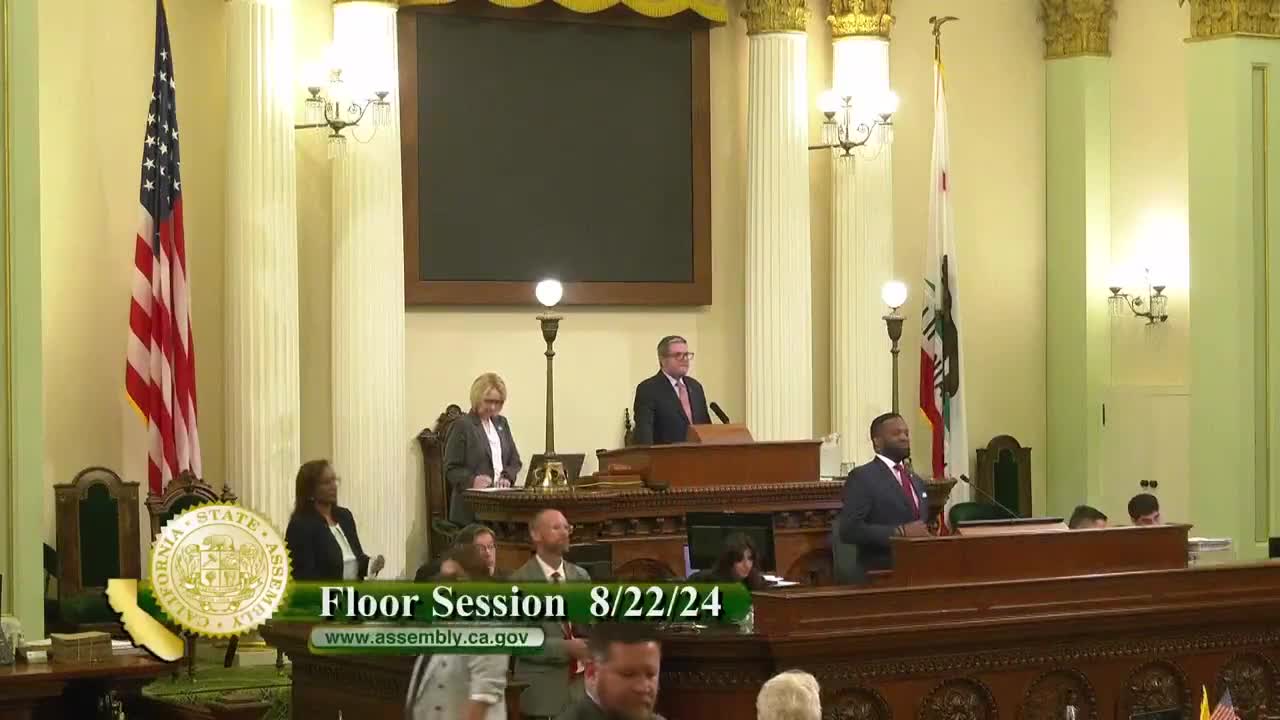 1MIN
Assembly Floor
 52SEC
Senate Floor
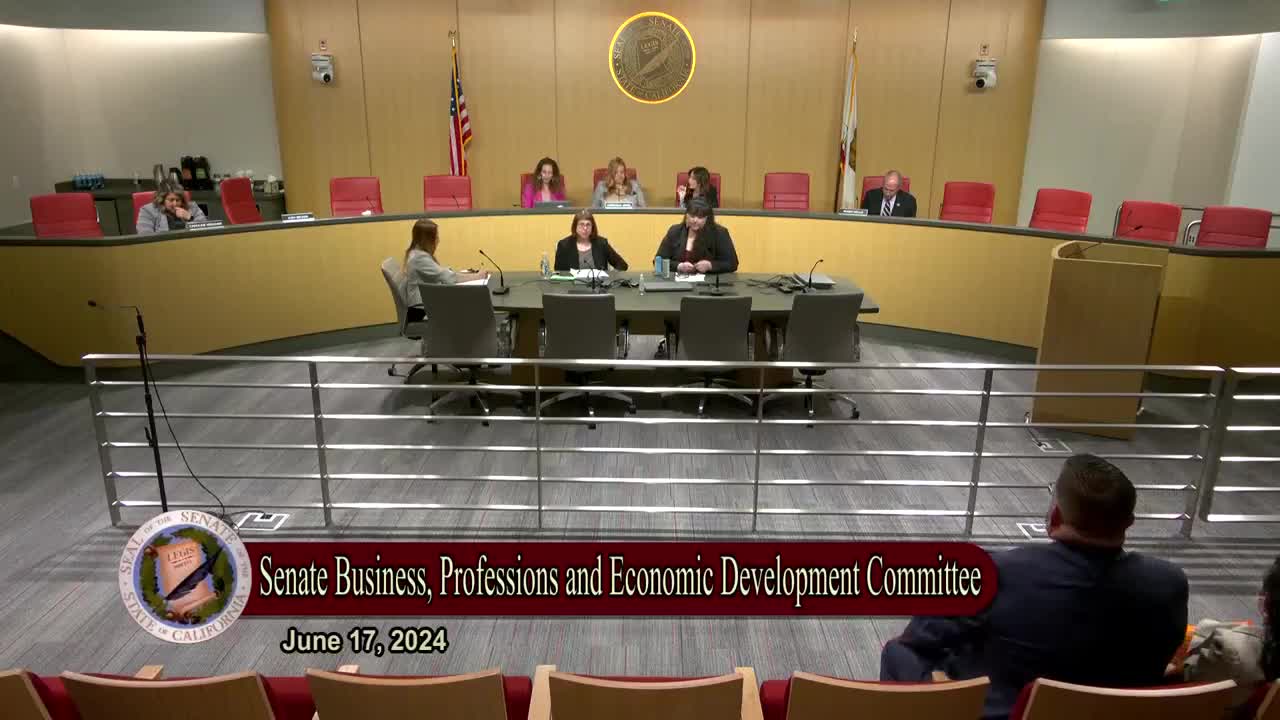 10MIN
Senate Standing Committee on Business, Professions and Economic Development
Bill Author