AB 2002: Vehicles: public safety: Blue Envelope Program.
- Session Year: 2023-2024
- House: Assembly
- Latest Version Date: 2024-03-06
Current Status:
Failed
(2024-05-16: In committee: Held under submission.)
Introduced
In Committee
First Chamber
In Committee
Second Chamber
Enacted
What does this bill do?
The bill requires the Department of Motor Vehicles to create a "Blue Envelope" program and provide a blue envelope to people with disabilities or to a parent, guardian, family member, or driver of a passenger with a disability so they can carry their license, registration, and insurance and indicate they may need accommodations. The envelope must include printed traffic-stop safety tips, suggested ways officers can improve communication and accommodation, and blank spaces for notes and an emergency contact; law enforcement agencies may create similar items if they meet these minimums.
The summary is provided by generative AI which can make mistakes. For original language, please view the details in the table below.
Existing law establishes the Department of Motor Vehicles, tasked with issuance and renewal of licenses to drivers. Existing law requires the department to prescribe and provide suitable forms of applications, certificates of ownership, registration cards, drivers licenses, and all other forms that are deemed necessary.
This bill would, by January 1, 2026, require the department, in consultation with relevant stakeholders, to develop a Blue Envelope Program. Under the program, the bill would require the blue envelope to contain specified information for requesters with a condition or disability, as specified. The bill would also authorize others, including a parent or legal guardian of a passenger with a disability, to request a blue envelope.
Existing law establishes the Department of Motor Vehicles, tasked with issuance and renewal of licenses to drivers. Existing law requires the department to prescribe and provide suitable forms of applications, certificates of ownership, registration cards, drivers licenses, and all other forms that are deemed necessary.
This bill would, by January 1, 2026, require the department, in consultation with relevant stakeholders, to develop a Blue Envelope Program. Under the program, the bill would require the blue envelope to contain specified information for requesters with a condition or disability, as specified.
(a)The Department of Motor Vehicles, in consultation with relevant stakeholders, including, but not limited to, the Association of Regional Center Agencies, the California State Sheriffs Association, and the California Police Chiefs Association, a representative from the Association of Regional Center Agencies, representatives from law enforcement, including a representative from a sheriffs department, and an organization or individual with disability expertise, shall develop a Blue Envelope Program. The blue envelope developed in the program shall contain the following:
(1)Printed information for the envelopes holder regarding traffic stop safety tips.
(2)Printed recommendations to the responding law enforcement officer with interaction techniques to help promote enhanced communication and accommodation between law enforcement and community members.
(3)Blank area where the individual, or their emergency contact, may add additional noteworthy comments pertaining to the individuals needs or requested accommodations.
(4)Blank area where the individual may write down the contact information of their emergency contact person.
(b)Upon request by a person who is protected by the Americans with Disabilities Act of 1990 (Public Law 101-336), or a person who has a condition and may need additional accommodations with law enforcement, or a parent or other family member, legal guardian, conservator, or driver of a passenger with a disability, the department shall provide the requester a blue envelope. The blue envelope shall be designed to hold a copy of the persons operator license, vehicle registration, and insurance card.
(c)Nothing in this section shall prevent a law enforcement agency from developing its own blue envelope or other products, including, but not limited to, lanyards, seatbelt covers, decals, stickers, wristbands, and keychains, so long as it follows the minimum requirements set forth in this section.
(d)The department shall make the blue envelope available by January 1, 2026.
REVISIONS: HeadingLine 5.(a)The Department of Motor Vehicles, in consultation with relevant stakeholders, including, but not limited to, the Association of Regional Center Agencies, the California State Sheriffs Association, and the California Police Chiefs Association, shall develop a Blue Envelope Program. The blue envelope developed in the program shall contain the following:
(1)Printed information for the envelopes holder regarding traffic stop safety tips.
(2)Printed recommendations to the responding law enforcement officer with interaction techniques to help promote enhanced communication and accommodation between law enforcement and community members.
(3)Blank area where the individual, or their emergency contact, may add additional noteworthy comments pertaining to the individuals needs or requested accommodations.
(4)Blank area where the individual may write down the contact information of their emergency contact person.
(b)Upon request by a person who is protected by the Americans with Disabilities Act of 1990 (Public Law 101-336), or a person who has a condition and may need additional accommodations with law enforcement, the department shall provide the requester a blue envelope. The blue envelope shall be designed to hold a copy of the persons operator license, vehicle registration, and insurance card.
(c)Nothing in this section shall prevent a law enforcement agency from developing its own blue envelope or other products, including, but not limited to, lanyards, seatbelt covers, decals, stickers, wristbands, and keychains, so long as it follows the minimum requirements set forth in this section.
(d)The department shall make the blue envelope available by January 1, 2026.
|
Date
|
Status
|
|---|---|
| May 16, 2024 | In committee: Held under submission. |
| Apr 17, 2024 | In committee: Set, first hearing. Referred to APPR. suspense file. |
| Mar 19, 2024 | Coauthors revised. |
| Mar 19, 2024 | From committee: Do pass and re-refer to Com. on APPR. (Ayes 13. Noes 0.) (March 19). Re-referred to Com. on APPR. |
| Mar 7, 2024 | Re-referred to Com. on TRANS. |
| Mar 6, 2024 | From committee chair, with author's amendments: Amend, and re-refer to Com. on TRANS. Read second time and amended. |
| Feb 20, 2024 | Referred to Com. on TRANS. |
| Jan 31, 2024 | From printer. May be heard in committee March 1. |
| Jan 30, 2024 | Read first time. To print. |
|
Date
|
Description
|
Location
|
Votes
|
|
|---|---|---|---|---|
| Mar 19, 2024 | Do pass and be re-referred to the Committee on [Appropriations] | Assembly Standing Committee on Transportation |
Passed |
This list shows positions taken on this bill by organizations on the date displayed, which is linked to the original source.
Positions by individuals are not included.
|
Organization
|
Position
|
Date
|
|---|---|---|
| Alta California Regional Center | ** Support | |
| Alzheimer's Los Angeles | ** Support | |
| alzheimer's orange county | ** Support | |
| Alzheimer'S San Diego | ** Support | |
| Arcadia Police Officers' Association | ** Support | |
| Association Of Regional Center Agencies | ** Support | |
| Burbank Police Officers' Association | ** Support | |
| Cal-TASH | ** Support | |
| California Agencies for the Blind and Visually Impaired | ** Support | |
| California Coalition of School Safety Professionals | ** Support | |
| California Council Of The Blind | ** Support | |
| California Dental Association | ** Support | |
| California Narcotic Officers' Association | ** Support | |
| California Reserve Peace Officers Association | ** Support | |
| California State Sheriffs Association | ** Support | |
| CLAREMONT POLICE OFFICERS ASSOCIATION | ** Support | |
| Corona Police Officers Association | ** Support | |
| Culver City Police Officers' Association | ** Support | |
| Deaf Community Services of San Diego | ** Support | |
| Decoding Dyslexia CA | ** Support | |
| Deputy Sheriffs Association of Monterey County | ** Support | |
| Doogri, INC. | ** Against | |
| Educate. Advocate. | ** Support | |
| Fullerton Police Officers' Association | ** Support | |
| Los Angeles School Police Management Association | ** Support | |
| los angeles school police officers association | ** Support | |
| Murrieta Police Officers' Association | ** Support | |
| Newport Beach Police Association | ** Support | |
| Novato Police Officers Association | ** Support | |
| Palos Verdes Police Officers Association | ** Support | |
| PLACER COUNTY DEPUTY SHERIFFS ASSOCIATION | ** Support | |
| Pomona Police Officers' Association | ** Support | |
| Riverside County Sheriff's Office | ** Support | |
| RIVERSIDE POLICE OFFICERS ASSOCIATION | ** Support | |
| Riverside Sheriffs' Association | ** Support | |
| San Diego County Sheriff'S Department | ** Support | |
| San Diego Regional Center | ** Support | |
| Santa Ana Police Officers Association | ** Support | |
| Social Impact Services | ** Support | |
| Upland Police Officers Association | ** Support | |
| Valley Center for the Blind | ** Support |
Date of Hearing: April 17, 2024
ASSEMBLY COMMITTEE ON APPROPRIATIONS
Buffy Wicks, Chair
ABPCA Bill Id:AB 2002
Author:(Sanchez) – As Amended Ver:March 6, 2024
Policy Committee: | Transportation | Vote: | 13 - 0 |
|
| ||
|
|
Urgency: No State Mandated Local Program: No Reimbursable: Yes
SUMMARY:
This bill requires the Department of Motor Vehicles (DMV) to develop and implement a Blue Envelope Program.
Specifically, this bill:
- Requires the DMV to develop a Blue Envelope Program by which any of the following persons may request from DMV a blue envelope, designed to a hold copy of a person’s operator license, vehicle registration and insurance card: a person who is protected by the Americans with Disabilities Act of 1990; a person who has a condition and may need additional accommodations with law enforcement; or a parent or other family member, legal guardian, conservator or driver of a passenger with a disability.
- Directs the DMV to make the blue envelope available, by January 1, 2026, to any person described above who requests it from DMV.
- Requires the DMV to develop the program in consultation with relevant stakeholders, including a representative from the Association of Regional Center Agencies, representatives from law enforcement, including a sheriff’s department, and an organization or individual with disability expertise.
- Requires the blue envelope that results from development of the program contain specified printed information regarding traffic stop safety tips and recommendations to a responding law enforcement officer regarding interaction techniques, as well as blank areas where the holder of the blue envelope may add noteworthy comments regarding the holder’s individual needs, requested accommodations, contact information and emergency contact person.
- Provides that this bill does not prohibit a law enforcement agency from developing its own blue envelope program or other products.
FISCAL EFFECT:
- One-time costs to DMV to develop the Blue Envelope Program. DMV did not provide an estimate of its one-time costs, but, based on DMV estimates of one-time information technology (IT) costs to implement other bills, it is likely these costs will be in the low millions of dollars (Motor Vehicle Account (MVA)). DMV regularly points to its complete revamp of its IT systems—a process DMV calls the “Enterprise Modernization Project – the Digital eXperience Project (DXP),” which DMV anticipates to last through fiscal year 2025-26. DMV has repeatedly warned new legislative mandates may lead DMV to develop temporary IT solutions, which DMV describes as “costly and may require the department to acquire new technology and services at significantly high costs.”
- Ongoing annual costs to DMV to administer the Blue Envelope Program. DMV identifies costs related to printing ($3.8 million), postage ($2.5 million) and staff time ($2 million) to handle the request for blue envelopes (MVA). DMV cautions it is difficult to estimate these costs accurately, but observes that, according to the Centers for Disease Control, there are approximately 7.6 million adults in California with a disability, and the bill requires DMV to provide a blue envelope to any eligible customer who requests one.
According to the Legislative Analyst’s Office (LAO), the MVA—the main funding source for the DMV—is expected to fully exhaust its reserves and become insolvent in fiscal year 2025‑26. The LAO further warns that the MVA, absent corrective action, such as revenue increases or spending reductions, will experience a negative fund balance of $1.4 billion in fiscal year 2028‑29.
COMMENTS:
- Purpose. The author intends this bill to lead to a statewide “blue envelope” program that will “improve accessibility and communication between law enforcement and individuals with disabilities.” The author asserts that similar programs “have successfully been used in multiple states and localities.”
- Background. Stops of drivers by law enforcement are fraught experiences. A law enforcement officer has a variety of punitive, coercive and violent options available to them to ensure compliance by an individual the officer perceives as not complying with their orders.
Evidence suggests a law enforcement officer is likely to treat a person the officer perceives as having a disability differently than the officer would treat another person. For example, the 2024 annual report of the California Racial and Identity Profiling Advisory Board reports:
Individuals perceived to have a disability were searched (42.7%), detained curbside or in a patrol car (42.2%), and handcufed (41.6%) at a much higher rate than individuals perceived to not have a disability (13.4% searched, 14.4% detained curbside or in a patrol car, and 9.9% handcufed). However, individuals perceived to have a disability were removed from a vehicle by order at a lower rate (3.4%), compared to individuals who were not perceived to have a disability (4.8%).
The premise of this bill is that a law enforcement officer involved in a traffic stop is more likely to respond appropriately to a person perceived as having a disability if the officer is aware of the disability early in the interaction.
As noted by the author, several jurisdictions—including local jurisdictions in California—have implemented blue envelope programs to improve interactions between law enforcement officers and persons perceived to have a disability. These jurisdictions include the Riverside County Sheriff and the San Diego County Sheriff, both of which sponsor this bill. The local California programs are fairly new. For example, the San Diego County Sheriff began a blue envelope program in October of last year.
- Prior Legislation.
- AB 971 (Gray), of the 2021-22 Legislative Session, would have (i) required an application for a driver’s license or identification card to allow an applicant to self-certify they may have difficulty communicating with a law enforcement office because of a developmental disability and (ii) allowed an applicant to request the DMV print an appropriate designation on the face of a driver’s license or identification card. The bill was held on the suspense file of this committee.
- AB 259 (Calderon), of the 2019-20 Legislative Session, would have created within the DMV the Voluntary Deaf and Hard of Hearing Notification Program, under which DMV was to allow a person registering a vehicle to voluntarily indicate that a driver of the vehicle may be deaf or hard of hearing and place a notification in the record of the vehicle registration. The bill would have prohibited any marking on a person’s driver’s license indicating the person was hard of hearing. The bill was held on the suspense file of this committee.
Analysis Prepared by: Jay Dickenson / APPR. / (916) 319-2081
Date of Hearing: March 19, 2024
ASSEMBLY COMMITTEE ON TRANSPORTATION
Lori D. Wilson, Chair
ABPCA Bill Id:AB 2002 (
Author:Sanchez) – As Amended Ver:March 06, 2024
SUBJECT: Vehicles: public safety: Blue Envelope Program
SUMMARY: Requires the Department of Motor Vehicles (DMV) in consultation with relevant stakeholders, to develop a Blue Envelope Program to assist persons protected by the Americans with Disability Act (ADA) during law enforcement stops. Specifically, this bill:
- Requires DMV to consult with a representative from the Association of Regional Center Agencies, representatives from law enforcement, including a representative from a sheriff’s department, and an organization or individual with disability expertise in developing the blue envelope program.
- Requires the blue envelope to contain the following printed information:
- Traffic stop safety tips;
- Printed recommendations to the responding law enforcement officer with interaction techniques to help promote enhanced communication and accommodations between law enforcement and community members;
- A blank area where the individual, or their emergency contact, may add additional noteworthy comments pertaining to the individual’s needs or requested accommodations; and,
- A blank area where the individual may write down the contact information of their emergency contact.
- Requires the blue envelope to be designed to hold a copy of the person’s operator license, vehicle registration, and insurance card.
- Authorizes a person who is protected by the ADA, a person who has a condition and may need additional accommodations with law enforcement, or a parent or other family member, legal guardian, conservator, or driver of a passenger with a disability to request a blue envelope from DMV.
- Provides that nothing in this bill prevents a local law enforcement agency from developing its own blue envelope or other products.
- Requires DMV to make the blue envelope available by January 1, 2026.
EXISTING LAW:
- Authorizes DMV to issue driver’s licenses and identification cards. (Vehicle Code Section 1652)
- Requires the Commission on Peace Officer Standards and Training (POST) to establish a training course on law enforcement interactions with persons with mental illness and requires a three-hour continuing education course on the same subject matter. (Penal Code Section 13515.26 and 13515.27)
FISCAL EFFECT: Unknown
COMMENTS:
A Blue Envelope Program was first developed in Connecticut in 2020 as a way to ease interactions between law enforcement and individuals with autism. It was modeled after the state's Green Envelope Program, which indicated to law enforcement that a person was deaf or hard of hearing.
According to the author, “Blue envelope programs have successfully been used in multiple states and localities to improve accessibility and communication between law enforcement and individuals with disabilities. I introduced AB 2002 to create a statewide blue envelope program that will work to promote inclusivity and help keep people safe.”
According to the 2024 Racial and Identity Profiling Advisory Board (RIPA) report, “Stopped individuals perceived as having a disability had a higher proportion of their stops involve officers taking actions towards them (69.6%) than individuals not perceived to have a disability (24.4%). Stopped individuals who officers perceived to have a disability were searched (42.7%), detained on the curb or in a patrol car (42.2%), and handcuffed (41.6%) at a much higher rate than individuals perceived not to have a disability (13.4% searched, 14.4% detained on the curb or in a patrol car, and 9.9% handcuffed). Individuals who officers perceived to have a disability had a lower rate of being removed from a vehicle by order (3.4%) compared to individuals who were not perceived as having a disability (4.8%). Officers took no action as a result of stops during a higher proportion of stops of people they perceived to have a disability (13.7%) than during stops of people they perceived not to have a disability (9.0%). Further, stopped individuals whom officers perceived as having a disability had much lower rates of being cited (7.9%) or warned (18.0%) and higher rates of being arrested (25.9%) than individuals perceived to not have a disability (42.9% cited, 31.8% warned, and 15.9% arrested).
In California, both the San Diego and Riverside sheriffs’ departments have created a Blue Envelope Program. The San Diego program was created in October of 2023. Unlike the Connecticut program, which limits the blue envelope only to individuals with autism, the San Diego program is available for anyone with a disability. Data provided to the committee showed that as of February 2024, San Diego has already distributed nearly 7,000 blue envelopes.
According to the San Diego County Sherriff’s Department, one of the co-sponsors of this bill, “The outreach material has been strategically designed, with community and stakeholder input, to assist individuals with a condition or disability which may impact communication or require additional accommodations or awareness during a law enforcement interaction. Being contacted by law enforcement can make anyone uncomfortable, and for individuals with a condition or disability, it could cause even greater stress. We look to expand this program throughout the State and create a more inclusive awareness tool that is voluntary, with the intent to lead to better-informed interactions and safer outcomes for all.”
The Legislature in recent years has taken several steps to try to improve interactions between people with disabilities and law enforcement. SB 11 (Beall), Chapter468, Statutes of 2015 and SB 29 (Beall), Chapter 469, Statutes of 2015 required the Peace Officer Standards and Training to develop training courses and continuing education courses to improve interactions between law enforcement and individuals with disabilities.
According to CAL-TASH, a disability rights organization supporting this bill, “By being able to present a blue envelope, containing their license, registration, and pertinent information, individuals with disabilities and their families will be able to quickly and easily inform law enforcement about their disability. This will assist law enforcement personnel to better understand the individual’s behaviors, and why they may be responding differently and may not be able to follow directives. This legislation is a very important step in public safety, awareness, and understanding for individuals with disabilities.”
Committee Concerns: According to the Legislative Analyst Office (LAO), The Motor Vehicle Account (MVA), the primary funding source for DMV, is expected to fully exhaust its reserves and become insolvent in 2025-26. The LAO recommends the Legislature should consider MVA cost pressures when evaluating new proposals. LAO argues that “Until a plan is put in place to address MVA’s structural deficit, we recommend the Legislature set a high bar for considering approval of any proposals that create additional MVA cost pressures and accelerate the risk of insolvency.”
The development of a Blue Envelope Program may be better suited for a law enforcement agency instead of the DMV because it is intended to improve interactions between individuals with disabilities with law enforcement. The author may want to consider finding such a state agency that may be interested in developing this program.
While this bill intends to be voluntary, it may have unintended consequences. A conservator may require the use of a blue envelope, for example. It is also important for law enforcement officers to be properly trained to interact with people with disabilities, regardless of whether the person has e a blue envelope.
Related Legislation:
SB 1285 (Laird) of 2024 requires DMV to develop an appropriate disability identifier symbol to be placed on a driver’s license or identification card that is discreet and represents all types of disability. That bill is pending before the Senate Transportation Committee.
Previous Legislation:
AB 971 (Gray of 2021) was similar to SB 1285. That bill was held in suspense in the Assembly Appropriations Committee.
REGISTERED SUPPORT / OPPOSITION:
Support
Association of Regional Center Agencies (co-sponsor)
Riverside County Sheriff's Office (co-sponsor)
San Diego County Sheriff's Department (co-sponsor)
Alta California Regional Center
Alzheimer's Los Angeles
Alzheimer's Orange County
Alzheimer's San Diego
Arcadia Police Officers' Association
Burbank Police Officers' Association
Cal-TASH
California Agencies for the Blind and Visually Impaired
California Coalition of School Safety Professionals
California Council of the Blind
California Dental Association
California Narcotic Officers' Association
California Reserve Peace Officers Association
California State Sheriffs’ Association
Claremont Police Officers Association
Corona Police Officers Association
Culver City Police Officers' Association
Deaf Community Services of San Diego
Decoding Dyslexia CA
Deputy Sheriffs' Association of Monterey County
Educate. Advocate.
Fullerton Police Officers' Association
Los Angeles School Police Management Association
Los Angeles School Police Officers Association
Murrieta Police Officers' Association
Newport Beach Police Association
Novato Police Officers Association
Palos Verdes Police Officers Association
Placer County Deputy Sheriffs' Association
Pomona Police Officers' Association
Riverside Police Officers Association
Riverside Sheriffs' Association
San Diego Regional Center
Santa Ana Police Officers Association
Social Impact Services
Upland Police Officers Association
Valley Center for the Blind
Oppose
Doogri, INC.
Analysis Prepared by: David Sforza / TRANS. / (916) 319-2093
Discussed in Hearing
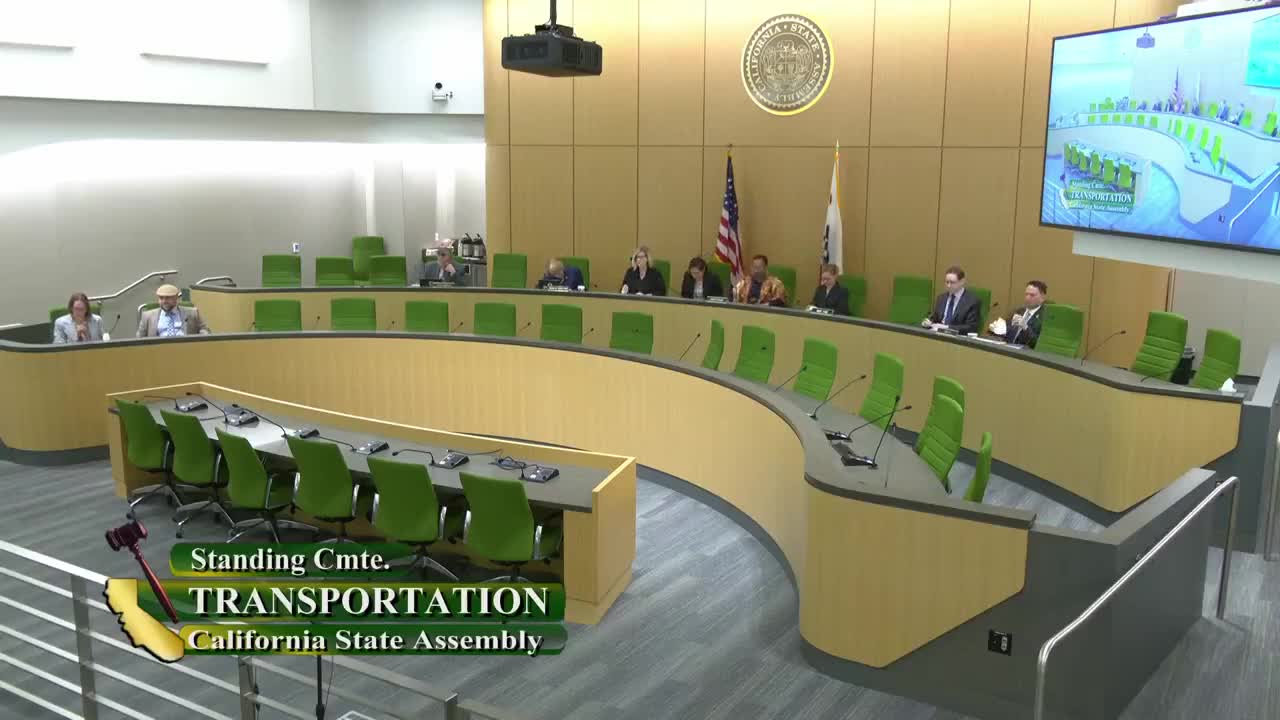 12MIN
Assembly Standing Committee on Transportation
Bill Author