AB 2480: Zero-emission schoolbus replacement grants: private contractors.
- Session Year: 2023-2024
- House: Assembly
- Latest Version Date: 2024-04-16
Current Status:
Failed
(2024-04-22: In committee: Set, first hearing. Hearing canceled at the request of author.)
Introduced
In Committee
First Chamber
In Committee
Second Chamber
Enacted
What does this bill do?
The bill lets private contractors — companies under contract with a school district, county office of education, or charter school that own schoolbuses used to transport students — be eligible for state grants to buy zero‑emission schoolbuses and related charging or fueling infrastructure. It also requires the State Air Resources Board to set a minimum time those contractors must continue providing transportation with the funded bus and to create a depreciation schedule that determines how much of the grant must be repaid if they stop before that period.
The summary is provided by generative AI which can make mistakes. For original language, please view the details in the table below.
Existing law appropriates, for the 202324 fiscal year, $375,000,000 from the General Fund to the State Air Resources Board for the Hybrid and Zero-Emission Truck and Voucher Incentive Project to fund grants to local educational agencies, as defined, for zero-emission schoolbuses to replace heavy-duty internal combustion schoolbuses owned by local educational agencies, as specified, and $125,000,000 from the General Fund to the State Energy Resources Conservation and Development Commission to fund grants to local educational agencies for zero-emission schoolbus charging or fueling infrastructure and related activities, including, but not limited to, charging or fueling stations, equipment, site design, construction, and related infrastructure upgrades, in order to complement those vehicle investments, as specified.
This bill would include, for the definition of a local educational agency for purposes of these provisions, also make the above-described grants available to a private contractor contractor, defined as an entity under contract with a school district, county office of education, or charter school with ownership of title for a schoolbus that is used to provide transportation services for a the school district, county office of education, or charter school, as provided. The bill would require, if a private contractor acquires a schoolbus pursuant to these provisions and subsequently ceases to contract with any school district, county office of education, or charter school to provide transportation services using the schoolbus, ownership of title for the schoolbus to be transferred to the school district, county office of education, or charter school that it last contracted with. By expanding the scope of eligibility for purposes of an appropriation, the bill would make an appropriation. The bill would require the State Air Resources Board to establish the minimum time period for which a private contractor would be required to contract to provide transportation services to a school district, county office of education, or charter school using a schoolbus acquired pursuant to these provisions and to develop a depreciation schedule for the schoolbus that determines the amount of grant moneys that the private contractor would be required to repay to the State Air Resources Board if the private contractor does not provide transportation services using the schoolbus for the minimum time period.
Existing law appropriates, for the 202324 fiscal year, $375,000,000 from the General Fund to the State Air Resources Board for the Hybrid and Zero-Emission Truck and Voucher Incentive Project to fund grants to local educational agencies, as defined, for zero-emission schoolbuses to replace heavy-duty internal combustion schoolbuses owned by local educational agencies, as specified, and $125,000,000 from the General Fund to the State Energy Resources Conservation and Development Commission to fund grants to local educational agencies for zero-emission schoolbus charging or fueling infrastructure and related activities, including, but not limited to, charging or fueling stations, equipment, site design, construction, and related infrastructure upgrades, in order to complement those vehicle investments, as specified.
This bill would include, for the definition of a local educational agency for purposes of these provisions, a private contractor with ownership of title for a schoolbus that is used to provide transportation services for a school district, county office of education, or charter school, as provided. The bill would require, if a private contractor acquires a schoolbus pursuant to these provisions and subsequently ceases to contract with any school district, county office of education, or charter school to provide transportation services using the schoolbus, ownership of title for the schoolbus to be transferred to the school district, county office of education, or charter school that it last contracted with. By expanding the scope of eligibility for purposes of an appropriation, the bill would make an appropriation.
Existing law establishes the Carl Moyer Memorial Air Quality Standards Attainment Program, which is administered by the State Air Resources Board. The program authorizes the state board to provide grants to offset the incremental cost of eligible projects that reduce emissions from covered vehicular sources. The state board is required to establish and update grant criteria and guidelines for covered vehicle projects. Existing law sets forth general eligibility criteria for projects funded through the program, including a cost-effectiveness requirement. For schoolbus projects, existing law prohibits a grant from exceeding specified cost caps and requires the cost-effectiveness value to be set forth in the guidelines adopted by the state board.This bill would provide that, notwithstanding any other law, a project to purchase a new zero-emission schoolbus to replace an internal combustion engine schoolbus is eligible for a grant under the program regardless of the model year of the associated internal combustion engine.Existing law establishes the Carl Moyer Memorial Air Quality Standards Attainment Program, which is administered by the State Air Resources Board. The program authorizes the state board to provide grants to offset the incremental cost of eligible projects that reduce emissions from covered vehicular sources. The state board is required to establish and update grant criteria and guidelines for covered vehicle projects. Existing law sets forth general eligibility criteria for projects funded through the program, including a cost-effectiveness requirement. For schoolbus projects, existing law prohibits a grant from exceeding specified cost caps and requires the cost-effectiveness value to be set forth in the guidelines adopted by the state board.
This bill would provide that, notwithstanding any other law, a project to purchase a new zero-emission schoolbus to replace an internal combustion engine schoolbus is eligible for a grant under the program regardless of the model year of the associated internal combustion engine.
(a)(1)For the 202324 fiscal year, the sum of three hundred seventy-five million dollars ($375,000,000) is hereby appropriated from the General Fund to the State Air Resources Board for the Hybrid and Zero-Emission Truck and Voucher Incentive Project to fund zero-emission schoolbuses to replace heavy-duty internal combustion schoolbuses owned by local educational agencies and private contractors over five years beginning in the 202324 fiscal year, consistent with this section. This funding shall be available as grants to local educational agencies and private contractors for encumbrance until June 30, 2029. Local educational agencies and private contractors shall have three fiscal years after the fiscal year in which the funds are received to expend the funds. Any funds that are not expended by a local educational agency or private contractor by the end of that period shall be returned to the state.
(2)For the 202324 fiscal year, the sum of one hundred twenty-five million dollars ($125,000,000) is hereby appropriated from the General Fund to the Energy Commission to fund zero-emission schoolbus charging or fueling infrastructure and related activities, including, but not limited to, charging or fueling stations, equipment, site design, construction, and related infrastructure upgrades, in order to complement the vehicle investments described in paragraph (1). This funding shall be available as grants to local educational agencies and private contractors for encumbrance until June 30, 2029. Local educational agencies and private contractors shall have three fiscal years after the fiscal year in which the funds are received to expend the funds. Any funds that are not expended by a local educational agency or private contractor by the end of that period shall be returned to the state.
(b)It is the intent of the Legislature to appropriate three hundred and seventy-five million dollars ($375,000,000) in the 202425 and 202526 fiscal years to the State Air Resources Board, and one hundred twenty-five million dollars ($125,000,000) in the 202425 and 202526 fiscal years to the Energy Commission, for purposes of subdivision (a).
(c)The State Air Resources Board and the Energy Commission shall coordinate to offer a single application to cover vehicle purchases, infrastructure investments, and other associated funding requests.
(d)The State Air Resources Board and the Energy Commission shall ensure that the funding provided in this section supports the transition to zero-emission schoolbus fleets by supporting up to the full purchase cost of zero-emission schoolbuses and related schoolbus charging or fueling infrastructure, as well as provide funding support for other associated costs, including workforce development and training.
(e)(1)The State Air Resources Board, in consultation with the Energy Commission, shall prioritize funding zero-emission schoolbuses under this section.
(2)If a local educational agency is able to provide sufficient information to the State Air Resources Board and the Energy Commission to demonstrate significant barriers to the adoption of zero-emission technology at the time of application, and that alternate approaches to decrease internal combustion vehicle use are not appropriate, the State Air Resources Board and the Energy Commission may fund schoolbuses powered by renewable fuel under this section, to the extent and in the time period that these barriers apply to the local educational agency.
(f)Priority shall be given to grantees serving a high percentage of unduplicated pupils, as defined in Section 42238.02 of the Education Code, grantees operating the oldest internal combustion buses, grantees that are small and rural school districts, and grantees purchasing zero-emission buses with bidirectional charging where available.
(g)The State Air Resources Board and the Energy Commission shall create program guidelines relative to their respective activities. Notwithstanding any other law, the Administrative Procedure Act (Chapter 3.5 (commencing with Section 11340) of Part 1 of Division 3 of Title 2 of the Government Code) shall not apply to the development and approval of the guidelines or other standards or requirements adopted or used by the State Air Resources Board or the Energy Commission in administering these funds.
(h)No less than 90 percent of a grantees grant award shall be expended for the purchase of zero-emission schoolbuses, as well as the supporting charging infrastructure needed to operate the zero-emission schoolbuses and related activities, including, but not limited to, charging or fueling stations, equipment, site design, construction, and related infrastructure upgrades.
(i)Up to 10 percent of a grantees grant award may be expended to incorporate or supplement funding for the grantees school transportation program.
(j)(1)Any schoolbuses that are replaced pursuant to this section shall be scrapped no later than 24 months from date of delivery of the replacement vehicles. Grantees shall provide to the State Air Resources Board proof of scrap of the retired internal combustion schoolbus or schoolbuses.
(2)The grant agreement related to the grant award shall require grantees to submit schoolbus and infrastructure information and documentation resulting from the grants provided in this section to the State Air Resources Board and the Energy Commission.
(k)The Department of General Services, in consultation with the Energy Commission and the California Workforce Development Board, shall establish statewide contracts with manufacturers of zero- or low-emission schoolbuses. These contracts shall satisfy the high road standards pursuant to subdivision (r) of Section 14005 of the Unemployment Insurance Code.
(l)As a condition of entering into a statewide contract with the state, a bidder shall incorporate high road job standards designed to achieve all of the following goals:
(1)Support the creation and retention of quality, nontemporary, and full-time jobs that provide high wages, including benefits and access to training.
(2)Support the hiring of displaced workers and individuals facing barriers to employment.
(3)Encourage the development of the states long-term, climate-sustainable transportation and related infrastructure and manufacturing sectors.
(4)Protect public health by supporting the adoption of specific protections for worker health and safety.
(m)At a minimum, the contract shall include all of the following terms:
(1)All of the bidders employees performing work to fulfill the contract shall be paid no less than the minimum trainee wage set by the Employment Training Panel for the county in which the work is performed, or the applicable federal, state, or local minimum wage, whichever is greater. To the extent permissible, health care benefits valued at up to two dollars and fifty cents ($2.50) per hour may be used to meet this wage requirement.
(2)Any person performing work to fulfill the contract shall be placed in the proper employment classification. This requirement includes, but is not limited to, prohibitions on misclassifying a person performing work to fulfill the contract as an independent contractor.
(3)The bidder and any contractors and subcontractors performing work to fulfill the contract shall comply with all applicable federal, state, and local laws pertaining to paid sick leave, including any antiretaliation provisions contained in such laws.
(4)The bidder and any contractors and subcontractors performing work to fulfill the contract shall comply with all applicable safety and health requirements, and shall comply with Sections 6310 and 6311 of the Labor Code, pertaining to protection of employees who file complaints or refuse to work in the face of hazardous conditions.
(5)The bidder and any contractors and subcontractors comply and shall comply with the federal Americans with Disabilities Act (42 U.S.C. Sec. 12101 et seq.) and all regulations thereunder.
(n)Grants received pursuant to this section shall supplement, not supplant, existing services and funds provided by grantees in support of transportation programs.
(o)For purposes of this section, the following definitions apply:
(1)Bidder means a manufacturer of zero-emission schoolbuses that seeks to enter into a statewide contract with the Department of General Services pursuant to this section.
(2)Energy Commission means the State Energy Resources Conservation and Development Commission.
(3)Local educational agency means any of the following:
(A)A school district, county office of education, or charter school, excluding a charter school classified as a nonclassroom-based charter school as of the 202122 fiscal year second principal apportionment certification pursuant to Section 47612.5 of the Education Code, with ownership of title for a schoolbus or schoolbuses.
(B)A school district or charter school, excluding a charter school classified as a nonclassroom-based charter school as of the 202122 fiscal year second principal apportionment certification pursuant to Section 47612.5 of the Education Code, that contracts with a county office of education or private contractor for the maintenance and operation of its schoolbuses.
(C)A county office of education that contracts with a private contractor entity for maintenance and operation of its schoolbuses.
(D)A joint powers authority currently operating home-to-school transportation programs on behalf of school districts, county offices of education, or charter schools, excluding charter schools classified as a nonclassroom-based charter school as of the 202122 fiscal year second principal apportionment certification pursuant to Section 47612.5 of the Education Code.
(E)A private contractor(4)Private contractor means an entity under contract with a school district, county office of education, or charter school, excluding a charter school classified as a nonclassroom-based charter school as of the 202122 fiscal year second principal apportionment certification pursuant to Section 47612.5 of the Education Code, with ownership of title for a schoolbus that is used to provide transportation services for a the school district, county office of education, or charter school, excluding a charter school classified as a nonclassroom-based charter school as of the 202122 fiscal year second principal apportionment certification pursuant to Section 47612.5 of the Education Code. school.
(4)(5)Rural school district means a school district with a school with a locale code of 31, 32, 33, 41, 42, or 43, as classified by the National Center for Education Statistics.
(5)(6)Small school district means a school district with fewer than 2,501 units of average daily attendance using the most recently reported annual data in the California Longitudinal Pupil Attendance Data System.
(p)(1)If a participating charter school acquires a schoolbus pursuant to this section and the charter school subsequently ceases operation, the schoolbus shall be made available to the State Air Resources Board for reallocation to other eligible local educational agencies.
(2)If a private contractor acquires a schoolbus pursuant to this section and the private contractor subsequently ceases to contract with any school district, county office of education, or charter school to provide transportation services using the schoolbus, ownership of title for the schoolbus shall be transferred to the school district, county office of education, or charter school that it last contracted with.(2)The State Air Resources Board shall establish the minimum time period for which a private contractor shall contract to provide transportation services to a school district, county office of education, or charter school using a schoolbus acquired pursuant to this section. The State Air Resources Board shall develop a depreciation schedule for the schoolbus that determines the amount of grant moneys that the private contractor shall repay to the State Air Resources Board if the private contractor does not provide transportation services using the schoolbus for the minimum time period.
(q)For purposes of making the computations required by Section 8 of Article XVI of the California Constitution, the appropriations made by paragraphs (1) and (2) of subdivision (a) shall be deemed to be General Fund revenues appropriated for school districts, as defined in subdivision (c) of Section 41202 of the Education Code, for the 202122 fiscal year, and included within the total allocations to school districts and community college districts from General Fund proceeds of taxes appropriated pursuant to Article XIIIB, as defined in subdivision (e) of Section 41202 of the Education Code, for the 202122 fiscal year.
(r)The provisions of this section are severable. If any provision of this section or its application is held invalid, that invalidity shall not affect other provisions or applications that can be given effect without the invalid provision or application.
(a)(1)For the 202324 fiscal year, the sum of three hundred seventy-five million dollars ($375,000,000) is hereby appropriated from the General Fund to the State Air Resources Board for the Hybrid and Zero-Emission Truck and Voucher Incentive Project to fund zero-emission schoolbuses to replace heavy-duty internal combustion schoolbuses owned by local educational agencies over five years beginning in the 202324 fiscal year, consistent with this section. This funding shall be available as grants to local educational agencies for encumbrance until June 30, 2029. Local educational agencies shall have three fiscal years after the fiscal year in which the funds are received to expend the funds. Any funds that are not expended by a local educational agency by the end of that period shall be returned to the state.
(2)For the 202324 fiscal year, the sum of one hundred twenty-five million dollars ($125,000,000) is hereby appropriated from the General Fund to the Energy Commission to fund zero-emission schoolbus charging or fueling infrastructure and related activities, including, but not limited to, charging or fueling stations, equipment, site design, construction, and related infrastructure upgrades, in order to complement the vehicle investments described in subdivision (a). paragraph (1). This funding shall be available as grants to local educational agencies for encumbrance until June 30, 2029. Local educational agencies shall have three fiscal years after the fiscal year in which the funds are received to expend the funds. Any funds that are not expended by a local educational agency by the end of that period shall be returned to the state.
(b)It is the intent of the Legislature to appropriate three hundred and seventy-five million dollars ($375,000,000) in the 202425 and 202526 fiscal years to the State Air Resources Board, and one hundred twenty-five million dollars ($125,000,000) in the 202425 and 202526 fiscal years to the Energy Commission, for purposes of subdivision (a).
(c)The State Air Resources Board and the Energy Commission shall coordinate to offer a single application to cover vehicle purchases, infrastructure investments, and other associated funding requests.
(d)The State Air Resources Board and the Energy Commission shall ensure that the funding provided in this section supports the transition to zero-emission schoolbus fleets by supporting up to the full purchase cost of zero-emission schoolbuses and related schoolbus charging or fueling infrastructure, as well as provide funding support for other associated costs, including workforce development and training.
(e)(1)The State Air Resources Board, in consultation with the Energy Commission, shall prioritize funding zero-emission schoolbuses under this section.
(2)If a local educational agency is able to provide sufficient information to the State Air Resources Board and the Energy Commission to demonstrate significant barriers to the adoption of zero-emission technology at the time of application, and that alternate approaches to decrease internal combustion vehicle use are not appropriate, the State Air Resources Board and the Energy Commission may fund schoolbuses powered by renewable fuel under this section, to the extent and in the time period that these barriers apply to the local educational agency.
(f)Priority shall be given to grantees serving a high percentage of unduplicated pupils, as defined in Section 42238.02 of the Education Code, grantees operating the oldest internal combustion buses, grantees that are small and rural school districts, and grantees purchasing zero-emission buses with bidirectional charging where available.
(g)The State Air Resources Board and the Energy Commission shall create program guidelines relative to their respective activities. Notwithstanding any other law, the Administrative Procedure Act (Chapter 3.5 (commencing with Section 11340) of Part 1 of Division 3 of Title 2 of the Government Code) shall not apply to the development and approval of the guidelines or other standards or requirements adopted or used by the State Air Resources Board or the Energy Commission in administering these funds.
(h)No less than 90 percent of a grantees grant award shall be expended for the purchase of zero-emission schoolbuses, as well as the supporting charging infrastructure needed to operate the zero-emission schoolbuses and related activities, including, but not limited to, charging or fueling stations, equipment, site design, construction, and related infrastructure upgrades.
(i)Up to 10 percent of a grantees grant award may be expended to incorporate or supplement funding for the grantees school transportation program.
(j)(1)Any schoolbuses that are replaced pursuant to this section shall be scrapped no later than 24 months from date of delivery of the replacement vehicles. Grantees shall provide to the State Air Resources Board proof of scrap of the retired internal combustion schoolbus or schoolbuses.
(2)The grant agreement related to the grant award shall require grantees to submit schoolbus and infrastructure information and documentation resulting from the grants provided in this section to the State Air Resources Board and the Energy Commission.
(k)The Department of General Services, in consultation with the Energy Commission and the California Workforce Development Board, shall establish statewide contracts with manufacturers of zero- or low-emission schoolbuses. These contracts shall satisfy the high road standards pursuant to subdivision (r) of Section 14005 of the Unemployment Insurance Code.
(l)As a condition of entering into a statewide contract with the state, a bidder shall incorporate high road job standards designed to achieve all of the following goals:
(1)Support the creation and retention of quality, nontemporary, and full-time jobs that provide high wages, including benefits and access to training.
(2)Support the hiring of displaced workers and individuals facing barriers to employment.
(3)Encourage the development of the states long-term, climate-sustainable transportation and related infrastructure and manufacturing sectors.
(4)Protect public health by supporting the adoption of specific protections for worker health and safety.
(m)At a minimum, the contract shall include all of the following terms:
(1)All of the bidders employees performing work to fulfill the contract shall be paid no less than the minimum trainee wage set by the Employment Training Panel for the county in which the work is performed, or the applicable federal, state, or local minimum wage, whichever is greater. To the extent permissible, health care benefits valued at up to two dollars and fifty cents ($2.50) per hour may be used to meet this wage requirement.
(2)Any person performing work to fulfill the contract shall be placed in the proper employment classification. This requirement includes, but is not limited to, prohibitions on misclassifying a person performing work to fulfill the contract as an independent contractor.
(3)The bidder and any contractors and subcontractors performing work to fulfill the contract shall comply with all applicable federal, state, and local laws pertaining to paid sick leave, including any antiretaliation provisions contained in such laws.
(4)The bidder and any contractors and subcontractors performing work to fulfill the contract shall comply with all applicable safety and health requirements, and shall comply with Sections 6310 and 6311 of the Labor Code, pertaining to protection of employees who file complaints or refuse to work in the face of hazardous conditions.
(5)The bidder and any contractors and subcontractors comply and shall comply with the federal Americans with Disabilities Act (42 U.S.C. Sec. 12101 et seq.) and all regulations thereunder.
(n)Grants received pursuant to this section shall supplement, not supplant, existing services and funds provided by grantees in support of transportation programs.
(o)For purposes of this section, the following definitions apply:
(1)Bidder means a manufacturer of zero-emission schoolbuses that seeks to enter into a statewide contract with the Department of General Services pursuant to this section.
(2)Energy Commission means the State Energy Resources Conservation and Development Commission.
(3)Local educational agency means any of the following:
(A)A school district, county office of education, or charter school, excluding a charter school classified as a nonclassroom-based charter school as of the 202122 fiscal year second principal apportionment certification pursuant to Section 47612.5 of the Education Code, with ownership of title for a schoolbus or schoolbuses.
(B)A school district or charter school, excluding a charter school classified as a nonclassroom-based charter school as of the 202122 fiscal year second principal apportionment certification pursuant to Section 47612.5 of the Education Code, that contracts with a county office of education or private contractor for the maintenance and operation of its schoolbuses.
(C)A county office of education that contracts with a private contractor for maintenance and operation of its schoolbuses.
(D)A joint powers authority currently operating home-to-school transportation programs on behalf of school districts, county offices of education, or charter schools, excluding charter schools classified as a nonclassroom-based charter school as of the 202122 fiscal year second principal apportionment certification pursuant to Section 47612.5 of the Education Code.
(E)A private contractor with ownership of title for a schoolbus that is used to provide transportation services for a school district, county office of education, or charter school, excluding a charter school classified as a nonclassroom-based charter school as of the 202122 fiscal year second principal apportionment certification pursuant to Section 47612.5 of the Education Code.
(4)Rural school district means a school district with a school with a locale code of 31, 32, 33, 41, 42, or 43, as classified by the National Center for Education Statistics.
(5)Small school district means a school district with fewer than 2,501 units of average daily attendance using the most recently reported annual data in the California Longitudinal Pupil Attendance Data System.
(p)(1)If a participating charter school acquires a schoolbus pursuant to this section and the charter school subsequently ceases operation, the schoolbus shall be made available to the State Air Resources Board for reallocation to other eligible local educational agencies.
(2)If a private contractor acquires a schoolbus pursuant to this section and the private contractor subsequently ceases to contract with any school district, county office of education, or charter school to provide transportation services using the schoolbus, ownership of title for the schoolbus shall be transferred to the school district, county office of education, or charter school that it last contracted with.
(q)For purposes of making the computations required by Section 8 of Article XVI of the California Constitution, the appropriations made by paragraphs (1) and (2) of subdivision (a) shall be deemed to be General Fund revenues appropriated for school districts, as defined in subdivision (c) of Section 41202 of the Education Code, for the 202122 fiscal year, and included within the total allocations to school districts and community college districts from General Fund proceeds of taxes appropriated pursuant to Article XIIIB, as defined in subdivision (e) of Section 41202 of the Education Code, for the 202122 fiscal year.(r)The provisions of this section are severable. If any provision of this section or its application is held invalid, that invalidity shall not affect other provisions or applications that can be given effect without the invalid provision or application.SECTION 1.Section 44282.6 is added to the Health and Safety Code, to read:44282.6.Notwithstanding any other law, a project to purchase a new zero-emission schoolbus to replace an internal combustion engine schoolbus shall be eligible for a grant under the program regardless of the model year of the associated internal combustion engine.Notwithstanding any other law, a project to purchase a new zero-emission schoolbus to replace an internal combustion engine schoolbus shall be eligible for a grant under the program regardless of the model year of the associated internal combustion engine.
|
Date
|
Status
|
|---|---|
| Apr 22, 2024 | In committee: Set, first hearing. Hearing canceled at the request of author. |
| Apr 17, 2024 | Re-referred to Com. on TRANS. |
| Apr 16, 2024 | From committee chair, with author's amendments: Amend, and re-refer to Com. on TRANS. Read second time and amended. |
| Mar 21, 2024 | Re-referred to Com. on TRANS. |
| Mar 20, 2024 | From committee chair, with author's amendments: Amend, and re-refer to Com. on TRANS. Read second time and amended. |
| Mar 4, 2024 | Referred to Com. on TRANS. |
| Feb 14, 2024 | From printer. May be heard in committee March 15. |
| Feb 13, 2024 | Read first time. To print. |
This list shows positions taken on this bill by organizations on the date displayed, which is linked to the original source.
Positions by individuals are not included.
|
Organization
|
Position
|
Date
|
|---|---|---|
| Advanced Energy United | ** Support | |
| Association Of California School Administrators | ** Against | |
| California Environmental Voters | ** Support | |
| California Federation of Teachers, AFL-CIO | ** Against | |
| California School Employees Association | ** Against | |
| Kern County Superintendent of Schools Office | ** Support | |
| SEIU California State Council | ** Against | |
| Zum Transportation | ** Support |
Date of Hearing: April 22, 2024
ASSEMBLY COMMITTEE ON TRANSPORTATION
Lori D. Wilson, Chair
ABPCA Bill Id:AB 2480 (
Author:Garcia) – As Amended Ver:April 16, 2024
SUBJECT: Zero-emission schoolbus replacement grants: private contractors
SUMMARY: Makes zero-emission schoolbus and infrastructure (ZESBI) grants, established with a onetime budget allocation of $500 million from Proposition 98 (Prop. 98) General Fund moneys and designated for use by local educational agencies (LEAs), also available to private schoolbus contractors. Specifically, this bill:
- Defines “private contractor” as an entity under contract with a school district, county office of education, or charter school, with ownership of title for a schoolbus that is used to provide transportation services for the school district, county office of education, or charter school.
- Makes ZESBI grants, administered by the California Air Resources Board (CARB) and the California Energy Commission (CEC) to fund replacement of heavy-duty internal combustion schoolbuses with zero-emission schoolbuses (ZESBs) and construction of supporting charging or fueling infrastructure, available to private contractors.
- Requires CARB to establish a minimum time period for a private contractor to provide transportation services to an LEA with a ZESB purchased using ZESBI grant money and to develop a depreciation schedule for the ZESB that determines the amount of money to be repaid to CARB by the private contractor, if the private contractor ceases to contract with an LEA to provide transportation services before the minimum time period elapses.
EXISTING LAW:
- Allocates, for the 2023–24 fiscal year, $375 million to CARB for the Hybrid and Zero-Emission Truck and Voucher Incentive Project (HVIP) to fund grants to LEAs for ZESBs to replace heavy-duty internal combustion schoolbuses, and $125 million to the CEC to fund grants to LEAs for ZESB charging or fueling infrastructure and related activities. (Section 121, Chapter 52, Statutes of 2022)
- Requires 100% of all newly purchased or contracted schoolbuses of an LEA to be zero-emission vehicles, where feasible, starting January 1, 2035. (Education Code (EDC) 17927)
- Prohibits a continuing contract for the furnishing of transportation of pupils in LEAs to and from school using a ZESB from exceeding 15 years. Further prohibits a continuing contract for the lease or rental of schoolbuses from exceeding 15 years, except that if a lease or rental contract provides the LEA an option either to purchase the bus or to cancel the lease at the end of each annual period during the period of the contract, then the contract may not exceed 20 years. (EDC 39803.5)
FISCAL EFFECT: Unknown
COMMENTS: According to a 2022 report on “Green School Bus Grants” by the Legislative Analyst’s Office, two-thirds of California’s 5.89 million students are driven to and from school in private automobiles. Nearly 30% of statewide greenhouse gas (GHG) emissions are generated by light-duty passenger vehicles alone. A full‑size ZESB can carry more than 50 students, potentially eliminating several dozen trips in private vehicles and the associated emissions.
There are approximately 20,000 schoolbuses in the state, transporting just over 500,000 (9%) students to and from school each year. The majority of schoolbuses (15,500) are owned by LEAs; the remaining schoolbuses are owned and operated by private, third-party contractors. Due to a lack of universal transportation programs, and minimal state funding for this purpose, many LEAs contract with private transportation companies to transport specific student populations – primarily students with disabilities and homeless youth. LEAs cite various advantages and disadvantages of contracting with private student transportation providers. Some LEAs note less hassle with managing labor, logistics, and infrastructure as well as lower costs when working with contractors due to economies of scale. Other LEAs experience unreliable service and high costs when contracting with third-party transportation providers.
Replacing diesel schoolbuses, especially the oldest schoolbuses, is a top priority for the state. Diesel-fueled buses contribute to unhealthy levels of ozone, inhalable particulate matter, carbon monoxide, NOx, and sulfur dioxide, affecting local air quality. Young school-age children are particularly vulnerable to adverse health impacts from exposure to toxic air contaminants. Within California, 55% of all schoolbuses run on diesel, 25% on gasoline or flexible bifuel, 14% on compressed natural gas (CNG), and 5% on propane. Only 3% are hybrid or fully electric. Available data suggest that more than 4,000 buses statewide are more than 20 years old. The average bus in a publicly-owned schoolbus fleet is model year (MY) 2010, whereas the average schoolbus in a privately-owned fleet is MY 2014. Nearly 93% of diesel buses that are MY 2007 or older belong to LEAs.
California has been a leader in improving air quality for children for decades, requiring schoolbuses upgrade to newer, cleaner models, and in some cases zero-emission (ZE) models. In 2009, the Truck and Bus regulation required schoolbuses to use the best available control technology (BACT) for reducing emissions and banned schoolbuses MY 1977 or older starting in 2012. AB 579 (2023) requires that, starting in 2035, 100% of all newly purchased or contracted schoolbuses by LEAs be ZESBs, with compliance extensions available to LEAs based on terrain or route constraints. As of 2023, CARB indicates that 1,900 ZESBs have been funded and 600 are already on the road. To comply with AB 579, LEAs and private schoolbus contractors will need many more ZESBs. Given the average cost of a ZESB is $400,000, upgrades of the entire publicly-owned schoolbus fleet are expected to cost around $5.5-6 billion, not including the cost of building charging infrastructure.
There are many grant programs available for purchasing cleaner diesel and zero-emission schoolbuses at the state and federal level. The table below highlights some of these programs and their eligibility requirements. State incentive programs include the Carl Moyer Program and Low Emission School Bus Program (LESBP), the Rural School Bus Pilot, the HVIP Public Schoolbus Set-Aside and Standard Funds under HVIP through CARB as well as the Schoolbus Replacement Program through the CEC. The federal government offers money for schoolbus upgrades under the Diesel Emissions Reduction Act (DERA) of 2010, and has recently started providing $5 billion of dedicated funds to the Clean School Bus Program under the Bipartisan Infrastructure Law. While these programs are highly subscribed and some funding sources are not reserved solely for schoolbuses, several of these ZESB incentive programs are already available to private schoolbus contractors.
Source: Appendix E: 2023 SB 1403 School Bus Incentive Program Report,
Low Carbon Transportation and Air Quality Improvement Program Funding Plan
In 2022, $1.5 billion of Prop. 98 funds were earmarked for LEAs to replace heavy-duty internal combustion schoolbuses with cleaner ZESBs. In 2023, SB 114 delayed allocation of $1 billion in fiscal year 2023-24, but stated the Legislature’s intent to allocate the money in subsequent years. Starting in 2024, CARB and the CEC are jointly administering the allocated $500 million as “ZESBI grants”. The $375 million of the $500 million is for the purchase of ZESBs which approximates to 938 ZESBs at an average cost of $400,000. CARB and CEC are working on implementation guidelines, and expect to open the ZESBI grant program to applications from May through September 2024.
The ZESBI grants are being modeled on the previously successful, coordinated effort between CARB and the CEC to support ZESB adoption through the HVIP Public Schoolbus Set-aside and the Energy Infrastructure Incentives for Zero-Emission Commercial Vehicles (EnergIIze) programs. The Public Schoolbus Set-aside required scrappage of schoolbuses MY 2010 or older (previously MY 2007 and older) and funds for both programs were only made available to small and medium-sized air districts. Currently, most ZESBs available for purchase are battery electric, though at least one manufacturer is starting production of hydrogen-fuel cell schoolbuses. Under the new ZESBI grants, CARB and the CEC are tentatively proposing to cover the majority of costs for a ZESB purchase for LEAs, and concomitantly fund at least one supporting EV charger.
Demand for zero-emission schoolbuses varies across rural and urban school districts in the state. In late 2023, the L.A. Unified School District unanimously approved a measure to purchase 180 new ZESBs to replace 15% of its old fleet. Meanwhile, also in 2023, the Modoc Joint Unified School District turned down a $2.3 million federal grant to purchase electric buses, with the superintendent stating that “‘[t]he technology is going to have to improve a lot before we would consider switching’ to electric buses”. Due to limited range and charging demands of ZESBs, replacement of a diesel schoolbus may require more than one ZESB and multiple chargers to accommodate a school district’s driving needs. According to the World Resources Institute, battery electric ZESBs have driving ranges of 75-210 miles, which can vary greatly based on climate, terrain, and driver habits. Other barriers in the transition to electric are that districts sometimes take a long time to approve electric buses; delivery can be delayed, and electric buses can require beefing up the electrical supply for the chargers.
According to the author, “Some Local Education Agencies (LEA’s) throughout the state of California contract out their school transports services to private transportation companies. However, these private transport companies cannot access certain pots of funding for zero-emission bus conversion and cannot help contribute to California’s climate objectives.”
In support, Advanced Energy United writes: “current statute does not enable local educational agencies (LEAs) that contract out their school bus transportation (and therefore don't own their buses) to participate in the [ZESBI] incentive program. Thirty percent of LEAs in the state, many of them large districts in urban areas disproportionately burdened by poor air quality, are not eligible to receive the funding as a result….Not enabling all districts to participate in this incentive program puts an unnecessary burden on certain LEAs over others, specifically urban school districts that are economically disadvantaged and overly burdened by poor air quality created in large part by the transportation sector.”
Writing in opposition, the California School Employees Association states: “The zero-emission school bus replacement program has a finite amount of funding. AB 2480 would encourage unnecessary competition between local educational agencies (LEAs) and private transportation companies for the same limited source of Proposition 98 funding. LEAs, especially smaller ones, are already at a disadvantage at applying for grant funding; this bill would exacerbate their inability to further compete with a larger pool of competitors.…While we recognize [the] desire to help move the state closer to its climate goals, we do not believe that creating more competition for our LEAs is the right way to do it.”
Committee comments: This bill makes ZESBI grants, previously only available to LEAs, also available to private schoolbus contractors.
Private schoolbus contractors own and operate a quarter of all schoolbuses in California. Privately owned schoolbuses tend to be newer and less polluting than the remaining 75% of schoolbuses statewide that LEAs own and operate. It is unclear how many students are transported by publicly-owned schoolbuses versus privately-owned schoolbuses, and how many students would stand to benefit from making ZESBI grants available to private student transportation providers. Consequently, opening up ZESBI grants to private schoolbus contractors may not result in the greatest turnover of the dirtiest schoolbuses or provide the highest benefit for students’ health.
There are also concerns that, by making ZESBI grants available to private contractors, LEAs will have more competition for these grants and smaller districts may be at a competitive disadvantage. In addition, certain rural LEAs may be reluctant to convert to ZESBs even with generous grants due to the impracticality of using ZESBs. If ZESBI grants become available to private schoolbus contractors, conditional restrictions on the use of ZESBs purchased with those funds, or a set-aside for rural areas, could help facilitate the ZESB transition in rural areas.
Under existing law and this bill, ZESBI grants may only go towards purchase of ZESBs and related infrastructure. ZESBI grants may not be used by LEAs to outsource their transportation to a private contractor. As noted by Advanced Energy United, LEAs that contract with third-party student transportation providers for schoolbus needs may be ineligible for ZESBI grants, as they do not own schoolbuses that can be scrapped in order to access the incentives. In some cases, a single private contractor contracts with multiple LEAs using the same fleet. This bill would allow such LEAs to benefit from the ZESBI funds despite not owning any schoolbuses, and could reduce the number of ZESBs needed if private contractors are able to serve multiple LEA student populations with a smaller fleet at a higher utilization rate.
Making ZESBI funds available to LEAs and private contractors reflects similar availability of state and federal funding for ZESB through state programs such as HVIP, Carl Moyer, and the Clean Bus Program. Unlike these programs that fund private sector vehicles transitioning to ZEVs, this bill includes a mechanism to ensure that if a contractor terminates their contract with the LEA, the state has the ability to retain some of the value of the asset. This approach may address some of the concerns raised regarding private contractors retaining the ZESB assets obtained through ZESBI grants even after termination of a service contract with an LEA. An alternative approach initially considered by this bill would have required transfer of a ZESB to an LEA after termination of a contract, paralleling an existing requirement for a charter school to return the ZESB to CARB for re-allocation if the charter school ceases operation. This approach conceptually has merit, but is far more complicated and could result in the LEA ending up with stranded assets.
This bill requires CARB to establish minimum required contract lengths for private contractors to provide transportation services to an LEA, and a depreciation schedule for private contractors to return funds to HVIP if the minimum time period for a contract is not met. Funds returned to the LEA are likely to be less than the original grant amount and insufficient for procurement of another new ZESB or related infrastructure, but would provide a simpler mechanism for recovery of value than transfer of a ZESB asset.
To better ensure that the highest priority schoolbuses are replaced, amendments could be considered that require CARB and CEC guidelines for the implementation of ZESBI grants to consider the following:
- Capping the value of ZESBI grants available to private schoolbus contractors, and/or reserving most of the ZESBI grant money for LEA use.
- Requiring private schoolbus contractors to coordinate with LEAs to retire a schoolbus owned by the LEA and transfer a newer, cleaner combustion or hybrid schoolbus to the LEA, preferably an LEA in rural or disadvantaged community.
- Restricting use of ZESBs private schoolbus contractors to disadvantaged communities, rural communities, or wherever else older diesel schoolbuses have not yet been upgraded or replaced.
Related legislation: AB 181 (Assembly Committee on Budget), Chapter 52, Statutes of 2022, for 2022–23 fiscal year, appropriates $1.1 billion from the General Fund, to the CARB for the HVIP to fund ZESBs to replace heavy-duty internal combustion schoolbuses owned by LEAs, and would appropriate $375 million from the General Fund to the CEC to fund ZESB charging or fueling infrastructure and related activities.
SB 114 (Senate Committee on Budget and Fiscal Review), Chapter 48, Statutes of 2023 reduces the amount of funds appropriated in AB 181 of 2022, for the 2023-24 fiscal year, to $375 million to CARB for HVIP to fund grants to LEAs for ZEBs to replace HD IC schoolbuses owned by LEAS, and $125 million to the CEC for LEAs towards charging or fueling infrastructure in order to complement the vehicle grants under HVIP. SB 114 also states the intent of the Legislature to appropriate $375 million to CARB and $125 million to the CEC in the 2024-2025 and 2025-26 fiscal years for the same purpose.
AB 579 (Ting), Chapter 445, Statutes of 2023 requires all newly purchased or contracted school buses of an LEA to be zero-emission starting January 1, 2035, and authorizes a one-time extension for up to five years if the LEA determines that the purchase or contracting of a ZESB is not feasible due to both terrain and route constraints if certain conditions are met. AB 579 also prohibits contracts for ZESB transportation services and contracts for lease/rental of ZESBs from exceeding 15 years, or from exceeding 20 years if the contract for lease allows for LEAs to exercise an option to purchase or cancel at the end of each annual period.
AB 1418 (Chiu) of 2019 would have required the Public Utilities Commission (PUC) to assess if applications regarding transportation electrification would provide sufficient resources to achieve a 100% shift to zero-emissions for school buses in the applicant’s territory, would have required publicly owned utilities to report to the CEC specified information about the investment in charging infrastructure to achieve conversion to ZESBs in the utility’s territory; would have further required the CEC to develop a clearinghouse for information and resources regarding manufactures and pricing of ZESBs and regarding incentive programs for ZESBs and supporting infrastructure. Held in Assembly Utilities and Energy Committee.
AB 923 (Chapter 707, Statutes of 2004) provides funds from motor vehicle registration fee surcharge to fund projects in Carl Moyer Program clean air categories, including schoolbus purchases under the Lower Emission School Bus Program (LESBP).
SB 1403 (Lara), Chapter 370, Statutes of 2018 requires that CARB and the CEC provide an annual report outlining California’s school bus incentive programs and progress made towards cleaning the State’s school bus fleet as part of the broader Heavy-Duty Investment Strategy.
REGISTERED SUPPORT / OPPOSITION:
Support
Advanced Energy United
California Environmental Voters
Kern County Superintendent of Schools Office
Zum Transportation
Opposition
Association of California School Administrators
California Federation of Teachers, AFL-CIO
California School Employees Association
SEIU California State Council
Analysis Prepared by: Stephanie Choing / TRANS. / (916) 319-2093
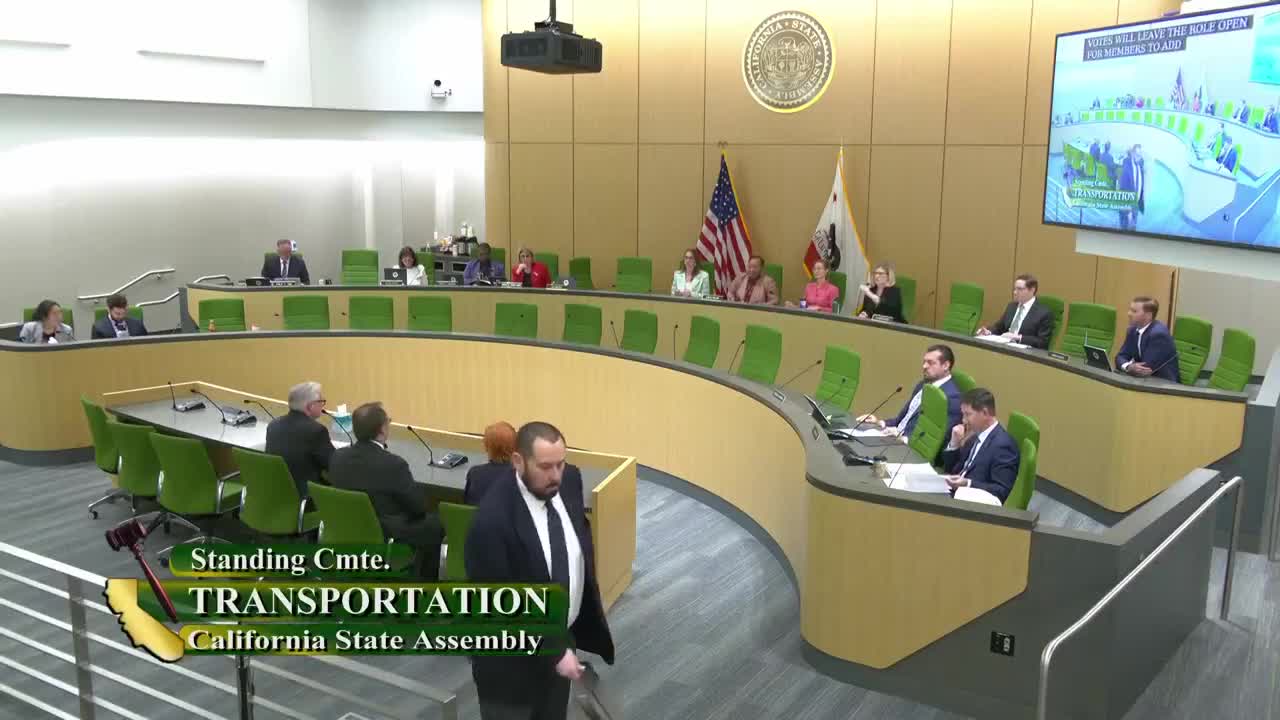
Discussed in Hearing
 16SEC
Assembly Standing Committee on Transportation
Bill Author

Bill Co-Author(s):