AB 389: Native American repatriation: California Native American Graves Protection and Repatriation Act of 2001: California State University.
- Session Year: 2023-2024
- House: Assembly
- Latest Version Date: 2023-10-10
Current Status:
Passed
(2023-10-10: Chaptered by Secretary of State - Chapter 649, Statutes of 2023.)
Introduced
In Committee
First Chamber
In Committee
Second Chamber
Enacted
What does this bill do?
This bill requires the California State University to adopt and carry out systemwide policies for handling, keeping, and repatriating California Native American human remains and cultural items, and it bars using those remains or items for teaching or research while they are held by CSU campuses or museums. It also creates systemwide and campus NAGPRA committees with majority tribal members, requires full‑time repatriation coordinators, updated inventories, annual reports to the Legislature, and funding estimates to support timely, respectful returns to tribes.
The summary is provided by generative AI which can make mistakes. For original language, please view the details in the table below.
Existing law establishes the California State University, under the administration of the Trustees of the California State University, as one of the segments of public postsecondary education in this state. The California State University comprises 23 institutions of higher education located throughout the state.
The California Native American Graves Protection and Repatriation Act of 2001 requires all agencies and museums, which is defined to include higher education institutions, that receive state funding and have possession or control over collections of California Native American human remains and associated funerary objects to inventory those remains and objects for repatriation to the appropriate California Indian tribes, as specified.
This bill would require the California State University to comply with various requirements regarding the handling, maintenance, and repatriation of Native American human remains and cultural items under the California Native American Graves Protection and Repatriation Act of 2001, including adopting and implementing systemwide policies that, among other things, prohibit the use of any Native American human remains or cultural items for purposes of teaching or research at the California State University while in the possession of a California State University campus or museum. The bill would make its provisions severable.
Existing law establishes the California State University, under the administration of the Trustees of the California State University, as one of the segments of public postsecondary education in this state. The California State University comprises 23 institutions of higher education located throughout the state.
The California Native American Graves Protection and Repatriation Act of 2001 requires all agencies and museums, which is defined to include higher education institutions, that receive state funding and have possession or control over collections of California Native American human remains and associated funerary objects to inventory those remains and objects for repatriation to the appropriate California Indian tribes, as specified.
This bill would prohibit require the California State University to comply with various requirements regarding the handling, maintenance, and repatriation of Native American human remains and cultural items under the California Native American Graves Protection and Repatriation Act of 2001, including adopting and implementing systemwide policies that, among other things, prohibit the use of any Native American human remains or cultural items for purposes of teaching or research at the California State University. The bill would require the office of the Chancellor of the California State University to comply with various requirements related to repatriation of Native American human remains and cultural items under the California Native American Graves Protection and Repatriation Act of 2001, as specified. University while in the possession of a California State University campus or museum. The bill would make its provisions severable.
Existing law establishes the California State University, under the administration of the Trustees of the California State University, as one of the segments of public postsecondary education in this state. The California State University comprises 23 institutions of higher education located throughout the state.
The California Native American Graves Protection and Repatriation Act of 2001 requires all agencies and museums, which is defined to include higher education institutions, that receive state funding and have possession or control over collections of California Native American human remains and associated funerary objects to inventory those remains and objects for repatriation to the appropriate California Indian tribes, as specified.
This bill would prohibit the use of any Native American human remains or cultural items for purposes of teaching or research at the California State University. The bill would require the office of the Chancellor of the California State University to comply with various requirements related to repatriation of Native American human remains and cultural items under the California Native American Graves Protection and Repatriation Act of 2001, as specified.
(1)Existing law establishes the Native American Heritage Commission and empowers the commission to do certain things, including to identify and catalog places of special religious or social significance to Native Americans and known graves and cemeteries of Native Americans on private lands. Existing law, the California Public Records Act, requires that public records, as defined, be available to the public for inspection and made promptly available to any person, with specified exceptions, including an exception for records of Native American graves, cemeteries, and sacred places, among other things.This bill would provide, as an exception to the California Public Records Act, genealogical records of tribal members and cultural affiliation records received during a consultation by the commission relating to the inclusion or removal of a Native American tribe, person, or entity on the tribal contact list maintained by the commission, among other records relating to the commission. (2)Existing law requires a county coroner to notify the commission by telephone within 24 hours if the coroner determines that discovered human remains are not subject to their authority and recognizes, or has reason to believe, the remains are those of a Native American, as specified. Existing law requires the commission, whenever it receives notification of a discovery of Native American human remains from a county coroner, to immediately notify those persons it believes to be most likely descended from the deceased Native American.This bill would authorize the commission to make recommendations to a county coroner on human remains notification and repatriation procedures.(3)Existing constitutional provisions require that a statute that limits the right of access to the meetings of public bodies or the writings of public officials and agencies be adopted with findings demonstrating the interest protected by the limitation and the need for protecting that interest.This bill would make legislative findings to that effect.(1)Existing law establishes the Native American Heritage Commission and empowers the commission to do certain things, including to identify and catalog places of special religious or social significance to Native Americans and known graves and cemeteries of Native Americans on private lands. Existing law, the California Public Records Act, requires that public records, as defined, be available to the public for inspection and made promptly available to any person, with specified exceptions, including an exception for records of Native American graves, cemeteries, and sacred places, among other things.
This bill would provide, as an exception to the California Public Records Act, genealogical records of tribal members and cultural affiliation records received during a consultation by the commission relating to the inclusion or removal of a Native American tribe, person, or entity on the tribal contact list maintained by the commission, among other records relating to the commission.
(2)Existing law requires a county coroner to notify the commission by telephone within 24 hours if the coroner determines that discovered human remains are not subject to their authority and recognizes, or has reason to believe, the remains are those of a Native American, as specified. Existing law requires the commission, whenever it receives notification of a discovery of Native American human remains from a county coroner, to immediately notify those persons it believes to be most likely descended from the deceased Native American.
This bill would authorize the commission to make recommendations to a county coroner on human remains notification and repatriation procedures.
(3)Existing constitutional provisions require that a statute that limits the right of access to the meetings of public bodies or the writings of public officials and agencies be adopted with findings demonstrating the interest protected by the limitation and the need for protecting that interest.
This bill would make legislative findings to that effect.
(1)Existing law establishes the Native American Heritage Commission and empowers the commission to do certain things, including to identify and catalog places of special religious or social significance to Native Americans and known graves and cemeteries of Native Americans on private lands. Existing law, the California Public Records Act, requires that public records, as defined, be available to the public for inspection and made promptly available to any person, with specified exceptions, including an exception for records of Native American graves, cemeteries, and sacred places, among other things. The Bagley-Keene Open Meeting Act requires, with specified exceptions for authorized closed sessions, that all meetings of a state body be open and public and all persons be permitted to attend any meeting of a state body.
This bill would provide, as an exception to the California Public Records Act, genealogical records of tribal members and cultural affiliation records received during a consultation by the commission relating to the inclusion or removal of a Native American tribe, person, or entity on the tribal contact list maintained by the commission, among other records relating to the commission. The bill would provide, as an exception to the Bagley-Keene Open Meeting Act, that nothing in the act shall be construed to prevent the commission from holding closed sessions when considering matters related to the inclusion or removal of a Native American tribe, person, or entity on the tribal contact list maintained by the commission, among other matters.
(2)Existing law requires a county coroner to notify the commission by telephone within 24 hours if the coroner determines that discovered human remains are not subject to their authority and recognizes, or has reason to believe, the remains are those of a Native American, as specified. Existing law requires the commission, whenever it receives notification of a discovery of Native American human remains from a county coroner, to immediately notify those persons it believes to be most likely descended from the deceased Native American.
This bill would require authorize the commission to make recommendations to a county coroner on human remains notification and repatriation procedures.
(3)Existing constitutional provisions require that a statute that limits the right of access to the meetings of public bodies or the writings of public officials and agencies be adopted with findings demonstrating the interest protected by the limitation and the need for protecting that interest.
This bill would make legislative findings to that effect.
(1)Existing law establishes the Native American Heritage Commission and empowers the commission to do certain things, including to identify and catalog places of special religious or social significance to Native Americans and known graves and cemeteries of Native Americans on private lands. Existing law, the California Public Records Act, requires that public records, as defined, be available to the public for inspection and made promptly available to any person, with specified exceptions, including an exception for records of Native American graves, cemeteries, and sacred places, among other things. The Bagley-Keene Open Meeting Act requires, with specified exceptions for authorized closed sessions, that all meetings of a state body be open and public and all persons be permitted to attend any meeting of a state body.
This bill would provide, as an exception to the California Public Records Act, genealogical records of tribal members and cultural affiliation records received during a consultation by the commission relating to the inclusion or removal of a Native American tribe, person, or entity on the tribal contact list maintained by the commission, among other records relating to the commission. The bill would provide, as an exception to the Bagley-Keene Open Meeting Act, that nothing in the act shall be construed to prevent the commission from holding closed sessions when considering matters related to the inclusion or removal of a Native American tribe, person, or entity on the tribal contact list maintained by the commission, among other matters.
(2)Existing law requires a county coroner to notify the commission by telephone within 24 hours if the coroner determines that discovered human remains are not subject to their authority and recognizes, or has reason to believe, the remains are those of a Native American, as specified. Existing law requires the commission, whenever it receives notification of a discovery of Native American human remains from a county coroner, to immediately notify those persons it believes to be most likely descended from the deceased Native American.
This bill would also require a county sheriff to notify the commission when it has determined that discovered human remains are not subject to the sheriffs authority and the sheriff recognizes, or has reason to believe, the remains are those of a Native American. By requiring a higher level of service from county sheriffs, this bill would impose a state-mandated local program.This bill would require the commission to make recommendations to a county sheriff or coroner on human remains notification and repatriation procedures.
(3)Existing constitutional provisions require that a statute that limits the right of access to the meetings of public bodies or the writings of public officials and agencies be adopted with findings demonstrating the interest protected by the limitation and the need for protecting that interest.
This bill would make legislative findings to that effect.
(4)The California Constitution requires the state to reimburse local agencies and school districts for certain costs mandated by the state. Statutory provisions establish procedures for making that reimbursement.This bill would provide that, if the Commission on State Mandates determines that the bill contains costs mandated by the state, reimbursement for those costs shall be made pursuant to the statutory provisions noted above.(1)Existing law establishes the Native American Heritage Commission and empowers the commission to do certain things, including to identify and catalog places of special religious or social significance to Native Americans and known graves and cemeteries of Native Americans on private lands. Existing law, the California Public Records Act, requires that public records, as defined, be available to the public for inspection and made promptly available to any person, with specified exceptions, including an exception for records of Native American graves, cemeteries, and sacred places, among other things. The Bagley-Keene Open Meeting Act requires, with specified exceptions for authorized closed sessions, that all meetings of a state body be open and public and all persons be permitted to attend any meeting of a state body.
This bill would provide, as an exception to the California Public Records Act, genealogical records of tribal members and cultural affiliation records received during a consultation by the commission relating to the inclusion or removal of a Native American tribe, person, or entity on the tribal contact list maintained by the commission, among other records relating to the commission. The bill would provide, as an exception to the Bagley-Keene Open Meeting Act, that nothing in the act shall be construed to prevent the commission from holding closed sessions when considering matters related to the inclusion or removal of a Native American tribe, person, or entity on the tribal contact list maintained by the commission, among other matters.
(2)Existing law requires a county coroner to notify the commission by telephone within 24 hours if the coroner determines that discovered human remains are not subject to their authority and recognizes, or has reason to believe, the remains are those of a Native American, as specified. Existing law requires the commission, whenever it receives notification of a discovery of Native American human remains from a county coroner, to immediately notify those persons it believes to be most likely descended from the deceased Native American.
This bill would also require a county sheriff to notify the commission when it has determined that discovered human remains are not subject to the sheriffs authority and the sheriff recognizes, or has reason to believe, the remains are those of a Native American. By requiring a higher level of service from county sheriffs, this bill would impose a state-mandated local program.
This bill would require the commission to make recommendations to a county sheriff or coroner on human remains notification and repatriation procedures.
(3)Existing constitutional provisions require that a statute that limits the right of access to the meetings of public bodies or the writings of public officials and agencies be adopted with findings demonstrating the interest protected by the limitation and the need for protecting that interest.
This bill would make legislative findings to that effect.
(4)The California Constitution requires the state to reimburse local agencies and school districts for certain costs mandated by the state. Statutory provisions establish procedures for making that reimbursement.
This bill would provide that, if the Commission on State Mandates determines that the bill contains costs mandated by the state, reimbursement for those costs shall be made pursuant to the statutory provisions noted above.
This bill would state the intent of the Legislature to enact subsequent legislation to provide, as an exception to the California Public Records Act, genealogical records of tribal members and cultural affiliation records received during a consultation by the commission relating to the inclusion or removal of a Native American tribe, person, or entity on the tribal contact list maintained by the commission, among other records relating to the commission. The bill would further state the intent of the Legislature to enact subsequent legislation to provide, as an exception to the Bagley-Keene Open Meeting Act, that nothing in the act shall be construed to prevent the commission from holding closed sessions when considering matters related to the inclusion or removal of a Native American tribe, person, or entity on the tribal contact list maintained by the commission, among other matters.Existing law establishes the Native American Heritage Commission and empowers the commission to do certain things, including to identify and catalog places of special religious or social significance to Native Americans and known graves and cemeteries of Native Americans on private lands. Existing law, the California Public Records Act, requires that public records, as defined, be available to the public for inspection and made promptly available to any person, with specified exceptions, including an exception for records of Native American graves, cemeteries, and sacred places, among other things. The Bagley-Keene Open Meeting Act requires, with specified exceptions for authorized closed sessions, that all meetings of a state body be open and public and all persons be permitted to attend any meeting of a state body.
This bill would state the intent of the Legislature to enact subsequent legislation to provide, as an exception to the California Public Records Act, genealogical records of tribal members and cultural affiliation records received during a consultation by the commission relating to the inclusion or removal of a Native American tribe, person, or entity on the tribal contact list maintained by the commission, among other records relating to the commission. The bill would further state the intent of the Legislature to enact subsequent legislation to provide, as an exception to the Bagley-Keene Open Meeting Act, that nothing in the act shall be construed to prevent the commission from holding closed sessions when considering matters related to the inclusion or removal of a Native American tribe, person, or entity on the tribal contact list maintained by the commission, among other matters.
(a)In order to better implement the federal Native American Graves Protection and Repatriation Act (25 U.S.C. Sec. 3001 et seq.) and this chapter, the California State University shall do all of the following:
(1)Facilitate the establishment, composition, and function of systemwide and campus-level committees, established pursuant to Section 8028.71, with respect to reviewing and advising the university on matters related to the universitys implementation of legal requirements to increase repatriation outcomes or dispositions of Native American human remains and cultural items to California Indian tribes.
(2)(A)Adopt and implement systemwide policies regarding the culturally appropriate treatment of Native American human remains and cultural items, including a policy that prohibits the use of Native American human remains or cultural items for the purposes of teaching or research at the California State University while in the possession of a California State University campus or museum. The systemwide policies shall also include policies regarding tribal research and testing requests, California State University campus and museum reporting requirements to the CSU Systemwide NAGPRA Committee established pursuant to subdivision (a) of Section 8028.71, and culturally appropriate best practices and training concerning repatriation.
(B)Adopt and implement clear and transparent policies and procedures on the systemwide requirements for submitting, processing, and implementing claims for the repatriation of human remains and cultural items, demonstrating cultural affiliation, notification to tribes of human remains and cultural items deemed culturally affiliated and unidentifiable and from whose state aboriginal territory the items were removed, but that are not subject to a repatriation claim, dispute resolution regarding repatriation claims, and any other relevant subject governed by the federal Native American Graves Protection and Repatriation Act (25 U.S.C. Sec. 3001 et seq.), Part 10 (commencing with Section 10.1) of Subtitle A of Title 43 of the Code of Federal Regulations, and this chapter.
(C)Adopt or amend systemwide California State University museum collection management policies to explicitly provide for the deaccession of collections containing Native American human remains and cultural items to effect the timely and respectful return of those items pursuant to valid claims submitted by a California Indian tribe.
(D)Adopt systemwide California State University policies and procedures for the identification and disposition of culturally unidentifiable human remains and cultural items, as required by the federal Native American Graves Protection and Repatriation Regulations (43 C.F.R. Part 10). Those policies shall include updates to existing inventories in order to determine whether cultural affiliation can be determined, or to confirm that the human remains are culturally unidentifiable as defined in paragraph (2) of subsection (e) of Section 10.2 of Part 10 of Title 43 of the Code of Federal Regulations. These policies also shall include updates to existing inventories or summaries to identify cultural items that may not have been identified in the original inventories or summaries because traditional tribal knowledge was not incorporated into the identification process.
(3)Develop all policies and procedures pursuant to paragraph (2) in consultation with California Indian tribes on the contact list maintained by the Native American Heritage Commission pursuant to Section 8013. Each California Indian tribe appearing on the contact list shall be invited to consult on any California State University proposed policies and procedures regarding repatriation. For purposes of this section, consultation has the same meaning as defined in Section 65352.4 of the Government Code.
(4)Timely submit the policies and procedures adopted pursuant to paragraph (2) to the commission, so they may review and comment upon them pursuant to subdivision (p) of Section 5097.94 of the Public Resources Code on or before July 1, 2024. The California State University shall make best efforts to adopt the commissions recommendations.
(5)Implement the systemwide policies adopted pursuant to paragraph (2) on or before July 1, 2025, and implement any campus policies within one year after the adoption of the systemwide policies.
(6)Ensure that each campus Native American Graves Protection and Repatriation Act Implementation Committee implements the policies and procedures adopted pursuant to paragraph (2).
(7)Adopt procedures to support appeals and dispute resolution when a tribe disagrees with a campus determination regarding identification, repatriation, or disposition of human remains or cultural items directly to the CSU Systemwide NAGPRA Committee established pursuant to subdivision (a) of Section 8028.71.
(8)On or before July 1, 2024, to ensure that campuses pursue timely repatriation, require campuses with Native American remains and cultural items to have full-time, experienced repatriation coordinators, as well as a systemwide coordinator for the California State University.
(9)On or before December 31, 2024, and each December 31 thereafter, submit an annual report to the Legislature, pursuant to Section 9795 of the Government Code, on the California State Universitys systemwide progress in reviewing its collections of Native American human remains and cultural items.
(b)A campus of the California State University may adopt policies to supplement the systemwide policies adopted pursuant to paragraph (2) of subdivision (a), if the campus determines that individual circumstances involving that campus are not adequately addressed in the adopted and approved systemwide policies, in consultation with California Indian tribes. A policy or procedure adopted by a campus pursuant to this subdivision shall not conflict with the approved systemwide policies adopted pursuant to paragraph (2) of subdivision (a).
8028.71.(a)(1)In order to better implement the federal Native American Graves Protection and Repatriation Act (25 U.S.C. Sec. 3001 et seq.) and this chapter, the California State University shall establish a systemwide Native American Graves Protection and Repatriation Act Implementation and Oversight Committee, which shall also be known as the CSU Systemwide NAGPRA Committee. At least a majority of the CSU Systemwide NAGPRA Committees voting members shall be from California Indian tribes.
(2)The membership of the committee shall be as follows:
(A)Three voting members of an Indian tribe as described in paragraph (1) of subdivision (c) of Section 8012, meeting the requirements of subdivision (c) of this section.
(B)One voting member of an Indian tribe as described in paragraph (2) of subdivision (c) of Section 8012, meeting the requirements of subdivision (c) of this section, or, if none is available, a member of an Indian tribe as described in paragraph (1) of subdivision (c) of Section 8012, meeting the requirements of subdivision (c) of this section.
(C)Three voting members from the California State University. At least two of these members shall be affiliated with an American Indian or Native American studies program and each of these members shall meet the requirements of subdivision (d).
(D)One nonvoting member from each campus of the California State University that is subject to the federal Native American Graves Protection and Repatriation Act (25 U.S.C. Sec. 3001 et seq.). Each of these nonvoting members shall meet the requirements of subdivision (d).
(3)The Chancellor of the California State University, or the chancellors designee, shall appoint members to the committee upon nomination by the commission.
(4)The composition of the systemwide committee may be altered to include a greater number of qualified members of a California Indian tribe, to the extent that qualified California State University candidates cannot be located pursuant to paragraph (2).
(b)(1)In order to better implement the federal Native American Graves Protection and Repatriation Act (25 U.S.C. Sec. 3001 et seq.) and this chapter, each California State University campus shall establish a campus-based Native American Graves Protection and Repatriation Act Implementation Committee, which shall also be known as the NAGPRA Committee for that campus. At least a majority of each campus NAGPRA Committees membership shall be from California Indian tribes.
(2)The membership of the campus committee shall be as follows:
(A)Three voting members of an Indian tribe as described in paragraph (1) of subdivision (c) of Section 8012, meeting the requirements of subdivision (c) of this section.
(B)One voting member of an Indian tribe as described in paragraph (2) of subdivision (c) of Section 8012, meeting the requirements of subdivision (c) of this section, or, if none is available, a member of a California Indian tribe as described in paragraph (1) of subdivision (c) of Section 8012, meeting the requirements of subdivision (c) of this section.
(C)Three voting members from the California State University. At least one of these members shall be affiliated with an American Indian or Native American studies program and each of these members shall meet the requirements of subdivision (d).
(3)The Chancellor of the California State University or the chancellors designee shall appoint members to the campus-based committees upon nomination by the commission.
(4)All claims for repatriation or claims of any violation of the policies and procedures adopted pursuant to Section 8025 shall be submitted to the campus-based Native American Graves Protection and Repatriation Act Implementation Committee for determination.
(5)The composition of the campus-based committees may be altered to include a greater number of qualified members of a California Indian tribe, to the extent that qualified California State University candidates meeting the criteria in paragraph (1) of subdivision (d) cannot be located.
(c)(1)A voting member of a California Indian tribe shall be an elder, spiritual leader, tribal leader, or tribal member, as designated by the governing body of the individuals tribe, with a minimum of five years prior experience in any of the following:
(A)Repatriation of human remains and cultural items pursuant to the federal Native American Graves Protection and Repatriation Act (25 U.S.C. Sec. 3001 et seq.).
(B)Cultural resources protection under tribal, state, and federal law.
(C)Consultation with state and federal entities and agencies.
(2)Preference shall be given to members of a California Indian tribe. If no members of a California Indian tribe meeting the qualifications of paragraph (1) are available, members of other tribes may serve.
(d)(1)A representative of the California State University shall meet both of the following criteria:
(A)(i)Have a graduate degree in archaeology, anthropology, Native American studies, ethnic studies, law, sociology, environmental studies, or history, with a focus in California.
(ii)If there are no candidates satisfying clause (i), candidates that have degrees and direct professional experience in fields relevant to repatriation or tribal cultural resources matters shall be deemed to meet the requirements of clause (i).
(B)Have a minimum of five years prior experience working in the applicable field of study.
(2)Preference shall be given to members who have demonstrated, through their professional experience, the ability to work in collaboration with Native American tribes successfully on issues related to repatriation or museum collection management.
(3)In the event that candidates from the California State University are not available or do not meet the criteria of paragraph (1), the California State University representative positions may be filled by retired emeriti of the California State University who meet the criteria of paragraph (1).
8028.72.To ensure that each California State University campus has the funding necessary to comply with this chapter, the California State University shall do all of the following:
(a)Require each campus with Native American remains or cultural items to identify and estimate, on or before January 31, 2025, the funding and other resources it needs to complete repatriations under the act in an appropriate and timely manner.
(b)Compile the estimates described in subdivision (a) into a systemwide report, disaggregated by campus, and submit this report to the Native American Heritage Commission and the Legislature, pursuant to Section 9795 of the Government Code.
(c)Upon evaluation of the reasonableness of campus estimates under subdivision (a), identify and provide funding to campuses from existing systemwide or campus-based resources, or seek additional funding from the Legislature, to ensure that campuses have sufficient funding to support their activities under the act.
SEC. 2.Section 5097.94 of the Public Resources Code is amended to read:5097.94.The commission shall have the following powers and duties:
(a)To identify and catalog places of special religious or social significance to Native Americans, and known graves and cemeteries of Native Americans on private lands. The identification and cataloguing of known graves and cemeteries shall be completed on or before January 1, 1984. The commission shall notify landowners on whose property the graves and cemeteries are determined to exist, and shall identify the Native American group most likely descended from those Native Americans who may be interred on the property.
(b)To make recommendations relative to Native American sacred places that are located on private lands, are inaccessible to Native Americans, and have cultural significance to Native Americans for acquisition by the state or other public agencies for the purpose of facilitating or assuring access thereto by Native Americans.
(c)To make recommendations to the Legislature relative to procedures that will voluntarily encourage private property owners to preserve and protect sacred places in a natural state and to allow appropriate access to Native American religionists for ceremonial or spiritual activities.
(d)To appoint necessary clerical staff.
(e)To accept grants or donations, real or in kind, to carry out the purposes of this chapter and the California Native American Graves Protection and Repatriation Act of 2001 (Chapter 5 (commencing with Section 8010) of Part 2 of Division 7 of the Health and Safety Code).
(f)To make recommendations to the Director of Parks and Recreation and the California Arts Council relative to the California State Indian Museum and other Indian matters touched upon by department programs.
(g)To bring an action to prevent severe and irreparable damage to, or assure appropriate access for Native Americans to, a Native American sanctified cemetery, place of worship, religious or ceremonial site, or sacred shrine located on public property, pursuant to Section 5097.97. If the court finds that severe and irreparable damage will occur or that appropriate access will be denied, and appropriate mitigation measures are not available, it shall issue an injunction, unless it finds, on clear and convincing evidence, that the public interest and necessity require otherwise. The Attorney General shall represent the commission and the state in litigation concerning affairs of the commission, unless the Attorney General has determined to represent the agency against whom the commissions action is directed, in which case the commission shall be authorized to employ other counsel. In an action to enforce this subdivision the commission shall introduce evidence showing that a cemetery, place, site, or shrine has been historically regarded as a sacred or sanctified place by Native American people and represents a place of unique historical and cultural significance to an Indian tribe or community.
(h)To request and utilize the advice and service of all federal, state, local, and regional agencies, including for purposes of carrying out the California Native American Graves Protection and Repatriation Act of 2001 (Chapter 5 (commencing with Section 8010) of Part 2 of Division 7 of the Health and Safety Code).
(i)To assist Native Americans in obtaining appropriate access to sacred places that are located on public lands for ceremonial or spiritual activities.
(j)To assist state agencies in any negotiations with agencies of the federal government for the protection of Native American sacred places that are located on federal lands.
(k)(1)To mediate, upon application of either of the parties, disputes arising between landowners and known descendants relating to the treatment and disposition of Native American human burials, skeletal remains, and items associated with Native American burials.
(2)The agreements shall provide protection to Native American human burials and skeletal remains from vandalism and inadvertent destruction and provide for sensitive treatment and disposition of Native American burials, skeletal remains, and associated grave goods consistent with the planned use of, or the approved project on, the land.
(l)To assist interested landowners in developing agreements with appropriate Native American groups for treating or disposing, with appropriate dignity, of the human remains and any items associated with Native American burials.
(m)To provide each California Native American tribe, as defined in Section 21073, on or before July 1, 2016, with a list of all public agencies that may be a lead agency pursuant to Division 13 (commencing with Section 21000) within the geographic area with which the tribe is traditionally and culturally affiliated, the contact information of those public agencies, and information on how the tribe may request the public agency to notify the tribe of projects within the jurisdiction of those public agencies for the purposes of requesting consultation pursuant to Section 21080.3.1.
(n)(1)To assume the powers and duties of the former Repatriation Oversight Commission and meet, when necessary and at least quarterly, to perform the following duties:
(A)Order the repatriation of human remains and cultural items in accordance with the act.
(B)Establish mediation procedures and, upon the application of the parties involved, mediate disputes among tribes and museums and agencies relating to the disposition of human remains and cultural items. The commission shall have the power of subpoena for purposes of discovery and may impose civil penalties against any agency or museum that intentionally or willfully fails to comply with the act. Members of the commission and commission staff shall receive training in mediation for purposes of this subparagraph. The commission may delegate its responsibility to mediate disputes to a certified mediator or commission staff.
(C)Establish and maintain an internet website for communication among tribes and museums and agencies.
(D)Upon the request of tribes or museums and agencies, analyze and make decisions regarding providing financial assistance to aid in specific repatriation activities.
(E)Make recommendations to the Legislature to assist tribes in obtaining the dedication of appropriate state lands for the purposes of reinterment of human remains and cultural items.
(F)(i)Prepare and submit to the Legislature an annual report detailing commission activities, disbursement of funds, and dispute resolutions relating to the repatriation activities under the act.
(ii)A report submitted to the Legislature pursuant to this subparagraph shall be submitted in compliance with Section 9795 of the Government Code.
(G)Refer any known noncompliance with the federal Native American Graves Protection and Repatriation Act (25 U.S.C. Sec. 3001 et seq.) to the United States Attorney General and the Secretary of the Interior.
(H)Impose administrative civil penalties pursuant to Section 8029 of the Health and Safety Code against an agency or museum that is determined by the commission to have violated the act.
(I)Establish those rules and regulations the commission determines to be necessary for the administration of the act.
(2)For purposes of this subdivision, the following terms have the following meanings:
(A)Act means the California Native American Graves Protection and Repatriation Act (Chapter 5 (commencing with Section 8010) of Part 2 of Division 7 of the Health and Safety Code).
(B)Tribe means a California Indian tribe as that term is used in the act.
(o)(1)To establish and assess a fee on a person or public or private entity that is reasonably related to the cost of conducting a search of catalogs, described in subdivision (a), inventories, described in Section 5097.96, or lists, described in Section 21073, for that person or entity, which funds shall be available to the commission upon appropriation by the Legislature.
(2)The Legislature finds that, pursuant to subdivision (b) of Section 3 of Article XIIIA of the California Constitution, the fees established pursuant to paragraph (1) are not taxes. To the extent that these fees are appropriated through the Budget Act for the purposes for which they are collected to provide services to the people of the State of California, the Legislature finds that these fees are not subject to Article XIIIB of the California Constitution.
(p)Review and provide comment and guidance on all policies and procedures proposed pursuant to Article 3 (commencing with Section 8025) and Article 3.5 (commencing with Section 8028.7) of Chapter 5 of Part 2 of Division 7 of the Health and Safety Code.
SEC. 3.The provisions of this act are severable. If any provision of this act or its application is held invalid, that invalidity shall not affect other provisions or applications that can be given effect without the invalid provision or application.
(a)In order to better implement the federal Native American Graves Protection and Repatriation Act (25 U.S.C. Sec. 3001 et seq.) and this chapter, the California State University shall do all of the following:
(1)Facilitate the establishment, composition, and function of systemwide and campus-level committees, established pursuant to Section 8028.71, with respect to reviewing and advising the university on matters related to the universitys implementation of legal requirements to increase repatriation outcomes or dispositions of Native American human remains and cultural items to California Indian tribes.
(2)(A)Adopt and implement systemwide policies regarding the culturally appropriate treatment of Native American human remains and cultural items, including a policy that prohibits the use of Native American human remains or cultural items for the purposes of teaching or research at the California State University while in the possession of a California State University campus or museum. The systemwide policies shall also include policies regarding tribal research and testing requests, California State University campus and museum reporting requirements to the CSU Systemwide NAGPRA Committee established pursuant to subdivision (a) of Section 8028.71, and culturally appropriate best practices and training concerning repatriation.
(B)Adopt and implement clear and transparent policies and procedures on the systemwide requirements for submitting, processing, and implementing claims for the repatriation of human remains and cultural items, demonstrating cultural affiliation, notification to tribes of human remains and cultural items deemed culturally affiliated and unidentifiable and from whose state aboriginal territory the items were removed, but that are not subject to a repatriation claim, dispute resolution regarding repatriation claims, and any other relevant subject governed by the federal Native American Graves Protection and Repatriation Act (25 U.S.C. Sec. 3001 et seq.), Part 10 (commencing with Section 10.1) of Subtitle A of Title 43 of the Code of Federal Regulations, and this chapter.
(C)Adopt or amend systemwide California State University museum collection management policies to explicitly provide for the deaccession of collections containing Native American human remains and cultural items to effect the timely and respectful return of those items pursuant to valid claims submitted by a California Indian tribe.
(D)Adopt systemwide California State University policies and procedures for the identification and disposition of culturally unidentifiable human remains and cultural items, as required by the federal Native American Graves Protection and Repatriation Regulations (43 C.F.R. Part 10). Those policies shall include updates to existing inventories in order to determine whether cultural affiliation can be determined, or to confirm that the human remains are culturally unidentifiable as defined in paragraph (2) of subsection (e) of Section 10.2 of Part 10 of Title 43 of the Code of Federal Regulations. These policies also shall include updates to existing inventories or summaries to identify cultural items that may not have been identified in the original inventories or summaries because traditional tribal knowledge was not incorporated into the identification process.
(3)Develop all policies and procedures pursuant to paragraph (2) in consultation with California Indian tribes on the contact list maintained by the Native American Heritage Commission pursuant to Section 8013. Each California Indian tribe appearing on the contact list shall be invited to consult on any California State University proposed policies and procedures regarding repatriation. For purposes of this section, consultation has the same meaning as defined in Section 65352.4 of the Government Code.
(4)Timely submit the policies and procedures adopted pursuant to paragraph (2) to the commission, so they may review and comment upon them pursuant to subdivision (p) of Section 5097.94 of the Public Resources Code on or before July 1, 2024. The California State University shall make best efforts to adopt the commissions recommendations.
(5)Implement the systemwide policies adopted pursuant to paragraph (2) on or before July 1, 2025, and implement any campus policies within one year after the adoption of the systemwide policies.
(6)Ensure that each campus Native American Graves Protection and Repatriation Act Implementation Committee implements the policies and procedures adopted pursuant to paragraph (2).
(7)Adopt procedures to support appeals and dispute resolution when a tribe disagrees with a campus determination regarding identification, repatriation, or disposition of human remains or cultural items directly to the CSU Systemwide NAGPRA Committee established pursuant to subdivision (a) of Section 8028.71.
(8)On or before July 1, 2024, to ensure that campuses pursue timely repatriation, require campuses with Native American remains and cultural items to have full-time, experienced repatriation coordinators, as well as a systemwide coordinator for the California State University.
(9)On or before December 31, 2024, and each December 31 thereafter, submit an annual report to the Legislature, pursuant to Section 9795 of the Government Code, on the California State Universitys systemwide progress in reviewing its collections of Native American human remains and cultural items.
(b)A campus of the California State University may adopt policies to supplement the systemwide policies adopted pursuant to paragraph (2) of subdivision (a), if the campus determines that individual circumstances involving that campus are not adequately addressed in the adopted and approved systemwide policies, in consultation with California Indian tribes. A policy or procedure adopted by a campus pursuant to this subdivision shall not conflict with the approved systemwide policies adopted pursuant to paragraph (2) of subdivision (a).
8028.71.(a)(1)In order to better implement the federal Native American Graves Protection and Repatriation Act (25 U.S.C. Sec. 3001 et seq.) and this chapter, the California State University shall establish a systemwide Native American Graves Protection and Repatriation Act Implementation and Oversight Committee, which shall also be known as the CSU Systemwide NAGPRA Committee. At least a majority of the CSU Systemwide NAGPRA Committees voting members shall be from California Indian tribes.
(2)The membership of the committee shall be as follows:
(A)Three voting members of an Indian tribe as described in paragraph (1) of subdivision (c) of Section 8012, meeting the requirements of subdivision (c) of this section.
(B)One voting member of an Indian tribe as described in paragraph (2) of subdivision (c) of Section 8012, meeting the requirements of subdivision (c) of this section, or, if none is available, a member of an Indian tribe as described in paragraph (1) of subdivision (c) of Section 8012, meeting the requirements of subdivision (c) of this section.
(C)Three voting members from the California State University. At least two of these members shall be affiliated with an American Indian or Native American studies program and each of these members shall meet the requirements of subdivision (d).
(D)One nonvoting member from each campus of the California State University that is subject to the federal Native American Graves Protection and Repatriation Act (25 U.S.C. Sec. 3001 et seq.). Each of these nonvoting members shall meet the requirements of subdivision (d).
(3)The Chancellor of the California State University, or the chancellors designee, shall appoint members to the committee upon nomination by the commission.
(4)The composition of the systemwide committee may be altered to include a greater number of qualified members of a California Indian tribe, to the extent that qualified California State University candidates cannot be located pursuant to paragraph (2).
(b)(1)In order to better implement the federal Native American Graves Protection and Repatriation Act (25 U.S.C. Sec. 3001 et seq.) and this chapter, each California State University campus shall establish a campus-based Native American Graves Protection and Repatriation Act Implementation Committee, which shall also be known as the NAGPRA Committee for that campus. At least a majority of each campus NAGPRA Committees membership shall be from California Indian tribes.
(2)The membership of the campus committee shall be as follows:
(A)Three voting members of an Indian tribe as described in paragraph (1) of subdivision (c) of Section 8012, meeting the requirements of subdivision (c) of this section.
(B)One voting member of an Indian tribe as described in paragraph (2) of subdivision (c) of Section 8012, meeting the requirements of subdivision (c) of this section, or, if none is available, a member of a California Indian tribe as described in paragraph (1) of subdivision (c) of Section 8012, meeting the requirements of subdivision (c) of this section.
(C)Three voting members from the California State University. At least one of these members shall be affiliated with an American Indian or Native American studies program and each of these members shall meet the requirements of subdivision (d).
(3)The Chancellor of the California State University or the chancellors designee shall appoint members to the campus-based committees upon nomination by the commission.
(4)All claims for repatriation or claims of any violation of the policies and procedures adopted pursuant to Section 8025 shall be submitted to the campus-based Native American Graves Protection and Repatriation Act Implementation Committee for determination.
(5)The composition of the campus-based committees may be altered to include a greater number of qualified members of a California Indian tribe, to the extent that qualified California State University candidates meeting the criteria in paragraph (1) of subdivision (d) cannot be located.
(c)(1)A voting member of a California Indian tribe shall be an elder, spiritual leader, tribal leader, or tribal member, as designated by the governing body of the individuals tribe, with a minimum of five years prior experience in any of the following:
(A)Repatriation of human remains and cultural items pursuant to the federal Native American Graves Protection and Repatriation Act (25 U.S.C. Sec. 3001 et seq.).
(B)Cultural resources protection under tribal, state, and federal law.
(C)Consultation with state and federal entities and agencies.
(2)Preference shall be given to members of a California Indian tribe. If no members of a California Indian tribe meeting the qualifications of paragraph (1) are available, members of other tribes may serve.
(d)(1)A representative of the California State University shall meet both of the following criteria:
(A)(i)Have a graduate degree in archaeology, anthropology, Native American studies, ethnic studies, law, sociology, environmental studies, or history, with a focus in California.
(ii)If there are no candidates satisfying clause (i), candidates that have degrees and direct professional experience in fields relevant to repatriation or tribal cultural resources matters shall be deemed to meet the requirements of clause (i).
(B)Have a minimum of five years prior experience working in the applicable field of study.
(2)Preference shall be given to members who have demonstrated, through their professional experience, the ability to work in collaboration with Native American tribes successfully on issues related to repatriation or museum collection management.
(3)In the event that candidates from the California State University are not available or do not meet the criteria of paragraph (1), the California State University representative positions may be filled by retired emeriti of the California State University who meet the criteria of paragraph (1).
8028.72.To ensure that each California State University campus has the funding necessary to comply with this chapter, the California State University shall do all of the following:
(a)Require each campus with Native American remains or cultural items to identify and estimate, on or before January 31, 2025, the funding and other resources it needs to complete repatriations under the act in an appropriate and timely manner.
(b)Compile the estimates described in subdivision (a) into a systemwide report, disaggregated by campus, and submit this report to the Native American Heritage Commission and the Legislature, pursuant to Section 9795 of the Government Code.
(c)Upon evaluation of the reasonableness of campus estimates under subdivision (a), identify and provide funding to campuses from existing systemwide or campus-based resources, or seek additional funding from the Legislature, to ensure that campuses have sufficient funding to support their activities under the act.
SEC. 2.Section 5097.94 of the Public Resources Code is amended to read:5097.94.The commission shall have the following powers and duties:
(a)To identify and catalog places of special religious or social significance to Native Americans, and known graves and cemeteries of Native Americans on private lands. The identification and cataloguing of known graves and cemeteries shall be completed on or before January 1, 1984. The commission shall notify landowners on whose property the graves and cemeteries are determined to exist, and shall identify the Native American group most likely descended from those Native Americans who may be interred on the property.
(b)To make recommendations relative to Native American sacred places that are located on private lands, are inaccessible to Native Americans, and have cultural significance to Native Americans for acquisition by the state or other public agencies for the purpose of facilitating or assuring access thereto by Native Americans.
(c)To make recommendations to the Legislature relative to procedures that will voluntarily encourage private property owners to preserve and protect sacred places in a natural state and to allow appropriate access to Native American religionists for ceremonial or spiritual activities.
(d)To appoint necessary clerical staff.
(e)To accept grants or donations, real or in kind, to carry out the purposes of this chapter and the California Native American Graves Protection and Repatriation Act of 2001 (Chapter 5 (commencing with Section 8010) of Part 2 of Division 7 of the Health and Safety Code).
(f)To make recommendations to the Director of Parks and Recreation and the California Arts Council relative to the California State Indian Museum and other Indian matters touched upon by department programs.
(g)To bring an action to prevent severe and irreparable damage to, or assure appropriate access for Native Americans to, a Native American sanctified cemetery, place of worship, religious or ceremonial site, or sacred shrine located on public property, pursuant to Section 5097.97. If the court finds that severe and irreparable damage will occur or that appropriate access will be denied, and appropriate mitigation measures are not available, it shall issue an injunction, unless it finds, on clear and convincing evidence, that the public interest and necessity require otherwise. The Attorney General shall represent the commission and the state in litigation concerning affairs of the commission, unless the Attorney General has determined to represent the agency against whom the commissions action is directed, in which case the commission shall be authorized to employ other counsel. In an action to enforce this subdivision the commission shall introduce evidence showing that a cemetery, place, site, or shrine has been historically regarded as a sacred or sanctified place by Native American people and represents a place of unique historical and cultural significance to an Indian tribe or community.
(h)To request and utilize the advice and service of all federal, state, local, and regional agencies, including for purposes of carrying out the California Native American Graves Protection and Repatriation Act of 2001 (Chapter 5 (commencing with Section 8010) of Part 2 of Division 7 of the Health and Safety Code).
(i)To assist Native Americans in obtaining appropriate access to sacred places that are located on public lands for ceremonial or spiritual activities.
(j)To assist state agencies in any negotiations with agencies of the federal government for the protection of Native American sacred places that are located on federal lands.
(k)(1)To mediate, upon application of either of the parties, disputes arising between landowners and known descendants relating to the treatment and disposition of Native American human burials, skeletal remains, and items associated with Native American burials.
(2)The agreements shall provide protection to Native American human burials and skeletal remains from vandalism and inadvertent destruction and provide for sensitive treatment and disposition of Native American burials, skeletal remains, and associated grave goods consistent with the planned use of, or the approved project on, the land.
(l)To assist interested landowners in developing agreements with appropriate Native American groups for treating or disposing, with appropriate dignity, of the human remains and any items associated with Native American burials.
(m)To provide each California Native American tribe, as defined in Section 21073, on or before July 1, 2016, with a list of all public agencies that may be a lead agency pursuant to Division 13 (commencing with Section 21000) within the geographic area with which the tribe is traditionally and culturally affiliated, the contact information of those public agencies, and information on how the tribe may request the public agency to notify the tribe of projects within the jurisdiction of those public agencies for the purposes of requesting consultation pursuant to Section 21080.3.1.
(n)(1)To assume the powers and duties of the former Repatriation Oversight Commission and meet, when necessary and at least quarterly, to perform the following duties:
(A)Order the repatriation of human remains and cultural items in accordance with the act.
(B)Establish mediation procedures and, upon the application of the parties involved, mediate disputes among tribes and museums and agencies relating to the disposition of human remains and cultural items. The commission shall have the power of subpoena for purposes of discovery and may impose civil penalties against any agency or museum that intentionally or willfully fails to comply with the act. Members of the commission and commission staff shall receive training in mediation for purposes of this subparagraph. The commission may delegate its responsibility to mediate disputes to a certified mediator or commission staff.
(C)Establish and maintain an Internet Web site internet website for communication among tribes and museums and agencies.
(D)Upon the request of tribes or museums and agencies, analyze and make decisions regarding providing financial assistance to aid in specific repatriation activities.
(E)Make recommendations to the Legislature to assist tribes in obtaining the dedication of appropriate state lands for the purposes of reinterment of human remains and cultural items.
(F)(i)Prepare and submit to the Legislature an annual report detailing commission activities, disbursement of funds, and dispute resolutions relating to the repatriation activities under the act.
(ii)A report submitted to the Legislature pursuant to this subparagraph shall be submitted in compliance with Section 9795 of the Government Code.
(G)Refer any known noncompliance with the federal Native American Graves Protection and Repatriation Act (25 U.S.C. Sec. 3001 et seq.) to the United States Attorney General and the Secretary of the Interior.
(H)Impose administrative civil penalties pursuant to Section 8029 of the Health and Safety Code against an agency or museum that is determined by the commission to have violated the act.
(I)Establish those rules and regulations the commission determines to be necessary for the administration of the act.
(2)For purposes of this subdivision, the following terms have the following meanings:
(A)Act means the California Native American Graves Protection and Repatriation Act (Chapter 5 (commencing with Section 8010) of Part 2 of Division 7 of the Health and Safety Code).
(B)Tribe means a California Indian tribe as that term is used in the act.
(o)(1)To establish and assess a fee on a person or public or private entity that is reasonably related to the cost of conducting a search of catalogs, described in subdivision (a), inventories, described in Section 5097.96, or lists, described in Section 21073, for that person or entity, which funds shall be available to the commission upon appropriation by the Legislature.
(2)The Legislature finds that, pursuant to subdivision (b) of Section 3 of Article XIIIA of the California Constitution, the fees established pursuant to paragraph (1) are not taxes. To the extent that these fees are appropriated through the Budget Act for the purposes for which they are collected to provide services to the people of the State of California, the Legislature finds that these fees are not subject to Article XIIIB of the California Constitution.
(p)Review and provide comment and guidance on all policies and procedures proposed pursuant to Article 3 (commencing with Section 8025) and Article 3.5 (commencing with Section 8028.7) of Chapter 5 of Part 2 of Division 7 of the Health and Safety Code.
SEC. 3.The provisions of this act are severable. If any provision of this act or its application is held invalid, that invalidity shall not affect other provisions or applications that can be given effect without the invalid provision or application.
SECTION 1.Chapter 4.2 (commencing with Section 89417) is added to Part 55 of Division 8 of Title 3 of the Education Code, to read:4.2.California Native American Graves Protection and Repatriation Act Compliance89417.For purposes of this chapter, the following definitions apply:(a)Act means the California Native American Graves Protection and Repatriation Act of 2001 established pursuant to Chapter 5 (commencing with Section 8010) of Part 2 of Division 7 of the Health and Safety Code.(b)Campus means a campus of the California State University.(c)Chancellors office means the office of the Chancellor of the California State University.(d)CSU means the California State University.89417.5.The CSU shall prohibit the use of any Native American human remains or cultural items for purposes of teaching or research at the CSU.89418.The chancellors office shall comply with all of the following requirements related to repatriation of Native American human remains and cultural items under the act:(a)To ensure that the CSU makes adequate progress in satisfying its requirements under the act, submit an annual report, on or before December 31, 2024, and each December 31 thereafter, to the Legislature, pursuant to Section 9795 of the Government Code, on the CSUs systemwide progress in reviewing its collections, consulting with Native American tribes, and repatriating Native American human remains and cultural items.(b)To ensure campuses identify all of the Native American remains and cultural items in their collections, do both of the following:(1)Monitor campus efforts to review their collections and require the completion of their inventories by December 31, 2025.(2)Ensure that campuses properly consult with Native American tribes by engaging in a meaningful and timely discussion in a manner respectful of tribal sovereignty regarding protocols for handling and identifying Native American remains and cultural items.(c)To provide campuses with the guidance and best practices necessary for effectively complying with the act, issue, in consultation with California Native American tribes and the Native American Heritage Commission, a systemwide policy establishing consistent repatriation processes and training requirements.(d)On or before December 31, 2024, to ensure that it adequately oversees campus-based repatriation activities under the act, establish a systemwide oversight committee.(e)On or before December 31, 2024, implement a process for campuses to periodically report their repatriation activities to the systemwide oversight committee established pursuant to subdivision (d).(f)Require campuses with more than 100 Native American remains and cultural items to establish campus-based Native American Graves Protection and Repatriation committees.(g)On or before June 30, 2025, to ensure that campuses pursue timely repatriation, require campuses with more than 100 sets of Native American remains and cultural items to have fulltime, experienced repatriation coordinators.(h)To ensure that repatriation is a systemwide priority and that campuses have access to clear and consistent leadership under the act, formalize, on or before December 31, 2024, its administrative structure. This may include, but is not limited to, the chancellors office assigning a position within the chancellors office to directly oversee the work of the systemwide project manager established under the act.(i)To ensure that campuses have the funding necessary to comply with the act, do both the following:(1)Require each campus with Native American remains or cultural items collections to identify and estimate, on or before January 31, 2025, the funding and other resources it needs to complete repatriation under the act in an appropriate and timely manner.(2)After evaluating the reasonableness of campus estimates under paragraph (1), identify and provide the required funding from existing systemwide or campus-based resources, or seek additional funding from the Legislature, to ensure that campuses have adequate funding to support their activities under the act.For purposes of this chapter, the following definitions apply:
(a)Act means the California Native American Graves Protection and Repatriation Act of 2001 established pursuant to Chapter 5 (commencing with Section 8010) of Part 2 of Division 7 of the Health and Safety Code.
(b)Campus means a campus of the California State University.
(c)Chancellors office means the office of the Chancellor of the California State University.
(d)CSU means the California State University.
89417.5.The CSU shall prohibit the use of any Native American human remains or cultural items for purposes of teaching or research at the CSU.
89418.The chancellors office shall comply with all of the following requirements related to repatriation of Native American human remains and cultural items under the act:
(a)To ensure that the CSU makes adequate progress in satisfying its requirements under the act, submit an annual report, on or before December 31, 2024, and each December 31 thereafter, to the Legislature, pursuant to Section 9795 of the Government Code, on the CSUs systemwide progress in reviewing its collections, consulting with Native American tribes, and repatriating Native American human remains and cultural items.
(b)To ensure campuses identify all of the Native American remains and cultural items in their collections, do both of the following:
(1)Monitor campus efforts to review their collections and require the completion of their inventories by December 31, 2025.
(2)Ensure that campuses properly consult with Native American tribes by engaging in a meaningful and timely discussion in a manner respectful of tribal sovereignty regarding protocols for handling and identifying Native American remains and cultural items.
(c)To provide campuses with the guidance and best practices necessary for effectively complying with the act, issue, in consultation with California Native American tribes and the Native American Heritage Commission, a systemwide policy establishing consistent repatriation processes and training requirements.
(d)On or before December 31, 2024, to ensure that it adequately oversees campus-based repatriation activities under the act, establish a systemwide oversight committee.
(e)On or before December 31, 2024, implement a process for campuses to periodically report their repatriation activities to the systemwide oversight committee established pursuant to subdivision (d).
(f)Require campuses with more than 100 Native American remains and cultural items to establish campus-based Native American Graves Protection and Repatriation committees.
(g)On or before June 30, 2025, to ensure that campuses pursue timely repatriation, require campuses with more than 100 sets of Native American remains and cultural items to have fulltime, experienced repatriation coordinators.
(h)To ensure that repatriation is a systemwide priority and that campuses have access to clear and consistent leadership under the act, formalize, on or before December 31, 2024, its administrative structure. This may include, but is not limited to, the chancellors office assigning a position within the chancellors office to directly oversee the work of the systemwide project manager established under the act.
(i)To ensure that campuses have the funding necessary to comply with the act, do both the following:
(1)Require each campus with Native American remains or cultural items collections to identify and estimate, on or before January 31, 2025, the funding and other resources it needs to complete repatriation under the act in an appropriate and timely manner.
(2)After evaluating the reasonableness of campus estimates under paragraph (1), identify and provide the required funding from existing systemwide or campus-based resources, or seek additional funding from the Legislature, to ensure that campuses have adequate funding to support their activities under the act.
All matter omitted in this version of the bill appears in the bill as amended in the Senate, June 26, 2023. (JR11)Except as provided in Sections 7924.510, 7924.700, and 7929.610, this division does not require disclosure of any of the following:
(a)Records of Native American graves, cemeteries, and sacred places.
(b)Records of Native American places, features, and objects described in Sections 5097.9 and 5097.993 of the Public Resources Code, which are maintained by, or in the possession of, the Native American Heritage Commission, another state agency, or a local agency.
(c)(1)Genealogical records of tribal members and cultural affiliation records received during a consultation by the Native American Heritage Commission relating to the either of the following:
(A)The inclusion or removal of a Native American tribe, person, or entity on the tribal contact list maintained by the Native American Heritage Commission, consideration Commission.
(B)The consideration of the persons most likely descended from Native American human remains pursuant to subdivision (a) of Section 5097.98 of the Public Resources Code, or a claim or dispute under Section 8014 or 8016 of the Health and Safety Code. However, when
(2)When considering matters related to the inclusion or removal of a Native American tribe, person, or entity on the contact list, consideration of the persons most likely descended from Native American human remains pursuant to subdivision (a) of Section 5097.98 of the Public Resources Code, or a claim or dispute under Section 8014 or 8016 of the Health and Safety Code, paragraph (1), the Native American Heritage Commission shall give written notice at least 30 days in advance of rendering a decision on those matters to any affected federally recognized Native American tribe and afford the affected federally recognized Native American tribe a meaningful opportunity for tribal consultation between the affected federally recognized Native American tribe and the Native American Heritage Commission. This written notice shall include sufficient detail of the decision being made in order to allow the affected federally recognized Native American tribe to review the matter and prepare for consultation. The Native American Heritage Commission shall provide a written explanation to the affected federally recognized Native American tribe on how tribal input was incorporated in the final decision.
SEC. 2.Section 5097.94 of the Public Resources Code is amended to read:5097.94.The commission shall have the following powers and duties:
(a)To identify and catalog places of special religious or social significance to Native Americans, and known graves and cemeteries of Native Americans on private lands. The identification and cataloguing of known graves and cemeteries shall be completed on or before January 1, 1984. The commission shall notify landowners on whose property the graves and cemeteries are determined to exist, and shall identify the Native American group most likely descended from those Native Americans who may be interred on the property.
(b)To make recommendations relative to Native American sacred places that are located on private lands, are inaccessible to Native Americans, and have cultural significance to Native Americans for acquisition by the state or other public agencies for the purpose of facilitating or ensuring access thereto by Native Americans.
(c)To make recommendations to the Legislature relative to procedures that will voluntarily encourage private property owners to preserve and protect sacred places in a natural state and to allow appropriate access to Native American religionists for ceremonial or spiritual activities.
(d)To appoint necessary clerical staff.
(e)To accept grants or donations, real or in kind, to carry out the purposes of this chapter and the California Native American Graves Protection and Repatriation Act of 2001 (Chapter 5 (commencing with Section 8010) of Part 2 of Division 7 of the Health and Safety Code).
(f)To make recommendations to the Director of Parks and Recreation and the California Arts Council relative to the California State Indian Museum and other Indian matters touched upon by department programs.
(g)To bring an action to prevent severe and irreparable damage to, or ensure appropriate access for Native Americans to, a Native American sanctified cemetery, place of worship, religious or ceremonial site, or sacred shrine located on public property, pursuant to Section 5097.97. If the court finds that severe and irreparable damage will occur or that appropriate access will be denied, and appropriate mitigation measures are not available, it shall issue an injunction, unless it finds, on clear and convincing evidence, that the public interest and necessity require otherwise. The Attorney General shall represent the commission and the state in litigation concerning affairs of the commission, unless the Attorney General has determined to represent the agency against whom the commissions action is directed, in which case the commission shall be authorized to employ other counsel. In an action to enforce this subdivision the commission shall introduce evidence showing that a cemetery, place, site, or shrine has been historically regarded as a sacred or sanctified place by Native American people and represents a place of unique historical and cultural significance to an Indian tribe or community.
(h)To request and utilize the advice and service of all federal, state, local, and regional agencies, including for purposes of carrying out the California Native American Graves Protection and Repatriation Act of 2001 (Chapter 5 (commencing with Section 8010) of Part 2 of Division 7 of the Health and Safety Code).
(i)To assist Native Americans in obtaining appropriate access to sacred places that are located on public lands for ceremonial or spiritual activities.
(j)To assist state agencies in any negotiations with agencies of the federal government for the protection of Native American sacred places that are located on federal lands.
(k)(1)To mediate, upon application of either of the parties, disputes arising between landowners and known descendants relating to the treatment and disposition of Native American human burials, skeletal remains, and items associated with Native American burials.
(2)The agreements shall provide protection to Native American human burials and skeletal remains from vandalism and inadvertent destruction and provide for sensitive treatment and disposition of Native American burials, skeletal remains, and associated grave goods consistent with the planned use of, or the approved project on, the land.
(l)To assist interested landowners in developing agreements with appropriate Native American groups for treating or disposing, with appropriate dignity, of the human remains and any items associated with Native American burials.
(m)To provide each California Native American tribe, as defined in Section 21073, on or before July 1, 2016, with a list of all public agencies that may be a lead agency pursuant to Division 13 (commencing with Section 21000) within the geographic area with which the tribe is traditionally and culturally affiliated, the contact information of those public agencies, and information on how the tribe may request the public agency to notify the tribe of projects within the jurisdiction of those public agencies for the purposes of requesting consultation pursuant to Section 21080.3.1.
(n)(1)To assume the powers and duties of the former Repatriation Oversight Commission and meet, when necessary and at least quarterly, to perform the following duties:
(A)Order the repatriation of human remains and cultural items in accordance with the act.
(B)Establish mediation procedures and, upon the application of the parties involved, mediate disputes among tribes and museums and agencies relating to the disposition of human remains and cultural items. The commission shall have the power of subpoena for purposes of discovery and may impose civil penalties against any agency or museum that intentionally or willfully fails to comply with the act. Members of the commission and commission staff shall receive training in mediation for purposes of this subparagraph. The commission may delegate its responsibility to mediate disputes to a certified mediator or commission staff.
(C)Establish and maintain an internet website for communication among tribes and museums and agencies.
(D)Upon the request of tribes or museums and agencies, analyze and make decisions regarding providing financial assistance to aid in specific repatriation activities.
(E)Make recommendations to the Legislature to assist tribes in obtaining the dedication of appropriate state lands for the purposes of reinterment of human remains and cultural items.
(F)(i)Prepare and submit to the Legislature an annual report detailing commission activities, disbursement of funds, and dispute resolutions relating to the repatriation activities under the act.
(ii)A report submitted to the Legislature pursuant to this subparagraph shall be submitted in compliance with Section 9795 of the Government Code.
(G)Refer any known noncompliance with the federal Native American Graves Protection and Repatriation Act (25 U.S.C. Sec. 3001 et seq.) to the United States Attorney General and the Secretary of the Interior.
(H)Impose administrative civil penalties pursuant to Section 8029 of the Health and Safety Code against an agency or museum that is determined by the commission to have violated the act.
(I)Establish those rules and regulations the commission determines to be necessary for the administration of the act.
(2)For purposes of this subdivision, the following terms have the following meanings:
(A)Act means the California Native American Graves Protection and Repatriation Act (Chapter 5 (commencing with Section 8010) of Part 2 of Division 7 of the Health and Safety Code).
(B)Tribe means a California Indian tribe as that term is used in the act.
(o)(1)To establish and assess a fee on a person or public or private entity that is reasonably related to the cost of conducting a search of catalogs, described in subdivision (a), inventories, described in Section 5097.96, or lists, described in Section 21073, for that person or entity, which funds shall be available to the commission upon appropriation by the Legislature.
(2)The Legislature finds that, pursuant to subdivision (b) of Section 3 of Article XIIIA of the California Constitution, the fees established pursuant to paragraph (1) are not taxes. To the extent that these fees are appropriated through the Budget Act for the purposes for which they are collected to provide services to the people of the State of California, the Legislature finds that these fees are not subject to Article XIIIB of the California Constitution.
(p)Review and provide comment and guidance on all policies and procedures proposed pursuant to Article 3 (commencing with Section 8025) 8024) of Chapter 5 of Part 2 of Division 7 of the Health and Safety Code.
(q)To make recommendations to a county coroner on human remains notification and repatriation procedures.
SEC. 3.The Legislature finds and declares that Section 1 of this act, which amends Section 7927.000 of the Government Code, imposes a limitation on the publics right of access to the meetings of public bodies or the writings of public officials and agencies within the meaning of Section 3 of Article I of the California Constitution. Pursuant to that constitutional provision, the Legislature makes the following findings to demonstrate the interest protected by this limitation and the need for protecting that interest:
Subject to the notice and tribal consultation requirements pursuant to subdivision (c) of Section 7927.000 of the Government Code, to protect the sovereignty of tribal nations, the internal workings and sensitive cultural and historical information of Native American tribes, and to protect sensitive and private information of Native American tribal membership of Native American tribes, it is necessary that this act limit the publics access to that information.
Except as provided in Sections 7924.510, 7924.700, and 7929.610, this division does not require disclosure of any of the following:
(a)Records of Native American graves, cemeteries, and sacred places.
(b)Records of Native American places, features, and objects described in Sections 5097.9 and 5097.993 of the Public Resources Code, which are maintained by, or in the possession of, the Native American Heritage Commission, another state agency, or a local agency.
(c)Genealogical records of tribal members and cultural affiliation records received during a consultation by the Native American Heritage Commission relating to the inclusion or removal of a Native American tribe, person, or entity on the tribal contact list maintained by the Native American Heritage Commission, consideration of the persons most likely descended from Native American human remains pursuant to subdivision (a) of Section 5097.98 of the Public Resources Code, or a claim or dispute under Section 8014 or 8016 of the Health and Safety Code. However, before holding closed sessions when considering matters related to the inclusion or removal of a Native American tribe, person, or entity on the contact list, consideration of the persons most likely descended from Native American human remains pursuant to subdivision (a) of Section 5097.98 of the Public Resources Code, or a claim or dispute under Section 8014 or 8016 of the Health and Safety Code, the Native American Heritage Commission shall give written notice at least 30 days in advance of rendering a decision on those matters to any affected federally recognized Native American tribe and afford the affected federally recognized Native American tribe a meaningful opportunity for tribal consultation. consultation between the affected federally recognized Native American tribe and the Native American Heritage Commission. This written notice shall include sufficient detail of the decision being made in order to allow the affected federally recognized Native American tribe to review the matter and prepare for consultation. The Native American Heritage Commission shall provide a written explanation to the affected federally recognized Native American tribe on how tribal input was incorporated in the final decision.
SEC. 2.Section 11126 of the Government Code is amended to read:11126.(a)(1)Nothing in this article shall be construed to prevent a state body from holding closed sessions during a regular or special meeting to consider the appointment, employment, evaluation of performance, or dismissal of a public employee or to hear complaints or charges brought against that employee by another person or employee unless the employee requests a public hearing.(2)As a condition to holding a closed session on the complaints or charges to consider disciplinary action or to consider dismissal, the employee shall be given written notice of their right to have a public hearing, rather than a closed session, and that notice shall be delivered to the employee personally or by mail at least 24 hours before the time for holding a regular or special meeting. If notice is not given, any disciplinary or other action taken against any employee at the closed session shall be null and void.(3)The state body also may exclude from any public or closed session, during the examination of a witness, any or all other witnesses in the matter being investigated by the state body.(4)Following the public hearing or closed session, the body may deliberate on the decision to be reached in a closed session.(b)For the purposes of this section, employee does not include any person who is elected to, or appointed to a public office by, any state body. However, officers of the California State University who receive compensation for their services, other than per diem and ordinary and necessary expenses, shall, when engaged in that capacity, be considered employees. Furthermore, for purposes of this section, the term employee includes a person exempt from civil service pursuant to subdivision (e) of Section 4 of Article VII of the California Constitution.(c)Nothing in this article shall be construed to do any of the following:(1)Prevent state bodies that administer the licensing of persons engaging in businesses or professions from holding closed sessions to prepare, approve, grade, or administer examinations.(2)Prevent an advisory body of a state body that administers the licensing of persons engaged in businesses or professions from conducting a closed session to discuss matters that the advisory body has found would constitute an unwarranted invasion of the privacy of an individual licensee or applicant if discussed in an open meeting, provided the advisory body does not include a quorum of the members of the state body it advises. Those matters may include review of an applicants qualifications for licensure and an inquiry specifically related to the state bodys enforcement program concerning an individual licensee or applicant where the inquiry occurs before the filing of a civil, criminal, or administrative disciplinary action against the licensee or applicant by the state body.(3)Prohibit a state body from holding a closed session to deliberate on a decision to be reached in a proceeding required to be conducted pursuant to Chapter 5 (commencing with Section 11500) or similar provisions of law.(4)Grant a right to enter any correctional institution or the grounds of a correctional institution where that right is not otherwise granted by law, nor shall anything in this article be construed to prevent a state body from holding a closed session when considering and acting upon the determination of a term, parole, or release of any individual or other disposition of an individual case, or if public disclosure of the subjects under discussion or consideration is expressly prohibited by statute.(5)Prevent any closed session to consider the conferring of honorary degrees, or gifts, donations, and bequests that the donor or proposed donor has requested in writing to be kept confidential.(6)Prevent the Alcoholic Beverage Control Appeals Board or the Cannabis Control Appeals Panel from holding a closed session for the purpose of holding a deliberative conference as provided in Section 11125.(7)(A)Prevent a state body from holding closed sessions with its negotiator before the purchase, sale, exchange, or lease of real property by or for the state body to give instructions to its negotiator regarding the price and terms of payment for the purchase, sale, exchange, or lease.(B)However, before the closed session, the state body shall hold an open and public session in which it identifies the real property or real properties that the negotiations may concern and the person or persons with whom its negotiator may negotiate.(C)For purposes of this paragraph, the negotiator may be a member of the state body.(D)For purposes of this paragraph, lease includes renewal or renegotiation of a lease.(E)Nothing in this paragraph shall preclude a state body from holding a closed session for discussions regarding eminent domain proceedings pursuant to subdivision (e).(8)Prevent the California Postsecondary Education Commission from holding closed sessions to consider matters pertaining to the appointment or termination of the Director of the California Postsecondary Education Commission.(9)Prevent the Council for Private Postsecondary and Vocational Education from holding closed sessions to consider matters pertaining to the appointment or termination of the Executive Director of the Council for Private Postsecondary and Vocational Education.(10)Prevent the Franchise Tax Board from holding closed sessions for the purpose of discussion of confidential tax returns or information the public disclosure of which is prohibited by law, or from considering matters pertaining to the appointment or removal of the Executive Officer of the Franchise Tax Board.(11)Require the Franchise Tax Board to notice or disclose any confidential tax information considered in closed sessions, or documents executed in connection therewith, the public disclosure of which is prohibited pursuant to Article 2 (commencing with Section 19542) of Chapter 7 of Part 10.2 of Division 2 of the Revenue and Taxation Code.(12)Prevent the Corrections Standards Authority from holding closed sessions when considering reports of crime conditions under Section 6027 of the Penal Code.(13)Prevent the State Air Resources Board from holding closed sessions when considering the proprietary specifications and performance data of manufacturers.(14)Prevent the State Board of Education or the Superintendent of Public Instruction, or any committee advising the board or the Superintendent, from holding closed sessions on those portions of its review of assessment instruments pursuant to Chapter 5 (commencing with Section 60600) of Part 33 of Division 4 of Title 2 of the Education Code during which actual test content is reviewed and discussed. The purpose of this provision is to maintain the confidentiality of the assessments under review.(15)Prevent the Department of Resources Recycling and Recovery or its auxiliary committees from holding closed sessions for the purpose of discussing confidential tax returns, discussing trade secrets or confidential or proprietary information in its possession, or discussing other data, the public disclosure of which is prohibited by law.(16)Prevent a state body that invests retirement, pension, or endowment funds from holding closed sessions when considering investment decisions. For purposes of consideration of shareholder voting on corporate stocks held by the state body, closed sessions for the purposes of voting may be held only with respect to election of corporate directors, election of independent auditors, and other financial issues that could have a material effect on the net income of the corporation. For the purpose of real property investment decisions that may be considered in a closed session pursuant to this paragraph, a state body shall also be exempt from paragraph (7) relating to the identification of real properties before the closed session.(17)Prevent a state body, or boards, commissions, administrative officers, or other representatives that may properly be designated by law or by a state body, from holding closed sessions with its representatives in discharging its responsibilities under Chapter 10 (commencing with Section 3500), Chapter 10.3 (commencing with Section 3512), Chapter 10.5 (commencing with Section 3525), or Chapter 10.7 (commencing with Section 3540) of Division 4 of Title 1 as the sessions relate to salaries, salary schedules, or compensation paid in the form of fringe benefits. For the purposes enumerated in the preceding sentence, a state body may also meet with a state conciliator who has intervened in the proceedings.(18)(A)Prevent a state body from holding closed sessions to consider matters posing a threat or potential threat of criminal or terrorist activity against the personnel, property, buildings, facilities, or equipment, including electronic data, owned, leased, or controlled by the state body, where disclosure of these considerations could compromise or impede the safety or security of the personnel, property, buildings, facilities, or equipment, including electronic data, owned, leased, or controlled by the state body.(B)Notwithstanding any other law, a state body, at any regular or special meeting, may meet in a closed session pursuant to subparagraph (A) upon a two-thirds vote of the members present at the meeting.(C)After meeting in closed session pursuant to subparagraph (A), the state body shall reconvene in open session before adjournment and report that a closed session was held pursuant to subparagraph (A), the general nature of the matters considered, and whether any action was taken in closed session.(D)After meeting in closed session pursuant to subparagraph (A), the state body shall submit to the Legislative Analyst written notification stating that it held this closed session, the general reason or reasons for the closed session, the general nature of the matters considered, and whether any action was taken in closed session. The Legislative Analyst shall retain for no less than four years any written notification received from a state body pursuant to this subparagraph.(19)Prevent the California Sex Offender Management Board from holding a closed session for the purpose of discussing matters pertaining to the application of a sex offender treatment provider for certification pursuant to Sections 290.09 and 9003 of the Penal Code. Those matters may include review of an applicants qualifications for certification.(d)(1)Notwithstanding any other law, any meeting of the Public Utilities Commission at which the rates of entities under the commissions jurisdiction are changed shall be open and public.(2)Nothing in this article shall be construed to prevent the Public Utilities Commission from holding closed sessions to deliberate on the institution of proceedings, or disciplinary actions against any person or entity under the jurisdiction of the commission.(e)(1)Nothing in this article shall be construed to prevent a state body, based on the advice of its legal counsel, from holding a closed session to confer with, or receive advice from, its legal counsel regarding pending litigation when discussion in open session concerning those matters would prejudice the position of the state body in the litigation.(2)For purposes of this article, all expressions of the lawyer-client privilege other than those provided in this subdivision are hereby abrogated. This subdivision is the exclusive expression of the lawyer-client privilege for purposes of conducting closed session meetings pursuant to this article. For purposes of this subdivision, litigation shall be considered pending when any of the following circumstances exist:(A)An adjudicatory proceeding before a court, an administrative body exercising its adjudicatory authority, a hearing officer, or an arbitrator, to which the state body is a party, has been initiated formally.(B)(i)A point has been reached where, in the opinion of the state body on the advice of its legal counsel, based on existing facts and circumstances, there is a significant exposure to litigation against the state body.(ii)Based on existing facts and circumstances, the state body is meeting only to decide whether a closed session is authorized pursuant to clause (i).(C)Based on existing facts and circumstances, the state body has decided to initiate or is deciding whether to initiate litigation.(3)The legal counsel of the state body shall prepare and submit to it a memorandum stating the specific reasons and legal authority for the closed session. If the closed session is pursuant to subparagraph (A) of paragraph (2), the memorandum shall include the title of the litigation. If the closed session is pursuant to subparagraph (B) or (C) of paragraph (2), the memorandum shall include the existing facts and circumstances on which it is based. The legal counsel shall submit the memorandum to the state body before the closed session, if feasible, and in any case no later than one week after the closed session. The memorandum shall be exempt from disclosure pursuant to Section 7927.205.(4)For purposes of this subdivision, litigation includes any adjudicatory proceeding, including eminent domain, before a court, administrative body exercising its adjudicatory authority, hearing officer, or arbitrator.(5)Disclosure of a memorandum required under this subdivision shall not be deemed as a waiver of the lawyer-client privilege, as provided for under Article 3 (commencing with Section 950) of Chapter 4 of Division 8 of the Evidence Code.(f)In addition to subdivisions (a), (b), and (c), nothing in this article shall be construed to do any of the following:(1)Prevent a state body operating under a joint powers agreement for insurance pooling from holding a closed session to discuss a claim for the payment of tort liability or public liability losses incurred by the state body or any member agency under the joint powers agreement.(2)Prevent the examining committee established by the State Board of Forestry and Fire Protection, pursuant to Section 763 of the Public Resources Code, from conducting a closed session to consider disciplinary action against an individual professional forester before the filing of an accusation against the forester pursuant to Section 11503.(3)Prevent the enforcement advisory committee established by the California Board of Accountancy pursuant to Section 5020 of the Business and Professions Code from conducting a closed session to consider disciplinary action against an individual accountant before the filing of an accusation against the accountant pursuant to Section 11503. Nothing in this article shall be construed to prevent the qualifications examining committee established by the California Board of Accountancy pursuant to Section 5023 of the Business and Professions Code from conducting a closed hearing to interview an individual applicant or accountant regarding the applicants qualifications.(4)Prevent a state body, as defined in subdivision (b) of Section 11121, from conducting a closed session to consider any matter that properly could be considered in closed session by the state body whose authority it exercises.(5)Prevent a state body, as defined in subdivision (d) of Section 11121, from conducting a closed session to consider any matter that properly could be considered in a closed session by the body defined as a state body pursuant to subdivision (a) or (b) of Section 11121.(6)Prevent a state body, as defined in subdivision (c) of Section 11121, from conducting a closed session to consider any matter that properly could be considered in a closed session by the state body it advises.(7)Prevent the State Board of Equalization from holding closed sessions for either of the following:(A)When considering matters pertaining to the appointment or removal of the Executive Secretary of the State Board of Equalization.(B)For the purpose of hearing confidential taxpayer appeals or data, the public disclosure of which is prohibited by law.(8)Require the State Board of Equalization to disclose any action taken in closed session or documents executed in connection with that action, the public disclosure of which is prohibited by law pursuant to Sections 15619 and 15641 of this code and Sections 833, 7056, 8255, 9255, 11655, 30455, 32455, 38705, 38706, 43651, 45982, 46751, 50159, 55381, and 60609 of the Revenue and Taxation Code.(9)Prevent the California Earthquake Prediction Evaluation Council, or other body appointed to advise the Director of Emergency Services or the Governor concerning matters relating to volcanic or earthquake predictions, from holding closed sessions when considering the evaluation of possible predictions.(g)This article does not prevent either of the following:(1)The Teachers Retirement Board or the Board of Administration of the Public Employees Retirement System from holding closed sessions when considering matters pertaining to the recruitment, appointment, employment, or removal of the chief executive officer or when considering matters pertaining to the recruitment or removal of the Chief Investment Officer of the State Teachers Retirement System or the Public Employees Retirement System.(2)The Commission on Teacher Credentialing from holding closed sessions when considering matters relating to the recruitment, appointment, or removal of its executive director.(h)This article does not prevent the Board of Administration of the Public Employees Retirement System from holding closed sessions when considering matters relating to the development of rates and competitive strategy for plans offered pursuant to Chapter 15 (commencing with Section 21660) of Part 3 of Division 5 of Title 2.(i)This article does not prevent the Managed Risk Medical Insurance Board from holding closed sessions when considering matters related to the development of rates and contracting strategy for entities contracting or seeking to contract with the board, entities with which the board is considering a contract, or entities with which the board is considering or enters into any other arrangement under which the board provides, receives, or arranges services or reimbursement, pursuant to Part 6.2 (commencing with Section 12693), former Part 6.3 (commencing with Section 12695), former Part 6.4 (commencing with Section 12699.50), former Part 6.5 (commencing with Section 12700), Part 6.6 (commencing with Section 12739.5), or Part 6.7 (commencing with Section 12739.70) of Division 2 of the Insurance Code.(j)Nothing in this article shall be construed to prevent the board of the State Compensation Insurance Fund from holding closed sessions in the following:(1)When considering matters related to claims pursuant to Chapter 1 (commencing with Section 3200) of Division 4 of the Labor Code, to the extent that confidential medical information or other individually identifiable information would be disclosed.(2)To the extent that matters related to audits and investigations that have not been completed would be disclosed.(3)To the extent that an internal audit containing proprietary information would be disclosed.(4)To the extent that the session would address the development of rates, contracting strategy, underwriting, or competitive strategy, pursuant to the powers granted to the board in Chapter 4 (commencing with Section 11770) of Part 3 of Division 2 of the Insurance Code, when discussion in open session concerning those matters would prejudice the position of the State Compensation Insurance Fund.(k)The State Compensation Insurance Fund shall comply with the procedures specified in Section 11125.4 of the Government Code with respect to any closed session or meeting authorized by subdivision (j), and in addition shall provide an opportunity for a member of the public to be heard on the issue of the appropriateness of closing the meeting or session.(l)Nothing in this article shall be construed to prevent the Native American Heritage Commission from holding closed sessions when considering matters related to the inclusion or removal of a Native American tribe, person, or entity on the tribal contact list maintained by the Native American Heritage Commission, consideration of the persons most likely descended from Native American human remains pursuant to subdivision (a) of Section 5097.98 of the Public Resources Code, or a claim or dispute under Section 8014 or 8016 of the Health and Safety Code. However, before holding closed sessions when considering matters related to the inclusion or removal of a Native American tribe, person, or entity on the contact list, consideration of the persons most likely descended from Native American human remains pursuant to subdivision (a) of Section 5097.98 of the Public Resources Code, or a claim or dispute under Section 8014 or 8016 of the Health and Safety Code, the Native American Heritage Commission shall give written notice to any affected federally recognized Native American tribe and afford the affected federally recognized Native American tribe a meaningful opportunity for tribal consultation. After notice and consultation with any affected federally recognized Native American tribe, action taken on agenda items considered in closed session pursuant to this subdivision shall be taken in open session so as to inform the public of the evidence, findings, and basis of the Native American Heritage Commissions decision, consistent with Sections 7927.000 and 7927.005. SEC. 3.SEC. 2.Section 5097.94 of the Public Resources Code is amended to read:5097.94.The commission shall have the following powers and duties:
(a)To identify and catalog places of special religious or social significance to Native Americans, and known graves and cemeteries of Native Americans on private lands. The identification and cataloguing of known graves and cemeteries shall be completed on or before January 1, 1984. The commission shall notify landowners on whose property the graves and cemeteries are determined to exist, and shall identify the Native American group most likely descended from those Native Americans who may be interred on the property.
(b)To make recommendations relative to Native American sacred places that are located on private lands, are inaccessible to Native Americans, and have cultural significance to Native Americans for acquisition by the state or other public agencies for the purpose of facilitating or ensuring access thereto by Native Americans.
(c)To make recommendations to the Legislature relative to procedures that will voluntarily encourage private property owners to preserve and protect sacred places in a natural state and to allow appropriate access to Native American religionists for ceremonial or spiritual activities.
(d)To appoint necessary clerical staff.
(e)To accept grants or donations, real or in kind, to carry out the purposes of this chapter and the California Native American Graves Protection and Repatriation Act of 2001 (Chapter 5 (commencing with Section 8010) of Part 2 of Division 7 of the Health and Safety Code).
(f)To make recommendations to the Director of Parks and Recreation and the California Arts Council relative to the California State Indian Museum and other Indian matters touched upon by department programs.
(g)To bring an action to prevent severe and irreparable damage to, or ensure appropriate access for Native Americans to, a Native American sanctified cemetery, place of worship, religious or ceremonial site, or sacred shrine located on public property, pursuant to Section 5097.97. If the court finds that severe and irreparable damage will occur or that appropriate access will be denied, and appropriate mitigation measures are not available, it shall issue an injunction, unless it finds, on clear and convincing evidence, that the public interest and necessity require otherwise. The Attorney General shall represent the commission and the state in litigation concerning affairs of the commission, unless the Attorney General has determined to represent the agency against whom the commissions action is directed, in which case the commission shall be authorized to employ other counsel. In an action to enforce this subdivision the commission shall introduce evidence showing that a cemetery, place, site, or shrine has been historically regarded as a sacred or sanctified place by Native American people and represents a place of unique historical and cultural significance to an Indian tribe or community.
(h)To request and utilize the advice and service of all federal, state, local, and regional agencies, including for purposes of carrying out the California Native American Graves Protection and Repatriation Act of 2001 (Chapter 5 (commencing with Section 8010) of Part 2 of Division 7 of the Health and Safety Code).
(i)To assist Native Americans in obtaining appropriate access to sacred places that are located on public lands for ceremonial or spiritual activities.
(j)To assist state agencies in any negotiations with agencies of the federal government for the protection of Native American sacred places that are located on federal lands.
(k)(1)To mediate, upon application of either of the parties, disputes arising between landowners and known descendants relating to the treatment and disposition of Native American human burials, skeletal remains, and items associated with Native American burials.
(2)The agreements shall provide protection to Native American human burials and skeletal remains from vandalism and inadvertent destruction and provide for sensitive treatment and disposition of Native American burials, skeletal remains, and associated grave goods consistent with the planned use of, or the approved project on, the land.
(l)To assist interested landowners in developing agreements with appropriate Native American groups for treating or disposing, with appropriate dignity, of the human remains and any items associated with Native American burials.
(m)To provide each California Native American tribe, as defined in Section 21073, on or before July 1, 2016, with a list of all public agencies that may be a lead agency pursuant to Division 13 (commencing with Section 21000) within the geographic area with which the tribe is traditionally and culturally affiliated, the contact information of those public agencies, and information on how the tribe may request the public agency to notify the tribe of projects within the jurisdiction of those public agencies for the purposes of requesting consultation pursuant to Section 21080.3.1.
(n)(1)To assume the powers and duties of the former Repatriation Oversight Commission and meet, when necessary and at least quarterly, to perform the following duties:
(A)Order the repatriation of human remains and cultural items in accordance with the act.
(B)Establish mediation procedures and, upon the application of the parties involved, mediate disputes among tribes and museums and agencies relating to the disposition of human remains and cultural items. The commission shall have the power of subpoena for purposes of discovery and may impose civil penalties against any agency or museum that intentionally or willfully fails to comply with the act. Members of the commission and commission staff shall receive training in mediation for purposes of this subparagraph. The commission may delegate its responsibility to mediate disputes to a certified mediator or commission staff.
(C)Establish and maintain an internet website for communication among tribes and museums and agencies.
(D)Upon the request of tribes or museums and agencies, analyze and make decisions regarding providing financial assistance to aid in specific repatriation activities.
(E)Make recommendations to the Legislature to assist tribes in obtaining the dedication of appropriate state lands for the purposes of reinterment of human remains and cultural items.
(F)(i)Prepare and submit to the Legislature an annual report detailing commission activities, disbursement of funds, and dispute resolutions relating to the repatriation activities under the act.
(ii)A report submitted to the Legislature pursuant to this subparagraph shall be submitted in compliance with Section 9795 of the Government Code.
(G)Refer any known noncompliance with the federal Native American Graves Protection and Repatriation Act (25 U.S.C. Sec. 3001 et seq.) to the United States Attorney General and the Secretary of the Interior.
(H)Impose administrative civil penalties pursuant to Section 8029 of the Health and Safety Code against an agency or museum that is determined by the commission to have violated the act.
(I)Establish those rules and regulations the commission determines to be necessary for the administration of the act.
(2)For purposes of this subdivision, the following terms have the following meanings:
(A)Act means the California Native American Graves Protection and Repatriation Act (Chapter 5 (commencing with Section 8010) of Part 2 of Division 7 of the Health and Safety Code).
(B)Tribe means a California Indian tribe as that term is used in the act.
(o)(1)To establish and assess a fee on a person or public or private entity that is reasonably related to the cost of conducting a search of catalogs, described in subdivision (a), inventories, described in Section 5097.96, or lists, described in Section 21073, for that person or entity, which funds shall be available to the commission upon appropriation by the Legislature.
(2)The Legislature finds that, pursuant to subdivision (b) of Section 3 of Article XIIIA of the California Constitution, the fees established pursuant to paragraph (1) are not taxes. To the extent that these fees are appropriated through the Budget Act for the purposes for which they are collected to provide services to the people of the State of California, the Legislature finds that these fees are not subject to Article XIIIB of the California Constitution.
(p)Review and provide comment and guidance on all policies and procedures proposed pursuant to Article 3 (commencing with Section 8025) of Chapter 5 of Part 2 of Division 7 of the Health and Safety Code.
(q)To make recommendations to a county coroner on human remains notification and repatriation procedures.
SEC. 4.SEC. 3.The Legislature finds and declares that Section 1 of this act, which amends Section 7927.000 of the Government Code, imposes a limitation on the publics right of access to the meetings of public bodies or the writings of public officials and agencies within the meaning of Section 3 of Article I of the California Constitution. Pursuant to that constitutional provision, the Legislature makes the following findings to demonstrate the interest protected by this limitation and the need for protecting that interest:
Subject to the notice and tribal consultation requirements pursuant to subdivision (c) of Section 7927.000 of the Government Code, to protect the sovereignty of tribal nations, the internal workings and sensitive cultural and historical information of Native American tribes, and to protect sensitive and private information of Native American tribal membership of Native American tribes, it is necessary that this act limit the publics access to that information.
SEC. 5.The Legislature finds and declares that Section 2 of this act, which amends Section 11126 of the Government Code, imposes a limitation on the publics right of access to the meetings of public bodies or the writings of public officials and agencies within the meaning of Section 3 of Article I of the California Constitution. Pursuant to that constitutional provision, the Legislature makes the following findings to demonstrate the interest protected by this limitation and the need for protecting that interest:Subject to the notice and consultation requirements pursuant to subdivision (l) of Section 11126 of the Government Code, to protect the sovereignty of tribal nations, the internal workings and sensitive cultural and historical information of Native American tribes, and to protect sensitive and private information of Native American tribal membership of Native American tribes, it is necessary that this act limit the public access to that information.Except as provided in Sections 7924.510, 7924.700, and 7929.610, this division does not require disclosure of any of the following:
(a)Records of Native American graves, cemeteries, and sacred places.
(b)Records of Native American places, features, and objects described in Sections 5097.9 and 5097.993 of the Public Resources Code, which are maintained by, or in the possession of, the Native American Heritage Commission, another state agency, or a local agency.
(c)Genealogical records of tribal members and cultural affiliation records received during a consultation by the Native American Heritage Commission relating to the inclusion or removal of a Native American tribe, person, or entity on the tribal contact list maintained by the Native American Heritage Commission, consideration of the persons most likely descended from Native American human remains pursuant to subdivision (a) of Section 5097.98 of the Public Resources Code, or a claim or dispute under Section 8014 or 8016 of the Health and Safety Code. However, before holding closed sessions when considering matters related to the inclusion or removal of a Native American tribe, person, or entity on the contact list, consideration of the persons most likely descended from Native American human remains pursuant to subdivision (a) of Section 5097.98 of the Public Resources Code, or a claim or dispute under Section 8014 or 8016 of the Health and Safety Code, the Native American Heritage Commission shall give written notice to any affected federally recognized Native American tribe and afford the affected federally recognized Native American tribe a meaningful opportunity for tribal consultation.
SEC. 2.Section 11126 of the Government Code is amended to read:11126.(a)(1)Nothing in this article shall be construed to prevent a state body from holding closed sessions during a regular or special meeting to consider the appointment, employment, evaluation of performance, or dismissal of a public employee or to hear complaints or charges brought against that employee by another person or employee unless the employee requests a public hearing.
(2)As a condition to holding a closed session on the complaints or charges to consider disciplinary action or to consider dismissal, the employee shall be given written notice of their right to have a public hearing, rather than a closed session, and that notice shall be delivered to the employee personally or by mail at least 24 hours before the time for holding a regular or special meeting. If notice is not given, any disciplinary or other action taken against any employee at the closed session shall be null and void.
(3)The state body also may exclude from any public or closed session, during the examination of a witness, any or all other witnesses in the matter being investigated by the state body.
(4)Following the public hearing or closed session, the body may deliberate on the decision to be reached in a closed session.
(b)For the purposes of this section, employee does not include any person who is elected to, or appointed to a public office by, any state body. However, officers of the California State University who receive compensation for their services, other than per diem and ordinary and necessary expenses, shall, when engaged in that capacity, be considered employees. Furthermore, for purposes of this section, the term employee includes a person exempt from civil service pursuant to subdivision (e) of Section 4 of Article VII of the California Constitution.
(c)Nothing in this article shall be construed to do any of the following:
(1)Prevent state bodies that administer the licensing of persons engaging in businesses or professions from holding closed sessions to prepare, approve, grade, or administer examinations.
(2)Prevent an advisory body of a state body that administers the licensing of persons engaged in businesses or professions from conducting a closed session to discuss matters that the advisory body has found would constitute an unwarranted invasion of the privacy of an individual licensee or applicant if discussed in an open meeting, provided the advisory body does not include a quorum of the members of the state body it advises. Those matters may include review of an applicants qualifications for licensure and an inquiry specifically related to the state bodys enforcement program concerning an individual licensee or applicant where the inquiry occurs before the filing of a civil, criminal, or administrative disciplinary action against the licensee or applicant by the state body.
(3)Prohibit a state body from holding a closed session to deliberate on a decision to be reached in a proceeding required to be conducted pursuant to Chapter 5 (commencing with Section 11500) or similar provisions of law.
(4)Grant a right to enter any correctional institution or the grounds of a correctional institution where that right is not otherwise granted by law, nor shall anything in this article be construed to prevent a state body from holding a closed session when considering and acting upon the determination of a term, parole, or release of any individual or other disposition of an individual case, or if public disclosure of the subjects under discussion or consideration is expressly prohibited by statute.
(5)Prevent any closed session to consider the conferring of honorary degrees, or gifts, donations, and bequests that the donor or proposed donor has requested in writing to be kept confidential.
(6)Prevent the Alcoholic Beverage Control Appeals Board or the Cannabis Control Appeals Panel from holding a closed session for the purpose of holding a deliberative conference as provided in Section 11125.
(7)(A)Prevent a state body from holding closed sessions with its negotiator before the purchase, sale, exchange, or lease of real property by or for the state body to give instructions to its negotiator regarding the price and terms of payment for the purchase, sale, exchange, or lease.
(B)However, before the closed session, the state body shall hold an open and public session in which it identifies the real property or real properties that the negotiations may concern and the person or persons with whom its negotiator may negotiate.
(C)For purposes of this paragraph, the negotiator may be a member of the state body.
(D)For purposes of this paragraph, lease includes renewal or renegotiation of a lease.
(E)Nothing in this paragraph shall preclude a state body from holding a closed session for discussions regarding eminent domain proceedings pursuant to subdivision (e).
(8)Prevent the California Postsecondary Education Commission from holding closed sessions to consider matters pertaining to the appointment or termination of the Director of the California Postsecondary Education Commission.
(9)Prevent the Council for Private Postsecondary and Vocational Education from holding closed sessions to consider matters pertaining to the appointment or termination of the Executive Director of the Council for Private Postsecondary and Vocational Education.
(10)Prevent the Franchise Tax Board from holding closed sessions for the purpose of discussion of confidential tax returns or information the public disclosure of which is prohibited by law, or from considering matters pertaining to the appointment or removal of the Executive Officer of the Franchise Tax Board.
(11)Require the Franchise Tax Board to notice or disclose any confidential tax information considered in closed sessions, or documents executed in connection therewith, the public disclosure of which is prohibited pursuant to Article 2 (commencing with Section 19542) of Chapter 7 of Part 10.2 of Division 2 of the Revenue and Taxation Code.
(12)Prevent the Corrections Standards Authority from holding closed sessions when considering reports of crime conditions under Section 6027 of the Penal Code.
(13)Prevent the State Air Resources Board from holding closed sessions when considering the proprietary specifications and performance data of manufacturers.
(14)Prevent the State Board of Education or the Superintendent of Public Instruction, or any committee advising the board or the Superintendent, from holding closed sessions on those portions of its review of assessment instruments pursuant to Chapter 5 (commencing with Section 60600) of Part 33 of Division 4 of Title 2 of the Education Code during which actual test content is reviewed and discussed. The purpose of this provision is to maintain the confidentiality of the assessments under review.
(15)Prevent the Department of Resources Recycling and Recovery or its auxiliary committees from holding closed sessions for the purpose of discussing confidential tax returns, discussing trade secrets or confidential or proprietary information in its possession, or discussing other data, the public disclosure of which is prohibited by law.
(16)Prevent a state body that invests retirement, pension, or endowment funds from holding closed sessions when considering investment decisions. For purposes of consideration of shareholder voting on corporate stocks held by the state body, closed sessions for the purposes of voting may be held only with respect to election of corporate directors, election of independent auditors, and other financial issues that could have a material effect on the net income of the corporation. For the purpose of real property investment decisions that may be considered in a closed session pursuant to this paragraph, a state body shall also be exempt from paragraph (7) relating to the identification of real properties before the closed session.
(17)Prevent a state body, or boards, commissions, administrative officers, or other representatives that may properly be designated by law or by a state body, from holding closed sessions with its representatives in discharging its responsibilities under Chapter 10 (commencing with Section 3500), Chapter 10.3 (commencing with Section 3512), Chapter 10.5 (commencing with Section 3525), or Chapter 10.7 (commencing with Section 3540) of Division 4 of Title 1 as the sessions relate to salaries, salary schedules, or compensation paid in the form of fringe benefits. For the purposes enumerated in the preceding sentence, a state body may also meet with a state conciliator who has intervened in the proceedings.
(18)(A)Prevent a state body from holding closed sessions to consider matters posing a threat or potential threat of criminal or terrorist activity against the personnel, property, buildings, facilities, or equipment, including electronic data, owned, leased, or controlled by the state body, where disclosure of these considerations could compromise or impede the safety or security of the personnel, property, buildings, facilities, or equipment, including electronic data, owned, leased, or controlled by the state body.
(B)Notwithstanding any other law, a state body, at any regular or special meeting, may meet in a closed session pursuant to subparagraph (A) upon a two-thirds vote of the members present at the meeting.
(C)After meeting in closed session pursuant to subparagraph (A), the state body shall reconvene in open session before adjournment and report that a closed session was held pursuant to subparagraph (A), the general nature of the matters considered, and whether any action was taken in closed session.
(D)After meeting in closed session pursuant to subparagraph (A), the state body shall submit to the Legislative Analyst written notification stating that it held this closed session, the general reason or reasons for the closed session, the general nature of the matters considered, and whether any action was taken in closed session. The Legislative Analyst shall retain for no less than four years any written notification received from a state body pursuant to this subparagraph.
(19)Prevent the California Sex Offender Management Board from holding a closed session for the purpose of discussing matters pertaining to the application of a sex offender treatment provider for certification pursuant to Sections 290.09 and 9003 of the Penal Code. Those matters may include review of an applicants qualifications for certification.
(d)(1)Notwithstanding any other law, any meeting of the Public Utilities Commission at which the rates of entities under the commissions jurisdiction are changed shall be open and public.
(2)Nothing in this article shall be construed to prevent the Public Utilities Commission from holding closed sessions to deliberate on the institution of proceedings, or disciplinary actions against any person or entity under the jurisdiction of the commission.
(e)(1)Nothing in this article shall be construed to prevent a state body, based on the advice of its legal counsel, from holding a closed session to confer with, or receive advice from, its legal counsel regarding pending litigation when discussion in open session concerning those matters would prejudice the position of the state body in the litigation.
(2)For purposes of this article, all expressions of the lawyer-client privilege other than those provided in this subdivision are hereby abrogated. This subdivision is the exclusive expression of the lawyer-client privilege for purposes of conducting closed session meetings pursuant to this article. For purposes of this subdivision, litigation shall be considered pending when any of the following circumstances exist:
(A)An adjudicatory proceeding before a court, an administrative body exercising its adjudicatory authority, a hearing officer, or an arbitrator, to which the state body is a party, has been initiated formally.
(B)(i)A point has been reached where, in the opinion of the state body on the advice of its legal counsel, based on existing facts and circumstances, there is a significant exposure to litigation against the state body.
(ii)Based on existing facts and circumstances, the state body is meeting only to decide whether a closed session is authorized pursuant to clause (i).
(C)Based on existing facts and circumstances, the state body has decided to initiate or is deciding whether to initiate litigation.
(3)The legal counsel of the state body shall prepare and submit to it a memorandum stating the specific reasons and legal authority for the closed session. If the closed session is pursuant to subparagraph (A) of paragraph (2), the memorandum shall include the title of the litigation. If the closed session is pursuant to subparagraph (B) or (C) of paragraph (2), the memorandum shall include the existing facts and circumstances on which it is based. The legal counsel shall submit the memorandum to the state body before the closed session, if feasible, and in any case no later than one week after the closed session. The memorandum shall be exempt from disclosure pursuant to Section 7927.205.
(4)For purposes of this subdivision, litigation includes any adjudicatory proceeding, including eminent domain, before a court, administrative body exercising its adjudicatory authority, hearing officer, or arbitrator.
(5)Disclosure of a memorandum required under this subdivision shall not be deemed as a waiver of the lawyer-client privilege, as provided for under Article 3 (commencing with Section 950) of Chapter 4 of Division 8 of the Evidence Code.
(f)In addition to subdivisions (a), (b), and (c), nothing in this article shall be construed to do any of the following:
(1)Prevent a state body operating under a joint powers agreement for insurance pooling from holding a closed session to discuss a claim for the payment of tort liability or public liability losses incurred by the state body or any member agency under the joint powers agreement.
(2)Prevent the examining committee established by the State Board of Forestry and Fire Protection, pursuant to Section 763 of the Public Resources Code, from conducting a closed session to consider disciplinary action against an individual professional forester before the filing of an accusation against the forester pursuant to Section 11503.
(3)Prevent the enforcement advisory committee established by the California Board of Accountancy pursuant to Section 5020 of the Business and Professions Code from conducting a closed session to consider disciplinary action against an individual accountant before the filing of an accusation against the accountant pursuant to Section 11503. Nothing in this article shall be construed to prevent the qualifications examining committee established by the California Board of Accountancy pursuant to Section 5023 of the Business and Professions Code from conducting a closed hearing to interview an individual applicant or accountant regarding the applicants qualifications.
(4)Prevent a state body, as defined in subdivision (b) of Section 11121, from conducting a closed session to consider any matter that properly could be considered in closed session by the state body whose authority it exercises.
(5)Prevent a state body, as defined in subdivision (d) of Section 11121, from conducting a closed session to consider any matter that properly could be considered in a closed session by the body defined as a state body pursuant to subdivision (a) or (b) of Section 11121.
(6)Prevent a state body, as defined in subdivision (c) of Section 11121, from conducting a closed session to consider any matter that properly could be considered in a closed session by the state body it advises.
(7)Prevent the State Board of Equalization from holding closed sessions for either of the following:
(A)When considering matters pertaining to the appointment or removal of the Executive Secretary of the State Board of Equalization.
(B)For the purpose of hearing confidential taxpayer appeals or data, the public disclosure of which is prohibited by law.
(8)Require the State Board of Equalization to disclose any action taken in closed session or documents executed in connection with that action, the public disclosure of which is prohibited by law pursuant to Sections 15619 and 15641 of this code and Sections 833, 7056, 8255, 9255, 11655, 30455, 32455, 38705, 38706, 43651, 45982, 46751, 50159, 55381, and 60609 of the Revenue and Taxation Code.
(9)Prevent the California Earthquake Prediction Evaluation Council, or other body appointed to advise the Director of Emergency Services or the Governor concerning matters relating to volcanic or earthquake predictions, from holding closed sessions when considering the evaluation of possible predictions.
(g)This article does not prevent either of the following:
(1)The Teachers Retirement Board or the Board of Administration of the Public Employees Retirement System from holding closed sessions when considering matters pertaining to the recruitment, appointment, employment, or removal of the chief executive officer or when considering matters pertaining to the recruitment or removal of the Chief Investment Officer of the State Teachers Retirement System or the Public Employees Retirement System.
(2)The Commission on Teacher Credentialing from holding closed sessions when considering matters relating to the recruitment, appointment, or removal of its executive director.
(h)This article does not prevent the Board of Administration of the Public Employees Retirement System from holding closed sessions when considering matters relating to the development of rates and competitive strategy for plans offered pursuant to Chapter 15 (commencing with Section 21660) of Part 3 of Division 5 of Title 2.
(i)This article does not prevent the Managed Risk Medical Insurance Board from holding closed sessions when considering matters related to the development of rates and contracting strategy for entities contracting or seeking to contract with the board, entities with which the board is considering a contract, or entities with which the board is considering or enters into any other arrangement under which the board provides, receives, or arranges services or reimbursement, pursuant to Part 6.2 (commencing with Section 12693), former Part 6.3 (commencing with Section 12695), former Part 6.4 (commencing with Section 12699.50), former Part 6.5 (commencing with Section 12700), Part 6.6 (commencing with Section 12739.5), or Part 6.7 (commencing with Section 12739.70) of Division 2 of the Insurance Code.
(j)Nothing in this article shall be construed to prevent the board of the State Compensation Insurance Fund from holding closed sessions in the following:
(1)When considering matters related to claims pursuant to Chapter 1 (commencing with Section 3200) of Division 4 of the Labor Code, to the extent that confidential medical information or other individually identifiable information would be disclosed.
(2)To the extent that matters related to audits and investigations that have not been completed would be disclosed.
(3)To the extent that an internal audit containing proprietary information would be disclosed.
(4)To the extent that the session would address the development of rates, contracting strategy, underwriting, or competitive strategy, pursuant to the powers granted to the board in Chapter 4 (commencing with Section 11770) of Part 3 of Division 2 of the Insurance Code, when discussion in open session concerning those matters would prejudice the position of the State Compensation Insurance Fund.
(k)The State Compensation Insurance Fund shall comply with the procedures specified in Section 11125.4 of the Government Code with respect to any closed session or meeting authorized by subdivision (j), and in addition shall provide an opportunity for a member of the public to be heard on the issue of the appropriateness of closing the meeting or session.
(l)Nothing in this article shall be construed to prevent the Native American Heritage Commission from holding closed sessions when considering matters related to the inclusion or removal of a Native American tribe, person, or entity on the tribal contact list maintained by the Native American Heritage Commission, consideration of the persons most likely descended from Native American human remains pursuant to subdivision (a) of Section 5097.98 of the Public Resources Code, or a claim or dispute under Section 8014 or 8016 of the Health and Safety Code. Action However, before holding closed sessions when considering matters related to the inclusion or removal of a Native American tribe, person, or entity on the contact list, consideration of the persons most likely descended from Native American human remains pursuant to subdivision (a) of Section 5097.98 of the Public Resources Code, or a claim or dispute under Section 8014 or 8016 of the Health and Safety Code, the Native American Heritage Commission shall give written notice to any affected federally recognized Native American tribe and afford the affected federally recognized Native American tribe a meaningful opportunity for tribal consultation. After notice and consultation with any affected federally recognized Native American tribe, action taken on agenda items considered in closed session pursuant to this subdivision shall be taken in open session so as to inform the public of the evidence, findings, and basis of the Native American Heritage Commissions decision, consistent with Sections 7927.000 and 7927.005.
SEC. 3.Section 7050.5 of the Health and Safety Code is amended to read:7050.5.(a) Every person who knowingly mutilates or disinters, wantonly disturbs, or willfully removes any human remains in or from any location other than a dedicated cemetery without authority of law is guilty of a misdemeanor, except as provided in Section 5097.99 of the Public Resources Code. This subdivision shall not apply to any person carrying out an agreement developed pursuant to subdivision ( l) of Section 5097.94 of the Public Resources Code or to any person authorized to implement Section 5097.98 of the Public Resources Code.(b) In the event of discovery or recognition of any human remains in any location other than a dedicated cemetery, there shall be no further excavation or disturbance of the site or any nearby area reasonably suspected to overlie adjacent remains until the sheriff or coroner of the county in which the human remains are discovered has determined, in accordance with Chapter 10 (commencing with Section 27460) of Part 3 of Division 2 of Title 3 of the Government Code, that the remains are not subject to Section 27491 of the Government Code or any other related law concerning investigation of the circumstances, manner, and cause of any death, and the recommendations concerning the treatment and disposition of the human remains have been made to the person responsible for the excavation, or to their authorized representative, in the manner provided in Section 5097.98 of the Public Resources Code. The sheriff or coroner shall make their determination within two working days from the time the person responsible for the excavation, or their authorized representative, notifies the sheriff or coroner of the discovery or recognition of the human remains.(c) If the sheriff or coroner determines that the remains are not subject to their authority and if the sheriff or coroner recognizes the human remains to be those of a Native American, or has reason to believe that they are those of a Native American, the sheriff or coroner shall contact, by telephone within 24 hours, the Native American Heritage Commission.SEC. 4.SEC. 3.Section 5097.94 of the Public Resources Code is amended to read:5097.94.The commission shall have the following powers and duties:
(a)To identify and catalog places of special religious or social significance to Native Americans, and known graves and cemeteries of Native Americans on private lands. The identification and cataloguing of known graves and cemeteries shall be completed on or before January 1, 1984. The commission shall notify landowners on whose property the graves and cemeteries are determined to exist, and shall identify the Native American group most likely descended from those Native Americans who may be interred on the property.
(b)To make recommendations relative to Native American sacred places that are located on private lands, are inaccessible to Native Americans, and have cultural significance to Native Americans for acquisition by the state or other public agencies for the purpose of facilitating or assuring ensuring access thereto by Native Americans.
(c)To make recommendations to the Legislature relative to procedures that will voluntarily encourage private property owners to preserve and protect sacred places in a natural state and to allow appropriate access to Native American religionists for ceremonial or spiritual activities.
(d)To appoint necessary clerical staff.
(e)To accept grants or donations, real or in kind, to carry out the purposes of this chapter and the California Native American Graves Protection and Repatriation Act of 2001 (Chapter 5 (commencing with Section 8010) of Part 2 of Division 7 of the Health and Safety Code).
(f)To make recommendations to the Director of Parks and Recreation and the California Arts Council relative to the California State Indian Museum and other Indian matters touched upon by department programs.
(g)To bring an action to prevent severe and irreparable damage to, or assure ensure appropriate access for Native Americans to, a Native American sanctified cemetery, place of worship, religious or ceremonial site, or sacred shrine located on public property, pursuant to Section 5097.97. If the court finds that severe and irreparable damage will occur or that appropriate access will be denied, and appropriate mitigation measures are not available, it shall issue an injunction, unless it finds, on clear and convincing evidence, that the public interest and necessity require otherwise. The Attorney General shall represent the commission and the state in litigation concerning affairs of the commission, unless the Attorney General has determined to represent the agency against whom the commissions action is directed, in which case the commission shall be authorized to employ other counsel. In an action to enforce this subdivision the commission shall introduce evidence showing that a cemetery, place, site, or shrine has been historically regarded as a sacred or sanctified place by Native American people and represents a place of unique historical and cultural significance to an Indian tribe or community.
(h)To request and utilize the advice and service of all federal, state, local, and regional agencies, including for purposes of carrying out the California Native American Graves Protection and Repatriation Act of 2001 (Chapter 5 (commencing with Section 8010) of Part 2 of Division 7 of the Health and Safety Code).
(i)To assist Native Americans in obtaining appropriate access to sacred places that are located on public lands for ceremonial or spiritual activities.
(j)To assist state agencies in any negotiations with agencies of the federal government for the protection of Native American sacred places that are located on federal lands.
(k)(1)To mediate, upon application of either of the parties, disputes arising between landowners and known descendants relating to the treatment and disposition of Native American human burials, skeletal remains, and items associated with Native American burials.
(2)The agreements shall provide protection to Native American human burials and skeletal remains from vandalism and inadvertent destruction and provide for sensitive treatment and disposition of Native American burials, skeletal remains, and associated grave goods consistent with the planned use of, or the approved project on, the land.
(l)To assist interested landowners in developing agreements with appropriate Native American groups for treating or disposing, with appropriate dignity, of the human remains and any items associated with Native American burials.
(m)To provide each California Native American tribe, as defined in Section 21073, on or before July 1, 2016, with a list of all public agencies that may be a lead agency pursuant to Division 13 (commencing with Section 21000) within the geographic area with which the tribe is traditionally and culturally affiliated, the contact information of those public agencies, and information on how the tribe may request the public agency to notify the tribe of projects within the jurisdiction of those public agencies for the purposes of requesting consultation pursuant to Section 21080.3.1.
(n)(1)To assume the powers and duties of the former Repatriation Oversight Commission and meet, when necessary and at least quarterly, to perform the following duties:
(A)Order the repatriation of human remains and cultural items in accordance with the act.
(B)Establish mediation procedures and, upon the application of the parties involved, mediate disputes among tribes and museums and agencies relating to the disposition of human remains and cultural items. The commission shall have the power of subpoena for purposes of discovery and may impose civil penalties against any agency or museum that intentionally or willfully fails to comply with the act. Members of the commission and commission staff shall receive training in mediation for purposes of this subparagraph. The commission may delegate its responsibility to mediate disputes to a certified mediator or commission staff.
(C)Establish and maintain an internet website for communication among tribes and museums and agencies.
(D)Upon the request of tribes or museums and agencies, analyze and make decisions regarding providing financial assistance to aid in specific repatriation activities.
(E)Make recommendations to the Legislature to assist tribes in obtaining the dedication of appropriate state lands for the purposes of reinterment of human remains and cultural items.
(F)(i)Prepare and submit to the Legislature an annual report detailing commission activities, disbursement of funds, and dispute resolutions relating to the repatriation activities under the act.
(ii)A report submitted to the Legislature pursuant to this subparagraph shall be submitted in compliance with Section 9795 of the Government Code.
(G)Refer any known noncompliance with the federal Native American Graves Protection and Repatriation Act (25 U.S.C. Sec. 3001 et seq.) to the United States Attorney General and the Secretary of the Interior.
(H)Impose administrative civil penalties pursuant to Section 8029 of the Health and Safety Code against an agency or museum that is determined by the commission to have violated the act.
(I)Establish those rules and regulations the commission determines to be necessary for the administration of the act.
(2)For purposes of this subdivision, the following terms have the following meanings:
(A)Act means the California Native American Graves Protection and Repatriation Act (Chapter 5 (commencing with Section 8010) of Part 2 of Division 7 of the Health and Safety Code).
(B)Tribe means a California Indian tribe as that term is used in the act.
(o)(1)To establish and assess a fee on a person or public or private entity that is reasonably related to the cost of conducting a search of catalogs, described in subdivision (a), inventories, described in Section 5097.96, or lists, described in Section 21073, for that person or entity, which funds shall be available to the commission upon appropriation by the Legislature.
(2)The Legislature finds that, pursuant to subdivision (b) of Section 3 of Article XIIIA of the California Constitution, the fees established pursuant to paragraph (1) are not taxes. To the extent that these fees are appropriated through the Budget Act for the purposes for which they are collected to provide services to the people of the State of California, the Legislature finds that these fees are not subject to Article XIIIB of the California Constitution.
(p)Review and provide comment and guidance on all policies and procedures proposed pursuant to Article 3 (commencing with Section 8025) of Chapter 5 of Part 2 of Division 7 of the Health and Safety Code.
(q)To make recommendations to a county sheriff or coroner on human remains notification and repatriation procedures.
SEC. 5.Section 5097.98 of the Public Resources Code is amended to read:5097.98.(a)Whenever the commission receives notification of a discovery of Native American human remains from a county sheriff or coroner pursuant to subdivision (c) of Section 7050.5 of the Health and Safety Code, the commission shall immediately notify those persons it believes to be most likely descended from the deceased Native American. The descendants may, with the permission of the landowner or the landowners authorized representative, inspect the site of the discovery of the Native American human remains and may recommend to the landowner or the person responsible for the excavation work means for treatment or disposition, with appropriate dignity, of the human remains and any associated grave goods. The descendants shall complete their inspection and make recommendations or preferences for treatment within 48 hours of being granted access to the site.(b)Upon the discovery of Native American remains, the landowner shall ensure that the immediate vicinity, according to generally accepted cultural or archaeological standards or practices, where the Native American human remains are located, is not damaged or disturbed by further development activity until the landowner has discussed and conferred, as prescribed in this section, with the most likely descendants regarding their recommendations, if applicable, taking into account the possibility of multiple human remains. The landowner shall discuss and confer with the descendants all reasonable options regarding the descendants preferences for treatment.(1)The descendants preferences for treatment may include the following:(A)The nondestructive removal and analysis of human remains and items associated with Native American human remains.(B)Preservation of Native American human remains and associated items in place.(C)Relinquishment of Native American human remains and associated items to the descendants for treatment.(D)Other culturally appropriate treatment.(2)The parties may also mutually agree to extend discussions, taking into account the possibility that additional or multiple Native American human remains, as defined in this section, are located in the project area, providing a basis for additional treatment measures.(c)For purposes of this section, conferral or discuss and confer means the meaningful and timely discussion and careful consideration of the views of each party, in a manner that is cognizant of all parties cultural values, and where feasible, seeking agreement. Each party shall recognize the others needs and concerns for confidentiality of information provided to the other.(d)(1)Human remains of a Native American may be an inhumation or cremation, and in any state of decomposition or skeletal completeness.(2)Any items associated with the human remains that are placed or buried with the Native American human remains are to be treated in the same manner as the remains, but do not by themselves constitute human remains.(e)Whenever the commission is unable to identify a descendant, or the descendants identified fail to make a recommendation, or the landowner or the landowners authorized representative rejects the recommendation of the descendants and the mediation provided for in subdivision (k) of Section 5097.94, if invoked, fails to provide measures acceptable to the landowner, the landowner or the landowners authorized representative shall reinter the human remains and items associated with Native American human remains with appropriate dignity on the property in a location not subject to further and future subsurface disturbance. To protect these sites, the landowner shall do one or more of the following:(1)Record the site with the commission or the appropriate Information Center.(2)Use an open-space or conservation zoning designation or easement.(3)Record a document with the county in which the property is located. The document shall be titled Notice of Reinterment of Native American Remains and shall include a legal description of the property, the name of the owner of the property, and the owners acknowledged signature, in addition to any other information required by this section. The document shall be indexed as a notice under the name of the owner.(f)Upon the discovery of multiple Native American human remains during a ground disturbing land development activity, the landowner may agree that additional conferral with the descendants is necessary to consider culturally appropriate treatment of multiple Native American human remains. Culturally appropriate treatment of the discovery may be ascertained from a review of the site using cultural and archaeological standards. Where the parties are unable to agree on the appropriate treatment measures the human remains and items associated and buried with Native American human remains shall be reinterred with appropriate dignity, pursuant to subdivision (e).(g)Notwithstanding Section 5097.9, this section, including those actions taken by the landowner or the landowners authorized representative to implement this section and any action taken to implement an agreement developed pursuant to subdivision (l) of Section 5097.94, shall be exempt from the requirements of the California Environmental Quality Act (Division 13 (commencing with Section 21000)).(h)Notwithstanding Section 30244, this section, including those actions taken by the landowner or the landowners authorized representative to implement this section and any action taken to implement an agreement developed pursuant to subdivision (l) of Section 5097.94, shall be exempt from the requirements of the California Coastal Act of 1976 (Division 20 (commencing with Section 30000)).SEC. 6.SEC. 4.The Legislature finds and declares that Section 1 of this act, which amends Section 7927.000 of the Government Code, imposes a limitation on the publics right of access to the meetings of public bodies or the writings of public officials and agencies within the meaning of Section 3 of Article I of the California Constitution. Pursuant to that constitutional provision, the Legislature makes the following findings to demonstrate the interest protected by this limitation and the need for protecting that interest:
ToSubject to the notice and tribal consultation requirements pursuant to subdivision (c) of Section 7927.000 of the Government Code, to protect the sovereignty of tribal nations, the internal workings and sensitive cultural and historical information of Native American tribes, and to protect sensitive and private information of Native American tribal membership of Native American tribes, it is necessary that this act limit the publics access to that information.
SEC. 7.SEC. 5.The Legislature finds and declares that Section 2 of this act, which amends Section 11126 of the Government Code, imposes a limitation on the publics right of access to the meetings of public bodies or the writings of public officials and agencies within the meaning of Section 3 of Article I of the California Constitution. Pursuant to that constitutional provision, the Legislature makes the following findings to demonstrate the interest protected by this limitation and the need for protecting that interest:
ToSubject to the notice and consultation requirements pursuant to subdivision (l) of Section 11126 of the Government Code, to protect the sovereignty of tribal nations, the internal workings and sensitive cultural and historical information of Native American tribes, and to protect sensitive and private information of Native American tribal membership of Native American tribes, it is necessary that this act limit the public access to that information.
SEC. 8.If the Commission on State Mandates determines that this act contains costs mandated by the state, reimbursement to local agencies and school districts for those costs shall be made pursuant to Part 7 (commencing with Section 17500) of Division 4 of Title 2 of the Government Code.Except as provided in Sections 7924.510, 7924.700, and 7929.610, this division does not require disclosure of any of the following:
(a)Records of Native American graves, cemeteries, and sacred places.
(b)Records of Native American places, features, and objects described in Sections 5097.9 and 5097.993 of the Public Resources Code, which are maintained by, or in the possession of, the Native American Heritage Commission, another state agency, or a local agency.
(c)Genealogical records of tribal members and cultural affiliation records received during a consultation by the Native American Heritage Commission relating to the inclusion or removal of a Native American tribe, person, or entity on the tribal contact list maintained by the Native American Heritage Commission, consideration of the persons most likely descended from Native American human remains pursuant to subdivision (a) of Section 5097.98 of the Public Resources Code, or a claim or dispute under Section 8014 or 8016 of the Health and Safety Code.
SEC. 2.Section 11126 of the Government Code is amended to read:11126.(a)(1)Nothing in this article shall be construed to prevent a state body from holding closed sessions during a regular or special meeting to consider the appointment, employment, evaluation of performance, or dismissal of a public employee or to hear complaints or charges brought against that employee by another person or employee unless the employee requests a public hearing.
(2)As a condition to holding a closed session on the complaints or charges to consider disciplinary action or to consider dismissal, the employee shall be given written notice of their right to have a public hearing, rather than a closed session, and that notice shall be delivered to the employee personally or by mail at least 24 hours before the time for holding a regular or special meeting. If notice is not given, any disciplinary or other action taken against any employee at the closed session shall be null and void.
(3)The state body also may exclude from any public or closed session, during the examination of a witness, any or all other witnesses in the matter being investigated by the state body.
(4)Following the public hearing or closed session, the body may deliberate on the decision to be reached in a closed session.
(b)For the purposes of this section, employee does not include any person who is elected to, or appointed to a public office by, any state body. However, officers of the California State University who receive compensation for their services, other than per diem and ordinary and necessary expenses, shall, when engaged in that capacity, be considered employees. Furthermore, for purposes of this section, the term employee includes a person exempt from civil service pursuant to subdivision (e) of Section 4 of Article VII of the California Constitution.
(c)Nothing in this article shall be construed to do any of the following:
(1)Prevent state bodies that administer the licensing of persons engaging in businesses or professions from holding closed sessions to prepare, approve, grade, or administer examinations.
(2)Prevent an advisory body of a state body that administers the licensing of persons engaged in businesses or professions from conducting a closed session to discuss matters that the advisory body has found would constitute an unwarranted invasion of the privacy of an individual licensee or applicant if discussed in an open meeting, provided the advisory body does not include a quorum of the members of the state body it advises. Those matters may include review of an applicants qualifications for licensure and an inquiry specifically related to the state bodys enforcement program concerning an individual licensee or applicant where the inquiry occurs prior to before the filing of a civil, criminal, or administrative disciplinary action against the licensee or applicant by the state body.
(3)Prohibit a state body from holding a closed session to deliberate on a decision to be reached in a proceeding required to be conducted pursuant to Chapter 5 (commencing with Section 11500) or similar provisions of law.
(4)Grant a right to enter any correctional institution or the grounds of a correctional institution where that right is not otherwise granted by law, nor shall anything in this article be construed to prevent a state body from holding a closed session when considering and acting upon the determination of a term, parole, or release of any individual or other disposition of an individual case, or if public disclosure of the subjects under discussion or consideration is expressly prohibited by statute.
(5)Prevent any closed session to consider the conferring of honorary degrees, or gifts, donations, and bequests that the donor or proposed donor has requested in writing to be kept confidential.
(6)Prevent the Alcoholic Beverage Control Appeals Board or the Cannabis Control Appeals Panel from holding a closed session for the purpose of holding a deliberative conference as provided in Section 11125.
(7)(A)Prevent a state body from holding closed sessions with its negotiator prior to before the purchase, sale, exchange, or lease of real property by or for the state body to give instructions to its negotiator regarding the price and terms of payment for the purchase, sale, exchange, or lease.
(B)However, prior to before the closed session, the state body shall hold an open and public session in which it identifies the real property or real properties that the negotiations may concern and the person or persons with whom its negotiator may negotiate.
(C)For purposes of this paragraph, the negotiator may be a member of the state body.
(D)For purposes of this paragraph, lease includes renewal or renegotiation of a lease.
(E)Nothing in this paragraph shall preclude a state body from holding a closed session for discussions regarding eminent domain proceedings pursuant to subdivision (e).
(8)Prevent the California Postsecondary Education Commission from holding closed sessions to consider matters pertaining to the appointment or termination of the Director of the California Postsecondary Education Commission.
(9)Prevent the Council for Private Postsecondary and Vocational Education from holding closed sessions to consider matters pertaining to the appointment or termination of the Executive Director of the Council for Private Postsecondary and Vocational Education.
(10)Prevent the Franchise Tax Board from holding closed sessions for the purpose of discussion of confidential tax returns or information the public disclosure of which is prohibited by law, or from considering matters pertaining to the appointment or removal of the Executive Officer of the Franchise Tax Board.
(11)Require the Franchise Tax Board to notice or disclose any confidential tax information considered in closed sessions, or documents executed in connection therewith, the public disclosure of which is prohibited pursuant to Article 2 (commencing with Section 19542) of Chapter 7 of Part 10.2 of Division 2 of the Revenue and Taxation Code.
(12)Prevent the Corrections Standards Authority from holding closed sessions when considering reports of crime conditions under Section 6027 of the Penal Code.
(13)Prevent the State Air Resources Board from holding closed sessions when considering the proprietary specifications and performance data of manufacturers.
(14)Prevent the State Board of Education or the Superintendent of Public Instruction, or any committee advising the board or the Superintendent, from holding closed sessions on those portions of its review of assessment instruments pursuant to Chapter 5 (commencing with Section 60600) of Part 33 of Division 4 of Title 2 of the Education Code during which actual test content is reviewed and discussed. The purpose of this provision is to maintain the confidentiality of the assessments under review.
(15)Prevent the Department of Resources Recycling and Recovery or its auxiliary committees from holding closed sessions for the purpose of discussing confidential tax returns, discussing trade secrets or confidential or proprietary information in its possession, or discussing other data, the public disclosure of which is prohibited by law.
(16)Prevent a state body that invests retirement, pension, or endowment funds from holding closed sessions when considering investment decisions. For purposes of consideration of shareholder voting on corporate stocks held by the state body, closed sessions for the purposes of voting may be held only with respect to election of corporate directors, election of independent auditors, and other financial issues that could have a material effect on the net income of the corporation. For the purpose of real property investment decisions that may be considered in a closed session pursuant to this paragraph, a state body shall also be exempt from the provisions of paragraph (7) relating to the identification of real properties prior to before the closed session.
(17)Prevent a state body, or boards, commissions, administrative officers, or other representatives that may properly be designated by law or by a state body, from holding closed sessions with its representatives in discharging its responsibilities under Chapter 10 (commencing with Section 3500), Chapter 10.3 (commencing with Section 3512), Chapter 10.5 (commencing with Section 3525), or Chapter 10.7 (commencing with Section 3540) of Division 4 of Title 1 as the sessions relate to salaries, salary schedules, or compensation paid in the form of fringe benefits. For the purposes enumerated in the preceding sentence, a state body may also meet with a state conciliator who has intervened in the proceedings.
(18)(A)Prevent a state body from holding closed sessions to consider matters posing a threat or potential threat of criminal or terrorist activity against the personnel, property, buildings, facilities, or equipment, including electronic data, owned, leased, or controlled by the state body, where disclosure of these considerations could compromise or impede the safety or security of the personnel, property, buildings, facilities, or equipment, including electronic data, owned, leased, or controlled by the state body.
(B)Notwithstanding any other law, a state body, at any regular or special meeting, may meet in a closed session pursuant to subparagraph (A) upon a two-thirds vote of the members present at the meeting.
(C)After meeting in closed session pursuant to subparagraph (A), the state body shall reconvene in open session prior to before adjournment and report that a closed session was held pursuant to subparagraph (A), the general nature of the matters considered, and whether any action was taken in closed session.
(D)After meeting in closed session pursuant to subparagraph (A), the state body shall submit to the Legislative Analyst written notification stating that it held this closed session, the general reason or reasons for the closed session, the general nature of the matters considered, and whether any action was taken in closed session. The Legislative Analyst shall retain for no less than four years any written notification received from a state body pursuant to this subparagraph.
(19)Prevent the California Sex Offender Management Board from holding a closed session for the purpose of discussing matters pertaining to the application of a sex offender treatment provider for certification pursuant to Sections 290.09 and 9003 of the Penal Code. Those matters may include review of an applicants qualifications for certification.
(d)(1)Notwithstanding any other law, any meeting of the Public Utilities Commission at which the rates of entities under the commissions jurisdiction are changed shall be open and public.
(2)Nothing in this article shall be construed to prevent the Public Utilities Commission from holding closed sessions to deliberate on the institution of proceedings, or disciplinary actions against any person or entity under the jurisdiction of the commission.
(e)(1)Nothing in this article shall be construed to prevent a state body, based on the advice of its legal counsel, from holding a closed session to confer with, or receive advice from, its legal counsel regarding pending litigation when discussion in open session concerning those matters would prejudice the position of the state body in the litigation.
(2)For purposes of this article, all expressions of the lawyer-client privilege other than those provided in this subdivision are hereby abrogated. This subdivision is the exclusive expression of the lawyer-client privilege for purposes of conducting closed session meetings pursuant to this article. For purposes of this subdivision, litigation shall be considered pending when any of the following circumstances exist:
(A)An adjudicatory proceeding before a court, an administrative body exercising its adjudicatory authority, a hearing officer, or an arbitrator, to which the state body is a party, has been initiated formally.
(B)(i)A point has been reached where, in the opinion of the state body on the advice of its legal counsel, based on existing facts and circumstances, there is a significant exposure to litigation against the state body.
(ii)Based on existing facts and circumstances, the state body is meeting only to decide whether a closed session is authorized pursuant to clause (i).
(C)Based on existing facts and circumstances, the state body has decided to initiate or is deciding whether to initiate litigation.
(3)The legal counsel of the state body shall prepare and submit to it a memorandum stating the specific reasons and legal authority for the closed session. If the closed session is pursuant to subparagraph (A) of paragraph (2), the memorandum shall include the title of the litigation. If the closed session is pursuant to subparagraph (B) or (C) of paragraph (2), the memorandum shall include the existing facts and circumstances on which it is based. The legal counsel shall submit the memorandum to the state body prior to before the closed session, if feasible, and in any case no later than one week after the closed session. The memorandum shall be exempt from disclosure pursuant to Section 7927.205.
(4)For purposes of this subdivision, litigation includes any adjudicatory proceeding, including eminent domain, before a court, administrative body exercising its adjudicatory authority, hearing officer, or arbitrator.
(5)Disclosure of a memorandum required under this subdivision shall not be deemed as a waiver of the lawyer-client privilege, as provided for under Article 3 (commencing with Section 950) of Chapter 4 of Division 8 of the Evidence Code.
(f)In addition to subdivisions (a), (b), and (c), nothing in this article shall be construed to do any of the following:
(1)Prevent a state body operating under a joint powers agreement for insurance pooling from holding a closed session to discuss a claim for the payment of tort liability or public liability losses incurred by the state body or any member agency under the joint powers agreement.
(2)Prevent the examining committee established by the State Board of Forestry and Fire Protection, pursuant to Section 763 of the Public Resources Code, from conducting a closed session to consider disciplinary action against an individual professional forester prior to before the filing of an accusation against the forester pursuant to Section 11503.
(3)Prevent the enforcement advisory committee established by the California Board of Accountancy pursuant to Section 5020 of the Business and Professions Code from conducting a closed session to consider disciplinary action against an individual accountant prior to before the filing of an accusation against the accountant pursuant to Section 11503. Nothing in this article shall be construed to prevent the qualifications examining committee established by the California Board of Accountancy pursuant to Section 5023 of the Business and Professions Code from conducting a closed hearing to interview an individual applicant or accountant regarding the applicants qualifications.
(4)Prevent a state body, as defined in subdivision (b) of Section 11121, from conducting a closed session to consider any matter that properly could be considered in closed session by the state body whose authority it exercises.
(5)Prevent a state body, as defined in subdivision (d) of Section 11121, from conducting a closed session to consider any matter that properly could be considered in a closed session by the body defined as a state body pursuant to subdivision (a) or (b) of Section 11121.
(6)Prevent a state body, as defined in subdivision (c) of Section 11121, from conducting a closed session to consider any matter that properly could be considered in a closed session by the state body it advises.
(7)Prevent the State Board of Equalization from holding closed sessions for either of the following:
(A)When considering matters pertaining to the appointment or removal of the Executive Secretary of the State Board of Equalization.
(B)For the purpose of hearing confidential taxpayer appeals or data, the public disclosure of which is prohibited by law.
(8)Require the State Board of Equalization to disclose any action taken in closed session or documents executed in connection with that action, the public disclosure of which is prohibited by law pursuant to Sections 15619 and 15641 of this code and Sections 833, 7056, 8255, 9255, 11655, 30455, 32455, 38705, 38706, 43651, 45982, 46751, 50159, 55381, and 60609 of the Revenue and Taxation Code.
(9)Prevent the California Earthquake Prediction Evaluation Council, or other body appointed to advise the Director of Emergency Services or the Governor concerning matters relating to volcanic or earthquake predictions, from holding closed sessions when considering the evaluation of possible predictions.
(g)This article does not prevent either of the following:
(1)The Teachers Retirement Board or the Board of Administration of the Public Employees Retirement System from holding closed sessions when considering matters pertaining to the recruitment, appointment, employment, or removal of the chief executive officer or when considering matters pertaining to the recruitment or removal of the Chief Investment Officer of the State Teachers Retirement System or the Public Employees Retirement System.
(2)The Commission on Teacher Credentialing from holding closed sessions when considering matters relating to the recruitment, appointment, or removal of its executive director.
(h)This article does not prevent the Board of Administration of the Public Employees Retirement System from holding closed sessions when considering matters relating to the development of rates and competitive strategy for plans offered pursuant to Chapter 15 (commencing with Section 21660) of Part 3 of Division 5 of Title 2.
(i)This article does not prevent the Managed Risk Medical Insurance Board from holding closed sessions when considering matters related to the development of rates and contracting strategy for entities contracting or seeking to contract with the board, entities with which the board is considering a contract, or entities with which the board is considering or enters into any other arrangement under which the board provides, receives, or arranges services or reimbursement, pursuant to Part 6.2 (commencing with Section 12693), former Part 6.3 (commencing with Section 12695), former Part 6.4 (commencing with Section 12699.50), former Part 6.5 (commencing with Section 12700), Part 6.6 (commencing with Section 12739.5), or Part 6.7 (commencing with Section 12739.70) of Division 2 of the Insurance Code.
(j)Nothing in this article shall be construed to prevent the board of the State Compensation Insurance Fund from holding closed sessions in the following:
(1)When considering matters related to claims pursuant to Chapter 1 (commencing with Section 3200) of Division 4 of the Labor Code, to the extent that confidential medical information or other individually identifiable information would be disclosed.
(2)To the extent that matters related to audits and investigations that have not been completed would be disclosed.
(3)To the extent that an internal audit containing proprietary information would be disclosed.
(4)To the extent that the session would address the development of rates, contracting strategy, underwriting, or competitive strategy, pursuant to the powers granted to the board in Chapter 4 (commencing with Section 11770) of Part 3 of Division 2 of the Insurance Code, when discussion in open session concerning those matters would prejudice the position of the State Compensation Insurance Fund.
(k)The State Compensation Insurance Fund shall comply with the procedures specified in Section 11125.4 of the Government Code with respect to any closed session or meeting authorized by subdivision (j), and in addition shall provide an opportunity for a member of the public to be heard on the issue of the appropriateness of closing the meeting or session.
(l)Nothing in this article shall be construed to prevent the Native American Heritage Commission from holding closed sessions when considering matters related to the inclusion or removal of a Native American tribe, person, or entity on the tribal contact list maintained by the Native American Heritage Commission, consideration of the persons most likely descended from Native American human remains pursuant to subdivision (a) of Section 5097.98 of the Public Resources Code, or a claim or dispute under Section 8014 or 8016 of the Health and Safety Code. Action taken on agenda items considered in closed session pursuant to this subdivision shall be taken in open session so as to inform the public of the evidence, findings, and basis of the Native American Heritage Commissions decision, consistent with Sections 7927.000 and 7927.005.
SEC. 3.Section 7050.5 of the Health and Safety Code is amended to read:7050.5.(a) Every person who knowingly mutilates or disinters, wantonly disturbs, or willfully removes any human remains in or from any location other than a dedicated cemetery without authority of law is guilty of a misdemeanor, except as provided in Section 5097.99 of the Public Resources Code. The provisions of this This subdivision shall not apply to any person carrying out an agreement developed pursuant to subdivision ( l) of Section 5097.94 of the Public Resources Code or to any person authorized to implement Section 5097.98 of the Public Resources Code.
(b) In the event of discovery or recognition of any human remains in any location other than a dedicated cemetery, there shall be no further excavation or disturbance of the site or any nearby area reasonably suspected to overlie adjacent remains until the sheriff or coroner of the county in which the human remains are discovered has determined, in accordance with Chapter 10 (commencing with Section 27460) of Part 3 of Division 2 of Title 3 of the Government Code, that the remains are not subject to the provisions of Section 27491 of the Government Code or any other related provisions of law concerning investigation of the circumstances, manner manner, and cause of any death, and the recommendations concerning the treatment and disposition of the human remains have been made to the person responsible for the excavation, or to his or her their authorized representative, in the manner provided in Section 5097.98 of the Public Resources Code. The sheriff or coroner shall make his or her their determination within two working days from the time the person responsible for the excavation, or his or her their authorized representative, notifies the sheriff or coroner of the discovery or recognition of the human remains.
(c) If the sheriff or coroner determines that the remains are not subject to his or her their authority and if the sheriff or coroner recognizes the human remains to be those of a Native American, or has reason to believe that they are those of a Native American, he or she the sheriff or coroner shall contact, by telephone within 24 hours, the Native American Heritage Commission.
SEC. 4.Section 5097.94 of the Public Resources Code is amended to read:5097.94.The commission shall have the following powers and duties:
(a)To identify and catalog places of special religious or social significance to Native Americans, and known graves and cemeteries of Native Americans on private lands. The identification and cataloguing of known graves and cemeteries shall be completed on or before January 1, 1984. The commission shall notify landowners on whose property the graves and cemeteries are determined to exist, and shall identify the Native American group most likely descended from those Native Americans who may be interred on the property.
(b)To make recommendations relative to Native American sacred places that are located on private lands, are inaccessible to Native Americans, and have cultural significance to Native Americans for acquisition by the state or other public agencies for the purpose of facilitating or assuring access thereto by Native Americans.
(c)To make recommendations to the Legislature relative to procedures that will voluntarily encourage private property owners to preserve and protect sacred places in a natural state and to allow appropriate access to Native American religionists for ceremonial or spiritual activities.
(d)To appoint necessary clerical staff.
(e)To accept grants or donations, real or in kind, to carry out the purposes of this chapter and the California Native American Graves Protection and Repatriation Act of 2001 (Chapter 5 (commencing with Section 8010) of Part 2 of Division 7 of the Health and Safety Code).
(f)To make recommendations to the Director of Parks and Recreation and the California Arts Council relative to the California State Indian Museum and other Indian matters touched upon by department programs.
(g)To bring an action to prevent severe and irreparable damage to, or assure appropriate access for Native Americans to, a Native American sanctified cemetery, place of worship, religious or ceremonial site, or sacred shrine located on public property, pursuant to Section 5097.97. If the court finds that severe and irreparable damage will occur or that appropriate access will be denied, and appropriate mitigation measures are not available, it shall issue an injunction, unless it finds, on clear and convincing evidence, that the public interest and necessity require otherwise. The Attorney General shall represent the commission and the state in litigation concerning affairs of the commission, unless the Attorney General has determined to represent the agency against whom the commissions action is directed, in which case the commission shall be authorized to employ other counsel. In an action to enforce this subdivision the commission shall introduce evidence showing that a cemetery, place, site, or shrine has been historically regarded as a sacred or sanctified place by Native American people and represents a place of unique historical and cultural significance to an Indian tribe or community.
(h)To request and utilize the advice and service of all federal, state, local, and regional agencies, including for purposes of carrying out the California Native American Graves Protection and Repatriation Act of 2001 (Chapter 5 (commencing with Section 8010) of Part 2 of Division 7 of the Health and Safety Code).
(i)To assist Native Americans in obtaining appropriate access to sacred places that are located on public lands for ceremonial or spiritual activities.
(j)To assist state agencies in any negotiations with agencies of the federal government for the protection of Native American sacred places that are located on federal lands.
(k)(1)To mediate, upon application of either of the parties, disputes arising between landowners and known descendants relating to the treatment and disposition of Native American human burials, skeletal remains, and items associated with Native American burials.
(2)The agreements shall provide protection to Native American human burials and skeletal remains from vandalism and inadvertent destruction and provide for sensitive treatment and disposition of Native American burials, skeletal remains, and associated grave goods consistent with the planned use of, or the approved project on, the land.
(l)To assist interested landowners in developing agreements with appropriate Native American groups for treating or disposing, with appropriate dignity, of the human remains and any items associated with Native American burials.
(m)To provide each California Native American tribe, as defined in Section 21073, on or before July 1, 2016, with a list of all public agencies that may be a lead agency pursuant to Division 13 (commencing with Section 21000) within the geographic area with which the tribe is traditionally and culturally affiliated, the contact information of those public agencies, and information on how the tribe may request the public agency to notify the tribe of projects within the jurisdiction of those public agencies for the purposes of requesting consultation pursuant to Section 21080.3.1.
(n)(1)To assume the powers and duties of the former Repatriation Oversight Commission and meet, when necessary and at least quarterly, to perform the following duties:
(A)Order the repatriation of human remains and cultural items in accordance with the act.
(B)Establish mediation procedures and, upon the application of the parties involved, mediate disputes among tribes and museums and agencies relating to the disposition of human remains and cultural items. The commission shall have the power of subpoena for purposes of discovery and may impose civil penalties against any agency or museum that intentionally or willfully fails to comply with the act. Members of the commission and commission staff shall receive training in mediation for purposes of this subparagraph. The commission may delegate its responsibility to mediate disputes to a certified mediator or commission staff.
(C)Establish and maintain an Internet Web site internet website for communication among tribes and museums and agencies.
(D)Upon the request of tribes or museums and agencies, analyze and make decisions regarding providing financial assistance to aid in specific repatriation activities.
(E)Make recommendations to the Legislature to assist tribes in obtaining the dedication of appropriate state lands for the purposes of reinterment of human remains and cultural items.
(F)(i)Prepare and submit to the Legislature an annual report detailing commission activities, disbursement of funds, and dispute resolutions relating to the repatriation activities under the act.
(ii)A report submitted to the Legislature pursuant to this subparagraph shall be submitted in compliance with Section 9795 of the Government Code.
(G)Refer any known noncompliance with the federal Native American Graves Protection and Repatriation Act (25 U.S.C. Sec. 3001 et seq.) to the United States Attorney General and the Secretary of the Interior.
(H)Impose administrative civil penalties pursuant to Section 8029 of the Health and Safety Code against an agency or museum that is determined by the commission to have violated the act.
(I)Establish those rules and regulations the commission determines to be necessary for the administration of the act.
(2)For purposes of this subdivision, the following terms have the following meanings:
(A)Act means the California Native American Graves Protection and Repatriation Act (Chapter 5 (commencing with Section 8010) of Part 2 of Division 7 of the Health and Safety Code).
(B)Tribe means a California Indian tribe as that term is used in the act.
(o)(1)To establish and assess a fee on a person or public or private entity that is reasonably related to the cost of conducting a search of catalogs, described in subdivision (a), inventories, described in Section 5097.96, or lists, described in Section 21073, for that person or entity, which funds shall be available to the commission upon appropriation by the Legislature.
(2)The Legislature finds that, pursuant to subdivision (b) of Section 3 of Article XIIIA of the California Constitution, the fees established pursuant to paragraph (1) are not taxes. To the extent that these fees are appropriated through the Budget Act for the purposes for which they are collected to provide services to the people of the State of California, the Legislature finds that these fees are not subject to Article XIIIB of the California Constitution.
(p)Review and provide comment and guidance on all policies and procedures proposed pursuant to Article 3 (commencing with Section 8025) of Chapter 5 of Part 2 of Division 7 of the Health and Safety Code.
(q)To make recommendations to a county sheriff or coroner on human remains notification and repatriation procedures.
SEC. 5.Section 5097.98 of the Public Resources Code is amended to read:5097.98.(a)Whenever the commission receives notification of a discovery of Native American human remains from a county sheriff or coroner pursuant to subdivision (c) of Section 7050.5 of the Health and Safety Code, it the commission shall immediately notify those persons it believes to be most likely descended from the deceased Native American. The descendants may, with the permission of the owner of the land, landowner or his or her the landowners authorized representative, inspect the site of the discovery of the Native American human remains and may recommend to the owner landowner or the person responsible for the excavation work means for treatment or disposition, with appropriate dignity, of the human remains and any associated grave goods. The descendants shall complete their inspection and make recommendations or preferences for treatment within 48 hours of being granted access to the site.
(b)Upon the discovery of Native American remains, the landowner shall ensure that the immediate vicinity, according to generally accepted cultural or archaeological standards or practices, where the Native American human remains are located, is not damaged or disturbed by further development activity until the landowner has discussed and conferred, as prescribed in this section, with the most likely descendants regarding their recommendations, if applicable, taking into account the possibility of multiple human remains. The landowner shall discuss and confer with the descendants all reasonable options regarding the descendants preferences for treatment.
(1)The descendants preferences for treatment may include the following:
(A)The nondestructive removal and analysis of human remains and items associated with Native American human remains.
(B)Preservation of Native American human remains and associated items in place.
(C)Relinquishment of Native American human remains and associated items to the descendants for treatment.
(D)Other culturally appropriate treatment.
(2)The parties may also mutually agree to extend discussions, taking into account the possibility that additional or multiple Native American human remains, as defined in this section, are located in the project area, providing a basis for additional treatment measures.
(c)For the purposes of this section, conferral or discuss and confer means the meaningful and timely discussion and careful consideration of the views of each party, in a manner that is cognizant of all parties cultural values, and where feasible, seeking agreement. Each party shall recognize the others needs and concerns for confidentiality of information provided to the other.
(d)(1)Human remains of a Native American may be an inhumation or cremation, and in any state of decomposition or skeletal completeness.
(2)Any items associated with the human remains that are placed or buried with the Native American human remains are to be treated in the same manner as the remains, but do not by themselves constitute human remains.
(e)Whenever the commission is unable to identify a descendant, or the descendants identified fail to make a recommendation, or the landowner or his or her the landowners authorized representative rejects the recommendation of the descendants and the mediation provided for in subdivision (k) of Section 5097.94, if invoked, fails to provide measures acceptable to the landowner, the landowner or his or her the landowners authorized representative shall reinter the human remains and items associated with Native American human remains with appropriate dignity on the property in a location not subject to further and future subsurface disturbance. To protect these sites, the landowner shall do one or more of the following:
(1)Record the site with the commission or the appropriate Information Center.
(2)Utilize Use an open-space or conservation zoning designation or easement.
(3)Record a document with the county in which the property is located. The document shall be titled Notice of Reinterment of Native American Remains and shall include a legal description of the property, the name of the owner of the property, and the owners acknowledged signature, in addition to any other information required by this section. The document shall be indexed as a notice under the name of the owner.
(f)Upon the discovery of multiple Native American human remains during a ground disturbing land development activity, the landowner may agree that additional conferral with the descendants is necessary to consider culturally appropriate treatment of multiple Native American human remains. Culturally appropriate treatment of the discovery may be ascertained from a review of the site utilizing using cultural and archaeological standards. Where the parties are unable to agree on the appropriate treatment measures the human remains and items associated and buried with Native American human remains shall be reinterred with appropriate dignity, pursuant to subdivision (e).
(g)Notwithstanding Section 5097.9, this section, including those actions taken by the landowner or his or her the landowners authorized representative to implement this section and any action taken to implement an agreement developed pursuant to subdivision (l) of Section 5097.94, shall be exempt from the requirements of the California Environmental Quality Act (Division 13 (commencing with Section 21000)).
(h)Notwithstanding Section 30244, this section, including those actions taken by the landowner or his or her the landowners authorized representative to implement this section and any action taken to implement an agreement developed pursuant to subdivision (l) of Section 5097.94, shall be exempt from the requirements of the California Coastal Act of 1976 (Division 20 (commencing with Section 30000)).
SEC. 6.The Legislature finds and declares that Section 1 of this act, which amends Section 7927.000 of the Government Code, imposes a limitation on the publics right of access to the meetings of public bodies or the writings of public officials and agencies within the meaning of Section 3 of Article I of the California Constitution. Pursuant to that constitutional provision, the Legislature makes the following findings to demonstrate the interest protected by this limitation and the need for protecting that interest:
To protect the sovereignty of tribal nations, the internal workings and sensitive cultural and historical information of Native American tribes, and to protect sensitive and private information of Native American tribal membership of Native American tribes, it is necessary that this act limit the publics access to that information.
SEC. 7.The Legislature finds and declares that Section 2 of this act, which amends Section 11126 of the Government Code, imposes a limitation on the publics right of access to the meetings of public bodies or the writings of public officials and agencies within the meaning of Section 3 of Article I of the California Constitution. Pursuant to that constitutional provision, the Legislature makes the following findings to demonstrate the interest protected by this limitation and the need for protecting that interest:
To protect the sovereignty of tribal nations, the internal workings and sensitive cultural and historical information of Native American tribes, and to protect sensitive and private information of Native American tribal membership of Native American tribes, it is necessary that this act limit the public access to that information.
SEC. 8.If the Commission on State Mandates determines that this act contains costs mandated by the state, reimbursement to local agencies and school districts for those costs shall be made pursuant to Part 7 (commencing with Section 17500) of Division 4 of Title 2 of the Government Code.
SECTION 1.It is the intent of the Legislature to enact subsequent legislation to provide, as an exception to the California Public Records Act, genealogical records of tribal members and cultural affiliation records received during a consultation by the Native American Heritage Commission relating to the inclusion or removal of a Native American tribe, person, or entity on the tribal contact list maintained by the commission, among other records relating to the commission. It is further the intent of the Legislature to enact subsequent legislation to provide, as an exception to the Bagley-Keene Open Meeting Act, that nothing in the act shall be construed to prevent the commission from holding closed sessions when considering matters related to the inclusion or removal of a Native American tribe, person, or entity on the tribal contact list maintained by the commission, among other matters.It is the intent of the Legislature to enact subsequent legislation to provide, as an exception to the California Public Records Act, genealogical records of tribal members and cultural affiliation records received during a consultation by the Native American Heritage Commission relating to the inclusion or removal of a Native American tribe, person, or entity on the tribal contact list maintained by the commission, among other records relating to the commission. It is further the intent of the Legislature to enact subsequent legislation to provide, as an exception to the Bagley-Keene Open Meeting Act, that nothing in the act shall be construed to prevent the commission from holding closed sessions when considering matters related to the inclusion or removal of a Native American tribe, person, or entity on the tribal contact list maintained by the commission, among other matters.
|
Date
|
Status
|
|---|---|
| Oct 10, 2023 | Chaptered by Secretary of State - Chapter 649, Statutes of 2023. |
| Oct 10, 2023 | Approved by the Governor. |
| Sep 21, 2023 | Enrolled and presented to the Governor at 3:30 p.m. |
| Sep 14, 2023 | From committee: That the Senate amendments be concurred in. (Ayes 10. Noes 0.) (September 14). |
| Sep 14, 2023 | In Assembly. Concurrence in Senate amendments pending. |
| Sep 14, 2023 | Joint Rule 62(a), file notice suspended. (Page 3587.) |
| Sep 14, 2023 | Re-referred to Com. on HIGHER ED. pursuant to Assembly Rule 77.2. |
| Sep 14, 2023 | Senate amendments concurred in. To Engrossing and Enrolling. (Ayes 78. Noes 0. Page 3613.). |
| Sep 14, 2023 | Read third time. Passed. Ordered to the Assembly. (Ayes 40. Noes 0. Page 2788.). |
| Sep 13, 2023 | Read second time. Ordered to third reading. |
| Sep 12, 2023 | From committee: Do pass. (Ayes 7. Noes 0.) (September 12). |
| Sep 11, 2023 | Senate Rules Suspended |
| Sep 11, 2023 | Read second time and amended. Re-referred to Com. on APPR. |
| Sep 11, 2023 | From committee: Amend, and do pass as amended and re-refer to Com. on APPR. (Ayes 5. Noes 0.) (September 11). |
| Sep 5, 2023 | In committee: Hearing postponed by committee. |
| Sep 1, 2023 | Joint Rule 61(a)(12) suspended. (Ayes 29. Noes 8. Page 2234.) |
| Aug 29, 2023 | Re-referred to Com. on ED. |
| Aug 29, 2023 | Withdrawn from committee. |
| Aug 29, 2023 | Re-referred to Com. on RLS. |
| Aug 28, 2023 | From committee chair, with author's amendments: Amend, and re-refer to committee. Read second time, amended, and re-referred to Com. on JUD. |
| Jun 26, 2023 | Read second time and amended. Re-referred to Com. on JUD. |
| Jun 22, 2023 | From committee: Amend, and do pass as amended and re-refer to Com. on JUD. with recommendation: To Consent Calendar. (Ayes 11. Noes 0.) (June 22). |
| Jun 7, 2023 | In committee: Hearing postponed by committee. |
| Jun 5, 2023 | From committee chair, with author's amendments: Amend, and re-refer to committee. Read second time, amended, and re-referred to Com. on N.R. & W. |
| May 31, 2023 | Referred to Coms. on N.R. & W. and JUD. |
| May 18, 2023 | In Senate. Read first time. To Com. on RLS. for assignment. |
| May 18, 2023 | Read third time. Passed. Ordered to the Senate. (Ayes 74. Noes 0. Page 1594.) |
| May 11, 2023 | Read second time. Ordered to Consent Calendar. |
| May 10, 2023 | From committee: Do pass. To Consent Calendar. (Ayes 14. Noes 0.) (May 10). |
| May 2, 2023 | Re-referred to Com. on APPR. |
| May 1, 2023 | Read second time and amended. |
| Apr 27, 2023 | From committee: Amend, and do pass as amended and re-refer to Com. on APPR. (Ayes 22. Noes 0.) (April 26). |
| Apr 18, 2023 | From committee: Do pass and re-refer to Com. on G.O. (Ayes 11. Noes 0.) (April 17). Re-referred to Com. on G.O. |
| Mar 27, 2023 | Re-referred to Com. on NAT. RES. |
| Mar 23, 2023 | Referred to Coms. on NAT. RES. and G.O. |
| Mar 23, 2023 | From committee chair, with author's amendments: Amend, and re-refer to Com. on NAT. RES. Read second time and amended. |
| Feb 3, 2023 | From printer. May be heard in committee March 5. |
| Feb 2, 2023 | Read first time. To print. |
|
Date
|
Description
|
Location
|
Votes
|
|
|---|---|---|---|---|
| Sep 14, 2023 | AB 389 Ramos Concurrence in Senate Amendments | Assembly Floor |
Passed |
|
| Sep 14, 2023 | Assembly 3rd Reading AB389 Ramos et al. Ochoa Bogh | Senate Floor |
Passed |
|
| Sep 14, 2023 | With recommendation: That Senate amendments be concurred in. | Assembly Standing Committee on Higher Education |
Passed |
|
| Sep 12, 2023 | Do pass | Senate Standing Committee on Appropriations |
Passed |
|
| Sep 11, 2023 | Do pass as amended, but first amend, and re-refer to the Committee on [Appropriations] | Senate Standing Committee on Education |
Passed |
|
| Jun 22, 2023 | Do pass as amended, but first amend, and re-refer to the Committee on [Judiciary] with the recommendation: To Consent Calendar | Senate Standing Committee on Natural Resources and Water |
Passed |
|
| May 18, 2023 | AB 389 Ramos Consent Calendar Second Day Regular Session | Assembly Floor |
Passed |
|
| May 10, 2023 | Do pass. To Consent Calendar. | Assembly Standing Committee on Appropriations |
Passed |
|
| Apr 26, 2023 | Do pass as amended and be re-referred to the Committee on [Appropriations] | Assembly Standing Committee on Governmental Organization |
Passed |
|
| Apr 17, 2023 | Do pass and be re-referred to the Committee on [Governmental Organization] | Assembly Standing Committee on Natural Resources |
Passed |
This list shows positions taken on this bill by organizations on the date displayed, which is linked to the original source.
Positions by individuals are not included.
|
Organization
|
Position
|
Date
|
|---|---|---|
| Aaron Read & Associates | * Indeterminate | Sep 11, 2023 |
| Aclu California Action | ** Support | |
| Buena Vista Rancheria Of Me-Wuk Indians | ** Against | |
| cahuilla band of indians | ** Support | |
| California Faculty Association | ** Support | |
| California Indian Legal Services | ** Support | |
| California Indian Nations College | ** Support | |
| California Native Vote Project | * Support | Sep 11, 2023 |
| California State University | * Indeterminate | Sep 11, 2023 |
| California State University, Office Of The Chancellor | ** Support | |
| California Tribal Families Coalition | ** Support | |
| Capitol Advocacy, LLC | * Support | Sep 11, 2023 |
| Enterprise Rancheria | ** Support | |
| Federated Indians Of Graton Rancheria | ** Against | |
| Generation Up | ** Support | |
| Governmental Advocates, Inc. | * Support | Sep 11, 2023 |
| Indigenous Justice | ** Support | |
| International Indian Treaty Council | ** Support | |
| Morongo Band Of Mission Indians | ** Support | |
| Pala Band Of Mission Indians | ** Support | |
| Pechanga Band of Indians | * Support | Sep 12, 2023 |
| Picayune Rancheria of the Chukchansi Indians | ** Support | |
| Pinoleville Pomo Nation | * Support | Sep 11, 2023 |
| Redding Rancheria | ** Support | |
| Rincon San Luiseno Band of Indians | ** Support | |
| San Manuel Band Of Mission Indians | ** Support | |
| Santa Rosa Rancheria Tachi Yokut Tribe | ** Support | |
| Santa Ynez Band Of Chumash Indians | ** Support | |
| Shingle Springs Band Of Miwok Indians | ** Support | |
| Soboba Band Of Luiseno Indians | ** Support | |
| Society for California Archaeology | * Against Unless Amend | Sep 11, 2023 |
| Society for California Archaeology | * Against | Sep 11, 2023 |
| Strategic Solutions Advisors | * Support | Sep 14, 2023 |
| Strategies 360 | * Support | Sep 11, 2023 |
| Tachi Yokut Tribe | ** Support | |
| Tule River Tribe | ** Support | |
| United Auburn Indian Community | ** Against | |
| Viejas Band Of Kumeyaay Indians | * Support | Sep 11, 2023 |
| Wilton Rancheria | ** Support | |
| Yurok Tribe | ** Support |
Date of Hearing: September 14, 2023
ASSEMBLY COMMITTEE ON HIGHER EDUCATION
Mike Fong, Chair
ABPCA Bill Id:AB 389 (
Author:Ramos) – As Amended Ver:September 11, 2023
SUBJECT: Native American repatriation: California Native American Graves Protection and Repatriation Act of 2001: California State University.
SUMMARY: Requires the California State University (CSU) to comply with various requirements related to the handling, maintenance, and repatriation of Native American human remains and cultural items under the California Native American Graves Protection and Repatriation Act of 2001 (CalNAGPRA). Specifically, this bill:
- Establishes various requirements for the CSU to fully implement federal NAGPRA and CalNAGPRA, including, but not limited to, all of the following:
- Facilitate the establishment, composition, and function of systemwide and campus-level committees with respect to reviewing and advising the university on matters related to the university’s implementation of legal requirements to increase repatriation outcomes or dispositions of Native American human remains and cultural items to California Indian tribes;
- Adopt and implement systemwide policies regarding the culturally appropriate treatment of Native American human remains and cultural items, including a policy that prohibits the use of Native American human remains or cultural items for the purposes of teaching or research at the CSU while in the possession of a CSU campus or museum, as specified;
- Adopt and implement clear and transparent policies and procedures on the systemwide requirements for submitting, processing, and implementing claims for the repatriation of human remains and cultural items, demonstrating cultural affiliation, notification to tribes of human remains and cultural items deemed culturally affiliated and unidentifiable and from whose state aboriginal territory the items were removed, as specified;
- Adopt or amend systemwide CSU museum collection management policies to explicitly provide for the deaccession of collections containing Native American human remains and cultural items to effect the timely and respectful return of those items pursuant to valid claims submitted by a California Indian tribe;
- Adopt systemwide CSU policies and procedures for the identification and disposition of culturally unidentifiable human remains and cultural items, as required by the federal NAGPRA, as specified;
- Submit an annual report by December 31, 2024, and annually thereafter to the Legislature, on the CSU’s systemwide progress in reviewing its collections of Native American human remains and cultural items;
- Adopt supplemental policies if a campus determines that individual circumstances are not adequately addressed in the adopted and approved systemwide policies, in consultation with California Indian tribes;
- Establish a systemwide NAGPRA Implementation and Oversight Committee, with at least a majority of the voting members from California Indian tribes, as specified;
- Require each CSU campus to establish a campus-based NAGPRA Implementation Committee, with at least a majority of each campus membership to be from California Indian tribes, as specified; and,
- To ensure that campuses have the funding necessary to comply:
- Require each campus with Native American remains or cultural items collections to identify and estimate, by January 31, 2025, the funding and other resources it needs to complete repatriation under the CalNAGPRA in an appropriate and timely manner;
- Compile the estimates into a systemwide report, disaggregated by campus, and submit it to the Native American Heritage Commission and the Legislature; and,
- After evaluating the reasonableness of the campus estimate, identify and provide the required funding from existing systemwide or campus-based resources, or seek additional funding from the Legislature, to ensure that campuses have adequate funding to support their activities.
- Makes clarifying and technical changes.
EXISTING LAW:
Federal law.
- Creates the NAGPRA of 1990, which, in part:
- Requires federal agencies and institutions, including museums that receive federal funding, to repatriate "cultural items" to lineal descendants and culturally-affiliated Indian tribes and Native Hawaiian organizations, as provided;
- Defines cultural items to include human remains, funerary objects, sacred objects, and objects of cultural patrimony, as specified;
- Declares that the Secretary of the Interior may assess civil penalties on museums that fail to comply;
- Establishes procedures for the inadvertent discovery or planned excavation of Native American cultural items on federal or tribal lands;
- Makes it a criminal offense to traffic in Native American human remains without right of possession or in Native American cultural items obtained in violation of the Act, as provided; and,
- Establishes penalties for trafficking in remains or cultural items, including up to 12 months imprisonment and a $100,000 fine for first offender violations (Public Law 101- 601; 25 U.S.C. 3001-3013).
State law.
- Establishes the CSU system, made of 23 campuses, and bestows upon the CSU Trustees, through the Board of Trustees, the power, duties, and functions with respect to the management, administration, and control of the CSU system (Education Code Section 66606 and 89030, et seq.).
- Creates the CalNAGPRA, which, in part:
- Applies the state’s repatriation policy consistently with the NAGPRA;
- Facilitates the implementation of NAGPRA with respect to publicaly funded agencies and museums in California;
- Encourages voluntary disclosure and return of Native American human remains and cultural items by a private institution or museum;
- Stipulates that an agency or museum receiving a repatriation request shall repatriate human remains and cultural items, as specified; and,
- Stipulates that if there is a committee or group of California Indian tribes authorized by their respective tribal governments to accept repatriation of human remains and cultural items originating from their state aboriginal territory or culturally affiliated with those tribal governments, the items may be repatriated to those groups (Health and Safety Code (HSC) Section 8010, et seq.).
- Establishes the University of California (UC) NAGPRA, a structure for a UC systemwide campus-based NAGPRA process for repatriation for UC campuses that have Native American cultural artifacts or remains. Creates UC NAGPRA, a UC administrative oversight committee, with membership as follows:
- Three voting members of a California Indian tribe as defined under the federal NAGPRA that are either an elder, spiritual leader, tribal leader, tribal member, or designated by the governing body of the individual’s tribe;
- One voting member of a California Indian tribe that is not recognized by the federal government, but is indigenous to the territory that is now known as the State of California, is listed in the Bureau of Indian Affairs Branch of Acknowledgement and Research petitioner list pursuant to Section 82.1 of Title 25 of the Federal Code of Regulations and is determined by the commission to be a tribe that is eligible to participate in the repatriation process set forth in this chapter;
- Four voting members from the UC. Not fewer than two of these members shall be affiliated with an American Indian or Native American Studies program; and,
- One nonvoting member from each UC campus that is subject to the federal NAGPRA (HSC Section 8026).
FISCAL EFFECT: According to the Senate Committee on Appropriations:
The CSU Chancellor’s Office estimates ongoing General Fund costs of $4 - $5 million to ensure appropriate staffing levels and implement the inventory controls necessary to comply with CalNAGPRA requirements.
COMMENTS: Gut and amend. The former version of this measure, in part, sought to exempt from the California Public Records Act genealogical records of tribal members and cultural affiliation records under specified conditions; and, exempt from the Bagley-Keene Open Meeting Act the Native American Heritage Commission (NAHC) when considering matters related to the inclusion or removal of a Native American tribe, person, or entity on the tribal contact list maintained by NAHC. However, on August 28, 2023, the aforementioned contents of this measure were stricken entirely, and, on September 11, 2023, the measure was significantly amended again.
This measure now, in part, requires the CSU to comply with various requirements related to the handling, maintenance, and repatriation of Native American human remains and cultural items under NAGPRA and CalNAGPRA.
Need for the measure. According to the author, “this bill is a continuation on the work I have done on the proper repatriation of Native American remains and cultural items – this time for the California State University (CSU) system. After reviewing the auditor’s report released in June, I was upset at the lack of effort and respect from the CSUs. It has been over 30 years since the enactment of NAGPRA and CalNAGPRA, the fact that we are still dealing with this issue today is frustrating, and we must take action. This is an issue that I care deeply about and we must continue to hold institutions accountable so that we can allow for Native American tribes to finally have peace and closure on an issue that has been around for generations.”
The author contends that, “currently, the CSU system is not compliant with the NAGPRA and CalNAGPRA. Just recently, the State Auditor released a report, which highlighted key issues of the CSU’s compliance with NAGRPA and CalNAGPRA. It will take at least a decade of effort to repatriate all the items in the CSU’s collection. It also found that over half of the campuses with collections have not finished their reviews and 16 have little to no activity.”
Background on federal and CalNAGPRA. The federal NAGPRA was enacted on November 16, 1990, to address the rights of lineal descendants, Indian tribes, and Native Hawaiian organizations to certain Native American human remains, funerary objects, sacred objects, and objects of cultural patrimony. In 1990, the Congressional Budget Office estimated that NAGPRA would apply to the remains of between 100,000 and 200,000 individuals in museums and Federal agency collections. In the last 15+ years, museums and Federal agencies have announced their willingness to repatriate the remains of 31,093 individuals. Another 111,000 human remains were listed as “culturally unidentifiable.”
The federal NAGPRA assigned several implementation responsibilities to the Secretary of the Interior, including:
- Promulgating implementing regulations;
- Establishing and providing staff support to the Native American Graves Protection and Repatriation Review Committee;
- Making grants to assist museums, Indian tribes, and Native Hawaiian organizations in fulfilling their responsibilities under the Act;
- Extending inventory deadlines for museums that demonstrate a good faith effort;
- Publishing notices for museums and Federal agencies in the Federal Register;
- Assessing civil penalties on museums that fail to comply with provisions of the Act; and,
- Responding to notices of inadvertent discoveries of Native American cultural items on Department of the Interior lands.
The CalNAGPRA, enacted in 2001, created a process whereby California Native Tribes could seek to repatriate human remains and objects from their cultural heritage from museums and custodial institutions. Additionally, CalNAGPRA established a ten-member appointed Repatriation Commission with authority to order repatriation, to mediate disputes, to issue subpoenas, and to impose civil penalties. Further, CalNAGPRA required any agency or museum that has possession or control over collections of California Native American human remains and associated funerary objects to complete, by January 1, 2003, an inventory of all items and specified information in facilitating the return of the objects.
The Legislature amended CalNAGPRA in 2018 in response to allegations from stakeholders that the UC had an inferior record of completed repatriations and that participation by tribes in the repatriation process had been limited.
Recent California State Auditor (CSA) Audit. The CSA released its report on the CSU’s compliance with federal NAGPRA and CalNAGPRA on June 29, 2023. The audit found that, although the CSU Chancellor’s Office has recently taken some steps to support the CSU campuses’ repatriation efforts, the CSU Chancellor’s Office must take additional action to ensure that CSU campuses’ prioritize complying with federal NAGPRA and CalNAGPRA.
The audit surveyed all 23 CSU campuses and conducted further on-site reviews at four campuses: CSU Chico, Sacramento, San Diego, and San José. The Auditor found that of the 21 campuses with NAGPRA collections, more than half have not repatriated any remains or cultural items to tribes, and that two campuses that returned remains or cultural items did not follow NAGPRA requirements when returning remains or cultural items. Further, the audit found that more than half of the 21 CSU campuses do not yet know the extent of their collections of remains and cultural items, despite federal law requiring them to do so by late 1995.
Additionally, the audit found that campuses generally lack the policies, funding, and staffing necessary to follow the law and repatriate their collections. The CSU system has repatriated only 6% of its collections to tribes to date. The audit also found that guidance or oversight has not been provided by the CSU Chancellor’s Office to CSU campuses in order to ensure compliance with NAGPRA laws.
As a result of the aforementioned findings, the CSA issued recommendations to the Legislature and the CSU Chancellor’s Office. The CSA calls on the Legislature to require annual reporting from the CSU Chancellor’s Office on systemwide progress in reviewing its collections, consulting with tribes, and repatriating human remains and cultural items. The audit recommendations also directed the CSU Chancellor’s Office to do all of the following, in summary:
- Monitor campus efforts to review their collections and require the completion of their inventories by December 2024.
- Ensure that campuses properly consult with tribes regarding protocols for handling and identifying remains and cultural items, and issue a systemwide NAGPRA policy establishing consistent repatriation processes and training requirements in consultation with California tribes and the Native American Heritage Commission.
- Establish a systemwide NAGPRA oversight committee by December 2023.
- Implement a process for campuses to periodically report their repatriation activity to the systemwide oversight committee.
- Require that campuses with more than 100 remains and cultural items also establish NAGPRA committees and have full-time, experienced repatriation coordinators by June 2024.
- Formalize its administrative structure by assigning a dedicated position to directly oversee the work of the systemwide CalNAGPRA project manager.
- Require each campus with NAGPRA collections to identify and estimate, by January 2024, the funding and other resources they need to complete repatriation in an appropriate and timely manner.
- Identify and provide the required funding from existing systemwide or campus resources or seek additional funding from the Legislature to ensure that campuses have adequate funding to support their federal NAGPRA and CalNAGPRA activities.
The CSU Interim Chancellor, Jolene Koester, responded to the audit findings, and stated in a letter, dated June 8, 2023, to the State Auditor, “the CSU intends to implement each recommendation made by your office as reflected in the audit report. Additionally, the Chancellor’s Office will finalize and implement a systemwide NAGPRA/CalNAGPRA policy, which includes appropriate oversight, that will be vetted through Tribal consultation, require annual campus reporting of NAGPRA/CalNAGPRA activity and progress, and ensure adequate funding and resources for NAGPRA/CalNAGPRA efforts.”
This measure, in part, seeks to codify recommendations by the CSA, including, but not limited to, requiring the CSU to report on the progress towards repatriation pursuant to NAGPRA and CalNAGPRA.
Committee comments. Committee Staff understands that this measure, in addition to addressing the CSA audit, seeks to align CSU’s NAGPRA and CalNAGPRA to existing law for the UC. The measure appears to accomplish said intent, however, due to the timing of this gut and amend and the subsequent additional substantive amendments, this measure was not heard by the Assembly Committee on Arts, Entertainment, Sports, and Tourism, which shares NAGPRA and CalNAGPRA jurisdiction with this Committee.
Further, while the CSU Chancellor’s Office committed to implementing all of the CSA’s audit recommendations, it is presently unclear if the CSU has the fiscal resources to fully implement the audit recommendations and the requirements contained in this measure.
Looking ahead to the second year of the 2023-24 Legislative Session, the author may wish to ask for a budget appropriation to ensure the CSU fully implements all the provisions contained in this measure.
Arguments in support. According to the San Manuel Band of Mission Indians (San Manuel), “the audit, released June 29, revealed that the CSU system has over 700,000 remains and cultural items in their possession yet to be returned and repatriated to Indian Tribes. Despite enactment of the federal NAGPRA more than 30 years ago, little to no progress has been made in repatriating items that are of historical and cultural significance to Tribes.”
San Manuel further contends that, “this bill is aimed at holding the CSU accountable, and allowing for tribal families to have peace and closure on an issue that has been around for generations.”
Arguments of concern. While the Federated Indians of Graton Rancheria (the Tribe) officially removed their opposition to the August 28, 2023 version of this measure, the Tribe, now neutral to this measure, expressed the following: “we stand firm in our repeated request that all tribal legislation – particularly legation that goes to the very heart of tribal sovereignty, culture, and our ancestors – be developed transparently and with full tribal consultation. That did not occur here, but we expect and hope that the process will be honored going further.”
The Tribe believes that while amendments taken, as reflected in the most recent version of this measure (as in print on September 11, 2023), “strengthen the bill and better align AB 389 with the existing framework for the UC system, we believe more must be done to strengthen our state’s repatriation laws.”
Related legislation. AB 226 (Ramos) of 2023, which, at the time of this analysis being released, is pending action on the Senate Floor, in part, requires additional audits in 2024 and 2026 by the CSA regarding UC’s compliance with federal and state NAGPRA relating to Native American remains and cultural items. Further, this measure strongly urges, annually by June 30, 3024, and annually thereafter, on each UC campus’ progress towards completing repatriation of Native American remains and cultural items. Additionally, this measure strongly urges the UC Office of the President to provide funding to support each UC Campus’ efforts towards repatriation. Lastly, this bill strongly urges UC to prohibit use of any Native American human remains or cultural items for the purpose of teaching or research at UC.
SB 61 (Dodd) of 2023, which was held on the Suspense File in the Assembly Committee on Appropriations, in part, requires the UC Office of the President, as a condition for the use of state funds, to handle and maintain Native American human remains and cultural items, and must comply with various requirements regarding the repatriation of Native American human and cultural items, in addition to requirements already established by the CalNAGPRA.
Prior legislation. AB 275 (Ramos), Chapter 167, Statutes of 2020, in part, revised the process for agencies to complete and review their inventories of collections of California Native American human remains and associated funerary objects for repatriation.
AB 1662 (Ramos and Gloria), Chapter 112, Statutes of 2019, added an additional member from a California Tribe to the UC NAGPRA Implementation and Oversight Committee.
AB 2836 (Gloria), Chapter 823, Statutes of 2018, in part, required the UC Regents to establish and support a systemwide UC NAGPRA Implementation and Oversight Committee, and for any campus subject to the federal NAGPRA, to establish a campus implementation committee.
AB 978 (Steinberg), Chapter 818, Statutes of 2001, in part, enacted the CalNAGPRA of 2001, to establish a process for repatriating Native American human remains and cultural items that are currently in the possession of any state or local agency or any museum that receives state funds.
REGISTERED SUPPORT / OPPOSITION:
Support
ACLU California Action
Cahuilla Band of Indians
California Faculty Association
California Indian Legal Services
California Indian Nations College
California State University, Office of The Chancellor
California Tribal Families Coalition
Enterprise Rancheria
Generation Up
Indigenous Justice
International Indian Treaty Council
Morongo Band of Mission Indians
Pala Band of Mission Indians
Picayune Rancheria of the Chukchansi Indians
Redding Rancheria
Rincon San Luiseno Band of Indians
San Manuel Band of Mission Indians (Sponsor)
Santa Rosa Rancheria Tachi Yokut Tribe
Santa Ynez Band of Chumash Indians
Shingle Springs Band of Miwok Indians
Soboba Band of Luiseno Indians
Tachi Yokut Tribe
Wilton Rancheria
Yurok Tribe
Opposition
None on file based on the most recent version of this measure.
Analysis Prepared by: Jeanice Warden / HIGHER ED. / (916) 319-3960
CONCURRENCE IN SENATE AMENDMENTS
CSA2 Bill Id:AB 389
Author:(Ramos, et al.)
As Amended Ver:September 11, 2023
Majority vote
SUMMARY
Original Committee of Reference: NAT. RES.
SUMMARY: Requires the California State University (CSU) to comply with various requirements related to the handling, maintenance, and repatriation of Native American human remains and cultural items under the California Native American Graves Protection and Repatriation Act of 2001 (CalNAGPRA).
Senate Amendments
Current Committee Recommendation: Concur
- Establish various requirements for the CSU to fully implement federal NAGPRA and CalNAGPRA, including, but not limited to, all of the following:
- Facilitate the establishment, composition, and function of systemwide and campus-level committees with respect to reviewing and advising the university on matters related to the university’s implementation of legal requirements to increase repatriation outcomes or dispositions of Native American human remains and cultural items to California Indian tribes;
- Adopt and implement systemwide policies regarding the culturally appropriate treatment of Native American human remains and cultural items, including a policy that prohibits the use of Native American human remains or cultural items for the purposes of teaching or research at the CSU while in the possession of a CSU campus or museum, as specified;
- Adopt and implement clear and transparent policies and procedures on the systemwide requirements for submitting, processing, and implementing claims for the repatriation of human remains and cultural items, demonstrating cultural affiliation, notification to tribes of human remains and cultural items deemed culturally affiliated and unidentifiable and from whose state aboriginal territory the items were removed, as specified;
- Adopt or amend systemwide CSU museum collection management policies to explicitly provide for the deaccession of collections containing Native American human remains and cultural items to effect the timely and respectful return of those items pursuant to valid claims submitted by a California Indian tribe;
- Adopt systemwide CSU policies and procedures for the identification and disposition of culturally unidentifiable human remains and cultural items, as required by the federal NAGPRA, as specified;
- Submit an annual report by December 31, 2024, and annually thereafter to the Legislature, on the CSU’s systemwide progress in reviewing its collections of Native American human remains and cultural items;
- Adopt supplemental policies if a campus determines that individual circumstances are not adequately addressed in the adopted and approved systemwide policies, in consultation with California Indian tribes;
- Establish a systemwide NAGPRA Implementation and Oversight Committee, with at least a majority of the voting members from California Indian tribes, as specified;
- Require each CSU campus to establish a campus-based NAGPRA Implementation Committee, with at least a majority of each campus membership to be from California Indian tribes, as specified; and,
- To ensure that campuses have the funding necessary to comply:
- Require each campus with Native American remains or cultural items collections to identify and estimate, by January 31, 2025, the funding and other resources it needs to complete repatriation under the CalNAGPRA in an appropriate and timely manner;
- Compile the estimates into a systemwide report, disaggregated by campus, and submit it to the Native American Heritage Commission and the Legislature; and,
- After evaluating the reasonableness of the campus estimate, identify and provide the required funding from existing systemwide or campus-based resources, or seek additional funding from the Legislature, to ensure that campuses have adequate funding to support their activities.
- Make clarifying and technical changes.
COMMENTS
Gut and amend. The former version of this measure, in part, sought to exempt from the California Public Records Act genealogical records of tribal members and cultural affiliation records under specified conditions; and, exempt from the Bagley-Keene Open Meeting Act the Native American Heritage Commission (NAHC) when considering matters related to the inclusion or removal of a Native American tribe, person, or entity on the tribal contact list maintained by NAHC. However, on August 28, 2023, the aforementioned contents of this measure were stricken entirely, and, on September 11, 2023, the measure was significantly amended again.
This measure now, in part, requires the CSU to comply with various requirements related to the handling, maintenance, and repatriation of Native American human remains and cultural items under NAGPRA and CalNAGPRA.
Recent California State Auditor (CSA) Audit. The CSA released its report on the CSU’s compliance with federal NAGPRA and CalNAGPRA on June 29, 2023. The audit found that, although the CSU Chancellor’s Office has recently taken some steps to support the CSU campuses’ repatriation efforts, the CSU Chancellor’s Office must take additional action to ensure that CSU campuses’ prioritize complying with federal NAGPRA and CalNAGPRA.
The audit surveyed all 23 CSU campuses and conducted further on-site reviews at four campuses: CSU Chico, Sacramento, San Diego, and San José. The Auditor found that of the 21 campuses with NAGPRA collections, more than half have not repatriated any remains or cultural items to tribes, and that two campuses that returned remains or cultural items did not follow NAGPRA requirements when returning remains or cultural items. Further, the audit found that more than half of the 21 CSU campuses do not yet know the extent of their collections of remains and cultural items, despite federal law requiring them to do so by late 1995.
Additionally, the audit found that campuses generally lack the policies, funding, and staffing necessary to follow the law and repatriate their collections. The CSU system has repatriated only 6% of its collections to tribes to date. The audit also found that guidance or oversight has not been provided by the CSU Chancellor’s Office to CSU campuses in order to ensure compliance with NAGPRA laws.
As a result of the aforementioned findings, the CSA issued recommendations to the Legislature and the CSU Chancellor’s Office. The CSA calls on the Legislature to require annual reporting from the CSU Chancellor’s Office on systemwide progress in reviewing its collections, consulting with tribes, and repatriating human remains and cultural items.
The CSU Interim Chancellor, Jolene Koester, responded to the audit findings, and stated in a letter, dated June 8, 2023, to the State Auditor, 'the CSU intends to implement each recommendation made by your office as reflected in the audit report. Additionally, the Chancellor’s Office will finalize and implement a systemwide NAGPRA/CalNAGPRA policy, which includes appropriate oversight, that will be vetted through Tribal consultation, require annual campus reporting of NAGPRA/CalNAGPRA activity and progress, and ensure adequate funding and resources for NAGPRA/CalNAGPRA efforts.'
For further discussion of the CSA audit, please refer to the Assembly Committee on Higher Education Policy Analysis of this measure.
This measure, in part, seeks to codify recommendations by the CSA, including, but not limited to, requiring the CSU to report on the progress towards repatriation pursuant to NAGPRA and CalNAGPRA.
According to the Author
'This bill is a continuation on the work I have done on the proper repatriation of Native American remains and cultural items – this time for the California State University (CSU) system. After reviewing the auditor’s report released in June, I was upset at the lack of effort and respect from the CSUs. It has been over 30 years since the enactment of NAGPRA and CalNAGPRA, the fact that we are still dealing with this issue today is frustrating, and we must take action. This is an issue that I care deeply about and we must continue to hold institutions accountable so that we can allow for Native American tribes to finally have peace and closure on an issue that has been around for generations.'
The author contends that, 'currently, the CSU system is not compliant with the NAGPRA and CalNAGPRA. Just recently, the State Auditor released a report, which highlighted key issues of the CSU’s compliance with NAGRPA and CalNAGPRA. It will take at least a decade of effort to repatriate all the items in the CSU’s collection. It also found that over half of the campuses with collections have not finished their reviews and 16 have little to no activity.'
Arguments in Support
According to the San Manuel Band of Mission Indians (San Manuel), 'the audit, released June 29, revealed that the CSU system has over 700,000 remains and cultural items in their possession yet to be returned and repatriated to Indian Tribes. Despite enactment of the federal NAGPRA more than 30 years ago, little to no progress has been made in repatriating items that are of historical and cultural significance to Tribes.'
San Manuel further contends that, 'this bill is aimed at holding the CSU accountable, and allowing for tribal families to have peace and closure on an issue that has been around for generations.'
Arguments in Opposition
None on file based on the most recent version of this measure.
However, while the Federated Indians of Graton Rancheria (the Tribe) officially removed their opposition to the August 28, 2023 version of this measure, the Tribe, now neutral to this measure, expressed the following: 'we stand firm in our repeated request that all tribal legislation – particularly legation that goes to the very heart of tribal sovereignty, culture, and our ancestors – be developed transparently and with full tribal consultation. That did not occur here, but we expect and hope that the process will be honored going further.'
The Tribe believes that while amendments taken, as reflected in the most recent version of this measure (as in print on September 11, 2023), 'strengthen the bill and better align AB 389 with the existing framework for the UC system, we believe more must be done to strengthen our state’s repatriation laws.'
FISCAL COMMENTS
According to the Senate Committee on Appropriations:
The CSU Chancellor’s Office estimates ongoing General Fund costs of $4 - $5 million to ensure appropriate staffing levels and implement the inventory controls necessary to comply with CalNAGPRA requirements.
VOTES
ASM NATURAL RESOURCES: 11-0-0
YES: Luz Rivas, Flora, Addis, Friedman, Hoover, Mathis, Muratsuchi, Pellerin, Ward, Wood, Zbur
ASM GOVERNMENTAL ORGANIZATION: 22-0-0
YES: Santiago, Lackey, Aguiar-Curry, Berman, Bryan, Cervantes, Megan Dahle, Davies, Garcia, Gipson, Jones-Sawyer, Low, Mathis, McCarty, McKinnor, Jim Patterson, Quirk-Silva, Ramos, Robert Rivas, Blanca Rubio, Ta, Villapudua
ASM APPROPRIATIONS: 14-0-2
YES: Holden, Megan Dahle, Calderon, Wendy Carrillo, Dixon, Mike Fong, Addis, Lowenthal, Papan, Pellerin, Robert Rivas, Sanchez, Weber, Wilson
ABS, ABST OR NV: Bryan, Mathis
ASSEMBLY FLOOR: 74-0-6
YES: Addis, Aguiar-Curry, Alanis, Alvarez, Arambula, Bains, Bauer-Kahan, Bennett, Berman, Boerner, Bonta, Bryan, Calderon, Juan Carrillo, Wendy Carrillo, Chen, Connolly, Megan Dahle, Davies, Dixon, Essayli, Flora, Mike Fong, Gabriel, Gallagher, Garcia, Gipson, Grayson, Haney, Hart, Holden, Hoover, Irwin, Jackson, Jones-Sawyer, Kalra, Lackey, Lee, Low, Lowenthal, Maienschein, Mathis, McCarty, McKinnor, Muratsuchi, Stephanie Nguyen, Ortega, Pacheco, Papan, Jim Patterson, Joe Patterson, Pellerin, Petrie-Norris, Quirk-Silva, Ramos, Reyes, Luz Rivas, Robert Rivas, Rodriguez, Blanca Rubio, Sanchez, Santiago, Schiavo, Soria, Ta, Ting, Valencia, Wallis, Ward, Weber, Wicks, Wood, Zbur, Rendon
ABS, ABST OR NV: Cervantes, Vince Fong, Friedman, Villapudua, Waldron, Wilson
ASM HIGHER EDUCATION: 10-0-2
YES: Mike Fong, Ta, Addis, Arambula, Gabriel, Ortega, Sanchez, Santiago, Wallis, Weber
ABS, ABST OR NV: Irwin, Low
UPDATED
VERSION: September 11, 2023
CONSULTANT: Jeanice Warden / HIGHER ED. / (916) 319-3960 FN: 0002465
SENATE RULES COMMITTEE Office of Senate Floor Analyses (916) 651-1520 Fax: (916) 327-4478 | AB 389 |
THIRD READING
Bill No: AB 389
Author: Ramos (D), Garcia (D), Mathis (R) and Valencia (D), et al.
Amended: 9/11/23 in Senate
Vote: 21
SENATE NATURAL RES. & WATER COMMITTEE: 11-0, 6/22/23
AYES: Min, Seyarto, Allen, Dahle, Grove, Hurtado, Laird, Limón, McGuire, Padilla, Stern
SENATE EDUCATION COMMITTEE: 5-0, 9/11/23
AYES: Newman, Ochoa Bogh, Cortese, Glazer, McGuire
NO VOTE RECORDED: Smallwood-Cuevas, Wilk
SENATE APPROPRIATIONS COMMITTEE: 7-0, 9/12/23
AYES: Portantino, Jones, Ashby, Bradford, Seyarto, Wahab, Wiener
ASSEMBLY FLOOR: Not relevant
SUBJECT: Native American repatriation: California Native American Graves Protection and Repatriation Act of 2001: California State University
SOURCE: Picayune Rancheria of the Chukchansi Indians
Redding Rancheria
San Manuel Band of Mission Indians
Shingle Springs Band of Miwok Indians
Tachi Yokut Tribe
Tule River Tribe
DIGEST:
This bill requires the California State University (CSU) to comply with various requirements related to the handling, maintenance and repatriation of Native American human remains and cultural items under the California Native American Graves Protection and Repatriation Act of 2001 (CalNAGPRA).
ANALYSIS: Existing federal law creates the Native American Graves Protection and Repatriation Act (federal NAGPRA) of 1990, which, in part:
- Requires federal agencies, museums, and institutions, which include University of California (UC) campuses, to repatriate "cultural items" to lineal descendants and culturally-affiliated Indian tribes and Native Hawaiian organizations, as provided;
- Defines cultural items to include human remains, funerary objects, sacred objects, and objects of cultural patrimony, as specified;
- Declares that the Secretary of the Interior may assess civil penalties on museums that fail to comply;
- Establishes procedures for the inadvertent discovery or planned excavation of Native American cultural items on federal or tribal lands;
- Makes it a criminal offense to traffic in Native American human remains without right of possession or in Native American cultural items obtained in violation of the Act, as provided; and,
- Establishes penalties for trafficking in remains or cultural items, including up to 12 months imprisonment and a $100,000 fine for first offender violations. (Public Law 101- 601; 25 U.S.C. 3001-3013)
Existing state law creates the CalNAGPRA, which, in part:
- States that it is the intent of the Legislature to, among other things, apply the state’s repatriation policy consistently with the federal NAGPRA while considering the unique history of California towards California Indian tribes and facilitate the implementation of the federal NAGPRA with respect to publicly funded agencies and museums in California.
- Requires any public agency or museum (includes UC and CSU campuses) that has possession or control over collections of California Native American human remains or associated funerary objects to complete a review of their inventories of all these remains and associated funerary objects in accordance with the requirements specified in the act.
- Requires agencies and museums to consult with affiliated California Indian tribes on any protocols to be used in the inventory process prior to new or additional inventory work being conducted.
- Requires an agency or museum receiving a repatriation request for human remains and cultural items to follow the criteria specified in the act.
- Requires, further, the UC (UC only), as a condition for using state funds for the handling or maintenance of Native American human remains and cultural items, to establish a systemwide NAGPRA Implementation and Oversight Committee, and for any campus subject to the federal NAGPRA to establish a campus implementation committee and:
- Requires the UC Regents to establish a systemwide NAGPRA Implementation and Oversight Committee with membership as specified.
- Requires UC, in consultation with the California Native American Tribes, to adopt and implement certain policies and procedures to better implement the federal NAGPRA and to timely submit the policies and procedures to the Native American Heritage Commission for review and comment.
- Requires that UC ensure that each campus committee utilize the specified policies and procedures adopted and also adopt procedures to support appeals and dispute resolutions in cases where a tribe disagrees with a campus determination regarding repatriation or disposition of human remains or cultural items.
- Authorizes a UC campus to adopt policies to supplement the systemwide policies adopted, under certain conditions and in consultation with California Native American tribes.
- Requires each campus that is subject to the federal NAGPRA to establish a NAGPRA implementation committee, with membership as specified. The act provides that claims for repatriation or claims of any violation of the policies and procedures adopted are to be submitted to the campus committee for determination.
- Requires the California State Auditor (Auditor) to conduct an audit regarding the UC’s compliance with the federal NAGPRA and the CalNAGPRA and report it’s findings to the Legislature commencing in 2019 and again in 2021. (Health and Safety Code § 8010 et,al. and § 8024 – 8028.5)
This bill establishes various requirements for the CSU to better implement the federal NAGPRA. Notable provisions include the following:
- Facilitate the establishment, composition, and function of systemwide and campus-level committees with respect to reviewing and advising the university on matters related to the university’s implementation of legal requirements to increase repatriation outcomes or dispositions of Native American human remains and cultural items to California Indian tribes.
- Adopt and implement systemwide policies regarding the culturally appropriate treatment of Native American human remains and cultural items, including a policy that prohibits the use of Native American human remains or cultural items for the purposes of teaching or research at the CSU while in the possession of a CSU campus or museum, as specified.
- Adopt and implement clear and transparent policies and procedures on the systemwide requirements for submitting, processing, and implementing claims for the repatriation of human remains and cultural items, demonstrating cultural affiliation, notification to tribes of human remains and cultural items deemed culturally affiliated and unidentifiable and from whose state aboriginal territory the items were removed, as specified.
- Adopt or amend systemwide CSU museum collection management policies to explicitly provide for the deaccession of collections containing Native American human remains and cultural items to effect the timely and respectful return of those items pursuant to valid claims submitted by a California Indian tribe.
- Adopt systemwide CSU policies and procedures for the identification and disposition of culturally unidentifiable human remains and cultural items, as required by the federal NAGPRA, as specified.
- Submit an annual report by December 31, 2024, and annually thereafter to the Legislature, on the CSU’s systemwide progress in reviewing its collections of Native American human remains and cultural items.
- Adopt supplemental policies if a campus determines that individual circumstances are not adequately addressed in the adopted and approved systemwide policies, in consultation with California Indian tribes.
- Establish a systemwide NAGPRA Implementation and Oversight Committee, with at least a majority of the voting members from California Indian tribes, as specified.
- Require each CSU campus to establish a campus-based NAGPRA Implementation Committee, with at least a majority of each campus membership to be from California Indian tribes, as specified.
- Provide that to ensure that campuses have the funding necessary to comply with the act:
- Require each campus with Native American remains or cultural items collections to identify and estimate, by January 31, 2025, the funding and other resources it needs to complete repatriation under the CalNAGPRA in an appropriate and timely manner.
- Compile the estimates into a systemwide report, disaggregated by campus, and submit it to the Native American Heritage Commission and the Legislature.
- After evaluating the reasonableness of the campus estimate, identify and provide the required funding from existing systemwide or campus-based resources, or seek additional funding from the Legislature, to ensure adequate funding to support their activities.
- Provide that the provisions of the bill are severable, as specified.
Comments
- Need for the bill. According to the author, “This bill is a continuation on the work I have done on the proper repatriation of Native American remains and cultural items – this time for the California State University (CSU) System. After reviewing the Auditor’s report released in June, I was upset at the lack of effort and respect from the CSUs. It has been over 30 years since the enactment of NAGPRA and CalNAGPRA, the fact that we are still dealing with this issue today is frustrating, and we must take action. This is an issue that I care deeply about and we must continue to hold institutions accountable so that we can allow for Native American tribes to finally have peace and closure on an issue that has been around for generations.”
- Audit Report. The Auditor released its report on the CSU’s compliance with federal NAGPRA and CalNAGPRA on June 29, 2023. It states that, although the CSU Chancellor’s Office has taken steps recently to support the campuses’ repatriation efforts, it must take additional action to ensure that campuses prioritize complying with federal NAGPRA and CalNAGPRA. The audit surveyed all 23 CSU campuses and conducted further on-site reviews at four: CSU Chico, Sacramento, San Diego, and San Jose. Of the 21 campuses with NAGPRA collections, more than half have not repatriated any remains or cultural items to tribes, and two campuses that returned remains or cultural items did not follow NAGPRA requirements when doing so. More than half of these 21 campuses do not yet know the extent of their collections of remains and cultural items, despite federal law requiring them to do so by late 1995. The report notes that campuses generally lack the policies, funding, and staffing necessary to follow the law and repatriate their collections. The system has repatriated only 6% of its collections to tribes to date. The audit additionally found that guidance or oversight has not been provided by the Chancellor’s Office to campuses in order to ensure compliance with NAGPRA laws.
As a result of these findings, the Auditor provided legislative and Chancellor’s Office recommendations. The Legislature is to require annual reporting from the CSU Chancellor’s Office on systemwide progress as specified. Audit recommendations direct the CSU Chancellor’s Office to do all of the following, in summary:
- Monitor campus efforts to review their collections and require the completion of their inventories by December 2024.
- Ensure that campuses properly consult with tribes regarding protocols for handling and identifying remains and cultural items, and issue a systemwide NAGPRA policy establishing consistent repatriation processes and training requirements in consultation with California tribes and the Native American Heritage Commission.
- Establish a systemwide NAGPRA oversight committee by December 2023.
- Implement a process for campuses to periodically report their repatriation activity to the systemwide oversight committee.
- Require that campuses with more than 100 remains and cultural items also establish NAGPRA committees and have full-time, experienced repatriation coordinators by June 2024.
- Assign a dedicated position to directly oversee the work of the systemwide CalNAGPRA project manager.
- Require each campus with NAGPRA collections to identify and estimate, by January 2024, the funding and other resources they need to complete repatriation in an appropriate and timely manner.
- Identify and provide the required funding from existing systemwide or campus resources or seek additional funding from the Legislature to ensure that campuses have adequate funding to support their federal NAGPRA and CalNAGPRA activities.
This bill expands upon the audit recommendations by establishing specific implementation requirements, including the composition of committees.
FISCAL EFFECT: Appropriation: No Fiscal Com.: Yes Local: No
According to the Senate Appropriations Committee, the CSU Chancellor’s Office estimates ongoing General Fund costs of $4 - $5 million to ensure appropriate staffing levels and implement the inventory controls necessary to comply with CalNAGPRA requirements.
SUPPORT: (Verified 9/13/23)
Picayune Rancheria of the Chukchansi Indians (co-source)
Redding Rancheria (co-source)
San Manuel Band of Mission Indians (co-source)
Shingle Springs Band of Miwok Indians (co-source)
Tachi Yokut Tribe (co-source)
Tule River Tribe (co-source)
ACLU California Action
Cahuilla Band of Indians
California Indian Legal Services
California Indian Nations College
California State University, Office of the Chancellor
California Tribal Families Coalition
Enterprise Rancheria
Generation Up
Indigenous Justice
International Indian Treaty Council
Morongo Band of Mission Indians
Pala Band of Mission Indians
Santa Rosa Rancheria Tachi Yokut Tribe
Santa Ynez Band of Chumash Indians
Shingle Springs Band of Miwok Indians
Wilton Rancheria
Yurok Tribe
OPPOSITION: (Verified 9/13/23)
United Auburn Indian Community
ASSEMBLY FLOOR: 74-0, 5/18/23
AYES: Addis, Aguiar-Curry, Alanis, Alvarez, Arambula, Bains, Bauer-Kahan, Bennett, Berman, Boerner, Bonta, Bryan, Calderon, Juan Carrillo, Wendy Carrillo, Chen, Connolly, Megan Dahle, Davies, Dixon, Essayli, Flora, Mike Fong, Gabriel, Gallagher, Garcia, Gipson, Grayson, Haney, Hart, Holden, Hoover, Irwin, Jackson, Jones-Sawyer, Kalra, Lackey, Lee, Low, Lowenthal, Maienschein, Mathis, McCarty, McKinnor, Muratsuchi, Stephanie Nguyen, Ortega, Pacheco, Papan, Jim Patterson, Joe Patterson, Pellerin, Petrie-Norris, Quirk-Silva, Ramos, Reyes, Luz Rivas, Robert Rivas, Rodriguez, Blanca Rubio, Sanchez, Santiago, Schiavo, Soria, Ta, Ting, Valencia, Wallis, Ward, Weber, Wicks, Wood, Zbur, Rendon
NO VOTE RECORDED: Cervantes, Vince Fong, Friedman, Villapudua, Waldron, Wilson
Prepared by: Olgalilia Ramirez / ED. / (916) 651-4105
9/13/23 18:28:17
**** END ****
SENATE COMMITTEE ON
Senator Anthony Portantino, Chair
2023 - 2024 Regular Session
AB 389 (Ramos) - Native American repatriation: California Native American Graves Protection and Repatriation Act of 2001: California State University
Version: | Policy Vote: |
Urgency: | Mandate: |
Hearing Date: | Consultant: |
Bill Summary:
This bill requires the California State University (CSU) to comply with various requirements related to the handling, maintenance and repatriation of Native American human remains and cultural items under the California Native American Graves Protection and Repatriation Act of 2001 (CalNAGPRA).
Fiscal Impact:
The CSU Chancellor’s Office estimates ongoing General Fund costs of $4 - $5 million to ensure appropriate staffing levels and implement the inventory controls necessary to comply with CalNAGPRA requirements.
Background:
Existing federal law establishes the Native American Graves Protection and Repatriation Act (federal NAGPRA) of 1990, which, in part:
- Requires federal agencies, museums, and institutions, which include University of California (UC) campuses, to repatriate "cultural items" to lineal descendants and culturally-affiliated Indian tribes and Native Hawaiian organizations, as provided;
- Defines cultural items to include human remains, funerary objects, sacred objects, and objects of cultural patrimony, as specified;
- Declares that the Secretary of the Interior may assess civil penalties on museums that fail to comply;
- Establishes procedures for the inadvertent discovery or planned excavation of Native American cultural items on federal or tribal lands;
- Makes it a criminal offense to traffic in Native American human remains without right of possession or in Native American cultural items obtained in violation of the Act, as provided; and,
Existing state law creates the California Native American Graves Protection and Repatriation Act (CalNAGPRA), which, states that it is the intent of the Legislature to apply the state’s repatriation policy consistently with the federal NAGPRA while considering the unique history of California towards California Indian tribes and facilitate the implementation of the federal NAGPRA with respect to publicly funded agencies and museums in California.
Existing law requires any public agency or museum (include UC and CSU campuses) that has possession or control over collections of California Native American human remains or associated funerary objects to complete a review of their inventories of all these remains and associated funerary objects in accordance with the requirements specified in the act. It requires agencies and museums to consult with affiliated California Indian tribes on any protocols to be used in the inventory process prior to new or additional inventory work being conducted.
Existing law requires the UC, as a condition for using state funds for the handling or maintenance of Native American human remains and cultural items, to establish a systemwide NAGPRA Implementation and Oversight Committee, and for any campus subject to the federal NAGPRA to establish a campus implementation committee, among other things. It also requires the UC, in consultation with the California Native American Tribes, to adopt and implement certain policies and procedures to better implement the federal NAGPRA and to timely submit the policies and procedures to the Native American Heritage Commission for review and comment.
Proposed Law: This bill establishes various requirements for the CSU to better implement the federal NAGPRA. Notable provisions include the following:
Facilitate the establishment, composition, and function of systemwide and campus-level committees with respect to reviewing and advising the university on matters related to the university’s implementation of legal requirements to increase repatriation outcomes or dispositions of Native American human remains and cultural items to California Indian tribes.
Adopt and implement systemwide policies regarding the culturally appropriate treatment of Native American human remains and cultural items, including a policy that prohibits the use of Native American human remains or cultural items for the purposes of teaching or research at the CSU while in the possession of a CSU campus or museum, as specified.
Adopt and implement clear and transparent policies and procedures on the systemwide requirements for submitting, processing, and implementing claims for the repatriation of human remains and cultural items, demonstrating cultural affiliation, notification to tribes of human remains and cultural items deemed culturally affiliated and unidentifiable and from whose state aboriginal territory the items were removed, as specified.
Adopt or amend systemwide CSU museum collection management policies to explicitly provide for the deaccession of collections containing Native American human remains and cultural items to effect the timely and respectful return of those items pursuant to valid claims submitted by a California Indian tribe.
Adopt systemwide CSU policies and procedures for the identification and disposition of culturally unidentifiable human remains and cultural items, as required by the federal NAGPRA, as specified.
Submit an annual report by December 31, 2024, and annually thereafter to the Legislature, on the CSU’s systemwide progress in reviewing its collections of Native American human remains and cultural items.
Adopt supplemental policies if a campus determines that individual circumstances are not adequately addressed in the adopted and approved systemwide policies, in consultation with California Indian tribes.
Establish a systemwide NAGPRA Implementation and Oversight Committee, with at least a majority of the voting members from California Indian tribes, as specified.
Require each CSU campus to establish a campus-based NAGPRA Implementation Committee, with at least a majority of each campus membership to be from California Indian tribes, as specified.
To ensure that campuses have the funding necessary to comply with the act:
Require each campus with Native American remains or cultural items collections to identify and estimate, by January 31, 2025, the funding and other resources it needs to complete repatriation under the CalNAGPRA in an appropriate and timely manner.
Compile the estimates into a systemwide report, disaggregated by campus, and submit it to the Native American Heritage Commission and the Legislature.
After evaluating the reasonableness of the campus estimate, identify and provide the required funding from existing systemwide or campus-based resources, or seek additional funding from the Legislature, to ensure that campuses have adequate funding to support their activities.
Related Legislation:
AB 226 (Ramos, 2023), similar to the provisions in this bill but for the University of California (UC), urges UC to report each campus’s progress towards completing repatriation of Native American remains and cultural items. This bill is currently pending on the Senate Floor.
SB 61 (Dodd, 2023), similar to this bill, would codify portions of the audit recommendations related to NAGPRA compliance and requires the UC to comply with various requirements regarding the repatriation of Native American human and cultural items. SB 61 was held on the Suspense File in the Assembly Appropriations Committee.
Staff Comments:
The Auditor released its report on the CSU’s compliance with federal NAGPRA and CalNAGPRA on June 29, 2023. The report provides that, although the CSU Chancellor’s Office has taken steps recently to support the campuses’ repatriation efforts, it must take additional action to ensure that campuses prioritize complying with federal NAGPRA and CalNAGPRA. The audit surveyed all 23 CSU campuses and conducted further on-site reviews at four: CSU Chico, Sacramento, San Diego, and San Jose. It found that of the 21 campuses with NAGPRA collections, more than half have not repatriated any remains or cultural items to tribes, and that two campuses that returned remains or cultural items did not follow NAGPRA requirements when doing so. The report notes that campuses generally lack the policies, funding, and staffing necessary to follow the law and repatriate their collections. The system has repatriated only 6% of its collections to tribes to date. As a result of the findings in the report, the Auditor issued specific recommendations to the Legislature and the CSU Chancellor’s Office and provides that the Legislature require annual reporting from the CSU on systemwide progress in reviewing its collections, consulting with tribes, and repatriating human remains and cultural items.
-- END --
SENATE COMMITTEE ON EDUCATION
Senator Josh Newman, Chair
2023 - 2024 Regular
Bill No: Hearing Date: September 11, 2023
Author: | Ramos | ||
Version: |
| ||
Urgency: | Fiscal: | ||
Consultant: | |||
Subject:
NOTE: This bill has been amended to replace its contents and this is the first time the bill is being heard in its current form.
SUMMARY
This bill prohibits the use of any Native American human remains or cultural items for purposes of teaching or research at the California State University (CSU). It further requires the CSU Chancellor’s Office to comply with various requirements under the California Native American Graves Protection and Repatriation Act of 2001 (CalNAGPRA) related to the identification, treatment, and repatriation of Native American human remains and cultural items in its possession.
BACKGROUND
Existing law:
Federal law
- Creates the Native American Graves Protection and Repatriation Act (federal NAGPRA) of 1990, which, in part:
- Requires federal agencies, museums, and institutions, which include University of California (UC) campuses, to repatriate "cultural items" to lineal descendants and culturally-affiliated Indian tribes and Native Hawaiian organizations, as provided;
- Defines cultural items to include human remains, funerary objects, sacred objects, and objects of cultural patrimony, as specified;
- Declares that the Secretary of the Interior may assess civil penalties on museums that fail to comply;
- Establishes procedures for the inadvertent discovery or planned excavation of Native American cultural items on federal or tribal lands;
- Makes it a criminal offense to traffic in Native American human remains without right of possession or in Native American cultural items obtained in violation of the Act, as provided; and,
- Establishes penalties for trafficking in remains or cultural items, including up to 12 months imprisonment and a $100,000 fine for first offender violations. (Public Law 101- 601; 25 U.S.C. 3001-3013)
State law:
- Creates the California Native American Graves Protection and Repatriation Act (CalNAGPRA), which, in part:
- States that it is the intent of the Legislature to, among other things, apply the state’s repatriation policy consistently with the federal NAGPRA while considering the unique history of California towards California Indian tribes and facilitate the implementation of the federal NAGPRA with respect to publicly funded agencies and museums in California.
- Requires any public agency or museum (include UC and CSU campuses) that has possession or control over collections of California Native American human remains or associated funerary objects to complete a review of their inventories of all these remains and associated funerary objects in accordance with the requirements specified in the act.
- Requires agencies and museums to consult with affiliated California Indian tribes on any protocols to be used in the inventory process prior to new or additional inventory work being conducted.
- Requires an agency or museum receiving a repatriation request for human remains and cultural items to follow the criteria specified in the act.
- Further requires the UC (UC only), as a condition for using state funds for the handling or maintenance of Native American human remains and cultural items, to establish a systemwide NAGPRA Implementation and Oversight Committee, and for any campus subject to the federal NAGPRA to establish a campus implementation committee and:
- Requires the UC Regents to establish a systemwide NAGPRA
Implementation and Oversight Committee with membership as specified.
- Requires UC, in consultation with the California Native American
Tribes, to adopt and implement certain policies and procedures to better implement the federal NAGPRA and to timely submit the policies and procedures to the Native American Heritage Commission for review and comment.
- Requires that UC ensure that each campus committee utilize the
specified policies and procedures adopted and also adopt procedures to support appeals and dispute resolutions in cases where a tribe disagrees with a campus determination regarding repatriation or disposition of human remains or cultural items.
- Authorizes a UC campus to adopt policies to supplement the
systemwide policies adopted, under certain conditions and in consultation with California Native American tribes.
- Requires each campus that is subject to the federal NAGPRA to
establish a NAGPRA implementation committee, with membership as specified. The act provides that claims for repatriation or claims of any violation of the policies and procedures adopted are to be submitted to the campus committee for determination.
- Requires the California State Auditor (Auditor) to conduct an audit
regarding the UC’s compliance with the federal NAGPRA and the CalNAGPRA and report it is findings to the Legislature commencing in 2019 and again in 2021. (Health and Safety Code § 8010 et,al. and § 8024 – 8028.5)
3) Establishes the CSU, under the administration of the CSU Trustees, as one of the segments of public postsecondary education in this state. The CSU comprises 23 institutions of higher education located throughout the state. (Education Code § 66600-66610)
ANALYSIS
This bill prohibits the use of any Native American human remains or cultural items for purposes of teaching or research at the CSU. It further requires the CSU Chancellor’s Office to comply with various requirements under the CalNAGPRA related to the identification, treatment, and repatriation of Native American human remains and cultural items in its possession. Specifically, it:
- Prohibits the use of any Native American human remains or cultural items for purposes of teaching or research at the CSU.
- Requires that the CSU Chancellor’s Office comply with all of the following requirements related to the CalNAGPRA:
- Submit an annual report by December 31, 2024, and annually thereafter to
the Legislature, on the CSU’s systemwide progress in reviewing its collections, consulting with Native American tribes, and repatriating Native American human remains and cultural items.
- To ensure campuses identify all of the Native American remains and
cultural items in their collections, do both of the following:
- Monitor campus efforts to review their collections and require the
completion of their inventories by December 31, 2025.
- Ensure that campuses properly consult with Native American tribes,
as specified regarding protocols for handling and identifying Native American remains and cultural items.
- Issue, in consultation with California Native American tribes and the Native
American Heritage Commission, a systemwide policy establishing a consistent repatriation process and training requirements for campuses.
- Establish, by December 31, 2024, an oversight committee to ensure that it
adequately oversees campus-based repatriation activities under the CalNAGPRA and implements a process for campuses to report those activities to the systemwide oversight committee.
- Require campuses with more than 100 Native American remains and
cultural items to:
- Establish campus-based NAGPRA committees.
- By June 30, 2025, have full-time, experienced repatriation
coordinators.
- Formalize an administrative structure by December 31, 2024, that may
include, but is not limited to, the Chancellor’s Office assigning a position within the Chancellor’s Office to directly oversee the work of the systemwide project manager established by CalNAGPRA.
- To ensure that campuses have the funding necessary to comply with the
act, do both of the following:
- Require each campus with Native American remains or cultural
items collections to identify and estimate, by January 31, 2025, the funding and other resources it needs to complete repatriation under the CalNAGPRA in an appropriate and timely manner.
- After evaluating the reasonableness of the campus estimate,
identify and provide the required funding from existing systemwide or campus-based resources, or seek additional funding from the Legislature, to ensure that campuses have adequate funding to support their activities under CalNAGPRA.
- Defines various terms for purposes of the bill.
STAFF COMMENTS
- Need for the bill. According to the author, “This bill is a continuation on the work I have done on the proper repatriation of Native American remains and cultural items – this time for the California State University (CSU) System. After reviewing the Auditor’s report released in June, I was upset at the lack of effort and respect from the CSUs. It has been over 30 years since the enactment of NAGPRA and CalNAGPRA, the fact that we are still dealing with this issue today is frustrating, and we must take action. This is an issue that I care deeply about and we must continue to hold institutions accountable so that we can allow for Native American tribes to finally have peace and closure on an issue that has been around for generations.”
- Audit Report. The Auditor released its report on the CSU’s compliance with federal NAGPRA and CalNAGPRA on June 29, 2023. It states that, although the CSU Chancellor’s Office has taken steps recently to support the campuses’ repatriation efforts, it must take additional action to ensure that campuses prioritize complying with federal NAGPRA and CalNAGPRA. The audit surveyed all 23 CSU campuses and conducted further on-site reviews at four: CSU Chico, Sacramento, San Diego, and San Jose. The Auditor found that of the 21 campuses with NAGPRA collections, more than half have not repatriated any remains or cultural items to tribes, and that two campuses that returned remains or cultural items did not follow NAGPRA requirements when doing so. More than half of these 21 campuses do not yet know the extent of their collections of remains and cultural items, despite federal law requiring them to do so by late 1995. The report notes that campuses generally lack the policies, funding, and staffing necessary to follow the law and repatriate their collections. The system has repatriated only 6% of its collections to tribes to date. The audit additionally found that guidance or oversight has not been provided by the Chancellor’s Office to campuses in order to ensure compliance with NAGPRA laws.
As a result of these findings, the Auditor issued recommendations to the Legislature and the Chancellor’s Office. It calls on the Legislature to require annual reporting from the CSU Chancellor’s Office on systemwide progress in reviewing its collections, consulting with tribes, and repatriating human remains and cultural items. Audit recommendations also directed the CSU Chancellor’s Office to do all of the following, in summary:
- Monitor campus efforts to review their collections and require the completion of their inventories by December 2024.
- Ensure that campuses properly consult with tribes regarding protocols for handling and identifying remains and cultural items, and issue a systemwide NAGPRA policy establishing consistent repatriation processes and training requirements in consultation with California tribes and the Native American Heritage Commission.
- Establish a systemwide NAGPRA oversight committee by December 2023.
- Implement a process for campuses to periodically report their repatriation activity to the systemwide oversight committee.
- Require that campuses with more than 100 remains and cultural items also establish NAGPRA committees and have full-time, experienced repatriation coordinators by June 2024.
- Formalize its administrative structure by assigning a dedicated position to directly oversee the work of the systemwide CalNAGPRA project manager.
- Require each campus with NAGPRA collections to identify and estimate, by January 2024, the funding and other resources they need to complete repatriation in an appropriate and timely manner.
- Identify and provide the required funding from existing systemwide or campus resources or seek additional funding from the Legislature to ensure that campuses have adequate funding to support their federal NAGPRA and CalNAGPRA activities.
This bill would codify all of the audit recommendations.
- CSU and NAGPRA. As noted in the background of this analysis, the 1990 federal NAGPRA and CalNAPGRA establish requirements for the protection, identification, handling, and repatriation of Native American human remains and cultural items from government agencies and museums, including CSU. California NAPGRA establishes a process by which a lineal descendent or a California Indian tribe that meets certain criteria may claim a relationship with and request the return of human remains or cultural items held by an agency or museum with the Native American Heritage Commission. According to the Auditor’s report, the university has historically maintained a significant collection of hundreds of thousands of remains and cultural items. It further notes that the CSU Chancellor’s Office has delegated accountability and oversight of federal NAGPRA and CalNAGPRA activities to the individual campuses. In its response to the Auditor, the Chancellor states that it is the intent of the CSU to implement each recommendation reflected in the report. The chancellor’s response further states, “Additionally, the Chancellor’s Office will finalize and implement a systemwide NAGPRA/CalNAGPRA policy, which includes appropriate oversight, that will be vetted through tribal consultation, require annual campus reporting of NAGPRA/CalNAGPRA activity and progress, and ensure adequate funding and resources for NAGPRA/CalNAGPRA efforts.” By requiring similar accountability measures through statute, this bill attempts to ensure that NAGPRA laws are followed and that California native tribes are more fully consulted.
- Prior and Related Legislation
AB 226 (Ramos, 2023), similar to the provisions in this bill but for UC, urges, by June 30, 3024, and annually thereafter, the UC to report each campus’s progress towards completing repatriation of Native American remains and cultural items. AB 226 also strongly urges the UC Office of the President to provide funding to support each institution’s efforts toward repatriation. Lastly, UC is strongly urged to prohibit the use of any Native American human remains or cultural items for purposes of teaching or research at UC. AB 226 was approved by this committee by a vote of 7 to 0 and is currently being considered by the Senate Appropriations Committee.
SB 61 (Dodd, 2023), similar to this bill, codifies portions of the audit recommendations related to NAGPRA compliance. Specifically, it requires, as a condition for the use of state funds to handle and maintain Native American human remains and cultural items, that the University of California Office of the President comply with various requirements regarding the repatriation of Native American human and cultural items, including issue guidance on partner entities for item repatriation, establish a uniform process that campuses must adhere to when consulting with tribes regarding university inventories, have full-time repatriation coordinators, and submit detailed repatriation plans with budgets for review. SB 61 and this bill focus on different recommendations; as such, the bills do not appear to establish conflicting policies. SB 61 was passed by this committee by a vote of 7 to 0 and is currently being considered by the Assembly Appropriations Committee.
AB 1662 (Ramos, Chapter 112, Statutes 2019) expands the membership of the UC systemwide NAGPRA Implementation and Oversight Committee from two to three voting members from a tribe located in California, thereby increasing the committee’s overall membership to eight individuals.
AB 2836 (Gloria, Chapter 823, Statutes of 2018) required the UC Regents to establish and support a system-wide NAGPRA Implementation and Oversight Committee and for any campus subject to the federal NAGPRA to establish a campus implementation committee.
AB 978 (Steinberg, Chapter 818, Statutes of 2001) enacted the CalNAGPRA to establish a process for repatriating Native American human remains and cultural items that are currently in the possession of any state or local agency or any museum that receives state funds.
SUPPORT
Picayune Rancheria of the Chukchansi Indians (Co-Sponsor)
Redding Rancheria (Co-Sponsor)
San Manuel Band of Mission Indians (Co-Sponsor)
Tachi Yokut Tribe (Co-Sponsor)
ACLU California Action
Cahuilla Band of Indians
California Indian Legal Services
California Indian Nations College
California State University, Office of the Chancellor
California Tribal Families Coalition
Enterprise Rancheria
Generation Up
Indigenous Justice
International Indian Treaty Council
Morongo Band of Mission Indians
Pala Band of Mission Indians
Santa Rosa Rancheria Tachi Yokut Tribe
Santa Ynez Band of Chumash Indians
Shingle Springs Band of Miwok Indians
Soboba Band of Luiseno Indians
Wilton Rancheria
Yurok Tribe
OPPOSITION
Buena Vista Rancheria of Me-Wuk Indians
Federated Indians of Graton Rancheria
United Auburn Indian Community
-- END --
SENATE COMMITTEE ON EDUCATION
Senator Josh Newman, Chair
2023 - 2024 Regular
Bill No: Hearing Date: September 6, 2023
Author: | Ramos | ||
Version: |
| ||
Urgency: | Fiscal: | ||
Consultant: | |||
Subject: .
NOTE: This bill has been amended to replace its contents and this is the first time the bill is being heard in its current form.
SUMMARY
This bill prohibits the use of any Native American human remains or cultural items for purposes of teaching or research at the California State University (CSU). It further requires the CSU Chancellor’s Office to comply with various requirements under the California Native American Graves Protection and Repatriation Act of 2001 (CalNAGPRA) related to the identification, treatment, and repatriation of Native American human remains and cultural items in its possession.
BACKGROUND
Existing law:
Federal law
- Creates the Native American Graves Protection and Repatriation Act (federal NAGPRA) of 1990, which, in part:
- Requires federal agencies, museums, and institutions, which include University of California (UC) campuses, to repatriate "cultural items" to lineal descendants and culturally-affiliated Indian tribes and Native Hawaiian organizations, as provided;
- Defines cultural items to include human remains, funerary objects, sacred objects, and objects of cultural patrimony, as specified;
- Declares that the Secretary of the Interior may assess civil penalties on museums that fail to comply;
- Establishes procedures for the inadvertent discovery or planned excavation of Native American cultural items on federal or tribal lands;
- Makes it a criminal offense to traffic in Native American human remains without right of possession or in Native American cultural items obtained in violation of the Act, as provided; and,
- Establishes penalties for trafficking in remains or cultural items, including up to 12 months imprisonment and a $100,000 fine for first offender violations. (Public Law 101- 601; 25 U.S.C. 3001-3013)
State law:
- Creates the California Native American Graves Protection and Repatriation Act (CalNAGPRA), which, in part:
- States that it is the intent of the Legislature to, among other things, apply the state’s repatriation policy consistently with the federal NAGPRA while considering the unique history of California towards California Indian tribes and facilitate the implementation of the federal NAGPRA with respect to publicly funded agencies and museums in California.
- Requires any public agency or museum (include UC and CSU campuses) that has possession or control over collections of California Native American human remains or associated funerary objects to complete a review of their inventories of all these remains and associated funerary objects in accordance with the requirements specified in the act.
- Requires agencies and museums to consult with affiliated California Indian tribes on any protocols to be used in the inventory process prior to new or additional inventory work being conducted.
- Requires an agency or museum receiving a repatriation request for human remains and cultural items to follow the criteria specified in the act.
- Further requires the UC (UC only), as a condition for using state funds for the handling or maintenance of Native American human remains and cultural items, to establish a systemwide NAGPRA Implementation and Oversight Committee, and for any campus subject to the federal NAGPRA to establish a campus implementation committee and:
- Requires the UC Regents to establish a systemwide NAGPRA
Implementation and Oversight Committee with membership as specified.
- Requires UC, in consultation with the California Native American
Tribes, to adopt and implement certain policies and procedures to better implement the federal NAGPRA and to timely submit the policies and procedures to the Native American Heritage Commission for review and comment.
- Requires that UC ensure that each campus committee utilize the
specified policies and procedures adopted and also adopt procedures to support appeals and dispute resolutions in cases where a tribe disagrees with a campus determination regarding repatriation or disposition of human remains or cultural items.
- Authorizes a UC campus to adopt policies to supplement the
systemwide policies adopted, under certain conditions and in consultation with California Native American tribes.
- Requires each campus that is subject to the federal NAGPRA to
establish a NAGPRA implementation committee, with membership as specified. The act provides that claims for repatriation or claims of any violation of the policies and procedures adopted are to be submitted to the campus committee for determination.
- Requires the California State Auditor (Auditor) to conduct an audit
regarding the UC’s compliance with the federal NAGPRA and the CalNAGPRA and report it is findings to the Legislature commencing in 2019 and again in 2021. (Health and Safety Code § 8010 et,al. and § 8024 – 8028.5)
3) Establishes the CSU, under the administration of the CSU Trustees, as one of the segments of public postsecondary education in this state. The CSU comprises 23 institutions of higher education located throughout the state. (Education Code § 66600-66610)
ANALYSIS
This bill prohibits the use of any Native American human remains or cultural items for purposes of teaching or research at the CSU. It further requires the CSU Chancellor’s Office to comply with various requirements under the CalNAGPRA related to the identification, treatment, and repatriation of Native American human remains and cultural items in its possession. Specifically, it:
- Prohibits the use of any Native American human remains or cultural items for purposes of teaching or research at the CSU.
- Requires that the CSU Chancellor’s Office comply with all of the following requirements related to the CalNAGPRA:
- Submit an annual report by December 31, 2024, and annually thereafter to
the Legislature, on the CSU’s systemwide progress in reviewing its collections, consulting with Native American tribes, and repatriating Native American human remains and cultural items.
- To ensure campuses identify all of the Native American remains and
cultural items in their collections, do both of the following:
- Monitor campus efforts to review their collections and require the
completion of their inventories by December 31, 2025.
- Ensure that campuses properly consult with Native American tribes,
as specified regarding protocols for handling and identifying Native American remains and cultural items.
- Issue, in consultation with California Native American tribes and the Native
American Heritage Commission, a systemwide policy establishing a consistent repatriation process and training requirements for campuses.
- Establish, by December 31, 2024, an oversight committee to ensure that it
adequately oversees campus-based repatriation activities under the CalNAGPRA and implements a process for campuses to report those activities to the systemwide oversight committee.
- Require campuses with more than 100 Native American remains and
cultural items to:
- Establish campus-based NAGPRA committees.
- By June 30, 2025, have full-time, experienced repatriation
coordinators.
- Formalize an administrative structure by December 31, 2024, that may
include, but is not limited to, the Chancellor’s Office assigning a position within the Chancellor’s Office to directly oversee the work of the systemwide project manager established by CalNAGPRA.
- To ensure that campuses have the funding necessary to comply with the
act, do both of the following:
- Require each campus with Native American remains or cultural
items collections to identify and estimate, by January 31, 2025, the funding and other resources it needs to complete repatriation under the CalNAGPRA in an appropriate and timely manner.
- After evaluating the reasonableness of the campus estimate,
identify and provide the required funding from existing systemwide or campus-based resources, or seek additional funding from the Legislature, to ensure that campuses have adequate funding to support their activities under CalNAGPRA.
- Defines various terms for purposes of the bill.
STAFF COMMENTS
- Need for the bill. According to the author, “This bill is a continuation on the work I have done on the proper repatriation of Native American remains and cultural items – this time for the California State University (CSU) System. After reviewing the Auditor’s report released in June, I was upset at the lack of effort and respect from the CSUs. It has been over 30 years since the enactment of NAGPRA and CalNAGPRA, the fact that we are still dealing with this issue today is frustrating, and we must take action. This is an issue that I care deeply about and we must continue to hold institutions accountable so that we can allow for Native American tribes to finally have peace and closure on an issue that has been around for generations.”
- Audit Report. The Auditor released its report on the CSU’s compliance with federal NAGPRA and CalNAGPRA on June 29, 2023. It states that, although the CSU Chancellor’s Office has taken steps recently to support the campuses’ repatriation efforts, it must take additional action to ensure that campuses prioritize complying with federal NAGPRA and CalNAGPRA. The audit surveyed all 23 CSU campuses and conducted further on-site reviews at four: CSU Chico, Sacramento, San Diego, and San Jose. The Auditor found that of the 21 campuses with NAGPRA collections, more than half have not repatriated any remains or cultural items to tribes, and that two campuses that returned remains or cultural items did not follow NAGPRA requirements when doing so. More than half of these 21 campuses do not yet know the extent of their collections of remains and cultural items, despite federal law requiring them to do so by late 1995. The report notes that campuses generally lack the policies, funding, and staffing necessary to follow the law and repatriate their collections. The system has repatriated only 6% of its collections to tribes to date. The audit additionally found that guidance or oversight has not been provided by the Chancellor’s Office to campuses in order to ensure compliance with NAGPRA laws.
As a result of these findings, the Auditor issued recommendations to the Legislature and the Chancellor’s Office. It calls on the Legislature to require annual reporting from the CSU Chancellor’s Office on systemwide progress in reviewing its collections, consulting with tribes, and repatriating human remains and cultural items. Audit recommendations also directed the CSU Chancellor’s Office to do all of the following, in summary:
- Monitor campus efforts to review their collections and require the completion of their inventories by December 2024.
- Ensure that campuses properly consult with tribes regarding protocols for handling and identifying remains and cultural items, and issue a systemwide NAGPRA policy establishing consistent repatriation processes and training requirements in consultation with California tribes and the Native American Heritage Commission.
- Establish a systemwide NAGPRA oversight committee by December 2023.
- Implement a process for campuses to periodically report their repatriation activity to the systemwide oversight committee.
- Require that campuses with more than 100 remains and cultural items also establish NAGPRA committees and have full-time, experienced repatriation coordinators by June 2024.
- Formalize its administrative structure by assigning a dedicated position to directly oversee the work of the systemwide CalNAGPRA project manager.
- Require each campus with NAGPRA collections to identify and estimate, by January 2024, the funding and other resources they need to complete repatriation in an appropriate and timely manner.
- Identify and provide the required funding from existing systemwide or campus resources or seek additional funding from the Legislature to ensure that campuses have adequate funding to support their federal NAGPRA and CalNAGPRA activities.
This bill would codify all of the audit recommendations.
- CSU and NAGPRA. As noted in the background of this analysis, the 1990 federal NAGPRA and CalNAPGRA establish requirements for the protection, identification, handling, and repatriation of Native American human remains and cultural items from government agencies and museums, including CSU. California NAPGRA establishes a process by which a lineal descendent or a California Indian tribe that meets certain criteria may claim a relationship with and request the return of human remains or cultural items held by an agency or museum with the Native American Heritage Commission. According to the Auditor’s report, the university has historically maintained a significant collection of hundreds of thousands of remains and cultural items. It further notes that the CSU Chancellor’s Office has delegated accountability and oversight of federal NAGPRA and CalNAGPRA activities to the individual campuses. In its response to the Auditor, the Chancellor states that it is the intent of the CSU to implement each recommendation reflected in the report. The chancellor’s response further states, “Additionally, the Chancellor’s Office will finalize and implement a systemwide NAGPRA/CalNAGPRA policy, which includes appropriate oversight, that will be vetted through tribal consultation, require annual campus reporting of NAGPRA/CalNAGPRA activity and progress, and ensure adequate funding and resources for NAGPRA/CalNAGPRA efforts.” By requiring similar accountability measures through statute, this bill attempts to ensure that NAGPRA laws are followed and that California native tribes are more fully consulted.
- Prior and Related Legislation
AB 226 (Ramos, 2023), similar to the provisions in this bill but for UC, urges, by June 30, 3024, and annually thereafter, the UC to report each campus’s progress towards completing repatriation of Native American remains and cultural items. AB 226 also strongly urges the UC Office of the President to provide funding to support each institution’s efforts toward repatriation. Lastly, UC is strongly urged to prohibit the use of any Native American human remains or cultural items for purposes of teaching or research at UC. AB 226 was approved by this committee by a vote of 7 to 0 and is currently being considered by the Senate Appropriations Committee.
SB 61 (Dodd, 2023), similar to this bill, codifies portions of the audit recommendations related to NAGPRA compliance. Specifically, it requires, as a condition for the use of state funds to handle and maintain Native American human remains and cultural items, that the University of California Office of the President comply with various requirements regarding the repatriation of Native American human and cultural items, including issue guidance on partner entities for item repatriation, establish a uniform process that campuses must adhere to when consulting with tribes regarding university inventories, have full-time repatriation coordinators, and submit detailed repatriation plans with budgets for review. SB 61 and this bill focus on different recommendations; as such, the bills do not appear to establish conflicting policies. SB 61 was passed by this committee by a vote of 7 to 0 and is currently being considered by the Assembly Appropriations Committee.
AB 1662 (Ramos, Chapter 112, Statutes 2019) expands the membership of the UC systemwide NAGPRA Implementation and Oversight Committee from two to three voting members from a tribe located in California, thereby increasing the committee’s overall membership to eight individuals.
AB 2836 (Gloria, Chapter 823, Statutes of 2018) required the UC Regents to establish and support a system-wide NAGPRA Implementation and Oversight Committee and for any campus subject to the federal NAGPRA to establish a campus implementation committee.
AB 978 (Steinberg, Chapter 818, Statutes of 2001) enacted the CalNAGPRA to establish a process for repatriating Native American human remains and cultural items that are currently in the possession of any state or local agency or any museum that receives state funds.
SUPPORT
San Manuel Band of Mission Indians
OPPOSITION
None received
-- END --
SENATE COMMITTEE ON NATURAL RESOURCES AND WATER
Senator Dave Min, Chair
2023 - 2024 Regular
Bill No: AB 389 Hearing Date: June 22, 2023
Author: | |||
Version: | Amended | ||
Urgency: | Fiscal: | ||
Consultant: | |||
Subject: Public resources: Native American Heritage Commission: human remains notifications: tribal contact list: public records
BACKGROUND AND EXISTING LAW
Existing law:
- Establishes the Native American Heritage Commission (NAHC) in state government consisting of nine members appointed by the Governor with the advice and consent of the Senate. Public Resources Code (PRC) §5097.91.
- Establishes NAHC’s powers and duties, including, among others, to:
- Identify and catalog places of special religious or social significance to Native Americans, and known graves and cemeteries of Native Americans on private lands.
- Make recommendations relative to Native American sacred places that are located on private lands, are inaccessible to Native Americans, and have cultural significance to Native Americans for acquisition by the state or other public agencies for the purpose of facilitating or assuring access thereto by Native Americans.
- Make recommendations to the Legislature relative to procedures that will voluntarily encourage private property owners to preserve and protect sacred places in a natural state and to allow appropriate access to Native American religionists for ceremonial or spiritual activities. PRC §5097.94.
- Requires a county coroner to notify NAHC by telephone within 24 hours if the coroner determines that discovered human remains are not subject to their authority and recognizes, or has reason to believe, the remains are those of a Native American, as specified. Government Code (GOV) §11126.
- Requires NAHC, whenever it receives notification of a discovery of Native American human remains from a county coroner, as specified, to immediately notify those persons it believes to be most likely descended from the deceased Native American. PRC §5097.98.
- Establishes the California Public Records Act. GOV §§7920.000 et seq. Further, under this act:
- Finds that access to information concerning the conduct of the people’s business is a fundamental and necessary right of every person in this state. GOV §7921.000.
- Defines “public records” to include any writing, as defined, containing information relating to the conduct of the public’s business prepared, owned, used, or retained by any state or local agency regardless of physical form or characteristics. GOV §7920.530.
- Generally provides that this act does not require disclosure of any of the following:
- Records of Native American graves, cemeteries, and sacred places.
- Records of Native American places, features, and objects, as specified, which are maintained by, or in the possession of, the NAHC, another state agency, or a local agency. GOV §7927.000.
Background
Native American Heritage Commission. AB 4239 (Chapter 1332, Statutes of 1976) established NAHC as the primary government agency responsible for identifying and cataloging Native American cultural resources. Up until this point, there had been little government participation in the protection of California’s cultural resources. As such, one of the NAHC’s primary duties is to prevent irreparable damage to designated sacred sites, as well as to prevent interference with the expression of Native American religion in California.
Furthermore, the bill authorized NAHC to prevent damage to, and insure Native American access to, sacred sites. Moreover, NAHC could request that the court issue an injunction for the site, unless it found evidence that public interest and necessity required otherwise. In addition, the bill authorized NAHC to prepare an inventory of Native American sacred sites located on public lands and required NAHC to review current administrative and statutory protections accorded to such sites.
In 1982, legislation was passed authorizing NAHC to identify a Most Likely Descendant (MLD) when Native American human remains were discovered any place other than a dedicated cemetery. MLDs were granted the legal authority to make recommendations regarding the treatment and disposition of the discovered remains. These recommendations, although they cannot halt work on the project site, give MLDs a means to ensure that the Native American human remains are treated in the appropriate manner.
Today, the NAHC provides protection to Native American human burials and skeletal remains from vandalism and inadvertent destruction. It also provides a legal means by which Native American descendants can make known their concerns regarding the need for sensitive treatment and disposition of Native American burials, skeletal remains, and items associated with Native American burials.
California Public Records Act. Legislation enacting the California Public Records Act (also referred to as “Act”) was signed in 1968, culminating a 15-year-long effort to create a general records law for California. Previously, one was required to look at the law governing the specific type of record in question to determine whether it was disclosable. With the Act, an attempt was made to remove a number of these specific laws from the books. However, preexisting privileges such as the attorney-client privilege have been incorporated by reference into the Act.
The fundamental precept of the Act is that governmental records shall be disclosed to the public, upon request, unless there is a specific reason not to do so. Most of the reasons for withholding disclosure of a record are set forth in specific exemptions contained in the Act. However, some confidentiality provisions are incorporated by reference to other laws. Also, the Act provides for a general balancing test by which an agency may withhold records from disclosure, if it can establish that the public interest in nondisclosure clearly outweighs the public interest in disclosure.
There are two recurring interests that justify most of the exemptions from disclosure. First, several Act exemptions are based on a recognition of the individual’s right to privacy (e.g., privacy in certain personnel, medical, or similar records). Second, a number of disclosure exemptions are based on the government’s need to perform its assigned functions in a reasonably efficient manner (e.g., maintaining confidentiality of investigative records, official information, records related to pending litigation, and preliminary notes or memoranda).
If a record contains exempt information, the agency generally must segregate or redact the exempt information and disclose the remainder of the record. If an agency improperly withholds records, a member of the public may enforce, in court, his or her right to inspect or copy the records and receive payment for court costs and attorney’s fees.
PROPOSED LAW
This bill would exempt certain genealogical records of tribal members and cultural affiliation records received by NAHC under specified circumstances from the California Public Records Act. Further, the bill would direct NAHC to make recommendations to a county coroner on human remains notification and repatriation procedures. Specifically, this bill would:
- Expand NAHC’s powers and duties to include making recommendations to a county coroner on human remains notification and repatriation procedures.
- Expand the listed exemptions from the California Public Records Act related to Native American records to include genealogical records of tribal members and cultural affiliation records received during a consultation by NAHC relating to:
- The inclusion or removal of a Native American tribe, person, or entity on NAHC’s tribal contact list.
- Consideration of the persons most likely descended from Native American human remains for specified purposes.
- Require NAHC, when considering matters related to (1), to give written notice at least 30 days in advance of rendering a decision on those matters to any affected federally recognized Native American tribe and afford the affected federally recognized Native American tribe a meaningful opportunity for tribal consultation with NAHC.
- Require the written notice required pursuant to (3) to include sufficient detail of the decision being made in order to allow the affected federally recognized Native American tribe to review the matter and prepare for consultation.
- Require NAHC to provide a written explanation to the affected federally recognized Native American tribe on how tribal input was incorporated in the final decision.
- Make a finding as to the need for limiting the public’s right to access the records exempted by this bill from the California Public Records Act.
- Make other nonsubstantive changes.
ARGUMENTS IN SUPPORT
According to the author, “The California Native American Heritage Commission deals with matters that require confidentiality and expediency. Oftentimes the consultations that are requested are sensitive and need the Heritage Commission’s full attention to provide expediency.”
According to the sponsor, the Rincon Band of Luiseño Indians, “The Commission, established in 1976, is an important nexus between tribes and state government. Amongst other duties, the Commission is empowered to identify known graves and cemeteries of Native Americans on private lands. Due to the sensitivities of these topics, it is critical that closed sessions be allowed when considering certain matters.”
ARGUMENTS IN OPPOSITION
None received.
COMMENTS
Referral. This bill was referred to this committee first and the Senate Judiciary Committee second. Elements of the bill under that committee’s jurisdiction will be discussed there and are included here for context and completeness only.
California Public Records Act. Since 1968, the Act has granted the public a right to inspect the records and writings of state and local government, unless the records and writings are expressly exempted from disclosure. In 2016, the Legislature asked the California Law Revision Commission to study the Act and recommend legislation that would make the Act more user-friendly without making any substantive changes to its rights and exemptions. The Law Revision Commission published its recommended recodification and reorganization in 2019. AB 473 (Chau, Chapter 614, Statutes of 2021) enacted those recommendations, including a disclosure exemption of records of Native American graves, cemeteries, and sacred places, and records of Native American places, features, and objects maintained by, or in the possession of, NAHC, another state agency, or a local agency.
This bill would further shield Native American information by exempting certain genealogical records of tribal members and cultural affiliation records received by NAHC under specified circumstances from the California Public Records Act.
Committee amendments. The Committee may wish to consider nonsubstantive amendments to facilitate understanding of the text. See Amendments.
County Coroner. Under current law, a county coroner is required to notify NAHC by telephone within 24 hours if the coroner determines that discovered human remains are those of a Native American. NAHC then notifies those persons it believes to be most likely descended from the deceased Native American. This bill would require NAHC to make recommendations to a county sheriff or coroner on human remains notification and repatriation procedures.
Previous legislation.
AB 473 (Chau, Chapter 614, Statutes of 2021) enacted recommendations from the California Law Revision Commission relating to the California Public Records Act, including a disclosure exemption of records of Native American graves, cemeteries, and sacred places, and records of Native American places, features, and objects maintained by, or in the possession of, the Commission, another state agency, or a local agency.
AMENDMENTS
SECTION 1. Section 7927.000 of the Government Code is amended to read:
7927.000. Except as provided in Sections 7924.510, 7924.700, and 7929.610, this division does not require disclosure of any of the following:
(a) Records of Native American graves, cemeteries, and sacred places.
(b) Records of Native American places, features, and objects described in Sections 5097.9 and 5097.993 of the Public Resources Code, which are maintained by, or in the possession of, the Native American Heritage Commission, another state agency, or a local agency.
(c)(1) Genealogical records of tribal members and cultural affiliation records received during a consultation by the Native American Heritage Commission relating to the any of the following:
(A) The inclusion or removal of a Native American tribe, person, or entity on the tribal contact list maintained by the Native American Heritage Commission,.
(B) Consideration consideration of the persons most likely descended from Native American human remains pursuant to either of the following:
(i) subdivision Subdivision (a) of Section 5097.98 of the Public Resources Code, or.
(ii) A a claim or dispute under Section 8014 or 8016 of the Health and Safety Code.
(2) However, when considering matters related to the inclusion or removal of a Native American tribe, person, or entity on the contact list, consideration of the persons most likely descended from Native American human remains pursuant to subdivision (a) of Section 5097.98 of the Public Resources Code, or a claim or dispute under Section 8014 or 8016 of the Health and Safety Code paragraph (1), the Native American Heritage Commission shall give written notice at least 30 days in advance of rendering a decision on those matters to any affected federally recognized Native American tribe and afford the affected federally recognized Native American tribe a meaningful opportunity for tribal consultation between the affected federally recognized Native American tribe and the Native American Heritage Commission. This written notice shall include sufficient detail of the decision being made in order to allow the affected federally recognized Native American tribe to review the matter and prepare for consultation. The Native American Heritage Commission shall provide a written explanation to the affected federally recognized Native American tribe on how tribal input was incorporated in the final decision.
SUPPORT
Rincon Band of Luiseño Indians (sponsor)
California Faculty Association
Yurok Tribe
OPPOSITION
None received
-- END --
Date of Hearing: May 10, 2023
ASSEMBLY COMMITTEE ON APPROPRIATIONS
Chris Holden, Chair
ABPCA Bill Id:AB 389
Author:(Ramos) – As Amended Ver:May 1, 2023
Policy Committee: | Natural Resources | Vote: | 11 - 0 |
Governmental Organization | 22 - 0 | ||
|
|
Urgency: No State Mandated Local Program: No Reimbursable: No
SUMMARY:
This bill, among other things, exempts from the California Public Records Act (PRA) certain tribal records under specified conditions and exempts from the Bagley-Keene Open Meeting Act (Bagley-Keene) the Native American Heritage Commission (Commission) when the Commission considers certain tribal matters.
Specifically, this bill, among other things:
- Exempts from the PRA any genealogical records of tribal members and cultural affiliation records received during a consultation by the Commission relating to the inclusion or removal of a Native American tribe, person, or entity on the tribal contact list maintained by the Commission, consideration of the persons most likely descended from Native American human remains, as specified, or a claim or dispute under current law.
- Provides that, under Bagley-Keene, the law does not prevent the Commission from holding closed sessions when considering matters enumerated in 1).
- Requires the Commission, before holding closed sessions pursuant to 1) and 2), to give written notice to any affected federally recognized tribe and afford the tribe a meaningful opportunity for tribal consultation.
- Requires, after notice and consultation pursuant to 3), any action taken on agenda items considered in closed session be taken in open session to inform the public of the evidence, findings, and basis of the Commission’s decision, as specified.
- Requires the Commission to make recommendations to a county coroner on human remains notification and repatriation procedures.
FISCAL EFFECT:
Minor and absorbable costs to the Native American Heritage Commission.
COMMENTS:
1) Purpose. According to the author:
The California Native American Heritage Commission deals with matters that require confidentiality and expediency. Oftentimes the consultations that are requested are sensitive and need the Heritage Commission’s full attention to provide expediency. Additionally, this bill would also require the Heritage Commission to make recommendations to a county sheriff or coroner on human remains should they encounter them outside of their normal investigations.
2) Background.
Native American Heritage Commission. The Commission is a nine-member body whose members are appointed by the Governor to identify, catalog, and protect Native American cultural resources. The Commission is also charged with ensuring California Native American tribes’ accessibility to ancient Native American cultural resources on public lands, overseeing the treatment and disposition of inadvertently discovered Native American human remains and burial items, and administering the California Native American Graves Protection and Repatriation Act, among other powers and duties.
Under current law, a county coroner is required to notify the Commission by phone within 24 hours if the coroner determines that discovered human remains are those of a Native American. The Commission then notifies those persons it believes to be most likely descended from the deceased Native American. This bill would require the Commission to make recommendations to a county coroner on notification and repatriation procedures.
Public Records. Since 1968, the PRA has granted the public a right to inspect the records and writings of state and local government, unless the records and writings are expressly exempted from disclosure. In 2016, the Legislature asked the California Law Revision Commission to study the PRA and recommend legislation that would make the PRA more user-friendly without making any substantive changes to its rights and exemptions. The Law Revision Commission published its recommended recodification and reorganization in 2019. AB 473 (Chau), Chapter 614, Statutes of 2021, enacted those recommendations, including disclosure exemption of records of Native American graves, cemeteries, and sacred places, and records of Native American places, features, and objects maintained by, or in the possession of, the Commission, another state agency, or a local agency. This bill expands the PRA exemption to include additional Native American tribal information.
Bagley-Keene Open Meeting Act. Bagley Keene generally requires state entities to publicly notice their meetings, prepare agendas, accept public testimony, and conduct their meetings in public unless specifically authorized to meet in closed session. This bill provides that Bagley-Keene does not prevent the Commission from holding closed sessions when considering specified tribal matters but requires notice and consultation with affected tribes and actions taken in closed session to also be taken in open session to inform the public.
The bill notes that both exemptions are to protect the sovereignty of tribal nations, the internal workings and sensitive cultural and historical information of Native American tribes, and sensitive and private information of Native American tribal membership of Native American tribes.
Analysis Prepared by: Nikita Koraddi / APPR. / (916) 319-2081
Date of Hearing: April 26, 2023
ASSEMBLY COMMITTEE ON GOVERNMENTAL ORGANIZATION
Miguel Santiago, Chair
ABPCA Bill Id:AB 389 (
Author:Ramos) – As Amended Ver:March 23, 2023
SUBJECT: Public resources: Native American Heritage Commission: tribal contact list: public records: open meetings
SUMMARY: Exempts from the Bagley-Keene Open Meeting Act (Bagley-Keene) the Native American Heritage Commission (Commission) when considering matters related to the inclusion or removal of a Native American tribe, person, or entity on the tribal contact list maintained by the Commission, among other matters. Exempts from the California Public Records Act (CPRA) genealogical records of tribal members and cultural affiliation records under specified conditions. This bill would require the Commission to make recommendations to a county sheriff or coroner on human remains notification and repatriation procedures. Specifically, this bill:
1) Provides, as an exception to the CPRA, genealogical records of tribal members and cultural affiliation records received during a consultation by the Commission relating to the inclusion or removal of a Native American tribe, person, or entity on the tribal contact list maintained by the Commission, consideration of the persons most likely descended from Native American human remains, as defined, or a claim or dispute under current law.
2) Provides that, under Bagley-Keene Act, the law does not prevent the Commission from holding closed sessions when considering matters related to the inclusion or removal of a Native American tribe, person, or entity on the tribal contact list maintained by the Commission, consideration of the persons most likely descended from Native American human remains, or a claim or dispute, as defined. Requires action taken on agenda items considered in closed session to be taken in open session so as to inform the public of the evidence, findings, and basis of the Commission’s decision, consistent with the CPRA.
3) Allows the sheriff, in addition to a coroner of the county, to determine, in the event of discovery or recognition of any human remains in any location other than a dedicated cemetery that the remains are not subject to further investigation of the circumstances before there is further excavation or disturbance of the site.
4) Requires the sheriff to make the determination within two working days from the time the person responsible for the excavation, or an authorized representative, notifies the sheriff or coroner of the discovery or recognition of the human remains.
5) Adds to the Commission’s powers and duties to make recommendations to a county sheriff or coroner on human remains notification and repatriation procedures.
6) Makes technical and clarifying changes.
7) Makes legislative findings relating to the Bagley-Keene and the PRA to demonstrate the interest protected by the limitation and the need for protecting that interest: To protect the sovereignty of tribal nations, the internal workings and sensitive cultural and historical information of Native American tribes, and to protect sensitive and private information of Native American tribal membership of Native American tribes, it is necessary that this act limit the public’s access to that information.
EXISTING LAW:
1) Establishes the Commission and empowers the commission to do certain things, including to identify and catalog places of special religious or social significance to Native Americans and known graves and cemeteries of Native Americans on private lands. (California Public Resources Code § 5097.91)
2) Establishes the CPRA requiring state and local agencies to make their records available for public inspection, unless an exemption from disclosure applies. (California Government Code § 6250 et seq.)
3) Exempts disclosure of records of Native American graves, cemeteries, and sacred places, and records of Native American places, features, and objects that are maintained by, or in the possession of, the Commission, another state agency, or a local agency. (California Government Code § 7297.000)
4) Provides, under the Bagley-Keene Act specified exceptions for authorized closed sessions, that all meetings of a state body be open and public and all persons be permitted to attend any meeting of a state body. (California Government Code § 11120)
5) Provides that nothing in Bagley-Keene Act shall be construed to prevent a state body from holding closed sessions during a regular or special meeting to consider the appointment, employment, evaluation of performance, or dismissal of a public employee or to hear complaints or charges brought against that employee by another person or employee unless the employee requests a public hearing. (California Government Code § 11126 (a) (1))
6) Requires a county coroner to notify the Commission by telephone within 24 hours if the coroner determines that discovered human remains are not subject to their authority and recognizes, or has reason to believe, the remains are those of a Native American, as specified. (California Government Code § 11126)
7) Requires the Commission, whenever it receives notification of a discovery of Native American human remains from a county coroner, to immediately notify those persons it believes to be most likely descended from the deceased Native American. (California Public Resources Code § 5097.9)
8) Existing constitutional provisions require that a statute that limits the right of access to the meetings of public bodies or the writings of public officials and agencies be adopted with findings demonstrating the interest protected by the limitation and the need for protecting that interest.
FISCAL EFFECT: This bill is keyed fiscal by Legislative Counsel.
COMMENTS:
Double referral. This bill was heard by the Assembly Committee on Natural Resources on April 17, 2023, and passed that Committee by a vote of 11 to 0.
Purpose of the bill. According to the author, “The California Native American Heritage Commission deals with matters that require confidentiality and expediency. Oftentimes the consultations that are requested are sensitive and need the Commission’s full attention to provide expediency. Additionally, this bill would also require the Commission to make recommendations to a county sheriff or coroner on human remains should they encounter them outside of their normal investigations.”
Background.
Native American Heritage Commission. The Commission is a nine-member body whose members are appointed by the Governor to identify, catalog, and protect Native American cultural resources – ancient places of special religious or social significance to Native Americans and known ancient graves and cemeteries of Native Americans on private and public lands in California. The Commission is also charged with ensuring California Native American tribes’ accessibility to ancient Native American cultural resources on public lands, overseeing the treatment and disposition of inadvertently discovered Native American human remains and burial items, and administering the California Native American Graves Protection and Repatriation Act, among many other powers and duties. Under current law, a county coroner is required to notify the Commission by telephone within 24 hours if the coroner determines that discovered human remains are those of a Native American. The Commission then notifies those persons it believes to be most likely descended from the deceased Native American.
Bagley-Keene Open Meeting Act. The Bagley Keene Act generally requires state entities to publicly notice their meetings, prepare agendas, accept public testimony, and conduct their meetings in public unless specifically authorized to meet in closed session.
AB 389 provides that Bagley-Keene Act does not prevent the Commission from holding closed sessions when considering matters related to the inclusion or removal of a Native American tribe, person, or entity on the tribal contact list maintained by the Commission, consideration of the persons most likely descended from Native American human remains, or a claim or dispute. The bill would require action taken on agenda items considered in closed session to be taken in open session so as to inform the public of the evidence, findings, and basis of the Commission’s decision, consistent with the CPRA.
The bill finds and declares that the exemption from both the CPRA and Bagley-Keene Act is to protect the sovereignty of tribal nations, the internal workings and sensitive cultural and historical information of Native American tribes, and to protect sensitive and private information of Native American tribal membership of Native American tribes.
California Public Records Act. Since 1968, the CPRA has granted the public a right to inspect the records and writings of state and local government, unless the records and writings are expressly exempted from disclosure. In 2016, the Legislature asked the California Law Revision Commission to study the CPRA and recommend legislation that would make the CPRA more user-friendly without making any substantive changes to its rights and exemptions. The Law Revision Commission published its recommended recodification and reorganization in 2019. AB 473 (Chau, Chapter 614, Statutes of 2021) enacted those recommendations, including disclosure exemption of records of Native American graves, cemeteries, and sacred places, and records of Native American places, features, and objects maintained by, or in the possession of, the Commission, another state agency, or a local agency.
Among other records relating to the Commission, this bill would exempt from the CPRA genealogical records of tribal members and cultural affiliation records received during a consultation by the Commission relating to the inclusion or removal of a Native American tribe, person, or entity on the tribal contact list maintained by the Commission.
In support. The Rincon Band of Luiseño Indians writes, the Commission, established in 1976, is an important nexus between tribes and state government. Amongst other duties, the Commission is empowered to identify known graves and cemeteries of Native Americans on private lands. Due to the sensitivities of these topics, it is critical that closed sessions be allowed when considering certain matters.
Author amendments. The author will present amendments in the committee to accomplish or restate the following in order to maintain the purpose of the bill while providing additional clarification to the intent of the bill:
1) Before holding closed sessions when considering matters related to the inclusion or removal of a Native American tribe, person, or entity on the contact list, consideration of the persons most likely descended from Native American human remains, the Commission shall give written notice to any affected federally recognized Native American tribe and afford the affected federally recognized Native American tribe a meaningful opportunity for tribal consultation.
2) Remove the responsibility of the county sheriff to notify the Commission. A county coroner is required to do this under existing law.
3) Direct the Commission to make recommendations to a county sheriff or coroner on human remains notification and repatriation procedures.
4) Make a legislative declaration that a closed session is necessary to protect the sovereignty of tribal nations, the internal workings and sensitive cultural and historical information of Native American tribes, and to protect sensitive and private information of Native American tribal membership of Native American tribes, it is necessary that this bill limit the public access to that information.
REGISTERED SUPPORT / OPPOSITION:
Support
Rincon Band of Luiseño Indians
Yurok Tribe
Opposition
None on file
Analysis Prepared by: Eric Johnson / G.O. / (916) 319-2531
Date of Hearing: April 17, 2023
ASSEMBLY COMMITTEE ON NATURAL RESOURCES
Luz Rivas, Chair
ABPCA Bill Id:AB 389 (
Author:Ramos) – As Amended Ver:March 23, 2023
SUBJECT: Public resources: Native American Heritage Commission: human remains notifications: tribal contact list: public records: open meetings
SUMMARY: Exempts from the California Public Records Act (PRA) genealogical records of tribal members and cultural affiliation records under specified conditions. Exempts from the Bagley-Keene Open Meeting Act (Bagley-Keene) the Native American Heritage Commission (Commission) when considering matters related to the inclusion or removal of a Native American tribe, person, or entity on the tribal contact list maintained by the Commission, among other matters. Requires the Commission to make recommendations to a county sheriff or coroner on human remains notification and repatriation procedures.
EXISTING LAW:
- Establishes the Commission and the powers and duties of the Commission. (Public Resources Code 5097.91)
- Establishes the PRA requiring state and local agencies to make their records available for public inspection, unless an exemption from disclosure applies. (Government Code (GC) 6250 et seq.)
- Exempts disclosure of records of Native American graves, cemeteries, and sacred places, and records of Native American places, features, and objects that are maintained by, or in the possession of, the Commission, another state agency, or a local agency. (GC 7297.000)
- Establishes, under Bagley-Keene, the policy of the state that actions of state agencies be taken openly and that their deliberation be conducted openly. (GC 11120)
- Provides that nothing in Bagley-Keene shall be construed to prevent a state body from holding closed sessions during a regular or special meeting to consider the appointment, employment, evaluation of performance, or dismissal of a public employee or to hear complaints or charges brought against that employee by another person or employee unless the employee requests a public hearing. (GC 11126 (a) (1))
THIS BILL:
- Excludes from the PRA any genealogical records of tribal members and cultural affiliation records received during a consultation by the Commission relating to the inclusion or removal of a Native American tribe, person, or entity on the tribal contact list maintained by the Commission, consideration of the persons most likely descended from Native American human remains, or a claim or dispute under current law.
- Provides that, under Bagley-Keene, the law does not prevent the Commission from holding closed sessions when considering matters related to the inclusion or removal of a Native American tribe, person, or entity on the tribal contact list maintained by the Commission, consideration of the persons most likely descended from Native American human remains, or a claim or dispute. Requires action taken on agenda items considered in closed session to be taken in open session so as to inform the public of the evidence, findings, and basis of the Commission’s decision, consistent with the PRA.
- Allows the sheriff, in addition to a coroner of the county, to determine, in the event of discovery or recognition of any human remains in any location other than a dedicated cemetery that the remains are not subject to further investigation of the circumstances before there is further excavation or disturbance of the site.
- Requires the sheriff to make the determination within two working days from the time the person responsible for the excavation, or an authorized representative, notifies the sheriff or coroner of the discovery or recognition of the human remains.
- Adds to the Commission’s powers and duties to make recommendations to a county sheriff or coroner on human remains notification and repatriation procedures.
- Finds and declares that the amendments the bill makes to the PRA impose a limitation on the public’s right of access to the meetings of public bodies or the writings of public officials and agencies within the meaning of Section 3 of Article I of the California Constitution. Pursuant to that constitutional provision, the Legislature makes the following findings to demonstrate the interest protected by this limitation and the need for protecting that interest:
- To protect the sovereignty of tribal nations, the internal workings and sensitive cultural and historical information of Native American tribes, and to protect sensitive and private information of Native American tribal membership of Native American tribes, it is necessary that this act limit the public’s access to that information.
- Finds and declares that the amendments made to Bagley-Keene impose a limitation on the public’s right of access to the meetings of public bodies or the writings of public officials and agencies within the meaning of Section 3 of Article I of the California Constitution. Pursuant to that constitutional provision, the Legislature makes the following findings to demonstrate the interest protected by this limitation and the need for protecting that interest:
To protect the sovereignty of tribal nations, the internal workings and sensitive cultural and historical information of Native American tribes, and to protect sensitive and private information of Native American tribal membership of Native American tribes, it is necessary that this act limit the public access to that information.
- Provides that if the Commission on State Mandates determines that this act contains costs mandated by the state, reimbursement to local agencies and school districts for those costs shall be made.
FISCAL EFFECT: Unknown
COMMENTS:
- Author’s statement:
The California Native American Heritage Commission deals with matters that require confidentiality and expediency. Oftentimes the consultations that are requested are sensitive and need the Heritage Commission’s full attention to provide expediency. Additionally, this bill would also require the Heritage Commission to make recommendations to a county sheriff or coroner on human remains should they encounter them outside of their normal investigations.
- Native American Heritage Commission. The Commission is a nine-member body whose members are appointed by the Governor to identify, catalog, and protect Native American cultural resources – ancient places of special religious or social significance to Native Americans and known ancient graves and cemeteries of Native Americans on private and public lands in California. The Commission is also charged with ensuring California Native American tribes’ accessibility to ancient Native American cultural resources on public lands, overseeing the treatment and disposition of inadvertently discovered Native American human remains and burial items, and administering the California Native American Graves Protection and Repatriation Act, among many other powers and duties.
Under current law, a county coroner is required to notify the Commission by telephone within 24 hours if the coroner determines that discovered human remains are those of a Native American. The Commission then notifies those persons it believes to be most likely descended from the deceased Native American. AB 389 would also require a county sheriff to notify the Commission when it has determined that discovered human are those of a Native American. Further, the bill would require the Commission to make recommendations to a county sheriff or coroner on human remains notification and repatriation procedures.
- Public records. Since 1968, the PRA has granted the public a right to inspect the records and writings of state and local government, unless the records and writings are expressly exempted from disclosure. In 2016, the Legislature asked the California Law Revision Commission to study the PRA and recommend legislation that would make the PRA more user-friendly without making any substantive changes to its rights and exemptions. The Law Revision Commission published its recommended recodification and reorganization in 2019. AB 473 (Chau, Chapter 614, Statutes of 2021) enacted those recommendations, including disclosure exemption of records of Native American graves, cemeteries, and sacred places, and records of Native American places, features, and objects maintained by, or in the possession of, the Commission, another state agency, or a local agency.
AB 389 would further shield Native American information and add to PRA exemptions any genealogical records of tribal members and cultural affiliation records received during a consultation by the Commission relating to the inclusion or removal of a Native American tribe, person, or entity on the tribal contact list maintained by the Commission, consideration of the persons most likely descended from Native American human remains, or a claim or dispute under current law.
- Bagley-Keene Open Meeting Act. Bagley Keene generally requires state entities to publicly notice their meetings, prepare agendas, accept public testimony, and conduct their meetings in public unless specifically authorized to meet in closed session.
AB 389 provides that Bagley-Keene does not prevent the Commission from holding closed sessions when considering matters related to the inclusion or removal of a Native American tribe, person, or entity on the tribal contact list maintained by the Commission, consideration of the persons most likely descended from Native American human remains, or a claim or dispute. The bill would require action taken on agenda items considered in closed session to be taken in open session so as to inform the public of the evidence, findings, and basis of the Commission’s decision, consistent with the PRA.
The bill finds and declares that the exemption from both the PRA and Bagley-Keene is to protect the sovereignty of tribal nations, the internal workings and sensitive cultural and historical information of Native American tribes, and to protect sensitive and private information of Native American tribal membership of Native American tribes.
- Double referral. Should this committee approve the bill, it will be referred to the Assembly Governmental Organization Committee, which has jurisdiction over open meetings laws as they affect state government.
REGISTERED SUPPORT / OPPOSITION:
Support
Rincon San Luiseno Band of Indians
Opposition
None on file
Analysis Prepared by: Paige Brokaw / NAT. RES. /
Discussed in Hearing
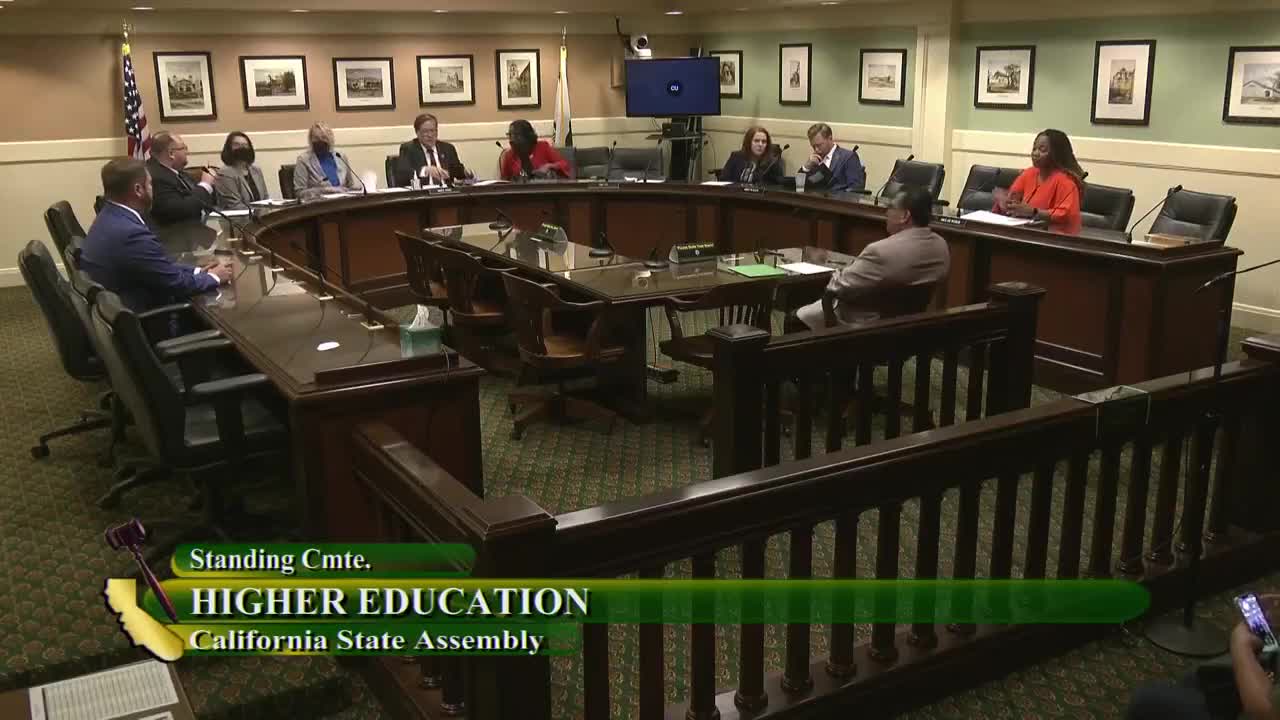 13MIN
Assembly Standing Committee on Higher Education
 1MIN
Senate Floor
 3MIN
Senate Standing Committee on Appropriations
 38MIN
Senate Standing Committee on Education
 8MIN
Assembly Standing Committee on Governmental Organization
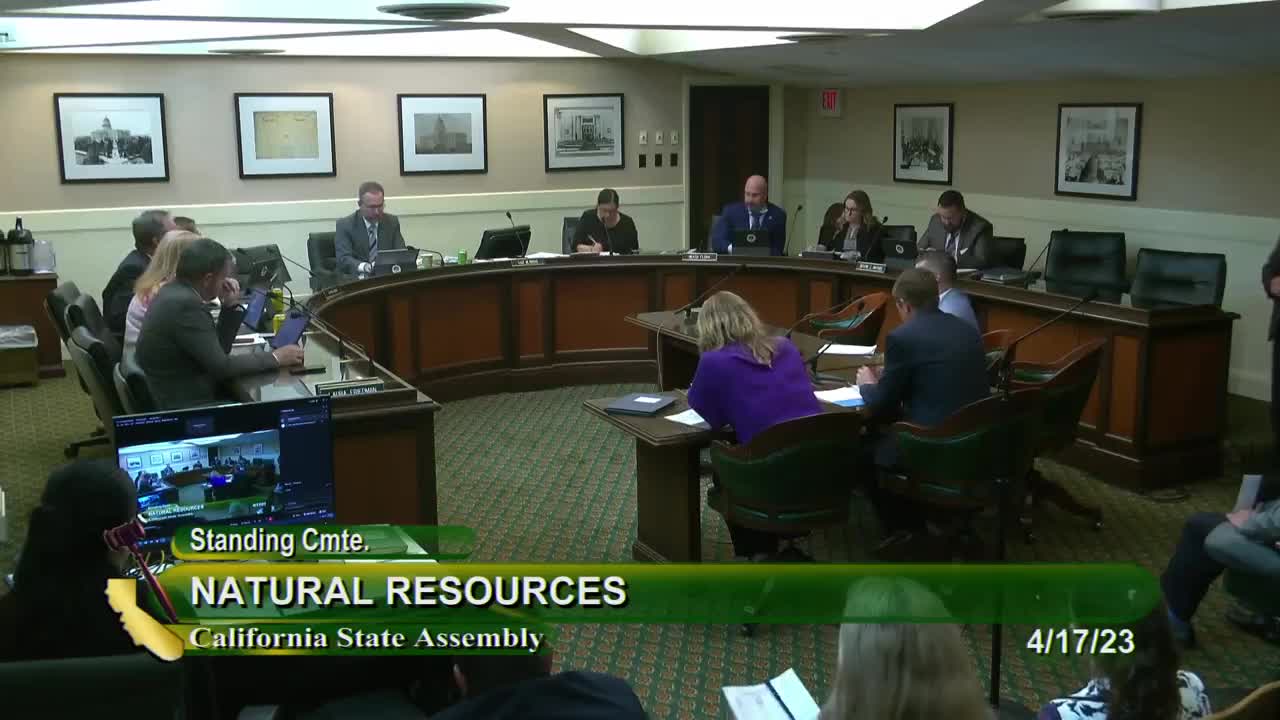 12MIN
Assembly Standing Committee on Natural Resources


Bill Co-Author(s):