AB 549: Gender discrimination.
- Session Year: 2023-2024
- House: Assembly
- Latest Version Date: 2023-03-08
Current Status:
Failed
(2024-02-01: From committee: Filed with the Chief Clerk pursuant to Joint Rule 56.)
Introduced
In Committee
First Chamber
In Committee
Second Chamber
Enacted
Existing law prohibits discrimination and harassment in employment and housing based on certain factors, including, among others, sex and gender.
This bill would require all state agencies, in consultation with the Commission on the Status of Women and Girls, to conduct an evaluation of their own departments to ensure that the state does not discriminate against women through the allocation of funding and the delivery of services. The bill, on or before January 1, 2024, 2025, and on or before January 1 every 2 years thereafter, would require state agencies to report their findings and recommendations, as specified, to the commission.
Existing law prohibits discrimination and harassment in employment and housing based on certain factors, including, among others, sex and gender.
This bill would require all state agencies, in consultation with the Commission on the Status of Women and Girls, to conduct an evaluation of their own departments to ensure that the state does not discriminate against women through the allocation of funding and the delivery of services. The bill, on or before January 1, 2024, and on or before January 1 every 2 years thereafter, would require state agencies to report their findings and recommendations, as specified, to the commission.
The Legislature finds and declares all of the following:
(a)The Convention on the Elimination of All Forms of Discrimination Against Women (CEDAW) is an international Bill of Rights for women. It is the first and only international instrument that comprehensively addresses womens rights within political, cultural, economic, social, and family life.
(b)There is a continued need for the State of California to protect the human rights of women and girls by addressing discrimination, including violence, against them and to implement the principles of the CEDAW. Adherence to the principles of the CEDAW on the state level will especially promote equal access to and equity in health care, employment, economic development, and educational opportunities for women and girls girls, and will also address the continuing and critical problems of violence against women and girls.
(c)The state should implement the principles underlying the CEDAW by addressing discrimination against women and girls in areas areas, including, but not limited to, economic development, education, employment practices, violence against women and girls, and health care products and services.
(d)There is a need to analyze the operations of state departments, policies, and programs to identify discrimination in, but not limited to, employment practices, budget allocation, and the provision of direct and indirect services and, if identified, to remedy that discrimination. In addition, there is a need to work toward implementing the principles of the CEDAW in the private sector.
SEC. 2.Chapter 3.15 (commencing with Section 8250.2) is added to Division 1 of Title 2 of the Government Code, to read:3.15.Gender Discrimination8250.2.(a)All state agencies, including the California Department of Aging, the Department of Corrections and Rehabilitation, the Employment Development Department, the State Department of Education, the Department of Fair Employment and Housing, the State Department of Health Care Services, the Department of Justice, and the Department of Veterans Affairs, in consultation with the Commission on the Status of Women and Girls, shall conduct an evaluation of their own departments to ensure that the state does not discriminate against women through the implementation of state policies and programs, including the allocation of funding and delivery of services.
(b)On or before January 1, 2024, 2025, and on or before January 1 every two years thereafter, state agencies shall report their findings to the Commission on the Status of Women and Girls, with recommendations for which practices and policies, if any, should change to ensure that the state does not discriminate against women as provided in subdivision (a).
REVISIONS: HeadingLine 2.The Legislature finds and declares all of the following:
(a)The Convention on the Elimination of All Forms of Discrimination Against Women (CEDAW) is an international Bill of Rights for women. It is the first and only international instrument that comprehensively addresses womens rights within political, cultural, economic, social, and family life.
(b)There is a continued need for the State of California to protect the human rights of women and girls by addressing discrimination, including violence, against them and to implement the principles of the CEDAW. Adherence to the principles of the CEDAW on the state level will especially promote equal access to and equity in health care, employment, economic development, and educational opportunities for women and girls and will also address the continuing and critical problems of violence against women and girls.
(c)The state should implement the principles underlying the CEDAW by addressing discrimination against women and girls in areas including, but not limited to, economic development, education, employment practices, violence against women and girls, and health care products and services.
(d)There is a need to analyze the operations of state departments, policies, and programs to identify discrimination in, but not limited to, employment practices, budget allocation, and the provision of direct and indirect services and, if identified, to remedy that discrimination. In addition, there is a need to work toward implementing the principles of the CEDAW in the private sector.
SEC. 2.Chapter 3.15 (commencing with Section 8250.2) is added to Division 1 of Title 2 of the Government Code, to read:3.15.Gender Discrimination8250.2.(a)All state agencies, including the California Department of Aging, the Department of Corrections and Rehabilitation, the Employment Development Department, the State Department of Education, the Department of Fair Employment and Housing, the State Department of Health Care Services, the Department of Justice, and the Department of Veterans Affairs, in consultation with the Commission on the Status of Women and Girls, shall conduct an evaluation of their own departments to ensure that the state does not discriminate against women through the implementation of state policies and programs, including the allocation of funding and delivery of services.
(b)On or before January 1, 2024, and on or before January 1 every two years thereafter, state agencies shall report their findings to the Commission on the Status of Women and Girls, with recommendations for which practices and policies, if any, should change to ensure that the state does not discriminate against women as provided in subdivision (a).
|
Date
|
Status
|
|---|---|
| Feb 1, 2024 | From committee: Filed with the Chief Clerk pursuant to Joint Rule 56. |
| Jan 31, 2024 | Died pursuant to Art. IV, Sec. 10(c) of the Constitution. |
| May 18, 2023 | Coauthors revised. |
| May 18, 2023 | In committee: Held under submission. |
| Apr 19, 2023 | In committee: Set, first hearing. Referred to APPR. suspense file. |
| Mar 21, 2023 | From committee: Do pass and re-refer to Com. on APPR. (Ayes 8. Noes 1.) (March 21). Re-referred to Com. on APPR. |
| Mar 9, 2023 | Re-referred to Com. on JUD. |
| Mar 8, 2023 | From committee chair, with author's amendments: Amend, and re-refer to Com. on JUD. Read second time and amended. |
| Feb 17, 2023 | Referred to Com. on JUD. |
| Feb 9, 2023 | From printer. May be heard in committee March 11. |
| Feb 8, 2023 | Read first time. To print. |
|
Date
|
Description
|
Location
|
Votes
|
|
|---|---|---|---|---|
| Mar 21, 2023 | Do pass and be re-referred to the Committee on [Appropriations] | Assembly Standing Committee on Judiciary |
Passed |
This list shows positions taken on this bill by organizations on the date displayed, which is linked to the original source.
Positions by individuals are not included.
|
Organization
|
Position
|
Date
|
|---|---|---|
| American Association Of University Women California | * Support | Mar 21, 2023 |
| Butte County | * Against | Mar 21, 2023 |
| California Commission on the Status of Women and Girls | ** Support | |
| Chico Environmental Health Advocacy | * Against | Mar 21, 2023 |
| National Association Of Social Workers, California Chapter | * Support | Mar 21, 2023 |
| None | * Against | Mar 21, 2023 |
| Planned Parenthood Affiliates Of California | * Support | Mar 21, 2023 |
| United Nations Association of San Francisco | * Support | Mar 21, 2023 |
| United Nations Association of the USA, San Francisco Chapter | ** Support |
Date of Hearing: April 19, 2023
ASSEMBLY COMMITTEE ON APPROPRIATIONS
Chris Holden, Chair
ABPCA Bill Id:AB 549
Author:(Wilson) – As Amended Ver:March 8, 2023
Policy Committee: | Judiciary | Vote: | 8 - 1 |
|
| ||
|
|
Urgency: No State Mandated Local Program: No Reimbursable: No
SUMMARY:
This bill requires each state agency to, in consultation with the Commission on the Status of Women and Girls (Commission), conduct an evaluation of its own programs and policies to determine whether they discriminate against women, including through the allocation of funding and delivery of services. The bill also requires each state agency to report its findings and recommendations to the Commission by January 1, 2025, and every two years thereafter.
FISCAL EFFECT:
- Costs in the millions of dollars annually (General Fund) for state agencies to review their policies and programs and report to the Commission. As discussed further below, the scope of this review and the number of state agencies required to complete it is unclear. If each agency named in the bill dedicates one attorney and one administrative analyst to complete the duties required by this bill, the total staffing costs for the agencies named in the bill would be over $1.5 million annually, plus benefits, overhead, and material costs. The costs may be significantly higher if this bill requires additional agencies to review their policies and report to the Commission.
- The Commission reports $112,000 in staffing costs (General Fund) for the first two years of implementation for an analyst to fulfill the duties required by this bill. Due to the uncertainty discussed below, there may be additional, unknown costs to the Commission.
COMMENTS:
Convention on the Elimination of All Forms of Discrimination Against Women. The Convention on the Elimination of All Forms of Discrimination Against Women (CEDAW) is an international treaty adopted by the United National General Assembly that defines discrimination against women and memorializes an agreement to take action to eliminate such discrimination. Although the United States has not ratified the treaty, San Francisco, Los Angeles, San Diego, and other California cities have adopted CEDAW ordinances.
This bill contains findings and declarations that there is a continued need for California to address discrimination against women and girls, and that the state should implement the principles underlying the CEDAW. According to the author, the statute added by this bill would “create a statewide standard for data collection and analysis needed to create a fairer and more equitable workplace for all.”
This bill broadly requires “[a]ll state agencies, including” certain specified departments, to conduct an evaluation of their policies and programs to ensure the state does not discriminate against women in the implementation of those policies and programs. The text expressly indicates that the eight agencies named in the bill must review their policies and report their findings to the Commission. However, the text does not clearly indicate how many more agencies, beyond the eight named agenies, are also required to fulfill the duties created by this bill. By some statutory definitions, California has more than 200 agencies, including state departments, boards, commissions, bureaus, universities, and other entities. If each of these agencies is required to fulfill the requirements of this bill, the costs would be significantly higher. Additionally, as indicated in the analysis of this bill by the Assembly Committee on Judiciary, the scope of the evaluations required by this bill is somewhat unclear. The author may wish to add additional direction to guide the agencies conducting these evaluations, and to help determine the extent of their cost.
Analysis Prepared by: Annika Carlson / APPR. / (916) 319-2081
Date of Hearing: March 21, 2023
ASSEMBLY COMMITTEE ON JUDICIARY
Brian Maienschein, Chair
ABPCA Bill Id:AB 549
Author:(Wilson) – As Amended Ver:March 8, 2023
SUBJECT: Gender discrimination
KEY ISSUE: should all state agencies conduct an evaluation of their policies and programs in order TO ensure that they do not discriminate against women and to prepare periodic reports on their findings?
SYNOPSIS
This bill requires all state agencies, in consultation with the Commission on the Status of Women and Girls [Commission], to conduct an evaluation of their programs and policies to ensure that they do not discriminate against women. The bill also requires state agencies to submit a report of their findings to the Commission on or before January 1, 2025, and every two years thereafter. According to the author, the state has made great strides in closing the wage gender gap; however, the recent Covid-19 pandemic exacerbated existing inequalities. The author believes that this bill will “create a statewide standard for data collection and analysis needed to create a fairer and more equitable workplace for all.”
The bill does not specify the scope of the required review or prescribe the contents of the report. Presumably, the parameters of the review and report will be determined during the consultation with the Commission. However, should the bill move forward, the author may wish to provide state agencies with more guidance on the type, extent, and level of detail of information sought. The bill is co-sponsored by the California Commission on the Status of Women and the San Francisco Chapter of the United Nations Association of the USA. There is no known opposition to the bill.
SUMMARY: Requires all state agencies to conduct an evaluation to ensure that they do not discriminate against women through their policies and practices and submit a report of their findings, as specified. Specifically, this bill:
- Requires all state agencies, in consultation with the Commission on the Status of Women and Girls, to conduct an evaluation of their own departments to ensure that the state does not discriminate against women through the implementation of state policies and programs, including in the allocation of funding and delivery of services.
- Requires all state agencies, on or before January 1, 2025, and every two years thereafter, to report their findings to the Commission on the Status of Women and Girls, with recommendations for which practices and policies, if any, should change to ensure that the state does not discriminate against women.
EXISTING LAW:
- Provides that no person shall be denied full and equal access to the benefits of, or be subjected to discrimination under, any state-operated or state-funded program upon the basis of certain protected characteristics, including upon the person’s sex or gender. (Government Code Section 11135.)
- Makes it unlawful for an employer, including the state, to discriminate against an employee on the basis of certain protected characteristics, including the employee’s sex or gender. (Government Code Section 12940.)
FISCAL EFFECT: As currently in print this bill is keyed fiscal.
COMMENTS: According to the author, while California has made some progress in closing the wage gender gap, the recent Covid-19 pandemic exacerbated existing inequalities. Indeed, several recent studies appear to support this claim. For example, a report by the Center for the Advancement of Women at Mount Saint Mary’s University showed that 80% of jobs lost due to the Covid-19 pandemic were clustered in the lower-paid economic sectors dominated by women, including retail, education, child care, and hospitality. (Cited in California Commission on Women and Girls, California Blue Print for Women’s Pandemic Recovery, March 22, “Executive Summary.”) Other studies show that the negative impact on women varies greatly by education, as college-educated women were more likely to keep working from home than women without a college degree. Whether women worked from home, worked away from home, or left the labor force due to the pandemic, the time they devoted to child care approximately doubled during the pandemic (from 8.7 hours per week to 17.3 hours per week). While 41% of women working from home provided extra childcare during the first year when schools closed, only 15% of men did extra childcare work. In short, women appear to have borne the brunt of the economic consequences of the pandemic both at work and at home, and this is especially so for women without a college degree working in lower-paying jobs. (Id.; see also Claudia Goldin, Understanding the Economic Impact of Covid-19 on Women, Brookings Papers on Economic Activity, March 2022. For a concise summary of others studies done in 2022, see Naomi Cahn, “Updates on the Gendered Wage Gap – and Covid-19,” Forbes Magazine, March 31, 2022.)
While many of the studies on the impact of Covid-19 focus on women in the private sector, women working in state agencies presumably face many of the same problems. The author hopes that this bill will “create a statewide standard for data collection and analysis needed to create a fairer and more equitable workplace for all.”
This bill requires all state agencies, in consultation with the Commission on the Status of Women and Girls [Commission], to conduct an evaluation of their programs and policies to ensure that they do not discriminate against women. State agencies would also be required to submit a report of their findings to the Commission on or before January 1, 2025, and every two years thereafter. Although existing law already prohibits gender discrimination by state agencies – whether as employers or service providers – this bill would force agencies to evaluate their policies and practices and consider more proactive ways to avoid discrimination against women.
As currently in print, the bill says very little about the scope of the review that agencies must undertake, nor does it specify any elements that the reports must contain or address. Presumably, the parameters of the review and report will be determined during the consultation with the Commission. However, if the bill moves forward, the author may wish to provide state agencies with more guidance on the type, extent, and detail of information sought.
ARGUMENTS IN SUPPORT: The California Commission on the Status of Women and Girls (Commission), one of the bill’s co-sponsors, argues that this bill recognizes “the continued need to analyze operations of state departments, policies, and programs to identify discrimination in employment practices, budgets, and provisions of direct and indirect services.” While the Commission acknowledges the “significant progress” that the Legislature has made toward addressing gender discrimination over the years, the Commission’s recent report, California’s Blueprint for Women’s Pandemic Recovery, noted that “the absence of adequate data can impede progress in creating informed and effective policies.” The Commission believes that the passage of AB 549 takes an important “first step to prioritizing equity and building a state in which women’s contributions and labor are properly valued for their significant impact on the state’s economy, its people, and communities.”
REGISTERED SUPPORT / OPPOSITION:
Support
California Commission on the Status of Women and Girls (co-sponsor)
United Nations Association of the USA, San Francisco Chapter (co-sponsor)
Opposition
None on file
Analysis Prepared by: Tom Clark / JUD. / (916) 319-2334
Discussed in Hearing
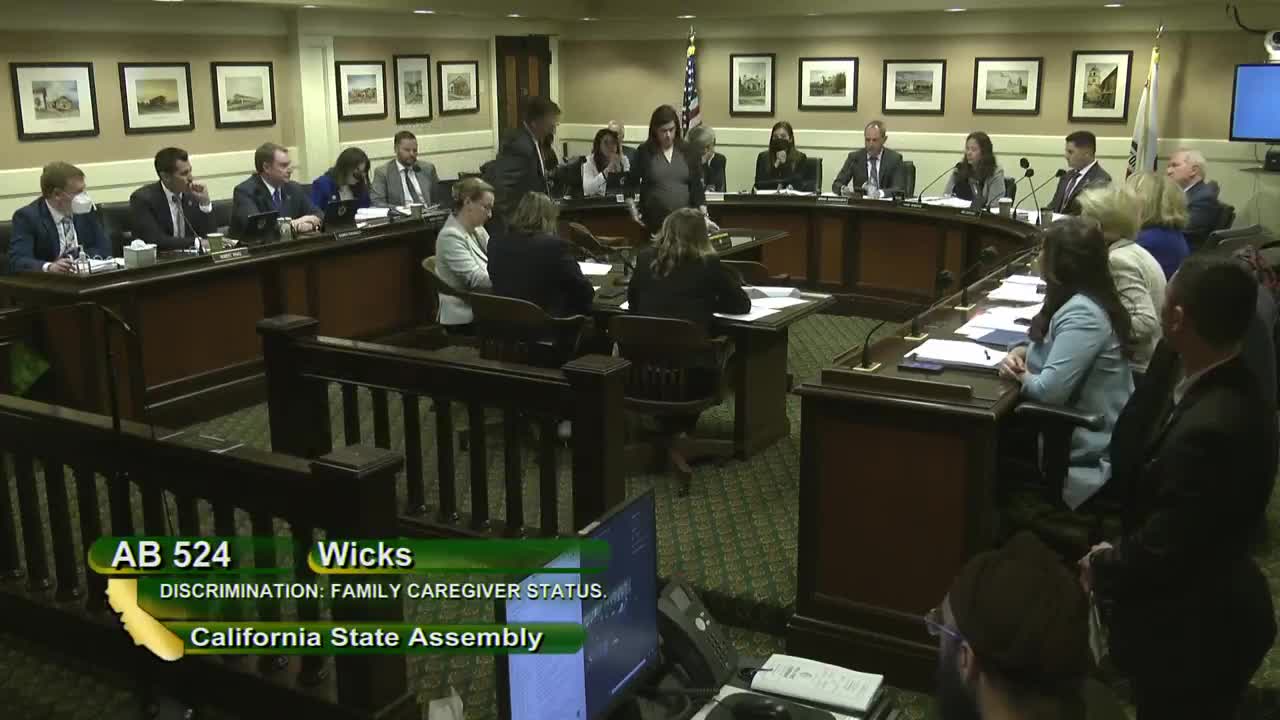 13MIN
Assembly Standing Committee on Judiciary
Bill Author