AB 685: Workforce training: CaliforniaVolunteers: youth job corps.
- Session Year: 2023-2024
- House: Assembly
- Latest Version Date: 2023-02-13
Current Status:
Failed
(2024-02-01: From committee: Filed with the Chief Clerk pursuant to Joint Rule 56.)
Introduced
In Committee
First Chamber
In Committee
Second Chamber
Enacted
Under existing law, by executive order, CaliforniaVolunteers is established in the Office of the Governor and is charged with overseeing programs and initiatives for service and volunteerism. Existing law authorizes CaliforniaVolunteers to form a nonprofit public benefit corporation or other entity exempt from income taxation, as provided, to raise revenues and receive grants or other financial support from private or public sources, for purposes of undertaking or funding any lawful activity authorized to be undertaken by CaliforniaVolunteers. Existing federal law, the National and Community Service Trust Act of 1993, also requires the state to create a commission to carry out specified duties relating to national service programs to be eligible for grants or allotments under certain programs, or to receive distributions of approved national service positions. Existing state law continues into existence the Board of Commissioners under CaliforniaVolunteers for purposes of meeting the requirements of the federal act and the acts implementing rules and regulations.
#CaliforniansForAll Youth Jobs Corps is a program of the CaliforniaVolunteers.
This bill would establish in statute the #CaliforniansForAll Youth Job Corps Program. The bill would require the CaliforniaVolunteers to expand the program, upon appropriation by the Legislature, which would fund supportive services, as specified, that are necessary for homeless youth and current or former foster youth to enable their participation in the workforce development program, as defined. Under the bill, grants would be awarded on a competitive basis. The bill would require the CaliforniaVolunteers to conduct outreach activities and to provide technical assistance to eligible applicants to ensure that grants are awarded to qualified applicants providing a broad spectrum of supportive services. The bill would prescribe definitions, duties for the CaliforniaVolunteers, and requirements for applications and applicants, including the requirement that applicants agree to provide the office any information that the office deems necessary to meet reporting requirements and other grant requirements. The bill would require the CaliforniaVolunteers to evaluate how grants awarded under the program address the needs of eligible targeted populations and, beginning one year after the initial award of grant funds, to post an annual report on its internet website regarding the progress and success of the program.
The Legislature finds and declares as follows:
(a)As part of Governor Gavin Newsoms California Comeback Plan, the #CaliforniansForAll Youth Job Corps program created a $185,000,000 investment for youth workforce development activities to 13 of the largest cities and counties in California.
(b)The first phase awarded $150,000,000 for youth workforce development in the 13 largest cities in California, and in phase two saw $35,000,000 awarded to counties and smaller cities through a competitive process.
(c)The #CaliforniansForAll Youth Job Corps program provides up to two years of meaningful employment to underserved youth.
(d)The program targets low-income, former foster, justice-involved, and unemployed youth and young adults between 16 and 30 years of age.
(e)The main focus of the program is placement in subsidized work experience opportunities in key service areas.
(f)The program includes wraparound services like case management, resume preparation, special job training, and other benefits to help ensure both the short-term and long-term success of the youth enrolled.
(g)The #CaliforniansForAll Youth Jobs Corps program addresses three critical issues: COVID-19 recovery, food insecurity, and climate action.
(h)Through the program, youth engage with their communities in meaningful ventures as they develop their job skills and pursue careers in public service.
(i)Of the funds appropriated, expenditure of $185,300,000 associated with the Promoting Workforce Stability initiative is contingent upon adoption of statutory changes codifying the intent and details of implementation, including definitions, stipend and reimbursement amounts, related terms of service for participating regional center staff and direct service providers, key implementation timelines, and specification of metrics for the tracking of outcomes.
(j)Upon appropriation by the Legislature, this act will require the CaliforniaVolunteers to expand the program, which would fund supportive services, as specified, that are necessary for every youth to succeed, California must focus on targeted youth furthest from opportunity, those facing persistent educational opportunity gaps, especially students of color, indigenous students, low-income students, rural students, students with disabilities, and systemimpacted youth, including youths who are at risk of disconnection or are disconnected from the education system or employment and those unhoused or in the child welfare, juvenile justice, or criminal legal systems.
(k)For participating youth, wraparound support services and the engagement of families, caregivers, and youth serving community-based organizations and support networks are critical and essential.
(l)Establishing pipelines for youth to enter growth industries for on-the-job training that allows them to earn and learn is a proven practice that can transform their participation in the labor force fostering economic security and prosperity as well as strengthening the sustainability of the overall economy.
(m)Under this act, grants will be awarded on a competitive basis.
(n)The act will require grantees to conduct outreach activities and to provide technical assistance to eligible applicants to ensure that grants are awarded to qualified applicants addressing three critical issues: COVID-19 recovery, food insecurity, and climate action.
(o)The act keeps definitions, duties for the CaliforniaVolunteers, and requirements for applications and applicants, including the requirement that applicants agree to provide the office any information that it deems necessary to meet reporting requirements and other grant requirements.
(p)The act requires the CaliforniaVolunteers to evaluate how grants awarded under the program address the needs of eligible targeted populations and, beginning one year after the initial award of grant funds, to post an annual report regarding the progress and success of the program.
SEC. 2.Article 8 (commencing with Section 14125) is added to Chapter 3 of Division 7 of the Unemployment Insurance Code, to read:8.Youth Access to Workforce Training14125.(a)The #CaliforniansForAll Youth Job Corps Program is hereby established in statute.
(b)This article shall be known, and may be cited, as the #CaliforniansForAll Youth Job Corps Expansion.
14126.As used in this article:
(a)Applicant means a community-based organization, local workforce development board, or nonprofit organization that helps individuals who face barriers to employment get supportive services, meets the standards of the program, and submits an application for a grant.
(b)(1)Homeless youth means a person up to 30 years of age, who has been verified as a homeless child or youth, as defined in paragraph (2) of Section 11343a of Title 42 of the United States Code, as it read on January 1, 2021, by at least one of the following:
(A)A homeless services provider, as defined in paragraph (3) of subdivision (e) of Section 103577 of the Health and Safety Code.
(B)The director, or the directors designee, of a federal TRIO program or a Gaining Early Awareness and Readiness for Undergraduate Programs program.
(C)A financial aid administrator.
(2)Targeted youth means a person who is less than 30 years of age who meets either of the following criteria:
(A)The person is, or has been, the subject of a petition filed pursuant to Section 300 of the Welfare and Institutions Code and who was removed from the persons home by the juvenile court pursuant to Section 319 or 361 of the Welfare and Institutions Code.
(B)A person who is, or has been, the subject of a petition filed pursuant to Section 602 of the Welfare and Institutions Code and who was removed from the persons home by the juvenile court pursuant to Section 727 of the Welfare and Institutions Code.
(C)Includes, but is not limited to, youth who are low income, unemployed, justice involved, out of school, in foster care, or engaged with mental health or substance abuse.
(c)Office means the CaliforniaVolunteers in the Office of the Governor.
(d)Program means the #CaliforniansForAll Youth Job Corps Program as established by this article.
(e)Supportive services includes, but is not limited to, any of the following and, for purposes of this section, these services shall be interpreted consistently with the federal Workforce Innovation and Opportunity Act (Public Law 113-128):
(1)Linkages to community services.
(2)Assistance with transportation.
(3)Assistance with childcare and dependent care.
(4)Assistance with housing.
(5)Needs-related payments.
(6)Assistance with educational testing.
(7)Reasonable accommodations for individuals with disabilities.
(8)Legal aid services.
(9)Referrals to health care.
(10)Assistance with uniforms or other appropriate work attire and work-related tools, including items such as eyeglasses and protective eyewear.
(11)Assistance with books, fees, school supplies, and other necessary items for students who are enrolled in postsecondary education classes.
(12)Payments and fees for employment and training-related applications, tests, and certifications.
(f)Workforce development program means the services described in paragraph (5) of subdivision (d) of Section 14013.
14127.(a)Upon appropriation by the Legislature, the office shall expand the program to fund supportive services that are necessary for homeless youth and current or former foster youth in order to enable their participation in the workforce development program. Grants shall be awarded on a competitive basis consistent with this article.
(b)The office, pursuant to the rulemaking provisions of the Administrative Procedure Act (Chapter 3.5 (commencing with Section 11340) of Part 1 of Division 3 of Title 2 of the Government Code), shall develop regulations to implement this program, including criteria, policies, and guidelines for the award of supportive services grant funds to applicants. The office shall develop methods to evaluate how grant projects adequately serve the needs of eligible homeless youth and current or former foster youth.
(c)The office shall conduct outreach activities and provide technical assistance to eligible applicants to ensure that grants are awarded to qualified applicants providing a broad spectrum of supportive services.
14128.(a)Application forms for the program shall include, at a minimum, all of the following:
(1)A description of the permitted purposes for which program grants may be awarded, the requirements of the program oversight and monitoring process, and other required terms of the grants.
(2)A description of the requirement that grant recipients report to the CaliforniaVolunteers on their use of the funds on an annual basis and upon completion of the grant period.
(3)An acknowledgment pursuant to which an applicant shall agree to provide any information to the office that it deems necessary to meet reporting and other grant requirements.
(b)A completed application shall contain, at a minimum, all of the following:
(1)A detailed description of the proposed supportive services to be provided.
(2)An explanation of how the supportive services to be provided will serve targeted youth and assist these populations in obtaining and completing workforce development programs.
(3)A description of the process through which the needs of participants will be assessed and how those needs will be met in the most cost-effective manner possible, including through the referral to, and utilization of, other public and private programs and services that may be available.
(4)An acknowledgment that the applicant agrees to provide any information to the office that the office deems necessary to meet reporting requirements and other grant requirements.
14129.The office shall evaluate how grants awarded under the program address the needs of eligible targeted populations. Beginning one year after the initial grant funds are awarded, and annually thereafter until all grant funding has been awarded and all grant periods completed, the office shall post an annual report on its internet website regarding the progress and success of the grant program.
REVISIONS: HeadingLine 1.|
Date
|
Status
|
|---|---|
| Feb 1, 2024 | From committee: Filed with the Chief Clerk pursuant to Joint Rule 56. |
| Jan 31, 2024 | Died pursuant to Art. IV, Sec. 10(c) of the Constitution. |
| May 18, 2023 | In committee: Hearing postponed by committee. |
| May 10, 2023 | In committee: Set, first hearing. Referred to APPR. suspense file. |
| May 3, 2023 | In committee: Hearing postponed by committee. |
| Apr 26, 2023 | In committee: Hearing postponed by committee. |
| Mar 22, 2023 | Coauthors revised. |
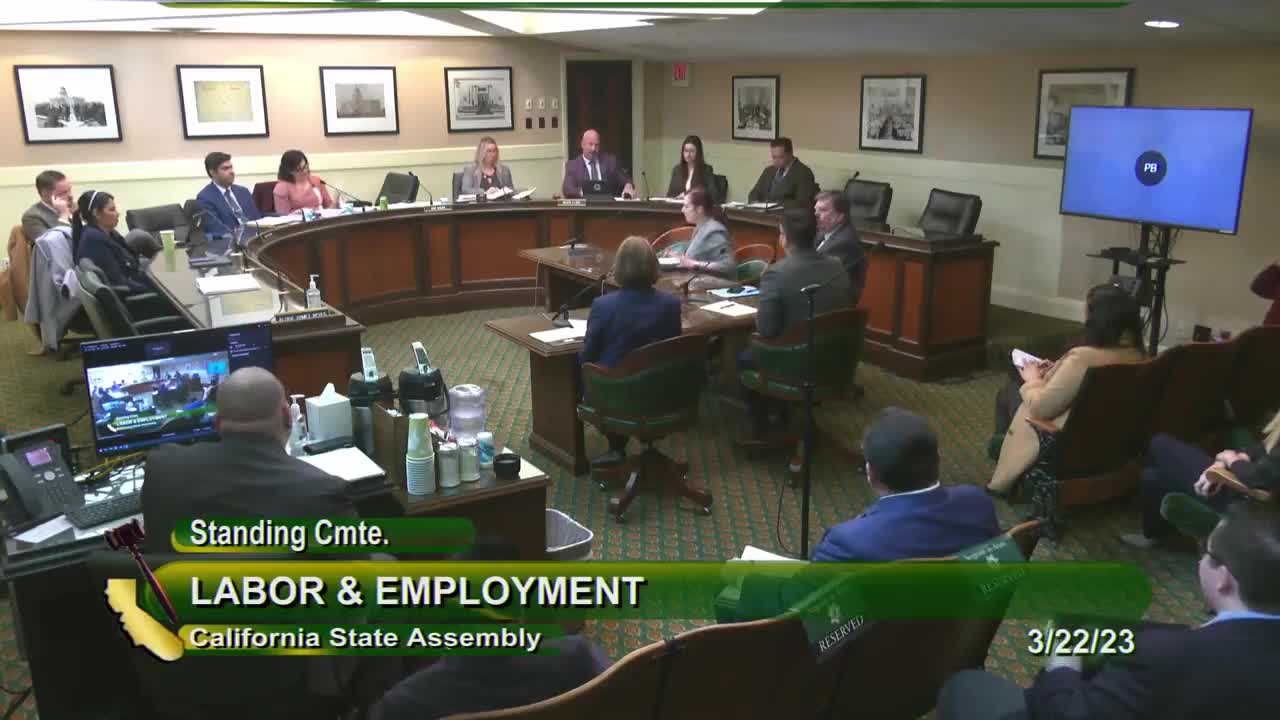
| Mar 22, 2023 | From committee: Do pass and re-refer to Com. on APPR. (Ayes 7. Noes 0.) (March 22). Re-referred to Com. on APPR. |
| Feb 23, 2023 | Referred to Com. on L. & E. |
| Feb 14, 2023 | From printer. May be heard in committee March 16. |
| Feb 13, 2023 | Read first time. To print. |
|
Date
|
Description
|
Location
|
Votes
|
|
|---|---|---|---|---|
| Mar 22, 2023 | Do pass and be re-referred to the Committee on [Appropriations] | Assembly Standing Committee on Labor and Employment |
Passed |
This list shows positions taken on this bill by organizations on the date displayed, which is linked to the original source.
Positions by individuals are not included.
|
Organization
|
Position
|
Date
|
|---|---|---|
| california opportunity youth network | ** Support | |
| California Workforce Association | * Support | Mar 22, 2023 |
| Imperial County WDB | ** Support | |
| Workforce Development Board of Madera County | ** Support |
Date of Hearing: May 10, 2023
ASSEMBLY COMMITTEE ON APPROPRIATIONS
Chris Holden, Chair
ABPCA Bill Id:AB 685
Author:(Ramos) – As Introduced Ver:February 13, 2023
Policy Committee: | Labor and Employment | Vote: | 7 - 0 |
|
| ||
|
|
Urgency: No State Mandated Local Program: No Reimbursable: No
SUMMARY:
This bill establishes the #CaliforniansForAll Youth Job Corps Program (Youth Job Corps) in statute and requires CaliforniaVolunteers (CV), upon appropriation, to expand the program.
Specifically, this bill:
- Requires CV, upon appropriation by the Legislature, to expand the Youth Job Corps to fund competitive grants that provide supportive services necessary for homeless youth and current or former foster youth to participate in the Youth Job Corps.
- Requires CV to conduct outreach activities and provide technical assistance to eligible grant applicants to ensure awardees provide a broad spectrum of supportive services.
- Prescribes what information must be included on grant application forms.
- Requires CV to post online an annual report on the grant program’s progress and success.
FISCAL EFFECT:
- Although this bill states that the existing Youth Job Corps is “hereby established in statute,” this bill does not further establish any provisions of the existing program in statute. Thus, there are no costs to CV to codify the existing program in this bill’s current form, but there are ongoing General Fund (GF) cost pressures of $78.1 million.
- GF cost pressures to appropriate approximately $30 million to CV to expand the Youth Job Corps, as specified. The author is requesting a $30 million one-time appropriation for this purpose in the 2023-24 state budget.
COMMENTS:
- Purpose. According to the author:
[This bill] builds on the success that we have seen through the #CaliforniansForAll Youth Job Corps program and would expand it throughout the entire state. For the past two years, this program has provided meaningful employment to underserved youth and has targeted low-income, former foster, justice-involved, and unemployed youth, and young adults. This is an important step to ensure that our most vulnerable youth throughout the state have access to workforce development.
This bill is sponsored by the California Workforce Association and supported by other workforce development partners.
- Background.
Youth Jobs Corps. The Youth Jobs Corps was created with $184 million one-time federal COVID-19 relief funds in fiscal year 2021-22. CV spread the funds across 2022, 2023, and 2024 to fund the program for two and a half years. Additionally, the 2022-23 state budget supplemented initial funds with $25 million one-time GF to augment services during summer 2023. CV allocated 80% of funds to the state’s largest 13 cities and granted 19% of funds on a competitive basis to 14 other cities and counties. The remaining 1% of funds support CV program administration and oversight.
Participating local governments use program funding to hire youth to work as their employees, or under contract with local community-based organizations, at a minimum hourly wage of $15.50. The program hires youth ages 16 to 30 who may not have access to traditional career-building resources and prioritizes individuals who are lower-income, unemployed or out of school, justice-involved, transitioning from foster care, or engaged with mental health or substance abuse systems. In addition to wages, grantees can use funding for administrative costs and to provide wraparound services, such as job or interview preparation, childcare, healthcare, transportation, and other non-wage benefits necessary for stable employment.
CV estimates approximately 2,000 youth are currently enrolled or have completed the program. The Governor’s proposed 2023-24 state budget includes $78.1 million ongoing GF to continue the Youth Jobs Corps after exhaustion of federal funds. This bill establishes the Youth Jobs Corps in statute, but does not further codify specific existing program details. Instead, this bill specifies Youth Jobs Corps expansion, upon appropriation, to bolster supportive services for homeless and foster youth. Although the Youth Jobs Corps currently allows funding for these wraparound services, funding is capped at 40% of each local government allocation. Accordingly, this bill provides additional funding for a specified population of eligible program participants to receive supportive services from an entity other than the employing local government, such as a community-based organization, local workforce development board, or non-profit organization grant applicant.
Legislative Analyst’s Office (LAO) Recommendation. The LAO’s March 1, 2023 report, The 2023-24 Budget: California Volunteers Proposed Program Expansions, recommends the Legislature reject the Governor’s budget proposal to fund the Youth Jobs Corps, as well as the Climate Action Corps, on an ongoing basis. According to the LAO:
We find the proposed funding augmentations and ongoing commitments to be premature given that neither program can yet present comprehensive data that it is a more cost-effective approach to achieving its goals than other existing or alternative approaches. This lack of evidence is particularly problematic given that, because of the budget problem, both proposals come at the expense of other existing [GF]-supported commitments. Given the state budget problem, we also recommend the Legislature approve the Governor’s proposal to reduce $25 million [GF] previously provided for the Youth Jobs Corps program to augment its services in summer 2023.
Analysis Prepared by: Irene Ho / APPR. / (916) 319-2081
Date of Hearing: March 22, 2023
ASSEMBLY COMMITTEE ON LABOR AND EMPLOYMENT
Ash Kalra, Chair
ABPCA Bill Id:AB 685 (
Author:Ramos) – As Introduced Ver:February 13, 2023
SUBJECT: Workforce training: CaliforniaVolunteers: youth job corps
SUMMARY: Codifies the #CaliforniansForAll Youth Jobs Corps Program (YJCP) in statute and requires the CaliforniaVolunteers (CV) to expand the YJCP, upon appropriation by the Legislature, to fund supportive services necessary for homeless youth and current or former foster youth to participate in the workforce development program. Specifically, this bill:
- Finds and declares, among other things, that establishing pipelines for youth to enter growth industries for on-the-job training that allows them to earn and learn is a proven practice that can transform their participation in the labor force fostering economic security and prosperity as well as strengthening the sustainability of the overall economy.
- Defines “applicant” as a community-based organization, local workforce development board, or nonprofit organization that helps individuals who face barriers to employment get supportive services, meets the standards of the program, and submits an application for a grant.
- Defines “homeless youth” as a person up to 30 years of age who lacks a fixed, regular, or adequate nighttime residence and who has been verified as a homeless child or youth, by at least one of the following:
- A homeless youth service provider, as defined.
- The director, or the director’s designee, of a federal TRIO program or a Gaining Early Awareness and Readiness for Undergraduate Programs program.
- A financial aid administrator.
- Defines “targeted youth” as a person who is less than 30 years of age who meets either of the following criteria:
- The person is, or has been, the subject of a petition filed pursuant to Section 300 of the Welfare and Institutions Code and who was removed from the person’s home by the juvenile court pursuant to Section 319 or 361 of the Welfare and Institutions Code.
- A person who is, or has been, the subject of a petition filed pursuant to Section 602 of the Welfare and Institutions Code and who was removed from the person’s home by the juvenile court pursuant to Section 727 of the Welfare and Institutions Code.
- Specifies that “targeted youth” includes, but is not limited to, youth who are low income, unemployed, justice involved, out of school, in foster care, or engaged with mental health or substance abuse.
- Defines “supportive services” to include, but not be limited to, any of the following and, for purposes of this section, these services to be interpreted consistently with the federal Workforce Innovation and Opportunity Act (WIOA):
- Linkages to community services.
- Assistance with transportation.
- Assistance with childcare and dependent care.
- Assistance with housing.
- Needs-related payments.
- Assistance with educational testing.
- Reasonable accommodations for individuals with disabilities.
- Legal aid services.
- Referrals to health care.
- Assistance with uniforms or other appropriate work attire and work-related tools, including items such as eyeglasses and protective eyewear.
- Assistance with books, fees, school supplies, and other necessary items for students who are enrolled in postsecondary education classes.
- Payments and fees for employment and training-related applications, tests, and certifications.
- Defines “workforce development program” to mean services that develop standards, procedures, and criteria for defining high road employers, high road jobs, high road workforce development, and high road training partnerships in California, in accordance with lessons learned from California Workforce Development Board’s (CWDB) ongoing high road workforce development initiatives.
- Requires CV, pursuant to the rulemaking provisions of the Administrative Procedure Act, to develop regulations to implement the YJCP, including criteria, policies, and guidelines for the award of supportive services grant funds to applicants.
- Requires grants under the YJCP to be rewarded on a competitive basis.
- Requires CV to develop methods to evaluate how grant projects adequately serve the needs of eligible homeless youth and current or former foster youth.
- Requires CV to conduct outreach activities and provide technical assistance to eligible applicants to ensure that grants are awarded to qualified applicants providing a broad spectrum of supportive services.
- Requires application forms for the YJCP to include, at a minimum, all of the following:
- A description of the permitted purposes for which program grants may be awarded, the requirements of the program oversight and monitoring process, and other required terms of the grants.
- A description of the requirement that grant recipients report to CV on their use of the funds on an annual basis and upon completion of the grant period.
- An acknowledgment pursuant to which an applicant shall agree to provide any information to CV that it deems necessary to meet reporting and other grant requirements.
- Requires a completed application to contain, at a minimum, all of the following:
- A detailed description of the proposed supportive services to be provided.
- An explanation of how the supportive services to be provided will serve targeted youth and assist these populations in obtaining and completing workforce development programs.
- A description of the process through which the needs of participants will be assessed and how those needs will be met in the most cost-effective manner possible, including through the referral to, and utilization of, other public and private programs and services that may be available.
- An acknowledgment that the applicant agrees to provide any information to CV that CV deems necessary to meet reporting requirements and other grant requirements.
- Requires CV to evaluate how grants awarded under the program address the needs of eligible targeted populations.
- Requires CV, beginning one year after the initial grant funds are awarded, and annually thereafter until all grant funding has been awarded and all grant periods completed, to post an annual report on its internet website regarding the progress and success of the grant program.
EXISTING FEDERAL LAW:
- Requires the state, under the National Community Service Trust Act, to create a commission to carry out specified duties relating to national service programs to be eligible for grants or allotments under certain programs, or to receive distributions of approved national service positions. (42 U.S.C. §12501.)
- Establishes the Workforce Innovation and Opportunity Act (WIOA) of 2014 in order to help job seekers access employment, education, training, and support services to succeed in the labor market and to match employers with skilled workers. WIOA coordinates employment and training services for adults, dislocated workers, and youth through grants to states that are implemented at the state and local level. (29 U.S.C. § 3101 et seq.)
EXISTING STATE LAW:
- Establishes CV in the Governor's Office with the specific mission to recruit and mobilize citizens for volunteer service by identifying service opportunities throughout the state and by recognizing citizen contributions as volunteers and participants in public service. (Executive Order S-24-06)
- Authorizes CV to form a tax-exempt public benefit nonprofit corporation for fundraising purposes, as specified. (Gov. Code, § 8400 (a).)
- Establishes the Board of Commissioners (Commission) under CV for purposes of meeting the requirements of the National Community Service Trust Act and the act’s implementing rules and regulations. (Gov. Code, § 8411 (a)-(b).)
- Authorizes the Commission to do any of the following for purposes of supporting CV:
- Advise and participate in the work of CV, including, but not limited to, policy, communication and program decision making, and special initiatives, by attending meetings and participating on committees, working groups, and task forces.
- Conduct outreach to specific constituencies, including, but not limited to, government, nonprofit, business, and labor, to seek these constituencies’ participation in and support of CV activities and programs.
- Coordinate with other state agencies and volunteer service programs to ensure a comprehensive and integrated service system within the state.
- Promote community service throughout the state by representing CV at service-related events and venues.
- Support programs funded by CV by participating in site visits and speaking at launch or graduation activities. (Gov. Code, § 8411 (c).)
FISCAL EFFECT: Unknown
COMMENTS: Currently, CV provides Youth Job Corps funding directly to cities and other jurisdictions to employ and support underserved youth. The program has three stated goals: to increase employment of underserved youth across California; to develop meaningful public service career pathways; and to enhance the capacity of local governments to address challenges in the key areas of food insecurity, climate change, and COVID-19 recovery.[1]
According to the California Lifting Children and Families Out of Poverty Task Force Report, “employment provides the most sustainable route out of poverty. Providing individuals with quality employment opportunities requires: job skills training, transition and barrier removal services, subsidized employment/apprenticeships, and child care for adults in workless households currently experiencing deep poverty. Apprenticeships, skills gateways and supportive services for childless young people not in employment, education or training are also vital.
Quality jobs provide a living wage, stable and predictable pay, control over scheduling, access to benefits, a safe and dignified work environment, and opportunities for training and career advancement.”[2]
According to the author, “[This bill] builds on the success that we have seen through the #CaliforniansForAll Youth Job Corps program and would expand it throughout the entire state. For the past two years, this program has provided meaningful employment to underserved youth and has targeted low-income, former foster, justice-involved, and unemployed youth, and young adults. This is an important step to ensure that our most vulnerable youth throughout the state have access to workforce development.”
Governors 2023-24 Budget
This bill compliments the proposals laid out in Governor Newsom’s proposed 2023-24 budget. In an effort to continue support for the California YJCP, which was established as a 2.5-year program using federal COVID-19 recovery funds, the Governor has proposed $78.1 million[3] ongoing moneys from the General Fund to continue the program once the temporary federal funds have been expended.
Argument in Support
The California Workforce Association, sponsor of the bill, states, “For the past two years, the #CaliforniansForAll Youth Job Corps program has provided meaningful employment to underserved youth, targeting low-income, former foster, justice involved, and unemployed youth and young adults between the ages of 16 and 30. This program places youth in subsidized work experience in key service areas and includes wraparound services like case management, resume preparation, special job training and other benefits that help promote short- and long-term success in all those who are enrolled. The #CaliforniansForAll Youth Job Corps program addresses three critical issues which are COVID-19 recovery, food insecurity, and climate action and provides youth with opportunities to engage with their communities as they simultaneously develop job skills and pursue careers in public service. Given the success of this program and the youth that it has served, it is imperative that California expand the #CaliforniansForAll Youth Job Corps program to the entire state. Only 20 cities of the 482 in California, and only 8 of the state’s 58 counties have been selected to participate in this program to date. This leaves out a significant portion of youth in rural areas which desperately need programs like this. Expanding this program and applying a formula based funding process will provide all cities and counties, regardless of size, with an opportunity to participate and provide youth with career pathways and purposeful work experiences.”
REGISTERED SUPPORT / OPPOSITION:
Support
California Workforce Association (Sponsor)
California Opportunity Youth Network
Imperial County WDB
Workforce Development Board of Madera County
Opposition
None on file.
Analysis Prepared by: Martin Vindiola / L. & E. /
Legislative Analyst’s Office. The 2023-24 Budget: California Volunteers Proposed Program Expansions, March 2023. ↑
California Lifting Children and Families out of Poverty Task Force. Recommended Strategies to Address Deep Child Poverty and Child Poverty in California, November 2018. ↑
State of California. 2023-24 Governor's Budget. Proposed January 10, 2023. ↑
Discussed in Hearing
 6MIN










