SB 480: Pupil instruction: work-based learning: youth apprenticeship programs: high school graduation requirements: pilot program.
- Session Year: 2023-2024
- House: Senate
- Latest Version Date: 2024-06-17
Current Status:
Failed
(2024-08-15: August 15 hearing: Held in committee and under submission.)
Introduced
In Committee
First Chamber
In Committee
Second Chamber
Enacted
(1)Existing law requires a pupil to complete designated coursework while in grades 9 to 12, inclusive, in order to receive a diploma of graduation from high school. The coursework requirements include, among others, the completion of one course in visual or performing arts, foreign language, or, until July 1, 2027, career technical education. Existing law defines a course in career technical education to mean a course in a district-operated career technical education program that is aligned to the career technical model curriculum standards and framework adopted by the State Board of Education, including courses through a regional occupational center or program operated by a county superintendent of schools or pursuant to a joint powers agreement. Existing law requires the Superintendent of Public Instruction to coordinate the development, on a cyclical basis, of model curriculum standards for, among other courses of study, a career technical education course of study.
This bill, until July 1, 2027, would revise that definition to clarify that a course in a district-operated career technical education program that is aligned to the career technical model curriculum standards and framework adopted by the state board also includes courses that include participation in a preapprenticeship program, as defined, or a youth apprenticeship program, as defined.
The bill would require the Superintendent, on or before July 1, 2029, and in collaboration with specified entities, to develop and adopt work-based learning program guidelines, as provided. The bill would require the State Department of Education, on or before January 1, 2026, and in collaboration with the Labor and Workforce Development Agency, to develop guidance on the definitions of youth apprenticeship programs, career technical education programs, preapprenticeship programs, and regional occupation programs, as provided.
(2)Existing law requires the department, in collaboration with, and subject to the approval of, the executive director of the State Board of Education, to develop and maintain the California School Dashboard, a web-based system for publicly reporting performance data on the state and local indicators included in the evaluation rubrics. The department, pursuant to the requirement of developing the California School Dashboard, has included as one of several state indicators, the College/Career Indicator (CCI), which represents the percentage of high school graduates who are prepared for college or a career, and includes several measures, including, among others, work-based learning measures, as part of the CCI.
This bill would require the state board to, on or before July 1, 2026, consider including youth apprenticeship programs as a work-based learning measure for purposes of the CCI.
(3)Existing law provides funding for career technical education programs, including through, among others, the California Career Technical Education Incentive Grant Program, the Strong Workforce Program, and a K12 component of the Strong Workforce Program, with the purpose of creating, maintaining, supporting, encouraging, strengthening, and expanding the delivery of career technical education programs in the state, as provided.
This bill would, subject to an appropriation of one-time funds for this purpose in the annual Budget Act or another statute, establish the High School Apprenticeship Pilot Program under the administration of the department. The bill would require the department, on or before July 1, 2026, to provide grants to 3 school districts, county offices of education, or charter schools for use over 2 school years, commencing with the 202627 school year, as provided. The bill would require the department to, among other things, convene a working group with specified entities and to work in collaboration with the working group to, among other things, determine application procedures and selection criteria for the grant awards. The bill would require the department to identify data to be collected by the grant recipients and would require the department, on or before December 1, 2028, to submit a report to the Legislature including, among other things, the data identified by the department.
This bill would make these provisions relating to the grant program inoperative on July 1, 2032, and would repeal it as of January 1, 2033.
(1)Existing law requires a pupil to complete designated coursework while in grades 9 to 12, inclusive, in order to receive a diploma of graduation from high school. The coursework requirements include, among others, the completion of one course in visual or performing arts, foreign language, or, until July 1, 2027, career technical education. Existing law defines a course in career technical education to mean a course in a district-operated career technical education program that is aligned to the career technical model curriculum standards and framework adopted by the State Board of Education, including courses through a regional occupational center or program operated by a county superintendent of schools or pursuant to a joint powers agreement. Existing law requires the Superintendent of Public Instruction to coordinate the development, on a cyclical basis, of model curriculum standards for, among other courses of study, a career technical education course of study.
This bill, for the 202627 school year, would authorize a school district or county office of education to offer the participation in a youth apprenticeship program, as defined, for 2 school years as an alternative to the requirement that a pupil complete a course in visual or performing arts, foreign language, or career technical education, and would require a school district or county office of education, before offering that alternative to pupils, to notify parents, teachers, pupils, and the public at a regularly scheduled meeting of the governing board of the school district or county board of education of specified information.This bill, until July 1, 2027, would revise that definition to clarify that a course in a district-operated career technical education program that is aligned to the career technical model curriculum standards and framework adopted by the state board also includes courses that include participation in a preapprenticeship program, as defined, or a youth apprenticeship program, as defined.
The bill would require the Superintendent, on or before July 1, 2029, and in collaboration with specified entities, to develop and adopt work-based learning standards, program guidelines, as provided. The bill would require the State Department of Education, on or before January 1, 2026, and in collaboration with the Labor and Workforce Development Agency, to develop guidance on the distinction between definitions of youth apprenticeship programs, career technical education programs, preapprenticeship programs, and regional occupation programs, as provided.
(2)Existing law requires the department, in collaboration with, and subject to the approval of, the executive director of the State Board of Education, to develop and maintain the California School Dashboard, a web-based system for publicly reporting performance data on the state and local indicators included in the evaluation rubrics. The department, pursuant to the requirement of developing the California School Dashboard, has included as one of several state indicators, the College/Career Indicator (CCI), which represents the percentage of high school graduates who are prepared for college or a career, and includes several measures, including, among others, work-based learning measures, as part of the CCI.
This bill would require the state board to, on or before July 1, 2026, include consider including youth apprenticeship programs as a work-based learning measure for purposes of the CCI.
(3)Existing law provides funding for career technical education programs, including through, among others, the California Career Technical Education Incentive Grant Program, the Strong Workforce Program, and a K12 component of the Strong Workforce Program, with the purpose of creating, maintaining, supporting, encouraging, strengthening, and expanding the delivery of career technical education programs in the state, as provided.This bill would, subject to an appropriation of one-time funds for this purpose in the annual Budget Act or another statute, establish the High School Apprenticeship Pilot Program under the administration of the department. The bill would require the department, on or before July 1, 2026, to provide grants to 3 school districts, county offices of education, or charter schools for use over two school years, commencing with the 202627 school year, as provided. The bill would require the department to, among other things, convene a working group with specified entities and to work in collaboration with the working group to determine application procedures and selection criteria for the grant awards. The bill would require grant recipients to use the grant funds for the implementation and success of a youth apprenticeship pilot program, as provided. The bill would require the grant recipients to submit to the department data identified by the department and would require the department, on or before December 1, 2028, to submit a report to the Legislature regarding the program, as provided.The bill would make these provisions inoperative on July 1, 2032, and would repeal them as of January 1, 2033.(1)Existing law requires a pupil to complete designated coursework while in grades 9 to 12, inclusive, in order to receive a diploma of graduation from high school. The coursework requirements include, among others, the completion of one course in visual or performing arts, foreign language, or, until July 1, 2027, career technical education. Existing law requires the Superintendent of Public Instruction to coordinate the development, on a cyclical basis, of model curriculum standards for, among other courses of study, a career technical education course of study.
This bill, for the 202627 school year, would authorize a school district or county office of education to offer the participation in a youth apprenticeship program, as defined, for 2 school years as an alternative to the requirement that a pupil complete a course in visual or performing arts, foreign language, or career technical education, and would require a school district or county office of education, before offering that alternative to pupils, to notify parents, teachers, pupils, and the public at a regularly scheduled meeting of the governing board of the school district or county board of education of specified information.
The bill would require the Superintendent, on or before July 1, 2029, and in collaboration with specified entities, to develop and adopt work-based learning standards, as provided. The bill would require the State Department of Education, on or before January 1, 2026, and in collaboration with the Labor and Workforce Development Agency, to develop guidance on the distinction between youth apprenticeship programs, career technical education programs, preapprenticeship programs, and regional occupation programs, as provided.
(2)Existing law requires the department, in collaboration with, and subject to the approval of, the executive director of the State Board of Education, to develop and maintain the California School Dashboard, a web-based system for publicly reporting performance data on the state and local indicators included in the evaluation rubrics. The department, pursuant to the requirement of developing the California School Dashboard, has included as one of several state indicators, the College/Career Indicator (CCI), which represents the percentage of high school graduates who are prepared for college or a career, and includes several measures, including, among others, work-based learning measures, as part of the CCI.
This bill would require the state board to, on or before July 1, 2026, include youth apprenticeship programs as a work-based learning measure for purposes of the CCI.
(3)Existing law provides funding for career technical education programs, including through, among others, the California Career Technical Education Incentive Grant Program, the Strong Workforce Program, and a K12 component of the Strong Workforce Program, with the purpose of creating, maintaining, supporting, encouraging, strengthening, and expanding the delivery of career technical education programs in the state, as provided.
This bill would, subject to an appropriation of one-time funds for this purpose in the annual Budget Act or another statute, establish the High School Apprenticeship Pilot Program under the administration of the department. The bill would require the department, on or before July 1, 2026, to provide grants to 3 school districts, county offices of education, or charter schools for use over two school years, commencing with the 202627 school year, as provided. The bill would require the department to, among other things, convene a working group with specified entities and to work in collaboration with the working group to determine application procedures and selection criteria for the grant awards. The bill would require grant recipients to use the grant funds for the implementation and success of a youth apprenticeship pilot program, as provided. The bill would require the grant recipients to submit to the department data identified by the department and would require the department, on or before December 1, 2028, to submit a report to the Legislature regarding the program, as provided.
The bill would make these provisions inoperative on July 1, 2032, and would repeal them as of January 1, 2033.
Existing law authorizes the governing board of a school district to initiate and carry on any program, activity, or to act in any manner that is not in conflict with or inconsistent with, or preempted by, any law and that is not in conflict with the purposes for which school districts are established. Existing law authorizes the governing board of a school district or a county board of education, on a districtwide or countywide basis or on behalf of one or more of its schools or programs, after a public hearing on the matter, to request the State Board of Education to waive all or part of any section of the Education Code or any regulation adopted by the state board that implements a provision of that code that may be waived, except as otherwise specified.This bill would, notwithstanding any other law, require the Superintendent of Public Instruction, with the approval of the state board, to select 3 geographically diverse school districts to implement, on a voluntary basis, a pilot program at one high school within the school district based upon the Korean Meister high school system. The bill would require the department to develop, and the state board to adopt, regulations to implement the pilot programs, consistent with specified requirements, including, among other requirements, that pupils participating in a pilot program are required to attend school 3 days per week and engage in their work experience 2 days per week, and that school districts will not lose funding tied to average daily attendance for pupils participating in a pilot program. The bill would repeal its provisions as of January 1, 2034.Existing law authorizes the governing board of a school district to initiate and carry on any program, activity, or to act in any manner that is not in conflict with or inconsistent with, or preempted by, any law and that is not in conflict with the purposes for which school districts are established. Existing law authorizes the governing board of a school district or a county board of education, on a districtwide or countywide basis or on behalf of one or more of its schools or programs, after a public hearing on the matter, to request the State Board of Education to waive all or part of any section of the Education Code or any regulation adopted by the state board that implements a provision of that code that may be waived, except as otherwise specified.
This bill would, notwithstanding any other law, require the Superintendent of Public Instruction, with the approval of the state board, to select 3 geographically diverse school districts to implement, on a voluntary basis, a pilot program at one high school within the school district based upon the Korean Meister high school system. The bill would require the department to develop, and the state board to adopt, regulations to implement the pilot programs. programs, consistent with specified requirements, including, among other requirements, that pupils participating in a pilot program are required to attend school 3 days per week and engage in their work experience 2 days per week, and that school districts will not lose funding tied to average daily attendance for pupils participating in a pilot program. The bill would repeal its provisions as of January 1, 2034.
Existing law authorizes the governing board of a school district to initiate and carry on any program, activity, or to act in any manner that is not in conflict with or inconsistent with, or preempted by, any law and that is not in conflict with the purposes for which school districts are established. Existing law authorizes the governing board of a school district or a county board of education, on a districtwide or countywide basis or on behalf of one or more of its schools or programs, after a public hearing on the matter, to request the State Board of Education to waive all or part of any section of the Education Code or any regulation adopted by the state board that implements a provision of that code that may be waived, except as otherwise specified.
This bill would, notwithstanding any other law, require the Superintendent of Public Instruction, with the approval of the state board, to select 3 geographically diverse school districts to implement, on a voluntary basis, a pilot program at one high school within the school district based upon the Korean Meister high school system. The bill would require the department to develop, and the state board to adopt adopt, regulations to implement the pilot programs. The bill would repeal its provisions as of January 1, 2034.
Existing law authorizes the governing board of a school district to initiate and carry on any program, activity, or to act in any manner that is not in conflict with or inconsistent with, or preempted by, any law and that is not in conflict with the purposes for which school districts are established. Existing law authorizes the governing board of a school district or a county board of education, on a districtwide or countywide basis or on behalf of one or more of its schools or programs, after a public hearing on the matter, to request the State Board of Education to waive all or part of any section of the Education Code or any regulation adopted by the state board that implements a provision of that code that may be waived, except as otherwise specified.
This bill would, notwithstanding any other law, require the Superintendent of Public Instruction, with the approval of the state board, to select 3 geographically diverse school districts to implement, on a voluntary basis, a pilot program at one high school within the school district based upon the Korean Meister high school system. The bill would require the department and the state board to adopt regulations to implement the pilot programs.
Existing law states the policy of the State of California to afford all persons in public schools, regardless of their disability, gender, gender identity, gender expression, nationality, race or ethnicity, religion, sexual orientation, or any other specified characteristic, equal rights and opportunities in the educational institutions of the state, and states that the purpose of related existing law is to prohibit acts that are contrary to that policy and to provide remedies therefor.This bill would make nonsubstantive changes to that provision.Existing law states the policy of the State of California to afford all persons in public schools, regardless of their disability, gender, gender identity, gender expression, nationality, race or ethnicity, religion, sexual orientation, or any other specified characteristic, equal rights and opportunities in the educational institutions of the state, and states that the purpose of related existing law is to prohibit acts that are contrary to that policy and to provide remedies therefor.
This bill would make nonsubstantive changes to that provision.
(a)A pupil shall complete all of the following while in grades 9 to 12, inclusive, in order to receive a diploma of graduation from high school:
(1)At least the following numbers of courses in the subjects specified, each course having a duration of one year, unless otherwise specified:
(A)Three courses in English.
(B)Two courses in mathematics. If the governing board of a school district requires more than two courses in mathematics for graduation, the governing board of the school district may award a pupil up to one mathematics course credit pursuant to Section 51225.35.
(C)Two courses in science, including biological and physical sciences.
(D)Three courses in social studies, including United States history and geography; world history, culture, and geography; a one-semester course in American government and civics; and a one-semester course in economics.
(E)(i)One course in visual or performing arts, world language, or, commencing with the 201213 school year, career technical education.
(ii)For purposes of satisfying the requirement specified in clause (i), a course in American Sign Language shall be deemed a course in world language.
(iii)For purposes of this subparagraph, the following definitions apply:
(I)A course in career technical education means a course in a district-operated career technical education program that is aligned to the career technical model curriculum standards and framework adopted by the state board, including courses through a regional occupational center or program operated by a county superintendent of schools or pursuant to a joint powers agreement or courses that include participation in a preapprenticeship program, as defined in Section 79144, or a youth apprenticeship program.
(II)A youth apprenticeship program means an apprenticeship program registered with the Division of Apprenticeship Standards that fulfills all existing registered apprenticeship requirements and serves youth between 16 and 24 years of age, inclusive, at the time of enrollment.
(iv)This subparagraph does not require a school or school district that currently does not offer career technical education courses to start new career technical education programs for purposes of this section.
(v)If a school district or county office of education elects to allow a career technical education course to satisfy the requirement imposed by this subparagraph, the governing board of the school district or county office of education, before offering that alternative to pupils, shall notify parents, teachers, pupils, and the public at a regularly scheduled meeting of the governing board of all of the following:
(I)The intent to offer career technical education courses to fulfill the graduation requirement specified in this subparagraph.
(II)The impact that offering career technical education courses, pursuant to this subparagraph, will have on the availability of courses that meet the eligibility requirements for admission to the California State University and the University of California, and whether the career technical education courses to be offered pursuant to this subparagraph are approved to satisfy those eligibility requirements. If a school district elects to allow a career technical education course to satisfy the requirement imposed by this subparagraph, the school district shall comply with subdivision (l) of Section 48980.
(III)The distinction, if any, between the high school graduation requirements of the school district or county office of education, and the eligibility requirements for admission to the California State University and the University of California.
(F)Two courses in physical education, unless the pupil has been exempted pursuant to this code.
(G)(i)Commencing with pupils graduating in the 202930 school year, including for pupils enrolled in a charter school, a one-semester course in ethnic studies. A local educational agency, including a charter school, may require a full-year course in ethnic studies at its discretion. Commencing with the 202526 school year, a local educational agency, including a charter school, with pupils in grades 9 to 12, inclusive, shall offer at least a one-semester course in ethnic studies.
(ii)Subject to the course offerings of a local educational agency, including a charter school, a pupil may fulfill the requirement of clause (i) through the completion of any of the following types of courses:
(I)A course based on the model curriculum developed pursuant to Section 51226.7.
(II)An existing ethnic studies course.
(III)An ethnic studies course taught as part of a course that has been approved as meeting the AG requirements of the University of California and the California State University.
(IV)A locally developed ethnic studies course approved by the governing board of the school district or the governing body of the charter school. The proposed course shall first be presented at a public meeting of the governing board of the school district or the governing body of the charter school, and shall not be approved until a subsequent public meeting of the governing board or governing body at which the public has had the opportunity to express its views on the proposed course.
(iii)A course that does not use ethnic studies content as the primary content through which the subject is taught shall not be used to satisfy the requirement of clause (i).
(iv)A pupil completing a course described in clause (ii) shall also accrue credit for coursework in the subject that the course is offered, including, if applicable, credit towards satisfying a course required for a diploma of graduation from high school pursuant to this section.
(v)Curriculum, instruction, and instructional materials for a course described in clause (ii) shall meet all of the following requirements:
(I)Be appropriate for use with pupils of all races, religions, nationalities, genders, sexual orientations, and diverse ethnic and cultural backgrounds, pupils with disabilities, and English learners.
(II)Not reflect or promote, directly or indirectly, any bias, bigotry, or discrimination against any person or group of persons on the basis of any category protected by Section 220.
(III)Not teach or promote religious doctrine.
(vi)It is the intent of the Legislature that local educational agencies, including charter schools, consider that, pursuant to Section 51226.7, the Instructional Quality Commission undertook a lengthy, thorough, deliberative, and inclusive process before submitting a model curriculum in ethnic studies to the state board. To the extent that local educational agencies, including charter schools, choose to locally develop an ethnic studies program for approval by their governing board or governing body, it is the intent of the Legislature that local educational agencies not use the portions of the draft model curriculum that were not adopted by the Instructional Quality Commission due to concerns related to bias, bigotry, and discrimination.
(vii)The amendments made to this section by Section 1 of Chapter 661 of the Statutes of 2021 shall not be construed to alter any other requirement of this section for pupils enrolled in a charter school.
(2)Other coursework requirements adopted by the governing board of the school district.
(b)The governing board, with the active involvement of parents, administrators, teachers, and pupils, shall adopt alternative means for pupils to complete the prescribed course of study that may include practical demonstration of skills and competencies, supervised work experience or other outside school experience, career technical education classes offered in high schools, courses offered by regional occupational centers or programs, interdisciplinary study, independent study, and credit earned at a postsecondary educational institution. Requirements for graduation and specified alternative modes for completing the prescribed course of study shall be made available to pupils, parents, and the public.
(c)On or before July 1, 2017, the department shall submit a comprehensive report to the appropriate policy committees of the Legislature on the addition of career technical education courses to satisfy the requirement specified in subparagraph (E) of paragraph (1) of subdivision (a), including, but not limited to, the following information:
(1)A comparison of the pupil enrollment in career technical education courses, world language courses, and visual and performing arts courses for the 200506 to 201112 school years, inclusive, to the pupil enrollment in career technical education courses, world language courses, and visual and performing arts courses for the 201213 to 201617 school years, inclusive.
(2)The reasons, reported by school districts, that pupils give for choosing to enroll in a career technical education course to satisfy the requirement specified in subparagraph (E) of paragraph (1) of subdivision (a).
(3)The type and number of career technical education courses that were conducted for the 200506 to 201112 school years, inclusive, compared to the type and number of career technical education courses that were conducted for the 201213 to 201617 school years, inclusive.
(4)The number of career technical education courses that satisfied the subject matter requirements for admission to the University of California or the California State University.
(5)The extent to which the career technical education courses chosen by pupils are aligned with the California Career Technical Education Model Curriculum Standards, and prepare pupils for employment, advanced training, and postsecondary education.
(6)The number of career technical education courses that also satisfy the visual and performing arts requirement, and the number of career technical education courses that also satisfy the world language requirement.
(7)Annual pupil dropout and graduation rates for the 201112 to 201415 school years, inclusive.
(d)For purposes of completing the report described in subdivision (c), the Superintendent may use existing state resources and federal funds. If state or federal funds are not available or sufficient, the Superintendent may apply for and accept grants, and receive donations and other financial support from public or private sources for purposes of this section.
(e)For purposes of completing the report described in subdivision (c), the Superintendent may accept support, including, but not limited to, financial and technical support, from high school reform advocates, teachers, chamber organizations, industry representatives, research centers, parents, and pupils.
(f)The amendments made to this section by Section 1 of Chapter 661 of the Statutes of 2021 shall become operative only upon an appropriation of funds by the Legislature for purposes of these amendments in the annual Budget Act or another statute.
(g)This section shall become inoperative on the earlier of the following two dates:
(1)On July 1, immediately following the first fiscal year after the enactment of Chapter 621 of the Statutes of 2011 in which the number of career technical education courses that, as determined by the department, satisfy the world language requirement for admission to the California State University and the University of California is at least twice the number of career technical education courses that meet these admission requirements as of January 1, 2012. This section shall be repealed on the following January 1, unless a later enacted statute, that becomes operative on or before that date, deletes or extends the dates on which it becomes inoperative and is repealed. It is the intent of the Legislature that new career technical education courses that satisfy the world language requirement for admission to the California State University and the University of California focus on world languages aligned with career preparation, emphasizing real-world application and technical content in related career and technical education courses.
(2)On July 1, 2027, and, as of January 1, 2028, is repealed.
SEC. 2.Section 51226.10 is added to the Education Code, immediately following Section 51226.9, to read:51226.10.On or before July 1, 2029, the Superintendent shall, in collaboration with the office of the Chancellor of the California Community Colleges and the Labor and Workforce Development Agency, develop and adopt work-based learning program guidelines that ensure all pupils have access to equitable and grade-appropriate work-based learning opportunities. The work-based learning program guidelines may be developed using available data from existing work-based programs in the state.
SEC. 3.Section 51226.11 is added to the Education Code, immediately following Section 51226.10, to read:51226.11.On or before January 1, 2026, the department shall, in collaboration with the Labor and Workforce Development Agency, develop guidance on the definitions of youth apprenticeship programs, career technical education programs, preapprenticeship programs, and regional occupational programs. In developing the guidance, the department shall use the definition of youth apprenticeship program established by the Division of Apprenticeship Standards.
SEC. 4.Section 52064.2 is added to the Education Code, to read:52064.2.(a)On or before July 1, 2026, the state board shall consider including youth apprenticeship programs as a work-based learning measure for the College/Career Indicator associated with the California School Dashboard maintained by the department pursuant to subdivision (f) of Section 52064.5.
(b)For purposes of this section, a youth apprenticeship program means an apprenticeship program registered with the Division of Apprenticeship Standards that fulfills all existing registered apprenticeship requirements and serves youth between 16 and 24 years of age, inclusive, at the time of enrollment.
SEC. 5.Chapter 14 (commencing with Section 52980) is added to Part 28 of Division 4 of Title 2 of the Education Code, to read:14.High School Apprenticeship Pilot Program52980.(a)For purposes of this chapter, the following definitions apply:
(1)Local educational agency means a school district, county office of education, or charter school.
(2)Program means the High School Apprenticeship Pilot Program established pursuant to subdivision (b).
(3)Working group means the high school apprenticeship interagency working group established pursuant to subdivision (c).
(4)Youth apprenticeship program means an apprenticeship program registered with the Division of Apprenticeship Standards that fulfills all existing registered apprenticeship requirements and serves youth between 16 and 24 years of age, inclusive, at the time of enrollment.
(b)The High School Apprenticeship Pilot Program is hereby established under the administration of the department. The department shall, on or before July 1, 2026, provide grants to three local educational agencies selected pursuant to subdivision (d) for use over two school years, commencing with the 202627 school year.
(c)In administering the program, the department shall, on or before August 1, 2025, convene the high school apprenticeship interagency working group that includes a representative from all of the following:
(1)The office of the Superintendent.
(2)The office of the Chancellor of the California Community Colleges.
(3)The Division of Apprenticeship Standards.
(4)The California Workforce Development Board.
(5)Educators.
(6)School administrators.
(7)Pupils.
(8)Parents or guardians.
(9)Leaders in the business community.
(d)In collaboration with the working group, the department shall do all of the following:
(1)Determine application procedures and selection criteria for the three grant awards. Grant awards shall be awarded to three geographically diverse schoolsites with at least one schoolsite in a rural region.
(2)Develop pilot program study goals.
(3)Identify data to be collected by the grant recipients and reported to the department.
(e)The department shall, on or before January 1, 2026, make grant applications available to local educational agencies for participation in the program.
(f)Notwithstanding any other law, a pupil that participates in a pilot program pursuant to this chapter shall be deemed to meet the minimum instructional minutes as required by Section 46141.
(g)(1)On or before December 1, 2028, the department shall submit a report to the appropriate policy and fiscal committees of the Legislature, that includes all of the following:
(A)Data collected from grant recipients pursuant to paragraph (3) of subdivision (d).
(B)The study goals developed for the program pursuant to paragraph (2) of subdivision (d).
(C)Recommendations for all of the following:
(i)If necessary, future legislation related to high school youth apprenticeship programs.
(ii)Next steps for increasing access to youth apprenticeship programs in high schools.
(2)The department may contract with an appropriate entity for an independent evaluation of the program.
(h)The implementation of this chapter is contingent upon the enactment of an appropriation for its purposes in the annual Budget Act or another statute.
52980.5.This chapter shall become inoperative on July 1, 2032, and, as of January 1, 2033, is repealed.
REVISIONS: HeadingLine 3.(a)A pupil shall complete all of the following while in grades 9 to 12, inclusive, in order to receive a diploma of graduation from high school:
(1)At least the following numbers of courses in the subjects specified, each course having a duration of one year, unless otherwise specified:
(A)Three courses in English.
(B)Two courses in mathematics. If the governing board of a school district requires more than two courses in mathematics for graduation, the governing board of the school district may award a pupil up to one mathematics course credit pursuant to Section 51225.35.
(C)Two courses in science, including biological and physical sciences.
(D)Three courses in social studies, including United States history and geography; world history, culture, and geography; a one-semester course in American government and civics; and a one-semester course in economics.
(E)(i)One course in visual or performing arts, world language, or, commencing with the 201213 school year, career technical education.
(ii)Commencing with the 202627 school year, participation in a youth apprenticeship program for two school years may also satisfy the requirements of clause (i).(iii)(ii)For purposes of satisfying the requirement specified in clause (i), a course in American Sign Language shall be deemed a course in world language.
(iv)(iii)For purposes of this subparagraph, the following definitions apply:
(I)A course in career technical education means a course in a district-operated career technical education program that is aligned to the career technical model curriculum standards and framework adopted by the state board, including courses through a regional occupational center or program operated by a county superintendent of schools or pursuant to a joint powers agreement. agreement or courses that include participation in a preapprenticeship program, as defined in Section 79144, or a youth apprenticeship program.
(II)A youth apprenticeship program means an apprenticeship program registered with the Division of Apprenticeship Standards that fulfills all existing registered apprenticeship requirements and serves youth between 16 and 24 years of age, inclusive, at the time of enrollment.
(v)(iv)This subparagraph does not require a school or school district that currently does not offer career technical education courses or youth apprenticeship programs to start new career technical education programs or youth apprenticeship programs for purposes of this section.
(vi)(v)If a school district or county office of education elects to allow a career technical education course or a youth apprenticeship program to satisfy the requirement imposed by this subparagraph, the governing board of the school district or county office of education, before offering that alternative to pupils, shall notify parents, teachers, pupils, and the public at a regularly scheduled meeting of the governing board of all of the following:
(I)The intent to offer career technical education courses or youth apprenticeship programs to fulfill the graduation requirement specified in this subparagraph.
(II)The impact that offering career technical education courses or youth apprenticeship programs, courses, pursuant to this subparagraph, will have on the availability of courses that meet the eligibility requirements for admission to the California State University and the University of California, and whether the career technical education courses or youth apprenticeship programs to be offered pursuant to this subparagraph are approved to satisfy those eligibility requirements. If a school district elects to allow a career technical education course or a youth apprenticeship program to satisfy the requirement imposed by this subparagraph, the school district shall comply with subdivision (l) of Section 48980.
(III)The distinction, if any, between the high school graduation requirements of the school district or county office of education, and the eligibility requirements for admission to the California State University and the University of California.
(F)Two courses in physical education, unless the pupil has been exempted pursuant to this code.
(G)(i)Commencing with pupils graduating in the 202930 school year, including for pupils enrolled in a charter school, a one-semester course in ethnic studies. A local educational agency, including a charter school, may require a full-year course in ethnic studies at its discretion. Commencing with the 202526 school year, a local educational agency, including a charter school, with pupils in grades 9 to 12, inclusive, shall offer at least a one-semester course in ethnic studies.
(ii)Subject to the course offerings of a local educational agency, including a charter school, a pupil may fulfill the requirement of clause (i) through the completion of any of the following types of courses:
(I)A course based on the model curriculum developed pursuant to Section 51226.7.
(II)An existing ethnic studies course.
(III)An ethnic studies course taught as part of a course that has been approved as meeting the AG requirements of the University of California and the California State University.
(IV)A locally developed ethnic studies course approved by the governing board of the school district or the governing body of the charter school. The proposed course shall first be presented at a public meeting of the governing board of the school district or the governing body of the charter school, and shall not be approved until a subsequent public meeting of the governing board or governing body at which the public has had the opportunity to express its views on the proposed course.
(iii)A course that does not use ethnic studies content as the primary content through which the subject is taught shall not be used to satisfy the requirement of clause (i).
(iv)A pupil completing a course described in clause (ii) shall also accrue credit for coursework in the subject that the course is offered, including, if applicable, credit towards satisfying a course required for a diploma of graduation from high school pursuant to this section.
(v)Curriculum, instruction, and instructional materials for a course described in clause (ii) shall meet all of the following requirements:
(I)Be appropriate for use with pupils of all races, religions, nationalities, genders, sexual orientations, and diverse ethnic and cultural backgrounds, pupils with disabilities, and English learners.
(II)Not reflect or promote, directly or indirectly, any bias, bigotry, or discrimination against any person or group of persons on the basis of any category protected by Section 220.
(III)Not teach or promote religious doctrine.
(vi)It is the intent of the Legislature that local educational agencies, including charter schools, consider that, pursuant to Section 51226.7, the Instructional Quality Commission undertook a lengthy, thorough, deliberative, and inclusive process before submitting a model curriculum in ethnic studies to the state board. To the extent that local educational agencies, including charter schools, choose to locally develop an ethnic studies program for approval by their governing board or governing body, it is the intent of the Legislature that local educational agencies not use the portions of the draft model curriculum that were not adopted by the Instructional Quality Commission due to concerns related to bias, bigotry, and discrimination.
(vii)The amendments made to this section by Section 1 of Chapter 661 of the Statutes of 2021 shall not be construed to alter any other requirement of this section for pupils enrolled in a charter school.
(2)Other coursework requirements adopted by the governing board of the school district.
(b)The governing board, with the active involvement of parents, administrators, teachers, and pupils, shall adopt alternative means for pupils to complete the prescribed course of study that may include practical demonstration of skills and competencies, supervised work experience or other outside school experience, career technical education classes offered in high schools, courses offered by regional occupational centers or programs, interdisciplinary study, independent study, and credit earned at a postsecondary educational institution. Requirements for graduation and specified alternative modes for completing the prescribed course of study shall be made available to pupils, parents, and the public.
(c)On or before July 1, 2017, the department shall submit a comprehensive report to the appropriate policy committees of the Legislature on the addition of career technical education courses to satisfy the requirement specified in subparagraph (E) of paragraph (1) of subdivision (a), including, but not limited to, the following information:
(1)A comparison of the pupil enrollment in career technical education courses, world language courses, and visual and performing arts courses for the 200506 to 201112 school years, inclusive, to the pupil enrollment in career technical education courses, world language courses, and visual and performing arts courses for the 201213 to 201617 school years, inclusive.
(2)The reasons, reported by school districts, that pupils give for choosing to enroll in a career technical education course to satisfy the requirement specified in subparagraph (E) of paragraph (1) of subdivision (a).
(3)The type and number of career technical education courses that were conducted for the 200506 to 201112 school years, inclusive, compared to the type and number of career technical education courses that were conducted for the 201213 to 201617 school years, inclusive.
(4)The number of career technical education courses that satisfied the subject matter requirements for admission to the University of California or the California State University.
(5)The extent to which the career technical education courses chosen by pupils are aligned with the California Career Technical Education Model Curriculum Standards, and prepare pupils for employment, advanced training, and postsecondary education.
(6)The number of career technical education courses that also satisfy the visual and performing arts requirement, and the number of career technical education courses that also satisfy the world language requirement.
(7)Annual pupil dropout and graduation rates for the 201112 to 201415 school years, inclusive.
(d)For purposes of completing the report described in subdivision (c), the Superintendent may use existing state resources and federal funds. If state or federal funds are not available or sufficient, the Superintendent may apply for and accept grants, and receive donations and other financial support from public or private sources for purposes of this section.
(e)For purposes of completing the report described in subdivision (c), the Superintendent may accept support, including, but not limited to, financial and technical support, from high school reform advocates, teachers, chamber organizations, industry representatives, research centers, parents, and pupils.
(f)The amendments made to this section by Section 1 of Chapter 661 of the Statutes of 2021 shall become operative only upon an appropriation of funds by the Legislature for purposes of these amendments in the annual Budget Act or another statute.
(g)This section shall become inoperative on the earlier of the following two dates:
(1)On July 1, immediately following the first fiscal year after the enactment of Chapter 621 of the Statutes of 2011 in which the number of career technical education courses that, as determined by the department, satisfy the world language requirement for admission to the California State University and the University of California is at least twice the number of career technical education courses that meet these admission requirements as of January 1, 2012. This section shall be repealed on the following January 1, unless a later enacted statute, that becomes operative on or before that date, deletes or extends the dates on which it becomes inoperative and is repealed. It is the intent of the Legislature that new career technical education courses that satisfy the world language requirement for admission to the California State University and the University of California focus on world languages aligned with career preparation, emphasizing real-world application and technical content in related career and technical education courses.
(2)On July 1, 2027, and, as of January 1, 2028, is repealed.
SEC. 2.Section 51226.10 is added to the Education Code, immediately following Section 51226.9, to read:51226.10.On or before July 1, 2029, the Superintendent shall, in collaboration with the office of the Chancellor of the California Community Colleges and the Labor and Workforce Development Agency, develop and adopt work-based learning standards program guidelines that ensure all pupils have access to equitable and grade-appropriate work-based learning opportunities. The work-based learning standards shall be based on best practices and recommendations developed through the pilot program established pursuant to Chapter 14 (commencing with Section 52980). program guidelines may be developed using available data from existing work-based programs in the state.
SEC. 3.Section 51226.11 is added to the Education Code, immediately following Section 51226.10, to read:51226.11.On or before January 1, 2026, the department shall, in collaboration with the Labor and Workforce Development Agency, develop guidance on the distinction between definitions of youth apprenticeship programs, career technical education programs, preapprenticeship programs, and regional occupational programs. In developing the guidance, the department shall use the definition of youth apprenticeship program established by the Division of Apprenticeship Standards.
SEC. 4.Section 52064.2 is added to the Education Code, to read:52064.2.(a)On or before July 1, 2026, the state board shall include consider including youth apprenticeship programs as a work-based learning measure for the College/Career Indicator associated with the California School Dashboard maintained by the department pursuant to subdivision (f) of Section 52064.5.
(b)For purposes of this section, a youth apprenticeship program means an apprenticeship program registered with the Division of Apprenticeship Standards that fulfills all existing registered apprenticeship requirements and serves youth between 16 and 24 years of age, inclusive, at the time of enrollment.
SEC. 5.Chapter 14 (commencing with Section 52980) is added to Part 28 of Division 4 of Title 2 of the Education Code, to read:14.High School Apprenticeship Pilot Program52980.(a)For purposes of this chapter, the following definitions apply:(1)Local educational agency means a school district, county office of education, or charter school.(2)Program means the High School Apprenticeship Pilot Program established pursuant to subdivision (b).(3)Working group means the high school apprenticeship interagency working group established pursuant to subdivision (c).(4)Youth apprenticeship program means an apprenticeship program registered with the Division of Apprenticeship Standards that fulfills all existing registered apprenticeship requirements and serves youth between 16 and 24 years of age, inclusive, at the time of enrollment.(b)The High School Apprenticeship Pilot Program is hereby established under the administration of the department. The department shall, on or before July 1, 2026, provide grants to three local educational agencies selected pursuant to subdivision (d) for use over two school years, commencing with the 202627 school year.(c)In administering the program, the department shall, on or before August 1, 2025, convene the high school apprenticeship interagency working group that includes a representative from all of the following:(1)The office of the Superintendent.(2)The office of the Chancellor of the California Community Colleges.(3)The Division of Apprenticeship Standards.(4)The California Workforce Development Board.(5)Educators.(6)School administrators.(7)Pupils.(8)Parents or guardians.(9)Leaders in the business community.(d)In collaboration with the working group, the department shall do all of the following:(1)Determine application procedures and selection criteria for the three grant awards. Grant awards shall be awarded to three geographically diverse schoolsites with at least one schoolsite in a rural region.(2)Develop pilot program study goals.(3)Identify data to be collected by the grant recipients and reported to the department, including, but not limited to, all of the following:(A)Participating pupil attendance and demographics.(B)Pupil feedback.(C)Pupil learning outcomes.(4)On or before January 1, 2026, make grant applications available to local educational agencies for participation in the program.(e)A grant recipient shall agree to all of the following:(1)Use grant funds for any of the following:(A)School administrator, teacher, and staff training specific to the implementation and maintenance of a youth apprenticeship program.(B)Mentorship and coaching programs designed to provide apprentices with guidance, support, and supervision from experienced mentors or journeyworkers.(C)Professional development for teachers after the initial establishment of the program.(D)Ongoing outreach to families of pupils, including strategies for family engagement.(E)Instructional coaches with demonstrated expertise and experience in implementing a youth apprenticeship program and instruction.(F)Industry-based instructional materials and assessments for proposed youth apprenticeship programs.(G)Support for the development and delivery of occupation-specific programs related to supplemental instruction that is directly aligned with the competencies and skills required for the apprenticeship occupation. This may include funding for instructional materials, equipment, and qualified instructors.(H)Strategic planning and implementation-related costs in the first year of program participation.(I)Reasonable administrative costs related to the management, coordination, and oversight of the youth apprenticeship program, such as program evaluation, reporting, and compliance monitoring.(J)Providing stipends or allowances to enrolled youth apprentices to cover expenses related to their participation in the program, including, but not limited to, transportation, work attire, and tools or materials necessary for their apprenticeship.(2)Report pupil data identified pursuant to paragraph (3) of subdivision (d) to the working group.(3)Fulfill all existing registered apprenticeship requirements.(4)Comply with minor labor laws.(5)Provide adequate mentorship and support structures to guide youth apprentices through their learning journey.(f)Notwithstanding any other law, a pupil that participates in a pilot program pursuant to this chapter shall be deemed to meet the minimum instructional minutes as required by Section 46141.(g)(1)On or before December 1, 2028, the department shall submit a report to the appropriate policy and fiscal committees of the Legislature, that includes all of the following:(A)Data collected from grant recipients pursuant to paragraph (3) of subdivision (d).(B)The study goals developed for the program pursuant to paragraph (2) of subdivision (d).(C)Recommendations for all of the following:(i)Improving the program.(ii)Future legislation related to high school apprenticeship programs.(iii)Next steps for standardizing the program.(2)The department may contract with an appropriate entity for an independent evaluation of the program.(h)The implementation of this chapter is contingent upon the enactment of an appropriation for its purposes in the annual Budget Act or another statute.52980.5This chapter shall become inoperative on July 1, 2032, and, as of January 1, 2033, is repealed. REVISIONS: HeadingLine 3.(a)A pupil shall complete all of the following while in grades 9 to 12, inclusive, in order to receive a diploma of graduation from high school:
(1)At least the following numbers of courses in the subjects specified, each course having a duration of one year, unless otherwise specified:
(A)Three courses in English.
(B)Two courses in mathematics. If the governing board of a school district requires more than two courses in mathematics for graduation, the governing board of the school district may award a pupil up to one mathematics course credit pursuant to Section 51225.35.
(C)Two courses in science, including biological and physical sciences.
(D)Three courses in social studies, including United States history and geography; world history, culture, and geography; a one-semester course in American government and civics; and a one-semester course in economics.
(E)(i)One course in visual or performing arts, world language, or, commencing with the 201213 school year, career technical education.
(ii)Commencing with the 202627 school year, participation in a youth apprenticeship program for two school years may also satisfy the requirements of clause (i).
(i)(iii)For purposes of satisfying the requirement specified in this subparagraph, clause (i), a course in American Sign Language shall be deemed a course in world language.
(ii)(iv)For purposes of this subparagraph, a the following definitions apply:
(I)A course in career technical education means a course in a district-operated career technical education program that is aligned to the career technical model curriculum standards and framework adopted by the state board, including courses through a regional occupational center or program operated by a county superintendent of schools or pursuant to a joint powers agreement.
(II)A youth apprenticeship program means an apprenticeship program registered with the Division of Apprenticeship Standards that fulfills all existing registered apprenticeship requirements and serves youth between 16 and 24 years of age, inclusive, at the time of enrollment.
(iii)(v)This subparagraph does not require a school or school district that currently does not offer career technical education courses or youth apprenticeship programs to start new career technical education programs or youth apprenticeship programs for purposes of this section.
(iv)(vi)If a school district or county office of education elects to allow a career technical education course or a youth apprenticeship program to satisfy the requirement imposed by this subparagraph, the governing board of the school district or county office of education, before offering that alternative to pupils, shall notify parents, teachers, pupils, and the public at a regularly scheduled meeting of the governing board of all of the following:
(I)The intent to offer career technical education courses or youth apprenticeship programs to fulfill the graduation requirement specified in this subparagraph.
(II)The impact that offering career technical education courses, courses or youth apprenticeship programs, pursuant to this subparagraph, will have on the availability of courses that meet the eligibility requirements for admission to the California State University and the University of California, and whether the career technical education courses or youth apprenticeship programs to be offered pursuant to this subparagraph are approved to satisfy those eligibility requirements. If a school district elects to allow a career technical education course or a youth apprenticeship program to satisfy the requirement imposed by this subparagraph, the school district shall comply with subdivision (l) of Section 48980.
(III)The distinction, if any, between the high school graduation requirements of the school district or county office of education, and the eligibility requirements for admission to the California State University and the University of California.
(F)Two courses in physical education, unless the pupil has been exempted pursuant to this code.
(G)(i)Commencing with pupils graduating in the 202930 school year, including for pupils enrolled in a charter school, a one-semester course in ethnic studies. A local educational agency, including a charter school, may require a full-year course in ethnic studies at its discretion. Commencing with the 202526 school year, a local educational agency, including a charter school, with pupils in grades 9 to 12, inclusive, shall offer at least a one-semester course in ethnic studies.
(ii)Subject to the course offerings of a local educational agency, including a charter school, a pupil may fulfill the requirement of clause (i) through the completion of any of the following types of courses:
(I)A course based on the model curriculum developed pursuant to Section 51226.7.
(II)An existing ethnic studies course.
(III)An ethnic studies course taught as part of a course that has been approved as meeting the AG requirements of the University of California and the California State University.
(IV)A locally developed ethnic studies course approved by the governing board of the school district or the governing body of the charter school. The proposed course shall first be presented at a public meeting of the governing board of the school district or the governing body of the charter school, and shall not be approved until a subsequent public meeting of the governing board or governing body at which the public has had the opportunity to express its views on the proposed course.
(iii)A course that does not use ethnic studies content as the primary content through which the subject is taught shall not be used to satisfy the requirement of clause (i).
(iv)A pupil completing a course described in clause (ii) shall also accrue credit for coursework in the subject that the course is offered, including, if applicable, credit towards satisfying a course required for a diploma of graduation from high school pursuant to this section.
(v)Curriculum, instruction, and instructional materials for a course described in clause (ii) shall meet all of the following requirements:
(I)Be appropriate for use with pupils of all races, religions, nationalities, genders, sexual orientations, and diverse ethnic and cultural backgrounds, pupils with disabilities, and English learners.
(II)Not reflect or promote, directly or indirectly, any bias, bigotry, or discrimination against any person or group of persons on the basis of any category protected by Section 220.
(III)Not teach or promote religious doctrine.
(vi)It is the intent of the Legislature that local educational agencies, including charter schools, consider that, pursuant to Section 51226.7, the Instructional Quality Commission undertook a lengthy, thorough, deliberative, and inclusive process before submitting a model curriculum in ethnic studies to the state board. To the extent that local educational agencies, including charter schools, choose to locally develop an ethnic studies program for approval by their governing board or governing body, it is the intent of the Legislature that local educational agencies not use the portions of the draft model curriculum that were not adopted by the Instructional Quality Commission due to concerns related to bias, bigotry, and discrimination.
(vii)The amendments made to this section by Section 1 of Chapter 661 of the Statutes of 2021 shall not be construed to alter any other requirement of this section for pupils enrolled in a charter school.
(2)Other coursework requirements adopted by the governing board of the school district.
(b)The governing board, with the active involvement of parents, administrators, teachers, and pupils, shall adopt alternative means for pupils to complete the prescribed course of study that may include practical demonstration of skills and competencies, supervised work experience or other outside school experience, career technical education classes offered in high schools, courses offered by regional occupational centers or programs, interdisciplinary study, independent study, and credit earned at a postsecondary educational institution. Requirements for graduation and specified alternative modes for completing the prescribed course of study shall be made available to pupils, parents, and the public.
(c)On or before July 1, 2017, the department shall submit a comprehensive report to the appropriate policy committees of the Legislature on the addition of career technical education courses to satisfy the requirement specified in subparagraph (E) of paragraph (1) of subdivision (a), including, but not limited to, the following information:
(1)A comparison of the pupil enrollment in career technical education courses, world language courses, and visual and performing arts courses for the 200506 to 201112 school years, inclusive, to the pupil enrollment in career technical education courses, world language courses, and visual and performing arts courses for the 201213 to 201617 school years, inclusive.
(2)The reasons, reported by school districts, that pupils give for choosing to enroll in a career technical education course to satisfy the requirement specified in subparagraph (E) of paragraph (1) of subdivision (a).
(3)The type and number of career technical education courses that were conducted for the 200506 to 201112 school years, inclusive, compared to the type and number of career technical education courses that were conducted for the 201213 to 201617 school years, inclusive.
(4)The number of career technical education courses that satisfied the subject matter requirements for admission to the University of California or the California State University.
(5)The extent to which the career technical education courses chosen by pupils are aligned with the California Career Technical Education Model Curriculum Standards, and prepare pupils for employment, advanced training, and postsecondary education.
(6)The number of career technical education courses that also satisfy the visual and performing arts requirement, and the number of career technical education courses that also satisfy the world language requirement.
(7)Annual pupil dropout and graduation rates for the 201112 to 201415 school years, inclusive.
(d)For purposes of completing the report described in subdivision (c), the Superintendent may use existing state resources and federal funds. If state or federal funds are not available or sufficient, the Superintendent may apply for and accept grants, and receive donations and other financial support from public or private sources for purposes of this section.
(e)For purposes of completing the report described in subdivision (c), the Superintendent may accept support, including, but not limited to, financial and technical support, from high school reform advocates, teachers, chamber organizations, industry representatives, research centers, parents, and pupils.
(f)The amendments made to this section by Section 1 of Chapter 661 of the Statutes of 2021 shall become operative only upon an appropriation of funds by the Legislature for purposes of these amendments in the annual Budget Act or another statute.
(g)This section shall become inoperative on the earlier of the following two dates:
(1)On July 1, immediately following the first fiscal year after the enactment of Chapter 621 of the Statutes of 2011 in which the number of career technical education courses that, as determined by the department, satisfy the world language requirement for admission to the California State University and the University of California is at least twice the number of career technical education courses that meet these admission requirements as of January 1, 2012. This section shall be repealed on the following January 1, unless a later enacted statute, that becomes operative on or before that date, deletes or extends the dates on which it becomes inoperative and is repealed. It is the intent of the Legislature that new career technical education courses that satisfy the world language requirement for admission to the California State University and the University of California focus on world languages aligned with career preparation, emphasizing real-world application and technical content in related career and technical education courses.
(2)On July 1, 2027, and, as of January 1, 2028, is repealed.
SEC. 2.Section 51226.10 is added to the Education Code, immediately following Section 51226.9, to read:51226.10.On or before July 1, 2029, the Superintendent shall, in collaboration with the office of the Chancellor of the California Community Colleges and the Labor and Workforce Development Agency, develop and adopt work-based learning standards that ensure all pupils have access to equitable and grade-appropriate work-based learning opportunities. The work-based learning standards shall be based on best practices and recommendations developed through the pilot program established pursuant to Chapter 14 (commencing with Section 52980).
SEC. 3.Section 51226.11 is added to the Education Code, immediately following Section 51226.10, to read:51226.11.On or before January 1, 2026, the department shall, in collaboration with the Labor and Workforce Development Agency, develop guidance on the distinction between youth apprenticeship programs, career technical education programs, preapprenticeship programs, and regional occupational programs. In developing the guidance, the department shall use the definition of youth apprenticeship program established by the Division of Apprenticeship Standards.
SEC. 4.Section 52064.2 is added to the Education Code, to read:52064.2.(a)On or before July 1, 2026, the state board shall include youth apprenticeship programs as a work-based learning measure for the College/Career Indicator associated with the California School Dashboard maintained by the department pursuant to subdivision (f) of Section 52064.5.
(b)For purposes of this section, a youth apprenticeship program means an apprenticeship program registered with the Division of Apprenticeship Standards that fulfills all existing registered apprenticeship requirements and serves youth between 16 and 24 years of age, inclusive, at the time of enrollment.
SEC. 5.Chapter 14 (commencing with Section 52980) is added to Part 28 of Division 4 of Title 2 of the Education Code, to read:14.High School Apprenticeship Pilot Program52980.(a)For purposes of this chapter, the following definitions apply:
(1)Local educational agency means a school district, county office of education, or charter school.
(2)Program means the High School Apprenticeship Pilot Program established pursuant to subdivision (b).
(3)Working group means the high school apprenticeship interagency working group established pursuant to subdivision (c).
(4)Youth apprenticeship program means an apprenticeship program registered with the Division of Apprenticeship Standards that fulfills all existing registered apprenticeship requirements and serves youth between 16 and 24 years of age, inclusive, at the time of enrollment.
(b)The High School Apprenticeship Pilot Program is hereby established under the administration of the department. The department shall, on or before July 1, 2026, provide grants to three local educational agencies selected pursuant to subdivision (d) for use over two school years, commencing with the 202627 school year.
(c)In administering the program, the department shall, on or before August 1, 2025, convene the high school apprenticeship interagency working group that includes a representative from all of the following:
(1)The office of the Superintendent.
(2)The office of the Chancellor of the California Community Colleges.
(3)The Division of Apprenticeship Standards.
(4)The California Workforce Development Board.
(5)Educators.
(6)School administrators.
(7)Pupils.
(8)Parents or guardians.
(9)Leaders in the business community.
(d)In collaboration with the working group, the department shall do all of the following:
(1)Determine application procedures and selection criteria for the three grant awards. Grant awards shall be awarded to three geographically diverse schoolsites with at least one schoolsite in a rural region.
(2)Develop pilot program study goals.
(3)Identify data to be collected by the grant recipients and reported to the department, including, but not limited to, all of the following:
(A)Participating pupil attendance and demographics.
(B)Pupil feedback.
(C)Pupil learning outcomes.
(4)On or before January 1, 2026, make grant applications available to local educational agencies for participation in the program.
(e)A grant recipient shall agree to all of the following:
(1)Use grant funds for any of the following:
(A)School administrator, teacher, and staff training specific to the implementation and maintenance of a youth apprenticeship program.
(B)Mentorship and coaching programs designed to provide apprentices with guidance, support, and supervision from experienced mentors or journeyworkers.
(C)Professional development for teachers after the initial establishment of the program.
(D)Ongoing outreach to families of pupils, including strategies for family engagement.
(E)Instructional coaches with demonstrated expertise and experience in implementing a youth apprenticeship program and instruction.
(F)Industry-based instructional materials and assessments for proposed youth apprenticeship programs.
(G)Support for the development and delivery of occupation-specific programs related to supplemental instruction that is directly aligned with the competencies and skills required for the apprenticeship occupation. This may include funding for instructional materials, equipment, and qualified instructors.
(H)Strategic planning and implementation-related costs in the first year of program participation.
(I)Reasonable administrative costs related to the management, coordination, and oversight of the youth apprenticeship program, such as program evaluation, reporting, and compliance monitoring.
(J)Providing stipends or allowances to enrolled youth apprentices to cover expenses related to their participation in the program, including, but not limited to, transportation, work attire, and tools or materials necessary for their apprenticeship.
(2)Report pupil data identified pursuant to paragraph (3) of subdivision (d) to the working group.
(3)Fulfill all existing registered apprenticeship requirements.
(4)Comply with minor labor laws.
(5)Provide adequate mentorship and support structures to guide youth apprentices through their learning journey.
(f)Notwithstanding any other law, a pupil that participates in a pilot program pursuant to this chapter shall be deemed to meet the minimum instructional minutes as required by Section 46141.
(g)(1)On or before December 1, 2028, the department shall submit a report to the appropriate policy and fiscal committees of the Legislature, that includes all of the following:
(A)Data collected from grant recipients pursuant to paragraph (3) of subdivision (d).
(B)The study goals developed for the program pursuant to paragraph (2) of subdivision (d).
(C)Recommendations for all of the following:
(i)Improving the program.
(ii)Future legislation related to high school apprenticeship programs.
(iii)Next steps for standardizing the program.
(2)The department may contract with an appropriate entity for an independent evaluation of the program.
(h)The implementation of this chapter is contingent upon the enactment of an appropriation for its purposes in the annual Budget Act or another statute.
52980.5This chapter shall become inoperative on July 1, 2032, and, as of January 1, 2033, is repealed.
SECTION 1.Section 35160.3 is added to the Education Code, to read:35160.3.(a)Notwithstanding any other law, the department, with the approval of the state board, shall select three geographically diverse school districts to implement, on a voluntary basis, a pilot program at one high school within the school district based upon the Korean Meister high school system.(b)The department shall develop, and the state board shall adopt, regulations to implement the pilot programs established pursuant to subdivision (a), consistent with all of the following:(1)Pupils participating in a pilot program shall attend school three days per week and engage in their work experience two days per week.(2)School districts and diverse local businesses shall be encouraged to work together to develop a pipeline of high school graduates to employees.(3)Pupils participating in a pilot program shall not be required to enroll in any dual enrollment program, and a pilot program shall be separate from the Golden State Pathways Program established pursuant to Chapter 16.1 (commencing with Section 53020) of Part 28 of Division 4.(4)School districts shall not lose funding tied to average daily attendance for pupils participating in a pilot program.(5)Pupils participating in a pilot program shall be able to satisfy the AG subject matter requirements for admission to the California State University and the University of California.(6)Participation in a pilot program shall be limited to pupils in grade 12.(c)This section shall remain in effect only until January 1, 2034, and as of that date is repealed.(a)Notwithstanding any other law, the department, with the approval of the state board, shall select three geographically diverse school districts to implement, on a voluntary basis, a pilot program at one high school within the school district based upon the Korean Meister high school system.
(b)The department shall develop, and the state board shall adopt, regulations to implement the pilot programs established pursuant to subdivision (a). (a), consistent with all of the following:
(1)Pupils participating in a pilot program shall attend school three days per week and engage in their work experience two days per week.
(2)School districts and diverse local businesses shall be encouraged to work together to develop a pipeline of high school graduates to employees.
(3)Pupils participating in a pilot program shall not be required to enroll in any dual enrollment program, and a pilot program shall be separate from the Golden State Pathways Program established pursuant to Chapter 16.1 (commencing with Section 53020) of Part 28 of Division 4.
(4)School districts shall not lose funding tied to average daily attendance for pupils participating in a pilot program.
(5)Pupils participating in a pilot program shall be able to satisfy the AG subject matter requirements for admission to the California State University and the University of California.
(6)Participation in a pilot program shall be limited to pupils in grade 12.
(c)This section shall remain in effect only until January 1, 2034, and as of that date is repealed.
(a)Notwithstanding any other law, the department, with the approval of the state board, shall select three geographically diverse school districts to implement, on a voluntary basis, a pilot program at one high school within the school district based upon the Korean Meister high school system.
(b)The department shall develop, and the state board shall adopt adopt, regulations to implement the pilot programs established pursuant to subdivision (a).
(c)This section shall remain in effect only until January 1, 2034, and as of that date is repealed.
(a)Notwithstanding any other law, the department, with the approval of the state board, shall select three geographically diverse school districts to implement, on a voluntary basis, a pilot program at one high school within the school district based upon the Korean Meister high school system.
(b)The department and the state board shall adopt regulations to implement the pilot programs established pursuant to subdivision (a).
SECTION 1.Section 200 of the Education Code is amended to read:200.It is the policy of the State of California to afford all persons in public schools, regardless of their disability, gender, gender identity, gender expression, nationality, race or ethnicity, religion, sexual orientation, or any other characteristic that is contained in the definition of hate crimes set forth in Section 422.55 of the Penal Code, including immigration status, equal rights and opportunities in the educational institutions of the state. The purpose of this chapter is to prohibit acts that are contrary to that policy and to provide remedies for the commission of those prohibited acts.It is the policy of the State of California to afford all persons in public schools, regardless of their disability, gender, gender identity, gender expression, nationality, race or ethnicity, religion, sexual orientation, or any other characteristic that is contained in the definition of hate crimes set forth in Section 422.55 of the Penal Code, including immigration status, equal rights, rights and opportunities in the educational institutions of the state. The purpose of this chapter is to prohibit acts that are contrary to that policy and to provide remedies therefor. for the commission of those prohibited acts.
|
Date
|
Status
|
|---|---|
| Aug 15, 2024 | August 15 hearing: Held in committee and under submission. |
| Aug 7, 2024 | August 7 set for first hearing. Placed on suspense file. |
| Jul 2, 2024 | From committee: Do pass and re-refer to Com. on APPR. with recommendation: To consent calendar. (Ayes 7. Noes 0.) (July 2). Re-referred to Com. on APPR. |
| Jul 2, 2024 | Coauthors revised. |
| Jun 26, 2024 | From committee: Do pass and re-refer to Com. on L. & E. with recommendation: To consent calendar. (Ayes 7. Noes 0.) (June 26). Re-referred to Com. on L. & E. |
| Jun 17, 2024 | From committee with author's amendments. Read second time and amended. Re-referred to Com. on ED. |
| Jun 13, 2024 | Coauthors revised. |
| Jun 12, 2024 | June 12 set for first hearing canceled at the request of author. |
| Jun 3, 2024 | From committee with author's amendments. Read second time and amended. Re-referred to Com. on ED. |
| May 7, 2024 | From committee with author's amendments. Read second time and amended. Re-referred to Com. on ED. |
| Apr 29, 2024 | Referred to Com. on ED. |
| Jan 29, 2024 | In Assembly. Read first time. Held at Desk. |
| Jan 29, 2024 | Read third time. Passed. (Ayes 37. Noes 1. Page 3050.) Ordered to the Assembly. |
| Jan 22, 2024 | Read second time. Ordered to third reading. |
| Jan 18, 2024 | From committee: Do pass. (Ayes 6. Noes 0. Page 3011.) (January 18). |
| Jan 12, 2024 | Set for hearing January 18. |
| Jun 5, 2023 | From committee with author's amendments. Read second time and amended. Re-referred to Com. on APPR. |
| May 18, 2023 | May 18 hearing: Held in committee and under submission. |
| May 16, 2023 | Set for hearing May 18. |
| May 15, 2023 | May 15 hearing: Placed on APPR suspense file. |
| May 5, 2023 | Set for hearing May 15. |
| May 3, 2023 | Read second time and amended. Re-referred to Com. on APPR. |
| May 2, 2023 | From committee: Do pass as amended and re-refer to Com. on APPR. (Ayes 7. Noes 0. Page 935.) (April 26). |
| Apr 11, 2023 | Set for hearing April 26. |
| Apr 3, 2023 | Set for hearing April 12. |
| Apr 3, 2023 | April 12 set for first hearing canceled at the request of author. |
| Mar 29, 2023 | Re-referred to Com. on ED. |
| Mar 20, 2023 | From committee with author's amendments. Read second time and amended. Re-referred to Com. on RLS. |
| Feb 22, 2023 | Referred to Com. on RLS. |
| Feb 15, 2023 | From printer. May be acted upon on or after March 17. |
| Feb 14, 2023 | Introduced. Read first time. To Com. on RLS. for assignment. To print. |
|
Date
|
Description
|
Location
|
Votes
|
|
|---|---|---|---|---|
| Jul 2, 2024 | Do pass and be re-referred to the Committee on [Appropriations] with recommendation: To Consent Calendar | Assembly Standing Committee on Labor and Employment |
Passed |
|
| Jun 26, 2024 | Do pass and be re-referred to the Committee on [Labor and Employment] with recommendation: To Consent Calendar | Assembly Standing Committee on Education |
Passed |
|
| Jan 29, 2024 | Senate 3rd Reading SB480 Portantino | Senate Floor |
Passed |
|
| Jan 18, 2024 | Do pass | Senate Standing Committee on Appropriations |
Passed |
|
| May 15, 2023 | Placed on suspense file | Senate Standing Committee on Appropriations |
Passed |
|
| Apr 26, 2023 | Do pass as amended, but first amend, and re-refer to the Committee on [Appropriations] | Senate Standing Committee on Education |
Passed |
This list shows positions taken on this bill by organizations on the date displayed, which is linked to the original source.
Positions by individuals are not included.
|
Organization
|
Position
|
Date
|
|---|---|---|
| Associated General Contractors Of California | ** Support | |
| Associated General Contractors-San Diego Chapter | ** Support | |
| California Builders Alliance | ** Support | |
| california opportunity youth network | ** Support | |
| California Workforce Association | ** Support | |
| Careerwise | ** Support | |
| Early Care & Education Pathways to Success | ** Support | |
| Foothill Workforce Development Board | ** Support | |
| Fresno Area Workforce Investment Corp. | ** Support | |
| Golden Sierra Workforce Development Board | ** Support | |
| Imperial County Workforce Development Board | ** Support | |
| Monterey County Workforce Development Board | ** Support | |
| North Central Counties Consortium | ** Support | |
| Novaworks | ** Support | |
| Oakland Workforce Development Board | ** Support | |
| Richmond Workforce Development Board | ** Support | |
| Sacramento Regional Builders Exchange | ** Support | |
| San Benito Workforce Development Board | ** Support | |
| San Diego Workforce Partnership | ** Support | |
| San Joaquin County Office Of Education | ** Support | |
| San Joaquin Employment and Economic Development Department | ** Support | |
| Society of Human Resource Management | ** Support | |
| The Anaheim Workforce Development Board | ** Support | |
| Verdugo Workforce Board | ** Support | |
| Workforce Development Board of Madera County | ** Support | |
| Workforce Investment Board of Tulare County | ** Support |
Date of Hearing: August 7, 2024
ASSEMBLY COMMITTEE ON APPROPRIATIONS
Buffy Wicks, Chair
SBPCA Bill Id:SB 480
Author:(Portantino) – As Amended Ver:June 17, 2024
Policy Committee: | Education | Vote: | 7 - 0 |
Labor and Employment | 7 - 0 | ||
|
|
Urgency: No State Mandated Local Program: No Reimbursable: No
SUMMARY:
This bill, contingent on appropriation, creates the High School Apprenticeship Pilot Program at the California Department of Education (CDE) to provide grants to three local educational agencies (LEAs) for two years. The bill also requires CDE and others to produce deliverables and take other actions related to career technical education.
Specifically, this bill, with relation to the High School Apprenticeship Pilot Program:
- Requires CDE, by July 1, 2026, to provide grants to three LEAs competitively selected by CDE for use over two school years, commencing with the 2026-27 school year. While the bill specifies the grants are to be used for youth apprenticeship programs, the bill does not contain additional parameters for the use of grant funds.
- Requires CDE, by August 1, 2025, to convene the high school apprenticeship interagency working group. The workgroup is to determine application procedures and selection criteria for High School Apprenticeship Pilot Program awards, identify data to be collected and develop pilot program study goals. The bill further requires CDE, by January 1, 2026, make the application available to LEAs.
- Requires, by December 1, 2028, CDE to submit to the Legislature a report with program data and recommendations related to next steps for youth apprenticeship programs in high schools.
In addition, this bill:
- Requires, by July 1, 2029, the Superintendent of Public Instruction, in collaboration with the office of the Chancellor of the California Community Colleges and the Labor and Workforce Development Agency, to develop and adopt work-based learning program guidelines that ensure all students have access to equitable and grade-appropriate work-based learning opportunities.
- Requires, by January 1, 2026, CDE, in collaboration with the Labor and Workforce Development Agency, to develop guidance on the definitions of youth apprenticeship programs, career technical education programs, preapprenticeship programs, and regional occupational programs.
- Requires, by July 1, 2026, the State Board of Education to consider including youth apprenticeship programs as a work-based learning measure for the College/Career Indicator in the California School Dashboard.
- Authorizes career technical education courses, when completed for purposes of meeting a high school graduation requirement, to include a course that includes participation in a pre-apprenticeship or a youth apprenticeship program.
FISCAL EFFECT:
- One-time Proposition 98 General Fund cost pressures of an undefined, but likely significant amount, potentially in the range of $1 million, for High School Apprenticeship Pilot Program grants.
- Ongoing annual General Fund costs, through the 2028-29 academic year, of $458,000 for CDE to hire three additional program staff at CDE to administer the pilot program, develop deliverables, and take other actions.
According to the Legislative Analyst’s Office, the General Fund faces a structural deficit in the tens of billions of dollars over the next several fiscal years.
COMMENTS:
- Purpose. According to the author:
California’s diverse population faces varied economic disparities and institutional barriers that create obstacles that may make post-secondary education inaccessible. Creating work-based learning opportunities statewide would provide youth with a multitude of pathways to skilled employment that are debt-free and increase diversity and inclusion in various industries.
This bill is sponsored by the California Workforce Association.
- Background.
Career Technical Education and Apprenticeships. Career technical education is a program of study, typically offered in grades seven through 12, that involves a multiyear sequence of courses that integrate core academic knowledge with technical and occupational knowledge to provide students with a pathway to postsecondary education and careers. Career technical education programs in California schools are organized into 15 industry sectors, including manufacturing, agriculture, health science, arts, and others.
Apprenticeship programs provide hands-on learning in a professional setting. Current law defines an “apprentice” to mean a person at least 16 years of age who has entered into an apprentice agreement with an employer or program sponsor, typically a labor union. Apprenticeship programs are approved by the Department of Apprenticeship Standards within the Department of Industrial Relations. Once in the apprenticeship, an apprentice receives on-the-job training and classroom instruction, all while earning wages. An apprentice typically must meet some minimum qualifications to enter an apprenticeship. Some perspective apprentices may complete a “pre-apprenticeship” to meet these qualifications. Current law defines pre-apprenticeship program to mean a structured plan of training and studies based on industry standards that is designed to prepare individuals with the skills and competencies needed to enter an apprenticeship program.
High school career technical education programs and apprenticeship programs are similar in that both provide students an opportunity to combine classroom education with hands-on workforce training. According to the Assembly Labor Committee, the career technical education coursework students complete in high school may overlap with or fulfill the prerequisites for entry into an apprenticeship program.
This bill creates a grant program to support “youth apprenticeship” programs at three LEAs. This bill defines youth apprenticeship program as an apprenticeship program registered with the Division of Apprenticeship Standards that fulfills all existing registered apprenticeship requirements and serves youth between 16 and 24 years of age at the time of enrollment. The bill does not specify how funds are to be used to support youth apprenticeships, however, the author’s office indicates the funds would be used for (a) apprenticeship instruction, such as purchase of instructional materials, equipment, and for qualified instructors, (b) strategic planning and implementation-related costs in the first year of the pilot, (c) administrative costs and, (d) stipends or allowances to enrolled youth apprentices to cover expenses related to their participation in the program.
Graduation Requirements. Current law establishes requirements for graduation from high school, including three courses in English, two courses in mathematics, two courses in science, three courses in social studies, one course in visual or performing arts or world languages or career technical education, two courses in physical education, and, commencing with the class of students graduating in the 2029-30 academic year, a one-semester course in ethnic studies.
This bill authorizes career technical education courses, for purposes of high school graduation requirements, to include a course that includes participation in a pre-apprenticeship or a youth apprenticeship program.
California School Dashboard. Current law establishes state priorities for student achievement. One such priority is preparing students for college and career. The state measures this priority by (a) the percentage of students who have successfully completed college preparatory courses, (b) the percentage of students who have successfully completed courses that satisfy the requirements for career technical education sequences or programs, and (c) the percentage of students who have successfully completed both types of courses. Student outcomes in these three areas make up College/Career Indicator for the California School Dashboard. The California School Dashboard is a publically available scorecard indicating how LEAs perform in educating students. An LEA’s poor performance on School Dashboard indicators can result in state intervention in certain cases.
This bill requires the State Board of Education, the entity responsible for determining metrics and other topics related to the School Dashboard, to consider including pre-apprenticeship and youth apprenticeship programs as a measure for the College/Career Readiness Indicator for the California School Dashboard.
Analysis Prepared by: Natasha Collins / APPR. / (916) 319-2081
Date of Hearing: July 2, 2024
ASSEMBLY COMMITTEE ON LABOR AND EMPLOYMENT
Liz Ortega, Chair
SBPCA Bill Id:SB 480
Author:(Portantino) – As Amended Ver:June 17, 2024
SENATE VOTE: 37-1
SUBJECT: Pupil instruction: work-based learning: youth apprenticeship programs: high school graduation requirements: pilot program
SUMMARY: Establishes, subject to appropriation, the High School Apprenticeship Pilot Program, as specified, authorizing, beginning with the 2026-27 school year, a school district or county office of education to offer the participation in a preapprenticeship or youth apprenticeship program, as defined, for two school years as an alternative to the requirement that a pupil complete a course in visual or performing arts, foreign language, or career technical education (CTE). Specifically, this bill:
- Amends the definition of “a course in CTE,” for purposes of meeting the high school graduation requirement of taking one course in visual or performing arts, world language or career technical education, to include courses through a regional occupational center or program operated by a county superintendent of schools or pursuant to a joint powers agreement or courses that include participation in a preapprenticeship program, as defined, or a youth apprenticeship program.
- Requires the Superintendent of Public Instruction, on or before July 1, 2029, and in collaboration with the office of the Chancellor of the California Community Colleges and the Labor and Workforce Development Agency (LWDA), to develop and adopt work-based learning program guidelines as specified.
- Requires the CDE, in collaboration with the LWDA, on or before July 1, 2026, to develop guidance on the definitions of youth apprenticeship programs, CTE programs, preapprenticeship programs, and regional occupational programs; requires the department, in developing the guidance, to use the definition of youth apprenticeship program established by the Division of Apprenticeship Standards (DAS).
- Requires the Board of Education, before July 1, 2026, to consider including youth apprenticeship programs as a work-based learning measure for the College/Career Indicator associated with the California School Dashboard maintained by the CDE.
- Establishes, subject to legislative appropriation, the High School Apprenticeship Pilot Program under the administration of the CDE, and requires the CDE to, on or before July 1, 2026, provide grants to three local educational agencies, as specified, for use over two school years, commencing with the 2026-27 school year.
- Requires the CDE, on or before August 1, 2025, to convene the high school apprenticeship interagency working group that includes specified entities.
- Requires the CDE, in collaboration with the working group, to do all of the following:
- Determine application procedures and selection criteria for the three grant awards. Grant awards shall be awarded to three geographically diverse schoolsites with at least one schoolsite in a rural region.
- Develop pilot program study goals.
- Identify data to be collected by the grant recipients and reported to the CDE.
- Requires the CDE, on or before January 1, 2026, to make grant applications available to local educational agencies for participation in the High School Apprenticeship Pilot Program.
- Provides that, notwithstanding any other law, a pupil that participates in a High School Apprenticeship Pilot Program will be deemed to have met the minimum instructional minutes as required.
- Requires the CDE, on or before December 1, 2028, to submit a report to the appropriate policy and fiscal committees of the Legislature that includes all of the following:
- Data collected from grant recipients, as specified.
- The study goals developed for the program, as specified.
- Recommendations for all of the following:
- If necessary, future legislation related to high school youth apprenticeship programs.
- Next steps for increasing access to youth apprenticeship programs in high schools.
- Allows the CDE to contract with an appropriate entity for an independent evaluation of the program.
- Defines “local educational agency” for the purposes of 5) to 11) above to mean a school district, county office of education, or charter school.
- Defines “youth apprenticeship program,” to mean an apprenticeship program registered with the DAS that fulfills all existing registered apprenticeship requirements and serves youth between 16 and 24 years of age, inclusive, at the time of enrollment.
- Sunsets the provisions of this bill on July 1, 2032 and repeals them on January 1, 2033.
EXISTING LAW:
Labor Code Provisions:
- Provides for apprenticeship programs within the DAS within the Department of Industrial Relations (DIR), sponsored by specific entities and employers, and requires the Chief of the DAS to perform various functions with respect to apprenticeship programs and the welfare of apprentices. Labor Code § 3070 et seq.
- Establishes the California Apprenticeship Council to issue rules and regulations which establish standards for minimum wages, maximum hours, and working conditions for apprentice agreements in the building and construction trades and for firefighter occupations. Labor Code § 3070-3071.
- Establishes the Interagency Advisory Committee on Apprenticeship to provide advice and guidance to the Administrator of Apprenticeship and the Chief of DAS on apprenticeship programs, and agreements that are not within the jurisdiction of the California Apprenticeship Council and on the development and administration of standards governing preapprenticeship, certification, and on-the-job training and retraining programs outside the building and construction trades and firefighters. Labor Code § 3071.5.
- Provides that an apprenticeship program may be administered by a joint apprenticeship committee, unilateral management or labor apprenticeship committee, or an individual employer; that programs may be approved by the Chief of the DAS in any trade or area of the state whenever the apprentice training needs justify the establishment; and that, where a collective bargaining agreement exists, requires a program to be jointly sponsored, as specified. Labor Code § 3075(a).
- Defines the term “apprentice” to mean a person at least 16 years of age who has entered into an apprentice agreement with an employer or program sponsor, and requires the term of apprenticeship for each apprenticeable occupation to be approved by the Chief of the DAS. Labor Code § 3077.
FISCAL EFFECT: Unknown.
COMMENTS:
CTE and Apprenticeship:
High school CTE programs and apprenticeship are similar in that both provide students an opportunity to combine classroom education with workforce training. As part of their high school studies, CTE students complete coursework that introduces them to workplace competencies, some of which may overlap with or fulfill the prerequisites for entry into apprenticeship programs.
Apprenticeships provide hands-on learning in a professional setting, and can offer an alternative pathway to economic mobility for individuals for whom the opportunity cost of college education is too high.
Recognizing the need for more skilled workers in fields critical to our nation’s economic competitiveness, the federal government has committed to increasing the number of apprentices, as well as the industry fields in which training is offered. It is also exploring the potential for connecting high school CTE students with apprenticeship training opportunities.
Currently in California, local educational agencies can authorize the participation in CTE courses to satisfy the graduation requirement that students take at least one course in visual or performing arts, world languages, or CTE. However, there are very few opportunities for secondary students to participate in preapprenticeship or apprenticeship programs, and these programs currently do not satisfy the graduation requirement of taking a course in CTE.
California’s Master Plan for Career Education:
In August 2023, Governor Gavin Newsom issued Executive Order N-11-23, which directs state agencies to work with public education systems and employers to develop a Master Plan on Career Education. One goal of the Master Plan is to prepare students for high-paying and fulfilling career paths that do not require college degrees.
Other recent state investments in career pathways include:
(Note that some of this funding has been delayed.)
- $500 million for Golden State Pathways Program, which provides students enrolled in career pathways with better access to postsecondary education opportunities, workforce training opportunities, and gainful employment in industries that align with market needs.
- $200 million for dual enrollment programs, which provide students the opportunity to take community college classes and earn college credits while still in high school.
- $200 million for California Youth Apprenticeships and the Apprenticeship Innovation Fund to expand apprenticeship programs to new industries, as well as to younger individuals.
Youth Apprenticeship Efforts Underway at the DAS:
In 2022 the Legislature passed and governor signed SB 191 (Committee on Budget and Fiscal Review), which, in part, established the California Opportunity Youth Apprenticeship (COYA) Grant. This new funding source aims to increase the participation of opportunity youth in pre-apprenticeship and apprenticeship programs, and to demonstrate the impact of apprenticeship on employment and earnings outcomes for opportunity youth.
Additionally, the DAS has convened the California Youth Apprenticeship Committee (CYAC) to develop recommendations on the expansion of youth apprenticeships in the state. One of the goals for the CYAC is to establish clear definitions for youth apprenticeship and high school apprenticeship. The committee recently released its draft recommendations and is required to submit a report to the DAS by July 1, 2024.
According to the Author:
“While the current high school curriculum works for the 30 percent of California youth who obtain a four-year degree, it regrettably isolates those who may not wish to continue their education past high school and would prefer to gain technical skills to advance their careers. As a result, a majority of youth encounter challenging journeys from education to employment, a pattern that reinforces racial and generational wealth gaps. California’s diverse population faces varied economic disparities and institutional barriers that create obstacles that may make post-secondary education inaccessible. Creating work-based learning opportunities statewide would provide youth with a multitude of pathways to skilled employment that are debt-free and increase diversity and inclusion in various industries. Moreover, our current system does not address the state’s declining population of trade-based workers. This issue will only be exacerbated as more individuals retire out of the system, the state’s need for housing intensifies, and the transition from fossil fuels to electrification progresses.”
Regarding how the bill promotes equity solutions and maximizes benefits for underserved and marginalized communities, the author adds that “According to the CDE Dashboard, only 43.9% of students are college or career ready. The goal with our bill is to provide students who typically do not go to college the opportunity to gain desirable and relevant industry specific skills so they may also have a chance at a middle class lifestyle like their peers who do go on to earn a 4-year degree. Based on data collected by the US CDEin 2021-22, there were 647,608 secondary CTE participants in California. The top four race/ethnicity groups among secondary CTE participants were Hispanic/Latino (57.00 percent), White (21.74 percent), Asian (11.93 percent), Black or African American (4.49 percent)[1]; the top four special population groups among secondary CTE participants were Individuals from Economically Disadvantaged Families (61.29 percent), Individuals Preparing for Non-traditional Fields (25.38 percent), Individuals With Disabilities (ESEA/IDEA) (11.00 percent), English Learners (10.25 percent).[2]”
Arguments in Support
The California Workforce Association, sponsor of this measure, writes that “High school apprenticeship programs play a crucial role in bridging the gap between academic learning and practical, real-world experience. These programs provide students with the opportunity to apply theoretical knowledge gained in classrooms to tangible, hands-on tasks within a professional setting. This practical exposure not only enhances their understanding of the subject matter but also equips them with valuable skills that are essential for success in their future careers. By engaging in apprenticeships during high school, students can identify their interests and make more informed decisions about their career paths. This early exposure helps students develop a clearer vision of their professional goals and increases their motivation to excel in their studies as they see the direct relevance of their education to their future endeavors.”
Arguments in Opposition
None on file.
Prior and Related Legislation
AB 1189 (Gipson) of 2023 would have required school districts serving students in grades 9 to 12 to offer CTE. This bill died in the Assembly Rules Committee.
AB 377 (Muratsuchi) of 2023 would have deleted authorization for the K-12 Strong Workforce Program (SWP), administered by the California Community College Chancellor’s Office, and shifted the $150 million of SWP funding to the Career Technical Education Incentive Grant (CTEIG) Program, administered by the CDE. This bill was held in the Senate Appropriations Committee.
AB 181 (Committee on Budget) Chapter 52, Statutes of 2022 appropriated $500 million in one-time Proposition 98 funding for the Golden State Pathways Program, which provides local educational agencies with the resources to promote pathways in high-wage, high-skill, high-growth areas, including technology, health care, education, and climate-related fields that, among other things, allow pupils to advance seamlessly from high school to college and career and provide the workforce needed for economic growth.
AB 1923 (Mathis) Chapter 114, Statutes of 2022 required the Superintendent of Public Instruction to prioritize proposals for new California Partnership Academies based on a school district’s enrollment of socioeconomically disadvantaged students, and for school districts located in a rural or economically disadvantaged area.
AB 130 (Committee on Budget) Chapter 44, Statutes of 2021, provided $300 million to the CDE for the 2021–22 fiscal year and each fiscal year thereafter for the CTEIG program. Also made adjustments to program provisions relating to eligibility requirements for grant applicants, and for ensuring compliance with program requirements.
AB 1808 (Committee on Budget) Chapter 32, Statutes of 2018 appropriated $150 million to the CTEIG program in the 2018–19 fiscal year and each fiscal year thereafter; also established a K–12 component of the SWP to create, support, or expand high-quality CTE programs at the K–12 level aligned with the workforce development efforts and, commencing with the 2018–19 fiscal year, requires the California Community College Chancellor’s Office to allocate $150 million for this program to regional CTE consortia.
AB 1743 (O’Donnell) of 2018 would have extended funding for CTEIG Program by providing ongoing funding at $500 million per year and established funding of $12 million per year for regional technical assistance. This bill was held in the Senate Education Committee.
AB 104 (Committee on Budget) Chapter 13, Statutes of 2015 established the CTEIG program administered by the CDE, to provide support for CTE in grades K-12, and provided $400 million in 2015-16, $300 million in 2016-17, and $200 million in 2017-18 for this program.
REGISTERED SUPPORT / OPPOSITION:
Support
California Workforce Association (Sponsor)
Associated General Contractors of California
Associated General Contractors-San Diego Chapter
California Builders Alliance
California Opportunity Youth Network
Careerwise
Early Care & Education Pathways to Success
Foothill Workforce Development Board
Fresno Area Workforce Investment Corp.
Golden Sierra Workforce Development Board
Imperial County Workforce Development Board
Monterey County Workforce Development Board
North Central Counties Consortium
Novaworks
Oakland Workforce Development Board
Richmond Workforce Development Board
Sacramento Regional Builders Exchange
San Benito Workforce Development Board
San Diego Workforce Parthership
San Joaquin County Office of Education
San Joaquin Employment and Economic Development Department
Society of Human Resources Management
The Anaheim Workforce Development Board
Verdugo Workforce Board
Workforce Development Board of Madera County
Workforce Investment Board of Tulare County
Opposition
None on file.
Analysis Prepared by: Erin Hickey / L. & E. /
Data from U.S. CDEOffice of Career, Technical, and Adult Education. Accessible at https://cte.ed.gov/pcrn/profile/state/enrollment/2022/CA/participant/secondary/race/allstudents ↑
Data from U.S. CDEOffice of Career, Technical, and Adult Education. Accessible at https://cte.ed.gov/pcrn/profile/state/enrollment/2022/CA/participant/secondary/special/allstudents ↑
Date of Hearing: June 26, 2024
ASSEMBLY COMMITTEE ON EDUCATION
Al Muratsuchi, Chair
SBPCA Bill Id:SB 480
Author:(Portantino) – Amended Ver: June 17, 2024
SENATE VOTE: 37-1
SUBJECT: Pupil instruction: work-based learning: youth apprenticeship programs: high school graduation requirements: pilot program.
SUMMARY: Authorizes career technical education (CTE) courses, for purposes of a high school graduation requirement, to include a course which includes participation in a pre-apprenticeship or a youth apprenticeship program; requires the Superintendent of Public Instruction (SPI) to develop and adopt work-based learning program guidelines; requires the California Department of Education (CDE) to develop guidance on the definition of specified CTE programs; requires the State Board of Education (SBE) to consider including youth apprenticeship programs in the College/Career Indicator associated with the California School Dashboard, and establishes the High School Apprenticeship Pilot Program. Specifically, this bill:
- Authorizes CTE courses, when completed for purposes of meeting a high school graduation requirement, to include a course which includes participation in a pre-apprenticeship or a youth apprenticeship program.
Defines a youth apprenticeship program, for purposes of this graduation requirement and the other provisions of the bill, to mean an apprenticeship program registered with the Division of Apprenticeship Standards that fulfills all existing registered apprenticeship requirements and serves youth between 16 and 24 years of age, inclusive, at the time of enrollment.
- Requires, by July 1, 2029, the SPI, in collaboration with the office of the Chancellor of the California Community Colleges and the Labor and Workforce Development Agency, to develop and adopt work-based learning program guidelines that ensure all students have access to equitable and grade-appropriate work-based learning opportunities. States that the work-based learning program guidelines may be developed using available data from existing work-based programs in the state.
Requires, on or before January 1, 2026, the CDE, in collaboration with the Labor and Workforce Development Agency, to develop guidance on the definitions of youth apprenticeship programs, CTE, pre-apprenticeship programs, and regional occupational programs. Requires that, in developing the guidance, the CDE use the definition of youth apprenticeship program established by the Division of Apprenticeship Standards.
- Requires, on or before July 1, 2026, the SBE to consider including youth apprenticeship programs as a work-based learning measure for the College/Career Indicator associated with the California School Dashboard.
- Establishes the High School Apprenticeship Pilot Program, to be administered by the CDE.
- Requires the CDE, on or before July 1, 2026, to provide grants to three local education agencies (LEAs) for use over two school years, commencing with the 2026–27 school year.
- Requires the CDE to, on or before August 1, 2025, convene the high school apprenticeship interagency working group that includes a representative from all of the following:
- The office of the SPI;
- The office of the Chancellor of the California Community Colleges;
- The Division of Apprenticeship Standards;
- The California Workforce Development Board;
- Educators;
- School administrators;
- Students;
- Parents or guardians; and
- Leaders in the business community.
- Requires the CDE, in collaboration with the working group, to do all of the following:
- Determine application procedures and selection criteria for the three grant awards. Requires that grant awards be awarded to three geographically diverse schoolsites with at least one schoolsite in a rural region;
- Develop pilot program study goals; and
- Identify data to be collected by the grant recipients and reported to the CDE.
- Requires the CDE to, on or before January 1, 2026, make grant applications available to LEAs for participation in the program.
- States that, notwithstanding any other law, a student that participates in a pilot program pursuant to this chapter shall be deemed to meet the minimum instructional minutes as required under existing law.
- Requires the CDE, on or before December 1, 2028, to submit a report to the appropriate policy and fiscal committees of the Legislature, that includes all of the following:
- Data collected from grant recipients;
- The study goals developed for the program; and
- Recommendations for all of the following:
- If required, future legislation related to high school apprenticeship programs; and
- Next steps for increasing access to youth apprenticeships in California.
- Authorizes the CDE to contract with an appropriate entity for an independent evaluation of the program.
- Makes the implementation the measure contingent upon the enactment of an appropriation for its purposes in the annual Budget Act or another statute.
EXISTING LAW:
- Establishes requirements for graduation from high school, including three courses in English, two courses in mathematics, two courses in science, three courses in social studies, one course in visual or performing arts or world languages or CTE, two courses in physical education, and, commencing with the class of students graduating in the 2029-30 academic year, a one-semester course in ethnic studies. (Education Code (EC) 51225.3)
- Defines a CTE course to mean a course in a district-operated CTE program that is aligned to the career technical model curriculum standards and framework adopted by the state board, including courses through a regional occupational center or program operated by a county superintendent of schools or pursuant to a joint powers agreement. (EC 51225.3)
- Defines a pre-apprenticeship program to mean a structured plan of training and studies based on industry standards that is designed to prepare individuals with the skills and competencies needed to enter an apprenticeship training program that has been approved pursuant to provisions of the Labor Code. (EC 79144)
- Requires the SPI to coordinate the development, on a cyclical basis, of model curriculum standards for a CTE course of study, requires the integration of career technical and academic education into the development of curriculum standards for CTE courses, and requires the standards for a CTE course of study to be adopted no later than June 1, 2005. (EC 51226)
- Authorizes the Career Technical Education Incentive Grant program (CTEIG) as a state education, economic, and workforce development initiative with the goal of providing students in kindergarten through 12th grade with the knowledge and skills necessary to transition to employment and postsecondary education. Identifies the purpose of the competitive CTEIG program as the encouragement and maintenance of the delivery of CTE programs by school districts and charter schools. (EC 53070).
- Authorizes the K-12 component of the Strong Workforce Program (SWP) to create, support, or expand high-quality CTE programs at the K-12 level that are aligned with the workforce development efforts occurring through the SWP, and authorizes, commencing with the 2018-19 fiscal year, and subject to an annual appropriation, $150 million to be apportioned annually by the California Community Colleges Chancellor’s Office (CCCCO) to local consortia. (EC 88827)
- Establishes the California Golden State Pathways Program (GSPP) to provide local educational agencies (LEAs) with the resources to promote pathways in high-wage, high-skill, high-growth areas, including technology, health care, education, and climate-related fields that, among other things, allow students to advance seamlessly from high school to college and career and provide the workforce needed for economic growth. (EC 53020)
- Federal law, the Strengthening Career and Technical Education for the 21st Century Act, reauthorizes the Carl D. Perkins Career and Technical Education Act of 2006 (Perkins) provides federal support for CTE programs and focuses on improving the academic and technical achievement of CTE students, strengthening the connections between secondary and postsecondary education and improving accountability.
- Establishes the California Career Pathways Trust as a state education and economic and workforce development initiative with the goal of preparing students in kindergarten and grades 1 to 12, inclusive, to successfully transition to postsecondary education and training and to employment in high-skill, high-wage, and high-growth or emerging sectors of the state’s economy. (EC § 53010)
- Requires the SPI to adopt rules and regulations for cooperative CTE programs and community classrooms, and defines “cooperative CTE programs” to include cooperative agreements between schools and employers to provide students with paid on-the-job experiences, as well as CTE instruction contributing to the student’s education and employability. (EC 52372.1)
- Authorizes the county superintendent of schools of each county, with the consent of the SBE, to establish and maintain a regional occupational center, or regional occupational program, in the county to provide education and training in CTE courses. (EC 52301, 52300)
- Establishes state priorities for purposes of a school district’s local control and accountability plan (LCAP), including student achievement as measured by:
- The percentage of students who have successfully completed courses that satisfy the requirements for entrance to the UC and the CSU;
- The percentage of students who have successfully completed courses that satisfy the requirements for CTE sequences or programs of study that align with state board-approved CTE standards and frameworks; and,
- The percentage of students who have successfully completed both types of courses. (EC 52060)
- The percentage of students who have successfully completed courses that satisfy the requirements for entrance to the UC and the CSU;
FISCAL EFFECT: Unknown
COMMENTS:
Need for the bill. According to the author, “While the current high school curriculum works for the 30 percent of California youth who obtain a four-year degree, it regrettably isolates those who may not wish to continue their education past high school and would prefer to gain technical skills to advance their careers. As a result, a majority of youth encounter challenging journeys from education to employment, a pattern that reinforces racial and generational wealth gaps.
California’s diverse population faces varied economic disparities and institutional barriers that create obstacles that may make post-secondary education inaccessible. Creating work-based learning opportunities statewide would provide youth with a multitude of pathways to skilled employment that are debt-free and increase diversity and inclusion in various industries.
Moreover, our current system does not address the state’s declining population of trade-based workers. This issue will only be exacerbated as more individuals retire out of the system, the state’s need for housing intensifies, and the transition from fossil fuels to electrification progresses.”
Defining Career Technical Education. CTE prepares students for the world of work by introducing them to workplace competencies, and makes academic content accessible to students by providing it in a hands-on context. Along the way, students develop career-relevant, real-world 21st Century skills.
CTE is a program of study that involves a multiyear sequence of courses that integrates core academic knowledge with technical and occupational knowledge to provide students with a pathway to postsecondary education and careers. CTE programs in California are organized into 15 industry sectors, covering 58 pathways that identify the knowledge and skills students need. Partnerships are usually developed between high schools, businesses, and postsecondary schools, providing pathways to employment and associate, bachelor’s, and advanced degrees.
CTE courses and pathways may be offered in comprehensive high schools with CTE programs, as well as through regional CTE programs or centers operated by JPAs or COEs. Some CTE programs are blended with academic programs in what is known as a “linked learning model.” Community colleges and technical institutes also offer CTE at the postsecondary level.
Apprenticeship and pre-apprenticeship programs. This bill authorizes a CTE course used to fulfill a graduation requirement to be a course which includes a pre-apprenticeship or a youth apprenticeship, as defined.
According to the U.S. Department of Labor (DOL), a pre-apprenticeship program is a program or set of strategies that is designed to prepare individuals to enter and succeed in a Registered Apprenticeship Program (RAP). While Pre-Apprenticeship programs have varied designs and approaches, the Department of Labor has outlined the elements of a quality pre-apprenticeship program that can place an individual on the potential career pathway to employability through a RAP, to include:
- Approved curriculum;
- Simulated experience;
- Facilitated entry;
- Increased diversity;
- Supportive services;
- Sustainable partnerships.
According to the DOL, RAPs combine paid on-the-job training with classroom instruction to prepare workers for highly-skilled careers. Workers benefit from apprenticeships by receiving a skills-based education that prepares them for good-paying jobs. Apprenticeship programs help employers recruit, build, and retain a highly-skilled workforce.
This bill defines youth apprenticeship programs to mean an apprenticeship program registered with the Division of Apprenticeship Standards of the Department of Industrial Relations that fulfills all existing registered apprenticeship requirements and serves youth between 16 and 24 years of age, inclusive, at the time of enrollment.
Improved outcomes for CTE students. A wide body of research indicates that involvement in CTE coursework provides improved academic outcomes and other benefits to students with findings, such as the following:
- Students with greater exposure to CTE are more likely to graduate from high school, enroll in a two-year college, be employed, and earn higher wages;
- The average high school graduation rate for students concentrating in CTE programs is 93%, compared to an average national graduation rate of 80%;
- Students taking more CTE classes are just as likely to pursue a four-year degree as their peers;
- 91% of high school graduates who earned 2-3 CTE credits enrolled in college;
- CTE provides the greatest boost to students who need it most – boys and students from low-income families; and
- 80% of students taking a college preparatory academic curriculum with rigorous CTE met college and career readiness goals, compared to only 63% of students taking the same academic core who did not experience rigorous CTE.
Importance of CTE to California’s economy. Career Tech points to benefits to California’s economy through CTE programs in our K-12 schools:
- Middle-skill jobs account for 50% of California’s labor market, but only 40% of workers in the state possess the required skills, leading to a skills gap that CTE can address; and
- If California increased the number of individuals with certificates or associate degrees by 10 percentage points, the state would have an increase in median per capita income by $1,462, 67,000 fewer individuals unemployed, and 267,000 fewer individuals living in poverty.
College and career readiness is a state priority. This bill requires the SBE, on or before July 1, 2026, to consider including youth apprenticeship programs as a work-based learning measure for the College/Career Indicator associated with the California School Dashboard.
The College/Career Indicator represents the percentage of high school graduates who are prepared for college or a career. This indicator was designed to encourage high schools to provide all students with a rigorous broad course of study that prepares them for postsecondary success. The following measures have been approved by the SBE for inclusion into the indicator:
- Advanced Placement Exams;
- A–G Completion;
- Career Technical Education Pathway Completion;
- College Credit Course (formerly called Dual Enrollment)
- International Baccalaureate Exams;
- Leadership/Military Science;
- Pre-Apprenticeships;
- Smarter Balanced Summative Assessments in English Language Arts/Literacy and Mathematics;
- State and Federal Job Programs;
- State Seal of Biliteracy; and
- Transition Classroom and Work-Based Learning Experiences.
Each LEA’s Local Control and Accountability Plan (LCAP) must demonstrate, among other priorities, how they are ensuring that all students are being prepared to be college and career ready. The College and Career Readiness Index displayed on each LEA’s dashboard includes data on the number of students completing a CTE pathway. The CDE notes that over 90% of districts report that CTE is now embedded into their LCAP.
Master Plan for Career Education. On August 31, 2023, Governor Newsom signed Executive Order N-11-23 directing state leaders in education, workforce development, and economic development to develop a Master Plan for Career Education.
Arguments in support. The California Workforce Association writes, “Traditionally, with few exceptions, education in California has largely been separated from employment. While high school students can participate in existing career technical education (CTE) programs and obtain work permits, much of the focus of the high school curriculum does not overlap with technical skills such as those obtained through apprenticeships or other work-based learning opportunities.
High school apprenticeship programs play a crucial role in bridging the gap between academic learning and practical, real-world experience. These programs provide students with the opportunity to apply theoretical knowledge gained in classrooms to tangible, hands-on tasks within a professional setting. This practical exposure not only enhances their understanding of the subject matter but also equips them with valuable skills that are essential for success in their future careers. By engaging in apprenticeships during high school, students can identify their interests and make more informed decisions about their career paths. This early exposure helps students develop a clearer vision of their professional goals and increases their motivation to excel in their studies as they see the direct relevance of their education to their future endeavors.”
Related legislation. AB 1189 (Gipson) of the 2023-24 Session would require school districts serving students in grades 9 to 12 to offer CTE.
AB 377 (Muratsuchi) of the 2023-24 Session would have required the consolidation of specified CTE programs, increased ongoing funding for the CTEIG program; required specified CTE staffing at the state and regional level to support local CTE programs and pathways; and deleted authorization for the K-12 SWP administered by the Chancellor of the California Community Colleges (CCCCO). This bill was held in the Senate Appropriations Committee.
AB 181 (Committee on Budget) Chapter 52, Statutes of 2022, appropriates $500 million in one-time Proposition 98 funding for the Golden State Pathways Program to support the development and implementation of college and career educational pathways in critically needed sectors of the economy. Authorizes the CDE to contract with up to 10 LEAs for the provision of technical assistance to LEAs, applicants, and grant recipients.
AB 1923 (Mathis) Chapter 114, Statutes of 2022, requires the SPI to prioritize proposals for new California Partnership Academies based on a school district’s enrollment of socioeconomically disadvantaged students, and for school districts located in a rural or economically disadvantaged area.
AB 130 (Committee on Budget) Chapter 44, Statutes of 2021, provides that, for the 2021–22 fiscal year and each fiscal year thereafter, $300 million would be made available to the CDE, upon appropriation for the CTEIG program. Also makes adjustments to program provisions relating to eligibility requirements for grant applicants, and for ensuring compliance with program requirements.
AB 1808 (Committee on Budget) Chapter 32, Statutes of 2018, appropriates in the 2018–19 fiscal year and each fiscal year thereafter, $150 million to the CTEIG program administered through CDE. Also establishes a K–12 component of the SWP to create, support, or expand high-quality CTE programs at the K–12 level aligned with the workforce development efforts and, commencing with the 2018–19 fiscal year, requires the CCCCO to allocate $150 million for this program to regional CTE consortia.
AB 1743 (O’Donnell) of the 2017-18 Session would have extended funding for CTEIG Program by providing ongoing funding of $500 million per year with a 1:1 local match as well as $12 million per year for regional K-12 CTE coordinators to provide technical assistance and support to local CTE providers. This bill was held in the Senate Education Committee.
AB 104 (Committee on Budget) Chapter 13, Statutes of 2015, establishes the CTEIG, a competitive grant program administered by the CDE, to provide support for career technical education in grades K-12, and provides $400 million in 2015-16, $300 million in 2016-17, and $200 million in 2017-18 for this program.
REGISTERED SUPPORT / OPPOSITION:
Support
Anaheim Workforce Development Board
Associated General Contractors of California
California Builders Alliance
California Opportunity Youth Network
California Workforce Association
CareerWise USA
Early Care and Education Pathways to Success
Foothill Workforce Development Board
Fresno Area Workforce Investment Corp.
Golden Sierra Workforce Development Board
Imperial County Workforce Development Board
Monterey County Workforce Development Board
North Central Counties Consortium
NOVAworks
Oakland Workforce Development Board
Richmond Workforce Development Board
Sacramento Regional Builders Exchange
San Benito Workforce Development Board
San Diego Workforce Partnership
San Joaquin County Office of Education
San Joaquin Employment and Economic Development Department
Society for Human Resource Management
Society of Human Resources Management
Verdugo Workforce Board
Verdugo Workforce Development Board
Workforce Development Board of Madera County
Workforce Investment Board of Tulare County
Opposition
None on file
Analysis Prepared by: Tanya Lieberman / ED. / (916) 319-2087
Date of Hearing: June 12, 2024
ASSEMBLY COMMITTEE ON EDUCATION
Al Muratsuchi, Chair
SBPCA Bill Id:SB 480
Author:(Portantino) – Amended Ver: June 3, 2024
SENATE VOTE: 37-1
SUBJECT: Pupil instruction: work-based learning: youth apprenticeship programs: high school graduation requirements.
SUMMARY: Authorizes career technical education (CTE) courses, for purposes of a high school graduation requirement, to include a course which includes participation in a pre-apprenticeship or a youth apprenticeship program; requires the Superintendent of Public Instruction (SPI) to develop and adopt work-based learning program guidelines; requires the California Department of Education (CDE) to develop guidance on the definition of specified CTE programs; and requires the State Board of Education (SBE) to consider including youth apprenticeship programs in the College/Career Indicator associated with the California School Dashboard. Specifically, this bill:
- Authorizes CTE courses, when completed for purposes of meeting a high school graduation requirement, to include a course which includes participation in a pre-apprenticeship or a youth apprenticeship program.
Defines a youth apprenticeship program, for purposes of this graduation requirement and the other provisions of the bill, to mean an apprenticeship program registered with the Division of Apprenticeship Standards that fulfills all existing registered apprenticeship requirements and serves youth between 16 and 24 years of age, inclusive, at the time of enrollment.
- Requires, by July 1, 2029, the SPI, in collaboration with the office of the Chancellor of the California Community Colleges and the Labor and Workforce Development Agency, todevelop and adopt work-based learning program guidelines that ensure all pupils have access to equitable and grade-appropriate work-based learning opportunities. States that the work-based learning program guidelines may be developed using available data from existing work-based programs in the state.
Requires, on or before January 1, 2026, the CDE, in collaboration with the Labor and Workforce Development Agency, to develop guidance on the definitions of youth apprenticeship programs, CTE, pre-apprenticeship programs, and regional occupational programs. Requires that, in developing the guidance, the CDE use the definition of youth apprenticeship program established by the Division of Apprenticeship Standards.
- Requires, on or before July 1, 2026, the SBE to consider including youth apprenticeship programs as a work-based learning measure for the College/Career Indicator associated with the California School Dashboard.
EXISTING LAW:
- Establishes requirements for graduation from high school, including three courses in English, two courses in mathematics, two courses in science, three courses in social studies, one course in visual or performing arts or world languages or CTE, two courses in physical education, and, commencing with the class of students graduating in the 2029-30 academic year, a one-semester course in ethnic studies. (Education Code (EC) 51225.3)
- Defines a CTE course to mean a course in a district-operated career technical education program that is aligned to the career technical model curriculum standards and framework adopted by the state board, including courses through a regional occupational center or program operated by a county superintendent of schools or pursuant to a joint powers agreement. (EC 51225.3)
- Defines a pre-apprenticeship program to mean a structured plan of training and studies based on industry standards that is designed to prepare individuals with the skills and competencies needed to enter an apprenticeship training program that has been approved pursuant to provisions of the Labor Code. (EC 79144)
- Requires the SPI to coordinate the development, on a cyclical basis, of model curriculum standards for a CTE course of study, requires the integration of career technical and academic education into the development of curriculum standards for CTE courses, and requires the standards for a CTE course of study to be adopted no later than June 1, 2005. (EC 51226)
- Authorizes the Career Technical Education Incentive Grant program (CTEIG) as a state education, economic, and workforce development initiative with the goal of providing students in kindergarten through 12th grade with the knowledge and skills necessary to transition to employment and postsecondary education. Identifies the purpose of the competitive CTEIG program as the encouragement and maintenance of the delivery of CTE programs by school districts and charter schools. (EC 53070).
- Authorizes the K-12 component of the Strong Workforce Program (SWP) to create, support, or expand high-quality CTE programs at the K-12 level that are aligned with the workforce development efforts occurring through the SWP, and authorizes, commencing with the 2018-19 fiscal year, and subject to an annual appropriation, $150 million to be apportioned annually by the CCCCO to local consortia. (EC 88827)
- Establishes the California Golden State Pathways Program (GSPP) to provide local educational agencies (LEAs) with the resources to promote pathways in high-wage, high-skill, high-growth areas, including technology, health care, education, and climate-related fields that, among other things, allow students to advance seamlessly from high school to college and career and provide the workforce needed for economic growth. (EC 53020)
- Federal law, the Strengthening Career and Technical Education for the 21st Century Act, reauthorizes the Carl D. Perkins Career and Technical Education Act of 2006 (Perkins) provides federal support for CTE programs and focuses on improving the academic and technical achievement of CTE students, strengthening the connections between secondary and postsecondary education and improving accountability.
- Establishes the California Career Pathways Trust as a state education and economic and workforce development initiative with the goal of preparing pupils in kindergarten and grades 1 to 12, inclusive, to successfully transition to postsecondary education and training and to employment in high-skill, high-wage, and high-growth or emerging sectors of the state’s economy. (EC § 53010)
- Requires the SPI to adopt rules and regulations for cooperative CTE programs and community classrooms, and defines “cooperative CTE programs” to include cooperative agreements between schools and employers to provide students with paid on-the-job experiences, as well as CTE instruction contributing to the student’s education and employability. (EC 52372.1)
- Authorizes the county superintendent of schools of each county, with the consent of the SBE, to establish and maintain a regional occupational center, or regional occupational program, in the county to provide education and training in CTE courses. (EC 52301, 52300)
- Establishes state priorities for purposes of a school district’s local control and accountability plan (LCAP), including student achievement as measured by:
- The percentage of students who have successfully completed courses that satisfy the requirements for entrance to the UC and the CSU;
- The percentage of students who have successfully completed courses that satisfy the requirements for CTE sequences or programs of study that align with state board-approved CTE standards and frameworks; and,
- The percentage of students who have successfully completed both types of courses. (EC 52060)
- The percentage of students who have successfully completed courses that satisfy the requirements for entrance to the UC and the CSU;
FISCAL EFFECT: Unknown
COMMENTS:
Need for the bill. According to the author, “While the current high school curriculum works for the 30 percent of California youth who obtain a four-year degree, it regrettably isolates those who may not wish to continue their education past high school and would prefer to gain technical skills to advance their careers. As a result, a majority of youth encounter challenging journeys from education to employment, a pattern that reinforces racial and generational wealth gaps.
California’s diverse population faces varied economic disparities and institutional barriers that create obstacles that may make post-secondary education inaccessible. Creating work-based learning opportunities statewide would provide youth with a multitude of pathways to skilled employment that are debt-free and increase diversity and inclusion in various industries.
Moreover, our current system does not address the state’s declining population of trade-based workers. This issue will only be exacerbated as more individuals retire out of the system, the state’s need for housing intensifies, and the transition from fossil fuels to electrification progresses.”
Defining Career Technical Education. CTE prepares students for the world of work by introducing them to workplace competencies, and makes academic content accessible to students by providing it in a hands-on context. Along the way, students develop career-relevant, real-world 21st Century skills.
CTE is a program of study that involves a multiyear sequence of courses that integrates core academic knowledge with technical and occupational knowledge to provide students with a pathway to postsecondary education and careers. CTE programs in California are organized into 15 industry sectors, covering 58 pathways that identify the knowledge and skills students need. Partnerships are usually developed between high schools, businesses, and postsecondary schools, providing pathways to employment and associate, Bachelor’s and advanced degrees.
CTE courses and pathways may be offered in comprehensive high schools with CTE programs, as well as through regional CTE programs or centers operated by JPAs or COEs. Some CTE programs are blended with academic programs in what is known as a “linked learning model.” Community colleges and technical institutes also offer CTE at the postsecondary level.
Apprenticeship and pre-apprenticeship programs. This bill authorizes a CTE course used to fulfill a graduation requirement to be a course which includes a pre-apprenticeship or a youth apprenticeship, as defined.
According to the U.S. Department of Labor (DOL), a pre-apprenticeship program is a program or set of strategies that is designed to prepare individuals to enter and succeed in a Registered Apprenticeship Program (RAP). While Pre-Apprenticeship programs have varied designs and approaches, the Department of Labor has outlined the elements of a quality pre-apprenticeship program that can place an individual on the potential career pathway to employability though a RAP, to include:
- Approved curriculum;
- Simulated experience;
- Facilitated entry;
- Increased diversity;
- Supportive services;
- Sustainable partnerships.
According to the DOL, RAPs combine paid on-the-job training with classroom instruction to prepare workers for highly-skilled careers. Workers benefit from apprenticeships by receiving a skills-based education that prepares them for good-paying jobs. Apprenticeship programs help employers recruit, build, and retain a highly-skilled workforce.
This bill defines youth apprenticeship programs to mean an apprenticeship program registered with the Division of Apprenticeship Standards of the Department of Industrial Relations that fulfills all existing registered apprenticeship requirements and serves youth between 16 and 24 years of age, inclusive, at the time of enrollment.
Improved outcomes for CTE students. A wide body of research indicates that involvement in CTE coursework provides improved academic outcomes and other benefits to students with findings, such as the following:
- Students with greater exposure to CTE are more likely to graduate from high school, enroll in a two-year college, be employed, and earn higher wages;
- The average high school graduation rate for students concentrating in CTE programs is 93%, compared to an average national graduation rate of 80%;
- Students taking more CTE classes are just as likely to pursue a four-year degree as their peers;
- 91% of high school graduates who earned 2-3 CTE credits enrolled in college;
- CTE provides the greatest boost to students who need it most – boys and students from low-income families; and
- 80% of students taking a college preparatory academic curriculum with rigorous CTE met college and career readiness goals, compared to only 63% of students taking the same academic core who did not experience rigorous CTE.
Importance of CTE to California’s economy. Career Tech points to benefits to California’s economy through CTE programs in our K-12 schools:
- Middle-skill jobs account for 50% of California’s labor market, but only 40% of workers in the state possess the required skills, leading to a skills gap which CTE can address; and
- If California increased the number of individuals with certificates or associate degrees by 10 percentage points, the state would have an increase in median per capita income by $1,462, 67,000 fewer individuals unemployed, and 267,000 fewer individuals living in poverty.
College and career readiness is a state priority. This bill requires the SBE, on or before July 1, 2026, to consider including youth apprenticeship programs as a work-based learning measure for the College/Career Indicator associated with the California School Dashboard.
The College/Career Indicator represents the percentage of high school graduates who are prepared for college or a career. This indicator was designed to encourage high schools to provide all students with a rigorous broad course of study that prepares them for postsecondary success. The following measures have been approved by the SBE for inclusion into the indicator:
- Advanced Placement Exams;
- A–G Completion;
- Career Technical Education Pathway Completion;
- College Credit Course (formerly called Dual Enrollment)
- International Baccalaureate Exams;
- Leadership/Military Science;
- Pre-Apprenticeships;
- Smarter Balanced Summative Assessments in English Language Arts/Literacy and Mathematics;
- State and Federal Job Programs;
- State Seal of Biliteracy; and
- Transition Classroom and Work-Based Learning Experiences.
Each LEA’s Local Control and Accountability Plan (LCAP) must demonstrate, among other priorities, how they are ensuring that all students are being prepared to be college and career ready. The College and Career Readiness Index displayed on each LEA’s dashboard includes data on the number of students completing a CTE pathway. The CDE notes that over 90% of districts report that CTE is now embedded into their LCAP.
Master Plan for Career Education. On August 31, 2023, Governor Newsom signed Executive Order N-11-23 directing state leaders in education, workforce development, and economic development to develop a Master Plan for Career Education.
Arguments in support. The California Workforce Association writes, “Traditionally, with few exceptions, education in California has largely been separated from employment. While high school students can participate in existing career technical education (CTE) programs and obtain work permits, much of the focus of the high school curriculum does not overlap with technical skills such as those obtained through apprenticeships or other work-based learning opportunities.
High school apprenticeship programs play a crucial role in bridging the gap between academic learning and practical, real-world experience. These programs provide students with the opportunity to apply theoretical knowledge gained in classrooms to tangible, hands-on tasks within a professional setting. This practical exposure not only enhances their understanding of the subject matter but also equips them with valuable skills that are essential for success in their future careers. By engaging in apprenticeships during high school, students can identify their interests and make more informed decisions about their career paths. This early exposure helps students develop a clearer vision of their professional goals and increases their motivation to excel in their studies as they see the direct relevance of their education to their future endeavors.”
Related legislation. AB 1189 (Gipson) of the 2023-24 Session would require school districts serving students in grades 9 to 12 to offer CTE.
AB 377 (Muratsuchi) of the 2023-24 Session would have required the consolidation of specified CTE programs, increase ongoing funding for the CTEIG program; requires specified CTE staffing at the state and regional level to support local CTE programs and pathways; and deleted authorization for the K-12 SWP administered by the Chancellor of the California Community Colleges (CCCCO). This bill was held in the Senate Appropriations Committee.
AB 181 (Committee on Budget) Chapter 52, Statutes of 2022, appropriates $500 million in one-time Proposition 98 funding for the Golden State Pathways Program to support the development and implementation of college and career educational pathways in critically needed sectors of the economy. Authorizes the CDE to contract with up to 10 LEAs for the provision of technical assistance to LEAs, applicants, and grant recipients.
AB 1923 (Mathis) Chapter 114, Statutes of 2022, requires the SPI to prioritize proposals for new California Partnership Academies based on a school district’s enrollment of socioeconomically disadvantaged students, and for school districts located in a rural or economically disadvantaged area.
AB 130 (Committee on Budget) Chapter 44, Statutes of 2021, provides that, for the 2021–22 fiscal year and each fiscal year thereafter, $300 million would be made available to the CDE, upon appropriation for the CTEIG program. Also makes adjustments to program provisions relating to eligibility requirements for grant applicants, and for ensuring compliance with program requirements.
AB 1808 (Committee on Budget) Chapter 32, Statutes of 2018, appropriates in the 2018–19 fiscal year and each fiscal year thereafter, $150 million to the CTEIG program administered through CDE. Also establishes a K–12 component of the SWP to create, support, or expand high-quality CTE programs at the K–12 level aligned with the workforce development efforts and, commencing with the 2018–19 fiscal year, requires the CCCCO to allocate $150 million for this program to regional CTE consortia.
AB 1743 (O’Donnell) of the 2017-18 Session would have extended funding for CTEIG Program by providing ongoing funding of $500 million per year with a 1:1 local match as well as $12 million per year for regional K-12 CTE coordinators to provide technical assistance and support to local CTE providers. This bill was held in the Senate Education Committee.
AB 104 (Committee on Budget) Chapter 13, Statutes of 2015, establishes the CTEIG, a competitive grant program administered by the CDE, to provide support for career technical education in grades K-12, and provides $400 million in 2015-16, $300 million in 2016-17, and $200 million in 2017-18 for this program.
REGISTERED SUPPORT / OPPOSITION:
Support
Associated General Contractors of California
California Opportunity Youth Network
Careerwise
Early Care and Education Pathways to Success
Foothill Workforce Development Board
San Joaquin County Office of Education
Society for Human Resource Management
Verdugo Workforce Development Board
Opposition
None on file
Analysis Prepared by: Tanya Lieberman / ED. / (916) 319-2087
SENATE RULES COMMITTEE Office of Senate Floor Analyses (916) 651-1520 Fax: (916) 327-4478 | SB 480 |
THIRD READING
Bill No: SB 480
Author: Portantino (D)
Amended: 6/5/23
Vote: 21
SENATE EDUCATION COMMITTEE: 7-0, 4/26/23
AYES: Newman, Ochoa Bogh, Cortese, Glazer, McGuire, Smallwood-Cuevas, Wilk
SENATE APPROPRIATIONS COMMITTEE: 6-0, 1/18/24
AYES: Portantino, Jones, Bradford, Seyarto, Wahab, Wiener
NO VOTE RECORDED: Ashby
SUBJECT: School districts: pilot programs: Korean Meister high school system
SOURCE: Author
DIGEST:
This bill requires the California Department of Education (CDE) to select three school districts to voluntarily implement a pilot program at high schools based upon the Korean Meister high school system.
ANALYSIS:
Existing law:
Compulsory education
- Requires each person between the ages of 6 and 18 years, with exception, to be subject to compulsory full-time education, and requires attendance at the public full-time day school for the full schoolday. (Education Code (EC) § 48200)
- Provides that the minimum schoolday in a high school is 240 minutes, except in an evening high school, an early college high school, a middle college high school, a regional occupational center, an opportunity school and in opportunity classes, a continuation high school, in continuation education classes, in late afternoon or Saturday occupationally organized vocational training programs conducted under a federally approved plan for vocational
education, and for students enrolled in a work experience education program. (EC § 46141)
High schools
- Designates the high schools of the state as four-year high schools, junior high schools, senior high schools, continuation high schools, and evening high schools. Evening high schools may be designated as adult schools. (EC § 53)
Regional occupational centers or programs
- Authorizes the county superintendent of schools of each county, with the consent of the State Board of Education (SBE), to establish and maintain a regional occupational center, or regional occupational program, in the county to provide education and training in career technical courses. Existing law states legislative intent to provide qualified students with the opportunity to attend a technical school or enroll in a career technical or technical training program, regardless of the geographical location of their residence in a county or region, and that regional occupational centers and programs provide career technical and occupational instruction related to the attainment of skills so that trainees are prepared for gainful employment in the area for which training was provided, or are upgraded so they have the higher level skills required because of new and changing technologies or so that they are prepared for enrollment in more advanced training programs. (EC § 52301 and § 52300)
Career technical education (CTE)
- Requires the Superintendent of Public Instruction (SPI) to coordinate the development, on a cyclical basis, of model curriculum standards for a CTE course of study, requires incorporate the integration of career technical and academic education into the development of curriculum standards for CTE courses, and requires the standards for a CTE course of study to be adopted no later than June 1, 2005. (EC § 51226)
- Defines a “linked learning program” is a program as a multiyear, comprehensive high school program of integrated academic and technical study that is organized around a broad theme, interest area, or industry sector; a program that ensures that all students have curriculum choices that will prepare them for career entry and a full range of postsecondary options, including two- and four-year college, apprenticeship, and formal employment training; and, a program that is comprised of specified components, including an integrated core curriculum that meets the eligibility requirements for admission to the University of California (UC) and the California State University (CSU) and is delivered through project-based learning and other engaging instructional strategies that intentionally bring real-world context and relevance to the curriculum where broad themes, interest areas, and CTE are emphasized. (EC § 52372.5)
- Establishes the California Career Technical Education Incentive Grant Program is hereby established as a state education, economic, and workforce development initiative with the goal of providing pupils in kindergarten and grades 1 to 12, inclusive, with the knowledge and skills necessary to transition to employment and postsecondary education. The purpose of the competitive program is to encourage, maintain, and strengthen the delivery of high-quality CTE programs. (EC § 53070 et seq.)
- Establishes the California Career Pathways Trust is hereby established as a state education and economic and workforce development initiative with the goal of preparing pupils in kindergarten and grades 1 to 12, inclusive, to successfully transition to postsecondary education and training and to employment in high-skill, high-wage, and high-growth or emerging sectors of the state’s economy. (EC § 53010)
- Establishes the Golden State Pathways Program to promote pathways in high-wage, high-skill, high-growth areas that allow students to advance seamlessly from high school to college and career and, provide the workforce needed for economic growth; encourage collaboration between local educational agencies (LEAs), institutions of higher education, local and regional employers, and other relevant community interest holders to develop, or expand the availability of, innovative college and career pathways that simultaneously align with an LEA’s local or regional labor market needs; and, enable more pupils to access postsecondary education opportunities and workforce training opportunities, or to obtain gainful employment in an industry that simultaneously aligns with local, regional, or state labor market needs. (EC § 53020 et seq.)
- Requires the SPI to adopt rules and regulations for cooperative CTE programs and community classrooms, and defines “cooperative CTE programs” to include cooperative agreements between schools and employers to provide students with paid on-the-job experiences, as well as CTE instruction contributing to the student’s education and employability. (EC § 52372.1)
- Authorizes the governing board of a district maintaining a high school to provide for the instruction of students in the skills, attitudes, and understanding necessary to succeed in employment by means of courses of work-based learning or work experience education; arrange, approve, coordinate, and award credit for work-based learning or work experience education courses, and for those purposes employ instructors, coordinators, and other necessary personnel; and, provide for the district to purchase liability insurance for students enrolled in programs of study involving work experience, which may include work-based learning, or vocational education at locations off school grounds approved by the governing board, or require students to purchase insurance and to pass on all or a portion of the costs, at the discretion of the governing board, to the district. (EC § 51760)
Work permits and other employment provisions
- Authorizes a permit to work to be issued to a minor who is under the age of 18 years and over the age of 14 years who is regularly enrolled in a high school or community college or who has been assigned to a vocational course in a place of employment, and who will work part time as a properly enrolled student in a work experience education course, as specified. (EC § 49113)
- Prohibits a minor having a permit to work and a minor under 18 years of age, who is otherwise required by law to attend school, from being out of school and unemployed for a period longer than 10 consecutive days while the public schools are in session, but shall enroll and attend school. (EC § 49100)
- Prohibits an employer from employing a minor 16 or 17 years of age for more than four hours in any day in which that minor is required by law to attend school for 240 minutes or more, except as follows:
- The minor is employed in personnel attendance occupations, as defined in the Industrial Welfare Commission Minimum Wage Order No. 15, school-approved work experience, or cooperative vocational education programs.
- The minor has been issued a permit to work and is employed in accordance with the provisions of that permit.
- If evidence is shown, to the satisfaction of the authority issuing the permit to work, that the schoolwork or the health of the minor is being impaired by the employment, that authority may revoke the permit. (EC § 49116)
- The minor is employed in personnel attendance occupations, as defined in the Industrial Welfare Commission Minimum Wage Order No. 15, school-approved work experience, or cooperative vocational education programs.
- Requires any entity that has a contract with an LEA to ensure that any employee who interacts with students, outside of the immediate supervision and control of the student’s parent or guardian or a school employee, has a valid criminal records summary. Also requires, when the contracting entity performs the criminal background check, it to immediately provide any subsequent arrest and conviction information it receives to any LEA that it is contracting with pursuant to the subsequent arrest service. (EC § 45125.1)
This bill:
- Requires the CDE, with the approval of the SBE, to select three geographically diverse school districts to implement, on a voluntary basis, a pilot program at one high school within the school district based upon the Korean Meister high school system.
- Requires CDE to develop, and SBE to adopt, regulations to implement the pilot programs, consistent with all of the following:
- Students participating in a pilot program shall attend school three days per week and engage in their work experience two days per week.
- School districts and diverse local businesses shall be encouraged to work together to develop a pipeline of high school graduates to employees.
- Students participating in a pilot program shall not be required to enroll in any dual enrollment program, and a pilot program shall be separate from the Golden State Pathways Program.
- School districts shall not lose funding tied to average daily attendance for students participating in a pilot program.
- Students participating in a pilot program shall be able to satisfy the A-G subject matter requirements for admission to CSU and UC.
- Participation in a pilot program shall be limited to students in grade 12.
- Students participating in a pilot program shall attend school three days per week and engage in their work experience two days per week.
- Notwithstands any other law.
- Sunsets the provisions of this bill on January 1, 2034.
Comments
- Need for this bill. According to the author, “The South Korean Meister high school program dramatically improved the future of students who did not wish to attend a university. With this program student get access to internships at major companies and get valuable work experience before they graduate from high school. In fact, the percentage of students who got a well-paying full time job was over 90 percent from 2013- 2017. With the integration of this pilot program, it will give students who are not sure about their future path an option to get a certificate that demonstrates their ability to enter the labor market, particularly in the tech field. If more programs like this were in place than the issues regarding our educational system would not be as robust.”
- What is the Korean Meister high school system? According to information provided by the author, the main intention of Meister high schools is to present hopes and visions for professional vocational high school students to grow into experts in the fields they choose based on their aptitude and interest. “A Meister high school is defined as a high school tailored to industrial demand … More specifically, it is a high school providing tailored curricula directly connected to the demand of industry for development of professional vocational education. … They are special purpose high schools nurturing Young Meisters with a link to specialized industrial needs in promising sectors. … Since the main characteristic of Meister high schools is that they provide a curriculum tailored to industrial demand, they can teach students according to the needs of industry by developing and operating a curriculum based on occupation analysis, exerting significant authority in curriculum and textbook use, and offering classes customized to corporate needs among other things.” (file:///C:/Users/lorberlr/Downloads/C02025_fulltext-1.pdf)
- CTE and regional occupational centers/programs. The state has established several CTE programs and opportunities. Additionally, schools may establish regional occupational centers or programs (ROC/P). This bill establishes a pilot program in three high schools to accomplish goals that are similar, if not identical, to CTE and ROC/Ps.
- Governor’s proposed Master Plan on Career Education. On August 31, 2023, Governor Newsom issued Executive Order N-11-23 calling for the development of a Master Plan for Career Education. The goal of this master plan is to “identify opportunities for alignment and coordination across the programs identified in this Order and related ongoing programs implemented by the agencies participating in the development of the Master Plan, including identification of actions by one or more agency participating in the development of the Master Plan to achieve such alignment and coordination, the development of user-centered tools leveraging existing systems to integrate the programs and goals identified, and, as necessary, specific policy proposals to further such alignment and coordination.”
The Executive Order calls upon specific agencies to develop the Master Plan for Career Education and consider how proposed actions address overarching goals, including:
- Career Pathways: All students, beginning at the start of high school, should be encouraged to discover and explore well-compensated, lasting careers-including those that do and do not require college degrees-and be guided to pathways to those careers.
- Hands-on Learning and Real-Life Skills: Students and workers should have expansive opportunities to "learn by doing" and be trained in real-life skills, especially via paid earn-and-learn opportunities. (https://www.gov.ca.gov/wp-content/uploads/2023/08/8.31.23-Career-Education-Executive-Order.pdf)
- Career Pathways: All students, beginning at the start of high school, should be encouraged to discover and explore well-compensated, lasting careers-including those that do and do not require college degrees-and be guided to pathways to those careers.
- Things to consider. This bill notwithstands any other law and provides few parameters for the implementation of pilot programs, which means that the pilot programs established by this bill may not necessary be required to meet existing provisions of the Education Code. Presumably teachers in the pilot programs will be required to be credentialed, schools will be required to offer the full course of study, students will be required to meet state high school graduation requirements, schools will be required to provide meals to students, employers will be required to be fingerprinted, etc. It is likely that the pilot programs will need some flexibility in relation to the required minimum 240 minutes of instruction in high school, as is currently provided for ROC/Ps and other similar programs. This bill generally leaves the details and parameters of these pilot programs to yet-to-be developed regulations.
FISCAL EFFECT: Appropriation: No Fiscal Com.: Yes Local: No
According to the Senate Appropriations Committee:
- The CDE estimates one-time General costs of approximately $300,000 over a three-year period for planning and implementation activities, and ongoing General Fund costs of $200,000 to $300,000 to establish and implement the pilot program. The ongoing costs could be higher or lower depending on whether the business partners or school districts are responsible for paying the student internships.
- To the extent that this bill authorizes school districts to retain average daily attendance for students that miss instructional time due to the internships, this bill could result in the loss of Proposition 98 General Fund savings. The extent of these costs is unknown as it would depend on the number of students at the participating schools and the amount of instructional time that is missed. School districts currently receive base Local Control Funding Formula grants between $10,119 and $11,391 per student each year, depending on the grade level.
SUPPORT: (Verified 1/18/24)
None received
OPPOSITION: (Verified 1/18/24)
None received
Prepared by: Lynn Lorber / ED. / (916) 651-4105
1/22/24 15:22:43
**** END ****
SENATE COMMITTEE ON
Senator Anthony Portantino, Chair
2023 - 2024 Regular Session
SB 480 (Portantino) - School districts: pilot programs: Korean Meister high school system
Version: | Policy Vote: |
Urgency: | Mandate: |
Hearing Date: | Consultant: |
Bill Summary:
This bill requires the California Department of Education (CDE) to select three school districts to voluntarily implement a pilot program at high schools based upon the Korean Meister high school system.
Fiscal Impact:
- The CDE estimates one-time General costs of approximately $300,000 over a three-year period for planning and implementation activities, and ongoing General Fund costs of $200,000 to $300,000 to establish and implement the pilot program. The ongoing costs could be higher or lower depending on whether the business partners or school districts are responsible for paying the student internships.
- To the extent that this bill authorizes school districts to retain average daily attendance (ADA) for students that miss instructional time due to the internships, this bill could result in the loss of Proposition 98 General Fund savings. The extent of these costs is unknown as it would depend on the number of students at the participating schools and the amount of instructional time that is missed. School districts currently receive base LCFF grants between $10,119 and $11,391 per student each year, depending on the grade level.
Background:
Existing law authorizes the county superintendent of schools of each county, with the consent of the State Board of Education (SBE), to establish and maintain a regional occupational center, or regional occupational program, in the county to provide education and training in career technical courses. Existing law states legislative intent to provide qualified students with the opportunity to attend a technical school or enroll in a career technical or technical training program, regardless of the geographical location of their residence in a county or region, and that regional occupational centers and programs provide career technical and occupational instruction related to the attainment of skills so that trainees are prepared for gainful employment in the area for which training was provided, or are upgraded so they have the higher level skills required because of new and changing technologies or so that they are prepared for enrollment in more advanced training programs.
Existing law requires the Superintendent of Public Instruction (SPI) to coordinate the development, on a cyclical basis, of model curriculum standards for a CTE course of study, requires incorporate the integration of career technical and academic education into the development of curriculum standards for CTE courses, and requires the standards for a CTE course of study to be adopted no later than June 1, 2005.
Existing law defines a “linked learning program” as a multiyear, comprehensive high school program of integrated academic and technical study that is organized around a broad theme, interest area, or industry sector; a program that ensures that all students have curriculum choices that will prepare them for career entry and a full range of postsecondary options, including two- and four-year college, apprenticeship, and formal employment training; and, a program that is comprised of specified components, including an integrated core curriculum that meets the eligibility requirements for admission to the University of California (UC) and the California State University (CSU) and is delivered through project-based learning and other engaging instructional strategies that intentionally bring real-world context and relevance to the curriculum where broad themes, interest areas, and CTE are emphasized.
Existing law establishes the California Career Technical Education Incentive Grant Program is hereby established as a state education, economic, and workforce development initiative with the goal of providing pupils in kindergarten and grades 1 to 12, inclusive, with the knowledge and skills necessary to transition to employment and postsecondary education. The purpose of the competitive program is to encourage, maintain, and strengthen the delivery of high-quality CTE programs.
Existing law establishes the California Career Pathways Trust is hereby established as a state education and economic and workforce development initiative with the goal of preparing pupils in kindergarten and grades 1 to 12, inclusive, to successfully transition to postsecondary education and training and to employment in high-skill, high-wage, and high-growth or emerging sectors of the state’s economy.
Existing law establishes the Golden State Pathways Program to promote pathways in high-wage, high-skill, high-growth areas that allow students to advance seamlessly from high school to college and career and, provide the workforce needed for economic growth; encourage collaboration between local educational agencies (LEAs), institutions of higher education, local and regional employers, and other relevant community interest holders to develop, or expand the availability of, innovative college and career pathways that simultaneously align with an LEA’s local or regional labor market needs; and, enable more pupils to access postsecondary education opportunities and workforce training opportunities, or to obtain gainful employment in an industry that simultaneously aligns with local, regional, or state labor market needs.
According to information provided by the author, the main intention of Meister high schools is to present hopes and visions for professional vocational high school students to grow into experts in the fields they choose based on their aptitude and interest. “A Meister high school is defined as a high school tailored to industrial demand … More specifically, it is a high school providing tailored curricula directly connected to the demand of industry for development of professional vocational education. … They are special purpose high schools nurturing Young Meisters with a link to specialized industrial needs in promising sectors. … Since the main characteristic of Meister high schools is that they provide a curriculum tailored to industrial demand, they can teach students according to the needs of industry by developing and operating a curriculum based on occupation analysis, exerting significant authority in curriculum and textbook use, and offering classes customized to corporate needs among other things.”
Proposed Law:
This bill requires the CDE, with the approval of the SBE, to select three geographically diverse school districts to implement, on a voluntary basis, a pilot program at one high school within the school district based upon the Korean Meister high school system. This bill requires that CDE shall develop and SBE to adopt regulations to implement the pilot programs. Further, this bill notwithstands any other law.
Staff Comments:
In California, school funding is primarily calculated using ADA. Each time a student is absent, that absence negatively impacts that school district’s ADA, thereby reducing its’ overall funding. While each individual absence may be insignificant, in the aggregate, absences do have impact on overall funding. Under current law, all absences, whether excused or unexcused, result in a reduction of overall ADA.
This bill could result in unknown losses in Proposition 98 GF savings to the extent that students who would have otherwise attended school, do not attend as a result of this measure. Typically, there would be savings at the state level due to the redirection of funds from school districts that would no longer generate state funding for these students. However, it appears that the bill would allow school districts to retain their ADA even if the students miss instructional time for their internships. School districts currently receive base LCFF grants between $10,119 and $11,391 per student each year, depending on the grade level.
-- END --
SENATE COMMITTEE ON EDUCATION
Senator Josh Newman, Chair
2023 - 2024 Regular
Bill No: SB 480 Hearing Date: April 26, 2023
Author: | |||
Version: | March 20, 2023 | ||
Urgency: | No | Fiscal: | Yes |
Consultant: | Lynn Lorber | ||
Subject: School districts: pilot programs: Korean Meister high school system
SUMMARY
This bill requires the California Department of Education (CDE) to select three school districts to voluntarily implement a pilot program at high schools based upon the Korean Meister high school system.
BACKGROUND
Existing law:
Compulsory education
- Requires each person between the ages of 6 and 18 years, with exception, to be subject to compulsory full-time education, and requires attendance at the public full-time day school for the full schoolday. (Education Code (EC) § 48200)
- Provides that the minimum schoolday in a high school is 240 minutes, except in an evening high school, an early college high school, a middle college high school, a regional occupational center, an opportunity school and in opportunity classes, a continuation high school, in continuation education classes, in late afternoon or Saturday occupationally organized vocational training programs conducted under a federally approved plan for vocational education, and for students enrolled in a work experience education program. (EC § 46141)
High schools
- Designates the high schools of the state as four-year high schools, junior high schools, senior high schools, continuation high schools, and evening high schools. Evening high schools may be designated as adult schools. (EC § 53)
Regional occupational centers or programs
- Authorizes the county superintendent of schools of each county, with the consent of the State Board of Education (SBE), to establish and maintain a regional occupational center, or regional occupational program, in the county to provide education and training in career technical courses. Existing law states legislative intent to provide qualified students with the opportunity to attend a technical school or enroll in a career technical or technical training program, regardless of the geographical location of their residence in a county or region, and that regional occupational centers and programs provide career technical and occupational instruction related to the attainment of skills so that trainees are prepared for gainful employment in the area for which training was provided, or are upgraded so they have the higher level skills required because of new and changing technologies or so that they are prepared for enrollment in more advanced training programs. (EC § 52301 and § 52300)
Career technical education (CTE)
- Requires the Superintendent of Public Instruction (SPI) to coordinate the development, on a cyclical basis, of model curriculum standards for a CTE course of study, requires incorporate the integration of career technical and academic education into the development of curriculum standards for CTE courses, and requires the standards for a CTE course of study to be adopted no later than June 1, 2005. (EC § 51226)
- Defines a “linked learning program” is a program as a multiyear, comprehensive high school program of integrated academic and technical study that is organized around a broad theme, interest area, or industry sector; a program that ensures that all students have curriculum choices that will prepare them for career entry and a full range of postsecondary options, including two- and four-year college, apprenticeship, and formal employment training; and, a program that is comprised of specified components, including an integrated core curriculum that meets the eligibility requirements for admission to the University of California (UC) and the California State University (CSU) and is delivered through project-based learning and other engaging instructional strategies that intentionally bring real-world context and relevance to the curriculum where broad themes, interest areas, and CTE are emphasized. (EC § 52372.5)
- Establishes the California Career Technical Education Incentive Grant Program is hereby established as a state education, economic, and workforce development initiative with the goal of providing pupils in kindergarten and grades 1 to 12, inclusive, with the knowledge and skills necessary to transition to employment and postsecondary education. The purpose of the competitive program is to encourage, maintain, and strengthen the delivery of high-quality CTE programs. (EC § 53070 et seq.)
- Establishes the California Career Pathways Trust is hereby established as a state education and economic and workforce development initiative with the goal of preparing pupils in kindergarten and grades 1 to 12, inclusive, to successfully transition to postsecondary education and training and to employment in high-skill, high-wage, and high-growth or emerging sectors of the state’s economy. (EC § 53010)
- Establishes the Golden State Pathways Program to promote pathways in high-wage, high-skill, high-growth areas that allow students to advance seamlessly from high school to college and career and, provide the workforce needed for economic growth; encourage collaboration between local educational agencies (LEAs), institutions of higher education, local and regional employers, and other relevant community interest holders to develop, or expand the availability of, innovative college and career pathways that simultaneously align with an LEA’s local or regional labor market needs; and, enable more pupils to access postsecondary education opportunities and workforce training opportunities, or to obtain gainful employment in an industry that simultaneously aligns with local, regional, or state labor market needs. (EC § 53020 et seq.)
- Requires the SPI to adopt rules and regulations for cooperative CTE programs and community classrooms, and defines “cooperative CTE programs” to include cooperative agreements between schools and employers to provide students with paid on-the-job experiences, as well as CTE instruction contributing to the student’s education and employability. (EC § 52372.1)
- Authorizes the governing board of a district maintaining a high school to provide for the instruction of students in the skills, attitudes, and understanding necessary to succeed in employment by means of courses of work-based learning or work experience education; arrange, approve, coordinate, and award credit for work-based learning or work experience education courses, and for those purposes employ instructors, coordinators, and other necessary personnel; and, provide for the district to purchase liability insurance for students enrolled in programs of study involving work experience, which may include work-based learning, or vocational education at locations off school grounds approved by the governing board, or require students to purchase insurance and to pass on all or a portion of the costs, at the discretion of the governing board, to the district. (EC § 51760)
Work permits and other employment provisions
- Authorizes a permit to work to be issued to a minor who is under the age of 18 years and over the age of 14 years who is regularly enrolled in a high school or community college or who has been assigned to a vocational course in a place of employment, and who will work part time as a properly enrolled student in a work experience education course, as specified. (EC § 49113)
- Prohibits a minor having a permit to work and a minor under 18 years of age, who is otherwise required by law to attend school, from being out of school and unemployed for a period longer than 10 consecutive days while the public schools are in session, but shall enroll and attend school. (EC § 49100)
- Prohibits an employer from employing a minor 16 or 17 years of age for more than four hours in any day in which that minor is required by law to attend school for 240 minutes or more, except as follows:
- The minor is employed in personnel attendance occupations, as defined in the Industrial Welfare Commission Minimum Wage Order No. 15, school-approved work experience, or cooperative vocational education programs.
- The minor has been issued a permit to work and is employed in accordance with the provisions of that permit.
- If evidence is shown, to the satisfaction of the authority issuing the permit to work, that the schoolwork or the health of the minor is being impaired by the employment, that authority may revoke the permit. (EC § 49116)
- The minor is employed in personnel attendance occupations, as defined in the Industrial Welfare Commission Minimum Wage Order No. 15, school-approved work experience, or cooperative vocational education programs.
- Requires any entity that has a contract with an LEA to ensure that any employee who interacts with students, outside of the immediate supervision and control of the student’s parent or guardian or a school employee, has a valid criminal records summary. Existing law requires, when the contracting entity performs the criminal background check, it to immediately provide any subsequent arrest and conviction information it receives to any LEA that it is contracting with pursuant to the subsequent arrest service. (EC § 45125.1)
College and career indicator
- Establishes state priorities for purposes of a school district’s local control and accountability plan, including student achievement as measured by:
- The percentage of students who have successfully completed courses that satisfy the requirements for entrance to the UC and the CSU;
- The percentage of students who have successfully completed courses that satisfy the requirements for CTE sequences or programs of study that align with state board-approved CTE standards and frameworks; and,
- The percentage of students who have successfully completed both types of courses. (EC § 52060)
- The percentage of students who have successfully completed courses that satisfy the requirements for entrance to the UC and the CSU;
ANALYSIS
This bill:
- Requires the CDE, with the approval of the SBE, to select three geographically diverse school districts to implement, on a voluntary basis, a pilot program at one high school within the school district based upon the Korean Meister high school system.
- Requires CDE and SBE to adopt regulations to implement the pilot programs.
- Notwithstands any other law.
STAFF COMMENTS
- Need for the bill. According to the author, “The South Korean Meister high school program dramatically improved the future of students who did not wish to attend a university. With this program student get access to internships at major companies and get valuable work experience before they graduate from high school. In fact, the percentage of students who got a well-paying full time job was over 90 percent from 2013- 2017. With the integration of this pilot program, it will give students who are not sure about their future path an option to get a certificate that demonstrates their ability to enter the labor market, particularly in the tech field. If more programs like this were in place than the issues regarding our educational system would not be as robust.”
- What is the Korean Meister high school system? According to information provided by the author, the main intention of Meister high schools is to present hopes and visions for professional vocational high school students to grow into experts in the fields they choose based on their aptitude and interest. “A Meister high school is defined as a high school tailored to industrial demand … More specifically, it is a high school providing tailored curricula directly connected to the demand of industry for development of professional vocational education. … They are special purpose high schools nurturing Young Meisters with a link to specialized industrial needs in promising sectors. … Since the main characteristic of Meister high schools is that they provide a curriculum tailored to industrial demand, they can teach students according to the needs of industry by developing and operating a curriculum based on occupation analysis, exerting significant authority in curriculum and textbook use, and offering classes customized to corporate needs among other things.” file:///C:/Users/lorberlr/Downloads/C02025_fulltext-1.pdf
- Career technical education (CTE) and regional occupational centers/programs. As noted in the background section of this analysis, the state has established several CTE programs and opportunities. Additionally, schools may establish regional occupational centers or programs (ROC/P). This bill establishes a pilot program in three high schools to accomplish goals that are similar, if not identical, to CTE and ROC/Ps, but without any of the statutory requirements or guidance imposed upon those programs.
The original CTE Model Curriculum Standards were adopted by the SBE on May 11, 2005. The standards, written for grades seven through twelve, specify learning goals in 58 career pathways organized around 15 industry sectors. The CTE standards were subsequently revised based on recommendations of the California State Plan for Career Technical Education, A Bridge to the Future, (approved by the SBE in May 2008) and aligned with the Common Core State Standards, Next Generation Science Core Ideas, and the History/Social Science Standards. The newly revised CTE Model Curriculum Standards designed to prepare students to be both Career and College ready were adopted by the SBE on January 16, 2013.
It is not clear if the pilot program created by this bill will be required to be aligned with the model CTE standards and existing CTE industry sectors. This bill requires CDE to develop regulations to implement the pilot programs; presumably the regulations will prescribe the parameters of the programs. - Things to consider. This bill notwithstands any other law, which means that the pilot programs established by this bill may not necessary be required to meet existing provisions of the Education Code. Presumably teachers in the pilot programs will be required to be credentialed, schools will be required to offer the full course of study, students will be required to meet state high school graduation requirements, schools will be required to provide meals to students, employers will be required to be fingerprinted, etc. It is likely that the pilot programs will need some flexibility in relation to the required minimum 240 minutes of instruction in high school, as is currently provided for ROC/Ps and other similar programs. The committee may wish to consider whether all details and parameters of these pilot programs should be left to yet-to-be developed regulations.
The establishment of new pilot programs is often paired with reporting requirements and/or a sunset date. Staff recommends an amendment to add a 10-year sunset on this bill. - Technical amendment. Staff recommends an amendment to clarify that the CDE is to develop regulations and SBE is to adopt those regulations.
“(b) The department shall develop and the state board shall adopt regulations to implement the pilot programs established pursuant to subdivision (a).”
SUPPORT
None received
OPPOSITION
None received
-- END --
Discussed in Hearing
View Older Hearings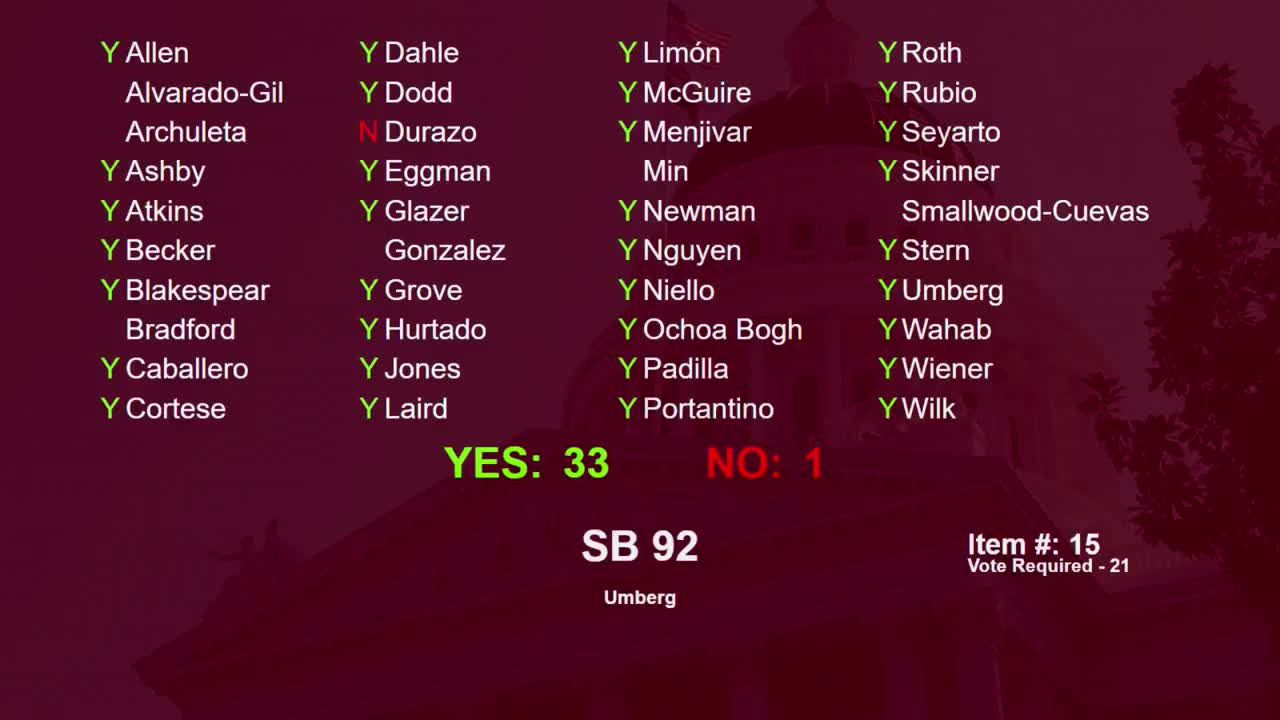
Bill Author

Bill Co-Author(s):