SB 920: California Purple Star School Designation Program.
- Session Year: 2023-2024
- House: Senate
- Latest Version Date: 2024-09-29
Current Status:
Passed
(2024-09-29: Chaptered by Secretary of State. Chapter 923, Statutes of 2024.)
Introduced
In Committee
First Chamber
In Committee
Second Chamber
Enacted
Existing law requires the State Department of Education to establish a formal liaison with the United States Department of Defense and school districts and county offices of education that enroll military dependents to, among other things, create model memoranda of agreement between military bases and school districts or county offices of education regarding enabling schoolage military dependents to experience a smoother transition from one school to another school. Existing law authorizes a governing board of a school district and a county office of education to undertake certain activities to properly address the needs of military dependents.
This bill would require the State Department of Education to establish a nonmonetary California Purple Star School Designation Program to reduce the burden on military-connected pupils and their families and to publicly recognize and designate public schools that meet certain requirements related to supporting military-connected pupils and their families unique needs, as provided. The bill would require the department to develop an annual application process and adopt application criteria for the California Purple Star School Designation Program, as specified, and would provide that a Purple Star School designation is valid for 3 years, after which a schoolsite seeking to renew its designation is required to reapply.
Existing law requires the State Department of Education to establish a formal liaison with the United States Department of Defense and school districts and county offices of education that enroll military dependents to, among other things, create model memoranda of agreement between military bases and school districts or county offices of education regarding enabling schoolage military dependents to experience a smoother transition from one school to another school. Existing law authorizes a governing board of a school district and a county office of education to undertake certain activities to properly address the needs of military dependents.
This bill would require the State Department of Education to establish a nonmonetary California Purple Star School Designation Program to reduce the burden on military-connected pupils and their families and to publicly recognize and designate public schools that meet certain requirements related to supporting military-connected pupils and their families unique needs, as provided. The bill would establish require the department to develop an annual application process and adopt application criteria for the California Purple Star School Designation Program, as specified, and require schools that earn the award to apply for recertification every 3 years.
Existing law requires the State Department of Education to establish a formal liaison with the United States Department of Defense and school districts and county offices of education that enroll military dependents to, among other things, create model memoranda of agreement between military bases and school districts or county offices of education regarding enabling schoolage military dependents to experience a smoother transition from one school to another school. Existing law authorizes a governing board of a school district and a county office of education to undertake certain activities to properly address the needs of military dependents.
This bill would require the State Department of Education to establish a nonmonetary California Purple Star School Designation Program to reduce the burden on military-connected pupils and their families and to publicly recognize and designate public schools that meet certain requirements related to supporting military-connected pupils and their families unique needs, as provided. The bill would establish an annual application process for the California Purple Star School Designation Program, as specified, and require schools that earn the award to apply for recertification every 3 years.
(a)The department shall establish a nonmonetary California Purple Star School Designation Program pursuant to this article in order to achieve both of the following goals:
(1)Reduce the burden on military-connected pupils and their families by articulating the most critical transition supports for military-connected pupils and their families.
(2)Publicly recognize and designate schools that meet certain requirements and signal which schools are the most committed and best equipped to meet military-connected pupils and their families unique needs.
(b)(1)The department shall develop an application process that provides annual opportunities for schoolsites to earn the Purple Star School designation by demonstrating compliance with the application criteria adopted pursuant to paragraph (2).
(2)The department shall adopt application criteria for schoolsites seeking the Purple Star School designation. The department shall consider including, as part of the application criteria, a requirement that a schoolsite do all of following:
(A)Demonstrate an active status designation, as identified by the department on the departments internet website.
(B)Designate a staff member to serve as a point of contact, who shall act as a liaison between military families and the schoolsite, easing military-connected pupils enrollment and acclimation period, and assist with pupils graduation requirements.
(C)Provide professional development opportunities to train staff on the unique considerations for, and needs of, military-connected pupils.
(D)Develop a dedicated webpage on the schoolsites internet website with easily accessible information and resources for military-connected families.
(E)Provide a transition program to welcome and socially acclimate incoming military-connected pupils. This transition program may be pupil led.
(F)Provide programming and events to include, celebrate, and honor service members and military-connected pupils and families, including community members.
(c)(1)Once a schoolsite is awarded a Purple Star School designation, it shall display its active status designation, as identified by the department, on the schoolsites internet website.
(2)A Purple Star School designation shall be valid for three years, after which a schoolsite seeking to renew its designation shall reapply pursuant to subdivision (b).
(3)The department may request additional information to verify if a schoolsite that has earned a Purple Star School designation continues to adhere to the Purple Star School designation criteria adopted pursuant to paragraph (2) of subdivision (b).
(4)(A)Notwithstanding paragraphs (1) and (2), if the department finds that a schoolsite that has earned a Purple Star School designation ceases to comply with the criteria adopted pursuant to paragraph (2) of subdivision (b) during the three-year designation period, the schoolsite shall lose the designation.
(B)A schoolsite that loses the designation pursuant to subparagraph (A) may reapply pursuant to subdivision (b).
(d)For purposes of this section, the following definitions apply:
(1)Military-connected pupil means a schoolage child who is either of the following:
(A)A dependent of a current or former member of any of the following:
(i)The United States military, serving in the United States Air Force, United States Army, United States Coast Guard, United States Marine Corps, United States Navy, or United States Space Force on active duty.
(ii)The California National Guard.
(iii)A reserve force of the United States military.
(B)Was a dependent of a member of a military or reserve force described in subparagraph (A) who was killed in the line of duty.
(2)Schoolsite means a publicly funded school serving pupils in kindergarten or any of grades 1 to 12, inclusive.
(a)The department shall establish a nonmonetary California Purple Star School Designation Program pursuant to this article in order to achieve both of the following goals:
(1)Reduce the burden on military-connected pupils and their families by articulating the most critical transition supports for military-connected pupils and their families.
(2)Publicly recognize and designate schools that meet certain requirements and signal which schools are the most committed and best equipped to meet military-connected pupils and their families unique needs.
(b)(1)In order to qualify for a Purple Star School designation from the department, an individual schoolsite shall do all of the following:(b)(1)The department shall develop an application process that provides annual opportunities for schoolsites to earn the Purple Star School designation by demonstrating compliance with the application criteria adopted pursuant to paragraph (2).
(2)The department shall adopt application criteria for schoolsites seeking the Purple Star School designation. The department shall consider including, as part of the application criteria, a requirement that a schoolsite do all of following:
(A)Demonstrate an active status designation, as identified by the department on its the departments internet website.
(B)Designate a staff member to serve as a point of contact, who shall act as a liaison between military families and the schoolsite, easing military-connected pupils enrollment and acclimation period. period, and assist with pupils graduation requirements.
(C)Provide professional development opportunities to train staff on the unique considerations for, and needs of, military-connected pupils.
(D)Develop a dedicated webpage on the schoolsites internet website with easily accessible information and resources for military-connected families.
(E)Provide a transition program to welcome and socially acclimate incoming military-connected pupils. This transition program may be pupil led.
(F)Hire, or continue to employ, an individual who specializes in the Interstate Compact on Educational Opportunity for Military Children and addressing military-connected pupils graduation requirements.(2)In addition to the requirements in paragraph (1), schoolsites may provide programming and events to include, celebrate, and honor service members and military-connected pupils and families, including community members.(c)The department shall develop an application process that provides annual opportunities for schoolsites to earn the Purple Star School designation by demonstrating compliance with the requirements of paragraph (1) of subdivision (b).(F)Provide programming and events to include, celebrate, and honor service members and military-connected pupils and families, including community members.
(c)(1)Once a schoolsite is awarded a Purple Star School designation, it shall display its active status designation, as identified by the department, on the schoolsites internet website.
(d)(1)(2)A Purple Star School designation shall be valid for three years, after which a schoolsite seeking to renew its designation shall reapply pursuant to subdivision (c). (b).
(3)The department may request additional information to verify if a schoolsite that has earned a Purple Star School designation continues to adhere to the Purple Star School designation criteria adopted pursuant to paragraph (2) of subdivision (b).
(2)(4)(A)Notwithstanding paragraph (1), paragraphs (1) and (2), if the department finds that a schoolsite that has earned a Purple Star School designation that ceases to comply with the requirements of criteria adopted pursuant to paragraph (1) (2) of subdivision (b) during the three-year designation period period, the schoolsite shall lose the designation.
(B)A schoolsite that loses the designation pursuant to subparagraph (A) may reapply pursuant to subdivision (c). (b).
(e)(d)For purposes of this section, the following definitions apply:
(1)Military-connected pupil means a schoolage child who is either of the following:
(A)A dependent of a current or former member of any of the following:
(i)The United States military, serving in the United States Air Force, United States Army, United States Coast Guard, United States Marine Corps, United States Navy, or United States Space Force on active duty.
(ii)The California National Guard.
(iii)A reserve force of the United States military.
(B)Was a dependent of a member of a military or reserve force described in subparagraph (A) who was killed in the line of duty.
(2)Schoolsite means a publicly funded school serving pupils in kindergarten or any of grades 1 to 12, inclusive.
(a)The department shall establish a nonmonetary California Purple Star School Designation Program pursuant to this article in order to achieve both of the following goals:
(1)Reduce the burden on military-connected pupils and their families by articulating the most critical transition supports for military-connected pupils and their families.
(2)Publicly recognize and designate schools that meet certain requirements and signal which schools are the most committed and best equipped to meet military-connected pupils and their families unique needs.
(b)(1)In order to qualify for a Purple Star School designation from the department, an individual schoolsite shall do all of the following:
(A)Demonstrate an active status designation, as identified by the department on its internet website.
(B)Designate a staff member to serve as a point of contact, who shall act as a liaison between military families and the schoolsite, easing military-connected pupils enrollment and acclimation period.
(C)Provide professional development opportunities to train staff on the unique considerations for, and needs of, military-connected pupils.
(D)Develop a dedicated webpage on the schoolsites internet website with easily accessible information and resources for military-connected families.
(E)Provide a transition program to welcome and socially acclimate incoming military-connected pupils. This transition program may be pupil led.
(F)Hire, or continue to employ, an individual who specializes in the Interstate Compact on Educational Opportunity for Military Children and addressing military-connected pupils graduation requirements.
(2)In addition to the requirements in paragraph (1), schoolsites may provide programming and events to include, celebrate, and honor service members and military-connected pupils and families, including community members.
(c)The department shall develop an application process that provides annual opportunities for schoolsites to earn the Purple Star School designation by demonstrating compliance with the requirements of paragraph (1) of subdivision (b).
(d)(1)A Purple Star School designation shall be valid for three years, after which a schoolsite seeking to renew its designation shall reapply pursuant to subdivision (c).
(2)(A)Notwithstanding paragraph (1), a schoolsite that has earned a Purple Star School designation that ceases to comply with the requirements of paragraph (1) of subdivision (b) during the three-year designation period shall lose the designation.
(B)A schoolsite that loses the designation pursuant to subparagraph (A) may reapply pursuant to subdivision (c).
(e)For purposes of this section, the following definitions apply:
(1)Military-connected pupil means a schoolage child who is either of the following:
(A)A dependent of a current or former member of any of the following:
(i)The United States military, serving in the United States Air Force, United States Army, United States Coast Guard, United States Marine Corps, United States Navy, or United States Space Force on active duty.
(ii)The California National Guard.
(iii)A reserve force of the United States military.
(B)Was a dependent of a member of a military or reserve force described in subparagraph (A) who was killed in the line of duty.
(2)Schoolsite means a publicly funded school serving pupils in kindergarten or any of grades 1 to 12, inclusive.
|
Date
|
Status
|
|---|---|
| Sep 29, 2024 | Chaptered by Secretary of State. Chapter 923, Statutes of 2024. |
| Sep 29, 2024 | Approved by the Governor. |
| Sep 3, 2024 | Enrolled and presented to the Governor at 3 p.m. |
| Aug 26, 2024 | In Senate. Ordered to engrossing and enrolling. |
| Aug 26, 2024 | Read third time. Passed. (Ayes 77. Noes 0. Page 6520.) Ordered to the Senate. |
| Aug 19, 2024 | Read second time. Ordered to third reading. |
| Aug 15, 2024 | From committee: Do pass. (Ayes 14. Noes 0.) (August 15). |
| Aug 7, 2024 | August 7 set for first hearing. Placed on suspense file. |
| Jun 26, 2024 | From committee: Do pass and re-refer to Com. on APPR. (Ayes 9. Noes 0.) (June 25). Re-referred to Com. on APPR. |
| Jun 13, 2024 | From committee: Do pass and re-refer to Com. on M. & V.A. with recommendation: To consent calendar. (Ayes 7. Noes 0.) (June 12). Re-referred to Com. on M. & V.A. |
| Jun 3, 2024 | Referred to Coms. on ED. and M. & V.A. |
| May 24, 2024 | In Assembly. Read first time. Held at Desk. |
| May 23, 2024 | Read third time. Passed. (Ayes 37. Noes 0. Page 4177.) Ordered to the Assembly. |
| May 20, 2024 | Ordered to special consent calendar. |
| May 16, 2024 | Read second time. Ordered to third reading. |
| May 16, 2024 | From committee: Do pass. (Ayes 7. Noes 0. Page 3964.) (May 16). |
| May 10, 2024 | Set for hearing May 16. |
| Apr 22, 2024 | April 22 hearing: Placed on APPR suspense file. |
| Apr 12, 2024 | Set for hearing April 22. |
| Apr 9, 2024 | From committee: Do pass and re-refer to Com. on APPR with recommendation: To consent calendar. (Ayes 5. Noes 0. Page 3512.) (April 8). Re-referred to Com. on APPR. |
| Mar 28, 2024 | Set for hearing April 8. |
| Mar 21, 2024 | Read second time and amended. Re-referred to Com. on M. & V.A. |
| Mar 20, 2024 | From committee: Do pass as amended and re-refer to Com. on M. & V.A. with recommendation: To consent calendar. (Ayes 7. Noes 0. Page 3377.) (March 20). |
| Mar 1, 2024 | Set for hearing March 20. |
| Feb 14, 2024 | Referred to Coms. on ED. and M. & V.A. |
| Jan 11, 2024 | From printer. May be acted upon on or after February 10. |
| Jan 10, 2024 | Introduced. Read first time. To Com. on RLS. for assignment. To print. |
|
Date
|
Description
|
Location
|
Votes
|
|
|---|---|---|---|---|
| Aug 26, 2024 | SB 920 Seyarto Senate Third Reading By Mathis | Assembly Floor |
Passed |
|
| Aug 15, 2024 | Do pass. | Assembly Standing Committee on Appropriations |
Passed |
|
| Jun 25, 2024 | Do pass and be re-referred to the Committee on [Appropriations] | Assembly Standing Committee on Military and Veterans Affairs |
Passed |
|
| Jun 12, 2024 | Do pass and be re-referred to the Committee on [Military and Veterans Affairs] with recommendation: To Consent Calendar | Assembly Standing Committee on Education |
Passed |
|
| May 23, 2024 | Special Consent SB920 Seyarto et al. | Senate Floor |
Passed |
|
| May 16, 2024 | Do pass | Senate Standing Committee on Appropriations |
Passed |
|
| Apr 22, 2024 | Placed on suspense file | Senate Standing Committee on Appropriations |
Passed |
|
| Apr 8, 2024 | Do pass, but first be re-referred to the Committee on [Appropriations] with the recommendation: To Consent Calendar | Senate Standing Committee on Military and Veterans Affairs |
Passed |
|
| Mar 20, 2024 | Do pass as amended, but first amend, and re-refer to the Committee on [Military and Veterans Affairs] with the recommendation: To Consent Calendar | Senate Standing Committee on Education |
Passed |
This list shows positions taken on this bill by organizations on the date displayed, which is linked to the original source.
Positions by individuals are not included.
SENATE THIRD READING
STR Bill Id:SB 920
Author:(Seyarto)
As Amended Ver:March 21, 2024
Majority vote
SUMMARY
Codifies the existing Purple Star School Designation Program, which was established by the California Department of Education (CDE) in 2022.
Major Provisions
- Requires the CDE to establish a nonmonetary California Purple Star School Designation Program pursuant to this article in order to achieve both of the following goals:
- Reduce the burden on military-connected students and their families by articulating the most critical transition supports for military-connected students and their families; and
- Publicly recognize and designate schools that meet certain requirements and signal which schools are the most committed and best equipped to meet military-connected students and their families' unique needs.
- Requires the CDE to develop an application process that provides annual opportunities for schoolsites to earn the Purple Star School designation by demonstrating compliance with the application criteria.
- Requires the CDE to adopt application criteria for schoolsites seeking the Purple Star School designation. Requires the CDE to consider including, as part of the application criteria, a requirement that a schoolsite do all of the following:
- Demonstrate an active status designation, as identified by the CDE on the CDE's website;
- Designate a staff member to serve as a point of contact, to act as a liaison between military families and the schoolsite, easing military-connected students' enrollment and acclimation period, and assist with students' graduation requirements;
- Provide professional development opportunities to train staff on the unique considerations for, and needs of, military-connected students;
- Develop a dedicated webpage on the schoolsite's website with easily accessible information and resources for military-connected families;
- Provide a transition program to welcome and socially acclimate incoming military-connected students. This transition program may be student led; and
- Provide programming and events to include, celebrate, and honor service members and military-connected students and families, including community members.
- Requires that, once a schoolsite is awarded a Purple Star School designation, it display its active status designation, as identified by the CDE, on the schoolsite's website.
- Requires that a Purple Star School designation be valid for three years, after which a schoolsite seeking to renew its designation must reapply.
- Authorizes the CDE to request additional information to verify if a schoolsite that has earned a Purple Star School designation continues to adhere to the Purple Star School designation criteria.
- Requires that, if the CDE finds that a schoolsite that has earned a Purple Star School designation ceases to comply with the criteria, the schoolsite shall lose the designation.
- Permits a schoolsite that loses the designation to reapply.
- Establishes the following definitions:
- "Military-connected student" means a schoolage child who is either of the following:
- A dependent of a current or former member of any of the following:
- The United States military, serving in the United States Air Force, United States Army, United States Coast Guard, United States Marine Corps, United States Navy, or United States Space Force on active duty; and
- The California National Guard; or
- A reserve force of the United States military.
- Was a dependent of a member of a military or reserve force who was killed in the line of duty.
- Defines "schoolsite" to mean a publicly funded school serving students in kindergarten or any of grades one to 12, inclusive.
COMMENTS
Current Purple Star Schools program. In 2021, the Legislature passed Assembly Concurrent Resolution (ACR) 53 (Ward), Chapter 57, Statutes of 2021, which requested the CDE to establish and maintain a program designating schools as Purple Star Schools when those schools provided supports for children in military families. Before the start of the 2022-23 school year, the CDE established the Purple Star School Designation Program. As of February 2024, there are 127 schools with the designation.
According to the CDE, to receive the designation, a school site must meet the following requirements:
- Designated Point-of-Contact: A staff member to act as a liaison between military families and the school, easing military-connected students' enrollment and acclimation period;
- Professional Development: Trained staff on the unique considerations for and needs of military-connected students;
- Dedicated Web Page: A dedicated web page on the school's website with easily accessible information and resources for military-connected families;
- Transition Programs: A transition program to welcome and socially acclimate incoming military-connected students, which can be student-led; and
- Military Recognition: Programming and events to include, celebrate and honor service members and military-connected students and families, including community members. (Optional)
Once a school site has been awarded the Purple Star School Designation, the schoolsite does not have to apply again for three years. Once an application is approved for a Purple Star School designation, the CDE reserves the right to request additional information in subsequent years to verify that the school site continues to adhere to the purpose and requirements of the Purple Star Program.
Purple Star Schools. A review of Purple Star schools conducted by the Center for Public Research and Leadership at Columbia University found that while most Purple Star schools and districts already had programming for military-families in place before seeking designation, staff and faculty report that they have benefitted from the Purple Star application process and the encouragement to refine and expand programming related to the program designation requirements. The study also found that of the core designation requirements, selecting a point-of-contact, training more staff and faculty, and establishing new student transition programs are commonly cited as the highest-impact activities.
California School Recognition Program. The CDE currently administers a number of recognition programs known collectively as the California School Recognition Program (CSRP).
Begun in 1986, these programs have been developed voluntarily by the Superintendent of Public Instruction (SPI) over time, not through statute, and are supported by private funds. The CSRP includes the following recognitions:
- California Exemplary Arts Education;
- California Exemplary Physical Activity and Nutrition Education;
- California Exemplary Career Technical Education;
- California Exemplary Districts;
- California Green Ribbon Schools;
- California Purple Star School Designation;
- California Teachers of the Year;
- Civic Learning Award;
- Classified School Employees of the Year;
- Model Continuation High School Recognition Program;
- National Blue Ribbon Schools; and
- National Elementary and Secondary Education Act (ESEA) Distinguished Schools.
According to the CDE, the award programs recognize sustained student achievement, excellence in environmental program design, or superior job performance, and community involvement.
The Assembly may wish to consider that, as nothing in current law precludes the current SPI from developing a recognition program, and the SPI has already established this program pursuant to ACR 53 (Ward), Chapter 53, Statutes of 2021, this bill is not necessary, and that it would a precedent for the other school recognition programs.
Military-connected students in California. According to the U.S. Department of Defense (DOD), California is home to the largest number of active-duty military personnel in the country, with 155,000 active duty personnel, representing 13.5% of the national force. According to the CDE, in the 2021-22 school year there were 46,587 military connected students in California, down from 56,127 in 2017. According to the author, these students were affiliated with 30 different military commands throughout the state, with the largest concentration in San Diego County.
According to the Author
"The Purple Star School program is a successful way for military families to be able to identify where they will meet the understanding and support they deserve for their unique needs. Taking this program from an option to a guarantee is a no-brainer and pledges a benefit we are happy to offer to those who have served our country."
Arguments in Support
The San Diego Unified School District writes, "San Diego Unified is proud to have 25 designated Purple Star Schools recognized for their efforts to support military families. Our district has partnered with organizations to hire dedicated Military Family Life counselors who understand the unique needs of military-connected students and are equipped to address their emotional and social well-being. Additionally, in partnership with Military School Liaison officers, the district offers professional development opportunities for teachers and school staff. By increasing awareness about the barriers, rights, and needs of military children, these initiatives foster a more inclusive and supportive educational environment. San Diego Unified also holds annual military resource fairs to help new military families connect with supports and services available within the district and in the larger region. From offering streamlined enrollment, to celebrating the Month of the Military Child with resources and activities that recognize our military families, San Diego Unified strives to ensure our military students feel welcomed and supported at school.
SB 920 will enshrine the Purple Star School Program in state law, to ensure that its existence and support does not fall away and is instead a program that military families can rely and count on in years to come."
Arguments in Opposition
None on file.
FISCAL COMMENTS
According to the Assembly Appropriations Committee:
- Ongoing General Fund costs, potentially in the low hundreds of thousands of dollars, for staff at CDE.
- According to CDE, although CDE has implemented the program within existing resources thus far, it would need $371,000 and three positions to make the Purple Star School Designation Program permanent and "expand program implementation depth and breadth." CDE also indicates these positions could support the state's participation in a related unfunded mandate, the Military Interstate Children's Compact Commission (MIC3), described in more detail in comment 2, below.
- According to the Legislative Analyst's Office, the General Fund faces a structural deficit in the tens of billions of dollars over the next several fiscal years.
VOTES
SENATE FLOOR: 37-0-3
YES: Alvarado-Gil, Ashby, Atkins, Becker, Blakespear, Bradford, Caballero, Cortese, Dahle, Dodd, Durazo, Eggman, Glazer, Gonzalez, Grove, Hurtado, Jones, Laird, Limón, McGuire, Menjivar, Min, Nguyen, Niello, Ochoa Bogh, Padilla, Portantino, Roth, Rubio, Seyarto, Skinner, Smallwood-Cuevas, Stern, Umberg, Wahab, Wiener, Wilk
ABS, ABST OR NV: Allen, Archuleta, Newman
ASM EDUCATION: 7-0-0
YES: Muratsuchi, Addis, Alvarez, Bonta, Flora, Hoover, McCarty
ASM MILITARY AND VETERANS AFFAIRS: 9-0-1
YES: Schiavo, Davies, Addis, Lackey, Alvarez, Boerner, Juan Carrillo, Valencia, Villapudua
ABS, ABST OR NV: Mathis
ASM APPROPRIATIONS: 14-0-1
YES: Wicks, Sanchez, Arambula, Bryan, Calderon, Wendy Carrillo, Dixon, Mike Fong, Grayson, Haney, Hart, Pellerin, Ta, Villapudua
ABS, ABST OR NV: Jim Patterson
UPDATED
VERSION: March 21, 2024
CONSULTANT: Tanya Lieberman / ED. / (916) 319-2087 FN: 0003934
Date of Hearing: August 7, 2024
ASSEMBLY COMMITTEE ON APPROPRIATIONS
Buffy Wicks, Chair
SBPCA Bill Id:SB 920
Author:(Seyarto) – As Amended Ver:March 21, 2024
Policy Committee: | Education | Vote: | 7 - 0 |
Military and Veterans Affairs | 9 - 0 | ||
|
|
Urgency: No State Mandated Local Program: No Reimbursable: No
SUMMARY:
This bill codifies the existing Purple Star School Designation Program, which was established by the California Department of Education (CDE) in the 2022-23 school year.
Specifically, this bill establishes the Purple Star School Designation Program in statute and requires CDE to continue operating the program. The bill also codifies certain requirements for the program, such as application requirements and conditions under which a school shall lose its designation. To receive a designation, the bill requires a school to establish new student transition programming, train school staff on the needs of children of military families, and meet other criteria.
FISCAL EFFECT:
Ongoing General Fund costs, potentially in the low hundreds of thousands of dollars, for staff at CDE.
According to CDE, although CDE has implemented the program within existing resources thus far, it would need $371,000 and three positions to make the Purple Star School Designation Program permanent and “expand program implementation depth and breadth.” CDE also indicates these positions could support the state’s participation in a related unfunded mandate, the Military Interstate Children’s Compact Commission (MIC3), described in more detail in comment 2, below.
According to the Legislative Analyst’s Office, the General Fund faces a structural deficit in the tens of billions of dollars over the next several fiscal years.
COMMENTS:
- Purpose. According to the author:
The Purple Star School program is a successful way for military families to be able to identify where they will meet the understanding and support they deserve for their unique needs. Taking this program from an option to a guarantee is a no-brainer and pledges a benefit we are happy to offer to those who have served our country.
- Background. Most states, including California participate in the MIC3. The Department of Defense, in collaboration with the national Center for Interstate Compacts and Council of State Governments, developed the MIC3 compact to address educational transition issues for children of military families including enrollment, transfer of school records and on-time graduation. States pay annual dues of $66,000 for membership in the compact. AB 343 (Saldana), Chapter 237, Statutes of 2009, requires the Superintendent of Public Instruction to appoint a state commissioner and codified the requirements of the compact.
Some states also designate schools as Purple Star Schools. To receive a designation, a school must typically meet certain requirements, including establishment of new student transition programming and provision of training to school staff on the needs of children of military families.
ACR 53 (Ward), Chapter 57, Statutes of 2021, requested CDE establish and manage a program to designate a school that supports children of military families as a Purple Star School. Prior to the start of the 2022-23 school year, CDE established the Purple Star School program as part of its designation and recognition programs known collectively as the California School Recognition Program. The programs includes designations and recognitions for arts education, career technical education, teachers of the year, and national programs like Blue Ribbon schools. These programs have been developed voluntarily by the CDE over time, but are not established in statute, and are supported by private funds. As of February 2024, 127 schools have earned a Purple Star School designation.
This bill establishes the Purple Star Program in statute, requires CDE to continue operating the program, and codifies certain requirements for the program.
Analysis Prepared by: Natasha Collins / APPR. / (916) 319-2081
Date of Hearing: June 25, 2024
ASSEMBLY COMMITTEE ON MILITARY AND VETERANS AFFAIRS
Pilar Schiavo, Chair
SBPCA Bill Id:SB 920
Author:(Seyarto) – As Amended Ver:March 21, 2024
SENATE VOTE: 37-0
SUBJECT: California Purple Star School Designation Program
SUMMARY: Codifies the existing Purple Star School Designation Program, which was established by the California Department of Education (CDE) in 2022. Specifically, this bill:
- Requires the CDE to establish a nonmonetary California Purple Star School Designation Program pursuant to this article in order to achieve both of the following goals:
- Reduce the burden on military-connected students and their families by articulating the most critical transition supports for military-connected students and their families; and
- Publicly recognize and designate schools that meet certain requirements and signal which schools are the most committed and best equipped to meet military-connected students and their families’ unique needs.
- Requires the CDE to develop an application process that provides annual opportunities for schools to earn the Purple Star School designation by demonstrating compliance with the application criteria.
- Requires the CDE to adopt application criteria for schools seeking the Purple Star School designation. Requires the CDE to consider including, as part of the application criteria, a requirement that schools do all of the following:
- Demonstrate an active status designation, as identified by the CDE on the CDE’s website;
- Designate a staff member to serve as a point of contact, to act as a liaison between military families and the schools, easing military-connected students’ enrollment and acclimation period, and assist with students’ graduation requirements;
- Provide professional development opportunities to train staff on the unique considerations for, and needs of, military-connected students;
- Develop a dedicated webpage on the schools website with easily accessible information and resources for military-connected families;
- Provide a transition program to welcome and socially acclimate incoming military-connected students. This transition program may be student led; and
- Provide programming and events to include, celebrate, and honor service members and military-connected students and families, including community members.
- Requires that, once a schools is awarded a Purple Star School designation, it display its active status designation, as identified by the CDE, on the schools website.
- Requires that a Purple Star School designation be valid for three years, after which a schools seeking to renew its designation must reapply.
- Authorizes the CDE to request additional information to verify if a schools that has earned a Purple Star School designation continues to adhere to the Purple Star School designation criteria.
- Requires that, if the CDE finds that a schools that has earned a Purple Star School designation ceases to comply with the criteria, the schools shall lose the designation.
- Permits a schools that loses the designation to reapply.
- Establishes the following definitions:
- “Military-connected student” means a school age child who is either of the following:
- A dependent of a current or former member of any of the following:
- The United States military, serving in the United States Air Force, United States Army, United States Coast Guard, United States Marine Corps, United States Navy, or United States Space Force on active duty; and
- The California National Guard; or
- A reserve force of the United States military.
- Was a dependent of a member of a military or reserve force who was killed in the line of duty.
- Defines “schools” to mean a publicly funded school serving students in kindergarten or any of grades 1 to 12, inclusive.
EXISTING LAW:
- Defines “a student who is a child of a military family” as a school-aged child who is living in the household of an active duty service member. This is the same definition used in current law for purposes of Interstate Compact on Educational Opportunity for Military Children. (Education Code (EC) 49701)
- Requires local educational agencies (LEAs), including charter schools, to exempt a student of a military family who transfers between schools any time after the completion of the student’s second year of high school from all coursework and other requirements that are in excess of state graduation requirements, unless the school district makes a finding that the student is reasonably able to complete the school district’s graduation requirements in time to graduate from high school by the end of the student’s fourth year of high school. (EC 51225.1)
- Requires that, if an LEA determines that a student of a military family is reasonably able to complete graduation requirements within the students’ fifth year of high school, the LEA:
- Inform the student of their option to remain in school for a fifth year to complete the school district’s graduation requirements;
- Inform the student about how remaining in school for a fifth year to complete the graduation requirements will affect the student’s ability to gain admission to a postsecondary educational institution;
- Provide information to the student about transfer opportunities available through the California Community Colleges; and
- Permit the student to stay in school for a fifth year to complete the graduation requirements. (EC 51225.1)
- Requires that, within 30 calendar days of the date that a student who is a child of a military family may qualify for this exemption, the LEA notify the student and the student’s parent or guardian of the availability of the exemption. (EC 51225.1)
- Requires that, if the LEA fails to provide this notice, the student of a military family remain eligible for the exemption. (EC 51225.1)
- Places other requirements on LEAs intended to ensure that students are not required to graduate before the end of their fourth year of high school, that students are aware of the impact of the waived graduation requirements on postsecondary educational institution admission, and that the exemption continues to be in effect even if the student no longer meets the definition of a child of a military family. (EC 51225.1)
- Requires an LEA to accept coursework satisfactorily completed by a student of a military family while attending another public school even if the student did not complete the entire course, and requires that the student be issued full or partial credit for work completed. (EC 51225.2)
- Prohibits a student who is a child of a military family from being required to take a course if the student has satisfactorily completed the entire course in another school. (EC 51225.2)
- Prohibits a student who is a child of a military family from being prevented from retaking or taking a course to meet the eligibility requirements for the California State University or the University of California. (EC 51225.2)
- Requires that a student who is the child of a military family be allowed to remain in his or her school of origin, and to matriculate with his or her peers in accordance with the established feeder patterns of school districts. (EC 48204.6)
- Establishes the Interstate Compact on Educational Opportunity for Military Children, which addresses educational transition issues of children of military families.
- Prohibits a school district of residence from prohibiting the transfer of a student who is a child of an active military duty parent to a school in any school district, if the school district to which the parents of the student applies approves the application for transfer. (EC 49700)
FISCAL EFFECT: According to the Senate Appropriations Committee, the CDE estimates General Fund costs of $371,000 and 3.0 positions to implement the provisions of this bill.
COMMENTS: The purpose of this bill is to mandate in statute the continued existence of the California Department of Education’s Purple Star School Designation program,
According to the author, “The Purple Star School program is a successful way for military families to be able to identify where they will meet the understanding and support they deserve for their unique needs. Taking this program from an option to a guarantee is a no-brainer and pledges a benefit we are happy to offer to those who have served our country.”
The Purple Star School Program. In 2021, the Legislature passed Assembly Concurrent Resolution (ACR) 53, which requested the CDE to establish and maintain a program designating schools as Purple Star Schools when those schools provided supports for children in military families. Before the start of the 2022-23 school year, the CDE established the Purple Star School Designation Program. As of February 2024, there are 127 schools with the designation.
According to the CDE, to receive the designation, a school site must meet the following requirements:
- Designated Point-of-Contact: A staff member to act as a liaison between military families and the school, easing military-connected students’ enrollment and acclimation period;
- Professional Development: Trained staff on the unique considerations for and needs of military-connected students;
- Dedicated Web Page: A dedicated web page on the school’s website with easily accessible information and resources for military-connected families;
- Transition Programs: A transition program to welcome and socially acclimate incoming military-connected students, which can be student-led; and
- Military Recognition: Programming and events to include, celebrate and honor service members and military-connected students and families, including community members. (Optional)
Once a school site has been awarded the Purple Star School Designation, the school does not have to apply again for three years. Once an application is approved for a Purple Star School designation, the CDE reserves the right to request additional information in subsequent years to verify that the school site continues to adhere to the purpose and requirements of the Purple Star Program.
A review of Purple Star schools conducted by the Center for Public Research and Leadership at Columbia University found that while most Purple Star schools and districts already had programming for military-families in place before seeking designation, staff and faculty report that they have benefitted from the Purple Star application process and the encouragement to refine and expand programming related to the program designation requirements. The study also found that of the core designation requirements, selecting a point-of-contact, training more staff and faculty, and establishing new student transition programs are commonly cited as the highest-impact activities
Military-connected students in California.
According to the U.S. Department of Defense (DOD), there are 158,000 active duty service members in California, more than any other state, representing 14 percent of the active component. According to the CDE, in the 2021-22 school year there were 46,587 military connected students in California, down from 56,127 in 2017. According to the author, these students were distributed across 30 different military commands throughout the state, with the largest concentration in San Diego County.
The Assembly Committee on Education has written a detailed analysis of the effects of mobility on academic success and the performance of military dependent students in California. In sum, the high degree of mobility demanded by an active duty military career can have a significant negative effect on reading and math achievement, and some research indicates increased risk of suicidal ideation and behavior, but military dependent students in California slightly outperform their peers in state assessments.
Interstate Compact on Educational Opportunity for Military Children.
The DOD, in collaboration with the National Center for Interstate Compacts and the Council of State Governments, developed the Interstate Compact on Educational Opportunity for Military Children (Compact) to address educational transition issues of children of military families.
The goal of the Compact is to ensure that the children of military families are afforded the same opportunities for educational success as other children, and are not penalized or delayed in achieving their educational goals. States participating in the Compact work to coordinate graduation requirements, transfer of records, course placement, and other administrative policies. According to the DOD, all 50 States and the District of Columbia participate in the interstate compact. California adopted the Compact in the state’s Education Code in 2009. The Compact addresses a number of topics, including:
- Timely enrollment;
- Transfer of school records;
- School placement;
- Eligibility for enrollment and participation in school programs, athletics, and extracurricular activities; and
- On-time graduation.
A 2014 CDE review of the implementation of the Compact in California found variations in implementation across districts. The report suggested that California undertake a more comprehensive effort to ensure that school district personnel and military families are maximally familiar with the provisions of the Compact so that its provisions are applied consistently. The report also found that California’s membership in the Compact has substantially aided both school districts and military families by alleviating many of the educational difficulties military children encounter in their frequent moves from a school in one state to a school in another state.
Related legislation
ACR 53 (Ward), Chapter 53, Statutes of 2021, requests the CDE to establish and manage a program designating schools that support military-connected students as Purple Star Schools and use the Military Child Education Coalition for resources and information regarding the Purple Star School Program.
AB 2949 (Gloria), Chapter 327, Statutes of 2018, requires that a student who is the child of a military family be allowed to remain in his or her school of origin and to matriculate with his or her peers in accordance with the established feeder patterns of school districts.
AB 365 (Muratsuchi), Chapter 739, Statutes of 2017, extends to students from military families certain rights regarding exemptions from local graduation requirements and acceptance of partial credit which are currently afforded to other groups of highly mobile students.
SB 455 (Newman), Chapter 239, Statutes of 2017, establishes that a student whose parent is transferred or is pending transfer to a military installation within the state while on active military duty pursuant to an official military order has complied with the residency requirements for school attendance in any school district.
AB 306 (Hadley), Chapter 771, Statutes of 2016, prohibits a school district of residence from prohibiting the transfer of a student who is a child of an active military duty parent to a school in any school district, if the school district to which the parents of the student applies approves the application for transfer.
AB 2102 (Saldana), Chapter 608, Statutes of 2006, establishes procedures, including requiring the CDE to establish a formal liaison with the DOD and school districts that enroll military dependents, to facilitate and smooth the transfer of school-age military dependents and their school records.
REGISTERED SUPPORT / OPPOSITION:
Support
San Diego Unified School District
Opposition
None on file.
Analysis Prepared by: Christian Burkin / M. & V.A. / (916) 319-3550
Date of Hearing: June 12, 2024
ASSEMBLY COMMITTEE ON EDUCATION
Al Muratsuchi, Chair
SBPCA Bill Id:SB 920
Author:(Seyarto) – As Amended Ver:March 21, 2024
[Note: This bill was double referred to the Assembly Committee on Military and Veterans Affairs and will be heard by that Committee as it relates to issues under its jurisdiction.]
SENATE VOTE: 37-0
SUBJECT: California Purple Star School Designation Program
SUMMARY: Codifies the existing Purple Star School Designation Program, which was established by the California Department of Education (CDE) in 2022. Specifically, this bill:
- Requires the CDE to establish a nonmonetary California Purple Star School Designation Program pursuant to this article in order to achieve both of the following goals:
- Reduce the burden on military-connected students and their families by articulating the most critical transition supports for military-connected students and their families; and
- Publicly recognize and designate schools that meet certain requirements and signal which schools are the most committed and best equipped to meet military-connected students and their families’ unique needs.
- Requires the CDE to develop an application process that provides annual opportunities for schoolsites to earn the Purple Star School designation by demonstrating compliance with the application criteria.
- Requires the CDE to adopt application criteria for schoolsites seeking the Purple Star School designation. Requires the CDE to consider including, as part of the application criteria, a requirement that a schoolsite do all of the following:
- Demonstrate an active status designation, as identified by the CDE on the CDE’s website;
- Designate a staff member to serve as a point of contact, to act as a liaison between military families and the schoolsite, easing military-connected students’ enrollment and acclimation period, and assist with students’ graduation requirements;
- Provide professional development opportunities to train staff on the unique considerations for, and needs of, military-connected students;
- Develop a dedicated webpage on the schoolsite’s website with easily accessible information and resources for military-connected families;
- Provide a transition program to welcome and socially acclimate incoming military-connected students. This transition program may be student led; and
- Provide programming and events to include, celebrate, and honor service members and military-connected students and families, including community members.
- Requires that, once a schoolsite is awarded a Purple Star School designation, it display its active status designation, as identified by the CDE, on the schoolsite’s website.
- Requires that a Purple Star School designation be valid for three years, after which a schoolsite seeking to renew its designation must reapply.
- Authorizes the CDE to request additional information to verify if a schoolsite that has earned a Purple Star School designation continues to adhere to the Purple Star School designation criteria.
- Requires that, if the CDE finds that a schoolsite that has earned a Purple Star School designation ceases to comply with the criteria, the schoolsite shall lose the designation.
- Permits a schoolsite that loses the designation to reapply.
- Establishes the following definitions:
- “Military-connected student” means a schoolage child who is either of the following:
- A dependent of a current or former member of any of the following:
- The United States military, serving in the United States Air Force, United States Army, United States Coast Guard, United States Marine Corps, United States Navy, or United States Space Force on active duty; and
- The California National Guard; or
- A reserve force of the United States military.
- Was a dependent of a member of a military or reserve force who was killed in the line of duty.
- Defines “schoolsite” to mean a publicly funded school serving students in kindergarten or any of grades 1 to 12, inclusive.
EXISTING LAW:
- Defines “a student who is a child of a military family” as a school-aged child who is living in the household of an active duty service member. This is the same definition used in current law for purposes of Interstate Compact on Educational Opportunity for Military Children. (Education Code (EC) 49701)
- Requires local educational agencies (LEAs), including charter schools, to exempt a student of a military family who transfers between schools any time after the completion of the student’s second year of high school from all coursework and other requirements that are in excess of state graduation requirements, unless the school district makes a finding that the student is reasonably able to complete the school district’s graduation requirements in time to graduate from high school by the end of the student’s fourth year of high school. (EC 51225.1)
- Requires that, if an LEA determines that a student of a military family is reasonably able to complete graduation requirements within the students’ fifth year of high school, the LEA:
- Inform the student of their option to remain in school for a fifth year to complete the school district’s graduation requirements;
- Inform the student about how remaining in school for a fifth year to complete the graduation requirements will affect the student’s ability to gain admission to a postsecondary educational institution;
- Provide information to the student about transfer opportunities available through the California Community Colleges; and
- Permit the student to stay in school for a fifth year to complete the graduation requirements. (EC 51225.1)
- Requires that, within 30 calendar days of the date that a student who is a child of a military family may qualify for this exemption, the LEA notify the student and the student’s parent or guardian of the availability of the exemption. (EC 51225.1)
- Requires that, if the LEA fails to provide this notice, the student of a military family remain eligible for the exemption. (EC 51225.1)
- Places other requirements on LEAs intended to ensure that students are not required to graduate before the end of their fourth year of high school, that students are aware of the impact of the waived graduation requirements on postsecondary educational institution admission, and that the exemption continues to be in effect even if the student no longer meets the definition of a child of a military family. (EC 51225.1)
- Requires an LEA to accept coursework satisfactorily completed by a student of a military family while attending another public school even if the student did not complete the entire course, and requires that the student be issued full or partial credit for work completed. (EC 51225.2)
- Prohibits a student who is a child of a military family from being required to take a course if the student has satisfactorily completed the entire course in another school. (EC 51225.2)
- Prohibits a student who is a child of a military family from being prevented from retaking or taking a course to meet the eligibility requirements for the California State University or the University of California. (EC 51225.2)
- Requires that a student who is the child of a military family be allowed to remain in his or her school of origin, and to matriculate with his or her peers in accordance with the established feeder patterns of school districts. (EC 48204.6)
- Establishes the Interstate Compact on Educational Opportunity for Military Children, which addresses educational transition issues of children of military families.
- Prohibits a school district of residence from prohibiting the transfer of a student who is a child of an active military duty parent to a school in any school district, if the school district to which the parents of the student applies approves the application for transfer. (EC 49700)
FISCAL EFFECT: According to the Senate Appropriations Committee, the CDE estimates General Fund costs of $371,000 and 3.0 positions to implement the provisions of this bill.
COMMENTS:
Need for the bill. The author writes, “The Purple Star School program is a successful way for military families to be able to identify where they will meet the understanding and support they deserve for their unique needs. Taking this program from an option to a guarantee is a no-brainer and pledges a benefit we are happy to offer to those who have served our country.”
Current Purple Star Schools program. In 2021, the Legislature passed Assembly Concurrent Resolution (ACR) 53, which requested the CDE to establish and maintain a program designating schools as Purple Star Schools when those schools provided supports for children in military families. Before the start of the 2022-23 school year, the CDE established the Purple Star School Designation Program. As of February 2024, there are 127 schools with the designation.
According to the CDE, to receive the designation, a school site must meet the following requirements:
- Designated Point-of-Contact: A staff member to act as a liaison between military families and the school, easing military-connected students’ enrollment and acclimation period;
- Professional Development: Trained staff on the unique considerations for and needs of military-connected students;
- Dedicated Web Page: A dedicated web page on the school’s website with easily accessible information and resources for military-connected families;
- Transition Programs: A transition program to welcome and socially acclimate incoming military-connected students, which can be student-led; and
- Military Recognition: Programming and events to include, celebrate and honor service members and military-connected students and families, including community members. (Optional)
Once a school site has been awarded the Purple Star School Designation, the schoolsite does not have to apply again for three years. Once an application is approved for a Purple Star School designation, the CDE reserves the right to request additional information in subsequent years to verify that the school site continues to adhere to the purpose and requirements of the Purple Star Program.
Purple Star Schools. A review of Purple Star schools conducted by the Center for Public Research and Leadership at Columbia University found that while most Purple Star schools and districts already had programming for military-families in place before seeking designation, staff and faculty report that they have benefitted from the Purple Star application process and the encouragement to refine and expand programming related to the program designation requirements. The study also found that of the core designation requirements, selecting a point-of-contact, training more staff and faculty, and establishing new student transition programs are commonly cited as the highest-impact activities.
California School Recognition Program. The CDE currently administers a number of recognition programs known collectively as the California School Recognition Program (CSRP).
Begun in 1986, these programs have been developed voluntarily by the Superintendent of Public Instruction (SPI) over time, not through statute, and are supported by private funds. The CSRP includes the following recognitions:
- California Exemplary Arts Education;
- California Exemplary Physical Activity and Nutrition Education;
- California Exemplary Career Technical Education;
- California Exemplary Districts;
- California Green Ribbon Schools;
- California Purple Star School Designation;
- California Teachers of the Year;
- Civic Learning Award;
- Classified School Employees of the Year;
- Model Continuation High School Recognition Program;
- National Blue Ribbon Schools; and
- National Elementary and Secondary Education Act (ESEA) Distinguished Schools
According to the CDE, the award programs recognize sustained student achievement, excellence in environmental program design, or superior job performance, and community involvement.
The Committee may wish to consider that, as nothing in current law precludes the current SPI from developing a recognition program, and the SPI has already established this program pursuant to ACR 53 (Ward), Chapter 53, Statutes of 2021, this bill is not necessary, and that it would a precedent for the other school recognition programs.
Military-connected students in California. According to the U.S. Department of Defense (DOD), California is home to the largest number of active-duty military personnel in the country, with 155,000 active duty personnel, representing 13.5% of the national force. According to the CDE, in the 2021-22 school year there were 46,587 military connected students in California, down from 56,127 in 2017. According to the author, these students were affiliated with 30 different military commands throughout the state, with the largest concentration in San Diego County.
Academic achievement of military-connected students in California is slightly higher than the average. The federal Every Student Succeeds Act (ESSA), enacted in 2015, requires states to identify military students with a unique military identifier, in order to allow military student data to be analyzed as a separate subgroup. The identifier is intended to help assess military student performance, as well as to shed light on the relationship between military life and dependent child development.
Since the 2018-19 school year, state summative assessment data in English language arts and mathematics has been disaggregated for students from military families as a separate group. These data show that, for the 2022-23 school year, 50% of military students met or exceeded standards in English language arts, compared to a statewide average of 47%. In mathematics, 37% of military students met or exceeded standard, compared to a statewide average of 35%.
Effect of high mobility on academic success. According to the DOD, children from military families move an average of six to nine times during a school career, and 33% of these children are in transition annually. A 2012 report by the Military Child Education Coalition for the U.S. Army found that “graduation requirements, tiered diplomas, prerequisite courses, grading variations, and state high stakes testing are all challenges to the student in transition.”
Numerous studies indicate that student mobility is associated with poor educational outcomes. One meta-analysis (Mehana, 2004) on the effects of school mobility on reading and math achievement in the elementary grades found the equivalent of a 3–4 month performance disadvantage in achievement. Another study (Reynolds, 2009) found that frequent mobility was associated with significantly lower reading and math achievement by up to a third of a standard deviation, and that students who moved three or more times had rates of school dropout that was nearly one-third of a standard deviation higher than those who were school stable. One longitudinal study (Temple, 1999) found that half of the one year difference between mobile and non-mobile students could be attributed to mobility, and that it is “frequent, rather than occasional, mobility that significantly increases the risk of underachievement.” And another longitudinal study (Herbers, 2014) found that students who experience more school changes between kindergarten and twelfth grade are less likely to complete high school on time, complete fewer years of school, and attain lower levels of occupational prestige, even when controlling for poverty. Results of this study indicated more negative outcomes associated with moves later in the grade school career, particularly between fourth and eighth grade.
Knowledge gap on academic outcomes for students of military families. There is very little published data regarding the academic performance of students from military families. One area of inquiry has been the effect of long parental deployments on students’ academic performance, and one study (Richardson, 2011) found that students whose parents have been deployed 19 months or longer have modestly lower scores across all subjects and irrespective of the rank, component, seniority, or gender of the parent. Another study (Engel, 2010) of students in DOD schools found that long deployments and deployments during the month of testing had the most adverse effects, and that evidence suggests that these effects may persist for several years. A 2011 policy brief from the University of Southern California School of Social Work notes that “Living with fear that a parent – or another relative – serving in the military is in danger can traumatize a child to the point where it significantly affects their ability to function in the school environment.”
Other research has focused on risk factors which are associated with poor academic outcomes. One study (Sullivan, 2015), using data from the 2013 administration of the California Healthy Kids Survey, found that students from military families had greater odds of experience with substance use, physical violence, and nonphysical harassment than their peers. Another study (Gilreath, 2016) using the same data set found that California military-connected youth are at a higher risk for suicidal ideation, plans, attempts, and attempts requiring medical care because of suicidal behaviors.
Interstate Compact on Educational Opportunity for Military Children. The DOD, in collaboration with the National Center for Interstate Compacts and the Council of State Governments, developed the Interstate Compact on Educational Opportunity for Military Children (Compact) to address educational transition issues of children of military families.
The goal of the Compact is to ensure that the children of military families are afforded the same opportunities for educational success as other children, and are not penalized or delayed in achieving their educational goals. States participating in the Compact work to coordinate graduation requirements, transfer of records, course placement, and other administrative policies. According to the DOD, all 50 States and the District of Columbia participate in the interstate compact. California adopted the Compact in the state’s Education Code in 2009. The Compact addresses a number of topics, including:
- Timely enrollment;
- Transfer of school records;
- School placement;
- Eligibility for enrollment and participation in school programs, athletics, and extracurricular activities; and
- On-time graduation.
A 2014 CDE review of the implementation of the Compact in California found variations in implementation across districts. The report suggested that California undertake a more comprehensive effort to ensure that school district personnel and military families are maximally familiar with the provisions of the Compact so that its provisions are applied consistently. The report also found that California’s membership in the Compact has substantially aided both school districts and military families by alleviating many of the educational difficulties military children encounter in their frequent moves from a school in one state to a school in another state.
Arguments in support. The San Diego Unified School District writes, “San Diego Unified is proud to have 25 designated Purple Star Schools recognized for their efforts to support military families. Our district has partnered with organizations to hire dedicated Military Family Life counselors who understand the unique needs of military-connected students and are equipped to address their emotional and social well-being. Additionally, in partnership with Military School Liaison officers, the district offers professional development opportunities for teachers and school staff. By increasing awareness about the barriers, rights, and needs of military children, these initiatives foster a more inclusive and supportive educational environment. San Diego Unified also holds annual military resource fairs to help new military families connect with supports and services available within the district and in the larger region. From offering streamlined enrollment, to celebrating the Month of the Military Child with resources and activities that recognize our military families, San Diego Unified strives to ensure our military students feel welcomed and supported at school.
SB 920 will enshrine the Purple Star School Program in state law, to ensure that its existence and support does not fall away and is instead a program that military families can rely and count on in years to come.”
Related and prior legislation. ACR 53 (Ward), Chapter 53, Statutes of 2021, requests the CDE to establish and manage a program designating schools that support military-connected students as Purple Star Schools and use the Military Child Education Coalition for resources and information regarding the Purple Star School Program.
AB 2949 (Gloria), Chapter 327, Statutes of 2018, requires that a student who is the child of a military family be allowed to remain in his or her school of origin and to matriculate with his or her peers in accordance with the established feeder patterns of school districts.
AB 365 (Muratsuchi), Chapter 739, Statutes of 2017, extends to students from military families certain rights regarding exemptions from local graduation requirements and acceptance of partial credit which are currently afforded to other groups of highly mobile students.
SB 455 (Newman), Chapter 239, Statutes of 2017, establishes that a student whose parent is transferred or is pending transfer to a military installation within the state while on active military duty pursuant to an official military order has complied with the residency requirements for school attendance in any school district.
AB 306 (Hadley), Chapter 771, Statutes of 2016, prohibits a school district of residence from prohibiting the transfer of a student who is a child of an active military duty parent to a school in any school district, if the school district to which the parents of the student applies approves the application for transfer.
AB 2341 (Quirk-Silva) of the 2013-14 Session would have added an indicator to the CALPADS to identify students of military families, and would have required LEAs to report enrollment of students of military families, as specified. This bill was held in the Senate Appropriations Committee.
AB 2202 (Block), Chapter 402, Statutes of 2012, extends the sunset from January 1, 2013 to January 1, 2014, for provisions related to the SPI reconvening a task force to review the impact of the Compact on school districts and students, and issue a final report to the Legislature by December 1, 2013.
AB 343 (Saldana) Chapter 237, Statutes of 2009, enacts the Compact, which addresses issues experienced by children of military families who frequently transfer between schools.
AB 2049 (Saldana) Chapter 589, Statutes of 2008, requires the SPI to convene and support a task force to review and make recommendations regarding the Compact.
AB 1809 (Saldana) of the 2007-08 Session would have established the Interstate Commission on Educational Opportunities for Military Families and ratified the Interstate Compact on Educational Opportunity for Military Children, to remove barriers to educational success imposed on children of military families due to frequent moves and deployment of their parents. This bill was held in the Assembly Appropriations Committee.
AB 2102 (Saldana), Chapter 608, Statutes of 2006, establishes procedures, including requiring the CDE to establish a formal liaison with the DOD and school districts that enroll military dependents, to facilitate and smooth the transfer of school-age military dependents and their school records.
REGISTERED SUPPORT / OPPOSITION:
Support
San Diego Unified School District
Opposition
None on file
Analysis Prepared by: Tanya Lieberman / ED. / (916) 319-2087
SENATE RULES COMMITTEE Office of Senate Floor Analyses (916) 651-1520 Fax: (916) 327-4478 | SB 920 |
THIRD READING
Bill No: SB 920
Author: Seyarto (R), et al.
Amended: 3/21/24
Vote: 21
SENATE EDUCATION COMMITTEE: 7-0, 3/20/24
AYES: Newman, Ochoa Bogh, Cortese, Glazer, Gonzalez, Smallwood-Cuevas, Wilk
SENATE MILITARY & VETERANS COMMITTEE: 5-0, 4/8/24
AYES: Archuleta, Grove, Alvarado-Gil, Menjivar, Umberg
SENATE APPROPRIATIONS COMMITTEE: 7-0, 5/16/24
AYES: Caballero, Jones, Ashby, Becker, Bradford, Seyarto, Wahab
SUBJECT: California Purple Star School Designation Program
SOURCE: Author
DIGEST:
This bill codifies the existence of the Purple Star School Designation Program, which was established by the California Department of Education (CDE) in 2022.
ANALYSIS:
Existing Law:
- Defines “a pupil who is a child of a military family” as a school-aged child who is living in the household of an active duty service member. This is the same definition used in current law for purposes of the Interstate Compact on Educational Opportunity for Military Children (Compact). (EC § 49701, 51225.1, and 51225.2)
2) Requires local educational agencies (LEAs), including charter schools, to exempt a student of a military family who transfers between schools any time after the completion of the student’s second year of high school from all coursework and other requirements that are in excess of state graduation requirements, unless the school district makes a finding that the student is reasonably able to complete the school district’s graduation requirements in time to graduate from high school by the end of the student’s fourth year of high school. (EC § 51225.1)
3) Establishes the Compact, which addresses educational transition issues of children of military families. (EC § 49700, et seq.)
This bill:
- Requires the CDE to establish a nonmonetary California Purple Star School Designation Program to achieve both of the following:
- Reduce the burden on military-connected pupils and their families by articulating the most critical transition supports for military-connected pupils and their families.
- Publicly recognize and designate schools that meet certain requirements and signal which schools are the most committed and best equipped to meet military-connected pupils and their families’ unique needs.
- Allows CDE to adopt application criteria for schoolsites seeking the Purple Star School designation rather than prescribe qualifying criteria in statute and consider the following qualifications:
- Demonstrate an active status designation, as identified by the CDE on its internet website.
- Designate a staff member to serve as a point of contact, who shall act as a liaison between military families and the schoolsite, easing military-connected pupils’ enrollment and acclimation period.
- Provide professional development opportunities to train staff on the unique considerations for, and needs of, military-connected pupils.
- Develop a dedicated webpage on the schoolsite’s internet website with easily accessible information and resources for military-connected families.
- Provide a transition program to welcome and socially acclimate incoming military-connected pupils. This transition program may be pupil led.
- Hire, or continue to employ, an individual who specializes in the Compact and addressing military-connected pupils’ graduation requirements.
- Allows a school site to provide programming and events to include, celebrate, and honor service members and military-connected pupils and families, including community members to qualify for the Purple Star School designation.
- Require a school site, once it has been awarded a Purple Star School designation, to display the designation on their website.
- Requires the CDE to develop an application process that provides annual opportunities for schoolsites to earn the Purple Star School designation by demonstrating compliance with the required qualifications.
- Allows the Purple Star School Designation to be valid for three years and allows a school site, if they have lost their designation, to reapply the following year.
- Allows the CDE to request additional information to verify if a schoolsite that has earned a Purple Star School designation continues to adhere to the Purple Star School designation criteria adopted during its three year designation.
- Defines “Military-connected pupil” means a schoolage child who is either of the following:
- A dependent of a current or former member of any of the following:
The United States military, serving in the United States Air Force, United States Army, United States Coast Guard, United States Marine Corps, United States Navy, or United States Space Force on active duty.
The California National Guard.
A reserve force of the United States military.
- Was a dependent of a member of a military or reserve force who was killed in the line of duty.
- Defines “Schoolsite” means a publicly funded school serving pupils in kindergarten or any of grades 1 to 12, inclusive.
Comments
- Need for the bill. According the author:
“The Purple Star School program is a successful way for military families to be able to identify where they will meet the understanding and support they deserve for their unique needs. Taking this program from an option to a guarantee is a no-brainer and pledges a benefit we are happy to offer to those who have served our country.”
- Assembly Concurrent Resolution 53 (Ward, 2021) – The Purple Star School Program. In 2021, the Legislature passed Assembly Concurrent Resolution (ACR) 53, which requested the CDE to establish and maintain a program designating schools as Purple Star Schools when those schools provided supports for children in military families. Subsequently, before the start of the 2022-23 school year, the CDE established the Purple Star School Designation Program.
CDE’s Eligibility Requirements: In addition to a school site showing active status, as identified on the CDE’s California School Directory, a school site must meet the following:
- Designated Point-of-Contact: A staff member to act as a liaison between military families and the school, easing military-connected students’ enrollment and acclimation period.
- Professional Development: Trained staff on the unique considerations for and needs of military-connected students.
- Dedicated Web Page: A dedicated web page on the school’s website with easily accessible information and resources for military-connected families.
- Transition Programs: A transition program to welcome and socially acclimate incoming military-connected students, which can be student-led.
- Military Recognition: Programming and events to include, celebrate and honor service members and military-connected students and families, including community members. (Optional)
Review and Award Process: Each application will be reviewed by the CDE. Applicants that can provide the information requested, with fidelity, will be awarded a Purple Star School designation. Incomplete or late applications are not considered by the CDE.
Once a school site has been awarded the Purple Star School Designation, the school site does not have to apply again for three years. Once an application is approved for a Purple Star School designation, the CDE reserves the right to request additional information in subsequent years to verify that the school site continues to adhere to the purpose/requirements of the Purple Star Program.
In response to ACR 53, the CDE established the Purple Star School Designation Program in addition to the departments other recognition programs as mentioned in comment 3. This bill attempts to codify the Purple Star School designation, and its eligibility requirements, into statute.
- California School Recognition Program. The CDE operates several recognition programs known collectively as the California School Recognition Program (CSRP). Since its inception in 1986, the CSRP recognizes numerous types of schools, including, in addition to the Purple Star School Designation, the following:
a) California Exemplary Arts Education.
b) California Exemplary Physical Activity and Nutrition Education.
c) California Exemplary Career Technical Education.
d) California Exemplary Districts.
e) California Green Ribbon Schools.
f) California Teachers of the Year.
g) Civic Learning Award.
h) Classified School Employees of the Year.
i) Model Continuation High School Recognition Program.
j) National Blue Ribbon Schools.
k) National Elementary and Secondary Education Act (ESEA) Distinguished Schools.
According to the CDE, “the CSRP gives exceptional schools and school leaders the opportunity to gather and share their Model Programs and Practices and their special skills which have contributed to their success. There are many details that go into the eligibility and selection of these awardees. All of the award programs recognize sustained student achievement, excellence in environmental program design, or superior job performance, and community involvement. CSRP Awardees are recognized at a CSRP Awards Ceremony held during the spring.” Qualification and standards are set by the CDE to ensure the quality of candidates selected to receives these recognitions.
- Interstate Compact on Educational Opportunity for Military Children. The United States Department of Defense, in collaboration with the National Center for Interstate Compacts and the Council of State Governments, developed the Compact to address educational transition issues of children of military families.
The goal of the Compact is to ensure that the children of military families are afforded the same opportunities for educational success as other children, and are not penalized or delayed in achieving their educational goals. States participating in the Compact work to coordinate graduation requirements, transfer of records, course placement, and other administrative policies. According to the Department of Defense, all 50 States and the District of Columbia participate in the interstate compact. California adopted the Compact in the state’s Education Code in 2009. The Compact addresses a number of topics, including:- Timely enrollment.
- Transfer of school records.
- School placement.
- Eligibility for enrollment and participation in school programs, athletics, and extracurricular activities.
- On-time graduation.
- Timely enrollment.
The Compact does not speak generally to the right of students to remain in their schools of origin when their parents’ residence changes, but does state that a transitioning military child, placed in the care of a noncustodial parent or other person standing in loco parentis, who lives in a jurisdiction other than that of the custodial parent, may continue to attend the school in which he/she was enrolled while residing with the custodial parent.
- Related/Prior Legislation
ACR 53 (Ward, Chapter 53) requests the CDE to establish and manage a program designating schools as Purple Star Schools when schools support military connected students in specified ways, and requests the CDE to use the Military Child Education Coalition for resources and information regarding establishing and managing a Purple Star School Program in California.
AB 2949 (Gloria, Chapter 327, Statutes of 2018) requires that a student who is the child of a military family be allowed to remain in his or her school of origin, and to matriculate with his or her peers in accordance with the established feeder patterns of school districts.
AB 365 (Muratsuchi, Chapter 739, Statutes of 2017) extends to students from military families certain rights regarding exemptions from local graduation requirements and acceptance of partial credit which are currently afforded to other groups of highly mobile students.
SB 455 (Newman, Chapter 239, Statutes of 2017) establishes that a student whose parent is transferred or is pending transfer to a military installation within state while on active military duty pursuant to an official military order has complied with the residency requirements for school attendance in any school district.
FISCAL EFFECT: Appropriation: No Fiscal Com.: Yes Local: No
According to the Senate Appropriations Committee:
“The CDE estimates General Fund costs of $371,000 and 3.0 positions to implement the provisions of this bill.”
SUPPORT: (Verified 5/16/24)
None received
OPPOSITION: (Verified 5/16/24)
Prepared by: Kordell Hampton / ED. / (916) 651-4105
5/17/24 17:44:21
**** END ****
SENATE COMMITTEE ON
Senator Anna Caballero, Chair
2023 - 2024 Regular Session
SB 920 (Seyarto) - California Purple Star School Designation Program
Version: | Policy Vote: |
Urgency: | Mandate: |
Hearing Date: | Consultant: |
Bill Summary:
This bill codifies the Purple Star School Designation Program, which was administratively established by the California Department of Education (CDE) in 2022.
Fiscal Impact:
The CDE estimates General Fund costs of $371,000 and 3.0 positions to implement the provisions of this bill.
Background:
In 2021, the Legislature passed Assembly Concurrent Resolution 53 (Ward, Chapter 57, Statutes of 2021), which requested the CDE to establish and maintain a program designating schools that provide supports for children in military families as Purple Star Schools. The CDE established the Purple Star School Designation Program before the start of the 2022-23 school year. As part of the program, the CDE provides that a school site must meet the following:
- Designated Point-of-Contact: A staff member to act as a liaison between military families and the school, easing military-connected students’ enrollment and acclimation period.
- Professional Development: Trained staff on the unique considerations for and needs of military-connected students.
- Dedicated Web Page: A dedicated web page on the school’s website with easily accessible information and resources for military-connected families.
- Transition Programs: A transition program to welcome and socially acclimate incoming military-connected students, which can be student-led.
- Military Recognition: Programming and events to include, celebrate and honor service members and military-connected students and families, including community members. (Optional)
Each application is reviewed by the CDE and applicants that can provide the information requested will be awarded a Purple Star School designation.
Proposed Law:
This bill requires the CDE to establish a nonmonetary California Purple Star School Designation Program to achieve the following: reduce the burden on military-connected pupils and their families by articulating the most critical transition supports for military-connected pupils and their families; and publicly recognize and designate schools that meet certain requirements and signal which schools are the most committed and best equipped to meet military-connected pupils and their families’ unique needs.
This bill requires CDE to develop an application process that provides annual opportunities for schools to earn Purple Star School designation, as specified. The CDE shall adopt application criteria for school sites and consider a requirements that they do the following:
- Demonstrate an active status designation, as identified by the CDE on its internet website.
- Designate a staff member to serve as a point of contact, who shall act as a liaison between military families and the school site, easing military-connected pupils’ enrollment and acclimation period, and assist with students’ graduation requirements.
- Provide professional development opportunities to train staff on the unique considerations for, and needs of, military-connected pupils.
- Develop a dedicated webpage on the school site’s internet website with easily accessible information and resources for military-connected families.
- Provide a transition program to welcome and socially acclimate incoming military-connected pupils. This transition program may be pupil led.
- Provide programming and events to include, celebrate, and honor service members and military-connected students and families, including community members.
This bill requires a school site to display its active status designation on its internet website if it is awarded a Purple Star School designation, and allows the designation to be valid for three years and allows a school site, if they have lost their designation, to reapply the following year.
Related Legislation:
ACR 53 (Ward, Chapter 57, Statutes of 2021) requests the CDE to establish and manage a program designating schools as Purple Star Schools when schools support military connected students in specified ways, and requests the CDE to use the Military Child Education Coalition for resources and information regarding establishing and managing a Purple Star School Program in California.
Staff Comments:
This bill codifies the existing Purple Star Schools program that CDE established as a result of ACR 53. Similar to the provisions of this bill, the Purple Star Schools program publicly recognizes and designates schools that describe their local efforts to support military-connected students and their families. While the CDE has implemented that initiative within existing resources thus far, it indicates that ongoing General Fund resources of $371,000 and 3.0 positions would be needed to support a permanent program as a result of this bill.
-- END --
SENATE COMMITTEE ON MILITARY AND VETERANS AFFAIRS
Senator Bob Archuleta, Chair
2023 - 2024 Regular
Bill No: SB 920 Hearing Date: 4/8/24
Author: | Seyarto | ||
Version: | 3/21/24 Amended | ||
Urgency: | No | Fiscal: | Yes |
Consultant: | Jenny Callison | ||
Subject: California Purple Star School Designation Program
DESCRIPTION
Summary:
Codifies the existence of the Purple Star School Designation Program, which was established by the California Department of Education (CDE) in 2022.
Existing law:
- Defines “a pupil who is a child of a military family” as a school-aged child who is living in the household of an active duty service member. This is the same definition used in current law for purposes of the Interstate Compact on Educational Opportunity for Military Children (Compact).
- Requires local educational agencies (LEAs), including charter schools, to exempt a student of a military family who transfers between schools any time after the completion of the student’s second year of high school from all coursework and other requirements that are in excess of state graduation requirements, unless the school district makes a finding that the student is reasonably able to complete the school district’s graduation requirements in time to graduate from high school by the end of the student’s fourth year of high school.
- Establishes the Compact, which addresses educational transition issues of children of military families.
This bill:
- Requires the CDE to establish a nonmonetary California Purple Star School Designation Program to achieve both of the following:
- Reduce the burden on military-connected pupils and their families by articulating the most critical transition support for military-connected pupils and their families.
- Publicly recognize and designate schools that meet certain requirements and signal which schools are the most committed and best equipped to meet military-connected pupils and their families’ unique needs.
- Requires that a school site do all of the following to qualify for the Purple Star School designation:
- Demonstrate an active status designation, as identified by the CDE on its internet website.
- Designate a staff member to serve as a point of contact, who shall act as a liaison between military families and the schoolsite, easing military-connected pupils’ enrollment and acclimation period.
- Provide professional development opportunities to train staff on the unique considerations for, and needs of, military-connected pupils.
- Develop a dedicated webpage on the schoolsite’s internet website with easily accessible information and resources for military-connected families.
- Provide a transition program to welcome and socially acclimate incoming military-connected pupils. This transition program may be pupil led.
- Hire, or continue to employ, an individual who specializes in the Compact and addressing military-connected pupils’ graduation requirements.
- Allows a school site to provide programming and events to include, celebrate, and honor service members and military-connected pupils and families, including community members to qualify for the Purple Star School designation.
- Requires the CDE to develop an application process that provides annual opportunities for schoolsites to earn the Purple Star School designation by demonstrating compliance with the required qualifications.
- Allows the Purple Star School Designation to be valid for three years and allows a school site, if they have lost their designation, to reapply the following year.
- Defines “Military-connected pupil” means a schoolage child who is either of the following:
- A dependent of a current or former member of any of the following:
- The United States military, serving in the United States Air Force, United States Army, United States Coast Guard, United States Marine Corps, United States Navy, or United States Space Force on active duty.
- The California National Guard.
- A reserve force of the United States military.
- Was a dependent of a member of a military or reserve force who was killed in the line of duty.
- A dependent of a current or former member of any of the following:
- Defines “Schoolsite” means a publicly funded school serving pupils in kindergarten or any of grades 1 to 12, inclusive.
BACKGROUND
In 2021, the Legislature passed Assembly Concurrent Resolution (ACR) 53, which requested the CDE to establish and maintain a program designating schools as Purple Star Schools when those schools provided supports for children in military families. Subsequently, before the start of the 2022-23 school year, the CDE established the Purple Star School Designation Program.
CDE’s Eligibility Requirements: In addition to a school site showing active status, as identified on the CDE’s California School Directory, a school site must meet the following:
- Designated Point-of-Contact: A staff member to act as a liaison between military families and the school, easing military-connected students’ enrollment and acclimation period.
- Professional Development: Trained staff on the unique considerations for and needs of military-connected students.
- Dedicated Web Page: A dedicated web page on the school’s website with easily accessible information and resources for military-connected families.
- Transition Programs: A transition program to welcome and socially acclimate incoming military-connected students, which can be student-led.
- Military Recognition: Programming and events to include, celebrate and honor service members and military-connected students and families, including community members. (Optional)
Review and Award Process: Each application will be reviewed by the CDE. Applicants that can provide the information requested, with fidelity, will be awarded a Purple Star School designation. Incomplete or late applications are not considered by the CDE.
Once a school site has been awarded the Purple Star School Designation, the school site does not have to apply again for three years. Once an application is approved for a Purple Star School designation, the CDE reserves the right to request additional information in subsequent years to verify that the school site continues to adhere to the purpose/requirements of the Purple Star Program.
COMMENT
According to the CDE, “the CSRP gives exceptional schools and school leaders the opportunity to gather and share their Model Programs and Practices and their special skills which have contributed to their success. There are many details that go into the eligibility and selection of these awardees. All of the award programs recognize sustained student achievement, excellence in environmental program design, or superior job performance, and community involvement. CSRP Awardees are recognized at a CSRP Awards Ceremony held during the spring.” Qualification and standards are set by the CDE to ensure the quality of candidates selected to receive these recognitions.
POSITIONS
Sponsor: Author.
Support: None on File.
Oppose: None on File.
-- END --
SENATE COMMITTEE ON EDUCATION
Senator Josh Newman, Chair
2023 - 2024 Regular
Bill No: Hearing Date: March 20, 2024
Author: | Seyarto | ||
Version: |
| ||
Urgency: | Fiscal: | ||
Consultant: | |||
Subject:
NOTE: This bill has been referred to the Committees on Education and Health. A "do pass" motion should include referral to the Committee on Military and Veterans Affairs.
SUMMARY
This bill codifies the existence of the Purple Star School Designation Program, which was established by the California Department of Education (CDE) in 2022.
BACKGROUND
Existing Law:
Education Code (EC)
- Defines “a pupil who is a child of a military family” as a school-aged child who is living in the household of an active duty service member. This is the same definition used in current law for purposes of the Interstate Compact on Educational Opportunity for Military Children (Compact). (EC § 49701, 51225.1, and 51225.2)
2) Requires local educational agencies (LEAs), including charter schools, to exempt a student of a military family who transfers between schools any time after the completion of the student’s second year of high school from all coursework and other requirements that are in excess of state graduation requirements, unless the school district makes a finding that the student is reasonably able to complete the school district’s graduation requirements in time to graduate from high school by the end of the student’s fourth year of high school. (EC § 51225.1)
3) Establishes the Compact, which addresses educational transition issues of children of military families. (EC § 49700, et seq.)
ANALYSIS
This bill:
- Requires the CDE to establish a nonmonetary California Purple Star School Designation Program to achieve both of the following:
- Reduce the burden on military-connected pupils and their families by articulating the most critical transition supports for military-connected pupils and their families.
- Publicly recognize and designate schools that meet certain requirements and signal which schools are the most committed and best equipped to meet military-connected pupils and their families’ unique needs.
- Requires that a school site do all of the following to qualify for the Purple Star School designation:
- Demonstrate an active status designation, as identified by the CDE on its internet website.
- Designate a staff member to serve as a point of contact, who shall act as a liaison between military families and the schoolsite, easing military-connected pupils’ enrollment and acclimation period.
- Provide professional development opportunities to train staff on the unique considerations for, and needs of, military-connected pupils.
- Develop a dedicated webpage on the schoolsite’s internet website with easily accessible information and resources for military-connected families.
- Provide a transition program to welcome and socially acclimate incoming military-connected pupils. This transition program may be pupil led.
- Hire, or continue to employ, an individual who specializes in the Compact and addressing military-connected pupils’ graduation requirements.
- Allows a school site to provide programming and events to include, celebrate, and honor service members and military-connected pupils and families, including community members to qualify for the Purple Star School designation.
- Requires the CDE to develop an application process that provides annual opportunities for schoolsites to earn the Purple Star School designation by demonstrating compliance with the required qualifications.
- Allows the Purple Star School Designation to be valid for three years and allows a school site, if they have lost their designation, to reapply the following year.
- Defines “Military-connected pupil” means a schoolage child who is either of the following:
- A dependent of a current or former member of any of the following:
The United States military, serving in the United States Air Force, United States Army, United States Coast Guard, United States Marine Corps, United States Navy, or United States Space Force on active duty.
The California National Guard.
A reserve force of the United States military.
- Was a dependent of a member of a military or reserve force who was killed in the line of duty.
- Defines “Schoolsite” means a publicly funded school serving pupils in kindergarten or any of grades 1 to 12, inclusive.
STAFF COMMENTS
- Need for the bill. According the author, “The Purple Star School program is a successful way for military families to be able to identify where they will meet the understanding and support they deserve for their unique needs. Taking this program from an option to a guarantee is a no-brainer and pledges a benefit we are happy to offer to those who have served our country.”
- Assembly Concurrent Resolution 53 (Ward, 2021) – The Purple Star School Program. In 2021, the Legislature passed Assembly Concurrent Resolution (ACR) 53, which requested the CDE to establish and maintain a program designating schools as Purple Star Schools when those schools provided supports for children in military families. Subsequently, before the start of the 2022-23 school year, the CDE established the Purple Star School Designation Program.
CDE’s Eligibility Requirements: In addition to a school site showing active status, as identified on the CDE’s California School Directory, a school site must meet the following:
- Designated Point-of-Contact: A staff member to act as a liaison between military families and the school, easing military-connected students’ enrollment and acclimation period.
- Professional Development: Trained staff on the unique considerations for and needs of military-connected students.
- Dedicated Web Page: A dedicated web page on the school’s website with easily accessible information and resources for military-connected families.
- Transition Programs: A transition program to welcome and socially acclimate incoming military-connected students, which can be student-led.
- Military Recognition: Programming and events to include, celebrate and honor service members and military-connected students and families, including community members. (Optional)
Review and Award Process: Each application will be reviewed by the CDE. Applicants that can provide the information requested, with fidelity, will be awarded a Purple Star School designation. Incomplete or late applications are not considered by the CDE.
Once a school site has been awarded the Purple Star School Designation, the school site does not have to apply again for three years. Once an application is approved for a Purple Star School designation, the CDE reserves the right to request additional information in subsequent years to verify that the school site continues to adhere to the purpose/requirements of the Purple Star Program.
In response to ACR 53, the CDE established the Purple Star School Designation Program in addition to the departments other recognition programs as mentioned in comment 2. This bill attempts to codify the Purple Star School designation, and its eligibility requirements, into statute.
- California School Recognition Program. The CDE operates several recognition programs known collectively as the California School Recognition Program (CSRP). Since its inception in 1986, the CSRP recognizes numerous types of schools, including, in addition to the Purple Star School Designation, the following:
a) California Exemplary Arts Education.
b) California Exemplary Physical Activity and Nutrition Education.
c) California Exemplary Career Technical Education.
d) California Exemplary Districts.
e) California Green Ribbon Schools.
f) California Teachers of the Year.
g) Civic Learning Award.
h) Classified School Employees of the Year.
i) Model Continuation High School Recognition Program.
j) National Blue Ribbon Schools.
k) National Elementary and Secondary Education Act (ESEA) Distinguished Schools.
According to the CDE, “the CSRP gives exceptional schools and school leaders the opportunity to gather and share their Model Programs and Practices and their special skills which have contributed to their success. There are many details that go into the eligibility and selection of these awardees. All of the award programs recognize sustained student achievement, excellence in environmental program design, or superior job performance, and community involvement. CSRP Awardees are recognized at a CSRP Awards Ceremony held during the spring.” Qualification and standards are set by the CDE to ensure the quality of candidates selected to receives these recognitions.
By codifying the Purple Star School Designation program into statute, it may be difficult for the CDE to adjust their qualifying criteria. The committee may want to consider allowing the CDE to establish criteria to qualify for the Purple Star designation, and provide a list of criteria for the CDE to consider rather than prescribing qualifying criteria in statute. This would provide the CDE flexibility to adjust the Purple Star designation program as needed while codifying the program simultaneously.
- Interstate Compact on Educational Opportunity for Military Children. The United States Department of Defense, in collaboration with the National Center for Interstate Compacts and the Council of State Governments, developed the Compact to address educational transition issues of children of military families.
The goal of the Compact is to ensure that the children of military families are afforded the same opportunities for educational success as other children, and are not penalized or delayed in achieving their educational goals. States participating in the Compact work to coordinate graduation requirements, transfer of records, course placement, and other administrative policies. According to the Department of Defense, all 50 States and the District of Columbia participate in the interstate compact. California adopted the Compact in the state’s Education Code in 2009. The Compact addresses a number of topics, including:- Timely enrollment.
- Transfer of school records.
- School placement.
- Eligibility for enrollment and participation in school programs, athletics, and extracurricular activities.
- On-time graduation.
- Timely enrollment.
The Compact does not speak generally to the right of students to remain in their schools of origin when their parents’ residence changes, but does state that a transitioning military child, placed in the care of a noncustodial parent or other person standing in loco parentis, who lives in a jurisdiction other than that of the custodial parent, may continue to attend the school in which he/she was enrolled while residing with the custodial parent.
- Committee Amendments. Committee staff recommends, and the author has agreed to accept, the following amendments:
- Allows CDE to adopt application criteria for schoolsites seeking the Purple Star School designation rather than prescribe qualifying criteria in statute.
- Require a school site, once it has been awarded a Purple Star School designation, to display the designation on their website.
- Add that the department may request additional information to verify if a schoolsite that has earned a Purple Star School designation continues to adhere to the Purple Star School designation criteria adopted during its three year designation.
- Adds coauthors.
- Makes technical changes.
- Related Legislation.
ACR 53 (Ward, Chapter 53) requests the CDE to establish and manage a program designating schools as Purple Star Schools when schools support military connected students in specified ways, and requests the CDE to use the Military Child Education Coalition for resources and information regarding establishing and managing a Purple Star School Program in California.
AB 2949 (Gloria, Chapter 327, Statutes of 2018) requires that a student who is the child of a military family be allowed to remain in his or her school of origin, and to matriculate with his or her peers in accordance with the established feeder patterns of school districts.
AB 365 (Muratsuchi, Chapter 739, Statutes of 2017) extends to students from military families certain rights regarding exemptions from local graduation requirements and acceptance of partial credit which are currently afforded to other groups of highly mobile students.
SB 455 (Newman, Chapter 239, Statutes of 2017) establishes that a student whose parent is transferred or is pending transfer to a military installation within state while on active military duty pursuant to an official military order has complied with the residency requirements for school attendance in any school district.
SUPPORT
None Received
OPPOSITION
None Received
-- END --
Discussed in Hearing
View Older Hearings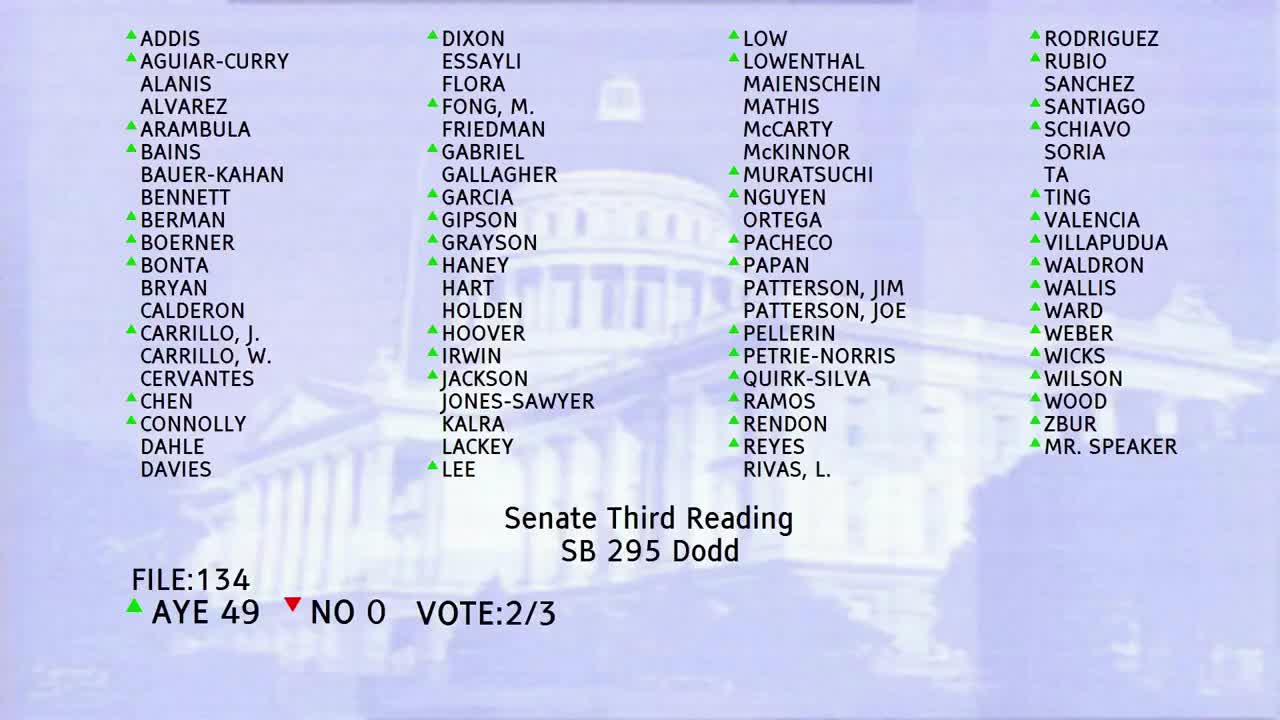
Bill Author