AB 2336: Personal Income Tax Law: exclusions from income: retirement: overtime.
- Session Year: 2025-2026
- House: Assembly
- Latest Version Date: 2026-02-19
Current Status:
In Progress
(2026-04-27: In committee: Set, second hearing. Held under submission.)
Introduced
In Committee
Awaiting First Chamber Vote
Passed First Chamber
In Committee
Awaiting Second Chamber Vote
Passed Second Chamber
Enacted
The Personal Income Tax Law, in modified conformity with federal income tax laws, defines gross income as income from whatever source derived, except as specifically excluded, and provides various exclusions from gross income.
This bill would, for taxable years beginning on or after January 1, 2026, and before January 1, 2031, exclude from gross income the first $25,000 of overtime pay received by a taxpayer during the taxable year. The bill would also exclude from gross income the first $25,000 received by a taxpayer as proceeds from a defined benefit plan, as defined.
Existing law requires any bill authorizing a new tax expenditure to contain, among other things, specific goals that the tax expenditure will achieve, detailed performance indicators, and data collection requirements.
This bill also would include additional information required for any bill authorizing a new tax expenditure.
This bill would take effect immediately as a tax levy.
(a)For taxable years beginning on or after January 1, 2026, and before January 1, 2031, gross income does not include the first twenty-five thousand dollars ($25,000) of overtime pay received during the taxable year.
(b)This section shall remain operative only until January 1, 2031, and as of that date is repealed.
SEC. 2.Section 17147.1 is added to the Revenue and Taxation Code, to read:17147.1.(a)For taxable years beginning on or after January 1, 2026, and before January 1, 2031, gross income does not include the first twenty-five thousand dollars ($25,000) received by a taxpayer as proceeds from a defined benefit plan, as defined in Section 414(j) of the Internal Revenue Code, during the taxable year.
(b)This section shall remain operative only until January 1, 2031, and as of that date is repealed.
SEC. 3.For purposes of complying with Section 41 of the Revenue and Taxation Code, as it related to the exclusions from income allowed by Sections 17147 and 17147.1 of the Revenue and Taxation Code, as added by Sections 1 and 2 of this act, the Legislature finds and declares as follows:
(a)The specific goal of the exclusions is to give financial support to those working extra hours to afford increasing costs and those on limited retirement income.
(b)There is no available data to collect or report with respect to the exclusions.
SEC. 4.This act provides for a tax levy within the meaning of Article IV of the California Constitution and shall go into immediate effect.
|
Date
|
Status
|
|---|---|
| Apr 27, 2026 | In committee: Set, second hearing. Held under submission. |
| Apr 13, 2026 | In committee: Set, first hearing. Referred to REV. & TAX. suspense file. |
| Apr 6, 2026 | In committee: Hearing postponed by committee. |
| Mar 9, 2026 | Referred to Com. on REV. & TAX. |
| Feb 20, 2026 | From printer. May be heard in committee March 22. |
| Feb 19, 2026 | Read first time. To print. |
This list shows positions taken on this bill by organizations on the date displayed, which is linked to the original source.
Positions by individuals are not included.
|
Organization
|
Position
|
Date
|
|---|---|---|
| California Association Of Highway Patrolmen | ** Support | |
| California Restaurant Association | ** Support | |
| California Teachers Association | ** Against | |
| Howard Jarvis Taxpayers Association | ** Support | |
| SFV Alliance | ** Support |
Date of Hearing: April 27, 2026
ASSEMBLY COMMITTEE ON REVENUE AND TAXATION
Mike Gipson, Chair
ABPCA Bill Id:AB 2336 (
Author:Macedo) – As Introduced Ver:February 19, 2026
SUSPENSE
Majority vote. Tax levy. Fiscal committee.
SUBJECT: Personal Income Tax Law: exclusions from income: retirement: overtime
SUMMARY: Excludes from gross income the first $25,000 of overtime pay received during the taxable year and the first $25,000 received as proceeds from a defined benefit plan, as defined, during the taxable year. Specifically, this bill:
- Excludes from gross income, under the Personal Income Tax (PIT) Law, the first $25,000 of overtime pay received during the taxable year.
- Excludes from gross income, under the PIT Law, the first $25,000 received by a taxpayer as proceeds from a defined benefit plan, as defined in Internal Revenue Code (IRC) Section 414(j), during the taxable year.
- Authorizes both gross income exclusions for taxable years beginning on or after January 1, 2026, and before January 1, 2031.
- Provides that, for purposes of complying with Revenue and Taxation Code (R&TC) Section 41, the Legislature finds and declares the following:
- The specific goal of the exclusions is to give financial support to those working extra hours to afford increasing costs and those on limited retirement income; and,
- There is no available data to collect or report with respect to the exclusions.
- Takes immediate effect as a tax levy.
- Repeals the statutory provisions for both gross income exclusions on January 1, 2031.
EXISTING FEDERAL LAW:
- Defines "gross income" as income from whatever source derived, except as specifically excluded. (IRC Section 61.)
- Deducts from gross income an amount equal to the "qualified overtime compensation" received during the taxable year, as specified, and limits the deduction to $12,500, or $25,000 if filing jointly. The deduction is subject to a phase-out if a taxpayer's modified adjusted gross income (AGI) is $150,000 or more, or $300,000 or more if filing jointly. While this deduction is an itemized deduction, it is also available to those taking the standard deduction. (IRC Section 225.)
- Defines a "defined contribution plan" as a plan that provides for an individual account for each participant and for benefits based solely on the amount contributed to the participant's account, and any income, expenses, gains and losses, and any forfeitures of accounts of other participants which may be allocated to such participant's account. (IRC Section 414(i).)
- Defines a "defined benefit plan" as any plan that is not a defined contribution plan. (IRC section 414(j).)
EXISTING STATE LAW conforms to federal tax law as of January 1, 2025, with certain modifications, but does not conform to the federal deduction on overtime pay. (R&TC Section 17024.5.)
FISCAL EFFECT: The Franchise Tax Board (FTB) estimates that this bill would result in a revenue loss of $5.5 billion in the 2026-27 fiscal year (FY), $3.7 billion in FY 2027-28, and $3.8 billion in FY 2028-29.
COMMENTS:
- The author has submitted the following statement in support of this bill:
Hard-working Californians are struggling to afford the rising costs of basic necessities such as groceries, gas, and housing costs. Exempting the first $25,000 of overtime pay and pension payment boosts take-home earnings to cover essentials.
- The California Association of Highway Patrolmen, writing in support of this bill, states, in part:
[California Highway Patrol] officers often pick up extra shifts and work overtime hours to ensure the safety of all Californians. Instead of being rewarded for their hard work, they are penalized by taxation on that income. By providing much needed relief, lawmakers can help hard-working Californians continue to live in our great state.
- The California Teachers Association, writing in opposition to a series of tax expenditure bills referred to this Committee, states, in part:
In fiscal year 2025-26, the Department of Finance estimated a $94 billion dollar loss in general fund revenue due to existing tax expenditures. This is revenue that would have otherwise gone to the General Fund, of which approximately 40% would have gone
toward the Proposition [(Prop.)] 98 minimum guarantee. Once tax credits are passed with a simple majority, it takes a two-thirds vote of the Legislature to repeal them.
- Committee Staff Comments:
- One Big Beautiful Bill Act (OBBBA): The OBBBA was signed into law on July, 4, 2025, and provided for a series of changes in federal tax law. Among those changes was an a new itemized deduction that could also be used by those taking the standard deduction deduction for certain pay received by certain taxpayers. The deduction applied to overtime pay required pursuant to federal labor law, and was limited by the amount of compensation, and the amount of income earned by a qualifying taxpayer.
- California conformity to federal tax law: California does not automatically conform to changes in federal tax law. Rather, the state conforms to federal tax law provisions as of a certain date, and provides certain exceptions to that conformity. Currently, California conforms to federal tax provisions as enacted on January 1, 2025. Thus, California generally does not conform to provisions of the OBBBA.
- This bill: As currently drafted, this bill would, for five years, exclude from gross income up to $25,000 in overtime pay, or proceeds from a defined benefit plan, received by the taxpayer during the taxable year. Defined benefit plans are retirement plans that do not account for contributions made by the individual into an account. Thus, a defined benefit plan is generally a pension plan.
- Nonconformity to federal law: It appears this bill is intended to conform to the federal deduction authorized in the OBBBA. If that is the case, this bill departs from that construction. First, this bill does not distinguish between maximum amounts of deductible gross income based on filer status. Second, this bill does not limit the deduction based on modified AGI. Third, this bill provides a deduction on payments to a beneficiary of a pension plan, for which there is no corresponding deduction in federal law. If any of these departures from federal tax law is contrary to the author's intent, this bill should be amended.
- Deductions benefit higher-income taxpayers: All else equal, as gross income increases, the value of a deduction to a taxpayer generally increases. This is because a deduction is applied before the application of the relevant tax bracket rate. Thus, the same $100 deduction results in a tax liability reduction of $12.30, for taxpayers with income subject to the 12.3% rate, and only $8 for taxpayers with income subject to the 8% rate.
- Drafting considerations: This bill references January 1, 2031 as the repeal date. Generally, when the statute limits a tax expenditure to certain taxable years, the repeal date referenced will be December 1st of the taxable year following the last qualifying taxable year. This bill's repeal dates should be amended to state that the exclusion remains "in effect only until December 1, 2031".
Additionally, this bill uses the undefined term "overtime pay." The author may wish to define this term to avoid taxpayer confusion, and to ensure proper administration by the FTB.
Finally, this bill applies retroactively to taxable years beginning on or after January 1, 2026. Generally, tax expenditures are authorized on a prospective basis. The author may wish to amend this bill to delay the implementation and repeal dates by one taxable year.
- Prop. 98: In 1988, California voters approved Prop. 98, which guarantees a certain level of educational funding for schools and community colleges based on certain calculations that vary with General Fund revenues and changes in per capita personal income. Three types of calculations, or tests, are stipulated in the law, and these tests impact the overall amount of revenue reserved for schools in any given year. In Test 1 years, the amount guaranteed under Prop. 98 is approximately 40% of General Fund revenues. Thus, any one dollar of General Fund revenue lost corresponds to a $0.40 decrease in the Prop. 98 guarantee. According to the Legislative Analyst's Office (LAO), Test 1 remains operative for the 2026-27 FY[1].
- What is a "tax expenditure"? Existing law provides various credits, deductions, exclusions, and exemptions for particular taxpayer groups. In the late 1960s, United States Treasury officials began arguing that these features of the tax law should be referred to as "expenditures" since they are generally enacted to accomplish some governmental purpose and there is a determinable cost associated with each of them (in the form of forgone revenues). This bill would exclude certain amounts of overtime pay and pension payments from gross income under the PIT Law, thereby constituting a tax expenditure.
- Committee's tax expenditure policy: SB 1335 (Leno), Chapter 845, Statutes of 2014, added R&TC Section 41, which recognized that the Legislature should apply the same level of review used for government spending programs to tax credits introduced on or after January 1, 2015. AB 263 (Burke), Chapter 743, Statutes of 2019, extended the requirements in R&TC Section 41 to all tax expenditure measures under the PIT Law, the Corporation Tax Law, and the Sales and Use Tax Law introduced on or after January 1, 2020. A tax expenditure authorizing a gross income exclusion is exempt from reporting performance metrics if the Legislature determines that there are no available data to report.
A tax expenditure proposal must outline specific goals, purposes, and objectives that the tax expenditure will achieve, along with detailed performance indicators for the Legislature to use when measuring whether the tax expenditure meets those stated goals, purposes, and objectives. In addition to the R&TC Section 41 requirements, this Committee's policy also requires that all tax expenditure proposals contain an appropriate sunset provision to be eligible for a vote[2]. Sunsets are required because eliminating a tax expenditure generally requires a 2/3rd vote. These requirements must be satisfied before a bill can receive a vote in this Committee. This bill contains an appropriate five-year sunset, and provides that no data is available to report pursuant to R&TC Section 41.
- Related legislation:
- SB 711 (Committee on Revenue and Taxation), Chapter 231, Statutes of 2025, updated California's reference date for the purposes of conforming to federal tax law provisions to January 1, 2025.
- Related legislation:
- AB 1057 (Michelle Rodriguez), of this Legislative Session, would have excluded from gross income qualified overtime wages received by a qualified taxpayer. AB 1057 was held on this Committee's Suspense File.
REGISTERED SUPPORT / OPPOSITION:
Support
California Association of Highway Patrolmen
California Restaurant Association
Howard Jarvis Taxpayers Association
California Restaurant Association
SFV Alliance
Opposition
California Teachers Association
Analysis Prepared by: Harrison Bowlby / REV. & TAX. / (916) 319-2098
Proposition 98 and K-12 Education, The 2026-27 Budget, Legislative Analyst’s Office (February 4, 2026). https://lao.ca.gov/Publications/Report/5110, accessed March 2026. ↑
An "appropriate sunset provision" shall mean five years, except in the case of a tax expenditure measure providing relief to California veterans, in which case "appropriate sunset provision" shall mean 10 years. ↑
Date of Hearing: April 13, 2026
ASSEMBLY COMMITTEE ON REVENUE AND TAXATION
Mike Gipson, Chair
ABPCA Bill Id:AB 2336 (
Author:Macedo) – As Introduced Ver:February 19, 2026
Majority vote. Tax levy. Fiscal committee.
SUBJECT: Personal Income Tax Law: exclusions from income: retirement: overtime
SUMMARY: Excludes from gross income the first $25,000 of overtime pay received during the taxable year and the first $25,000 received as proceeds from a defined benefit plan, as defined, during the taxable year. Specifically, this bill:
- Excludes from gross income, under the Personal Income Tax (PIT) Law, the first $25,000 of overtime pay received during the taxable year.
- Excludes from gross income, under the PIT Law, the first $25,000 received by a taxpayer as proceeds from a defined benefit plan, as defined in Internal Revenue Code (IRC) Section 414(j), during the taxable year.
- Authorizes both gross income exclusions for taxable years beginning on or after January 1, 2026, and before January 1, 2031.
- Provides that, for purposes of complying with Revenue and Taxation Code (R&TC) Section 41, the Legislature finds and declares the following:
- The specific goal of the exclusions is to give financial support to those working extra hours to afford increasing costs and those on limited retirement income; and,
- There is no available data to collect or report with respect to the exclusions.
- Takes immediate effect as a tax levy.
- Repeals the statutory provisions for both gross income exclusions on January 1, 2031.
EXISTING FEDERAL LAW:
- Defines "gross income" as income from whatever source derived, except as specifically excluded. (IRC Section 61.)
- Deducts from gross income an amount equal to the "qualified overtime compensation" received during the taxable year, as specified, and limits the deduction to $12,500, or $25,000 if filing jointly. The deduction is subject to a phase-out if a taxpayer's modified adjusted gross income (AGI) is $150,000 or more, or $300,000 or more if filing jointly. While this deduction is an itemized deduction, it is also available to those taking the standard deduction. (IRC Section 225.)
- Defines a "defined contribution plan" as a plan that provides for an individual account for each participant and for benefits based solely on the amount contributed to the participant's account, and any income, expenses, gains and losses, and any forfeitures of accounts of other participants which may be allocated to such participant's account. (IRC Section 414(i).)
- Defines a "defined benefit plan" as any plan that is not a defined contribution plan. (IRC section 414(j).)
EXISTING STATE LAW conforms to federal tax law as of January 1, 2025, with certain modifications, but does not conform to the federal deduction on overtime pay. (R&TC Section 17024.5.)
FISCAL EFFECT: The Franchise Tax Board (FTB) estimates that this bill would result in a revenue loss of $5.5 billion in the 2026-27 fiscal year (FY), $3.7 billion in FY 2027-28, and $3.8 billion in FY 2028-29.
COMMENTS:
- The author has submitted the following statement in support of this bill:
Hard-working Californians are struggling to afford the rising costs of basic necessities such as groceries, gas, and housing costs. Exempting the first $25,000 of overtime pay and pension payment boosts take-home earnings to cover essentials.
- The California Association of Highway Patrolmen, writing in support of this bill, states, in part:
[California Highway Patrol] officers often pick up extra shifts and work overtime hours to ensure the safety of all Californians. Instead of being rewarded for their hard work, they are penalized by taxation on that income. By providing much needed relief, lawmakers can help hard-working Californians continue to live in our great state.
- The California Teachers Association, writing in opposition to a series of tax expenditure bills referred to this Committee, states, in part:
In fiscal year 2025-26, the Department of Finance estimated a $94 billion dollar loss in general fund revenue due to existing tax expenditures. This is revenue that would have otherwise gone to the General Fund, of which approximately 40% would have gone
toward the Proposition [(Prop.)] 98 minimum guarantee. Once tax credits are passed with a simple majority, it takes a two-thirds vote of the Legislature to repeal them.
- Committee Staff Comments:
- One Big Beautiful Bill Act (OBBBA): The OBBBA was signed into law on July, 4, 2025, and provided for a series of changes in federal tax law. Among those changes was an a new itemized deduction that could also be used by those taking the standard deduction deduction for certain pay received by certain taxpayers. The deduction applied to overtime pay required pursuant to federal labor law, and was limited by the amount of compensation, and the amount of income earned by a qualifying taxpayer.
- California conformity to federal tax law: California does not automatically conform to changes in federal tax law. Rather, the state conforms to federal tax law provisions as of a certain date, and provides certain exceptions to that conformity. Currently, California conforms to federal tax provisions as enacted on January 1, 2025. Thus, California generally does not conform to provisions of the OBBBA.
- This bill: As currently drafted, this bill would, for five years, exclude from gross income up to $25,000 in overtime pay, or proceeds from a defined benefit plan, received by the taxpayer during the taxable year. Defined benefit plans are retirement plans that do not account for contributions made by the individual into an account. Thus, a defined benefit plan is generally a pension plan.
- Nonconformity to federal law: It appears this bill is intended to conform to the federal deduction authorized in the OBBBA. If that is the case, this bill departs from that construction. First, this bill does not distinguish between maximum amounts of deductible gross income based on filer status. Second, this bill does not limit the deduction based on modified AGI. Third, this bill provides a deduction on payments to a beneficiary of a pension plan, for which there is no corresponding deduction in federal law. If any of these departures from federal tax law is contrary to the author's intent, this bill should be amended.
- Deductions benefit higher-income taxpayers: All else equal, as gross income increases, the value of a deduction to a taxpayer generally increases. This is because a deduction is applied before the application of the relevant tax bracket rate. Thus, the same $100 deduction results in a tax liability reduction of $12.30, for taxpayers with income subject to the 12.3% rate, and only $8 for taxpayers with income subject to the 8% rate.
- Drafting considerations: This bill references January 1, 2031 as the repeal date. Generally, when the statute limits a tax expenditure to certain taxable years, the repeal date referenced will be December 1st of the taxable year following the last qualifying taxable year. This bill's repeal dates should be amended to state that the exclusion remains "in effect only until December 1, 2031".
Additionally, this bill uses the undefined term "overtime pay." The author may wish to define this term to avoid taxpayer confusion, and to ensure proper administration by the FTB.
Finally, this bill applies retroactively to taxable years beginning on or after January 1, 2026. Generally, tax expenditures are authorized on a prospective basis. The author may wish to amend this bill to delay the implementation and repeal dates by one taxable year.
- Prop. 98: In 1988, California voters approved Prop. 98, which guarantees a certain level of educational funding for schools and community colleges based on certain calculations that vary with General Fund revenues and changes in per capita personal income. Three types of calculations, or tests, are stipulated in the law, and these tests impact the overall amount of revenue reserved for schools in any given year. In Test 1 years, the amount guaranteed under Prop. 98 is approximately 40% of General Fund revenues. Thus, any one dollar of General Fund revenue lost corresponds to a $0.40 decrease in the Prop. 98 guarantee. According to the Legislative Analyst's Office (LAO), Test 1 remains operative for the 2026-27 FY[1].
- What is a "tax expenditure"? Existing law provides various credits, deductions, exclusions, and exemptions for particular taxpayer groups. In the late 1960s, United States Treasury officials began arguing that these features of the tax law should be referred to as "expenditures" since they are generally enacted to accomplish some governmental purpose and there is a determinable cost associated with each of them (in the form of forgone revenues). This bill would exclude certain amounts of overtime pay and pension payments from gross income under the PIT Law, thereby constituting a tax expenditure.
- Committee's tax expenditure policy: SB 1335 (Leno), Chapter 845, Statutes of 2014, added R&TC Section 41, which recognized that the Legislature should apply the same level of review used for government spending programs to tax credits introduced on or after January 1, 2015. AB 263 (Burke), Chapter 743, Statutes of 2019, extended the requirements in R&TC Section 41 to all tax expenditure measures under the PIT Law, the Corporation Tax Law, and the Sales and Use Tax Law introduced on or after January 1, 2020. A tax expenditure authorizing a gross income exclusion is exempt from reporting performance metrics if the Legislature determines that there are no available data to report.
A tax expenditure proposal must outline specific goals, purposes, and objectives that the tax expenditure will achieve, along with detailed performance indicators for the Legislature to use when measuring whether the tax expenditure meets those stated goals, purposes, and objectives. In addition to the R&TC Section 41 requirements, this Committee's policy also requires that all tax expenditure proposals contain an appropriate sunset provision to be eligible for a vote[2]. Sunsets are required because eliminating a tax expenditure generally requires a 2/3rd vote. These requirements must be satisfied before a bill can receive a vote in this Committee. This bill contains an appropriate five-year sunset, and provides that no data is available to report pursuant to R&TC Section 41.
- Related legislation:
- SB 711 (Committee on Revenue and Taxation), Chapter 231, Statutes of 2025, updated California's reference date for the purposes of conforming to federal tax law provisions to January 1, 2025.
- Related legislation:
- AB 1057 (Michelle Rodriguez), of this Legislative Session, would have excluded from gross income qualified overtime wages received by a qualified taxpayer. AB 1057 was held on this Committee's Suspense File.
REGISTERED SUPPORT / OPPOSITION:
Support
California Association of Highway Patrolmen
Howard Jarvis Taxpayers Association
California Restaurant Association
Opposition
California Teachers Association
Analysis Prepared by: Harrison Bowlby / REV. & TAX. / (916) 319-2098
Proposition 98 and K-12 Education, The 2026-27 Budget, Legislative Analyst’s Office (February 4, 2026). https://lao.ca.gov/Publications/Report/5110, accessed March 2026. ↑
An "appropriate sunset provision" shall mean five years, except in the case of a tax expenditure measure providing relief to California veterans, in which case "appropriate sunset provision" shall mean 10 years. ↑
Discussed in Hearing
 7MIN
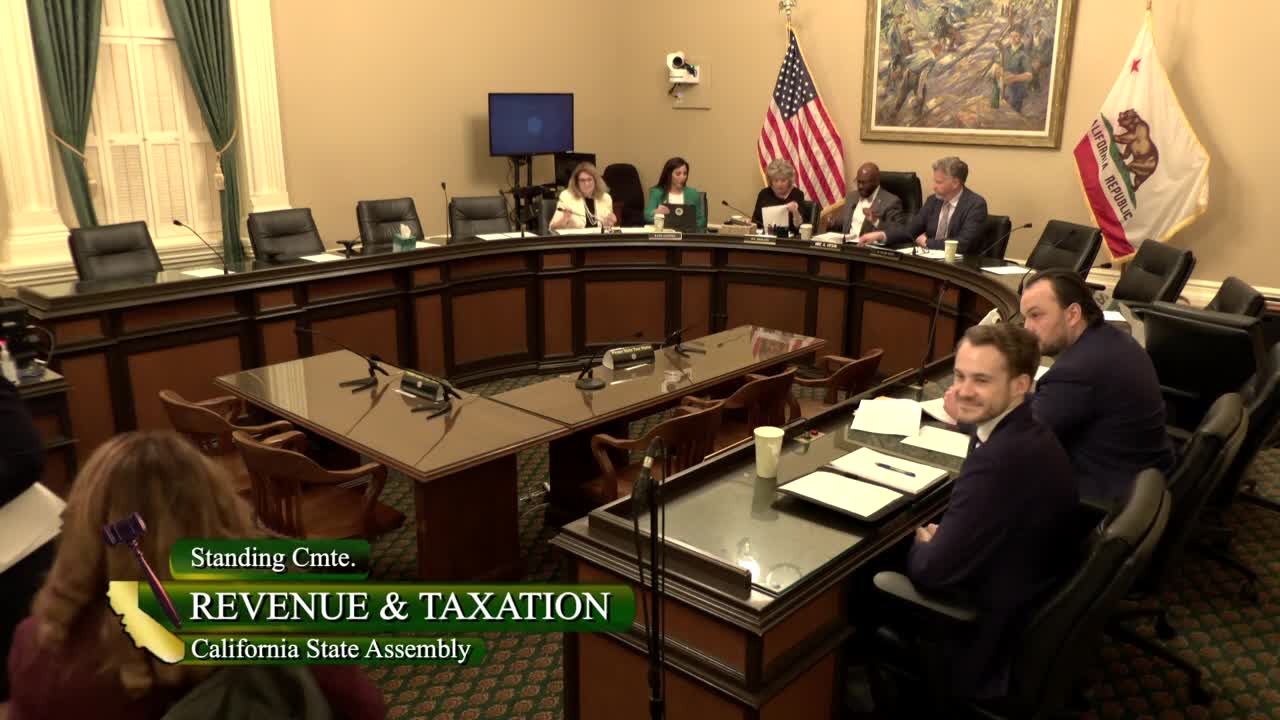
Assembly Standing Committee on Revenue and Taxation
Bill Author

Bill Co-Author(s):