AB 742: Department of Consumer Affairs: licensing: applicants who are descendants of slaves.
- Session Year: 2025-2026
- House: Assembly
- Latest Version Date: 2025-09-12
Current Status:
Failed
(2026-01-22: Consideration of Governor's veto stricken from file.)
Introduced
In Committee
Awaiting First Chamber Vote
Passed First Chamber
In Committee
Awaiting Second Chamber Vote
Passed Second Chamber
Enacted
What does this bill do?
The bill would require California professional licensing boards to speed up (expedite) license applications for people who are certified as descendants of American slaves. That expedited process would apply only after a new state Bureau for Descendants of American Slavery sets up a certification system, and the rule would automatically end four years after it begins or by January 1, 2032, whichever is earlier.
The summary is provided by generative AI which can make mistakes. For original language, please view the details in the table below.
Existing law establishes the Department of Consumer Affairs, which is composed of specified boards that license and regulate various professions. Existing law requires those boards to expedite the licensure process for an applicant who holds a current license in another jurisdiction in the same profession or vocation and supplies evidence that they are married to or in a domestic partnership or other legal union with an active duty member of the Armed Forces of the United States who is assigned to a duty station in this state under official active duty military orders.
This bill would require those boards to expedite applications for applicants seeking licensure who are descendants of American slaves once a process to certify descendants of American slaves is implemented, as specified.
This bill would make these provisions operative only if SB 518 of the 202526 Regular Session is enacted establishing the Bureau for Descendants of American Slavery, and would make these provisions operative when the certification process is implemented pursuant to that measure. The bill would repeal these provisions 4 years from the date on which they become operative or on January 1, 2032, whichever is earlier.
Existing law establishes the Department of Consumer Affairs, which is composed of specified boards that license and regulate various professions. Existing law requires those boards to expedite the licensure process for an applicant who holds a current license in another jurisdiction in the same profession or vocation and supplies evidence that they are married to or in a domestic partnership or other legal union with an active duty member of the Armed Forces of the United States who is assigned to a duty station in this state under official active duty military orders.
This bill would require those boards to prioritize applicants expedite applications for applicants seeking licensure who are descendants of American slaves once a process to certify descendants of American slaves is established, implemented, as specified. The bill would make those provisions operative when the certification process is established and would repeal those provisions 4 years from the date on which the provisions become operative or on January 1, 2032, whichever is earlier.
This bill would make these provisions operative only if SB 518 of the 202526 Regular Session is enacted establishing the Bureau for Descendants of American Slavery, and would make these provisions operative when the certification process is established implemented pursuant to that measure. The bill would repeal these provisions 4 years from the date on which they become operative or on January 1, 2032, whichever is earlier.
Existing law establishes the Department of Consumer Affairs, which is composed of specified boards that license and regulate various professions.
This bill would require those boards to prioritize applicants seeking licensure who are descendants of slaves seeking licenses, especially applicants who are descended from a person enslaved within the United States. American slaves once a process to certify descendants of American slaves is established, as specified. The bill would make those provisions operative when the certification process is established and would repeal those provisions 4 years from the date on which the provisions become operative or on January 1, 2032, whichever is earlier.
This bill would make these provisions operative only if SB 518 of the 202526 Regular Session is enacted establishing the Bureau for Descendants of American Slavery, and would make these provisions operative when the certification process is established pursuant to that measure. The bill would repeal these provisions 4 years from the date on which they become operative or on January 1, 2032, whichever is earlier.
Existing law establishes the Department of Consumer Affairs, which is composed of specified boards that license and regulate various professions.
This bill would require those boards to prioritize applicants who are descendants of slaves seeking licenses, especially applicants who are descended from a person enslaved within the United States.
(a)Notwithstanding any other law, once the process to certify descendants of American slaves is implemented by the Bureau for Descendants of American Slavery pursuant to Chapter 4 (commencing with Section 15210) of Part 6 of Division 3 of Title 2 of the Government Code that confirms an individuals status as a descendant of an American slave, each board shall expedite applications for applicants seeking licensure who are descendants of American slaves.
(b)This section shall become operative on the date that the certification process for the descendants of American Slaves is implemented by the Bureau for Descendants of American Slavery pursuant to Chapter 4 (commencing with Section 15210) of Part 6 of Division 3 of Title 2 of the Government Code.
(c)This section shall remain in effect only for four years from the date on which this section became operative, or until January 1, 2032, whichever is earlier, and as of that date is repealed.
(d)This section shall become operative only if Senate Bill 518 of the 202526 Regular Session is enacted establishing the Bureau for Descendants of American Slavery.
(a)Notwithstanding any other law, once the process to certify descendants of American slaves is established implemented by the Bureau for Descendants of American Slavery pursuant to Part 15 Chapter 4 (commencing with Section 16000) 15210) of Part 6 of Division 3 of Title 2 of the Government Code that confirms an individuals status as a descendant of an American slave, each board shall prioritize applicants expedite applications for applicants seeking licensure who are descendants of American slaves.
(b)This section shall become operative on the date that the certification process for the descendants of American Slaves is established implemented by the Bureau for Descendants of American Slavery pursuant to Part 15 Chapter 4 (commencing with Section 16000) 15210) of Part 6 of Division 3 of Title 2 of the Government Code.
(c)This section shall remain in effect only for four years from the date on which this section became operative, or until January 1, 2032, whichever is earlier, and as of that date is repealed.
(d)This section shall become operative only if Senate Bill 518 of the 202526 Regular Session is enacted establishing the Bureau for Descendants of American Slavery.
(a)Notwithstanding any other law, a once the process to certify descendants of American slaves is established by the Bureau for Descendants of American Slavery pursuant to Part 15 (commencing with Section 16000) of Division 3 of Title 2 of the Government Code that confirms an individuals status as a descendant of an American slave, each board shall prioritize applicants seeking licensure who are descendants of slaves seeking licenses, especially applicants who are descended from a person enslaved within the United States. American slaves.
(b)This section shall become operative on the date that the certification process for the descendants of American Slaves is established by the Bureau for Descendants of American Slavery pursuant to Part 15 (commencing with Section 16000) of Division 3 of Title 2 of the Government Code.
(c)This section shall remain in effect only for four years from the date on which this section became operative, or until January 1, 2032, whichever is earlier, and as of that date is repealed.
(d)This section shall become operative only if Senate Bill 518 of the 202526 Regular Session is enacted establishing the Bureau for Descendants of American Slavery.
REVISIONS: HeadingLine 6.Notwithstanding any other law, a board shall prioritize applicants who are descendants of slaves seeking licenses, especially applicants who are descended from a person enslaved within the United States.
|
Date
|
Status
|
|---|---|
| Jan 22, 2026 | Consideration of Governor's veto stricken from file. |
| Oct 13, 2025 | Consideration of Governor's veto pending. |
| Oct 13, 2025 | Vetoed by Governor. |
| Sep 22, 2025 | Enrolled and presented to the Governor at 3 p.m. |
| Sep 10, 2025 | Senate amendments concurred in. To Engrossing and Enrolling. (Ayes 59. Noes 16. Page 3200.). |
| Sep 9, 2025 | In Assembly. Concurrence in Senate amendments pending. |
| Sep 9, 2025 | Read third time. Passed. Ordered to the Assembly. (Ayes 30. Noes 9. Page 2734.). |
| Aug 29, 2025 | Read second time. Ordered to third reading. |
| Aug 29, 2025 | From committee: Do pass. (Ayes 5. Noes 2.) (August 29). |
| Aug 18, 2025 | In committee: Referred to suspense file. |
| Jul 16, 2025 | From committee: Do pass and re-refer to Com. on APPR. (Ayes 11. Noes 1.) (July 15). Re-referred to Com. on APPR. |
| Jul 7, 2025 | From committee: Do pass and re-refer to Com. on JUD. (Ayes 8. Noes 2.) (July 7). Re-referred to Com. on JUD. |
| Jul 2, 2025 | From committee chair, with author's amendments: Amend, and re-refer to committee. Read second time, amended, and re-referred to Com. on B. P. & E.D. |
| Jun 18, 2025 | Referred to Coms. on B. P. & E.D. and JUD. |
| Jun 4, 2025 | In Senate. Read first time. To Com. on RLS. for assignment. |
| Jun 3, 2025 | Read third time. Passed. Ordered to the Senate. (Ayes 57. Noes 14. Page 2031.) |
| May 27, 2025 | Read second time. Ordered to third reading. |
| May 23, 2025 | From committee: Do pass. (Ayes 11. Noes 3.) (May 23). |
| May 7, 2025 | In committee: Set, first hearing. Referred to APPR. suspense file. |
| Apr 30, 2025 | From committee: Do pass and re-refer to Com. on APPR. (Ayes 8. Noes 2.) (April 29). Re-referred to Com. on APPR. |
| Apr 8, 2025 | From committee: Do pass and re-refer to Com. on JUD. (Ayes 12. Noes 2.) (April 8). Re-referred to Com. on JUD. |
| Apr 8, 2025 | Coauthors revised. |
| Mar 17, 2025 | Re-referred to Com. on B. & P. |
| Mar 13, 2025 | From committee chair, with author's amendments: Amend, and re-refer to Com. on B. & P. Read second time and amended. |
| Mar 3, 2025 | Referred to Coms. on B. & P. and JUD. |
| Feb 19, 2025 | From printer. May be heard in committee March 21. |
| Feb 18, 2025 | Read first time. To print. |
|
Date
|
Description
|
Location
|
Votes
|
|
|---|---|---|---|---|
| Sep 10, 2025 | AB 742 Elhawary Concurrence in Senate Amendments | Assembly Floor |
Passed |
|
| Sep 9, 2025 | Assembly 3rd Reading AB742 Elhawary et al. By Weber Pierson | Senate Floor |
Passed |
|
| Aug 29, 2025 | Do pass | Senate Standing Committee on Appropriations |
Passed |
|
| Aug 18, 2025 | Placed on suspense file | Senate Standing Committee on Appropriations |
Passed |
|
| Jul 15, 2025 | Do pass, but first be re-referred to the Committee on [Appropriations] | Senate Standing Committee on Judiciary |
Passed |
|
| Jul 7, 2025 | Do pass, but first be re-referred to the Committee on [Judiciary] | Senate Standing Committee on Business, Professions and Economic Development |
Passed |
|
| Jun 3, 2025 | AB 742 Elhawary Assembly Third Reading | Assembly Floor |
Passed |
|
| May 23, 2025 | Do pass. | Assembly Standing Committee on Appropriations |
Passed |
|
| Apr 29, 2025 | Do pass and be re-referred to the Committee on [Appropriations] | Assembly Standing Committee on Judiciary |
Passed |
|
| Apr 8, 2025 | Do pass and be re-referred to the Committee on [Judiciary] | Assembly Standing Committee on Business and Professions |
Passed |
This list shows positions taken on this bill by organizations on the date displayed, which is linked to the original source.
Positions by individuals are not included.
|
Organization
|
Position
|
Date
|
|---|---|---|
| Board of Behavioral Sciences | ** Support | |
| Board of Registered Nursing | ** Support | |
| Board of Supervisors for the City and County of San Francisco | ** Support | |
| California Faculty Association | ** Support | |
| California Federation of Teachers, California Affiliate of the AFT, AFL-CIO | ** Support | |
| California Landscape Contractors Association | ** Against | |
| Californians for Equal Rights Foundation | ** Against | |
| Carlsbad Citizens for Community Oversight | ** Against | |
| City Of Oakland | ** Support | |
| Contractors State License Board | ** Support | |
| Dental Board of California | ** Against | |
| Greater Sacramento Urban League | ** Support | |
| Pacific Legal Foundation | ** Against | |
| San Francisco Board of Supervisors | ** Support |
GOVERNOR'S VETO
GV Bill Id:AB 742
Author:(Elhawary)
As Enrolled Ver:September 12, 2025
2/3 vote
SUMMARY
Requires state licensing boards within the Department of Consumer Affairs (DCA) to expedite applications from individuals seeking licensure who are descendants of American slaves.
Senate Amendments
- Replace language in the bill requiring boards to "prioritize applicants" to instead require boards to "expedite applications for applicants."
- Make additional technical changes to language in the bill delaying its requirements until a certification process for the descendants of American Slaves is implemented by the Bureau for Descendants of American Slavery.
Governor's Veto Message
This bill would require boards and bureaus under the Department of Consumer Affairs to expedite applicants seeking licensure who are descendants of slaves, once a certification process for the descendants of American Slaves is implemented by the Bureau for Descendants of American Slavery.
I appreciate the author's intent to increase diversity within the professional licensed population and improve licensure opportunities for historically underrepresented communities. However, as the number of applicants who qualify for expedited licensure increases, the benefits of mandated prioritization may start to diminish, creating negative impacts on other applicants. Additionally, licensing fee increases may result from this bill, as an increase in staff will be necessary to ensure expedited applications.
I vetoed two similar measures seeking to expedite licensure for specified populations last year for these same concerns, and I believe more data is needed on the effectiveness and consequences of expedited licensure before committing to similar frameworks.
COMMENTS
Expedited Licensure. The DCA consists of 36 boards, bureaus, and other entities responsible for licensing, certifying, or otherwise regulating professionals in California. As of March 2023, there are over 3.4 million licensees overseen by programs under the DCA, including health professionals regulated by healing arts boards under Division 2 of the Business and Professions Code. Each licensing program has its own unique requirements, with the governing acts for each profession providing for various prerequisites including prelicensure education, training, and examination. Most boards additionally require the payment of a fee and some form of background check for each applicant.
The average duration between the submission of an initial license application and approval by an entity under the DCA can vary based on a number of circumstances, including increased workload, delays in obtaining an applicant's criminal history, and deficiencies in an application. Boards typically set internal targets for application processing timelines and seek adequate staffing in an effort to meet those targets consistently. License processing timelines are then regularly evaluated through the Legislature's sunset review oversight process.
The first expedited licensure laws specifically related to the unique needs of military families. The Syracuse University Institute for Veterans and Military Families found that up to 35% of military spouses are employed in fields requiring licensure. Because each state possesses its own licensing regime for professional occupations, military family members are required to obtain a new license each time they move states, with one-third of military spouses reportedly moving four or more times while their partner is on active duty. Because of the barriers encountered by military family members who seek to relocate their licensed work to a new state, it is understood that continuing to work in their field is often challenging if not impossible.
In an effort to address these concerns, Assembly Bill 1904 (Block) Chapter 399, Statutes of 2012 was enacted in 2012 to require boards and bureaus under the DCA to expedite the licensure process for military spouses and domestic partners of a military member who is on active duty in California. Two years later, Senate Bill 1226 (Correa) Chapter 657, Statutes of 2014 was enacted to similarly require boards and bureaus under the DCA to expedite applications from honorably discharged veterans, with the goal of enabling these individuals to quickly transition into civilian employment upon retiring from service.
Statute requires entities under the DCA to annually report the number of applications for expedited licensure that were submitted by veterans and active-duty spouses and partners. For example, in Fiscal Year 2022-23, the Medical Board of California (MBC) received 14 applications from military spouses or partners and 101 applications from honorably discharged veterans subject to expedited processing. In 2023, the federal Servicemembers Civil Relief Act (SCRA) imposed new requirements on states to recognize qualifying out-of-state licenses for service members and their spouses. This new form of enhanced license portability potentially displaces the need for expedited licensure for these applicants.
A decade after the first expedited licensure laws were enacted for military families, the Legislature enacted Assembly Bill 2113 (Low) Chapter 186, Statutes of 2020 to require licensing entities under the DCA to expedite licensure applications for refugees, asylees, and Special Immigrant Visa holders. The intent of this bill was to address the urgency of allowing those forced to flee their homes to restart their lives upon acceptance into California with refugee status. It is understood that the population of license applicants who have utilized this new expedited licensure program across all DCA entities is, to date, relatively small.
Subsequently in 2022, the Legislature enacted Assembly Bill 657 (Cooper) Chapter 560, Statutes of 2022 to add another category of applicants eligible for expedited licensure. This bill required the MBC, the Osteopathic Medical Board of California (OMBC), the Board of Registered Nursing (BRN), and the Physician Assistant Board (PAB) to expedite the license application for an applicant who demonstrates that they intend to provide abortions. This bill was passed in the wake of the Supreme Court's decision to overturn Roe v. Wade, which led to concerns that with approximately half of all states likely to pursue abortion bans, patients in those states would come to California to receive abortion services, creating a swell in demand for abortion providers. Assembly Bill 657 was passed to ensure that there is an adequate health care provider workforce to provide urgent reproductive care services.
State Efforts to Provide Reparations to Descendants of Slavery. In 2020, the Legislature enacted Assembly Bill 3121 (Weber), Chapter 319, Statutes of 2020 which formally established the Task Force to Study and Develop Reparation Proposals for African Americans, with a Special Consideration for African Americans Who are Descendants of Persons Enslaved in the United States. The bill's findings and declarations acknowledged that "more than 4,000,000 Africans and their descendants were enslaved in the United States and the colonies that became the United States from 1619 to 1865." The bill further found that as "a result of the historic and continued discrimination, African Americans continue to suffer debilitating economic, educational, and health hardships," including, among other hardships, "an unemployment rate more than twice the current white unemployment rate."
The Task Force created by AB 3121 was given responsibility for studying and developing reparation proposals for African Americans as a result of slavery and numerous subsequent forms of discrimination based on race. The Task Force was then required to recommend appropriate remedies in consideration of its findings, which were submitted as a report to the Legislature on June 29, 2023. The California Reparations Report, drafted with staff assistance from the California Department of Justice, totals over a thousand pages and provides a comprehensive history of the numerous past injustices and persistent inequalities and discriminatory practices. The report also includes a number of recommendations for how the state should formally apologize for slavery, provide compensation and restitution, and address the pervasive effects of enslavement and other historical atrocities.
Chapter 10 of the Task Force's report, titled "Stolen Labor and Hindered Opportunity," addresses how African Americans have historically been excluded from occupational licenses. As discussed in the Task Force's report, "state licensure systems worked in parallel to exclusion by unions and professional societies in a way that has been described by scholars as "particularly effective" in excluding Black workers from skilled, higher paid jobs. White craft unions implemented unfair tests, conducted exclusively by white examiners to exclude qualified Black workers."
The report additionally describes how, as the use of licensure to regulate jobs increased beginning in the 1950s, African American workers continued to be excluded from economic opportunity, in large part due to laws disqualifying licenses for applicants with criminal records, which disproportionately impacted African Americans. This specific issue was previously addressed in California through the Legislature's enactment of Assembly Bill 2138 (Chiu/Low) in 2018, which reduced barriers to licensure for individuals with prior criminal histories by limiting the discretion of most regulatory boards to deny a new license application to cases where the applicant was formally convicted of a substantially related crime or subjected to formal discipline by a licensing board, with nonviolent offenses older than seven years no longer eligible for license denial.
In its discussion of issues relating to professional licensure, the Task Force concludes by stating that "while AB 2138 represents progress, other schemes remain in California which continue to have a racially discriminatory impact." The Task Force then provides several recommendations on how the Legislature could "expand on AB 2138." This includes a recommendation in favor of "prioritizing African American applicants seeking occupational licenses, especially those who are descendants [of slavery]."
On January 31, 2024, the California Legislative Black Caucus announced the introduction of the 2024 Reparations Priority Bill Package, consisting of a series of bills introduced by members of the caucus to implement the recommendations in the Task Force's report. Assembly Bill 2862 (Gipson) of 2024 was introduced to implement the Task Force's recommendation that boards be required to prioritize African American applicants seeking licenses, especially applicants who are descended from a person enslaved in the United States. However, this bill ultimately did not pass the Senate Committee on Business, Professions, and Economic Development.
The following year, the California Legislative Black Caucus announced its "Road to Repair 2025 Priority Bill Package," which it described as "not only about acknowledging the past, but also a commitment to build a more just and equitable future by addressing the systemic barriers that Black Californians continue to face." This bill, included as part of that package, is similar to Assembly Bill 2862 from the prior session. However, this bill replaces prior references to African American applicants with a requirement that boards expedite applications for licensure for "descendants of American slaves."
Because there is currently no established way to prove this status, the bill's requirements are contingent on the Legislature also enacting Senate Bill 518 (Weber Pierson), which would establish a Bureau for Descendants of American Slavery. Once this Bureau has implemented a process for certifying descendants of American slaves, certified applicants would qualify for expedition under the bill. This requirement would be similar to existing expedited licensure processes for military families, refugee applicants, and abortion providers. While this bill would only represent a single step in what could be considered a long journey toward addressing the malignant consequences of slavery and systemic discrimination, the author believes it would meaningfully address the specific impact those transgressions have had on African Americans seeking licensure in California.
According to the Author
"Descendant of slaves have faced historical barriers to accessing licenses due to longstanding impact of racial bias. By prioritizing descendants of slaves when applying for licenses, we hope to increase the number of applicants and recipients of licensure in various businesses and professions where descendants of slaves have often been overlooked and underrepresented. This is one small step in righting the wrongs of the past."
Arguments in Support
The Greater Sacramento Urban League supports this bill, writing: "For generations, Black Californians have faced systemic discrimination in licensing processes, limiting their ability to enter high-demand professions and contribute fully to California's workforce. The historical impacts of racial bias, mass incarceration, and unjust restrictions on licensing have disproportionately affected descendants of enslaved people, creating economic disparities that persist today. AB 742 takes a critical step toward correcting these injustices by ensuring that licensing boards prioritize applications from descendants of enslaved individuals and eliminate arbitrary waiting periods that delay their ability to enter the workforce."
Arguments in Opposition
Pacific Legal Foundation opposes this bill, writing: "As currently drafted, AB 742 does not offer its ostensible race-based eligibility criteria as a remedy to specific instances of discrimination in state licensing. While the Task Force report prompting the legislation references state laws restricting individuals with certain criminal convictions from obtaining licenses that are more likely to impact African American workers, it makes no mention of any laws explicitly excluding or limiting African Americans from receiving a license. The justification for AB 742's race-based licensing thus amounts to addressing societal discrimination, which is insufficient as a compelling interest."
FISCAL COMMENTS
According to the Senate Committee on Appropriations, the DCA's Office of Information Services reports a one-time cost of approximately $305,000 to update all 302 different types of online applications and to post all paper applications that have been updated with the determined language to their respective program; most programs within the DCA anticipate absorbable costs, but the Board of Barbering and Cosmetology reports unabsorbable costs of $275,000 in the first year and $128,000 ongoing to develop and implement a process to expedite applications for specified applicants.
VOTES
ASM BUSINESS AND PROFESSIONS: 12-2-4
YES: Berman, Ahrens, Bains, Caloza, Elhawary, Haney, Irwin, Jackson, Krell, Lowenthal, Nguyen, Pellerin
NO: Hadwick, Macedo
ABS, ABST OR NV: Flora, Alanis, Bauer-Kahan, Chen
ASM JUDICIARY: 8-2-2
YES: Kalra, Bryan, Connolly, Harabedian, Pacheco, Papan, Stefani, Zbur
NO: Macedo, Sanchez
ABS, ABST OR NV: Dixon, Bauer-Kahan
ASM APPROPRIATIONS: 11-3-1
YES: Wicks, Arambula, Calderon, Caloza, Elhawary, Fong, Mark González, Hart, Pacheco, Pellerin, Solache
NO: Dixon, Ta, Tangipa
ABS, ABST OR NV: Sanchez
ASSEMBLY FLOOR: 57-14-8
YES: Addis, Aguiar-Curry, Ahrens, Alvarez, Arambula, Ávila Farías, Bains, Bauer-Kahan, Bennett, Berman, Boerner, Bonta, Bryan, Calderon, Caloza, Carrillo, Connolly, Elhawary, Fong, Gabriel, Garcia, Gipson, Mark González, Haney, Harabedian, Hart, Irwin, Jackson, Kalra, Krell, Lee, Lowenthal, McKinnor, Muratsuchi, Nguyen, Ortega, Pacheco, Papan, Patel, Pellerin, Petrie-Norris, Quirk-Silva, Ramos, Ransom, Celeste Rodriguez, Rogers, Schultz, Sharp-Collins, Solache, Soria, Stefani, Valencia, Ward, Wicks, Wilson, Zbur, Rivas
NO: Castillo, Davies, DeMaio, Dixon, Ellis, Gallagher, Jeff Gonzalez, Hadwick, Hoover, Macedo, Patterson, Ta, Tangipa, Wallis
ABS, ABST OR NV: Alanis, Chen, Flora, Lackey, Michelle Rodriguez, Blanca Rubio, Sanchez, Schiavo
SENATE FLOOR: 30-9-1
YES: Allen, Archuleta, Arreguín, Ashby, Becker, Blakespear, Cabaldon, Caballero, Cervantes, Cortese, Durazo, Gonzalez, Grayson, Hurtado, Laird, Limón, McGuire, McNerney, Menjivar, Padilla, Pérez, Reyes, Richardson, Rubio, Smallwood-Cuevas, Stern, Umberg, Wahab, Weber Pierson, Wiener
NO: Alvarado-Gil, Choi, Dahle, Grove, Jones, Niello, Ochoa Bogh, Seyarto, Strickland
ABS, ABST OR NV: Valladares
ASSEMBLY FLOOR: 59-16-5
YES: Addis, Aguiar-Curry, Ahrens, Alvarez, Arambula, Ávila Farías, Bains, Bauer-Kahan, Bennett, Berman, Boerner, Bonta, Bryan, Calderon, Caloza, Carrillo, Connolly, Elhawary, Fong, Gabriel, Garcia, Gipson, Mark González, Haney, Harabedian, Hart, Irwin, Jackson, Kalra, Krell, Lee, Lowenthal, McKinnor, Muratsuchi, Nguyen, Ortega, Pacheco, Papan, Patel, Pellerin, Petrie-Norris, Quirk-Silva, Ramos, Ransom, Celeste Rodriguez, Michelle Rodriguez, Rogers, Blanca Rubio, Schultz, Sharp-Collins, Solache, Soria, Stefani, Valencia, Ward, Wicks, Wilson, Zbur, Rivas
NO: Alanis, Castillo, Davies, DeMaio, Dixon, Ellis, Gallagher, Jeff Gonzalez, Hadwick, Hoover, Johnson, Macedo, Patterson, Sanchez, Ta, Wallis
ABS, ABST OR NV: Chen, Flora, Lackey, Schiavo, Tangipa
UPDATED
VERSION: September 12, 2025
CONSULTANT: Robert Sumner / B. & P. / (916) 319-3301 FN: 0002182
CONCURRENCE IN SENATE AMENDMENTS
CSA1 Bill Id:AB 742
Author:(Elhawary)
As Amended Ver:July 2, 2025
Majority vote
SUMMARY
Requires state licensing boards within the Department of Consumer Affairs (DCA) to expedite applications from individuals seeking licensure who are descendants of American slaves.
Senate Amendments
- Replace language in the bill requiring boards to "prioritize applicants" to instead require boards to "expedite applications for applicants."
- Make additional technical changes to language in the bill delaying its requirements until a certification process for the descendants of American Slaves is implemented by the Bureau for Descendants of American Slavery.
COMMENTS
Expedited Licensure. The DCA consists of 36 boards, bureaus, and other entities responsible for licensing, certifying, or otherwise regulating professionals in California. As of March 2023, there are over 3.4 million licensees overseen by programs under the DCA, including health professionals regulated by healing arts boards under Division 2 of the Business and Professions Code. Each licensing program has its own unique requirements, with the governing acts for each profession providing for various prerequisites including prelicensure education, training, and examination. Most boards additionally require the payment of a fee and some form of background check for each applicant.
The average duration between the submission of an initial license application and approval by an entity under the DCA can vary based on a number of circumstances, including increased workload, delays in obtaining an applicant's criminal history, and deficiencies in an application. Boards typically set internal targets for application processing timelines and seek adequate staffing in an effort to meet those targets consistently. License processing timelines are then regularly evaluated through the Legislature's sunset review oversight process.
The first expedited licensure laws specifically related to the unique needs of military families. The Syracuse University Institute for Veterans and Military Families found that up to 35 percent of military spouses are employed in fields requiring licensure. Because each state possesses its own licensing regime for professional occupations, military family members are required to obtain a new license each time they move states, with one-third of military spouses reportedly moving four or more times while their partner is on active duty. Because of the barriers encountered by military family members who seek to relocate their licensed work to a new state, it is understood that continuing to work in their field is often challenging if not impossible.
In an effort to address these concerns, Assembly Bill 1904 (Block) was enacted in 2012 to require boards and bureaus under the DCA to expedite the licensure process for military spouses and domestic partners of a military member who is on active duty in California. Two years later, Senate Bill 1226 (Correa) was enacted to similarly require boards and bureaus under the DCA to expedite applications from honorably discharged veterans, with the goal of enabling these individuals to quickly transition into civilian employment upon retiring from service.
Statute requires entities under the DCA to annually report the number of applications for expedited licensure that were submitted by veterans and active-duty spouses and partners. For example, in Fiscal Year 2022-23, the MBC received 14 applications from military spouses or partners and 101 applications from honorably discharged veterans subject to expedited processing. In 2023, the federal Servicemembers Civil Relief Act (SCRA) imposed new requirements on states to recognize qualifying out-of-state licenses for service members and their spouses. This new form of enhanced license portability potentially displaces the need for expedited licensure for these applicants.
A decade after the first expedited licensure laws were enacted for military families, the Legislature enacted Assembly Bill 2113 (Low) in 2020 to require licensing entities under the DCA to expedite licensure applications for refugees, asylees, and Special Immigrant Visa holders. The intent of this bill was to address the urgency of allowing those forced to flee their homes to restart their lives upon acceptance into California with refugee status. It is understood that the population of license applicants who have utilized this new expedited licensure program across all DCA entities is, to date, relatively small.
Subsequently in 2022, the Legislature enacted Assembly Bill 657 (Cooper) to add another category of applicants eligible for expedited licensure. This bill required the MBC, OMBC, the BRN, and the PAB to expedite the license application for an applicant who demonstrates that they intend to provide abortions. This bill was passed in the wake of the Supreme Court’s decision to overturn Roe v. Wade, which led to concerns that with approximately half of all states likely to pursue abortion bans, patients in those states would come to California to receive abortion services, creating a swell in demand for abortion providers. Assembly Bill 657 was passed to ensure that there is an adequate health care provider workforce to provide urgent reproductive care services.
State Efforts to Provide Reparations to Descendants of Slavery. In 2020, the Legislature enacted Assembly Bill 3121 (Weber), which formally established the Task Force to Study and Develop Reparation Proposals for African Americans, with a Special Consideration for African Americans Who are Descendants of Persons Enslaved in the United States. The bill's findings and declarations acknowledged that "more than 4,000,000 Africans and their descendants were enslaved in the United States and the colonies that became the United States from 1619 to 1865.” The bill further found that as "a result of the historic and continued discrimination, African Americans continue to suffer debilitating economic, educational, and health hardships," including, among other hardships, "an unemployment rate more than twice the current white unemployment rate."
The Task Force created by AB 3121 was given responsibility for studying and developing reparation proposals for African Americans as a result of slavery and numerous subsequent forms of discrimination based on race. The Task Force was then required to recommend appropriate remedies in consideration of its findings, which were submitted as a report to the Legislature on June 29, 2023. The California Reparations Report, drafted with staff assistance from the California Department of Justice, totals over a thousand pages and provides a comprehensive history of the numerous past injustices and persistent inequalities and discriminatory practices. The report also includes a number of recommendations for how the state should formally apologize for slavery, provide compensation and restitution, and address the pervasive effects of enslavement and other historical atrocities.
Chapter 10 of the Task Force’s report, titled "Stolen Labor and Hindered Opportunity," addresses how African Americans have historically been excluded from occupational licenses. As discussed in the Task Force's report, "state licensure systems worked in parallel to exclusion by unions and professional societies in a way that has been described by scholars as "particularly effective" in excluding Black workers from skilled, higher paid jobs. White craft unions implemented unfair tests, conducted exclusively by white examiners to exclude qualified Black workers."
The report additionally describes how, as the use of licensure to regulate jobs increased beginning in the 1950s, African American workers continued to be excluded from economic opportunity, in large part due to laws disqualifying licenses for applicants with criminal records, which disproportionately impacted African Americans. This specific issue was previously addressed in California through the Legislature's enactment of Assembly Bill 2138 (Chiu/Low) in 2018, which reduced barriers to licensure for individuals with prior criminal histories by limiting the discretion of most regulatory boards to deny a new license application to cases where the applicant was formally convicted of a substantially related crime or subjected to formal discipline by a licensing board, with nonviolent offenses older than seven years no longer eligible for license denial.
In its discussion of issues relating to professional licensure, the Task Force concludes by stating that "while AB 2138 represents progress, other schemes remain in California which continue to have a racially discriminatory impact." The Task Force then provides several recommendations on how the Legislature could "expand on AB 2138." This includes a recommendation in favor of "prioritizing African American applicants seeking occupational licenses, especially those who are descendants [of slavery]."
On January 31, 2024, the California Legislative Black Caucus announced the introduction of the 2024 Reparations Priority Bill Package, consisting of a series of bills introduced by members of the caucus to implement the recommendations in the Task Force's report. Assembly Bill 2862 (Gipson) was introduced to implement the Task Force's recommendation that boards be required to prioritize African American applicants seeking licenses, especially applicants who are descended from a person enslaved in the United States. However, this bill ultimately did not pass the Senate Committee on Business, Professions, and Economic Development.
The following year, the California Legislative Black Caucus announced its "Road to Repair 2025 Priority Bill Package," which it described as "not only about acknowledging the past, but also a commitment to build a more just and equitable future by addressing the systemic barriers that Black Californians continue to face." This bill, included as part of that package, is similar to Assembly Bill 2862 from the prior session. However, this bill replaces prior references to African American applicants with a requirement that boards expedite applications for licensure for “descendants of American slaves.
Because there is currently no established way to prove this status, the bill’s requirements are contingent on the Legislature also enacting Senate Bill 518 (Weber Pierson), which would establish a Bureau for Descendants of American Slavery. Once this Bureau has implemented a process for certifying descendants of American slaves, certified applicants would qualify for expedition under the bill. This requirement would be similar to existing expedited licensure processes for military families, refugee applicants, and abortion providers. While this bill would only represent a single step in what could be considered a long journey toward addressing the malignant consequences of slavery and systemic discrimination, the author believes it would meaningfully address the specific impact those transgressions have had on African Americans seeking licensure in California.
According to the Author
"Descendant of slaves have faced historical barriers to accessing licenses due to longstanding impact of racial bias. By prioritizing descendants of slaves when applying for licenses, we hope to increase the number of applicants and recipients of licensure in various businesses and professions where descendants of slaves have often been overlooked and underrepresented. This is one small step in righting the wrongs of the past."
Arguments in Support
The Greater Sacramento Urban League supports this bill, writing: "For generations, Black Californians have faced systemic discrimination in licensing processes, limiting their ability to enter high-demand professions and contribute fully to California's workforce. The historical impacts of racial bias, mass incarceration, and unjust restrictions on licensing have disproportionately affected descendants of enslaved people, creating economic disparities that persist today. AB 742 takes a critical step toward correcting these injustices by ensuring that licensing boards prioritize applications from descendants of enslaved individuals and eliminate arbitrary waiting periods that delay their ability to enter the workforce."
Arguments in Opposition
Pacific Legal Foundation opposes this bill, writing: "As currently drafted, AB 742 does not offer its ostensible race-based eligibility criteria as a remedy to specific instances of discrimination in state licensing. While the Task Force report prompting the legislation references state laws restricting individuals with certain criminal convictions from obtaining licenses that are more likely to impact African American workers, it makes no mention of any laws explicitly excluding or limiting African Americans from receiving a license. The justification for AB 742's race-based licensing thus amounts to addressing societal discrimination, which is insufficient as a compelling interest."
FISCAL COMMENTS
According to the Senate Committee on Appropriations, the DCA's Office of Information Services reports a one-time cost of approximately $305,000 to update all 302 different types of online applications and to post all paper applications that have been updated with the determined language to their respective program: most programs within the DCA anticipate absorbable costs, but the Board of Barbering and Cosmetology reports unabsorbable costs of $275,000 in the first year and $128,000 ongoing to develop and implement a process to expedite applications for specified applicants.
VOTES:
ASM BUSINESS AND PROFESSIONS: 12-2-4
YES: Berman, Ahrens, Bains, Caloza, Elhawary, Haney, Irwin, Jackson, Krell, Lowenthal, Nguyen, Pellerin
NO: Hadwick, Macedo
ABS, ABST OR NV: Flora, Alanis, Bauer-Kahan, Chen
ASM JUDICIARY: 8-2-2
YES: Kalra, Bryan, Connolly, Harabedian, Pacheco, Papan, Stefani, Zbur
NO: Macedo, Sanchez
ABS, ABST OR NV: Dixon, Bauer-Kahan
ASM APPROPRIATIONS: 11-3-1
YES: Wicks, Arambula, Calderon, Caloza, Elhawary, Fong, Mark González, Hart, Pacheco, Pellerin, Solache
NO: Dixon, Ta, Tangipa
ABS, ABST OR NV: Sanchez
ASSEMBLY FLOOR: 57-14-8
YES: Addis, Aguiar-Curry, Ahrens, Alvarez, Arambula, Ávila Farías, Bains, Bauer-Kahan, Bennett, Berman, Boerner, Bonta, Bryan, Calderon, Caloza, Carrillo, Connolly, Elhawary, Fong, Gabriel, Garcia, Gipson, Mark González, Haney, Harabedian, Hart, Irwin, Jackson, Kalra, Krell, Lee, Lowenthal, McKinnor, Muratsuchi, Nguyen, Ortega, Pacheco, Papan, Patel, Pellerin, Petrie‑Norris, Quirk-Silva, Ramos, Ransom, Celeste Rodriguez, Rogers, Schultz, Sharp-Collins, Solache, Soria, Stefani, Valencia, Ward, Wicks, Wilson, Zbur, Rivas
NO: Castillo, Davies, DeMaio, Dixon, Ellis, Gallagher, Jeff Gonzalez, Hadwick, Hoover, Macedo, Patterson, Ta, Tangipa, Wallis
ABS, ABST OR NV: Alanis, Chen, Flora, Lackey, Michelle Rodriguez, Blanca Rubio, Sanchez, Schiavo
UPDATED
VERSION: July 2, 2025
CONSULTANT: Robert Sumner / B. & P. / (916) 319-3301 FN: 0001984
SENATE RULES COMMITTEE Office of Senate Floor Analyses (916) 651-1520 Fax: (916) 327-4478 | AB 742 |
THIRD READING
Bill No: AB 742
Author: Elhawary (D), et al.
Amended: 7/2/25 in Senate
Vote: 21
SENATE BUS., PROF. & ECON. DEV. COMMITTEE: 8-2, 7/7/25
AYES: Ashby, Archuleta, Arreguín, Grayson, Menjivar, Smallwood-Cuevas, Umberg, Weber Pierson
NOES: Choi, Strickland
NO VOTE RECORDED: Niello
SENATE JUDICIARY COMMITTEE: 11-1, 7/15/25
AYES: Umberg, Allen, Arreguín, Ashby, Caballero, Durazo, Laird, Stern, Wahab, Weber Pierson, Wiener
NOES: Niello
NO VOTE RECORDED: Valladares
SENATE APPROPRIATIONS COMMITTEE: 5-2, 8/29/25
AYES: Caballero, Cabaldon, Grayson, Richardson, Wahab
NOES: Seyarto, Dahle
ASSEMBLY FLOOR: 57-14, 6/3/25 - See last page for vote
SUBJECT: Department of Consumer Affairs: licensing: applicants who are descendants of slaves
SOURCE: California Black Legislative Caucus
DIGEST:
This bill requires each board within the Department of Consumer Affairs (DCA) to expedite the application of a descendant of an American Slave, effective on the date that a certification process for the descendants of American Slaves is implemented by the Bureau for Descendants of American Slavery (Bureau). This bill sets a sunset date for the provisions of this bill at four years after the bill becomes operative or January 1, 2032, whichever comes first.
Note: This bill becomes operative only upon enactment of Senate Bill 518 (Weber Pierson of 2025), which would create the Bureau.
ANALYSIS:
Existing law:
- Establishes various boards and other entities within the DCA. (Business and Professions Code (BPC) § 101)
- Requires boards within the DCA to expedite, and authorizes boards to assist, the initial licensure process for an applicant who has served as an active duty member of the Armed Forces of the United States and was honorably discharged or who, beginning July 1, 2024, is enrolled in the United States Department of Defense SkillBridge program. (BPC § 115.4)
- Requires boards within the DCA to expedite the licensure process and waive any associated fees for applicants who hold a current license in another state and who are married to, or in a domestic partnership or other legal union with, an active duty member of the Armed Forces of the United States who is assigned to a duty station in this state under official active duty military orders. (BPC § 115.5)
- Requires boards within the DCA to expedite, and authorizes boards to assist, the initial licensure process for applicants who have been admitted to the United States as a refugee, have been granted asylum by the Secretary of Homeland Security or the Attorney General of the United States, or have a special immigrant visa. (BPC § 135.4)
- Requires the Medical Board of California (MBC), Osteopathic Medical Board of California, Board of Registered Nursing, and Physician Assistant Board to expedite licensure for applicants who demonstrate that they intend to provide abortions within the scope of practice of their license. (BPC § 870)
- Requires the MBC to give priority review to the application of a physician and surgeon’s applicant who demonstrates intent to practice in a medically underserved area or serve a medically underserved population. (BPC § 2092)
- Requires the Insurance Commissioner to obtain the names of any slaveholders or slaves described in specified insurance records, and to make the information available to the public and the Legislature. (Insurance Code (IC) § 13811)
- States that descendants of slaves, whose ancestors’ owners were compensated for damages by insurers, are entitled to full disclosure. (IC § 13813)
This bill:
- Requires each board within DCA to expedite the application of any applicant who is a descendant of an American slave.
- Makes the provisions of this bill operative only if Senate Bill 518 (Weber Pierson of 2025), which would establish the Bureau, is enacted and states that this bill becomes effective on the date that the certification process for the descendants of American Slaves is implemented by the Bureau.
- Sets a sunset date for this bill at four years after this bill becomes operative or January 1, 2032, whichever comes first, and repeals the section.
Background
The DCA consists of 36 boards, bureaus, and other entities responsible for licensing, certifying, or otherwise regulating professionals in California, including 16 that issue licenses to healing arts professionals. As of March 2023, there were over 3.4 million active licensees who were issued a license by a DCA program.
The average processing time between application submission and license issuance varies depending on many factors outside the licensing programs’ control, including the time: to obtain an applicant’s criminal history; for the applicant to take and pass a required examination; for an applicant’s school to send transcripts; and time for the applicant to resolve application deficiencies, among others.
AB 3121 (Weber, Chapter 319, Statutes of 2020) established a task force to study the issue of reparations for African Americans and make recommendations on the forms that reparations might take. The Task Force submitted the California Reparations Report to the Legislature on June 29, 2023 that provides a comprehensive history of numerous systemic injustices and discriminatory practices used to “restrict the freedom and prosperity of African Americans.”
Chapter 10 of the Task Force’s report, titled “Stolen Labor and Hindered Opportunity,” addresses how African Americans have historically been excluded from occupational licenses, in large part due to laws disqualifying licenses for applicants with criminal records, which disproportionately impacts African Americans. This specific issue was addressed in California through enactment of AB 2138 (Chiu, Chapter 995, Statutes of 2018), which reduced barriers to licensure for individuals with prior criminal histories.
Several mandates already require DCA programs to expedite applications, including applications received from: 1) former members of the military; 2) military spouses, domestic partners, and those in any other legal union with a current member of the military stationed in California; 3) refugees and those granted asylum; 4) active-duty members of a regular component of the Armed Forces who are enrolled in the U.S. Department of Defense SkillBridge program under; and 5) specified healing arts licensees who intend to perform abortions.
In addition to AB 2862, two bills were introduced in 2024 to require expedited application processing from DCA healing arts programs. Those bills – SB 1067 (Smallwood-Cuevas of 2024), which would have required expedited licensure for applicants who intend to practice in a medically underserved area, and AB 2442 (Zbur of 2024), which would have required expedited licensure for applicants who demonstrate intent to provide gender-affirming health care or gender-affirming mental health care services – were vetoed. The Governor’s veto message cited the number of existing expedite mandates was cited as a reason for veto. It is unknown how many additional applicants would be added to the aggregate as a result of this bill; however, whether each program receives one application or many, this bill does not address the concerns in the veto message.
FISCAL EFFECT: Appropriation: No Fiscal Com.: Yes Local: No
According to the Senate Committee on Appropriations, DCA’s Office of Information Services (OIS) reports a one-time cost of approximately $305,000 to update all 302 different types of online applications and to post all paper applications that have been updated with the determined language to their respective program (various special funds). OIS notes it may absorb the $30,000 Americans with Disabilities Act remediation and web posting of updates; however will require one-time resources for the remaining $275,000 to contract with a vendor to update all online forms. The Board of Barbering and Cosmetology reports costs of approximately $275,000 in the first year, and $128,000 ongoing to develop and implement a process to expedite applications for specified applicants, which is not anticipated to be absorbable within existing resources. BBC notes additional costs of approximately $25,000 to promulgate regulations and update translations for its eight applications, which is anticipated to be absorbable.
SUPPORT: (Verified 8/29/25)
Board of Behavioral Sciences
Board of Supervisors for the City and County of San Francisco
California Faculty Association
California Federation of Teachers, California Affiliate of the AFT, AFL-CIO
City of Oakland
Contractors State License Board
Greater Sacramento Urban League
San Francisco Board of Supervisors
OPPOSITION: (Verified 8/29/25)
Californians for Equal Rights Foundation
Carlsbad Citizens for Community Oversight
Dental Board of California
ARGUMENTS IN SUPPORT: The Board of Behavioral Sciences writes, “The Board is supportive of this effort to remedy past discrimination that has led to descendants of slaves being underrepresented in numerous professions.”
The California Faculty Association writes, “By granting prioritized consideration, this bill aims to rectify past discriminatory practices that have long denied Black Californians access to licensed professions.”
This City of Oakland writes, “AB 742 will increase the number of applicants and recipients of licensure in various Businesses and professions where descendants of slaves have often been overlooked and underrepresented.”
The Contractors State License Board (CSLB) writes, “CSLB has long supported increased professional licensure by underrepresented populations and recognizes the value in prioritizing licensing applications from descendants of slaves.”
The Greater Sacramento Urban League writes, “AB 742 takes a critical step toward correcting [historical] injustices by ensuring that licensing boards prioritize applications from descendants of enslaved individuals and eliminate arbitrary waiting periods that delay their ability to enter the workforce.”
ARGUMENTS IN OPPOSITION: The Californians for Equal Rights Foundation writes, “While AB 742 does not explicitly mention race, certifying descendants of American slaves is unambiguously employed as a race proxy… Advocating blatant government preferences with race-based considerations distorts the principle of equal opportunity into an illiberal tool of equal outcome.”
Carlsbad Citizens for Community Oversight states, “Government preferences on the basis of race, cloaked in the scheme of “reparations,” are unconstitutional and immoral. Instead of obsessing over race and lineage, the state shall grant professional licenses and certifications strictly based on individual merit.”
ASSEMBLY FLOOR: 57-14, 6/3/25
AYES: Addis, Aguiar-Curry, Ahrens, Alvarez, Arambula, Ávila Farías, Bains, Bauer-Kahan, Bennett, Berman, Boerner, Bonta, Bryan, Calderon, Caloza, Carrillo, Connolly, Elhawary, Fong, Gabriel, Garcia, Gipson, Mark González, Haney, Harabedian, Hart, Irwin, Jackson, Kalra, Krell, Lee, Lowenthal, McKinnor, Muratsuchi, Nguyen, Ortega, Pacheco, Papan, Patel, Pellerin, Petrie-Norris, Quirk-Silva, Ramos, Ransom, Celeste Rodriguez, Rogers, Schultz, Sharp-Collins, Solache, Soria, Stefani, Valencia, Ward, Wicks, Wilson, Zbur, Rivas
NOES: Castillo, Davies, DeMaio, Dixon, Ellis, Gallagher, Jeff Gonzalez, Hadwick, Hoover, Macedo, Patterson, Ta, Tangipa, Wallis
NO VOTE RECORDED: Alanis, Chen, Flora, Lackey, Michelle Rodriguez, Blanca Rubio, Sanchez, Schiavo
Prepared by: Yeaphana La Marr / B., P. & E.D. /
8/29/25 20:52:59
**** END ****
SENATE COMMITTEE ON
Senator Anna Caballero, Chair
2025 - 2026 Regular Session
AB 742 (Elhawary) - Department of Consumer Affairs: licensing: applicants who are descendants of slaves
Version: | Policy Vote: |
Urgency: | Mandate: |
Hearing Date: | Consultant: |
Bill Summary:
AB 742 requires each board within the Department of Consumer Affairs (DCA) to expedite the applications for applicants seeking licensure who are descendants of American slaves, once a certification process is established by the to-be created Bureau for Descendants of American Slavery (Bureau). AB 742 specifies its provisions are operative only upon enactment of Senate Bill 518 (Weber Pierson, 2025), which would establish the Bureau.
Fiscal Impact:
The DCA’s Office of Information Services (OIS) reports a one-time cost of approximately $305,000 to update all 302 different types of online applications and to post all paper applications that have been updated with the determined language to their respective program (various special funds). OIS notes it may absorb the $30,000 Americans with Disabilities Act remediation and web posting of updates; however will require one-time resources for the remaining $275,000 to contract with a vendor to update all online forms.
The DCA notes that most of its programs anticipate absorbable costs related to expediting applications under the provisions of this bill, as many of its programs have processes in place to do so and would have minor costs to update these processes and forms. DCA notes one program reported the following fiscal impacts:
- The Board of Barbering and Cosmetology reports costs of approximately $275,000 in the first year, and $128,000 ongoing to develop and implement a process to expedite applications for specified applicants, which is not anticipated to be absorbable within existing resources (Barbering and Cosmetology Contingent Fund). BBC notes additional costs of approximately $25,000 to promulgate regulations and update translations for its eight applications, which is anticipated to be absorbable.
Background:
The DCA consists of 36 boards, bureaus, and other entities responsible for licensing, certifying, or otherwise regulating professionals in California, including 16 that issue licenses to healing arts professionals. As of March 2023, there were over 3.4 million active licensees who were issued a license by a program within DCA. Licensure is intended to protect consumers by ensuring applicants have the knowledge, skills, and abilities to engage in regulated activity without creating a negative impact on public health, safety, and welfare.
Proposed Law:
- Once the process to certify descendants of American slaves is implemented by the Bureau, requires each board under the DCA to expedite applications for applicants seeking licensure who are descendants of American slaves.
- Makes the operation of the provisions of this bill operative on the date the certification process for the descendants of American Slaves is implemented by the Bureau.
- Sunsets the provisions of this bill four years from the operative date, or until January 1, 2032, whichever is earlier.
- Makes the provisions of this bill operative only if SB 518 of the 2025-26 Regular Session is enacting establishing the Bureau.
Related Legislation:
SB 518 (Weber Pierson, 2025) establishes the Bureau for Descendants of American Slavery within state government, contingent upon an appropriation by the Legislature, and establishes the Bureau’s duties, as specified. SB 518 is pending on the Suspense File in the Assembly Appropriations Committee.
-- END --
Senator Thomas Umberg, Chair
2025-2026 Regular Session
Bill No: AB 742 (Author:Elhawary)
Version: July 2, 2025
Hearing Date: July 15, 2025
Fiscal: Yes
Urgency: No
Consultant: AWM
SUBJECT
Department of Consumer Affairs: licensing: applicants who are descendants of slaves
DIGEST
This bill requires all licensing boards, bureaus, commissions, and programs (boards) within the Department of Consumer Affairs (DCA) to expedite the applications of applicants seeking licensure who are descendants of slaves, as certified by the to-be-created Bureau for Descendants of American Slavery (Bureau).
EXECUTIVE SUMMARY
In 2020, the Legislature passed, and the Governor signed, SB 3121 (Weber, Ch. 319, Stats. 2020), which established the first-in-the nation Task Force to Study and Develop Reparation Proposals for African Americans, with a Special Consideration for African Americans Who are Descendants of Persons Enslaved in the United States (Task Force) to study and develop reparations proposals for California’s role in accommodating and facilitating slavery, perpetuating the vestiges of enslavement, enforcing state-sanctioned discrimination, and permitting pervasive, systematic structures of discrimination against African Americans. The Task Force completed its work and issued its final report in 2023. The report contains a number of recommended remedies the state could implement in order to atone for its decades of state-sanctioned white supremacy.
This bill is intended to remediate one of the historical wrongs discussed by the Task Force, relating to discrimination in professional licensing. Specifically, this bill requires professional boards within the DCA to expedite the licensure applications of persons who are certified as descendants of American enslaved persons by the Bureau. The bill’s effectiveness is contingent upon two events: the passage of SB 518 (Weber Pierson, 2025), which establishes the Bureau, and the Bureau’s implementation of the procedure for certifying persons as descendants of American enslaved persons; boards will then be required to expedite the applications of certified descendants for four years from the implementation of the certification process, or until January 1, 2032, whichever is earlier.
This bill is sponsored by the author and is supported by the Board of Behavioral Sciences and the Contractors State License Board. The Committee has not received timely opposition to this bill. The Senate Business, Professions and Economic Development Committee passed this bill with a vote of 8-2.
PROPOSED CHANGES TO THE LAW
Existing constitutional law:
- Provides for equal protection under the law as follows:
- Under the United States Constitution, provides that no state shall deny to any person within its jurisdiction the equal protection of the laws. (U.S. Const., 14th Amend., § 1.)
- Under the California Constitution, provides that a person may not be denied the equal protection of the laws, and that a citizen or class of citizens may not be granted privileges or immunities not granted on the same terms to all citizens. (Cal. Const., art. I, § 7.)
- Provides that the State shall not discriminate against, or grant preferential treatment to, any individual or group on the basis of race, sex, color, ethnicity, or national origin in the operation of public employment, public education, or public contracting. (Cal. Const., art. I, § 31.)
Existing law:
- Establishes the DCA, which oversees specified boards, bureaus, and commissions established within the DCA for the purpose of ensuring that the private businesses and professions deemed to engage in activities which have potential impact upon the public health, safety, and welfare are adequately regulated in order to protect the people of California. (Bus. & Prof. Code, div. 1, §§ 100 et seq.)
- Sets forth the boards, bureaus, and commissions established within the DCA (DCA boards), which regulate a wide range of professions, including professions relating to medicine and mental health, security and investigative services, automotive repair, pest control, real estate appraisers, and professional fiduciaries. (Bus. & Prof. Code, § 101.)[1]
- Requires every DCA board to inquire in every application for licensure whether the individual applying for licensure is serving in, or has previously served in, the military. (Bus. & Prof. Code, § 114.5(a).)
- Requires a DCA board to expedite, and permits the board to assist, the initial licensure process for an applicant who supplies satisfactory evidence that they have served as an active duty member of the Armed Forces of the United States and were honorably discharged, or that they are an active duty member of a regular component of the Armed Forces of the United States enrolled in the United States Department of Defense SkillBridge program. (Bus. & Prof. Code, § 115.4.)
- Requires a DCA board to expedite the licensure process for an applicant who meets both of the following requirements:
- Supplies evidence satisfactory to the DCA board that they are married to, or in a domestic partnership or other legal union with, an active duty member of the Armed Forces of the United States who is assigned to a duty system in this state under official active duty military orders.
- Holds a current license in another state, district, or territory of the United States in their profession or vocation for which the applicant seeks a license from the board. (Bus. & Prof. Code, § 115.5.)
- Requires a DCA board to expedite, and permits the board to assist, the initial licensure process for an applicant who supplies satisfactory evidence to the board that they have been admitted to the United States as a refugee, have been granted asylum, or have a special immigrant visa, under specified federal laws. (Bus. & Prof. Code, § 135.4.)
- Requires the Medical Board of California, the Osteopathic Medical Board of California, the Board of Registered Nursing, and the Physician Assistant Board to expedite the licensure process for an applicant who demonstrates that they intend to provide abortions, as defined, within the scope of practice of their licensure. (Bus. & Prof. Code, § 870.)
- Requires the Medical Board of California to develop a process to give priority review status to the application of an applicant for a physician and surgeon’s certificate who can demonstrate that they intend to practice in a medically underserved area or to serve a medically underserved population, as defined. (Bus. & Prof. Code, § 2092.)
- Prohibits the inclusion of any question relative to an applicant’s race, sex, marital status, or religion on any application blank or form required to be filled in and submitted by an applicant to any department, board, commission, officer, agent, or employee of this state is prohibited. (Gov. Code, § 8310.)
- Defines, for purposes of 11) and 12), “licensing board” to include any state board that has the ability to grant licenses or certificates which are prerequisites to employment eligibility or professional status. (Gov. Code, § 12944(f).)
- Prohibits a licensing board to require any examination or establish any other qualification for licensing that has an adverse impact on any class by virtue of its race, creed, color, national origin or ancestry, sex, gender, gender identity, gender expression, age, medical condition, genetic information, physical disability, mental disability, reproductive health decisionmaking, or sexual orientation, unless the practice can be demonstrated to be job-related. (Gov. Code, § 12944(a).)
- Prohibits a licensing board, unless specifically acting in accordance with federal equal employment opportunity guidelines or regulations, to print or circulate or cause to be printed or circulated any publication, or to make any non-job-related inquiry, either verbally or through use of an application form, which expresses, directly or indirectly, any limitation, specification, or discrimination as to race, religious creed, color, national origin, ancestry, physical disability, mental disability, medical condition, genetic information, sex, gender, gender identity, gender expression, age, reproductive health decisionmaking, or sexual orientation or any intent such limitation, specification, or discrimination. (Gov. Code, § 12944(c).)
Former state law established the Task Force to develop reparations proposals for African Americans, with special consideration for African Americans who are descended from persons enslaved in the United States, and provided that the Task Force statutes would remain in effect until July 1, 2023, and as of that date be repealed. (former Gov. Code, §§ 8301-8301.7, repealed by Gov. Code, § 8301.7.)
This bill:
- Provides, notwithstanding any other law, once the process to certify descendants of American slaves is implemented by the Bureau that confirms an individual’s status as a descendant of an American slave, that each DCA board shall expedite applications for applicants seeking licensure who are descendants of American slaves.
- Provides that 1) shall become operative on the date that the Bureau implements the certification process, and shall remain in effect only for four years from the date on which 1) becomes operative, or until January 1, 2032, whichever is earlier.
- Provides that 1)-2) become operative only if SB 518 (Weber Pierson, 2025) is enacted, establishing the Bureau.
COMMENTS
- Author’s comment
According to the author:
By prioritizing descendants of slaves when applying for licenses, we hope to increase the number of applicants and recipients of licensure in various businesses and professions where descendants of slaves have often been overlooked and underrepresented. This is one small step in righting the wrongs of the past.
2. The Task Force’s report and recommendations
In 2020, the Legislature enacted AB 3121 (Weber, Ch. 319, Stats. 2020), which created the first-in-the-nation Task Force to explore options for providing reparations to African Americans, and particularly the descendants of enslaved persons, in recognition of California’s role in the heinous institution of slavery and the post-abolition perpetuation of racist institutions.[2] The Task Force released an interim report on June 1, 2022, which provided the Task Force’s preliminary findings regarding the ongoing and compounding harms caused by federal, state, and local governments from slavery and the “ ‘badges and incidents of slavery’ ” that continued to be imposed on African Americans long after slavery was formally abolished.[3] The report notes that, because “the effects of slavery infected every aspect of American society over the last 400 years…it is nearly impossible to identify every ‘badge and incident of slavery,’ to include every piece of evidence, or describe every harm done to African Americans.”[4]
On June 29, 2023, the Task Force issued its final report to the California Legislature, known as the California Reparations Report.[5] The California Reparations Report incorporates and updates the interim report and recommends appropriate remedies, including compensation, for African Americans as recompense for the State’s gross human rights violations against African Americans and their descendants.[6] The California Reparations Report explains:
[T]he harms inflicted upon African Americans have not been incidental or accidental—they have been by design. They are the result of an all-encompassing web of discriminatory laws, regulations, and policies enacted by government. These laws and policies have enabled government officials and private individuals and entities to perpetuate the legacy of slavery by subjecting African Americans as a group to discrimination, exclusion, neglect, and violence in every facet of American life. And there has been no comprehensive effort to disrupt and dismantle institutionalized racism, stop the harm, and redress the specific injuries caused to descendants and the larger African American community.[7]
The Task Force developed its recommendations for reparations taking into account this willful infliction of harm and applying international standards and principles for the remedy of wrongs and injuries caused by a government.[8]
One of the topics addressed in the final report is the exclusion of Black workers from professions requiring a professional license.[9] Throughout the nineteenth and well into the twentieth centuries, “[s]tate licensure systems worked in parallel to exclusion by unions and professional societies in a way that has been described by scholars as ‘particularly effective’ in excluding Black workers from skilled, higher paid jobs.”[10] Boards erected barriers to licensing that were not explicitly race-based—such as requiring, as a condition of licensure, a worker to have completed an apprenticeship, even though the apprenticeship excluded Black workers—and personal interview requirements, which allowed racist board members to exclude Black workers for nebulous personal reasons.[11]
The use of licensure to regulate professions in the U.S. increased dramatically over the second half of the twentieth and the beginning of the twenty-first century—only 5 percent of professions required licensure in the 1950s, but by 2018, that number was up to 21.8 percent.[12] Even in cases where licensing standards were not deliberately crafted to exclude Black workers, the de facto effect was often to prevent Black workers from obtaining licenses at higher rates.[13] For example, licensing restrictions often refuse to grant licenses to individuals with criminal records; given the over-policing of Black communities and disproportionate prosecution of Black individuals for things like low-level drug use, the effect has been to also disproportionately exclude Black workers from obtaining professional licenses.[14] The relative lack of access to professional licensure, in turn, is a contributing factor in the pervasive racial wealth gap.[15]
3. This bill requires DCA boards to expedite licensure applications for persons certified as descendants of American enslaved persons by the Bureau
This bill requires DCA boards to expedite the licensure applications of persons who are certified by the Bureau as descendants of American enslaved persons. The bill will take effect only if SB 518 (Weber Pierson, 2025), which establishes the Bureau, is enacted, and the requirement to expedite applications will become effective only as of the date that the Bureau implements a process to certify persons as descendants of American slaves. The expedited licensure requirement will then be in effect only for four years from the implementation of the certification process, or until January 1, 2032, whichever is earlier.
The Senate Business, Professions and Economic Development Committee, which passed this bill with a vote of x-y, analyzed this bill from an overall policy standpoint, including the likely effects on the various DCA boards and applicants for licensure. As their analysis notes, California already requires DCA boards to expedite the licenses of certain other types of applicants, including members of the armed forces and their spouses, refugees, and medical practitioners who will provide abortion services.[16]
This bill was referred to this Committee to consider the question of whether expediting applications for persons who have been certified as descendants of American enslaved persons violates any constitutional principles. But because this bill delegates the question of who qualifies as a descendant, and how a person can become certified as a descendant, to the Bureau, the viability of this bill’s provisions will likely rise and fall with the success of the Bureau. As currently in print, SB 518’s definition of “descendant” does not include a race-based classification or a classification that serves as a proxy for all members of a single race, so the strict-scrutiny analysis for race-based classifications should not apply. With respect to whether this particular bill serves a reparatory purpose, licensure regimes were historically used to exclude descendants of American slaves from professions, so this modest measure appears to fit the historical wrong.
Two of the boards to which this bill would apply, the Board of Behavioral Sciences and the Contractors State License Board, are in support of the bill.
SUPPORT
Board of Behavioral Sciences
Contractors State License Board
OPPOSITION
None received
RELATED LEGISLATION
Pending legislation:
SB 518 (Weber Pierson, 2025) establishes the Bureau for Descendants of American Slavery within state government, contingent upon an appropriation by the Legislature, and establishes the Bureau’s duties, as specified. SB 518 is pending before the Assembly Appropriations Committee.
AB 1522 (Committee on Judiciary, 2025) requires the State Bar, on or before January 1, 2026, to transmit to the Supreme Court a proposal outlining a process for expediting the licensure to practice law in this state of an attorney who meets specified criteria, including being employed by an agency of the federal government on January 20, 2025. AB 1522 is pending before this Committee.
Prior legislation:
SB 1403 (Bradford, 2024) would have established the California Freedmen Affairs Agency which would, among other things, implement and oversee the implementation of the recommendations of the Task Force. SB 1403 died on the Assembly Floor.
AB 2862 (Gipson, 2024) would have required all licensing boards, bureaus, commissions, and programs (boards) within the Department of Consumer Affairs (DCA) to prioritize African American applicants seeking licensure, especially those who are descended from an enslaved person in the United States, until January 1, 2029. AB 2862 died in the Senate Business, Professions and Economic Development Committee.
AB 2442 (Zbur, 2024) would have required specified boards to expedite the licensure process for an applicant who demonstrates that they intend to provide gender-affirming care. Governor Newsom vetoed the bill, stating in his message that he was “concerned about the aggregate effect of legislation that seeks to expedite licensure.”
AB 657 (Cooper, Ch. 560, Stats. 2022) required specified DCA boards to expedite licensure applications from applicants who demonstrate that they intend to provide abortion care, as defined.
PRIOR VOTES:
Senate Business, Professions and Economic Development Committee (Ayes 8, Noes 2)
Assembly Floor (Ayes 57, Noes 14)
Assembly Appropriations Committee (Ayes 11, Noes 3)
Assembly Judiciary Committee (Ayes 8, Noes 2)
Assembly Business and Professions Committee (Ayes 12, Noes 2)
**************
The State Bar of California is not a DCA board. (See Bus. & Prof. Code, § 6001.) ↑
HR 40 (Pressley, 119th Cong., 2025-2026), a federal bill to create a federal commission to study the effects of slavery and discrimination on African Americans and devise reparations proposals, is pending before the House Committee on Judiciary. The bill has been introduced every year since 1989. ↑
California Task Force to Study and Develop Reparation Proposals for African Americans, Interim Report (June 1, 2022), available at https://oag.ca.gov/ab3121/reports. All links in this analysis are current as of July 10, 2025. ↑
Id. at p. 5. ↑
See generally California Reparations Report (2023), available at https://oag.ca.gov/ab3121/reports. ↑
Id. at p. 4. ↑
Id. at p. 48. ↑
Id. at p. 512. ↑
Id. at pp. 362-363. ↑
Id. at p. 362 (footnote omitted). ↑
Ibid. ↑
Id. at p. 363. ↑
Ibid. ↑
Id. at pp. 363, 402-404, 406-408. ↑
Id. at pp. 489-490. ↑
Bus. & Prof. Code, §§ 115.4, 155.5, 135.4, 2092. ↑
ASSEMBLY THIRD READING
ATR Bill Id:AB 742
Author:(Elhawary)
As Amended Ver:March 13, 2025
Majority vote
SUMMARY
Requires state licensing boards within the Department of Consumer Affairs (DCA) to prioritize applicants seeking licensure who are descendants of American slaves.
Major Provisions
- Requires each board under the DCA to prioritize applicants seeking licensure who are descendants of American slaves.
- Makes the requirements of the bill contingent on the enactment of additional legislation establishing the Bureau for Descendants of American Slavery, and requires an applicant to obtain certification from the Bureau confirming their status as a descendant of an American slave to qualify for prioritization for licensure.
- Subjects the bill's provisions to repeal four years from the date on which they become operative, or until January 1, 2032, whichever is earlier.
COMMENTS
Expedited Licensure. The DCA consists of 36 boards, bureaus, and other entities responsible for licensing, certifying, or otherwise regulating professionals in California. As of March 2023, there are over 3.4 million licensees overseen by programs under the DCA, including health professionals regulated by healing arts boards under Division 2 of the Business and Professions Code. Each licensing program has its own unique requirements, with the governing acts for each profession providing for various prerequisites including prelicensure education, training, and examination. Most boards additionally require the payment of a fee and some form of background check for each applicant.
The average duration between the submission of an initial license application and approval by an entity under the DCA can vary based on a number of circumstances, including increased workload, delays in obtaining an applicant's criminal history, and deficiencies in an application. Boards typically set internal targets for application processing timelines and seek adequate staffing in an effort to meet those targets consistently. License processing timelines are then regularly evaluated through the Legislature's sunset review oversight process.
The first expedited licensure laws specifically related to the unique needs of military families. The Syracuse University Institute for Veterans and Military Families found that up to 35 percent of military spouses are employed in fields requiring licensure. Because each state possesses its own licensing regime for professional occupations, military family members are required to obtain a new license each time they move states, with one-third of military spouses reportedly moving four or more times while their partner is on active duty. Because of the barriers encountered by military family members who seek to relocate their licensed work to a new state, it is understood that continuing to work in their field is often challenging if not impossible.
In an effort to address these concerns, AB 1904 (Block), Chapter 399, Statutes of 2012 was enacted to require boards and bureaus under the DCA to expedite the licensure process for military spouses and domestic partners of a military member who is on active duty in California. Two years later, SB 1226 (Correa), Chapter 657, Statutes of 2014 was enacted to similarly require boards and bureaus under the DCA to expedite applications from honorably discharged veterans, with the goal of enabling these individuals to quickly transition into civilian employment upon retiring from service.
Statute requires entities under the DCA to annually report the number of applications for expedited licensure that were submitted by veterans and active-duty spouses and partners. For example, in Fiscal Year 2022-23, the MBC received 14 applications from military spouses or partners and 101 applications from honorably discharged veterans subject to expedited processing. In 2023, the federal Servicemembers Civil Relief Act (SCRA) imposed new requirements on states to recognize qualifying out-of-state licenses for service members and their spouses. This new form of enhanced license portability potentially displaces the need for expedited licensure for these applicants.
A decade after the first expedited licensure laws were enacted for military families, the Legislature enacted AB 2113 (Low), Chapter 186, Statutes of 2020 to require licensing entities under the DCA to expedite licensure applications for refugees, asylees, and Special Immigrant Visa holders. The intent of this bill was to address the urgency of allowing those forced to flee their homes to restart their lives upon acceptance into California with refugee status. It is understood that the population of license applicants who have utilized this new expedited licensure program across all DCA entities is, to date, relatively small.
Subsequently in 2022, the Legislature enacted AB 657 (Cooper), Chapter 560, Statutes of 2022 to add another category of applicants eligible for expedited licensure. This bill required the MBC, OMBC, the BRN, and the PAB to expedite the license application for an applicant who demonstrates that they intend to provide abortions. This bill was passed in the wake of the Supreme Court's decision to overturn Roe v. Wade, which led to concerns that with approximately half of all states likely to pursue abortion bans, patients in those states would come to California to receive abortion services, creating a swell in demand for abortion providers. Assembly Bill 657 was passed to ensure that there is an adequate health care provider workforce to provide urgent reproductive care services.
State Efforts to Provide Reparations to Descendants of Slavery. In 2020, the Legislature enacted Assembly Bill 3121 (Weber), which formally established the Task Force to Study and Develop Reparation Proposals for African Americans, with a Special Consideration for African Americans Who are Descendants of Persons Enslaved in the United States. The bill's findings and declarations acknowledged that "more than 4,000,000 Africans and their descendants were enslaved in the United States and the colonies that became the United States from 1619 to 1865." The bill further found that as "a result of the historic and continued discrimination, African Americans continue to suffer debilitating economic, educational, and health hardships," including, among other hardships, "an unemployment rate more than twice the current white unemployment rate."
The Task Force created by AB 3121 was given responsibility for studying and developing reparation proposals for African Americans as a result of slavery and numerous subsequent forms of discrimination based on race. The Task Force was then required to recommend appropriate remedies in consideration of its findings, which were submitted as a report to the Legislature on June 29, 2023. The California Reparations Report, drafted with staff assistance from the California Department of Justice, totals over a thousand pages and provides a comprehensive history of the numerous past injustices and persistent inequalities and discriminatory practices. The report also includes a number of recommendations for how the state should formally apologize for slavery, provide compensation and restitution, and address the pervasive effects of enslavement and other historical atrocities.
Chapter 10 of the Task Force's report, titled "Stolen Labor and Hindered Opportunity," addresses how African Americans have historically been excluded from occupational licenses. As discussed in the Task Force's report, "state licensure systems worked in parallel to exclusion by unions and professional societies in a way that has been described by scholars as "particularly effective" in excluding Black workers from skilled, higher paid jobs. White craft unions implemented unfair tests, conducted exclusively by white examiners to exclude qualified Black workers."
The report additionally describes how, as the use of licensure to regulate jobs increased beginning in the 1950s, African American workers continued to be excluded from economic opportunity, in large part due to laws disqualifying licenses for applicants with criminal records, which disproportionately impacted African Americans. This specific issue was previously addressed in California through the Legislature's enactment of Assembly Bill 2138 (Chiu/Low) in 2018, which reduced barriers to licensure for individuals with prior criminal histories by limiting the discretion of most regulatory boards to deny a new license application to cases where the applicant was formally convicted of a substantially related crime or subjected to formal discipline by a licensing board, with nonviolent offenses older than seven years no longer eligible for license denial.
In its discussion of issues relating to professional licensure, the Task Force concludes by stating that "while AB 2138 represents progress, other schemes remain in California which continue to have a racially discriminatory impact." The Task Force then provides several recommendations on how the Legislature could "expand on AB 2138." This includes a recommendation in favor of "prioritizing African American applicants seeking occupational licenses, especially those who are descendants [of slavery]."
On January 31, 2024, the California Legislative Black Caucus announced the introduction of the 2024 Reparations Priority Bill Package, consisting of a series of bills introduced by members of the caucus to implement the recommendations in the Task Force's report. Assembly Bill 2862 (Gipson) was introduced to implement the Task Force's recommendation that boards be required to prioritize African American applicants seeking licenses, especially applicants who are descended from a person enslaved in the United States. However, this bill ultimately did not pass the Senate Committee on Business, Professions, and Economic Development.
The following year, the California Legislative Black Caucus announced its "Road to Repair 2025 Priority Bill Package," which it described as "not only about acknowledging the past, but also a commitment to build a more just and equitable future by addressing the systemic barriers that Black Californians continue to face." This bill, included as part of that package, is similar to Assembly Bill 2862 from the prior session. However, this bill replaces prior references to African American applicants with a requirement that boards prioritize "descendants of American slaves."
Because there is currently no established way to prove this status, the bill's requirements are contingent on the Legislature also enacting Senate Bill 518 (Weber Pierson), which would establish a Bureau for Descendants of American Slavery. Once this Bureau has implemented a process for certifying descendants of American slaves, certified applicants would qualify for prioritization under the bill. This requirement would be similar to existing expedited licensure processes for military families, refugee applicants, and abortion providers. While this bill would only represent a single step in what could be considered a long journey toward addressing the malignant consequences of slavery and systemic discrimination, the author believes it would meaningfully address the specific impact those transgressions have had on African Americans seeking licensure in California.
According to the Author
"Descendant of slaves have faced historical barriers to accessing licenses due to longstanding impact of racial bias. By prioritizing descendants of slaves when applying for licenses, we hope to increase the number of applicants and recipients of licensure in various businesses and professions where descendants of slaves have often been overlooked and underrepresented. This is one small step in righting the wrongs of the past."
Arguments in Support
The Greater Sacramento Urban League supports this bill, writing: "For generations, Black Californians have faced systemic discrimination in licensing processes, limiting their ability to enter high-demand professions and contribute fully to California's workforce. The historical impacts of racial bias, mass incarceration, and unjust restrictions on licensing have disproportionately affected descendants of enslaved people, creating economic disparities that persist today. AB 742 takes a critical step toward correcting these injustices by ensuring that licensing boards prioritize applications from descendants of enslaved individuals and eliminate arbitrary waiting periods that delay their ability to enter the workforce."
Arguments in Opposition
Pacific Legal Foundation opposes this bill, writing: "As currently drafted, AB 742 does not offer its ostensible race-based eligibility criteria as a remedy to specific instances of discrimination in state licensing. While the Task Force report prompting the legislation references state laws restricting individuals with certain criminal convictions from obtaining licenses that are more likely to impact African American workers, it makes no mention of any laws explicitly excluding or limiting African Americans from receiving a license. The justification for AB 742's race-based licensing thus amounts to addressing societal discrimination, which is insufficient as a compelling interest."
FISCAL COMMENTS
According to the Assembly Committee on Appropriations, minor and absorbable workload to most boards under the DCA, with the State Board of Barbering and Cosmetology identifying costs of require $275,000 in the first year, and $128,000 ongoing to support a one-year limited-term position, as well as one permanent position to support the implementation of the bill; additional one-time costs of $305,000 to the DCA's Office of Information Services.
VOTES
ASM BUSINESS AND PROFESSIONS: 12-2-4
YES: Berman, Ahrens, Bains, Caloza, Elhawary, Haney, Irwin, Jackson, Krell, Lowenthal, Nguyen, Pellerin
NO: Hadwick, Macedo
ABS, ABST OR NV: Flora, Alanis, Bauer-Kahan, Chen
ASM JUDICIARY: 8-2-2
YES: Kalra, Bryan, Connolly, Harabedian, Pacheco, Papan, Stefani, Zbur
NO: Macedo, Sanchez
ABS, ABST OR NV: Dixon, Bauer-Kahan
ASM APPROPRIATIONS: 11-3-1
YES: Wicks, Arambula, Calderon, Caloza, Elhawary, Fong, Mark González, Hart, Pacheco, Pellerin, Solache
NO: Dixon, Ta, Tangipa
ABS, ABST OR NV: Sanchez
UPDATED
VERSION: March 13, 2025
CONSULTANT: Robert Sumner / B. & P. / (916) 319-3301 FN: 0000666
Date of Hearing: May 7, 2025
ASSEMBLY COMMITTEE ON APPROPRIATIONS
Buffy Wicks, Chair
ABPCA Bill Id:AB 742
Author:(Elhawary) – As Amended Ver:March 13, 2025
Policy Committee: | Business and Professions | Vote: | 12 - 2 |
Judiciary | 8 - 2 | ||
|
|
Urgency: No State Mandated Local Program: No Reimbursable: No
SUMMARY:
This bill requires a state licensing board within the Department of Consumer Affairs (DCA) to prioritize applicants seeking licensure who are descendants of American slaves.
Specifically, this bill:
- Upon establishment of the process to certify descendants of American slaves by the Bureau for Descendants of American Slavery, requires each state licensing board within the DCA to prioritize applicants seeking licensure who are descendants of American slaves.
- Specifies the bill’s provisions become operative on the date that the certification process for the descendants of American slaves is established by the Bureau for Descendants of American Slavery.
- Sunsets the bill’s provisions four years from the date the bill becomes operative, or on January 1, 2032, whichever is earlier, and as of that date is repealed.
- Specifies the bill’s provisions become operative only if Senate Bill 518 of the 2025–26 Regular Session is enacted establishing the Bureau for Descendants of American Slavery.
FISCAL EFFECT:
The Department of Consumer Affairs (DCA), after surveying all DCA boards and bureaus (programs), indicates the following special fund costs (various funds):
- The majority of programs determined that additional workload, such as updates to applications, websites, materials, annual reports, procedures, regulations, as well as required training and outreach, would be minor and absorbable within existing resources. Most of the programs indicated they already have a process in place to expedite applications. A portion of the programs also identified the need to promulgate regulations.
- One program, the Board of Barbering and Cosmetology (BBC), identified a non-absorbable cost as follows:
The BBC would require $275,000 in the first year, and $128,000 ongoing to support a one-year limited-term position, as well as one permanent position to support the implementation of this bill. The limited-term position will develop new procedures for applicants, update policies, system modifications, and reporting, and coordinate with licensing staff. The permanent position will be responsible for processing all prioritized applications, and the associated workload to maintain records and support system modifications. The BBC will also need to promulgate regulations and update translations for all eight applications with a cost of approximately $25,000, which is absorbable within the board’s current resources.
- The Office of Information Services (OIS), within DCA, estimates a one-time IT General Fund cost of $305,000. OIS indicates this bill will require updates to online applications and posting of paper applications on websites, and assumes all 302 application types would be affected. OIS indicates it can absorb $30,000 of this cost within existing resources. However, OIS will require one-time funding for the remaining $278,000 to contract with a vendor to update all online forms.
COMMENTS:
- Purpose. This bill is part of a package of bills introduced by members of the California Legislative Black Caucus that seek to implement recommendations of the California’s Task Force to Study and Develop Reparations Proposals for African Americans (Task Force). According to the author:
Descendant of slaves have faced historical barriers to accessing licenses due to longstanding impact of racial bias. By prioritizing descendants of slaves when applying for licenses, we hope to increase the number of applicants and recipients of licensure in various businesses and professions where descendants of slaves have often been overlooked and underrepresented. This is one small step in righting the wrongs of the past.
- Background. The DCA consists of 36 boards, bureaus, and other entities responsible for licensing, certifying, or otherwise regulating professionals in California. As of March 2023, there were over 3.4 million licensees overseen by programs under the DCA. Each licensing program has its own unique requirements, with the governing acts for each profession providing for various prerequisites including prelicensure education, training, and examination. Most boards additionally require the payment of a fee and some form of background check for each applicant.
AB 3121 (Weber), Chapter 319, Statutes of 2020, established the Task Force and required it to study and develop reparation proposals for African Americans as a result of slavery and numerous subsequent forms of discrimination based on race. The Task Force was required to recommend appropriate remedies in consideration of its findings, which were submitted as a report to the Legislature on June 29, 2023.
Chapter 10 of the Task Force’s report, titled “Stolen Labor and Hindered Opportunity,” addresses how African Americans have historically been excluded from occupational licenses. In its discussion of professional licensure, the Task Force includes a recommendation in favor of “prioritizing African American applicants seeking occupational licenses, especially those who are descendants [of slavery].”
In January 2024, the California Legislative Black Caucus announced the introduction of the 2024 Reparations Priority Bill Package, consisting of a series of bills introduced by members of the caucus to implement the recommendations in the Task Force’s report. As part of that package, AB 2862 (Gipson) was introduced, to implement the Task Force recommendation that DCA boards be required to prioritize African American applicants seeking licenses, especially applicants who are descended from a person enslaved in the United States. AB 2862 did not pass the Senate Committee on Business, Professions, and Economic Development.
This year, the California Legislative Black Caucus announced its “Road to Repair 2025 Priority Bill Package.” This bill, included as part of that package, is similar to AB 2862. However, this bill replaces references to “African American applicants” with a requirement that boards prioritize “descendants of American slaves.” Because there is no established way to prove this status, this bill’s requirements are contingent on the Legislature also enacting Senate Bill 518 (Weber Pierson), which establishes a Bureau for Descendants of American Slavery.
Once this Bureau has implemented a process for certifying descendants of American slaves, certified applicants would qualify for prioritization under this bill. This requirement would be similar to existing expedited licensure processes for military families, refugee applicants, and abortion providers. The author believes this bill would meaningfully address the specific impact specific transgressions have had on African Americans seeking licensure in California.
- Arguments in Support. The Greater Sacramento Urban League asserts:
For generations, Black Californians have faced systemic discrimination in licensing processes, limiting their ability to enter high-demand professions and contribute fully to California’s workforce. The historical impacts of racial bias, mass incarceration, and unjust restrictions on licensing have disproportionately affected descendants of enslaved people, creating economic disparities that persist today. [This bill] takes a critical step toward correcting these injustices by ensuring that licensing boards prioritize applications from descendants of enslaved individuals and eliminate arbitrary waiting periods that delay their ability to enter the workforce.
- Arguments in Opposition. The Pacific Legal Foundation (PLF) and Californians for Equal Rights Foundation each oppose this bill for substantially the same reasons, contending that the operative classification of “descendants of American slavery” is a proxy for race, and, as such, it is a racial classification that violates the 14th Amendment of the U.S. Constitution. PLF contends that this classification would be held to a strict scrutiny test, and that under this test the state could not satisfy either the “compelling interest” prong or the “narrow tailoring” prong of that test.
Analysis Prepared by: Jennifer Swenson / APPR. / (916) 319-2081
Date of Hearing: April 29, 2025
ASSEMBLY COMMITTEE ON JUDICIARY
Ash Kalra, Chair
ABPCA Bill Id:AB 742
Author:(Elhawary) – As Amended Ver:March 13, 2025
SUBJECT: Department of Consumer Affairs: licensing: applicants who are descendants of slaves
KEY ISSUE: should state licensing boards prioritize applications for licensure from persons who are descendants of american slaves?
SYNOPSIS
This bill is one of several pending bills, including three that are before this Committee today, that seek to implement some of the recommendations of the Reparations Task Force. The bill is also quite similar to last year’s AB 2862 (Gipson) that would have required licensing boards within the Department of Consumer Affairs (DCA) to prioritize African American applicants seeking licensure. This bill would require state licensing boards to prioritize applications for licensure from persons who are descendants of American Slaves. Like all of the bills inspired by the recommendations of the Reparations Task Force, this bill raises questions about whether it is based on a “suspect” racial classification. Strictly speaking, the bill does not use a racial classification, but rather a classification based upon a person’s status as a descendant of a person who had been enslaved in the United States. Because legal slavery was defined by race, and given the history and context of the Reparations Task Force, opponents of this measure contend that the bill uses a classification that is a proxy for race. Ultimately, this will be a question for the courts, and possibly the U.S. Supreme Court, to answer.
Notwithstanding state law prohibiting state agencies from discriminating on the basis of protected characteristics, existing state licensing law already contains a discriminatory provision similar to the one proposed by this bill. Specifically, Government Code Section 115.4 requires a state licensing board to “expedite” the licensure process for an applicant who has served as an active duty member of the Armed Forces of the United States. Under state anti-discrimination statutes, “veteran status” like “race” is a protected characteristic. Although this bill requires a licensing board to “prioritize” applicants who are descendants of slavery, and existing law requires a board to “expedite” applicants from veterans, it appears that they are intended to mean the same thing.
This bill is contingent on the enactment of SB 518 (Weber Pierson), which, if enacted, will establish the Bureau for Descendants of American Slavery, which will be assigned the task of determining how an individual’s status as a descendant of slavery shall be confirmed. The provisions of the bill now before the Committee would become operative once the Bureau certifies a process for determining a person’s status as a descendant. The bill’s provisions would remain in effect for fours from the date the bill becomes operative, or until January 1, 2032, whichever is earlier.
This bill recently passed the Assembly Business & Professions Committee by a 12-2 vote. It is supported by the California Faculty Association and the Greater Sacramento Urban League and opposed by California Landscape Contractors Association, Californians for Equal Rights Foundation, and the Pacific Legal Foundation.
SUMMARY: Requires state licensing boards within the Department of Consumer Affairs to prioritize applicants seeking licensure who are descendants of American slaves. Specifically, this bill:
- Provides that once the process to certify descendants of American slaves is established by the Bureau for Descendants of American Slavery, each state licensing board within the Department of Consumer Affairs shall prioritize applicants seeking licensure who are descendants of American slaves.
- Provides that the provision above shall become operative on the date that the certification process for the descendants of American slaves is established by the Bureau for Descendants of American Slavery.
- Specifies that the provisions of the bill shall remain in effect only for four years from the date on which the bill becomes operative, or until January 1, 2032, whichever is earlier, and as of that date is repealed.
- Specifies that the provisions of this bill shall become operative only if Senate Bill 518 of the 2025–26 Regular Session is enacted establishing the Bureau for Descendants of American Slavery.
EXISTING LAW:
- Establishes the Department of Consumer Affairs (DCA), which is comprised of several boards, bureaus, and commissions (boards) that license various professions and occupations. Specifies that these boards are established for the purpose of ensuring that private businesses and professions that engage in activities which have potential impact upon public health, safety, and welfare are adequately regulated in order to protect the people of California. (Business & Professions Code Sections 100-101, 101.6.)
- Requires any licensing board within DCA to expedite, and assist, the initial licensure process for an applicant who supplies satisfactory evidence to the board that the applicant has served as an active duty member of the Armed Forces of the United States and was honorably discharged. Similarly requires a licensing board within the DCA to expedite the initial licensure process and waive the licensure application fee for an applicant who is married to an active duty member of Armed Forces of the United States, as specified. (Business & Professions Code Sections 115.4-115.5.)
- Provides that no person in the State of California shall, on the basis of sex, race, color, religion, ancestry, national origin, ethnic group identification, age, mental disability, physical disability, medical condition, genetic information, marital status, or sexual orientation, be unlawfully denied full and equal access to the benefits of, or be unlawfully subjected to discrimination under, any program or activity that is conducted, operated, or administered by the state or by any state agency, is funded directly by the state, or receives any financial assistance from the state. (Government Code Section 11135.)
- Prohibits a state from denying any person equal protection of the laws. (U.S. Constitution Amendment XIV, Section 1 and California Constitution Article I, Section 7(a).)
FISCAL EFFECT: As currently in print this bill is keyed fiscal.
COMMENTS: According to the author:
Descendant of slaves have faced historical barriers to accessing licenses due to longstanding impact of racial bias. To make matters worse, descendants of slaves have disproportionately suffered from mass incarceration and laws that were designed to imprison descendants of slaves. Furthermore, the Legislature wrote laws that then bar or place a waiting period for individuals with felonies to apply for licenses, while nearly 30% of jobs require licensure, certification or clearance by an oversight board or agency. The Legislature needs to right the wrongs of the institutional barriers created within their purview that have been placed on descendants of slaves. By prioritizing descendants of slaves when applying for licenses, we hope to increase the number of applicants and recipients of licensure in various businesses and professions where descendants of slaves have often been overlooked and underrepresented. This is one small step in righting the wrongs of the past.
Discrimination under existing state licensing law. The Department of Consumer Affairs (DCA) is comprised of several boards, bureaus, and commissions (boards) that, in order to protect consumers, license and regulate various professions and occupations. These boards are especially concerned with those occupations and professions that engage in an activity that could have a significant impact on public health, safety, and welfare if performed negligently or without proper skill. For the most part, these boards perform a strictly administrative function of issuing licenses to persons who meet all of the statutory requirements to practice that occupation or profession. In short, the boards are not supposed to issue or deny licenses on arbitrary grounds unrelated to the persons qualifications. In addition, existing state law provides that no person shall be unlawfully denied full and equal access to the benefits of, or be unlawfully subjected to discrimination under, any program or activity that is conducted, operated, or administered by the state or by any state agency based on a protected characteristic, including, most relevant for this bill, “race, color, religion, ancestry, national origin, [or] ethnic group identification.” Because the state licensing boards are state agencies, they cannot discriminate against persons on the basis of any of the protected characteristics.
Notwithstanding state law prohibiting state agencies from discriminating on the basis of protected characteristics, state licensing law already contains a discriminatory provision similar to the one proposed by this bill. Specifically, Government Code Section 115.4 requires a state licensing board to “expedite” licensure process for an applicant who supplies satisfactory evidence to the board that the applicant has served as an active duty member of the Armed Forces of the United States and was honorably discharged.
This bill provides that a licensing board shall “prioritize” applications from descendants of persons enslaved in the United States. Based on the background provided by the author to the Committee, the letters of support, and the Committee communications with the author’s office, it seems apparent that for purposes of this bill “prioritize” means something very similar, if not identical, to “expedite.” Both “race” and “ancestry,” as well as “veteran status,” are protected characteristics under other state laws, including the Unruh Civil Rights Act and the Fair Employment and Housing Act. Therefore, if expediting licensure for veterans does not discriminate, then perhaps prioritizing applicants who are descendants of an enslaved person also is not discriminatory.
Proposition 209 does not appear to be applicable to this bill. Although one of the letters of opposition cites case law arising out of California’s Proposition 209, that state constitutional provision does not prohibit the type of classification that is made by this bill. Proposition 209 amended the California state constitution as an initiative measure in 1996; it prohibited the state from discriminating against, or granting preferential treatment, on the basis of race, sex, color, ethnicity, or national origin in the operation of public employment, public education, and public contracting. (California Constitution Article II, Section 8.) However, state licensing does not fall within any one of these categories. One could certainly argue that Proposition 209 reflects a general principle of opposing racial preferences, whether directly or by proxy, but Proposition 209 according to its plain meaning does not apply to state licensing.
Racial classification under the 14th Amendment’s “equal protection clause.” While nothing in state law or the state constitution clearly prohibits the classification proposed by this bill, the same cannot be said of the bill’s prospects under the equal protection clause of the 14th Amendment of the United States Constitution. The relevant language in the 14th Amendment provides simply that “no state shall deny any person equal protection of the law.” How this seemingly clear language applies to any particular state law or policy, however, is not always clear and has changed greatly over time. In Plessy v. Ferguson (1896) the U.S. Supreme Court held that a state-mandated racial segregation law did not violate the equal protection clause so long as the state provided “separate but equal” facilities. In Brown v. Board of Education (1954) the Court held that a state-mandated racial segregation law did violate the equal protection clause and that the “separate but equal doctrine” has no place in our law. Prior to the 1970s, no court held that discrimination based on sex or gender violated any provision of the 14th Amendment; since the 1970s, no court would hold otherwise. (Compare Bradwell v. Illinois (1873) 83 U.S. 130 and Minor v. Happersett (1875) 88 U.S. 162, with Reed v. Reed 404 (1971) U.S. 71 [holding for the first time that the equal protection clause applied to sex-based discrimination] and Craig v. Boren (1976) 429 U.S. 190 [applying heightened scrutiny to sex- and gender-based discrimination].)
However, one thing that has not changed since the Korematsu case in 1944: racial classifications are suspect and therefore held to “strict” or “exacting” scrutiny. (Korematsu v. United States (1944) 323 U.S. 214.) Although this decision is usually remembered for upholding the internment of Japanese-Americans citizens during World War II, it was also the first case to hold that racial classifications should be subjected to strict scrutiny. However, while courts have consistently applied strict scrutiny to racial classifications, it has not struck down all racial classifications. It seems likely that a court, interpreting the equal protection clause, would see “descendants of American slaves” as a proxy for race, given that slavery in American history has been racially defined and the impetus for this bill came from the Reparations Task Force, which clearly had African Americans in mind. More telling, the bill expressly links itself to SB 518, which defines “descendants” to mean “descendants of an African American chattel enslaved person in the United States, or descendants of a free Black person living in the United States prior to the end of the 19th century.” [Emphasis added.] If a court sees the category used in this bill as a proxy for a racial classification, the strict scrutiny standard of review would apply, requiring the government to prove that the racial classification furthers a “compelling government interest” by means that are “narrowly tailored” to further that interest and only that interest. That is a high bar to meet.
Classifications that benefit racial groups. For almost 50 years, affirmative action policies have sparked the most controversial equal protection cases and tested the limits of “strict scrutiny.” In Bakke v. UC Regents (1978) 438 U.S. 265, a divided U.S. Supreme Court held that affirmative action programs that established a “quota” (that is an automatic “set aside” for members of a particular group) violated the equal protection clause because it did not allow for an individualized assessment of each candidate. However, the Court held that considering race as one “factor” among many was constitutionally permissible. More recently, the Court reaffirmed that strict scrutiny is the proper test for affirmative action programs and substantially upheld the Bakke distinction between permissible “factors” and impermissible “quotas.” (Grutter v Bollinger (2003) 539 U.S. 306 and Gratz v. Bollinger (2003) 539 U.S. 244.) The recent Bollinger cases also reaffirmed a distinction between what constituted a constitutional purpose for affirmative action programs: generally, using affirmative action to remedy past “societal” or “generalized” discrimination is not constitutionally permissible; however, under the Bollinger cases, using affirmative action to promote “diversity” is more likely to be constitutionally permissible.
However, the settled distinctions running from Bakke to the Bollinger cases were drastically unsettled in last year’s Students for Fair Admissions, Inc. v. President & Fellows of Harvard College (2023) 600 U.S. 181. The Court held that Harvard’s admissions policies – even if it only used race as a “factor” for admission – violated the equal protection clause of the 14th Amendment. The Court held that Harvard (and the University of North Carolina in a consolidated case) could not show a “compelling state interest” in any measurable way. However, the Court did provide a slight opening for affirmative action when it conceded that a college could consider an applicant’s discussion of how race affected the applicant’s life, so long as the discussion is tied to the character or unique ability of the individual candidate. Yet, the overall message of the Court was perhaps best summarized when, quoting prior case law, the majority of the Court wrote that, “distinctions between citizens solely because of their ancestry are by their very nature odious to a free people whose institutions are founded upon the doctrine of equality.” (Students for Fair Admissions, supra, quoting Rice v. Cayetano (2000) 528 U.S. 495, which in turn was quoting Hirabayashi v. United States (1943) 320 U.S. 81.) In short, the current position of the U.S. Supreme Court appears to be that any classification based on race or ancestry is “odious” and thus most likely to fail strict scrutiny.
This bill differs significantly from affirmative action programs at issue in existing case law. While the recent affirmative action cases treat racial classifications as highly suspect, the prioritization required by this bill is quite different from affirmative action programs. First, affirmative action programs impact competition for a finite number of jobs or classroom seats, so that a person hired or admitted under affirmative action displaces someone who is not eligible for affirmative action. However, there are not a finite number of licenses that the state can issue, and the bill does not propose granting a license to an applicant who is a descendant of an enslaved person over an applicant that is not a descendant. The bill merely requires that the descendant’s application be “prioritized” or “expedited.” Other qualified applicants will still obtain a license, albeit somewhat later than they would have otherwise.
Second, while the holding in Students for Fair Admissions suggests that the Court will place a very high bar on what constitutes a “compelling state interest” in the affirmative action context, such an interest, if one can be found, would justify a narrowly tailored racial classification. Here, the “compelling state interest” is that California has recently recognized its direct culpability, through express laws and policies, for perpetuating slavery in its early history, and in perpetuating Jim Crow laws, redlining, and a host of other policies that the Final Report of California’s Reparations Task Force concluded were designed to discriminate and humiliate African Americans. Efforts to remedy these specific policies, therefore, are not attempts to remedy “generalized” or “societal” racism – justifications the courts currently frown upon – but are an effort to remedy the very real harms caused by identifiable laws enacted, implemented, and adjudicated by all three branches of California’s government.
In sum, the opponents of this bill may be correct that courts will find that this bill violates the equal protection clause of the 14th Amendment. This is especially so given that the current majority on the U.S. Supreme Court, enamored as it is with “color-blindness,” has overturned the few thin precedents that might have justified race-conscious policies seeking to counter the legacy of earlier race-conscious policies. Whether constitutional or not, it seems palpably unfair to say that race-conscious policies are always and inherently unconstitutional even though the problems that those policies try to address are the products of a long train of race-conscious policies.
“Prioritize” vs “expedite.” The California Board of Registered Nursing would support this bill if the author changed the word “prioritize” to “expedite.” As noted above, existing law requires state licensing boards to “expedite” the licensure applications by veterans and the spouses of activity duty military members. (Business & Professions Code Sections 115.4-115.5.) In fact, the existing law requires the board to do a bit more than “expedite.” Section 115.4 provides that the board “shall expedite, and may assist,” if the applicant is a veteran or on active military duty. Section 115.5 requires the board to “expedite” and “waive the licensure application fee” for an applicant who is married to, or in a domestic partnership with, an active duty member of the Armed Forces. Just as this bill does not define “prioritize,” the existing law does not define “expedite.” However, “prioritize” is defined by the online Oxford English Dictionary to mean to “to determine the order for dealing with (in a series of items or tasks) according to their relative importance.” The online Cambridge English Dictionary defines the word to mean “to arrange in order of importance.” Thus, as used in this bill, it would appear to mean, at a minimum, to consider the descendant’s application first. These same online dictionaries define “expedite” to mean “to process with a degree of urgency or priority” and “to make something happen more quickly.” Thus “expedite” would not only require moving the application up in the order processed, it would also require considering it without the usual delays.
If the bill moves out of this Committee, the author may wish to consider using “expedite,” which aligns with terminology used in existing law, rather than “prioritize,” if that definition would better reflect the author’s goals and intent.
ARGUMENTS IN SUPPORT: The Greater Sacramento Urban League writes in support of this bill:
For generations, Black Californians have faced systemic discrimination in licensing processes, limiting their ability to enter high-demand professions and contribute fully to California’s workforce. The historical impacts of racial bias, mass incarceration, and unjust restrictions on licensing have disproportionately affected descendants of enslaved people, creating economic disparities that persist today.
AB 742 takes a critical step toward correcting these injustices by ensuring that licensing boards prioritize applications from descendants of enslaved individuals and eliminate arbitrary waiting periods that delay their ability to enter the workforce. This measure not only expands access to professional opportunities but also promotes economic mobility and financial independence for historically marginalized communities.
The California Faculty Association supports the bill for substantially the same reasons as those articulated above by the Greater Sacramento Urban League.
ARGUMENTS IN SUPPORT, IF AMENDED: The Board of Registered Nursing (BRN) supports this bill to use the term “expedite”, rather than “prioritize.” This change, BRN contends, will “align the bill with existing licensing processes for other targeted populations and assist in implementation.”
ARGUMENTS IN OPPOSITION: The California Landscape Contractors Association (CLCA) opposes this bill because, as contractors who must hold a license, their members “understand the importance of processing license applications and renewals in a timely manner. Prioritizing one class of applicants over others creates unfair delays in the processing of licenses, which in turn will impact the livelihoods of other applicants. Unless this type of legislation is accompanied by a budget augmentation to expedite the application and renewal process, CLCA cannot support this proposal.”
Californians for Equal Rights Foundation writes in opposition:
AB 742, if passed, would violate California’s constitutional principle of equal treatment as well as the U.S. Constitution and federal legislation by giving preferential treatment to descendants of formerly enslaved people in the Department of Consumer Affairs, composed of specific boards that license and regular various professions.
While AB 742 does not explicitly mention race, certifying descendants of American slaves is unambiguously employed as a race proxy. In fact, the bill is listed as one of the 16 reparations bills for 2025 introduced by the California Legislative Black Caucus in its “Road to Repair 2025 priority bill package.” The Caucus calls the package “a commitment to build a more just and equitable future by addressing the systemic barriers that Black Californians continue to face.”
California State Constitution Article I Section 31(a) was established by the passage of Proposition 209, or the California Civil Rights Initiative in 1996. It unequivocally states: “The state shall not discriminate against, or grant preferential treatment to, any individual or group on the basis of race, sex, color, ethnicity, or national origin in the operation of public employment, public education, or public contracting.” This principle was overwhelmingly reaffirmed on the November 2020 ballot when 57.2% of California voters rejected Proposition 16, which would have repealed Prop 209.
Race-based government programs also violate a series of federal legislation and the U.S. Constitution. This includes: The Fourteenth Amendment to the U.S. Constitution (equal protection of the laws), Supreme Court rulings in City of Richmond v. Croson (1989), Adarand Constructors, Inc. v. Peña (1995), and Ricci v. DeStefano (2009). At the state level, government preferences also violate California Supreme Court rulings in Hi-Voltage v. City of San Jose [and] Coral Construction Co. v. City and County of San Francisco.
The Pacific Legal Foundation (PLF) opposes this bill for substantially the same reasons as those articulated above by Californians for Equal Rights Foundation, contending that the operative classification of “descendants of American slavery” is a proxy for race, and as such it is a racial classification that violates the 14th Amendment of the U.S. Constitution. PLF contends the this classification would be held to a strict scrutiny test, and that under this test the state could not satisfy either the “compelling interest” prong or the “narrow tailoring” prong of that test.
REGISTERED SUPPORT / OPPOSITION:
Support
California Faculty Association
Greater Sacramento Urban League
Support if amended
Board of Registered Nursing
Opposition
California Landscape Contractors Association
Californians for Equal Rights Foundation
Pacific Legal Foundation
Analysis Prepared by: Tom Clark / JUD. / (916) 319-2334
Date of Hearing: April 8, 2025
ASSEMBLY COMMITTEE ON BUSINESS AND PROFESSIONS
Marc Berman, Chair
ABPCA Bill Id:AB 742
Author:(Elhawary) – As Amended Ver:March 13, 2025
NOTE: This bill is double referred and if passed by this Committee will be re-referred to the Assembly Committee on Judiciary.
SUBJECT: Department of Consumer Affairs: licensing: applicants who are descendants of slaves.
SUMMARY: Requires state licensing boards to prioritize applicants seeking licensure who are descendants of American slaves.
EXISTING LAW:
- Provides that the term “board” includes “bureau,” “commission,” “committee,” “department,” “division,” “examining committee,” “program,” and “agency.” (Business and Professions Code (BPC) § 22)
- States that unless otherwise expressly provided, the term “license” means license, certificate, registration, or other means to engage in a business or profession regulated by the Business and Professions Code. (BPC § 23.7)
- Establishes the Department of Consumer Affairs (DCA) within the Business, Consumer Services, and Housing Agency. (BPC § 100)
- Enumerates various regulatory boards, bureaus, committees, and commissions under the DCA’s jurisdiction. (BPC § 101)
- States that boards, bureaus, and commissions within the DCA must establish minimum qualifications and levels of competency and license persons desiring to engage in the occupations they regulate, upon determining that such persons possess the requisite skills and qualifications necessary to provide safe and effective services to the public. (BPC § 101.6)
- Requires boards within the DCA to expedite, and authorizes boards to assist, the initial licensure process for an applicant who has served as an active duty member of the Armed Forces of the United States and was honorably discharged or who, beginning July 1, 2024, is enrolled in the United States Department of Defense SkillBridge program. (BPC § 115.4)
- Requires boards within the DCA to expedite the licensure process and waive any associated fees for applicants who hold a current license in another state and who are married to, or in a domestic partnership or other legal union with, an active duty member of the Armed Forces of the United States who is assigned to a duty station in this state under official active duty military orders. (BPC § 115.5)
- Requires boards within the DCA to expedite, and authorizes boards to assist, the initial licensure process for applicants who have been admitted to the United States as a refugee, have been granted asylum by the Secretary of Homeland Security or the Attorney General of the United States, or have a special immigrant visa. (BPC § 135.4)
- Requires the Medical Board of California (MBC), the Osteopathic Medical Board of California (OMBC), the Board of Registered Nursing (BRN), and the Physician Assistant Board (PAB) to expedite the licensure process for applicants who demonstrate that they intend to provide abortions within the scope of practice of their license. (BPC § 870)
- Requires the MBC to give priority review status to the application of an applicant for a physician’s and surgeon’s certificate who can demonstrate that they intend to practice in a medically underserved area or serve a medically underserved population. (BPC § 2092)
- Requests that the Regents of the University of California assemble a colloquium of scholars to draft a research proposal to analyze the economic benefits of slavery that accrued to owners and the businesses, including insurance companies and their subsidiaries, that received those benefits. (Education Code § 92615)
- Requires the Insurance Commissioner to obtain the names of any slaveholders or slaves described in specified insurance records, and to make the information available to the public and the Legislature. (Insurance Code § 13811)
- Declares that descendants of slaves, whose ancestors were defined as private property, dehumanized, divided from their families, forced to perform labor without appropriate compensation or benefits, and whose ancestors’ owners were compensated for damages by insurers, are entitled to full disclosure. (Insurance Code § 13813)
- Enacts the Apology Act for the Perpetration of Gross Human Rights Violations and Crimes Against Humanity, with special consideration for African Slaves and their Descendants. (Government Code (GOV) §§ 8301 et seq.)
- Requires the State Controller’s Office and the Department of Human Resources, when collecting demographic data as to the ancestry or ethnic origin of persons hired into state employment, to include collection categories and tabulations for Black or African American groups, including, but not limited to, African Americans who are descendants of persons who were enslaved in the United States. (GOV § 8310.6)
THIS BILL:
- Requires each board under the DCA to prioritize applicants seeking licensure who are descendants of American slaves.
- Makes the requirements of the bill contingent on the enactment of additional legislation establishing the Bureau for Descendants of American Slavery, and requires an applicant to obtain certification from the Bureau confirming their status as a descendant of an American slave to qualify for prioritization for licensure.
- Subjects the bill’s provisions to repeal four years from the date on which they become operative, or until January 1, 2032, whichever is earlier.
FISCAL EFFECT: Unknown; this bill is keyed fiscal by the Legislative Counsel.
COMMENTS:
Purpose. This bill is sponsored by the California Legislative Black Caucus. According to the author: “By prioritizing descendants of slaves when applying for licenses, we hope to increase the number of applicants and recipients of licensure in various businesses and professions where descendants of slaves have often been overlooked and underrepresented. This is one small step in righting the wrongs of the past.”
Background.
Expedited Licensure. The DCA consists of 36 boards, bureaus, and other entities responsible for licensing, certifying, or otherwise regulating professionals in California. As of March 2023, there are over 3.4 million licensees overseen by programs under the DCA, including health professionals regulated by healing arts boards under Division 2 of the Business and Professions Code. Each licensing program has its own unique requirements, with the governing acts for each profession providing for various prerequisites including prelicensure education, training, and examination. Most boards additionally require the payment of a fee and some form of background check for each applicant.
The average duration between the submission of an initial license application and approval by an entity under the DCA can vary based on a number of circumstances, including increased workload, delays in obtaining an applicant’s criminal history, and deficiencies in an application. Boards typically set internal targets for application processing timelines and seek adequate staffing in an effort to meet those targets consistently. License processing timelines are then regularly evaluated through the Legislature’s sunset review oversight process.
The first expedited licensure laws specifically related to the unique needs of military families. The Syracuse University Institute for Veterans and Military Families found that up to 35 percent of military spouses are employed in fields requiring licensure. Because each state possesses its own licensing regime for professional occupations, military family members are required to obtain a new license each time they move states, with one-third of military spouses reportedly moving four or more times while their partner is on active duty. Because of the barriers encountered by military family members who seek to relocate their licensed work to a new state, it is understood that continuing to work in their field is often challenging if not impossible.
In an effort to address these concerns, Assembly Bill 1904 (Block) was enacted in 2012 to require boards and bureaus under the DCA to expedite the licensure process for military spouses and domestic partners of a military member who is on active duty in California. Two years later, Senate Bill 1226 (Correa) was enacted to similarly require boards and bureaus under the DCA to expedite applications from honorably discharged veterans, with the goal of enabling these individuals to quickly transition into civilian employment upon retiring from service.
Statute requires entities under the DCA to annually report the number of applications for expedited licensure that were submitted by veterans and active-duty spouses and partners. For example, in Fiscal Year 2022-23, the MBC received 14 applications from military spouses or partners and 101 applications from honorably discharged veterans subject to expedited processing. In 2023, the federal Servicemembers Civil Relief Act (SCRA) imposed new requirements on states to recognize qualifying out-of-state licenses for service members and their spouses. This new form of enhanced license portability potentially displaces the need for expedited licensure for these applicants.
A decade after the first expedited licensure laws were enacted for military families, the Legislature enacted Assembly Bill 2113 (Low) in 2020 to require licensing entities under the DCA to expedite licensure applications for refugees, asylees, and Special Immigrant Visa holders. The intent of this bill was to address the urgency of allowing those forced to flee their homes to restart their lives upon acceptance into California with refugee status. It is understood that the population of license applicants who have utilized this new expedited licensure program across all DCA entities is, to date, relatively small.
Subsequently in 2022, the Legislature enacted Assembly Bill 657 (Cooper) to add another category of applicants eligible for expedited licensure. This bill required the MBC, OMBC, the BRN, and the PAB to expedite the license application for an applicant who demonstrates that they intend to provide abortions. This bill was passed in the wake of the Supreme Court’s decision to overturn Roe v. Wade, which led to concerns that with approximately half of all states likely to pursue abortion bans, patients in those states would come to California to receive abortion services, creating a swell in demand for abortion providers. Assembly Bill 657 was passed to ensure that there is an adequate health care provider workforce to provide urgent reproductive care services.
State Efforts to Provide Reparations to Descendants of Slavery. In 2020, the Legislature enacted Assembly Bill 3121 (Weber), which formally established the Task Force to Study and Develop Reparation Proposals for African Americans, with a Special Consideration for African Americans Who are Descendants of Persons Enslaved in the United States. The bill’s findings and declarations acknowledged that “more than 4,000,000 Africans and their descendants were enslaved in the United States and the colonies that became the United States from 1619 to 1865.” The bill further found that as “a result of the historic and continued discrimination, African Americans continue to suffer debilitating economic, educational, and health hardships,” including, among other hardships, “an unemployment rate more than twice the current white unemployment rate.”
The Task Force created by AB 3121 was given responsibility for studying and developing reparation proposals for African Americans as a result of slavery and numerous subsequent forms of discrimination based on race. The Task Force was then required to recommend appropriate remedies in consideration of its findings, which were submitted as a report to the Legislature on June 29, 2023. The California Reparations Report, drafted with staff assistance from the California Department of Justice, totals over a thousand pages and provides a comprehensive history of the numerous past injustices and persistent inequalities and discriminatory practices. The report also includes a number of recommendations for how the state should formally apologize for slavery, provide compensation and restitution, and address the pervasive effects of enslavement and other historical atrocities.
Chapter 10 of the Task Force’s report, titled “Stolen Labor and Hindered Opportunity,” addresses how African Americans have historically been excluded from occupational licenses. As discussed in the Task Force’s report, “state licensure systems worked in parallel to exclusion by unions and professional societies in a way that has been described by scholars as “particularly effective” in excluding Black workers from skilled, higher paid jobs. White craft unions implemented unfair tests, conducted exclusively by white examiners to exclude qualified Black workers.”
The report additionally describes how, as the use of licensure to regulate jobs increased beginning in the 1950s, African American workers continued to be excluded from economic opportunity, in large part due to laws disqualifying licenses for applicants with criminal records, which disproportionately impacted African Americans. This specific issue was previously addressed in California through the Legislature’s enactment of Assembly Bill 2138 (Chiu/Low) in 2018, which reduced barriers to licensure for individuals with prior criminal histories by limiting the discretion of most regulatory boards to deny a new license application to cases where the applicant was formally convicted of a substantially related crime or subjected to formal discipline by a licensing board, with nonviolent offenses older than seven years no longer eligible for license denial.
In its discussion of issues relating to professional licensure, the Task Force concludes by stating that “while AB 2138 represents progress, other schemes remain in California which continue to have a racially discriminatory impact.” The Task Force then provides several recommendations on how the Legislature could “expand on AB 2138.” This includes a recommendation in favor of “prioritizing African American applicants seeking occupational licenses, especially those who are descendants [of slavery].”
On January 31, 2024, the California Legislative Black Caucus announced the introduction of the 2024 Reparations Priority Bill Package, consisting of a series of bills introduced by members of the caucus to implement the recommendations in the Task Force’s report. Assembly Bill 2862 (Gipson) was introduced to implement the Task Force’s recommendation that boards be required to prioritize African American applicants seeking licenses, especially applicants who are descended from a person enslaved in the United States. However, this bill ultimately did not pass the Senate Committee on Business, Professions, and Economic Development.
The following year, the California Legislative Black Caucus announced its “Road to Repair 2025 Priority Bill Package,” which it described as “not only about acknowledging the past, but also a commitment to build a more just and equitable future by addressing the systemic barriers that Black Californians continue to face.” This bill, included as part of that package, is similar to Assembly Bill 2862 from the prior session. However, this bill replaces references to African American applicants with a requirement that boards prioritize “descendants of American slaves.”
Because there is currently no established way to prove this status, the bill’s requirements are contingent on the Legislature also enacting Senate Bill 518 (Weber Pierson), which would establish a Bureau for Descendants of American Slavery. Once this Bureau has implemented a process for certifying descendants of American slaves, certified applicants would qualify for prioritization under the bill. This requirement would be similar to existing expedited licensure processes for military families, refugee applicants, and abortion providers. While this bill would only represent a single step in what could be considered a long journey toward addressing the malignant consequences of slavery and systemic discrimination, the author believes it would meaningfully address the specific impact those transgressions have had on African Americans seeking licensure in California.
Current Related Legislation. AB 7 (Bryan) would allow higher education institutions in California to grant descendants of American chattel slavery preferential consideration for admission, to the extent that it does not conflict with federal law. This bill is pending in the Assembly Committee on Higher Education.
AB 57 (McKinnor) would designate a share of Home Purchase Assistance Funds for first-time home buyers who are descendants of American chattel slavery. This bill is pending in the Assembly Committee on Judiciary.
SB 437 (Weber Pierson) would require the California State University to conduct independent research and issue a report on scientific methods for verifying an individual’s genealogical connection to enslaved ancestors in the United States. This bill is pending in the Senate Committee on Judiciary.
SB 518 (Weber Pierson) would establish the Bureau of Descendants of American Slavery. This bill is pending in the Senate Committee on Governmental Organization.
Prior Related Legislation. AB 2862 (Gipson) of 2024 would have required state licensing boards under the (DCA to prioritize African American applicants seeking licenses, especially applicants who are descended from a person enslaved in the United States. This bill died in the Senate Committee on Business, Professions, and Economic Development.
SB 1403 (Bradford) of 2024 would have established a California American Freedmen Affairs Agency. This bill died on the Assembly Floor inactive file.
AB 657 (Cooper), Chapter 560, Statutes of 2022 requires specified boards under the DCA to expedite applications from applicants who demonstrate that they intend to provide abortions.
AB 3121 (Weber), Chapter 319, Statutes of 2020 established the Task Force to Study and Develop Reparation Proposals for African Americans, with a Special Consideration for African Americans Who are Descendants of Persons Enslaved in the United States.
AB 2113 (Low), Chapter 186, Statutes of 2020 requires entities under the DCA to expedite applications from refugees, asylees, and special immigrant visa holders.
AB 2138 (Chiu/Low), Chapter 995, Statutes of 2018 reduced barriers to licensure for individuals with prior criminal convictions.
SB 1226 (Correa), Chapter 657, Statutes of 2014 requires entities under the DCA to expedite applications from honorable discharged veterans.
AB 1904 (Block), Chapter 399, Statutes of 2012 requires entities under the DCA to expedite applications from military spouses and partners.
ARGUMENTS IN SUPPORT:
The Greater Sacramento Urban League supports this bill, writing: “For generations, Black Californians have faced systemic discrimination in licensing processes, limiting their ability to enter high-demand professions and contribute fully to California’s workforce. The historical impacts of racial bias, mass incarceration, and unjust restrictions on licensing have disproportionately affected descendants of enslaved people, creating economic disparities that persist today. AB 742 takes a critical step toward correcting these injustices by ensuring that licensing boards prioritize applications from descendants of enslaved individuals and eliminate arbitrary waiting periods that delay their ability to enter the workforce.”
ARGUMENTS IN OPPOSITION:
Pacific Legal Foundation opposes this bill, writing: “As currently drafted, AB 742 does not offer its ostensible race-based eligibility criteria as a remedy to specific instances of discrimination in state licensing. While the Task Force report prompting the legislation references state laws restricting individuals with certain criminal convictions from obtaining licenses that are more likely to impact African American workers, it makes no mention of any laws explicitly excluding or limiting African Americans from receiving a license. The justification for AB 742’s race-based licensing thus amounts to addressing societal discrimination, which is insufficient as a compelling interest.”
POLICY ISSUE(S) FOR CONSIDERATION:
Creation of Additional Expedited Licensure Processes. When expedited licensure was first established as a process in California, it was intended to address unique issues relating to military families who move frequently and can often not afford to wait to qualify for a new license each time they relocate to a new state. The addition of refugee and asylee applicants was intended to respond to a growing international refugee crisis by providing similar benefits to a small number of applicants whose relocation to California was presumably abrupt and who would need to rebuild their professions. In that same spirit, the extension of expedited licensure to abortion care providers was aimed at preparing for a potential influx of demand for those services in the wake of the Supreme Court’s decision to overturn longstanding protections for reproductive rights.
Several pieces of legislation have been subsequently introduced to establish new expedited licensure requirements for additional populations of applicants. Each of these proposals has arguably been meritorious, as were each of the measures previously signed into law. However, there is potentially a cause for concern that as the state contemplates adding more categories of license applicants to the growing list of applications that must be expedited by entities within the DCA, the value of expediting each applicant type becomes diluted and non-expedited applications could become unduly delayed.
If the Legislature intends to extend expedited licensure requirements to new demographics of applicants—which the author of this bill has argued cogently in favor of doing—attention should be paid to the impact that all these proposals ultimately have in their totality. The Legislature should also subsequently revisit the need for expedited licensure requirements that were established in particular contexts and determine if they are still needed, which could be achieved by the addition of sunset clauses. This bill would arguably address this issue by subjecting the provisions of the bill to sunset four years after their effective date.
Constitutionality. In June of 2023, the Supreme Court of the United States issued its ruling in Students for Fair Admissions v. Harvard, in which it decided that the Equal Protection Clause of the Fourteenth Amendment prohibits universities from positively considering race as a factor in admissions. This decision strongly suggests an antagonistic position within the current composition of the Supreme Court when reviewing policies that seek to improve equitable access to opportunity or providing redress to representatives of racial groups that have been subjected to discrimination and marginalization. The likelihood of this bill’s provisions surviving a strict scrutiny examination by the Supreme Court will be more thoroughly discussed when this bill is re-referred to the Assembly Committee on Judiciary.
REGISTERED SUPPORT:
Greater Sacramento Urban League
REGISTERED OPPOSITION:
California Landscape Contractor’s Association
Pacific Legal Foundation
17 Individuals
Analysis Prepared by: Robert Sumner / B. & P. / (916) 319-3301
Discussed in Hearing
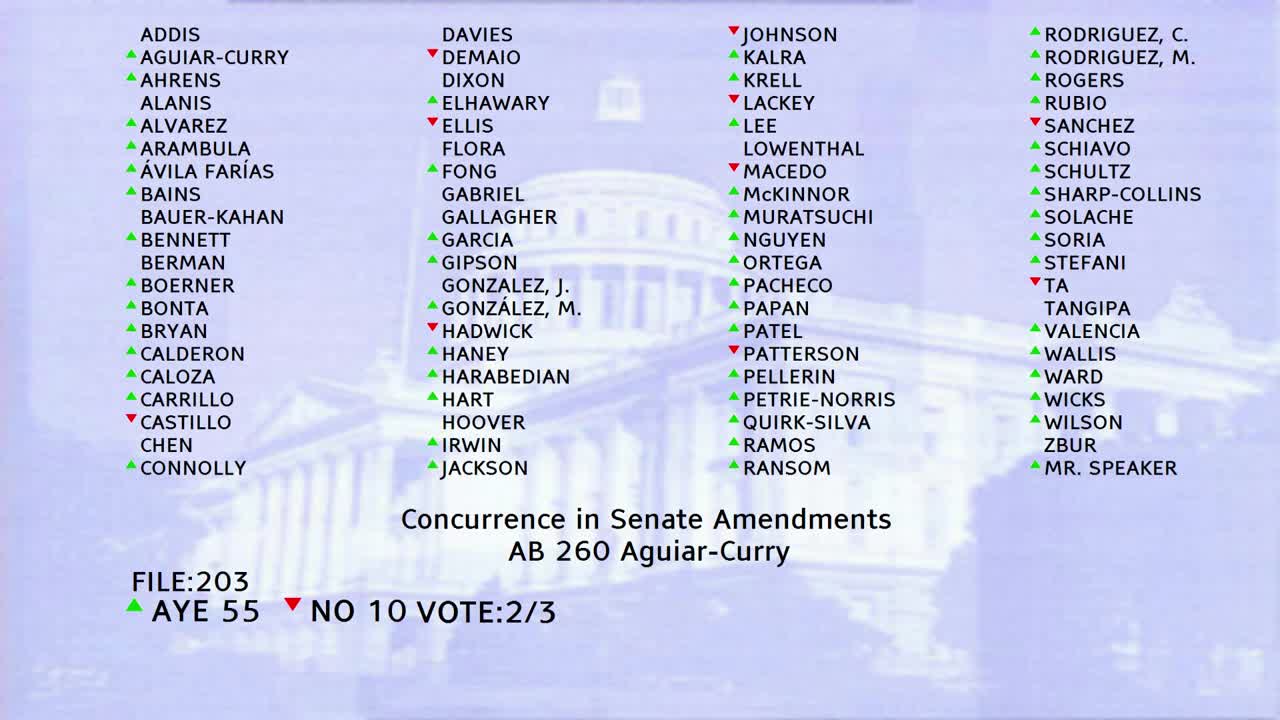 44SEC
Assembly Floor
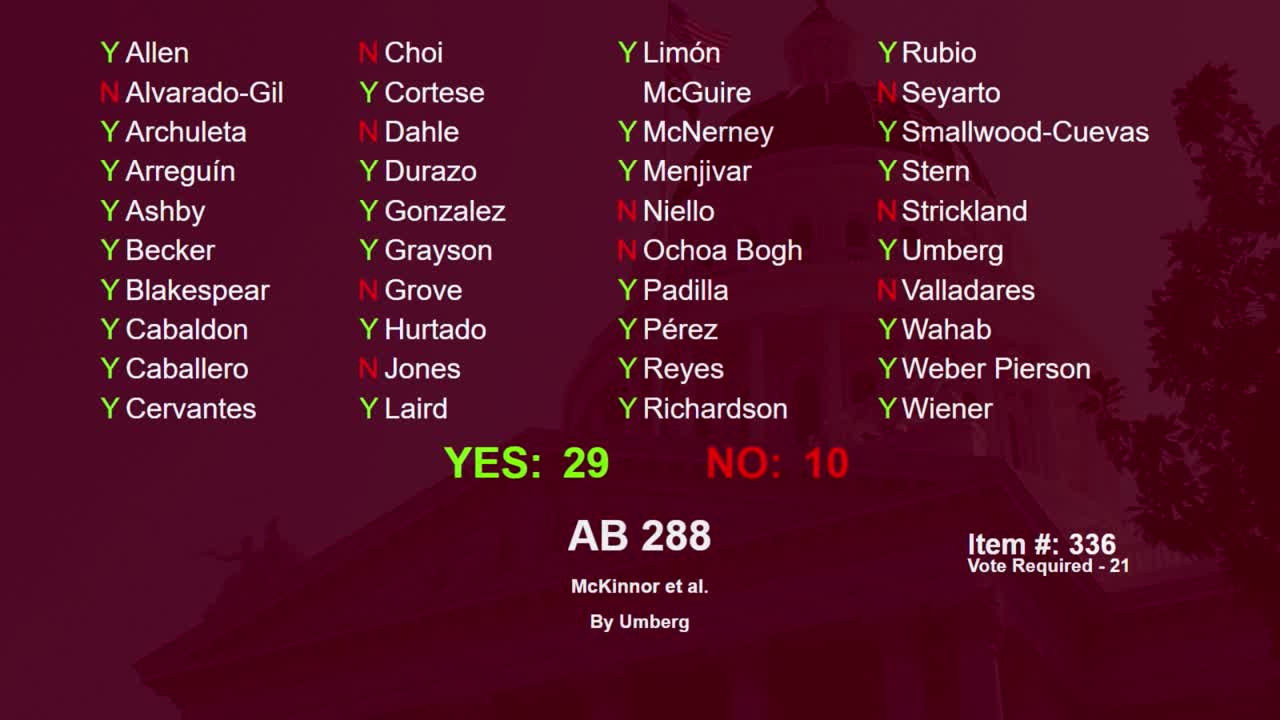 3MIN
Senate Floor
 3MIN
Senate Standing Committee on Judiciary
 2MIN
Senate Standing Committee on Business, Professions and Economic Development
 1MIN
Assembly Floor
 2MIN
Assembly Standing Committee on Judiciary
 11MIN