SB 423: California Public Records Act: private detention facilities.
- Session Year: 2025-2026
- House: Senate
- Latest Version Date: 2026-09-29
Current Status:
Passed
(2026-09-29: Chaptered by Secretary of State. Chapter 751, Statutes of 2026.)
Introduced
In Committee
Awaiting First Chamber Vote
Passed First Chamber
In Committee
Awaiting Second Chamber Vote
Passed Second Chamber
Enacted
Existing law, the California Public Records Act, requires each state or local agency, upon a request for a copy of records that reasonably describes an identifiable record or records, to make the records promptly available to any person upon payment of fees covering direct costs of duplication, or a statutory fee if applicable, except with respect to public records exempt from disclosure by express provisions of law. Existing law requires, upon request, an exact copy to be provided unless it is impracticable to do so.
This bill would specify that a recording of a call or a written communication that is maintained by a state or local agency that reports or describes an incident, as defined, occurring at a private detention facility, and specified records relating to that call or communication in the possession of a law enforcement agency, are not confidential, and would require an agency to disclose those records upon request to any member of the public. By requiring agencies to disclose certain records to the public, the bill would increase the duties of local officials and create a state-mandated local program.
Existing law specifies that, except as provided, the act does not require the disclosure of records of complaints to, or investigations conducted by, or records of intelligence information or security procedures of, the office of the Attorney General and the Department of Justice, the Office of Emergency Services and any state or local police agency, or any investigatory or security files compiled by any other state or local police agency, or any investigatory or security files compiled by any other state or local agency for correctional, law enforcement, or licensing purposes.
This bill would also except the above-described requirements relating to records relating to private detention facilities from that provision, but would specify that those requirements do not apply to the office of the Attorney General, the Department of Justice, the Department of Consumer Affairs, or any state entity within the Department of Consumer Affairs, as specified.
The California Constitution requires local agencies, for the purpose of ensuring public access to the meetings of public bodies and the writings of public officials and agencies, to comply with a statutory enactment that amends or enacts laws relating to public records or open meetings and contains findings demonstrating that the enactment furthers the constitutional requirements relating to this purpose.
This bill would make legislative findings to that effect.
The California Constitution requires the state to reimburse local agencies and school districts for certain costs mandated by the state. Statutory provisions establish procedures for making that reimbursement.
This bill would provide that no reimbursement is required by this act for a specified reason.
Existing law, the California Public Records Act, requires each state or local agency, upon a request for a copy of records that reasonably describes an identifiable record or records, to make the records promptly available to any person upon payment of fees covering direct costs of duplication, or a statutory fee if applicable, except with respect to public records exempt from disclosure by express provisions of law. Existing law requires, upon request, an exact copy to be provided unless it is impracticable to do so.
This bill would specify that a recording of a call or a written communication that is maintained by a state or local agency that reports or describes an incident, as defined, occurring at a private detention facility, and specified records relating to that call or communication in the possession of a law enforcement agency, are not confidential, and would require an agency to disclose those records upon request to any member of the public. By requiring agencies to disclose certain records to the public, the bill would increase the duties of local officials and create a state-mandated local program.
Existing law specifies that, except as provided, the act does not require the disclosure of records of complaints to, or investigations conducted by, or records of intelligence information or security procedures of, the office of the Attorney General and the Department of Justice, the Office of Emergency Services and any state or local police agency, or any investigatory or security files compiled by any other state or local police agency, or any investigatory or security files compiled by any other state or local agency for correctional, law enforcement, or licensing purposes.
This bill would also except the above-described requirements relating to records relating to private detention facilities from that provision, but would specify that those requirements do not apply to the office of the Attorney General or the Department of Justice. General, the Department of Justice, the Department of Consumer Affairs, or any state entity within the Department of Consumer Affairs, as specified.
The California Constitution requires local agencies, for the purpose of ensuring public access to the meetings of public bodies and the writings of public officials and agencies, to comply with a statutory enactment that amends or enacts laws relating to public records or open meetings and contains findings demonstrating that the enactment furthers the constitutional requirements relating to this purpose.
This bill would make legislative findings to that effect.
The California Constitution requires the state to reimburse local agencies and school districts for certain costs mandated by the state. Statutory provisions establish procedures for making that reimbursement.
This bill would provide that no reimbursement is required by this act for a specified reason.
Existing law, the California Public Records Act, requires each state or local agency, upon a request for a copy of records that reasonably describes an identifiable record or records, to make the records promptly available to any person upon payment of fees covering direct costs of duplication, or a statutory fee if applicable, except with respect to public records exempt from disclosure by express provisions of law. Existing law requires, upon request, an exact copy to be provided unless it is impracticable to do so.
This bill would specify that certain records maintained by a state or local agency that relate to private detention facilities, as defined, including any audio or video recording of any telephonic or other call a recording of a call or a written communication that is maintained by a state or local agency that reports or describes an incident, as defined, occurring at a private detention facility, and specified records relating to that call or communication in the possession of a law enforcement agency, are not confidential, and would require an agency to disclose those records upon request to any member of the public. By requiring agencies to disclose certain records to the public, the bill would increase the duties of local officials and create a state-mandated local program.
Existing law specifies that, except as provided, the act does not require the disclosure of records of complaints to, or investigations conducted by, or records of intelligence information or security procedures of, the office of the Attorney General and the Department of Justice, the Office of Emergency Services and any state or local police agency, or any investigatory or security files compiled by any other state or local police agency, or any investigatory or security files compiled by any other state or local agency for correctional, law enforcement, or licensing purposes.
This bill would also except the above-described requirements relating to records relating to private detention facilities from that provision. provision, but would specify that those requirements do not apply to the office of the Attorney General or the Department of Justice.
The California Constitution requires local agencies, for the purpose of ensuring public access to the meetings of public bodies and the writings of public officials and agencies, to comply with a statutory enactment that amends or enacts laws relating to public records or open meetings and contains findings demonstrating that the enactment furthers the constitutional requirements relating to this purpose.
This bill would make legislative findings to that effect.
The California Constitution requires the state to reimburse local agencies and school districts for certain costs mandated by the state. Statutory provisions establish procedures for making that reimbursement.
This bill would provide that no reimbursement is required by this act for a specified reason.
Existing law, the California Public Records Act, requires each state or local agency, upon a request for a copy of records that reasonably describes an identifiable record or records, to make the records promptly available to any person upon payment of fees covering direct costs of duplication, or a statutory fee if applicable, except with respect to public records exempt from disclosure by express provisions of law. Existing law requires, upon request, an exact copy to be provided unless it is impracticable to do so.
This bill would specify that certain records maintained by a state or local agency that relate to private detention facilities, as defined, including any audio or video recording of any telephonic or other call that reports or describes an incident, as defined, occurring at a private detention facility, are not confidential, and would require an agency to disclose those records upon request to any member of the public. By requiring agencies to disclose certain records to the public, the bill would increase the duties of local officials and create a state-mandated local program.
Existing law requires each agency, within 10 days of a request for a copy of records, to determine whether the request seeks copies of disclosable public records in possession of the agency and to promptly notify the person of the determination and the reasons therefor. If the agency determines that the request seeks disclosable public records, existing law requires the agency to also state the estimated date and time when the records will be made available. Existing law authorizes that time limit to be extended by no more than 14 days under unusual circumstances, as defined. This bill would exempt the above-described records relating to private detention facilities from those provisions. The bill would correct an erroneous cross-reference related to those provisions.Existing law specifies that, except as provided, the act does not require the disclosure of records of complaints to, or investigations conducted by, or records of intelligence information or security procedures of, the office of the Attorney General and the Department of Justice, the Office of Emergency Services and any state or local police agency, or any investigatory or security files compiled by any other state or local police agency, or any investigatory or security files compiled by any other state or local agency for correctional, law enforcement, or licensing purposes.
This bill would also except the above-described requirements relating to records relating to private detention facilities from that provision.
The California Constitution requires local agencies, for the purpose of ensuring public access to the meetings of public bodies and the writings of public officials and agencies, to comply with a statutory enactment that amends or enacts laws relating to public records or open meetings and contains findings demonstrating that the enactment furthers the constitutional requirements relating to this purpose.
This bill would make legislative findings to that effect.
The California Constitution requires the state to reimburse local agencies and school districts for certain costs mandated by the state. Statutory provisions establish procedures for making that reimbursement.
This bill would provide that no reimbursement is required by this act for a specified reason.
Existing law, the California Public Records Act, requires each state or local agency, upon a request for a copy of records that reasonably describes an identifiable record or records, to make the records promptly available to any person upon payment of fees covering direct costs of duplication, or a statutory fee if applicable, except with respect to public records exempt from disclosure by express provisions of law. Existing law requires, upon request, an exact copy to be provided unless it is impracticable to do so.
This bill would specify that certain records maintained by a state or local agency that relate to private detention facilities, as defined, including any audio or video recording of any telephonic or other call that reports or describes an incident, as defined, occurring at a private detention facility, are not confidential, and would require an agency to disclose those records upon request to any member of the public. By requiring agencies to disclose certain records to the public, the bill would increase the duties of local officials and create a state-mandated local program.
Existing law requires each agency, within 10 days of a request for a copy of records, to determine whether the request seeks copies of disclosable public records in possession of the agency and to promptly notify the person of the determination and the reasons therefor. If the agency determines that the request seeks disclosable public records, existing law requires the agency to also state the estimated date and time when the records will be made available. Existing law authorizes that time limit to be extended by no more than 14 days under unusual circumstances, as defined.
This bill would exempt the above-described records relating to private detention facilities from those provisions. The bill would correct an erroneous cross-reference related to those provisions.
Existing law specifies that, except as provided, the act does not require the disclosure of records of complaints to, or investigations conducted by, or records of intelligence information or security procedures of, the office of the Attorney General and the Department of Justice, the Office of Emergency Services and any state or local police agency, or any investigatory or security files compiled by any other state or local police agency, or any investigatory or security files compiled by any other state or local agency for correctional, law enforcement, or licensing purposes.
This bill would also except the above-described requirements relating to records relating to private detention facilities from that provision.
The California Constitution requires local agencies, for the purpose of ensuring public access to the meetings of public bodies and the writings of public officials and agencies, to comply with a statutory enactment that amends or enacts laws relating to public records or open meetings and contains findings demonstrating that the enactment furthers the constitutional requirements relating to this purpose.
This bill would make legislative findings to that effect.
The California Constitution requires the state to reimburse local agencies and school districts for certain costs mandated by the state. Statutory provisions establish procedures for making that reimbursement.
This bill would provide that no reimbursement is required by this act for a specified reason.
(1)Existing law, the Zenovich-Moscone-Chacon Housing and Home Finance Act, among other things, establishes the Department of Housing and Community Development and requires it to administer various programs intended to promote the development of housing and to provide housing assistance and home loans. Existing law sets forth various general powers of the department in implementing these programs, including authorizing the department to enter into long-term contracts or agreements of up to 30 years for the purpose of servicing loans or grants or enforcing regulatory agreements or other security documents. Existing law creates the California Housing Finance Agency within the Business, Consumer Services, and Housing Agency and authorizes the agency to make loans to finance affordable housing.This bill would allow a state or local agency administering an affordable housing program to enter into or modify a provision of a regulatory agreement regarding curing an event of default, if prescribed conditions apply. The bill would exempt a regulatory agreement entered into or altered pursuant to its provisions from any conflicting land use restriction, declaration of restrictive covenants, deed restriction, or similar instrument, as provided. The bill would specify that its provisions are not to be construed to supersede any other law governing the foreclosure of deeds of trust or mortgages and the extinguishment of junior interests.The bill would include findings that these changes proposed by this bill address a matter of statewide concern rather than a municipal affair and, therefore, apply to all cities, including charter cities.(2)Existing statutory law, enacted by Proposition 62, as approved by the voters at the November 4, 1986, statewide general election, prohibits a local government or district from imposing any transaction tax or sales tax on the sale of real property within the city, county, or district, except as provided. The California Constitution authorizes cities organized under a charter to make and enforce all ordinances and regulations with respect to municipal affairs, which supersede inconsistent general laws. Existing law, the Documentary Transfer Tax Act, authorizes the imposition of a tax by a county or city, as provided, with respect to specified instruments that transfer specified interests in real property.This bill would prohibit the City of Los Angeles from imposing a documentary transfer tax greater than a specified rate on a deed, instrument, or writing that conveys real property that was issued its first certificate of occupancy within the previous 15 years, except as provided. The bill would authorize the City of Los Angeles to impose a documentary transfer tax at greater than a specified rate on a deed, instrument, or writing that conveys real property unless the real property is a single-family housing property, as defined, and meets specified conditions, including that the dwelling unit on the single-family housing property was destroyed by a disaster that resulted in a declared local emergency. The bill would make these provisions operative on a specified date, but only if certain conditions are satisfied, as provided.This bill would make legislative findings and declarations as to the necessity of a special statute for the City of Los Angeles.(1)Existing law, the Zenovich-Moscone-Chacon Housing and Home Finance Act, among other things, establishes the Department of Housing and Community Development and requires it to administer various programs intended to promote the development of housing and to provide housing assistance and home loans. Existing law sets forth various general powers of the department in implementing these programs, including authorizing the department to enter into long-term contracts or agreements of up to 30 years for the purpose of servicing loans or grants or enforcing regulatory agreements or other security documents. Existing law creates the California Housing Finance Agency within the Business, Consumer Services, and Housing Agency and authorizes the agency to make loans to finance affordable housing.
This bill would allow a state or local agency administering an affordable housing program to enter into or modify a provision of a regulatory agreement regarding curing an event of default, if prescribed conditions apply. The bill would exempt a regulatory agreement entered into or altered pursuant to its provisions from any conflicting land use restriction, declaration of restrictive covenants, deed restriction, or similar instrument, as provided. The bill would specify that its provisions are not to be construed to supersede any other law governing the foreclosure of deeds of trust or mortgages and the extinguishment of junior interests.
The bill would include findings that these changes proposed by this bill address a matter of statewide concern rather than a municipal affair and, therefore, apply to all cities, including charter cities.
(2)Existing statutory law, enacted by Proposition 62, as approved by the voters at the November 4, 1986, statewide general election, prohibits a local government or district from imposing any transaction tax or sales tax on the sale of real property within the city, county, or district, except as provided. The California Constitution authorizes cities organized under a charter to make and enforce all ordinances and regulations with respect to municipal affairs, which supersede inconsistent general laws. Existing law, the Documentary Transfer Tax Act, authorizes the imposition of a tax by a county or city, as provided, with respect to specified instruments that transfer specified interests in real property.
This bill would prohibit the City of Los Angeles from imposing a documentary transfer tax greater than a specified rate on a deed, instrument, or writing that conveys real property that was issued its first certificate of occupancy within the previous 15 years, except as provided. The bill would authorize the City of Los Angeles to impose a documentary transfer tax at greater than a specified rate on a deed, instrument, or writing that conveys real property unless the real property is a single-family housing property, as defined, and meets specified conditions, including that the dwelling unit on the single-family housing property was destroyed by a disaster that resulted in a declared local emergency. The bill would make these provisions operative on a specified date, but only if certain conditions are satisfied, as provided.
This bill would make legislative findings and declarations as to the necessity of a special statute for the City of Los Angeles.
Existing law establishes in the Natural Resources Agency the Department of Forestry and Fire Protection, and requires the department to be responsible for, among other things, fire protection and prevention, as provided. Existing law establishes the California Conservation Corps and requires the corps to implement and administer various training and educational programs, including the California Conservation Camp program. Under existing law, inmates and wards in the California Conservation Camp program work on projects supervised by the department. Existing law requires the department to use inmates and wards assigned to conservation camps in performing fire prevention, fire control, and other work at the department.This bill would authorize, upon appropriation by the Legislature, the fire chief of the County of Los Angeles Fire Department to establish the Local Handcrew Pilot Program for 5 years and would authorize the fire chief to enroll in the pilot program formerly incarcerated individuals who have successfully completed specified programs or work. The bill would require the fire chief to develop metrics for evaluating the efficacy and success of the pilot program, to evaluate the efficacy and success of the pilot program using those metrics, and to report the findings of the evaluation to the Legislature and the Governor, as provided. This bill would make legislative findings and declarations as to the necessity of a special statute for the County of Los Angeles.Existing law establishes in the Natural Resources Agency the Department of Forestry and Fire Protection, and requires the department to be responsible for, among other things, fire protection and prevention, as provided. Existing law establishes the California Conservation Corps and requires the corps to implement and administer various training and educational programs, including the California Conservation Camp program. Under existing law, incarcerated persons inmates and wards in the California Conservation Camp program work on projects supervised by the department. Existing law requires the department to use incarcerated persons inmates and wards assigned to conservation camps in performing fire prevention, fire control, and other work at the department.
This bill would require, upon appropriation by the Legislature, the department, in collaboration with the California Conservation Corps and the Department of Corrections and Rehabilitation, to operate an enhanced firefighter training and certification program at the Ventura Training Center in the County of Ventura, or its successor facility.The This bill would authorize, upon appropriation by the Legislature, the fire chief of the County of Los Angeles Fire Department to establish the Local Handcrew Pilot Program for 5 years and would authorize the fire chief to enroll in the pilot program formerly incarcerated individuals who have successfully completed specified programs, training, programs or work. The bill would require the fire chief to develop metrics for evaluating the efficacy and success of the pilot program, to evaluate the efficacy and success of the pilot program using those metrics, and to report the findings of the evaluation to the Legislature and the Governor, as provided.
This bill would make legislative findings and declarations as to the necessity of a special statute for the Ventura Training Center in the County of Ventura. County of Los Angeles.
Existing law establishes the California Community Colleges under the administration of the Board of Governors of the California Community Colleges. Under existing law, the board of governors appoints a chief executive officer, who is known as the Chancellor of the California Community Colleges. Existing law requires the Department of Corrections and Rehabilitation and the office of the Chancellor of the California Community Colleges to enter into an interagency agreement to expand access to community college courses that lead to degrees or certificates that result in enhanced workforce skills or transfer to a 4-year university.
This bill would require, on or before January 1, 2028, the Department of Corrections and Rehabilitation and the office of the Chancellor of the California Community Colleges to expand access to community college courses that lead to degrees and certificates in specified subjects including, among other subjects, fire science, for individuals serving in California Conservation Corps handcrews or institutional firehouses, as provided.
Existing law establishes in the Natural Resources Agency the Department of Forestry and Fire Protection, and requires the department to be responsible for, among other things, fire protection and prevention, as provided. Existing law establishes the California Conservation Corps and requires the corps to implement and administer various training and educational programs, including the California Conservation Camp program. Under existing law, incarcerated persons in the California Conservation Camp program work on projects supervised by the department. Existing law requires the department to use incarcerated persons assigned to conservation camps in performing fire prevention, fire control, and other work at the department.
This bill would require require, upon appropriation by the Legislature, the department, in collaboration with the California Conservation Corps and the Department of Corrections and Rehabilitation, to operate an enhanced firefighter training and certification program at the Ventura Training Center in the County of Ventura, or its successor facility, and would also require, upon appropriation of the Legislature, the operation of an enhanced firefighter training and certification program at a facility in the northern region of the state. facility.
The bill would authorize, upon appropriation by the Legislature, the fire chief of the County of Los Angeles Fire Department to establish the Local Handcrew Pilot Program for 5 years and would authorize the fire chief to enroll in the pilot program formerly incarcerated individuals who have successfully completed specified programs, training, or work. The bill would require the fire chief to develop metrics for evaluating the efficacy and success of the pilot program, to evaluate the efficacy and success of the pilot program using those metrics, and to report the findings of the evaluation to the Legislature and the Governor, as provided.
This bill would make legislative findings and declarations as to the necessity of a special statute for the Ventura Training Center in the County of Ventura.
Existing law establishes the California Community Colleges under the administration of the Board of Governors of the California Community Colleges. Under existing law, the board of governors appoints a chief executive officer, who is known as the Chancellor of the California Community Colleges. Existing law requires the Department of Corrections and Rehabilitation and the office of the Chancellor of the California Community Colleges to enter into an interagency agreement to expand access to community college courses that lead to degrees or certificates that result in enhanced workforce skills or transfer to a 4-year university.
This bill would require, on or before January 1, 2028, the Department of Corrections and Rehabilitation and the office of the Chancellor of the California Community Colleges to expand access to community college courses that lead to degrees and certificates in specified subjects including, among other subjects, fire science, for individuals serving in California Conservation Corps handcrews or institutional firehouses, as provided.
Existing law establishes in the Natural Resources Agency the Department of Forestry and Fire Protection, and requires the department to be responsible for, among other things, fire protection and prevention, as provided. Existing law establishes the California Conservation Corps in the Natural Resources Agency and requires the corps to implement and administer various training and educational programs, including the California Conservation Camp program. Under existing law, incarcerated persons in the California Conservation Camp program work on projects supervised by the Department of Forestry and Fire Protection. department. Existing law requires the department to utilize use incarcerated persons assigned to conservation camps in performing fire prevention, fire control, and other work at the department.
Existing law allows a defendant who successfully participated in the California Conservation Camp program as an incarcerated individual hand crew member, or who successfully participated as a member of a county incarcerated hand crew, except as specified, to petition the court to have the pleading dismissed, as described, thus releasing the person of any penalties and disabilities of conviction, except as otherwise provided.This bill, the Enhancing Workforce Development for Incarcerated Firefighters Act, would establish the Incarcerated Firefighter Community Reinvestment Fund, to be administered by the Department of Finance, in consultation with the Department of Corrections and Rehabilitation and the Department of Forestry and Fire Protection. The bill would require the Department of Finance, beginning July 1, 2026, and based on specified data, to calculate the savings to the state derived in the prior fiscal year from the use of incarcerated firefighters in wildfire suppression, fire prevention, and other emergency response activities, instead of the use of nonincarcerated firefighters for those purposes, and to transfer that amount into the fund. The bill would require the Department of Finance, by January 1, 2027, and subject to an appropriation by the Legislature, to develop and implement a grant program to distribute moneys in the fund for specified purposes relating to assisting formerly incarcerated firefighters after they have been released from prison, including providing workforce training and housing support. The bill would require the Department of Finance to report to the Legislature, on or before January 1 of each year, various data including the cost savings and data related to recidivism. The bill would also require the Department of Finance, the Department of Corrections and Rehabilitation, and the Department of Forestry and Fire Protection to each post a copy of the Department of Finance report to their internet websites.The bill would require the Department of Corrections and Rehabilitation, in consultation with specified entities including local fire departments and accredited firefighter academies, to establish a postrelease hiring program and accompanying procedures for hiring formerly incarcerated firefighters. The bill would require the Department of Corrections and Rehabilitation, in consultation with the Department of Forestry and Fire Protection, on or before January 1 of each calendar year, until January 1, 2030, to submit a report to the Legislature regarding, among other things, the number of individuals enrolled in the program and recommendations to enhance or expand the program.The bill would require the Department of Corrections and Rehabilitation, in consultation with specified entities including the Chancellors office of the Community Colleges and the Academic Senate for California Community Colleges, to establish a uniform fire science and emergency medical technician curriculum for use in all correctional facilities that offer firefighting or emergency medical technician programs.The bill would require the Department of Corrections and Rehabilitation, in partnership with, among others, the Department of Forestry and Fire Protection, to develop a tiered training program that includes certain modules for advanced leadership. The bill would also require the Division of Apprenticeship Standards, in collaboration with, among others, the Department of Corrections and Rehabilitation, to establish a firefighter apprenticeship framework that integrates in-custody training hours with recognized apprenticeship credits toward advanced firefighting licenses or certifications.This bill would require the department, in collaboration with the California Conservation Corps and the Department of Corrections and Rehabilitation, to operate an enhanced firefighter training and certification program at the Ventura Training Center in the County of Ventura, or its successor facility, and would also require, upon appropriation of the Legislature, the operation of an enhanced firefighter training and certification program at a facility in the northern region of the state.
The bill would authorize, upon appropriation by the Legislature, the fire chief of the County of Los Angeles Fire Department to establish the Local Handcrew Pilot Program for 5 years and would authorize the fire chief to enroll in the pilot program formerly incarcerated individuals who have successfully completed specified programs, training, or work. The bill would require the fire chief to develop metrics for evaluating the efficacy and success of the pilot program, to evaluate the efficacy and success of the pilot program using those metrics, and to report the findings of the evaluation to the Legislature and the Governor, as provided.
This bill would make legislative findings and declarations as to the necessity of a special statute for the Ventura Training Center in the County of Ventura.
Existing law establishes the California Conservation Corps in the Natural Resources Agency and requires the corps to implement and administer various training and educational programs, including the California Conservation Camp program. Under existing law, incarcerated persons in the California Conservation Camp program work on projects supervised by the Department of Forestry and Fire Protection. Existing law requires the department to utilize incarcerated persons assigned to conservation camps in performing fire prevention, fire control, and other work at the department.
Existing law allows a defendant who successfully participated in the California Conservation Camp program as an incarcerated individual hand crew member, or who successfully participated as a member of a county incarcerated hand crew, except as specified, to petition the court to have the pleading dismissed, as described, thus releasing the person of any penalties and disabilities of conviction, except as otherwise provided.
This bill, the Enhancing Workforce Development for Incarcerated Firefighters Act, would establish the Incarcerated Firefighter Community Reinvestment Fund, to be administered by the Department of Finance, in consultation with the Department of Corrections and Rehabilitation and the Department of Forestry and Fire Protection. The bill would require the Department of Finance, beginning July 1, 2026, and based on specified data, to calculate the savings to the state derived in the prior fiscal year from the use of incarcerated firefighters in wildfire suppression, fire prevention, and other emergency response activities, instead of the use of nonincarcerated firefighters for those purposes, and to transfer that amount into the fund. The bill would require the Department of Finance, by January 1, 2027, and subject to an appropriation by the Legislature, to develop and implement a grant program to distribute moneys in the fund for specified purposes relating to assisting formerly incarcerated firefighters after they have been released from prison, including providing workforce training and housing support. The bill would require the Department of Finance to report to the Legislature, on or before January 1 of each year, various data including the cost savings and data related to recidivism. The bill would also require the Department of Finance, the Department of Corrections and Rehabilitation, and the Department of Forestry and Fire Protection to each post a copy of the Department of Finance report to their internet websites.
The bill would require the Department of Corrections and Rehabilitation, in consultation with specified entities including local fire departments and accredited firefighter academies, to establish a postrelease hiring program and accompanying procedures for hiring formerly incarcerated firefighters. The bill would require the Department of Corrections and Rehabilitation, in consultation with the Department of Forestry and Fire Protection, on or before January 1 of each calendar year, until January 1, 2030, to submit a report to the Legislature regarding, among other things, the number of individuals enrolled in the program and recommendations to enhance or expand the program.
The bill would require the Department of Corrections and Rehabilitation, in consultation with specified entities including the Chancellors office of the Community Colleges and the Academic Senate for California Community Colleges, to establish a uniform fire science and emergency medical technician curriculum for use in all correctional facilities that offer firefighting or emergency medical technician programs.
The bill would require the Department of Corrections and Rehabilitation, in partnership with, among others, the Department of Forestry and Fire Protection, to develop a tiered training program that includes certain modules for advanced leadership. The bill would also require the Division of Apprenticeship Standards, in collaboration with, among others, the Department of Corrections and Rehabilitation, to establish a firefighter apprenticeship framework that integrates in-custody training hours with recognized apprenticeship credits toward advanced firefighting licenses or certifications.
Existing law authorizes the Department of Corrections and Rehabilitation to employ inmates for the rendering of service needed by the state or any political subdivision thereof, as specified, or for the rendering of emergency services for the protection of life and property in a state of emergency, as specified.This bill would state the intent of the Legislature to enact legislation relating to the certification of inmate firefighters.Existing law authorizes the Department of Corrections and Rehabilitation to employ inmates for the rendering of service needed by the state or any political subdivision thereof, as specified, or for the rendering of emergency services for the protection of life and property in a state of emergency, as specified.
This bill would state the intent of the Legislature to enact legislation relating to the certification of inmate firefighters.
(a)Except as provided in Sections 7923.606, 7924.510, 7924.700, and 7929.610, this division does not require the disclosure of records of complaints to, or investigations conducted by, or records of intelligence information or security procedures of, the office of the Attorney General and the Department of Justice, the Office of Emergency Services and any state or local police agency, or any investigatory or security files compiled by any other state or local police agency, or any investigatory or security files compiled by any other state or local agency for correctional, law enforcement, or licensing purposes.
(b)A customer list that an alarm or security company provides to a state or local police agency at the agencys request is a record subject to this article.
SEC. 2.Section 7923.606 is added to the Government Code, to read:7923.606.(a)Notwithstanding any other law, all of the following records maintained by a state or local agency shall not be confidential and an agency shall disclose those records upon request to any member of the public:
(1)Any recording of any telephonic or other call to the agency that reports or describes an incident occurring at a private detention facility, or any transcript of any such recording.
(2)Any written communication to the agency that reports or describes any incident occurring at a private detention facility.
(3)(A)For records in the possession of a law enforcement agency, any writing related to the report, investigation, or findings of an incident reported or described in a recording or any transcript described in paragraph (1) or a written communication described in paragraph (2), except as provided in subparagraph (B).
(B)Subparagraph (A) shall not require an agency to disclose a writing or portion of a writing during an active investigation being conducted by the agency that received the request if the disclosure would substantially interfere with the investigation, including by endangering the safety of a witness or a confidential source.
(C)This paragraph does not authorize withholding any of the following:
(i)An audio or video recording or transcript described in paragraph (1) or any portion thereof.
(ii)A written communication described in paragraph (2) or any portion thereof.
(b)(1)An agency shall redact any record disclosed pursuant to this section to remove both of the following:
(A)The name or identifying number of a person who reportedly experienced an incident or was the victim of a crime listed in paragraph (1) of subdivision (b) of Section 7923.615.
(B)The name or identifying number of a person, including, but not limited to, a whistleblower, complainant, or witness, if there is a specific, articulable, and particularized reason to believe that failure to do so would pose a significant danger to the physical safety of that person.
(2)An agency shall not redact any record disclosed pursuant to this section except as required pursuant to paragraph (1) or as authorized pursuant to subparagraph (B) of paragraph (3) of subdivision (a).
(c)For purposes of this section, both of the following definitions shall apply:
(1)Incident means any mental or physical illness or injury, any attempted suicide, any alleged crime, or any emergency.
(2)Private detention facility has the same meaning as that term is defined in Section 7320.
(d)This section shall not apply to the office of the Attorney General, the Department of Justice, the Department of Consumer Affairs, or any board, bureau, committee, commission, program, or other state entity within the Department of Consumer Affairs.
(e)This section shall not be construed to limit, restrict, or reduce any public right of access to records or information provided by any other law.
SEC. 3.The Legislature finds and declares that this act furthers, within the meaning of paragraph (7) of subdivision (b) of Section 3 of Article I of the California Constitution, the purposes of that constitutional section as it relates to the right of public access to the meetings of local public bodies or the writings of local public officials and local agencies. Pursuant to paragraph (7) of subdivision (b) of Section 3 of Article I of the California Constitution, the Legislature makes the following findings:
This act ensures the publics right to know the frequency and substance of complaints and calls for assistance made by or on behalf of vulnerable individuals held in private detention facilities, who are exposed to significant risk of sexual assault or other abuses. Public access to these records is especially important in light of reports that some law enforcement agencies have allowed the management of private detention facilities to determine whether and how those complaints or calls for assistance are investigated.
SEC. 4.No reimbursement is required by this act pursuant to Section 6 of Article XIII B of the California Constitution because the only costs that may be incurred by a local agency or school district under this act would result from a legislative mandate that is within the scope of paragraph (7) of subdivision (b) of Section 3 of Article I of the California Constitution.
(a)Except as provided in Sections 7923.606, 7924.510, 7924.700, and 7929.610, this division does not require the disclosure of records of complaints to, or investigations conducted by, or records of intelligence information or security procedures of, the office of the Attorney General and the Department of Justice, the Office of Emergency Services and any state or local police agency, or any investigatory or security files compiled by any other state or local police agency, or any investigatory or security files compiled by any other state or local agency for correctional, law enforcement, or licensing purposes.
(b)A customer list that an alarm or security company provides to a state or local police agency at the agencys request is a record subject to this article.
SEC. 2.Section 7923.606 is added to the Government Code, to read:7923.606.(a)Notwithstanding any other law, all of the following records maintained by a state or local agency shall not be confidential and an agency shall disclose those records upon request to any member of the public:
(1)Any recording of any telephonic or other call to the agency that reports or describes an incident occurring at a private detention facility, or any transcript of any such recording.
(2)Any written communication to the agency that reports or describes any incident occurring at a private detention facility.
(3)(A)For records in the possession of a law enforcement agency, any writing related to the report, investigation, or findings of an incident reported or described in a recording or any transcript described in paragraph (1) or a written communication described in paragraph (2), except as provided in subparagraph (B).
(B)Subparagraph (A) shall not require an agency to disclose a writing or portion of a writing during an active investigation being conducted by the agency that received the request if the disclosure would substantially interfere with the investigation, including by endangering the safety of a witness or a confidential source.
(C)This paragraph does not authorize withholding any of the following:
(i)An audio or video recording or transcript described in paragraph (1) or any portion thereof.
(ii)A written communication described in paragraph (2) or any portion thereof.
(b)(1)An agency shall redact any record disclosed pursuant to this section to remove both of the following:
(A)The name or identifying number of a person who reportedly experienced an incident or was the victim of a crime listed in paragraph (1) of subdivision (b) of Section 7923.615.
(B)The name or identifying number of a person, including, but not limited to, a whistleblower, complainant, or witness, if there is a specific, articulable, and particularized reason to believe that failure to do so would pose a significant danger to the physical safety of that person.
(2)An agency shall not redact any record disclosed pursuant to this section except as required pursuant to paragraph (1) or as authorized pursuant to subparagraph (B) of paragraph (3) of subdivision (a).
(c)For purposes of this section, both of the following definitions shall apply:
(1)Incident means any mental or physical illness or injury, any attempted suicide, any alleged crime, or any emergency.
(2)Private detention facility has the same meaning as that term is defined in Section 7320.
(d)This section shall not apply to the office of the Attorney General or the Department of Justice. General, the Department of Justice, the Department of Consumer Affairs, or any board, bureau, committee, commission, program, or other state entity within the Department of Consumer Affairs.
(e)This section shall not be construed to limit, restrict, or reduce any public right of access to records or information provided by any other law.
SEC. 3.The Legislature finds and declares that this act furthers, within the meaning of paragraph (7) of subdivision (b) of Section 3 of Article I of the California Constitution, the purposes of that constitutional section as it relates to the right of public access to the meetings of local public bodies or the writings of local public officials and local agencies. Pursuant to paragraph (7) of subdivision (b) of Section 3 of Article I of the California Constitution, the Legislature makes the following findings:
This act ensures the publics right to know the frequency and substance of complaints and calls for assistance made by or on behalf of vulnerable individuals held in private detention facilities, who are exposed to significant risk of sexual assault or other abuses. Public access to these records is especially important in light of reports that some law enforcement agencies have allowed the management of private detention facilities to determine whether and how those complaints or calls for assistance are investigated.
SEC. 4.No reimbursement is required by this act pursuant to Section 6 of Article XIII B of the California Constitution because the only costs that may be incurred by a local agency or school district under this act would result from a legislative mandate that is within the scope of paragraph (7) of subdivision (b) of Section 3 of Article I of the California Constitution.
(a)Except as provided in Sections 7923.606, 7924.510, 7924.700, and 7929.610, this division does not require the disclosure of records of complaints to, or investigations conducted by, or records of intelligence information or security procedures of, the office of the Attorney General and the Department of Justice, the Office of Emergency Services and any state or local police agency, or any investigatory or security files compiled by any other state or local police agency, or any investigatory or security files compiled by any other state or local agency for correctional, law enforcement, or licensing purposes.
(b)A customer list that an alarm or security company provides to a state or local police agency at the agencys request is a record subject to this article.
SEC. 2.Section 7923.606 is added to the Government Code, to read:7923.606.(a)Notwithstanding any other law, all of the following records maintained by a state or local agency shall not be confidential and an agency shall disclose those records upon request to any member of the public:
(1)Any recording of any telephonic or other call to the agency that reports or describes an incident occurring at a private detention facility, or any transcript of any such recording.
(2)Any written communication to the agency that reports or describes any incident occurring at a private detention facility.
(3)(A)Any For records in the possession of a law enforcement agency, any writing related to the report, investigation, or findings of an incident reported or described in a recording or any transcript described in paragraph (1) or a written communication described in paragraph (2), including, but not limited to, any communications, notes, reports, investigations, or findings, except as provided in subparagraph (B).
(B)Subparagraph (A) shall not require an agency to disclose a writing or portion of a writing during an active investigation being conducted by the agency that received the request if the disclosure would substantially interfere with the investigation, including by endangering the safety of a witness or a confidential source.
(C)This paragraph does not authorize withholding any of the following:
(i)An audio or video recording or transcript described in paragraph (1) or any portion thereof.
(ii)A written communication described in paragraph (2) or any portion thereof.
(b)(1)An agency shall redact any record disclosed pursuant to this section to remove the both of the following:
(A)The name or identifying number of a person who reportedly experienced an incident or was the victim of a crime listed in paragraph (1) of subdivision (b) of Section 7923.615.
(B)The name or identifying number of a person, including, but not limited to, a whistleblower, complainant, or witness, if there is a specific, articulable, and particularized reason to believe that failure to do so would pose a significant danger to the physical safety of that person.
(2)An agency shall not redact any record disclosed pursuant to this section except as required pursuant to paragraph (1) or as authorized pursuant to subparagraph (B) of paragraph (3) of subdivision (a).
(c)For purposes of this section, both of the following definitions shall apply:
(1)Incident means any mental or physical illness or injury, any attempted suicide, any alleged crime, or any emergency.
(2)Private detention facility has the same meaning as that term is defined in Section 7320.
(d)This section shall not apply to the office of the Attorney General or the Department of Justice.
(e)This section shall not be construed to limit, restrict, or reduce any public right of access to records or information provided by any other law.
SEC. 3.The Legislature finds and declares that this act furthers, within the meaning of paragraph (7) of subdivision (b) of Section 3 of Article I of the California Constitution, the purposes of that constitutional section as it relates to the right of public access to the meetings of local public bodies or the writings of local public officials and local agencies. Pursuant to paragraph (7) of subdivision (b) of Section 3 of Article I of the California Constitution, the Legislature makes the following findings:
This act ensures the publics right to know the frequency and substance of complaints and calls for assistance made by or on behalf of vulnerable individuals held in private detention facilities, who are exposed to significant risk of sexual assault or other abuses. Public access to these records is especially important in light of reports that some law enforcement agencies have allowed the management of private detention facilities to determine whether and how those complaints or calls for assistance are investigated.
SEC. 4.No reimbursement is required by this act pursuant to Section 6 of Article XIII B of the California Constitution because the only costs that may be incurred by a local agency or school district under this act would result from a legislative mandate that is within the scope of paragraph (7) of subdivision (b) of Section 3 of Article I of the California Constitution.
(a)Except as provided in Sections 7923.606, 7924.510, 7924.700, and 7929.610, this division does not require the disclosure of records of complaints to, or investigations conducted by, or records of intelligence information or security procedures of, the office of the Attorney General and the Department of Justice, the Office of Emergency Services and any state or local police agency, or any investigatory or security files compiled by any other state or local police agency, or any investigatory or security files compiled by any other state or local agency for correctional, law enforcement, or licensing purposes.
(b)A customer list that an alarm or security company provides to a state or local police agency at the agencys request is a record subject to this article.
SEC. 3.SEC. 2.Section 7923.606 is added to the Government Code, to read:7923.606.(a)Notwithstanding any other law, all of the following records maintained by a state or local agency shall not be confidential and an agency shall disclose those records upon request to any member of the public:
(1)Any recording of any telephonic or other call to the agency that reports or describes an incident occurring at a private detention facility, or any transcript of any such recording.
(2)Any written communication to the agency that reports or describes any incident occurring at a private detention facility.
(3)(A)Any writing related to a recording or any transcript described in paragraph (1) or a written communication described in paragraph (2), including, but not limited to, any communications, notes, reports, investigations, or findings, except as provided in subparagraph (B).
(B)Subparagraph (A) shall not require an agency to disclose a writing or portion of a writing during an active investigation being conducted by the agency that received the request if the disclosure would substantially interfere with the investigation, including by endangering the safety of a witness or a confidential source.
(C)This paragraph does not authorize withholding any of the following:
(i)An audio or video recording or transcript described in paragraph (1) or any portion thereof.
(ii)A written communication described in paragraph (2) or any portion thereof.
(b)An agency shall redact any record disclosed pursuant to this section to remove the name or identifying number of a person who reportedly experienced an incident or was the victim of a crime listed in paragraph (1) of subdivision (b) of Section 7923.615.
(c)For purposes of this section, both of the following definitions shall apply:
(1)Incident means any mental or physical illness or injury, any attempted suicide, any alleged crime, or any emergency.
(2)Private detention facility has the same meaning as that term is defined in Section 7320.
SEC. 4.Section 25152.5 of the Health and Safety Code is amended to read:25152.5.(a)For purposes of this section, the following definitions apply:(1)Unusual circumstances means only the following:(A)The need to search for and collect the requested records from field facilities or other establishments that are separate from the office processing the request.(B)The need to search for, collect, and appropriately examine a voluminous amount of separate and distinct records that are demanded in a single request.(C)The need to consult with another agency having a substantial interest in the determination of whether to respond to the request.(2)Public records means any public record, as defined in Section 7920.530 of the Government Code, of the department relating to this chapter, Chapter 6.7 (commencing with Section 25280), or Part 2 (commencing with Section 78000) of Division 45. Public records includes unprinted information relating to this chapter, Chapter 6.7 (commencing with Section 25280), or Part 2 (commencing with Section 78000) of Division 45 that is stored in data or word processing equipment either owned by an employee and located on premises under control of the department or owned by the department.(b)Notwithstanding any other provision of law, the department shall not limit the hours during the normal working day or limit the number of working days during which public records are open for inspection.(c)(1)Notwithstanding any other provision of law, the department shall make public records that are not exempt from disclosure by law, including Division 10 (commencing with Section 7920.000) of Title 1 of the Government Code, promptly available to any person, within the time limits specified in subdivision (a) of Section 7922.535 of the Government Code, upon payment of a fee established by the department to cover the direct costs of duplication, as specified in subdivision (f). In addition, a person requesting copies by mail may be required to pay the mailing costs.(2)If any portion of a record is exempt from disclosure, the part that is not exempt shall be provided as prescribed in this section.(d)Any person may request access to, or copies of, public records of the department in person or by mail. A request shall reasonably describe an identifiable record or information to be produced therefrom.(e)If the department determines that an unusual circumstance exists, the department shall comply with the notification procedures and the time limits specified in Section 7922.535 of the Government Code.(f)The department shall, upon request, provide any person with the facts upon which it bases its determination of the direct costs of copying for each page that is requested. The department shall not impose a minimum fee for a copy of a public record that is greater than its direct per page copying costs and the department shall not impose limits on the types or amounts of public records that the department will provide to persons requesting these records, upon payment of any fees covering the direct costs of duplication by the department.(g)This section does not authorize the department, or any employee of the department, to delay access for purposes of inspecting or obtaining copies of public records, unless there are unusual circumstances.(h)Any denial of a request for records shall set forth in writing the reasons for the denial and the names and titles or positions of each person responsible for the denial. This written response shall be provided to the requester within five working days of the denial.SEC. 5.SEC. 3.The Legislature finds and declares that this act furthers, within the meaning of paragraph (7) of subdivision (b) of Section 3 of Article I of the California Constitution, the purposes of that constitutional section as it relates to the right of public access to the meetings of local public bodies or the writings of local public officials and local agencies. Pursuant to paragraph (7) of subdivision (b) of Section 3 of Article I of the California Constitution, the Legislature makes the following findings:
This act ensures the publics right to know the frequency and substance of complaints and calls for assistance made by or on behalf of vulnerable individuals held in private detention facilities, who are exposed to significant risk of sexual assault or other abuses. Public access to these records is especially important in light of reports that some law enforcement agencies have allowed the management of private detention facilities to determine whether and how those complaints or calls for assistance are investigated.
SEC. 6.SEC. 4.No reimbursement is required by this act pursuant to Section 6 of Article XIII B of the California Constitution because the only costs that may be incurred by a local agency or school district under this act would result from a legislative mandate that is within the scope of paragraph (7) of subdivision (b) of Section 3 of Article I of the California Constitution.
REVISIONS: HeadingLines 2 and 3.(a)Each agency, upon a request for a copy of records, shall, within 10 days from receipt of the request, determine whether the request, in whole or in part, seeks copies of disclosable public records in the possession of the agency and shall promptly notify the person making the request of the determination and the reasons therefor. If the agency determines that the request seeks disclosable public records, the agency shall also state the estimated date and time when the records will be made available.
(b)In unusual circumstances, the time limit prescribed in this article and Article 1 (commencing with Section 7922.500) may be extended by written notice from the head of the agency or a designee to the person making the request, setting forth the reasons for the extension and the date on which a determination is expected to be dispatched. The notice shall not specify a date that would result in an extension for more than 14 days.
(c)This section shall not apply to a request for records described in Section 7923.606.
(c)(d)As used in this section, unusual circumstances means the following, but only to the extent reasonably necessary to the proper processing of the particular request:
(1)The need to search for and collect the requested records from field facilities or other establishments that are separate from the office processing the request.
(2)The need to search for, collect, and appropriately examine a voluminous amount of separate and distinct records that are demanded in a single request.
(3)The need for consultation, which shall be conducted with all practicable speed, with another agency having substantial interest in the determination of the request or among two or more components of the agency having substantial subject matter interest therein.
(4)The need to compile data, to write programming language or a computer program, or to construct a computer report to extract data.
(5)The inability of the agency, because of a cyberattack, to access its electronic servers or systems in order to search for and obtain a record that the agency believes is responsive to a request and is maintained on the servers or systems in an electronic format.
(A)This paragraph does not relieve the agency of its obligation to comply with subdivision (a) when the requested record is maintained in a location other than on the electronic server or system affected by the cyberattack, or maintained in a nonelectronic format.
(B)This paragraph applies only until the agency regains its ability to access its electronic servers or systems and search for and obtain electronic records that may be responsive to a request.
(6)The need to search for, collect, and appropriately examine records during a state of emergency proclaimed by the Governor in the jurisdiction where the agency is located when the state of emergency currently and directly affects, due to the state of emergency, the agencys ability to timely respond to requests due to staffing shortages or closure of facilities where the requested records are located.
(A)This paragraph shall not apply to a request for records created during and related to the state of emergency proclaimed by the Governor.
(B)For purposes of this paragraph, state of emergency means a state of emergency proclaimed pursuant to Section 8625 of the California Emergency Services Act (Chapter 7 (commencing with Section 8550) of Division 1 of Title 2).
SEC. 2.Section 7923.600 of the Government Code is amended to read:7923.600.(a)Except as provided in Sections 7923.606, 7924.510, 7924.700, and 7929.610, this division does not require the disclosure of records of complaints to, or investigations conducted by, or records of intelligence information or security procedures of, the office of the Attorney General and the Department of Justice, the Office of Emergency Services and any state or local police agency, or any investigatory or security files compiled by any other state or local police agency, or any investigatory or security files compiled by any other state or local agency for correctional, law enforcement, or licensing purposes.
(b)A customer list that an alarm or security company provides to a state or local police agency at the agencys request is a record subject to this article.
SEC. 3.Section 7923.606 is added to the Government Code, to read:7923.606.(a)Notwithstanding any other law, all of the following records maintained by a state or local agency shall not be confidential and an agency shall disclose those records upon request to any member of the public:
(1)Any recording of any telephonic or other call to the agency that reports or describes an incident occurring at a private detention facility, or any transcript of any such recording.
(2)Any written communication to the agency that reports or describes any incident occurring at a private detention facility.
(3)(A)Any writing related to a recording or any transcript described in paragraph (1) or a written communication described in paragraph (2), including, but not limited to, any communications, notes, reports, investigations, or findings, except as provided in subparagraph (B).
(B)Subparagraph (A) shall not require an agency to disclose a writing or portion of a writing during an active investigation being conducted by the agency that received the request if the disclosure would substantially interfere with the investigation, including by endangering the safety of a witness or a confidential source.
(C)This paragraph does not authorize withholding any of the following:
(i)An audio or video recording or transcript described in paragraph (1) or any portion thereof.
(ii)A written communication described in paragraph (2) or any portion thereof.
(b)An agency shall redact any record disclosed pursuant to this section to remove the name or identifying number of a person who reportedly experienced an incident or was the victim of a crime listed in paragraph (1) of subdivision (b) of Section 7923.615.
(c)For purposes of this section, both of the following definitions shall apply:
(1)Incident means any mental or physical illness or injury, any attempted suicide, any alleged crime, or any emergency.
(2)Private detention facility has the same meaning as that term is defined in Section 7320.
SEC. 4.Section 25152.5 of the Health and Safety Code is amended to read:25152.5.(a)For purposes of this section, the following definitions apply:
(1)Unusual circumstances means only the following:
(A)The need to search for and collect the requested records from field facilities or other establishments that are separate from the office processing the request.
(B)The need to search for, collect, and appropriately examine a voluminous amount of separate and distinct records that are demanded in a single request.
(C)The need to consult with another agency having a substantial interest in the determination of whether to respond to the request.
(2)Public records means any public record, as defined in Section 7920.530 of the Government Code, of the department relating to this chapter, Chapter 6.7 (commencing with Section 25280), or Part 2 (commencing with Section 78000) of Division 45. Public records includes unprinted information relating to this chapter, Chapter 6.7 (commencing with Section 25280), or Part 2 (commencing with Section 78000) of Division 45 that is stored in data or word processing equipment either owned by an employee and located on premises under control of the department or owned by the department.
(b)Notwithstanding any other provision of law, the department shall not limit the hours during the normal working day or limit the number of working days during which public records are open for inspection.
(c)(1)Notwithstanding any other provision of law, the department shall make public records that are not exempt from disclosure by law, including Division 10 (commencing with Section 7920.000) of Title 1 of the Government Code, promptly available to any person, within the time limits specified in subdivision (a) of Section 7922.535 of the Government Code, upon payment of a fee established by the department to cover the direct costs of duplication, as specified in subdivision (f). In addition, a person requesting copies by mail may be required to pay the mailing costs.
(2)If any portion of a record is exempt from disclosure, the part that is not exempt shall be provided as prescribed in this section.
(d)Any person may request access to, or copies of, public records of the department in person or by mail. A request shall reasonably describe an identifiable record or information to be produced therefrom.
(e)If the department determines that an unusual circumstance exists, the department shall comply with the notification procedures and the time limits specified in subdivisions (b) and (c) of Section 7922.535 of the Government Code.
(f)The department shall, upon request, provide any person with the facts upon which it bases its determination of the direct costs of copying for each page that is requested. The department shall not impose a minimum fee for a copy of a public record that is greater than its direct per page copying costs and the department shall not impose limits on the types or amounts of public records that the department will provide to persons requesting these records, upon payment of any fees covering the direct costs of duplication by the department.
(g)This section does not authorize the department, or any employee of the department, to delay access for purposes of inspecting or obtaining copies of public records, unless there are unusual circumstances.
(h)Any denial of a request for records shall set forth in writing the reasons for the denial and the names and titles or positions of each person responsible for the denial. This written response shall be provided to the requester within five working days of the denial.
SEC. 5.The Legislature finds and declares that this act furthers, within the meaning of paragraph (7) of subdivision (b) of Section 3 of Article I of the California Constitution, the purposes of that constitutional section as it relates to the right of public access to the meetings of local public bodies or the writings of local public officials and local agencies. Pursuant to paragraph (7) of subdivision (b) of Section 3 of Article I of the California Constitution, the Legislature makes the following findings:
This act ensures the publics right to know the frequency and substance of complaints and calls for assistance made by or on behalf of vulnerable individuals held in private detention facilities, who are exposed to significant risk of sexual assault or other abuses. Public access to these records is especially important in light of reports that some law enforcement agencies have allowed the management of private detention facilities to determine whether and how those complaints or calls for assistance are investigated.
SEC. 6.No reimbursement is required by this act pursuant to Section 6 of Article XIII B of the California Constitution because the only costs that may be incurred by a local agency or school district under this act would result from a legislative mandate that is within the scope of paragraph (7) of subdivision (b) of Section 3 of Article I of the California Constitution.
SECTION 1.Chapter 12 (commencing with Section 50360) is added to Part 1 of Division 31 of the Health and Safety Code, to read:12.Affordable Housing Covenant Flexibility50360.For purposes of this chapter:(a)Affordable housing program means any program the purpose of which is to finance the acquisition, development, rehabilitation, preservation, or operation of housing affordable to households at lower or moderate incomes, as defined in Sections 50079.5 and 50093.(b)First lien capital means any loan or investment, secured by a first lien deed of trust on the property, and underwritten on the basis of repayment from project revenues. First lien capital does not include any loan or investment whose repayment is contingent upon or deferred or limited to surplus cash, residual receipts, or similar arrangements.(c)Event of default means the occurrence of any event that constitutes a defined event of default under an agreement for a loan or related security agreement or guarantee secured by the property.(d)Regulatory agreement means an agreement with a governmental agency for the purposes of any governmental program, which obligates the project sponsor to maintain the affordability of the assisted housing development for households at lower or moderate incomes, as defined in Sections 50079.5 and 50093.50361.(a)Notwithstanding any other law, except as provided in Section 50362, a local agency administering an affordable housing program may enter into a regulatory agreement containing a provision regarding curing an event of default or, with the consent of the project sponsor, waive, modify, amend, or delete a provision of a regulatory agreement within the control of the agency regarding curing an event of default, if all of the following conditions apply:(1)The provision regarding curing an event of default relates to any of the following:(A)Subordination to first lien capital.(B)Resale restrictions to specified entities that may be modified so long as entities identified in subdivision (d) of Section 65863.11 of the Government Code are given the opportunity to submit an offer to purchase the development.(C)Income or rent limits.(D)Target population or set-aside requirements.(E)Term of a regulatory restriction period that exceeds 55 years.(2)Rents for an affordable housing project subject to the regulatory agreement shall not exceed an affordable rent for lower income households set in an amount consistent with the rent limits established by the California Tax Credit Allocation Committee.(3)The term of the regulatory restriction amended pursuant to subparagraph (E) of paragraph (1) shall not be less than 55 years from the initial recording date.(b)An affordable housing project with a regulatory agreement entered into or altered under subdivision (a) shall be exempt from any land use restriction, declaration of restrictive covenants, deed restriction, or similar instrument that conflicts with any provision entered into or altered pursuant to subdivision (a), excepting any such instruments recorded by any state agency or to which any state agency is a party.50362.Nothing in this chapter shall be construed to supersede any other law governing the foreclosure of deeds of trust or mortgages and the extinguishment of junior interests, including, but not limited to, Sections 2910 to 2924, inclusive, of the Civil Code.50363.The Legislature finds and declares that allowing local agencies additional flexibility to cure defaults in affordable housing projects, including through new regulatory agreements that conditionally confer such authority only in the event of default, is necessary to preserve affordability, protect tenants, keep projects viable, and ensure that public and other soft funds are placed effectively and efficiently.50364.The Legislature finds and declares that the preservation of affordable housing, in light of the severe shortage of affordable housing in this state, is a matter of statewide concern and is not a municipal affair as that term is used in Section 5 of Article XI of the California Constitution. Therefore, this chapter applies to all cities, including charter cities.SEC. 2.Section 11914 is added to the Revenue and Taxation Code, to read:11914.(a)The City of Los Angeles shall not impose a documentary transfer tax greater than the rate of seven dollars and fifty cents ($7.50) for five hundred dollars ($500) in consideration or value of the interest or property, or fractional part thereof, conveyed on a deed, instrument, or writing that conveys real property that has been issued its first certificate of occupancy within the previous 15 years.(b)Notwithstanding subdivision (a), the City of Los Angeles may impose a documentary transfer tax greater than the rate of seven dollars and fifty cents ($7.50) for five hundred dollars ($500) in consideration or value of the interest or property, or fractional part thereof, conveyed on each deed, instrument, or writing that conveys real property for a building receiving its entitlement after the operative date of this section if both of the following conditions are met:(1)The building is over 85 feet in height above grade.(2)The construction of the building did not meet the labor standards of paragraph (8) of subdivision (a) of Section 65913.4 of the Government Code.(c)Notwithstanding subdivision (a), the City of Los Angeles may impose a documentary transfer tax greater than the rate of seven dollars and fifty cents ($7.50) for five hundred dollars ($500) in consideration or value of the interest or property, or fractional part thereof, conveyed on a deed, instrument, or writing, unless the real property is a single-family property and both of the following conditions are true:(1)The dwelling unit on the single-family housing property was destroyed by a disaster that resulted in a declared local emergency.(2)The single-family housing property was issued a certificate of occupancy on a date that is both of the following:(A)Within the previous five years.(B)After the declared local emergency described in paragraph (1).(d)For purposes of this section, single-family housing property means a property containing a single dwelling unit that is not an accessory dwelling unit or junior accessory dwelling unit, as those terms are defined in Section 66313 of the Government Code.SEC. 3.The Legislature finds and declares that, with respect to Section 2 of this act, a special statute is necessary and that a general statute cannot be made applicable within the meaning of Section 16 of Article IV of the California Constitution because of the unique circumstances relating to the imposition of documentary transfer taxes in the City of Los Angeles.SEC. 4.(a)Section 2 of this act, adding Section 11914 to the Revenue and Taxation Code, shall become operative on the applicable of the following dates, but only if the relevant conditions are met:(1)On January 1, 2026, if, as of that date, Initiative 25-0004A1, Initiative 25-0005A1, and Initiative 25-0006A1 have each been withdrawn by their respective proponents.(2)On the 39th day, excluding Saturdays, Sundays, and holidays, after February 25, 2026, if, as of that date, Initiative 25-0004A1, Initiative 25-0005A1, and Initiative 25-0006A1 have each failed to qualify to appear on the ballot for the November 3, 2026, statewide general election.(b)If neither of the conditions described in subdivision (a) are satisfied, Section 2 of this act shall not become operative.For purposes of this chapter:
(a)Affordable housing program means any program the purpose of which is to finance the acquisition, development, rehabilitation, preservation, or operation of housing affordable to households at lower or moderate incomes, as defined in Sections 50079.5 and 50093.
(b)First lien capital means any loan or investment, secured by a first lien deed of trust on the property, and underwritten on the basis of repayment from project revenues. First lien capital does not include any loan or investment whose repayment is contingent upon or deferred or limited to surplus cash, residual receipts, or similar arrangements.
(c)Event of default means the occurrence of any event that constitutes a defined event of default under an agreement for a loan or related security agreement or guarantee secured by the property.
(d)Regulatory agreement means an agreement with a governmental agency for the purposes of any governmental program, which obligates the project sponsor to maintain the affordability of the assisted housing development for households at lower or moderate incomes, as defined in Sections 50079.5 and 50093.
50361.(a)Notwithstanding any other law, except as provided in Section 50362, a local agency administering an affordable housing program may enter into a regulatory agreement containing a provision regarding curing an event of default or, with the consent of the project sponsor, waive, modify, amend, or delete a provision of a regulatory agreement within the control of the agency regarding curing an event of default, if all of the following conditions apply:
(1)The provision regarding curing an event of default relates to any of the following:
(A)Subordination to first lien capital.
(B)Resale restrictions to specified entities that may be modified so long as entities identified in subdivision (d) of Section 65863.11 of the Government Code are given the opportunity to submit an offer to purchase the development.
(C)Income or rent limits.
(D)Target population or set-aside requirements.
(E)Term of a regulatory restriction period that exceeds 55 years.
(2)Rents for an affordable housing project subject to the regulatory agreement shall not exceed an affordable rent for lower income households set in an amount consistent with the rent limits established by the California Tax Credit Allocation Committee.
(3)The term of the regulatory restriction amended pursuant to subparagraph (E) of paragraph (1) shall not be less than 55 years from the initial recording date.
(b)An affordable housing project with a regulatory agreement entered into or altered under subdivision (a) shall be exempt from any land use restriction, declaration of restrictive covenants, deed restriction, or similar instrument that conflicts with any provision entered into or altered pursuant to subdivision (a), excepting any such instruments recorded by any state agency or to which any state agency is a party.
50362.Nothing in this chapter shall be construed to supersede any other law governing the foreclosure of deeds of trust or mortgages and the extinguishment of junior interests, including, but not limited to, Sections 2910 to 2924, inclusive, of the Civil Code.
50363.The Legislature finds and declares that allowing local agencies additional flexibility to cure defaults in affordable housing projects, including through new regulatory agreements that conditionally confer such authority only in the event of default, is necessary to preserve affordability, protect tenants, keep projects viable, and ensure that public and other soft funds are placed effectively and efficiently.
50364.The Legislature finds and declares that the preservation of affordable housing, in light of the severe shortage of affordable housing in this state, is a matter of statewide concern and is not a municipal affair as that term is used in Section 5 of Article XI of the California Constitution. Therefore, this chapter applies to all cities, including charter cities.
SEC. 2.Section 11914 is added to the Revenue and Taxation Code, to read:11914.(a)The City of Los Angeles shall not impose a documentary transfer tax greater than the rate of seven dollars and fifty cents ($7.50) for five hundred dollars ($500) in consideration or value of the interest or property, or fractional part thereof, conveyed on a deed, instrument, or writing that conveys real property that has been issued its first certificate of occupancy within the previous 15 years.
(b)Notwithstanding subdivision (a), the City of Los Angeles may impose a documentary transfer tax greater than the rate of seven dollars and fifty cents ($7.50) for five hundred dollars ($500) in consideration or value of the interest or property, or fractional part thereof, conveyed on each deed, instrument, or writing that conveys real property for a building receiving its entitlement after the operative date of this section if both of the following conditions are met:
(1)The building is over 85 feet in height above grade.
(2)The construction of the building did not meet the labor standards of paragraph (8) of subdivision (a) of Section 65913.4 of the Government Code.
(c)Notwithstanding subdivision (a), the City of Los Angeles may impose a documentary transfer tax greater than the rate of seven dollars and fifty cents ($7.50) for five hundred dollars ($500) in consideration or value of the interest or property, or fractional part thereof, conveyed on a deed, instrument, or writing, unless the real property is a single-family property and both of the following conditions are true:
(1)The dwelling unit on the single-family housing property was destroyed by a disaster that resulted in a declared local emergency.
(2)The single-family housing property was issued a certificate of occupancy on a date that is both of the following:
(A)Within the previous five years.
(B)After the declared local emergency described in paragraph (1).
(d)For purposes of this section, single-family housing property means a property containing a single dwelling unit that is not an accessory dwelling unit or junior accessory dwelling unit, as those terms are defined in Section 66313 of the Government Code.
SEC. 3.The Legislature finds and declares that, with respect to Section 2 of this act, a special statute is necessary and that a general statute cannot be made applicable within the meaning of Section 16 of Article IV of the California Constitution because of the unique circumstances relating to the imposition of documentary transfer taxes in the City of Los Angeles.
SEC. 4.(a)Section 2 of this act, adding Section 11914 to the Revenue and Taxation Code, shall become operative on the applicable of the following dates, but only if the relevant conditions are met:
(1)On January 1, 2026, if, as of that date, Initiative 25-0004A1, Initiative 25-0005A1, and Initiative 25-0006A1 have each been withdrawn by their respective proponents.
(2)On the 39th day, excluding Saturdays, Sundays, and holidays, after February 25, 2026, if, as of that date, Initiative 25-0004A1, Initiative 25-0005A1, and Initiative 25-0006A1 have each failed to qualify to appear on the ballot for the November 3, 2026, statewide general election.
(b)If neither of the conditions described in subdivision (a) are satisfied, Section 2 of this act shall not become operative.
SECTION 1.(a)The Legislature finds and declares both of the following:(1)Incarcerated individuals trained in handcrews and firefighting serve a crucial role in protecting communities from wildfires and other emergencies.(2)A cohesive education and career training system reduces recidivism, strengthens public safety, and creates a more equitable and sustainable employment pathway for those who have served the public on incarcerated handcrews or in institutional firehouses.(b)It is therefore the intent of the Legislature to build upon and strengthen the states current workforce development framework for incarcerated handcrew and institutional firehouse members in custody and postrelease.SEC. 2.Chapter 3 (commencing with Section 4970) is added to Part 4 of Division 4 of the Public Resources Code, to read:3.Local Handcrew Pilot Program4970.For the purpose of this chapter, the following definitions apply:(a)Fire chief means the fire chief of the County of Los Angeles Fire Department. (b)Program means the Local Handcrew Pilot Program.4971.(a)The fire chief may, in collaboration with an authorized employee representative of the County of Los Angeles Fire Department, establish the Local Handcrew Pilot Program. The program shall operate for five years.(b)The fire chief may enroll in the program formerly incarcerated individuals who have successfully completed one or more of the following:(1)The California Conservation Camp program crew.(2)Relevant programming at Camp David Gonzales.(3)Work at an institutional firehouse.(c)Notwithstanding subdivision (a), the fire chief may end the program before it has operated for five years.4972.(a)If the fire chief establishes the program pursuant to Section 4971, the fire chief shall do all of the following:(1)Develop metrics for evaluating the efficacy and success of the program.(2)Evaluate the efficacy and success of the program using the metrics developed pursuant to paragraph (1).(3)(A)Report the findings of the evaluation to the Legislature and the Governor.(B)The fire chief shall submit the report described in this paragraph within 42 months of establishing the program and upon conclusion of the program.(b)If the fire chief ceases program operations pursuant to subdivision (c) of Section 4971, the fire chief shall submit a report to the Legislature and the Governor explaining the reasons for ceasing operation of the program based on the metrics developed pursuant to paragraph (1) of subdivision (a). (c)A report submitted to the Legislature pursuant to this section shall be submitted in compliance with Section 9795 of the Government Code.4973.The program established pursuant to this chapter shall not replace or restrict existing or future programs and training offered to formerly incarcerated individuals, nor displace, replace, or reduce currently employed firefighters, handcrew personnel, or other existing positions in the County of Los Angeles Fire Department.4974.This chapter shall become operative only upon an appropriation by the Legislature for its purposes in the annual Budget Act or another statute.SEC. 3.The Legislature finds and declares that a special statute is necessary and that a general statute cannot be made applicable within the meaning of Section 16 of Article IV of the California Constitution because, in January 2025, the County of Los Angeles suffered the states most costly wildfire on record displaying the unique need for opportunities for additional trained handcrews in the region.(a)The Legislature finds and declares all both of the following:
(1)Incarcerated individuals trained in handcrews and firefighting serve a crucial role in protecting communities from wildfires and other emergencies.
(2)A cohesive education and career training system reduces recidivism, strengthens public safety, and creates a more equitable and sustainable employment pathway for those who have served the public on incarcerated handcrews or in institutional firehouses.
(3)The Department of Corrections and Rehabilitation and the office of the Chancellor of the California Community Colleges have established workforce development programs to provide education, job training, and rehabilitative services for incarcerated and formerly incarcerated individuals.(b)It is therefore the intent of the Legislature to build upon and strengthen the states current workforce development framework for incarcerated handcrew or and institutional firehouse members in custody and postrelease.
SEC. 2.Section 84810.8 is added to the Education Code, to read:84810.8.(a)On or before January 1, 2028, the Department of Corrections and Rehabilitation and the office of the Chancellor of the California Community Colleges shall expand access to community college courses that lead to degrees or certificates in fire science, forestry, basic emergency medical technician, or related subjects, including, but not limited to, incident command systems and fire line leadership, for individuals serving in Conservation Camp handcrews or institutional firehouses through the Rising Scholars Network established pursuant to Section 78071 or similar programs supporting postsecondary education in prisons.(b)The educational content described in subdivision (a) may be delivered by the community colleges.(c)If the educational content described in subdivision (a) is not delivered by community colleges, the Department of Corrections and Rehabilitation may contract with private postsecondary educational institutions accredited by the Western Association of Schools and Colleges or private nonprofit organizations that qualify under Section 501(c)(3) of the federal Internal Revenue Code and are otherwise accredited or licensed to deliver the educational content.SEC. 3.Chapter 3 (commencing with Section 4970) is added to Part 4 of Division 4 of the Public Resources Code, to read:3.Enhanced Firefighter Training and Certification Program4970.(a)The department, in collaboration with the California Conservation Corps and the Department of Corrections and Rehabilitation, shall operate an enhanced firefighter training and certification program at the Ventura Training Center in the County of Ventura, or a successor facility in the southern region of the state.(b)The department may contract with private postsecondary educational institutions accredited by the Western Association of Schools and Colleges or private nonprofit organizations that qualify under Section 501(c)(3) of the federal Internal Revenue Code and are otherwise accredited or licensed to deliver the content of the program established pursuant to this chapter.(c)This section shall become operative only upon an appropriation by the Legislature for its purposes in the annual Budget Act or another statute.4971.The program established pursuant to this chapter shall not replace or restrict existing or future programs and training offered to formerly incarcerated individuals.SEC. 4.Chapter 4 (commencing with Section 4980) is added to Part 4 of Division 4 of the Public Resources Code, to read:4.Local Handcrew Pilot Program4980. SEC. 2.Chapter 3 (commencing with Section 4970) is added to Part 4 of Division 4 of the Public Resources Code, to read:3.Local Handcrew Pilot Program4970.For the purpose of this chapter, the following definitions apply:
(a)Fire chief means the fire chief of the County of Los Angeles Fire Department.
(b)Program means the Local Handcrew Pilot Program.
4981.4971.(a)The fire chief may, in collaboration with an authorized employee representative of the County of Los Angeles Fire Department, establish the Local Handcrew Pilot Program. The program shall operate for five years.
(b)The fire chief may enroll in the program formerly incarcerated individuals who have successfully completed one or more of the following:
(1)The California Conservation Camp program crew.
(2)Relevant programming at Camp David Gonzales.
(3)Training at the enhanced firefighter training and certification program established pursuant to Chapter 3 (commencing with Section 4970).(4)(3)Work at an institutional firehouse.
(c)Notwithstanding subdivision (a), the fire chief may end the program before it has operated for five years.
4982.4972.(a)If the fire chief establishes the program pursuant to Section 4981, 4971, the fire chief shall do all of the following:
(1)Develop metrics for evaluating the efficacy and success of the program.
(2)Evaluate the efficacy and success of the program using the metrics developed pursuant to paragraph (1).
(3)(A)Report the findings of the evaluation to the Legislature and the Governor.
(B)The fire chief shall submit the report described in this paragraph within 42 months of establishing the program and upon conclusion of the program.
(b)If the fire chief ceases program operations pursuant to subdivision (c) of Section 4981, 4971, the fire chief shall submit a report to the Legislature and the Governor explaining the reasons for ceasing operation of the program based on the metrics developed pursuant to paragraph (1) of subdivision (a).
(c)A report submitted to the Legislature pursuant to this section shall be submitted in compliance with Section 9795 of the Government Code.
4983.4973.The program established pursuant to this chapter shall not replace or restrict existing or future programs and training offered to formerly incarcerated individuals, nor displace, replace, or reduce currently employed firefighters, handcrew personnel, or other existing positions in the County of Los Angeles Fire Department.
4984.4974.This chapter shall become operative only upon an appropriation by the Legislature for its purposes in the annual Budget Act or another statute.
SEC. 5.SEC. 3.The Legislature finds and declares that a special statute is necessary and that a general statute cannot be made applicable within the meaning of Section 16 of Article IV of the California Constitution because, following an appropriation by the Legislature in the Budget Act of 2018, the Ventura Training Center has built a successful postrelease rehabilitation program for formerly incarcerated handcrew members that has reduced recidivism and provided important reentry support services to formerly incarcerated individuals, and over 400 candidates have enrolled in the program with over 250 of them securing jobs in the fire service. in January 2025, the County of Los Angeles suffered the states most costly wildfire on record displaying the unique need for opportunities for additional trained handcrews in the region.
CORRECTIONS: TextPage 4.(a)The Legislature finds and declares all of the following:
(1)Incarcerated individuals trained in handcrews and firefighting serve a crucial role in protecting communities from wildfires and other emergencies.
(2)A cohesive education and career training system reduces recidivism, strengthens public safety, and creates a more equitable and sustainable employment pathway for those who have served the public on incarcerated handcrews or in institutional firehouses.
(3)The Department of Corrections and Rehabilitation and the office of the Chancellor of the California Community Colleges have established workforce development programs to provide education, job training, and rehabilitative services for incarcerated and formerly incarcerated individuals.
(b)It is therefore the intent of the Legislature to build upon and strengthen the states current workforce development framework for incarcerated handcrew or institutional firehouse members in custody and postrelease.
SEC. 2.Section 84810.8 is added to the Education Code, to read:84810.8.(a)On or before January 1, 2028, the Department of Corrections and Rehabilitation and the office of the Chancellor of the California Community Colleges shall expand access to community college courses that lead to degrees or certificates in fire science, forestry, basic emergency medical technician, or related subjects, including, but not limited to, incident command systems and fire line leadership, for individuals serving in Conservation Camp handcrews or institutional firehouses through the Rising Scholars Network established pursuant to Section 78071 or similar programs supporting postsecondary education in prisons.
(b)The educational content described in subdivision (a) may be delivered by the community colleges.
(c)If the educational content described in subdivision (a) is not delivered by community colleges, the Department of Corrections and Rehabilitation may contract with private postsecondary educational institutions accredited by the Western Association of Schools and Colleges or private nonprofit organizations that qualify under Section 501(c)(3) of the federal Internal Revenue Code and are otherwise accredited or licensed to deliver the educational content.
SEC. 3.Chapter 3 (commencing with Section 4970) is added to Part 4 of Division 4 of the Public Resources Code, to read:3.Enhanced Firefighter Training and Certification Program4970.(a)The department, in collaboration with the California Conservation Corps and the Department of Corrections and Rehabilitation, shall operate an enhanced firefighter training and certification program at the Ventura Training Center in the County of Ventura, or a successor facility in the southern region of the state.
(b)The department may contract with private postsecondary educational institutions accredited by the Western Association of Schools and Colleges or private nonprofit organizations that qualify under Section 501(c)(3) of the federal Internal Revenue Code and are otherwise accredited or licensed to deliver the content of the program established pursuant to this chapter.
(c)This section shall become operative only upon an appropriation by the Legislature for its purposes in the annual Budget Act or another statute.
4971.(a)The department, in collaboration with the California Conservation Corps and the Department of Corrections and Rehabilitation, shall operate an enhanced firefighter training and certification program at a facility in the northern region of the state.(b)The department may contract with private postsecondary educational institutions accredited by the Western Association of Schools and Colleges or private nonprofit organizations that qualify under Section 501(c)(3) of the federal Internal Revenue Code and are otherwise accredited or licensed to deliver the content of the program established pursuant to this chapter.(c)This section shall become operative only upon an appropriation by the Legislature for its purposes in the annual Budget Act or another statute.4972.4971.The program established pursuant to this chapter shall not replace or restrict existing or future programs and training offered to formerly incarcerated individuals.
SEC. 4.Chapter 4 (commencing with Section 4980) is added to Part 4 of Division 4 of the Public Resources Code, to read:4.Local Handcrew Pilot Program4980.For purposes the purpose of this chapter chapter, the following definitions apply:
(a)Fire chief means the fire chief of the County of Los Angeles Fire Department.
(b)Program means the Local Handcrew Pilot Program.
4981.(a)The fire chief may, in collaboration with an authorized employee representative of the County of Los Angeles Fire Department, establish the Local Handcrew Pilot Program. The program shall operate for five years.
(b)The fire chief may enroll in the program formerly incarcerated individuals who have successfully completed one or more of the following:
(1)The California Conservation Camp program crew.
(2)Relevant programming at Camp David Gonzalez. Gonzales.
(3)Training at the enhanced firefighter training and certification program established pursuant to Chapter 3 (commencing with Section 4970).
(4)Work at an institutional firehouse.
(c)Notwithstanding subdivision (a), the fire chief may end the program before it has operated for five years.
4982.(a)If the fire chief establishes the program pursuant to Section 4981, the fire chief shall do all of the following:
(1)Develop metrics for evaluating the efficacy and success of the program.
(2)Evaluate the efficacy and success of the program using the metrics developed pursuant to paragraph (1).
(3)(A)Report the findings of the evaluation to the Legislature and the Governor.
(B)The fire chief shall submit the report described in this paragraph within 42 months of establishing the program and upon conclusion of the program.
(b)If the fire chief ceases program operations pursuant to subdivision (c) of Section 4981, the fire chief shall submit a report to the Legislature and the Governor explaining the reasons for ceasing operation of the program based on the metrics developed pursuant to paragraph (1) of subdivision (a).
(c)A report submitted to the Legislature pursuant to this section shall be submitted in compliance with Section 9795 of the Government Code.
4983.The program established pursuant to this chapter shall not replace or restrict existing or future programs and training offered to formerly incarcerated individuals, nor displace, replace, or reduce currently employed firefighters, handcrew personnel, or other existing positions in the County of Los Angeles Fire Department.
4984.This chapter shall become operative only upon an appropriation by the Legislature for its purposes in the annual Budget Act or another statute.
SEC. 5.The Legislature finds and declares that a special statute is necessary and that a general statute cannot be made applicable within the meaning of Section 16 of Article IV of the California Constitution because, following an appropriation by the Legislature in the Budget Act of 2018, the Ventura Training Center has built a successful postrelease rehabilitation program for formerly incarcerated handcrew members that has reduced recidivism and provided important reentry support services to formerly incarcerated individuals, and over 400 candidates have enrolled in the program with over 250 of them securing jobs in the fire service.
(a)The Legislature finds and declares all of the following:
(1)Incarcerated individuals trained in handcrews and firefighting serve a crucial role in protecting communities from wildfires and other emergencies.
(2)A cohesive education and career training system reduces recidivism, strengthens public safety, and creates a more equitable and sustainable employment pathway for those who have served the public on incarcerated handcrews or in institutional firehouses.
(3)The Department of Corrections and Rehabilitation and the office of the Chancellor of California Community Colleges have established workforce development programs to provide education, job training, and rehabilitative services for incarcerated and formerly incarcerated individuals.
(b)It is therefore the intent of the Legislature to build upon and strengthen the states current workforce development framework for incarcerated handcrew or institutional firehouse members in custody and postrelease.
SEC. 2.Section 84810.8 is added to the Education Code, to read:84810.8.(a)On or before January 1, 2028, the Department of Corrections and Rehabilitation and the office of the Chancellor of the California Community Colleges shall expand access to community college courses that lead to degrees or certificates in fire science, forestry, basic emergency medical technician, or related subjects, including, but not limited to, incident command systems and fire line leadership, for individuals serving in Conservation Camp handcrews or institutional firehouses through the Rising Scholars Network established pursuant to Section 78071 or similar programs supporting postsecondary education in prisons.
(b)The educational content described in subdivision (a) may be delivered by the community colleges.
(c)If the educational content described in subdivision (a) is not delivered by community colleges, the Department of Corrections and Rehabilitation may contract with private postsecondary educational institutions accredited by the Western Association of Schools and Colleges or private nonprofit organizations that qualify under Section 501(c)(3) of the federal Internal Revenue Code and are otherwise accredited or licensed to deliver the educational content.
SEC. 3.Chapter 3 (commencing with Section 4970) is added to Part 4 of Division 4 of the Public Resources Code, to read:3.Enhanced Firefighter Training and Certification Program4970.The department, in collaboration with the California Conservation Corps and the Department of Corrections and Rehabilitation, shall operate an enhanced firefighter training and certification program at the Ventura Training Center in the County of Ventura, or a successor facility in the southern region of the state.
4971.(a)The department, in collaboration with the California Conservation Corps and the Department of Corrections and Rehabilitation, shall operate an enhanced firefighter training and certification program at a facility in the northern region of the state.
(b)The department may contract with private postsecondary educational institutions accredited by the Western Association of Schools and Colleges or private nonprofit organizations that qualify under Section 501(c)(3) of the federal Internal Revenue Code and are otherwise accredited or licensed to deliver the content of the program established pursuant to this chapter.
(c)This section shall become operative only upon an appropriation by the Legislature for its purposes in the annual Budget Act or another statute.
4972.The program established pursuant to this chapter shall not replace or restrict existing or future programs and training offered to formerly incarcerated individuals.
SEC. 4.Chapter 4 (commencing with Section 4980) is added to Part 4 of Division 4 of the Public Resources Code, to read:4.Local Handcrew Pilot Program4980.For purposes of this chapter the following definitions apply:
(a)Fire chief means the fire chief of the County of Los Angeles Fire Department.
(b)Program means the Local Handcrew Pilot Program.
4981.(a)The fire chief may, in collaboration with an authorized employee representative of the County of Los Angeles Fire Department, establish the Local Handcrew Pilot Program. The program shall operate for five years.
(b)The fire chief may enroll in the program formerly incarcerated individuals who have successfully completed one or more of the following:
(1)The California Conservation Camp program crew.
(2)Relevant programming at Camp David Gonzalez.
(3)Training at the enhanced firefighter training and certification program established pursuant to Chapter 3 (commencing with Section 4970).
(4)Work at an institutional firehouse.
(c)Notwithstanding subdivision (a), the fire chief may end the program before it has operated for five years.
4982.(a)If the fire chief establishes the program pursuant to Section 4981, the fire chief shall do all of the following:
(1)Develop metrics for evaluating the efficacy and success of the program.
(2)Evaluate the efficacy and success of the program using the metrics developed pursuant to paragraph (1).
(3)(A)Report the findings of the evaluation to the Legislature and the Governor.
(B)The fire chief shall submit the report described in this paragraph within 42 months of establishing the program and upon conclusion of the program.
(b)If the fire chief ceases program operations pursuant to subdivision (c) of Section 4981, the fire chief shall submit a report to the Legislature and the Governor explaining the reasons for ceasing operation of the program based on the metrics developed pursuant to paragraph (1) of subdivision (a).
(c)A report submitted to the Legislature pursuant to this section shall be submitted in compliance with Section 9795 of the Government Code.
4983.The program established pursuant to this chapter shall not replace or restrict existing or future programs and training offered to formerly incarcerated individuals, nor displace, replace, or reduce currently employed firefighters, handcrew personnel, or other existing positions in the County of Los Angeles Fire Department.
4984.This chapter shall become operative only upon an appropriation by the Legislature for its purposes in the annual Budget Act or another statute.
SEC. 5.The Legislature finds and declares that a special statute is necessary and that a general statute cannot be made applicable within the meaning of Section 16 of Article IV of the California Constitution because, following an appropriation by the Legislature in the Budget Act of 2018, the Ventura Training Center has built a successful postrelease rehabilitation program for formerly incarcerated handcrew members that has reduced recidivism and provided important reentry support services to formerly incarcerated individuals, and over 400 candidates have enrolled in the program with over 250 of them securing jobs in the fire service.
SECTION 1.Article 4.5 (commencing with Section 2775) is added to Chapter 5 of Title 1 of Part 3 of the Penal Code, to read:4.5.Enhancing Workforce Development for Incarcerated Firefighters Act2775.This act shall be known, and may be cited, as the Enhancing Workforce Development for Incarcerated Firefighters Act.2775.5.The Legislature finds and declares all of the following:(a)The Legislature recognizes that the Department of Corrections and Rehabilitation (CDCR) has established workforce development programs to provide education, job training, and rehabilitative services for individuals in custody. However, these programs have often lacked consistent pathways to postrelease employment in high-demand fields, including firefighting.(b)The provisions of this act are intended to build upon and strengthen CDCRs current workforce development framework in the following ways:(1)Adding a specialized track for incarcerated firefighters that offers comprehensive training aligned with professional wildland, structural firefighting, and emergency medical technician standards.(2)Formalizing a postrelease hiring pipeline, in coordination with the Department of Forestry and Fire Protection and participating local fire departments and other accredited firefighter academies, to ensure that skills acquired in custody translate directly into viable career opportunities.(3)Incorporating collaborations with community colleges to provide accredited coursework, certifications, and the academic continuity necessary for success upon reentry.(4)Establishing funding mechanisms to reinvest a portion of the cost savings generated by incarcerated firefighting labor into reentry services, workforce training, and transitional housing support, thereby bolstering CDCRs rehabilitative impact.(5)Ensuring a transparent and equitable determination of cost savings resulting from the use of incarcerated firefighters, acknowledging that incarcerated crews may function as both supplements and replacements to traditional firefighting labor.(6)Incorporating a methodology designed to ensure comprehensive data collection, promote fiscal accountability, and invest any confirmed savings back into the professional development and reentry support of incarcerated individuals.(c)By linking in-custody job training with an employment system, specialized certifications, and targeted community development, this act significantly advances the effectiveness of CDCRs workforce development efforts. The result is a cohesive system that reduces recidivism, strengthens public safety, and creates a more equitable and sustainable employment pathway for those who have served the public as incarcerated firefighters.(d)The Legislature finds that incarcerated individuals trained in firefighting serve a crucial role in protecting communities from wildfires and other emergencies, filling crucial gaps in the states emergency response force.(e)By facilitating a less restrictive path from in-custody training to employment as professional firefighters upon release, the state enhances its overall emergency response capabilities, reinforces public safety, and decreases recidivism.(f)Establishing a formal hiring pipeline and reinvestment fund underscores Californias commitment to maintaining a robust and resilient firefighting workforce, ultimately safeguarding public well-being.(g)Incarcerated firefighter programs have historically generated significant cost savings for the state by supplementing the firefighting labor force at below-market wages.(h)A portion of these savings, when reinvested into structured workforce training, reentry support, and housing assistance, yields long-term fiscal benefits by reducing recidivism and dependence on public assistance.(i)Establishing a dedicated fund for community-based reentry programs and workforce initiatives creates a sustainable mechanism to transform temporary savings into enduring economic opportunities for formerly incarcerated firefighters.(j)Enacting this act will enhance the integrity and impact of Californias incarcerated firefighter programs, transform cost savings into community benefits, and advance the states broader goals of fairness, equity, and public safety.(k)It is therefore, the intent of the Legislature, in enacting this act, to build upon and strengthen CDCRs current workforce development framework for formerly incarcerated firefighters.2776.(a)The Department of Corrections and Rehabilitation, in consultation with the Department of Forestry and Fire Protection, local fire departments, and accredited firefighter academies, shall establish a postrelease, hiring program and procedures for hiring formerly incarcerated firefighters, called the Firefighter Hiring Pipeline Program. The program shall authorize the development of a formerly incarcerated firefighter preference bonus points program. This program shall expand access to interview opportunities or provisional hiring for formerly incarcerated firefighters who satisfy or exceed the minimum competencies required by all relevant accrediting bodies or licensing authorities for wildland or structural firefighting, and basis emergency medical technician certifications.(b)Local fire departments may participate in the program through a memorandum of understanding with the Department of Corrections and Rehabilitation and the Department of Forestry and Fire Protection. Participating fire departments shall offer interview opportunities or conditional job offers to eligible individuals, subject to standard assessments.(c)On or before January 1 of each calendar year, until January 1, 2030, the Department of Corrections and Rehabilitation, in consultation with the Department of Forestry and Fire Protection, shall jointly submit a report to the Legislature that includes all of the following:(1)The number of individuals enrolled in the program.(2)The number of individuals who successfully completed the required training.(3)The number of interviews and provisional hires made by the Department of Forestry and Fire Protection or by local fire departments.(4)Recommendations to enhance or expand the program.(d)The report submitted pursuant to this section shall be submitted in compliance with Section 9795 of the Government Code.(e)For the purposes of this article, formerly incarcerated firefighter means an individual who participated in the California Conservation Camp program while incarcerated and who is no longer incarcerated.2776.5.(a)The Department of Corrections and Rehabilitation, in consultation with the Chancellors office of the California Community Colleges, the Academic Senate for California Community Colleges, private postsecondary institutions accredited by the Western Association of Schools and Colleges who elect to participate, the Department of Forestry and Fire Protection, local fire departments, and the Emergency Medical Services Authority, shall determine a uniform fire science and emergency medical technician curriculum for use in all correctional facilities offering firefighting or emergency medical technician programs.(b)The curriculum shall satisfy or exceed the minimum competencies required by all relevant accrediting bodies or licensing authorities for wildland and structural firefighting, and emergency medical technician certification.(c)All instructional staff shall possess credentials consistent with community college or state licensing standards, ensuring parity with external educational offerings.(d)The Chancellors office of the California Community Colleges, in coordination with the Academic Senate for California Community Colleges and any private postsecondary institutions accredited by the Western Association of Schools and Colleges who elect to participate, shall establish a binding articulation agreement for the transfer of academic credits earned in custody through approved fire science and emergency medical technician courses.(e)Upon release from custody, a student who satisfactorily completes coursework aligned with the articulation agreement shall be entitled to receive full credit toward relevant certificate or degree programs, without penalty or duplication of coursework requirements.(f)Educational institutions receiving transferred students pursuant to this section shall provide academic counseling and priority enrollment assistance for the first two semesters following their release from custody.2777.(a)(1)The Incarcerated Firefighter Community Reinvestment Fund is hereby established in the State Treasury.(2)The fund shall be administered by the Department of Finance, in consultation with the Department of Corrections and Rehabilitation and the Department of Forestry and Fire Protection for the purpose of expanding incarcerated workforce education and training and reentry services, including transitional transportation and housing support, and shall be available, upon appropriation by the Legislature, for the purposes of this section.(b)(1)Commencing July 1, 2026, for the 202526 fiscal year, and each fiscal year thereafter, the Director of Finance shall calculate the portion of cost savings or program savings to the state derived from the use of incarcerated firefighters in wildfire suppression, fire prevention, and other emergency response activities, instead of the use of nonincarcerated firefighters for those purposes. The cost-savings calculation shall be based on, at a minimum, each of the following:(A)Records of the total number of incarcerated firefighters deployed, by incident or project, and the aggregated number of hours or days each incarcerated firefighter worked.(B)Records of the location and type of assignment performed.(C)The daily wages or stipends paid to incarcerated firefighters.(D)The cost of supervision of the incarcerated firefighters, including the salaries and benefits of a correctional officer, Department of Forestry and Fire Protection liaisons, or other personnel dedicated to supervising incarcerated firefighting crews.(E)Equipment, training, transportation, and logistical expenses attributable to the California Conservation Camp program that exceed baseline costs of incarceration.(F)The average or median salary of nonincarcerated firefighters, disaggregated by base pay and overtime rates, including employer-paid benefits, pension contributions, and other fringe benefits.(G)The costs associated with seasonal or contract hires, as applicable.(H)Documentation specifying how many of the roles or hours filled by incarcerated fighters would have been performed by nonincarcerated firefighters compensated at base pay, overtime pay, or by new hires or mutual aid.(I)Historical data, including incident-level records from prior fiscal years, to determine whether incarcerated firefighter crews replaced or supplemented the nonincacerated firefighter workforce.(J)Identification of all instances where an incarcerated firefighter performed tasks instead of a nonincarcerated firefighter under normal or overtime conditions.(K)The difference between the total compensation of a nonincarcerated firefighter and the actual cost for an incarcerated firefighter crew, including wages, training, and supervision for the same hours or days worked. (L)If an incarcerated firefighter crew was supplemental to existing staffing levels, estimated marginal cost savings that arose from avoiding overtime, deferred hiring, or reliance on higher cost mutual aid.(M)Data accounting for, in the absence of incarcerated firefighter labor, the costs the state would have incurred for additional staffing or certain firefighting tasks that would have been incomplete.(2)The Department of Corrections and Rehabilitation and the Department of Forestry and Fire Protection shall provide the data necessary for the Director of Finance to complete their annual report, including detailed cost records, personnel rosters, deployment logs, and incident-specific documentation. The Department of Corrections and Rehabilitation and the Department of Forestry and Fire Protection shall maintain records in a manner that clearly distinguishes between baseline costs of incarceration and additional expenses specifically attributable to incarcerated firefighter programs.(c)The savings calculated pursuant to paragraph (1) of subdivision (b), and all other funds, public or private, that are designated for the purpose of expanding incarcerated workforce education and training and reentry services, including transitional transportation and housing support, shall be deposited into the fund and, subject to an appropriation by the Legislature, shall be available for expenditure in accordance with this section.(d)(1)The Department of Finance, in consultation with the Department of Corrections and Rehabilitation, shall establish a grant program to distribute moneys in the fund.(2)Grants made pursuant to the program shall be used to fund all of the following:(A)Community-based reentry programs. A minimum of 25 percent of the moneys in the fund shall be allocated to nonprofit organizations and service providers offering reentry support, including, but not limited to, job placement, mental health services, substance use treatment, and educational resources, to formerly incarcerated firefighters.(B)Workforce training. A minimum of 35 percent of the moneys in the fund shall be allocated to workforce development and vocational training programs for formerly incarcerated firefighters that enhance employability in firefighting, emergency services, construction, or other high-demand sectors.(C)Housing support. A minimum of 35 percent of the moneys in the fund shall be allocated to transitional or permanent housing initiatives that aid formerly incarcerated firefighters in securing stable and affordable housing upon release from prison.(3)Up to 5 percent of the moneys in the fund shall be used to pay for administrative costs related to the grant program, including, but not limited to, program oversight, grant administration, or compliance monitoring.(4)(A)The Department of Finance shall promulgate regulations establishing the grant program, and shall begin funding the grant program no later than January 1, 2027.(B)The regulations shall be adopted in accordance with the Administrative Procedure Act (Chapter 3.5 (commencing with Section 11340) of Part 1 of Division 3 of Title 2 of the Government Code).(e)(1)Notwithstanding Section 10231.5 of the Government Code, on or before January 1 of each year, the Department of Finance shall submit a report to the Legislature detailing all of the following:(A)The total amount of savings calculated pursuant to subdivision (b).(B)The specific programs or organizations that received grants pursuant to subdivision (d), and the amounts awarded to each program or organization.(C)Outcome data relating to recidivism, employment, or housing stability for participants in programs funded with grants.(D)Recommendations to improve the allocation or effectiveness of funds.(E)The ratio of replacement to supplemental usage of incarcerated firefighters.(F)The total hours or days attributed to replacement usage.(G)The total hours or days attributed to supplemental usage.(H)A summary of the wages, benefits, and overhead saved.(2)A report submitted pursuant to these provisions shall be submitted in compliance with Section 9795 of the Government Code.(3)The Department of Finance, the Department of Corrections and Rehabilitation, and the Department of Forestry and Fire Protection shall each post a copy of the report from the Department of Finance on their internet website that describes how cost savings were identified and calculated.2777.5.(a)The Department of Corrections and Rehabilitation, in partnership with the Department of Forestry and Fire Protection, local fire departments, and any accredited firefighting academy, shall develop a tiered training program that includes modules for advanced leadership, including crew supervision, advanced equipment operation, and incident command systems.(b)Any individual demonstrating mastery of these modules shall receive a specialized leadership certification documented on their official record, that shall be recognized by state agencies and any local fire department participating in the postrelease Firefighter Hiring Pipeline Program.(c)The Department of Corrections and Rehabilitation may enter into memoranda of understanding with professional firefighter associations or other private accredited entities to facilitate mentorship or leadership development workshops for participants who have aptitude for supervisory roles.2778.(a)The Division of Apprenticeship Standards, in collaboration with the Department of Corrections and Rehabilitation, fire departments, and the Department of Forestry and Fire Protection, shall establish a firefighter apprenticeship framework that integrates in-custody training hours with recognized apprenticeship credits toward advanced firefighting licenses or certifications.(b)The apprenticeship program shall include progressive skill tiers, culminating in advanced roles such as equipment technician, leadership officer, or specialized rescue operator.(c)Any hours completed in custody under this program shall be formally documented and honored by participating employers upon the incarcerated firefighters release.This act shall be known, and may be cited, as the Enhancing Workforce Development for Incarcerated Firefighters Act.
2775.5.The Legislature finds and declares all of the following:
(a)The Legislature recognizes that the Department of Corrections and Rehabilitation (CDCR) has established workforce development programs to provide education, job training, and rehabilitative services for individuals in custody. However, these programs have often lacked consistent pathways to postrelease employment in high-demand fields, including firefighting.
(b)The provisions of this act are intended to build upon and strengthen CDCRs current workforce development framework in the following ways:
(1)Adding a specialized track for incarcerated firefighters that offers comprehensive training aligned with professional wildland, structural firefighting, and emergency medical technician standards.
(2)Formalizing a postrelease hiring pipeline, in coordination with the Department of Forestry and Fire Protection and participating local fire departments and other accredited firefighter academies, to ensure that skills acquired in custody translate directly into viable career opportunities.
(3)Incorporating collaborations with community colleges to provide accredited coursework, certifications, and the academic continuity necessary for success upon reentry.
(4)Establishing funding mechanisms to reinvest a portion of the cost savings generated by incarcerated firefighting labor into reentry services, workforce training, and transitional housing support, thereby bolstering CDCRs rehabilitative impact.
(5)Ensuring a transparent and equitable determination of cost savings resulting from the use of incarcerated firefighters, acknowledging that incarcerated crews may function as both supplements and replacements to traditional firefighting labor.
(6)Incorporating a methodology designed to ensure comprehensive data collection, promote fiscal accountability, and invest any confirmed savings back into the professional development and reentry support of incarcerated individuals.
(c)By linking in-custody job training with an employment system, specialized certifications, and targeted community development, this act significantly advances the effectiveness of CDCRs workforce development efforts. The result is a cohesive system that reduces recidivism, strengthens public safety, and creates a more equitable and sustainable employment pathway for those who have served the public as incarcerated firefighters.
(d)The Legislature finds that incarcerated individuals trained in firefighting serve a crucial role in protecting communities from wildfires and other emergencies, filling crucial gaps in the states emergency response force.
(e)By facilitating a less restrictive path from in-custody training to employment as professional firefighters upon release, the state enhances its overall emergency response capabilities, reinforces public safety, and decreases recidivism.
(f)Establishing a formal hiring pipeline and reinvestment fund underscores Californias commitment to maintaining a robust and resilient firefighting workforce, ultimately safeguarding public well-being.
(g)Incarcerated firefighter programs have historically generated significant cost savings for the state by supplementing the firefighting labor force at below-market wages.
(h)A portion of these savings, when reinvested into structured workforce training, reentry support, and housing assistance, yields long-term fiscal benefits by reducing recidivism and dependence on public assistance.
(i)Establishing a dedicated fund for community-based reentry programs and workforce initiatives creates a sustainable mechanism to transform temporary savings into enduring economic opportunities for formerly incarcerated firefighters.
(j)Enacting this act will enhance the integrity and impact of Californias incarcerated firefighter programs, transform cost savings into community benefits, and advance the states broader goals of fairness, equity, and public safety.
(k)It is therefore, the intent of the Legislature, in enacting this act, to build upon and strengthen CDCRs current workforce development framework for formerly incarcerated firefighters.
2776.(a)The Department of Corrections and Rehabilitation, in consultation with the Department of Forestry and Fire Protection, local fire departments, and accredited firefighter academies, shall establish a postrelease, hiring program and procedures for hiring formerly incarcerated firefighters, called the Firefighter Hiring Pipeline Program. The program shall authorize the development of a formerly incarcerated firefighter preference bonus points program. This program shall expand access to interview opportunities or provisional hiring for formerly incarcerated firefighters who satisfy or exceed the minimum competencies required by all relevant accrediting bodies or licensing authorities for wildland or structural firefighting, and basis emergency medical technician certifications.
(b)Local fire departments may participate in the program through a memorandum of understanding with the Department of Corrections and Rehabilitation and the Department of Forestry and Fire Protection. Participating fire departments shall offer interview opportunities or conditional job offers to eligible individuals, subject to standard assessments.
(c)On or before January 1 of each calendar year, until January 1, 2030, the Department of Corrections and Rehabilitation, in consultation with the Department of Forestry and Fire Protection, shall jointly submit a report to the Legislature that includes all of the following:
(1)The number of individuals enrolled in the program.
(2)The number of individuals who successfully completed the required training.
(3)The number of interviews and provisional hires made by the Department of Forestry and Fire Protection or by local fire departments.
(4)Recommendations to enhance or expand the program.
(d)The report submitted pursuant to this section shall be submitted in compliance with Section 9795 of the Government Code.
(e)For the purposes of this article, formerly incarcerated firefighter means an individual who participated in the California Conservation Camp program while incarcerated and who is no longer incarcerated.
2776.5.(a)The Department of Corrections and Rehabilitation, in consultation with the Chancellors office of the California Community Colleges, the Academic Senate for California Community Colleges, private postsecondary institutions accredited by the Western Association of Schools and Colleges who elect to participate, the Department of Forestry and Fire Protection, local fire departments, and the Emergency Medical Services Authority, shall determine a uniform fire science and emergency medical technician curriculum for use in all correctional facilities offering firefighting or emergency medical technician programs.
(b)The curriculum shall satisfy or exceed the minimum competencies required by all relevant accrediting bodies or licensing authorities for wildland and structural firefighting, and emergency medical technician certification.
(c)All instructional staff shall possess credentials consistent with community college or state licensing standards, ensuring parity with external educational offerings.
(d)The Chancellors office of the California Community Colleges, in coordination with the Academic Senate for California Community Colleges and any private postsecondary institutions accredited by the Western Association of Schools and Colleges who elect to participate, shall establish a binding articulation agreement for the transfer of academic credits earned in custody through approved fire science and emergency medical technician courses.
(e)Upon release from custody, a student who satisfactorily completes coursework aligned with the articulation agreement shall be entitled to receive full credit toward relevant certificate or degree programs, without penalty or duplication of coursework requirements.
(f)Educational institutions receiving transferred students pursuant to this section shall provide academic counseling and priority enrollment assistance for the first two semesters following their release from custody.
2777.(a)(1)The Incarcerated Firefighter Community Reinvestment Fund is hereby established in the State Treasury.
(2)The fund shall be administered by the Department of Finance, in consultation with the Department of Corrections and Rehabilitation and the Department of Forestry and Fire Protection for the purpose of expanding incarcerated workforce education and training and reentry services, including transitional transportation and housing support, and shall be available, upon appropriation by the Legislature, for the purposes of this section.
(b)(1)Commencing July 1, 2026, for the 202526 fiscal year, and each fiscal year thereafter, the Director of Finance shall calculate the portion of cost savings or program savings to the state derived from the use of incarcerated firefighters in wildfire suppression, fire prevention, and other emergency response activities, instead of the use of nonincarcerated firefighters for those purposes. The cost-savings calculation shall be based on, at a minimum, each of the following:
(A)Records of the total number of incarcerated firefighters deployed, by incident or project, and the aggregated number of hours or days each incarcerated firefighter worked.
(B)Records of the location and type of assignment performed.
(C)The daily wages or stipends paid to incarcerated firefighters.
(D)The cost of supervision of the incarcerated firefighters, including the salaries and benefits of a correctional officer, Department of Forestry and Fire Protection liaisons, or other personnel dedicated to supervising incarcerated firefighting crews.
(E)Equipment, training, transportation, and logistical expenses attributable to the California Conservation Camp program that exceed baseline costs of incarceration.
(F)The average or median salary of nonincarcerated firefighters, disaggregated by base pay and overtime rates, including employer-paid benefits, pension contributions, and other fringe benefits.
(G)The costs associated with seasonal or contract hires, as applicable.
(H)Documentation specifying how many of the roles or hours filled by incarcerated fighters would have been performed by nonincarcerated firefighters compensated at base pay, overtime pay, or by new hires or mutual aid.
(I)Historical data, including incident-level records from prior fiscal years, to determine whether incarcerated firefighter crews replaced or supplemented the nonincacerated firefighter workforce.
(J)Identification of all instances where an incarcerated firefighter performed tasks instead of a nonincarcerated firefighter under normal or overtime conditions.
(K)The difference between the total compensation of a nonincarcerated firefighter and the actual cost for an incarcerated firefighter crew, including wages, training, and supervision for the same hours or days worked.
(L)If an incarcerated firefighter crew was supplemental to existing staffing levels, estimated marginal cost savings that arose from avoiding overtime, deferred hiring, or reliance on higher cost mutual aid.
(M)Data accounting for, in the absence of incarcerated firefighter labor, the costs the state would have incurred for additional staffing or certain firefighting tasks that would have been incomplete.
(2)The Department of Corrections and Rehabilitation and the Department of Forestry and Fire Protection shall provide the data necessary for the Director of Finance to complete their annual report, including detailed cost records, personnel rosters, deployment logs, and incident-specific documentation. The Department of Corrections and Rehabilitation and the Department of Forestry and Fire Protection shall maintain records in a manner that clearly distinguishes between baseline costs of incarceration and additional expenses specifically attributable to incarcerated firefighter programs.
(c)The savings calculated pursuant to paragraph (1) of subdivision (b), and all other funds, public or private, that are designated for the purpose of expanding incarcerated workforce education and training and reentry services, including transitional transportation and housing support, shall be deposited into the fund and, subject to an appropriation by the Legislature, shall be available for expenditure in accordance with this section.
(d)(1)The Department of Finance, in consultation with the Department of Corrections and Rehabilitation, shall establish a grant program to distribute moneys in the fund.
(2)Grants made pursuant to the program shall be used to fund all of the following:
(A)Community-based reentry programs. A minimum of 25 percent of the moneys in the fund shall be allocated to nonprofit organizations and service providers offering reentry support, including, but not limited to, job placement, mental health services, substance use treatment, and educational resources, to formerly incarcerated firefighters.
(B)Workforce training. A minimum of 35 percent of the moneys in the fund shall be allocated to workforce development and vocational training programs for formerly incarcerated firefighters that enhance employability in firefighting, emergency services, construction, or other high-demand sectors.
(C)Housing support. A minimum of 35 percent of the moneys in the fund shall be allocated to transitional or permanent housing initiatives that aid formerly incarcerated firefighters in securing stable and affordable housing upon release from prison.
(3)Up to 5 percent of the moneys in the fund shall be used to pay for administrative costs related to the grant program, including, but not limited to, program oversight, grant administration, or compliance monitoring.
(4)(A)The Department of Finance shall promulgate regulations establishing the grant program, and shall begin funding the grant program no later than January 1, 2027.
(B)The regulations shall be adopted in accordance with the Administrative Procedure Act (Chapter 3.5 (commencing with Section 11340) of Part 1 of Division 3 of Title 2 of the Government Code).
(e)(1)Notwithstanding Section 10231.5 of the Government Code, on or before January 1 of each year, the Department of Finance shall submit a report to the Legislature detailing all of the following:
(A)The total amount of savings calculated pursuant to subdivision (b).
(B)The specific programs or organizations that received grants pursuant to subdivision (d), and the amounts awarded to each program or organization.
(C)Outcome data relating to recidivism, employment, or housing stability for participants in programs funded with grants.
(D)Recommendations to improve the allocation or effectiveness of funds.
(E)The ratio of replacement to supplemental usage of incarcerated firefighters.
(F)The total hours or days attributed to replacement usage.
(G)The total hours or days attributed to supplemental usage.
(H)A summary of the wages, benefits, and overhead saved.
(2)A report submitted pursuant to these provisions shall be submitted in compliance with Section 9795 of the Government Code.
(3)The Department of Finance, the Department of Corrections and Rehabilitation, and the Department of Forestry and Fire Protection shall each post a copy of the report from the Department of Finance on their internet website that describes how cost savings were identified and calculated.
2777.5.(a)The Department of Corrections and Rehabilitation, in partnership with the Department of Forestry and Fire Protection, local fire departments, and any accredited firefighting academy, shall develop a tiered training program that includes modules for advanced leadership, including crew supervision, advanced equipment operation, and incident command systems.
(b)Any individual demonstrating mastery of these modules shall receive a specialized leadership certification documented on their official record, that shall be recognized by state agencies and any local fire department participating in the postrelease Firefighter Hiring Pipeline Program.
(c)The Department of Corrections and Rehabilitation may enter into memoranda of understanding with professional firefighter associations or other private accredited entities to facilitate mentorship or leadership development workshops for participants who have aptitude for supervisory roles.
2778.(a)The Division of Apprenticeship Standards, in collaboration with the Department of Corrections and Rehabilitation, fire departments, and the Department of Forestry and Fire Protection, shall establish a firefighter apprenticeship framework that integrates in-custody training hours with recognized apprenticeship credits toward advanced firefighting licenses or certifications.
(b)The apprenticeship program shall include progressive skill tiers, culminating in advanced roles such as equipment technician, leadership officer, or specialized rescue operator.
(c)Any hours completed in custody under this program shall be formally documented and honored by participating employers upon the incarcerated firefighters release.
SECTION 1.Is it the intent of the Legislature to enact legislation relating to the certification of inmate firefighters.Is it the intent of the Legislature to enact legislation relating to the certification of inmate firefighters.
|
Date
|
Status
|
|---|---|
| Sep 29, 2026 | Chaptered by Secretary of State. Chapter 751, Statutes of 2026. |
| Sep 29, 2026 | Approved by the Governor. |
| Sep 9, 2026 | Enrolled and presented to the Governor at 2 p.m. |
| Aug 31, 2026 | Assembly amendments concurred in. (Ayes 30. Noes 10.) Ordered to engrossing and enrolling. |
| Aug 30, 2026 | In Senate. Concurrence in Assembly amendments pending. |
| Aug 30, 2026 | Read third time. Passed. (Ayes 58. Noes 16. Page 6941.) Ordered to the Senate. |
| Aug 30, 2026 | Read third time. Passed. Ordered to the Senate. |
| Aug 20, 2026 | Read third time and amended. |
| Aug 20, 2026 | Ordered to third reading. |
| Aug 17, 2026 | Read second time. Ordered to third reading. |
| Aug 13, 2026 | Read second time and amended. Ordered to second reading. |
| Aug 13, 2026 | From committee: Do pass as amended. (Ayes 11. Noes 4.) (August 13). |
| Aug 13, 2026 | Assembly Rule 63 suspended. |
| Aug 5, 2026 | August 5 set for first hearing. Placed on suspense file. |
| Jul 1, 2026 | From committee: Do pass and re-refer to Com. on APPR. (Ayes 9. Noes 3.) (June 30). Re-referred to Com. on APPR. |
| Jul 1, 2026 | Coauthors revised. |
| Jun 18, 2026 | From committee with author's amendments. Read second time and amended. Re-referred to Com. on JUD. |
| Jun 15, 2026 | Re-referred to Com. on JUD. pursuant to Assembly Rule 96. |
| Jun 11, 2026 | From committee with author's amendments. Read second time and amended. Re-referred to Com. on L. GOV. |
| Sep 11, 2025 | September 11 set for first hearing canceled at the request of author. |
| Sep 11, 2025 | (Corrected September 30). |
| Sep 10, 2025 | Re-referred to Com. on L. GOV. pursuant to Assembly Rule 77.2. |
| Sep 10, 2025 | Joint Rule 62(a) suspended. |
| Sep 9, 2025 | Read third time and amended. |
| Sep 9, 2025 | Ordered to third reading. |
| Sep 9, 2025 | Joint Rule 61(a)(13) suspended. (Ayes 60. Noes 20. Page 3128.) |
| Sep 8, 2025 | Assembly Rule 78 suspended. |
| Sep 8, 2025 | Ordered to third reading. |
| Sep 8, 2025 | From inactive file. |
| Sep 4, 2025 | Ordered to inactive file on request of Assembly Member Aguiar-Curry. |
| Sep 3, 2025 | Read second time. Ordered to third reading. |
| Sep 2, 2025 | Read second time and amended. Ordered to second reading. |
| Aug 29, 2025 | From committee: Do pass as amended. (Ayes 11. Noes 0.) (August 29). |
| Aug 20, 2025 | August 20 set for first hearing. Placed on APPR. suspense file. |
| Jul 15, 2025 | From committee: Do pass and re-refer to Com. on APPR. with recommendation: To consent calendar. (Ayes 13. Noes 0.) (July 14). Re-referred to Com. on APPR. |
| Jul 2, 2025 | From committee: Do pass and re-refer to Com. on NAT. RES. with recommendation: To consent calendar. (Ayes 9. Noes 0.) (July 1). Re-referred to Com. on NAT. RES. |
| Jun 16, 2025 | Referred to Coms. on PUB. S. and NAT. RES. |
| Jun 5, 2025 | In Assembly. Read first time. Held at Desk. |
| Jun 4, 2025 | Read third time. Passed. (Ayes 39. Noes 0. Page 1503.) Ordered to the Assembly. |
| May 27, 2025 | Read second time. Ordered to third reading. |
| May 23, 2025 | Read second time and amended. Ordered to second reading. |
| May 23, 2025 | From committee: Do pass as amended. (Ayes 6. Noes 0. Page 1199.) (May 23). |
| May 16, 2025 | Set for hearing May 23. |
| May 12, 2025 | May 12 hearing: Placed on APPR. suspense file. |
| May 6, 2025 | Set for hearing May 12. |
| May 5, 2025 | Read second time and amended. Re-referred to Com. on APPR. |
| May 1, 2025 | From committee: Do pass as amended and re-refer to Com. on APPR. (Ayes 7. Noes 0. Page 969.) (April 30). |
| Apr 25, 2025 | Set for hearing April 30. |
| Apr 24, 2025 | Set for hearing April 28. |
| Apr 24, 2025 | April 28 hearing postponed by committee. |
| Apr 23, 2025 | From committee: Do pass and re-refer to Com. on N.R. & W. (Ayes 5. Noes 1. Page 841.) (April 22). Re-referred to Com. on N.R. & W. |
| Apr 9, 2025 | Set for hearing April 22. |
| Apr 2, 2025 | Re-referred to Coms. on PUB. S. and N.R. & W. |
| Mar 26, 2025 | From committee with author's amendments. Read second time and amended. Re-referred to Com. on RLS. |
| Feb 26, 2025 | Referred to Com. on RLS. |
| Feb 19, 2025 | From printer. May be acted upon on or after March 21. |
| Feb 18, 2025 | Introduced. Read first time. To Com. on RLS. for assignment. To print. |
|
Date
|
Description
|
Location
|
Votes
|
|
|---|---|---|---|---|
| Aug 31, 2026 | Unfinished Business SB423 Gonzalez et al. Concurrence | Senate Floor |
Passed |
|
| Aug 30, 2026 | SB 423 Gonzalez Senate Third Reading By Ortega | Assembly Floor |
Passed |
|
| Aug 13, 2026 | Do pass as amended. | Assembly Standing Committee on Appropriations |
Passed |
|
| Jun 30, 2026 | Do pass and be re-referred to the Committee on [Appropriations] | Assembly Standing Committee on Judiciary |
Passed |
|
| Aug 29, 2025 | Do pass as amended. | Assembly Standing Committee on Appropriations |
Passed |
|
| Jul 14, 2025 | Do pass and be re-referred to the Committee on [Appropriations] with recommendation: To Consent Calendar | Assembly Standing Committee on Natural Resources |
Passed |
|
| Jul 1, 2025 | Do pass and be re-referred to the Committee on [Natural Resources] with recommendation: To Consent Calendar | Assembly Standing Committee on Public Safety |
Passed |
|
| Jun 4, 2025 | Senate 3rd Reading SB423 Smallwood-Cuevas | Senate Floor |
Passed |
|
| May 23, 2025 | Do pass as amended | Senate Standing Committee on Appropriations |
Passed |
|
| May 12, 2025 | Placed on suspense file | Senate Standing Committee on Appropriations |
Passed |
|
| Apr 30, 2025 | Do pass as amended, but first amend, and re-refer to the Committee on [Appropriations] | Senate Standing Committee on Natural Resources and Water |
Passed |
|
| Apr 22, 2025 | Do pass, but first be re-referred to the Committee on [Natural Resources and Water] | Senate Standing Committee on Public Safety |
Passed |
This list shows positions taken on this bill by organizations on the date displayed, which is linked to the original source.
Positions by individuals are not included.
|
Organization
|
Position
|
Date
|
|---|---|---|
| 1 individual | ** Support | |
| A New Way of Life Re-Entry Project | ** Support | |
| a number of criminal justice reform groups | ** Support | |
| Abundant Housing LA | ** Support | |
| Aclu California Action | ** Support | |
| Alliance for Boys and Men of Color | ** Support | |
| Amnesty International USA | ** Support | |
| Asian American Journalists Association, Greater Los Angeles | ** Support | |
| Asian American Journalists Association, Los Angeles | ** Support | |
| Association of Alternative Newsmedia Publishers | ** Support | |
| Blue Turn Indivisible | ** Support | |
| Buen Vecino | ** Support | |
| Cal Fire Local 2881 | ** Against | |
| California Association Of Local Housing Finance Agencies | ** Support | |
| California Civil Liberties Advocacy | ** Support | |
| California Coalition for Women Prisoners | ** Support | |
| California Community Foundation | ** Support | |
| California Council For Affordable Housing | ** Support | |
| California Mandela Campaign | ** Support | |
| California News Publishers Association | ** Support | |
| California Professional Firefighters | ** Against | |
| California Public Defenders Association | ** Support | |
| Californians for Safety and Justice | ** Support | |
| CCNMA Latino Journalists of California | ** Support | |
| Central Valley Immigrant Integration Collaborative | ** Support | |
| Circulate San Diego | ** Support | |
| Coalition of California Welfare Rights Organizations | ** Support | |
| Communities United for Restorative Youth Justice | ** Support | |
| Courage California | ** Support | |
| CROP ORGANIZATION; THE | ** Support | |
| Debt Free Justice California | ** Support | |
| Disability Rights California | ** Support | |
| Ella Baker Center For Human Rights | ** Support | |
| Eugene Dey Consulting | ** Support | |
| Families Inspiring Reentry & Reunification 4 Everyone | ** Support | |
| First Amendment Coalition | ** Support | |
| First Amendment Coalition (co-sponsor) | ** Support | |
| Freedom Of The Press Foundation | ** Support | |
| Friends Committee On Legislation Of California | ** Support | |
| Friends of La Peña Immigrant Rights | ** Support | |
| Gregory Pleasants Law, APC | ** Support | |
| Housing Action Coalition | ** Support | |
| Howard Jarvis Taxpayers Association | ** Against | |
| Immigrant Defense Advocates | ** Support | |
| Immigrant Defense Advocates (co-sponsor) | ** Support | |
| Incarcerated Firefighter Workforce Coalition | ** Support | |
| Indivisible Alta-Pasadena | ** Support | |
| Indivisible Marin | ** Support | |
| Indivisible Media City | ** Support | |
| Indivisible Palo Alto Plus | ** Support | |
| Indivisible Sacramento | ** Support | |
| Indivisible Santa Cruz County | ** Support | |
| Indivisible West CoCo County | ** Support | |
| Indivisible West Marin | ** Support | |
| Indivisible Westside Los Angeles | ** Support | |
| Initiate Justice Action | ** Support | |
| Inland Counties Legal Services | ** Support | |
| Inland Counties Legal Services INC. | ** Support | |
| IWCCC | ** Support | |
| Justice2jobs Coalition | ** Support | |
| Karen Bass, Mayor of the City of LA | ** Support | |
| LA Defensa | ** Support | |
| Law Office of Helen Lawrence | ** Support | |
| League Of Women Voters Of California | ** Support | |
| Legal Aid At Work | ** Support | |
| Legal Services for Prisoners with Children | ** Support | |
| Los Angeles County Firefighters Local 1014 | ** Against | |
| Los Angeles Press Club | ** Support | |
| National Association of Hispanic Journalists | ** Support | |
| National Association of Hispanic Journalists, Bay Area | ** Support | |
| Oakland Privacy | ** Support | |
| Oasis Legal Services | ** Support | |
| Orange County Press Club | ** Support | |
| Pacific Media Workers, TNG-CWA | ** Support | |
| Prosecutors Alliance of California, a Project of Tides Advocacy | ** Support | |
| REDF | ** Support | |
| Refreshments & Resistance | ** Support | |
| Richmond Indivisible | ** Support | |
| Rubicon Programs | ** Support | |
| San Diego Pro Chapter of The Society of Professional Journalists | ** Support | |
| San Francisco Public Defender | ** Support | |
| Society of Professional Journalists | ** Support | |
| Society of Professional Journalists, Greater Los Angeles Chapter | ** Support | |
| Society of Professional Journalists, Northern California | ** Support | |
| Society of Professional Journalists, San Diego Pro Chapter | ** Support | |
| south bay people power | ** Support | |
| Starting Over Inc. | ** Support | |
| Starting Over Strong | ** Support | |
| The Change Parallel Project | ** Support | |
| The CROP Organization | ** Support | |
| The Place4grace | ** Support | |
| The Two Hundred for Homeownership | ** Support | |
| The W. Haywood Burns Institute | ** Support | |
| Venice Resistance | ** Support | |
| Vera Institute Of Justice | ** Support | |
| Wellstone Democratic Renewal Club | ** Support |
SENATE RULES COMMITTEE Office of Senate Floor Analyses (916) 651-4171 | SB 423 |
UNFINISHED BUSINESS
Bill No: SB 423
Author: Gonzalez (D), et al.
Amended: 8/20/26
Vote: 21
SENATE PUBLIC SAFETY COMMITTEE: 5-1, 4/22/25
AYES: Arreguín, Caballero, Gonzalez, Pérez, Wiener
NOES: Seyarto
SENATE NATURAL RES. & WATER COMMITTEE: 7-0, 4/30/25
AYES: Limón, Seyarto, Allen, Grove, Hurtado, Laird, Stern
SENATE APPROPRIATIONS COMMITTEE: 6-0, 5/23/25
AYES: Caballero, Seyarto, Cabaldon, Grayson, Richardson, Wahab
NO VOTE RECORDED: Dahle
SENATE FLOOR: 39-0, 6/4/25
AYES: Allen, Alvarado-Gil, Archuleta, Arreguín, Ashby, Becker, Blakespear, Cabaldon, Caballero, Cervantes, Choi, Cortese, Dahle, Durazo, Gonzalez, Grayson, Grove, Hurtado, Jones, Laird, Limón, McGuire, McNerney, Menjivar, Niello, Ochoa Bogh, Padilla, Pérez, Richardson, Rubio, Seyarto, Smallwood-Cuevas, Stern, Strickland, Umberg, Valladares, Wahab, Weber Pierson, Wiener
NO VOTE RECORDED: Reyes
ASSEMBLY FLOOR: Passed, 8/30/26
SUBJECT: California Public Records Act: private detention facilities
SOURCE: First Amendment Coalition
Immigrant Defense Advocates
DIGEST:
This bill provides that certain records maintained by state agencies relating to private detention facilities are disclosable under the California Public Records Act (CPRA), a specified.
Assembly Amendments
deleted the prior contents of the bill and amended in the current contents of the bill.
ANALYSIS:
Existing law:
- Provides, pursuant to the California Constitution, that the people have the right of access to information concerning the conduct of the people’s business, and, therefore, the meetings of public bodies and the writings of public officials and agencies are required to be open to public scrutiny. (California Constitution [Cal. const.] art. I, § 3(b)(1).)
- Requires a statute to be broadly construed if it furthers the people’s right of access, and narrowly construed if it limits the right of access. (Cal. const. art. I, § 3(b)(1).)
- Requires a statute that limits the public’s right of access to be adopted with findings demonstrating the interest protected by the limitation and the need for protecting that interest. (Cal. const. art. I, § 3(b)(1).)
- Governs the disclosure of information collected and maintained by public agencies pursuant to the CPRA. (Government [Gov.] Code §§ 792.000 et seq.)
- States that, the Legislature, mindful of the right of individuals to privacy, finds and declares that access to information concerning the conduct of the people’s business is a fundamental and necessary right of every person in this state. (Gov. Code § 7921.000.)
- Defines “public records” as any writing containing information relating to the conduct of the public’s business prepared, owned, used, or retained by any state or local agency regardless of physical form or characteristics. (Gov. Code § 7920.530.)
- Defines “public agency” as any state or local agency. (Gov. Code § 7920.525(a).)
- Provides that all public records are open to inspection at all times during the office hours of a state or local agency and every person has a right to inspect any public record, unless the record is exempt from public disclosure. Any reasonably segregable portion of a record shall be available for inspection by any person requesting the record after deletion of the portions that are exempted by law. (Gov. Code § 7922.525.)
- Some records are prohibited from being disclosed and other records are permissively exempted from being disclosed. (See e.g. Gov. Code §§ 7920.505 & 7922.200.)
- There are several general categories of documents or information that are permissively exempt from disclosure under the CPRA essentially due to the character of the information. The exempt information can be withheld by the public agency with custody of the information, but it also may be disclosed if it is shown that the public’s interest in disclosure outweighs the public’s interest in non-disclosure of the information. (CBS, Inc. v. Block (1986) 42 Cal.3d 646, at 652.).
- Provides that certain provisions of existing law may operate to exempt certain records under the CPRA. (Gov. Code § 7930.180.)
This bill:
- Provides that the following records maintained by a state or local agency are not confidential and an agency must disclose those records upon request to any member of the public:
- Any recording of any telephonic or other call to the agency that reports or describes an incident occurring at a private detention facility, or any transcript of any such recording.
- Any written communication to the agency that reports or describes any incident occurring at a private detention facility.
- Any records in the possession of a law enforcement agency, any writing related to the report, investigation, or findings of an incident reported or described in a recording or any transcript described in a) or a written communication described in b), except that an agency does not need to disclose a writing or portion of a writing during an active investigation being conducted by the agency that received the request if the disclosure would substantially interfere with the investigation, including by endangering the safety of a witness or a confidential source.
- Requires an agency to redact any record disclosed under 1), above, to remove both of the following:
- the name or identifying number of a person who reportedly experienced an incident or was the victim of specified crimes; and
- the name or identifying number of a person, including, but not limited to, a whistleblower, complainant, or witness, if there is a specific, articulable, and particularized reason to believe that failure to do so would pose a significant danger to the physical safety of that person.
- Provides that the above does not apply to the office of the Attorney General, the Department of Justice, the Department of Consumer Affairs, or any board, bureau, committee, commission, program, or other state entity within the Department of Consumer Affairs.
Comments
The federal government, primarily through the Immigration and Customs Enforcement agency (ICE), enforces federal immigration laws in the interior of the country, through placing individuals suspected of being deportable into deportation proceedings, carrying out expedited removals in certain circumstances, or executing outstanding deportation orders.[1] When someone is arrested by ICE for immigration enforcement, they may be detained to await adjudication of their deportation case or the effectuation of their deportation. Any person in the United States who is not a citizen has some level of risk that they could be deported from the United States, and individuals of all varieties of immigration status, from lawful permanent residency to those who are applying for asylum or who are undocumented, may be detained pending adjudication of charges of deportability or their application for relief from deportation. In many circumstances, a detained individual has a right to request a bond hearing before an immigration judge to request release from detention. In other cases, detainees are subject to “mandatory detention,” in which they do not have a right to a bond hearing.[2] Many immigrants are detained for months or even years, separating them from their families and subjecting them to the harsh and inhumane conditions of confinement.
Almost all immigration detention centers in the United States are owned and operated by private companies that contract with the federal government to provide immigration detention. All immigration detention centers in California are operated as private detention centers. Currently, there are seven private detention centers in California: the Golden State Annex; Mesa Verde ICE processing center; Adelanto ICE processing center; Desert View Annex; Otay Mesa Detention Center; Imperial Regional Detention Facility; and the California City Detention Center. There are 6,459 detainees being detained in California detention centers as of February 2026.[3]
While private detention centers are required to meet a variety of health and safety standards set by ICE, they regularly fail to meet those standards and are plagued by reports of unsafe and inhumane conditions.[4] These include reports of inadequate medical care, a lack of access to safe drinking water, inedible or spoiled food, the use of solitary confinement and extreme temperatures or 24-hour overhead lighting, poor and unsanitary amenities, overcrowding, and harassment and abuse.[5]
Access to information concerning the conduct of the people’s business is a fundamental and necessary right of every person in this state. (Gov. Code § 7921.000.) In 2004, the right of public access was enshrined in the California Constitution with the passage of Proposition 59 (Nov. 3, 2004, statewide general election), which amended the California Constitution to specifically protect the right of the public to access and obtain government records: “The people have the right of access to information concerning the conduct of the people’s business, and therefore . . . the writings of public officials and agencies shall be open to public scrutiny.” (Cal. Const., art. I, sec. 3 (b)(1).) In 2014, voters approved Proposition 42 (Jun. 3, 2014, statewide direct primary election) to further increase public access to government records by requiring local agencies to comply with the CPRA and the Ralph M. Brown Act , and with any subsequent statutory enactment amending either act, as provided. (Cal. Const., art. I, sec. 3 (b)(7).)
Under the CPRA, public records are open to inspection by the public at all times during the office hours of the agency, unless exempted from disclosure. (Gov. Code § 7922.252.) A public record is defined as any writing containing information relating to the conduct of the public’s business prepared, owned, used, or retained by any public agency regardless of physical form or characteristics. (Gov. Code § 7920.530.) There are several general categories of documents or information that are permissively exempt from disclosure under the CPRA essentially due to the character of the information. The exempt information can be withheld by the public agency with custody of the information, but it also may be disclosed if it is shown that the public’s interest in disclosure outweighs the public’s interest in non-disclosure of the information. (CBS, Inc. v. Block (1986) 42 Cal.3d 646, at 652.). Additionally, some records are prohibited from disclosure or are specifically stated to not be public records. (e.g. Gov. Code § 7924.110(a).) One such exemption, is for records of “any investigatory or security files compiled by any other state or local police agency, or any investigatory or security files compiled by any other state or local agency for correctional, law enforcement, or licensing purposes.” (Gov. Code § 7923.600.)
The sponsors and supporters of this bill report that journalists have attempted to obtain records of emergency calls from these facilities under the provisions of the CPRA, but have faced roadblocks to obtaining records due to agencies claiming exemptions to disclosure.
Supporters of this bill write:
Journalists have been tirelessly pursuing stories about what occurs in detention. And for good reason. Between September 2025 and March 2026, there were six deaths at two facilities in California. This month ICE announced that it will no longer report the deaths of detainees who have recently been released from custody – even if the cause of death could have been an illness or incident that occurred at the facility. Numerous reports of inhumane conditions, medical neglect, mistreatment and sexual violence underscore the need for greater transparency and oversight.
Journalists trying to document these important stories in California often face barriers to public records. For example, a 2026 CalMatters investigation found a rise in reports of rape and other sexual violence at the Otay Mesa detention facility in San Diego County. The limited amount of public records made available showed that in 2025 there were 159 calls for service, 21 of them related to the federal Prison Rape Elimination Act, and seven of those alleging rape. When journalists tried to uncover more information, the sheriff’s department refused to release recordings of the 911 calls or the full dispatch log, stating that the records were exempt as they were records of a law enforcement investigation, even though a contract revealed that the sheriff had ceded control of the investigations to private administrators employed by the for-profit prison contractor. Reporters at other news organizations have experienced similar barriers to crucial information. The San Bernardino Sun this year reported a sixfold increase in 911 calls from Adelanto’s detention center. But when the reporter sought to understand specific incidents in greater detail, the sheriff’s department withheld the information citing the investigatory records exemption.
In order to increase transparency surrounding the conditions in these facilities, this bill limits the discretion of an agency to withhold 911 calls and other records related to private detention facilities, while ensuring certain personal or sensitive information is redacted.
FISCAL EFFECT: Appropriation: No Fiscal Com.: Yes Local: Yes
SUPPORT: (Verified 8/30/26)
First Amendment Coalition (source)
Immigrant Defense Advocates (source)
ACLU California Action
Amnesty International USA
Asian American Journalists Association, Greater Los Angeles
Association of Alternative Newsmedia Publishers
Blue Turn Indivisible
Buen Vecino
California Mandela Campaign
California News Publishers Association
CCNMA Latino Journalists of California
Central Valley Immigrant Integration Collaborative
Disability Rights California
Freedom of the Press Foundation
Friends of La Peña Immigrant Rights
Gregory Pleasants Law, APC
Indivisible Alta-Pasadena
Indivisible Marin
Indivisible Media City
Indivisible Palo Alto Plus
Indivisible Sacramento
Indivisible Santa Cruz County
Indivisible West CoCo County
Indivisible West Marin
Indivisible Westside Los Angeles
Inland Counties Legal Services
IWCCC
Law Office of Helen Lawrence
League of Women Voters of California
Los Angeles Press Club
National Association of Hispanic Journalists, Bay Area
Oakland PRivacy
Oasis Legal Services
Orange County Press Club
Pacific Media Workers, TNG-CWA
Refreshments & Resistance
Richmond Indivisible
San Diego Pro Chapter of the Society of Professional Journalists
Society of Professional Journalists
Society of Professional Journalists, Greater Los Angeles Chapter
Society of Professional Journalists, Northern California
Society of Professional Journalists, San Diego PRO Chapter
South Bay People Power
Venice Resistance
Wellstone Democratic Renewal Club
OPPOSITION: (Verified 8/30/26)
None received
ARGUMENTS IN SUPPORT: The author writes:
Private detention facilities in California currently detain approximately 6,400 people and have been the subjects of numerous reports of inhumane conditions – yet because they are run by private, for-profit corporations, the public has little ability to see what happens inside them. California's Attorney General inspects and reports on conditions at these facilities, but records of emergencies and calls for help—911 recordings, dispatch logs, and reports of assault, medical crises, and sexual violence—are routinely withheld when agencies invoke law enforcement exemptions under the Public Records Act. In one recent case, according to a CalMatters investigation, a Sheriff's department refused to release audio recordings of 911 calls or a full dispatch log from a private facility, citing a law enforcement investigation exemption -- despite the fact that the Sheriff’s department was not investigating the incident. SB 423 amends the California Public Records Act to require local agencies to disclose records of emergency calls from private detention facilities, while protecting privacy by redacting victims' identifying information and allowing limited withholding of records that would substantially interfere with an active investigation. No facility that holds people in government custody should operate in the dark, and the bill gives California the ability to hold these facilities accountable when they violate the rights of those they detain.
Prepared by: Amanda Mattson / JUD. / (916) 651-4113
8/30/26 22:12:04
**** END ****
Deportation proceedings are administrative proceedings that are adjudicated by an immigration judge, who must make the determination of whether the non-citizen respondent is deportable, and whether they qualify for relief from deportation like asylum. Expedited removal is a process by which an immigration officer, not an immigration judge, may remove an individual from the United States without a hearing on their deportability. While expedited removal has historically been limited to narrow circumstances where an individual is apprehended close to the border, the Trump Administration has significantly expanded the circumstances to which it applies, despite significant due process and other constitutional concerns with the practice. ↑
See, 8 U.S.C. § 1226(c); Johnson v. Arteaga-Martinez (2022) 596 U.S. 573. ↑
Id. ↑
Akash Pillai et al., “Health issues for immigrants in detention centers,” Kaiser Family Foundation (Sept. 30, 2025), https://www.kff.org/racial-equity-and-health-policy/health-issues-for-immigrants-in-detention-centers. ↑
Id.; Disability Rights California, “Newly Opened California City ICE Detention Facility: Dangerous for Disabled People” (Nov. 3, 2025) https://www.disabilityrightsca.org/reports/california-city-ice-processing-center-a-dangerous-expansion-of-immigration-detention-in; Muzaffar Chisti & Valerie Lacarte, “U.S. detention grows to record heights under Trump Administration,” Migration Policy Institute (Oct. 29, 2025) https://www.migrationpolicy.org/article/trump-immigrant-detention. ↑
SENATE THIRD READING
STR Bill Id:SB 423
Author:(Gonzalez)
As Amended Ver:August 20, 2026
Majority vote
SUMMARY
Specifies that records of calls, and written communications that report or describe an "incident," as defined, occurring at a private detention facility are not confidential and must be disclosed by an agency upon request, unless specific circumstances are present.
Major Provisions
- Specifies that all of the following records maintained by a state or local agency are not confidential and an agency must disclose these records upon request to any member of the public:
- Any recording of any telephonic or other call to the agency that reports or describes an incident occurring at a private detention facility, or any transcript of any such recording.
- Any written communication to the agency that reports or describes any incident occurring at a private detention facility.
- For records in the possession of a law enforcement agency, any writing related to the report, investigation, or findings of an incident reported or described in a recording or any transcript described in a) or a written communication described in b), except as provided in 2).
- Specifies that c) above does not require an agency to disclose a writing or portion of a writing during an active investigation being conducted by the agency that received the request if the disclosure would substantially interfere with the investigation, including by endangering the safety of a witness or confidential source. Specifies that this does not authorize withholding of any of the following:
- An audio or video recording or transcript described in a) above or any portion thereof.
- A written communication described in b) above or any portion thereof.
- Requires an agency to redact any record disclosed pursuant to this bill to remove both of the following:
- The name or identifying number of a person who reportedly experienced an incident or was the victim of specified crimes.
- The name or identifying number of a person, including, but not limited to, a whistleblower, complainant, or witness, if there is a specific, articulable, and particularized reason to believe that failure to do so would pose a significant danger to the physical safety of that person.
- Specifies that an agency must not redact any record disclosed pursuant to this bill except as required by this bill.
- Defines, for the purposes of the bill, the following:
- "Incident" means any mental or physical illness or injury, any attempted suicide, any alleged crime, or any emergency.
- "Private detention facility" means the term as defined in existing law.
- Specifies that the provisions of this bill will not apply to the office of the Attorney General or the Department of Justice, the Department of Consumer Affairs, or any board, bureau, committee, commission, program, or other state entity within the Department of Consumer Affairs.
- Specifies that this bill will not be construed to limit, restrict, or reduce any public right of access to records or information provided by any other law.
COMMENTS
Privately operated and owned immigration detention centers are notorious for inhumane conditions and mistreatment of detainees. In November 2025, the American Civil Liberties Union with other civil rights organizations filed a class action lawsuit on behalf of a group of detainees at a facility in California City, alleging failure to provide sanitary conditions and access to health care, including sewage leaks, insect infestations, lack of access to attorneys, and insufficient cold-weather clothing. (Maria Pena, Detainees sue ICE for allegedly denying medical care at California City facility, The Fresno Bee (Nov. 15, 2025) available at: https://www.fresnobee.com/news/california/article312905782.html.) News reports about another detention center in San Diego detail rampant rape and sexual abuse, including an allegation of at least seven reported assaults at the Otay Mesa center in 2025 went uninvestigated. (Wendy Fry and Niguel Duara, Why a private company is investigating rapes at an ICE detention center instead of the sheriff, CalMatters (Mar. 24, 2026) available at: https://www.fresnobee.com/news/california/article312905782.html.)
When some journalists have attempted to obtain records of emergency calls from these facilities pursuant to the California's Public Records Act (CPRA), many have faced challenges with getting these records because agencies frequently claim exemptions under the Act. To increase transparency surrounding the conditions in these facilities, the author introduced this measure, which limits the discretion of an agency to withhold 911 calls and other records related to private detention facilities.
911 recordings and investigatory exemptions from the CPRA. Under the California Public Records Act (CPRA), public records are open to inspection at all times during the office hours of a public agency for inspection by the public, unless exempted. (Government Code Section 7922.525. All further code references are to the Government Code.) A public record is defined as any writing containing information relating to the conduct of the public's business prepared, owned, used, or retained by any public agency regardless of physical form or characteristics. (Section 7920.530.) Despite the CPRA's general rule that public records are open to inspection and subject to disclosure, the CPRA provides exceptions providing that a document, or a portion thereof, is not subject to public disclosure. An exemption can be explicit in the CPRA itself, pursuant to another law, or justified by the agency's determination that, based on the facts of the particular case, the public interest served by not disclosing the record clearly outweighs the public interest served by disclosure of the record. (See Sections 7922.000, 7922.525, 7922.530.)
Records of 911 calls reporting emergencies are disclosable under the CPRA. However, requesters frequently face barriers when attempting to get access to recordings of the calls themselves, transcripts of the calls, or any written communications describing the calls. Agencies can and have claimed law enforcement investigatory record exemptions when individuals request these records.
Exemptions for investigatory records allow agencies to withhold any investigatory or security files compiled by any state or local police agency, or any investigatory or security files compiled by any other state or local agency for correctional, law enforcement, or licensing purposes. (Section 7923.600.) Agencies can also withhold "records of complaints to, or investigations conducted by, or records of intelligence information or security procedures of, the office of the Attorney General and the Department of Justice, the Office of Emergency Services and any state or local police agency." (Id.) Because "the investigation exemption does not terminate when the investigation terminates," these records can be unavailable to the public in perpetuity. (Rackauckas v. Superior Court (2002) 104 Cal.App.4th 169, 174.)
Accordingly, this bill seeks to limit the scope of the investigatory exemption and any other exemptions under the CPRA as they related to records describing incidents at a private detention facility. For the purposes of the bill, an "incident" is defined as "any medical or physical illness or injury, any attempted suicide, any alleged crime, or any emergency." Under the bill, agencies would be required to provide recordings of a 911 call or any transcript of the call that reports or describes an incident occurring at a private detention facility. The bill also requires an agency to disclose any written communication it receives, which reports or describes an incident at a private detention facility. Finally, for records in the possession of a law enforcement agency, any writings related to the report, investigation, or findings of an incident reported or described in specified recordings, transcripts, or written communications have to be disclosed if requested.
To ensure the privacy of any victims of an incident, the bill requires an agency to redact the name or an identifying number of a person who has reportedly experienced an incident or was the victim of specified crimes. Agencies are also required to redact the name or identifying number of any whistleblower, complainant, or witness, if there is a specific, articulable, and particularized reason to believe that failure to do so would pose a significant danger to the physical safety of that person. The bill also specifies that it does not require an agency to disclose a writing or portion of a writing during an active investigation being conducted by the agency that received the request, if the disclosure would substantially interfere with the investigation, including by endangering the safety of a witness or a confidential source.
On balance, this bill should provide members of the public and journalists with additional insight into the conditions of these centers while still preserving the privacy of detainees that experience medical events or are victims of an alleged crime, without substantially interfering with an active investigation or endangering the safety of critical witnesses.
According to the Author
Private detention facilities in California currently detain approximately 6,400 people and have been the subjects of numerous reports of inhumane conditions – yet because they are run by private, for-profit corporations, the public has little ability to see what happens inside them. California's Attorney General inspects and reports on conditions at these facilities, but records of emergencies and calls for help—911 recordings, dispatch logs, and reports of assault, medical crises, and sexual violence—are routinely withheld when agencies invoke law enforcement exemptions under the Public Records Act. In one recent case, according to a CalMatters investigation, a Sheriff's department refused to release audio recordings of 911 calls or a full dispatch log from a private facility, citing a law enforcement investigation exemption and leaving officials and the public unable to verify whether the facility was protecting the people in its care. SB 423 amends the California Public Records Act to require local agencies to disclose records of emergency calls from private detention facilities, while protecting privacy by redacting victims' identifying information and allowing limited withholding of records that would substantially interfere with an active investigation. No facility that holds people in government custody should operate in the dark, and the bill gives California the ability to hold these facilities accountable when they violate the rights of those they detain.
Arguments in Support
One of the co-sponsors of the bill, the First Amendment Coalition, along with several other groups representing journalists, publishers, and other representatives of the news media, collectively write the following in support of the bill:
This bill is a necessary and urgently needed transparency measure to ensure that the public, journalists, policymakers, and state and local officials can better understand what is happening inside privately operated detention facilities.
Private detention facilities operate within California and confine people pursuant to government authority, yet much of what occurs inside these facilities remains hidden from public view. The need for more transparency is especially acute given the number of people — approximately 6,400 — being held in privately run civil detention centers in California every day has nearly doubled since early 2025. Those detained include long-term California residents, asylum seekers and, at times, U.S. citizens mistakenly placed in immigration detention. Many are held for lengthy periods; the average length of detention in some California facilities exceeded 100 days in 2025.
[…]
Journalists trying to document these important stories in California often face barriers to public records. For example, a 2026 CalMatters investigation found a rise in reports of rape and other sexual violence at the Otay Mesa detention facility in San Diego County. The limited amount of public records made available showed that in 2025 there were 159 calls for service, 21 of them related to the federal Prison Rape Elimination Act, and seven of those alleging rape. When journalists tried to uncover more information, the sheriff's department refused to release recordings of the 911 calls or the full dispatch log, stating that the records were exempt as they were records of a law enforcement investigation, even though a contract revealed that the sheriff had ceded control of the investigations to private administrators employed by the for-profit prison contractor. Reporters at other news organizations have experienced similar barriers to crucial information. The San Bernardino Sun this year reported a sixfold increase in 911 calls from Adelanto's detention center. But when the reporter sought to understand specific incidents in greater detail, the sheriff's department withheld the information citing the investigatory records exemption.
SB 423 addresses this gap by making disclosure of 911 call records in this context mandatory rather than discretionary. Existing law already allows or requires local agencies to disclose these records under the California Public Records Act, or CPRA. SB 423 does not affect that existing framework. But the public's right to know should not depend on inconsistent local practices or discretionary withholding. When a private detention facility generates emergency calls to local agencies, those records should be accessible to the public, subject to appropriate safeguards.
The bill also balances transparency with legitimate privacy and law enforcement concerns. SB 423 includes safeguards to protect names of victims and allows an agency to withhold certain information when there is an active investigation and disclosure would substantially interfere with that investigation. These protections ensure that transparency does not come at the expense of victim privacy or legitimate investigative needs.
Similarly, Immigrant Defense Advocates, the other co-sponsor of the bill, states the following:
The need for SB 423 is especially urgent given the rapid growth of immigration detention in California and across the country. There are currently seven private detention facilities operating in California, with an estimated capacity of more than 9,000 beds. Those detained include long-term California residents, asylum seekers, and, in some cases, U.S. citizens who have been mistakenly placed in immigration detention. Many are detained for lengthy periods, with the average length of detention in some California facilities stretching beyond 200 days in 2025. Since September 2025, six people detained at the Adelanto and Imperial Regional ICE Processing Centers have died.
[…]
Transparency has already proven essential in exposing abuses in detention settings. Public access to emergency call records has enabled journalists in other states to document attempted suicides, assaults, medical neglect, pregnancy complications, sexual assault reports, and inhumane conditions inside privately run detention facilities. Increased scrutiny has, in some cases, prompted federal action and contractor changes. California should not allow comparable records to remain hidden while people detained in private facilities face serious harm.
[…]
SB 423 is a modest, targeted, and necessary step toward accountability. By requiring disclosure of 911 calls and other calls for service from private detention facilities, the bill will help shine a light on civil rights violations, alleged crimes, medical emergencies, and inhumane conditions that too often remain hidden. Public access to these records will strengthen oversight, support responsible policymaking, and help ensure that private detention operators cannot evade scrutiny when people in their custody are harmed.
Arguments in Opposition
None on file
FISCAL COMMENTS
According to the Assembly Appropriations Committee, costs of an unknown amount, potentially significant, to state agencies including CalFIRE and the Department of Consumer Affairs (General Fund, special funds) to respond to records requests within the scope of the bill.
VOTES
SENATE FLOOR: 39-0-1
YES: Allen, Alvarado-Gil, Archuleta, Arreguín, Ashby, Becker, Blakespear, Cabaldon, Caballero, Cervantes, Choi, Cortese, Dahle, Durazo, Gonzalez, Grayson, Grove, Hurtado, Jones, Laird, Limón, McGuire, McNerney, Menjivar, Niello, Ochoa Bogh, Padilla, Pérez, Richardson, Rubio, Seyarto, Smallwood-Cuevas, Stern, Strickland, Umberg, Valladares, Wahab, Weber Pierson, Wiener
ABS, ABST OR NV: Reyes
ASM PUBLIC SAFETY: 9-0-0
YES: Schultz, Alanis, Mark González, Haney, Harabedian, Lackey, Nguyen, Ramos, Sharp-Collins
ASM NATURAL RESOURCES: 13-0-1
YES: Bryan, Alanis, Connolly, Ellis, Flora, Garcia, Haney, Hoover, Kalra, Muratsuchi, Pellerin, Schultz, Zbur
ABS, ABST OR NV: Wicks
ASM APPROPRIATIONS: 11-0-4
YES: Wicks, Arambula, Calderon, Caloza, Elhawary, Fong, Mark González, Ahrens, Pacheco, Pellerin, Solache
ABS, ABST OR NV: Sanchez, Dixon, Ta, Tangipa
ASM JUDICIARY: 9-3-0
YES: Kalra, Bauer-Kahan, Bryan, Connolly, Harabedian, Pacheco, Papan, Stefani, Zbur
NO: Macedo, Dixon, Sanchez
ASM APPROPRIATIONS: 11-4-0
YES: Wicks, Arambula, Calderon, Caloza, Fong, Mark González, Krell, Pacheco, Pellerin, Sharp-Collins, Solache
NO: Hoover, Dixon, Ta, Tangipa
UPDATED
VERSION: August 20, 2026
CONSULTANT: Kristian Wright / JUD. / (916) 319-2334 FN: 0003883
SENATE THIRD READING
STR Bill Id:SB 423
Author:(Gonzalez)
As Amended Ver:August 13, 2026
Majority vote
SUMMARY
Specifies that records of calls, and written communications that report or describe an "incident," as defined, occurring at a private detention facility are not confidential and must be disclosed by an agency upon request, unless specific circumstances are present.
Major Provisions
- Specifies that all of the following records maintained by a state or local agency are not confidential and an agency must disclose these records upon request to any member of the public:
- Any recording of any telephonic or other call to the agency that reports or describes an incident occurring at a private detention facility, or any transcript of any such recording.
- Any written communication to the agency that reports or describes any incident occurring at a private detention facility.
- For records in the possession of a law enforcement agency, any writing related to the report, investigation, or findings of an incident reported or described in a recording or any transcript described in a) or a written communication described in b), except as provided in 2).
- Specifies that c) above does not require an agency to disclose a writing or portion of a writing during an active investigation being conducted by the agency that received the request if the disclosure would substantially interfere with the investigation, including by endangering the safety of a witness or confidential source. Specifies that this does not authorize withholding of any of the following:
- An audio or video recording or transcript described in a) above or any portion thereof.
- A written communication described in b) above or any portion thereof.
- Requires an agency to redact any record disclosed pursuant to this bill to remove both of the following:
- The name or identifying number of a person who reportedly experienced an incident or was the victim of specified crimes.
- The name or identifying number of a person, including, but not limited to, a whistleblower, complainant, or witness, if there is a specific, articulable, and particularized reason to believe that failure to do so would pose a significant danger to the physical safety of that person.
- Specifies that an agency must not redact any record disclosed pursuant to this bill except as required by this bill.
- Defines, for the purposes of the bill, the following:
- "Incident" means any mental or physical illness or injury, any attempted suicide, any alleged crime, or any emergency.
- "Private detention facility" means the term as defined in existing law.
- Specifies that the provisions of this bill will not apply to the office of the Attorney General or the Department of Justice.
- Specifies that this bill will not be construed to limit, restrict, or reduce any public right of access to records or information provided by any other law.
COMMENTS
Privately operated and owned immigration detention centers are notorious for inhumane conditions and mistreatment of detainees. In November 2025, the American Civil Liberties Union with other civil rights organizations filed a class action lawsuit on behalf of a group of detainees at a facility in California City, alleging failure to provide sanitary conditions and access to health care, including sewage leaks, insect infestations, lack of access to attorneys, and insufficient cold-weather clothing. (Maria Pena, Detainees sue ICE for allegedly denying medical care at California City facility, The Fresno Bee (Nov. 15, 2025) available at: https://www.fresnobee.com/news/california/article312905782.html.) News reports about another detention center in San Diego detail rampant rape and sexual abuse, including an allegation of at least seven reported assaults at the Otay Mesa center in 2025 went uninvestigated. (Wendy Fry and Niguel Duara, Why a private company is investigating rapes at an ICE detention center instead of the sheriff, CalMatters (Mar. 24, 2026) available at: https://www.fresnobee.com/news/california/article312905782.html.)
When some journalists have attempted to obtain records of emergency calls from these facilities pursuant to the California's Public Records Act (CPRA), many have faced challenges with getting these records because agencies frequently claim exemptions under the Act. To increase transparency surrounding the conditions in these facilities, the author introduced this measure, which limits the discretion of an agency to withhold 911 calls and other records related to private detention facilities.
911 recordings and investigatory exemptions from the CPRA. Under the California Public Records Act (CPRA), public records are open to inspection at all times during the office hours of a public agency for inspection by the public, unless exempted. (Government Code Section 7922.525. All further code references are to the Government Code.) A public record is defined as any writing containing information relating to the conduct of the public's business prepared, owned, used, or retained by any public agency regardless of physical form or characteristics. (Section 7920.530.) Despite the CPRA's general rule that public records are open to inspection and subject to disclosure, the CPRA provides exceptions providing that a document, or a portion thereof, is not subject to public disclosure. An exemption can be explicit in the CPRA itself, pursuant to another law, or justified by the agency's determination that, based on the facts of the particular case, the public interest served by not disclosing the record clearly outweighs the public interest served by disclosure of the record. (See Sections 7922.000, 7922.525, 7922.530.)
Records of 911 calls reporting emergencies are disclosable under the CPRA. However, requesters frequently face barriers when attempting to get access to recordings of the calls themselves, transcripts of the calls, or any written communications describing the calls. Agencies can and have claimed law enforcement investigatory record exemptions when individuals request these records.
Exemptions for investigatory records allow agencies to withhold any investigatory or security files compiled by any state or local police agency, or any investigatory or security files compiled by any other state or local agency for correctional, law enforcement, or licensing purposes. (Section 7923.600.) Agencies can also withhold "records of complaints to, or investigations conducted by, or records of intelligence information or security procedures of, the office of the Attorney General and the Department of Justice, the Office of Emergency Services and any state or local police agency." (Id.) Because "the investigation exemption does not terminate when the investigation terminates," these records can be unavailable to the public in perpetuity. (Rackauckas v. Superior Court (2002) 104 Cal.App.4th 169, 174.)
Accordingly, this bill seeks to limit the scope of the investigatory exemption and any other exemptions under the CPRA as they related to records describing incidents at a private detention facility. For the purposes of the bill, an "incident" is defined as "any medical or physical illness or injury, any attempted suicide, any alleged crime, or any emergency." Under the bill, agencies would be required to provide recordings of a 911 call or any transcript of the call that reports or describes an incident occurring at a private detention facility. The bill also requires an agency to disclose any written communication it receives, which reports or describes an incident at a private detention facility. Finally, for records in the possession of a law enforcement agency, any writings related to the report, investigation, or findings of an incident reported or described in specified recordings, transcripts, or written communications have to be disclosed if requested.
To ensure the privacy of any victims of an incident, the bill requires an agency to redact the name or an identifying number of a person who has reportedly experienced an incident or was the victim of specified crimes. Agencies are also required to redact the name or identifying number of any whistleblower, complainant, or witness, if there is a specific, articulable, and particularized reason to believe that failure to do so would pose a significant danger to the physical safety of that person. The bill also specifies that it does not require an agency to disclose a writing or portion of a writing during an active investigation being conducted by the agency that received the request, if the disclosure would substantially interfere with the investigation, including by endangering the safety of a witness or a confidential source.
On balance, this bill should provide members of the public and journalists with additional insight into the conditions of these centers while still preserving the privacy of detainees that experience medical events or are victims of an alleged crime, without substantially interfering with an active investigation or endangering the safety of critical witnesses.
According to the Author
Private detention facilities in California currently detain approximately 6,400 people and have been the subjects of numerous reports of inhumane conditions – yet because they are run by private, for-profit corporations, the public has little ability to see what happens inside them. California's Attorney General inspects and reports on conditions at these facilities, but records of emergencies and calls for help—911 recordings, dispatch logs, and reports of assault, medical crises, and sexual violence—are routinely withheld when agencies invoke law enforcement exemptions under the Public Records Act. In one recent case, according to a CalMatters investigation, a Sheriff's department refused to release audio recordings of 911 calls or a full dispatch log from a private facility, citing a law enforcement investigation exemption and leaving officials and the public unable to verify whether the facility was protecting the people in its care. SB 423 amends the California Public Records Act to require local agencies to disclose records of emergency calls from private detention facilities, while protecting privacy by redacting victims' identifying information and allowing limited withholding of records that would substantially interfere with an active investigation. No facility that holds people in government custody should operate in the dark, and the bill gives California the ability to hold these facilities accountable when they violate the rights of those they detain.
Arguments in Support
One of the co-sponsors of the bill, the First Amendment Coalition, along with several other groups representing journalists, publishers, and other representatives of the news media, collectively write the following in support of the bill:
This bill is a necessary and urgently needed transparency measure to ensure that the public, journalists, policymakers, and state and local officials can better understand what is happening inside privately operated detention facilities.
Private detention facilities operate within California and confine people pursuant to government authority, yet much of what occurs inside these facilities remains hidden from public view. The need for more transparency is especially acute given the number of people — approximately 6,400 — being held in privately run civil detention centers in California every day has nearly doubled since early 2025. Those detained include long-term California residents, asylum seekers and, at times, U.S. citizens mistakenly placed in immigration detention. Many are held for lengthy periods; the average length of detention in some California facilities exceeded 100 days in 2025.
[…]
Journalists trying to document these important stories in California often face barriers to public records. For example, a 2026 CalMatters investigation found a rise in reports of rape and other sexual violence at the Otay Mesa detention facility in San Diego County. The limited amount of public records made available showed that in 2025 there were 159 calls for service, 21 of them related to the federal Prison Rape Elimination Act, and seven of those alleging rape. When journalists tried to uncover more information, the sheriff's department refused to release recordings of the 911 calls or the full dispatch log, stating that the records were exempt as they were records of a law enforcement investigation, even though a contract revealed that the sheriff had ceded control of the investigations to private administrators employed by the for-profit prison contractor. Reporters at other news organizations have experienced similar barriers to crucial information. The San Bernardino Sun this year reported a sixfold increase in 911 calls from Adelanto's detention center. But when the reporter sought to understand specific incidents in greater detail, the sheriff's department withheld the information citing the investigatory records exemption.
SB 423 addresses this gap by making disclosure of 911 call records in this context mandatory rather than discretionary. Existing law already allows or requires local agencies to disclose these records under the California Public Records Act, or CPRA. SB 423 does not affect that existing framework. But the public's right to know should not depend on inconsistent local practices or discretionary withholding. When a private detention facility generates emergency calls to local agencies, those records should be accessible to the public, subject to appropriate safeguards.
The bill also balances transparency with legitimate privacy and law enforcement concerns. SB 423 includes safeguards to protect names of victims and allows an agency to withhold certain information when there is an active investigation and disclosure would substantially interfere with that investigation. These protections ensure that transparency does not come at the expense of victim privacy or legitimate investigative needs.
Similarly, Immigrant Defense Advocates, the other co-sponsor of the bill, states the following:
The need for SB 423 is especially urgent given the rapid growth of immigration detention in California and across the country. There are currently seven private detention facilities operating in California, with an estimated capacity of more than 9,000 beds. Those detained include long-term California residents, asylum seekers, and, in some cases, U.S. citizens who have been mistakenly placed in immigration detention. Many are detained for lengthy periods, with the average length of detention in some California facilities stretching beyond 200 days in 2025. Since September 2025, six people detained at the Adelanto and Imperial Regional ICE Processing Centers have died.
[…]
Transparency has already proven essential in exposing abuses in detention settings. Public access to emergency call records has enabled journalists in other states to document attempted suicides, assaults, medical neglect, pregnancy complications, sexual assault reports, and inhumane conditions inside privately run detention facilities. Increased scrutiny has, in some cases, prompted federal action and contractor changes. California should not allow comparable records to remain hidden while people detained in private facilities face serious harm.
[…]
SB 423 is a modest, targeted, and necessary step toward accountability. By requiring disclosure of 911 calls and other calls for service from private detention facilities, the bill will help shine a light on civil rights violations, alleged crimes, medical emergencies, and inhumane conditions that too often remain hidden. Public access to these records will strengthen oversight, support responsible policymaking, and help ensure that private detention operators cannot evade scrutiny when people in their custody are harmed.
Arguments in Opposition
None on file
FISCAL COMMENTS
According to the Assembly Appropriations Committee, costs of an unknown amount, potentially significant, to state agencies including CalFIRE and the Department of Consumer Affairs (General Fund, special funds) to respond to records requests within the scope of the bill.
VOTES
SENATE FLOOR: 39-0-1
YES: Allen, Alvarado-Gil, Archuleta, Arreguín, Ashby, Becker, Blakespear, Cabaldon, Caballero, Cervantes, Choi, Cortese, Dahle, Durazo, Gonzalez, Grayson, Grove, Hurtado, Jones, Laird, Limón, McGuire, McNerney, Menjivar, Niello, Ochoa Bogh, Padilla, Pérez, Richardson, Rubio, Seyarto, Smallwood-Cuevas, Stern, Strickland, Umberg, Valladares, Wahab, Weber Pierson, Wiener
ABS, ABST OR NV: Reyes
ASM PUBLIC SAFETY: 9-0-0
YES: Schultz, Alanis, Mark González, Haney, Harabedian, Lackey, Nguyen, Ramos, Sharp-Collins
ASM NATURAL RESOURCES: 13-0-1
YES: Bryan, Alanis, Connolly, Ellis, Flora, Garcia, Haney, Hoover, Kalra, Muratsuchi, Pellerin, Schultz, Zbur
ABS, ABST OR NV: Wicks
ASM APPROPRIATIONS: 11-0-4
YES: Wicks, Arambula, Calderon, Caloza, Elhawary, Fong, Mark González, Ahrens, Pacheco, Pellerin, Solache
ABS, ABST OR NV: Sanchez, Dixon, Ta, Tangipa
ASM JUDICIARY: 9-3-0
YES: Kalra, Bauer-Kahan, Bryan, Connolly, Harabedian, Pacheco, Papan, Stefani, Zbur
NO: Macedo, Dixon, Sanchez
ASM APPROPRIATIONS: 11-4-0
YES: Wicks, Arambula, Calderon, Caloza, Fong, Mark González, Krell, Pacheco, Pellerin, Sharp-Collins, Solache
NO: Hoover, Dixon, Ta, Tangipa
UPDATED
VERSION: August 13, 2026
CONSULTANT: Kristian Wright / JUD. / (916) 319-2334 FN: 0003594
Date of Hearing: August 5, 2026
ASSEMBLY COMMITTEE ON APPROPRIATIONS
Buffy Wicks, Chair
SBPCA Bill Id:SB 423
Author:(Gonzalez) – As Amended Ver:June 18, 2026
Policy Committee: | Public Safety | Vote: | 9 - 0 |
Natural Resources | 13 - 0 | ||
Judiciary | 9 - 3 |
Urgency: No State Mandated Local Program: Yes Reimbursable: No
SUMMARY:
This bill requires a state or local agency to disclose, upon request, records of calls and written communications that report or describe an incident occurring at a private detention facility, subject to specified redaction requirements and a limited active-investigation exception.
Specifically, this bill:
- Provides that the following records maintained by a state or local agency are not confidential and must be disclosed upon request to any member of the public: any recording or transcript of a call to the agency that reports or describes an incident occurring at a private detention facility; any written communication to the agency that reports or describes such an incident; and any related writing, including communications, notes, reports, investigations, or findings.
- Provides that a related writing need not be disclosed during an active investigation being conducted by the agency that received the request if disclosure would substantially interfere with the investigation, but specifies that this exception does not authorize withholding the underlying call recordings, transcripts, or written communications.
- Requires an agency to redact any disclosed record to remove the name or identifying number of a person who reportedly experienced an incident or was the victim of specified crimes.
- Defines “incident” to mean any mental or physical illness or injury, any attempted suicide, any alleged crime, or any emergency; and defines “private detention facility” by reference to existing law.
FISCAL EFFECT:
Costs of up to $700,000 (General Fund) to the Department of Justice (DOJ) to respond to records requests within the scope of the bill, reflecting four permanent positions beginning January 1, 2027. Within the Office of General Counsel, the Legal Unit would need to add one deputy attorney general and one legal secretary to handle an anticipated influx of requests for records DOJ gathers in the course of existing oversight and reporting duties. Within the Public Rights Division, the Civil Rights Enforcement Section would need to add one senior legal analyst and one legal secretary to search for and compile responsive records, review and assist with redactions, and provide related production support. DOJ reports the department could not absorb these costs within existing budgeted resources.
COMMENTS:
- Purpose. The author contends that private detention facilities in California detain approximately 6,400 people and have been the subject of numerous reports of inhumane conditions, but that because the facilities are privately operated the public has little ability to see what happens inside. The author states that records of emergencies and calls for help are routinely withheld when agencies invoke law enforcement exemptions under the California Public Records Act (CPRA), and that the bill requires disclosure of these records while protecting privacy through redaction of victims’ identifying information and allowing limited withholding of records that would substantially interfere with an active investigation. This bill is co-sponsored by the First Amendment Coalition and the Immigrant Defense Advocates.
- Background. The CPRA generally provides that public records are open to inspection unless an exemption applies. Among those exemptions, existing law does not require disclosure of investigatory or security files compiled by state or local police agencies, or by other state or local agencies for correctional, law enforcement, or licensing purposes. Under case law, the investigatory records exemption does not terminate when the underlying investigation concludes, so records subject to the exemption can remain withheld indefinitely. According to the Assembly Judiciary Committee, recordings of 911 calls reporting emergencies are generally disclosable, but requesters, including journalists seeking to document conditions at private detention facilities, have faced barriers when agencies claim the investigatory records exemption for call recordings, transcripts, and related writings.
Journalists’ investigations have documented rising reports of sexual violence and emergency calls at private detention facilities in California, including a reported sixfold increase in 911 calls from one facility, while agencies have withheld the underlying records under the investigatory exemption. This bill makes disclosure of these records mandatory rather than discretionary, while requiring redaction of the name or identifying number of a person who experienced an incident and preserving a limited withholding option for related writings during an active investigation.
Analysis Prepared by: Shiran Zohar / APPR. / (916) 319-2081
Date of Hearing: June 30, 2026
ASSEMBLY COMMITTEE ON JUDICIARY
Ash Kalra, Chair
SBPCA Bill Id:SB 423
Author:(Gonzalez) – As Amended Ver:June 18, 2026
SENATE VOTE: NOT RELEVANT
SUBJECT: CALIFORNIA PUBLIC RECORDS ACT: PRIVATE DETENTION FACILITIES
SYNOPSIS
Privately operated and owned immigration detention centers are notorious for inhumane conditions and mistreatment of detainees. When some journalists have attempted to obtain records of emergency calls from these facilities pursuant to the California’s Public Records Act (CPRA), many have faced challenges with getting these records because agencies frequently claim exemptions under the Act. To circumvent these exemptions, this bill limits the agencies’ discretion to withhold records of 911 calls or other communications describing an “incident” occurring at a private detention facility. The bill defines an incident as any mental or physical injury, any attempted suicide, any alleged crime or any emergency. Under the bill, an agency is required to redact or remove specified identifying information of any person who experienced an incident or was the victim of an alleged crime. Finally, the bill specifies that these provisions do not require an agency to provide any writing or portion of a writing during an active investigation being conducted by the agency that received the request, if doing so would substantially interfere with the investigation.
This bill is sponsored by the First Amendment Coalition and the Immigrant Defense Advocates. The bill also enjoys the support of a broad coalition of organizations, including those advocating for immigrant rights, civil rights, and privacy rights, as well as various representatives of the news media. Generally, these groups contend this bill will; by requiring disclosures of calls from private detention facilities to public agencies, help shine a light on civil rights violations and inhumane conditions that exist within private detention facilities. There is no registered opposition to this bill.
SUMMARY: Specifies that records of calls, and written communications that report or describe an “incident,” as defined, occurring at a private detention facility are not confidential and must be disclosed by an agency upon request, unless specific circumstances are present. Specifically, this bill:
- Specifies that all of the following records maintained by a state or local agency are not confidential and an agency must disclose these records upon request to any member of the public:
- Any recording of any telephonic or other call to the agency that reports or describes an incident occurring at a private detention facility, or any transcript of any such recording.
- Any written communication to the agency that reports or describes any incident occurring at a private detention facility.
- Any writing related to a recording or any transcript described in a) or a written communication described in b), including, but not limited to, any communications, notes, reports, investigations, or findings, except as provided in 2).
- Specifies that c) above does not require an agency to disclose a writing or portion of a writing during an active investigation being conducted by the agency that received the request if the disclosure would substantially interfere with the investigation, including by endangering the safety of a witness or confidential source. Specifies that this does not authorize withholding of any of the following:
- An audio or video recording or transcript described in a) above or any portion thereof.
- A written communication described in b) above or any portion thereof.
- Requires an agency to redact any record disclosed pursuant to this bill to remove the name or identifying number of a person who reportedly experienced an incident or was the victim of specified crimes.
- Defines, for the purposes of the bill, the following:
- “Incident” means any mental or physical illness or injury, any attempted suicide, any alleged crime, or any emergency.
- “Private detention facility” means the term as defined in existing law.
- Makes legislative findings.
EXISTING LAW:
- Provides that the people have the right of access to information concerning the conduct of the people’s business and, therefore, the writings of public officials and agencies shall be open to public scrutiny. Specifies that any law or rule that limits the public right of access shall be adopted with findings demonstrating the interest protected by the limitation. (California Constitution, art. I, Section 3.)
- Provides that, in enacting the California Public Records Act (CPRA), the Legislature, mindful of the right of individuals to privacy, finds and declares that access to information concerning the conduct of the people’s business is a fundamental and necessary right of every person in this state. (Government Code Section 7921.000.)
- Defines “public records” to include any writing containing information relating to the conduct of the public’s business prepared, owned, used, or retained by any state or local agency regardless of physical form or characteristics and those in the custody of, or maintained by, the Governor’s office means any writing prepared on or after January 6, 1975. (Government Code Section 7920.530.)
- Provides that public records are open to inspection at all times during the office hours of a state or local agency and every person has a right to inspect any public record, exempted as otherwise provided; and that any reasonably segregable portion of a record shall be available for inspection by any person requesting the record after deletion of the portions that are exempted by law. (Government Code Section 7922.525.)
- Requires a public agency to determine whether it has disclosable public records in its possession within ten days or, in specified “unusual circumstances,” within 14 days of the ten-day period, of its receipt of a request for public records and to promptly notify the person making the request of the determination and the reasons therefor. (Government Code Section 7922.535 (a).)
- Defines, for the purposes of 5) “unusual circumstances” to mean the following, to the extent reasonably necessary to the proper processing of the particular request:
- The need to search for and collect the requested records from field facilities or other establishments that are separate from the office processing the request.
- The need to search for, collect, and appropriately examine a voluminous amount of separate and distinct records that are demanded in a single request.
- The need for consultation, which shall be conducted with all practicable speed, with another agency having substantial interest in the determination of the request or among two or more components of the agency having substantial subject matter interest therein.
- The need to compile data, to write programming language or a computer program, or to construct a computer report to extract data.
- The inability of the agency, because of a cyberattack, to access its electronic servers or systems in order to search for and obtain a record that the agency believes is responsive to a request and is maintained on the servers or systems in an electronic format. (Government Code Section 7922.535 (c).)
- Requires a public agency to justify withholding any record by demonstrating that the record in question is exempt under express provisions of this division, or that on the facts of the particular case the public interest served by not disclosing the record clearly outweighs the public interest served by disclosure of the record. (Government Code Section 7922.000.)
- Specifies that, except as specified in existing law, the CPRA does not require the disclosure of records of complaints to, or investigations conducted by, or records of intelligence or security procedures of, the office of the Attorney General and the Department of Justice, the Office of Emergency Services and any state or local police agency, or any investigatory or security files complied by any other state or local agency for correctional, law enforcement, or licensing purposes. (Government Code Section 7923.600.)
- Provides that a video or audio recording that relates to a “critical incident,” which is defined as an incident involving the discharge of a firearm at a person by a peace officer or custodial officer or an incident in which the use of force by a peace officer or custodial officer resulted in death or in great bodily injury, may be withheld only as follows:
- During an active criminal or administrative investigation, disclosure of a recording related to a critical incident may be delayed for no longer than 45 calendar days after the date the agency knew or reasonable should have known about the incident, if, based on the facts and circumstances depicted in the recording, disclosure would substantially interfere with the investigation, such as by endangering the safety of a witness or a confidential source. If an agency delays disclosure, the agency must provide in writing to the requester the specific basis for the agency’s determination that disclosure would substantially interfere with the investigation and the estimated date for disclosure.
- After 45 days from the date the agency knew or reasonably should have known about the incident, and up to one year from that date, the agency may continue to delay disclosure of a recording if the agency demonstrates that disclosure would substantially interfere with the investigation. After one year from the date the agency knew or reasonably should have known about the incident, the agency may continue to delay disclosure of a recording only if the agency demonstrates by clear and convincing evidence that disclosure would substantially interfere with the investigation. If an agency delays disclosure pursuant to the above, the agency must promptly provide in writing to the requester the specific basis for the agency’s determination that the interest in preventing interference with an active investigation outweighs the public interest in disclosure and provide the estimated date for the disclosure. The agency must reassess withholding and notify the requester every 30 days. A recording withheld by the agency must be disclosed promptly when the specific basis for withholding is resolved.
- If the agency demonstrates, on the facts of the particular case, that the public interest in withholding a video or audio recording clearly outweighs the public interest in disclosure because the release of the recording would, based on the facts and circumstances depicted in the recording, violate the reasonable expectation of privacy of a subject depicted in the recording, the agency must provide in writing to the requester the specific basis for the expectation of privacy and the public interest served by withholding the recording and may use redaction technology, including blurring or distorting images or audio, to obscure those specific portions of the recording that protect that interest. However, the redaction must not interfere with the viewer’s ability to fully, completely, and accurately comprehend the events captured in the recording and the recording must not otherwise be edited or altered. (Government Code Section 7923.625.)
- During an active criminal or administrative investigation, disclosure of a recording related to a critical incident may be delayed for no longer than 45 calendar days after the date the agency knew or reasonable should have known about the incident, if, based on the facts and circumstances depicted in the recording, disclosure would substantially interfere with the investigation, such as by endangering the safety of a witness or a confidential source. If an agency delays disclosure, the agency must provide in writing to the requester the specific basis for the agency’s determination that disclosure would substantially interfere with the investigation and the estimated date for disclosure.
- Establishes the Warren-911 Emergency Assistance Act, which establishes the number “911” as the primary emergency telephone number for use in this state and to encourage units of local government and combinations of such units to develop and improve emergency communication procedures and facilities in such a manner as to be able to quickly respond to any person calling the telephone number “911” seeking police, fire, medical, rescue, and other emergency services. (Government Code Section 53100 et seq.)
- Defines a “detention facility” as a facility in which persons are incarcerated or otherwise involuntarily confined for purposes of execution of a punitive sentence imposed by a court or detention pending a trial hearing or other judicial or administrative proceeding. Defines a “private detention facility” as a detention facility that is operated by a private, nongovernmental, for-profit entity pursuant to a contract or agreement with a governmental entity. Excludes various types of facilities from the definition of detention facility, including a facility providing specified health services, residential care facilities, and facilities used for quarantine. (Government Code Section 7320.)
- Specifies that any facility that detains a noncitizen pursuant to a contract with a city, county, city and county, or a local law enforcement agency is subject to the CPRA. (Civil Code Section 1670.9.)
FISCAL EFFECT: As currently in print this bill is keyed fiscal.
COMMENTS: Privately operated and owned immigration detention centers are notorious for inhumane conditions and mistreatment of detainees. In November 2025, the American Civil Liberties Union with other civil rights organizations filed a class action lawsuit on behalf of a group of detainees at a facility in California City, alleging failure to provide sanitary conditions and access to health care, including sewage leaks, insect infestations, lack of access to attorneys, and insufficient cold-weather clothing. (Maria Pena, Detainees sue ICE for allegedly denying medical care at California City facility, The Fresno Bee (Nov. 15, 2025) available at: https://www.fresnobee.com/news/california/article312905782.html.) News reports about another detention center in San Diego detail rampant rape and sexual abuse, including an allegation of at least seven reported assaults at the Otay Mesa center in 2025 went uninvestigated. (Wendy Fry and Niguel Duara, Why a private company is investigating rapes at an ICE detention center instead of the sheriff, CalMatters (Mar. 24, 2026) available at: https://www.fresnobee.com/news/california/article312905782.html.)
When some journalists have attempted to obtain records of emergency calls from these facilities pursuant to the California’s Public Records Act (CPRA), many have faced challenges with getting these records because agencies frequently claim exemptions under the Act. To increase transparency surrounding the conditions in these facilities, the author introduced this measure, which limits the discretion of an agency to withhold 911 calls and other records related to private detention facilities. In support of this bill, the author states:
Private detention facilities in California currently detain approximately 6,400 people and have been the subjects of numerous reports of inhumane conditions – yet because they are run by private, for-profit corporations, the public has little ability to see what happens inside them. California's Attorney General inspects and reports on conditions at these facilities, but records of emergencies and calls for help—911 recordings, dispatch logs, and reports of assault, medical crises, and sexual violence—are routinely withheld when agencies invoke law enforcement exemptions under the Public Records Act. In one recent case, according to a CalMatters investigation, a Sheriff's department refused to release audio recordings of 911 calls or a full dispatch log from a private facility, citing a law enforcement investigation exemption and leaving officials and the public unable to verify whether the facility was protecting the people in its care. SB 423 amends the California Public Records Act to require local agencies to disclose records of emergency calls from private detention facilities, while protecting privacy by redacting victims' identifying information and allowing limited withholding of records that would substantially interfere with an active investigation. No facility that holds people in government custody should operate in the dark, and the bill gives California the ability to hold these facilities accountable when they violate the rights of those they detain.
911 recordings and investigatory exemptions from the CPRA. Under the California Public Records Act (CPRA), public records are open to inspection at all times during the office hours of a public agency for inspection by the public, unless exempted. (Government Code Section 7922.525.) A public record is defined as any writing containing information relating to the conduct of the public’s business prepared, owned, used, or retained by any public agency regardless of physical form or characteristics. (Section 7920.530.) Despite the CPRA’s general rule that public records are open to inspection and subject to disclosure, the CPRA provides exceptions providing that a document, or a portion thereof, is not subject to public disclosure. An exemption can be explicit in the CPRA itself, pursuant to another law, or justified by the agency’s determination that, based on the facts of the particular case, the public interest served by not disclosing the record clearly outweighs the public interest served by disclosure of the record. (See Sections 7922.000, 7922.525, 7922.530.)
Records of 911 calls reporting emergencies are disclosable under the CPRA. However, requesters frequently face barriers when attempting to get access to recordings of the calls themselves, transcripts of the calls, or any written communications describing the calls. Agencies can and have claimed law enforcement investigatory record exemptions when individuals request these records.
Exemptions for investigatory records allow agencies to withhold any investigatory or security files compiled by any state or local police agency, or any investigatory or security files compiled by any other state or local agency for correctional, law enforcement, or licensing purposes. (Section 7923.600.) Agencies can also withhold “records of complaints to, or investigations conducted by, or records of intelligence information or security procedures of, the office of the Attorney General and the Department of Justice, the Office of Emergency Services and any state or local police agency.” (Id.) Because “the investigation exemption does not terminate when the investigation terminates,” these records can be unavailable to the public in perpetuity. (Rackauckas v. Superior Court (2002) 104 Cal.App.4th 169, 174.)
Accordingly, this bill seeks to limit the scope of the investigatory exemption and any other exemptions under the CPRA as they related to records describing incidents at a private detention facility. For the purposes of the bill, an “incident” is defined as “any medical or physical illness or injury, any attempted suicide, any alleged crime, or any emergency.” Under the bill, agencies would be required to provide recordings of a 911 call or any transcript of the call that reports or describes an incident occurring at a private detention facility. The bill also requires an agency to disclose any written communication it receives, which reports or describes an incident at a private detention facility. Finally, any writings, including notes, reports, investigations, or findings, related to those calls and written communications would also have to be disclosed if requested.
To ensure the privacy of any victims of an incident, the bill requires an agency to redact the name or an identifying number of a person who has reportedly experienced an incident or was the victim of specified crimes. Additionally, the bill also specifies that it does not require an agency to disclose a writing or portion of a writing during an active investigation being conducted by the agency that received the request, if the disclosure would substantially interfere with the investigation, including by endangering the safety of a witness or a confidential source.
On balance, this bill should provide members of the public and journalists with additional insight into the conditions of these centers while still preserving the privacy of detainees that experience medical events or are victims of an alleged crime, without substantially interfering with an active investigation.
ARGUMENTS IN SUPPORT: One of the co-sponsors of the bill, the First Amendment Coalition, along with several other groups representing journalists, publishers, and other representatives of the news media, collectively write the following in support of the bill:
This bill is a necessary and urgently needed transparency measure to ensure that the public, journalists, policymakers, and state and local officials can better understand what is happening inside privately operated detention facilities.
Private detention facilities operate within California and confine people pursuant to government authority, yet much of what occurs inside these facilities remains hidden from public view. The need for more transparency is especially acute given the number of people — approximately 6,400 — being held in privately run civil detention centers in California every day has nearly doubled since early 2025. Those detained include long-term California residents, asylum seekers and, at times, U.S. citizens mistakenly placed in immigration detention. Many are held for lengthy periods; the average length of detention in some California facilities exceeded 100 days in 2025.
[…]
Journalists trying to document these important stories in California often face barriers to public records. For example, a 2026 CalMatters investigation found a rise in reports of rape and other sexual violence at the Otay Mesa detention facility in San Diego County. The limited amount of public records made available showed that in 2025 there were 159 calls for service, 21 of them related to the federal Prison Rape Elimination Act, and seven of those alleging rape. When journalists tried to uncover more information, the sheriff’s department refused to release recordings of the 911 calls or the full dispatch log, stating that the records were exempt as they were records of a law enforcement investigation, even though a contract revealed that the sheriff had ceded control of the investigations to private administrators employed by the for-profit prison contractor. Reporters at other news organizations have experienced similar barriers to crucial information. The San Bernardino Sun this year reported a sixfold increase in 911 calls from Adelanto’s detention center. But when the reporter sought to understand specific incidents in greater detail, the sheriff’s department withheld the information citing the investigatory records exemption.
SB 423 addresses this gap by making disclosure of 911 call records in this context mandatory rather than discretionary. Existing law already allows or requires local agencies to disclose these records under the California Public Records Act, or CPRA. SB 423 does not affect that existing framework. But the public’s right to know should not depend on inconsistent local practices or discretionary withholding. When a private detention facility generates emergency calls to local agencies, those records should be accessible to the public, subject to appropriate safeguards.
The bill also balances transparency with legitimate privacy and law enforcement concerns. SB 423 includes safeguards to protect names of victims and allows an agency to withhold certain information when there is an active investigation and disclosure would substantially interfere with that investigation. These protections ensure that transparency does not come at the expense of victim privacy or legitimate investigative needs.
Similarly, Immigrant Defense Advocates, the other co-sponsor of the bill, states the following:
The need for SB 423 is especially urgent given the rapid growth of immigration detention in California and across the country. There are currently seven private detention facilities operating in California, with an estimated capacity of more than 9,000 beds. Those detained include long-term California residents, asylum seekers, and, in some cases, U.S. citizens who have been mistakenly placed in immigration detention. Many are detained for lengthy periods, with the average length of detention in some California facilities stretching beyond 200 days in 2025. Since September 2025, six people detained at the Adelanto and Imperial Regional ICE Processing Centers have died.
[…]
Transparency has already proven essential in exposing abuses in detention settings. Public access to emergency call records has enabled journalists in other states to document attempted suicides, assaults, medical neglect, pregnancy complications, sexual assault reports, and inhumane conditions inside privately run detention facilities. Increased scrutiny has, in some cases, prompted federal action and contractor changes. California should not allow comparable records to remain hidden while people detained in private facilities face serious harm.
[…]
SB 423 is a modest, targeted, and necessary step toward accountability. By requiring disclosure of 911 calls and other calls for service from private detention facilities, the bill will help shine a light on civil rights violations, alleged crimes, medical emergencies, and inhumane conditions that too often remain hidden. Public access to these records will strengthen oversight, support responsible policymaking, and help ensure that private detention operators cannot evade scrutiny when people in their custody are harmed.
REGISTERED SUPPORT / OPPOSITION:
Support
First Amendment Coalition (co-sponsor)
Immigrant Defense Advocates (co-sponsor)
ACLU California Action
Amnesty International USA
Asian American Journalists Association, Los Angeles
Association of Alternative Newsmedia Publishers
Buen Vecino
California Community Foundation
California News Publishers Association
Ccnma: Latino Journalists of California
Central Valley Immigrant Integration Collaborative
Disability Rights California
Freedom of the Press Foundation
Indivisible Alta Pasadena
Indivisible Marin
Indivisible Media City Burbank
Indivisible Sacramento
Indivisible Santa Cruz County
Indivisible West Marin
Indivisible Westside Los Angeles
Inland Counties Legal Services INC.
Law Office of Helen Lawrence
League of Women Voters of California
Los Angeles Press Club
National Association of Hispanic Journalists
Oakland Privacy
Oasis Legal Services
Orange County Press Club
San Diego Pro Chapter of the Society of Professional Journalists
Society of Professional Journalists
Society of Professional Journalists, Greater Los Angeles Chapter
Society of Professional Journalists, Northern California Chapter
Venice Resistance
Wellstone Democratic Renewal Club
Opposition
None on file
Analysis Prepared by: Kristian Wright / JUD. / (916) 319-2334
Date of Hearing: September 11, 2025
ASSEMBLY COMMITTEE ON LOCAL GOVERNMENT
Juan Carrillo, Chair
SBPCA Bill Id:SB 423
Author:(Gonzalez) – As Amended Ver:September 9, 2025
SENATE VOTE: 39-0
SUBJECT: Housing: real property transfer taxes: affordability covenants.
SUMMARY: Limits the authority of the City of Los Angeles (LA) to impose a documentary transfer tax (DTT) and authorizes a local agency administering an affordable housing program to enter into a regulatory agreement containing a provision regarding curing an event of default or waive, modify, amend, or delete a provision of a regulatory agreement regarding curing an event of default, as specified. Specifically, this bill:
- Defines the following terms:
- “Affordable housing program” as any program the purpose of which is to finance the acquisition, development, rehabilitation, preservation, or operation of housing affordable to households at lower or moderate incomes, as defined.
- “First lien capital” as any loan investment, secured by a first lien deed of trust on the property, and underwritten on the basis of repayment from project revenues. First lien capital does not include any loan or investment whose repayment is contingent upon or deferred or limited to surplus cash, residual receipts, or similar arrangements.
- “Event of default” as the occurrence of any event that constitutes a defined event of default under an agreement for a loan or related security agreement or guarantee secured by the property.
- “Regulatory agreement” as an agreement with a governmental agency for the purposes of any governmental program, which obligates the project sponsor to maintain the affordability of the assisted housing development for households at lower or moderate incomes, as defined.
- Provides that, except as otherwise specified, a local agency administering an affordable housing program may enter into a regulatory agreement containing a provision regarding curing an event of default or, with the consent of the project sponsor, waive, modify, amend, or delete a provision of a regulatory agreement within the control of the agency regarding curing an event of default, if all of the following conditions apply:
- The provision regarding curing an event of default relates to any of the following:
- Subordination to first lien capital.
- Resale restrictions to specified entities that may be modified so long as certain nonprofit entities, and others, are given the opportunity to submit an offer to purchase the development.
- Income or rent limits.
- Target population or set-aside requirements.
- Term of a regulatory restriction period that exceeds 55 years.
- Rents for an affordable housing project subject to the regulatory agreement shall not exceed an affordable rent for lower income households set in an amount consistent with the rent limits established by the California Tax Credit Allocation Committee.
- The term of the regulatory restriction amended pursuant to 2)a)v), above, shall not be less than 55 years from the initial recording date.
- The provision regarding curing an event of default relates to any of the following:
- Specifies that an affordable housing project with a regulatory agreement entered into or altered under 2), above, shall be exempt from any land use restriction, declaration of restrictive covenants, deed restriction, or similar instrument that conflicts with any provision entered into or altered pursuant to 2), above, excepting any such instruments recorded by any state agency or to which any state agency is a party.
- Provides that nothing in this bill shall be construed to supersede any other law governing the foreclosure of deeds of trust or mortgages and the extinguishment of junior interests, including, but not limited to, specified liens and mortgages.
- Provides that the City of LA shall not impose a DTT greater than the rate of $7.50 for $500 (1.5%) in consideration or value of the interest or property, or fractional part thereof, conveyed on a deed, instrument, or writing that conveys real property that has been issued its first certificate of occupancy within the previous 15 years.
- Provides that the City of LA may impose a DTT greater than the rate specified in 5), above, for a building receiving its entitlement after the specified operative date of this bill if both of the following conditions are met:
- The building is over 85 feet in height above grade.
- The construction of the building did not meet specified labor standards.
- Specifies that the City of LA may impose a DTT greater than the rate specified in 5), above, unless the real property is a single-family property and both of the following conditions are true:
- The dwelling unit on the single-family housing property was destroyed by a disaster that resulted in a declared local emergency.
- The single-family housing property was issued a certificate of occupancy on a date that is both of the following:
- Within the previous five years.
- After the declared local emergency described in a), above.
- Provides that for the purposes of 5) through 7), above, “single-family housing property” means a property containing a single dwelling unit that is not an accessory dwelling unit or junior accessory dwelling unit, as defined.
- Provides that 5) through 8), above, shall become operative on the applicable of the following dates, but if only relevant conditions are met:
- On January 1, 2026, if, as of that date, Initiative 25-0004A1, Initiative 25-0005A1, and Initiative 25-0006A1 have each been withdrawn by their respective proponents.
- On the 39th day, excluding Saturdays, Sundays, and holidays, after February 25, 2026, if, as of that date, Initiative 25-0004A1, Initiative 25-0005A1, and Initiative 25-0006A1 have each failed to qualify to appear on the ballot for the November 3, 2026, statewide general election.
- Specifies that if neither of the conditions described in 9), above, are satisfied, 5) through 8), above, shall not become operative.
- Contains findings and declarations to support its purposes.
EXISTING LAW:
- Provides that any change in state statute which results in any taxpayer paying a higher tax must be imposed by an act passed by not less than two-thirds of all members elected to each of the two houses of the Legislature, except that no new ad valorem taxes on real property, or sales or transaction taxes on the sales of real property may be imposed (California Constitution, Article XIIIA, Section 3).
- Authorizes cities, counties, and special districts, by a two-thirds vote of the qualified electors of such district, to impose special taxes on such district, except ad valorem taxes on real property or a transaction tax or sales tax on the sale of real property within such city, county or special district (California Constitution, Article XIIIA, Section 4).
- Specifies that, except as permitted in Section 1 of Article XIII A of the California Constitution, no local government or district may impose any ad valorem taxes on real property. No local government or district may impose any transaction tax or sales tax on the sale of real property within the city, county or district (Government Code § 53725).
- Establishes the DTT Act that governs the authority of a city or county to impose a transfer tax and provides for specific exemptions to the tax [Revenue and Taxation Code (RTC) §§ 11901-11935].
- Specifies that the board of supervisors of any county or city and county, by an ordinance, may impose, on each deed, instrument, or writing by which any lands, tenements, or other realty sold within the county shall be granted, assigned, transferred, or otherwise conveyed to, or vested in, the purchaser or purchasers, or any other person or persons, by their direction, when the consideration or value of the interest or property conveyed (exclusive of the value of any lien or encumbrance remaining thereon at the time of sale) exceeds $100, a tax at the rate of $0.55 for each $500 or fractional part thereof (RTC § 11911).
- Provides that the legislative body of any city which is within a county which has imposed a tax pursuant to 5), above may, by an ordinance, impose, on each deed, instrument, or writing by which any lands, tenements, or other realty sold within the city shall be granted, assigned, transferred, or otherwise conveyed to, or vested in, the purchaser or purchasers, or any other person or persons, by their direction, when the consideration or value of the interest or property conveyed (exclusive of the value of any lien or encumbrance remaining thereon at the time of sale) exceeds $100, a tax at the rate of one-half the amount specified in 5), above, for each $500 or fractional part thereof (RTC § 11911).
- Requires a credit to be allowed against the tax imposed by a county ordinance for the amount of any tax due to any city by reason of an ordinance (RTC § 11911).
- Species that any tax imposed pursuant to 5) and 6), above, shall be paid by any person who makes, signs or issues any document or instrument subject to the tax, or for whose use or benefit the same is made, signed or issued (RTC § 11912).
FISCAL EFFECT: Unknown.
COMMENTS:
- Bill Summary. This bill prohibits the City of LA from imposing a DTT greater than $7.50 per $500 dollars (1.5%) of property value on a deed or instrument that conveys real property that has been issued its first certificate of occupancy within the previous 15 years. However, the City of LA may impose a DTT greater than 1.5% if the building is over 85 feet tall and the construction of the building did not meet specified labor standards. Additionally, the City of LA may impose a DTT greater than 1.5% unless the real property is a single-family property that was destroyed by a disaster that resulted in a declared local emergency and the single-family housing property was issued a certificate of occupancy within the previous five years after the declared local emergency. This bill states that these provisions related to City of LA DTTs only become operative if certain conditions are met.
This bill also authorizes a local agency administering an affordable housing program to enter into a regulatory agreement containing a provision regarding curing an event of default or to waive, modify, amend, or delete a provision of a regulatory agreement regarding curing an event of default if certain conditions are met. This bill is sponsored by Karen Bass, Mayor of the City of LA.
- Author’s Statement. According to the author, “While Measure ULA is a valuable resource for protecting tenants and subsidizing affordable housing, these benefits come with significant costs. Preliminary data suggests that Measure ULA has depressed new construction of multifamily housing in Los Angeles and has frustrated the industry to the point where they are now backing the Taxpayer Protection Act (TPA). This Act will not only repeal Measure ULA, but it will also negatively impact local governments' ability to raise revenue.
“To address these concerns, SB 423 will create targeted exemptions for new construction of commercial, industrial, and multifamily housing, as well as homes impacted by disasters. Furthermore, SB 423 will remove barriers to affordable housing development and safeguard future local revenue authority. SB 423 is a balanced approach that will only take effect if the TPA fails—all while spurring housing and commercial development, stimulating local economies, and supporting well-paying jobs.”
- Documentary Transfer Taxes. The California Constitution and state statute prohibit transaction taxes or sales taxes on transfers of real property. The DTT Act allows counties to levy a tax upon the recording of documents that transfer interests in real property. All 58 counties impose a DTT, which is levied at a rate of 55 cents per $500 (0.11%) of the value of the real property or interest being transferred. The Act allows a city within a county that has adopted a DTT to impose a DTT at one-half of the county rate. The amount of tax paid to a city is a credit against the amount of the tax owed to a county. Most cities levy a DTT pursuant to the Act. Under the “municipal affairs” doctrine established by Article XI, Section 5 of the California Constitution, some charter cities tax the transfer of ownership of real estate at rates that exceed the statutory limit on the DTT.
- Recent Real Estate Transfer Tax Measure. A recent University of California, Los Angeles (UCLA) study titled, The Unintended Consequences of Measure ULA, released in April 2025, discusses the effect that the passage of Measure ULA has had on higher-end real estate transactions in LA. Measure ULA was placed on the ballot by and approved by LA voters in 2022 with a 57.77% vote. Measure ULA went into effect in April 2023. The tax was framed as a “Mansion Tax”, and it imposed a real estate transfer tax designed to help alleviate LA’s housing crisis. The study provides details on how the tax effects certain real estate transactions saying the measure initially applied to real estate transactions over $5 million, and it imposed a 4% tax on transactions priced between $5 million and $10 million, and a 5.5% tax on transactions over $10 million. The tax thresholds are to be adjusted for inflation every year.
Prior to Measure ULA, like many cities, LA did have a real estate transfer tax, but it was low: its rate was 0.45% on transactions above $100,000. The study states, “For high-end sales, then, Measure ULA represented an almost ninefold increase in the tax rate. ULA’s goal is to help alleviate housing burdens, and the revenue it raises is dedicated to projects like homeless housing, affordable housing, and tenant assistance.” The Los Angeles Housing Department Dashboard shows that Measure ULA has generated more than $830 million over 1,207 transactions since it was imposed by the voters.
According to the UCLA study, “...While ULA has real and visible benefits, there are signs that it also carries considerable, albeit less visible, costs. One sign of those costs is the revenue ULA hasn’t raised. The measure’s supporters are correct that ULA has raised more money than any other local housing program, but this is a depressingly low bar to clear. It’s also a different bar than the one laid out when voters were asked to support the measure. When proponents first placed the ‘Mansion Tax’ on the ballot, they did so estimating that it would raise between $600 million and $1.1 billion annually. It has not come close to hitting that mark. According to the city’s ULA Dashboard, from April 2023 to December 2024 the measure actually raised $480 million, or roughly $288 million per year — well below what was anticipated.” (citations omitted)
In its conclusion, the UCLA study notes, “In summary, we believe a fair reading of the evidence should give cause for concern. Measure ULA is plausibly reducing a small but disproportionately important segment of real estate transactions. These transactions — the trade in more expensive non-single family property — are pivotal for increasing our housing supply, and for repurposing many spaces that the new economy has rendered obsolete. These transactions also drive growth in the property tax base, which means they have strong fiscal implications for not just the City of LA but also the other governments (the county, the school district, and various special districts) that rely on revenue from property in the City of L.A. Not least, discouraging these transactions also reduces ULA’s own revenue.
“A final point is that Measure ULA, in targeting these transactions, departs from the spirit in which it was advertised. ULA was heavily promoted as a ‘Mansion Tax’ and a tax on unearned gains, but our evidence suggests it is landing heavily on the trade in commercial, industrial and multifamily residential property. Put another way, Measure ULA was advertised as a tax on what might be called ‘consumer’ real estate — high-value single-family residences — but we see that in practice it lands heavily on investor real estate, which is to say people trying to build, or to operate properties as businesses.”
- Related Legislation. AB 698 (Wicks and Mark Gonzalez) requires, before a legislative body adopts any transfer tax on the sale of real property, the legislative body to provide an analysis that examines the effect of the proposed tax. This bill is currently in the Senate Rules Committee.
- Arguments in Support. According to the sponsor, Mayor of the City of LA, Karen Bass, SB 423 would, “...revise the City of Los Angeles’ Measure ULA to create targeted exemptions for new construction and disaster recovery, removing barriers to affordable housing development and safeguarding future local revenue authority. This revision will make housing more available and affordable in Los Angeles while helping families seeking to rebuild after January’s wildfires.
“City of Los Angeles voters approved Measure ULA in November 2022 to provide stable long-term funding dedicated to developing affordable housing and preventing homelessness. While the initiative has generated millions of dollars to help the most vulnerable, ULA has had an unintended impact on multi-family and commercial development in the City. SB 423 is a targeted measure that would address these issues and advance our priority to recover and rebuild while preserving ULA’s core intent.”
- Arguments in Opposition. According to the Howard Jarvis Taxpayers Association, “This bill uses fire victims in the Pacific Palisades as props in a cynical ploy to disrupt our initiative qualification campaign to restore Proposition 13’s two-thirds vote requirement for all local special taxes and ban on transfer taxes above 0.11 percent.
“If this Legislature actually cared about the people in the Palisades, they wouldn’t make their relief contingent on the outcome of our initiative. SB 423 is about stopping our initiative, not about helping the fire victims in the Palisades.”
REGISTERED SUPPORT / OPPOSITION:
Support
Karen Bass, Mayor of the City of LA [SPONSOR]
Abundant Housing LA
California Association of Local Housing Finance Agencies
California Community Foundation
California Council for Affordable Housing
Circulate San Diego
Housing Action Coalition
The Two Hundred for Homeownership
Opposition
Howard Jarvis Taxpayers Association
Analysis Prepared by: Jimmy MacDonald / L. GOV. / (916) 319-3958
SENATE THIRD READING
STR Bill Id:SB 423
Author:(Smallwood-Cuevas)
As Amended Ver:September 02, 2025
Majority vote
SUMMARY
Establishes the Local Handcrew Pilot Program (LHPP) in the County of Los Angeles.
Major Provisions
- Establishes the Local Handcrew Pilot Program (LHPP).
- States that the Los Angeles County Fire Chief (LACFC) may enroll in the LHPP formerly incarcerated individuals who have successfully completed one or more of the following:
- The California Conservation Corps (CCC) program crew;
- Relevant programming at Camp David Gonzales; or
- Work at an institutional firehouse.
- Establishes that the LHPP shall operate for five years.
- Permits the LACFC to end the LHPP before it has operated for five years.
- States that if the LACFC establishes the LHPP, the LACFC shall do all of the following:
- Develop metrics for evaluating the efficacy and success of the program;
- Evaluate the efficacy and success of the program using the developed metrics; and,
- Report the findings of the evaluation to the Legislature and the Governor.
- Provides that the LACFC shall submit the LACFC report to the Legislature and Governor within 42 months of establishing the LHPP and upon conclusion of the program.
- States that if the LACFC ceases the LHPP, the LACFC shall submit a report to the Legislature and the Governor explaining the reasons for ceasing the program's operations based on the developed metrics.
- Establishes that the LHPP shall not replace or restrict existing or future programs and training offered to formerly incarcerated individuals, nor displace, replace, or reduce currently employed firefighters, handcrew personnel, or other existing positions in the County of Los Angeles Fire Department.
- Establishes that the LHPP shall become operative only upon an appropriation by the Legislature for the purposes of the program.
- Defines "fire chief" to mean the fire chief of the County of Los Angeles Fire Department.
- Defines "program" to mean the Local Handcrew Pilot Program.
- Makes findings and declarations.
- Makes other technical and nonsubstantive changes.
COMMENTS
According to the Author
"SB 423 acknowledges the tremendous skill and sacrifice of incarcerated firefighters by ensuring they have enhanced access to the academic courses, certifications, and programming that lead to real opportunities upon release. For too long, the state has exploited our incarcerated fire crews putting them in harm's way with little opportunity for employment upon release. SB 423 expands our states commitment to our incarcerated fire crews by ensuring they receive the supports they need to be better prepared to continue their service to the state, after their time has been served. In doing so, SB 423 will help the state fill our critical public safety needs, reduce recidivism, and offer our most deserving individuals a path to a meaningful career."
Arguments in Support
According to Initiate Justice Action, "The bill is a necessary step in establishing equitable opportunities for formerly incarcerated individuals who have served on fi re crews while incarcerated to continue building meaningful careers once they return home.
"Over the past few years, approximately 3,500 justice-involved individuals have served on state fi re crews annually, according to the California Department of Corrections and Rehabilitation (CDCR). These individuals risk their lives combating wildfires, protecting our communities, and acquiring essential emergency response skills. Yet, upon release, they often face significant barriers in obtaining the licenses, certifications, and recognition needed to pursue firefighter and related public-safety roles.
"By creating a formal pipeline (pending amendment, to be administered by CalHR and the State Personnel Board) to establish civil service preference points, SB 423 provides increased integration for justice-involved applicants into hiring pools. SB 423 also creates a Community Reinvestment Fund which transfers calculated labor cost savings from incarcerated crews into a fund supporting reentry services, mental health, Workforce and Development programs and other administrative functions.
"Moreover, SB 423's aims to reduce barriers and increase opportunities and access to portable and standardized curriculum, workforce development programs, vocational training, and much needed post-release support services. Through collaboration with state and local agencies, private Cadet Academies and local community colleges, SB 423 ensures that all incarcerated firefighters can begin working towards securing essential experience and certifications before they are released. Research cited by CDCR indicates that stable employment can reduce recidivism by as much as 32%, underscoring the vital role of consistent, comprehensive training and job placement programs in preventing reoffense."
Arguments in Opposition
None on file.
FISCAL COMMENTS
According to the Assembly Appropriations Committee, "Cost pressures (General Fund) of an unknown but potentially significant amount to fund the pilot program. Depending on the scope of operations, these costs pressures could be in the hundreds of thousands to millions of dollars annually for the duration of the pilot program."
VOTES
SENATE FLOOR: 39-0-1
YES: Allen, Alvarado-Gil, Archuleta, Arreguín, Ashby, Becker, Blakespear, Cabaldon, Caballero, Cervantes, Choi, Cortese, Dahle, Durazo, Gonzalez, Grayson, Grove, Hurtado, Jones, Laird, Limón, McGuire, McNerney, Menjivar, Niello, Ochoa Bogh, Padilla, Pérez, Richardson, Rubio, Seyarto, Smallwood-Cuevas, Stern, Strickland, Umberg, Valladares, Wahab, Weber Pierson, Wiener
ABS, ABST OR NV: Reyes
ASM PUBLIC SAFETY: 9-0-0
YES: Schultz, Alanis, Mark González, Haney, Harabedian, Lackey, Nguyen, Ramos, Sharp-Collins
ASM NATURAL RESOURCES: 13-0-1
YES: Bryan, Alanis, Connolly, Ellis, Flora, Garcia, Haney, Hoover, Kalra, Muratsuchi, Pellerin, Schultz, Zbur
ABS, ABST OR NV: Wicks
ASM APPROPRIATIONS: 11-0-4
YES: Wicks, Arambula, Calderon, Caloza, Elhawary, Fong, Mark González, Ahrens, Pacheco, Pellerin, Solache
ABS, ABST OR NV: Sanchez, Dixon, Ta, Tangipa
UPDATED
VERSION: September 02, 2025
CONSULTANT: Dustin Weber / PUB. S. / (916) 319-3744 FN: 0001338
Date of Hearing: August 20, 2025
ASSEMBLY COMMITTEE ON APPROPRIATIONS
Buffy Wicks, Chair
SBPCA Bill Id:SB 423
Author:(Smallwood-Cuevas) – As Amended Ver:May 23, 2025
Policy Committee: | Public Safety | Vote: | 9 - 0 |
Natural Resources | 13 - 0 | ||
|
|
Urgency: No State Mandated Local Program: No Reimbursable: No
SUMMARY:
This bill establishes and expands educational and training programs for incarcerated and formerly incarcerated firefighters, and authorizes a pilot program in Los Angeles County for formerly incarcerated firefighters.
Specifically, among other provisions, this bill:
- Requires CDCR and the CCCCO to, by January 1, 2028, expand access to community college courses that lead to degrees or certificates for incarcerated people serving on conservation camp handcrews or institutional firehouses, as specified.
- Requires CAL FIRE, the California Conservation Corps (CCC), and CDCR to operate an enhanced firefighter training and certification program (“enhanced firefighter program”) at the Ventura Training Center (VTC), or a successor facility in the southern region of the state.
- Permits CAL FIRE to contract with accredited private postsecondary institutions or nonprofit organizations to deliver the content of the enhanced firefighter program.
- Makes provisions related to the enhanced firefighter program contingent upon appropriation.
- Authorizes the fire chief of the County of Los Angeles Fire Department (“fire chief”) to establish a local handcrew pilot program (“pilot program”) in collaboration with an authorized employee representative of the County of Los Angeles Fire Department.
- Specifies the pilot program shall operate for five years, and authorizes the fire chief to end the program before it has operated for five years.
- Specifies the fire chief may enroll in the pilot program formerly incarcerated people who have successfully completed one or more of the following: the California Conservation Camp program crew, relevant programming at Camp David Gonzales, training at the enhanced firefighter program, or work at an institutional firehouse.
- If the fire chief establishes the pilot program, requires the fire chief to develop metrics to evaluate the efficacy and success of the program, evaluate the program according to those metrics, and report the findings of the evaluation to the Legislature and the Governor.
- Specifies the pilot program shall not replace or restrict existing or future programs and training offered to formerly incarcerated individuals, nor displace, replace, or reduce currently employed firefighters, handcrew personnel, or other existing positions in the County of Los Angeles Fire Department.
- Makes provisions related to the pilot program contingent upon appropriation.
FISCAL EFFECT:
- Costs to CCCCO (Proposition 98 General Fund (GF)) to expand community college courses for incarcerated firefighters. CCCCO reports the work required by this bill is already ongoing through its Rising Scholars Network program (see below). The 2025-26 state budget increases annual funding for the program from $25 million to $35 million ongoing Proposition 98 GF to support its expansion, and there is trailer bill language eliminating the cap on the number of campuses that may operate a Rising Scholars program. CCCCO believes the workload and other costs needed to fulfill this bill’s requirements are absorbable within this existing funding for the Rising Scholars program.
- Costs to CAL FIRE (GF), possibly in the tens of millions of dollars annually, to operate the enhanced firefighter program. CAL FIRE estimates costs of $26.1 million in year one of implementation, $13.6 million in year two, and $13.2 million annually thereafter. This estimate includes 15 new staff positions to develop, design, and operate the training program and ensure compliance with all state and federal requirements. This estimate also includes significant funding for operating costs including extractor and dryers for cleaning personal protective equipment, leasing of training engines while awaiting the actual delivery of state-owned fire engines requested, fire ground props, and classroom materials. CAL FIRE reports it would need an increased GF appropriation to implement this bill, as well as budget bill language to allow for extended encumbrance and expenditure related to deferred maintenance and special repairs.
- Costs to CDCR (GF), possibly in the millions of dollars to tens of millions of dollars annually, to expand access to community college courses in conservation camps and operate the enhanced firefighter program. For the community college expansion, CDCR anticipates one-time costs in the millions of dollars to establish internet infrastructure and procure equipment, including laptops, for more than 30 conservation camps. CDCR also anticipates ongoing costs of several million dollars annually to fund the delivery of coursework and for staffing needed to support the educational programs. For the enhanced firefighter program, CDCR contends the bill is unclear about whether the intent is to enhance the current programmatic offering at VTC or to codify current operations at the site. CDCR reports it currently expends approximately $2 million annually for the existing program at VTC. If CDCR must expand its operations, it will incur additional costs. Actual costs will depend on the scope of the expansion but may be in the hundreds of thousands to low millions of dollars annually.
- Costs to the CCC (GF) of an unknown but potentially significant amount to help operate the enhanced firefighter program.
- Cost pressures (General Fund) of an unknown but potentially significant amount to fund the pilot program. Depending on the scope of operations, these costs pressures could be in the hundreds of thousands to millions of dollars annually for the duration of the pilot program.
COMMENTS:
- Background. CDCR operates 35 minimum-security conservation camps with CAL FIRE and the Los Angeles County Fire Department. Conservation camp workers support government agencies during emergency responses to fires, floods, and other disasters. CDCR reports that as of January 2025, there were approximately 1,872 incarcerated people working in conservation camps, 1,150 of whom were fire line-qualified crew members. Incarcerated hand crews use hand tools to aid fire suppression by clearing brush and establishing firelines during wildland fires. People who successfully participate in a conservation camp or county hand crew may be eligible for expedited criminal record expungement upon release – a reform enacted by the Legislature to help formerly incarcerated firefighters find full-time work in firefighting after their release.
Additionally, CAL FIRE, the CCC, and CDCR operate an enhanced firefighter training and certification program at the VTC in Ventura County. VTC began training participants in October 2018 and accepts trainees who have recently been part of a trained firefighting workforce in fire camps or institutional firehouses operated by CAL FIRE and CDCR. Members of the CCC are also eligible to participate. Participants in the certification program are provided with additional rehabilitation and job training skills to help them be more successful after completion of the program. Cadets who complete the program will be qualified to apply for entry-level firefighting jobs with local, state, and federal firefighting agencies. According to the author’s office, this bill seeks to codify these existing operations at VTC, though, as discussed above, that is not entirely clear from the text of the bill.
The Rising Scholars Network was formally established in 2021 to provide educational support to currently and formerly incarcerated people through the California Community Colleges. According to the CCCCO, the Rising Scholars Network is comprised of 93 community colleges, serving 126 correctional institutions statewide and 84 on-campus programs.
- Purpose. The author seeks to strengthen existing educational and training programs for incarcerated firefighters to support their future employment. According to the author:
For too long, the state has exploited our incarcerated fire crews putting them in harm’s way with little opportunity for employment upon release. SB 423 expands our states commitment to our incarcerated fire crews by ensuring they receive the supports they need to be better prepared to continue their service to the state, after their time has been served.
This bill is sponsored by Legal Services for Prisoners with Children and is supported by a number of criminal justice reform groups.
Analysis Prepared by: Annika Carlson / APPR. / (916) 319-2081
Date of Hearing: July 14, 2025
ASSEMBLY COMMITTEE ON NATURAL RESOURCES
Isaac G. Bryan, Chair
SBPCA Bill Id:SB 423
Author:(Smallwood-Cuevas) – As Amended Ver:May 23, 2025
SENATE VOTE: 39-0
SUBJECT: Inmate firefighters: postsecondary education: enhanced firefighter training and certification program: local handcrew pilot program
SUMMARY: Requires the state to expand access to community college courses that lead to degrees and certificates in specified subjects and to operate an enhanced firefighter training and certification program at the Ventura Training Center (VTC). Further authorizes the Los Angeles Fire Department to establish a handcrew program for formerly incarcerated individuals.
EXISTING LAW:
- Establishes the Department of Forestry and Fire Prevention (CAL FIRE) in the California Natural Resources Agency (NRA) to provide fire protection and prevention services, as specified. (Public Resources Code (PRC) 701)
- Establishes the California Conservation Corps (CCC) in the NRA and requires the CCC to implement and administer the conservation corps program. (Public Resources Code (PRC) 14000 et seq.)
- Authorizes any department, division, bureau, commission or other agency of the state of California or the federal government to use or cause to be used convicts confined in the state prisons to perform work necessary and proper to be done by them at permanent, temporary, and mobile camps. (Penal Code (PC) 2780)
- Establishes the California Conservation Camps for the purpose of having incarcerated persons work on projects supervised by CAL FIRE. Establishes the policy of this state to require the inmates and wards assigned to such camps to perform public conservation projects including, but not limited to, forest fire prevention and control, forest and watershed management, recreation, fish and game management, soil conversion, and forest and watershed revegetation. (PRC 4951)
- Requires CAL FIRE to utilize inmates and wards assigned to conservation camps in performing fire prevention, fire control, and other work of CAL FIRE. (PRC 4953)
- Establishes the Education and Employment Reentry Program within the CCC and authorizes the director of CCC to enroll formerly incarcerated individuals who successfully served on a California Conservation Camp program crew and were recommended for participation as a program member by the Director of CAL FIRE and the Secretary of the California Department of Corrections and Rehabilitation (CDCR). (PRC 14415.1)
- Authorizes an incarcerated individual who has successfully participated in either a California Conservation Camp program or a county program as an incarcerated individual hand crewmember, as determined by specified authorities, and has been released from custody, to file a petition for relief with a court. (PC 1203.4b. (a)(1))
THIS BILL:
- Requires, on or before January 1, 2028, CDCR and the office of the Chancellor of the California Community Colleges to expand access to community college courses that lead to degrees or certificates in fire science, forestry, basic emergency medical technician, or related subjects, including, but not limited to, incident command systems and fire line leadership, for individuals serving in Conservation Camp handcrews or institutional firehouses through the Rising Scholars Network or similar programs supporting postsecondary education in prisons.
- Authorizes, if the educational content is not delivered by community colleges, CDCR to contract with private postsecondary educational institutions accredited by the Western Association of Schools and Colleges or private nonprofit organizations and are otherwise accredited or licensed to deliver the educational content.
- Establishes the Enhanced Firefighter Training and Certification Program.
- Requires CAL FIRE, in collaboration with the CCC and CDCR, to operate an enhanced firefighter training and certification program at the VTC in the County of Ventura, or a successor facility in the southern region of the state.
- Authorizes CAL FIRE to contract with private postsecondary educational institutions accredited by the Western Association of Schools and Colleges or private nonprofit organizations that qualify under Section 501(c)(3) of the federal Internal Revenue Code and are otherwise accredited or licensed to deliver the content of the program.
- Provides that the Enhanced Firefighter Training and Certification Program only becomes operative upon an appropriation by the Legislature for its purposes in the annual Budget Act or another statute.
- Establishes the Local Handcrew Pilot Program.
- Defines “fire chief” as the fire chief of the County of Los Angeles Fire Department.
- Authorizes the fire chief, in collaboration with an authorized employee representative of Los Angeles Fire Department, to establish the Local Handcrew Pilot Program. Requires the program to operate for five years, but authorizes the fire chief to end the program before it has operated for five years.
- Authorizes the fire chief to enroll in the program formerly incarcerated individuals who have successfully completed one or more of the following:
- The California Conservation Camp program crew;
- Relevant programming at Camp David Gonzalez;
- Training at the enhanced firefighter training and certification program; and/or,
- Work at an institutional firehouse.
- Requires the fire chief to do all of the following if establishing a Local Handcrew Pilot Program:
- Develop metrics for evaluating the efficacy and success of the program;
- Evaluate the efficacy and success of the program using the developed metrics; and,
- Report the findings of the evaluation to the Legislature and the governor. Requires the report to be submitted within 42 months of establishing the Local Handcrew Pilot Program and upon conclusion of the program.
- Requires, if the fire chief ceases program operations sooner than five years, the fire chief to submit a report to the Legislature and the governor explaining the reasons for ceasing operation of the program based on the developed metrics.
- Provides that a Local Handcrew Pilot Program does not replace or restrict existing or future programs and training offered to formerly incarcerated individuals, nor displace, replace, or reduce currently employed firefighters, handcrew personnel, or other existing positions in the Los Angeles Fire Department.
- Provides that the Local Handcrew Pilot Program becomes operative only upon an appropriation by the Legislature for its purposes in the annual Budget Act or another statute.
- Finds and declares that a special statute is necessary and that a general statute cannot be made applicable within the meaning of Section 16 of Article IV of the California Constitution.
FISCAL EFFECT: According to the Senate Appropriations Committee, this bill will result in the following state costs:
- Unknown, significant costs (General Fund) to CDCR to provide in-prison community college courses required by this bill and to operate an enhanced firefighter training and certification program.
- Unknown, significant fiscal impact (General Fund), to CAL FIRE to operate the enhanced firefighter training and certification program training center.
- The Community College Chancellor’s Office indicates unknown local assistance cost pressures (Proposition 98 General Fund) in the low hundreds of thousands of dollars to expand access to specified fire science courses for Conservation Camp handcrews and institutional firehouses, although this work is already ongoing. Through the Rising Scholars Network, community colleges are leveraging this funding to expand educational opportunities to all justice-involved students. CDCR continues to provide infrastructure upgrades, including internet access, for community colleges to offer educational programming. The Governor’s proposed 2025-26 State Budget also provides an additional $30 million ongoing to expand the Rising Scholars Network.
- Unknown, potential workload cost pressures (local funds) to the Los Angeles Fire Department to establish and operate the Local Handcrew Pilot Program authorized by this bill.
COMMENTS:
- Author’s statement:
SB 423 acknowledges the tremendous skill and sacrifice of incarcerated firefighters by ensuring they have enhanced access to the academic courses, certifications, and programming that lead to real opportunities upon release. For too long, the state has exploited our incarcerated fire crews putting them in harm’s way with little opportunity for employment upon release. SB 423 expands our states commitment to our incarcerated fire crews by ensuring they receive the supports they need to be better prepared to continue their service to the state, after their time has been served. In doing so, SB 423 will help the state fill our critical public safety needs, reduce recidivism, and offer our most deserving individuals a path to a meaningful career.
- California Conservation Corps. The CCC, established in 1976, is the oldest and largest state conservation corps program in the country. Approximately 3,000 corpsmembers apply each round for the 1,587 available corpsmember slots. More than 120,000 young adults have participated in the CCC.
AB 864 (McCarty), Chapter 659, Statutes of 2017, allowed the director of the CCC to select applicants who are on probation, post release community supervision, or mandatory supervision. Those applicants affected by the passage of AB 864 make up less than 1% of the total active corpsmembership. Furthermore, the applicant’s probation officer has to consent to the placement of the applicant into the corps. CCC worked with the probation officers on a case-by-case basis to evaluate the applicant’s acceptance to the program. AB 278 (McCarty), Chapter 571, statutes of 2019, allows the director to consider those applicants who are actively on parole.
- Conservation Camp Program. The primary mission of the Conservation Camp Program is to support state, local, and federal government agencies as they respond to emergencies such as fires, floods, and other natural or manmade disasters. CDCR, in cooperation with CAL FIRE and Los Angeles Fire Department, jointly operate 30 conservation camps, commonly referred to as fire camps, across 30 counties. All camps are minimum-security facilities, staffed with correctional staff, and typically located within a few miles of a small population center. CAL FIRE is allocated up to 2,584 spaces for incarcerated firefighters; currently there are approximately 1,125 incarcerated persons serving at fire camps, 1,011 of whom are fire-line qualified.
In addition to inmate firefighters, camp inmates can work as support staff. All inmates receive the same entry-level training as CAL FIRE's seasonal firefighters, in addition to ongoing training from CAL FIRE throughout the time they are in the program. An inmate must volunteer for the fire camp program; no inmate is involuntarily assigned to work in a fire camp. Volunteers must have “minimum custody” status, or the lowest classification for inmates based on their sustained good behavior in prison, their conforming to rules within the prison and participation in rehabilitative programming. Some conviction offenses automatically make an inmate ineligible for conservation camp assignment, even if they have minimum custody status. Those convictions include sexual offenses, arson, and any history of escape with force or violence.
The crews at the conservation camps, known as fire crews or handcrews, are available to respond to all types of emergencies, including wildfires, floods, search, and rescue. By joining a fire crew, they get the opportunity to reduce their sentences, earning one or two days of credit for every day they work. Fire crew participants are paid between $5.80 and $10.24 per day (paid by CDCR), and an additional $1 per hour (paid by CAL FIRE) when fighting an active fire. The crews perform more than three million hours of emergency response work each year. When not assigned to emergency response or pre-fire project work, crews undertake labor-intensive project work on public lands. Fire crews conduct critical hazard fuels reduction projects in support of the state and federal fire plans, repair and maintain public infrastructure, and implement other community-service projects.
According to the Los Angeles Times (May 28, 2025) more than 1,000 inmates in CDCR helped fight the January Palisades and Eaton fires.
- Ventura Training Center. To offer formerly-incarcerated firefighters an opportunity to continue using the skills and knowledge they worked to achieve while participating in the Conservation Camp Program, CALFIRE, CCC, and CDCR, in partnership with the Anti-Recidivism Coalition (ARC), developed an enhanced firefighter training and certification program at the VTC in Ventura County. VTC began training participants in October 2018 and accepts trainees who have recently been part of a trained firefighting workforce housed in fire camps or institutional firehouses operated by CAL FIRE and CDCR.
Participants in the 18-month certification program are provided with additional rehabilitation and job training skills to help them be more successful after completion of the program. Cadets who complete the program will be qualified to apply for entry-level firefighting jobs with local, state, and federal firefighting agencies. Through a contract with CDCR’s Division of Rehabilitative Programs, the nonprofit ARC provides life skills training and resources, including education and employment assistance, and community service referrals.
VTC has enrolled 432 cadets to date, and 272 currently have jobs – 78 of which are not employed in a fire related role. That results in a 63% employment rate.
- Local Handcrew Pilot Program. This bill authorizes the fire chief of the Los Angeles Fire Department to establish the Local Handcrew Pilot Program and enroll formerly incarcerated individuals who have successfully completed: the California Conservation Camp program crew; relevant programming at Camp David Gonzalez; training at the enhanced firefighter training and certification program; and/or, work at an institutional firehouse.
If the fire chief elects to establish the program, the chief will be required to develop metrics for evaluating the efficacy and success of the program; evaluate the efficacy and success of the program using those metrics; and, report the findings of the evaluation to the Legislature and the Governor.
- Community college curriculum. Created in 2020 by the Chancellor’s Office and funded by the California Legislature, the Rising Scholars Network is a joint initiative of California Community Colleges committed to serving incarcerated and formerly incarcerated individuals by providing degree-granting programs in correctional facilities and on-campus support for students who have experienced the criminal justice system. More than 90 California community colleges offer programming. According to the Legislative Analyst’s Office, the number of incarcerated students enrolled at the community colleges has increased over the past decade—from about 2,200 full time equivalent (FTE) students in 2014-15 to about 7,100 FTE students in 2023-24. The majority of these students were in state prisons, and the remaining students were in other facilities such as county jails, county juvenile facilities, or federal facilities. Based on data from the Chancellor’s Office, the number of formerly incarcerated students has doubled since 2019-20, reaching about 4,500 FTE students in 2023-24. The Governor’s 2025-26 budget increases funding for the Rising Scholars Network to $55 million, and is proposing trailer bill language removing the cap on the number of colleges participating in the adult component of the program (budget negotiations are ongoing.)
The bill requires CDCR and the office of the Chancellor of the California Community Colleges to expand access to community college courses that lead to degrees or certificates in fire science, forestry, basic emergency medical technician, or related subjects, including, but not limited to, incident command systems and fire line leadership, for individuals serving in Conservation Camp handcrews or institutional firehouses through the Rising Scholars Network or similar programs supporting postsecondary education in prisons.
- Double referral. This bill is was heard in the Assembly Public Safety Committee on July 1 and approved 9-0.
- Related legislation:
- AB 247 (Bryan) requires an incarcerated individual hand crew member, in addition to receiving credits, and a ward or youth placed at the Pine Grove Youth Conservation Camp to be paid an hourly wage equal to $7.25 while assigned to an active fire incident. This bill is referred to the Senate Public Safety Committee.
- AB 619 (Ransom) requires CAL FIRE and CDCR to jointly evaluate the VTC and report to the Legislature on its evaluation. This bill was held in the Assembly Appropriations Committee.
- AB 1380 (Elhawary) requires, within six months from the date the bill becomes operative, CAL FIRE, in partnership with CDCR and the California Conservation Camp program, to implement a standardized process to ensure that all individuals who successfully complete CAL FIRE’s firefighting training program while incarcerated receive official written certification before their release from prison. This bill is referred to the Senate Public Safety Committee.
- AB 409 (Weber, 2023) would have required CAL FIRE to modify its training program for inmate firefighters serving as members of a hand crew through the California Conservation Camp program to provide participants the opportunity to earn a specified list of certifications related to firefighting, or CAL FIRE’s equivalents of those certifications, while incarcerated. That bill was referred to the Assembly Natural Resources Committee, but pulled by the author.
- SB 936 (Glazer, 2021) would have required, upon an appropriation, the director of the CCC to establish a forestry training center in northern California in partnership with CAL FIRE and CDCR to provide enhanced training, education, work experience, and job readiness for entry-level forestry and vegetation management jobs. This bill was vetoed by the governor.
- AB 2126 (Eggman), Chapter 362, Statutes of 2018, requires the CCC to establish a forestry corps program to accomplish certain objectives including developing and implementing forest health projects, as provided, and establishing forestry corps crews.
REGISTERED SUPPORT / OPPOSITION:
Support
A New Way of Life Re-entry Project
ACLU California Action
All of US or None (HQ)
All of US or None Orange County
California Public Defenders Association
Courage California
Crop Organization; the
Debt Free Justice California
Ella Baker Center for Human Rights
Eugene Dey Consulting
Families Inspiring Reentry & Reunification 4 Everyone
Incarcerated Firefighter WorkforceCoalition
Initiate Justice Action
Justice2jobs Coalition
LA Defensa
Legal Services for Prisoners With Children
Prosecutors Alliance of California, a Project of Tides Advocacy
Redf
Starting Over INC.
The W. Haywood Burns Institute
Vera Institute of Justice
Opposition
None on file
Analysis Prepared by: Paige Brokaw / NAT. RES. /
SENATE RULES COMMITTEE Office of Senate Floor Analyses (916) 651-1520 Fax: (916) 327-4478 | SB 423 |
THIRD READING
Bill No: SB 423
Author: Smallwood-Cuevas (D)
Amended: 5/23/25
Vote: 21
SENATE PUBLIC SAFETY COMMITTEE: 5-1, 4/22/25
AYES: Arreguín, Caballero, Gonzalez, Pérez, Wiener
NOES: Seyarto
SENATE NATURAL RES. & WATER COMMITTEE: 7-0, 4/30/25
AYES: Limón, Seyarto, Allen, Grove, Hurtado, Laird, Stern
SENATE APPROPRIATIONS COMMITTEE: 6-0, 5/23/25
AYES: Caballero, Seyarto, Cabaldon, Grayson, Richardson, Wahab
NO VOTE RECORDED: Dahle
SUBJECT: Inmate firefighters: postsecondary education: enhanced firefighter training and certification program: local handcrew pilot program
SOURCE: Incarcerated Firefighter Workforce Coalition
DIGEST:
This bill (1) requires the California Department of Corrections and Rehabilitation (CDCR) and the office of the Chancellor of the California Community Colleges to expand access to community college courses that lead to degrees or certificates in fire science, forestry, basic emergency medical technician, or related subjects; requires the Department of Forestry and Fire Protection (CAL FIRE) in collaboration with the California Conservation Corps and CDCR, and upon an appropriation, to (2) operate an enhanced firefighter training and certification program; and (3) authorizes the Los Angeles County Fire Department, upon an appropriation, to establish the Local Handcrew Pilot Program.
ANALYSIS:
Existing law:
- Establishes CAL FIRE to oversee and administer programs related to forest health and fire prevention and response. (Public (Pub.) Resources Code, § 701.)
- Establishes the California Conservation Camp program to be operated by CDCR in conjunction with CAL FIRE to provide for training and use of incarcerated individuals assigned to the camps to perform public conservation projects including, but not limited to, forest fire prevention and control, forest and watershed management, recreation, fish and game management, soil conservation, and forest and watershed revegetation. (Pub. Resources Code, §§ 4951, 4952.)
- Provides that incarcerated individuals and wards assigned to the Conservation Camp program may perform fire prevention, fire control, and other work of CAL FIRE, or under an agreement, with a local, state, or federal agency or qualified nonprofit. (Pub. Resources Code, § 4953).
- Provides that Conservation Camp participants may be utilized in the rescue of lost or injured persons, the saving of life, and the protection of property, watershed revegetation, and work necessary to prevent flood damage to land after a fire. (Pub. Resources Code, § 4957.)
- Provides that Conservation Camp participants may be perform work to prevent flood damage to land resulting from levee breaks or overflows. (Pub. Resources Code, § 4958.)
- Establishes the California Apprenticeship Council within the Division of Apprenticeship Standards. (Labor Code, § 3070.)
- Requires the California Apprenticeship Council to issue rules and regulations which establish standards for firefighter occupations, as those occupations are submitted by the California Firefighter Joint Apprenticeship Committee (CAL-JAC). (Labor Code, § 3071.)
- Establishes a statewide firefighter pre-apprenticeship program designed to recruit candidates from underrepresented groups. (Health & Safety Code, § 13159.15.)
- Requires CDCR and the Office of the Chancellor of the California Community Colleges to enter into an interagency agreement to expand access to community college courses that lead to degrees or certificates that result in enhanced workforce skills or transfer to a four-year university. (Education (Ed.) Code, § 84810.7, subd. (a).)
- Establishes the Rising Scholars Network, authorizing the office of the Chancellor of the California Community Colleges to enter into agreements with up to 65 community colleges to provide additional funds for services in support of postsecondary education for justice-involved students and to expand the number of justice-involved students participating and succeeding in the community colleges. (Ed. Code, § 78071, subd. (a).)
This bill:
- Requires CDCR and the office of the Chancellor of the California Community Colleges, on or before January 1, 2028, to expand access to community college courses that lead to degrees or certificates in fire science, forestry, basic emergency medical technician, or related subjects, including, but not limited to, incident command systems and fire line leadership, for individuals serving in Conservation Camp handcrews or institutional firehouses through the Rising Scholars Network or similar programs supporting postsecondary education in prisons.
- Provides that the educational content described may be delivered by the community colleges.
- Provides that if the educational content is not delivered by community colleges, CDCR may contract with private postsecondary educational institutions accredited by the Western Association of Schools and Colleges or private nonprofit organizations and are otherwise accredited or licensed to deliver the educational content.
- Requires CAL FIRE, in collaboration with the California Conservation Corps and CDCR, to operate an enhanced firefighter training and certification program at the Ventura Training Center in the County of Ventura, or a successor facility in the southern region of the state. Authorizes CAL FIRE to contract with private postsecondary educational institutions, as specified. Provides that these provisions only becomes operative upon an appropriation by the Legislature. Provides that the program established does not replace or restrict existing or future programs and training offered to formerly incarcerated individuals.
- Authorizes the fire chief of the County of Los Angeles Fire Department to, in collaboration with an authorized employee representative of the County of Los Angeles Fire Department, establish the Local Handcrew Pilot Program. Provides that the program shall operate for five years.
- Authorizes the fire chief to enroll formerly incarcerated individuals who have successfully completed one or more of the following in the program: the California Conservation Camp program crew; relevant programming at Camp David Gonzales; training at the enhanced firefighter training and certification program, as specified; or work at an institutional firehouse.
- Authorizes the fire chief to end the program before it has operated for five years.
- Requires the fire chief, if the program is established, to do all of the following:
- Develop metrics for evaluating the efficacy and success of the program.
- Evaluate the efficacy and success of the program using the metrics developed.
- Report the findings of the evaluation to the Legislature and the Governor.
- Requires the fire chief, if the program ceases operations before it has operated for five years, to submit a report to the Legislature and the Governor explaining the reasons for ceasing operation of the program based on the metrics developed.
- Prohibits the local handcrew pilot program from replacing or restricting existing or future programs and training offered to formerly incarcerated individuals. Prohibits the program from displacing, replacing, or reducing currently employed firefighters, handcrew personnel, or other existing positions in the County of Los Angeles Fire Department.
- Provides that the local handcrew pilot program shall become operative only upon an appropriation by the Legislature for its purposes in the annual Budget Act or another statute.
- Includes legislative findings and declarations.
Background
CDCR, in cooperation with CAL FIRE and the Los Angeles County Fire Department, jointly operates 35 conservation camps, commonly referred to as fire camps, in 25 counties across the state. Conservation Camp Program participants support state, local and federal government agencies as they respond to emergencies such as fires, floods, and other natural or manmade disasters, and complete community service projects when not assigned to an emergency. All fire camps are minimum-security facilities which are overseen by CDCR employees. Participants are supervised by Cal Fire staff when responding to a wildfire or working on a conservation project. (See <https://www.cdcr.ca.gov/facility-locator/conservation-camps/faq-conservation-fire-camp-program/ .)
Incarcerated individual participating in fire camps receive the same entry-level training as CAL FIRE’s seasonal firefighters as well as ongoing training from CAL FIRE throughout their time in the program. An incarcerated person must volunteer for the fire camp program, and some individuals are ineligible for fire camp assignment based on their convictions, including convictions for sex offenses, arson, and escape with force or violence. (https://www.cdcr.ca.gov/facility-locator/conservation-camps/faq-conservation-fire-camp-program/.)
Individuals who volunteer for fire camp must complete CAL FIRE’s Firefighting Training Program, and program participants become certified wildland firefighters after completing tis training. (<https://www.cdcr.ca.gov/facility-locator/conservation-camps/faq-conservation-fire-camp-program/ )
Ventura Training Center. In an effort to expand employment opportunities to formerly incarcerated firefighters who served in a fire camp, the Ventura Training Center (VTC) was established at the Ventura Conservation Camp. CAL FIRE, CDCR, and CCC, in partnership with the Anti-Recidivism Coalition, developed an enhanced firefighter training and certification program. The VTC program runs for 18 months, divided into three phases of training. The program began operating in October 2018. (<https://www.cdcr.ca.gov/facility-locator/conservation-camps/ventura/
In order to be eligible for VTC, participants must have had minimum-custody status while incarcerated and were determined to be eligible after a review of their behavior in prison, medical and mental health issues, and time remaining to serve. Participants must also be recommended by CAL FIRE, have no serious rules violations while serving at a fire camp or while on parole or probation; and have no conditions of parole or community supervision requirements that would restrict their participation in the program. (<https://www.cdcr.ca.gov/facility-locator/conservation-camps/ventura/ )
In addition to the job training provided at VTC, participants receive life skills training and resources, including employment skill assessments, money management, technology education, tutoring, career planning, developing resumes and cover letters, and searching and applying for employment, from the Anti-Recidivism Coalition.
Employment Opportunities for the Formerly Incarcerated. Formerly incarcerated firefighters are eligible for employment with CAL FIRE, the U.S. Forest Service, and interagency hot shot crews. Prior to the enactment of AB 2147 (Reyes), Chapter 60, Statutes of 2020, formerly incarcerated firefighters were often unable to seek additional firefighting employment opportunities due to their felony convictions because a felony conviction serves as a bar to obtaining an Emergency Medical Technician (EMT) certification which is required by many municipal fire departments.
AB 2147 created Penal Code section 1203.4b which allows a formerly incarcerated firefighter to petition the court to withdraw their guilty plea or nolo contendere, set aside their guilty verdict in a conviction, and/or terminate parole or post release community supervision. Because individuals who are eligible for an expungement under Penal Code section 1203.4b continue to face challenges, AB 245 (Reyes) was introduced this year to automate elements of the process.
This bill expands on these prior efforts. Specifically, this bill requires CDCR and the office of the Chancellor of the California Community Colleges to expand access to community college courses that lead to degrees or certificates in fire science, forestry, basic emergency medical technician, or related subjects; requires CAL FIRE in collaboration with the California Conservation Corps and CDCR, and upon an appropriation, to operate an enhanced firefighter training and certification program; and authorizes the Los Angeles County Fire Department, upon an appropriation, to establish the Local Handcrew Pilot Program.
FISCAL EFFECT: Appropriation: No Fiscal Com.: Yes Local: No
According to the Senate Appropriations Committee:
California Department of Corrections and Rehabilitation (CDCR): Unknown, significant costs (General Fund) to CDCR to provide in-prison community college courses required by this bill and to operate an enhanced firefighter training and certification program.
Department of Forestry and Fire Protection (CAL FIRE): Unknown, significant fiscal impact (General Fund), to CAL FIRE to operate the enhanced firefighter training and certification program training center.
California Community Colleges Chancellor’s Office: The CCC’s indicate unknown local assistance cost pressures (Proposition 98 General Fund) in the low hundreds of thousands of dollars to expand access to specified fire science courses for Conservation Camp handcrews and institutional firehouses, although this work is already ongoing. Through the Rising Scholars Network, community colleges are leveraging this funding to expand educational opportunities to all justice-involved students. CDCR continues to provide infrastructure upgrades, including internet access, for community colleges to offer educational programming. The Governor’s proposed 2025-26 State Budget also provides an additional $30 million ongoing to expand the Rising Scholars Network.
County of Los Angeles: Unknown, potential workload cost pressures (local funds) to the Los Angeles County Fire Department to establish and operate the Local Handcrew Pilot Program authorized by this bill.
SUPPORT: (Verified 5/23/25)
Incarcerated Firefighter Workforce Coalition (source)
A New Way of Life Re-Entry Project
ACLU California Action
All of Us or None
Alliance for Boys and Men of Color
California Civil Liberties Advocacy
California Coalition for Women Prisoners
Californians for Safety and Justice
Coalition of California Welfare Rights Organizations
Communities United for Restorative Youth Justice
Courage California
Ella Baker Center for Human Rights
Eugene Dey Consulting
Friends Committee on Legislation of California
Initiate Justice
Initiate Justice Action
La Defensa
Legal Aid At Work
Legal Services for Prisoners With Children
Prosecutors Alliance Action
Riverside All of Us or None
Roberts Enterprise Development Fund
Rubicon Programs
San Francisco Public Defender
Starting Over
Starting Over Strong
The Change Parallel Project
The Crop Organization
The Place4grace
Vera Institute of Justice
OPPOSITION: (Verified 5/23/25)
None received
Prepared by: Stephanie Jordan / PUB. S. /
5/27/25 12:20:10
**** END ****
SENATE COMMITTEE ON
Senator Anna Caballero, Chair
2025 - 2026 Regular Session
SB 423 (Smallwood-Cuevas) - Inmate firefighters: postsecondary education: enhanced firefighter training and certification program: local handcrew pilot program
Version: | Policy Vote: |
Urgency: | Mandate: |
Hearing Date: | Consultant: |
Bill Summary:
SB 423 requires CDCR to provide access to community college courses that lead to degrees or certificates in fire science; establishes the enhanced firefighter training and certification program; and, allows Los Angeles County Fire Department to establish a Local Handcrew Pilot Program for formerly incarcerated persons.
*********** ANALYSIS ADDENDUM – SUSPENSE FILE ***********
The following information is revised to reflect amendments
adopted by the committee on May 23, 2025
Fiscal Impact:
- California Department of Corrections and Rehabilitation (CDCR): Unknown, significant costs (General Fund) to CDCR to provide in-prison community college courses required by this bill and to operate an enhanced firefighter training and certification program.
- Department of Forestry and Fire Protection (CAL FIRE): Unknown, significant fiscal impact (General Fund), to CAL FIRE to operate the enhanced firefighter training and certification program training center.
- California Community Colleges Chancellor’s Office: The CCC’s indicate unknown local assistance cost pressures (Proposition 98 General Fund) in the low hundreds of thousands of dollars to expand access to specified fire science courses for Conservation Camp handcrews and institutional firehouses, although this work is already ongoing. Through the Rising Scholars Network, community colleges are leveraging this funding to expand educational opportunities to all justice-involved students. CDCR continues to provide infrastructure upgrades, including internet access, for community colleges to offer educational programming. The Governor’s proposed 2025-26 State Budget also provides an additional $30 million ongoing to expand the Rising Scholars Network.
- County of Los Angeles: Unknown, potential workload cost pressures (local funds) to the Los Angeles County Fire Department to establish and operate the Local Handcrew Pilot Program authorized by this bill.
Committee Amendments:
Strike provisions requiring CAL FIRE, in collaboration with the California Conservation Corps and CDCR to operate an enhanced firefighter training and certification program at a facility in the northern region of the state.
-- END --
SENATE COMMITTEE ON APPROPRIATIONS
Senator Anna Caballero, Chair
2025 - 2026 Regular Session
SB 423 (Smallwood-Cuevas) - Inmate firefighters: postsecondary education: enhanced firefighter training and certification program: local handcrew pilot program
Version: May 5, 2025 | Policy Vote: PUB. S. 5 - 1, N.R. & W. 7 - 0 |
Urgency: No | Mandate: No |
Hearing Date: May 12, 2025 | Consultant: Liah Burnley |
Bill Summary:
SB 423 requires CDCR to provide access to community college courses that lead to degrees or certificates in fire science; establishes the enhanced firefighter training and certification program; and, allows Los Angeles County Fire Department to establish a Local Handcrew Pilot Program for formerly incarcerated persons.
Fiscal Impact:
- California Department of Corrections and Rehabilitation (CDCR): Unknown, significant costs (General Fund) to CDCR to provide in-prison community college courses required by this bill and to operate an enhanced firefighter training and certification program in the southern part of this state. Annual ongoing costs could potentially be in the millions for agreements with CCCs for community college courses. CDCR would also incur significant ongoing costs, likely around $10 million annually to establish and operate training program. By way of example, CAL FIRE, California Conservation Corps, and CDCR requested a total of $7.7 million General Fund in 2018-19, $6.3 million General Fund ongoing, and 12.4 positions, to operate a Firefighter Training and Certification Program for formerly incarcerated persons at the Ventura Training Center. (See Staff Comments)
- Department of Forestry and Fire Protection (CAL FIRE): Unknown, significant fiscal impact (General Funds), of potentially $10 million annually to CAL FIRE to establish a new enhanced firefighter training and certification program training center in the northern part of the state. As explained above, the CAL FIRE requested $6.3 million General Fund ongoing for the Ventura Training Center in 2018. Additionally, for 2018-19 CAL FIRE also requested $18.9 million General Fund for the preliminary plans, working drawings, and construction phases of a capital outlay project to make necessary improvements for the ongoing operation of the Ventura Training Center.
- California Community Colleges Chancellor’s Office: The CCC’s indicate unknown local assistance cost pressures (Proposition 98 General Fund) in the low hundreds of thousands of dollars to expand access to specified fire science courses for Conservation Camp handcrews and institutional firehouses, although this work is already ongoing. Through the Rising Scholars Network, community colleges are leveraging this funding to expand educational opportunities to all justice-involved students. CDCR continues to provide infrastructure upgrades, including internet access, for community colleges to offer educational programming. The Governor’s proposed 2025-26 State Budget also provides an additional $30 million ongoing to expand the Rising Scholars Network.
- County of Los Angeles: Unknown, potential workload cost pressures (local funds) to the Los Angeles County Fire Department to establish and operate the Local Handcrew Pilot Program authorized by this bill.
Background:
- Ventura Training Center: CAL FIRE received an appropriation of $18.8 million in the Budget Act of 2018 to renovate the Ventura Training Center (VTC) and open an enhanced firefighter training and certification program. Developed by CAL FIRE, CDCR, the California Conservation Corps (CCC), and in partnership with the Anti-Recidivism Coalition, VTC provides formerly-incarcerated hand crew members an opportunity to continue using the skills and knowledge they worked to achieve while participating in the Conservation Camp Program.
- In-Prison Education: CDCR offers students the opportunity to enroll in college and earn a degree from the California Community Colleges, the California State University (CSU), the University of California (UC), and private non-profit accredited college and universities. CDCR partners with more than 30 different colleges and universities. Incarcerated students are fully matriculated with the same enrollment status as students in the community. Courses have the same rigor and standards as courses on campus, and all credits are fully transferrable so a student who leaves CDCR prior to degree completion can continue working towards their degree in the community.
Proposed Law:
This bill does all of the following:
- In-Prison Education:
- Requires, on or before January 1, 2028, CDCR and the office of the Chancellor of the California Community Colleges to expand access to community college courses that lead to degrees or certificates in fire science, forestry, basic emergency medical technician, or related subjects, including, but not limited to, incident command systems and fire line leadership, for individuals serving in Conservation Camp handcrews or institutional firehouses through the Rising Scholars Network or similar programs supporting postsecondary education in prisons;
- Allows these courses to delivered by the community college;
- Provides that, if the educational content is not delivered by community colleges, CDCR may contract with private postsecondary educational institutions accredited by the Western Association of Schools and Colleges or private nonprofit organizations that are otherwise accredited or licensed to deliver the educational content.
- Enhanced Firefighter Training and Certification Program:
- Requires CAL FIRE in collaboration with the California Conservation Corps and CDCR, shall operate an enhanced firefighter training and certification program at the Ventura Training Center in the County of Ventura, or a successor facility in the southern region of the state and at a facility in the northern region of the state;
- Authorizes CAL FIRE to contract with private postsecondary educational institutions accredited by the Western Association of Schools and Colleges or private nonprofit organizations and are otherwise accredited or licensed to deliver the content of the program;
- Provides that these provisions shall become operative only upon an appropriation by the Legislature for its purposes in the annual Budget Act or another statute
- States that the program shall not replace or restrict existing or future programs and training offered to formerly incarcerated individuals.
- Local Handcrew Pilot Program:
- Authorizes the fire chief of the County of Los Angeles Fire Department, in collaboration with an authorized employee representative of the County of Los Angeles Fire Department, establish the Local Handcrew Pilot Program, as follows:
- The program shall operate for five years;
- The fire chief may enroll in the program formerly incarcerated individuals who have successfully completed one or more of the following:
- The California Conservation Camp program crew;
- Relevant programming at Camp David Gonzalez;
- Training at the enhanced firefighter training and certification program established by this bill; and/or,
- Work at an institutional firehouse;
- The fire chief may end the program before it has operated for five years;
- If the fire chief establishes the program, the fire chief shall do all of the following:
- Develop metrics for evaluating the efficacy and success of the program;
- Evaluate the efficacy and success of the program using the metrics;
- Report the findings of the evaluation to the Legislature and the Governor within 42 months of establishing the program and upon conclusion of the program;
- If the fire chief ceases program operations the fire chief shall submit a report to the Legislature and the Governor explaining the reasons for ceasing operation of the program based on the metrics;
- Specifies that the program shall not replace or restrict existing or future programs and training offered to formerly incarcerated individuals, nor displace, replace, or reduce currently employed firefighters, handcrew personnel, or other existing positions in the County of Los Angeles Fire Department.
- Provides that these provisions shall become operative only upon an appropriation by the Legislature for its purposes in the annual Budget Act or another statute.
- Authorizes the fire chief of the County of Los Angeles Fire Department, in collaboration with an authorized employee representative of the County of Los Angeles Fire Department, establish the Local Handcrew Pilot Program, as follows:
Staff Comments:
This bill requires CAL FIRE, the California Conservation Corps and CDCR, to operate an enhanced firefighter training and certification programs. However, as drafted it is unclear as to whether these programs are intended to train persons currently incarcerated at CDCR or to train formerly incarcerated individuals. Consequently, the fiscal impact of this bill remains uncertain, as expenditures can vary significantly depending on the custody status of the participants.
This bill could potentially yield some long-terms savings from reduced recidivism and re-incarceration. According to the LAO, the average cost to incarcerate person in state prison for one year is $133,000. Inmates who participate in educational programs are 43% less likely to recidivate than those who did not participate. Every dollar invested in prison education programs saved nearly $5 on later incarceration costs and through reducing recidivism, correctional education is cost effective for states. Compared to the direct costs of incarceration, correctional education offers an estimated 400% return on investment for taxpayers over three years.[1]
-- END --
“Incarcerated Students: Encouraging Results from Pilot Program.” California Community Colleges Chancellor’s Office. 2018. ↑
SENATE COMMITTEE ON NATURAL RESOURCES AND WATER
Senator Monique Limón, Chair
2025 - 2026 Regular
Bill No: SB 423 Hearing Date: April 30, 2025
Author: | |||
Version: | Amended | ||
Urgency: | Fiscal: | ||
Consultant: | |||
Subject: Inmate labor: Enhancing Workforce Development for Incarcerated Firefighters Act
SUMMARY
The bill would require the Department of Corrections and Rehabilitation (CDCR), in consultation with specified entities including local fire departments and accredited firefighter academies, to establish a post-release hiring program and accompanying procedures for hiring formerly incarcerated firefighters; uniform fire science and emergency medical technician curriculum for use in all correctional facilities that offer firefighting or emergency medical technician programs; a tiered training program that includes certain modules for advanced leadership. The bill would also require the Division of Apprenticeship Standards, in collaboration with, among others, CDCR, to establish a firefighter apprenticeship framework that integrates in-custody training hours with recognized apprenticeship credits toward advanced firefighting licenses or certifications.
BACKGROUND AND EXISTING LAW
CDCR. CDCR is established in Chapter 1, Title 7, Part 3, of the Penal Code (PEN). The objective of adult incarceration in CDCR is to facilitate the successful reintegration of individuals in the department’s care back to their communities equipped with the tools to be drug-free, healthy, and employable members of society by providing education, treatment, and rehabilitative and restorative justice programs, all in a safe and humane environment (PEN § 5000).
CAL FIRE. CAL FIRE is established within the Natural Resources Agency (Public Resources Code (PRC) § 701). CAL FIRE is responsible for the fire protection, fire prevention, maintenance, and enhancement of the state’s forest, range, and brushland resources, contract fire protection, associated emergency services, and assistance in civil disasters and other nonfire emergencies (PRC § 713).
California Conservation Camp Program. The Legislature created the California Conservation Camp program to provide for the training and use of inmates and wards assigned thereto to perform public conservation projects, including, but not limited to, forest fire prevention and control, forest and watershed management, recreation, fish and game management, soil conservation, and forest and watershed revegetation (PRC § 4951). Conservation Camps receive prisoners committed to the custody of CDCR and are supervised by employees of CAL FIRE (PRC § 4952).
January 2025 Los Angeles Wildfires. Fourteen wildfires burned across Southern California in January. The two most notable – the Palisades and the Eaton fires – began burning on the same day, scorching over 37,000 acres, destroying over 18,000 structures, and tragically claiming the lives of 30 people. At one point, over 1,100 incarcerated hand crew members were in Southern California supporting the wildfire response – nearly the entire program.[1] The incarcerated crew members were praised while the program received some scrutiny over the crews’ pay. The Pine Grove Youth Conservation Camp was recently honored on the Senate floor for their work protecting communities during the Southern California Wildfires.[2]
Institutional Firehouses. There are 23 institutional firehouses among CDCR’s 31 facilities, which respond to calls inside prison grounds and, through mutual aid agreements with local governments, in the nearby community.[3], [4] Each firehouse staffs a minimum of four inmate firefighters per fire engine and two per supplemental vehicle. Inmate firefighters are on call at all times.[5]
Ventura Training Center. CAL FIRE received an appropriation of $18.8 million in the Budget Act of 2018 to renovate the Ventura Training Center (VTC) and open an enhanced firefighter training and certification program. Developed by CAL FIRE, CDCR, the California Conservation Corps (CCC), and in partnership with the Anti-Recidivism Coalition, VTC provides formerly-incarcerated hand crew members an opportunity to continue using the skills and knowledge they worked to achieve while participating in the Conservation Camp Program.
Rising Scholars Network. In 2018, the Office of the Chancellor of California Community Colleges released a report “Incarcerated Students: Encouraging Results from Pilot Program.” The Chancellor’s Office had partnered with CDCR over the previous three years to improve incarcerated student success outcomes, especially by providing face-to-face instruction. In the report, the Chancellor’s Office cites the importance of prison education programs:
A 2013 study by the Rand Corporation, funded by the U. S. Department of Justice, found inmates who participated in educational programs were 43 percent less likely to return to prison within three years than those who did not participate. The study found that every dollar invested in prison education programs saved nearly $5 on later incarceration costs and through reducing recidivism, correctional education was cost effective for states. Compared to the direct costs of incarceration, correctional education offers an estimated 400 percent return on investment for taxpayers over three years.[6]
The Rising Scholars Network, funded by the Foundation for California’s Community Colleges, partners with up to 65 community colleges to expand the number of justice-involved students participating and succeeding in community college (Education Code (EDC) § 78071). The Rising Scholars Network provides academic tutoring, financial assistance, and support and mentorship to incarcerated or formerly incarcerated students.
EXISTING LAW:
- Establishes the Conservation Camp Program (PRC §§ 4951, 4952).
- The inmates and wards assigned to the Conservation Camp program may perform fire prevention, fire control, and other work of CAL FIRE, or under an agreement, with a local, state, or federal agency or qualified nonprofit (PRC § 4953).
- Conservation Camp inmates and wards may be utilized in the rescue of lost or injured persons, the saving of life, and the protection of property, watershed revegetation, and work necessary to prevent flood damage to land after a fire (PRC § 4957).
- Conservation Camp inmates and wards may be perform work to prevent flood damage to land resulting from levee breaks or overflows (PRC § 4958).
- Establishes the Division of Apprenticeship Standards within the California Apprenticeship Council (Labor Code (LAB) § 3070). The Division shall issue rules and regulations which establish standards for firefighter occupations, as those occupations are submitted by the California Firefighter Joint Apprenticeship Committee (CAL-JAC) (PRC § 3071).
- Establishes a statewide firefighter preapprenticeship program designed to recruit candidates from underrepresented groups (Health and Safety Code (HSC) § 13159.15).
- Requires CDCR and the Office of the Chancellor of the California Community Colleges to expand access to community college courses that lead to degrees or certificates that result in enhanced workforce skills or transfer to a four-year university (EDC § 84810.7).
- Established the Rising Scholars Network, authorizing the office of the Chancellor of the California Community Colleges to enter into agreements with up to 65 community colleges to provide additional funds for services in support of postsecondary education for justice-involved students and expand the number of justice-involved students participating and succeeding in the community colleges (EDC § 78071).
PROPOSED LAW
This bill would:
- Establish the Enhancing Workforce Development for Incarcerated Firefighters Act.
- Make findings and declarations related to the intention of this bill and the importance of career pathways for formerly incarcerated individuals.
- Require CDCR to establish the Firefighter Hiring Pipeline Program, a post-release hiring program for hiring formerly incarcerated firefighters and define the term “formerly incarcerated firefighters.”
- Require CDCR to determine a uniform science and emergency medical technician curriculum for use in all correctional facilities offering firefighting or emergency medical technician programs.
- Establish the Incarcerated Firefighter Community Reinvestment Fund in the State Treasury.
- Require Finance to calculate the portion of savings to the state derived from the use of incarcerated firefighters in wildfire suppression, fire prevention, and other emergency response activities instead of the use of nonincarcerated firefighters.
- Require Finance to establish a grant program to distribute the moneys in the fund.
- Require CDCR to develop a tiered training program including modules for leadership, including crew supervision, advanced equipment operation, and incident command systems.
- Require the Division of Apprenticeship Standards to establish a firefighter apprenticeship framework that integrates in-custody training hours with apprenticeship credits toward advanced firefighting licenses.
ARGUMENTS IN SUPPORT
According to the author, “SB 423 acknowledges the tremendous skill and sacrifice of incarcerated firefighters by establishing clear, transferable credentials, robust reentry services, and a civil service framework that respects their experience. Ultimately, this is about filling critical public safety needs, reducing recidivism, and offering deserving individuals a path to a meaningful career.”
As a co-sponsor in support of the bill, Legal Services for Prisoners with Children writes:
“SB 423 aims to reduce barriers increasing opportunities and access to portable and standardized curriculum, workforce development programs, vocational training, and much needed post-release support services. Through collaboration with state and local agencies, private Cadet Academies and local community colleges, SB 423 ensures that all incarcerated firefighters can begin working towards securing essential experience and certifications before they are released. Increasing the odds for continuing and finalizing their qualifications once they return to their communities. Research cited by CDCR indicates that stable employment can reduce recidivism by as much as 32%, underscoring the vital role of consistent, comprehensive training and job placement programs in preventing reoffense.
“In addition to strengthening our state’s firefighting capacity, SB 423 aligns with broader public safety goals by prioritizing sustainable reentry. Through early skill-building, expanded licensing opportunities, supportive services—such as transitional housing, mental health resources, and ongoing career mentorship—formerly incarcerated individuals can rebuild their lives, contribute to their communities, and break the cycle of reincarceration. This approach not only saves taxpayer dollars in reduced corrections costs but also fosters a more inclusive, resilient workforce capable of meeting California’s growing needs in emergency response and disaster preparedness.”
ARGUMENTS IN OPPOSITION
California Professional Firefighters writes in opposition to the bill in print. Recent amendments to the bill may change their, and other groups’, position.
“During the January firestorms in Los Angeles County there was significant media coverage and public conversation about […] firefighter staffing levels or shortages […]. It is immensely important that we share that there are literally thousands of Californians with various levels of previous training and experience that are actively trying to get hired as a full-time firefighter in this state. […]
“This measure creates training programs that are detached from the training bodies that currently set standards for firefighters in California, the Office of the State Fire Marshal, California Firefighters Joint Apprenticeship Committee, and the California Emergency Medical Services Authority. […]
“Rather than move forward with this measure, we would respectfully recommend that we collaborate on funding and support for a hand crew pilot program in the County of Los Angeles, consistent with the bullets included as an addendum to this letter.”
COMMENTS
This bill is double-referred. This committee is the second committee of referral, after the Senate Public Safety Committee. Elements of this bill under the jurisdiction of the Senate Public Safety Committee are included here for context and completeness only. This bill passed out of Public Safety on April 22, 2025, with a vote of 5-1.
Public Safety Committee Amendments. Due to the limited time between the Public Safety hearing on April 22 and the Natural Resources and Water Committee hearing on April 30, the Natural Resources Committee will be crossing amendments agreed to in Public Safety [SEE AMENDMENTS #1, #2, and #3]. Some of the Natural Resources and Water Committee amendments may overlap with Public Safety amendments.
On-the-job training for in-demand skills... To participate in the Conservation Camp program, incarcerated individuals must pass a physical fitness test and CAL FIRE’s Firefighter Training (FFT) program – four days of classroom training and four days of field training. Program participants become certified wildland firefighters. Some prisons have partnerships with community colleges, providing correspondence courses and other opportunities. Sonora County’s Columbia College, for example, offers a fire science certification course. Fire crew members can earn a certificate that transfers their credits to a two- or four-year program after release.
Institutional firehouse participants are trained at the Sierra Conservation Camp, when space exists, and on-the-job training is performed regularly in conformance with the California Fire Service Training and Education Program (CFSTEP) recognized by the State Fire Marshal. Other technical trainings may be coordinated through other fire service agencies or local colleges. All fire department personnel are required to be certified in first aid and CPR.
…does not always transfer to callbacks. A 2003 study found that formerly incarcerated people are one-half to one-third as likely to receive callbacks from employers.[7] In 2018, California made it illegal for employers with five or more employees to inquire about the conviction history of a job candidate until a conditional job offer has been made (AB 1008, McCarty, Chapter 789, Statutes of 2017). Other obstacles to transferring in-custody firefighting training to post-release careers is achieving postsecondary degrees, needing to duplicate training already achieved while incarcerated, and lack of access to reentry support services.
Existing educational frameworks could be expanded to provide more opportunities to incarcerated hand crews and firefighters. This bill proposes to add two educational programs to serve incarcerated individuals (see proposed sections 2776.5 and 2777.5). There are existing programs that could be utilized to increase access to fire science, forestry, basic EMT, and related courses – such as incident command systems and fire line leadership – to incarcerated individuals. Building on the success of the Rising Scholars Network (RSN) and similar programs can improve educational opportunities for incarcerated hand crews or firefighters in related fields, reducing barriers to fire and forestry related careers.
Based on a search of the RSN directory, only two community colleges offer fire-related programs:
- Columbia College, in Sonora, offers continuing education credits in fire science.
- Shasta College, in Redding, offers vocational training in wildfire safety.
The committee may wish to consider amendments to the Education Code to incorporate fire science and related degree programs into the Rising Scholars Network or similar partnerships. [SEE AMENDMENTS #4, #5, and #6]
The state is providing pathways to certification. EMT licensure is particularly difficult for formerly incarcerated individuals to achieve, as licensure is immediately denied if the applicant has been convicted of two or more felonies or has been convicted of a felony and released from incarceration in the preceding ten years (Title 22, California Code of Regulations (CCR), § 100108.06). However, if a formerly incarcerated individual participated in the Conservation Camp or institutional firehouse program, their record may be expunged (PEN § 1203.4b). This may help them qualify for an EMT license.
The Emergency Medical Services Authority evaluated demographic data,[8] including criminal history, for the 68 California EMT certifying entities (CEs) during the 2021 calendar year. 65 CEs reported that out of a total of 9,328 applicants:
- 4% (399) of all applicants had a criminal history in their background.
- 96.5% (385) of those 399 applicants received approved applications.
- 3.5% (14) of those 399 applicants were denied. Of those 14 applicants,
- Five were denied according to 22 CCR § 100108.06.
- Nine were denied according to HSC § 1798.200(c).
- Between 2018 and 2021, 96.1% of EMT applicants with criminal histories were approved.
Although the requirements for EMT licensure includes clinical work and field work that cannot be offered in an institutional setting, at least 31 California Community Colleges offer the classroom EMT training. It is reasonable to expect that classroom EMT instruction could occur at California prisons by expanding existing educational programs and partnerships between CDCR and California Community Colleges.
Existing apprenticeship programs are overlooked. The Division of Apprenticeship Standards, in collaboration with the California Firefighter Joint Apprenticeship Committee (CAL-JAC), is directed to develop a statewide firefighter preapprenticeship program to recruit candidates from underrepresented groups (HSC § 13159.15). Upon release, it is likely many, if not most, former hand crew or firehouse program participants would qualify as underrepresented groups eligible for this preapprenticeship. [SEE AMENDMENT #7]
Building on the success of the VTC. In operation since 2018, the VTC provides former incarcerated hand crew members 18 months of training to prepare them for careers in the fire service. Training is divided into three phases:
- Orientation and basic training for three months, including reentry planning, life skills training, job skills readiness, any required treatment and educational programs, basic forestry, and firefighting courses.
- Three months of firefighter training, completing advanced, comprehensive industry firefighter courses and certifications not previously obtainable as a member of a conservation camp.
- Participants receive a Type I Fire Crew assignment for 12 months, receiving in-service training as well as fuel reduction and community service project work when not responding to fires and other types of emergencies.
Employment opportunities are available through Type 1 Interagency Hand Crews used during fire suppression such as those supported by the United States Forest Service, US Bureau of Land Management, US Bureau of Indian Affairs, and other government agencies, private contractors, and contract county crews. So far, VTC has trained over 400 individuals and placed over 250 of them into jobs.
The committee may wish to consider amendments to establish the VTC formally in statute and provide the opportunity for a similar facility in the northern region of the state. [SEE AMENDMENT #8]
Local Government Hand Crew Pilot Program. In their opposition letter to the Senate Public Safety Committee, the California Professional Firefighters proposed a state-funded local hand crew, selecting from the pool of formerly incarcerated hand crew and firehouse participants, initially piloted by Los Angeles County. The committee may wish to amend the bill to include this program. [SEE AMENDMENTS #9 and #10]
Two firefighting programs, both alike in dignity. There are two programs in CDCR through which incarcerated individuals may engage in firefighting and related activities.
- The Conservation Camp program supports state, local, and federal government agencies as they respond to emergencies, including fires, floods, and other natural disasters. Additionally, hand crews respond to rescue efforts in local parks or flood suppression. There are 35 camps across 25 California counties. CDCR selects, supervises, and disciplines camp participants; CAL FIRE maintains the camps, supervises the work of the hand crews, and is responsible for crew custody on assignments. There were 4,500 individuals in the Conservation Camp program in 2012; that number is about 1,600 now.
- The institutional firehouses operate like a civilian fire department, responding to calls in the prisons and local communities. There are 23 institutional firehouses across CDCR’s 31 institutions, and they staff at least four incarcerated firefighters per engine.
This bill would create the Firefighter Hiring Pipeline Program for “formerly incarcerated firefighters,” who are defined as participants of the Conservation Camp program. The committee may wish to consider amending this bill so that institutional firehouse participants are part of the enacted programs [SEE amendments throughout].
Findings and declarations. Many of the findings enumerated in proposed § 2775.5 are specific to the purposes and intended outcomes of this bill. As the bill is amended, these findings will become inconsistent with the language of the bill. The committee may wish to amend those findings to more broadly express the declaration of the Legislature in enacting this bill. [SEE AMENDMENT #11]
Work in progress. This bill constructs the outline of several new proposed programs; as the bill moves forward, the author may wish to consider refining the programs to improve implementation outcomes. The author may also wish to consider evaluating, and reducing if necessary, barriers to support services faced by formerly incarcerated hand crew and firehouse participants as they pursue additional training or certifications towards a career in the fire service.
Recent Related Legislation:
AB 247 (Bryan, 2025) would increase the pay for incarcerated hand crew members. This bill passed the Assembly Public Safety Committee and is pending before the Assembly Appropriations Committee.
AB 619 (Ransom, 2025) would require CAL FIRE to evaluate the effectiveness of the VTC. This bill passed the Assembly Natural Resources Committee and is pending before the Assembly Public Safety Committee.
AB 799 (Rodriguez, 2025) would require the state pay a death benefit, for the death of any incarcerated crew members in the California Conservation Camp program. This bill has passed the Assembly Appropriations Committee and is moved to the consent calendar.
AB 812 (Lowenthal, 2025) would make clarifications regarding the requirements to resentence incarcerated hand crew members. This bill has passed the Assembly Public Safety Committee and is pending before the Assembly Appropriations Committee.
AB 1011 (Hoover, 2025) would prevent a person convicted of certain child abuse acts to earn extra credits for serving on an incarcerated hand crew. This bill has passed the Assembly Public Safety Committee and is pending before the Assembly Appropriations Committee.
AB 1380 (Elhawary, 2025) would require a certain number of firefighter type I positions be reserved for formerly incarcerated firefighters. This bill passed the Assembly Natural Resources Committee and is pending before the Assembly Public Safety Committee.
SUGGESTED AMENDMENTS
AMENDMENT #1
2775.5. The Legislature finds and declares all of the following:
[…]
(f) Establishing a formal hiring pipeline and reinvestment fund underscores California’s commitment to maintaining a robust and resilient firefighting workforce, ultimately safeguarding public well-being.
(g) Incarcerated firefighter programs have historically generated significant cost savings for the state by supplementing the firefighting labor force at below-market wages.
(h) A portion of these savings, when reinvested into structured workforce training, reentry support, and housing assistance, yields long-term fiscal benefits by reducing recidivism and dependence on public assistance.
(i) Establishing a dedicated fund for community-based reentry programs and workforce initiatives creates a sustainable mechanism to transform temporary savings into enduring economic opportunities for formerly incarcerated firefighters.
(j) (h) Enacting this act will enhance the integrity and impact of California’s incarcerated firefighter programs, transform cost savings into community benefits, and advance the state’s broader goals of fairness, equity, and public safety.
(k) (i) It is therefore, the intent of the Legislature, in enacting this act, to build upon and strengthen CDCR’s current workforce development framework for formerly incarcerated firefighters.
AMENDMENT #2
2776. (a) The Department of Corrections and Rehabilitation, in consultation with the Department of Forestry and Fire Protection, local fire departments, and accredited firefighter academies, shall establish a postrelease, hiring program and procedures for hiring formerly incarcerated firefighters, called the Firefighter Hiring Pipeline Program. The program shall authorize the development of a formerly incarcerated firefighter preference bonus points program. This program shall expand access to interview opportunities or provisional hiring for formerly incarcerated firefighters who satisfy or exceed the minimum competencies required by all relevant accrediting bodies or licensing authorities for wildland or structural firefighting, and basis emergency medical technician certifications.
(b) Local fire departments may participate in the program through a memorandum of understanding with the Department of Corrections and Rehabilitation and the Department of Forestry and Fire Protection. Participating fire departments shall offer interview opportunities or conditional job offers to eligible individuals, subject to standard assessments.
(c) On or before January 1 of each calendar year, until January 1, 2030, the Department of Corrections and Rehabilitation, in consultation with the Department of Forestry and Fire Protection, shall jointly submit a report to the Legislature that includes all of the following:
(1) The number of individuals enrolled in the program.
(2) The number of individuals who successfully completed the required training.
(3) The number of interviews and provisional hires made by the Department of Forestry and Fire Protection or by local fire departments.
(4) Recommendations to enhance or expand the program.
(d) The report submitted pursuant to this section shall be submitted in compliance with Section 9795 of the Government Code.
(e) For the purposes of this article, “formerly incarcerated firefighter” means an individual who participated in the California Conservation Camp program while incarcerated and who is no longer incarcerated.
AMENDMENT #3
Delete proposed section 2777.
AMENDMENT #4
Sec. 2. Section 84810.7 of the Education Code is amended to read;
84810.7.
(a) On or before March 1, 2015, the Department of Corrections and Rehabilitation and the Office of the Chancellor of the California Community Colleges shall enter into an interagency agreement to expand access to community college courses that lead to degrees or certificates that result in enhanced workforce skills or transfer to a four-year university. The courses for inmates in a state correctional facility developed as a result of this agreement will serve to supplement, but not duplicate or supplant, any adult education course opportunities offered at that facility by the Office of Correctional Education of the Department of Corrections and Rehabilitation.
(b) The Department of Corrections and Rehabilitation, in collaboration with the Office of the Chancellor of the California Community Colleges, shall develop metrics for evaluations of the efficacy and success of the programs developed through the interagency agreement established pursuant to this section, conduct the evaluations, and report findings from the evaluations to the Legislature and the Governor on or before July 31, 2018.
(c) On or before January 1, 2028, the Department of Corrections and Rehabilitation and the Office of the Chancellor of the California Community Colleges shall expand access to community college courses that lead to degrees or certificates in fire science, forestry, basic emergency medical technician, or related subjects such as incident command systems and fire line leadership, to individuals serving in Conservation Camp crews or institutional firehouses through the Rising Scholars Network pursuant to section 78071 or similar programs supporting higher education in prisons.
(1) The educational content specified in subdivision (c) may be delivered by the Community Colleges or private postsecondary institutions accredited by the Western Association of Schools and Colleges.
(2) The Department of Corrections and Rehabilitation may contract with private postsecondary institutions accredited by the Western Association of Schools and Colleges or private non-profit 501(c)(3) organizations otherwise accredited or licensed to deliver the educational content specified in subdivision (c) that is not otherwise provided by California Community Colleges.
(d) (1) The requirement for submitting a report imposed under subdivision (b) is inoperative on July 31, 2022, pursuant to Section 10231.5 of the Government Code.
(2) A report to be submitted pursuant to subdivision (b) shall be submitted in compliance with Section 9795 of the Government Code.
AMENDMENT #5
Delete proposed section 2776.5.
AMENDMENT #6
Delete proposed section 2777.5.
AMENDMENT #7
Delete proposed section 2778.
AMENDMENT #8
Chapter 3 is added to Part 4, Division 4 of the Public Resources Code to read;
Chapter 3. Enhanced Firefighter Training and Certification Program
4970. The department, in collaboration with the California Conservation Corps and the Department of Corrections and Rehabilitation, shall operate an enhanced firefighter training and certification program at the Ventura Training Center in Ventura County, or a successor facility in the southern region of the state.
4971. The department, in collaboration with the California Conservation Corps and the Department of Corrections and Rehabilitation, shall operate an enhanced firefighter training and certification program at a facility in the northern region of the state. The department may contract with postsecondary institutions accredited by the Western Association of Schools and Colleges or private non-profit 501(c)(3) organizations otherwise accredited or licensed to deliver the content in the program.
4972. The program established pursuant to this chapter shall not replace or restrict existing or future programs and training offered to formerly incarcerated individuals.
4973. Implementation of the program in section 4971 pursuant to this chapter is contingent upon an appropriation being made in the annual Budget Act or another statute for its purposes.
AMENDMENT #9
Chapter 4 is added to Part 4, Division 4 of the Public Resources Code to read;
Chapter 4. Local Hand Crew Pilot Program
4980. (a) The Los Angeles County Fire Chief may establish a Hand Crew Pilot Program to operate for five years in collaboration with an authorized employee representative of the Los Angeles County Fire Department.
(b) For purposes of this chapter, “program” means the Hand Crew Pilot Program.
(c) The Fire Chief may enroll in the program formerly incarcerated individuals who successfully completed one or more of the following programs:
(1) California Conservation Camp program crew, or
(2) relevant programming at Camp David Gonzalez, or
(3) training at an enhanced firefighter training and certification program pursuant to chapter 3, or
(4) an institutional firehouse.
(d) The Fire Chief may cease program operations during the pilot phase.
4981. (a) The Fire Chief shall develop metrics for evaluations of the efficacy and success of the program established pursuant to this section, conduct the evaluations, and report findings from the evaluations annually to the Legislature and the Governor.
(b) The Fire Chief shall submit a report in subdivision (a) no later than three years and six months after the establishment of the program and upon conclusion of the pilot program.
(c) If the Fire Chief wishes to cease operations of the program during its pilot phase, the Fire Chief must explain in a report submitted to the Legislature and the Governor their reasons for doing so relative to the metrics established pursuant to subdivision (a).
4982. A local government may implement the pilot program pursuant to this chapter. A local government, other than Los Angeles County, is not required to submit a report pursuant to section 4981.
4983. Any program established pursuant to this chapter shall not replace or restrict existing or future programs and training offered to formerly incarcerated individuals, nor displace, replace, or reduce currently employed firefighters, hand crew personnel, or other existing positions in Los Angeles County Fire Department or local governments.
4973. Implementation of the program by Los Angeles County pursuant to this chapter is contingent upon an appropriation being made in the annual Budget Act or another statute for its purposes.
AMENDMENT #10
Delete proposed section 2776.
AMENDMENT #11
Section 1. The Legislature finds and declares all of the following:
- Incarcerated individuals trained in hand crews and firefighting serve a crucial role in protecting communities from wildfires and other emergencies.
- A cohesive education and career training system reduces recidivism, strengthens public safety, and creates a more equitable and sustainable employment pathway for those who have served the public on incarcerated hand crews or institutional firehouses.
- The Department of Corrections and Rehabilitation and the Office of the Chancellor of California Community Colleges has established workforce development programs to provide education, job training, and rehabilitative services for incarcerated and formerly incarcerated individuals. It is therefore the intent of the Legislature to build upon and strengthen the state’s current workforce development framework for incarcerated hand crew or institutional firehouse members in custody and post-release.
Delete proposed sections 2775 and 2775.5.
SUPPORT
The Crop Organization (co-sponsor)
Starting Over INC. (co-sponsor)
Starting Over Strong (co-sponsor)
Eugene Dey Consulting (Bud2Thrive) (co-sponsor)
Legal Services for Prisoners With Children / All of US or None (co-sponsor)
All of US or None (HQ) (co-sponsor)
Incarcerated Firefighter Workforce Coalition (co-sponsor)
A New Way of Life Re-entry Project (co-sponsor)
California Coalition for Women Prisoners (co-sponsor)
Alliance for Boys and Men of Color (co-sponsor)
Legal Aid At Work (co-sponsor)
ACLU California Action
California for Safety and Justice
Coalition of California Welfare Rights Organizations
Communities United for Restorative Youth Justice (CURYJ)
Courage California
Ella Baker Center for Human Rights
Friends Committee on Legislation of California
Initiate Justice
Initiate Justice Action
Prosecutors Alliance Action
Riverside All of US or None
Rubicon Programs
San Francisco Public Defender
The Change Parallel Project
The Place4grace
Vera Institute of Justice
OPPOSITION
Cal Fire Local 2881 (unless amended)
California Professional Firefighters (unless amended)
Los Angeles County Firefighters Local 1014 (unless amended)
-- END --
“Running to Danger and Saving Lives.” Sam Levin, in The Guardian. January 15, 2025. https://www.theguardian.com/us-news/2025/jan/15/california-fire-incarcerated-firefighters-prisons. Accessed April 26, 2025. ↑
“Pine Grove youth honored by state legislature.” April 15, 2025, CDCR. https://www.cdcr.ca.gov/insidecdcr/2025/04/15/pine-grove-youth-honored-by-state-legislature/. Accessed April 26, 2025. ↑
“Meet a CCWF incarcerated firefighter.” April 18, 2025, CDCR. https://www.cdcr.ca.gov/insidecdcr/2025/04/18/meet-a-ccwf-incarcerated-firefighter/. Accessed April 23, 2025. ↑
“CMF hosts Fire Department pizza feed.” January 3, 2024, CDCR. https://www.cdcr.ca.gov/insidecdcr/2024/01/03/cmf-hosts-fire-department-pizza-feed/. Accessed April 23, 2025. ↑
CDCR Operations Manual. January 1, 2024. https://www.cdcr.ca.gov/regulations/wp-content/uploads/sites/171/2024/03/2024-DOM.pdf. Access April 28, 2025. ↑
“Incarcerated Students: Encouraging Results from Pilot Program.” California Community Colleges Chancellor’s Office. 2018. ↑
Pager, Devah. 2003. “The Mark of a Criminal Record.” American Journal of Sociology 108(5): 937–75. ↑
“Criminal History Impact on EMT Certification 2021.” Emergency Medical Services Authority, California Department of Health and Human Services. January 2023. https://emsa.ca.gov/wp-content/uploads/sites/71/2023/02/Criminal-History-EMT2021-FINAL-01.06.23.pdf. Accessed April 26, 2025. ↑
SENATE COMMITTEE ON PUBLIC SAFETY
Senator Jesse Arreguín, Chair
2025 - 2026 Regular
Bill No: SB 423 Hearing Date: April 22, 2025
Author: | Smallwood-Cuevas | ||
Version: | March 26, 2025 | ||
Urgency: | No | Fiscal: | Yes |
Consultant: | SJ | ||
Subject: Inmate labor: Enhancing Workforce Development for Incarcerated Firefighters Act
HISTORY
Source: Incarcerated Firefighters Workforce Coalition
Prior Legislation: AB 2147 (Reyes), Ch. 60, Stats. of 2020
AB 278 (McCarty), Ch. 571, Stats. of 2019
AB 1668 (Carrillo), Ch. 587, Stats. of 2019
AB 2138 (Chiu), Ch. 995, Stats. of 2018
SB 840 (Com. on Budget & Fiscal Rev.), Ch. 29, Stats. of 2018
Support: A New Way of Life Re-Entry Project; ACLU California Action; All of Us or None; Alliance for Boys and Men of Color; California Civil Liberties Advocacy; California Coalition for Women Prisoners; Californians for Safety and Justice; Coalition of California Welfare Rights Organizations; Communities United for Restorative Youth Justice; Courage California; Ella Baker Center for Human Rights; Eugene Dey Consulting; Friends Committee on Legislation of California; Incarcerated Firefighter Workforce Coalition; Initiate Justice; Initiate Justice Action; La Defensa; Legal Aid at Work; Legal Services for Prisoners With Children; Prosecutors Alliance Action; Riverside All of Us or None; Rubicon Programs; San Francisco Public Defender; Starting Over; Starting Over Strong; The Change Parallel Project; The Crop Organization; The Place4grace; Vera Institute of Justice; 1 individual
Opposition: Cal Fire Local 2881; California Professional Firefighters; Los Angeles County Firefighters Local 1014
PURPOSE
The purpose of this bill is to establish the Firefighter Hiring Pipeline Program, a uniform curriculum for fire science and emergency medical technician (EMT) programs at the state’s fire camps, a firefighter apprenticeship program, and the Incarcerated Firefighter Community Reinvestment Fund and related grant program, among other things.
Existing law establishes the Department of Forestry and Fire Protection (Cal Fire) to oversee and administer programs related to forest health and fire prevention and response. (Pub. Resources Code, § 701.)
Existing law establishes the California Conservation Corps (CCC) in the Natural Resources Agency and requires the CCC to implement and administer the conservation corps program. (Pub. Resources Code, § 14001.)
Existing law directs CCC program activities, including the management of environmentally important lands and water, public works projects, assistance in emergency operations, assistance in fire prevention and suppression, energy conservation, and environmental restoration. (Pub. Resources Code, § 14300.)
Existing law provides that corps members serve for one year with the possibility of an extension. (Pub. Resources Code, § 14302.)
Existing law authorizes the director of the CCC to select applicants who are on probation, parole, post release community supervision, or mandatory supervision. (Pub. Resources Code, § 14306.5.)
Existing law authorizes the director to adopt criteria for selecting applicants for enrollment in the corps program. (Pub. Resources Code, § 14306, subd. (b).)
Existing law requires the CCC, in conjunction with the Employment Development Department (EDD), to place an emphasis on developing and executing plans to assist corps members in obtaining employment following their participation in the CCC. (Pub. Resources Code, § 14302.)
Existing law specifies the following as Forestry Corps Program objectives:
- Develop and implement forest health projects;
- Establish forestry corps crews;
- Provide assistance to corps members to obtain forestry and forest technician degrees and certificates;
- Train corps members to operate forestry equipment; and
- Create pathways from the corps to degree programs and jobs. (Pub. Resources Code, § 14411, subd. (a).)
Existing law authorizes the director of the CCC to pursue partnerships with community colleges, trade associations, forest and timber industries, vocational education institutions, and apprenticeship programs to accomplish program goals. (Pub. Resources Code, § 14411, subd. (b).)
Existing law authorizes the director of the CCC to establish the Education and Employment Reentry Program and authorizes the enrollment in the program of formerly incarcerated individuals who successfully served on a CCC program crew and were recommended for participation as a program member by the Director of Cal Fire and the Secretary of the Department of Corrections and Rehabilitation (CDCR). (Pub. Resources Code, § 14415.1, subd. (a).)
Existing law provides that enrollment in the Education and Employment Reentry Program is for a period of up to one year, subject to extension. Requires the director of the CCC, in conjunction with the EDD, to prioritize developing and executing plans to assist program members in obtaining continued employment following participation in the program. Provides that program participants receive a stipend consistent with the current corpsmember pay system. (Pub. Resources Code, § 14415.2, subd. (a).)
Existing law provides, subject to the discretion and approval of the director of the CCC, the corps may enter into a planning agreement with appropriate state and local agencies, including, but not limited to, local community conservation corps and organizations providing reentry and counseling services, to develop reentry and job training opportunities who do not otherwise qualify for corps enrollment under corps policies, such as age limitations. (Pub. Resources Code, § 14415.2, subd. (b).)
Existing law requires that participants in the Education and Employment Reentry Program generally be engaged in any of the following activities:
- Natural resources or land management projects.
- Fuels reduction and vegetation management projects.
- Proactively restoring forest health to reduce greenhouse gases.
- Conserving, maintaining, improving, and developing natural resources in both urban and rural areas.
- Assisting in fire prevention and assisting in disaster operations.
- Protecting source watersheds from which the state’s water supply originates.
- Promoting the long-term storage of carbon in forest trees and soils.
- Minimizing the loss of forest carbon from large, intense wildfires.
- Assisting departments within the Natural Resources Agency in developing, rehabilitating, and restoring. (Pub. Resources Code, § 14415.3.)
Existing law outlines the following objectives for the Education and Employment Reentry Program:
- Develop, partner with, and create opportunities for the forestry corps program objectives.
- Collaborate with the EDD to provide access to workforce services.
- Collaborate with nongovernmental organizations dedicated to providing access to counseling, mentorship, supportive housing, health care, and educational opportunities.
- Employ collaborations and partnerships available to the corps. (Pub. Resources Code, § 14415.4.)
Existing law states that the Education and Employment Reentry Program does not replace or restrict existing or future programs and training offered to formerly incarcerated individuals. (Pub. Resources Code, § 14415.5.)
Existing law requires the CCC to submit an annual report to the Legislature with specified education and employment outcomes of corps members following their participation in the CCC. (Pub. Resources Code, § 14424.)
Existing law authorizes, in certain circumstances, a school district or county office of education that operates a community conservation corps to select applicants who are on probation, parole, post release community supervision, or mandatory supervision. (Pub. Resources Code, § 17003.)
Existing law establishes the California Conservation Camp program to be operated by CDCR in conjunction with Cal Fire to provide for training and use of inmates assigned to the camps to perform public conservation projects including, but not limited to, forest fire prevention and control, forest and watershed management, recreation, fish and game management, soil conservation, and forest and watershed revegetation. (Pub. Resources Code, § 4951.)
This bill requires CDCR in consultation with Cal Fire, local fire departments, and accredited firefighter academies, to establish a post-release hiring program called the Firefighter Hiring Pipeline Program.
This bill requires the program to authorize the development of a formerly incarcerated firefighter preference bonus points program.
This bill requires the program to expand access to interview opportunities or provisional hiring for formerly incarcerated firefighters who satisfy or exceed the minimum competencies required by all relevant accrediting bodies or licensing authorities for wildland or structural firefighting, and basis EMT certifications.
This bill authorizes local fire departments to participate in the program through a memorandum of understanding with CDCR and Cal Fire. Requires participating fire departments to offer interview opportunities or conditional job offers to eligible individuals, subject to standard assessments.
This bill requires CDCR to jointly submit a report with Cal Fire to the Legislature, on or before January 1 of each calendar year, until January 1, 2030, that includes all of the following:
- The number of individuals enrolled in the program.
- The number of individuals who successfully completed the required training.
- The number of interviews and provisional hires made by Cal Fire or by local fire departments.
- Recommendations to enhance or expand the program.
This bill defines “formerly incarcerated firefighter” as an individual who participated in the California Conservation Camp program while incarcerated and who is no longer incarcerated.
This bill requires CDCR, in consultation with the Chancellor’s office of the California Community Colleges (Chancellor’s Office), the Academic Senate for California Community Colleges, private postsecondary institutions accredited by the Western Association of Schools and Colleges who elect to participate, Cal Fire, local fire departments, and the Emergency Medical Services Authority, to determine a uniform fire science and EMT curriculum for use in all correctional facilities offering firefighting or EMT programs.
This bill requires the curriculum to satisfy or exceed the minimum competencies required by all relevant accrediting bodies or licensing authorities for wildland and structural firefighting, and EMT certification.
This bill mandates instructional staff possess credentials consistent with community college or state licensing standards, and that the Chancellor’s Office establish a binding articulation agreement regarding the transfer of academic credits earned in custody.
This bill provides that upon release from custody, a student who satisfactorily completes coursework aligned with the articulation agreement is entitled to receive full credit toward relevant certificate or degree programs, without penalty or duplication of coursework requirements.
This bill requires educational institutions receiving transferred students to provide academic counseling and priority enrollment assistance for the first two semesters following their release from custody.
This bill requires CDCR in partnership with Cal Fire, local fire departments, and any accredited firefighting academy, to develop a tiered training program that includes modules for advanced leadership, including crew supervision, advanced equipment operation, and incident command systems.
This bill requires that any individual demonstrating mastery of these modules receive a specialized leadership certification documented on their official record, that must be recognized by state agencies and any local fire department participating in the Firefighter Hiring Pipeline Program.
This bill authorizes CDCR to enter into memoranda of understanding with professional firefighter associations or other private accredited entities to facilitate mentorship or leadership development workshops for participants who have aptitude for supervisory roles.
This bill requires the Division of Apprenticeship Standards, in collaboration with CDCR, fire departments, and Cal Fire, to establish a firefighter apprenticeship framework that integrates in-custody training hours with recognized apprenticeship credits toward advanced firefighting licenses or certifications.
This bill requires the apprenticeship program to include progressive skill tiers, culminating in advanced roles such as equipment technician, leadership officer, or specialized rescue operator. Requires that any hours completed in custody under this program be formally documented and honored by participating employers upon the incarcerated firefighters’ release.
This bill establishes the Incarcerated Firefighter Community Reinvestment Fund within the State Treasury, to be administered by the Department of Finance (DOF), in consultation with CDCR and Cal Fire for the purpose of expanding incarcerated workforce education and training and reentry services, including transitional transportation and housing support. Requires the fund be available, upon appropriation by the Legislature.
This bill requires the Director of Finance, beginning July 1, 2026, for the 2025–26 fiscal year, and each fiscal year thereafter, to calculate the portion of cost savings or program savings to the state derived from the use of incarcerated firefighters in wildfire suppression, fire prevention, and other emergency response activities, instead of the use of nonincarcerated firefighters for those purposes.
This bill requires that the cost-savings calculation be based on, at a minimum, each of the following:
- Records of the total number of incarcerated firefighters deployed, by incident or project, and the aggregated number of hours or days each incarcerated firefighter worked.
- Records of the location and type of assignment performed.
- The daily wages or stipends paid to incarcerated firefighters.
- The cost of supervision of the incarcerated firefighters, including the salaries and benefits of a correctional officer, Cal Fire liaisons, or other personnel dedicated to supervising incarcerated firefighting crews.
- Equipment, training, transportation, and logistical expenses attributable to the CCC program that exceed baseline costs of incarceration.
- The average or median salary of nonincarcerated firefighters, disaggregated by base pay and overtime rates, including employer-paid benefits, pension contributions, and other fringe benefits.
- The costs associated with seasonal or contract hires, as applicable.
- Documentation specifying how many of the roles or hours filled by incarcerated fighters would have been performed by nonincarcerated firefighters compensated at base pay, overtime pay, or by new hires or mutual aid.
- Historical data, including incident-level records from prior fiscal years, to determine whether incarcerated firefighter crews replaced or supplemented the nonincarcerated firefighter workforce.
- Identification of all instances where an incarcerated firefighter performed tasks instead of a nonincarcerated firefighter under normal or overtime conditions.
- The difference between the total compensation of a nonincarcerated firefighter and the actual cost for an incarcerated firefighter crew, including wages, training, and supervision for the same hours or days worked.
- If an incarcerated firefighter crew was supplemental to existing staffing levels, estimated marginal cost savings that arose from avoiding overtime, deferred hiring, or reliance on higher cost mutual aid.
- Data accounting for, in the absence of incarcerated firefighter labor, the costs the state would have incurred for additional staffing or certain firefighting tasks that would have been incomplete.
This bill requires CDCR and Cal Fire to provide the data necessary for the Director of Finance to complete their annual report, and to keep records in such a way that distinguishes between baseline costs of incarceration and additional expenses specifically attributable to incarcerated firefighter programs.
This bill requires the calculated savings and all other public and private funds that are designated for the purpose of expanding incarcerated workforce education and training and reentry services to be deposited into the fund and, subject to an appropriation by the Legislature, must be available for expenditure.
This bill requires DOF, in consultation with CDCR, to establish a grant program to distribute moneys in the fund to fund all of the following:
- At least 25% allocated to nonprofit organizations and service providers offering reentry support, including, but not limited to, job placement, mental health services, substance use treatment, and educational resources, to formerly incarcerated firefighters.
- At least 35% allocated to workforce development and vocational training programs for formerly incarcerated firefighters that enhance employability in firefighting, emergency services, construction, or other high-demand sectors.
- At least 35% allocated to transitional or permanent housing initiatives that aid formerly incarcerated firefighters in securing stable and affordable housing upon release from prison.
This bill allows up to 5% of the moneys in the fund to pay for administrative costs; requires DOF to promulgate regulations establishing the grant program and begin funding the grant program no later than January 1, 2027; requires DOF to submit annual reports detailing the calculated savings, programs or organizations that received grants and amounts awarded, recidivism and employment outcomes, and recommendations to improve the allocation or effectiveness of funds, among other things; and requires CDCR and Cal Fire to publicly post the annual DOF report on their websites.
This bill includes several codified legislative findings and declarations.
COMMENTS
- Need For This Bill
According to the author:
SB 423 acknowledges the tremendous skill and sacrifice of incarcerated firefighters by establishing clear, transferable credentials, robust reentry services, and a civil service framework that respects their experience. Ultimately, this is about filling critical public safety needs, reducing recidivism, and offering deserving individuals a path to a meaningful career.
- Conservation (Fire) Camp Program
CDCR, in cooperation with Cal Fire and the Los Angeles County Fire Department, jointly operates 35 conservation camps, commonly referred to as fire camps, in 25 counties across the state. Conservation Camp Program participants support state, local and federal government agencies as they respond to emergencies such as fires, floods, and other natural or manmade disasters, and complete community service projects when not assigned to an emergency. All fire camps are minimum-security facilities which are overseen by CDCR employees. Participants are supervised by Cal Fire staff when responding to a wildfire or working on a conservation project. (See <https://www.cdcr.ca.gov/facility-locator/conservation-camps/faq-conservation-fire-camp-program/>.)
Incarcerated individual participating in fire camps receive the same entry-level training as Cal Fire’s seasonal firefighters as well as ongoing training from Cal Fire throughout their time in the program. An incarcerated person must volunteer for the fire camp program, and some individuals are ineligible for fire camp assignment based on their convictions, including convictions for sex offenses, arson, and escape with force or violence. (https://www.cdcr.ca.gov/facility-locator/conservation-camps/faq-conservation-fire-camp-program/.)
Individuals who volunteer for fire camp must complete Cal Fire’s Firefighting Training Program, and program participants become certified wildland firefighters after completing tis training. (<https://www.cdcr.ca.gov/facility-locator/conservation-camps/faq-conservation-fire-camp-program/>)
- Ventura Training Center
In an effort to expand employment opportunities to formerly incarcerated firefighters who served in a fire camp, the Ventura Training Center (VTC) was established at the Ventura Conservation Camp. Cal Fire, CDCR, and CCC, in partnership with the Anti-Recidivism Coalition, developed an enhanced firefighter training and certification program. The VTC program runs for 18 months, divided into three phases of training. The program began operating in October 2018. (<https://www.cdcr.ca.gov/facility-locator/conservation-camps/ventura/>
In order to be eligible for VTC, participants must have had minimum-custody status while incarcerated and were determined to be eligible after a review of their behavior in prison, medical and mental health issues, and time remaining to serve. Participants must also be recommended by Cal Fire, have no serious rules violations while serving at a fire camp or while on parole or probation; and have no conditions of parole or community supervision requirements that would restrict their participation in the program. (<https://www.cdcr.ca.gov/facility-locator/conservation-camps/ventura/>)
In addition to the job training provided at VTC, participants receive life skills training and resources, including employment skill assessments, money management, technology education, tutoring, career planning, developing resumes and cover letters, and searching and applying for employment, from the Anti-Recidivism Coalition.
- Employment Opportunities Following Release
Formerly incarcerated firefighters are eligible for employment with Cal Fire, the U.S. Forest Service, and interagency hot shot crews. Prior to the enactment of AB 2147 (Reyes), Chapter 60, Statutes of 2020, formerly incarcerated firefighters were often unable to seek additional firefighting employment opportunities due to their felony convictions because a felony conviction serves as a bar to obtaining an Emergency Medical Technician (EMT) certification which is required by many municipal fire departments.
AB 2147 created Penal Code section 1203.4b which allows a formerly incarcerated firefighter to petition the court to withdraw their guilty plea or nolo contendere, set aside their guilty verdict in a conviction, and/or terminate parole or post release community supervision. Because individuals who are eligible for an expungement under Penal Code section 1203.4b continue to face challenges, AB 245 (Reyes) was introduced this year to automate elements of the process.
- Major Provisions of the Bill
Establishes Firefighter Hiring Pipeline Program
This bill seeks to expand employment opportunities for formerly incarcerated firefighters. First, it requires CDCR to establish the Firefighter Hiring Pipeline Program. This program would be established in consultation with Cal Fire, local fire departments, and accredited firefighter academies. Notably, this program would allow for preferential hiring for formerly incarcerated firefighters. Although not required to participate in the program, local fire departments that elect to participate must offer interview opportunities or conditional job offers to eligible individuals.
Curriculum Requirements
This bill additionally requires CDCR to determine a uniform fire science and EMT curriculum for use in all correctional facilities offering firefighting or EMT programs. The curriculum must satisfy or exceed the minimum competencies required by all relevant accrediting bodies or licensing authorities for wildland and structural firefighting, and EMT certification. The bill also contains provisions related to the transferring of academic credits.
Training Program
This bill also requires CDCR in partnership with Cal Fire, local fire departments, and any accredited firefighting academy, to develop a tiered training program that includes modules for advanced leadership, including crew supervision, advanced equipment operation, and incident command systems. An individual demonstrating mastery of these modules would receive a specialized leadership certification, and the bill requires that this certification be recognized by state agencies and any local fire department participating in the Firefighter Hiring Pipeline Program.
Apprenticeship Program
This bill requires the Division of Apprenticeship Standards to establish a firefighter apprenticeship program that integrates in-custody training hours with recognized apprenticeship credits toward advanced firefighting licenses or certifications. This bill requires the apprenticeship program to include progressive skill tiers, and requires that any hours completed in custody under this program be formally documented and honored by participating employers upon the incarcerated firefighters’ release.
Establishes the Incarcerated Firefighter Community Reinvestment Fund and New Grant Program
Finally, this bill establishes the Incarcerated Firefighter Community Reinvestment Fund for the purpose of expanding incarcerated workforce education and training and reentry services. Beginning July 1, 2026, the Director of Finance would be required to calculate the portion of cost savings or program savings to the state derived from the use of incarcerated firefighters. The
calculated savings as well as other relevant public and private funds would be deposited into the fund and, subject to an appropriation by the Legislature, made available for expenditure via a grant program. The grant program would award the funds as follows:
- At least 25% allocated to nonprofit organizations and service providers offering reentry support, including, but not limited to, job placement, mental health services, substance use treatment, and educational resources, to formerly incarcerated firefighters.
- At least 35% allocated to workforce development and vocational training programs for formerly incarcerated firefighters that enhance employability in firefighting, emergency services, construction, or other high-demand sectors.
- At least 35% allocated to transitional or permanent housing initiatives that aid formerly incarcerated firefighters in securing stable and affordable housing upon release from prison.
This bill raises a number of questions. If the goal is to create additional employment opportunities for formerly incarcerated firefighters, should a new program and infrastructure be created, or can an existing program like the VTC be expanded? Would a pilot program be a more feasible approach rather than creating multiple, new statewide standards related to training and curriculum? This bill authorizes a “preference bonus points system” for formerly incarcerated firefighters, and requires that the local fire department that participate in the program interview and provide conditional job offers to eligible candidates. Given that most local fire departments have no shortage of interest with respect to job openings, is it appropriate to allow for this type of preferential hiring? Apart from veterans, are there other categories of job applicants who benefit from preferential hiring? Are the data points that DOF must consider when making the cost-savings determination appropriate? This bill allows the savings calculated by DOF as well as “all other funds, public or private, that are designated for the purpose of expanding incarcerated workforce education and training and reentry services, including transitional transportation and housing support” to be deposited in the fund that the bill creates. Would this provision allow funds currently designated for other beneficial purposes to be re-directed to support this program? If so, should it be narrowed?
- Argument in Support
Legal Services for Prisoners with Children writes:
SB 423 is a necessary step in establishing equitable opportunities for formerly incarcerated individuals who have served on fire crews while incarcerated—to continue building meaningful careers once they return home.
Over the past few years, approximately 3,500 justice-involved individuals have served on state fire crews annually…These individuals risk their lives combating wildfires, protecting our communities, and acquiring essential emergency response skills. Yet, upon release, they often face significant barriers in obtaining the licenses, certifications, and recognition need to pursue firefighter and related public-safety roles.
SB 423 addresses this gap ensuring that those who have been rehabilitated and demonstrate dedication to firefighting are not unjustly denied pathways to employment. By creating a formal pipeline … to establish civil service preference points, SB 423 provides increased integration for justice-involved applicants into hiring pools. SB 423 also creates a Community Reinvestment Fund …
…SB 423 aims to reduce barriers increasing opportunities and access to portable and standardized curriculum, workforce development programs, vocational training, and much needed post-release support services. … SB 423 ensures that all incarcerated firefighters can begin working towards securing essential experience and certifications before they are released. … Research cited by CDCR indicates that stable employment can reduce recidivism by as much as 32%...
… SB 423 aligns with broader public safety goals by prioritizing sustainable reentry. Through early skill-building, expanded licensing opportunities, supportive services … formerly incarcerated individuals can rebuild their lives, contribute to their communities, and break the cycle of reincarceration.
- Argument in Opposition
According to the California Professional Firefighters:
SB 423 … would among other things create significant new training obligations on the current Conservation Camp Program that do not consider current training programs and enact provisions that would prioritize the hiring of formerly incarcerated individual hand crew members ahead of the thousands of individuals who are attempting to enter the fire service.
During the January firestorms in Los Angeles County, there was significant media coverage and public conversation about the courageous work of the brave firefighters on the front lines, as well as the work of the incarcerated individual hand crew members. Additionally, we are also aware that firefighter staffing levels and shortages were a hot topic of conversations. It is immensely important that we share that there are literally thousands of Californians with various levels of previous training and experience that are actively truing to get hired as a full-time firefighter in this state.
In fact … [t]here are currently about 4,000 people on the [Statewide Eligibility List]. .. Any “shortage” of firefighters is not a result of a limited number of applicants but rather limitations on the investments made by fire departments throughout the State.
By creating a requirement for a “preference bonus point system,” this measure prioritizes the interviewing and hiring of incarcerated individual hand crew members over those who have developed experience through other mechanisms…CPF disagrees that incarcerated individual hand crew members should be provided preference over other individuals…
…[T]his measure creates training programs that are detached from the training bodies that currently set standards for firefighters in California, the Office of the State Fire Marshal, California Firefighters Joint Apprenticeship Committee, and the California Emergency Medical Services Authority. Along with directing new entities to set standards, the measure sets up training programs that are not consistent with the current training or duties of incarcerated individual hand crew members. …
Moreover, we are deeply concerned about the context of the development of the reinvestment fund … [which] appears to not consider the full costs of incarceration for individuals participating on the crews or time served prior to placement in a Conservation Camp. …
Finally, this measure does not consider or address the significant investments the state has made for individuals who have participated on an incarcerated hand crew. The Venture Training Center was established specifically to provide opportunities for those who served on incarcerated individual hand crews to continue the pursuit of jobs after incarceration. Additionally, the Governor signed AB 1668 (Carrillo, 2019) which established the statutory structure for the Employment and Education Reentry Program. We continue to advocate that the state should fund this program … Along with this program … the Governor signed AB 2147 (Reyes, 2020), which provides a pathway for record expungement for those who served in Conservation Camps.
… [W]e would respectfully recommend that we collaborate on funding and support for a hand crew pilot program in the County of Los Angeles…
-- END --
Discussed in Hearing
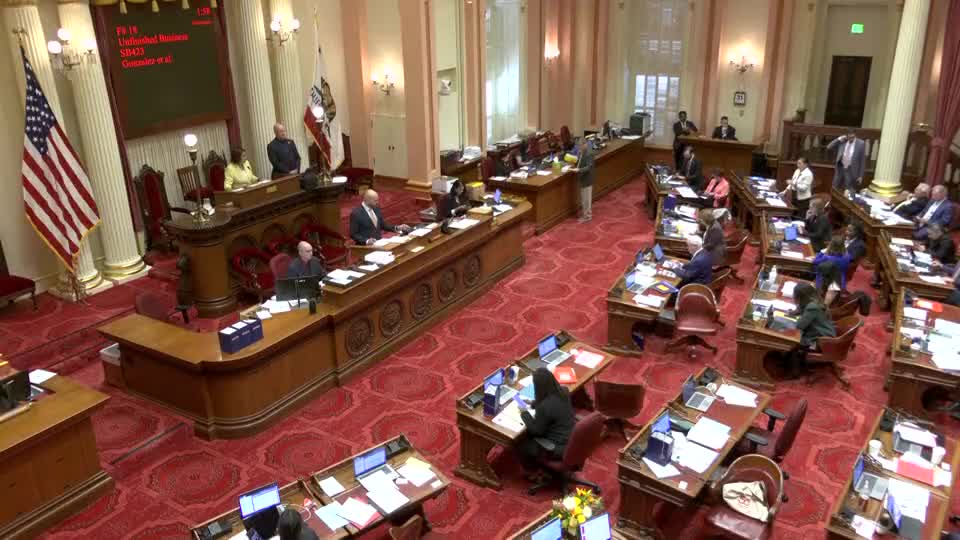 2MIN
Senate Floor
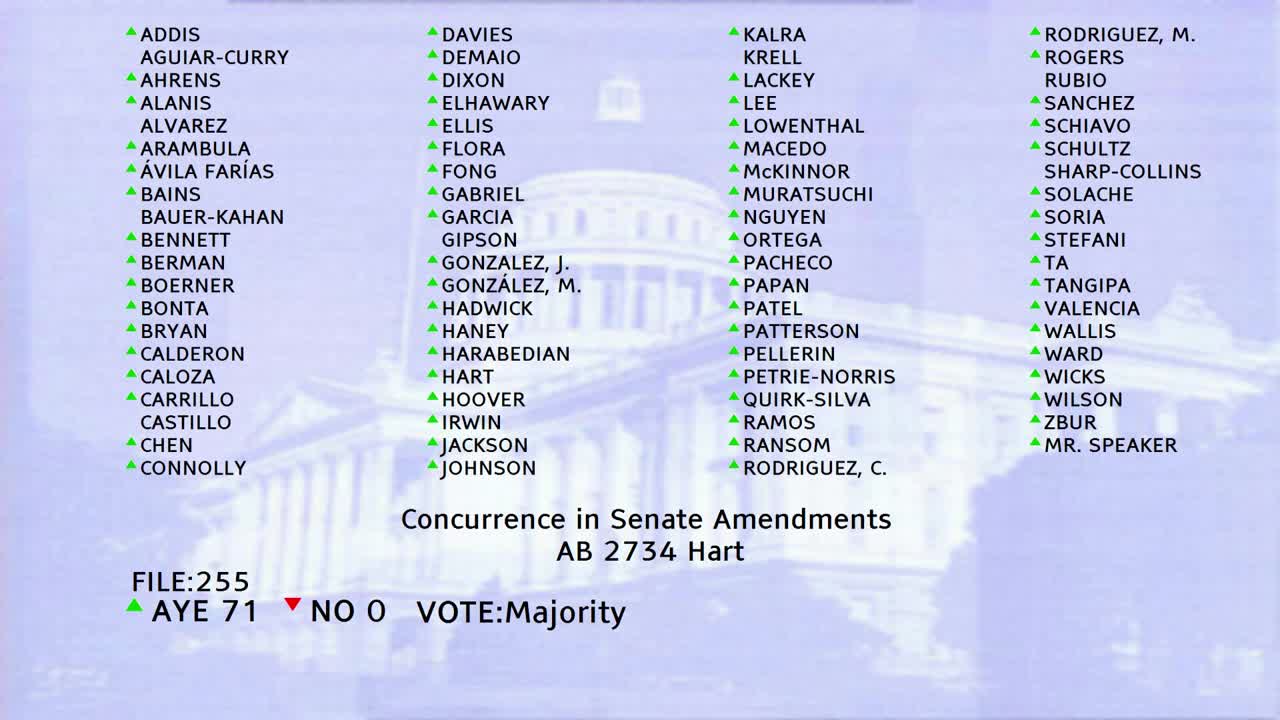 1MIN
Assembly Floor
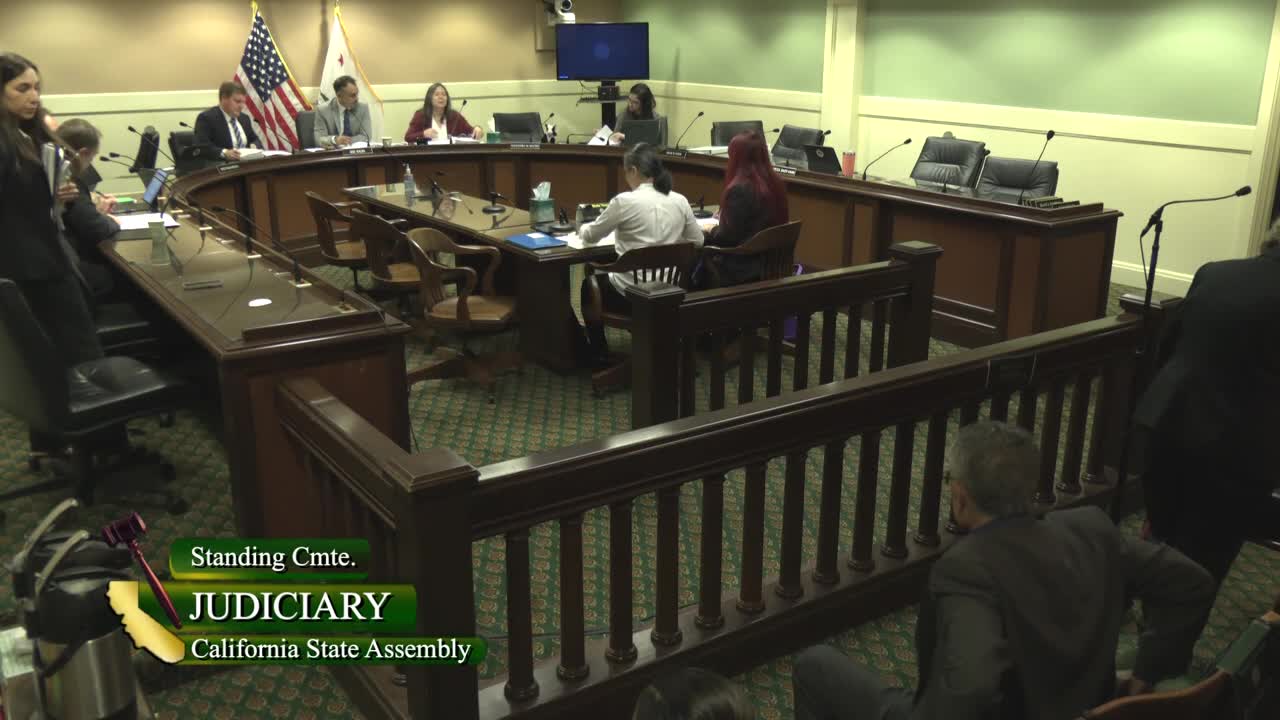 6MIN
Assembly Standing Committee on Judiciary
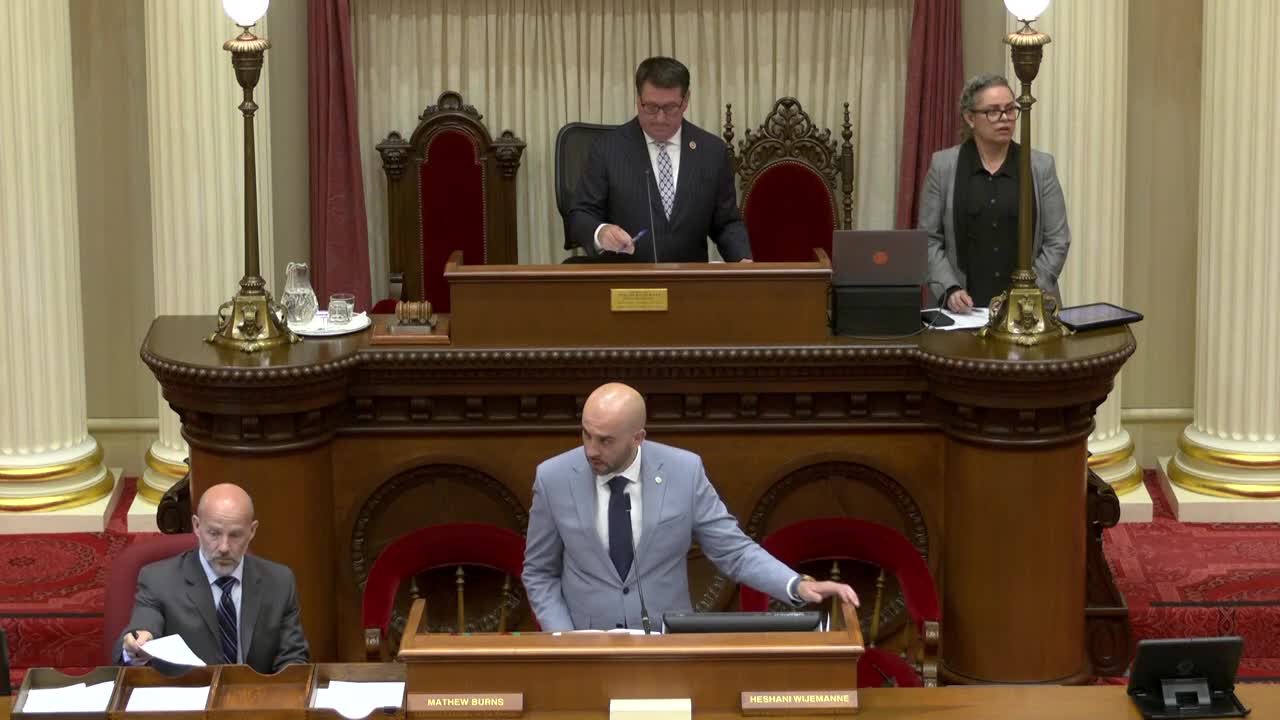 2MIN
Senate Floor
 21MIN
Senate Standing Committee on Natural Resources and Water
 27MIN