AB 1490: Oil and gas: well stimulation treatments: seismic activities.
- Session Year: 2015-2016
- House: Assembly
- Latest Version Date: 2015-05-05
Existing law requires the State Oil and Gas Supervisor to regulate oil and gas wells and tanks and facilities attendant to oil and gas production. Existing law requires the Division of Oil, Gas, and Geothermal Resources to adopt regulations governing the use of well stimulation treatments, including hydraulic fracturing. Under existing regulations, after the occurrence of an earthquake of magnitude 2.7 or higher, a well operator is prohibited from performing hydraulic fracturing on a well within a specified radius until the division completes certain evaluations and is satisfied that hydraulic fracturing within that radius does not create a heightened risk of seismic activity. Under existing law, a violation of requirements relating to oil and gas wells is a crime.
This bill would prohibit a well operator from conducting a well stimulation treatment following the occurrence of an earthquake of magnitude 2.0 2.5 or higher on a well that is within a radius of an unspecified distance 10 miles from the epicenter of the earthquake until the division completes a certain evaluation and is satisfied that the well stimulation treatment does not create a heightened risk of seismic activity. The bill would also prohibit wastewater disposal wells and all well stimulation treatments within 10 miles of a recently active fault, as defined. Because a violation of these prohibitions would be a crime, this bill would impose a state-mandated local program.
The California Constitution requires the state to reimburse local agencies and school districts for certain costs mandated by the state. Statutory provisions establish procedures for making that reimbursement.
This bill would provide that no reimbursement is required by this act for a specified reason.
Existing law requires the State Oil and Gas Supervisor to regulate oil and gas wells and tanks and facilities attendant to oil and gas production. Existing law requires the Division of Oil, Gas, and Geothermal Resources to adopt regulations governing the use of well stimulation treatments, including hydraulic fracturing. Under existing regulations, after the occurrence of an earthquake of magnitude 2.7 or higher, a well operator is prohibited from performing hydraulic fracturing on a well within a specified radius until the division completes certain evaluations and is satisfied that hydraulic fracturing within that radius does not create a heightened risk of seismic activity. Under existing law, a violation of requirements relating to oil and gas wells is a crime.
This bill would prohibit a well operator from conducting a well stimulation treatment following the occurrence of an earthquake of magnitude 2.0 or higher on a well that is within a radius of an unspecified distance from the epicenter of the earthquake until the division completes a certain evaluation and is satisfied that the well stimulation treatment does not create a heightened risk of seismic activity. The bill would also prohibit wastewater disposal wells and all well stimulation treatments within 10 miles of a recently active fault, as defined. Because a violation of these prohibitions would be a crime, this bill would impose a state-mandated local program.
The California Constitution requires the state to reimburse local agencies and school districts for certain costs mandated by the state. Statutory provisions establish procedures for making that reimbursement.
This bill would provide that no reimbursement is required by this act for a specified reason.
A well operator shall not conduct a well stimulation treatment following an occurrence of an earthquake of magnitude 2.0 2.5 or higher, as determined by the United States Geological Survey, on a well that is within a radius of ____ 10 miles from the epicenter of the earthquake, as determined by the United States Geological Survey, until the division completes an evaluation on whether there is a causal connection between the well stimulation treatment and the earthquake and is satisfied that the well stimulation treatment does not create a heightened risk of seismic activity.
SEC. 2.Section 3163 is added to the Public Resources Code, to read:3163.(a)Notwithstanding Sections 3160 and 3161, or any other law, wastewater disposal wells and all well stimulation treatments, including hydraulic fracturing, within 10 miles of a recently active fault are prohibited in this state.
(b)For purposes of this section, recently active fault means a fault that has been active in the past 200 years.
SEC. 3.No reimbursement is required by this act pursuant to Section 6 of Article XIIIB of the California Constitution because the only costs that may be incurred by a local agency or school district will be incurred because this act creates a new crime or infraction, eliminates a crime or infraction, or changes the penalty for a crime or infraction, within the meaning of Section 17556 of the Government Code, or changes the definition of a crime within the meaning of Section 6 of Article XIIIB of the California Constitution.
A well operator shall not conduct a well stimulation treatment following an occurrence of an earthquake of magnitude 2.0 or higher, as determined by the United States Geological Survey, on a well that is within a radius of ____ from the epicenter of the earthquake, as determined by the United States Geological Survey, until the division completes an evaluation on whether there is a causal connection between the well stimulation treatment and the earthquake and is satisfied that the well stimulation treatment does not create a heightened risk of seismic activity.
SEC. 2.Section 3163 is added to the Public Resources Code, to read:3163.(a)Notwithstanding Sections 3160 and 3161, or any other law, wastewater disposal wells and all well stimulation treatments, including hydraulic fracturing, within 10 miles of a recently active fault are prohibited in this state.
(b)For purposes of this section, recently active fault means a fault that has been active in the past 200 years.
SEC. 3.No reimbursement is required by this act pursuant to Section 6 of Article XIIIB of the California Constitution because the only costs that may be incurred by a local agency or school district will be incurred because this act creates a new crime or infraction, eliminates a crime or infraction, or changes the penalty for a crime or infraction, within the meaning of Section 17556 of the Government Code, or changes the definition of a crime within the meaning of Section 6 of Article XIIIB of the California Constitution.
|
Date
|
Status
|
|---|---|
| Feb 27, 2015 | Introduced. To print. |
| Mar 1, 2015 | From printer. May be heard in committee March 31. |
| Mar 2, 2015 | Read first time. |
| Mar 26, 2015 | Referred to Com. on NAT. RES. |
| May 4, 2015 | From committee: Amend, and do pass as amended and re-refer to Com. on APPR. (Ayes 6. Noes 3.) (April 27). |
| May 5, 2015 | Read second time and amended. |
| May 6, 2015 | Re-referred to Com. on APPR. |
| Jan 31, 2016 | Died pursuant to Article IV, Sec. 10(c) of the Constitution. |
| Feb 1, 2016 | From committee: Filed with the Chief Clerk pursuant to Joint Rule 56. |
|
Date
|
Description
|
Location
|
Votes
|
|
|---|---|---|---|---|
| Apr 27, 2015 | Do pass as amended and be re-referred to the Committee on [Appropriations] | Assembly Standing Committee on Natural Resources |
Passed |
This list shows positions taken on this bill by organizations on the date displayed, which is linked to the original source.
Positions by individuals are not included.
|
Organization
|
Position
|
Date
|
|---|---|---|
| Associated Builders And Contractors Of California | ** Against | Apr 27, 2015 |
| California Chamber Of Commerce | ** Against | Apr 27, 2015 |
| California League Of Conservation Voters | ** Support | Apr 27, 2015 |
| Center For Biological Diversity, Inc. | ** Support | Apr 27, 2015 |
| Citizens Coalition for a Safe Community | ** Support | Apr 27, 2015 |
| Clean Water Action | ** Support | Apr 27, 2015 |
| Coastal Environmental Rights Foundation | ** Support | Apr 27, 2015 |
| Environment California | ** Support | Apr 27, 2015 |
| Environmental Working Group | ** Support | Apr 27, 2015 |
| Frack Free Butte County | ** Support | Apr 27, 2015 |
| Los Padres Forest Watch | ** Support | Apr 27, 2015 |
| Save the Sespe | ** Support | Apr 27, 2015 |
| Sierra Club California | ** Support | Apr 27, 2015 |
| The Wildlands Conservancy | ** Support | Apr 27, 2015 |
| Wholly H2O | ** Support | Apr 27, 2015 |
AB 1490
Page 4
Date of Hearing: April 27, 2015
ASSEMBLY COMMITTEE ON NATURAL RESOURCES
Das Williams, Chair
AB 1490
(Rendon) – As Introduced February 27, 2015
SUBJECT: Oil and gas: well stimulation treatments: seismic activities
SUMMARY: Prohibits well stimulation, and in some cases, wastewater disposal in limited areas that are seismically active or have recently had an earthquake.
EXISTING LAW:
Requires the Department of Conservation’s Division of Oil, Gas, and Geothermal Resources (DOGGR) to regulate oil and gas wells, tanks, and facilities attendant to oil and gas production.
Establishes, pursuant to SB 4 (Pavley, Chapter 313, Statutes of 2013), a comprehensive, multi-agency regulatory program for oil and gas well stimulation treatments (e.g., hydraulic fracturing, acid matrix stimulation). Establishes DOGGR as the lead agency for the multi-agency regulatory program.
Requires, on or before January 1, 2015, the Secretary of the Natural Resources Agency to conduct and complete an independent scientific study on well stimulation treatments, including, but not limited to, hydraulic fracturing and acid well stimulation treatments.
Requires the scientific study to evaluate the hazards and risks and potential hazards and risks that well stimulation treatments pose to natural resources and public, occupational, and environmental health and safety, including induced seismicity.
Requires, on or before January 1, 2015, DOGGR, in consultation with the Department of Toxic Substances Control, the State Air Resources Board (ARB), the State Water Resources Control Board (SWRCB), the Department of Resources Recycling and Recovery, and any local air districts and regional water quality control boards in areas where well stimulation treatments, including acid well stimulation treatments and hydraulic fracturing treatments, may occur, to adopt rules and regulations specific to well stimulation treatments.
Pursuant to regulations adopted by DOGGR, prohibits a well operator, after the occurrence of an earthquake of magnitude 2.7 or higher, from performing hydraulic fracturing on a well within five times the axial dimensional stimulation area until DOGGR completes certain evaluations and is satisfied that hydraulic fracturing within that radius does not create a heightened risk of seismic activity.
THIS BILL:
Prohibits a well operator from conducting a well stimulation treatment following an occurrence of an earthquake of magnitude 2.0 or higher, as determined by the United States Geological Survey, on a well that is within a radius of an unspecified distance from the epicenter of the earthquake, as determined by the United States Geological Survey (USGS), until DOGGR completes an evaluation on whether there is a causal connection between the well stimulation treatment and the earthquake and is satisfied that the well stimulation treatment does not create a heightened risk of seismic activity.
Prohibits wastewater disposal wells and all well stimulation treatments, including hydraulic fracturing, within 10 miles of a recently active fault.
Defines “recently active fault” as a fault that has been active in the past 200 years.
FISCAL EFFECT: Unknown
COMMENTS:
Author’s statement.
The connection between earthquakes and fracking has received significant attention in recent years. Recent fracking (hydraulic fracturing) legislation and DOGGR regulations have considered this issue. Scientific research on their relationship in California is underway. In other states with fracking, USGS has concluded: ‘The increase in seismicity has been found to coincide with the injection of wastewater in deep disposal wells in several locations, including Colorado, Texas, Arkansas, Oklahoma, and Ohio. Much of this wastewater is a byproduct of oil and gas production and is routinely disposed of by injection into wells specifically designed and approved for this purpose.’ California has a long history of earthquake activity and the connection to fracking requires further study. In the meantime, fracking near earthquake faults should be on hold. As defined in this bill, fracking near active faults accounts for about 54-60% of the oil and gas extraction activity in California. (A Chevron representative cited the 60% estimate on April 15.) In addition, if an earthquake happens near fracking activity, such activity should be shut down while the investigation into the connection proceeds.
Scientific study. As stated above, USGS has found a connection between oil and gas activity and increased seismicity in Colorado, Texas, Arkansas, Oklahoma, and Ohio. On January 14, 2015, California Council on Science and Technology (CCST) released Volume I of the Independent Scientific Study required by SB 4 to the public. The key findings for Volume I were:
Fracking practices in California appear to be very different from current practices used to produce unconventional reservoirs in, for example, North Dakota, and Texas.
California fracked wells tend to be shallower, vertical, fracked in one location in the well only, and use much smaller amounts of water on average.
Future expanded production in California is likely to be predominantly in the San Joaquin basin where it is concentrated now. It remains highly uncertain how much oil is available to be produced directly from the Monterey Shale.
Hydraulic fracturing, rather than acidizing, has been used much more frequently both onshore and offshore.
Available data indicate approximately 150 frack jobs occur onshore and about one offshore per month.
Over the last decade, about 20% of California’s oil production has been from fracked wells.
Volume II, which will specifically address direct and indirect seismic impacts, is expected to be released by July 1, 2015. CCST did release a similar report commissioned by the Bureau of Land Management. That study stated, “Produced water disposal in dedicated injection wells (Class II wells according to EPA’s regulation for underground injection) presents the possibility of triggering earthquakes.” In addition, it also stated:
There are no published reports of induced seismicity caused by wastewater disposal related to oil and gas operations in California, and at present the seismic hazard posed by wastewater injection is likely to be low. However, possible correlations between seismicity and wastewater injection in California have not yet been studied in detail. Injection of much larger volumes of produced water from increased WST (well stimulation treatment) activity and the subsequent increase in oil and gas production could increase the hazard, particularly in areas of high, naturally occurring seismicity.
DOGGR Regulations. On December 30, 2014, the Office of Administrative Law (OAL) approved and filed the final proposed regulations on well stimulation treatments with the Office of the Secretary of State. The regulations contain similar language to AB 1490. However, DOGGR regulations prohibit well stimulation when an earthquake occurs that is 2.7 or higher in magnitude rather than the 2.0 in AB 1490. In addition, DOGGR regulations specify that no stimulation is to occur within five times the axial dimensional stimulation area. In AB 1490 the distance is left blank, but the author has indicated he would be interested in setting 10 miles as the distance. This would be clearer than five times the axial dimensional stimulation area. DOGGR is concerned about the ability to detect a 2.0 earthquake accurately without extensive earthquake sensing equipment. The author and committee may wish to consider amending the bill to inset 10 miles as the distance well stimulation is prohibited from occurring within and adjusting the earthquake magnitude to 2.5 or higher, which according to seismology website UPSeis, is the lowest level that can be felt and cause damage.
Related legislation.
SB 454 (Allen) prohibits DOGGR from submitting a proposal for an aquifer exemption to the U.S. Environmental Protection Agency (U.S. EPA) unless DOGGR and SWRCB concur in writing that the aquifer meets specified conditions. This bill is awaiting a hearing in the Senate Natural Resources and Water Committee on April 28.
SB 545 (Jackson, 2015) revises and updates DOGGR’s authority and permitting practices and reforms the handling of confidential wells. This bill is awaiting a hearing in the Senate Natural Resources and Water Committee on April 28.
SB 248 (Pavley) requires DOGGR to review and update its regulations, data management practices, and enhance required reporting. This bill is awaiting a hearing in the Senate Appropriations Committee.
AB 1501 (Rendon) requires air districts to establish an emission standard for methane from well stimulation treatment and other petroleum extraction facilities. This bill requires the emission standard to include a permit requirement and consideration of the effect production facilities have on adjacent vulnerable populations. This bill requires ARB or a local air district to install monitoring stations near any approved well stimulation site and other petroleum extraction facilities to monitor for 12 different chemicals. This bill will also be heard by this committee on April 27.
AB 356 (Williams) requires, prior to submitting a proposal to exempt an aquifer to U.S. EPA, that DOGGR hold a public hearing and gain concurrence from SWRCB on the proposal. The bill requires groundwater monitoring plans for underground injection projects as part of an application for approval of the project or for the annual review of the project. This bill will also be heard by this committee on April 27.
REGISTERED SUPPORT / OPPOSITION:
Support
California League of Conservation Voters
Center for Biological Diversity
Citizens Coalition for a Safe Community
Clean Water Action
Coastal Environmental Rights Foundation
Environmental Working Group
Environment California
Frack Free Butte County
Los Padres Forest Watch
Save the Sespe
Sierra Club California
The Wildlands Conservancy
Wholly H2O
Opposition
Associated Builders and Contractors of California
California Chamber of Commerce
California Independent Petroleum Association
National Federation of Independent Businesses
Western States Petroleum Association
Analysis Prepared by: Michael Jarred / NAT. RES. / (916) 319-2092
Discussed in Hearing
 23MIN
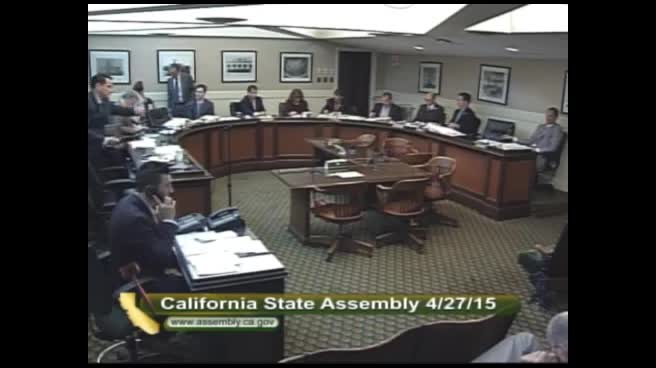
Assembly Standing Committee on Natural Resources
Bill Author

Bill Co-Author(s):