AB 1501: Well stimulation treatments: production facilities: emissions.
- Session Year: 2015-2016
- House: Assembly
- Latest Version Date: 2015-04-20
(1)Existing law authorizes the Division of Oil, Gas, and Geothermal Resources in the Department of Conservation to regulate the drilling, operation, maintenance, and abandonment of oil and gas wells in the state as well as the operation, maintenance, and removal or abandonment of tanks and facilities attendant to oil and gas production. Existing law generally vests the State Air Resources Board with the primary responsibility for the control of vehicular air pollution, and air pollution control and air quality management districts with the primary responsibility for the control of air pollution from all sources other than vehicular sources.
This bill would require an air district to establish an emission standard for methane from a well stimulation treatment, as defined, or a production facility, as defined, and to issue a permit or other regulatory document to an owner or operator to enforce that standard. The bill also would require the emission standard to include requirements on the owner or operator to monitor the well stimulation treatment for methane leaks. specified components. By adding to the duties of air districts, this bill would impose a state-mandated local program.
This bill would require the state board or an air district, as appropriate, to install monitoring stations near any site approved by the division for a well stimulation treatment or a production facility, as specified. By adding to the duties of air districts, this bill would impose a state-mandated local program.
(2)Existing law makes a violation of any rule, regulation, or order of the state board or an air district a misdemeanor. By expanding the scope of a crime, this bill would impose a state-mandated local program.
The California Constitution requires the state to reimburse local agencies and school districts for certain costs mandated by the state. Statutory provisions establish procedures for making that reimbursement.
This bill would provide that no reimbursement is required by this act for a specified reason.
(1)Existing law authorizes the Division of Oil, Gas, and Geothermal Resources in the Department of Conservation to regulate the drilling, operation, maintenance, and abandonment of oil and gas wells in the state. Existing law generally vests the State Air Resources Board with the primary responsibility for the control of vehicular air pollution, and air pollution control and air quality management districts with the primary responsibility for the control of air pollution from all sources other than vehicular sources.
This bill would require an air district to establish an emission standard for methane from a well stimulation treatment, as defined, and to issue a permit to an owner or operator to enforce that standard. The bill also would require the emission standard to include requirements on the owner or operator to monitor the well stimulation treatment for methane leaks. By adding to the duties of air districts, this bill would impose a state-mandated local program.
This bill would require the state board or an air district, as appropriate, to install monitoring stations near any site approved by the division for a well stimulation treatment, as specified. By adding to the duties of air districts, this bill would impose a state-mandated local program.
(2)Existing law makes a violation of any rule, regulation, or order of the state board or an air district a misdemeanor. By expanding the scope of a crime, this bill would impose a state-mandated local program.
The California Constitution requires the state to reimburse local agencies and school districts for certain costs mandated by the state. Statutory provisions establish procedures for making that reimbursement.
This bill would provide that no reimbursement is required by this act for a specified reason.
For purposes of this article, well stimulation treatment has the same meaning as in Section 3157 of the Public Resources Code.
42100.For purposes of this article, the following terms have the following meanings:
(a)Production facility has the same meaning as in Section 3010 of the Public Resources Code.
(b)Well stimulation treatment has the same meaning as in Section 3157 of the Public Resources Code.
42105.(a)Notwithstanding any other law, a district shall do both of the following:
(1)Establish an emission standard for methane from a well stimulation treatment and a production facility.
(2)Issue a permit or other regulatory document to an owner or operator to enforce the standard adopted pursuant to paragraph (1).
(b)The emission standard adopted pursuant to subdivision (a) shall include requirements on the owner or operator to monitor the well stimulation treatment for methane leaks.
(b)The emission standard adopted pursuant to subdivision (a) shall include both of the following:
(1)Requirements on the owner or operator to monitor the well stimulation treatment and the production facility for methane leaks, as defined by the district.
(2)A consideration of the effects of a well stimulation treatment or a production facility on adjacent vulnerable populations, including, but not limited to, school-age children and the elderly.
SEC. 2.Section 3160.5 is added to the Public Resources Code, to read:3160.5.The State Air Resources Board or an air pollution control or air quality management district, as appropriate, shall install monitoring stations near any site approved by the division for a well stimulation treatment. A monitoring station shall be equipped to monitor for all of the following:
(a)Acetaldehyde.
(b)Acetone.
(c)Alpha-Pinene.
(d)Dichlorodifluoromethane.
(e)
(d)Ethanol.
(f)
(e)Ethyl acetate.
(g)
(f)Isobutane.
(h)
(g)Isoprene.
(i)
(h)Methane.
(j)
(i)N-Heptane.
(k)
(j)N-Hexane.
(l)
(k)Propane.
(m)
(l)Toluene.
(n)Trichlorofluoromethane.
SEC. 3.Section 3270.5 is added to the Public Resources Code, to read:3270.5.The State Air Resources Board or an air pollution control or air quality management district, as appropriate, shall install monitoring stations near any site approved by the division for a production facility. A monitoring station shall be equipped to monitor for all of the following:
(a)Acetaldehyde.
(b)Acetone.
(c)Alpha-Pinene.
(d)Ethanol.
(e)Ethyl acetate.
(f)Isobutane.
(g)Isoprene.
(h)Methane.
(i)N-Heptane.
(j)N-Hexane.
(k)Propane.
(l)Toluene.
SEC. 3. SEC. 4.No reimbursement is required by this act pursuant to Section 6 of Article XIIIB of the California Constitution because a local agency or school district has the authority to levy service charges, fees, or assessments sufficient to pay for the program or level of service mandated by this act or because costs that may be incurred by a local agency or school district will be incurred because this act creates a new crime or infraction, eliminates a crime or infraction, or changes the penalty for a crime or infraction, within the meaning of Section 17556 of the Government Code, or changes the definition of a crime within the meaning of Section 6 of Article XIIIB of the California Constitution.
For purposes of this article, well stimulation treatment has the same meaning as in Section 3157 of the Public Resources Code.
42105.(a)Notwithstanding any other law, a district shall do both of the following:
(1)Establish an emission standard for methane from a well stimulation treatment.
(2)Issue a permit to an owner or operator to enforce the standard adopted pursuant to paragraph (1).
(b)The emission standard adopted pursuant to subdivision (a) shall include requirements on the owner or operator to monitor the well stimulation treatment for methane leaks.
SEC. 2.Section 3160.5 is added to the Public Resources Code, to read:3160.5.The State Air Resources Board or an air pollution control or air quality management district, as appropriate, shall install monitoring stations near any site approved by the division for a well stimulation treatment. A monitoring station shall be equipped to monitor for all of the following:
(a)Acetaldehyde.
(b)Acetone.
(c)Alpha-Pinene.
(d)Dichlorodifluoromethane.
(e)Ethanol.
(f)Ethyl acetate.
(g)Isobutane.
(h)Isoprene.
(i)Methane.
(j)N-Heptane.
(k)N-Hexane.
(l)Propane.
(m)Toluene.
(n)Trichlorofluoromethane.
SEC. 3.No reimbursement is required by this act pursuant to Section 6 of Article XIIIB of the California Constitution because a local agency or school district has the authority to levy service charges, fees, or assessments sufficient to pay for the program or level of service mandated by this act or because costs that may be incurred by a local agency or school district will be incurred because this act creates a new crime or infraction, eliminates a crime or infraction, or changes the penalty for a crime or infraction, within the meaning of Section 17556 of the Government Code, or changes the definition of a crime within the meaning of Section 6 of Article XIIIB of the California Constitution.
|
Date
|
Status
|
|---|---|
| Feb 27, 2015 | Introduced. To print. |
| Mar 1, 2015 | From printer. May be heard in committee March 31. |
| Mar 2, 2015 | Read first time. |
| Mar 26, 2015 | Referred to Com. on NAT. RES. |
| Apr 20, 2015 | From committee chair, with author's amendments: Amend, and re-refer to Com. on NAT. RES. Read second time and amended. |
| Apr 21, 2015 | Re-referred to Com. on NAT. RES. |
| Apr 28, 2015 | From committee: Do pass and re-refer to Com. on APPR. (Ayes 6. Noes 3.) (April 27). Re-referred to Com. on APPR. |
| Jan 31, 2016 | Died pursuant to Article IV, Sec. 10(c) of the Constitution. |
| Feb 1, 2016 | From committee: Filed with the Chief Clerk pursuant to Joint Rule 56. |
|
Date
|
Description
|
Location
|
Votes
|
|
|---|---|---|---|---|
| Apr 27, 2015 | Do pass and be re-referred to the Committee on [Appropriations] | Assembly Standing Committee on Natural Resources |
Passed |
This list shows positions taken on this bill by organizations on the date displayed, which is linked to the original source.
Positions by individuals are not included.
|
Organization
|
Position
|
Date
|
|---|---|---|
| Association of Irritated Residents | ** Support | Apr 27, 2015 |
| California Chamber Of Commerce | * Indeterminate | Apr 27, 2015 |
| California Communities Against Toxics | ** Support | Apr 27, 2015 |
| California Independent Petroleum Association | ** Against | Apr 27, 2015 |
| California League Of Conservation Voters | ** Support | Apr 27, 2015 |
| Center on Race, Poverty & the Environment | ** Support | Apr 27, 2015 |
| Citizens Coalition for a Safe Community | ** Support | Apr 27, 2015 |
| Clean Water Action | ** Support | Apr 27, 2015 |
| Clean Water and Air Matter | ** Support | Apr 27, 2015 |
| Coalition For Clean Air | ** Support | Apr 27, 2015 |
| Earthworks | ** Support | Apr 27, 2015 |
| Environment California | ** Support | Apr 27, 2015 |
| Environmental Working Group | ** Support | Apr 27, 2015 |
| Fresnans Against Fracking | ** Support | Apr 27, 2015 |
| Mainstreet Moms | ** Support | Apr 27, 2015 |
| National Parks Conservation Association | ** Support | Apr 27, 2015 |
| Save the Sespe | ** Support | Apr 27, 2015 |
| Sierra Club California | ** Support | Apr 27, 2015 |
| Western States Petroleum Association | ** Against | Apr 27, 2015 |
AB 1501
Page 4
Date of Hearing: April 27, 2015
ASSEMBLY COMMITTEE ON NATURAL RESOURCES
Das Williams, Chair
AB 1501
(Rendon) – As Amended April 21, 2015
SUBJECT: Well stimulation treatments: emissions
SUMMARY: Requires air districts to establish an emission standard for methane from well stimulation treatments and other petroleum extraction facilities. Requires the emission standard to include a permit requirement and consideration of the effect production facilities have on adjacent vulnerable populations. Requires the Air Resources Board (ARB) or a local air district to install monitoring stations near any approved well stimulation site and other petroleum extraction facilities to monitor for 12 different chemicals.
EXISTING LAW:
Requires the Department of Conservation’s Division of Oil, Gas, and Geothermal Resources (DOGGR) to regulate oil and gas wells, tanks, and facilities attendant to oil and gas production.
Establishes, pursuant to SB 4 (Pavley, Chapter 313, Statutes of 2013), a comprehensive, multi-agency regulatory program for oil and gas well stimulation treatments (e.g., hydraulic fracturing, acid matrix stimulation). Establishes DOGGR as the lead agency for the multi-agency regulatory program.
Requires, on or before January 1, 2015, the Secretary of the Natural Resources Agency to conduct and complete an independent scientific study on well stimulation treatments, including, but not limited to, hydraulic fracturing and acid well stimulation treatments.
Requires the scientific study to evaluate the hazards and risks and potential hazards and risks that well stimulation treatments pose to natural resources and public, occupational, and environmental health and safety, including potential degradation of air quality.
Requires, on or before January 1, 2015, DOGGR, in consultation with the Department of Toxic Substances Control, ARB, the State Water Resources Control Board (SWRCB), the Department of Resources Recycling and Recovery, and any local air districts and regional water quality control boards in areas where well stimulation treatments, including acid well stimulation treatments and hydraulic fracturing treatments, may occur, to adopt rules and regulations specific to well stimulation treatments.
Provides ARB with the primary responsibility for the control of vehicular air pollution, and air pollution control and air quality management districts with the primary responsibility for the control of air pollution from all sources other than vehicular sources.
Requires the Public Utilities Commission (PUC) to open a proceeding to adopt rules and procedures that minimize methane leaks from PUC-regulated gas pipeline facilities, with the goal of reducing Greenhouse Gas (GHG) emissions.
THIS BILL:
Requires air districts to establish an emission standard for methane from well stimulation treatment and other petroleum extraction facilities.
Requires air districts to issue permits or another regulatory document to an owner or operator to enforce the emission standard created pursuant to this bill.
Specifies that the emission standard shall include requirements on the owner or operator to monitor the well stimulation treatment for methane leaks.
Requires air districts, when adopting the emission standard, to consider the effects of production facilities on adjacent vulnerable populations, including but not limited, to school-age children and the elderly.
Requires ARB or local air districts to install monitoring stations near any approved well stimulation site and other petroleum extraction facilities to monitor for 12 specified chemicals.
FISCAL EFFECT: Unknown
COMMENTS:
Author’s statement.
Oil and gas extraction activities, including fracking activities, emit air pollutants. This problem has been identified from a number of sources – a recent Clean Water Action report and developing DOGGR regulations. But the problem does not appear to be receiving the urgent attention it needs. The fracking regulations, for example, just suggest that the extraction operation obtain a permit if the local air district requires one. The Southern California Air Quality Management District (AQMD) does some monitoring of fracking, but neither AQMD nor other air districts set emissions standards or require permits for oil and gas extraction. DOGGR and the air districts are doing little to address this problem.
Methane regulation. Methane is a potent contributor to climate change that produces 34 times the warming impact than the same amount of carbon dioxide. As stated above, DOGGR’s regulation requires compliance with all applicable requirements by ARB or a local air district. ARB is in the initial stages of drafting regulations to control methane at new and existing oil and natural gas facilities. These statewide standards will apply to all of California’s air districts and will encompass well stimulation, while achieving co-benefits that protect public health from toxic emissions from well stimulation or other sector sources. AB 1501 would inform that process by requiring the standard to meet certain criteria. This is similar to SB 1371 (Leno), Chapter 525, Statutes of 2014, which put requirements on the PUC for reducing methane emissions from the natural gas industry. SB 1371 is currently being implemented at the PUC. On March 18, 2015, the PUC released a staff report that identifies best practices and new technologies in natural gas leak detection.
Schools and oil production. In November of 2014, a nonprofit environmental organization called FracTracker reported that more than 350,000 California children go to schools within a mile of an oil or gas well. They also stated that the top 11 school districts with the most wells are in the San Joaquin Valley, with 10 of those in Kern County. In Kern County, the Taft High School District has more than 33,000 wells in their jurisdiction, and Kern Union High School District has more than 19,000 wells in their jurisdiction. The report stated that students attending school within 1 mile of oil and gas wells are predominantly non-white (79.6%), and 60.3% are Hispanic. In response to the report the Western States Petroleum Association stated, “Hydraulic fracturing and other well stimulation techniques are of little to no concern to public health.” AB 1501 requires the new emission standard to consider the effects of production facilities on adjacent vulnerable populations, including but not limited to school-age children and the elderly.
Related legislation.
SB 454 (Allen) prohibits DOGGR from submitting a proposal for an aquifer exemption to the U.S. Environmental Protection Agency (U.S. EPA) unless DOGGR and SWRCB concur in writing that the aquifer meets specified conditions. This bill is awaiting a hearing in the Senate Natural Resources and Water Committee on April 28.
SB 545 (Jackson) revises and updates DOGGR’s authority and permitting practices and reforms the handling of confidential wells. This bill is awaiting a hearing in the Senate Natural Resources and Water Committee on April 28.
SB 248 (Pavley) requires DOGGR to review and update its regulations, data management practices, and enhance required reporting. This bill is awaiting a hearing in the Senate Appropriations Committee.
AB 1490 (Rendon) prohibits well stimulation, and in some cases, wastewater disposal in areas that are seismically active or have recently had an earthquake. This bill will also be heard by this committee on April 27.
AB 1420 (Salas) requires a local health officer, if notified of a leak in a pipeline regulated by DOGGR, to direct the responsible party to test soil, air, and water and based on the test results make an assessment of the risk to the public. If the leak poses a risk to the public, requires the local health officer to notify residents affected by the leak of the threat and provide assistance to the public. This bill will also be heard by this committee on April 27.
AB 356 (Williams)
requires, prior to submitting a proposal to exempt an aquifer to U.S.
EPA, that DOGGR hold a public hearing and gain concurrence from SWRCB
on the proposal. This bill also requires groundwater monitoring plans
for underground injection projects as part of an application for
approval of the project or for the annual review of the project. This
bill will also be heard by this committee on April 27.
REGISTERED SUPPORT / OPPOSITION:
Support
Association of Irritated Residents
California Communities Against Toxics
California League of Conservation Voters
Center on Race, Poverty & The Environment
Citizens Coalition for a Safe Community
Clean Water Action
Clean Water and Air Matter
Coalition for Clean Air
Earthworks
Environmental Working Group
Environment California
Fresnans Against Fracking
Mainstreet Moms
National Parks Conservation Association
Save the Sespe
Sierra Club California
Opposition
California Independent Petroleum Association
Western States Petroleum Association
Analysis Prepared by: Michael Jarred / NAT. RES. / (916) 319-2092
Discussed in Hearing
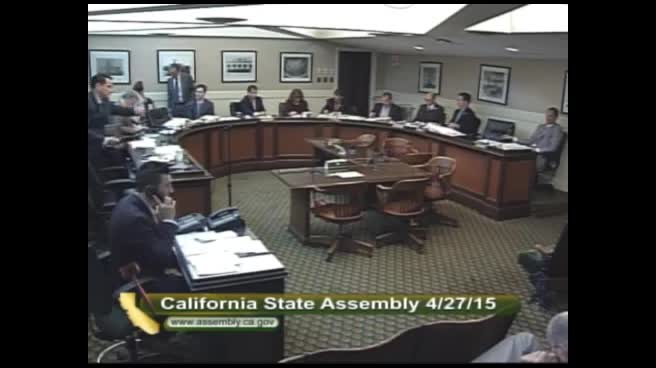 23MIN
Assembly Standing Committee on Natural Resources
Bill Author

Bill Co-Author(s):