AB 1882: Oil and gas: groundwater monitoring.
- Session Year: 2015-2016
- House: Assembly
- Latest Version Date: 2016-02-11
Existing law requires the State Oil and Gas Supervisor to supervise the drilling, operation, maintenance, and abandonment of wells and the operation, maintenance, and removal or abandonment of tanks and facilities attendant to oil and gas production. Existing law authorizes the supervisor to require a well operator to implement a monitoring program, designed to detect releases to the soil and water, for aboveground oil production tanks and facilities.
The federal Safe Drinking Water Act regulates certain wells as Class II wells. Under existing federal law, the authority to regulate Class II wells in California is delegated to the Division of Oil, Gas, and Geothermal Resources. Under existing regulations, a well operator is required to obtain approval from the supervisor or a district deputy for a subsurface injection or disposal project, including Class II wells, or any change in a project, as provided.
This bill would require the division to provide an opportunity and the information necessary for the State Water Resources Control Board and the appropriate regional water quality control board to review, comment on, and propose additional requirements for Class II underground injection well projects. The bill would require the state board or the appropriate regional water quality control board to review, comment on, and propose additional requirements it deems necessary for those projects to ensure that the injection of fluids will not affect the quality of water that is, or may reasonably be, used for any beneficial use. The bill would prohibit the division from approving those projects without written concurrence from the state board or the appropriate regional water quality control board and would require the written concurrence to describe the rationale for the concurrence and explanation as to why additional requirements were or were not required for those projects.
For purposes of this article, the following terms mean the following:
(a)Beneficial use has the same meaning as set forth in subdivision (f) of Section 13050 of the Water Code.
(b)Class II well has the same meaning as set forth in Section 144.6 of Title 40 of the Code of Federal Regulations.
(c)Exempted aquifer has the same meaning as set forth in Section 144.3 of Title 40 of the Code of Federal Regulations.
(d)Project means an underground injection or disposal project that uses a Class II well.
(e)Regional board means a California regional water quality board.
(d)
(f)State board means the State Water Resources Control Board.
(e)
(g)Underground Injection Control Program means a program covering Class II wells for which the division has received primacy from the United States Environmental Protection Agency pursuant to Section 1425 of the federal Safe Drinking Water Act (42 U.S.C. Sec. 300h-4).
SEC. 2.Section 3133 is added to the Public Resources Code, to read:3133.(a)The division shall provide an opportunity and the information necessary for the state board and the appropriate regional board to review, comment on, and propose additional requirements, including groundwater monitoring, for a new project or a project under review as of January 1, 2017.
(b)The state board or the appropriate regional board shall review, comment on, and propose additional requirements it deems necessary, including groundwater monitoring, for a new project or a project under review to ensure that the injection of fluids will not affect the quality of water that is, or may reasonably be, used for any beneficial use.
(c)The division shall not approve a new project, approve any modification or revision to an existing project, or finalize a comprehensive review of an existing project without written concurrence from the state board or the appropriate regional board that the injection of fluids will not affect the quality of water that is, or may reasonably be, used for any beneficial use.
(d)If written concurrence is provided by the state board or the appropriate regional board, the written concurrence shall describe the rationale for concurrence and an explanation of why conditions, such as groundwater monitoring, were or were not required for the project at issue.
|
Date
|
Status
|
|---|---|
| Feb 11, 2016 | Read first time. To print. |
| Feb 12, 2016 | From printer. May be heard in committee March 13. |
| Feb 25, 2016 | Referred to Com. on NAT. RES. |
| Apr 5, 2016 | From committee: Do pass and re-refer to Com. on APPR. (Ayes 6. Noes 2.) (April 4). Re-referred to Com. on APPR. |
| Apr 20, 2016 | In committee: Set, first hearing. Referred to APPR. suspense file. |
| May 27, 2016 | In committee: Held under submission. |
|
Date
|
Description
|
Location
|
Votes
|
|
|---|---|---|---|---|
| Apr 4, 2016 | Do pass and be re-referred to the Committee on [Appropriations] | Assembly Standing Committee on Natural Resources |
Passed |
This list shows positions taken on this bill by organizations on the date displayed, which is linked to the original source.
Positions by individuals are not included.
|
Organization
|
Position
|
Date
|
|---|---|---|
| Association Of California Water Agencies | ** Support | Apr 4, 2016 |
| California Chamber Of Commerce | * Against | Apr 4, 2016 |
| California Independent Petroleum Association | ** Against | Apr 4, 2016 |
| California League Of Conservation Voters | ** Support | Apr 4, 2016 |
| Center For Environmental Health | ** Support | Apr 4, 2016 |
| Citizens Coalition for a Safe Community | ** Support | Apr 4, 2016 |
| Clean Water Action | * Support | Apr 4, 2016 |
| Clean Water Action California | * Support | Apr 4, 2016 |
| Earthworks | ** Support | Apr 4, 2016 |
| East Bay Municipal Utility District | ** Support | Apr 4, 2016 |
| Environmental Defense Center | ** Support | Apr 4, 2016 |
| Environmental Justice Coalition for Water | ** Support | Apr 4, 2016 |
| Environmental Working Group | ** Support | Apr 4, 2016 |
| Grassroots Coalition | ** Support | Apr 4, 2016 |
| League Of Women Voters Of California | ** Support | Apr 4, 2016 |
| Mainstreet Moms | ** Support | Apr 4, 2016 |
| Natural Resources Defense Council | ** Support | Apr 4, 2016 |
| Santa Barbara County Board of Supervisors | * Support | Apr 4, 2016 |
| Save the Sespe | ** Support | Apr 4, 2016 |
| Sierra Club California | ** Support | Apr 4, 2016 |
| The Wildlands Conservancy | ** Support | Apr 4, 2016 |
| Ventura County Board of Supervisors | ** Support | Apr 4, 2016 |
| Western States Petroleum Association | ** Against | Apr 4, 2016 |
Date of Hearing: April 20, 2016
ASSEMBLY COMMITTEE ON APPROPRIATIONS
Lorena Gonzalez, Chair
ABPCA Bill Id:AB 1882
Author:(Williams) – As Introduced Ver:February 11, 2016
Policy Committee: | Natural Resources | Vote: | 6 - 2 |
|
| ||
|
|
Urgency: No State Mandated Local Program: No Reimbursable: No
SUMMARY:
This bill requires the State Water Resources Control Board (SWRCB), or the appropriate regional water quality control board (RWQCB) to review and concur with any Underground Injection Control (UIC) project subject to review or approval. This bill allows SWRCB, or the appropriate RWQCB to propose additional requirements for a project, including groundwater monitoring.
FISCAL EFFECT:
- Increased expenditure authority and ongoing costs of $2.1 million for SWRCB to fund 15 positons (Oil, Gas, and Geothermal Administrative Fund) to ensure existing UIC projects are operating in conformance with the federal Safe Drinking Water Act and state laws and regulations.
According to SWRCB, the extensive technical review will include somewhere in the vicinity of 30,000 wells to determine if each injection project is protective of current and future beneficial uses of groundwater. These project-by-project reviews are technically complex and may require between 30 to 60 hours each.
The reviews may include evaluating the Division of Oil, Gas and Geothermal Resources' (DOGGR) assessment as well as verifying the injection project is protective of water quality in the area.
- Minor absorbable DOGGR costs.
COMMENTS:
- Purpose. Last year's resources budget trailer bill (SB 83) requires the Secretary for Environmental Protection (CalEPA) and the Secretary of the Natural Resources Agency (NRA) to appoint an independent review panel to evaluate DOGGR’s administration of the UIC Program and consider whether it would be beneficial to transfer the program to SWRCB. This evaluation is required to be completed on or before January 1, 2018.
The joint project review in this bill is consistent with the review process outlined in SB 83. However, this bill is an alternative approach to transferring the UIC program to SWRCB.
- Background. In 1974, the Safe Drinking Water Act gave the US EPA the authority and responsibility to control underground injection to protect underground drinking water sources. In 1982, a primacy agreement was signed that allowed DOGGR to implement the US EPA’s UIC program for oil and gas wells in California.
In 2014, it was discovered that there were two versions of this agreement, one allowing exemptions for 11 aquifers with high water quality and another denying those exemptions and requiring all existing injection wells into those aquifers be phased out over 18 months. DOGGR’s UIC permitting decisions have been based on the assumption that these exemptions were granted for the 11 aquifers in question.
The discovery of the two different versions of agreement led to numerous federal and state responses and legislative directives.
Currently, the SWRCB is reviewing and commenting on UIC projects. It has requested more data on some projects and has indicated it will work with DOGGR to incorporate groundwater monitoring in others. However, it is unclear whether this will be a permanent arrangement or until US EPA’s concerns with the program have been addressed. This bill codifies the agreement.
- Support and Opposition. This bill is supported by numerous water agencies, public health and environmental groups, and local governments to ensure groundwater safety.
The Western States Petroleum Association (WSPA), California Independent Petroleum Association (CIPA), California Chamber of Commerce (CalChamber), and California Manufacturers and Technology Association oppose this bill claiming it will create a confusing and duplicative underground injection permit process that will only lead to time-consuming and costly legal challenges without providing any additional environmental and groundwater protections beyond those already provided under existing law.
Analysis Prepared by: Jennifer Galehouse / APPR. / (916) 319-2081
Date of Hearing: April 4, 2016
ASSEMBLY COMMITTEE ON NATURAL RESOURCES
Das Williams, Chair
ABPCA Bill Id:AB 1882 (
Author:Williams) – As Introduced Ver:February 11, 2016
SUBJECT: Oil and gas: groundwater monitoring
SUMMARY: Requires the State Water Resources Control Board (SWRCB) or appropriate regional water quality control board (RWQCB) to review and concur with any Underground Injection Control (UIC) project subject to review or approval. Authorizes SWRCB or appropriate RWQCB to propose additional requirements for a project, including groundwater monitoring.
EXISTING LAW:
- Pursuant to the Federal Safe Drinking Water Act (SDWA):
- Prohibits certain well activities that affect underground sources of drinking water unless those sources are located in an exempt aquifer.
- Declares that the UIC program for class II wells in the State of California, except those on tribal lands, is administered by the Division of Oil, Gas, and Geothermal Resources (DOGGR) approved by United States Environmental Protection Agency (US EPA) pursuant to SDWA section 1425.
- Allows DOGGR to propose and the regional administrator of US EPA to approve an exemption of an aquifer or its portion that meets the criteria in the definition of “underground source of drinking water” after considering its current and potential future use as drinking water.
- Prohibits certain well activities that affect underground sources of drinking water unless those sources are located in an exempt aquifer.
- Requires the state’s Oil and Gas Supervisor (Supervisor) to supervise the drilling, operation, maintenance, and abandonment of wells, and the operation, maintenance, and removal or abandonment of tanks and facilities attendant to oil and gas production.
- Authorizes the Supervisor to implement a monitoring program designed to detect releases to the soil and water for aboveground oil production tanks and facilities.
- Requires groundwater monitoring in the vicinity of a well subject to a well stimulation treatment.
- Requires DOGGR to consult with SWRCB or the appropriate RWQCB regarding any proposed aquifer exemption.
- Requires DOGGR and SWRCB to concur prior to proposing an aquifer exemption to US EPA.
THIS BILL:
- Defines the terms “project” and “regional board” related to the UIC program.
- Requires DOGGR to provide an opportunity and the information necessary for SWRCB or the appropriate RWQCB to review UIC projects.
- Requires SWRCB or the appropriate RWQCB to review, comment on, and propose additional requirements it deems necessary, including groundwater monitoring, for a new project or a project under review to ensure that injection of fluids will not affect the quality of water that is, or may reasonably be, used for any beneficial use.
- Prohibits DOGGR from approving a new project, approving any modification or revision to an existing project, or finalizing a comprehensive review of an existing project without written concurrence from SWRCB or the appropriate RWQCB.
- Requires the written concurrence to specify the rationale for concurrence and explain why permit conditions, such as requiring groundwater monitoring, were or were not required for the project.
FISCAL EFFECT: Unknown
COMMENTS:
- UIC Program. In 1974, the Safe Drinking Water Act gave the US EPA the authority and responsibility to control underground injection to protect underground drinking water sources. In 1982, a primacy agreement was signed that allowed DOGGR to implement the US EPA’s UIC program for oil and gas wells in California. In 2014 it was discovered that there were two versions of this agreement, one allowing exemptions for 11 aquifers with high water quality and another denying those exemptions and requiring all existing injection wells into those aquifers be phased out over 18 months. The aquifers were non-hydrocarbon producing and all had a total dissolved solids (TDS) concentration below 3,000 mg/l. The SDWA is supposed to protect underground sources of water with TDS concentrations below 10,000 mg/l. DOGGR’s UIC permitting decisions have been based on the assumption that these exemptions were granted for the 11 aquifers in question.
A 2011 US EPA audit of DOGGR’s UIC program implementation concluded that DOGGR was misclassifying underground sources of drinking water and doing an insufficient job monitoring the UIC program. In June 2014, it was discovered that DOGGR was approving injection wells in nonexempt aquifers. This included injections into the 11 aquifers that were not properly exempted, but also included injections into aquifers that were never exempt. California Environmental Protection Agency’s (CalEPA) review found that DOGGR’s district offices were approving projects without review from DOGGR and were making errors identifying the injectable zone of exempt aquifers. This included misidentifying the borders and depth of the aquifer and allowing expansion of productive limits over time beyond boundaries established in the Primacy Application. Initially 2,553 injection wells were identified as operating in non-exempt aquifers. The wells represented both disposal wells and enhanced oil recovery wells. To date, the state has shut down 56 injection wells because they were injecting into aquifers that could be suitable for drinking water. In addition, these wells could potentially have had an impact on nearby water supply wells. While no contamination of water supply wells has been found yet, it is clear that aquifers that could have been a source of underground drinking water have been contaminated with injection fluid.
In addition to the DOGGR and SWRCB review of projects whose aquifer exemptions are in question, DOGGR has taken other actions to improve its implementation of the UIC program. In October 2015, DOGGR released its “Renewal Plan for Oil and Gas Regulation,” which outlines reforms DOGGR will undertake with the goal of having “an effective regulatory program that ensures the protection of public health and the environment in the oil fields of California.” Included in the plan is a review of every project DOGGR has approved and updated regulations for the UIC program.
- Aquifer exemptions. Aquifers with less than 10,000 mg/l TDS must be exempted by US EPA to be injected into. The state can decide which aquifers to propose to US EPA. In response to US EPA’s audit and concerns over aquifers that were not properly exempted, DOGGR will now require SWRCB concurrence on any aquifer exemption proposal. Last year SB 83 (Committee on Budget and Fiscal Review), Chapter 24, Statutes of 2015, required DOGGR and SWRCB to concur on all proposed exemptions of aquifers from the SDWA before they can be submitted to the US EPA. In addition, the operator will be required to demonstrate that the aquifer cannot now, and will not in the future serve as a source of drinking water or for other beneficial uses. In its written concurrence for the Arroyo Grande Aquifer Exemption, SWRCB indicated that “approval of Class II UIC projects and permits will involve a joint review by the DOGGR and the Water Boards.” It also stated DOGGR and SWRCB will consider incorporating groundwater monitoring into projects in the aquifer exempted.
- Memorandum of Agreement (MOA). In 1988, DOGGR entered into a MOA with SWRCB for prescribing permit requirements. The MOA specifies that SWRCB or appropriate RWQCB may require permit applicants to submit additional data. The MOA also states that the appropriate RWQCB may comment on permit requirements and proposes additional conditions or revisions to proposed conditions. The MOA states that DOGGR will not issue final requirements until the appropriate RWQCB concerns have been satisfied. However, if DOGGR does not receive a response from the appropriate RWQCB during the public comment period, it is required to presume the appropriate RWCRB finds the requirement acceptable. In most instances, since this MOA was executed, the appropriate RWCRB has not commented on an application or asked for additional requirements. Now that SWRCB has new oil and gas responsibilities from SB 83 and SB 4 (Pavley), Chapter 313, Statutes of 2013, it reviews all UIC applications and asks for additional data from applicants when necessary. In addition, DOGGR and SWRCB are currently working on a new MOA to recognize SWRCB’s enhanced role in oil and gas regulation.
- Groundwater monitoring. Groundwater provides close to 40% of the state’s water supply in an average year. In dry or drought years, groundwater accounts for as much as 60% of the state’s water supply. Many disadvantaged communities rely on groundwater for 100% of their water supply. There are approximately 55,000 oilfield injection wells in California; however, those wells are grouped together as injection projects. According to DOGGR, there are 901 active injection projects and 2,167 total projects in DOGGR’s database. DOGGR estimates that these projects inject into 350 aquifers, but does not definitively know the number of aquifers being injected into. Wastewater and other fluids associated with the extraction of oil or gas can change the chemistry of and contaminate aquifers. There is concern that injection fluids may not stay in the aquifer they are injected into. Zonal isolation is important to protect other nearby aquifers. SB 4 requires groundwater monitoring for wells that have been stimulated. On July 7, 2015, SWRCB released model criteria to govern the groundwater monitoring plans required by SB 4. In SWRCB’s model criteria regional monitoring programs are required to factor in UIC wells, in addition to wells that have been stimulated. In the Arroyo Grande Aquifer Exemption, the SWRCB stated that sentry groundwater monitoring wells on the boundaries of the exempted area could provide assurances that the injected fluid will remain in the proposed exempted area.
- AB 1882. Currently, the SWRCB is reviewing and commenting on UIC projects. It has requested more data on some projects and has indicated it will work with DOGGR to incorporate groundwater monitoring in others. However, it is unclear whether this will be a permanent arrangement or until US EPA’s concerns with the program have been addressed. SB 83 required on or before January 1, 2018, the Secretary for Environmental Protection and the Secretary of the Natural Resources Agency to appoint an independent review panel to evaluate DOGGR’s administration of the UIC Program and consider whether it would be beneficial to transfer the program to SWRCB. AB 1882 codifies a joint review of UIC projects that are under consideration for approval or review, which is an alternative approach to transferring the UIC program to SWRCB. AB 1882 joint project review is consistent with the aquifer review process outlined in SB 83.
- Previous and related legislation.
AB 982 (Williams, 2013) required RWQCBs to approve a proposed groundwater monitoring plan prior to noticing the intent to begin any oil or gas drilling. The bill required the notice to include the source of water used during any hydraulic fracturing operations. The bill was held in Assembly Appropriations Committee.
SB 4 (Pavley), Chapter 313, Statutes of 2013, established a comprehensive regulatory program for oil and gas well stimulation treatments, which included, among other things, a study, the development of regulations, a permitting process, and public notification and disclosure.
SB 356 (Williams, 2015) required, prior to submitting a proposal to exempt an aquifer to the US EPA, that DOGGR hold a public hearing and gain concurrence from SWRCB on the proposal. This bill would have required groundwater monitoring plans for UIC projects as part of an application for approval of the project or for the annual review of the project. This bill failed passage on the Assembly Floor with a vote of 28-33.
SB 454 (Allen, 2015) prohibited DOGGR from submitting a proposal for an aquifer exemption to the US EPA unless DOGGR and SWRCB concur in writing that the aquifer meets specified conditions. This bill failed passage on the Senate Floor with a vote of 17-17.
SB 545 (Jackson, 2015) revised and updated DOGGR’s authority and permitting practices and reforms the handling of confidential wells. The bill was held in Senate Appropriations committee.
SB 248 (Pavley, 2015) requires DOGGR to review and update its regulations, data management practices, and enhance required reporting. This bill prohibits the use of oil sumps after July 1, 2017. This bill also prohibits injection chemicals, unless DOGGR has complete information about specified properties and potential groundwater impacts. This bill is in the Assembly Appropriations Committee.
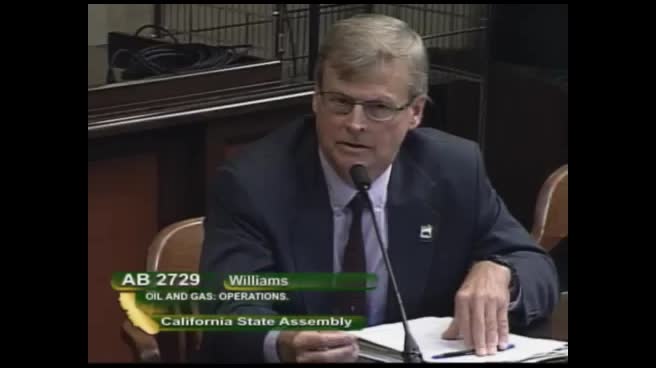
AB 2729 (Williams, 2016) creates disincentives for operators to maintain large idle well inventories, will ensure that funds are available to plug and abandon idle wells in the event that they are deserted, and will help improve public perception of oil and gas operations. This bill will also be heard by this committee on April 4, 2016.
AB 2756 (Thurmond, 2016) enhances DOGGR’s penalty and investigative authority and allows penalties to be spent on environmentally beneficial projects. This bill will also be heard by this Committee on April 4, 2016.
REGISTERED SUPPORT / OPPOSITION:
Support
Association of California Water Agencies
California League of Conservation Voters
Center for Environmental Health
Citizens Coalition for a Safe Community
Clean Water Action California
Earthworks
East Bay Municipal Utility District
Environmental Defense Center
Environmental Justice Coalition for Water
Environmental Working Group
Grassroots Coalition
League of Women Voters of California
Mainstreet Moms
Natural Resources Defense Council
Santa Barbara County Board of Supervisors
Save the Sespe
Sierra Club California
The Wildlands Conservancy
Ventura County Board of Supervisors
Opposition
California Chamber of Commerce
California Independent Petroleum Association
California Manufacturers & Technology Association
Western States Petroleum Association
Analysis Prepared by: Michael Jarred / NAT. RES. / (916) 319-2092
Discussed in Hearing
 15MIN
Assembly Standing Committee on Natural Resources
Bill Author
Bill Co-Author(s):
