AB 2200: School Employee Housing Assistance Grant Program.
- Session Year: 2015-2016
- House: Assembly
- Latest Version Date: 2016-04-14
Existing law requires the California Housing Finance Agency to administer various housing programs.
This bill would require the California Housing Finance Agency to administer a grant program, as specified, program to provide development financing assistance assistance, as specified, to a qualified school district, as defined, and to a qualified developer, as defined, for the creation of affordable rental housing for school employees, including teachers. The bill would require the State Department of Education to certify that a school district seeking a grant meets the definition of qualified school district. The bill would transfer $100,000,000 from the General Fund to the School Employee Housing Assistance Grant Fund, which would be created by this bill, and would continuously appropriate those moneys to the agency for the purposes described above and to reimburse the agency and the State Department of Education for costs incurred in the administration of the program. The bill would require a qualified school district to apply for grants, as provided, and to submit specified information to the agency. qualified school districts and qualified developers to apply for the financing assistance, as provided.
Existing law requires the California Housing Finance Agency to administer various housing programs.
This bill would require the California Housing Finance Agency to administer a grant program, as specified, to provide development financing assistance to a qualified school district, as defined, for the creation of affordable rental housing for school employees, including teachers. The bill would transfer $100,000,000 from the General Fund to the School Employee Housing Assistance Grant Fund, which would be created by this bill, and would continuously appropriate those moneys to the agency for the purposes described above. The bill would require a qualified school district to apply for grants, as provided, and to submit specified information to the agency.
Existing law establishes various programs for the recruitment of teachers.
This bill would state the intent of the Legislature to enact legislation that would guarantee that every pupil has access to high-quality educators by ensuring that pupils educators are able to live in the communities in which they serve. The bill would also state legislative findings and declarations relating to that purpose.
For purposes of this chapter, a qualified all of the following shall apply:
(a)Affordable rental housing means housing that serves persons and families of low or moderate income as defined by Section 50093 of the Health and Safety Code.
(b)Qualified developer means a developer that has partnered with a qualified school district to create affordable rental housing for school district employees, including teachers.
(c)Qualified school district means a school district that satisfies all of the following:
(a)
(1)Has acquired and designated surplus land from any of the following:
(1)
(A)A school district.
(2)
(B)A special district.
(3)
(C)A city.
(b)
(2)Has a high average cost for the recruitment of teachers.
(c)
(3)Has a low retention rate.
(d)
(4)Has 60 percent of its students participating in the National School Lunch Program.
51521.(a)The agency shall administer a grant program to provide development financing assistance to qualified school districts for the creation of affordable rental housing for school district employees, including teachers. The The financing assistance shall be in both of the following forms:
(1)Predevelopment grants to qualified school districts.
(2)Loans to qualified developers.
(b)The agency shall do all of the following:
(1)Be responsible for overseeing the grant program.
(2)Award predevelopment grants to qualified school districts.
(3)Determine the predevelopment grant amount and the development grant amount for each qualified school district pursuant to Section 51523.
(3)Make loans to qualified developers.
(4)Publish deadlines and written procedures for a qualified school district qualified school districts and qualified developers to apply for grants. financing assistance.(5)Provide technical assistance to a qualified school district that is not eligible to receive a development grant in applying for additional public funds.
(b)
(c)A qualified school district seeking a grant shall do both of the following:
(1)Apply for a predevelopment grant in the form and manner prescribed by the agency.
(2)Submit both of the following to the agency: the certification provided by the State Department of Education pursuant to Section 51521.5 to the agency.
(A)An eligible basis certification pursuant to Section 10322 of Division 17 of Title 4 of the California Code of Regulations, as it read on January 1, 2017.
(B)An itemized list of funds from state and federal programs and private funds used to cover projects costs.
(d)A qualified developer seeking a loan shall apply for a loan in the form and manner prescribed by the agency.
51521.5.(a)A school district seeking a predevelopment grant shall apply to the State Department of Education, in the form and manner prescribed by the department, for certification as a qualified school district.
(b)The State Department of Education shall certify that a school district seeking a predevelopment grant meets the definition of qualified school district as defined by Section 51520 and provide the qualified school district with the certification.
51522.(a)There is hereby transferred from the General Fund to the School Employee Housing Assistance Grant Fund, which is hereby created in the State Treasury, the sum of one hundred million dollars ($100,000,000).
(b)(1)Notwithstanding Section 13340 of the Government Code, all moneys in the fund shall be continuously appropriated to the agency for the purposes of this chapter. all of the following purposes:
(1)To reimburse the agency for any administrative costs incurred in the administration of this chapter. This amount shall not exceed 5 percent of the amount appropriated to the agency pursuant to this section.
(2)To reimburse the State Department of Education for the costs of certifying qualified school districts pursuant to Section 51521.5. This amount shall not exceed ____ percent of the amount appropriated to the agency pursuant to this section.
(3)For making predevelopment grants to qualified school districts. This amount shall not exceed 5 percent of the amount appropriated to the agency pursuant to this section.
(4)For making loans to qualified developers.
(2)The agency shall use 5 percent of the moneys appropriated to it pursuant to this section for predevelopment grants.
51523.(a)The agency shall determine both of the following for each qualified school district to be awarded a grant:
(1)(A)The predevelopment grant amount, which shall be equal to the predevelopment costs of the project excluding any costs related to the acquisition of the land.
(B)In order to be eligible to receive a predevelopment grant, the qualified school district must show a measurable degree of incapacity to fund the predevelopment project costs.
(2)The development grant amount, which shall be the difference between the eligible basis as specified in the eligible basis certification, excluding any costs related to the acquisition of the land and any predevelopment project costs, and the total amount of any public and private funds received for the development of the project.
(b)In order to be eligible to receive a development grant, the qualified school district must show that the project is not eligible for additional public funds as described in its eligible basis certification and that the project is subject to a project labor agreement and prevailing wage requirements.
51523.(a)The agency shall make loans to qualified developers using a project selection process established by the agency that meets all of the following requirements:
(1)To the extent feasible, ensures a reasonable geographic distribution of funds.
(2)Requires applications for projects to meet minimum threshold requirements, including, but not limited to, all of the following:
(A)The proposed project is located within reasonable proximity to public transportation and services.
(B)Development costs for the proposed project are reasonable compared to costs of comparable projects in the area.
(C)The proposed project is be feasible.
(3)The proposed project leverages other funds where they are available.
(b)(1)Loans made pursuant to this section shall be for a term of not less than 55 years.
(2)Principal and accumulated interest is due and payable upon completion of the term of the loan. The loan shall bear simple interest at the rate of 3 percent per annum on the unpaid principal balance.
(3)Any moneys that the agency receives in repayment of the loans, including interest, shall be deposited in the School Employee Housing Assistance Fund. These moneys shall be used for the purposes of this chapter.
(c)Each project shall be eligible for a loan not to exceed ten million dollars ($10,000,000).
For purposes of this chapter, a qualified school district means a school district that satisfies all of the following:
(a)Has acquired and designated surplus land from any of the following:
(1)A school district.
(2)A special district.
(3)A city.
(b)Has a high average cost for the recruitment of teachers.
(c)Has a low retention rate.
(d)Has 60 percent of its students participating in the National School Lunch Program.
51521.(a)The agency shall administer a grant program to provide development financing assistance to qualified school districts for the creation of affordable rental housing for school district employees, including teachers. The agency shall do all of the following:
(1)Be responsible for overseeing the grant program.
(2)Award grants to qualified school districts.
(3)Determine the predevelopment grant amount and the development grant amount for each qualified school district pursuant to Section 51523.
(4)Publish deadlines and written procedures for a qualified school district to apply for grants.
(5)Provide technical assistance to a qualified school district that is not eligible to receive a development grant in applying for additional public funds.
(b)A qualified school district seeking a grant shall do both of the following:
(1)Apply for a grant in the form and manner prescribed by the agency.
(2)Submit both of the following to the agency:
(A)An eligible basis certification pursuant to Section 10322 of Division 17 of Title 4 of the California Code of Regulations, as it read on January 1, 2017.
(B)An itemized list of funds from state and federal programs and private funds used to cover projects costs.
51522.(a)There is hereby transferred from the General Fund to the School Employee Housing Assistance Grant Fund, which is hereby created in the State Treasury, the sum of one hundred million dollars ($100,000,000).
(b)(1)Notwithstanding Section 13340 of the Government Code, all moneys in the fund shall be continuously appropriated to the agency for the purposes of this chapter.
(2)The agency shall use 5 percent of the moneys appropriated to it pursuant to this section for predevelopment grants.
51523.(a)The agency shall determine both of the following for each qualified school district to be awarded a grant:
(1)(A)The predevelopment grant amount, which shall be equal to the predevelopment costs of the project excluding any costs related to the acquisition of the land.
(B)In order to be eligible to receive a predevelopment grant, the qualified school district must show a measurable degree of incapacity to fund the predevelopment project costs.
(2)The development grant amount, which shall be the difference between the eligible basis as specified in the eligible basis certification, excluding any costs related to the acquisition of the land and any predevelopment project costs, and the total amount of any public and private funds received for the development of the project.
(b)In order to be eligible to receive a development grant, the qualified school district must show that the project is not eligible for additional public funds as described in its eligible basis certification and that the project is subject to a project labor agreement and prevailing wage requirements.
SECTION 1.(a)The Legislature finds and declares all of the following:
(1)The rising cost of housing in California is having a direct impact on education.
(2)Many school districts have difficulty retaining and recruiting teachers and other employees due to low compensation and high living and housing costs.
(3)This teacher shortage results in greater inequities among pupils, especially in communities serving high populations of low-income pupils, English learners, and foster youth.
(b)It is, therefore, the intent of the Legislature to enact legislation that would guarantee that every pupil has access to high-quality educators by ensuring that pupils educators are able to live in the communities in which they serve.
(a)The Legislature finds and declares all of the following:
(1)The rising cost of housing in California is having a direct impact on education.
(2)Many school districts have difficulty retaining and recruiting teachers and other employees due to low compensation and high living and housing costs.
(3)This teacher shortage results in greater inequities among pupils, especially in communities serving high populations of low-income pupils, English learners, and foster youth.
(b)It is, therefore, the intent of the Legislature to enact legislation that would guarantee that every pupil has access to high-quality educators by ensuring that pupils educators are able to live in the communities in which they serve.
|
Date
|
Status
|
|---|---|
| Feb 18, 2016 | Read first time. To print. |
| Feb 19, 2016 | From printer. May be heard in committee March 20. |
| Mar 17, 2016 | From committee chair, with author's amendments: Amend, and re-refer to Com. on H. & C.D. Read second time and amended. |
| Mar 17, 2016 | Referred to Coms. on H. & C.D. and ED. |
| Mar 28, 2016 | Re-referred to Com. on H. & C.D. |
| Apr 13, 2016 | From committee: Do pass and re-refer to Com. on ED. (Ayes 5. Noes 1.) (April 13). Re-referred to Com. on ED. |
| Apr 14, 2016 | From committee chair, with author's amendments: Amend, and re-refer to Com. on ED. Read second time and amended. |
| Apr 18, 2016 | Re-referred to Com. on ED. |
| Apr 21, 2016 | From committee: Do pass and re-refer to Com. on APPR. (Ayes 5. Noes 0.) (April 20). Re-referred to Com. on APPR. |
| May 18, 2016 | In committee: Set, first hearing. Referred to APPR. suspense file. |
| May 27, 2016 | In committee: Held under submission. |
|
Date
|
Description
|
Location
|
Votes
|
|
|---|---|---|---|---|
| Apr 20, 2016 | Do pass and be re-referred to the Committee on [Appropriations] | Assembly Standing Committee on Education |
Passed |
|
| Apr 13, 2016 | Do pass and be re-referred to the Committee on [Education] | Assembly Standing Committee on Housing and Community Development |
Passed |
This list shows positions taken on this bill by organizations on the date displayed, which is linked to the original source.
Positions by individuals are not included.
|
Organization
|
Position
|
Date
|
|---|---|---|
| AFL CIO Housing Investment Trust | ** Support | Apr 13, 2016 |
| California Catholic Conference | ** Support | Apr 13, 2016 |
| California Teachers Association | ** Support | Apr 20, 2016 |
| City Of Oakland | * Support | Apr 20, 2016 |
| Oakland Unified School District | ** Support | Apr 20, 2016 |
| One individual | ** Support | Apr 20, 2016 |
| San Leandro and Walnut Creek | * Support | Apr 13, 2016 |
| Small School Districts Association | * Support | Apr 20, 2016 |
| State Building and Construction Trades Council of California | ** Support | Apr 20, 2016 |
| Walnut Creek, City Of | ** Support | Apr 20, 2016 |
Date of Hearing: May 18, 2016
ASSEMBLY COMMITTEE ON APPROPRIATIONS
Lorena Gonzalez, Chair
ABPCA Bill Id:AB 2200
Author:(Thurmond) – As Amended Ver:April 14, 2016
Policy Committee: | Housing and Community Development | Vote: | 5 - 1 |
Education | 5 - 0 |
Urgency: No State Mandated Local Program: No Reimbursable: No
SUMMARY:
This bill requires California Housing Finance Agency (CalHFA) to administer a program to provide financing assistance to qualified school districts and qualified developers for the creation of affordable rental housing for school districts employees, including teachers. Only school districts with a high average cost for recruiting teachers, a low retention rate, and with 60% of their students participating in the National School Lunch Program would be eligible. This bill appropriates $100 million from the General Fund to fund the program and allows for reimbursements to affected agencies and departments.
FISCAL EFFECT:
- This bill appropriates $100 million (GF) to the newly created School Employee Housing Assistance Fund.
- This bill requires money in the Fund to be continuously appropriated to CalHFA for the following purposes:
- to reimburse the agency for administrative costs, not to exceed 5% of the total appropriation ($5 million);
- to reimburse the State Department of Education for the costs of certifying qualified school districts, not to exceed and unspecified percent of the total appropriation; and
- to make predevelopment grants to qualified school districts, not to exceed 5% of the total appropriation ($5 million). Because the original source of the grants would be the General Fund, any predevelopment grants awarded to qualified school districts likely would count toward the Proposition 98 minimum school funding guarantee. Accordingly, funding for ongoing Proposition 98 programs would be reduced by an amount equal to predevelopment grants awarded to school districts.
COMMENTS:
- Purpose. According to the author, "There is no existing program that allows financially-strained school districts to receive funding for the development of school employee housing. Some school districts in California have begun to increase teacher retention by providing housing to teachers. School districts in Los Angeles and Santa Clara, with San Francisco considering such a plan, have teachers in district-sponsored housing. However, for financially-strapped districts in high-cost areas, such a proven solution is not an option for attracting new teachers into the district. And while the Extra Credit Teacher Home Purchase Program does incentivize homeownership for school employees, for many new teachers beginning their career, rental housing is the first step prior to homeownership—a step that those in high-cost areas cannot take. AB 2200 seeks to close the achievement gap by allowing school employees, including teachers, to remain in the cities where they work."
- Background. California has seen a drastic decline in funding to support the construction of affordable housing for very low-, low- and moderate-income families. Historically, the state has invested in low- and moderate-income housing primarily by providing funding for construction. Because of the high cost of land and construction and the subsidy needed to keep housing affordable to residents, affordable housing is expensive to build. Developers typically use multiple sources of financing, including voter-approved housing bonds, state and federal low-income housing tax credits, private bank financing, and local matching dollars.
CalHFA, the state's affordable housing bank, provides down payment assistance to qualified low- and moderate-income buyers through a loan secured on the property that is repaid when a home sells. In addition, CalHFA provides loans to multifamily housing developers to construct housing affordable housing. CalHFA does not receive funding from the General Fund and pays for its programs by issuing bonds which are then repaid from loan proceeds. Developments financed using CalHFA's multi-family loans agree to provide the housing for a term of 55 years.
Analysis Prepared by: Jennifer Swenson / APPR. / (916) 319-2081
Date of Hearing: April 20, 2016
ASSEMBLY COMMITTEE ON EDUCATION
Patrick O'Donnell, Chair
ABPCA Bill Id:AB 2200 (
Author:Thurmond) – As Amended Ver:March 17, 2016
[The bill was double referred to the Committee on Housing and Community Development and was heard by that committee as it relates to issues under its jurisdiction.]
SUBJECT: School Employee Housing Assistance Program
SUMMARY: Requires California Housing Finance Agency (CalHFA) to administer a grant program to provide development financing assistance to qualified school districts for the creation of affordable rental housing for school districts employees, including teachers. Specifically, this bill:
- Defines "affordable rental housing" to mean housing that serves persons and families of low or moderate income as defined in the Health and Safety Code (Section 50093).
- Defines "qualified developer" to mean a developer that has partnered with a qualified school district to create affordable rental housing for school district employees, including teachers.
- Defines "qualified school district" to mean a school district that satisfies the following:
- Has acquired and designated surplus land from a school district, special district, or city;
- Has a high average cost for the recruitment of teachers;
- Has a low retention rate; and
- Has 60% of its students participating in the National School Lunch Program.
- Provides that CalHFA shall provide financial assistance in the form of predevelopment grants to qualified school districts and loans to qualified developers.
- Requires CalHFA to do all of the following to administer the grant program:
- Be responsible for overseeing the program;
- Award predevelopment grants to qualified school districts;
- Make loans to qualified developers; and
- Publish deadlines and written procedures for the program.
- Requires a school district seeking a predevelopment grant to apply to the California Department of Education (CDE) for certification as a qualified school district.
- Requires the CDE to certify that a school district seeking a predevelopment grant meets the definition of a qualified school district.
- Requires a qualified school district seeking a predevelopment grant to do both of the following:
- Apply for a predevelopment grant in the form and manner prescribed by CalHFA; and
- Submit the certification provided by the California Department of Education (CDE).
- Creates the School Employee Housing Assistance Fund (the Fund) in the State Treasury.
- Continuously appropriates $100,000,000 from the General Fund to the Fund.
- Requires the CalHFA to make loans to qualified developers using a project selection process it establishes that meets all of the following requirements:
- To the extent feasible, ensures a reasonable geographic distribution of funds
- Requires applications for projects to meet minimum threshold requirements, including, but not limited to, all of the following:
- The proposed project is located within reasonable proximity to public transportation and services;
- Development costs for the proposed project are reasonable compared to costs of comparable projects in the area; and
- The proposed project is feasible.
- The proposed project leverages other funds where they are available.
- Requires loans to be made for a term on not less than 55 years.
- Provides that principal and accumulated interest is due and payable upon completion of the term of the loan, and the loan shall bear simple interest at the rate of 3% per year.
- Requires any moneys received in repayment of loans, including interest, be deposited in the Fund.
- Specifies the maximum loan amount shall be $10 million.
EXISTING LAW: Defines eligible basis certification as a certification from a certified public accountant or tax attorney that project costs included in applicant’s calculation of eligible basis are allowed by IRC Section 42, as amended, and are presented in accordance with standard accounting procedures. If the project uses HOME Investment Partnership Program funds, then the tax professional must further certify as to the treatment of HOME Program funds for purposes of eligible basis calculations. (Tax Credit Allocation Committee regulations for the Low Income Housing Tax Credit Program)
FISCAL EFFECT: Total effect unknown. Includes an appropriation from the General Fund of $100,000,000.
COMMENTS:
Background. California has seen a drastic decline in funding to support the construction of affordable housing for very low-, low- and moderate-income families. Historically, the state has invested in low- and moderate-income housing primarily by providing funding for construction. Because of the high cost of land and construction and the subsidy needed to keep housing affordable to residents, affordable housing is expensive to build. Developers typically use multiple sources of financing, including voter-approved housing bonds, state and federal low-income housing tax credits, private bank financing, and local matching dollars.
Voter-approved bonds have been an important source of funding to support the construction of affordable housing. Proposition 46 of 2002 and Proposition 1C of 2006 together provided $4.95 billion for affordable housing. These funds financed the construction, rehabilitation, and preservation of 57,220 affordable apartments, including 2,500 supportive homes for people experiencing homelessness, and over 11,600 shelter spaces. In addition, these funds have helped 57,290 families become or remain homeowners. Nearly all of these funds have been awarded. In addition, prior to their dissolutions redevelopment agencies generated as much as $1.7 billion a year in local funding to support affordable housing.
CalHFA, the state's affordable housing bank, provides down payment assistance to qualified low- and moderate-income buyers through a loan secured on the property that is repaid when a home sells. In addition, CalHFA provides loans to multifamily housing developers to construct housing affordable housing. CalHFA does not receive funding from the General Fund and pays for its programs by issuing bonds which are then repaid from loan proceeds. The Department of Housing and Community Development (HCD) operates a variety of programs that support the acquisition, rehabilitation and construction of affordable housing to very low-, low- and moderate-income households. The Multi-Family Housing Program provides gap financing to affordable housing developers. Developments financed using MHP or CalHFA's multi-family loans agree to provide the housing for a term of 55 years.
This bill requires CalHFA to create and administer a grant program to provide both predevelopment grants and development grants to qualified school districts for the creation of affordable rental housing for school employees, including teachers. Only school districts with a high average cost for recruiting teachers and a low retention rate would be eligible for the grant.
Purpose of this bill. According to the author, "There is no existing program that allows financially-strained school districts to receive funding for the development of school employee housing. Some school districts in California have begun to increase teacher retention by providing housing to teachers. School districts in Los Angeles and Santa Clara, with San Francisco considering such a plan, have teachers in district-sponsored housing. However, for financially-strapped districts in high-cost areas, such a proven solution is not an option for attracting new teachers into the district. And while the Extra Credit Teacher Home Purchase Program does incentivize homeownership for school employees, for many new teachers beginning their career, rental housing is the first step prior to homeownership—a step that those in high-cost areas cannot take. AB 2200 seeks to close the achievement gap by allowing school employees, including teachers, to remain in the cities where they work. Specifically, the bill creates a $100 million grant program which will provide financial assistance to school districts that cannot independently fund housing for school employees. Gap financing will be given to school districts which: (1) have acquired land for development (2) can show high recruitment costs and low retention rates (3) have 60% of students participating in the Free and Reduced Lunch Program. The grant allocates 5% of its funds towards predevelopment costs that school districts that cannot independently fund. "
Arguments in support. According to the sponsor of the bill, the City of Oakland, "statistics show that the price of housing in California has risen exponentially in the last decade, while educator's wages have remained largely stagnant. This is especially true in the Bay Area where starting teacher salaries remain in the low $50,000 range and median home process are over $1,000,000."
K-12 Policy considerations:
- This bill requires grants be made for "affordable rental housing" for school district employees including teachers, however it does not define the income levels that would be eligible for the housing. This bill also does not require that the affordable housing units be restricted by affordability covenants to ensure that the housing remains affordable.
- This bill requires CalHFA to assist a school district that is not eligible to receive a development grant to apply for other a public funds. It is unclear what other public funds would be used for; in addition, CalHFA likely does not have the expertise to assist a school district in applying for public funds.
- This bill requires the CDE to certify that a school district seeking a predevelopment grant meets the definition of a qualified school district. To meet that definition, a school district must, in addition to other criteria, have a high average cost for the recruitment of teachers and a low retention rate. These are imprecise metrics, which leaves it to the discretion of the CDE to determine what is a high cost of recruitment and what is a low retention rate. Moreover, the CDE does not currently collect data on the cost of recruitment or retention rates. Therefore, it is unclear how the CDE would make these certifications.
- This bill defines "qualified districts" to be, among other criteria, a district in which at least 60% of its pupils are enrolled in the National School Lunch Program. According to the author's office, the purpose of this bill is to help "financially strapped" districts provide housing assistance for their employees, but this criterion misidentifies financially strapped districts. Under the local control funding formula (LCFF) which was enacted in 2013, districts that enroll large numbers and percentages of pupils who are eligible for free and reduced-price meals, English learners, or in foster care receive additional funding in the form of supplemental grant and concentration factor funding. By contrast, districts that have few pupils in these categories receive little or no supplemental grant and concentration factor funding and, under LCFF, are more financially strapped than districts with 60% or more of their pupils in the lunch program. In addition, a district that does not meet the 60% requirement (such as many Silicon Valley districts) is more likely to be located in an area with higher housing costs and a larger gap between housing costs and employee pay.
- This bill transfers $100 million from the General Fund to the School Employee Housing Assistance Fund. Because the original source of the grants would be the General Fund, any predevelopment grants awarded to qualified school districts likely would count toward the Proposition 98 minimum school funding guarantee. Accordingly, funding for ongoing Proposition 98 programs would be reduced by an amount equal to predevelopment grants awarded to school districts.
- This bill requires a school district to acquire and designate surplus land to be eligible for the funds. Once property is designated as "surplus," existing law requires the property to be offered to charter schools and local governments. If the author intends to require the use of district property for teacher housing, the author may wish to consider striking the requirement that land be designated as "surplus.”
REGISTERED SUPPORT / OPPOSITION:
Support
California Catholic Conference, Inc.
California Teachers Association
City of Walnut Creek
Oakland Unified School District
State Building and Construction Trades Council of California
One individual
Opposition
None received
Analysis Prepared by: Rick Pratt / ED. / (916) 319-2087
Date of Hearing: April 13, 2016
ASSEMBLY COMMITTEE ON HOUSING AND COMMUNITY DEVELOPMENT
David Chiu, Chair
ABPCA Bill Id:AB 2200 (
Author:Thurmond) – As Amended Ver:March 17, 2016
SUBJECT: School Employee Housing Assistance Grant Program
SUMMARY: Requires California Housing Finance Agency (CalHFA) to administer a grant program to provide development financing assistance to qualified school districts for the creation of affordable rental housing for school districts employees, including teachers. Specifically, this bill:
- Defines a "qualified school district" to mean a school district that satisfies the following:
- Has acquired and designated surplus land from a school district, special district, or city;
- Has a high average cost for the recruitment of teachers;
- Has a low retention rate; and
- Has 60% of its students participating in the National School Lunch Program.
- Requires CalHFA to do all of the following to administer the grant program:
- Be responsible for overseeing the grant program;
- Award grants to qualified school districts;
- Determine the predevelopment grant amount and the development grant amount for each qualified school district;
- Publish deadlines and written procedures for the program;
- Provide technical assistance to a qualified school district that is not eligible to receive a development grant in applying for additional public funds.
- Requires a qualified school district seeking a grant to provide CalHFA with the following:
- An eligible basis certificate required as part of an application for the Low Income Housing Tax Credits (LIHTC) program.
- An itemized list of funds from state and federal programs and private funds used to cover the project costs.
- Creates the School Employee Housing Assistance Grant Fund (the Fund) in the State Treasury.
- Continuously appropriates $100,000,000 from the General Fund to the Fund.
- Allows CalHFA to use 5% of the moneys appropriated for grants for predevelopment loans.
- Requires CalHFA to determine the predevelopment costs of the project excluding any costs related to the acquisition of the land in order to determine the grant amount the qualified school district can be awarded.
- Requires a qualified school district to show a measurable degree of incapacity to fund the predevelopment project costs to qualify for a grant.
- Requires CalHFA to determine the development grant amount a qualified school district is eligible for by taking the difference between the eligible basis as specified in the eligible basis certification subtracting any costs for land acquisition and any predevelopment project costs and the total amount of any public and private funds received for the project.
- Requires the qualified school district to show that the project is not eligible for additional public funds as described in its eligible basis certification and that the project is subject to a project labor agreement and prevailing wage requirements in order to receive a development grant.
EXISTING LAW:
- Defines eligible basis certification as a certification from a certified public accountant or tax attorney that project costs included in applicant’s calculation of eligible basis are allowed by IRC Section 42, as amended, and are presented in accordance with standard accounting procedures. If the project uses HOME Investment Partnership Program funds, then the tax professional must further certify as to the treatment of HOME Program funds for purposes of eligible basis calculations. (Tax Credit Allocation Committee regulations for the Low Income Housing Tax Credit Program)
FISCAL EFFECT: Total effect unknown. Includes an appropriation from the General Fund of $100,000,000.
COMMENTS:
Background:
California has seen a drastic decline in funding to support the construction of affordable housing for very low-, low- and moderate-income families. Historically, the state has invested in low- and moderate-income housing primarily by providing funding for construction. Because of the high cost of land and construction and the subsidy needed to keep housing affordable to residents, affordable housing is expensive to build. Developers typically use multiple sources of financing, including voter-approved housing bonds, state and federal low-income housing tax credits, private bank financing, and local matching dollars.
Voter-approved bonds have been an important source of funding to support the construction of affordable housing. Proposition 46 of 2002 and Proposition 1C of 2006 together provided $4.95 billion for affordable housing. These funds financed the construction, rehabilitation, and preservation of 57,220 affordable apartments, including 2,500 supportive homes for people experiencing homelessness, and over 11,600 shelter spaces. In addition, these funds have helped 57,290 families become or remain homeowners. Nearly all of these funds have been awarded. In addition, prior to their dissolutions redevelopment agencies generated as much as $1.7 billion a year in local funding to support affordable housing.
CalHFA, the state's affordable housing bank, provides down payment assistance to qualified low- and moderate-income buyers through a loan secured on the property that is repaid when a home sells. In addition, CalHFA provides loans to multifamily housing developers to construct housing affordable housing. CalHFA does not receive funding from the General Fund and pays for its programs by issuing bonds which are then repaid from loan proceeds. The Department of Housing and Community Development (HCD) operates a variety of programs that support the acquisition, rehabilitation and construction of affordable housing to very low-, low- and moderate-income households. The Multi-Family Housing Program provides gap financing to affordable housing developers. Developments financed using MHP or CalHFA's multi-family loans agree to provide the housing for a term of 55 years.
This bill would require CalHFA to create and administer a grant program to provide both predevelopment grants and development grants to qualified school districts for the creation of affordable rental housing for school employees, including teachers. Only school districts with a high average cost for recruiting teachers and a low retention rate would be eligible for the grant.
Purpose of this bill: According to the author, "There is no existing program that allows financially-strained school districts to receive funding for the development of school employee housing. Some school districts in California have begun to increase teacher retention by providing housing to teachers. School districts in Los Angeles and Santa Clara, with San Francisco considering such a plan, have teachers in district-sponsored housing. However, for financially-strapped districts in high-cost areas, such a proven solution is not an option for attracting new teachers into the district. And while the Extra Credit Teacher Home Purchase Program does incentivize homeownership for school employees, for many new teachers beginning their career, rental housing is the first step prior to homeownership—a step that those in high-cost areas cannot take. AB 2200 seeks to close the achievement gap by allowing school employees, including teachers, to remain in the cities where they work. Specifically, the bill creates a $100 million grant program which will provide financial assistance to school districts that cannot independently fund housing for school employees. Gap financing will be given to school districts which: (1) have acquired land for development (2) can show high recruitment costs and low retention rates (3) have 60% of students participating in the Free and Reduced Lunch Program. The grant allocates 5% of its funds towards predevelopment costs that school districts that cannot independently fund. "
Arguments in support: According to the sponsor of the bill, the City of Oakland, "statistics show that the price of housing in California has risen exponentially in the last decade, while educator's wages have remained largely stagnant. This is especially true in the Bay Area where starting teacher salaries remain in the low $50,000 range and median home process are over $1,000,000."
Policy considerations:
- CalHFA would be required to determine the amount of the predevelopment grant by subtracting the cost of land from the predevelopment cost of the project. The bill does not define what activities a predevelopment grant can be used for so it is unclear how CalHFA would determine the predevelopment cost for the purpose of making this calculation.
- This bill would require CalHFA to make loans to school districts. Historically, both CalHFA and HCD have made loans to developers with the expertise to build affordable housing. It's unlikely that many school districts have the expertise to assemble the financing needed for a affordable housing development or construct the housing. The committee may wish to consider whether grants for development should be made to school districts or to developers who have partnered with school districts.
- This bill requires grants be made for "affordable rental housing" for school district employees including teachers, however it does not define the income levels that would be eligible for the housing. This bill also does not require that the affordable housing units be restricted by affordability covenants to ensure that the housing remains affordable.
- This bill requires CalHFA to assist a school district that is not eligible to receive a development grant to apply for other a public funds. It is unclear what other public funds would be used for; in addition, CalHFA likely does not have the expertise to assist a school district in applying for public funds.
- This bill requires CalHFA to make loans to school districts that have a "high average cost for the recruitment of teachers and low retention rate" however these terms are not defined in the bill. Without a standard or definition of these criteria it's unclear how CalHFA would determine which school districts qualify for the grants.
Committee amendments:
- Cap the amount of the grant to $10 million per project.
- Require a qualified school to provide a certification from the Department of Education that they are "qualified school district";
- Define affordable rental housing to serve low- and moderate-income households up to 120% of AMI; and
- Restrict the affordability of the housing for 55 years.
Double referred: If AB 2200 passes this committee, the bill will be referred to the Committee on Education.
REGISTERED SUPPORT / OPPOSITION:
Support
City of Oakland (sponsor)
AFL▪ CIO Housing Investment Trust
California Catholic Conference
City of Walnut Creek
Oakland Unified School District
Opposition
None on File
Analysis Prepared by: Lisa Engel / H. & C.D. / (916) 319-2085, Lisa Engel / H. & C.D. / (961) 319-2085
Discussed in Hearing
 25MIN
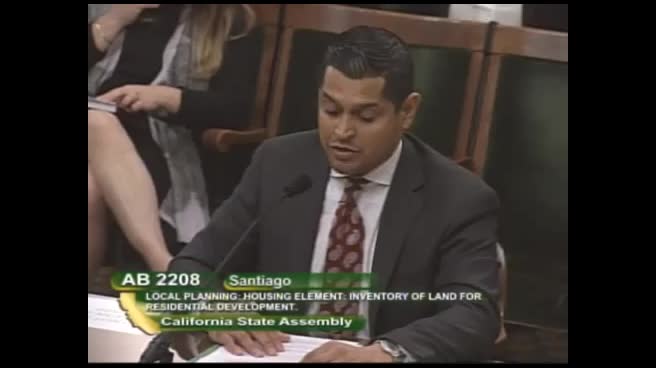
Assembly Standing Committee on Education
 19MIN
Assembly Standing Committee on Housing and Community Development
Bill Author

Bill Co-Author(s):