AB 2673: Sales and use tax exemption: income tax credits: hydrogen refueling station equipment.
- Session Year: 2015-2016
- House: Assembly
- Latest Version Date: 2016-04-26
(1)Existing sales and use tax laws impose a tax on retailers measured by the gross receipts from the sale of tangible personal property sold at retail in this state or on the storage, use, or other consumption in this state of tangible personal property purchased from a retailer for storage, use, or other consumption in this state. Existing law provides various exemptions from the taxes imposed by those laws.
This bill, on and after January 1, 2017, and before January 1, 2030, would exempt from those taxes the gross receipts from the sale of, and the storage, use, or other consumption in this state of, hydrogen refueling station equipment, as defined, purchased by a recipient of a grant pursuant to the Alternative and Renewable Fuel and Vehicle Technology Program for the development of hydrogen refueling stations.
The Bradley-Burns Uniform Local Sales and Use Tax Law authorizes counties and cities to impose local sales and use taxes in conformity with the Sales and Use Tax Law, and existing law authorizes districts, as specified, to impose transactions and use taxes in accordance with the Transactions and Use Tax Law, which generally conforms to the Sales and Use Tax Law. Amendments to state sales and use taxes are incorporated into these laws.
Section 2230 of the Revenue and Taxation Code provides that the state will reimburse counties and cities for revenue losses caused by the enactment of sales and use tax exemptions.
This bill would provide that, notwithstanding Section 2230 of the Revenue and Taxation Code, no appropriation is made and the state shall not reimburse any local agencies for sales and use tax revenues lost by them pursuant to this bill.
(2)The Personal Income Tax Law and the Corporation Tax Law allow various credits against the taxes imposed by those laws.
This bill would allow to a grant recipient described above a credit against those taxes for the taxable years beginning on or after January 1, 2016, and before January 1, 2017, for an amount equal to the sum of the sales tax reimbursements or use taxes previously paid by a grant recipient for hydrogen refueling station equipment during the period from January 1, 2014, to January 1, 2017, as provided. The bill would repeal these provisions as of December 1, 2017.
(3)This bill would take effect immediately as a tax levy.
(1)Existing sales and use tax laws impose a tax on retailers measured by the gross receipts from the sale of tangible personal property sold at retail in this state or on the storage, use, or other consumption in this state of tangible personal property purchased from a retailer for storage, use, or other consumption in this state. Existing law provides various exemptions from the taxes imposed by those laws.
This bill, on and after January 1, 2017, and before January 1, 2030, would exempt from those taxes the gross receipts from the sale of, and the storage, use, or other consumption in this state of, hydrogen refueling station equipment, as defined, purchased by a recipient of a grant pursuant to the Alternative and Renewable Fuel and Vehicle Technology Program for the development of hydrogen refueling stations.
The Bradley-Burns Uniform Local Sales and Use Tax Law authorizes counties and cities to impose local sales and use taxes in conformity with the Sales and Use Tax Law, and existing law authorizes districts, as specified, to impose transactions and use taxes in accordance with the Transactions and Use Tax Law, which generally conforms to the Sales and Use Tax Law. Amendments to state sales and use taxes are incorporated into these laws.
Section 2230 of the Revenue and Taxation Code provides that the state will reimburse counties and cities for revenue losses caused by the enactment of sales and use tax exemptions.
This bill would provide that, notwithstanding Section 2230 of the Revenue and Taxation Code, no appropriation is made and the state shall not reimburse any local agencies for sales and use tax revenues lost by them pursuant to this bill.
(2)The Personal Income Tax Law and the Corporation Tax Law allow various credits against the taxes imposed by those laws.
This bill would allow to a grant recipient described above a credit against those taxes for the taxable years beginning on or after January 1, 2016, and before January 1, 2017, for an amount equal to the sum of the sales tax reimbursement reimbursements or use taxes previously paid by a grant recipient for hydrogen refueling station equipment during the period from January 1, 2014, to January 1, 2017, inclusive, as provided. The bill would repeal these provisions as of December 1, 2017.
(3)This bill would take effect immediately as a tax levy.
(1)Existing sales and use tax laws impose a tax on retailers measured by the gross receipts from the sale of tangible personal property sold at retail in this state or on the storage, use, or other consumption in this state of tangible personal property purchased from a retailer for storage, use, or other consumption in this state. Existing law provides various exemptions from the taxes imposed by those laws.
This bill, on and after January 1, 2017, and before January 1, 2030, would exempt from those taxes the gross receipts from the sale of, and the storage, use, or other consumption in this state of, hydrogen refueling station equipment, as defined, purchased by a recipient of a grant pursuant to the Alternative and Renewable Fuel and Vehicle Technology Program for the development of hydrogen refueling stations.
The Bradley-Burns Uniform Local Sales and Use Tax Law authorizes counties and cities to impose local sales and use taxes in conformity with the Sales and Use Tax Law, and existing law authorizes districts, as specified, to impose transactions and use taxes in accordance with the Transactions and Use Tax Law, which conforms to the Sales and Use Tax Law. Amendments to state sales and use taxes are incorporated into these laws.
Section 2230 of the Revenue and Taxation Code provides that the state will reimburse counties and cities for revenue losses caused by the enactment of sales and use tax exemptions.
This bill would provide that, notwithstanding Section 2230 of the Revenue and Taxation Code, no appropriation is made and the state shall not reimburse any local agencies for sales and use tax revenues lost by them pursuant to this bill.
(2)The Personal Income Tax Law and the Corporation Tax Law allow various credits against the taxes imposed by those laws.
This bill would allow to a grant recipient described above a credit against those taxes for the taxable years beginning on or after January 1, 2016, and before January 1, 2017, for an amount equal to the sum of the sales tax reimbursement or use taxes previously paid by a grant recipient for hydrogen refueling station equipment during the period from January 1, 2014, to January 1, 2017, inclusive, as provided. The bill would repeal these provisions as of December 1, 2017.
(3)This bill would take effect immediately as a tax levy.
(a)On and after January 1, 2017, and before January 1, 2030, there are exempted from the taxes imposed by this part the both of the following:
(1)The gross receipts from the sale of, and the of hydrogen refueling station equipment to a qualified grant recipient.
(2)The storage, use, or other consumption in this state of, of hydrogen refueling station equipment to or by a qualified grant recipient before January 1, 2030. recipient.
(b)As used in this section, the following definitions shall apply:
(1)Qualified grant recipient means a person who has received a grant pursuant to Section 44272 of the Health and Safety Code for the development of hydrogen refueling stations within this state.
(2)Hydrogen refueling station means any motor vehicle fueling station which provides hydrogen fuel, either exclusively or concurrently with other motor vehicle fuels, for use by fuel cell electric vehicles.
(3)Hydrogen refueling station equipment means any of the following:
(A)Equipment, including, but not limited to, machinery, devices, contrivances, and component, repair, or replacement parts, whether purchased separately or in conjunction with a complete machine and regardless of whether the equipment or component parts are assembled by the grant recipient or another party, to be located at a hydrogen refueling station within this state and used exclusively for the distribution, dispensing, storage, or production of hydrogen fuel for fuel cell electric vehicles, including, but not limited to, pressurized storage, compression, pre-cooling, and pumping of hydrogen fuel.
(B)Personal property that is software or software services, regardless of location, and computer, computer-type, or data processing hardware or hardware services, regardless of location, that is used exclusively for the distribution, dispensing, storage, or production of hydrogen fuel at a hydrogen refueling station for fuel cell electric vehicles.
(C)Any other personal property required to operate, control, regulate, or maintain the hydrogen refueling station equipment set forth in subparagraph (A) or (B).
(4)Fuel cell means a device that directly or indirectly creates electricity through an electrochemical process using hydrogen, or hydrogen-rich, fuel and oxygen or another oxidizing agent.
SEC. 2.Section 17053.55 is added to the Revenue and Taxation Code, to read:17053.55.(a)For the taxable years beginning on or after January 1, 2016, and before January 1, 2017, there shall be allowed to a qualified grant recipient a credit against the net tax, as defined in Section 17039, for the taxable year, in an amount equal to the sum of sales tax reimbursements and use taxes previously paid during the period from January 1, 2014, to January 1, 2017, by the qualified grant recipient for hydrogen refueling station equipment.
(b)For the purposes of this section, the terms qualified grant recipient and hydrogen refueling station equipment have the same meanings as specified in Section 6377.5.
(c)In the case of a pass-thru entity, a credit under this section shall be allowed to the pass-thru entity and passed through to the partners or shareholders in accordance with the applicable provisions of this part. As used in this subdivision, pass-thru entity means any partnership or S corporation.
(d)If a credit otherwise allowed by this section exceeds the net tax for the taxable year, that portion of the credit that exceeds the net tax may be carried over and added to the credit in the succeeding taxable years, if necessary, until the credit is exhausted.
(e)The Franchise Tax Board may prescribe rules, guidelines, or procedures necessary or appropriate to carry out the purposes of this section. Chapter 3.5 (commencing with Section 11340) of Part 1 of Division 3 of Title 2 of the Government Code shall not apply to any rule, guideline, or procedure prescribed by the Franchise Tax Board pursuant to this section.
(f)Section 41 does not apply to the credit allowed by this section.
(g)This section shall remain in effect only until December 1, 2017, and as of that date is repealed.
SEC. 3.Section 23655 is added to the Revenue and Taxation Code, to read:23655.(a)For the taxable years beginning on or after January 1, 2016, and before January 1, 2017, there shall be allowed to a qualified grant recipient a credit against the tax, as defined in Section 23036, for the taxable year in an amount equal to the sum of sales tax reimbursements and use taxes previously paid during the period from January 1, 2014, to January 1, 2017, by the qualified grant recipient for hydrogen refueling station equipment.
(b)For the purposes of this section, the terms qualified grant recipient and hydrogen refueling station equipment have the same meanings as specified in Section 6377.5.
(c)In the case of a pass-thru entity, a credit under this section shall be allowed to the pass-thru entity and passed through to the partners or shareholders in accordance with the applicable provisions of this part. As used in this subdivision, pass-thru entity means any partnership.
(d)If a credit otherwise allowed by this section exceeds the tax for the taxable year, that portion of the credit that exceeds the tax may be carried over and added to the credit in the succeeding taxable years, if necessary, until the credit is exhausted.
(e)The Franchise Tax Board may prescribe rules, guidelines, or procedures necessary or appropriate to carry out the purposes of this section. Chapter 3.5 (commencing with Section 11340) of Part 1 of Division 3 of Title 2 of the Government Code shall not apply to any rule, guideline, or procedure prescribed by the Franchise Tax Board pursuant to this section.
(f)Section 41 does not apply to the credit allowed by this section.
(g)This section shall remain in effect only until December 1, 2017, and as of that date is repealed.
SEC. 4.Notwithstanding Section 2230 of the Revenue and Taxation Code, no appropriation is made by this act and the state shall not reimburse any local agency for any sales and use tax revenues lost by it under this act.
SEC. 5.This act provides for a tax levy within the meaning of Article IV of the Constitution and shall go into immediate effect.
(a)On and after January 1, 2017, there are exempted from the taxes imposed by this part the gross receipts from the sale of, and the storage, use, or other consumption in this state of, hydrogen refueling station equipment to or by a qualified grant recipient before January 1, 2030.
(b)As used in this section, the following definitions shall apply:
(1)Qualified grant recipient means a person who has received a grant pursuant to Section 44272 of the Health and Safety Code for the development of hydrogen refueling stations within this state.
(2)Hydrogen refueling station means any motor vehicle fueling station which provides hydrogen fuel, either exclusively or concurrently with other motor vehicle fuels, for use by fuel cell electric vehicles.
(3)Hydrogren Hydrogen refueling station equipment means any of the following:
(A)Equipment, including, but not limited to, machinery, devices, contrivances, and component, repair, or replacement parts, whether purchased separately or in conjunction with a complete machine and regardless of whether the equipment or component parts are assembled by the grant recipient or another party, to be located at a hydrogen refueling station within this state and used exclusively for the distribution, dispensing, storage, or production of hydrogen fuel for fuel cell electric vehicles, including, but not limited to, pressurized storage, compression, pre-cooling, and pumping of hydrogen fuel.
(B)Personal property that is software or software services, regardless of location, and computer, computer-type, or data processing hardware or hardware services, regardless of location, that is used exclusively for the distribution, dispensing, storage, or production of hydrogen fuel at a hydrogen refueling station for fuel cell electric vehicles.
(C)Any other personal property required to operate, control, regulate, or maintain the hydrogen refueling station equipment set forth in subparagraph (A) or (B).
(4)Fuel cell means a device that directly or indirectly creates electricity through an electrochemical process using hydrogen, or hydgrogen-rich, hydrogen-rich, fuel and oxygen or another oxidizing agent.
SEC. 2.Section 17053.55 is added to the Revenue and Taxation Code, to read:17053.55.(a)For the taxable years beginning on or after January 1, 2016, and before January 1, 2017, there shall be allowed to a qualified grant recipient a credit against the net tax, as defined in Section 17039, for the taxable year, in an amount equal to the sum of sales tax reimbursements and use taxes previously paid during the period from January 1, 2014, to January 1, 2017, by the qualified grant recipient for hydrogen refueling station refueling equipment that is placed in service during that period. equipment.
(b)For the purposes of this section, the terms qualified grant recipient and hydrogen refueling station refueling equipment have the same meanings as specified in Section 6377.5.
(c)In the case of a pass-thru entity, a credit under this section shall be allowed to the pass-thru entity and passed through to the partners or shareholders in accordance with the applicable provisions of this part. As used in this subdivision, pass-thru entity means any partnership or S corporation.
(d)If a credit otherwise allowed by this section exceeds the net tax for the taxable year, that portion of the credit that exceeds the net tax may be carried over and added to the credit in the succeeding taxable years, if necessary, until the credit is exhausted.
(e)The Franchise Tax Board may prescribe rules, guidelines, or procedures necessary or appropriate to carry out the purposes of this section. Chapter 3.5 (commencing with Section 11340) of Part 1 of Division 3 of Title 2 of the Government Code shall not apply to any rule, guideline, or procedure prescribed by the Franchise Tax Board pursuant to this section.
(f)Section 41 does not apply to the credit allowed by this section.
(g)This section shall remain in effect only until December 1, 2017, and as of that date is repealed.
SEC. 3.Section 23655 is added to the Revenue and Taxation Code, to read:23655.(a)For the taxable years beginning on or after January 1, 2016, and before January 1, 2017, there shall be allowed to a qualified grant recipient a credit against the tax, as defined in Section 23036, for the taxable year in an amount equal to the sum of sales tax reimbursements and use taxes previously paid during the period from January 1, 2014, to January 1, 2017, by the qualified grant recipient for hydrogen refueling station refueling equipment that is placed in service during that period. equipment.
(b)For the purposes of this section, the terms qualified grant recipient and hydrogen refueling station refueling equipment have the same meanings as specified in Section 6377.5.
(c)In the case of a pass-thru entity, a credit under this section shall be allowed to the pass-thru entity and passed through to the partners or shareholders in accordance with the applicable provisions of this part. As used in this subdivision, pass-thru entity means any partnership.
(d)If a credit otherwise allowed by this section exceeds the tax for the taxable year, that portion of the credit that exceeds the tax may be carried over and added to the credit in the succeeding taxable years, if necessary, until the credit is exhausted.
(e)The Franchise Tax Board may prescribe rules, guidelines, or procedures necessary or appropriate to carry out the purposes of this section. Chapter 3.5 (commencing with Section 11340) of Part 1 of Division 3 of Title 2 of the Government Code shall not apply to any rule, guideline, or procedure prescribed by the Franchise Tax Board pursuant to this section.
(f)Section 41 does not apply to the credit allowed by this section.
(g)This section shall remain in effect only until December 1, 2017, and as of that date is repealed.
SEC. 4.Notwithstanding Section 2230 of the Revenue and Taxation Code, no appropriation is made by this act and the state shall not reimburse any local agency for any sales and use tax revenues lost by it under this act.
SEC. 5.This act provides for a tax levy within the meaning of Article IV of the Constitution and shall go into immediate effect.
(a)On and after January 1, 2017, there are exempted from the taxes imposed by this part the gross receipts from the sale of, and the storage, use, or other consumption in this state of, hydrogen refueling station equipment to or by a qualified grant recipient before January 1, 2030.
(b)As used in this section, the following definitions shall apply:
(1)Qualified grant recipient means a person who has received a grant pursuant to Section 44272 of the Health and Safety Code for the development of hydrogen refueling stations within this state.
(2)Hydrogen refueling station means any motor vehicle fueling station which provides hydrogen fuel, either exclusively or concurrently with other motor vehicle fuels, for use by fuel cell electric vehicles.
(3)Hydrogren refueling station equipment means any of the following:
(A)Equipment, including, but not limited to, machinery, devices, contrivances, and component, repair, or replacement parts, whether purchased separately or in conjunction with a complete machine and regardless of whether the equipment or component parts are assembled by the grant recipient or another party, to be located at a hydrogen refueling station within this state and used exclusively for the distribution, dispensing, storage, or production of hydrogen fuel for fuel cell electric vehicles, including, but not limited to, pressurized storage, compression, pre-cooling, and pumping of hydrogen fuel.
(B)Personal property that is software or software services, regardless of location, and computer, computer-type, or data processing hardware or hardware services, regardless of location, that is used exclusively for the distribution, storage, or production of hydrogen fuel for fuel cell electric vehicles.
(C)Any other personal property required to operate, control, regulate, or maintain the hydrogen refueling station equipment set forth in subparagraph (A) or (B).
(4)Fuel cell means a device that directly or indirectly creates electricity through an electrochemical process using hydrogen, or hydgrogen-rich, fuel and oxygen or another oxidizing agent.
SEC. 2.Section 17053.55 is added to the Revenue and Taxation Code, to read:17053.55.(a)For the taxable years beginning on or after January 1, 2016, and before January 1, 2017, there shall be allowed to a qualified grant recipient a credit against the net tax, as defined in Section 17039, for the taxable year, in an amount equal to the sum of sales tax reimbursements and use taxes previously paid during the period from January 1, 2014, to January 1, 2017, by the qualified grant recipient for hydrogen station refueling equipment that is placed in service during that period.
(b)For the purposes of this section, the terms qualified grant recipient and hydrogen station refueling equipment have the same meanings as specified in Section 6377.5.
(c)In the case of a pass-thru entity, a credit under this section shall be allowed to the pass-thru entity and passed through to the partners or shareholders in accordance with the applicable provisions of this part. As used in this subdivision, pass-thru entity means any partnership or S corporation.
(d)If a credit otherwise allowed by this section exceeds the net tax for the taxable year, that portion of the credit that exceeds the net tax may be carried over and added to the credit in the succeeding taxable years, if necessary, until the credit is exhausted.
(e)The Franchise Tax Board may prescribe rules, guidelines, or procedures necessary or appropriate to carry out the purposes of this section. Chapter 3.5 (commencing with Section 11340) of Part 1 of Division 3 of Title 2 of the Government Code shall not apply to any rule, guideline, or procedure prescribed by the Franchise Tax Board pursuant to this section.
(f)Section 41 does not apply to the credit allowed by this section.
(g)This section shall remain in effect only until December 1, 2017, and as of that date is repealed.
SEC. 3.Section 23655 is added to the Revenue and Taxation Code, to read:23655.(a)For the taxable years beginning on or after January 1, 2016, and before January 1, 2017, there shall be allowed to a qualified grant recipient a credit against the tax, as defined in Section 23036, for the taxable year in an amount equal to the sum of sales tax reimbursements and use taxes previously paid during the period from January 1, 2014, to January 1, 2017, by the qualified grant recipient for hydrogen station refueling equipment that is placed in service during that period.
(b)For the purposes of this section, the terms qualified grant recipient and hydrogen station refueling equipment have the same meanings as specified in Section 6377.5.
(c)In the case of a pass-thru entity, a credit under this section shall be allowed to the pass-thru entity and passed through to the partners or shareholders in accordance with the applicable provisions of this part. As used in this subdivision, pass-thru entity means any partnership.
(d)If a credit otherwise allowed by this section exceeds the tax for the taxable year, that portion of the credit that exceeds the tax may be carried over and added to the credit in the succeeding taxable years, if necessary, until the credit is exhausted.
(e)The Franchise Tax Board may prescribe rules, guidelines, or procedures necessary or appropriate to carry out the purposes of this section. Chapter 3.5 (commencing with Section 11340) of Part 1 of Division 3 of Title 2 of the Government Code shall not apply to any rule, guideline, or procedure prescribed by the Franchise Tax Board pursuant to this section.
(f)Section 41 does not apply to the credit allowed by this section.
(g)This section shall remain in effect only until December 1, 2017, and as of that date is repealed.
SEC. 4.Notwithstanding Section 2230 of the Revenue and Taxation Code, no appropriation is made by this act and the state shall not reimburse any local agency for any sales and use tax revenues lost by it under this act.
SEC. 5.This act provides for a tax levy within the meaning of Article IV of the Constitution and shall go into immediate effect.
|
Date
|
Status
|
|---|---|
| Feb 19, 2016 | Introduced. To print. |
| Feb 21, 2016 | From printer. May be heard in committee March 22. |
| Feb 22, 2016 | Read first time. |
| Mar 10, 2016 | Referred to Com. on REV. & TAX. |
| Mar 28, 2016 | From committee chair, with author's amendments: Amend, and re-refer to Com. on REV. & TAX. Read second time and amended. |
| Mar 29, 2016 | Re-referred to Com. on REV. & TAX. |
| Apr 26, 2016 | From committee chair, with author's amendments: Amend, and re-refer to Com. on REV. & TAX. Read second time and amended. |
| Apr 27, 2016 | Re-referred to Com. on REV. & TAX. |
| May 9, 2016 | In committee: Set, first hearing. Failed passage. |
| May 9, 2016 | In committee: Set, first hearing. Referred to REV. & TAX. suspense file. |
| Jun 15, 2016 | From committee: Without further action pursuant to Joint Rule 62(a). |
|
Date
|
Description
|
Location
|
Votes
|
|
|---|---|---|---|---|
| May 9, 2016 | Do pass and be re-referred to the Committee on [Appropriations] | Assembly Standing Committee on Revenue and Taxation |
Failed |
This list shows positions taken on this bill by organizations on the date displayed, which is linked to the original source.
Positions by individuals are not included.
|
Organization
|
Position
|
Date
|
|---|---|---|
| Air Products | ** Support | May 9, 2016 |
| Bay Air Quality Management District | * Support | May 9, 2016 |
| California Hydrogen Business Council | ** Support | May 9, 2016 |
| California State Association Of Counties | * Against | May 9, 2016 |
| Clean Power Campaign | ** Support | May 9, 2016 |
| CSACK | * Against | May 9, 2016 |
| Energy Independence Now | ** Support | May 9, 2016 |
| First Element Fuel | * Support | May 9, 2016 |
| Fuel Cell and Hydrogen Energy Association | ** Support | May 9, 2016 |
| H2 Logic | ** Support | May 9, 2016 |
| Hillside Motor Fuels, Inc. | ** Support | May 9, 2016 |
| Honda | ** Support | May 9, 2016 |
| HTEC Hydrogen Technology & Energy Corporation | ** Support | May 9, 2016 |
| Hydrogenics Corporation | ** Support | May 9, 2016 |
| ITM Power | ** Support | May 9, 2016 |
| Los Angeles County Economic Development Corporation | ** Support | May 9, 2016 |
| Monterey Bay Air Resources District | ** Support | May 9, 2016 |
| National Fuel Cell Research Center | ** Support | May 9, 2016 |
| Powertech Labs Inc. | ** Support | May 9, 2016 |
| Santa Monica, City Of | ** Support | May 9, 2016 |
| StratosFuel, Inc. | ** Support | May 9, 2016 |
| United Hydrogen | ** Support | May 9, 2016 |
| US Hybrid | ** Support | May 9, 2016 |
Date of Hearing: May 9, 2016
ASSEMBLY COMMITTEE ON REVENUE AND TAXATION
Sebastian Ridley-Thomas, Chair
ABPCA Bill Id:AB 2673 (
Author:Harper) – As Amended Ver:April 26, 2016
Majority vote. Tax levy. Fiscal committee.
SUBJECT: Sales and use tax exemption: income tax credits: hydrogen refueling station equipment
SUMMARY: Establishes a sales and use tax (SUT) exemption for "hydrogen refueling station equipment" sold to a "qualified grant recipient". Specifically, this bill:
- Provides a SUT exemption for:
- The gross receipts from the sale of "hydrogen refueling station equipment" to a "qualified grant recipient"; and,
- The storage, use, or other consumption in this state of "hydrogen refueling station equipment" by a "qualified grant recipient".
- Provides that the SUT exemption shall apply on and after January 1, 2017, and before January 1, 2030.
- Defines "hydrogen refueling station equipment" as any of the following:
- Equipment, including machinery, devices, contrivances, and component, repair, or replacement parts, whether purchased separately or in conjunction with a complete machine and regardless of whether the equipment or component parts are assembled by the grant recipient or another party, to be located at a "hydrogen refueling station" within this state and used exclusively for the distribution, dispensing, storage, or production of hydrogen fuel for "fuel cell" electric vehicles, including, but not limited to, pressurized storage, compression, pre-cooling, and pumping of hydrogen fuel;
- Personal property that is software or software services, regardless of location, and computer, computer-type, or data processing hardware or hardware services, regardless of location, that is used exclusively for the distribution, dispensing, storage, or production of hydrogen fuel at a "hydrogen refueling station" for "fuel cell" electric vehicles; and,
- Any other personal property required to operate, control, regulate, or maintain the hydrogen refueling station equipment set forth above.
- Defines a "hydrogen refueling station" as any motor vehicle fueling station which provides hydrogen fuel, either exclusively or concurrently with other motor vehicle fuels, for use by "fuel cell" electric vehicles.
- Defines a "fuel cell" as a device that directly or indirectly creates electricity through an electrochemical process using hydrogen, or hydrogen-rich, fuel and oxygen or another oxidizing agent.
- Defines a "qualified grant recipient" as a person who has received a grant pursuant to Health and Safety Code (H&SC) Section 44272 for the development of hydrogen refueling stations within this state.
- Provides that, notwithstanding existing law, the state shall not reimburse any local agency for any SUT revenues lost as a result of this exemption.
- Provides a tax credit, under both the Personal Income Tax (PIT) Law and the Corporation Tax (CT) Law, equal to the sum of sales tax reimbursements and use taxes previously paid during the period from January 1, 2014, to January 1, 2017, by the qualified grant recipient for hydrogen refueling station equipment.
- Provides that the tax credit shall apply for taxable years beginning on or after January 1, 2016, and before January 1, 2017.
- Provides that, for purposes of the credit, the terms "qualified grant recipient" and "hydrogen refueling station equipment" have the same meanings as set forth above.
- Provides that, in the case of a pass-thru entity, a credit shall be allowed to the pass-thru entity and passed through to the partners or shareholders as specified. The term "pass-thru entity" is defined to mean any partnership for purposes of the CT Law credit and any partnership or "S" corporation for the PIT Law credit.
- Provides that if the credit amount exceeds the taxpayer's tax liability, the excess credit amount may be carried over and added to the credit in the succeeding taxable years, if necessary, until the credit is exhausted.
- Authorizes the Franchise Tax Board (FTB) to prescribe rules, guidelines, or procedures necessary or appropriate to carry out administration of the credit.
- Provides that Revenue and Taxation Code (R&TC) Section 41 shall not apply to this credit.
- Repeals the tax credit provisions on December 1, 2017.
- Takes immediate effect as a tax levy.
EXISTING LAW:
- Imposes a sales tax on retailers for the privilege of selling tangible personal property (TPP), absent a specific exemption. The tax is based upon the retailer's gross receipts from TPP sales in this state.
- Imposes a complimentary use tax on the storage, use, or other consumption of TPP purchased out-of-state and brought into California. The use tax is imposed on the purchaser; and unless the purchaser pays the use tax to an out-of-state retailer registered to collect California's use tax, the purchaser remains liable for the tax. The use tax is set at the same rate as the state's sales tax and must generally be remitted to the State Board of Equalization (BOE).
- Allows various tax credits under both the PIT Law and the CT Law. These credits are generally designed to encourage socially beneficial behavior or to provide relief to taxpayers who incur specified expenses.
- Requires any bill authorizing a new credit to contain all of the following:
- Specific goals, purposes, and objectives that the tax credit will achieve;
- Detailed performance indicators for the Legislature to use when measuring whether the tax credit meets the goals, purposes, and objectives stated in the bill; and,
- Data collection requirements to enable the Legislature to determine whether the tax credit is meeting, failing to meet, or exceeding those specific goals, purposes, and objectives. The requirements shall include the specific data and baseline measurements to be collected and remitted in each year the credit is in effect, for the Legislature to measure the change in performance indicators, and the specific taxpayers, state agencies, or other entities required to collect and remit data. (R&TC Section 41.)
- Establishes the Alternative and Renewable Fuel and Vehicle Technology Program (Program) administered by the State Energy Resources Conservation and Development Commission (Commission). The Program provides, upon appropriation by the Legislature, competitive grants, revolving loans, loan guarantees, loans, or other appropriate funding measures to specified entities to develop and deploy innovative technologies that transform California's fuel and vehicle types to help attain the state's climate change policies. State law provides that the Program's emphasis shall be to develop and deploy technology and alternative and renewable fuels in the marketplace, without adopting any one preferred fuel or technology. (H&SC Section 44272)
FISCAL EFFECT: The BOE estimates that this bill's SUT provisions would reduce revenues by $59,769 annually. The FTB estimates that the credit provisions of this bill would reduce General Fund (GF) revenues by $4.5 million in fiscal year (FY) 2016-17, by $0.9 million in FY 2017-18, and by $0.5 million in FY 2018-19.
COMMENTS:
- This bill is supported by the Los Angeles County Economic Development Corporation, which notes:
By providing a sales and use tax exemption on the sale of hydrogen refueling station equipment purchased by a recipient of an Alternative and Renewable Fuel and Vehicle Technology Program grant, AB 2673 resolves a counterintuitive glitch in the current system, whereby the California Energy Commission awards grants to incentivize hydrogen refueling station development, yet grant recipients must, at the same time, pay sales and use taxes to purchase this needed hydrogen refueling equipment. Moreover, AB 2673 also provides a one-time income tax credit that would allow qualified grant recipients to recover the amount of sales and use taxes previously paid, during the period from January 1, 2014 to January 1, 2017, the bill's effective date, for past purchases of hydrogen refueling station equipment.
We believe that by undoing this "glitch" to reflect the true intent of the Alternative and Renewable Fuel and Vehicle Technology Program, [this] bill will encourage the installation of a wider network of hydrogen refueling stations that are critical for the successful roll-out and adoption of hydrogen FCEVs in California.
- This bill is opposed by the California Tax Reform Association, which notes the following:
We question the effectiveness of singling out a particular technology for special tax treatment. In particular, the state makes many investments in alternative energy through utility rates, cap-and-trade revenues, and fees and mandates, as an attempt to transform the transportation sector. To the extent that the state determines that tax credits are more effective than direct investments, the general fund should be reimbursed from cap-and-trade revenues for the tax-exempt purchase of these fuel stations.
- The BOE notes the following in its staff analysis of this bill:
- Effect of the bill: "This bill would enable qualified grant recipients to purchase, use, or consume hydrogen refueling stations equipment, as defined, without paying sales or use tax from January 1, 2017, to January 1, 2030."
- The Commission's grant program has a different sunset date than the sales and use tax exemption: "The sunset date for the grant program is January 1, 2024, while the sunset date for this bill is January 1, 2030. The later sales tax exemption sunset date allows grant recipients additional time to utilize the sales and use tax exemption to build hydrogen refueling stations."
- Exemption also applies to local and district taxes: "The proposed sales and use tax exemption for recipients of the Commission's grant program includes all taxes imposed at the place of sale. The total sales and use tax rate includes local taxes and voter-approved city and county district taxes. This exemption applies to the entire sales and use tax rate resulting in revenue loss for cities and counties."
- The exemption is not transferable to construction contractor: "The proposed law exempts the sale of, and storage, use, or other consumption in this state of, hydrogen refueling station equipment, as defined, to qualified grant recipients, as defined. The exemption in the proposed law only applies when title to the materials and fixtures transfers to the 'qualified grant recipients.' Construction contractors hired to work on behalf of a qualified grant recipient would not benefit from the exemption with regards to materials and fixtures they consume."
- List of qualified participants: "In order to properly identify taxpayers qualified to use this new exemption, a report or publicly available list of "qualified grant recipients" should be provided to the BOE."
- The FTB notes the following in its staff analysis of this bill:
- "This bill would allow the credit for taxes 'previously paid.' Typically, credits are allowed for amounts that are either 'paid or incurred,' thus providing for both cash-basis and accrual-basis accounting methods."
- "The end date for the tax credit should be 'December 31, 2016,' rather than 'January 1, 2017,' as the sales and use tax exemption that would be added by this bill would begin January 1, 2017. Thus, it would be unlikely that a credit could be claimed for sales and use taxes paid on January 1, 2017."
- "This bill would provide that a credit allowed to a pass-thru entity would be passed through as provided under existing law. The bill should be amended to eliminate unnecessary language."
- Committee Staff Comments:
- What is a "tax expenditure"? Existing law provides various credits, deductions, exclusions, and exemptions for particular taxpayer groups. In the late 1960s, U.S. Treasury officials began arguing that these features of the tax law should be referred to as "expenditures" since they are generally enacted to accomplish some governmental purpose and there is a determinable cost associated with each (in the form of foregone revenues).
- How is a tax expenditure different from a direct expenditure? As the Department of Finance notes in its annual Tax Expenditure Report, there are several key differences between tax expenditures and direct expenditures. First, tax expenditures are reviewed less frequently than direct expenditures once they are put in place. Second, there is generally no control over the amount of revenue losses associated with any given tax expenditure. Finally, it should also be noted that, once enacted, it takes a two-thirds vote to rescind an existing tax expenditure absent a sunset date. This effectively results in a "one-way ratchet" whereby tax expenditures can be conferred by majority vote, but cannot be rescinded, irrespective of their efficacy or cost, without a supermajority vote.
- This bill's SUT exemption:
- An overview of the SUT Law: California's SUT Law imposes a sales tax on retailers for the privilege of selling TPP, absent a specific exemption. The tax is based upon a retailer's gross receipts from TPP sales in California. The SUT Law also imposes a mirror "use tax" on the storage, use, or other consumption of TPP purchased out-of-state and brought into California. The use tax is imposed on the purchaser, and unless the purchaser pays the use tax to an out-of-state retailer registered to collect California's use tax, the purchaser remains liable for the tax. The use tax is set at the same rate as the state's sales tax and must generally be remitted to the BOE.
- What is a "tax expenditure"? Existing law provides various credits, deductions, exclusions, and exemptions for particular taxpayer groups. In the late 1960s, U.S. Treasury officials began arguing that these features of the tax law should be referred to as "expenditures" since they are generally enacted to accomplish some governmental purpose and there is a determinable cost associated with each (in the form of foregone revenues).
The SUT represents the state's second largest source of GF revenues. Nevertheless, the past 60 years have seen a dramatic reduction in the state's reliance on the SUT and a corresponding increase in its reliance on PIT revenues. In FY 2014-15, SUT revenues were estimated to comprise 23% of the state's GF revenues, down from nearly 60% in FY 1950-51.
- What accounts for the state's reduced reliance on SUT revenues? The SUT Law was enacted in a very different era. In the 1930s, California's economy was largely dominated by manufacturing, and residents mostly bought and sold tangible goods. Thus, in establishing the base for a new consumption tax, it made sense to impose the tax on sales of TPP, defined as personal property that may be "seen, weighed, measured, felt, or touched." Over the past 80 years, however, California's economy has seen dramatic growth in the service and information sectors, resulting in a significant erosion of the SUT base. For example, the Commission on the 21st Century Economy noted that spending on taxable goods represented 34.6% of personal income in 2008, down from 55.4% in 1980. As a result, tax experts and economists from across the political spectrum argue that California should expand its SUT base.
It could be argued that, while well-intentioned, additional SUT exemptions further erode an already shrinking SUT base. This, in turn, increases fiscal pressures to maintain or even increase California's relatively high SUT rate. High rates arguably promote non-compliance and encourage out-of-state purchases, placing California retailers at a competitive disadvantage. High rates also risk impacting consumer decision-making, which runs counter to widely accepted principles of sound tax policy.
- What would this bill do? This bill would establish a SUT exemption for hydrogen refueling station equipment sold to a qualified grant recipient. This bill defines a "qualified grant recipient" as a person who has received a grant pursuant to H&SC Section 44272 for the development of hydrogen refueling stations within California. The SUT exemption would apply for a period of 13 years – namely, on and after January 1, 2017, and before January 1, 2030.
- An emerging technology: Proponents note that fuel cell electric vehicles (FCEVs), powered by hydrogen fuel, are just now being introduced in mass volumes by automakers, including Toyota, Honda, and Hyundai. Additional automakers, such as General Motors, Audi, BMW, and Mercedes-Benz, are reportedly preparing for market entry. While these vehicles are being commercialized throughout the world, California's mandate for zero-emission vehicles makes the state one of the focal points for the initial introduction and rollout of this new technology. Proponents note that FCEVs can be two to three times more efficient than conventional vehicles. Moreover, FCEVs are fueled with hydrogen gas, which is stored in the vehicle; they emit no pollutants – only water and heat.
- Current state support: AB 8 (Perea), Chapter 401, Statutes of 2013, established $20 million in annual funding for hydrogen refueling stations through grants administered by the Commission. The funding is available until there are at least 100 operational and publicly available hydrogen refueling stations in California, or until January 1, 2024.
- Potential amendments: The author and Committee may wish to consider the following potential amendments to this bill:
- A shortened sunset date: This bill's SUT exemption would apply for a period of 13 years. This Committee, however, has a longstanding policy favoring the inclusion of five-year sunset dates. This allows the Legislature to revisit tax expenditure programs in a timely fashion, to assess both efficacy and cost. The Committee may wish to consider shortening this bill's SUT exemption to five years. In addition, actual repeal language should be included to ensure the code section does not remain after the exemption's operative period.
- Defining the scope of the benefit: This bill provides an expansive definition of "hydrogen refueling station equipment" qualifying for the exemption. For example, the exemption covers equipment to be located at a hydrogen refueling station within this state. The exemption also covers software and software services used exclusively for the distribution of hydrogen fuel at a hydrogen refueling station. This second category of exempt property, however, is not limited to refueling stations located in California. If this is contrary to the author's intent, appropriate amendments should be taken. In addition, most services are already exempt from taxation under the SUT Law, given that the law applies to sales of TPP. Thus, it is not entirely clear why such services are enumerated in the list of items eligible for exemption.
- Including a recapture provision: Often, SUT exemptions that are contingent on a particular use of property contain "recapture provisions" that allow the state to collect SUT if the exempt property is subsequently used in a manner not qualifying for the exemption. The Committee may wish to consider whether it would be useful to include an appropriate recapture provision for this bill.
- The PIT Law and CT Law credit provisions: In addition to providing a SUT exemption, this bill would allow qualified grant recipients an income tax credit for SUT amounts previously paid on hydrogen refueling station equipment. Specifically, the credit would be available for taxable years beginning on or after January 1, 2016, and before January 1, 2017, for SUT amounts paid during the period from January 1, 2014, to January 1, 2017.
This bill's credit provisions raise a number of policy concerns that this Committee may wish to consider. First, credits are typically provided as a matter of Legislative grace to encourage some future, socially beneficial behavior on the part of the taxpayer. In this case, however, the credit appears designed to compensative grant recipients for SUT amounts paid in prior years. In addition, credits are typically structured so that the credit amount is equal to a specified percentage of qualifying costs paid or incurred by a taxpayer. This ensures that there is "buy-in" from the taxpayer, and that the state is not subsidizing the entire cost of certain taxpayer expenses. This bill, in contrast, provides a credit equal to all SUT expenses paid during the period from January 1, 2014 to January 1, 2017. As far as Committee staff is aware, such a credit would be unprecedented.
Beyond these broad policy concerns, the FTB has identified a host of implementation and technical concerns with this bill's tax credit provisions. For example, this bill uses undefined terms like "sum of sales tax reimbursements". The lack of definitional guidance could lead to disputes with taxpayers and would complicate administration of this credit. In addition, the FTB notes that it is unclear how it would verify that a taxpayer is a qualified grant recipient or determine SUT expenses attributable to the taxpayer. Finally, this bill contains an unlimited carry-forward period. Consequently, the FTB would be required to retain the carryover on the tax forms indefinitely. Recent credits have been enacted with a limited carryover period, because experience demonstrates that most credits are exhausted within eight years of being earned. FTB notes that it is available to work on these and other concerns subsequently identified.
- Suggested technical amendments: Committee staff suggests adoption of the following technical amendments:
- On page 3, in line 6, strike "which" and insert "that";
- On page 3, in line 15, insert "qualified" before "grant recipient";
- On page 3, in line 21, strike "Personal property" and insert "Tangible personal property"; and,
- On page 3, in line 27, insert "tangible" before "personal property".
- Suggested technical amendments: Committee staff suggests adoption of the following technical amendments:
REGISTERED SUPPORT / OPPOSITION:
Support
Air Products
American Lung Association of California
California Hydrogen Business Council
City of Santa Monica
Clean Power Campaign
Energy Independence Now
First Element Fuel
Fuel Cell and Hydrogen Energy Association
G&M Oil Company, Inc.
H2 Logic
Hillside Motor Fuels, Inc.
Honda
HTEC Hydrogen Technology & Energy Corporation
Hydrogenics Corporation
ITM Power
Linde North America
Los Angeles County Economic Development Corporation
Monterey Bay Air Resources District
National Fuel Cell Research Center
Powertech Labs Inc.
StratosFuel, Inc.
United Hydrogen
US Hybrid
Opposition
California State Association of Counties
California Tax Reform Association
Analysis Prepared by: M. David Ruff / REV. & TAX. / (916) 319-2098
Discussed in Hearing
 5MIN
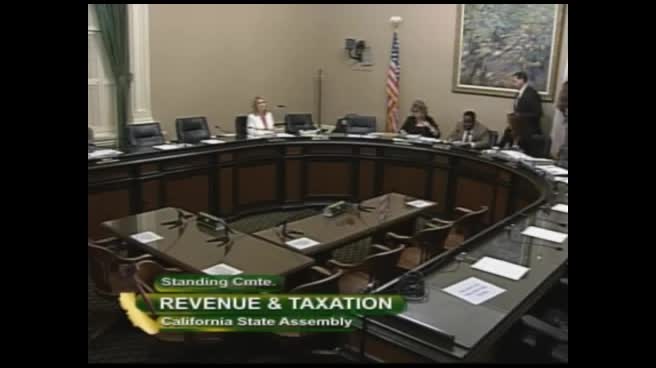
Assembly Standing Committee on Revenue and Taxation
Bill Author