AB 956: California Environmental Quality Act: exemption.
- Session Year: 2015-2016
- House: Assembly
- Latest Version Date: 2015-04-13
The California Environmental Quality Act (CEQA) requires a lead agency, as defined, to prepare, or cause to be prepared, and certify the completion of, of an environmental impact report on a project that it proposes to carry out or approve that may have a significant effect on the environment or to adopt a negative declaration if it finds that the project will not have that effect. The act also requires a lead agency to prepare a mitigated negative declaration for a project that may have a significant effect on the environment if revisions in the project would avoid or mitigate that effect and there is no substantial evidence that the project, as revised, would have a significant effect on the environment.
This bill would exempt from the requirements of CEQA activities undertaken by a local agency in response to a drought that are necessary to acquire water supplies, extend service, or for water recycling projects that provide water for drinking and sanitation to specific individuals and communities.
The California Environmental Quality Act (CEQA) requires a lead agency, as defined, to prepare, or cause to be prepared, and certify the completion of, an environmental impact report on a project that it proposes to carry out or approve that may have a significant effect on the environment or to adopt a negative declaration if it finds that the project will not have that effect. The act also requires a lead agency to prepare a mitigated negative declaration for a project that may have a significant effect on the environment if revisions in the project would avoid or mitigate that effect and there is no substantial evidence that the project, as revised, would have a significant effect on the environment.
The act requires an action or proceeding alleging noncompliance with its requirements to be based on grounds that were presented to the public agency, orally or in writing, by any person and requires the person maintaining the action or proceeding to have objected to the approval of the project, orally or in writing, during the public comment period provided under the act or prior to the close of the public hearing on the project before the issuance of the notice of determination. For an organization formed after the approval of a project, the act provides, on and after January 1, 2016, that that organization may maintain an action or proceeding if a member of the organization objected to the approval of the project during one of the 2 specified time periods.
This bill would make nonsubstantive changes to that provision. exempt from the requirements of CEQA activities undertaken by a local agency in response to a drought that are necessary to acquire water supplies, extend service, or provide water for drinking and sanitation to specific individuals and communities.
The California Environmental Quality Act requires a lead agency, as defined, to prepare, or cause to be prepared, and certify the completion of, an environmental impact report on a project that it proposes to carry out or approve that may have a significant effect on the environment or to adopt a negative declaration if it finds that the project will not have that effect. The act also requires a lead agency to prepare a mitigated negative declaration for a project that may have a significant effect on the environment if revisions in the project would avoid or mitigate that effect and there is no substantial evidence that the project, as revised, would have a significant effect on the environment.
The act requires an action or proceeding alleging noncompliance with its requirements to be based on grounds that were presented to the public agency, orally or in writing, by any person and requires the person maintaining the action or proceeding to have objected to the approval of the project, orally or in writing, during the public comment period provided under the act or prior to the close of the public hearing on the project before the issuance of the notice of determination. For an organization formed after the approval of a project, the act provides, on and after January 1, 2016, that that organization may maintain an action or proceeding if a member of the organization objected to the approval of the project during one of the 2 specified time periods.
This bill would make nonsubstantive changes to that provision.
This division does not apply to any activities undertaken by a local agency in response to a drought that are necessary to acquire water supplies, extend service, or for water recycling projects that provide water for drinking and sanitation to individuals and communities whose groundwater wells have run dry or where the only available groundwater exceeds a primary or secondary drinking water standards, as defined in Section 116275 of the Health and Safety Code.
This division does not apply to any activities undertaken by a local agency in response to a drought that are necessary to acquire water supplies, extend service, or provide water for drinking and sanitation to individuals and communities whose groundwater wells have run dry or where the only available groundwater exceeds a primary or secondary drinking water standards, as defined in Section 116275 of the Health and Safety Code.
SECTION 1.Section 21177 of the Public Resources Code, as added by Section 12 of Chapter 496 of the Statutes of 2010, is amended to read:21177.(a)An action or proceeding shall not be brought pursuant to Section 21167 unless the alleged grounds for noncompliance with this division were presented to the public agency orally or in writing by a person during the public comment period provided by this division or prior to the close of the public hearing on the project before the issuance of the notice of determination.
(b)A person shall not maintain an action or proceeding unless that person objected to the approval of the project orally or in writing during the public comment period provided by this division or prior to the close of the public hearing on the project before the filing of notice of determination pursuant to Sections 21108 and 21152.
(c)This section does not preclude an organization formed after the approval of a project from maintaining an action pursuant to Section 21167 if a member of that organization has complied with subdivision (b).
(d)This section does not apply to the Attorney General.
(e)This section does not apply to any alleged grounds for noncompliance with this division for which there was no public hearing or other opportunity for members of the public to raise those objections orally or in writing prior to the approval of the project, or if the public agency failed to give the notice required by law.
(f)This section shall become operative on January 1, 2016.
(a)An action or proceeding shall not be brought pursuant to Section 21167 unless the alleged grounds for noncompliance with this division were presented to the public agency orally or in writing by any a person during the public comment period provided by this division or prior to the close of the public hearing on the project before the issuance of the notice of determination.
(b)A person shall not maintain an action or proceeding unless that person objected to the approval of the project orally or in writing during the public comment period provided by this division or prior to the close of the public hearing on the project before the filing of notice of determination pursuant to Sections 21108 and 21152.
(c)This section does not preclude any an organization formed after the approval of a project from maintaining an action pursuant to Section 21167 if a member of that organization has complied with subdivision (b).
(d)This section does not apply to the Attorney General.
(e)This section does not apply to any alleged grounds for noncompliance with this division for which there was no public hearing or other opportunity for members of the public to raise those objections orally or in writing prior to the approval of the project, or if the public agency failed to give the notice required by law.
(f)This section shall become operative on January 1, 2016.
|
Date
|
Status
|
|---|---|
| Feb 26, 2015 | Read first time. To print. |
| Feb 27, 2015 | From printer. May be heard in committee March 29. |
| Apr 6, 2015 | From committee chair, with author's amendments: Amend, and re-refer to Com. on NAT. RES. Read second time and amended. |
| Apr 6, 2015 | Referred to Com. on NAT. RES. |
| Apr 7, 2015 | Re-referred to Com. on NAT. RES. |
| Apr 13, 2015 | From committee chair, with author's amendments: Amend, and re-refer to Com. on NAT. RES. Read second time and amended. |
| Apr 14, 2015 | Re-referred to Com. on NAT. RES. |
| Apr 27, 2015 | In committee: Set, first hearing. Failed passage. |
| Jun 8, 2015 | From committee: Without further action pursuant to Joint Rule 62(a). |
|
Date
|
Description
|
Location
|
Votes
|
|
|---|---|---|---|---|
| Apr 27, 2015 | Do pass and be re-referred to the Committee on [Appropriations] | Assembly Standing Committee on Natural Resources |
Failed |
This list shows positions taken on this bill by organizations on the date displayed, which is linked to the original source.
Positions by individuals are not included.
|
Organization
|
Position
|
Date
|
|---|---|---|
| California Native Plant Society | ** Against | Apr 27, 2015 |
| Clean Water Action | * Indeterminate | Apr 27, 2015 |
| NRDC | ** Against | Apr 27, 2015 |
| Sierra Club | * Against | Apr 27, 2015 |
| Sierra Club | * Indeterminate | Apr 27, 2015 |
AB 956
Page 3
Date of Hearing: April 27, 2015
ASSEMBLY COMMITTEE ON NATURAL RESOURCES
Das Williams, Chair
AB 956
(Mathis) – As Amended April 13, 2015
SUBJECT: California Environmental Quality Act: exemption
SUMMARY: Establishes an exemption from the California Environmental Quality Act (CEQA) for water recycling projects for specific communities during a drought.
EXISTING LAW:
Requires lead agencies with the principal responsibility for carrying out or approving a proposed project to prepare a negative declaration, mitigated negative declaration, or environmental impact report (EIR) for this action, unless the project is exempt from CEQA (CEQA includes various statutory exemptions, as well as categorical exemptions in the CEQA Guidelines).
Pursuant to Executive Order B-29-15, suspends CEQA for actions taken by state agencies to carry out specified drought relief directives.
Defines “recycled water” as water which, as a result of treatment of waste, is suitable for a direct beneficial use or a controlled use that would not otherwise occur and is therefore considered a valuable resource.
THIS BILL: Exempts from review under CEQA water recycling projects undertaken by a local agency in response to a drought. Projects must provide water for drinking and sanitation purposes to individuals and communities whose groundwater wells have run dry or exceed primary or secondary drinking water standards.
FISCAL EFFECT: Unknown
COMMENTS:
Background. CEQA provides a process for evaluating the environmental effects of applicable projects undertaken or approved by public agencies. If a project is not exempt from CEQA, an initial study is prepared to determine whether the project may have a significant effect on the environment. If the initial study shows that there would not be a significant effect on the environment, the lead agency must prepare a negative declaration. If the initial study shows that the project may have a significant effect on the environment, the lead agency must prepare an EIR.
Generally, an EIR must accurately describe the proposed project, identify and analyze each significant environmental impact expected to result from the proposed project, identify mitigation measures to reduce those impacts to the extent feasible, and evaluate a range of reasonable alternatives to the proposed project. Prior to approving any project that has received environmental review, an agency must make certain findings. If mitigation measures are required or incorporated into a project, the agency must adopt a reporting or monitoring program to ensure compliance with those measures.
CEQA includes limited exemptions for relatively small-scale pipeline maintenance and installation projects. CEQA exemptions under the Governor’s Executive Order B-29-15 include investment into new technologies such as integrated on-site reuse systems, and prioritizing safe drinking water permits issued by the State Water Resources Control Board. Although the Executive Order and existing CEQA exemptions could apply for portions of a water recycling project, neither would exempt an entire project.
Purpose of the bill. According to the author, this bill will expedite water to communities and individuals whose groundwater wells have run dry, or where the only available groundwater is contaminated, by eliminating delays and potential litigation related to CEQA. The author states that projects undertaken to provide safe and reliable water supplies could be delayed or killed by CEQA’s lengthy environmental review processes or litigation.
Infrastructure footprint, scale, and feasibility. Typically, wastewater is treated in municipal water treatment facilities by separating larger solid material with screens, skimming off smaller solids in settling tanks, breaking down waste with microbes in aeration tanks, and treating the clarified water with ultraviolet light, chemicals, and other processes. Although technology currently exists to treat wastewater for direct human consumption, treated wastewater is typically first deposited into reservoirs, rivers, or aquifers before being extracted and treated again. This is largely due to peoples’ strong aversion to consuming wastewater directly. New technologies are currently being developed such as anaerobic membrane bioreactors, microbial fuel cells, and using light and electricity to clean water that have the potential to reduce the cost of wastewater treatment and its environmental impact.
It is unclear in this bill as to what the infrastructure requirements and related environmental effects could potentially be for the numerous types of projects that provide water recycling services. The reference in this bill to communities whose groundwater is depleted or contaminated implies that these water recycling projects would be primarily for smaller rural communities, who are largely dependent on groundwater sources. According to the National Environmental Services Center, there are currently not any examples of small system wastewater to drinking water plants for smaller communities in the US, which the EPA classifies as less than 10,000 people. The smallest wastewater to drinking water treatment facility identified was found in Texas, serving a population of approximately 250,000 people. Although the technology for treating wastewater for drinking purposes is well-established, the different types of membrane filters that are required probably make it economically infeasible for smaller communities.
It is likely that water recycling projects that serve smaller rural communities will have to originate at a larger water treatment facility and then use pipelines for conveyance. Although adding more treatment ponds or infrastructure to an existing water treatment facility might not have detrimental environmental impacts, depending on the scale of the project, building extensive recycled water pipelines could.
Prior legislation. This bill has some similarities to AB 2417 (Nazarian) introduced last year which exempted recycled water pipelines from CEQA. AB 956 is much broader than AB 2417, as an entire recycled water project is seeking to be exempted here rather than just the construction of pipelines. AB 2417 died in the Senate Environmental Quality Committee.
REGISTERED SUPPORT / OPPOSITION:
Support
None on file.
Opposition
California Native Plant Society
NRDC
Sierra Club
Analysis Prepared by: Paul Jacobs / NAT. RES. / (916) 319-2092
Discussed in Hearing
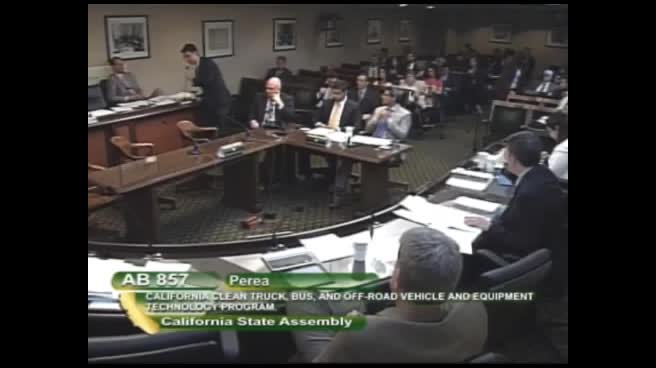 10MIN
Assembly Standing Committee on Natural Resources
Bill Author

Bill Co-Author(s):
