ACA 6: Property taxation: exemptions: fruit and nut trees: base year value transfers: persons with a severely disabled child.
- Session Year: 2015-2016
- House: Assembly
- Latest Version Date: 2016-04-07
(1)The California Constitution requires that all property be taxed unless otherwise provided by the California Constitution or the laws of the United States. The California Constitution exempts, among other things, fruit and nut trees for 4 years after the season in which they were planted in orchard form.
This measure would exempt from property taxation pistachio trees for 6 years after the season in which they were planted in orchard form.
(2)The California Constitution generally limits ad valorem taxes on real property to 1% of the full cash value of that property. For purposes of this limitation, full cash value is defined as the assessors valuation of real property as shown on the 197576 tax bill under full cash value or, thereafter, the appraised value of that real property when purchased, newly constructed, or a change in ownership has occurred. The California Constitution authorizes the Legislature to provide that persons over the age of 55 and persons who are severely disabled may transfer the base year value, as defined, of property to a replacement dwelling.
This measure would expand the authorization for base year value transfers provided to persons over the age of 55 years to include each individual member of a married couple who is over the age of 55 years, but only with respect to a replacement property purchased or newly constructed on or after the effective date of this measure and only with respect to an individual member of a married couple who has not transferred a base year value prior to that same effective date.
This measure would additionally authorize the Legislature to provide for transfer of base year value of property to a replacement dwelling for persons who have are the parent or legal guardian of a severely disabled child and reside with that child.
Existing property tax law implementing the constitutional authorization described above authorizes taxpayers to transfer the base year value of property to a replacement dwelling if certain conditions are met, including, among others, that the claimant has not previously been granted, as a claimant, this property tax relief. For purposes of applying this condition, existing property tax law requires the spouse of a claimant previously granted this property tax relief, where the spouse is a record owner of the replacement dwelling, to also be considered a claimant previously granted this property tax relief.
This measure would, for purposes of applying this condition of eligibility, exclude from the term claimant a spouse of a person who previously claimed and was granted this property tax relief, where that spouse is also a record owner of the replacement dwelling. This measure would apply these provisions only to persons who file a claim on or after the effective date of this measure.
(1)The California Constitution requires that all property be taxed unless otherwise provided by the California Constitution or the laws of the United States. The California Constitution exempts, among other things, fruit and nut trees for 4 years after the season in which they were planted in orchard form.
This measure would exempt from property taxation pistachio trees for 6 years after the season in which they were planted in orchard form.
(2)The California Constitution generally limits ad valorem taxes on real property to 1% of the full cash value of that property. For purposes of this limitation, full cash value is defined as the assessors valuation of real property as shown on the 197576 tax bill under full cash value or, thereafter, the appraised value of that real property when purchased, newly constructed, or a change in ownership has occurred. The California Constitution authorizes the Legislature to provide that persons over the age of 55 and persons who are severely disabled may transfer the base year value, as defined, of property to a replacement dwelling, if certain conditions are met. dwelling.
This measure would additionally authorize the Legislature to provide for transfer of base year value of property to a replacement dwelling for persons who have a severely disabled child.
Existing property tax law implementing the constitutional authorization described above authorizes taxpayers to transfer the base year value of property to a replacement dwelling if certain conditions are met, including, among others, that the claimant has not previously been granted, as a claimant, this property tax relief. For purposes of applying this condition, existing property tax law requires the spouse of a claimant previously granted this property tax relief, where the spouse is a record owner of the replacement dwelling, to also be considered a claimant previously granted this property tax relief.
This measure would, for purposes of applying this condition of eligibility, exclude from the term claimant a spouse of a person who previously claimed and was granted this property tax relief, where that spouse is also a record owner of the replacement dwelling. This measure would apply these provisions only to persons who file a claim on or after the effective date of this measure.
(1)The California Constitution requires that all property be taxed unless otherwise provided by the California Constitution or the laws of the United States. The California Constitution exempts, among other things, fruit and nut trees for 4 years after the season in which they were planted in orchard form.
This measure would exempt from property taxation pistachio trees for 6 years after the season in which they were planted in orchard form.
(2)The California Constitution generally limits ad valorem taxes on real property to 1% of the full cash value of that property. For purposes of this limitation, full cash value is defined as the assessors valuation of real property as shown on the 197576 tax bill under full cash value or, thereafter, the appraised value of that real property when purchased, newly constructed, or a change in ownership has occurred. The California Constitution authorizes the Legislature to provide that persons over the age of 55 and persons who are severely disabled may transfer the base year value, as defined, of property to a replacement dwelling, if certain conditions are met.
This measure would additionally authorize the Legislature to provide for transfer of base year value of property to a replacement dwelling for persons who have a severely disabled child.
The California Constitution generally limits ad valorem taxes on real property to 1% of the full cash value of that property. For purposes of this limitation, full cash value is defined as the assessors valuation of real property as shown on the 197576 tax bill under full cash value or, thereafter, the appraised value of that real property when purchased, newly constructed, or a change in ownership has occurred. The California Constitution authorizes the Legislature to provide that persons over the age of 55 and persons who are severely disabled may transfer the base year value, as defined, of property to a replacement dwelling, if certain conditions are met.
This measure would additionally authorize the Legislature to provide for transfer of base year value of property to a replacement dwelling for persons who have a severely disabled child.
Resolved by the Assembly, the Senate concurring, That the Legislature of the State of California at its 201516 Regular Session commencing on the first day of December 2014, two-thirds of the membership of each house concurring, hereby proposes to the people of the State of California, that the Constitution of the State be amended as follows:
The following are exempt from property taxation:
(a)Property owned by the State.
(b)Property owned by a local government, except as otherwise provided in Section 11(a).
(c)Bonds issued by the State or a local government in the State.
(d)Property used for libraries and museums that are free and open to the public and property used exclusively for public schools, community colleges, state colleges, and state universities.
(e)Buildings, land, equipment, and securities used exclusively for educational purposes by a nonprofit institution of higher education.
(f)Buildings, land on which they are situated, and equipment used exclusively for religious worship.
(g)Property used or held exclusively for the permanent deposit of human dead or for the care and maintenance of the property or the dead, except when used or held for profit. This property is also exempt from special assessment.
(h)Growing crops.
(i)(1)Fruit and nut trees until four years after the season in which they were planted in orchard form and grape vines until three years after the season in which they were planted in vineyard form.
(2)Notwithstanding paragraph (1), pistachio trees until six years after the season in which they were planted in orchard form.
(j)Immature forest trees planted on lands not previously bearing merchantable timber or planted or of natural growth on lands from which the merchantable original growth timber stand to the extent of 70 percent of all trees over 16 inches in diameter has been removed. Forest trees or timber shall be considered mature at such time after 40 years from the time of planting or removal of the original timber when so declared by a majority vote of a board consisting of a representative from the State Board of Forestry, a representative from the State Board of Equalization, and the assessor of the county in which the trees are located.
The Legislature may supersede the foregoing provisions with an alternative system or systems of taxing or exempting forest trees or timber, including a taxation system not based on property valuation. Any alternative system or systems shall provide for exemption of unharvested immature trees, shall encourage the continued use of timberlands for the production of trees for timber products, and shall provide for restricting the use of timberland to the production of timber products and compatible uses with provisions for taxation of timberland based on the restrictions. Nothing in this paragraph shall be construed to exclude timberland from the provisions of Section 8 of this article.
(k)Seven thousand dollars ($7,000) of the full value of a dwelling, as defined by the Legislature, when occupied by an owner as his principal residence, unless the dwelling is receiving another real property exemption. The Legislature may increase this exemption and may deny it if the owner received state or local aid to pay taxes either in whole or in part, and either directly or indirectly, on the dwelling.
No increase in this exemption above the amount of seven thousand dollars ($7,000) shall be effective for any fiscal year unless the Legislature increases the rate of state taxes in an amount sufficient to provide the subventions required by Section 25.
If the Legislature increases the homeowners property tax exemption, it shall provide increases in benefits to qualified renters, as defined by law, comparable to the average increase in benefits to homeowners, as calculated by the Legislature.
(l)Vessels of more than 50 tons burden in this State and engaged in the transportation of freight or passengers.
(m)Household furnishings and personal effects not held or used in connection with a trade, profession, or business.
(n)Any debt secured by land.
(o)Property in the amount of one thousand dollars ($1,000) of a claimant who
(1)is serving in or has served in and has been discharged under honorable conditions from service in the United States Army, Navy, Air Force, Marine Corps, Coast Guard, or Revenue Marine (Revenue Cutter) Service; and
(2)served either
(i)in time of war, or
(ii)in time of peace in a campaign or expedition for which a medal has been issued by Congress, or
(iii)in time of peace and because of a service-connected disability was released from active duty; and
(3)resides in the State on the current lien date.
An unmarried person who owns property valued at five thousand dollars ($5,000) or more, or a married person, who, together with the spouse, owns property valued at ten thousand dollars ($10,000) or more, is ineligible for this exemption.
If the claimant is married and does not own property eligible for the full amount of the exemption, property of the spouse shall be eligible for the unused balance of the exemption.
(p)Property in the amount of one thousand dollars ($1,000) of a claimant who
(1)is the unmarried spouse of a deceased veteran who met the service requirement stated in paragraphs (1) and (2) of subsection 3(o), and
(2)does not own property in excess of ten thousand dollars ($10,000), and
(3)is a resident of the State on the current lien date.
(q)Property in the amount of one thousand dollars ($1,000) of a claimant who
(1)is the parent of a deceased veteran who met the service requirement stated in paragraphs (1) and (2) of subsection 3(o), and
(2)receives a pension because of the veterans service, and
(3)is a resident of the State on the current lien date.
Either parent of a deceased veteran may claim this exemption.
An unmarried person who owns property valued at five thousand dollars ($5,000) or more, or a married person, who, together with the spouse, owns property valued at ten thousand dollars ($10,000) or more, is ineligible for this exemption.
(r)No individual residing in the State on the effective date of this amendment who would have been eligible for the exemption provided by the previous Section 11/4 of this article had it not been repealed shall lose eligibility for the exemption as a result of this amendment.
(a)(1)The full cash value means the county assessors valuation of real property as shown on the 197576 tax bill under full cash value or, thereafter, the appraised value of real property when purchased, newly constructed, or a change in ownership has occurred after the 1975 assessment. All real property not already assessed up to the 197576 full cash value may be reassessed to reflect that valuation. For purposes of this section, newly constructed does not include real property that is reconstructed after a disaster, as declared by the Governor, where the fair market value of the real property, as reconstructed, is comparable to its fair market value prior to the disaster. For purposes of this section, the term newly constructed does not include that portion of an existing structure that consists of the construction or reconstruction of seismic retrofitting components, as defined by the Legislature.
(2)(A)However, the Legislature may provide that, under appropriate circumstances and pursuant to definitions and procedures established by the Legislature, any person over the age of 55 years who resides in property that is eligible for the homeowners exemption under subdivision (k) of Section 3 of Article XIII and any implementing legislation may transfer the base year value of the property entitled to exemption, with the adjustments authorized by subdivision (b), to any replacement dwelling of equal or lesser value located within the same county and purchased or newly constructed by that person as his or her principal residence within two years of the sale of the original property. This paragraph applies to any replacement dwelling that was purchased or newly constructed on or after November 5, 1986.
(B)For purposes of this section, all of the following shall apply:
(i)Any person over the age of 55 years includes a married couple one member of which is over the age of 55 years.
(ii)Any person over the age of 55 years includes each individual member of a married couple who is over the age of 55 years, but only with respect to a replacement property purchased or newly constructed on or after the effective date of this clause and only with respect to an individual member of a married couple who has not transferred a base year value prior to that same effective date.
(ii)
(iii)Replacement dwelling means a building, structure, or other shelter constituting a place of abode, whether real property or personal property, and any land on which it may be situated.
(iii)
(iv)A two-dwelling unit shall be considered as two separate single-family dwellings.
(iv)For purposes of Section 69.5 of the Revenue and Taxation Code or any successor statute, a person shall not be deemed to have previously claimed and been granted the property tax relief authorized by this subdivision by reason of being or having been the spouse of a person who previously claimed and was granted that property tax relief, and also being or having been a record owner of the replacement dwelling. This clause applies only to persons who file a claim for the property tax relief authorized by this subdivision on or after the effective date of this clause.
(3)In addition, the Legislature may authorize each county board of supervisors, after consultation with the local affected agencies within the countys boundaries, to adopt an ordinance making the provisions of this subdivision relating to transfer of base year value also applicable to situations in which the replacement dwellings are located in that county and the original properties are located in another county within this State. For purposes of this paragraph, local affected agency means any city, special district, school district, or community college district that receives an annual property tax revenue allocation. This paragraph applies to any replacement dwelling that was purchased or newly constructed on or after the date the county adopted the provisions of this subdivision relating to transfer of base year value, but does not apply to any replacement dwelling that was purchased or newly constructed before November 9, 1988.
(4)The Legislature may extend the provisions of this subdivision relating to the transfer of base year values from original properties to replacement dwellings of homeowners over the age of 55 years to either or both of the following:
(A)Severely disabled homeowners, but only with respect to those replacement dwellings purchased or newly constructed on or after June 6, 1990.
(B)Homeowners with who are the parent or legal guardian of a severely disabled child and reside with that child, but only with respect to those replacement dwellings purchased or newly constructed on or after the effective date of this subparagraph.
(b)The full cash value base may reflect from year to year the inflationary rate not to exceed 2 percent for any given year or reduction as shown in the consumer price index or comparable data for the area under taxing jurisdiction, or may be reduced to reflect substantial damage, destruction, or other factors causing a decline in value.
(c)For purposes of subdivision (a), the Legislature may provide that the term newly constructed does not include any of the following:
(1)The construction or addition of any active solar energy system.
(2)The construction or installation of any fire sprinkler system, other fire extinguishing system, fire detection system, or fire-related egress improvement, as defined by the Legislature, that is constructed or installed after the effective date of this paragraph.
(3)The construction, installation, or modification on or after the effective date of this paragraph of any portion or structural component of a single- or multiple-family dwelling that is eligible for the homeowners exemption if the construction, installation, or modification is for the purpose of making the dwelling more accessible to a severely disabled person.
(4)The construction, installation, removal, or modification on or after the effective date of this paragraph of any portion or structural component of an existing building or structure if the construction, installation, removal, or modification is for the purpose of making the building more accessible to, or more usable by, a disabled person.
(d)For purposes of this section, the term change in ownership does not include the acquisition of real property as a replacement for comparable property if the person acquiring the real property has been displaced from the property replaced by eminent domain proceedings, by acquisition by a public entity, or governmental action that has resulted in a judgment of inverse condemnation. The real property acquired shall be deemed comparable to the property replaced if it is similar in size, utility, and function, or if it conforms to state regulations defined by the Legislature governing the relocation of persons displaced by governmental actions. This subdivision applies to any property acquired after March 1, 1975, but affects only those assessments of that property that occur after the provisions of this subdivision take effect.
(e)(1)Notwithstanding any other provision of this section, the Legislature shall provide that the base year value of property that is substantially damaged or destroyed by a disaster, as declared by the Governor, may be transferred to comparable property within the same county that is acquired or newly constructed as a replacement for the substantially damaged or destroyed property.
(2)Except as provided in paragraph (3), this subdivision applies to any comparable replacement property acquired or newly constructed on or after July 1, 1985, and to the determination of base year values for the 198586 fiscal year and fiscal years thereafter.
(3)In addition to the transfer of base year value of property within the same county that is permitted by paragraph (1), the Legislature may authorize each county board of supervisors to adopt, after consultation with affected local agencies within the county, an ordinance allowing the transfer of the base year value of property that is located within another county in the State and is substantially damaged or destroyed by a disaster, as declared by the Governor, to comparable replacement property of equal or lesser value that is located within the adopting county and is acquired or newly constructed within three years of the substantial damage or destruction of the original property as a replacement for that property. The scope and amount of the benefit provided to a property owner by the transfer of base year value of property pursuant to this paragraph shall not exceed the scope and amount of the benefit provided to a property owner by the transfer of base year value of property pursuant to subdivision (a). For purposes of this paragraph, affected local agency means any city, special district, school district, or community college district that receives an annual allocation of ad valorem property tax revenues. This paragraph applies to any comparable replacement property that is acquired or newly constructed as a replacement for property substantially damaged or destroyed by a disaster, as declared by the Governor, occurring on or after October 20, 1991, and to the determination of base year values for the 199192 fiscal year and fiscal years thereafter.
(f)For the purposes of subdivision (e):
(1)Property is substantially damaged or destroyed if it sustains physical damage amounting to more than 50 percent of its value immediately before the disaster. Damage includes a diminution in the value of property as a result of restricted access caused by the disaster.
(2)Replacement property is comparable to the property substantially damaged or destroyed if it is similar in size, utility, and function to the property that it replaces, and if the fair market value of the acquired property is comparable to the fair market value of the replaced property prior to the disaster.
(g)For purposes of subdivision (a), the terms purchased and change in ownership do not include the purchase or transfer of real property between spouses since March 1, 1975, including, but not limited to, all of the following:
(1)Transfers to a trustee for the beneficial use of a spouse, or the surviving spouse of a deceased transferor, or by a trustee of such a trust to the spouse of the trustor.
(2)Transfers to a spouse that take effect upon the death of a spouse.
(3)Transfers to a spouse or former spouse in connection with a property settlement agreement or decree of dissolution of a marriage or legal separation.
(4)The creation, transfer, or termination, solely between spouses, of any coowners interest.
(5)The distribution of a legal entitys property to a spouse or former spouse in exchange for the interest of the spouse in the legal entity in connection with a property settlement agreement or a decree of dissolution of a marriage or legal separation.
(h)(1)For purposes of subdivision (a), the terms purchased and change in ownership do not include the purchase or transfer of the principal residence of the transferor in the case of a purchase or transfer between parents and their children, as defined by the Legislature, and the purchase or transfer of the first one million dollars ($1,000,000) of the full cash value of all other real property between parents and their children, as defined by the Legislature. This subdivision applies to both voluntary transfers and transfers resulting from a court order or judicial decree.
(2)(A)Subject to subparagraph (B), commencing with purchases or transfers that occur on or after the date upon which the measure adding this paragraph becomes effective, the exclusion established by paragraph (1) also applies to a purchase or transfer of real property between grandparents and their grandchild or grandchildren, as defined by the Legislature, that otherwise qualifies under paragraph (1), if all of the parents of that grandchild or those grandchildren, who qualify as the children of the grandparents, are deceased as of the date of the purchase or transfer.
(B)A purchase or transfer of a principal residence shall not be excluded pursuant to subparagraph (A) if the transferee grandchild or grandchildren also received a principal residence, or interest therein, through another purchase or transfer that was excludable pursuant to paragraph (1). The full cash value of any real property, other than a principal residence, that was transferred to the grandchild or grandchildren pursuant to a purchase or transfer that was excludable pursuant to paragraph (1), and the full cash value of a principal residence that fails to qualify for exclusion as a result of the preceding sentence, shall be included in applying, for purposes of subparagraph (A), the one-million-dollar ($1,000,000) full cash value limit specified in paragraph (1).
(i)(1)Notwithstanding any other provision of this section, the Legislature shall provide with respect to a qualified contaminated property, as defined in paragraph (2), that either, but not both, of the following apply:
(A)(i)Subject to the limitation of clause (ii), the base year value of the qualified contaminated property, as adjusted as authorized by subdivision (b), may be transferred to a replacement property that is acquired or newly constructed as a replacement for the qualified contaminated property, if the replacement real property has a fair market value that is equal to or less than the fair market value of the qualified contaminated property if that property were not contaminated and, except as otherwise provided by this clause, is located within the same county. The base year value of the qualified contaminated property may be transferred to a replacement real property located within another county if the board of supervisors of that other county has, after consultation with the affected local agencies within that county, adopted a resolution authorizing an intercounty transfer of base year value as so described.
(ii)This subparagraph applies only to replacement property that is acquired or newly constructed within five years after ownership in the qualified contaminated property is sold or otherwise transferred.
(B)In the case in which the remediation of the environmental problems on the qualified contaminated property requires the destruction of, or results in substantial damage to, a structure located on that property, the term new construction does not include the repair of a substantially damaged structure, or the construction of a structure replacing a destroyed structure on the qualified contaminated property, performed after the remediation of the environmental problems on that property, provided that the repaired or replacement structure is similar in size, utility, and function to the original structure.
(2)For purposes of this subdivision, qualified contaminated property means residential or nonresidential real property that is all of the following:
(A)In the case of residential real property, rendered uninhabitable, and in the case of nonresidential real property, rendered unusable, as the result of either environmental problems, in the nature of and including, but not limited to, the presence of toxic or hazardous materials, or the remediation of those environmental problems, except where the existence of the environmental problems was known to the owner, or to a related individual or entity as described in paragraph (3), at the time the real property was acquired or constructed. For purposes of this subparagraph, residential real property is uninhabitable if that property, as a result of health hazards caused by or associated with the environmental problems, is unfit for human habitation, and nonresidential real property is unusable if that property, as a result of health hazards caused by or associated with the environmental problems, is unhealthy and unsuitable for occupancy.
(B)Located on a site that has been designated as a toxic or environmental hazard or as an environmental cleanup site by an agency of the State of California or the federal government.
(C)Real property that contains a structure or structures thereon prior to the completion of environmental cleanup activities, and that structure or structures are substantially damaged or destroyed as a result of those environmental cleanup activities.
(D)Stipulated by the lead governmental agency, with respect to the environmental problems or environmental cleanup of the real property, not to have been rendered uninhabitable or unusable, as applicable, as described in subparagraph (A), by any act or omission in which an owner of that real property participated or acquiesced.
(3)It shall be rebuttably presumed that an owner of the real property participated or acquiesced in any act or omission that rendered the real property uninhabitable or unusable, as applicable, if that owner is related to any individual or entity that committed that act or omission in any of the following ways:
(A)Is a spouse, parent, child, grandparent, grandchild, or sibling of that individual.
(B)Is a corporate parent, subsidiary, or affiliate of that entity.
(C)Is an owner of, or has control of, that entity.
(D)Is owned or controlled by that entity.
If this presumption is not overcome, the owner shall not receive the relief provided for in subparagraph (A) or (B) of paragraph (1). The presumption may be overcome by presentation of satisfactory evidence to the assessor, who shall not be bound by the findings of the lead governmental agency in determining whether the presumption has been overcome.
(4)This subdivision applies only to replacement property that is acquired or constructed on or after January 1, 1995, and to property repairs performed on or after that date.
(j)Unless specifically provided otherwise, amendments to this section adopted prior to November 1, 1988, are effective for changes in ownership that occur, and new construction that is completed, after the effective date of the amendment. Unless specifically provided otherwise, amendments to this section adopted after November 1, 1988, are effective for changes in ownership that occur, and new construction that is completed, on or after the effective date of the amendment.
Resolved by the Assembly, the Senate concurring, That the Legislature of the State of California at its 201516 Regular Session commencing on the first day of December 2014, two-thirds of the membership of each house concurring, hereby proposes to the people of the State of California, that the Constitution of the State be amended as follows:
The following are exempt from property taxation:
(a)Property owned by the State.
(b)Property owned by a local government, except as otherwise provided in Section 11(a).
(c)Bonds issued by the State or a local government in the State.
(d)Property used for libraries and museums that are free and open to the public and property used exclusively for public schools, community colleges, state colleges, and state universities.
(e)Buildings, land, equipment, and securities used exclusively for educational purposes by a nonprofit institution of higher education.
(f)Buildings, land on which they are situated, and equipment used exclusively for religious worship.
(g)Property used or held exclusively for the permanent deposit of human dead or for the care and maintenance of the property or the dead, except when used or held for profit. This property is also exempt from special assessment.
(h)Growing crops.
(i)(1)Fruit and nut trees until four years after the season in which they were planted in orchard form and grape vines until three years after the season in which they were planted in vineyard form.
(2)Notwithstanding paragraph (1), pistachio trees until six years after the season in which they were planted in orchard form.
(j)Immature forest trees planted on lands not previously bearing merchantable timber or planted or of natural growth on lands from which the merchantable original growth timber stand to the extent of 70 percent of all trees over 16 inches in diameter has been removed. Forest trees or timber shall be considered mature at such time after 40 years from the time of planting or removal of the original timber when so declared by a majority vote of a board consisting of a representative from the State Board of Forestry, a representative from the State Board of Equalization, and the assessor of the county in which the trees are located.
The Legislature may supersede the foregoing provisions with an alternative system or systems of taxing or exempting forest trees or timber, including a taxation system not based on property valuation. Any alternative system or systems shall provide for exemption of unharvested immature trees, shall encourage the continued use of timberlands for the production of trees for timber products, and shall provide for restricting the use of timberland to the production of timber products and compatible uses with provisions for taxation of timberland based on the restrictions. Nothing in this paragraph shall be construed to exclude timberland from the provisions of Section 8 of this article.
(k)Seven thousand dollars ($7,000) of the full value of a dwelling, as defined by the Legislature, when occupied by an owner as his principal residence, unless the dwelling is receiving another real property exemption. The Legislature may increase this exemption and may deny it if the owner received state or local aid to pay taxes either in whole or in part, and either directly or indirectly, on the dwelling.
No increase in this exemption above the amount of seven thousand dollars ($7,000) shall be effective for any fiscal year unless the Legislature increases the rate of state taxes in an amount sufficient to provide the subventions required by Section 25.
If the Legislature increases the homeowners property tax exemption, it shall provide increases in benefits to qualified renters, as defined by law, comparable to the average increase in benefits to homeowners, as calculated by the Legislature.
(l)Vessels of more than 50 tons burden in this State and engaged in the transportation of freight or passengers.
(m)Household furnishings and personal effects not held or used in connection with a trade, profession, or business.
(n)Any debt secured by land.
(o)Property in the amount of one thousand dollars ($1,000) of a claimant who
(1)is serving in or has served in and has been discharged under honorable conditions from service in the United States Army, Navy, Air Force, Marine Corps, Coast Guard, or Revenue Marine (Revenue Cutter) Service; and
(2)served either
(i)in time of war, or
(ii)in time of peace in a campaign or expedition for which a medal has been issued by Congress, or
(iii)in time of peace and because of a service-connected disability was released from active duty; and
(3)resides in the State on the current lien date.
An unmarried person who owns property valued at five thousand dollars ($5,000) or more, or a married person, who, together with the spouse, owns property valued at ten thousand dollars ($10,000) or more, is ineligible for this exemption.
If the claimant is married and does not own property eligible for the full amount of the exemption, property of the spouse shall be eligible for the unused balance of the exemption.
(p)Property in the amount of one thousand dollars ($1,000) of a claimant who
(1)is the unmarried spouse of a deceased veteran who met the service requirement stated in paragraphs (1) and (2) of subsection 3(o), and
(2)does not own property in excess of ten thousand dollars ($10,000), and
(3)is a resident of the State on the current lien date.
(q)Property in the amount of one thousand dollars ($1,000) of a claimant who
(1)is the parent of a deceased veteran who met the service requirement stated in paragraphs (1) and (2) of subsection 3(o), and
(2)receives a pension because of the veterans service, and
(3)is a resident of the State on the current lien date.
Either parent of a deceased veteran may claim this exemption.
An unmarried person who owns property valued at five thousand dollars ($5,000) or more, or a married person, who, together with the spouse, owns property valued at ten thousand dollars ($10,000) or more, is ineligible for this exemption.
(r)No individual residing in the State on the effective date of this amendment who would have been eligible for the exemption provided by the previous Section 11/4 of this article had it not been repealed shall lose eligibility for the exemption as a result of this amendment.
(a)(1)The full cash value means the county assessors valuation of real property as shown on the 197576 tax bill under full cash value or, thereafter, the appraised value of real property when purchased, newly constructed, or a change in ownership has occurred after the 1975 assessment. All real property not already assessed up to the 197576 full cash value may be reassessed to reflect that valuation. For purposes of this section, newly constructed does not include real property that is reconstructed after a disaster, as declared by the Governor, where the fair market value of the real property, as reconstructed, is comparable to its fair market value prior to the disaster. For purposes of this section, the term newly constructed does not include that portion of an existing structure that consists of the construction or reconstruction of seismic retrofitting components, as defined by the Legislature.
(2)(A)However, the Legislature may provide that, under appropriate circumstances and pursuant to definitions and procedures established by the Legislature, any person over the age of 55 years who resides in property that is eligible for the homeowners exemption under subdivision (k) of Section 3 of Article XIII and any implementing legislation may transfer the base year value of the property entitled to exemption, with the adjustments authorized by subdivision (b), to any replacement dwelling of equal or lesser value located within the same county and purchased or newly constructed by that person as his or her principal residence within two years of the sale of the original property. For This paragraph applies to any replacement dwelling that was purchased or newly constructed on or after November 5, 1986.
(B)For purposes of this section, any all of the following shall apply:
(i)Any person over the age of 55 years includes a married couple one member of which is over the age of 55 years. For purposes of this section, replacement
(ii)Replacement dwelling means a building, structure, or other shelter constituting a place of abode, whether real property or personal property, and any land on which it may be situated. For purposes of this section, a
(iii)A two-dwelling unit shall be considered as two separate single-family dwellings. This paragraph shall apply to any replacement dwelling that was purchased or newly constructed on or after November 5, 1986.
(iv)For purposes of Section 69.5 of the Revenue and Taxation Code or any successor statute, a person shall not be deemed to have previously claimed and been granted the property tax relief authorized by this subdivision by reason of being or having been the spouse of a person who previously claimed and was granted that property tax relief, and also being or having been a record owner of the replacement dwelling. This clause applies only to persons who file a claim for the property tax relief authorized by this subdivision on or after the effective date of this clause.
(3)In addition, the Legislature may authorize each county board of supervisors, after consultation with the local affected agencies within the countys boundaries, to adopt an ordinance making the provisions of this subdivision relating to transfer of base year value also applicable to situations in which the replacement dwellings are located in that county and the original properties are located in another county within this State. For purposes of this paragraph, local affected agency means any city, special district, school district, or community college district that receives an annual property tax revenue allocation. This paragraph applies to any replacement dwelling that was purchased or newly constructed on or after the date the county adopted the provisions of this subdivision relating to transfer of base year value, but does not apply to any replacement dwelling that was purchased or newly constructed before November 9, 1988.
(4)The Legislature may extend the provisions of this subdivision relating to the transfer of base year values from original properties to replacement dwellings of homeowners over the age of 55 years to either of or both of the following:
(A)Severely disabled homeowners, but only with respect to those replacement dwellings purchased or newly constructed on or after June 6, 1990.
(B)Homeowners with a severely disabled child, but only with respect to those replacement dwellings purchased or newly constructed on or after the effective date of this paragraph. subparagraph.
(b)The full cash value base may reflect from year to year the inflationary rate not to exceed 2 percent for any given year or reduction as shown in the consumer price index or comparable data for the area under taxing jurisdiction, or may be reduced to reflect substantial damage, destruction, or other factors causing a decline in value.
(c)For purposes of subdivision (a), the Legislature may provide that the term newly constructed does not include any of the following:
(1)The construction or addition of any active solar energy system.
(2)The construction or installation of any fire sprinkler system, other fire extinguishing system, fire detection system, or fire-related egress improvement, as defined by the Legislature, that is constructed or installed after the effective date of this paragraph.
(3)The construction, installation, or modification on or after the effective date of this paragraph of any portion or structural component of a single- or multiple-family dwelling that is eligible for the homeowners exemption if the construction, installation, or modification is for the purpose of making the dwelling more accessible to a severely disabled person.
(4)The construction, installation, removal, or modification on or after the effective date of this paragraph of any portion or structural component of an existing building or structure if the construction, installation, removal, or modification is for the purpose of making the building more accessible to, or more usable by, a disabled person.
(d)For purposes of this section, the term change in ownership does not include the acquisition of real property as a replacement for comparable property if the person acquiring the real property has been displaced from the property replaced by eminent domain proceedings, by acquisition by a public entity, or governmental action that has resulted in a judgment of inverse condemnation. The real property acquired shall be deemed comparable to the property replaced if it is similar in size, utility, and function, or if it conforms to state regulations defined by the Legislature governing the relocation of persons displaced by governmental actions. This subdivision applies to any property acquired after March 1, 1975, but affects only those assessments of that property that occur after the provisions of this subdivision take effect.
(e)(1)Notwithstanding any other provision of this section, the Legislature shall provide that the base year value of property that is substantially damaged or destroyed by a disaster, as declared by the Governor, may be transferred to comparable property within the same county that is acquired or newly constructed as a replacement for the substantially damaged or destroyed property.
(2)Except as provided in paragraph (3), this subdivision applies to any comparable replacement property acquired or newly constructed on or after July 1, 1985, and to the determination of base year values for the 198586 fiscal year and fiscal years thereafter.
(3)In addition to the transfer of base year value of property within the same county that is permitted by paragraph (1), the Legislature may authorize each county board of supervisors to adopt, after consultation with affected local agencies within the county, an ordinance allowing the transfer of the base year value of property that is located within another county in the State and is substantially damaged or destroyed by a disaster, as declared by the Governor, to comparable replacement property of equal or lesser value that is located within the adopting county and is acquired or newly constructed within three years of the substantial damage or destruction of the original property as a replacement for that property. The scope and amount of the benefit provided to a property owner by the transfer of base year value of property pursuant to this paragraph shall not exceed the scope and amount of the benefit provided to a property owner by the transfer of base year value of property pursuant to subdivision (a). For purposes of this paragraph, affected local agency means any city, special district, school district, or community college district that receives an annual allocation of ad valorem property tax revenues. This paragraph applies to any comparable replacement property that is acquired or newly constructed as a replacement for property substantially damaged or destroyed by a disaster, as declared by the Governor, occurring on or after October 20, 1991, and to the determination of base year values for the 199192 fiscal year and fiscal years thereafter.
(f)For the purposes of subdivision (e):
(1)Property is substantially damaged or destroyed if it sustains physical damage amounting to more than 50 percent of its value immediately before the disaster. Damage includes a diminution in the value of property as a result of restricted access caused by the disaster.
(2)Replacement property is comparable to the property substantially damaged or destroyed if it is similar in size, utility, and function to the property that it replaces, and if the fair market value of the acquired property is comparable to the fair market value of the replaced property prior to the disaster.
(g)For purposes of subdivision (a), the terms purchased and change in ownership do not include the purchase or transfer of real property between spouses since March 1, 1975, including, but not limited to, all of the following:
(1)Transfers to a trustee for the beneficial use of a spouse, or the surviving spouse of a deceased transferor, or by a trustee of such a trust to the spouse of the trustor.
(2)Transfers to a spouse that take effect upon the death of a spouse.
(3)Transfers to a spouse or former spouse in connection with a property settlement agreement or decree of dissolution of a marriage or legal separation.
(4)The creation, transfer, or termination, solely between spouses, of any coowners interest.
(5)The distribution of a legal entitys property to a spouse or former spouse in exchange for the interest of the spouse in the legal entity in connection with a property settlement agreement or a decree of dissolution of a marriage or legal separation.
(h)(1)For purposes of subdivision (a), the terms purchased and change in ownership do not include the purchase or transfer of the principal residence of the transferor in the case of a purchase or transfer between parents and their children, as defined by the Legislature, and the purchase or transfer of the first one million dollars ($1,000,000) of the full cash value of all other real property between parents and their children, as defined by the Legislature. This subdivision applies to both voluntary transfers and transfers resulting from a court order or judicial decree.
(2)(A)Subject to subparagraph (B), commencing with purchases or transfers that occur on or after the date upon which the measure adding this paragraph becomes effective, the exclusion established by paragraph (1) also applies to a purchase or transfer of real property between grandparents and their grandchild or grandchildren, as defined by the Legislature, that otherwise qualifies under paragraph (1), if all of the parents of that grandchild or those grandchildren, who qualify as the children of the grandparents, are deceased as of the date of the purchase or transfer.
(B)A purchase or transfer of a principal residence shall not be excluded pursuant to subparagraph (A) if the transferee grandchild or grandchildren also received a principal residence, or interest therein, through another purchase or transfer that was excludable pursuant to paragraph (1). The full cash value of any real property, other than a principal residence, that was transferred to the grandchild or grandchildren pursuant to a purchase or transfer that was excludable pursuant to paragraph (1), and the full cash value of a principal residence that fails to qualify for exclusion as a result of the preceding sentence, shall be included in applying, for purposes of subparagraph (A), the one-million-dollar ($1,000,000) full cash value limit specified in paragraph (1).
(i)(1)Notwithstanding any other provision of this section, the Legislature shall provide with respect to a qualified contaminated property, as defined in paragraph (2), that either, but not both, of the following apply:
(A)(i)Subject to the limitation of clause (ii), the base year value of the qualified contaminated property, as adjusted as authorized by subdivision (b), may be transferred to a replacement property that is acquired or newly constructed as a replacement for the qualified contaminated property, if the replacement real property has a fair market value that is equal to or less than the fair market value of the qualified contaminated property if that property were not contaminated and, except as otherwise provided by this clause, is located within the same county. The base year value of the qualified contaminated property may be transferred to a replacement real property located within another county if the board of supervisors of that other county has, after consultation with the affected local agencies within that county, adopted a resolution authorizing an intercounty transfer of base year value as so described.
(ii)This subparagraph applies only to replacement property that is acquired or newly constructed within five years after ownership in the qualified contaminated property is sold or otherwise transferred.
(B)In the case in which the remediation of the environmental problems on the qualified contaminated property requires the destruction of, or results in substantial damage to, a structure located on that property, the term new construction does not include the repair of a substantially damaged structure, or the construction of a structure replacing a destroyed structure on the qualified contaminated property, performed after the remediation of the environmental problems on that property, provided that the repaired or replacement structure is similar in size, utility, and function to the original structure.
(2)For purposes of this subdivision, qualified contaminated property means residential or nonresidential real property that is all of the following:
(A)In the case of residential real property, rendered uninhabitable, and in the case of nonresidential real property, rendered unusable, as the result of either environmental problems, in the nature of and including, but not limited to, the presence of toxic or hazardous materials, or the remediation of those environmental problems, except where the existence of the environmental problems was known to the owner, or to a related individual or entity as described in paragraph (3), at the time the real property was acquired or constructed. For purposes of this subparagraph, residential real property is uninhabitable if that property, as a result of health hazards caused by or associated with the environmental problems, is unfit for human habitation, and nonresidential real property is unusable if that property, as a result of health hazards caused by or associated with the environmental problems, is unhealthy and unsuitable for occupancy.
(B)Located on a site that has been designated as a toxic or environmental hazard or as an environmental cleanup site by an agency of the State of California or the federal government.
(C)Real property that contains a structure or structures thereon prior to the completion of environmental cleanup activities, and that structure or structures are substantially damaged or destroyed as a result of those environmental cleanup activities.
(D)Stipulated by the lead governmental agency, with respect to the environmental problems or environmental cleanup of the real property, not to have been rendered uninhabitable or unusable, as applicable, as described in subparagraph (A), by any act or omission in which an owner of that real property participated or acquiesced.
(3)It shall be rebuttably presumed that an owner of the real property participated or acquiesced in any act or omission that rendered the real property uninhabitable or unusable, as applicable, if that owner is related to any individual or entity that committed that act or omission in any of the following ways:
(A)Is a spouse, parent, child, grandparent, grandchild, or sibling of that individual.
(B)Is a corporate parent, subsidiary, or affiliate of that entity.
(C)Is an owner of, or has control of, that entity.
(D)Is owned or controlled by that entity.
If this presumption is not overcome, the owner shall not receive the relief provided for in subparagraph (A) or (B) of paragraph (1). The presumption may be overcome by presentation of satisfactory evidence to the assessor, who shall not be bound by the findings of the lead governmental agency in determining whether the presumption has been overcome.
(4)This subdivision applies only to replacement property that is acquired or constructed on or after January 1, 1995, and to property repairs performed on or after that date.
(j)Unless specifically provided otherwise, amendments to this section adopted prior to November 1, 1988, are effective for changes in ownership that occur, and new construction that is completed, after the effective date of the amendment. Unless specifically provided otherwise, amendments to this section adopted after November 1, 1988, are effective for changes in ownership that occur, and new construction that is completed, on or after the effective date of the amendment.
Resolved by the Assembly, the Senate concurring, That the Legislature of the State of California at its 201516 Regular Session commencing on the first day of December 2014, two-thirds of the membership of each house concurring, hereby proposes to the people of the State of California, that the Constitution of the State be amended as follows:
The following are exempt from property taxation:
(a)Property owned by the State.
(b)Property owned by a local government, except as otherwise provided in Section 11(a).
(c)Bonds issued by the State or a local government in the State.
(d)Property used for libraries and museums that are free and open to the public and property used exclusively for public schools, community colleges, state colleges, and state universities.
(e)Buildings, land, equipment, and securities used exclusively for educational purposes by a nonprofit institution of higher education.
(f)Buildings, land on which they are situated, and equipment used exclusively for religious worship.
(g)Property used or held exclusively for the permanent deposit of human dead or for the care and maintenance of the property or the dead, except when used or held for profit. This property is also exempt from special assessment.
(h)Growing crops.
(i)(1)Fruit and nut trees until 4 four years after the season in which they were planted in orchard form and grape vines until 3 three years after the season in which they were planted in vineyard form.
(2)Notwithstanding paragraph (1), pistachio trees until six years after the season in which they were planted in orchard form.
(j)Immature forest trees planted on lands not previously bearing merchantable timber or planted or of natural growth on lands from which the merchantable original growth timber stand to the extent of 70 percent of all trees over 16 inches in diameter has been removed. Forest trees or timber shall be considered mature at such time after 40 years from the time of planting or removal of the original timber when so declared by a majority vote of a board consisting of a representative from the State Board of Forestry, a representative from the State Board of Equalization, and the assessor of the county in which the trees are located.
The Legislature may supersede the foregoing provisions with an alternative system or systems of taxing or exempting forest trees or timber, including a taxation system not based on property valuation. Any alternative system or systems shall provide for exemption of unharvested immature trees, shall encourage the continued use of timberlands for the production of trees for timber products, and shall provide for restricting the use of timberland to the production of timber products and compatible uses with provisions for taxation of timberland based on the restrictions. Nothing in this paragraph shall be construed to exclude timberland from the provisions of Section 8 of this article.
(k)$7,000 Seven thousand dollars ($7,000) of the full value of a dwelling, as defined by the Legislature, when occupied by an owner as his principal residence, unless the dwelling is receiving another real property exemption. The Legislature may increase this exemption and may deny it if the owner received state or local aid to pay taxes either in whole or in part, and either directly or indirectly, on the dwelling.
No increase in this exemption above the amount of $7,000 seven thousand dollars ($7,000) shall be effective for any fiscal year unless the Legislature increases the rate of state taxes in an amount sufficient to provide the subventions required by Section 25.
If the Legislature increases the homeowners property tax exemption, it shall provide increases in benefits to qualified renters, as defined by law, comparable to the average increase in benefits to homeowners, as calculated by the Legislature.
(l)Vessels of more than 50 tons burden in this State and engaged in the transportation of freight or passengers.
(m)Household furnishings and personal effects not held or used in connection with a trade, profession, or business.
(n)Any debt secured by land.
(o)Property in the amount of $1,000 one thousand dollars ($1,000) of a claimant who
(1)is serving in or has served in and has been discharged under honorable conditions from service in the United States Army, Navy, Air Force, Marine Corps, Coast Guard, or Revenue Marine (Revenue Cutter) Service; and
(2)served either
(i)in time of war, or
(ii)in time of peace in a campaign or expedition for which a medal has been issued by Congress, or
(iii)in time of peace and because of a service-connected disability was released from active duty; and
(3)resides in the State on the current lien date.
An unmarried person who owns property valued at $5,000 five thousand dollars ($5,000) or more, or a married person, who, together with the spouse, owns property valued at $10,000 ten thousand dollars ($10,000) or more, is ineligible for this exemption.
If the claimant is married and does not own property eligible for the full amount of the exemption, property of the spouse shall be eligible for the unused balance of the exemption.
(p)Property in the amount of $1,000 one thousand dollars ($1,000) of a claimant who
(1)is the unmarried spouse of a deceased veteran who met the service requirement stated in paragraphs (1) and (2) of subsection 3(o), and
(2)does not own property in excess of $10,000, ten thousand dollars ($10,000), and
(3)is a resident of the State on the current lien date.
(q)Property in the amount of $1,000 one thousand dollars ($1,000) of a claimant who
(1)is the parent of a deceased veteran who met the service requirement stated in paragraphs (1) and (2) of subsection 3(o), and
(2)receives a pension because of the veterans service, and
(3)is a resident of the State on the current lien date.
Either parent of a deceased veteran may claim this exemption.
An unmarried person who owns property valued at $5,000 five thousand dollars ($5,000) or more, or a married person, who, together with the spouse, owns property valued at $10,000 ten thousand dollars ($10,000) or more, is ineligible for this exemption.
(r)No individual residing in the State on the effective date of this amendment who would have been eligible for the exemption provided by the previous section Section 11/4 of this article had it not been repealed shall lose eligibility for the exemption as a result of this amendment.
(a)(1)The full cash value means the county assessors valuation of real property as shown on the 197576 tax bill under full cash value or, thereafter, the appraised value of real property when purchased, newly constructed, or a change in ownership has occurred after the 1975 assessment. All real property not already assessed up to the 197576 full cash value may be reassessed to reflect that valuation. For purposes of this section, newly constructed does not include real property that is reconstructed after a disaster, as declared by the Governor, where the fair market value of the real property, as reconstructed, is comparable to its fair market value prior to the disaster. For purposes of this section, the term newly constructed does not include that portion of an existing structure that consists of the construction or reconstruction of seismic retrofitting components, as defined by the Legislature.
(2)However, the Legislature may provide that, under appropriate circumstances and pursuant to definitions and procedures established by the Legislature, any person over the age of 55 years who resides in property that is eligible for the homeowners exemption under subdivision (k) of Section 3 of Article XIII and any implementing legislation may transfer the base year value of the property entitled to exemption, with the adjustments authorized by subdivision (b), to any replacement dwelling of equal or lesser value located within the same county and purchased or newly constructed by that person as his or her principal residence within two years of the sale of the original property. For purposes of this section, any person over the age of 55 years includes a married couple one member of which is over the age of 55 years. For purposes of this section, replacement dwelling means a building, structure, or other shelter constituting a place of abode, whether real property or personal property, and any land on which it may be situated. For purposes of this section, a two-dwelling unit shall be considered as two separate single-family dwellings. This paragraph shall apply to any replacement dwelling that was purchased or newly constructed on or after November 5, 1986.
(3)In addition, the Legislature may authorize each county board of supervisors, after consultation with the local affected agencies within the countys boundaries, to adopt an ordinance making the provisions of this subdivision relating to transfer of base year value also applicable to situations in which the replacement dwellings are located in that county and the original properties are located in another county within this State. For purposes of this paragraph, local affected agency means any city, special district, school district, or community college district that receives an annual property tax revenue allocation. This paragraph applies to any replacement dwelling that was purchased or newly constructed on or after the date the county adopted the provisions of this subdivision relating to transfer of base year value, but does not apply to any replacement dwelling that was purchased or newly constructed before November 9, 1988.
(4)The Legislature may extend the provisions of this subdivision relating to the transfer of base year values from original properties to replacement dwellings of homeowners over the age of 55 years to either of both of the following:
(A)Severely disabled homeowners, but only with respect to those replacement dwellings purchased or newly constructed on or after June 6, 1990.
(B)Homeowners with a severely disabled child, but only with respect to those replacement dwellings purchased or newly constructed on or after the effective date of this paragraph.
(b)The full cash value base may reflect from year to year the inflationary rate not to exceed 2 percent for any given year or reduction as shown in the consumer price index or comparable data for the area under taxing jurisdiction, or may be reduced to reflect substantial damage, destruction, or other factors causing a decline in value.
(c)For purposes of subdivision (a), the Legislature may provide that the term newly constructed does not include any of the following:
(1)The construction or addition of any active solar energy system.
(2)The construction or installation of any fire sprinkler system, other fire extinguishing system, fire detection system, or fire-related egress improvement, as defined by the Legislature, that is constructed or installed after the effective date of this paragraph.
(3)The construction, installation, or modification on or after the effective date of this paragraph of any portion or structural component of a single- or multiple-family dwelling that is eligible for the homeowners exemption if the construction, installation, or modification is for the purpose of making the dwelling more accessible to a severely disabled person.
(4)The construction, installation, removal, or modification on or after the effective date of this paragraph of any portion or structural component of an existing building or structure if the construction, installation, removal, or modification is for the purpose of making the building more accessible to, or more usable by, a disabled person.
(d)For purposes of this section, the term change in ownership does not include the acquisition of real property as a replacement for comparable property if the person acquiring the real property has been displaced from the property replaced by eminent domain proceedings, by acquisition by a public entity, or governmental action that has resulted in a judgment of inverse condemnation. The real property acquired shall be deemed comparable to the property replaced if it is similar in size, utility, and function, or if it conforms to state regulations defined by the Legislature governing the relocation of persons displaced by governmental actions. This subdivision applies to any property acquired after March 1, 1975, but affects only those assessments of that property that occur after the provisions of this subdivision take effect.
(e)(1)Notwithstanding any other provision of this section, the Legislature shall provide that the base year value of property that is substantially damaged or destroyed by a disaster, as declared by the Governor, may be transferred to comparable property within the same county that is acquired or newly constructed as a replacement for the substantially damaged or destroyed property.
(2)Except as provided in paragraph (3), this subdivision applies to any comparable replacement property acquired or newly constructed on or after July 1, 1985, and to the determination of base year values for the 198586 fiscal year and fiscal years thereafter.
(3)In addition to the transfer of base year value of property within the same county that is permitted by paragraph (1), the Legislature may authorize each county board of supervisors to adopt, after consultation with affected local agencies within the county, an ordinance allowing the transfer of the base year value of property that is located within another county in the State and is substantially damaged or destroyed by a disaster, as declared by the Governor, to comparable replacement property of equal or lesser value that is located within the adopting county and is acquired or newly constructed within three years of the substantial damage or destruction of the original property as a replacement for that property. The scope and amount of the benefit provided to a property owner by the transfer of base year value of property pursuant to this paragraph shall not exceed the scope and amount of the benefit provided to a property owner by the transfer of base year value of property pursuant to subdivision (a). For purposes of this paragraph, affected local agency means any city, special district, school district, or community college district that receives an annual allocation of ad valorem property tax revenues. This paragraph applies to any comparable replacement property that is acquired or newly constructed as a replacement for property substantially damaged or destroyed by a disaster, as declared by the Governor, occurring on or after October 20, 1991, and to the determination of base year values for the 199192 fiscal year and fiscal years thereafter.
(f)For the purposes of subdivision (e):
(1)Property is substantially damaged or destroyed if it sustains physical damage amounting to more than 50 percent of its value immediately before the disaster. Damage includes a diminution in the value of property as a result of restricted access caused by the disaster.
(2)Replacement property is comparable to the property substantially damaged or destroyed if it is similar in size, utility, and function to the property that it replaces, and if the fair market value of the acquired property is comparable to the fair market value of the replaced property prior to the disaster.
(g)For purposes of subdivision (a), the terms purchased and change in ownership do not include the purchase or transfer of real property between spouses since March 1, 1975, including, but not limited to, all of the following:
(1)Transfers to a trustee for the beneficial use of a spouse, or the surviving spouse of a deceased transferor, or by a trustee of such a trust to the spouse of the trustor.
(2)Transfers to a spouse that take effect upon the death of a spouse.
(3)Transfers to a spouse or former spouse in connection with a property settlement agreement or decree of dissolution of a marriage or legal separation.
(4)The creation, transfer, or termination, solely between spouses, of any coowners interest.
(5)The distribution of a legal entitys property to a spouse or former spouse in exchange for the interest of the spouse in the legal entity in connection with a property settlement agreement or a decree of dissolution of a marriage or legal separation.
(h)(1)For purposes of subdivision (a), the terms purchased and change in ownership do not include the purchase or transfer of the principal residence of the transferor in the case of a purchase or transfer between parents and their children, as defined by the Legislature, and the purchase or transfer of the first one million dollars ($1,000,000) of the full cash value of all other real property between parents and their children, as defined by the Legislature. This subdivision applies to both voluntary transfers and transfers resulting from a court order or judicial decree.
(2)(A)Subject to subparagraph (B), commencing with purchases or transfers that occur on or after the date upon which the measure adding this paragraph becomes effective, the exclusion established by paragraph (1) also applies to a purchase or transfer of real property between grandparents and their grandchild or grandchildren, as defined by the Legislature, that otherwise qualifies under paragraph (1), if all of the parents of that grandchild or those grandchildren, who qualify as the children of the grandparents, are deceased as of the date of the purchase or transfer.
(B)A purchase or transfer of a principal residence shall not be excluded pursuant to subparagraph (A) if the transferee grandchild or grandchildren also received a principal residence, or interest therein, through another purchase or transfer that was excludable pursuant to paragraph (1). The full cash value of any real property, other than a principal residence, that was transferred to the grandchild or grandchildren pursuant to a purchase or transfer that was excludable pursuant to paragraph (1), and the full cash value of a principal residence that fails to qualify for exclusion as a result of the preceding sentence, shall be included in applying, for purposes of subparagraph (A), the one-million-dollar ($1,000,000) full cash value limit specified in paragraph (1).
(i)(1)Notwithstanding any other provision of this section, the Legislature shall provide with respect to a qualified contaminated property, as defined in paragraph (2), that either, but not both, of the following apply:
(A)(i)Subject to the limitation of clause (ii), the base year value of the qualified contaminated property, as adjusted as authorized by subdivision (b), may be transferred to a replacement property that is acquired or newly constructed as a replacement for the qualified contaminated property, if the replacement real property has a fair market value that is equal to or less than the fair market value of the qualified contaminated property if that property were not contaminated and, except as otherwise provided by this clause, is located within the same county. The base year value of the qualified contaminated property may be transferred to a replacement real property located within another county if the board of supervisors of that other county has, after consultation with the affected local agencies within that county, adopted a resolution authorizing an intercounty transfer of base year value as so described.
(ii)This subparagraph applies only to replacement property that is acquired or newly constructed within five years after ownership in the qualified contaminated property is sold or otherwise transferred.
(B)In the case in which the remediation of the environmental problems on the qualified contaminated property requires the destruction of, or results in substantial damage to, a structure located on that property, the term new construction does not include the repair of a substantially damaged structure, or the construction of a structure replacing a destroyed structure on the qualified contaminated property, performed after the remediation of the environmental problems on that property, provided that the repaired or replacement structure is similar in size, utility, and function to the original structure.
(2)For purposes of this subdivision, qualified contaminated property means residential or nonresidential real property that is all of the following:
(A)In the case of residential real property, rendered uninhabitable, and in the case of nonresidential real property, rendered unusable, as the result of either environmental problems, in the nature of and including, but not limited to, the presence of toxic or hazardous materials, or the remediation of those environmental problems, except where the existence of the environmental problems was known to the owner, or to a related individual or entity as described in paragraph (3), at the time the real property was acquired or constructed. For purposes of this subparagraph, residential real property is uninhabitable if that property, as a result of health hazards caused by or associated with the environmental problems, is unfit for human habitation, and nonresidential real property is unusable if that property, as a result of health hazards caused by or associated with the environmental problems, is unhealthy and unsuitable for occupancy.
(B)Located on a site that has been designated as a toxic or environmental hazard or as an environmental cleanup site by an agency of the State of California or the federal government.
(C)Real property that contains a structure or structures thereon prior to the completion of environmental cleanup activities, and that structure or structures are substantially damaged or destroyed as a result of those environmental cleanup activities.
(D)Stipulated by the lead governmental agency, with respect to the environmental problems or environmental cleanup of the real property, not to have been rendered uninhabitable or unusable, as applicable, as described in subparagraph (A), by any act or omission in which an owner of that real property participated or acquiesced.
(3)It shall be rebuttably presumed that an owner of the real property participated or acquiesced in any act or omission that rendered the real property uninhabitable or unusable, as applicable, if that owner is related to any individual or entity that committed that act or omission in any of the following ways:
(A)Is a spouse, parent, child, grandparent, grandchild, or sibling of that individual.
(B)Is a corporate parent, subsidiary, or affiliate of that entity.
(C)Is an owner of, or has control of, that entity.
(D)Is owned or controlled by that entity.
If this presumption is not overcome, the owner shall not receive the relief provided for in subparagraph (A) or (B) of paragraph (1). The presumption may be overcome by presentation of satisfactory evidence to the assessor, who shall not be bound by the findings of the lead governmental agency in determining whether the presumption has been overcome.
(4)This subdivision applies only to replacement property that is acquired or constructed on or after January 1, 1995, and to property repairs performed on or after that date.
(j)Unless specifically provided otherwise, amendments to this section adopted prior to November 1, 1988, are effective for changes in ownership that occur, and new construction that is completed, after the effective date of the amendment. Unless specifically provided otherwise, amendments to this section adopted after November 1, 1988, are effective for changes in ownership that occur, and new construction that is completed, on or after the effective date of the amendment.
Resolved by the Assembly, the Senate concurring, That the Legislature of the State of California at its 201516 commencing on the first day of December 2014, two-thirds of the membership of each house concurring, hereby proposes to the people of the State of California, that the Constitution of the State be amended as follows:
(a)(1)The full cash value means the county assessors valuation of real property as shown on the 197576 tax bill under full cash value or, thereafter, the appraised value of real property when purchased, newly constructed, or a change in ownership has occurred after the 1975 assessment. All real property not already assessed up to the 197576 full cash value may be reassessed to reflect that valuation. For purposes of this section, newly constructed does not include real property that is reconstructed after a disaster, as declared by the Governor, where the fair market value of the real property, as reconstructed, is comparable to its fair market value prior to the disaster. For purposes of this section, the term newly constructed does not include that portion of an existing structure that consists of the construction or reconstruction of seismic retrofitting components, as defined by the Legislature.
However,
(2)However, the Legislature may provide that, under appropriate circumstances and pursuant to definitions and procedures established by the Legislature, any person over the age of 55 years who resides in property that is eligible for the homeowners exemption under subdivision (k) of Section 3 of Article XIII and any implementing legislation may transfer the base year value of the property entitled to exemption, with the adjustments authorized by subdivision (b), to any replacement dwelling of equal or lesser value located within the same county and purchased or newly constructed by that person as his or her principal residence within two years of the sale of the original property. For purposes of this section, any person over the age of 55 years includes a married couple one member of which is over the age of 55 years. For purposes of this section, replacement dwelling means a building, structure, or other shelter constituting a place of abode, whether real property or personal property, and any land on which it may be situated. For purposes of this section, a two-dwelling unit shall be considered as two separate single-family dwellings. This paragraph shall apply to any replacement dwelling that was purchased or newly constructed on or after November 5, 1986.
In
(3)In addition, the Legislature may authorize each county board of supervisors, after consultation with the local affected agencies within the countys boundaries, to adopt an ordinance making the provisions of this subdivision relating to transfer of base year value also applicable to situations in which the replacement dwellings are located in that county and the original properties are located in another county within this State. For purposes of this paragraph, local affected agency means any city, special district, school district, or community college district that receives an annual property tax revenue allocation. This paragraph applies to any replacement dwelling that was purchased or newly constructed on or after the date the county adopted the provisions of this subdivision relating to transfer of base year value, but does not apply to any replacement dwelling that was purchased or newly constructed before November 9, 1988.
The
(4)The Legislature may extend the provisions of this subdivision relating to the transfer of base year values from original properties to replacement dwellings of homeowners over the age of 55 years to severely either of both of the following:
(A)Severely disabled homeowners, but only with respect to those replacement dwellings purchased or newly constructed on or after the effective date of this paragraph. June 6, 1990.
(B)Homeowners with a severely disabled child, but only with respect to those replacement dwellings purchased or newly constructed on or after the effective date of this paragraph.
(b)The full cash value base may reflect from year to year the inflationary rate not to exceed 2 percent for any given year or reduction as shown in the consumer price index or comparable data for the area under taxing jurisdiction, or may be reduced to reflect substantial damage, destruction, or other factors causing a decline in value.
(c)For purposes of subdivision (a), the Legislature may provide that the term newly constructed does not include any of the following:
(1)The construction or addition of any active solar energy system.
(2)The construction or installation of any fire sprinkler system, other fire extinguishing system, fire detection system, or fire-related egress improvement, as defined by the Legislature, that is constructed or installed after the effective date of this paragraph.
(3)The construction, installation, or modification on or after the effective date of this paragraph of any portion or structural component of a single- or multiple-family dwelling that is eligible for the homeowners exemption if the construction, installation, or modification is for the purpose of making the dwelling more accessible to a severely disabled person.
(4)The construction, installation, removal, or modification on or after the effective date of this paragraph of any portion or structural component of an existing building or structure if the construction, installation, removal, or modification is for the purpose of making the building more accessible to, or more usable by, a disabled person.
(d)For purposes of this section, the term change in ownership does not include the acquisition of real property as a replacement for comparable property if the person acquiring the real property has been displaced from the property replaced by eminent domain proceedings, by acquisition by a public entity, or governmental action that has resulted in a judgment of inverse condemnation. The real property acquired shall be deemed comparable to the property replaced if it is similar in size, utility, and function, or if it conforms to state regulations defined by the Legislature governing the relocation of persons displaced by governmental actions. This subdivision applies to any property acquired after March 1, 1975, but affects only those assessments of that property that occur after the provisions of this subdivision take effect.
(e)(1)Notwithstanding any other provision of this section, the Legislature shall provide that the base year value of property that is substantially damaged or destroyed by a disaster, as declared by the Governor, may be transferred to comparable property within the same county that is acquired or newly constructed as a replacement for the substantially damaged or destroyed property.
(2)Except as provided in paragraph (3), this subdivision applies to any comparable replacement property acquired or newly constructed on or after July 1, 1985, and to the determination of base year values for the 198586 fiscal year and fiscal years thereafter.
(3)In addition to the transfer of base year value of property within the same county that is permitted by paragraph (1), the Legislature may authorize each county board of supervisors to adopt, after consultation with affected local agencies within the county, an ordinance allowing the transfer of the base year value of property that is located within another county in the State and is substantially damaged or destroyed by a disaster, as declared by the Governor, to comparable replacement property of equal or lesser value that is located within the adopting county and is acquired or newly constructed within three years of the substantial damage or destruction of the original property as a replacement for that property. The scope and amount of the benefit provided to a property owner by the transfer of base year value of property pursuant to this paragraph shall not exceed the scope and amount of the benefit provided to a property owner by the transfer of base year value of property pursuant to subdivision (a). For purposes of this paragraph, affected local agency means any city, special district, school district, or community college district that receives an annual allocation of ad valorem property tax revenues. This paragraph applies to any comparable replacement property that is acquired or newly constructed as a replacement for property substantially damaged or destroyed by a disaster, as declared by the Governor, occurring on or after October 20, 1991, and to the determination of base year values for the 199192 fiscal year and fiscal years thereafter.
(f)For the purposes of subdivision (e):
(1)Property is substantially damaged or destroyed if it sustains physical damage amounting to more than 50 percent of its value immediately before the disaster. Damage includes a diminution in the value of property as a result of restricted access caused by the disaster.
(2)Replacement property is comparable to the property substantially damaged or destroyed if it is similar in size, utility, and function to the property that it replaces, and if the fair market value of the acquired property is comparable to the fair market value of the replaced property prior to the disaster.
(g)For purposes of subdivision (a), the terms purchased and change in ownership do not include the purchase or transfer of real property between spouses since March 1, 1975, including, but not limited to, all of the following:
(1)Transfers to a trustee for the beneficial use of a spouse, or the surviving spouse of a deceased transferor, or by a trustee of such a trust to the spouse of the trustor.
(2)Transfers to a spouse that take effect upon the death of a spouse.
(3)Transfers to a spouse or former spouse in connection with a property settlement agreement or decree of dissolution of a marriage or legal separation.
(4)The creation, transfer, or termination, solely between spouses, of any coowners interest.
(5)The distribution of a legal entitys property to a spouse or former spouse in exchange for the interest of the spouse in the legal entity in connection with a property settlement agreement or a decree of dissolution of a marriage or legal separation.
(h)(1)For purposes of subdivision (a), the terms purchased and change in ownership do not include the purchase or transfer of the principal residence of the transferor in the case of a purchase or transfer between parents and their children, as defined by the Legislature, and the purchase or transfer of the first one million dollars ($1,000,000) of the full cash value of all other real property between parents and their children, as defined by the Legislature. This subdivision applies to both voluntary transfers and transfers resulting from a court order or judicial decree.
(2)(A)Subject to subparagraph (B), commencing with purchases or transfers that occur on or after the date upon which the measure adding this paragraph becomes effective, the exclusion established by paragraph (1) also applies to a purchase or transfer of real property between grandparents and their grandchild or grandchildren, as defined by the Legislature, that otherwise qualifies under paragraph (1), if all of the parents of that grandchild or those grandchildren, who qualify as the children of the grandparents, are deceased as of the date of the purchase or transfer.
(B)A purchase or transfer of a principal residence shall not be excluded pursuant to subparagraph (A) if the transferee grandchild or grandchildren also received a principal residence, or interest therein, through another purchase or transfer that was excludable pursuant to paragraph (1). The full cash value of any real property, other than a principal residence, that was transferred to the grandchild or grandchildren pursuant to a purchase or transfer that was excludable pursuant to paragraph (1), and the full cash value of a principal residence that fails to qualify for exclusion as a result of the preceding sentence, shall be included in applying, for purposes of subparagraph (A), the one-million-dollar ($1,000,000) full cash value limit specified in paragraph (1).
(i)(1)Notwithstanding any other provision of this section, the Legislature shall provide with respect to a qualified contaminated property, as defined in paragraph (2), that either, but not both, of the following apply:
(A)(i)Subject to the limitation of clause (ii), the base year value of the qualified contaminated property, as adjusted as authorized by subdivision (b), may be transferred to a replacement property that is acquired or newly constructed as a replacement for the qualified contaminated property, if the replacement real property has a fair market value that is equal to or less than the fair market value of the qualified contaminated property if that property were not contaminated and, except as otherwise provided by this clause, is located within the same county. The base year value of the qualified contaminated property may be transferred to a replacement real property located within another county if the board of supervisors of that other county has, after consultation with the affected local agencies within that county, adopted a resolution authorizing an intercounty transfer of base year value as so described.
(ii)This subparagraph applies only to replacement property that is acquired or newly constructed within five years after ownership in the qualified contaminated property is sold or otherwise transferred.
(B)In the case in which the remediation of the environmental problems on the qualified contaminated property requires the destruction of, or results in substantial damage to, a structure located on that property, the term new construction does not include the repair of a substantially damaged structure, or the construction of a structure replacing a destroyed structure on the qualified contaminated property, performed after the remediation of the environmental problems on that property, provided that the repaired or replacement structure is similar in size, utility, and function to the original structure.
(2)For purposes of this subdivision, qualified contaminated property means residential or nonresidential real property that is all of the following:
(A)In the case of residential real property, rendered uninhabitable, and in the case of nonresidential real property, rendered unusable, as the result of either environmental problems, in the nature of and including, but not limited to, the presence of toxic or hazardous materials, or the remediation of those environmental problems, except where the existence of the environmental problems was known to the owner, or to a related individual or entity as described in paragraph (3), at the time the real property was acquired or constructed. For purposes of this subparagraph, residential real property is uninhabitable if that property, as a result of health hazards caused by or associated with the environmental problems, is unfit for human habitation, and nonresidential real property is unusable if that property, as a result of health hazards caused by or associated with the environmental problems, is unhealthy and unsuitable for occupancy.
(B)Located on a site that has been designated as a toxic or environmental hazard or as an environmental cleanup site by an agency of the State of California or the federal government.
(C)Real property that contains a structure or structures thereon prior to the completion of environmental cleanup activities, and that structure or structures are substantially damaged or destroyed as a result of those environmental cleanup activities.
(D)Stipulated by the lead governmental agency, with respect to the environmental problems or environmental cleanup of the real property, not to have been rendered uninhabitable or unusable, as applicable, as described in subparagraph (A), by any act or omission in which an owner of that real property participated or acquiesced.
(3)It shall be rebuttably presumed that an owner of the real property participated or acquiesced in any act or omission that rendered the real property uninhabitable or unusable, as applicable, if that owner is related to any individual or entity that committed that act or omission in any of the following ways:
(A)Is a spouse, parent, child, grandparent, grandchild, or sibling of that individual.
(B)Is a corporate parent, subsidiary, or affiliate of that entity.
(C)Is an owner of, or has control of, that entity.
(D)Is owned or controlled by that entity.
If this presumption is not overcome, the owner shall not receive the relief provided for in subparagraph (A) or (B) of paragraph (1). The presumption may be overcome by presentation of satisfactory evidence to the assessor, who shall not be bound by the findings of the lead governmental agency in determining whether the presumption has been overcome.
(4)This subdivision applies only to replacement property that is acquired or constructed on or after January 1, 1995, and to property repairs performed on or after that date.
(j)Unless specifically provided otherwise, amendments to this section adopted prior to November 1, 1988, are effective for changes in ownership that occur, and new construction that is completed, after the effective date of the amendment. Unless specifically provided otherwise, amendments to this section adopted after November 1, 1988, are effective for changes in ownership that occur, and new construction that is completed, on or after the effective date of the amendment.
|
Date
|
Status
|
|---|---|
| Apr 20, 2015 | Read first time. To print. |
| Apr 21, 2015 | From printer. May be heard in committee May 21. |
| Apr 30, 2015 | Referred to Coms. on REV. & TAX. and APPR. |
| Jul 13, 2015 | From committee chair, with author's amendments: Amend, and re-refer to Com. on REV. & TAX. Read second time and amended. |
| Jul 14, 2015 | Re-referred to Com. on REV. & TAX. |
| Jan 11, 2016 | In committee: Set, first hearing. Hearing canceled at the request of author. |
| Feb 8, 2016 | From committee chair, with author's amendments: Amend, and re-refer to Com. on REV. & TAX. Read second time and amended. |
| Feb 9, 2016 | Re-referred to Com. on REV. & TAX. |
| Mar 10, 2016 | In committee: Hearing postponed by committee. |
| Apr 6, 2016 | From committee: Amend, and be adopted as amended, and re-refer to Com. on APPR. with recommendation: To Consent Calendar. (Ayes 9. Noes 0.) (April 4). |
| Apr 7, 2016 | Read second time and amended. |
| Apr 11, 2016 | Re-referred to Com. on APPR. |
| May 27, 2016 | In committee: Held under submission. |
|
Date
|
Description
|
Location
|
Votes
|
|
|---|---|---|---|---|
| Apr 4, 2016 | Amend, and be adopted as amended and re-refer to the Committee on [Appropriations] with the recommendation: To Consent Calendar | Assembly Standing Committee on Revenue and Taxation |
Passed |
This list shows positions taken on this bill by organizations on the date displayed, which is linked to the original source.
Positions by individuals are not included.
|
Organization
|
Position
|
Date
|
|---|---|---|
| American Pistachio Growers | ** Support | Apr 20, 2016 |
| California Assessors' Association | ** Support | Apr 20, 2016 |
| Howard Jarvis Taxpayers Association | ** Support | Apr 20, 2016 |
Date of Hearing: April 20, 2016
ASSEMBLY COMMITTEE ON APPROPRIATIONS
Lorena Gonzalez, Chair
ABPCA Bill Id:ACA 6
Author:(Brown) – As Amended Ver:April 7, 2016
Policy Committee: | Revenue and Taxation | Vote: | 9 - 0 |
|
| ||
|
|
Urgency: State Mandated Local Program: No Reimbursable: No
SUMMARY:
This measure expands two constitutionally prescribed property tax exemptions for personal and real property. Specifically, this bill:
- Modifies Section 3 of Article XIII of the California Constitution to extend the existing property tax exemption on newly planted pistachio tress from four years, starting after the season in which they were planted in orchard form, to six years.
- Modifies Section 2 of Article XIIIA of the California Constitutions to do the following:
- Allows for spouses to qualify individually for the “base-year value” property tax relief, but only for a replacement property purchased or newly constructed on or after the effective date of this measure, and only for a spouse who has not already transferred a base year value prior to that same date.
- Authorizes the Legislature to extend the property tax relief for the “base-year value” transfer to homeowners who are the parent or legal guardian of a severely disabled child, but only with respect to replacement dwellings purchased or newly constructed on or after the effective date of this measure.
- Makes technical, conforming changes to the provisions related to property tax exemptions and base year value transfer eligibility requirements.
FISCAL EFFECT:
- Expanding the property tax exemption for pistachio trees will result in an annual revenue loss of $2 million, resulting in GF costs of approximately $1 million as a result of the Proposition 98 guarantee.
- Expanding the “base-year value” transfer will result in an annual revenue loss of approximately $335,000, resulting in GF costs of approximately $165,000 as a result of the Proposition 98 guarantee.
COMMENTS:
- Purpose. Supporters of the pistachio provisions content that this measure would bring property tax policy in line with the recognition that a pistachio tree is not ‘bearing’ for the first six years of its lives. Supporters of the base-year value provision argue that this constitutional amendment is needed to assist families caring for severely and permanently disabled children. The author cites an example of a situation in San Diego County where permanently disabled veterans are returning from military action and returning to their parents’ home, a house that is not accessible to permanently disabled inhabitants.
- Pistachio trees and the property tax: Existing law exempts fruit and nut bearing trees and grapevines from property tax during the first few years of their life and synchronizes the imposition of the tax with the ability of the trees to produce a sellable crop. The California Constitution exempts fruit and nut trees planted in orchard form from property tax until four years after the season first planted, and the Revenue and Taxation Code states that once the exemption period expires and the trees or vines are subject to tax, the law sets the initial base year value of the trees or vines at its full cash value as of January 1 of the first year they are taxable.
Pistachio trees, like other nut bearing trees, are not subject to the property tax for the first four years after the season in which they are planted. However, according to the United States Department of Agriculture (USDA), pistachio trees are not considered bearing until six years after the season in which they are planted. Therefore, pistachio trees are subject to the property tax for two years during which they are not producing any value for the owner.
While the trees themselves are not subject to property tax for the first four years of their lives, the agricultural land itself is still subject to property tax for those years. However, most pistachio trees are located on land subject to the Williamson Act and assessed under its prescribed methodology, which results in the lowest value for property tax purposes.
- Base year value transfers. Adopted in June 1978, Proposition 13 was designed to provide real property tax relief by limiting the assessment and taxing powers of state and local governments. As a general rule, Proposition 13 limits any tax on real property to 1% of the property's assessed value, measured as either the assessed value as of the 1975-76 tax year or the appraisal value when purchased, constructed, or a change in ownership has occurred, subject to adjustment for the lesser of inflation or 2% per year. As a result, real property is only reassessed to fair market value upon a change in ownership.
One exception to the change in ownership fair market value reassessment is the “base-year value transfer” provision. Under that rule, a disabled homeowner or a homeowner aged 55 or older may elect a once-in-a-lifetime transfer of the base year value of the homeowner's principal residence to a replacement residence of equal or lesser value within the same county, or in certain other counties, within two years of the sale of the original residence. The base year value transfer allows the homeowner to continue paying property taxes at the amount and rate of growth of the previous residence and not the fair market value of the new residence.
Under the current base value transfer rules, if a married couple are both record owners of a property that has received base year transfer value relief, neither will be eligible to claim such relief again in the future, even if the couple has divorced. Furthermore, if one of the spouses were to remarry an otherwise eligible person, that new couple would also be ineligible for the base year value transfer because the remarrying individual is not eligible.
- Related legislation. AB 1378 (Holden), would have allowed each spouse the opportunity to make separate, one-time base-value year claim after January 1, 2016. This bill was vetoed by the Governor, with the following veto message:
“This bill would allow each spouse in a marriage to submit a separate base-year property tax valuation transfer claim.
I think this bill is too road and allows an already generous property tax benefit to be allowed a second time on a larger scale.
I do not believe it would be prudent to authorize legislation such as this that would result in significant long-term costs to the General Fund.”
Analysis Prepared by: Luke Reidenbach / APPR. / (916) 319-2081
Date of Hearing: April 4, 2016
ASSEMBLY COMMITTEE ON REVENUE AND TAXATION
Sebastian Ridley-Thomas, Chair
ABPCA Bill Id:ACA 6 (
Author:Brown) – As Amended Ver:February 8, 2016
Tax levy. 2/3 vote. Fiscal committee.
SUBJECT: Property taxation: exemptions: fruit and nut trees: base-year value transfers: persons with a severely disabled child
SUMMARY: Proposes to expand several constitutionally prescribed property tax exemptions for personal and real property. Specifically, this bill:
- Modifies Section 3 of Article XIII of the California Constitution to extend the existing property tax exemption for newly planted pistachio trees from four years, starting after the season in which they were planted in orchard form, to six years.
- Modifies Section 2 of Article XIIIA of the California Constitution to do all of the following:
- Allow spouses to qualify individually for the "base-year value" transfer property tax relief. Specifically:
- Provides that, for purposes of existing statutory law, a person shall not be deemed to have previously claimed and been granted the property tax relief by reason of being or having been:
- The spouse of a person who previously was granted that property tax relief; and,
- A record owner of the replacement dwelling.
- The spouse of a person who previously was granted that property tax relief; and,
- Applies only to persons who file a claim for the property tax relief on or after the effective date of this measure.
- Provides that, for purposes of existing statutory law, a person shall not be deemed to have previously claimed and been granted the property tax relief by reason of being or having been:
- Authorize the Legislature to extend the property tax relief for the "base-year value" transfer to homeowners with a severely disabled child, but only with respect to replacement dwellings purchased or newly constructed on or after effective date of this measure.
- Make technical, conforming changes to the provisions relating to property tax exemptions and base year value transfer eligibility requirements.
- Allow spouses to qualify individually for the "base-year value" transfer property tax relief. Specifically:
EXISTING LAW:
- Provides that all property is taxable, unless otherwise provided by the California Constitution or federal laws [Section 1(a), Article XIII, California Constitution]. Limits ad valorem taxes on real property to 1% of the full cash value of that property [Section 1(a), Article XIII A, California Constitution (Proposition 13)].
- Exempts from property tax fruit and nut trees planted in orchard form until four years after the season first planted [Section 3(i), Article XIII, California Constitution]. The land upon which the trees are planted remains subject to tax. A similar exemption exists for grapevines, except that the exemption period is for three years.
- Requires real property to be reassessed to its current fair market value whenever a "change in ownership" occurs, but creates exceptions to numerous transfers. (California Constitution, Article XIII A, Section 2; R&TC Sections 60 – 69.5.) The assessed value of the property established initially for property tax purposes is generally referred to as "base-year value", which is subject to annual increases for inflation, not to exceed 2%.
- Allows a property owner over 55 years of age and a disabled person a once-in-a-lifetime opportunity to transfer the base-year value of his or her principle residence, within two years from the sale of the original residence, to a replacement home of equal or lesser value within the same county (Proposition 60, 1988) or to a replacement home in counties that have adopted ordinances allowing the transfer (Proposition 90, 1990), provided certain conditions are met and the county assessor is properly notified. Currently, Alameda, El Dorado, Los Angeles, Orange, Riverside, San Bernardino, San Diego, San Mateo, Santa Clara, and Ventura Counties allow these out-of-county transfers. In 1990, Proposition 110 also amended the California Constitution to extend the "base-year" transfer property tax relief to any severely and permanently disabled person regardless of age. "Base-year" transfers allow taxpayers to continue to pay property taxes at the amount and rate of growth of their previous home and prevent reassessments of their newly purchased homes to full market value.
- Provides that, if the replacement dwelling is purchased before the original property is sold, the taxpayer may transfer the base-year value only if the replacement property is 100% or less of the original property's value. If the replacement dwelling is purchased within the first year after the sale, then the taxpayer may transfer the base year if the replacement property is within 105% of the original property's value. And, if the replacement dwelling is purchased within the second year after the sale, then the taxpayer may transfer the base year if the replacement property is within 110% of the original property’s value.
- Allows a homeowner, who has been granted a base-year value transfer from his/her original residence to a replacement dwelling, to perform new construction on the replacement property subsequent to the transfer and exempts the new construction from assessment. The new construction must be completed within two years of the sale of the original property and its value may not exceed the sales price of the original property.
- Defines any person claiming the base-year transfer property tax relief as a "claimant" and specifies that spouses are deemed to be a single claimant. Provides that a person is eligible to claim a base-year value transfer as a claimant only if neither that person nor his/her spouse, who is a record owner of the new home, has previously received that property tax relief.
- Provides that each co-owner of real property, including domestic partners or unmarried couples, is considered to be a separate claimant for purposes of the base year value property tax relief.
FISCAL EFFECT: The BOE staff estimates that the provision expanding the property tax exemption for pistachio trees will result in an annual revenue loss of $2 million, the provision re-defining the definition of "claimant" in the case of a married couple will result in an annual revenue loss of $333,750, and the provision relating to a parent of a severely disabled child will result in an annual revenue loss of $1,335 per transfer.
COMMENTS:
- Author's Statement. The author has provided the following statement in support of this bill:
"ACA 6 would allow the transfer of Proposition 13 base year value on residential property to assist those families caring for children who are permanently and severely disabled. Current law, Proposition 60, allows a Proposition 13 base year transfer for persons over the age of 55 and to persons who are severely and permanently disabled. This ACA arises from a situation in San Diego County where permanently disabled veterans are returning from military action and returning to their parents' home, a house that is not accessible to permanently disabled inhabitants. Allowing base year transfers under these limited circumstances maintains the spirit of Proposition 60 and can easily be administered by the County Assessor's office." - Arguments in Support. The proponents of this constitutional amendment state that the provisions relating to the property tax exemption for fruit and nut trees would "recognize pistachios as 'bearing' six years after the season in which they were planted in orchard form" and would "align the County Tax Assessors Handbook with the definition of 'bearing' of pistachios trees as defined by the United States Department of Agriculture and by current industry standards and would provide two additional years of land tax exemption from the County Tax Assessor." They argue that because pistachio trees are currently treated as "bearing" at the end of the four-year period the valuation of these trees for property tax purposes is increased from $100 per acre to $13,000 per acre. This bill would provide two additional years of tax exemption, in line with the findings of the U.S. Department of Agriculture.
The proponents also argue that this constitutional amendment is needed to assist families caring for severely and permanently disabled children. They assert that "numerous parents have had to contend with the hardship of what occurs when a minor child becomes suddenly and severely disabled." This constitutional amendment "makes this challenging time easier for both parents and children." The proponents state that ACA 6 "updates the current base-year value transfer eligibility requirements in important ways in order to reflect the changing times in which we live, while at the same time benefitting both seniors and children with disabilities." - Proposition 13. Much of the law pertaining to property taxation is prescribed by Articles XIII and XIII A (commonly known as "Proposition 13") of the California Constitution. Proposition 13 was added to the California Constitution in June 1978 and was most recently amended by Proposition 26 in 2010. Proposition 13 was designed to provide real property tax relief by imposing a set of interlocking limitations upon the assessment and taxing powers of state and local governments.[1]
Section 1 of Article XIII A states that, as a general rule, the maximum amount of any ad valorem tax on real property may not exceed 1% of the property's full cash value, as adjusted for the lesser of inflation or 2% per year. The term "full cash value" is defined as the "county assessor's valuation of real property as shown on the 1975-1976 tax bill" or, thereafter, "the appraised value of real property when purchased, newly constructed, or a change in ownership has occurred after the 1975 assessment" [California Constitution, Article XIII A, Sections 1 and 2].
- Property Tax Exemption: Fruit and Nut Trees. Existing law exempts fruit and nut bearing trees and grapevines from property tax during the first few years of their life and synchronizes the imposition of the tax with the ability of the trees to produce a sellable crop. Thus, the California Constitution exempts from property tax fruit and nut trees planted in orchard form until four years after the season first planted and is intended to exempt from taxation plants that are harvested or replanted annually or that are too young. Section 211 of the Revenue and Taxation Code (R&TC) restates the exemption provisions of the constitution and additionally provides that any tree severely damaged during certain exemption period as a result of freezes restarts the exemption for another four years. In addition to the exemption for newly planted orchards provided by R&TC Section 211, Property Tax Rule 131 provides that the four-year exemption period will also apply to individual trees when: (a) a tree is newly planted within an existing orchard (i.e., a replacement tree), or (b) a tree that had reached commercial production requires grafting causing another non-producing period before it will bear fruit or nuts. Once the exemption period expires and the trees are subject to tax, R&TC Section 53 provides that the initial "base-year value" of the trees for purposes of Proposition 13 will be the full cash value of the trees as of January 1 on the first year when they are taxable.
- The Proposed Change for Taxing Pistachio Trees. A pistachio tree is native to western Asia and Asia Manor and was first introduced to the United States in 1890, when it was planted in California at the Plant Introduction Station in Chico, California in 1904.[2] The areas of the southwest San Joaquin Valley produce the best yields of pistachios. Pistachios are characterized by a long juvenile period, typically bearing few nuts before five years of age, and achieve full bearing between 10 and 12 years of age.[3] Peak yields are obtained from trees that are 10 to 20 years old. These trees are alternate bearing, meaning the crop production tends to alternate between high and low yields from year to year.[4] Since pistachio trees are not considered bearing until six years after the season in which they were planted, this bill proposes to exempt these trees from property tax for two more years.
- Taxation of Agricultural Land. Agricultural land is generally subject to property tax under Proposition 13; only the trees and vines are temporarily exempt. However, under the California Land Conservation Act (the "Williamson Act"), landowners may enter into contracts with cities and counties to restrict the land voluntarily to agricultural or open-space uses. In exchange, the land is valued according to income earning potential, which may be lower than the land's current fair-market value or Proposition 13- factored base-year value. According to the BOE staff analysis of this proposed constitutional amendment, most pistachio tree acres are located on land subject to the Williamson Act, which already results in the lowest value of the land for property tax purposes. The Committee may wish to consider whether the unique bearing age of pistachio trees warrants a full property tax exemption for extra two years given that most of those trees are grown on land already taxed at the lowest possible rate under the Williamson Act.
- Property Tax Exemption: Base-Year Value Transfers: Background. California has one of the lowest property taxes in the nation and provides the greatest benefit to property owners, especially those who have lived in their homes for many years. Proposition 13 contains provisions allowing a homeowner over the age of 55[5] or a homeowners who is disabled[6] a once-in-a-lifetime opportunity to transfer the base-year value in his/her principal residence, within two years from the sale of the original residence, to a replacement home of equal or lesser value within the same county or to a replacement home in counties that have adopted ordinances allowing the transfer[7], provided certain conditions are met and the county assessor is properly notified. Base-year transfers allow homeowners to continue paying property taxes at the amount and rate of growth of their previous homes and prevent reassessments of their newly purchased or constructed homes to full market value. This system, established by Proposition 13, may result in substantial property tax savings for long-term property owners.
- Base-Year Value Transfer: Fifty-Five and Over: Spouses. A person claiming the base-year value transfer relief is defined as a "claimant." To qualify, the claimant must provide certain information to the assessor, including his/her name and Social Security number as well as the name and Social Security number of his/her spouse who is also a record owner of the replacement dwelling. Under existing law, a person of any age may make a base-year value transfer claim as long as that person resides with a spouse who is over 55 or permanently disabled even if the spouse is not an owner of record of either the original or replacement property. However, the implementing statute, but not the Constitution, limits this "base-year value" benefit to a one-time relief. The statute requires that the "claimant" have not previously received this "property tax relief."
- What is a Problem? A spouse who shares title of the newly purchased home with the "claimant" is also considered to be a "claimant." Consequently, if "A" and "B" are married and record owners of property which has received the benefits of the base-year transfer value relief, then neither "A" nor "B" is eligible for a similar benefit in the future.[8] Furthermore, if "A" and "B" divorce, and "A" marries "C", "C" will not be eligible for the base-year value transfer relief with respect to "C's" replacement dwelling if both "A" and "C" are co-owners of record. The relief will be unavailable to "C" because "A" is considered a "claimant" for purposes of "C's" claim.
- Proposed Solution. This constitutional amendment proposes to stop treating a married couple as one "claimant" for purposes of the "base-year value" transfer relief and, instead, grant this property tax relief to any individual regardless of his/her marital status. Practically speaking, this proposed constitutional amendment would allow a married couple to transfer their base-year value twice, similarly to unmarried co-owners and registered domestic partners. However, this bill would not allow a claimant under the age of 55 to qualify for the tax relief even if the claimant resides with a spouse who meets the age requirement. As noted by the BOE staff, residency by an over-55 spouse will no longer suffice to permit transfer of the base-year value. To qualify, the over-55 spouse must file the actual claim and be a recorded owner of both homes. Under current law, a person who is under the age of 55 may be a claimant if he/she resides with a spouse who is over 55 years of age.
- Prospective or Retroactive? This proposed constitutional amendment does not specify whether retroactive claims are allowed. As noted by the BOE staff, it is unclear whether a spouse who was a record owner of a replacement dwelling for which a "base-year value" transfer was granted prior to the effective date of this constitutional amendment, would be eligible to file a claim for the "base-year value" relief on another replacement dwelling. It appears that the retroactive application of this provision would create certain administrative difficulties for the BOE. To monitor and enforce the existing one-time relief, the BOE is required to collect data from counties and maintain a database of base-year value transfer claimants and their spouses if names of both spouses appear on the title to the new home. If claimant's spouse subsequently claims another base-year value transfer, the BOE database would match the name and the claim will be denied. However, the original paper claims submitted by claimants to the BOE in the past years might have been destroyed. Thus, it may be impossible to determine whether the person (whose name is in the database) was listed as a spouse of the claimant or was the claimant himself/herself. The Committee may wish to consider amending this proposed constitutional amendment to clarify its prospective or retroactive application.
- Married Couple as a "Single Economic Unit." As observed by one of the prominent tax law professors, the choice between marriage neutrality and couples neutrality cannot be made purely on the basis of tax logic, but must consider "society's assumptions about the role of marriage and the family" and "in the end can rest on nothing more precise or permanent than collective social preferences."[9] Thus, under both federal and state income tax laws, a married couple is treated as a single economic unit. Generally, spouses file a joint tax return, reporting their combined income and calculate their tax liability based on that combined income. A married taxpayer filing separately is still subject to tax liability different from that if filed as single. Many tax preferences are disallowed to married taxpayers filing separately; these differences are called "marriage penalties" and "marriage bonuses".[10] It appears that existing California property tax law similarly treats married taxpayers as a single economic unit in contrast to couples that cohabitate or are registered as domestic partners. The Committee may wish to consider whether the rationale for this tax treatment of a married couple as a single economic unit is warranted in the context of the property tax law. The Committee may also wish to consider limiting the application of this proposed constitutional amendment to a married couple where one of the spouses was previously married and received a base-year value transfer on a home he/she, or his/her ex-spouse, owned in the prior marriage.
- Is the Constitutional Amendment Relating to Base-Year Transfer for Spouses Necessary? As noted by the BOE staff, this constitutional amendment addresses a problem that was created by the implementing statute rather than the Constitution. Put differently, the Constitution does not limit the number of base-year value transfers one person may receive nor does it require both spouses to be claimants. This requirement was imposed by the Legislature. The Committee may wish to consider whether this constitutional amendment is necessary to provide the property tax relief to spouses and ex-spouses, where the Legislature itself has full authority to change the implementing statute (as it proposed to do in 2015).
- Related Legislation. Last year, Governor Brown vetoed AB 1378 (Holden), sponsored by the Howard Jarvis Association, that would have allowed each spouse the opportunity to make a separate, one-time claim after January 1, 2016. Because AB 1378 would have applied prospectively only, it would have allowed a married couple to move their base-year value twice but only if each spouse makes a claim for the first time after January 1, 2016.
- What is a Problem? A spouse who shares title of the newly purchased home with the "claimant" is also considered to be a "claimant." Consequently, if "A" and "B" are married and record owners of property which has received the benefits of the base-year transfer value relief, then neither "A" nor "B" is eligible for a similar benefit in the future.[8] Furthermore, if "A" and "B" divorce, and "A" marries "C", "C" will not be eligible for the base-year value transfer relief with respect to "C's" replacement dwelling if both "A" and "C" are co-owners of record. The relief will be unavailable to "C" because "A" is considered a "claimant" for purposes of "C's" claim.
The Governor's veto message states:
"This bill would allow each spouse in a marriage to submit a separate base-year property tax valuation transfer claim.
"I think this bill is too broad and allows an already generous property tax benefit to be allowed a second time on a larger scale.
"I do not believe that it would be prudent to authorize legislation such as this that would result in significant long-term costs to the General Fund."
- Base-Year Value Transfers: Homeowners with Disabled Children. As discussed, the Constitution and implementing statute allow a homeowner who is severely and permanently disabled to sell his/her home, buy or build a new one, and transfer the base-year value to a replacement dwelling. To qualify, the move must be necessary to meet disability requirements and the new home must be of equal or lesser value and located in the same county or another county that offers this property tax benefit. In addition, the claimant must provide certain information to the assessor, including proof of severe and permanent disability.
- What is the Problem? It is unclear if the definition of a "severely disabled homeowner" includes a child who resides in his/her parents' home but has no legal right as a homeowner. According to a BOE annotation[11], a minor may obtain the benefit of a base-year value transfer indirectly if a guardianship or trust is created for the minor and the minor has received the title to both the original and replacement homes. A minor may not convey or make contracts relating to real property even though he/she may own real property or an interest therein. Nonetheless, if a guardian or trustee is appointed to sell real property owned by a minor, the benefits of a base-year value transfer may be obtained indirectly through a guardianship or trust. In other words, a disabled child's name must be added to the title in order to transfer the base-year value. Once the child is a record owner, he/she becomes a qualified claimant and the parent may file a claim on the child's behalf as the trustee or guardian.[12] However, adding a minor child to a home's legal title may be a lengthy, complicated and costly legal process. In some cases, parents may not be even aware of this indirect way of obtaining the benefit of a base-year value transfer. Furthermore, in the case of an adult child, the addition of the child's name to the title may result in non-tax related legal complications. To sum up, existing law does not allow a homeowner with a severely and permanently disabled child to qualify for this "base-year" value transfer directly.
- The Proposed Solution. This constitutional amendment would extend the benefit of a "base-year value" transfer to any person with a severely and permanently disabled child who resides in the home. The intent of the constitutional amendment is to assist a family caring for a child who is severely and permanently disabled by allowing the family to sell their home and build or buy a new one to accommodate their child's needs. To that end, this proposed constitutional amendment eliminates the need for parents to engage in complicated legal proceedings and allows a parent to claim directly the benefit of the "base-year value" transfer without adding the child's name to title.
- BOE's Implementation Concerns. In its analysis, the BOE staff noted that this constitutional amendment does not appear to require that the child reside in the home with the parent. To clarify the intent of the author and minimize any future implementation issues, the BOE staff recommends amending R&TC Section 69.5(g)(12). Furthermore, under this proposed constitutional amendment, any person (such as a caregiver, a relative or friend and not just a parent) with a severely and permanently disabled child would qualify for the base-year value transfer relief. The Committee may wish to consider amendments that would clarify the intent of this proposed constitutional amendment.
- Prior Legislation. AB 571 (Brown), or the 2014-15 Legislative Session, would have, among other things, provided for a transfer of base-year value of original property to a replacement dwelling for persons who have a severely disabled child. However, because the base-year value transfer relief was created by constitutional amendments, a new constitutional amendment is required to expand the scope of the relief to include disabled children. AB 571 was later amended to delete these base-year value relief provisions.
- What is the Problem? It is unclear if the definition of a "severely disabled homeowner" includes a child who resides in his/her parents' home but has no legal right as a homeowner. According to a BOE annotation[11], a minor may obtain the benefit of a base-year value transfer indirectly if a guardianship or trust is created for the minor and the minor has received the title to both the original and replacement homes. A minor may not convey or make contracts relating to real property even though he/she may own real property or an interest therein. Nonetheless, if a guardian or trustee is appointed to sell real property owned by a minor, the benefits of a base-year value transfer may be obtained indirectly through a guardianship or trust. In other words, a disabled child's name must be added to the title in order to transfer the base-year value. Once the child is a record owner, he/she becomes a qualified claimant and the parent may file a claim on the child's behalf as the trustee or guardian.[12] However, adding a minor child to a home's legal title may be a lengthy, complicated and costly legal process. In some cases, parents may not be even aware of this indirect way of obtaining the benefit of a base-year value transfer. Furthermore, in the case of an adult child, the addition of the child's name to the title may result in non-tax related legal complications. To sum up, existing law does not allow a homeowner with a severely and permanently disabled child to qualify for this "base-year" value transfer directly.
REGISTERED SUPPORT / OPPOSITION:
Support
American Pistachio Growers
Howard Jarvis Taxpayers Association
California Assessors' Association
Opposition
None on file
Analysis Prepared by: Oksana Jaffe / REV. & TAX. / (916) 319-2098
Since any tax savings resulting from the real property tax limitations provided in Sections 1 and 2 of Article XIII A could be effectively eliminated through the imposition of additional state and local taxes, Sections 3 and 4 place additional restrictions upon the imposition of any such taxes. See Amador Valley Joint Union High Sch. Dist. v. State Bd. of Equalization, (1978) 22 Cal.3d 208. ↑
The Pistachio Tree; Botany and Physiology and Factors that Affect Yield, by Louise Ferguson, Vito Polito and Craig Kallsen, p. 1. ↑
Ibid. ↑
Pistachio Timeline, by Nicole Mosz, HIB/BEAD, January 14, 2002. ↑
In 1986, the voters passed Proposition 60, which amended the Constitution to allow persons over the age of 55 to sell a principal residence and transfer its base-year value to a replacement principal residence within the same county. ↑
In 1990, the voters passed Proposition 110, which amended the Constitution to extend these provisions to any severely and permanently disabled person regardless of age. ↑
In 1988, the voters passed Proposition 90, which amended the Constitution to extend the base-year value transfer provisions to a replacement residence located in another county on a county-optional basis. ↑
BOE Annotation 200.0020 "Claimant (New Spouse)". ↑
Marriage and the Income Tax, L. Zelenak, 67 S. Cal. Rev. 339, p. 342 (1994), citing Boris I. Bittker, Federal Income Taxation and the Family, 27 Stan. L. Rev. 1389, 1395-96 (1975). ↑
Id., at p.339. ↑
Property Tax Annotation 200.0076, State Board of Equalization. ↑
BOE's Letter to Assessor's 2006/010, Question 6 ↑
Discussed in Hearing
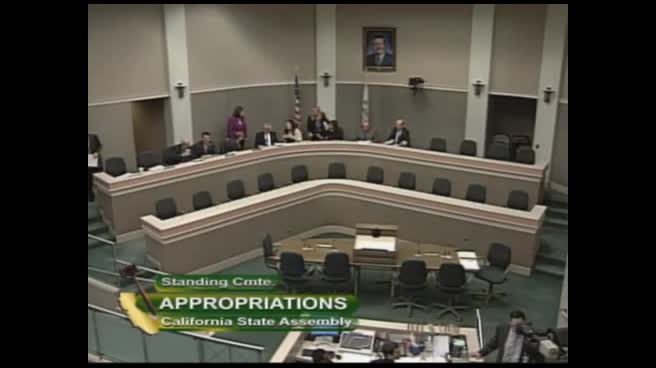 5MIN
Assembly Standing Committee on Appropriations



Bill Co-Author(s):