SB 1126: Property taxation: inflation factor: senior citizens.
- Session Year: 2015-2016
- House: Senate
- Latest Version Date: 2016-05-04
The California Constitution generally limits ad valorem taxes on real property to 1% of the full cash value, as defined, of that property, and provides that the full cash value base may be adjusted each year by an inflationary rate not to exceed 2% for any given year. Existing property tax law implementing this constitutional authority provides that the taxable value of real property is the lesser of its base year value compounded annually by the inflation factor not to exceed 2%, as provided, or its full cash value. Existing property tax law also provides that the taxable value of a manufactured home is the lesser of its base year value compounded annually by an inflation factor not to exceed 2% or its full cash value.
This bill would provide that the inflation factor shall not apply to the principal place of residence of a qualified taxpayer, defined by the bill to mean a taxpayer person that owns a dwelling as his or her principal place of residence, or a person that owns a manufactured home as his or her principal place of residence, who is 65 years of age or older on the lien date who meets specified requirements.
By changing the manner in which local tax officials calculate the taxable value of real property owned by senior citizens, this bill would impose a state-mandated local program.
Section 2229 of the Revenue and Taxation Code requires the Legislature to reimburse local agencies annually for certain property tax revenues lost as a result of any exemption or classification of property for purposes of ad valorem property taxation.
This bill would provide that, notwithstanding Section 2229 of the Revenue and Taxation Code, no appropriation is made and the state shall not reimburse local agencies for property tax revenues lost by them pursuant to the bill.
The California Constitution requires the state to reimburse local agencies and school districts for certain costs mandated by the state. Statutory provisions establish procedures for making that reimbursement.
This bill would provide that, if the Commission on State Mandates determines that the bill contains costs mandated by the state, reimbursement for those costs shall be made pursuant to these statutory provisions.
This bill would take effect immediately as a tax levy.
The California Constitution generally limits ad valorem taxes on real property to 1% of the full cash value, as defined, of that property, and provides that the full cash value base may be adjusted each year by an inflationary rate not to exceed 2% for any given year. Existing property tax law implementing this constitutional authority provides that the taxable value of real property is the lesser of its base year value compounded annually by the inflation factor not to exceed 2%, as provided, or its full cash value.
This bill would provide that the inflation factor shall not apply to the principal place of residence of a qualified taxpayer, defined by the bill to mean a taxpayer who is 65 years of age or older who meets specified requirements.
By changing the manner in which local tax officials calculate the taxable value of real property owned by senior citizens, this bill would impose a state-mandated local program.
Section 2229 of the Revenue and Taxation Code requires the Legislature to reimburse local agencies annually for certain property tax revenues lost as a result of any exemption or classification of property for purposes of ad valorem property taxation.
This bill would provide that, notwithstanding Section 2229 of the Revenue and Taxation Code, no appropriation is made and the state shall not reimburse local agencies for property tax revenues lost by them pursuant to the bill.
The California Constitution requires the state to reimburse local agencies and school districts for certain costs mandated by the state. Statutory provisions establish procedures for making that reimbursement.
This bill would provide that, if the Commission on State Mandates determines that the bill contains costs mandated by the state, reimbursement for those costs shall be made pursuant to these statutory provisions.
This bill would take effect immediately as a tax levy.
(a)For purposes of subdivision (b) of Section 2 of Article XIIIA of the California Constitution, for each lien date after the lien date in which the base year value is determined pursuant to Section 110.1, the taxable value of real property shall, except as otherwise provided in subdivision (b) or (c), be the lesser of:
(1)Its base year value, compounded annually since the base year by an inflation factor, which shall be determined as follows:
(A)For any assessment year commencing prior to January 1, 1985, the inflation factor shall be the percentage change in the cost of living, as defined in Section 2212.
(B)For any assessment year commencing after January 1, 1985, and prior to January 1, 1998, the inflation factor shall be the percentage change, rounded to the nearest one-thousandth of 1 percent, from December of the prior fiscal year to December of the current fiscal year in the California Consumer Price Index for all items, as determined by the California Department of Industrial Relations.
(C)For any assessment year commencing on or after January 1, 1998, the inflation factor shall be the percentage change, rounded to the nearest one-thousandth of 1 percent, from October of the prior fiscal year to October of the current fiscal year in the California Consumer Price Index for all items, as determined by the California Department of Industrial Relations.
(D)The percentage increase for any assessment year determined pursuant to subparagraph (A), (B), or (C) shall not exceed 2 percent of the prior years value.
(E)(i)Notwithstanding any other law, for any assessment year commencing on or after January 1, 2017, the percentage increase for an assessment year determined pursuant to subparagraph (A), (B), or (C) shall not apply to the principal place of residence of a qualified taxpayer.
(ii)For purposes of this subparagraph, both all of the following shall apply:
(I)Qualified taxpayer means a taxpayer person that owns a dwelling as his or her principal place of residence who is 65 years of age or older on the lien date and satisfies either of the following:
(ia)If the qualified taxpayer is single, his or her annual household income income, as defined in Section 20504, is twenty-five thousand dollars ($25,000) or less.
(ib)If the qualified taxpayer is married, his or her combined annual household income income, as defined in Section 20504, is fifty thousand dollars ($50,000) or less.
(II)A qualified taxpayer who is 65 years of age or older includes a married couple, one member of which is 65 years of age or older. older on the lien date.
(III)When claiming the benefit provided by this subparagraph, the claimant shall provide all information required by, and answer all questions contained in, an affidavit furnished by the assessor to determine that the claimant is a qualified taxpayer. The assessor may require additional proof of the information or answers provided in the affidavit before allowing the benefit provided by this subparagraph.
(2)Its full cash value, as defined in Section 110, as of the lien date, taking into account reductions in value due to damage, destruction, depreciation, obsolescence, removal of property, or other factors causing a decline in value.
(b)If the real property was damaged or destroyed by disaster, misfortune, or calamity and the board of supervisors of the county in which the real property is located has not adopted an ordinance pursuant to Section 170, or any portion of the real property has been removed by voluntary action by the taxpayer, the taxable value of the property shall be the sum of the following:
(1)The lesser of its base year value of land determined under paragraph (1) of subdivision (a) or full cash value of land determined pursuant to paragraph (2) of subdivision (a).
(2)The lesser of its base year value of improvements determined pursuant to paragraph (1) of subdivision (a) or the full cash value of improvements determined pursuant to paragraph (2) of subdivision (a).
In applying this subdivision, the base year value of the subject real property does not include that portion of the previous base year value of that property that was attributable to any portion of the property that has been destroyed or removed. The sum determined under this subdivision shall then become the base year value of the real property until that property is restored, repaired, or reconstructed or other provisions of law require establishment of a new base year value.
(c)If the real property was damaged or destroyed by disaster, misfortune or calamity and the board of supervisors in the county in which the real property is located has adopted an ordinance pursuant to Section 170, the taxable value of the real property shall be its assessed value as computed pursuant to Section 170.
(d)For purposes of this section, real property means that appraisal unit that persons in the marketplace commonly buy and sell as a unit, or that is normally valued separately.
(e)Nothing in this section shall be construed to require the assessor to make an annual reappraisal of all assessable property. However, for each lien date after the first lien date for which the taxable value of property is reduced pursuant to paragraph (2) of subdivision (a), the value of that property shall be annually reappraised at its full cash value as defined in Section 110 until that value exceeds the value determined pursuant to paragraph (1) of subdivision (a). In no event shall the assessor condition the implementation of the preceding sentence in any year upon the filing of an assessment appeal.
SEC. 2.Section 5813 of the Revenue and Taxation Code is amended to read:5813.For (a)For each lien date after the lien date for which the base year value is determined, the taxable value of a manufactured home shall be the lesser of:
(a)
(1)Its base year value, compounded annually since the base year by an inflation factor, which shall be the percentage change in the cost of living, as defined in Section 51, provided, that any percentage increase shall not exceed 2 percent of the prior years value; or
(b)
(2)Its full cash value, as defined in Section 5803, as of the lien date, taking into account reductions in value due to damage, destruction, depreciation, obsolescence, or other factors causing a decline in value; or
(c)
(3)If the manufactured home is damaged or destroyed by disaster, misfortune, or calamity, its value determined pursuant to (b) paragraph (2) shall be its base year value until the manufactured home is restored, repaired or reconstructed or other provisions of law require establishment of a new base year value.
(b)(1)Notwithstanding any other law, for any assessment year commencing on or after January 1, 2017, the percentage increase for an assessment year determined pursuant to paragraph (1) of subdivision (a) shall not apply to the principal place of residence of a qualified taxpayer.
(2)For purposes of this subdivision, all of the following shall apply:
(A)Qualified taxpayer means a person that owns a manufactured home as his or her principal place of residence who is 65 years of age or older on the lien date and satisfies either of the following:
(i)If the qualified taxpayer is single, his or her annual household income, as defined in Section 20504, is twenty-five thousand dollars ($25,000) or less.
(ii)If the qualified taxpayer is married, his or her combined annual household income, as defined in Section 20504, is fifty thousand dollars ($50,000) or less.
(B)A qualified taxpayer who is 65 years of age or older includes a married couple, one member of which is 65 years of age or older on the lien date.
(C)When claiming the benefit provided by this subdivision, the claimant shall provide all information required by, and answer all questions contained in, an affidavit furnished by the assessor to determine that the claimant is a qualified taxpayer. The assessor may require additional proof of the information or answers provided in the affidavit before allowing the benefit provided by this subdivision.
SEC. 2.SEC. 3.Notwithstanding Section 2229 of the Revenue and Taxation Code, no appropriation is made by this act and the state shall not reimburse any local agency for any property tax revenues lost by it pursuant to this act.
SEC. 3.SEC. 4.If the Commission on State Mandates determines that this act contains costs mandated by the state, reimbursement to local agencies and school districts for those costs shall be made pursuant to Part 7 (commencing with Section 17500) of Division 4 of Title 2 of the Government Code.
SEC. 4.SEC. 5.This act provides for a tax levy within the meaning of Article IV of the Constitution and shall go into immediate effect.
(a)For purposes of subdivision (b) of Section 2 of Article XIIIA of the California Constitution, for each lien date after the lien date in which the base year value is determined pursuant to Section 110.1, the taxable value of real property shall, except as otherwise provided in subdivision (b) or (c), be the lesser of:
(1)Its base year value, compounded annually since the base year by an inflation factor, which shall be determined as follows:
(A)For any assessment year commencing prior to January 1, 1985, the inflation factor shall be the percentage change in the cost of living, as defined in Section 2212.
(B)For any assessment year commencing after January 1, 1985, and prior to January 1, 1998, the inflation factor shall be the percentage change, rounded to the nearest one-thousandth of 1 percent, from December of the prior fiscal year to December of the current fiscal year in the California Consumer Price Index for all items, as determined by the California Department of Industrial Relations.
(C)For any assessment year commencing on or after January 1, 1998, the inflation factor shall be the percentage change, rounded to the nearest one-thousandth of 1 percent, from October of the prior fiscal year to October of the current fiscal year in the California Consumer Price Index for all items, as determined by the California Department of Industrial Relations.
(D)In no event shall the The percentage increase for any assessment year determined pursuant to subparagraph (A), (B), or (C) shall not exceed 2 percent of the prior years value.
(E)(i)Notwithstanding any other law, for any assessment year commencing on or after January 1, 2017, the percentage increase for an assessment year determined pursuant to subparagraph (A), (B), or (C) shall not apply to the principal place of residence of a qualified taxpayer.
(ii)For purposes of this subparagraph, both of the following shall apply:
(I)Qualified taxpayer means a taxpayer who is 65 years of age or older and satisfies either of the following:
(ia)If the qualified taxpayer is single, his or her annual household income is twenty-five thousand dollars ($25,000) or less.
(ib)If the qualified taxpayer is married, his or her combined annual household income is fifty thousand dollars ($50,000) or less.
(II)A qualified taxpayer who is 65 years of age or older includes a married couple, one member of which is 65 years of age or older.
(2)Its full cash value, as defined in Section 110, as of the lien date, taking into account reductions in value due to damage, destruction, depreciation, obsolescence, removal of property, or other factors causing a decline in value.
(b)If the real property was damaged or destroyed by disaster, misfortune, or calamity and the board of supervisors of the county in which the real property is located has not adopted an ordinance pursuant to Section 170, or any portion of the real property has been removed by voluntary action by the taxpayer, the taxable value of the property shall be the sum of the following:
(1)The lesser of its base year value of land determined under paragraph (1) of subdivision (a) or full cash value of land determined pursuant to paragraph (2) of subdivision (a).
(2)The lesser of its base year value of improvements determined pursuant to paragraph (1) of subdivision (a) or the full cash value of improvements determined pursuant to paragraph (2) of subdivision (a).
In applying this subdivision, the base year value of the subject real property does not include that portion of the previous base year value of that property that was attributable to any portion of the property that has been destroyed or removed. The sum determined under this subdivision shall then become the base year value of the real property until that property is restored, repaired, or reconstructed or other provisions of law require establishment of a new base year value.
(c)If the real property was damaged or destroyed by disaster, misfortune or calamity and the board of supervisors in the county in which the real property is located has adopted an ordinance pursuant to Section 170, the taxable value of the real property shall be its assessed value as computed pursuant to Section 170.
(d)For purposes of this section, real property means that appraisal unit that persons in the marketplace commonly buy and sell as a unit, or that is normally valued separately.
(e)Nothing in this section shall be construed to require the assessor to make an annual reappraisal of all assessable property. However, for each lien date after the first lien date for which the taxable value of property is reduced pursuant to paragraph (2) of subdivision (a), the value of that property shall be annually reappraised at its full cash value as defined in Section 110 until that value exceeds the value determined pursuant to paragraph (1) of subdivision (a). In no event shall the assessor condition the implementation of the preceding sentence in any year upon the filing of an assessment appeal.
SEC. 2.Notwithstanding Section 2229 of the Revenue and Taxation Code, no appropriation is made by this act and the state shall not reimburse any local agency for any property tax revenues lost by it pursuant to this act.
SEC. 3.If the Commission on State Mandates determines that this act contains costs mandated by the state, reimbursement to local agencies and school districts for those costs shall be made pursuant to Part 7 (commencing with Section 17500) of Division 4 of Title 2 of the Government Code.
SEC. 4.This act provides for a tax levy within the meaning of Article IV of the Constitution and shall go into immediate effect.
|
Date
|
Status
|
|---|---|
| Feb 17, 2016 | Introduced. Read first time. To Com. on RLS. for assignment. To print. |
| Feb 18, 2016 | From printer. May be acted upon on or after March 19. |
| Feb 25, 2016 | Referred to Com. on GOV. & F. |
| Apr 5, 2016 | Set for hearing April 27. |
| May 3, 2016 | From committee: Do pass as amended and re-refer to Com. on APPR. (Ayes 7. Noes 0. Page 3698.) (April 27). |
| May 3, 2016 | From committee: Do pass as amended and re-refer to Com. on APPR. (Ayes 7. Noes 0.) (April 27). |
| May 4, 2016 | Read second time and amended. Re-referred to Com. on APPR. |
| May 6, 2016 | Set for hearing May 16. |
| May 16, 2016 | May 16 hearing: Placed on APPR. suspense file. (Ayes 7. Noes 0.) |
| May 20, 2016 | Set for hearing May 27. |
| May 27, 2016 | May 27 hearing: Held in committee and under submission. |
|
Date
|
Description
|
Location
|
Votes
|
|
|---|---|---|---|---|
| May 16, 2016 | Placed on suspense file | Senate Standing Committee on Appropriations |
Passed |
|
| Apr 27, 2016 | Do pass as amended, but first amend, and re-refer to the Committee on [Appropriations] | Senate Standing Committee on Governance and Finance |
Passed |
This list shows positions taken on this bill by organizations on the date displayed, which is linked to the original source.
Positions by individuals are not included.
SENATE COMMITTEE ON APPROPRIATIONS
Senator Ricardo Lara, Chair
2015 - 2016 Regular Session
SB 1126 (Stone) - Property taxation: inflation factor: senior citizens
Version: May 4, 2016 | Policy Vote: GOV. & F. 7 - 0 |
Urgency: No | Mandate: Yes |
Hearing Date: May 16, 2016 | Consultant: Robert Ingenito |
This bill meets the criteria for referral to the Suspense File.
Bill Summary:
SB 1126 would eliminate the inflation factor-related assessed value increase for the principal place of residence of an income-eligible taxpayer over the age of 65.
Fiscal Impact:
The Board of Equalization (BOE) indicates that the bill would result in annual property tax revenue losses of $27 million. Reductions in local property tax revenues, in turn, increase General Fund Proposition 98 spending by up to roughly 50 percent (the exact amount depends on the specific amount of the annual Proposition 98 guarantee, which in turns depends upon a variety of economic, demographic and budgetary factors). Additionally, the bill could result in unknown, but likely minor, costs to reimburse local governments related to changes in property tax administration.
Background:
The California Constitution provides that all property is taxable unless explicitly exempted by the Constitution or federal law. The Constitution (1) limits the maximum amount of any ad valorem tax on real property at 1 percent of full cash value, plus any locally-authorized bonded indebtedness, and (2) provides that assessors can only reappraise property whenever it is purchased, newly constructed, or when ownership changes (Proposition 13, 1978). Proposition 13 also limits on the inflationary growth of real property value to 2 percent per year.
Thus, when real property is purchased, the county assessor assigns it an assessed value that is equal to its purchase price, or “acquisition value.” Each year thereafter, the property’s assessed value increases by 2 percent or the rate of inflation (as measured by the California Consumer Price Index), whichever is lower. This process continues until the property is sold, at which point the county assessor again assigns it an assessed value equal to its most recent purchase price. In other words, a property’s assessed value resets to market value (what a willing buyer would pay for it) when it is sold. In most years, under this assessment practice, a property’s market value is greater than its assessed value. This occurs because assessed values increase by a maximum of 2 percent per year, whereas market values tend to increase more rapidly. Therefore, as long as a property does not change ownership, its assessed value increases predictably from one year to the next and is unaffected by higher annual increases in market value.
For example, a home purchased in 2011 for $300,000, has a maximum taxable base year value of $306,000 in 2012, $312,200 in 2013, $318,440 in 2014, $325,808 in 2015, and $332,324 in 2016. This base year value is then multiplied by the appropriate rate (usually 1 percent, but can be slightly more) to determine tax due.
Reassessment limits and capped inflation growth ensure a predictable, slowly growing tax obligation for the taxpayer, and predictable revenue for local agencies; however, these provisions may also result in a taxable base year value below the property’s fair market value, which grows in magnitude the longer the assessor hasn’t reassessed the property. In most cases, this system results in shifting the cost of public services from incumbent homeowners onto individuals who recently purchased property.
Proposed Law:
Beginning January 1, 2017, this bill would eliminate future inflation factor increases for qualified homeowners 65 years of age or older. To qualify, the person must have an annual household income of $25,000 or less if single, or $50,000 or less if married. In the case of a married couple, only one person must be 65 or older. This limitation only applies to a person's principal place of residence, as defined. As a tax levy, this bill is effective immediately upon enactment. However, according to the bill’s provisions, it will first apply to property taxes due for the 2017-18 fiscal year, which are based on January 1, 2017 lien date values.
Related Legislation:
AB 2459 (Davis, 2008) would have authorized any county board of supervisors to allow persons 62 or older with total household income below a specified amount to trade their time and skills performing needed government services to offset their property taxes. This bill was held under submission in the Assembly Appropriations Committee.
Staff Comments:
Using previous example, had this bill’s provisions been in effect, a qualifying taxpayer would have seen a property tax reduction (assuming the basic one percent rate) of $60 in 2012, rising to $65 by 2016.
BOE’s revenue estimate utilizes U.S. Census data, which indicate that about 750,000 homes in the State are owned by those residents aged 65 years or older. The Census also provides data on the median household incomes of seniors 65 and over, and other details on living arrangements among that group. Based on that data, BOE estimates that up to 375,000 homes would qualify under the bill.
In 2015-16, the average assessed value of homes receiving the homeowners’ exemption was $358,217. Using this information, and assuming that annual inflation would exceed the 2 percent cap, BOE estimates the bill would result in an annual revenue loss of $27 million. Reductions in local property tax revenues, in turn, increase General Fund Proposition 98 spending by up to roughly 50 percent (the exact amount depends on the specific amount of the annual Proposition 98 guarantee, which in turns depends upon a variety of economic, demographic and budgetary factors).
-- END --
SENATE COMMITTEE ON GOVERNANCE AND FINANCE
Senator Robert M. Hertzberg, Chair
2015 - 2016 Regular
Bill No: | SB 1126 | Hearing Date: | 4/27/16 |
Author: | Stone | Tax Levy: | Yes |
Version: | 2/17/16 | Fiscal: | Yes |
Consultant: | Grinnell | ||
Property taxation: inflation factor: senior citizens
Eliminates the inflation adjustment for the principal place of residence of an income-eligible taxpayer over the age of 65.
Background
The California Constitution provides that all property is taxable unless explicitly exempted by the Constitution or federal law. The Constitution limits the maximum amount of any ad valorem tax on real property at 1% of full cash value, plus any locally-authorized bonded indebtedness, and provides that assessors can only reappraise property whenever it is purchased, newly constructed, or when ownership changes (Proposition 13, 1978).
Proposition 13 also established Constitutional limits on the inflationary growth of real property value to 2% per year. State law implementing Proposition 13 generally sets a property’s value as its price when purchased or when ownership changed, plus an annual inflation factor, calculated by the Department of Industrial Relations using the California Consumer Price Index for all items. For example, a home purchased in 2011 for $300,000, has a maximum taxable base year value of $306,000 in 2012, $312,200 in 2013, $318,440 in 2014, $325,808 in 2015, and $332,324 in 2016. This base year value is then multiplied by the appropriate rate (usually 1%, but can be slightly more) to determine tax due. Reassessment limits and capped inflation growth ensure a predictable, slowly growing tax obligation for the taxpayer, and predictable revenue for local agencies; however, these provisions may also result in a taxable base year value below the property’s fair market value, which grows in magnitude the longer the assessor hasn’t reassessed the property. In most cases, this system results in shifting the cost of public services from incumbent homeowners onto individuals who recently purchased property.
The author wants to disconnect the inflation factor for income-eligible seniors.
Proposed Law
Senate Bill 1126 eliminates the inflation adjustment for taxpayers over the age of 65 with annual income of less than $25,000 (single), or $50,000 (joint), essentially freezing the affected taxpayer’s base year value at its current amount, and doing the same whenever eligible taxpayers turn 65. The bill applies to married couples where one taxpayer is over 65, but the other isn’t. The measure applies to assessment years on or after January 1, 2017.
State Revenue Impact
According to the Board of Equalization (BOE), SB 1126 results in annual property tax revenue losses of $27 million annually.
Comments
1. Purpose of the bill. According to the author, “For many in California, finding enough money to buy a home has become difficult. For others, the challenge is not home ownership, but finding ways to stay in the home they currently live in. Many senior citizens are on a very fixed income, with most of that coming from Social Security and pensions. With the rising costs of health care and prescription drugs, and the economic uncertainty taking place across the country, California’s senior citizens find themselves in a very challenging time. There is nothing more important than the pride and freedom that comes with home ownership. For seniors at the lower end of the income spectrum, the ability to stay in their own home is becoming harder and harder, unless California finds ways to make the American Dream more affordable. SB 1126 is a small attempt to bring financial relief to senior citizens, who want to stay in their own home. SB 1126 will help seniors avoid homelessness by capping the property tax assessment for all senior citizens (age 65 or older) who meet the income requirements. If the qualified taxpayer is single, his or her household income is twenty-five thousand dollars ($25,000) or, if the qualified taxpayer is married, his or her combined annual household income is fifty thousand dollars ($50,000) or less.”
2. Too many benefits? Proposition 13 provided property owners in California with substantial protections from higher property tax rates and annual reassessments. SB 1126 would add to these benefits by freezing an income-eligible taxpayer over the age of 65’s base year value at its current amount. However, California already has the lowest property tax rates and most taxpayer-friendly reassessment triggers of almost any state in the nation, thereby providing significant benefits to property owners, especially those that have been in their homes for many years. Taxpayers over the age of 55 can also transfer their base year values to replacement homes of equal or lesser value (Proposition 60, 1988, and Propositions 90 and 110, 1990). Additionally, the State Controller administers the Property Tax Postponement (PTP) Program, which allows the state to loan funds to individuals over the age of 62 or disabled persons with less than $39,000 in income per year to pay their property taxes to the county tax collector. The Controller secures repayment by recording a lien against the claimant’s property, which is satisfied when the home is sold or refinanced. As liens are repaid, revenue flows back to the Controller, who in turn uses these funds to pay property taxes for new applicants, up to $20 million annually; the Controller must shift any amounts received above that amount to the General Fund. While PTP was defunct from 2009 until recently, the Controller may not have sufficient current resources to grant every claim, but the Legislature could appropriate more, or remove the requirement to shift funds back to the General Fund. The Committee may wish to consider whether SB 1126’s tax benefits are merited given those already afforded under current law, or whether adding resources to PTP may be a better way of helping low-income senior taxpayers.
3. Testing. Generally, property tax benefits don’t depend on the taxpayer’s income, with the exception of the disabled veterans’ exemption, which increases if the eligible taxpayer’s household income falls below a specified amount. SB 1126 would grant a new property tax benefit that is contingent on a taxpayer’s age and income, which would assist taxpayers who may not have sufficient income to both pay taxes and meet other needs. However, assessors would incur expenses to verify that taxpayers meet the bill’s age and income requirements. The Committee may wish to consider whether the bill’s expansion of property tax benefits should depend on the taxpayer’s income, and whether it’s worth the potential administrative costs necessary to implement.
4. Different treatment. Proposition 13’s cap on assessed value growth currently benefits all taxpayers regardless of age, income, or other variable. SB 1126 sets a precedent by freezing an income-eligible taxpayer over the age of 65’s property tax base at its amount today, as well as for other qualifying taxpayers when they turn 65, while all other taxpayers would be subject to annual inflation adjustments.
5. Related legislation. SB 1126’s elimination of the inflation factor for income-eligible taxpayers over the age of 65 is similar to another measure. SB 1104 (Stone), which would do the same for military veteran taxpayers over the age of 65 is currently set for the Committee’s May 11th hearing.
6. Mandate. The California Constitution requires the state to reimburse local governments for the costs of new or expanded state mandated local programs. Because SB 1126 changes the manner in which assessors value real property, Legislative Counsel says that it imposes a new state mandate. The measure provides that the state shall not reimburse local agencies for property tax revenue losses, instead stating that should the Commission on State Mandates determine that the bill imposes a reimbursable mandate, reimbursement must be made pursuant to existing statutory provisions.
7. Technicals. BOE and Committee Staff recommend the following technical amendments:
- On page 3, line 11, strike the second “taxpayer” and insert “person that owns a dwelling as his or her principal place of residence;” on line 12 after “older” insert “on the lien date.”
- On page 3, lines 14 and 17, after income, insert “as defined in Section 20504”
- On page 3, line 20, after “older,” insert “on the lien date.”
- Specify filing requirements and deadlines for taxpayers to claim the benefit, as assessors do not currently possess age and income information for potentially eligible taxpayers, including a process to continuously verify income on annual basis.
- Apply the bill’s enhanced benefits for owners of mobile homes by amending Revenue and Taxation Code §5813.
Support and Opposition
(4/21/16)
Support: Howard Jarvis Taxpayers Association
Opposition: California Tax Reform Association (unless amended).
-- END --
Discussed in Hearing
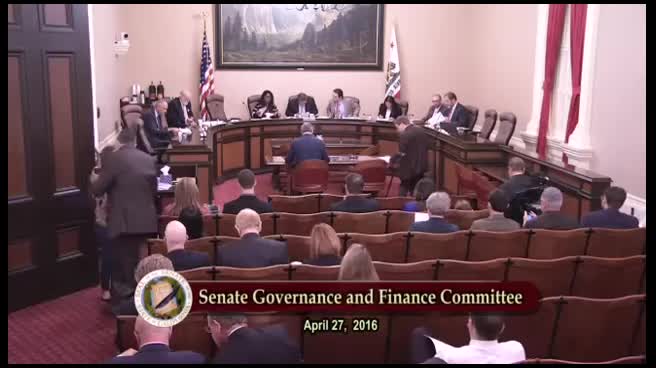 8MIN
Senate Standing Committee on Governance and Finance
Bill Author

Bill Co-Author(s):