SB 1249: School finance: school districts: annual budgets: reserve balance.
- Session Year: 2015-2016
- House: Senate
- Latest Version Date: 2016-02-18
In a fiscal year immediately after a fiscal year in which a transfer is made into the Public School System Stabilization Account, existing law prohibits a school districts adopted or revised budget from containing a combined assigned or unassigned ending fund balance that is in excess of either 2 or 3 times the minimum recommended reserve for economic uncertainties adopted by the State Board of Education, depending on the school districts units of average daily attendance. Existing law authorizes the county superintendent of schools to waive the prohibition, pursuant to specified conditions, for up to 2 consecutive fiscal years within a 3-year period if the school district provides documentation indicating that extraordinary fiscal circumstances substantiate the need for the balance.
This bill would repeal those provisions.
(a)In a fiscal year immediately after a fiscal year in which a transfer is made into the Public School System Stabilization Account, a school district budget that is adopted or revised pursuant to Section 42127 shall not contain a combined assigned or unassigned ending fund balance that is in excess of the following:
(1)For school districts with fewer than 400,000 units of average daily attendance, the sum of the school districts applicable minimum recommended reserve for economic uncertainties adopted by the state board pursuant to subdivision (a) of Section 33128, multiplied by two.
(2)For school districts with more than 400,000 units of average daily attendance, the sum of the school districts applicable minimum recommended reserve for economic uncertainties adopted by the state board pursuant to subdivision (a) of Section 33128, multiplied by three.
(b)A county superintendent of schools may grant a school district under its jurisdiction an exemption from the requirements of subdivision (a) for up to two consecutive fiscal years within a three-year period if the school district provides documentation indicating that extraordinary fiscal circumstances, including, but not limited to, multiyear infrastructure or technology projects, substantiate the need for a combined assigned or unassigned ending fund balance that is in excess of the minimum recommended reserve for economic uncertainties. As a condition of receiving an exception, a school district shall do all of the following:
(1)Provide a statement that substantiates the need for an assigned and unassigned ending fund balance that is in excess of the minimum recommended reserve for economic uncertainties.
(2)Identify the funding amounts in the budget adopted by the school district that are associated with the extraordinary fiscal circumstances.
(3)Provide documentation that no other fiscal resources are available to fund the extraordinary fiscal circumstances.
(c)This section shall become operative on December 15, 2014, only if Assembly Constitutional Amendment No. 1 of the 201314 Second Extraordinary Session is approved by the voters at the November 4, 2014, statewide general election. If Assembly Constitutional Amendment No. 1 of the 201314 Second Extraordinary Session is not approved by the voters at the November 4, 2014, statewide general election, this section shall not become operative and is repealed on January 1, 2015.
|
Date
|
Status
|
|---|---|
| Feb 18, 2016 | Introduced. Read first time. To Com. on RLS. for assignment. To print. |
| Feb 19, 2016 | From printer. May be acted upon on or after March 20. |
| Mar 3, 2016 | Referred to Coms. on ED. and B. & F.R. |
| Apr 8, 2016 | Set for hearing April 20. |
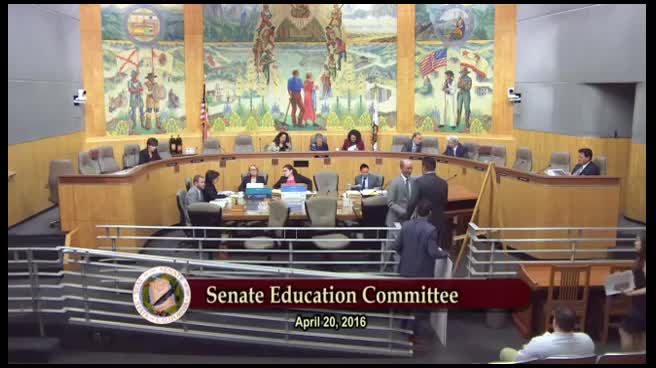
| Apr 20, 2016 | April 20 set for first hearing. Failed passage in committee. (Ayes 2. Noes 4. Page 3607.) Reconsideration granted. |
| Apr 20, 2016 | April 20 set for first hearing. Failed passage in committee. (Ayes 2. Noes 4.) Reconsideration granted. |
|
Date
|
Description
|
Location
|
Votes
|
|
|---|---|---|---|---|
| Apr 20, 2016 | [First] hearing set for [04-20-2016]: Failed passage in Committee. Reconsideration granted | Senate Standing Committee on Education |
Passed |
|
| Apr 20, 2016 | Do pass, but first be re-referred to the Committee on [Budget and Fiscal Review] | Senate Standing Committee on Education |
Failed |
This list shows positions taken on this bill by organizations on the date displayed, which is linked to the original source.
Positions by individuals are not included.
|
Organization
|
Position
|
Date
|
|---|---|---|
| Alvord Unified School District | * Against | Apr 20, 2016 |
| Animal Place Sanctuary, Grass Valley | * Support | Jun 26, 2018 |
| Association Of California School Administrators | * Support | Apr 20, 2016 |
| Biocom | * Against | Jun 26, 2018 |
| Cajon Valley Union School District | * Against | Apr 20, 2016 |
| California Association Of School Business Officials | * Support | Apr 20, 2016 |
| California Chamber Of Commerce | * Against | Jun 26, 2018 |
| California School Board Association | * Support | Apr 20, 2016 |
| California School Boards Association | * Support | Apr 20, 2016 |
| California Taxpayers' Association | ** Support | Apr 20, 2016 |
| California Teachers Association | * Against | Apr 20, 2016 |
| Covington & Burling | * Indeterminate | Jun 26, 2018 |
| Cruelty Free International | * Support | Jun 26, 2018 |
| Dana Hills High School | * Against | Apr 20, 2016 |
| Folsom Cordova Unified School District | * Support | Apr 20, 2016 |
| Hayward Unified School District | * Against | Apr 20, 2016 |
| Humanity Through Education | * Support | Jun 26, 2018 |
| Jane Unchained News Network | * Support | Jun 26, 2018 |
| Lake Tahoe Unified School District | * Against | Apr 20, 2016 |
| Lush Cosmetics | * Support | Jun 26, 2018 |
| North Orange County Community College District | * Against | Apr 20, 2016 |
| Oxnard School District | * Against | Apr 20, 2016 |
| Pet Assistance Foundation | * Support | Jun 26, 2018 |
| Physicians' Committee for Responsible Medicine | * Support | Jun 26, 2018 |
| Place for Animals | * Support | Jun 26, 2018 |
| Riverside County Superintendent of Schools | * Support | Apr 20, 2016 |
| Sacramento Area Vegans | * Support | Jun 26, 2018 |
| Social Compassion In Legislation | * Support | Jun 26, 2018 |
| Spa Organica Day Spa | * Support | Jun 26, 2018 |
| The Humane Society of the United States | * Support | Jun 26, 2018 |
| The Humane Society United States | * Support | Jun 26, 2018 |
| Torrance Unified School District | ** Support | Apr 20, 2016 |
| u California School Employees Association | ** Against | Apr 20, 2016 |
| World Animal News | * Support | Jun 26, 2018 |
SENATE COMMITTEE ON EDUCATION
Senator Carol Liu, Chair
2015 - 2016 Regular
Bill No:
Author: | Bates | ||
Version: | Hearing Date: April 20, 2016 | ||
Urgency: | Fiscal: | ||
Consultant: | |||
Subject:
NOTE: This bill has been referred to the Committees on Education and Budget and Fiscal Review. A "do pass" motion should include referral to the Committee on Budget and Fiscal Review.
SUMMARY
This bill repeals the statutory cap on the amount of fiscal reserves that a school district would be allowed to maintain under specified conditions and also repeals the authority for a county superintendent of schools to grant a school district within its jurisdiction an exemption from this requirement.
BACKGROUND
Existing law requires that in a fiscal year immediately after a fiscal year in which a transfer is made into the Public School System Stabilization Account, a school district budget that is adopted or revised shall not contain a combined assigned or unassigned ending fund balance that is in excess of the following:
- For school districts with fewer than 400,000 units of average daily attendance (ADA), the sum of the school district’s applicable minimum recommended reserve for economic uncertainties adopted by the State Board of Education (SBE), as specified, multiplied by two.
- For school districts with more than 400,000 units of ADA, the sum of the school district’s applicable minimum recommended reserve for economic uncertainties adopted by the SBE, as specified, multiplied by three.
Existing law also authorizes a county superintendent of schools to grant a school district under its jurisdiction an exemption from the cap for up to two consecutive fiscal years within a three-year period if the school district provides documentation indicating that extraordinary fiscal circumstances, including, but not limited to, multi-year infrastructure or technology projects, substantiate the need for a combined assigned or unassigned ending fund balance that is in excess of the minimum recommended reserve for economic uncertainties. As a condition of receiving an exemption, a school district shall do all of the following:
- Provide a statement that substantiates the need for an assigned and unassigned ending fund balance that is in excess of the minimum recommended reserve for economic uncertainties.
- Identify the funding amounts in the budget adopted by the school district that are associated with the extraordinary fiscal circumstances.
- Provide documentation that no other fiscal resources are available to fund the extraordinary fiscal circumstances. (Education Code § 42127.01)
ANALYSIS
This bill repeals the statutory cap on the amount of fiscal reserves that a school district would be allowed to maintain under specified conditions and also repeals the authority for a county superintendent of schools to grant a school district within its jurisdiction an exemption from this requirement.
STAFF COMMENTS
- Need for the bill. According to the author’s office, “the 2014 statutory requirement that sets a maximum amount of fiscal reserves school districts are allowed to maintain is counter-intuitive to sound budget principles. Districts of all sizes, levels of wealth, student and community make up have incredibly different needs that cannot be addressed by an arbitrary one-size-fits-all cap that is tied to a contribution of any size, even $1, to the state’s Proposition 98 rainy day fund. The current cap is fraught with problems for school districts. Those include:
- The reserve cap applies to assigned and unassigned ending balances, which includes funds being saved by school districts for such things as school construction, school repair, self-insurance, post-employment benefits for employees, investments in education programs including textbooks and technology, and larger purchases such as school buses.
- Limiting assigned and unassigned ending balances to two or three times the minimum reserve for economic uncertainty leaves districts exposed to the next recession and eventual downturn in Proposition 98 funding. During the Great Recession, school districts used their reserves to weather mid-year cuts, zero cost of living adjustments, growing deferrals of state payments, and to avert greater employee layoffs than actually occurred.
- Having the cap on the books, whether or not the cap is ever triggered, is having an immediate impact on credit ratings by the nation’s most notable rating agencies. Standard and Poor’s and Fitch and Moody’s have reported the cap as credit negative. It makes no sense for taxpayers to have to pay higher interest on school district debt, which is perhaps one of the most secure debt instruments, because of the presence of the reserve cap.
- Small school districts and those districts that are funded with high percentages of property taxes will be even more exposed to the uncertainties of the day-to-day surprises that they deal with constantly, such as: managing cash flow based on receiving property tax payments only twice a year, adjusting to the ebb and flow of student enrollments, or enrollment of one or more high cost special education students. These are just a few examples of issues that stress district finances and the ability to stay solvent.
- Triggering the reserve cap would leave school districts with only a few days’ worth of cash flow to be able to manage payroll and other ongoing expenses.”
Additionally, the author’s office indicates that reserve levels are determined by governing boards to meet local priorities and allow school districts to save for potential future expected and unexpected expenditures. These include economic downturns. Funds for crucial services such as classroom materials, technology, major textbook/instructional materials, school construction projects, deferred maintenance, etc. require successful and ongoing cash flow management and disciplined planning.
- Proposition 2 Rainy Day Fund. Proposition 2’s Rainy Day Initiative was passed by voters in 2014 and created a state reserve for schools and community colleges when state tax revenues from capital gains are higher than average and certain other conditions are met. The state has the ability to spend money out of this reserve to lessen the impact of difficult budgetary situations on schools and community colleges. Additionally, Proposition 2 created a new maximum amount of reserves that school districts could keep at the local level. For most school districts, the maximum amount of reserves would be between three percent and ten percent of their annual budget, depending on their size.
- 2014-15 Budget Act. As part of the 2014-15 budget, the Legislature passed and the Governor signed a budget trailer bill that included a provision of law that limits school district ending balances to no more than twice the required minimum reserve for school districts in the year a contribution is made to the state reserve for schools and community colleges. This provision was introduced during negotiations with the Administration shortly before the adoption of the 2014-15 budget. That left a relatively short amount of time for the Legislature to review them. Proponents of the bill have expressed concern that the deliberations were insufficient and left many issues that need to be addressed, such as the need for district reserves, how reserves have fluctuated over time, how they vary from district to district, and how the cap will affect district finances. An argument can also be made that imposing a cap would erode the ability of locally elected school district governing boards to make decisions that best serve their local needs, which is contrary to the principles of the Local Control Funding Formula. Notwithstanding concerns over the process and local control, proponents of the bill indicate that healthy school district reserves will protect students and teachers from budget cuts during future economic downturns. On the other hand, proponents of the existing cap argue that the purpose of establishing the state level reserve was to avoid future cuts to local school districts, lessening the need to have larger local district reserves.
- Is the bill necessary? To the extent that school districts are concerned about the potential impact the cap would have on their ability to maintain adequate reserve levels and save for future expenditures as well as unanticipated expenditures, existing law provides a mechanism for school districts to be exempted from this requirement. A county superintendent of schools is authorized to grant a school district under its jurisdiction an exemption if a school district is able to provide documentation that demonstrates extraordinary fiscal circumstances.
- Premature? The state must make deposits into the Rainy Day Fund when certain conditions are met to trigger the cap for districts. Among these conditions, Test 1 must be the applicable Proposition 98 test level and the state must have paid off all maintenance factor created before 2014-15. The Legislative Analyst Office (LAO) indicated in its 2016-17 Proposition 98 Education Analysis in February 2016 that one of these conditions will be satisfied in 2015-16—having paid all maintenance factor that was created prior to 2014-15. However, the LAO does not anticipate the state will meet the other condition within the next few years. Specifically, the LAO notes that, “a deposit requires the minimum guarantee to be growing more quickly than per capita personal income. Under the projections released by our office in November and by the Administration in January, this condition will not be met in 2016-17 or any of the following three years. To meet all of the conditions for a deposit, the state very likely would need to experience a year-to-year revenue surge of at least several billion dollars relative to these projections.”
- LAO’s assessment and recommendations. The LAO released a report, “Analysis of School District Reserves” in January 2015. In the report, the LAO provided its assessment and recommendations on the reserve caps. Specifically, the LAO indicated, “to the extent districts begin shifting monies to avoid the caps; we are concerned that local budgeting practices could become more confusing. To the extent districts begin spending down their reserves, we are concerned that they would incur a number of risks.” The risks include difficulty for school districts to maintain programs in tight fiscal times, difficulty addressing unexpected costs, greater fiscal distress, and higher borrowing costs. The LAO also indicated concern that the caps become operative following any deposit into the state school reserve, even if the size of that deposit is smaller than the triggered reduction in local reserves. To avoid all of these risks, the LAO has recommended the Legislature repeal the reserve caps.
- Related and prior legislation.
SB 799 (Hill, 2015), which was gutted and amended in the Assembly, proposes to modify the statutory cap on the amount of fiscal reserves that a school district would be allowed to maintain under specified conditions. This bill is pending in the Assembly Rules Committee.
AB 1048 (Baker, 2015), similar to this bill, proposes to repeal the statutory cap on the amount of fiscal reserves. This bill failed passage in the Assembly Education Committee.
AB 1318 (Gray, 2015) proposes to modify the calculation of the statutory cap on fiscal reserves. This bill failed passage in the Assembly Education Committee.
AB 531 (O’Donnell) proposes clarifying changes to the statutory cap on fiscal reserves. This bill was heard by and passed this Committee by a vote of 8-0 on June 17, 2015, and is now pending in the Senate Rules Committee.
SUPPORT
Association of California School Administrators
California Association of School Business Officials
California School Boards Association
California Taxpayers Association
Riverside County Superintendent of Schools
Torrance Unified School District
OPPOSITION
California School Employees Association
California Teachers Association
-- END --
Discussed in Hearing
 48MIN
Assembly Standing Committee on Judiciary
 25MIN
Senate Standing Committee on Education
Bill Author

Bill Co-Author(s):