SB 1357: Community colleges: Ortiz-Pacheco-Poochigian-Vasconcellos Cal Grant Act: California Community Colleges Assistance Grant Program.
- Session Year: 2015-2016
- House: Senate
- Latest Version Date: 2016-03-29
Existing law establishes the California Community Colleges, under the administration of the Board of Governors of the California Community Colleges, as one of the segments of public postsecondary education in this state. Existing law requires community college district governing boards to charge students an enrollment fee of $46 per unit per semester. Existing law provides for the waiver of this fee under certain circumstances.
Existing law, the Ortiz-Pacheco-Poochigian-Vasconcellos Cal Grant Program, establishes the Cal Grant A and B Entitlement awards, the California Community College Transfer Cal Grant Entitlement awards, the Competitive Cal Grant A and B awards, the Cal Grant C awards, and the Cal Grant T awards under the administration of the Student Aid Commission, and establishes eligibility requirements for awards under these programs for participating students attending qualifying institutions.
This bill would make a nonsubstantive change in this law by deleting an obsolete provision. establish the California Community Colleges Assistance Grant Program. Commencing with the 201718 award year, the bill would require the Student Aid Commission to annually augment the awards of all recipients of Cal Grant B Entitlement awards and Competitive Cal Grant B awards who are enrolled as students at campuses of the California Community Colleges by $1,500. The bill would specify that the amounts awarded under the bill would supplement, and not supplant, the Cal Grant B awards and other student financial aid received by those community college students. The bill would further specify that these awards would be funded by appropriations from the General Fund in the annual Budget Act.
Existing law establishes the California Community Colleges, under the administration of the Board of Governors of the California Community Colleges, as one of the segments of public postsecondary education in this state. Existing law requires community college district governing boards to charge students an enrollment fee of $46 per unit per semester. Existing law provides for the waiver of this fee under certain circumstances.
This bill would make a nonsubstantive change in this law by deleting an obsolete provision.
Notwithstanding any other law:
(a)The California Community Colleges Assistance Grant Program is hereby established. Commencing with the 201718 award year, the commission shall annually augment the awards of all recipients of Cal Grant B Entitlement awards and Competitive Cal Grant B awards who are enrolled as students at campuses of the California Community Colleges by the amount of one thousand five hundred dollars ($1,500). The amounts awarded under this article shall supplement, and not supplant, the Cal Grant B awards and other student financial aid received by those community college students.
(b)The awards made under this article shall be funded by an appropriation from the General Fund made in the annual Budget Act.
All matter omitted in this version of the bill appears in the bill as introduced in the Senate, February 19, 2016. (JR11)(a)The governing board of each community college district shall charge each student a fee pursuant to this section.
(b)(1)The fee prescribed by this section shall be forty-six dollars ($46) per unit per semester, effective with the summer term of the 2012 calendar year.
(2)The board of governors shall proportionately adjust the amount of the fee for term lengths based upon a quarter system, and also shall proportionately adjust the amount of the fee for summer sessions, intersessions, and other short-term courses. In making these adjustments, the board of governors may round the per unit fee and the per term or per session fee to the nearest dollar.
(c)For the purposes of computing apportionments to community college districts pursuant to Section 84750.5, the board of governors shall subtract, from the total revenue owed to each district, 98 percent of the revenues received by districts from charging a fee pursuant to this section.
(d)The board of governors shall reduce apportionments by up to 10 percent to any district that does not collect the fees prescribed by this section.
(e)The fee requirement does not apply to any of the following:
(1)Students enrolled in the noncredit courses designated by Section 84757.
(2)California State University or University of California students enrolled in remedial classes provided by a community college district on a campus of the University of California or a campus of the California State University, for whom the district claims an attendance apportionment pursuant to an agreement between the district and the California State University or the University of California.
(3)Students enrolled in credit contract education courses pursuant to Section 78021, if the entire cost of the course, including administrative costs, is paid by the public or private agency, corporation, or association with which the district is contracting and if these students are not included in the calculation of the full-time equivalent students (FTES) of that district.
(f)The governing board of a community college district may exempt special part-time students admitted pursuant to Section 76001 from the fee requirement.
(g)(1)The fee requirements of this section shall be waived for any student who meets all of the following requirements:
(A)Meets minimum academic and progress standards adopted by the board of governors, which fulfill the requirements outlined in this paragraph and paragraphs (2) to (5), inclusive. Any minimum academic and progress standards adopted pursuant to this section shall be uniform across all community college districts and campuses. These standards shall not include a maximum unit cap, and community college districts and colleges shall not impose requirements for fee waiver eligibility other than the minimum academic and progress standards adopted by the board of governors and the requirements of subparagraph (B).
(B)Meets one of the following criteria:
(i)At the time of enrollment, is a recipient of benefits under the Temporary Assistance for Needy Families program, the Supplemental Security Income/State Supplementary Payment Program, or a general assistance program.
(ii)Demonstrates eligibility according to income standards established by regulations of the board of governors.
(iii)Demonstrates financial need in accordance with the methodology set forth in federal law or regulation for determining the expected family contribution of students seeking financial aid.
(2)(A)The board of governors, in consultation with students, faculty, and other key stakeholders, shall consider all of the following in the development and adoption of minimum academic and progress standards pursuant to subparagraph (A) of paragraph (1):
(i)Minimum uniform academic and progress standards that do not unfairly disadvantage financially needy students in pursuing their education.
(ii)Criteria for reviewing extenuating circumstances and granting appeals that, at a minimum, take into account and do not penalize a student for circumstances outside his or her control, such as reductions in student support services or changes to the economic situation of the student.
(iii)A process for reestablishing fee waiver eligibility that provides a student with a reasonable opportunity to continue or resume his or her enrollment at a community college.
(B)To ensure that students are not unfairly impacted by the requirements of subparagraph (A) of paragraph (1), the board of governors shall establish a reasonable implementation period that commences no sooner than one year from adoption of the minimum academic and progress standards, or any subsequent changes to these standards, pursuant to subparagraph (A) of paragraph (1) and that is phased in to provide students adequate notification of this requirement and information about available support resources.
(3)It is the intent of the Legislature that minimum academic and progress standards adopted pursuant to subparagraph (A) of paragraph (1) be implemented only as campuses develop and implement the student support services and interventions necessary to ensure no disproportionate impact to students based on ethnicity, gender, disability, or socioeconomic status. The board of governors shall consider the ability of community college districts to meet the requirements of this paragraph before adopting minimum academic and progress standards, or any subsequent changes to these standards, pursuant to subparagraph (A) of paragraph (1).
(4)It is the intent of the Legislature to ensure that a student shall not lose fee waiver eligibility without a community college campus first demonstrating a reasonable effort to provide a student with adequate notification and assistance in maintaining his or her fee waiver eligibility. The board of governors shall adopt regulations to implement this paragraph that ensure all of the following:
(A)Students are provided information about the available student support services to assist them in maintaining fee waiver eligibility.
(B)Community college district policies and course catalogs reflect the minimum academic and progress standards adopted pursuant to subparagraph (A) of paragraph (1) and that appropriate notice is provided to students before the policies are put into effect.
(C)A student does not lose fee waiver eligibility unless he or she has not met minimum academic and progress standards adopted pursuant to subparagraph (A) of paragraph (1) for a period of no less than two consecutive academic terms.
(5)The board of governors shall provide notification of a proposed action to adopt regulations pursuant to this subdivision to the appropriate policy and fiscal committees of the Legislature in accordance with the requirements of paragraph (1) of subdivision (a) of Section 70901.5. This notification shall include, but not be limited to, all of the following:
(A)The proposed minimum academic and progress standards and information detailing how the requirements of paragraphs (1) to (4), inclusive, have been or will be satisfied.
(B)How many students may lose fee waiver eligibility by ethnicity, gender, disability, and, to the extent relevant data is available, by socioeconomic status.
(C)The criteria for reviewing extenuating circumstances, granting appeals, and reestablishing fee waiver eligibility pursuant to paragraph (2).
(h)The fee requirements of this section shall be waived for any student who, at the time of enrollment, is a dependent or surviving spouse who has not remarried, of any member of the California National Guard who, in the line of duty and while in the active service of the state, was killed, died of a disability resulting from an event that occurred while in the active service of the state, or is permanently disabled as a result of an event that occurred while in the active service of the state. Active service of the state, for the purposes of this subdivision, refers to a member of the California National Guard activated pursuant to Section 146 of the Military and Veterans Code.
(i)The fee requirements of this section shall be waived for any student who is the surviving spouse or the child, natural or adopted, of a deceased person who met all of the requirements of Section 68120.
(j)The fee requirements of this section shall be waived for any student in an undergraduate program, including a student who has previously graduated from another undergraduate or graduate program, who is the dependent of any individual killed in the September 11, 2001, terrorist attacks on the World Trade Center and the Pentagon or the crash of United Airlines Flight 93 in southwestern Pennsylvania, if that dependent meets the financial need requirements set forth in Section 69432.7 for the Cal Grant A Program and either of the following applies:
(1)The dependent was a resident of California on September 11, 2001.
(2)The individual killed in the attacks was a resident of California on September 11, 2001.
(k)A determination of whether a person is a resident of California on September 11, 2001, for purposes of subdivision (j) shall be based on the criteria set forth in Chapter 1 (commencing with Section 68000) of Part 41 of Division 5 for determining nonresident and resident tuition.
(l)(1)Dependent, for purposes of subdivision (j), is a person who, because of his or her relationship to an individual killed as a result of injuries sustained during the terrorist attacks of September 11, 2001, qualifies for compensation under the federal September 11th Victim Compensation Fund of 2001 (Title IV (commencing with Section 401) of Public Law 107-42).
(2)A dependent who is the surviving spouse of an individual killed in the terrorist attacks of September 11, 2001, is entitled to the waivers provided in this section until January 1, 2013.
(3)A dependent who is the surviving child, natural or adopted, of an individual killed in the terrorist attacks of September 11, 2001, is entitled to the waivers under subdivision (j) until that person attains 30 years of age.
(4)A dependent of an individual killed in the terrorist attacks of September 11, 2001, who is determined to be eligible by the California Victim Compensation and Government Claims Board, is also entitled to the waivers provided in this section until January 1, 2013.
(m)(1)It is the intent of the Legislature that sufficient funds be provided to support the provision of a fee waiver for every student who demonstrates eligibility pursuant to subdivisions (g) to (j), inclusive.
(2)From funds provided in the annual Budget Act, the board of governors shall allocate to community college districts, pursuant to this subdivision, an amount equal to 2 percent of the fees waived pursuant to subdivisions (g) to (j), inclusive. From funds provided in the annual Budget Act, the board of governors shall allocate to community college districts, pursuant to this subdivision, an amount equal to ninety-one cents ($0.91) per credit unit waived pursuant to subdivisions (g) to (j), inclusive. It is the intent of the Legislature that funds provided pursuant to this subdivision be used to support the determination of financial need and delivery of student financial aid services, on the basis of the number of students for whom fees are waived. It also is the intent of the Legislature that the funds provided pursuant to this subdivision directly offset mandated costs claimed by community college districts pursuant to Commission on State Mandates consolidated Test Claims 99-TC-13 (Enrollment Fee Collection) and 00-TC-15 (Enrollment Fee Waivers). Funds allocated to a community college district for determination of financial need and delivery of student financial aid services shall supplement, and shall not supplant, the level of funds allocated for the administration of student financial aid programs during the 199293 fiscal year.
(n)The board of governors shall adopt regulations implementing this section.
(o)This section shall become operative on May 1, 2012, only if subdivision (b) of Section 3.94 of the Budget Act of 2011 is operative.
|
Date
|
Status
|
|---|---|
| Feb 19, 2016 | Introduced. To Com. on RLS. for assignment. To print. |
| Feb 22, 2016 | From printer. May be acted upon on or after March 23. |
| Feb 22, 2016 | Read first time. |
| Mar 3, 2016 | Referred to Com. on RLS. |
| Mar 29, 2016 | From committee with author's amendments. Read second time and amended. Re-referred to Com. on RLS. |
| Apr 4, 2016 | Re-referred to Com. on ED. |
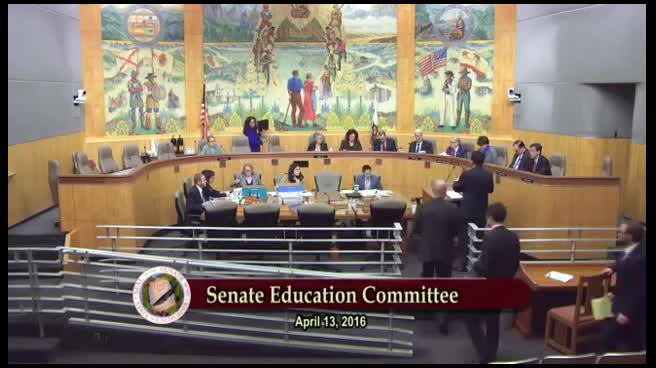
| Apr 6, 2016 | Set for hearing April 13. |
| Apr 13, 2016 | From committee: Do pass and re-refer to Com. on APPR. (Ayes 8. Noes 1. Page 3517.) (April 13). Re-referred to Com. on APPR. |
| Apr 13, 2016 | From committee: Do pass and re-refer to Com. on APPR. (Ayes 8. Noes 1.) (April 13). Re-referred to Com. on APPR. |
| Apr 15, 2016 | Set for hearing April 25. |
| Apr 25, 2016 | April 25 hearing: Placed on APPR. suspense file. |
| May 20, 2016 | Set for hearing May 27. |
| May 27, 2016 | May 27 hearing: Held in committee and under submission. |
|
Date
|
Description
|
Location
|
Votes
|
|
|---|---|---|---|---|
| Apr 25, 2016 | Placed on suspense file | Senate Standing Committee on Appropriations |
Passed |
|
| Apr 13, 2016 | Do pass, but first be re-referred to the Committee on [Appropriations] | Senate Standing Committee on Education |
Passed |
This list shows positions taken on this bill by organizations on the date displayed, which is linked to the original source.
Positions by individuals are not included.
|
Organization
|
Position
|
Date
|
|---|---|---|
| California Student Aid Comission | * Indeterminate | Apr 13, 2016 |
| Community College League of California | * Indeterminate | Apr 13, 2016 |
| Institute for College Access and Success | ** Support | Apr 13, 2016 |
| Mccallum Group, Inc. | * Indeterminate | Apr 13, 2016 |
| TICAS | * Support | Apr 13, 2016 |
SENATE COMMITTEE ON APPROPRIATIONS
Senator Ricardo Lara, Chair
2015 - 2016 Regular Session
SB 1357 (Block) - Community colleges: Ortiz-Pacheco-Poochigian-Vasconcellos Cal Grant Act: California Community Colleges Assistance Grant Program
Version: March 29, 2016 | Policy Vote: ED. 8 - 1 |
Urgency: No | Mandate: No |
Hearing Date: April 25, 2016 | Consultant: Jillian Kissee |
This bill meets the criteria for referral to the Suspense File.
Bill Summary:
This bill requires, contingent upon funding provided in the annual budget act that the California Student Aid Commission (Commission) annually augment the award amount of Cal Grant B recipients enrolled at the California Community Colleges (CCC) beginning in the 2017-18 award year.
Fiscal Impact:
- New CCC Assistance Grant Program: Additional costs of up to about $162 million annually, assuming a total of 108,104 recipients. (General Fund)
- Administrative costs: The Commission indicates that this bill will result in additional contract costs of about $58,000 to make appropriate changes to the grant delivery system. (General Fund)
- The CCC Chancellor’s Office indicates minor and absorbable costs to implement this bill since systems are already in place that pays out awards to Cal Grant B recipients.
Background:
Current law authorizes the Cal Grant program, administered by the CSAC, to provide grants to financially needy students to attend college. The program consists of the Cal Grant A, Cal Grant B, and Cal Grant C programs, and eligibility is based upon financial need, grade point average, California residency, and other eligibility criteria, as specified in Education Code § 69433.9. (Education Code § 69430 – § 69439)
The Cal Grant B High School Entitlement Program provides funds to eligible low-income high school graduates who have at least a 2.0 GPA on a four-point scale and apply within one year of graduation. The award provides up to $1,656 for the 2015-16 fiscal year for books and living expenses for the first year and each year following for up to four years. After the first year, the award also provides tuition fee funding at qualifying postsecondary institutions. As of the Budget Act of 2015, full systemwide tuition and fees at the University of California are $12,240 and at the California State University are $5,472. A fixed amount of $9,084 is provided for students at nonprofit or Western Association of Schools and Colleges -accredited for-profit colleges and $4,000 at other for-profit colleges.
The Cal Grant Competitive Award Program provides 22,500 Cal Grant A and B awards available to applicants who meet financial, academic, and general program eligibility requirements. Half of these awards are reserved for students enrolled at a community college and who met the September 2 application deadline.
The Budget Act of 2015 included funding for a new grant program for California Community College Cal Grant B recipient. AB 93 (Weber, Budget Act of 2015) provided $39 million in ongoing Proposition 98 funds for purposes of the Full-Time Student Success Grant Program, to be distributed to students who are receiving the Cal Grant B Access Award and are taking 12 units or more. This funding provides a supplemental grant for these particular award recipients, in which allocations are determined by the CCC Chancellor’s Office. The Chancellor’s Office has determined that this award shall not exceed $600 per student annually in 2015-16.
Proposed Law:
This bill establishes the California Community Colleges Assistance Grant Program. Beginning in the 2017-18 award year, contingent upon funding provided in the annual budget act, the Commission is required to annually augment the awards of all recipients of Cal Grant B Entitlement awards and Competitive Cal Grant B awards who are enrolled as at the CCC by $1,500. This amount is required to supplement, and not supplant, the Cal Grant B awards and other student financial aid received by community college students.
Staff Comments:
Increasing a Cal Grant B recipient’s award by $1,500 would result in additional costs of up to about $162 million annually, with ongoing costs depending upon the number of award recipients. This increase appears to be in addition to the funding being provided by the Full-Time Student Success Grant Program.
-- END --
SENATE COMMITTEE ON EDUCATION
Senator Carol Liu, Chair
2015 - 2016 Regular
Bill No: SB 1357
Author: | |||
Version: | March 29, 2016 Hearing Date: April 13, 2016 | ||
Urgency: | No | Fiscal: | Yes |
Consultant: | Kathleen Chavira | ||
Subject: Community colleges: Ortiz-Pacheco-Poochigian-Vasconcellos Cal Grant
Act: California Community Colleges Assistance Grant Program
SUMMARY
This bill requires that the California Student Aid Commission (CSAC) annually augment the award amount of Cal Grant B recipients enrolled at the California Community Colleges by $1,500, as specified, beginning with the 2017-18 award year and requires a General Fund appropriation for this purpose in the annual Budget Act.
BACKGROUND
Current law authorizes the Cal Grant program, administered by the CSAC, to provide grants to financially needy students to attend college. The program consists of the Cal Grant A, Cal Grant B, and Cal Grant C programs, and eligibility is based upon financial need, grade point average, California residency, and other eligibility criteria, as specified in Education Code § 69433.9. (Education Code § 69430 – § 69439)
These programs currently operate as follows:
- Cal Grant A* High School Entitlement Program provides tuition fee funding for the equivalent of four full-time years at qualifying postsecondary institutions to eligible lower and middle income high school graduates who have at least a 3.0 grade point average (GPA) on a four-point scale and apply within one year of graduation.
- Cal Grant B* High School Entitlement Program provides funds to eligible low-income high school graduates who have at least a 2.0 GPA on a four-point scale and apply within one year of graduation. The award provides up to $1,551 (and provides for adjustment of this amount in the Annual Budget Act) for books and living expenses for the first year and each year following for up to four years (or equivalent of four full-time years). After the first year, the award also provides tuition fee funding at qualifying postsecondary institutions.
- Community College Transfer Program provides a Cal Grant A or B to eligible high school graduates who have a community college GPA of at least 2.4 on a four point scale and transfer to a qualifying baccalaureate degree granting college or university.
- Cal Grant Competitive Award Program provides 22,500 Cal Grant A and B awards available to applicants who meet financial, academic, and general program eligibility requirements. Half of these awards are reserved for students enrolled at a community college and who met the September 2 application deadline.
- Cal Grant C Program provides funding for financially eligible lower-income students preparing for occupational or technical training. The authorized number of new awards is 7,761. For new and renewal recipients, the current tuition and fee award is up to $2,592 and the allowance for training-related costs is $576. (Education Code § 69430 - § 69450)
ANALYSIS
This bill:
- Establishes the California Community Colleges Assistance Grant Program. It:
- Requires the California Student Aid Commission (CSAC) to annually augment, by $1500, the award for a Cal Grant B Entitlement or Competitive grant recipient enrolled in a California community college.
- Requires that these awards supplement and not supplant Cal Grant B awards and other student financial aid received by these students.
- Requires that the awards under the California Community Colleges Assistance Grant Program be funded by a General Fund appropriation in the annual Budget Act.
STAFF COMMENTS
- Need for the bill. According to the author, the community college student demographic is much broader than the traditional first-time student, and often includes older, lower-income, first-generation students with families of their own. Although these students have access to Cal Grant B entitlement and competitive awards, the current annual access award of $1,551 is insufficient to cover expenses outside of school fees. According to the Legislative Analyst’s Office (LAO) 2016-17 Budget Report on Higher Education, the cost of attendance at a community college for a student living off campus with a family is $5,400-$12,300, with textbook costs alone ranging from $1249-$1364. This bill would provide an additional source of funding to community college Cal Grant B recipients to ensure they can cover the basic costs of attendance.
- Why only community colleges? According to information provided by the Institute for College Access & Success (TICAS), in Financial Aid Facts at California Community Colleges(March 2010), while CCC fees are much lower than tuition in other state or other colleges in California, the total cost of attending is much higher than most people realize. Despite high levels of need these students receive much smaller state and institutional grants than students at four year colleges, and full-time community college students are the most likely to have “unmet need” even after receiving all available aid. According to TICAS, 90 percent of CCC students still have need after all aid is awarded compared to 64 percent and 56 percent at public four-year and private four-year schools in the state, respectively. Students at the CCC have an average gap of $5,892 after all aid is received.
- Similar supplemental grant in 2015-16 Budget Act. The 2015-16 Budget Act included funding for a new grant program for California Community College Cal Grant B recipient students. AB 93 (Weber, Budget Act of 2015) provided $39 million in ongoing Proposition 98 funds for purposes of the Full-Time Student Success Grant Program, and SB 97 (Committee on Budget and Fiscal Review, Budget Act of 2015) made $3 million of the appropriation available on a one-time basis to support the implementation of the program by local campuses. The Full- Time Student Success Grant (FTSSG) provides a supplemental grant for the 2015-16 school year to community college Cal Grant B recipients who are receiving a Cal Grant B award payment.
The 2015-16 Budget Act also provided that:
- Eligible students must take 12 units or more.
- The Chancellor’s Office must determine the number of students eligible for this funding and distribute an equal amount to each student.
- Each California Community College campus must receive a minimum allocation of $50,000.
- The remainder of the funding is to be allocated to campuses based upon a formula reflecting full-time equivalent students weighted by a measure of low-income populations demonstrated by Board of Governors fee waiver program participation within a district.
The Chancellor’s Office has determined that this award shall not exceed $600 per student annually in 2015-16. The Chancellor’s Office also indicates that the intent of this funding was a desire to support student persistence, retention and success by providing additional assistance so that students could attend full-time and complete their programs. In addition, there was a desire to strengthen the value of the access award aid for the most disadvantaged students.
As currently drafted, this bill appears to create a program similar to that created by the budget, but administered through the California Student Aid Commission. It also appears that the $1500 award is to be granted in addition to the award to be provided at the campus level under the Full-Time Student Success Grant Program.
It is unclear why two distinct supplemental programs to the Cal Grant B are necessary.
- CSAC administration? Unlike the Full-Time Student Success Grant Program,
the program established by this bill would be administered by the California Student Aid Commission (CSAC). Particularly for new applicants, this administrative structure could delay receipt of supplemental awards, particularly as the CSAC awaits confirmation from students and campuses of the actual enrollment of the student, a process which can take some time to reconcile.
This supplement to the Cal Grant B program would be exclusively available to community college students. Is there a need for administration of a single system award program to be centralized at a state agency? Would distribution of supplemental awards by the Chancellor’s Office and local campuses allow for a more streamlined implementation and speedier access to funds by students?
- Consolidation/codification? This bill creates a program to provide a supplemental Cal Grant B award of $1500 to a community college student. The only criteria for the award is that the student receives a Cal Grant B. Staff notes that the existing Full-Time Student Success Grant Program only exists in Budget Act language. Rather than create yet another supplemental award program, could this program and the program created by the 2015 Budget be consolidated? Could/should this bill be amended to codify the program established via budget bill language?
- Community colleges and the Cal Grant B. A little over half of the total Cal Grant B awardees in the state (276,000 in 2013-14) are enrolled at the California Community Colleges. According to information from the California Student Aid Commission, in 2013-14, the total number of community college Cal Grant B awardees was 139,769 with 47,376 and 92,393 awarded the Competitive award and Entitlement awards, respectively.
SUPPORT
The Institute for College Access and Success
OPPOSITION
None received.
-- END --
Bill Author

Bill Co-Author(s):