SB 1405: Zero-emission vehicles: transportation systems.
- Session Year: 2015-2016
- House: Senate
- Latest Version Date: 2016-04-13
(1)Existing law describes the powers and duties of the State Air Resources Board relating to reducing emissions of air pollutants. Existing law requires the state board to adopt and implement emission standards for new motor vehicles. Existing law authorizes the state board to adopt regulations in furtherance of its powers and duties.
This bill would require the state board, by March 1, 2017, to revise its zero-emission vehicle standard regulation to expand the definition of transportation systems eligible for zero-emission vehicle credits under that regulation to include additional entities utilizing fleets of zero-emission vehicles, including rental car companies, transportation network companies, taxicab companies, and car-sharing companies, to the extent that the operations of those entities involve ridesharing features offered by those entities that reduce per-passenger emissions.
(2)The Charge Ahead California Initiative, administered by the state board, includes goals of, among other things, placing in service at least 1,000,000 zero-emission and near-zero-emission vehicles by January 1, 2023, and increasing access for disadvantaged, low-income, and moderate-income communities and consumers to zero-emission and near-zero-emission vehicles.
This bill would require the state board, as part of the initiative, to develop and implement a pilot program to provide conduct a study to determine the feasibility and efficacy of providing grants to transit operators to subsidize cost-effective rides serving disadvantaged communities through the use of zero-emission vehicles that are utilized by transportation systems that are eligible for zero-emission vehicle credits, in a manner that complements the transit service offered by the transit operator.
(1)Existing law describes the powers and duties of the State Air Resources Board relating to reducing emissions of air pollutants. Existing law requires the state board to adopt and implement emission standards for new motor vehicles. Existing law authorizes the state board to adopt regulations in furtherance of its powers and duties.
This bill would require the state board, by March 1, 2017, to revise its zero-emission vehicle standard regulation to expand the definition of transportation systems eligible for zero-emission vehicle credits under that regulation to include additional entities utilizing fleets of zero-emission vehicles, including rental car companies, transportation network companies, taxicab companies, and car-sharing companies, to the extent that the operations of those entities involve ridesharing features offered by those entities that reduce per-passenger emissions.
(2)The Charge Ahead California Initiative, administered by the state board, includes goals of, among other things, placing in service at least 1,000,000 zero-emission and near-zero-emission vehicles by January 1, 2023, and increasing access for disadvantaged, low-income, and moderate-income communities and consumers to zero-emission and near-zero-emission vehicles.
This bill would require the state board, as part of the initiative, to develop and implement a pilot program to provide grants to transit operators to subsidize cost-effective rides serving disadvantaged communities through the use of zero-emission vehicles that are utilized by transportation systems that are eligible for zero-emission vehicle credits, in a manner that complements the transit service offered by the transit operator.
Existing law requires, no later than June 30, 2007, the State Energy Resources Conservation and Development Commission, in partnership with the State Air Resources Board, and in consultation with specified state agencies, to develop and adopt a state plan to increase the use of alternative fuels, as defined.
This bill would make technical, nonsubstantive changes to those provisions.
On or before March 1, 2017, the state board, shall revise the regulations adopted by the state board relative to zero-emission vehicle standards to expand the definition of transportation systems eligible for zero-emission vehicle credits under that regulation to include additional entities utilizing fleets of zero-emission vehicles, including rental car companies, transportation network companies, taxicab companies, and car-sharing companies, to the extent that the operations of those entities involve ridesharing features offered by those entities that reduce per-passenger emissions.
SEC. 2.Section 44258.6 is added to the Health and Safety Code, to read:44258.6.In addition to its other activities authorized by this chapter, the state board shall develop and implement a pilot program to provide conduct a study to determine the feasibility and efficacy of providing grants to transit operators to subsidize cost-effective rides serving disadvantaged communities through the use of zero-emission vehicles that are utilized by transportation systems that are eligible for zero-emission vehicle credits pursuant to Section 39206.6, in a manner that complements the transit service offered by the transit operator.
On or before March 1, 2017, the state board, shall revise the regulations adopted by the state board relative to zero-emission vehicle standards to expand the definition of transportation systems eligible for zero-emission vehicle credits under that regulation to include additional entities utilizing fleets of zero-emission vehicles, including rental car companies, transportation network companies, taxicab companies, and car-sharing companies, to the extent that the operations of those entities involve ridesharing features offered by those entities that reduce per-passenger emissions.
SEC. 2.Section 44258.6 is added to the Health and Safety Code, to read:44258.6.In addition to its other activities authorized by this chapter, the state board shall develop and implement a pilot program to provide grants to transit operators to subsidize cost-effective rides serving disadvantaged communities through the use of zero-emission vehicles that are utilized by transportation systems that are eligible for zero-emission vehicle credits pursuant to Section 39206.6, in a manner that complements the transit service offered by the transit operator.
SECTION 1.Section 43866 of the Health and Safety Code is amended to read:43866.Not later than June 30, 2007, the State Energy Resources Conservation and Development Commission, in partnership with the state board, and in consultation with the State Water Resources Control Board, the Department of Food and Agriculture, and other relevant state agencies, shall develop and adopt a state plan to increase the use of alternative transportation fuels.
(a)The plan shall include an evaluation of alternative fuels on a full fuel-cycle assessment of emissions of criteria air pollutants, air toxics, greenhouse gases, water pollutants, and other substances that are known to damage human health; impacts on petroleum consumption; and other matters the state board deems necessary.
(b)The plan shall set goals for the years 2012, 2017, and 2022 for increased alternative fuel use in the state that accomplishes all of the following:
(1)Optimizes the environmental and public health benefits of alternative fuels, including, but not limited to, reductions in criteria air pollutants, greenhouse gases, and water pollutants consistent with existing or future state board regulations in the most cost-effective manner possible.
(2)Ensures that there is no net material increase in air pollution, water pollution, or any other substances that are known to damage human health.
(3)Minimizes the economic costs to the state, if any.
(4)Maximizes the economic benefits of producing alternative fuels in the state.
(5)Considers issues related to consumer acceptance and costs and identifies methods to overcome any barriers to alternative fuel use.
(c)The plan shall recommend policies to ensure alternative fuel goals are attained, including, but not limited to, all of the following:
(1)Standards on transportation fuels and vehicles.
(2)Requirements, financial incentives, and other policy mechanisms to ensure that vehicles capable of operating on alternative fuels use those fuels to the maximum extent feasible.
(3)Requirements, financial incentives, and other policy mechanisms to ensure that alternative fuel fueling stations are available to drivers of alternative fuel vehicles.
(4)Incentives, requirements, programs, or other mechanisms to encourage the research, development, demonstration, commercialization, manufacturing, or production of vehicles that use alternative fuels.
Not later than June 30, 2007, the State Energy Resources Conservation and Development Commission, in partnership with the state board, and in consultation with the State Water Resources Control Board, the Department of Food and Agriculture, and other relevant state agencies, shall develop and adopt a state plan to increase the use of alternative transportation fuels.
(a)The plan shall include an evaluation of alternative fuels on a full fuel-cycle assessment of emissions of criteria air pollutants, air toxics, greenhouse gases, water pollutants, and other substances that are known to damage human health, health; impacts on petroleum consumption, consumption; and other matters the state board deems necessary.
(b)The plan shall set goals for the years 2012, 2017, and 2022 for increased alternative fuel use in the state that accomplishes all of the following:
(1)Optimizes the environmental and public health benefits of alternative fuels, including, but not limited to, reductions in criteria air pollutants, greenhouse gases, and water pollutants consistent with existing or future state board regulations in the most cost-effective manner possible.
(2)Ensures that there is no net material increase in air pollution, water pollution, or any other substances that are known to damage human health.
(3)Minimizes the economic costs to the state, if any.
(4)Maximizes the economic benefits of producing alternative fuels in the state.
(5)Considers issues related to consumer acceptance and costs and identifies methods to overcome any barriers to alternative fuel use.
(c)The plan shall recommend policies to ensure alternative fuel goals are attained, including, but not limited to: to, all of the following:
(1)Standards on transportation fuels and vehicles.
(2)Requirements, financial incentives, and other policy mechanisms to ensure that vehicles capable of operating on alternative fuels use those fuels to the maximum extent feasible.
(3)Requirements, financial incentives, and other policy mechanisms to ensure that alternative fuel fueling stations are available to drivers of alternative fuel vehicles.
(4)Incentives, requirements, programs, or other mechanisms to encourage the research, development, demonstration, commercialization, manufacturing, or production of vehicles that use alternative fuels.
|
Date
|
Status
|
|---|---|
| Apr 13, 2016 | From committee with author's amendments. Read second time and amended. Re-referred to Com. on T. & H. |
| May 27, 2016 | May 27 hearing: Held in committee and under submission. |
| May 20, 2016 | Set for hearing May 27. |
| May 16, 2016 | May 16 hearing: Placed on APPR. suspense file. (Ayes 7. Noes 0.) |
| May 6, 2016 | Set for hearing May 16. |
| Apr 21, 2016 | From committee: Do pass and re-refer to Com. on APPR. (Ayes 7. Noes 0.) (April 20). Re-referred to Com. on APPR. |
| Apr 21, 2016 | From committee: Do pass and re-refer to Com. on APPR. (Ayes 7. Noes 0. Page 3644.) (April 20). Re-referred to Com. on APPR. |
| Apr 20, 2016 | From committee: Do pass and re-refer to Com. on E.Q. (Ayes 11. Noes 0.) (April 19). Re-referred to Com. on E.Q. |
| Apr 20, 2016 | From committee: Do pass and re-refer to Com. on E.Q. (Ayes 11. Noes 0. Page 3617.) (April 19). Re-referred to Com. on E.Q. |
| Apr 14, 2016 | Set for hearing April 20 in E.Q. pending receipt. |
| Feb 19, 2016 | Introduced. To Com. on RLS. for assignment. To print. |
| Apr 12, 2016 | Set for hearing April 19. |
| Apr 5, 2016 | Withdrawn from committee. |
| Apr 5, 2016 | Re-referred to Coms. on T. & H. and E.Q. |
| Mar 31, 2016 | Re-referred to Coms. on E.Q. and T. & H. |
| Mar 28, 2016 | From committee with author's amendments. Read second time and amended. Re-referred to Com. on RLS. |
| Mar 10, 2016 | Referred to Com. on RLS. |
| Feb 22, 2016 | Read first time. |
| Feb 22, 2016 | From printer. May be acted upon on or after March 23. |
|
Date
|
Description
|
Location
|
Votes
|
|
|---|---|---|---|---|
| May 16, 2016 | Placed on suspense file | Senate Standing Committee on Appropriations |
Passed |
|
| Apr 20, 2016 | Do pass, but first be re-referred to the Committee on [Appropriations] | Senate Standing Committee on Environmental Quality |
Passed |
|
| Apr 19, 2016 | Do pass, but first be re-referred to the Committee on [Environmental Quality] | Senate Standing Committee on Transportation and Housing |
Passed |
This list shows positions taken on this bill by organizations on the date displayed, which is linked to the original source.
Positions by individuals are not included.
|
Organization
|
Position
|
Date
|
|---|---|---|
| Alliance Of Automobile Manufacturers Inc. | * Support | Apr 19, 2016 |
| Lyft, Inc. | * Indeterminate | Apr 19, 2016 |
| Technet | ** Support | Apr 19, 2016 |
| UC Berkeley | * Support | Apr 19, 2016 |
SENATE COMMITTEE ON
Senator Ricardo Lara, Chair
2015 - 2016 Regular Session
SB 1405 (Pavley) - Zero-emission vehicles: transportation systems
Version: | Policy Vote: |
Urgency: | Mandate: |
Hearing Date: | Consultant: |
This bill meets the criteria for referral to the Suspense File.
Bill Summary:
SB 1405 would require the California Air Resources Board (ARB) to revise its zero-emission vehicle (ZEV) standards regulation to expand the definition of transportation systems eligible for ZEV credits, as specified. The bill would also require ARB to conduct a study on the feasibility and efficacy of providing grants to transit operators for subsidized services for disadvantaged communities using ZEVs.
Fiscal Impact:
- ARB costs of up to $244,000 in 2016-17 and up to $166,000 in 2017-18 to amend ZEV standards regulations to expand the definition of eligible transportation systems. (Motor Vehicle Account)
- ARB contracting costs of approximately $500,000 to conduct the feasibility study. (Motor Vehicle Account)
- Unknown significant cost pressures to implement the recommendations from the feasibility study. (Greenhouse Gas Reduction Fund or other special funds)
Background:
Existing law provides ARB with primary responsibility for control of mobile source air pollution, including adoption of rules for reducing vehicle emissions and the specification of vehicular fuel composition. Existing law requires ARB to implement motor vehicle emission standards, in-use performance standards, and motor vehicle fuel specifications for the control of air contaminants and sources of air pollution that ARB finds to be necessary, cost effective, and technologically feasible, unless preempted by federal law.
In March 2012, Governor Brown issued an Executive Order setting a goal of 1.5 million ZEVs on California roads by 2025. The order also set a greenhouse gas emissions reduction target of 80% below 1990 levels by 2050. SB 1275 (De León), Chapter 530/2014, builds on this goal by establishing the Charge Ahead California Initiative at ARB, which outlines a vision of placing 1 million electric cars, trucks, and buses on California’s roads by 2023. SB 1275 directs ARB to provide incentives to increase the availability of ZEVs and near-ZEVs, particularly in DACs. ARB’s FY 2015-16 Funding Plan includes, among other provisions, a new pilot project to create vanpooling for Central Valley agricultural workers, and the expansion of four existing pilot projects: (1) increased incentives for public fleets to purchase vehicles eligible for Clean Vehicle Rebate Program rebates; (2) advanced technology car-sharing and mobility options; (3) increased incentives for vehicle replacement under the Enhanced Fleet Modernization Program; and (4) financing assistance. These pilot projects are currently being implemented.
ARB’s zero-emission vehicle standards regulation requires large volume and intermediate volume vehicle manufacturers that sell cars in California to produce ZEVs (such as battery electric and fuel cell vehicles), clean plug-in hybrids, clean hybrids and clean gasoline vehicles with near-zero tail pipe emissions. In general, the ZEV regulation requires that 15% of new car sales be ZEVs by 2025. This target is intended to achieve 1.5 million ZEVs on the road by 2025 as directed under Governor Brown’s Executive Order B-16-2012.
To meet the ZEV requirement under the regulation, manufacturers selling vehicles in California must offer for sale a certain percentage of ZEVs each year, or must purchase credits from other manufacturers. These credits are generated by manufacturers that supply more ZEVs than the required amount.
The ZEV regulation was first adopted in 1990 as part of the Low Emission Vehicle Program. In 2001, the regulation was amended to allow auto manufacturers to receive additional ZEV credits for “transportation systems,” which the regulation specifies as projects that demonstrate shared use of ZEVs, and technologies such as reservation management, card systems, location management, charge billing and real-time wireless information systems. Additional ZEV credits are available if the project also includes linkage to transit. In general, ZEV credits go to vehicle manufacturers, but the “transportation systems” credits can be granted to varying entities. For example, a third-party such as ZipCar can apply for transportation system ZEV credits and then sell the ZEV credits in the credit market to any auto manufacturer for their regulation compliance.
The ability to receive ZEV credits from transportation systems expires in 2018.
Proposed Law:
SB 1405 would require ARB to revise the ZEV regulation by March 1, 2017 to expand the definition of “transportation systems eligible for zero-emission vehicle credits” to include additional entities utilizing fleets of ZEVs, including rental car companies, transportation network companies, taxicab companies, and car-sharing companies, to the extent that operations involve ridesharing features that reduce per-passenger emissions.
The bill would also require ARB to conduct a study to determine the feasibility and efficacy of providing grants to transit operators to subsidize cost-effective rides serving disadvantaged communities through the use of ZEVs utilized by ZEV-credit-eligible transportation systems in a manner that complements the transit service.
Staff Comments:
ARB indicates that updating the ZEV regulation to revise the definition of transit systems eligible for ZEV credits would require the use of one limited-term PY of staff time at a cost of $154,000 in 2016-17, and up to $77,000 in 2017-18, in addition to legal staff time of up to ½ PY at a cost of up to $90,000 in each of the two fiscal years. Staff notes that the ARB is currently involved in a collaborative effort with other state, national, and international partners to review the status of ZEV technologies, which may inform future updates to the ZEV regulation. In addition, the ability to get ZEV credits for transportation systems expires in 2018. It is unlikely that the ZEV regulations could be updated quickly enough to provide additional ZEV credits for transportation systems under the bill’s expanded definition prior to that expiration date.
ARB estimates that it would incur approximately $500,000 in contract costs to conduct the study specified in the bill. To the extent the study determines that providing grants to transit operators who use ZEV credit-eligible vehicles to subsidize transit service to disadvantaged communities is feasible and efficacious, the bill could drive additional significant cost pressures to establish a grant program for those purposes.
-- END --
SENATE COMMITTEE ON ENVIRONMENTAL QUALITY
Senator Wieckowski, Chair
2015 - 2016 Regular
Bill No: SB 1405
Author: | Pavley | ||
Version: | 4/13/2016 | Hearing Date: | 4/20/2016 |
Urgency: | No | Fiscal: | Yes |
Consultant: | Rebecca Newhouse | ||
SUBJECT: Zero-emission vehicles: transportation systems
ANALYSIS:
Existing law:
- Provides the California Air Resources Board (ARB) with primary responsibility for control of mobile source air pollution, including adoption of rules for reducing vehicle emissions and the specification of vehicular fuel composition. (Health and Safety Code §39000 et seq. and §39500 et seq.)
- Directs ARB to implement motor vehicle emission standards, in-use performance standards, and motor vehicle fuel specifications for the control of air contaminants and sources of air pollution that ARB finds to be necessary, cost effective, and technologically feasible, unless preempted by federal law. (HSC §43013 et seq.)
- Establishes the Charge Ahead Initiative administered by ARB with the goals of reaching at least one million zero-emission and near-zero-emission vehicles by January 1, and increasing accessibility for disadvantaged, low-income, and moderate-income communities. ARB is required to establish programs that further increase access to and direct benefits for disadvantaged, low-income, and moderate-income communities and consumers from electric transportation. (HSC §44258 et seq.)
- Under the California Global Warming Solutions Act of 2006, requires ARB to determine the 1990 statewide greenhouse gas (GHG) emissions level and approve a statewide GHG emissions limit that is equivalent to that level, to be achieved by 2020, and to adopt GHG emissions reductions measures by regulation. ARB is authorized to include the use of market-based mechanisms to comply with these regulations. (HSC §38500 et seq.)
This bill:
- Requires ARB to revise regulations relating to zero-emission vehicle standards to expand the definition of “transportation systems eligible for zero-emission vehicle credits” to include entities utilizing fleets of zero-emission vehicles, including rental car companies, transportation network companies, taxicab companies, and car-sharing companies, to the extent their operations involve ridesharing features that reduce per-passenger emissions.
- Requires ARB to conduct a study to determine the feasibility and efficacy of providing grants to transit operators to subsidize rides for disadvantaged communities through zero-emission vehicles used by transportation systems eligible for zero-emission vehicle credits, in a manner that complements the transit operator’s service.
Background
- Zero Emission Vehicle regulation. The Zero Emission Vehicle (ZEV) Regulation requires large volume and intermediate volume vehicle manufacturers that sell cars in California to produce ZEVs (such as battery electric and fuel cell vehicles), clean plug-in hybrids, clean hybrids and clean gasoline vehicles with near-zero tail pipe emissions. In general, the ZEV regulation requires that 15% of new car sales be ZEVs by 2025. This target is intended to achieve 1.5 million ZEVs on the road by 2025 as directed under Governor Brown’s Executive Order B-16-2012.
To meet the ZEV requirement under the regulation, manufacturers selling vehicles in California must offer for sale a certain percentage of ZEVs each year, or must purchase credits from other manufacturers. These credits are generated by manufacturers that supply more ZEVs than the required amount.
In 2001, the regulation was amended to allow auto manufacturers to receive additional ZEV credits for “transportation systems,” which the regulation specifies as projects that demonstrate shared use of ZEVs, and technologies such as reservation management, card systems, location management, charge billing and real-time wireless information systems. Additional ZEV credits are available if the project also includes linkage to transit.
In general, ZEV credits go to vehicle manufacturers, but the “transportation systems” credits can be granted to varying entities. For example, a third-party such as ZipCar can apply for transportation system ZEV credits and then sell the ZEV credits in the credit market to any auto manufacturer for their regulation compliance.
The ability for to receive ZEV credit from transportation systems expires in 2018.
SB 1405 requires ARB to amend their ZEV regulation to allow rental car companies, transportation network companies (e.g., Uber and Lyft), taxicab companies, and car-sharing companies, if they use ZEVs fleets with ride-sharing features, to qualify to receive “transportation system” ZEV credits.
- Charge Ahead Initiative. SB 1275 (de León, Chapter 530, Statutes of 2014) establishes the Charge Ahead California Initiative, which outlines a vision of placing one million electric cars, trucks, and buses on California’s roads by 2023 and directs ARB to provide incentives to increase the availability of zero-emission vehicles and near-zero-emission vehicles, particularly in disadvantaged communities.
Pursuant to SB 1275, ARB’s FY 2015-16 Low Carbon Transportation Funding Plan includes, among other programs and actions: a) $163M for Clean Vehicle Rebate Project (or CVRP, which provides rebates to consumers for purchasing electric vehicles) that includes an income cap to exclude high-income consumers and higher rebate levels for lower income consumers; b) $37 million for light-duty pilot projects in disadvantaged communities that are aimed at increasing access to clean vehicles in disadvantaged communities and lower-income households. These pilot projects include expansion of four existing pilot projects established in 2014, including increased incentives for public fleets to purchase CVRP-eligible vehicles, advanced technology car-sharing and mobility options, increased incentives to replace high-polluting vehicles, and financing assistance. ARB states that these pilot projects provide consumer exposure to clean vehicles in these communities and opportunities for ownership through purchase incentives and financing.
Specifically, ARB allocated $2.5 million in 2014-15, and $5 million in 2015-16 for a car sharing and mobility option pilot project for clean car sharing fleets in or near disadvantaged communities to offer an alternate mode of transportation and encourage the use of advanced technology cars, including plug-in hybrid electric vehicles (PHEVs), battery electric vehicles (BEVs), and fuel cell electric vehicles (FCEVs). The project will gather data that could help support future larger scale advanced technology car share programs.
Additionally, ARB proposed $3 million for a pilot project to provide incentives for the purchase of zero- or near-zero emission vehicles for agricultural worker vanpools in the San Joaquin Valley.
ARB is currently holding workshops to develop their funding plan for 2016-17.
The Governor’s proposed FY 2016-17 Budget includes $500 million for ARB to continue Low Carbon Transportation investments. Some fraction of the $500, at the same or increased funding as FY 2015-16, will likely be available to continue the five light-duty pilot projects in disadvantaged communities
Comments
- Purpose of Bill. According to the author, “California’s Zero Emission Vehicle (ZEV) program has driven a critical set of innovations in transportation technology. But if we are serious about meeting the Governor’s goals to reach 1.5 million zero-emission vehicles by 2025, and to provide broad access to these vehicles in all communities, we will need to significantly augment our efforts in building consumer awareness, and deploying vehicles in disadvantaged areas.
“The ZEV mandate created a market to incentivize low emissions technology. In its most basic form, auto manufacturers who produce ZEVs earn credits toward their obligation, and are able to sell any excess credits to auto manufacturers who don't produce as many ZEVs and therefore must meet their obligation by buying others’. (For example, a fictional hypothetical: Nissan sells credits earned from the production of its Leaf to Ford, which needs to buy credits to compensate for sales of its F-series trucks.)
“ZEV’s 2001 regulations created a “Transportation Systems” category to allow carsharing and stationary car deployment to provide auto manufacturers with extra credits for deploying ZEVs in high-exposure and transit-linked areas – the regulation did this to increase consumer awareness, and there is evidence that proves it accomplished this goal. While the ZEV program anticipated some technological changes in the transportation industry, its current regulatory framework is far behind today’s trend toward a multi-modal and mobility-driven model. There is now a critical opportunity to supercharge consumer awareness and increase access to ZEV technology in low- and middle-income neighborhoods by simply updating the regulations to more accurately capture today’s Transportation Systems.
“SB 1405 brings the ZEV regulations into alignment with modern transportation trends by updating the “Transportation System” definition in the existing CARB ZEV Mandate regulations to include more and larger vehicle fleets, including, for example, taxi cab companies, rental car companies, and transportation network companies.”
The bill also requires ARB to conduct a study relating to transit-subsidized rides on ZEV-credit-qualified transportation systems serving disadvantaged communities. According to the author, the study aims to examine the feasibility of these projects to help address the particular transportation needs of disadvantaged communities and increase access to, and awareness of, clean transportation in low-income neighborhoods.
- Study. As noted in the background, SB 1275 requires ARB to establish programs that further increase access to and direct benefits for disadvantaged, low-income, and moderate-income communities and consumers from electric transportation. Pursuant to SB 1275, ARB has established several pilot projects. These projects include increased incentives for public fleets to purchase CVRP-eligible vehicles, advanced technology car-sharing and mobility options, increased incentives to replace high-polluting vehicles, and financing assistance.
SB 1405 requires ARB to study the possibility of providing grants to subsidize rides serving disadvantaged communities through the use of ZEVs in car sharing programs offered by transportation network companies, like Uber and Lyft, taxicab companies and rental car companies.
In requiring the study, the bill aims to examine whether those additional grants would provide broad access to ZEVs in all communities in order to significantly augment efforts in building consumer awareness and deploying clean vehicles in disadvantaged areas.
Related/Prior Legislation
SB 1275 (de León, Chapter 530, Statutes of 2014) established the Charge Ahead California Initiative under ARB to provide incentives to increase the availability of zero-emission vehicles and near-zero-emission vehicles, particularly in disadvantaged communities.
DOUBLE REFERRAL:
This measure will be considered in the Senate Transportation and Housing Committee on April 19, 2016.
SOURCE:
Author
SUPPORT:
TechNet
OPPOSITION:
None received
-- END --
SENATE COMMITTEE ON TRANSPORTATION AND HOUSING
Senator Jim Beall, Chair
2015 - 2016 Regular
Bill No: Hearing Date: 4/19/16
Author: | Pavley | ||
Version: | 4/13/2016 Amended | ||
Urgency: | No | Fiscal: | Yes |
Consultant: | Erin Riches | ||
SUBJECT:
DIGEST: This bill requires the state Air Resources Board (ARB) to revise the Zero Emission Vehicle (ZEV) regulation to expand the definition of transportation systems eligible for ZEV credits, and to conduct a study relating to transit-subsidized rides on ZEV-credit-qualified transportation systems serving disadvantaged communities.
ANALYSIS:
AB 32 and disadvantaged communities
AB 32 (Núñez and Pavley, Chapter 488, Statutes of 2006) requires ARB to develop a plan to reduce emissions to 1990 levels by 2020. It also requires ARB to ensure that programs to reduce greenhouse gas (GHG) emissions are targeted, to the extent feasible, to the most disadvantaged communities (DACs) in the state. AB 32 authorizes ARB to deposit any fees paid by GHG emission sources into the Greenhouse Gas Reduction Fund (GGRF).
SB 535 (De León, Chapter 830, Statutes of 2012) requires 25% of GGRF funds to be allocated to projects that provide benefits to DACs, and at least 10% to projects located within DACs. DACs have been identified by the California Environmental Protection Agency using census tract data based on geographic, socioeconomic, public health, and environmental hazard criteria.
Charge Ahead Initiative
In March 2012, Governor Brown issued an Executive Order setting a goal of 1.5 million zero-emission vehicles (ZEVs) on California roads by 2025. The order also set a GHG emissions reduction target of 80% below 1990 levels by 2050. SB 1275 (De León, Chapter 530, Statutes of 2014) builds on this goal by establishing the Charge Ahead California Initiative at ARB, which outlines a vision of placing 1 million electric cars, trucks, and buses on California’s roads by 2023. SB 1275 directs ARB to provide incentives to increase the availability of ZEVs and near-ZEVs, particularly in DACs. Pursuant to SB 1275, ARB’s FY 2015-16 Funding Plan includes, among other provisions, a new pilot project to create vanpooling for Central Valley agricultural workers, and the expansion of four pilot projects: increased incentives for public fleets to purchase vehicles eligible for Clean Vehicle Rebate Program rebates; advanced technology car-sharing and mobility options; increased incentives for vehicle replacement under the Enhanced Fleet Modernization Program; and financing assistance. These pilot projects are currently being implemented.
ZEV regulation
The ZEV regulation includes near-zero-emission vehicles in addition to pure ZEVs. The regulation, which aims to encourage the commercialization of battery electric and fuel-cell vehicles, has a goal for ZEVs to comprise 15% of new cars sold in California by 2025. The ZEV regulation requires a certain percentage of a vehicle manufacturer’s passenger car and light-duty truck fleet each year to be battery electric and fuel-cell vehicles, clean plug-in hybrids, clean hybrids, and/or clean gasoline vehicles with near-zero tailpipe emissions. Different types of vehicles generate varying credits; a minimum percentage of pure ZEVs are required.
In complying with the ZEV regulation, manufacturers can transfer credits among each other and from third parties. Manufacturers can over-comply with the ZEV regulation, then use their credit balance to provide flexibility in the timing and production of bringing new clean cars to the market to meet more stringent ZEV requirements in the coming years. If a manufacturer fails to meet its ZEV requirement in a given year, it has two years to make up the deficit; if it still fails to comply, it is subject to financial penalties.
According to ARB, compliance with the ZEV regulation through model year 2014 represents a total of nearly 4 million ZEVs and near-ZEVs, including more than 500 fuel-cell vehicles; 60,000 battery electric vehicles; 29,400 neighborhood electric vehicles; 60,000 clean plug-in hybrids; and more than 3 million clean gasoline vehicles.
ZEV regulation: transportation system credits
The ZEV regulation provides credits to manufacturers for vehicles placed in an “innovative transportation system.” To be eligible, a project must at minimum demonstrate shared use of ZEVs and the application of “intelligent new technologies” such as reservation management, card systems, depot management, location management, charge billing, and real-time wireless information systems. If a project additionally features linkage to transit, such as dedicated parking and charging facilities at transit stations, it may receive additional credits. A project that features linkage to transit but does not demonstrate shared use or application of intelligent new technologies may also receive credits. A manufacturer can apply for the credits and directly use them or may obtain credits from a third party (such as a car-sharing company) that has applied for credits and then sold them on the credit market. Transportation system credits may be used to meet a portion, but not the entirety, of a manufacturer’s obligation. ARB determines the credits earned per vehicle.
ZEV Action Plan
Following the Governor’s 2012 Executive Order, the ZEV Action Plan was established to identify specific strategies and actions that state government would take to meet the milestones identified in the order. The plan was a product of an interagency working group led by the Governor’s office, with input from industry and other stakeholders.
Since 2013, new priorities have emerged. The draft 2015 ZEV Action Plan identifies seven broad goals for state government to advance ZEVs: building consumer awareness and demand; enabling necessary infrastructure; promoting broad access; transforming vehicle fleets; expanding the use of zero-emission rail, freight, and other medium- and heavy-duty technologies; capturing economic development opportunities; and supporting national and international ZEV deployment.
This bill requires ARB to:
- Revise the ZEV regulations by March 1, 2017, to expand the definition of “transportation systems eligible for zero-emission vehicle credits.” Specifically, the ARB shall include in this definition additional entities utilizing fleets of ZEVs, including rental car companies, transportation network companies (TNCs), taxicab companies, and car-sharing companies, to the extent that operations of these entities reduce per-passenger emissions.
- Conduct a study to determine the feasibility and efficacy of providing grants to transit operators to subsidize cost-effective rides serving DACs through the use of ZEVs utilized by ZEV-credit-eligible transportation systems, in a manner that complements the transit service.
COMMENTS:
- Purpose. The author states that California’s ZEV program has driven a critical set of innovations in transportation technology. But in order to meet the Governor’s goal of 1.5 million ZEVs by 2025, and to provide broad access to these vehicles in all communities, the state will need to significantly augment its efforts to build consumer awareness and deploy vehicles in DACs. The author states that the current regulatory framework is far behind today’s trend toward a multimodal and mobility-driven model. This bill brings the ZEV regulation into alignment with modern transportation trends and seeks to encourage locally driven pilot programs that benefit DACs.
- How many ZEVs are on California’s roads? According to ARB, as of December 2015 there were 180,000 ZEVS on California’s roads, representing about 3.5% of new car sales. About 1.4 million ZEVs were sold between 2010 and 2015. The Draft 2015 ZEV Action Plan notes that as of January 2015, Californians drive 40% of all ZEVs on the road in the U.S., while the U.S. comprises about half of the world market. ARB’s 2013 Climate Change Scoping Plan and current draft Mobile Source Strategy both point to the need for the light-duty vehicle fleet to be largely electrified by 2050, with ZEV sales of nearly 100% by that point.
- Where are the ZEVs? According to the Draft 2015 ZEV Action Plan, the metropolitan areas of Los Angeles, San Diego, and the San Francisco Bay Area lead the state in plug-in electric vehicle sales. ZEV adoption has been greatest in Los Angeles and Santa Clara counties. Many regions with low ZEV adoption have longer average driving distances, lack charging infrastructure, and have high populations of disadvantaged, low-income, and moderate-income communities. One strategy included in the draft plan is to increase access to ZEVs for low- and moderate-income consumers and to build awareness in DACs. Another strategy is to expand the use of zero-emission buses; specifically, to fund public transit and infrastructure benefiting DACs and low- and moderate-income communities, and to develop a program to build ZEV buses in local public transit fleets.
- Updating the “transportation systems” definition. The author states that this bill is needed to modernize the ZEV regulation to incorporate today’s technology: The current regulation focuses on car-sharing, while ride-sharing has now become quite popular. The ZEV regulation currently defines “innovative transportation system” as shared use of ZEVs and the application of technologies such as reservation management, card systems, depot management, location management, charge billing, and real-time wireless information systems, with additional credits awarded for linkage to transit. While it does not appear that the current regulation excludes fleets such as rental car companies, TNCs, and taxicab companies, the author states that updating the regulation to specifically include these entities will help foster consumer awareness and help the state reach its ZEV goals.
- Double-referral. This bill has also been referred to the Senate Environmental Quality Committee.
Related Legislation:
AB 1710 (Calderon) — requires ARB to develop and implement a program comprised of a portfolio of incentives to promote ZEV and near-ZEV deployment. AB 1710 also provides tax incentives for purchasing new or used ZEVs or near-ZEVs. This bill will be heard by the Assembly Revenue and Taxation Committee on April 18.
AB 2426 (Low) — requires ARB to establish and implement a Workplace Charging Stations Grant Program to provide funds for installation of electric vehicle charging stations in commercial parking facilities. This bill is pending in the Assembly Transportation Committee.
AB 2564 (Cooper) — requires ARB to adopt regulations for the Clean Vehicle Rebate Program, which provides rebates for the purchase of new ZEVs, to establish specified income limits, increase rebate payments for applicants with household incomes less than or equal to 300% of the federal poverty level, include outreach to DACs to increase consumer awareness, and prioritize rebate payments for low-income applicants. This bill will be heard in the Assembly Natural Resources Committee on April 18.
FISCAL EFFECT: Appropriation: No Fiscal Com.: Yes Local: No
POSITIONS: (Communicated to the committee before noon on Wednesday,
April 13, 2016.)
SUPPORT:
TechNet
OPPOSITION:
None received
-- END --
Discussed in Hearing
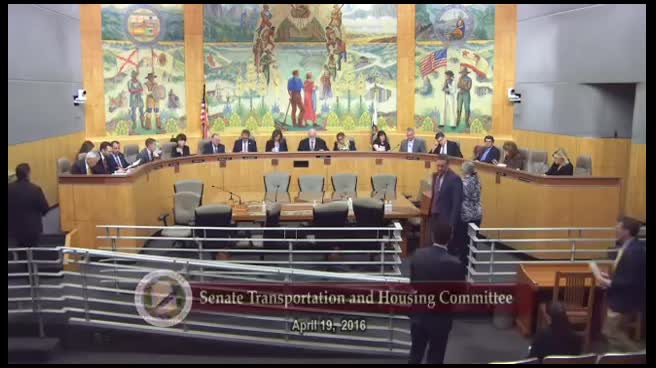 7MIN
Senate Standing Committee on Transportation and Housing
Bill Author

Bill Co-Author(s):