SB 240: California Environmental Quality Act: exemption: renewable energy projects on disturbed land.
- Session Year: 2015-2016
- House: Senate
- Latest Version Date: 2015-04-06
The California Environmental Quality Act (CEQA) requires a lead agency, as defined, to prepare, or cause to be prepared, and certify the completion of, an environmental impact report on a project that it proposes to carry out or approve that may have a significant effect on the environment or to adopt a negative declaration if it finds that the project will not have that effect. CEQA also requires a lead agency to prepare a mitigated negative declaration for a project that may have a significant effect on the environment if revisions in the project would avoid or mitigate that effect and there is no substantial evidence that the project, as revised, would have a significant effect on the environment. CEQA exempts various projects from its requirements.
This bill would exempt specified renewable energy projects of limited duration on disturbed land, as defined, that meet certain requirements. Because a lead agency would be required to determine if a project qualifies for this exemption, the bill would impose a state-mandated local program.
The California Constitution requires the state to reimburse local agencies and school districts for certain costs mandated by the state. Statutory provisions establish procedures for making that reimbursement.
This bill would provide that no reimbursement is required by this act for a specified reason.
Existing law authorizes a court, when sentencing a person to county jail for a felony, to commit the person to county jail for either the full term in custody, as specified, or to suspend the execution of a concluding portion of the term selected at the courts discretion. Under existing law, this period of suspended execution is supervised by the county probation officer and is known as mandatory supervision.
This bill would make a defendant subject to mandatory supervision subject to search and seizure by a peace officer at any time of the day or night, with or without cause. The bill would also require the defendant to admit any peace officer designated by the sheriff or his or her designee or the county probation officer or his or her designee into the defendants residence at any time for purposes of verifying the defendants compliance with the conditions of his or her mandatory supervision.
(a)For purposes of this section, the following terms mean the following:
(1)Disturbed land means real property that is any of the following:
(A)A brownfield as defined in Section 9601 of Title 42 of the United States Code.
(B)Property with at least 25 percent of the area covered by nonnative species.
(C)Property that was formerly used for agricultural or grazing purposes.
(D)Property that was historically used for timber harvesting or mining purposes.
(2)Limited duration means not more than 25 years.
(3)Renewable energy project means a project with a generation capacity of not more than 25 megawatts and that will provide electrical service pursuant to Section 2830 of the Public Utilities Code.
(b)This division does not apply to any activities related to the construction and operation of a renewable energy project of limited duration on disturbed land that meets all of the following:
(1)The renewable energy project is designed to provide both immediate benefit to ecosystem services, such as watershed function or habitat restoration, for the disturbed land during the first five years of the project and long-term benefits for the disturbed land.
(2)The renewable energy project demonstrates an overall energy cost savings to the local government for the life of the project.
(3)The project applicant has provided, to the satisfaction of the lead agency, sufficient financial assurance, in the form of a surety bond or other instrument, to remediate the disturbed land at the end of the life of the renewable energy project.
SEC. 2.No reimbursement is required by this act pursuant to Section 6 of Article XIIIB of the California Constitution because a local agency or school district has the authority to levy service charges, fees, or assessments sufficient to pay for the program or level of service mandated by this act, within the meaning of Section 17556 of the Government Code.
All matter omitted in this version of the bill appears in the bill as introduced in the Senate, February 17, 2015. (JR11)(a)(1)The Legislature finds and declares that the purpose of imprisonment for crime is punishment. This purpose is best served by terms proportionate to the seriousness of the offense with provision for uniformity in the sentences of offenders committing the same offense under similar circumstances. The Legislature further finds and declares that the elimination of disparity and the provision of uniformity of sentences can best be achieved by determinate sentences fixed by statute in proportion to the seriousness of the offense as determined by the Legislature to be imposed by the court with specified discretion.
(2)Notwithstanding paragraph (1), the Legislature further finds and declares that programs should be available for inmates, including, but not limited to, educational programs, that are designed to prepare nonviolent felony offenders for successful reentry into the community. The Legislature encourages the development of policies and programs designed to educate and rehabilitate nonviolent felony offenders. In implementing this section, the Department of Corrections and Rehabilitation is encouraged to give priority enrollment in programs to promote successful return to the community to an inmate with a short remaining term of commitment and a release date that would allow him or her adequate time to complete the program.
(3)In any case in which the punishment prescribed by statute for a person convicted of a public offense is a term of imprisonment in the state prison of any specification of three time periods, the court shall sentence the defendant to one of the terms of imprisonment specified unless the convicted person is given any other disposition provided by law, including a fine, jail, probation, or the suspension of imposition or execution of sentence or is sentenced pursuant to subdivision (b) of Section 1168 because he or she had committed his or her crime prior to July 1, 1977. In sentencing the convicted person, the court shall apply the sentencing rules of the Judicial Council. The court, unless it determines that there are circumstances in mitigation of the punishment prescribed, shall also impose any other term that it is required by law to impose as an additional term. Nothing in this article shall affect any provision of law that imposes the death penalty, that authorizes or restricts the granting of probation or suspending the execution or imposition of sentence, or expressly provides for imprisonment in the state prison for life, except as provided in paragraph (2) of subdivision (d). In any case in which the amount of preimprisonment credit under Section 2900.5 or any other provision of law is equal to or exceeds any sentence imposed pursuant to this chapter, the entire sentence shall be deemed to have been served and the defendant shall not be actually delivered to the custody of the secretary. The court shall advise the defendant that he or she shall serve a period of parole and order the defendant to report to the parole office closest to the defendants last legal residence, unless the in-custody credits equal the total sentence, including both confinement time and the period of parole. The sentence shall be deemed a separate prior prison term under Section 667.5, and a copy of the judgment and other necessary documentation shall be forwarded to the secretary.
(b)When a judgment of imprisonment is to be imposed and the statute specifies three possible terms, the choice of the appropriate term shall rest within the sound discretion of the court. At least four days prior to the time set for imposition of judgment, either party or the victim, or the family of the victim if the victim is deceased, may submit a statement in aggravation or mitigation. In determining the appropriate term, the court may consider the record in the case, the probation officers report, other reports, including reports received pursuant to Section 1203.03, and statements in aggravation or mitigation submitted by the prosecution, the defendant, or the victim, or the family of the victim if the victim is deceased, and any further evidence introduced at the sentencing hearing. The court shall select the term which, in the courts discretion, best serves the interests of justice. The court shall set forth on the record the reasons for imposing the term selected and the court may not impose an upper term by using the fact of any enhancement upon which sentence is imposed under any provision of law. A term of imprisonment shall not be specified if imposition of sentence is suspended.
(c)The court shall state the reasons for its sentence choice on the record at the time of sentencing. The court shall also inform the defendant that as part of the sentence after expiration of the term he or she may be on parole for a period as provided in Section 3000.
(d)(1)When a defendant subject to this section or subdivision (b) of Section 1168 has been sentenced to be imprisoned in the state prison and has been committed to the custody of the secretary, the court may, within 120 days of the date of commitment on its own motion, or at any time upon the recommendation of the secretary or the Board of Parole Hearings, recall the sentence and commitment previously ordered and resentence the defendant in the same manner as if he or she had not previously been sentenced, provided the new sentence, if any, is no greater than the initial sentence. The court resentencing under this subdivision shall apply the sentencing rules of the Judicial Council so as to eliminate disparity of sentences and to promote uniformity of sentencing. Credit shall be given for time served.
(2)(A)(i)When a defendant who was under 18 years of age at the time of the commission of the offense for which the defendant was sentenced to imprisonment for life without the possibility of parole has served at least 15 years of that sentence, the defendant may submit to the sentencing court a petition for recall and resentencing.
(ii)Notwithstanding clause (i), this paragraph shall not apply to defendants sentenced to life without parole for an offense where the defendant tortured, as described in Section 206, his or her victim or the victim was a public safety official, including any law enforcement personnel mentioned in Chapter 4.5 (commencing with Section 830) of Title 3, or any firefighter as described in Section 245.1, as well as any other officer in any segment of law enforcement who is employed by the federal government, the state, or any of its political subdivisions.
(B)The defendant shall file the original petition with the sentencing court. A copy of the petition shall be served on the agency that prosecuted the case. The petition shall include the defendants statement that he or she was under 18 years of age at the time of the crime and was sentenced to life in prison without the possibility of parole, the defendants statement describing his or her remorse and work towards rehabilitation, and the defendants statement that one of the following is true:
(i)The defendant was convicted pursuant to felony murder or aiding and abetting murder provisions of law.
(ii)The defendant does not have juvenile felony adjudications for assault or other felony crimes with a significant potential for personal harm to victims prior to the offense for which the sentence is being considered for recall.
(iii)The defendant committed the offense with at least one adult codefendant.
(iv)The defendant has performed acts that tend to indicate rehabilitation or the potential for rehabilitation, including, but not limited to, availing himself or herself of rehabilitative, educational, or vocational programs, if those programs have been available at his or her classification level and facility, using self-study for self-improvement, or showing evidence of remorse.
(C)If any of the information required in subparagraph (B) is missing from the petition, or if proof of service on the prosecuting agency is not provided, the court shall return the petition to the defendant and advise the defendant that the matter cannot be considered without the missing information.
(D)A reply to the petition, if any, shall be filed with the court within 60 days of the date on which the prosecuting agency was served with the petition, unless a continuance is granted for good cause.
(E)If the court finds by a preponderance of the evidence that the statements in the petition are true, the court shall hold a hearing to consider whether to recall the sentence and commitment previously ordered and to resentence the defendant in the same manner as if the defendant had not previously been sentenced, provided that the new sentence, if any, is not greater than the initial sentence. Victims, or victim family members if the victim is deceased, shall retain the rights to participate in the hearing.
(F)The factors that the court may consider when determining whether to recall and resentence include, but are not limited to, the following:
(i)The defendant was convicted pursuant to felony murder or aiding and abetting murder provisions of law.
(ii)The defendant does not have juvenile felony adjudications for assault or other felony crimes with a significant potential for personal harm to victims prior to the offense for which the sentence is being considered for recall.
(iii)The defendant committed the offense with at least one adult codefendant.
(iv)Prior to the offense for which the sentence is being considered for recall, the defendant had insufficient adult support or supervision and had suffered from psychological or physical trauma, or significant stress.
(v)The defendant suffers from cognitive limitations due to mental illness, developmental disabilities, or other factors that did not constitute a defense, but influenced the defendants involvement in the offense.
(vi)The defendant has performed acts that tend to indicate rehabilitation or the potential for rehabilitation, including, but not limited to, availing himself or herself of rehabilitative, educational, or vocational programs, if those programs have been available at his or her classification level and facility, using self-study for self-improvement, or showing evidence of remorse.
(vii)The defendant has maintained family ties or connections with others through letter writing, calls, or visits, or has eliminated contact with individuals outside of prison who are currently involved with crime.
(viii)The defendant has had no disciplinary actions for violent activities in the last five years in which the defendant was determined to be the aggressor.
(G)The court shall have the discretion to recall the sentence and commitment previously ordered and to resentence the defendant in the same manner as if the defendant had not previously been sentenced, provided that the new sentence, if any, is not greater than the initial sentence. The discretion of the court shall be exercised in consideration of the criteria in subparagraph (B). Victims, or victim family members if the victim is deceased, shall be notified of the resentencing hearing and shall retain their rights to participate in the hearing.
(H)If the sentence is not recalled, the defendant may submit another petition for recall and resentencing to the sentencing court when the defendant has been committed to the custody of the department for at least 20 years. If recall and resentencing is not granted under that petition, the defendant may file another petition after having served 24 years. The final petition may be submitted, and the response to that petition shall be determined, during the 25th year of the defendants sentence.
(I)In addition to the criteria in subparagraph (F), the court may consider any other criteria that the court deems relevant to its decision, so long as the court identifies them on the record, provides a statement of reasons for adopting them, and states why the defendant does or does not satisfy the criteria.
(J)This subdivision shall have retroactive application.
(e)(1)Notwithstanding any other law and consistent with paragraph (1) of subdivision (a), if the secretary or the Board of Parole Hearings or both determine that a prisoner satisfies the criteria set forth in paragraph (2), the secretary or the board may recommend to the court that the prisoners sentence be recalled.
(2)The court shall have the discretion to resentence or recall if the court finds that the facts described in subparagraphs (A) and (B) or subparagraphs (B) and (C) exist:
(A)The prisoner is terminally ill with an incurable condition caused by an illness or disease that would produce death within six months, as determined by a physician employed by the department.
(B)The conditions under which the prisoner would be released or receive treatment do not pose a threat to public safety.
(C)The prisoner is permanently medically incapacitated with a medical condition that renders him or her permanently unable to perform activities of basic daily living, and results in the prisoner requiring 24-hour total care, including, but not limited to, coma, persistent vegetative state, brain death, ventilator-dependency, loss of control of muscular or neurological function, and that incapacitation did not exist at the time of the original sentencing.
The Board of Parole Hearings shall make findings pursuant to this subdivision before making a recommendation for resentence or recall to the court. This subdivision does not apply to a prisoner sentenced to death or a term of life without the possibility of parole.
(3)Within 10 days of receipt of a positive recommendation by the secretary or the board, the court shall hold a hearing to consider whether the prisoners sentence should be recalled.
(4)Any physician employed by the department who determines that a prisoner has six months or less to live shall notify the chief medical officer of the prognosis. If the chief medical officer concurs with the prognosis, he or she shall notify the warden. Within 48 hours of receiving notification, the warden or the wardens representative shall notify the prisoner of the recall and resentencing procedures, and shall arrange for the prisoner to designate a family member or other outside agent to be notified as to the prisoners medical condition and prognosis, and as to the recall and resentencing procedures. If the inmate is deemed mentally unfit, the warden or the wardens representative shall contact the inmates emergency contact and provide the information described in paragraph (2).
(5)The warden or the wardens representative shall provide the prisoner and his or her family member, agent, or emergency contact, as described in paragraph (4), updated information throughout the recall and resentencing process with regard to the prisoners medical condition and the status of the prisoners recall and resentencing proceedings.
(6)Notwithstanding any other provisions of this section, the prisoner or his or her family member or designee may independently request consideration for recall and resentencing by contacting the chief medical officer at the prison or the secretary. Upon receipt of the request, the chief medical officer and the warden or the wardens representative shall follow the procedures described in paragraph (4). If the secretary determines that the prisoner satisfies the criteria set forth in paragraph (2), the secretary or board may recommend to the court that the prisoners sentence be recalled. The secretary shall submit a recommendation for release within 30 days in the case of inmates sentenced to determinate terms and, in the case of inmates sentenced to indeterminate terms, the secretary shall make a recommendation to the Board of Parole Hearings with respect to the inmates who have applied under this section. The board shall consider this information and make an independent judgment pursuant to paragraph (2) and make findings related thereto before rejecting the request or making a recommendation to the court. This action shall be taken at the next lawfully noticed board meeting.
(7)Any recommendation for recall submitted to the court by the secretary or the Board of Parole Hearings shall include one or more medical evaluations, a postrelease plan, and findings pursuant to paragraph (2).
(8)If possible, the matter shall be heard before the same judge of the court who sentenced the prisoner.
(9)If the court grants the recall and resentencing application, the prisoner shall be released by the department within 48 hours of receipt of the courts order, unless a longer time period is agreed to by the inmate. At the time of release, the warden or the wardens representative shall ensure that the prisoner has each of the following in his or her possession: a discharge medical summary, full medical records, state identification, parole medications, and all property belonging to the prisoner. After discharge, any additional records shall be sent to the prisoners forwarding address.
(10)The secretary shall issue a directive to medical and correctional staff employed by the department that details the guidelines and procedures for initiating a recall and resentencing procedure. The directive shall clearly state that any prisoner who is given a prognosis of six months or less to live is eligible for recall and resentencing consideration, and that recall and resentencing procedures shall be initiated upon that prognosis.
(f)Notwithstanding any other provision of this section, for purposes of paragraph (3) of subdivision (h), any allegation that a defendant is eligible for state prison due to a prior or current conviction, sentence enhancement, or because he or she is required to register as a sex offender shall not be subject to dismissal pursuant to Section 1385.
(g)A sentence to state prison for a determinate term for which only one term is specified, is a sentence to state prison under this section.
(h)(1)Except as provided in paragraph (3), a felony punishable pursuant to this subdivision where the term is not specified in the underlying offense shall be punishable by a term of imprisonment in a county jail for 16 months, or two or three years.
(2)Except as provided in paragraph (3), a felony punishable pursuant to this subdivision shall be punishable by imprisonment in a county jail for the term described in the underlying offense.
(3)Notwithstanding paragraphs (1) and (2), where the defendant (A) has a prior or current felony conviction for a serious felony described in subdivision (c) of Section 1192.7 or a prior or current conviction for a violent felony described in subdivision (c) of Section 667.5, (B) has a prior felony conviction in another jurisdiction for an offense that has all the elements of a serious felony described in subdivision (c) of Section 1192.7 or a violent felony described in subdivision (c) of Section 667.5, (C) is required to register as a sex offender pursuant to Chapter 5.5 (commencing with Section 290) of Title 9 of Part 1, or (D) is convicted of a crime and as part of the sentence an enhancement pursuant to Section 186.11 is imposed, an executed sentence for a felony punishable pursuant to this subdivision shall be served in state prison.
(4)Nothing in this subdivision shall be construed to prevent other dispositions authorized by law, including pretrial diversion, deferred entry of judgment, or an order granting probation pursuant to Section 1203.1.
(5)(A)Unless the court finds that, in the interests of justice, it is not appropriate in a particular case, the court, when imposing a sentence pursuant to paragraph (1) or (2), shall suspend execution of a concluding portion of the term for a period selected at the courts discretion.
(B)The portion of a defendants sentenced term that is suspended pursuant to this paragraph shall be known as mandatory supervision, and, unless otherwise ordered by the court, shall commence upon release from physical custody or an alternative custody program, whichever is later. During the period of mandatory supervision, the defendant shall be supervised by the county probation officer in accordance with the terms, conditions, and procedures generally applicable to persons placed on probation, for the remaining unserved portion of the sentence imposed by the court. The period of supervision shall be mandatory, and may not be earlier terminated except by court order. Any proceeding to revoke or modify mandatory supervision under this subparagraph shall be conducted pursuant to either subdivisions (a) and (b) of Section 1203.2 or Section 1203.3. During the period when the defendant is under such that supervision, unless in actual custody related to the sentence imposed by the court, the defendant shall be entitled to only actual time credit against the term of imprisonment imposed by the court. Any time period which is suspended because a person has absconded shall not be credited toward the period of supervision. A defendant subject to mandatory supervision is subject to search and seizure by a peace officer at any time of the day or night, with or without cause. In addition, the defendant shall admit any peace officer designated by the sheriff or his or her designee or the county probation officer or his or her designee into the defendants residence at any time for purposes of verifying the defendants compliance with the conditions of his or her mandatory supervision.
(6)The sentencing changes made by the act that added this subdivision shall be applied prospectively to any person sentenced on or after October 1, 2011.
(7)The sentencing changes made to paragraph (5) by the act that added this paragraph shall become effective and operative on January 1, 2015, and shall be applied prospectively to any person sentenced on or after January 1, 2015.
(i)This section shall remain in effect only until January 1, 2017, and as of that date is repealed, unless a later enacted statute, that is enacted before that date, deletes or extends that date.
SEC. 2.Section 1170 of the Penal Code, as amended by Section 2 of Chapter 612 of the Statutes of 2014, is amended to read:1170.(a)(1)The Legislature finds and declares that the purpose of imprisonment for crime is punishment. This purpose is best served by terms proportionate to the seriousness of the offense with provision for uniformity in the sentences of offenders committing the same offense under similar circumstances. The Legislature further finds and declares that the elimination of disparity and the provision of uniformity of sentences can best be achieved by determinate sentences fixed by statute in proportion to the seriousness of the offense as determined by the Legislature to be imposed by the court with specified discretion.
(2)Notwithstanding paragraph (1), the Legislature further finds and declares that programs should be available for inmates, including, but not limited to, educational programs, that are designed to prepare nonviolent felony offenders for successful reentry into the community. The Legislature encourages the development of policies and programs designed to educate and rehabilitate nonviolent felony offenders. In implementing this section, the Department of Corrections and Rehabilitation is encouraged to give priority enrollment in programs to promote successful return to the community to an inmate with a short remaining term of commitment and a release date that would allow him or her adequate time to complete the program.
(3)In any case in which the punishment prescribed by statute for a person convicted of a public offense is a term of imprisonment in the state prison of any specification of three time periods, the court shall sentence the defendant to one of the terms of imprisonment specified unless the convicted person is given any other disposition provided by law, including a fine, jail, probation, or the suspension of imposition or execution of sentence or is sentenced pursuant to subdivision (b) of Section 1168 because he or she had committed his or her crime prior to July 1, 1977. In sentencing the convicted person, the court shall apply the sentencing rules of the Judicial Council. The court, unless it determines that there are circumstances in mitigation of the punishment prescribed, shall also impose any other term that it is required by law to impose as an additional term. Nothing in this article shall affect any provision of law that imposes the death penalty, that authorizes or restricts the granting of probation or suspending the execution or imposition of sentence, or expressly provides for imprisonment in the state prison for life, except as provided in paragraph (2) of subdivision (d). In any case in which the amount of preimprisonment credit under Section 2900.5 or any other provision of law is equal to or exceeds any sentence imposed pursuant to this chapter, the entire sentence shall be deemed to have been served and the defendant shall not be actually delivered to the custody of the secretary. The court shall advise the defendant that he or she shall serve a period of parole and order the defendant to report to the parole office closest to the defendants last legal residence, unless the in-custody credits equal the total sentence, including both confinement time and the period of parole. The sentence shall be deemed a separate prior prison term under Section 667.5, and a copy of the judgment and other necessary documentation shall be forwarded to the secretary.
(b)When a judgment of imprisonment is to be imposed and the statute specifies three possible terms, the court shall order imposition of the middle term, unless there are circumstances in aggravation or mitigation of the crime. At least four days prior to the time set for imposition of judgment, either party or the victim, or the family of the victim if the victim is deceased, may submit a statement in aggravation or mitigation to dispute facts in the record or the probation officers report, or to present additional facts. In determining whether there are circumstances that justify imposition of the upper or lower term, the court may consider the record in the case, the probation officers report, other reports, including reports received pursuant to Section 1203.03, and statements in aggravation or mitigation submitted by the prosecution, the defendant, or the victim, or the family of the victim if the victim is deceased, and any further evidence introduced at the sentencing hearing. The court shall set forth on the record the facts and reasons for imposing the upper or lower term. The court may not impose an upper term by using the fact of any enhancement upon which sentence is imposed under any provision of law. A term of imprisonment shall not be specified if imposition of sentence is suspended.
(c)The court shall state the reasons for its sentence choice on the record at the time of sentencing. The court shall also inform the defendant that as part of the sentence after expiration of the term he or she may be on parole for a period as provided in Section 3000.
(d)(1)When a defendant subject to this section or subdivision (b) of Section 1168 has been sentenced to be imprisoned in the state prison and has been committed to the custody of the secretary, the court may, within 120 days of the date of commitment on its own motion, or at any time upon the recommendation of the secretary or the Board of Parole Hearings, recall the sentence and commitment previously ordered and resentence the defendant in the same manner as if he or she had not previously been sentenced, provided the new sentence, if any, is no greater than the initial sentence. The court resentencing under this subdivision shall apply the sentencing rules of the Judicial Council so as to eliminate disparity of sentences and to promote uniformity of sentencing. Credit shall be given for time served.
(2)(A)(i)When a defendant who was under 18 years of age at the time of the commission of the offense for which the defendant was sentenced to imprisonment for life without the possibility of parole has served at least 15 years of that sentence, the defendant may submit to the sentencing court a petition for recall and resentencing.
(ii)Notwithstanding clause (i), this paragraph shall not apply to defendants sentenced to life without parole for an offense where the defendant tortured, as described in Section 206, his or her victim or the victim was a public safety official, including any law enforcement personnel mentioned in Chapter 4.5 (commencing with Section 830) of Title 3, or any firefighter as described in Section 245.1, as well as any other officer in any segment of law enforcement who is employed by the federal government, the state, or any of its political subdivisions.
(B)The defendant shall file the original petition with the sentencing court. A copy of the petition shall be served on the agency that prosecuted the case. The petition shall include the defendants statement that he or she was under 18 years of age at the time of the crime and was sentenced to life in prison without the possibility of parole, the defendants statement describing his or her remorse and work towards rehabilitation, and the defendants statement that one of the following is true:
(i)The defendant was convicted pursuant to felony murder or aiding and abetting murder provisions of law.
(ii)The defendant does not have juvenile felony adjudications for assault or other felony crimes with a significant potential for personal harm to victims prior to the offense for which the sentence is being considered for recall.
(iii)The defendant committed the offense with at least one adult codefendant.
(iv)The defendant has performed acts that tend to indicate rehabilitation or the potential for rehabilitation, including, but not limited to, availing himself or herself of rehabilitative, educational, or vocational programs, if those programs have been available at his or her classification level and facility, using self-study for self-improvement, or showing evidence of remorse.
(C)If any of the information required in subparagraph (B) is missing from the petition, or if proof of service on the prosecuting agency is not provided, the court shall return the petition to the defendant and advise the defendant that the matter cannot be considered without the missing information.
(D)A reply to the petition, if any, shall be filed with the court within 60 days of the date on which the prosecuting agency was served with the petition, unless a continuance is granted for good cause.
(E)If the court finds by a preponderance of the evidence that the statements in the petition are true, the court shall hold a hearing to consider whether to recall the sentence and commitment previously ordered and to resentence the defendant in the same manner as if the defendant had not previously been sentenced, provided that the new sentence, if any, is not greater than the initial sentence. Victims, or victim family members if the victim is deceased, shall retain the rights to participate in the hearing.
(F)The factors that the court may consider when determining whether to recall and resentence include, but are not limited to, the following:
(i)The defendant was convicted pursuant to felony murder or aiding and abetting murder provisions of law.
(ii)The defendant does not have juvenile felony adjudications for assault or other felony crimes with a significant potential for personal harm to victims prior to the offense for which the sentence is being considered for recall.
(iii)The defendant committed the offense with at least one adult codefendant.
(iv)Prior to the offense for which the sentence is being considered for recall, the defendant had insufficient adult support or supervision and had suffered from psychological or physical trauma, or significant stress.
(v)The defendant suffers from cognitive limitations due to mental illness, developmental disabilities, or other factors that did not constitute a defense, but influenced the defendants involvement in the offense.
(vi)The defendant has performed acts that tend to indicate rehabilitation or the potential for rehabilitation, including, but not limited to, availing himself or herself of rehabilitative, educational, or vocational programs, if those programs have been available at his or her classification level and facility, using self-study for self-improvement, or showing evidence of remorse.
(vii)The defendant has maintained family ties or connections with others through letter writing, calls, or visits, or has eliminated contact with individuals outside of prison who are currently involved with crime.
(viii)The defendant has had no disciplinary actions for violent activities in the last five years in which the defendant was determined to be the aggressor.
(G)The court shall have the discretion to recall the sentence and commitment previously ordered and to resentence the defendant in the same manner as if the defendant had not previously been sentenced, provided that the new sentence, if any, is not greater than the initial sentence. The discretion of the court shall be exercised in consideration of the criteria in subparagraph (B). Victims, or victim family members if the victim is deceased, shall be notified of the resentencing hearing and shall retain their rights to participate in the hearing.
(H)If the sentence is not recalled, the defendant may submit another petition for recall and resentencing to the sentencing court when the defendant has been committed to the custody of the department for at least 20 years. If recall and resentencing is not granted under that petition, the defendant may file another petition after having served 24 years. The final petition may be submitted, and the response to that petition shall be determined, during the 25th year of the defendants sentence.
(I)In addition to the criteria in subparagraph (F), the court may consider any other criteria that the court deems relevant to its decision, so long as the court identifies them on the record, provides a statement of reasons for adopting them, and states why the defendant does or does not satisfy the criteria.
(J)This subdivision shall have retroactive application.
(e)(1)Notwithstanding any other law and consistent with paragraph (1) of subdivision (a), if the secretary or the Board of Parole Hearings or both determine that a prisoner satisfies the criteria set forth in paragraph (2), the secretary or the board may recommend to the court that the prisoners sentence be recalled.
(2)The court shall have the discretion to resentence or recall if the court finds that the facts described in subparagraphs (A) and (B) or subparagraphs (B) and (C) exist:
(A)The prisoner is terminally ill with an incurable condition caused by an illness or disease that would produce death within six months, as determined by a physician employed by the department.
(B)The conditions under which the prisoner would be released or receive treatment do not pose a threat to public safety.
(C)The prisoner is permanently medically incapacitated with a medical condition that renders him or her permanently unable to perform activities of basic daily living, and results in the prisoner requiring 24-hour total care, including, but not limited to, coma, persistent vegetative state, brain death, ventilator-dependency, loss of control of muscular or neurological function, and that incapacitation did not exist at the time of the original sentencing.
The Board of Parole Hearings shall make findings pursuant to this subdivision before making a recommendation for resentence or recall to the court. This subdivision does not apply to a prisoner sentenced to death or a term of life without the possibility of parole.
(3)Within 10 days of receipt of a positive recommendation by the secretary or the board, the court shall hold a hearing to consider whether the prisoners sentence should be recalled.
(4)Any physician employed by the department who determines that a prisoner has six months or less to live shall notify the chief medical officer of the prognosis. If the chief medical officer concurs with the prognosis, he or she shall notify the warden. Within 48 hours of receiving notification, the warden or the wardens representative shall notify the prisoner of the recall and resentencing procedures, and shall arrange for the prisoner to designate a family member or other outside agent to be notified as to the prisoners medical condition and prognosis, and as to the recall and resentencing procedures. If the inmate is deemed mentally unfit, the warden or the wardens representative shall contact the inmates emergency contact and provide the information described in paragraph (2).
(5)The warden or the wardens representative shall provide the prisoner and his or her family member, agent, or emergency contact, as described in paragraph (4), updated information throughout the recall and resentencing process with regard to the prisoners medical condition and the status of the prisoners recall and resentencing proceedings.
(6)Notwithstanding any other provisions of this section, the prisoner or his or her family member or designee may independently request consideration for recall and resentencing by contacting the chief medical officer at the prison or the secretary. Upon receipt of the request, the chief medical officer and the warden or the wardens representative shall follow the procedures described in paragraph (4). If the secretary determines that the prisoner satisfies the criteria set forth in paragraph (2), the secretary or board may recommend to the court that the prisoners sentence be recalled. The secretary shall submit a recommendation for release within 30 days in the case of inmates sentenced to determinate terms and, in the case of inmates sentenced to indeterminate terms, the secretary shall make a recommendation to the Board of Parole Hearings with respect to the inmates who have applied under this section. The board shall consider this information and make an independent judgment pursuant to paragraph (2) and make findings related thereto before rejecting the request or making a recommendation to the court. This action shall be taken at the next lawfully noticed board meeting.
(7)Any recommendation for recall submitted to the court by the secretary or the Board of Parole Hearings shall include one or more medical evaluations, a postrelease plan, and findings pursuant to paragraph (2).
(8)If possible, the matter shall be heard before the same judge of the court who sentenced the prisoner.
(9)If the court grants the recall and resentencing application, the prisoner shall be released by the department within 48 hours of receipt of the courts order, unless a longer time period is agreed to by the inmate. At the time of release, the warden or the wardens representative shall ensure that the prisoner has each of the following in his or her possession: a discharge medical summary, full medical records, state identification, parole medications, and all property belonging to the prisoner. After discharge, any additional records shall be sent to the prisoners forwarding address.
(10)The secretary shall issue a directive to medical and correctional staff employed by the department that details the guidelines and procedures for initiating a recall and resentencing procedure. The directive shall clearly state that any prisoner who is given a prognosis of six months or less to live is eligible for recall and resentencing consideration, and that recall and resentencing procedures shall be initiated upon that prognosis.
(f)Notwithstanding any other provision of this section, for purposes of paragraph (3) of subdivision (h), any allegation that a defendant is eligible for state prison due to a prior or current conviction, sentence enhancement, or because he or she is required to register as a sex offender shall not be subject to dismissal pursuant to Section 1385.
(g)A sentence to state prison for a determinate term for which only one term is specified, is a sentence to state prison under this section.
(h)(1)Except as provided in paragraph (3), a felony punishable pursuant to this subdivision where the term is not specified in the underlying offense shall be punishable by a term of imprisonment in a county jail for 16 months, or two or three years.
(2)Except as provided in paragraph (3), a felony punishable pursuant to this subdivision shall be punishable by imprisonment in a county jail for the term described in the underlying offense.
(3)Notwithstanding paragraphs (1) and (2), where the defendant (A) has a prior or current felony conviction for a serious felony described in subdivision (c) of Section 1192.7 or a prior or current conviction for a violent felony described in subdivision (c) of Section 667.5, (B) has a prior felony conviction in another jurisdiction for an offense that has all the elements of a serious felony described in subdivision (c) of Section 1192.7 or a violent felony described in subdivision (c) of Section 667.5, (C) is required to register as a sex offender pursuant to Chapter 5.5 (commencing with Section 290) of Title 9 of Part 1, or (D) is convicted of a crime and as part of the sentence an enhancement pursuant to Section 186.11 is imposed, an executed sentence for a felony punishable pursuant to this subdivision shall be served in state prison.
(4)Nothing in this subdivision shall be construed to prevent other dispositions authorized by law, including pretrial diversion, deferred entry of judgment, or an order granting probation pursuant to Section 1203.1.
(5)(A)Unless the court finds, in the interest of justice, that it is not appropriate in a particular case, the court, when imposing a sentence pursuant to paragraph (1) or (2), shall suspend execution of a concluding portion of the term for a period selected at the courts discretion.
(B)The portion of a defendants sentenced term that is suspended pursuant to this paragraph shall be known as mandatory supervision, and, unless otherwise ordered by the court, shall commence upon release from physical custody or an alternative custody program, whichever is later. During the period of mandatory supervision, the defendant shall be supervised by the county probation officer in accordance with the terms, conditions, and procedures generally applicable to persons placed on probation, for the remaining unserved portion of the sentence imposed by the court. The period of supervision shall be mandatory, and may not be earlier terminated except by court order. Any proceeding to revoke or modify mandatory supervision under this subparagraph shall be conducted pursuant to either subdivisions (a) and (b) of Section 1203.2 or Section 1203.3. During the period when the defendant is under such that supervision, unless in actual custody related to the sentence imposed by the court, the defendant shall be entitled to only actual time credit against the term of imprisonment imposed by the court. Any time period which is suspended because a person has absconded shall not be credited toward the period of supervision. A defendant subject to mandatory supervision is subject to search and seizure by a peace officer at any time of the day or night, with or without cause. In addition, the defendant shall admit any peace officer designated by the sheriff or his or her designee or the county probation officer or his or her designee into the defendants residence at any time for purposes of verifying the defendants compliance with the conditions of his or her mandatory supervision.
(6)The sentencing changes made by the act that added this subdivision shall be applied prospectively to any person sentenced on or after October 1, 2011.
(7)The sentencing changes made to paragraph (5) by the act that added this paragraph shall become effective and operative on January 1, 2015, and shall be applied prospectively to any person sentenced on or after January 1, 2015.
(i)This section shall become operative on January 1, 2017.
|
Date
|
Status
|
|---|---|
| Feb 17, 2015 | Introduced. Read first time. To Com. on RLS. for assignment. To print. |
| Feb 18, 2015 | From printer. May be acted upon on or after March 20. |
| Feb 26, 2015 | Referred to Com. on PUB. S. |
| Apr 6, 2015 | From committee with author's amendments. Read second time and amended. Re-referred to Com. on PUB. S. |
| Apr 15, 2015 | Re-referred to Com. on RLS. |
| Apr 15, 2015 | Withdrawn from committee. |
| Apr 16, 2015 | Re-referred to Com. on E.Q. |
| Apr 17, 2015 | Set for hearing April 29. |
| Apr 30, 2015 | April 29 set for first hearing. Failed passage in committee. Reconsideration granted. |
| Apr 30, 2015 | April 29 set for first hearing. Failed passage in committee. (Ayes 2. Noes 5. Page 857.) Reconsideration granted. |
| Feb 1, 2016 | Returned to Secretary of Senate pursuant to Joint Rule 56. |
|
Date
|
Description
|
Location
|
Votes
|
|
|---|---|---|---|---|
| Apr 29, 2015 | [First] hearing set for [04-29-2015]: Failed passage in Committee. Reconsideration granted | Senate Standing Committee on Environmental Quality |
Passed |
|
| Apr 29, 2015 | Do pass, but first be re-referred to the Committee on [Appropriations] | Senate Standing Committee on Environmental Quality |
Failed |
This list shows positions taken on this bill by organizations on the date displayed, which is linked to the original source.
Positions by individuals are not included.
|
Organization
|
Position
|
Date
|
|---|---|---|
| Sierra Club | * Against | Apr 29, 2015 |
| Sierra Club California | * Against | Apr 29, 2015 |
SB 240 (Stone) Page 8 of 8
SENATE COMMITTEE ON ENVIRONMENTAL QUALITY
Senator Wieckowski, Chair
2015 - 2016 Regular
Bill No: SB 240
Author: |
Stone |
||
Version: |
4/6/2015 |
Hearing Date: |
4/29/2015 |
Urgency: |
No |
Fiscal: |
Yes |
Consultant: |
Joanne Roy |
||
SUBJECT: California Environmental Quality Act: exemption: renewable energy projects on disturbed land
ANALYSIS:
Existing law:
Under the California Environmental Quality Act (CEQA), requires lead agencies with the principal responsibility for carrying out or approving a proposed discretionary project to prepare a negative declaration, mitigated negative declaration, or environmental impact report (EIR) for this action, unless the project is exempt from CEQA (CEQA includes various statutory exemptions, as well as categorical exemptions in the CEQA Guidelines). (Public Resources Code §21000 et seq.)
Creates the Local Government Renewable Energy Self-Generation Program, which authorizes a local government entity to receive a credit on their electric bill for power generated from a renewable energy facility that generates more energy than is needed to serve the electrical load of governmental entity owned or controlled site where the facility is located. (Public Utilities Code §2830 et seq.)
This bill:
Exempts from CEQA specified renewable energy projects of limited duration on disturbed land, as defined, that meet specified requirements.
Defines “disturbed land” as real property that is any of the following:
A brownfield;
Property with at least 25% of the area covered by nonnative species;
Property that was formerly used for agricultural or grazing purposes; or,
Property that was historically used for timber harvesting or mining purposes.
Defines “limited durations” as not more than 25 years.
Defines a “renewable energy project” as a project with a generation capacity of not more than 25 megawatts and that will provide electrical service pursuant to the Local Government Renewable Energy Self-Generation Program.
Background
CEQA: Environmental Review Process.
CEQA provides a process for evaluating the environmental effects of a project, and includes statutory exemptions as well as categorical exemptions in the CEQA guidelines. If a project is not exempt from CEQA, an initial study is prepared to determine whether a project may have a significant effect on the environment. If the initial study shows that there would not be a significant effect on the environment, the lead agency must prepare a negative declaration (ND). If the initial study shows that the project may have a significant effect on the environment, then the lead agency must prepare an EIR.
Generally, an EIR must accurately describe the proposed project, identify and analyze each significant environmental impact expected to result from the proposed project, identify mitigation measures to reduce those impacts to the extent feasible, and evaluate a range of reasonable alternatives to the proposed project. Prior to approving any project that has received an environmental review, an agency must make certain findings. If mitigation measures are required or incorporated into a project, the agency must adopt a reporting or monitoring program to ensure compliance with those measures.
If a mitigation measure would cause one or more significant effects in addition to those that would be caused by the proposed project, the effects of the mitigation measure must be discussed but in less detail than the significant effects of the proposed project.
What is Analyzed in an Environmental Review?
Pursuant to CEQA, an environmental review analyzing the significant direct and indirect environmental impacts of a proposed project, may include water quality, surface and subsurface hydrology, land use and agricultural resources, transportation and circulation, air quality and greenhouse gas emissions, terrestrial and aquatic biological resources, aesthetics, geology and soils, recreation, public services and utilities such as water supply and wastewater disposal, cultural resources, and tribal cultural resources.
The analysis must also evaluate the cumulative impacts of any past, present, and reasonably foreseeable projects/activities within study areas that are applicable to the resources being evaluated. A study area for a proposed project must not be limited to the footprint of the project because many environmental impacts of a development extend beyond the identified project boundary. Also, CEQA stipulates that the environmental impacts must be measured against existing physical conditions within the project area, not future, allowable conditions.
Comments
Purpose of Bill.
According to the author, “Throughout the state, we have programs that seek to protect land for a variety of reasons (e.g. endangered species protection, watershed value, sensitive habitats, parks and recreation, open space, etc.). While considerable effort and financial resources have been dedicated to land acquisitions, often lacking are the funds to provide management and restoration costs. Indeed, many of the acres acquired are not perfectly pristine, and often contain areas of significant degradation, invasive non-native species, soils contamination, or other issues. Senator Stone proposes a unique program to provide a new opportunity where a CEQA exemption could be used in order to facilitate renewable energy projects. These projects can be temporarily installed on degraded lands, and will contribute to the ultimate restoration of the land and generate a net benefit to the region, while also helping to meet the goals of our current and increasing renewable portfolio standards in the state.”
The author further states, “In partnership with San Diego State University, a pilot project is proposed that meets the goals of this project, provides cost savings to local governments on their electric bills, restored nearly 22 acres of habitat that is covered by eucalyptus forest (a highly invasive species and significant fire risk), and supports a long-term research study on how we can design renewable energy projects that integrate the principles of habitat compatibility and watershed management.”
Maybe a Negative Declaration or Mitigated Negative Declaration Applies.
The author states, “This bill seeks to create an efficient pathway by which renewable energy projects can efficiently navigate environmental review if (and only if) the underlying benefit is restoration and/or remediation.”
It may be noted that not all projects subject to CEQA are required to do an EIR. In fact, based on the number of documents submitted to the State Clearinghouse, data shows that most projects do not trigger an EIR.
If the initial study shows that there would not be a significant effect on the environment, then the lead agency must prepare a ND. If the initial study shows potentially significant impacts but the applicant revises the project plan, which would avoid or mitigate those impacts, before the proposed ND and initial study are released for public review, then the lead agency must prepare a mitigated negative declaration (MND). These types of environmental reviews tend to be less expensive and time-consuming than an EIR. Perhaps, such a project as described in SB 240 would qualify for an ND/MND.
However, if a project may have a significant impact, then an EIR must be prepared; and if this is the case, then is it not to the benefit of everyone concerned to make sure that the project is as environmentally sound as it can be?
What Is Lost With An Exemption From CEQA?
It is not unusual for some interests to assert that a particular exemption will expedite construction of a particular type of project and reduce costs. This, however, frequently overlooks the benefits of adequate environmental review where lead and responsible agencies are legally accountable for their actions: to inform decisionmakers and the public about project impacts, identify ways to avoid or significantly reduce environmental damage, prevent environmental damage by requiring feasible alternatives or mitigation measures, disclose to the public reasons why an agency approved a project if significant environmental effects are involved, involve public agencies in the process, and increase public participation in the environmental review and the planning processes.
If a project is exempt from CEQA, certain issues should be addressed. For example:
How can decisionmakers and the public be aware of impacts, mitigation measures, and alternatives of a project because of the exemption?
Is it appropriate for the public to live with the consequences when a project is exempt and impacts may not be mitigated and alternatives may not be considered regarding certain matters, such as air quality, water quality, and noise impacts?
Because adverse project impacts do not disappear when they are not identified and mitigated, does an exemption result in a direct transfer of responsibility for mitigating impacts from the applicant to the public (i.e., taxpayers) if impacts are ultimately addressed after completion of the project?
If taxpayers, rather than the project applicant, are ultimately responsible for mitigating certain impacts of such a project after project completion, what assessments or taxes will be increased to fund mitigation or pay for alternatives at a later date?
It
is also not unusual for certain interests to blame CEQA lawsuits.
However, according to a study on the issue, “Despite criticisms
that CEQA often results in litigation, CEQA-related litigation is
relatively rare.” The study noted that the number of lawsuits to
the number of CEQA reviews “yields an estimate of one lawsuit per
354 CEQA reviews.”
Those citing CEQA and CEQA litigation
as a problem do not indicate the result of that litigation. Were
significant impacts that were not evaluated in the initial document
ultimately addressed? What would have been the result if those
impacts had not been mitigated (e.g., flooding, exposure of people to
hazards, inadequate public services, congestion)?
Also,
challenges to CEQA determinations must be commenced within an
unusually short 30 days of an agency’s filing of a notice of
determination. In addition, no later than 20 days from the date of
service upon a public agency, the public agency must file a notice
with the court setting a time and place for all parties to meet and
attempt to settle the litigation.
Is Ignoring Significant, and Possibly Permanent, Impacts by Renewable Energy Projects Prudent?
Although increasing renewable energy usage is a laudable goal, renewable energy generation can sometimes have a negative impact on the environment. For example, wind turbines along Altamont Pass have generated clean electricity for decades but at the cost of killing thousands of birds, including American kestrels, burrowing owls (considered a Bird Species of Special Concern in California), golden eagles (listed as a fully protected species in California), and red-tailed hawks.
Solar energy farms can threaten wildlife as well. In 2013, the National Fish and Wildlife Forensics Laboratory recovered 233 birds from the site of three solar power plants as part of a federal investigation and concluded that many of the birds had been fatally singed, broken, or otherwise fatally crippled by the facilities. (“Streamers” is a name given to birds as their feathers ignite, mid-air, after flying through a concentrated beam of sunlight.) One of the dead birds found was a Yuma clapper rail – fewer than 1,000 of this species are thought to still be alive. According to the investigation, much of the problem appears to lie in the “lake effect,” in which birds and their insect prey can mistake a reflective solar facility for a water body, or spot water ponds at the site, then hone in on it. Because of the power of the lake effect, the federal report described such solar farms as “mega-traps.”
Also, renewable energy projects can displace terrestrial animals such as the threatened desert tortoise in the Mojave Desert where the sun shines more than 300 days each year, which is beneficial for producing solar energy.
The examples above are not simply about the impact on that one type of animal, but rather entire ecosystems – analyzing and mitigating for the one species helps preserve the ecosystem of which it is a part. Under CEQA, a project’s environmental impacts, such as the ones mentioned above, would be analyzed in order to avoid or mitigate the impacts.
“Renewable Energy”.
This bill defines “renewable energy project” as “a project with a generation capacity of not more than 25 megawatts and that will provide electrical service pursuant to Section 2830 of the Public Utilities Code.” However, what is considered “renewable energy”? Is it limited to solar and wind, or does it include biomass and/or natural gas? The bill is unclear on the types of renewable energy generation that would be subject to this bill.
“Disturbed Land”.
SB 240 provides that the exemption may apply to renewable energy projects on “disturbed land,” including, a brownfield, property with at least 25% of the area covered by nonnative species, property formerly used for agriculture or grazing, or property that was historically used for timber harvesting or mining.
Such qualifications may be considered too broad. For example, none of these properties have a limit to how expansive they may be, such as a maximum number of acres. Although the renewable energy project is limited to 25 megawatts, the project may sit on a much more substantial piece of property with other ancillary activities on it that may have an impact on the environment, but would proceed without an environmental review.
Also, “brownfields” is a broad term. As defined in 42 USC §9601, the term “brownfield site” means real property, the expansion, redevelopment, or reuse of which may be complicated by the presence or potential presence of a hazardous substance, pollutant, or contaminant” and includes a list of exclusions. A brownfield can be almost any piece of property, such as a residence with a septic tank, an agricultural field that has pesticides and herbicides used on it, or a gas station.
In addition, if a property has 25% of the area covered by nonnative species, but 50% of the property is critical habitat for a state listed endangered species, then would it not be prudent to do an environmental review and avoid/mitigate for that significant environmental impact?
“Limited Duration”.
This bill provides that the exemption proposed applies to a “renewable energy project of limited duration” and defines limited duration as no more than 25 years. Solar panels and wind turbines typically last 20-25 years and can be replaced. For example, the Altamont Pass wind farm, which was commissioned in 1981, has been there for about 34 years, and is replacing nearly half of the smaller turbines with the expected completion date of sometime this year.
Immediate and Long-Term Benefits.
The bill provides that the project must be designed to provide both “immediate benefit to ecosystem services, such as watershed function or habitat restoration, for the disturbed land during the first five years of the project and long-term benefits for the disturbed land.” However, a benefit does not necessarily have to directly address a significant environmental impact. There are no standards or requirements placed on what is to be considered an “immediate benefit to ecosystem services” or the more ambiguous “long-term benefits” – the bill does not specify that the long-term benefits need to be environmental; those benefits could be for a variety of purposes such as financial, community, energy-related, or solely for the benefit of the property owner.
Also, considering the bill does not specify what a “long-term benefit” is, it seems possible that a “long-term benefit” could include the continuance of a renewable energy project beyond the 25-year duration.
SOURCE:
Dr. Matt Rahn
SUPPORT:
None on file
OPPOSITION:
Sierra Club California
-- END --
Discussed in Hearing
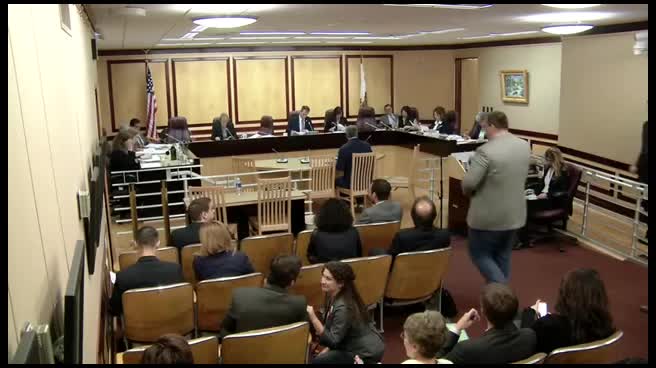 20MIN
Senate Standing Committee on Environmental Quality
Bill Author

Bill Co-Author(s):