SB 480: Taxation: qualified heavy equipment.
- Session Year: 2015-2016
- House: Senate
- Latest Version Date: 2015-04-29
The California Constitution authorizes the Legislature to classify personal property for differential taxation or for exemption by means of a statute approved by a 2/3 vote of the membership of each house.
This bill would, pursuant to this constitutional authorization, on and after July 1, 2016, to before July 1, 2026, impose a tax on every qualified renter for the privilege of renting qualified heavy equipment in this state at the rate of 0.75% of the rental price from the renting of qualified heavy equipment. This bill would require a qualified renter to pay and remit the tax, as provided. This bill would provide that this tax shall be in lieu of any personal property tax on qualified heavy equipment. This bill would require the tax to be administered by the State Board of Equalization and to be collected pursuant to the procedures set forth in the Fee Collection Procedures Law. This bill would require all revenues, interest, penalties, and other amounts, less refunds and the boards costs of administration, derived from the imposition of the tax to be deposited in the General Fund.
Existing property tax law requires the county auditor, in each fiscal year, to allocate property tax revenue to local jurisdictions in accordance with specified formulas and procedures, and generally requires that each jurisdiction be allocated an amount equal to the total of the amount of revenue allocated to that jurisdiction in the prior fiscal year, subject to certain modifications, and that jurisdictions portion of the annual tax increment, as defined. Existing property tax law also reduces the amounts of ad valorem property tax revenue that would otherwise be annually allocated to the county, cities, and special districts pursuant to these general allocation requirements by requiring, for purposes of determining property tax revenue allocations in each county for the 199293 and 199394 fiscal years, that the amounts of property tax revenue deemed allocated in the prior fiscal year to the county, cities, and special districts be reduced in accordance with certain formulas. It requires that the revenues not allocated to the county, cities, and special districts as a result of these reductions be transferred to the Educational Revenue Augmentation Fund in that county for allocation to school districts, community college districts, and the county office of education.
This bill would, for the 201617 fiscal year and for each fiscal year thereafter, to the 202526 fiscal year, inclusive, require the county auditor to increase the total amount of ad valorem property tax revenue that is otherwise required to be allocated among the county and each city and special district in the county by the qualified heavy equipment reimbursement amount, as defined, and to commensurately decrease the amount of ad valorem property tax revenue that is otherwise required to be allocated to the county Educational Revenue Augmentation Fund and, if necessary, the amount of those revenue revenues otherwise required to be allocated to school districts, as specified, by the qualified heavy equipment reimbursement amount.
By expanding the application of the Fee Collection Procedures Law, the violation of which is a crime, and by imposing new duties upon local officials in the allocation of ad valorem property tax revenues, this bill would impose a state-mandated local program.
The California Constitution requires the state to reimburse local agencies and school districts for certain costs mandated by the state. Statutory provisions establish procedures for making that reimbursement.
This bill would provide that with regard to certain mandates no reimbursement is required by this act for a specified reason.
With regard to any other mandates, this bill would provide that, if the Commission on State Mandates determines that the bill contains costs so mandated by the state, reimbursement for those costs shall be made pursuant to the statutory provisions noted above.
Section 2229 of the Revenue and Taxation Code requires the Legislature to reimburse local agencies annually for certain property tax revenues lost as a result of any exemption or classification of property for purposes of ad valorem property taxation.
This bill would provide that, notwithstanding Section 2229 of the Revenue and Taxation Code, no appropriation is made and the state shall not reimburse local agencies for property tax revenues lost by them pursuant to the bill.
The California Constitution authorizes the Legislature to classify personal property for differential taxation or for exemption by means of a statute approved by a 2/3 vote of the membership of each house.
This bill would, pursuant to this constitutional authorization, on and after July 1, 2016, impose a tax on every qualified renter for the privilege of renting qualified heavy equipment in this state at the rate of 0.75% of the rental price from the renting of qualified heavy equipment. This bill would require a qualified renter to pay and remit the tax, as provided. This bill would provide that this tax shall be in lieu of any personal property tax on qualified heavy equipment. This bill would require the tax to be administered by the State Board of Equalization and to be collected pursuant to the procedures set forth in the Fee Collection Procedures Law. This bill would require all revenues, interest, penalties, and other amounts, less refunds and the boards costs of administration, derived from the imposition of the tax to be deposited in the General Fund.
Existing property tax law requires the county auditor, in each fiscal year, to allocate property tax revenue to local jurisdictions in accordance with specified formulas and procedures, and generally requires that each jurisdiction be allocated an amount equal to the total of the amount of revenue allocated to that jurisdiction in the prior fiscal year, subject to certain modifications, and that jurisdictions portion of the annual tax increment, as defined. Existing property tax law also reduces the amounts of ad valorem property tax revenue that would otherwise be annually allocated to the county, cities, and special districts pursuant to these general allocation requirements by requiring, for purposes of determining property tax revenue allocations in each county for the 199293 and 199394 fiscal years, that the amounts of property tax revenue deemed allocated in the prior fiscal year to the county, cities, and special districts be reduced in accordance with certain formulas. It requires that the revenues not allocated to the county, cities, and special districts as a result of these reductions be transferred to the Educational Revenue Augmentation Fund in that county for allocation to school districts, community college districts, and the county office of education.
This bill would, for the 201617 fiscal year and for each fiscal year thereafter, require the county auditor to increase the total amount of ad valorem property tax revenue that is otherwise required to be allocated among the county and each city and special district in the county by the qualified heavy equipment reimbursement amount, as defined, and to commensurately decrease the amount of ad valorem property tax revenue that is otherwise required to be allocated to the county Educational Revenue Augmentation Fund and, if necessary, the amount of those revenue otherwise required to be allocated to school districts, as specified, by the qualified heavy equipment reimbursement amount.
By expanding the application of the Fee Collection Procedures Law, the violation of which is a crime, and by imposing new duties upon local officials in the allocation of ad valorem property tax revenues, this bill would impose a state-mandated local program.
The California Constitution requires the state to reimburse local agencies and school districts for certain costs mandated by the state. Statutory provisions establish procedures for making that reimbursement.
This bill would provide that with regard to certain mandates no reimbursement is required by this act for a specified reason.
With regard to any other mandates, this bill would provide that, if the Commission on State Mandates determines that the bill contains costs so mandated by the state, reimbursement for those costs shall be made pursuant to the statutory provisions noted above.
Section 2229 of the Revenue and Taxation Code requires the Legislature to reimburse local agencies annually for certain property tax revenues lost as a result of any exemption or classification of property for purposes of ad valorem property taxation.
This bill would provide that, notwithstanding Section 2229 of the Revenue and Taxation Code, no appropriation is made and the state shall not reimburse local agencies for property tax revenues lost by them pursuant to the bill.
(a)(1)Notwithstanding any other law, for the 201617 fiscal year and for each fiscal year thereafter, to the 202526 fiscal year, inclusive, the auditor of each county shall do both of the following:
(A)Increase the total amount of ad valorem property tax revenue that is otherwise required to be allocated among the county and each city and special district in the county by the qualified heavy equipment reimbursement amount. The qualified heavy equipment reimbursement amount shall be allocated among the county, cities, and special districts in proportion to the amounts of ad valorem property tax revenue otherwise allocated among those local agencies.
(B)Decrease the total amount of ad valorem property tax revenue that is otherwise required to be allocated to the countys Educational Revenue Augmentation Fund by the qualified heavy equipment reimbursement amount.
(2)(A)In the event that the countys Educational Revenue Augmentation Fund does not have sufficient funds to offset the qualified heavy equipment reimbursement amount, the auditor shall, to the extent that those funds are insufficient, decrease the total amount of ad valorem property tax that is allocated to local school districts providing instruction for kindergarten and grades 1 to 12, inclusive, that are excess tax school entities, in proportion to their allocations of ad valorem property tax revenue allocated to school districts providing instruction for kindergarten and grades 1 to 12, inclusive, in the county, and allocate that amount among the county, cities, and special districts in proportion to the amounts of ad valorem property tax revenues otherwise allocated among those local agencies.
(B)In the event that the amount of ad valorem property tax revenues allocated to the Educational Revenue Augmentation Fund, together with the allocations to those school districts providing instruction for kindergarten and grades 1 to 12, inclusive, that are excess tax school entities, is insufficient to offset the qualified heavy equipment reimbursement amount, the auditor may also decrease the amount of ad valorem property tax revenues allocated to school districts providing instruction for kindergarten and grades 1 to 12, inclusive, that are not excess tax school entities, and allocate that amount among the county, cities, and special districts in proportion to the amounts of ad valorem property tax revenue otherwise allocated among those local agencies.
(b)For purposes of this section, qualified heavy equipment reimbursement amount means the total amount of ad valorem property tax revenue received by the county and each city and special district in the county in the 201415 fiscal year from renters of qualified heavy equipment, as defined in Part 11 (commencing with Section 5500) of Division 1.
(c)For the 201718 fiscal year and for each fiscal year thereafter, to the 202526 fiscal year, inclusive, ad valorem property tax revenue allocations made pursuant to Sections 96.1 and 96.5, or any successor to either of those provisions, shall not incorporate the allocation adjustments made by this section.
(d)This section shall be repealed on January 1, 2027.
SEC. 2.Part 11 (commencing with Section 5500) is added to Division 1 of the Revenue and Taxation Code, to read:11.Taxation of Qualified Heavy Equipment5500.For purposes of this part, all of the following definitions shall apply:
(a)Rental price means the total amount of the charge for renting the qualified heavy equipment, excluding any separately stated charges that are not rental charges, including, but not limited to, separately stated charges for delivery and pickup fees, damage waivers, environmental mitigation fees, or use taxes.
(b)(1)Qualified heavy equipment means any construction, earthmoving, or industrial equipment that is mobile and rented by a qualified renter, including attachments for the equipment or other ancillary equipment, including, but not limited to, all of the following:
(A)A self-propelled vehicle that is not designed to be driven on the highway.
(B)Industrial electrical generation equipment or portable heating, ventilating, and air-conditioning equipment.
(C)Industrial lift equipment.
(D)Industrial material equipment.
(E)Equipment used in shoring, shielding, and ground trenching.
(F)Equipment or vehicles not subject to the fee imposed pursuant to the Vehicle License Fee Law (Part 5 (commencing with Section 10701) of Division 2).
(2)Qualified heavy equipment is mobile if the qualified heavy equipment is not intended to be permanently affixed to real property for the purpose of using the qualified heavy equipment for its intended use. Qualified heavy equipment is mobile if it is intended to be moved among worksites as needed.
(c)Qualified renter means a renter that satisfies all of the following:
(1)The principal business of the renter is the rental of qualified heavy equipment.
(2)Is engaged in a line of business described in Code 532412 of the North American Industry Classification System published by the United States Office of Management and Budget, 2012 edition.
(d)Renting or rent means a rental for a period of less than 365 days or for an undefined period, or an open-ended contract.
5501.(a)On and after July 1, 2016, and before July 1, 2026, there is hereby imposed a tax on every qualified renter for the privilege of renting qualified heavy equipment in this state at the rate of 0.75 percent of the rental price from the renting of qualified heavy equipment.
(b)The qualified renter shall pay and remit the tax to the board as required by this part.
(c)The board shall administer and collect the tax imposed by this part pursuant to the Fee Collection Procedures Law (Part 30 (commencing with Section 55001) of Division 2). For purposes of this part, the references in the Fee Collection Procedures Law to fee shall include the tax imposed by this part, and references to feepayer shall include a person liable for the payment of the taxes imposed by this part and collected pursuant to that law.
5502.Every qualified renter shall register with the board. Every application for registration shall be made upon a form prescribed by the board and shall set forth the name under which the applicant transacts or intends to transact business, the location of its place or places of business, and other information as the board may require. An application for an account shall be authenticated in a form or pursuant to methods as may be prescribed by the board.
5503.The board may prescribe, adopt, and enforce regulations relating to the administration and enforcement of this part, including, but not limited to, collections, reporting, refunds, and appeals.
5504.The taxes imposed by this part are due and payable to the board quarterly on or before the last day of the month next succeeding each quarterly period.
5505.(a)On or before the last day of the month following each quarterly period of three months, a return for the preceding quarterly period shall be filed using electronic media with the board.
(b)The board may prescribe those forms and reporting requirements as are necessary to implement the tax.
(c)Returns shall be authenticated in a form or pursuant to methods as may be prescribed by the board.
5505.5.A qualified renter is relieved from liability for the tax imposed by this part that became due and payable, insofar as the measure of tax on the rental of qualified heavy equipment is represented by accounts which have been found worthless and charged off for income tax purposes. If the qualified renter has previously paid the amount of the tax, the qualified renter may, under the rules and regulations prescribed by the board, take as a deduction the amount found worthless and charged of by the retailer. If any such accounts are thereafter in whole or in part collected by the qualified renter, the amount so collected shall be included in the first return filed after such collection and the tax shall be paid with the return.
5506.All revenues, interest, penalties, and other amounts collected pursuant to this part, less refunds and the boards costs of administration, shall be deposited in the General Fund.
5507.(a)For the 201617 fiscal year and for each fiscal year thereafter, to the 202526 fiscal year, inclusive, the tax imposed pursuant to this part shall be in lieu of any property tax on qualified heavy equipment subject to taxation pursuant to this part.
(b)Property of a qualified renter that is not subject to the tax imposed pursuant to this part shall remain subject to any applicable property taxes.
5508.This part shall be repealed on January 1, 2027.
SEC. 3.The repeal of Part 11 (commencing with Section 5500) of Division 1 of the Revenue and Taxation Code by the act adding this section shall not affect any act done or any right accruing or accrued, or any suit or proceeding had or commenced in any civil cause, before such repeal; but all rights and liabilities under such law shall continue, and may be enforced in the same manner, as if such repeal had not been made.
SEC. 3.SEC. 4.No reimbursement is required by this act pursuant to Section 6 of Article XIIIB of the California Constitution for certain costs that may be incurred by a local agency or school district because, in that regard, this act creates a new crime or infraction, eliminates a crime or infraction, or changes the penalty for a crime or infraction, within the meaning of Section 17556 of the Government Code, or changes the definition of a crime within the meaning of Section 6 of Article XIIIB of the California Constitution.
However, if the Commission on State Mandates determines that this act contains other costs mandated by the state, reimbursement to local agencies and school districts for those costs shall be made pursuant to Part 7 (commencing with Section 17500) of Division 4 of Title 2 of the Government Code.
SEC. 4.SEC. 5.Notwithstanding Section 2229 of the Revenue and Taxation Code, no appropriation is made by this act and the state shall not reimburse any local agency for any property tax revenues lost by it pursuant to this act.
(a)(1)Notwithstanding any other law, for the 201617 fiscal year and for each fiscal year thereafter, the auditor of each county shall do both of the following:
(A)Increase the total amount of ad valorem property tax revenue that is otherwise required to be allocated among the county and each city and special district in the county by the qualified heavy equipment reimbursement amount. The qualified heavy equipment reimbursement amount shall be allocated among the county, cities, and special districts in proportion to the amounts of ad valorem property tax revenue otherwise allocated among those local agencies.
(B)Decrease the total amount of ad valorem property tax revenue that is otherwise required to be allocated to the countys Educational Revenue Augmentation Fund by the qualified heavy equipment reimbursement amount.
(2)(A)In the event that the countys Educational Revenue Augmentation Fund does not have sufficient funds to offset the qualified heavy equipment reimbursement amount, the auditor shall, to the extent that those funds are insufficient, decrease the total amount of ad valorem property tax that is allocated to local school districts providing instruction for kindergarten and grades 1 to 12, inclusive, that are excess tax school entities, in proportion to their allocations of ad valorem property tax revenue allocated to school districts providing instruction for kindergarten and grades 1 to 12, inclusive, in the county, and allocate that amount among the county, cities, and special districts in proportion to the amounts of ad valorem property tax revenues otherwise allocated among those local agencies.
(B)In the event that the amount of ad valorem property tax revenues allocated to the Educational Revenue Augmentation Fund, together with the allocations to those school districts providing instruction for kindergarten and grades 1 to 12, inclusive, that are excess tax school entities, is insufficient to offset the qualified heavy equipment reimbursement amount, the auditor may also decrease the amount of ad valorem property tax revenues allocated to school districts providing instruction for kindergarten and grades 1 to 12, inclusive, that are not excess tax school entities, and allocate that amount among the county, cities, and special districts in proportion to the amounts of ad valorem property tax revenue otherwise allocated among those local agencies.
(b)For purposes of this section, qualified heavy equipment reimbursement amount means the total amount of ad valorem property tax revenue received by the county and each city and special district in the county in the 201415 fiscal year from renters of qualified heavy equipment, as defined in Part 11 (commencing with Section 5500) of Division 1.
(c)For the 201718 fiscal year and for each fiscal year thereafter, ad valorem property tax revenue allocations made pursuant to Sections 96.1 and 96.5, or any successor to either of those provisions, shall not incorporate the allocation adjustments made by this section.
SEC. 2.Part 11 (commencing with Section 5500) is added to Division 1 of the Revenue and Taxation Code, to read:11.Taxation of Qualified Heavy Equipment5500.For purposes of this part, all of the following definitions shall apply:
(a)Rental price means the total amount of the charge for renting the qualified heavy equipment, excluding any separately stated charges that are not rental charges, including, but not limited to, separately stated charges for delivery and pickup fees, damage waivers, environmental mitigation fees, or use taxes.
(b)(1)Qualified heavy equipment means any construction, earthmoving, or industrial equipment that is mobile and rented by a qualified renter, including attachments for the equipment or other ancillary equipment, including, but not limited to, all of the following:
(A)A self-propelled vehicle that is not designed to be driven on the highway.
(B)Industrial electrical generation equipment or portable heating, ventilating, and air-conditioning equipment.
(C)Industrial lift equipment.
(D)Industrial material equipment.
(E)Equipment used in shoring, shielding, and ground trenching.
(F)Equipment or vehicles not subject to the fee imposed pursuant to the Vehicle License Fee Law (Part 5 (commencing with Section 10701) of Division 2).
(2)Qualified heavy equipment is mobile if the qualified heavy equipment is not intended to be permanently affixed to real property for the purpose of using the qualified heavy equipment for its intended use. Qualified heavy equipment is mobile if it is intended to be moved among worksites as needed.
(c)Qualified renter means a renter that satisfies all of the following:
(1)The principal business of the renter is the rental of qualified heavy equipment.
(2)Is engaged in a line of business described in Code 532412 of the North American Industry Classification System published by the United States Office of Management and Budget, 2012 edition.
(d)Renting or rent means a rental for a period of less than 365 days or for an undefined period, or an open-ended contract.
5501.(a)On and after July 1, 2016, there is hereby imposed a tax on every qualified renter for the privilege of renting qualified heavy equipment in this state at the rate of 0.75 percent of the rental price from the renting of qualified heavy equipment.
(b)The qualified renter shall pay and remit the tax to the board as required by this part.
(c)The board shall administer and collect the tax imposed by this part pursuant to the Fee Collection Procedures Law (Part 30 (commencing with Section 55001) of Division 2). For purposes of this part, the references in the Fee Collection Procedures Law to fee shall include the tax imposed by this part, and references to feepayer shall include a person liable for the payment of the taxes imposed by this part and collected pursuant to that law.
5502.Every qualified renter shall register with the board. Every application for registration shall be made upon a form prescribed by the board and shall set forth the name under which the applicant transacts or intends to transact business, the location of its place or places of business, and other information as the board may require. An application for an account shall be authenticated in a form or pursuant to methods as may be prescribed by the board.
5503.The board may prescribe, adopt, and enforce regulations relating to the administration and enforcement of this part, including, but not limited to, collections, reporting, refunds, and appeals.
5504.The taxes imposed by this part are due and payable to the board quarterly on or before the last day of the month next succeeding each quarterly period.
5505.(a)On or before the last day of the month following each quarterly period of three months, a return for the preceding quarterly period shall be filed using electronic media with the board.
(b)The board may prescribe those forms and reporting requirements as are necessary to implement the tax.
(c)Returns shall be authenticated in a form or pursuant to methods as may be prescribed by the board.
5506.All revenues, interest, penalties, and other amounts collected pursuant to this part, less refunds and the boards costs of administration, shall be deposited in the General Fund.
5507.(a)For the 201617 fiscal year and for each fiscal year thereafter, the tax imposed pursuant to this part shall be in lieu of any property tax on qualified heavy equipment subject to taxation pursuant to this part.
(b)Property of a qualified renter that is not subject to the tax imposed pursuant to this part shall remain subject to any applicable property taxes.
SEC. 3.No reimbursement is required by this act pursuant to Section 6 of Article XIIIB of the California Constitution for certain costs that may be incurred by a local agency or school district because, in that regard, this act creates a new crime or infraction, eliminates a crime or infraction, or changes the penalty for a crime or infraction, within the meaning of Section 17556 of the Government Code, or changes the definition of a crime within the meaning of Section 6 of Article XIIIB of the California Constitution.
However, if the Commission on State Mandates determines that this act contains other costs mandated by the state, reimbursement to local agencies and school districts for those costs shall be made pursuant to Part 7 (commencing with Section 17500) of Division 4 of Title 2 of the Government Code.
SEC. 4.Notwithstanding Section 2229 of the Revenue and Taxation Code, no appropriation is made by this act and the state shall not reimburse any local agency for any property tax revenues lost by it pursuant to this act.
|
Date
|
Status
|
|---|---|
| Feb 26, 2015 | Introduced. Read first time. To Com. on RLS. for assignment. To print. |
| Feb 27, 2015 | From printer. May be acted upon on or after March 29. |
| Mar 12, 2015 | Referred to Com. on GOV. & F. |
| Mar 27, 2015 | Set for hearing April 15. |
| Apr 15, 2015 | April 15 set for first hearing canceled at the request of author. |
| Apr 17, 2015 | Set for hearing April 22. |
| Apr 28, 2015 | From committee: Do pass as amended and re-refer to Com. on APPR. (Ayes 4. Noes 2. Page 725.) (April 22). |
| Apr 29, 2015 | Read second time and amended. Re-referred to Com. on APPR. |
| May 1, 2015 | Set for hearing May 11. |
| May 11, 2015 | May 11 hearing: Placed on APPR. suspense file. |
| May 23, 2015 | Set for hearing May 28. |
| May 28, 2015 | May 28 hearing: Held in committee and under submission. |
| Feb 1, 2016 | Returned to Secretary of Senate pursuant to Joint Rule 56. |
|
Date
|
Description
|
Location
|
Votes
|
|
|---|---|---|---|---|
| May 11, 2015 | Placed on suspense file | Senate Standing Committee on Appropriations |
Passed |
|
| Apr 22, 2015 | Do pass as amended, but first amend, and re-refer to the Committee on [Appropriations] | Senate Standing Committee on Governance and Finance |
Passed |
This list shows positions taken on this bill by organizations on the date displayed, which is linked to the original source.
Positions by individuals are not included.
|
Organization
|
Position
|
Date
|
|---|---|---|
| American Rental Association | * Support | Apr 22, 2015 |
| California Taxpayers' Association | * Support | Apr 22, 2015 |
| Santa Clara County | * Against | Apr 22, 2015 |
| Southern California Contractors' Association | * Against | Apr 22, 2015 |
| United Rentals, Inc. | * Support | Apr 22, 2015 |
SB 480 (Pan) Page 4 of 4
SENATE COMMITTEE ON APPROPRIATIONS
Senator Ricardo Lara, Chair
2015 - 2016 Regular Session
SB 480 (Pan) - Taxation: qualified heavy equipment
|
|
Version: April 29, 2015 |
Policy Vote: GOV. & F. 4 - 2 |
Urgency: No |
Mandate: Yes |
Hearing Date: May 11, 2015 |
Consultant: Robert Ingenito |
This bill meets the criteria for referral to the Suspense File.
Bill Summary:
, SB 480 would (1) impose a 0.75 percent tax on a renter of qualified heavy equipment (QHE) in lieu of business personal property tax, and (2) require the Board of Equalization (BOE) to administer the proposed tax.
Fiscal Impact:
BOE would incur significant annual costs, in the hundreds of thousands of dollars minimally, to establish and administer the QHE tax (General Fund). Newly imposed duties would include taxpayer identification, notification, and registration; regulation development; manual and publication revisions; tax return design; computer programming; return, payment, and refund claim processing; audit and collection tasks; staff training; and public inquiry responses.
BOE estimates that the 0.75 percent tax on heavy equipment would result in a revenue gain in 2016-17 of $21 million. The measure would also result in an increase in sales and use tax revenues of $1.8 million, about half of which would be General Fund. Thus, the bill would result in total new revenues of $22.8 million ($21.9 million General Fund).
The Legislative Analyst’s Office (LAO) estimated in 2013 (based on 2011 data) that foregone property tax would likely be between $20 million and $25 million; this amount would likely increase by 2016-17. To the extent that new revenues from the QHE tax did not offset the foregone property tax revenue, General Fund costs would increase pursuant to Proposition 98.
Likely additional state-mandated costs to reimburse local jurisdictions related to county auditors.
As currently drafted, the bill’s sunset date would lead to heavy equipment escaping taxation in 2026-27 (see Staff Comments).
Background:
Current state law provides that all property is taxable unless explicitly exempted by the Constitution or federal law. The Constitution limits the maximum tax rate on real property at 1 percent of full cash value, and precludes reassessment unless the property is newly constructed or changes ownership, assessors value personal property each year. The Constitution specifically allows the Legislature to exempt or change the differential taxation of personal property by 2/3 vote. In 1980, the Legislature exempted all business inventories from the property tax, defined as items generally held for sale or lease in the ordinary course of business. In 2014, the Legislature exempted property used in space flight from the personal property tax (AB 777, Muratsuchi). Additionally, the Legislature has enacted taxes in-lieu of the personal property tax, such as the Vehicle License Fee for vehicles, and the Private Railroad Car Tax. This is typically done in response to the difficulties of locally assessing certain kinds of property.
California school districts receive general purpose funds known as a “revenue limit,” through a mix of local property taxes and state aid. A popular analogy for school district financing in California is a bucket: local property taxes fill the bucket first, and then the state General Fund fills up the remainder. For most districts, every dollar they receive is one less than the State has to spend. However, some districts, known as “basic aid” or “excess tax” districts, fund their revenue limit entirely through property taxes, and receive no general purpose state aid. Basic aid districts also retain any excess property taxes within their district. Property taxes fill these “buckets” entirely, so another dollar in additional property tax revenue doesn’t fiscally benefit the State.
Proposition 13 (1978) reduced local property tax revenues by imposing a statewide property tax rate cap of one per cent, plus any rates necessary to repay previously approved bonded indebtedness, and limiting reassessment only to new construction and changes in ownership. While the prior system allowed each local jurisdiction to impose its own property tax rate that applied to each parcel within its taxing jurisdictions, the initiative forced the Legislature to restructure property tax allocation in a one per cent world. The Legislature restructured the allocation of property taxes, basically freezing each agency’s share of countywide taxes as of 1975-76. Since then, the Legislature has shifted local property taxes from other local agencies to schools to provide General Fund relief. In both 1992-93 and 1993-94, the Legislature permanently shifted property tax revenues from local governments to each county’s Educational Revenue Augmentation Fund (ERAF) to fund schools, saving the General Fund billions. The Legislature again made ERAF shifts in 2004-05. The Legislature also enacted two more complex fiscal arrangements – the “VLF-property tax swap” and the “triple-flip” - which shifted funds from ERAF to non-school local agencies to compensate for other state funding reductions. In 2004, voters approved Proposition 1A, which limited the Legislature’s authority to affect local finances, including a prohibition on shifting property taxes from local agencies to schools; however, the Legislature can shift property taxes between non-school local agencies by 2/3 vote.
The heavy equipment rental industry generally makes short-term leases of equipment to contractors for use in construction. The term “heavy equipment” includes bulldozers, trucks, cranes, and earthmoving equipment, as well as excavators, asphalt rollers, tunneling and drilling equipment, heating, ventilation, air conditioning, power generation, safety, and lighter equipment. Most equipment is rented to construction contractors for use in complex construction projects, generally for short periods of time, and contactors often use rental equipment to augment equipment they already own. The LAO has noted that the heavy equipment market is highly competitive; numerous nationwide firms compete in regional markets with smaller, independent rental companies, and no single company controlling a substantial market share. In addition, most contracts allow the contractor to determine the end of the rental period by simply returning the equipment to the renter, instead of rental agreements of fixed periods.
As personal property, the county assessor must value a rental company’s equipment each year at fair market value, generally based on its adjusted cost as reported by the taxpayer on its business personal property statement. However, whether rental equipment is considered taxable property or exempt inventory depends entirely on its physical location on January 1st of each year: if the taxpayer hasn’t rented the equipment as of the lien date of January 1st, the equipment is considered exempt inventory, and isn’t taxed for the subsequent year. However, if the property is rented, it is taxable for the next year; the LAO estimates that 60 percent to 75 percent of all equipment is considered rented. One exception to the above rule is that under a long-term lease of six months or more, the equipment becomes assessable to the renter. Another county assessor may need to then value the equipment if the renter uses the equipment in a different county.
Proposed Law:
This bill would do all of the following:
Beginning on January 1, 2016, the bill would impose a tax on a qualified heavy equipment renter equal to 0.75 percent of the rental price, as defined, payable each quarter to BOE. Renters would register with BOE, and supply information and remit payment, as specified. Qualified renters’ principal business must be the rental of qualified equipment (meaning 50 percent or more of gross receipts derive from these rentals), and engaged in a line of business described in North American Industrial Classification System Code 532412. The tax would only apply to leases of unspecified terms, or specified terms less than 365 days per year.
The bill’s tax would be in lieu of the personal property tax, commencing in the 2016-17 year. However, the owner of the rental equipment would continue to pay real property tax as well as property taxes on all its personal property that isn’t qualified heavy equipment.
The bill would shift local property taxes from schools to other local agencies to compensate for the exemption, according to amounts local agencies previously received from heavy equipment rentals. Specifically, beginning in 2016-17, each county auditor must compute a “qualified heavy equipment reimbursement amount,” equal to the total amount of local property taxes received in the 2014-15 year by all non-school local agencies from renters of heavy equipment. The auditor then would shift an amount equal to the reimbursement amount from ERAF to non-school local agencies, allocated in proportion to each agency’s traditional share. If the county doesn’t have sufficient ERAF balances to shift the full reimbursement amount, the auditor must reduce property tax revenues to any K-12 basic aid school districts in the county, again according to each’s traditional share. The auditor then shifts property taxes from non-basic aid districts until the entire reimbursement amount has been completely shifted if the first two steps didn’t result in fully reallocating the entire reimbursement amount, again according to each’s traditional share.
Related Legislation:
AB 2114 (Pan, 2014) proposed a similar tax, and the Assembly Appropriations Committee held the bill. 2013’s AB 1055 (Pan) and 2012’s AB 1941 (Ma) also proposed a similar tax. Both of these bills were held by the Assembly Revenue and Taxation Committee.
Staff Comments:
As noted above, the county assessor determines taxability each year (generally on the January 1 lien date), and property tax assessment occurs on that date. Under this bill, the heavy equipment rental tax would end on July 1, 2026, but the lien date for personal property tax would be January 1, 2027 (since the heavy equipment rental tax provisions repeal on January 1, 2027). Therefore, for fiscal year, 2026-27, neither the proposed heavy equipment rental tax nor the personal property tax would apply. Assuming ten years of growth, the revenue loss could be as high as $35 million.
In previous versions of this bill, BOE’s calculated revenue gain from the 0.75 percent tax was considerably less than LAO’s estimate of the foregone property tax revenues. BOE’s methodology begins by using relevant data (receipts from heavy equipment rentals) from the U.S Economic Census, which is updated every five years. SB 480 represents the first time data from the 2012 U.S. Economic Census was available, and the revised data showed higher such heavy equipment rental receipts, thereby increasing BOE’s revenue estimate by about $5 million.
Given that the LAO’s estimate of revenue loss was from a 2013 publication, and relied on data from 2011, foregone property tax revenues in 2016-17 would likely be in excess of the $25 million upper bound of the LAO’s published estimate. Thus, while the revenue shortfall is less than previous iterations of this bill, it appears that SB 480 is likely not completely revenue neutral.
-- END --
SB 480 (Pan) 2/26/15 Page 7 of 7
SENATE COMMITTEE ON GOVERNANCE AND FINANCE
Senator Robert M. Hertzberg, Chair
2015 - 2016 Regular
Bill No: |
SB 480 |
Hearing Date: |
4/22/15 |
Author: |
Pan |
Tax Levy: |
No |
Version: |
2/26/15 |
Fiscal: |
Yes |
Consultant: |
Grinnell |
||
Taxation: qualified heavy equipment
Enacts a new tax on rentals of qualified heavy equipment in-lieu of the personal property tax; shifts property tax to compensate local agencies.
Background and Existing Law
I. Personal Property Taxes. Section 1 of Article XIII of the California Constitution provides that all property is taxable unless explicitly exempted by the Constitution or federal law. While the Constitution limits the maximum amount of any ad valorem tax on real property at 1% of full cash value, and precludes reassessment unless the property is newly constructed or changes ownership, assessors value personal property each year. The Constitution specifically allows the Legislature to exempt or change the differential taxation of personal property by 2/3 vote. The Legislature has previously enacted exemptions from the personal property tax for particular things, such as fruit trees, grapevines, and personal property used exclusively at a zoo, as well as categories, such as pets, personal effects, and household furnishings. In 1980, the Legislature exempted all business inventories from the property tax, defined as items generally held for sale or lease in the ordinary course of business. Last year, the Legislature exempted property used in space flight from the personal property tax (AB 777, Muratsuchi). Additionally, the Legislature has enacted taxes in-lieu of the personal property tax, such as the Vehicle License Fee for vehicles, and the Private Railroad Car Tax. The Legislature did so due to the difficulties of locally assessing certain kinds of property.
II. Property tax allocation. California school districts receive general purpose funds known as a “revenue limit,” through a mix of local property taxes and state aid. A popular analogy for school district financing in California is a bucket: local property taxes fill the bucket first, and then the state General Fund fills up the remainder. For most districts, every dollar they receive is one less than the State has to spend. However, some districts, known as “basic aid” or “excess tax” districts, fund their revenue limit entirely through property taxes, and receive no general purpose state aid. Basic aid districts also retain any excess property taxes within their district. Property taxes fill these “buckets” entirely, so another dollar in additional property tax revenue doesn’t fiscally benefit the State.
Proposition 13 (1978) reduced local property tax revenues by 57% by imposing a statewide property tax rate cap of one per cent, plus any rates necessary to repay previously approved bonded indebtedness, and limiting reassessment only to new construction and changes in ownership. While the prior system allowed each local jurisdiction to impose its own property tax rate that applied to each parcel within its taxing jurisdictions, the initiative forced the Legislature to restructure property tax allocation in a one per cent world. The Legislature restructured the allocation of property taxes, basically freezing each agency’s share of countywide taxes as of 1975-76 (AB 8, L. Greene, 1979). Over the years, the Legislature has shifted local property taxes from other local agencies to schools to relieve pressure on the General Fund. In 1992-93, and again in 1993-94, the Legislature permanently shifted property tax revenues from local governments to each county’s Educational Revenue Augmentation Fund (ERAF) to fund schools, saving the General Fund billions. The Legislature again made ERAF shifts in 2004-05. The Legislature also enacted two more complex fiscal arrangements – the “VLF-property tax swap” and the “triple-flip” - which shifted funds from ERAF to non-school local agencies to compensate for other state funding reductions. In 2004, voters approved Proposition 1A, which limited the Legislature’s authority to affect local finances, including a prohibition on shifting property taxes from local agencies to schools; however, the Legislature can shift property taxes between non-school local agencies by 2/3 vote.
III. Heavy Equipment Rental Industry. The heavy equipment rental industry generally makes short-term leases of equipment to contractors for use in construction. The Legislative Analyst’s Office (LAO), in its March 20, 2013 letter to Asm. Das Williams regarding tax issues for this industry, states:
The equipment market is highly competitive; numerous nationwide firms compete in regional markets with smaller, independent rental companies, and no single company controlling a substantial market share.
Equipment includes bulldozers, trucks, cranes, and earthmoving equipment, as well as excavators, asphalt rollers, tunneling and drilling equipment, heating, ventilation, air conditioning, power generation, safety, and lighter equipment.
Most equipment is rented to construction contractors for use in complex construction projects, generally for short periods of time, and contactors often use rental equipment to augment equipment they already own.
Most contracts allow the contractor to determine the end of the rental period by simply returning the equipment to the renter, instead of rental agreements of fixed periods.
As personal property, the assessor must value a rental company’s equipment each year at fair market value, generally based on its adjusted cost as reported by the taxpayer on its business personal property statement. However, whether rental equipment is considered taxable property or exempt inventory depends entirely on its physical location on January 1st of each year: if the taxpayer hasn’t rented the equipment as of the lien date of January 1st, the equipment is considered exempt inventory, and isn’t taxed for the next year. However, if the property’s rented, it is taxable for the next year, which comprises 60-75% of all equipment according to LAO. One exception to the above rule is that under a long-term lease of six months or more, the equipment becomes assessable to the renter. Another county assessor may need to then value the equipment if the renter uses the equipment in a different county.
Heavy equipment rental companies want to instead pay an annual tax to the Board of Equalization of 0.75% of the rental price of its equipment instead of the personal property tax, and compensate local agencies that would lose revenue from the exemption by shifting to them from schools an amount equal to current property tax revenues received from rental equipment.
Proposed Law
Senate Bill 480 contains three changes:
Enacts a new gross receipts tax on qualified renters for the privilege of renting qualified heavy equipment equal to .75% of the rental price of the equipment,
Provides that the new tax on equipment rentals is in lieu of any property tax, and
Shifts local property taxes from schools to other local agencies to compensate for the exemption, according to amounts local agencies previously received from heavy equipment rentals.
I. Gross Receipts Tax. Beginning on January 1, 2016, SB 480 imposes a tax on a qualified heavy equipment renter equal to .75% of the rental price, as defined, payable each quarter to the Board of Equalization (BOE). Renters must register with BOE, and supply specified information. Renters must remit amounts collected by the last day of the month following the close of the calendar quarter, and must file electronically. Qualified renters’ principal business must be the rental of qualified equipment (meaning 50% or more of gross receipts derive from these rentals), and engaged in a line of business described in North American Industrial Classification System Code 532412. The tax only applies to leases of unspecified terms, or specified terms less than 365 days per year.
BOE administers the tax according to the Fee Collections Procedures Law, and can issue regulations to implement the tax. The bill directs BOE to deposit tax revenues in the General Fund.
II. Personal Property Tax. SB 480 provides that its tax shall be in lieu of the personal property tax, commencing in the 2016-17 year. However, the owner of the rental equipment will continue to pay real property tax as well as property taxes on all its personal property that isn’t qualified heavy equipment.
III. Property Tax Shift. Beginning in 2016-17, each county auditor must compute a “qualified heavy equipment reimbursement amount,” equal to the total amount of local property taxes received in the 2014-15 year by all non-school local agencies from renters of heavy equipment. The auditor then shifts an amount equal to the reimbursement amount from ERAF to non-school local agencies, allocated in proportion to each agency’s traditional share. If the county doesn’t have sufficient ERAF balances to shift the full reimbursement amount, the auditor must reduce property tax revenues to any K-12 basic aid school districts in the county, again according to each’s traditional share. The auditor then shifts property taxes from non-basic aid districts until the entire reimbursement amount has been completely shifted if the first two steps didn’t result in fully reallocating the entire reimbursement amount, again according to each’s traditional share.
State Revenue Impact
According to BOE, SB 480’s tax would result in increases to state revenues commencing in the 2016-17 fiscal year of approximately $22.8 million.
Comments
1. Purpose of the bill. According to the author, “Currently the personal property tax owed each year is figured on a tax rate of 1.25%. The tax is based on each piece of rented equipment's valuation on January 1 of each year. AB 2114 would change this method and instead impose a rate of [0.75%] of the rental receipts from the short-term leases or rental receipts of a person whose principal business is derived from the short-term rental of heavy equipment property. This fee is in lieu of the personal property tax currently imposed on heavy equipment rental property and will be collected from rental customers on each rental invoice. The tax will be administered and collected by the Board of Equalization. Counties will receive a greater share of the real property tax to backfill the loss of personal property tax. This bill will alleviate concerns and provide a more level playing field for companies that rent out heavy equipment by imposing a fee at a rate of .75% of the rental receipts from the short rental receipts of a person whose principal business is derived from the short-term rental of heavy equipment property. This bill will allow businesses that rent or lease heavy equipment to spread out their tax payments by collecting the property tax from rental customers on each rental invoice.
2. Precedent. California’s personal property tax is often characterized as its worst when comparing its compliance burden with the revenue it generates. Firms must complete statements listing and providing cost information for any item of a value of more than $100,000, and assessors must in turn fulfil their Constitutional charge to properly value each item. Real property can be hard to value, but personal property more so, which leads to disputes, appeals, and litigation, which seems excessive when the tax only generates $2 billion annually, and constitutes less than 4% of total statewide taxable value. While SB 480 removes this burden by exempting heavy rental equipment, it does so by directing BOE to enact a new tax infrastructure, and asking auditors to shift property taxes to hopefully compensate for the exemption. As such, the measure removes the current compliance burden from one set of taxpayers, but places a new one onto BOE and county auditors, who have to implement the bill. Personal property taxes may be a pain to comply with, especially with the oddities that apply to heavy rental equipment, but should the state act to assume new responsibilities to replace the duties current law places on taxpayers, especially for one particular industry? The Committee may wish to consider how acute a taxpayer burden must be to give rise to the new tax infrastructure necessary to relieve it.
3. Certainty. SB 480 proposes a delicate balancing act. A new substitute tax for the property tax on equipment rentals creates an initial revenue loss for local agencies receiving current property taxes from heavy equipment renters. While no official estimate yet exists, LAO estimates the current personal property tax on equipment rentals generates between $20 and $25 million in total annual property tax revenues from heavy equipment renters’ land, buildings, improvements, and other personal property isn’t known. The bill directs county auditors to shift property tax revenues to local agencies to compensate for the losses, first from ERAF, then from basic aid school districts, and ultimately from non-basic aid school districts. Lastly, BOE estimates that the new heavy equipment tax will result in $22.8 million annually, which is enough to compensate for LAO’s estimate of the non-school district losses only from the equipment, but not the overall tax revenues that determine the shift amount. New tax revenues are intended to compensate for school district revenue losses resulting from the shift, as the new tax flows to the General Fund, which must backfill schools. However, SB 480 carries some risk that the balance won’t be maintained, as neither the current amount of property tax revenue received from rental companies, nor the revenue from the new tax, is known with certainty. The bill also doesn’t account for any future changes in the value of the equipment, instead fixing the property tax shift permanently as of the auditor’s calculation as of the amount of revenue received in 2014-15. Additionally, the revenue from the new tax may be volatile because it depends largely on the pace of future construction activity. While the General Fund could benefit if the new tax revenue exceeds the shifted reimbursement amount, the state could lose if the opposite occurs, especially because the shift is calculated by measuring the total amount of property tax from rental companies, not just the equipment. If the Committee wants to ensure the balance is maintained, it could pursue a different course: first, direct assessors and auditors in each county to first compute the current amount of revenue from personal property taxes imposed on heavy equipment for the past five years. Second, require auditors to calculate the revenue effect of not taxing the equipment for each agency in the county. Third, ask equipment renters to calculate annual gross receipts from equipment rentals for same period by requiring informational returns. Upon having the above information, a bill could set an annual revenue target of a fixed amount equal to the current taxes received from equipment, direct BOE to bill the industry proportionally according to each’s annual gross receipts, and devise a means of compensating each local agency according to the specific amount it would lose.
4. Follow the bouncing ball. As discussed above, there’s some risk that SB 480’s total revenue balance won’t be maintained, but it’s far more complicated to determine its effect on each effected local agency. A local agency’s base property tax revenue from the personal property tax on heavy equipment rentals will be based on (1) the value of the equipment in the county, (2) the level of construction activity in that county on January 1st each year (the more activity, the less likely the equipment is with the renter, and therefore exempt inventory), and (3) its AB 8 share of the property tax. Assuming that the auditor calculates the shift accurately, non-school local agencies’ losses from the exemption will be compensated by the shift. For schools, it’s even more complicated each will lose property tax revenues according to its current AB 8 share of the reimbursement amount, but will be compensated out of new revenues that flow from amounts the new tax generates for the General Fund, which must bring individual school districts up to its revenue limit. Basic aid school districts may lose current revenue if there aren’t sufficient funds in its county’s ERAF to compensate for non-school district local agency revenue losses. The General Fund benefits from any revenue the new tax generates not used to backfill school districts.
5. Easier Way? State law requires assessors to conduct mandatory audits of certain taxpayers, including its largest taxpayers, every four years. The rental equipment industry is often subject to these audits, and argues that they’re burdensome, especially for larger firms with locations in more than one county, where assessor may apply different audit techniques and information requirements. Additionally, a rental equipment firm can move equipment from county to county to meet demand, adding another layer of complication. However, instead of changing the way rental equipment is taxed, the Legislature could instead end mandatory audit requirements, enacted in response to the assessor scandals of the late 1950s and 1960s, where assessors were convicted of reducing assessments in exchange for bribes (AB 180, Petris and Knox, 1966). Today, county boards of supervisors and the BOE more effectively monitor assessors that during the time of the scandals. Voters also elect assessors, who are in the best position to know which taxpayers may not be adequately reporting personal property and business fixtures, and whether an audit may uncover a taxpayer’s lack of compliance. Mandatory audits substitute the Legislature’s judgment of whom an assessor should audit, instead of the locally-elected property tax expert who can best deploy audit resources. Additionally, state law no longer specifies which taxpayers FTB should audit, having removed such direction for water’s edge taxpayers (SB 788, Cogdill, 2007).
6. Incidence. The incidence of a tax is who pays it, and SB 480’s swapping of property taxes for a new tax based on rental price could have a slight incidence effect. Currently, heavy equipment renters pay property taxes according to the equipment’s value, and whether it’s leased or not on January 1st. Renters try to pass through the tax to contractors, either as a separate item or as part of the total price, and can do so when demand is high. SB 480’s tax is imposed on the renter, who must register with BOE, file returns, and is liable for nonpayment; however, because the measure’s tax is measured based on the rental price of the equipment, it will presumably be explicitly passed through to customers as an item on the bill
7. Shiftiness. Proposition 13 redefined the relationship between the state and local agencies by directing the state to allocate local property tax revenue. During times of fiscal stress, the state shifted property tax revenues away from local agencies to ERAF, thereby lowering state aid for public education, but diverting base revenue away from other agencies with service responsibilities. In 2004, the state and local agencies negotiated a compromise, which voters approved as Proposition 1A. The initiative prohibited the state from shifting to schools or community colleges any share of property tax revenues allocated to local governments for any fiscal year under the laws in effect as of November 3, 2004. The measure also specifies that any change in the way property tax revenues are allocated between local governments within a county must be approved by two-thirds of both houses of the Legislature (instead of by majority votes). Because it shifts revenues from schools to local agencies, Proposition 1A doesn’t bar a measure like SB 480, but does require the Legislature to enact it by 2/3 vote.
8. BOE administration. In recent years, the Legislature has directed BOE to collect more and more fees that apply to distinct sets of fee payers to pay for specified services. BOE now administers more than 30 fee programs, with the Legislature having added the California Tire Fee, the State Responsibility Area Fire Fee, Electronic Waste Recycling Fee, and the Lumber Products Assessment in the last ten years, and the Mobile Telephony Surcharge (MTS) just last year (AB 1717, Perea). SB 480 directs BOE to add yet another tax onto that list before it’s implemented the MTS, and BOE identifies significant costs to implement the bill. The Committee may wish to consider BOE’s capacity to implement another new program, especially one that takes effect January 1, 2016, as well as the costs necessary to do so.
9. Hat trick. As discussed above, Legislative Counsel keyed SB 480 a 2/3 vote because it shifts property taxes between local agencies. However, SB 480 is also keyed a 2/3 vote for two other reasons: first, by enacting a new tax, the measure increases a tax on any taxpayer under Section III of Article XIIIA of the California Constitution. Additionally, the measure changes the taxation of personal property from the property tax, which also requires a 2/3 vote under Article XIII.
10. Sunset. One way to compel an assessment in the future of SB 480’s effects is to insert a sunset provision, which repeals the law at a specified future date. Those seeking to extend the law will have to convince a future Legislature to extend the provision using information gathered during the bill’s effective period. The Committee may wish to consider inserting a sunset provision into SB 480.
11. Technicals. Committee staff recommends the following technical amendments:
Allow qualified renters to discharge liabilities when an account is found worthless and charged-off for income tax purposes.
Support and Opposition
(4/17/15)
Support: American Rental Association; BOE member, Diane Harkey; BOE member, George Runner; California Board of Equalization; United Rentals (48 individuals); CalTax.
Opposition: California Assessors’ Association; California Special Districts Association; State Association of County Auditors.
-- END --
SB 480 (Pan) 2/26/15 Page 7 of 7
SENATE COMMITTEE ON GOVERNANCE AND FINANCE
Senator Robert M. Hertzberg, Chair
2015 - 2016 Regular
Bill No: |
SB 480 |
Hearing Date: |
4/15/15 |
Author: |
Pan |
Tax Levy: |
No |
Version: |
2/26/15 |
Fiscal: |
Yes |
Consultant: |
Grinnell |
||
Taxation: qualified heavy equipment
Enacts a new tax on rentals of qualified heavy equipment in-lieu of the personal property tax; shifts property tax to compensate local agencies.
Background and Existing Law
I. Personal Property Taxes. Section 1 of Article XIII of the California Constitution provides that all property is taxable unless explicitly exempted by the Constitution or federal law. While the Constitution limits the maximum amount of any ad valorem tax on real property at 1% of full cash value, and precludes reassessment unless the property is newly constructed or changes ownership, assessors value personal property each year. The Constitution specifically allows the Legislature to exempt or change the differential taxation of personal property by 2/3 vote. The Legislature has previously enacted exemptions from the personal property tax for particular things, such as fruit trees, grapevines, and personal property used exclusively at a zoo, as well as categories, such as pets, personal effects, and household furnishings. In 1980, the Legislature exempted all business inventories from the property tax, defined as items generally held for sale or lease in the ordinary course of business. Last year, the Legislature exempted property used in space flight from the personal property tax (AB 777, Muratsuchi). Additionally, the Legislature has enacted taxes in-lieu of the personal property tax, such as the Vehicle License Fee for vehicles, and the Private Railroad Car Tax. The Legislature did so due to the difficulties of locally assessing certain kinds of property.
II. Property tax allocation. California school districts receive general purpose funds known as a “revenue limit,” through a mix of local property taxes and state aid. A popular analogy for school district financing in California is a bucket: local property taxes fill the bucket first, and then the state General Fund fills up the remainder. For most districts, every dollar they receive is one less than the State has to spend. However, some districts, known as “basic aid” or “excess tax” districts, fund their revenue limit entirely through property taxes, and receive no general purpose state aid. Basic aid districts also retain any excess property taxes within their district. Property taxes fill these “buckets” entirely, so another dollar in additional property tax revenue doesn’t fiscally benefit the State.
Proposition 13 (1978) reduced local property tax revenues by 57% by imposing a statewide property tax rate cap of one per cent, plus any rates necessary to repay previously approved bonded indebtedness, and limiting reassessment only to new construction and changes in ownership. While the prior system allowed each local jurisdiction to impose its own property tax rate that applied to each parcel within its taxing jurisdictions, the initiative forced the Legislature to restructure property tax allocation in a one per cent world. The Legislature restructured the allocation of property taxes, basically freezing each agency’s share of countywide taxes as of 1975-76 (AB 8, L. Greene, 1979). Over the years, the Legislature has shifted local property taxes from other local agencies to schools to relieve pressure on the General Fund. In 1992-93, and again in 1993-94, the Legislature permanently shifted property tax revenues from local governments to each county’s Educational Revenue Augmentation Fund (ERAF) to fund schools, saving the General Fund billions. The Legislature again made ERAF shifts in 2004-05. The Legislature also enacted two more complex fiscal arrangements – the “VLF-property tax swap” and the “triple-flip” - which shifted funds from ERAF to non-school local agencies to compensate for other state funding reductions. In 2004, voters approved Proposition 1A, which limited the Legislature’s authority to affect local finances, including a prohibition on shifting property taxes from local agencies to schools; however, the Legislature can shift property taxes between non-school local agencies by 2/3 vote.
III. Heavy Equipment Rental Industry. The heavy equipment rental industry generally makes short-term leases of equipment to contractors for use in construction. The Legislative Analyst’s Office (LAO), in its March 20, 2013 letter to Asm. Das Williams regarding tax issues for this industry, states:
The equipment market is highly competitive; numerous nationwide firms compete in regional markets with smaller, independent rental companies, and no single company controlling a substantial market share.
Equipment includes bulldozers, trucks, cranes, and earthmoving equipment, as well as excavators, asphalt rollers, tunneling and drilling equipment, heating, ventilation, air conditioning, power generation, safety, and lighter equipment.
Most equipment is rented to construction contractors for use in complex construction projects, generally for short periods of time, and contactors often use rental equipment to augment equipment they already own.
Most contracts allow the contractor to determine the end of the rental period by simply returning the equipment to the renter, instead of rental agreements of fixed periods.
As personal property, the assessor must value a rental company’s equipment each year at fair market value, generally based on its adjusted cost as reported by the taxpayer on its business personal property statement. However, whether rental equipment is considered taxable property or exempt inventory depends entirely on its physical location on January 1st of each year: if the taxpayer hasn’t rented the equipment as of the lien date of January 1st, the equipment is considered exempt inventory, and isn’t taxed for the next year. However, if the property’s rented, it is taxable for the next year, which comprises 60-75% of all equipment according to LAO. One exception to the above rule is that under a long-term lease of six months or more, the equipment becomes assessable to the renter. Another county assessor may need to then value the equipment if the renter uses the equipment in a different county.
Heavy equipment rental companies want to instead pay an annual tax to the Board of Equalization of 0.75% of the rental price of its equipment instead of the personal property tax, and compensate local agencies that would lose revenue from the exemption by shifting to them from schools an amount equal to current property tax revenues received from rental equipment.
Proposed Law
Senate Bill 480 contains three changes:
Enacts a new gross receipts tax on qualified renters for the privilege of renting qualified heavy equipment equal to .75% of the rental price of the equipment,
Provides that the new tax on equipment rentals is in lieu of any property tax, and
Shifts local property taxes from schools to other local agencies to compensate for the exemption, according to amounts local agencies previously received from heavy equipment rentals.
I. Gross Receipts Tax. Beginning on January 1, 2016, SB 480 imposes a tax on a qualified heavy equipment renter equal to .75% of the rental price, as defined, payable each quarter to the Board of Equalization (BOE). Renters must register with BOE, and supply specified information. Renters must remit amounts collected by the last day of the month following the close of the calendar quarter, and must file electronically. Qualified renters’ principal business must be the rental of qualified equipment (meaning 50% or more of gross receipts derive from these rentals), and engaged in a line of business described in North American Industrial Classification System Code 532412. The tax only applies to leases of unspecified terms, or specified terms less than 365 days per year.
BOE administers the tax according to the Fee Collections Procedures Law, and can issue regulations to implement the tax. The bill directs BOE to deposit tax revenues in the General Fund.
II. Personal Property Tax. SB 480 provides that its tax shall be in lieu of the personal property tax, commencing in the 2016-17 year. However, the owner of the rental equipment will continue to pay real property tax as well as property taxes on all its personal property that isn’t qualified heavy equipment.
III. Property Tax Shift. Beginning in 2016-17, each county auditor must compute a “qualified heavy equipment reimbursement amount,” equal to the total amount of local property taxes received in the 2014-15 year by all non-school local agencies from renters of heavy equipment. The auditor then shifts an amount equal to the reimbursement amount from ERAF to non-school local agencies, allocated in proportion to each agency’s traditional share. If the county doesn’t have sufficient ERAF balances to shift the full reimbursement amount, the auditor must reduce property tax revenues to any K-12 basic aid school districts in the county, again according to each’s traditional share. The auditor then shifts property taxes from non-basic aid districts until the entire reimbursement amount has been completely shifted if the first two steps didn’t result in fully reallocating the entire reimbursement amount, again according to each’s traditional share.
State Revenue Impact
According to BOE, SB 480’s tax would result in increases to state revenues commencing in the 2016-17 fiscal year of approximately $22.8 million.
Comments
1. Purpose of the bill. According to the author, “Currently the personal property tax owed each year is figured on a tax rate of 1.25%. The tax is based on each piece of rented equipment's valuation on January 1 of each year. AB 2114 would change this method and instead impose a rate of [0.75%] of the rental receipts from the short-term leases or rental receipts of a person whose principal business is derived from the short-term rental of heavy equipment property. This fee is in lieu of the personal property tax currently imposed on heavy equipment rental property and will be collected from rental customers on each rental invoice. The tax will be administered and collected by the Board of Equalization. Counties will receive a greater share of the real property tax to backfill the loss of personal property tax. This bill will alleviate concerns and provide a more level playing field for companies that rent out heavy equipment by imposing a fee at a rate of .75% of the rental receipts from the short rental receipts of a person whose principal business is derived from the short-term rental of heavy equipment property. This bill will allow businesses that rent or lease heavy equipment to spread out their tax payments by collecting the property tax from rental customers on each rental invoice.
2. Precedent. California’s personal property tax is often characterized as its worst when comparing its compliance burden with the revenue it generates. Firms must complete statements listing and providing cost information for any item of a value of more than $100,000, and assessors must in turn fulfil their Constitutional charge to properly value each item. Real property can be hard to value, but personal property more so, which leads to disputes, appeals, and litigation, which seems excessive when the tax only generates $2 billion annually, and constitutes less than 4% of total statewide taxable value. While SB 480 removes this burden by exempting heavy rental equipment, it does so by directing BOE to enact a new tax infrastructure, and asking auditors to shift property taxes to hopefully compensate for the exemption. As such, the measure removes the current compliance burden from one set of taxpayers, but places a new one onto BOE and county auditors, who have to implement the bill. Personal property taxes may be a pain to comply with, especially with the oddities that apply to heavy rental equipment, but should the state act to assume new responsibilities to replace the duties current law places on taxpayers, especially for one particular industry? The Committee may wish to consider how acute a taxpayer burden must be to give rise to the new tax infrastructure necessary to relieve it.
3. Certainty. SB 480 proposes a delicate balancing act. A new substitute tax for the property tax on equipment rentals creates an initial revenue loss for local agencies receiving current property taxes from heavy equipment renters. While no official estimate yet exists, LAO estimates the current personal property tax on equipment rentals generates between $20 and $25 million in total annual property tax revenues from heavy equipment renters’ land, buildings, improvements, and other personal property isn’t known. The bill directs county auditors to shift property tax revenues to local agencies to compensate for the losses, first from ERAF, then from basic aid school districts, and ultimately from non-basic aid school districts. Lastly, BOE estimates that the new heavy equipment tax will result in $22.8 million annually, which is enough to compensate for LAO’s estimate of the non-school district losses only from the equipment, but not the overall tax revenues that determine the shift amount. New tax revenues are intended to compensate for school district revenue losses resulting from the shift, as the new tax flows to the General Fund, which must backfill schools. However, SB 480 carries some risk that the balance won’t be maintained, as neither the current amount of property tax revenue received from rental companies, nor the revenue from the new tax, is known with certainty. The bill also doesn’t account for any future changes in the value of the equipment, instead fixing the property tax shift permanently as of the auditor’s calculation as of the amount of revenue received in 2014-15. Additionally, the revenue from the new tax may be volatile because it depends largely on the pace of future construction activity. While the General Fund could benefit if the new tax revenue exceeds the shifted reimbursement amount, the state could lose if the opposite occurs, especially because the shift is calculated by measuring the total amount of property tax from rental companies, not just the equipment. If the Committee wants to ensure the balance is maintained, it could pursue a different course: first, direct assessors and auditors in each county to first compute the current amount of revenue from personal property taxes imposed on heavy equipment for the past five years. Second, require auditors to calculate the revenue effect of not taxing the equipment for each agency in the county. Third, ask equipment renters to calculate annual gross receipts from equipment rentals for same period by requiring informational returns. Upon having the above information, a bill could set an annual revenue target of a fixed amount equal to the current taxes received from equipment, direct BOE to bill the industry proportionally according to each’s annual gross receipts, and devise a means of compensating each local agency according to the specific amount it would lose.
4. Follow the bouncing ball. As discussed above, there’s some risk that SB 480’s total revenue balance won’t be maintained, but it’s far more complicated to determine its effect on each effected local agency. A local agency’s base property tax revenue from the personal property tax on heavy equipment rentals will be based on (1) the value of the equipment in the county, (2) the level of construction activity in that county on January 1st each year (the more activity, the less likely the equipment is with the renter, and therefore exempt inventory), and (3) its AB 8 share of the property tax. Assuming that the auditor calculates the shift accurately, non-school local agencies’ losses from the exemption will be compensated by the shift. For schools, it’s even more complicated each will lose property tax revenues according to its current AB 8 share of the reimbursement amount, but will be compensated out of new revenues that flow from amounts the new tax generates for the General Fund, which must bring individual school districts up to its revenue limit. Basic aid school districts may lose current revenue if there aren’t sufficient funds in its county’s ERAF to compensate for non-school district local agency revenue losses. The General Fund benefits from any revenue the new tax generates not used to backfill school districts.
5. Easier Way? State law requires assessors to conduct mandatory audits of certain taxpayers, including its largest taxpayers, every four years. The rental equipment industry is often subject to these audits, and argues that they’re burdensome, especially for larger firms with locations in more than one county, where assessor may apply different audit techniques and information requirements. Additionally, a rental equipment firm can move equipment from county to county to meet demand, adding another layer of complication. However, instead of changing the way rental equipment is taxed, the Legislature could instead end mandatory audit requirements, enacted in response to the assessor scandals of the late 1950s and 1960s, where assessors were convicted of reducing assessments in exchange for bribes (AB 180, Petris and Knox, 1966). Today, county boards of supervisors and the BOE more effectively monitor assessors that during the time of the scandals. Voters also elect assessors, who are in the best position to know which taxpayers may not be adequately reporting personal property and business fixtures, and whether an audit may uncover a taxpayer’s lack of compliance. Mandatory audits substitute the Legislature’s judgment of whom an assessor should audit, instead of the locally-elected property tax expert who can best deploy audit resources. Additionally, state law no longer specifies which taxpayers FTB should audit, having removed such direction for water’s edge taxpayers (SB 788, Cogdill, 2007).
6. Incidence. The incidence of a tax is who pays it, and SB 480’s swapping of property taxes for a new tax based on rental price could have a slight incidence effect. Currently, heavy equipment renters pay property taxes according to the equipment’s value, and whether it’s leased or not on January 1st. Renters try to pass through the tax to contractors, either as a separate item or as part of the total price, and can do so when demand is high. SB 480’s tax is imposed on the renter, who must register with BOE, file returns, and is liable for nonpayment; however, because the measure’s tax is measured based on the rental price of the equipment, it will presumably be explicitly passed through to customers as an item on the bill
7. Shiftiness. Proposition 13 redefined the relationship between the state and local agencies by directing the state to allocate local property tax revenue. During times of fiscal stress, the state shifted property tax revenues away from local agencies to ERAF, thereby lowering state aid for public education, but diverting base revenue away from other agencies with service responsibilities. In 2004, the state and local agencies negotiated a compromise, which voters approved as Proposition 1A. The initiative prohibited the state from shifting to schools or community colleges any share of property tax revenues allocated to local governments for any fiscal year under the laws in effect as of November 3, 2004. The measure also specifies that any change in the way property tax revenues are allocated between local governments within a county must be approved by two-thirds of both houses of the Legislature (instead of by majority votes). Because it shifts revenues from schools to local agencies, Proposition 1A doesn’t bar a measure like SB 480, but does require the Legislature to enact it by 2/3 vote.
8. BOE administration. In recent years, the Legislature has directed BOE to collect more and more fees that apply to distinct sets of fee payers to pay for specified services. BOE now administers more than 30 fee programs, with the Legislature having added the California Tire Fee, the State Responsibility Area Fire Fee, Electronic Waste Recycling Fee, and the Lumber Products Assessment in the last ten years, and the Mobile Telephony Surcharge (MTS) just last year (AB 1717, Perea). SB 480 directs BOE to add yet another tax onto that list before it’s implemented the MTS, and BOE identifies significant costs to implement the bill. The Committee may wish to consider BOE’s capacity to implement another new program, especially one that takes effect January 1, 2016, as well as the costs necessary to do so.
9. Hat trick. As discussed above, Legislative Counsel keyed SB 480 a 2/3 vote because it shifts property taxes between local agencies. However, SB 480 is also keyed a 2/3 vote for two other reasons: first, by enacting a new tax, the measure increases a tax on any taxpayer under Section III of Article XIIIA of the California Constitution. Additionally, the measure changes the taxation of personal property from the property tax, which also requires a 2/3 vote under Article XIII.
10. Sunset. One way to compel an assessment in the future of SB 480’s effects is to insert a sunset provision, which repeals the law at a specified future date. Those seeking to extend the law will have to convince a future Legislature to extend the provision using information gathered during the bill’s effective period. The Committee may wish to consider inserting a sunset provision into SB 480
11. Technicals. Committee staff recommends the following technical amendments:
Allow qualified renters to discharge liabilities when an account is found worthless and charged-off for income tax purposes.
Support and Opposition
(4/9/15)
Support: American Rental Association; BOE member, Diane Harkey; BOE member, George Runner; California Board of Equalization; United Rentals (48 individuals); CalTax.
Opposition: California Assessors’ Association; State Association of County Auditors.
-- END --
Discussed in Hearing
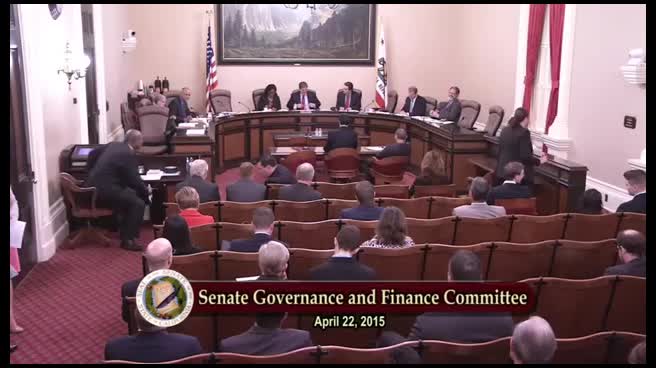 14MIN
Senate Standing Committee on Governance and Finance
Bill Author
Bill Co-Author(s):