SB 618: Educational apprenticeships: grant program.
- Session Year: 2015-2016
- House: Senate
- Latest Version Date: 2015-02-27
Existing law establishes the office of the Superintendent of Public Instruction, and specifies that the Superintendent is the ex officio Director of the State Department of Education. Under existing law, the State Department of Education administers numerous programs relating to elementary and secondary education.
This bill would establish a statewide grant program for educational apprenticeship programs under the administration of the Superintendent. The bill would require that a grant allocated by the Superintendent under this bill to be distributed on a competitive basis, subject to funding being made available in the annual Budget Act. The bill would specify certain criteria to be applied by the Superintendent to determine the competitive value of an application for a grant under the bill.
(a)The purpose of this article is to assist in the development of educational apprenticeship programs throughout the state by establishing a statewide grant program for those educational apprenticeship programs. A grant allocated by the Superintendent through this article shall be distributed on a competitive basis, subject to funding being made available in the annual Budget Act.
(b)At a minimum, both of the following criteria shall be applied by the Superintendent to determine the competitive value of an application made under this article:
(1)The apprenticeship program is new, and provides an innovative curriculum for its pupils.
(2)The apprenticeship program provides opportunities for, and clear pathways to, gainful employment in emerging industries that are relevant to the local economy.
|
Date
|
Status
|
|---|---|
| Feb 27, 2015 | Introduced. To Com. on RLS. for assignment. To print. |
| Mar 2, 2015 | From printer. May be acted upon on or after April 1. |
| Mar 2, 2015 | Read first time. |
| Mar 12, 2015 | Referred to Com. on ED. |
| Mar 20, 2015 | Set for hearing April 8. |
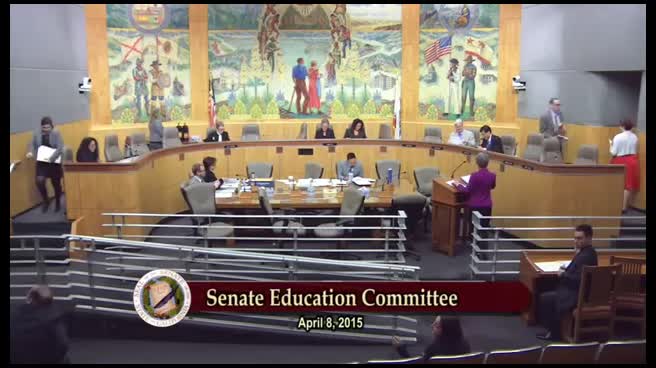
| Apr 8, 2015 | From committee: Do pass and re-refer to Com. on APPR. (Ayes 7. Noes 1. Page 522.) (April 8). Re-referred to Com. on APPR. |
| May 1, 2015 | Set for hearing May 11. |
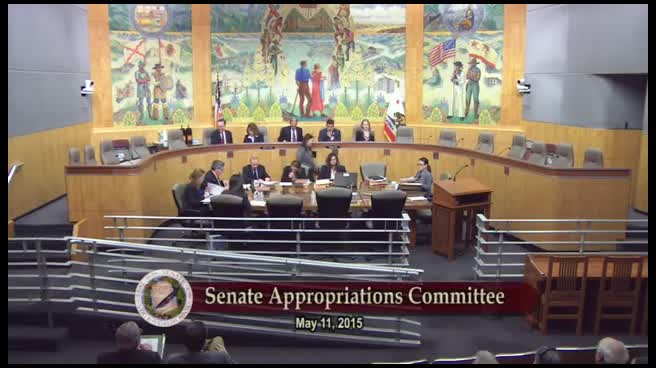
| May 11, 2015 | May 11 hearing: Placed on APPR. suspense file. |
| May 23, 2015 | Set for hearing May 28. |
| May 28, 2015 | May 28 hearing: Held in committee and under submission. |
| Feb 1, 2016 | Returned to Secretary of Senate pursuant to Joint Rule 56. |
|
Date
|
Description
|
Location
|
Votes
|
|
|---|---|---|---|---|
| May 11, 2015 | Placed on suspense file | Senate Standing Committee on Appropriations |
Passed |
|
| Apr 8, 2015 | Do pass, but first be re-referred to the Committee on [Appropriations] | Senate Standing Committee on Education |
Passed |
This list shows positions taken on this bill by organizations on the date displayed, which is linked to the original source.
Positions by individuals are not included.
|
Organization
|
Position
|
Date
|
|---|---|---|
| California School Boards Association | * Indeterminate | May 11, 2015 |
| California Teachers Association | * Indeterminate | May 11, 2015 |
| Small School Districts Association | * Against Unless Amend | Apr 8, 2015 |
| u Small School Districts' Association | * Against | Apr 8, 2015 |
SB 618 (Pavley) Page 3 of 3
SENATE COMMITTEE ON APPROPRIATIONS
Senator Ricardo Lara, Chair
2015 - 2016 Regular Session
SB 618 (Pavley) - Educational apprenticeships: grant program.
|
|
Version: February 27, 2015 |
Policy Vote: ED. 7 - 1 |
Urgency: No |
Mandate: No |
Hearing Date: May 11, 2015 |
Consultant: Jillian Kissee |
This bill meets the criteria for referral to the Suspense File.
Bill Summary:
This bill establishes a statewide competitive grant program for educational apprenticeship programs to be administered by the Superintendent of Public Instruction, contingent upon funding made available in the annual Budget Act.
Fiscal Impact:
Cost pressure: This bill results in a significant Proposition 98 General Fund cost pressure to fund the competitive grant program in the tens of millions. The 2015-16 Governor’s Budget proposes $37 million for existing apprenticeships.
State operations costs: The California Department of Education (CDE) estimates a need of about 1.5 positions at a cost of $222,000 General Fund to administer this program. This estimate could change, depending on the amount that may be available in the Budget Act and how many entities would apply.
Background:
The state authorizes and funds various workforce education and
training initiatives. Existing law establishes apprenticeship
training programs which are comprehensive plans that contain, among
other things, apprenticeship program standards, program regulations,
related and supplemental instruction course outlines, and policy
statements for the effective administration of that apprenticeship
training program. State funds provided for apprenticeships are
appropriated to the Chancellor’s Office of the California Community
Colleges (CCC) and passed through to local education agencies that
provide the instruction. Apprenticeships are paid education work
programs that pair adult students with skilled workers for
supervised, hands-on learning. Apprenticeships programs are commonly
sponsored by business or labor unions that help design and support
the programs. Program sponsors must partner with a school district
or community college and be approved by the Department of Industrial
Relations’ Division of Apprenticeship Standards to qualify for
related supplemental instruction funding. (Education Code § 79140
et. seq.)
Existing law establishes various career technical education (CTE) programs for public schools including Regional Occupational Center Programs (ROCP) that allow students from multiple schools or districts to participate in career technical training programs regardless of the geographical location of their residence in a county or region. Existing law authorizes the following types of ROCP operational models: county ROCP, joint powers agency ROCP, and single district ROCP. (Education Code § 52301 et. seq.)
AB 86
(Committee on Budget), Chapter 48, Statutes of 2013, created the
California Career Pathways Trust which provided one-time competitive
grants to school districts, county superintendents of school, charter
schools, and community college districts. The 2013 and 2014 budgets
provided a total of $500 million in Proposition 98 General Fund for
K-14 career pathways programs to support such things as funding
specialists in work-based learning to establish or enhance locally
defined career pathways programs
connecting education entities with business entities,
and establishing regional collaborative relationships with
business entities, community organizations, and local institutions of
postsecondary education.
Proposed Law:
This bill establishes a statewide grant program for educational apprenticeship programs, contingent upon funding made available in the annual Budget Act. This bill requires that California Department of Education (CDE) allocate an unspecified grant amount to be distributed on a competitive basis. At a minimum, CDE must apply the following two criteria in determining the competitive value of an application: (1) the program is new and provides an innovative curriculum for its students; and (2) the program provides opportunities for gainful employment in emerging industries that are relevant to the local economy.
Related Legislation:
SB 923 (Pavley, 2014) proposed to establish the Educational Apprenticeship Innovation Act whereby competitive grants would be awarded to applicant school districts, county offices of education, charter schools, and community colleges for purposes of promoting apprenticeships, pre-apprenticeships, and career pathways. This bill was vetoed with a message indicating that the bill creates a new and duplicative program that does not have an appropriation.
Chapter 48, Statutes of 2013 (AB 86, Committee on Budget) established the California Career Pathways Trust and appropriated $250 million in one-time competitive grants for its purposes.
Chapter
433, Statutes of 2012 (SB 1070, Steinberg) established the Career
Technical Education Pathways Program to improve linkages and career
technical education pathways between high schools and community
colleges.
Staff Comments:
This bill results in a significant Proposition 98 General Fund cost
pressure to fund the statewide competitive apprenticeship program.
The Governor’s Budget proposes a total of $37 million
for existing apprenticeships, an increase of $14 million over the
Budget Act of 2014. In addition, it proposes $15 million to support
the development of apprenticeships in high-demand occupations,
including healthcare, advanced manufacturing, information technology,
and jobs in renewable energy. Unlike the existing apprenticeship
funds, the Governor’s Budget proposes that these funds be used for
purposes other than reimbursing providers for related supplemental
instruction, such as aligning coursework and conducting studies to
determine regional needs for apprentices.
The author’s office indicates that this bill is modeled after the Governor’s Budget proposal.
SB 618 (Pavley) Page 4 of 4
SENATE COMMITTEE ON EDUCATION
Senator Carol Liu, Chair
2015 - 2016 Regular
Bill No: SB 618
Author: |
Pavley |
||
Version: |
February 27, 2015 Hearing Date: April 8, 2015 |
||
Urgency: |
No |
Fiscal: |
Yes |
Consultant: |
Lenin Del Castillo |
||
Subject: Educational apprenticeships: grant program
SUMMARY
This bill would establish a competitive educational apprenticeship program to be administered by the Superintendent of Public Instruction, subject to funding being made available in the annual Budget Act.
BACKGROUND
Existing law establishes apprenticeship training programs which are comprehensive plans that contain, among other things, apprenticeship program standards, program regulations, related and supplemental instruction course outlines, and policy statements for the effective administration of that apprenticeship training program. State funds provided for apprenticeships are appropriated to the Chancellor’s Office of the California Community Colleges (CCC) and passed through to local education agencies that provide the instruction. Apprenticeships are paid education work programs that pair adult students with skilled workers for supervised, hands-on learning. Apprenticeships programs are commonly sponsored by business or labor unions that help design and support the programs. Program sponsors must partner with a school district or community college and be approved by the state’s Division of Apprenticeship Standards to qualify for related supplemental instruction (RSI) funding. The CCC works closely with the division and workforce partners to direct funds to high quality apprenticeship programs meeting state standards. (Education Code § 79140 et. seq.)
Existing law establishes various career technical education (CTE) programs for public schools including Regional Occupational Center Programs (ROCP) that allow students from multiple schools or districts to participate in career technical training programs regardless of the geographical location of their residence in a county or region. Existing law authorizes the following types of ROCP operational models: county ROCP, joint powers agency ROCP, and a single district ROCP. (Education Code § 52301 et. seq.)
AB 86 (Committee on Budget), Chapter 48, Statutes of 2013, created the California Career Pathways Trust which provided one-time competitive grants to school districts, county superintendents of school, charter schools, and community college districts. The 2013 and 2014 budgets provided a total of $500 million in Proposition 98 General Fund for K-14 career pathways programs that accomplish the following:
Fund specialists in work-based learning, as defined in Section 51760.1 of the Education Code, to convene, connect, measure, or broker efforts to establish or enhance a locally defined career pathways program that connects school districts, county superintendents of schools, charter schools, and community colleges with business entities.
Establish regional collaborative relationships and partnerships with business entities, community organizations, and local institutions of postsecondary education.
Develop and integrate standards-based academics with a career-relevant, sequenced curriculum following industry-themed pathways that are aligned to high-need, high-growth, or emerging regional economic sectors.
Provide articulated pathways to postsecondary education aligned with regional economies.
ANALYSIS
This bill establishes the Education Apprenticeship Grant Program. Specifically, this bill:
Provides that the purpose of the program is to assist in the development of educational apprenticeship programs throughout the state.
Requires program grants to be allocated by the Superintendent of Public Instruction (SPI) on a competitive basis, subject to funding being made available in the annual Budget Act.
Requires both of the following criteria to be applied by the SPI to determine the competitive value of an application:
The apprenticeship program is new, and provides an innovative curriculum for its pupils.
The apprenticeship program provides opportunities for, and clear pathways to, gainful employment in emerging industries that are relevant to the local economy.
STAFF
COMMENTS
Need for the bill. According to the author’s office, youth unemployment is one of the most serious challenges to California’s economic recovery. Job prospects are especially dim for those who have not yet earned a college degree, those who do not plan on going to college, or who lack practical work experience. This lack of opportunity holds young people back from fully participating in society and can stunt professional and personal growth. The author’s office indicates that youth individuals need opportunities to learn vital job skills and succeed professionally and one of the most effective ways to equip young people with professional skills is to support educational apprenticeships as part of the school curriculum.
Apprentices. According to the Legislative Analyst Office’s Proposition 98 Education Analysis for the 2015-16 Budget, there are more than 50,000 apprentices in various trades. Specifically, in early 2015, California had 53,413 active apprentices in 47 trades, ranging from glazing to motion picture work. The most common apprenticeships are in the construction trades, providing training for carpenters, plumbers, and electricians. Apprenticeships in public safety, primarily for correctional workers and firefighters, are the second most common.
Status of funding. The 2014-15 Budget Act includes approximately $22.9 million in Proposition 98 General for apprenticeship related supplemental instruction (RSI). The 2015-16 Governor’s Budget proposes to increase this amount by $14 million, which would bring the total amount for existing apprenticeships to about $37 million. This increase is intended to restore apprenticeship slots to their pre-recession level and raise the RSI rate from $5.04 to $5.46 to match the community college noncredit hourly rate.
The 2015-16 Governor’s Budget also proposes $15 million in Proposition 98 General Fund to support the development of apprenticeships in high-demand occupations, including healthcare, advanced manufacturing, information technology, and jobs in renewable energy. Unlike the existing apprenticeship funds, the Governor’s Budget proposes that these funds be used for purposes other than reimbursing providers for related supplemental instruction (RSI), such as aligning coursework and conducting studies to determine regional needs for apprentices. The Committee may wish to consider whether the new grant program as proposed by this measure is necessary given that it duplicates much of what is proposed in the Governor’s Budget.
Related and previous legislation.
SB 923 (Pavley, 2014) proposed to establish the Educational Apprenticeship Innovation Act whereby competitive grants would be awarded to applicant school districts, county offices of education, charter schools, and community colleges for purposes of promoting apprenticeships, preapprenticeships, and career pathways. This bill was vetoed with the following veto message:
This bill would create the Educational Apprenticeship
Innovation Prize (EdPrize), a competitive grant program that would be
administered by the California Department of Education to promote
apprenticeship, pre-apprenticeship and career pathways between local
schools, community colleges, and local businesses.
While
the bill is intended to provide EdPrize applicants special
consideration under the California Career Pathways Trust, it instead
creates a new and duplicative program that does not have an
appropriation.
I share the author's sentiments about the
importance of apprenticeship programs. The state has invested $500
million dollars over the past two years to fund the Career Pathways
Trust. This investment of public funds encourages partnerships
between K-12 schools, community colleges and the business community,
and includes apprenticeship programs. I strongly encourage
apprenticeship programs to apply for the $250 million that is
currently available.
Chapter 48, Statutes of 2013 (AB 86, Committee on Budget) established the California Career Pathways Trust and appropriated $250 million in one-time competitive grants for its purposes.
Chapter 433, Statutes of 2012 (SB 1070, Steinberg) established the Career Technical Education Pathways Program to improve linkages and career technical education pathways between high schools and community colleges.
SUPPORT
None received.
OPPOSITION
Small School Districts’ Association
-- END --
Discussed in Hearing
 6MIN
Senate Standing Committee on Appropriations
 8MIN
Senate Standing Committee on Education
Bill Author

Bill Co-Author(s):