SB 665: Postsecondary education: preventing and addressing incidents of rape and sexual assault.
- Session Year: 2015-2016
- House: Senate
- Latest Version Date: 2015-05-06
Existing law, the Donahoe Higher Education Act, sets forth the missions and functions of Californias public segments of higher education and their respective institutions of higher education. Provisions of the act apply to the University of California only to the extent that the Regents of the University of California act, by appropriate resolution, to make them applicable. Among other things, the act requires the governing board of each community college district, the Trustees of the California State University, and the Regents of the University of California to adopt and implement a rape and sexual assault education program at each of their respective campuses or other facilities.
This bill would require the governing board of each community college district and the trustees, and as a condition of receiving state funds for student financial aid, the governing board of each independent postsecondary educational institution and the regents, to, among other things, enter into a contract with a local rape crisis center in order to designate an advocate, who is independent from the campus or university, to assist student victims following incidents of rape or sexual assault. The bill would require the Attorney General to establish a statewide Title IX Oversight Office, which would, among other things, serve as a point of contact for students who are dissatisfied with campus-based policies or investigative procedures designed to prevent or address incidents of rape or sexual assault. The bill would require the office to receive complaints from students regarding the students campuses noncompliance with Title IX of the Education Amendments of 1972. The bill would also authorize the oversight office to assess fines on a postsecondary educational institution that does not comply with its campus or systemwide policies, or state or federal laws, establish a process to investigate these complaints, and campus-based policies and investigative procedures regarding rape and sexual assault. The bill would further require all students enrolled at the California Community Colleges, the California State University, each independent postsecondary educational institution, and the University of California to receive information or to complete a form of annual training, electronic or in person, on rape and sexual assault awareness and prevention, and as specified. The bill would further require the California State University and University, the California Community Colleges, and as a condition of receiving state funds for student financial aid, each independent postsecondary educational institution institution, and the University of California, California to place a hold on each students the course registration of each student who does not complete required training by the end of the first term of the academic year until the student completes the training. The bill would further require informational posters containing specified information relating to rape and sexual assault to be placed in all buildings that are most frequented by students, including student housing and dining areas, the student union, and athletic facilities, on each campus of these institutions.
This bill would provide that compliance with its terms is a condition of receipt of state funds for financial assistance for the University of California and each independent postsecondary educational institution.
By imposing new duties on community college districts, this bill would impose a state-mandated local program.
The California Constitution requires the state to reimburse local agencies and school districts for certain costs mandated by the state. Statutory provisions establish procedures for making that reimbursement.
This bill would provide that, if the Commission on State Mandates determines that the bill contains costs mandated by the state, reimbursement for those costs shall be made pursuant to these statutory provisions.
Existing law, the Donahoe Higher Education Act, sets forth the missions and functions of Californias public segments of higher education and their respective institutions of higher education. Provisions of the act apply to the University of California only to the extent that the Regents of the University of California act, by appropriate resolution, to make them applicable. Among other things, the act requires the governing board of each community college district, the Trustees of the California State University, and the Regents of the University of California to adopt and implement a rape and sexual assault education program at each of their respective campuses or other facilities.
This bill would make nonsubstantive changes to a provision relating to the rape and sexual assault education program require the governing board of each community college district and the trustees, and as a condition of receiving state funds for student financial aid, the governing board of each independent postsecondary educational institution and the regents, to, among other things, enter into a contract with a local rape crisis center in order to designate an advocate, who is independent from the campus or university, to assist student victims following incidents of rape or sexual assault. The bill would require the Attorney General to establish a statewide Title IX Oversight Office, which would, among other things, serve as a point of contact for students dissatisfied with campus-based policies or investigative procedures designed to prevent or address incidents of rape or sexual assault. The bill would also authorize the oversight office to assess fines on a postsecondary educational institution that does not comply with its campus or systemwide policies, or state or federal laws, regarding rape and sexual assault. The bill would further require all students enrolled at the California Community Colleges, the California State University, each independent postsecondary educational institution, and the University of California to complete annual training, electronic or in person, on rape and sexual assault awareness and prevention, and would require the California State University and the California Community Colleges, and as a condition of receiving state funds for student financial aid, each independent postsecondary educational institution and the University of California, to place a hold on each students course registration until the student completes the training. The bill would further require informational posters containing specified information relating to rape and sexual assault to be placed in all buildings on each campus of these institutions.
By imposing new duties on community college districts, this bill would impose a state-mandated local program.
The California Constitution requires the state to reimburse local agencies and school districts for certain costs mandated by the state. Statutory provisions establish procedures for making that reimbursement.
This bill would provide that, if the Commission on State Mandates determines that the bill contains costs mandated by the state, reimbursement for those costs shall be made pursuant to these statutory provisions.
Existing law, the Donahoe Higher Education Act, sets forth the missions and functions of Californias public segments of higher education and their respective institutions of higher education. Provisions of the act apply to the University of California only to the extent that the Regents of the University of California act, by appropriate resolution, to make them applicable. Among other things, the act requires the governing board of each community college district, the Trustees of the California State University, and the Regents of the University of California to adopt and implement a rape and sexual assault education program at each of their respective campuses or other facilities.
This bill would make nonsubstantive changes to a provision relating to the rape and sexual assault education program.
(a)The governing board of each community college district, the Trustees of the California State University, the governing board of each independent postsecondary educational institution, and the Regents of the University of California shall enter into a contract with a local rape crisis center to designate an advocate, who is independent from the college or university, to provide immediate assistance for a victim, who is enrolled at one of their respective campuses, of rape or sexual assault. That assistance shall include, but not necessarily be limited to, accompanying the victim to the hospital and assisting with campus and criminal justice system reporting procedures.
67395.(a)It is the intent of the Legislature that the governing board of each community college district, the Trustees of the California State University, the governing board of each independent postsecondary educational institution, and the Regents of the University of California make available, on a 24-hour, 7-day-a-week basis, victim support services to assist a victim of rape or sexual assault who is enrolled at one of their respective campuses.
(b)(1)The Attorney General shall establish a statewide Title IX Oversight Office. This office shall have the following authority:
(A)The office shall serve as a point of contact for students who are dissatisfied with their the campus-based policies or investigative procedures designed to prevent or address incidents of rape and sexual assault at their respective campuses.
(B)The office shall receive complaints from students regarding the students campuses noncompliance with any aspect of Title IX of the Education Amendments of 1972 (20 U.S.C. Sec. 1681, et seq.).
(B)
(C)The office may assess fines on a postsecondary educational institution that does not comply with its campus or systemwide policies, or state or federal laws, relating to rape and sexual assault. establish a process to investigate campus-based policies and investigative procedures relating to rape and sexual assault and complaints filed pursuant to subparagraph (B).
(C)
(D)The office shall receive an annual deidentified report on the total number of, the campus-based investigative timeliness for, and the outcomes of campus-based investigations regarding, whether criminal charges were filed for, and the outcomes of criminal proceedings regarding, incidents of rape and sexual assault that involve students who are enrolled at a campus of the California Community Colleges, the California State University, independent postsecondary educational institutions, or the University of California. The office may investigate these institutions policies, procedures, or campus-based investigations following an incident of rape or sexual assault and make recommendations to the Attorney General, district attorney, or city attorney, as appropriate, to the extent doing so is in compliance with state and federal law.
(2)The governing board of each community college district, the Trustees of the California State University, the governing board of each independent postsecondary educational institution, and the Regents of the University of California shall annually report to the Title IX Oversight Office each incident of rape or sexual assault that involves one or more of their respective enrolled students students, the number of those incidents that were investigated by the institution, the timelines and outcomes of those investigations, the sanctions that were imposed by the institution on students who were involved, whether criminal charges were filed as to those incidents, and the outcomes of those criminal proceedings for purposes of subparagraph (C) (D) of paragraph (1).
(c)(1)(A)Each incoming freshman, transfer, and graduate student who is enrolled at a campus of the California Community Colleges, the California State University, the University of California, or an independent postsecondary educational institution shall shall, at the commencement of the academic year, complete annual comprehensive training, electronic or in person, on rape and sexual assault awareness and prevention. The training shall include, but not be limited to, the contact information for the independent advocate who is designated pursuant to subdivision (a).
(B)Each resident assistant, member of a fraternity or sorority, and student athlete, who is enrolled at a campus of the California Community Colleges, the California State University, the University of California, or an independent postsecondary educational institution, shall, at the commencement of each academic year, complete comprehensive training, electronic or in person, on rape and sexual assault awareness and prevention.
(C)Each student, not described in subparagraph (B), who is enrolled at a campus of the California Community Colleges, the California State University, the University of California, or an independent postsecondary educational institution shall annually receive information or complete refresher training, electronic or in person, on rape and sexual assault awareness and prevention.
(D)No student shall be required to complete the comprehensive training pursuant to subparagraphs (A) and (B) or the refresher training pursuant to subparagraph (C) more than once in the same academic year. No student shall be required to complete the comprehensive and refresher training in the same academic year.
(2)A student who does not complete the training described in paragraph (1) by the end of the first term of the academic year shall have his or her course registration placed on hold until he or she completes the training.
(d)The governing board of each community college district, the Trustees of the California State University, the governing board of independent postsecondary educational institutions, and the Regents of the University of California shall ensure that each of their respective campuses place informational posters in all buildings that buildings that are most frequented by students, including student housing and dining areas, the student union, and athletic facilities. These informational posters shall contain all of the following information:
(1)Summaries of the campus policies on rape and sexual assault.
(2)Contact information for police and campus and local rape and crisis center offices or representatives who respond to incidents of rape and sexual assault.
(3)Campus, civil, and criminal penalties for committing acts of rape and sexual assault.
(4)References to the Jeanne Clery Disclosure of Campus Security Policy and Campus Crime Statistics Act (20 U.S.C. Sec. 1092(f)(1) and (5)), Title IX of the Education Amendments of 1972 (20 U.S.C. Sec. 1681 et seq.), and other relevant state and federal laws and regulations.
(e)As a condition of receiving state funds for financial assistance, each independent postsecondary educational institution and the University of California shall comply with the requirements of this chapter.
SEC. 2.If the Commission on State Mandates determines that this act contains costs mandated by the state, reimbursement to local agencies and school districts for those costs shall be made pursuant to Part 7 (commencing with Section 17500) of Division 4 of Title 2 of the Government Code.
(a)The governing board of each community college district, the Trustees of the California State University, the governing board of each independent postsecondary educational institution, and the Regents of the University of California shall enter into a contract with a local rape crisis center to designate an advocate, who is independent from the college or university, to provide immediate assistance for a victim, who is enrolled at one of their respective campuses, of rape or sexual assault. That assistance shall include, but not necessarily be limited to, accompanying the victim to the hospital and assisting with campus and criminal justice system reporting procedures.
(b)(1)The Attorney General shall establish a statewide Title IX Oversight Office. This office shall have the following authority:
(A)The office shall serve as a point of contact for students dissatisfied with their campus-based policies or investigative procedures designed to prevent or address incidents of rape and sexual assault.
(B)The office may assess fines on a postsecondary educational institution that does not comply with its campus or systemwide policies, or state or federal laws, relating to rape and sexual assault.
(C)The office shall receive an annual deidentified report on the total number of, the campus-based investigative timeliness for, and the outcomes of campus-based investigations regarding, incidents of rape and sexual assault that involve students who are enrolled at a campus of the California Community Colleges, the California State University, independent postsecondary educational institutions, or the University of California. The office may investigate these institutions policies, procedures, or campus-based investigations following an incident of rape or sexual assault and make recommendations to the Attorney General, district attorney, or city attorney, as appropriate, to the extent doing so is in compliance with state and federal law.
(2)The governing board of each community college district, the Trustees of the California State University, the governing board of each independent postsecondary educational institution, and the Regents of the University of California shall report to the Title IX Oversight Office each incident of rape or sexual assault that involves one or more of their respective enrolled students for purposes of subparagraph (C) of paragraph (1).
(c)(1)Each student enrolled at a campus of the California Community Colleges, the California State University, the University of California, or an independent postsecondary educational institution shall complete annual training, electronic or in person, on rape and sexual assault awareness and prevention. The training shall include, but not be limited to, the contact information for the independent advocate who is designated pursuant to subdivision (a).
(2)A student who does not complete the training described in paragraph (1) shall have his or her course registration placed on hold until he or she completes the training.
(d)The governing board of each community college district, the Trustees of the California State University, the governing board of independent postsecondary educational institutions, and the Regents of the University of California shall ensure that each of their respective campuses place informational posters in all buildings that contain all of the following information:
(1)Summaries of the campus policies on rape and sexual assault.
(2)Contact information for police and campus and local rape and crisis center offices or representatives who respond to incidents of rape and sexual assault.
(3)Campus, civil, and criminal penalties for committing acts of rape and sexual assault.
(4)References to the Jeanne Clery Disclosure of Campus Security Policy and Campus Crime Statistics Act (20 U.S.C. Sec. 1092(f)(1) and (5)), Title IX of the Education Amendments of 1972 (20 U.S.C. Sec. 1681 et seq.), and other relevant state and federal laws and regulations.
(e)As a condition of receiving state funds for financial assistance, each independent postsecondary educational institution and the University of California shall comply with the requirements of this chapter.
SEC. 2.If the Commission on State Mandates determines that this act contains costs mandated by the state, reimbursement to local agencies and school districts for those costs shall be made pursuant to Part 7 (commencing with Section 17500) of Division 4 of Title 2 of the Government Code.
SECTION 1.Section 67391 of the Education Code is amended to read:67391.The governing board of each community college district, the Trustees of the California State University, the Board of Directors of the Hastings College of the Law, and the Regents of the University of California shall, using existing resources, adopt and implement a rape and sexual assault education program for, and ensure the maximum feasible participation of, students and student services professional staff members or student affairs professional staff members at each of their respective campuses or other facilities.
The governing board of each community college district, the Trustees of the California State University, the Board of Directors of the Hastings College of the Law, and the Regents of the University of California shall, within using existing resources, adopt and implement a rape and sexual assault education program for, and ensure the maximum feasible participation of, students and student services professional staff members or student affairs professional staff members at each of their respective campuses or other facilities.
|
Date
|
Status
|
|---|---|
| Feb 27, 2015 | Introduced. To Com. on RLS. for assignment. To print. |
| Mar 2, 2015 | From printer. May be acted upon on or after April 1. |
| Mar 2, 2015 | Read first time. |
| Mar 12, 2015 | Referred to Com. on RLS. |
| Apr 6, 2015 | From committee with author's amendments. Read second time and amended. Re-referred to Com. on RLS. |
| Apr 16, 2015 | Re-referred to Com. on ED. |
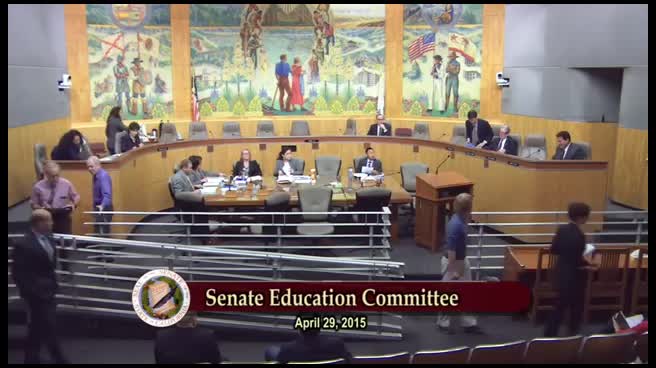
| Apr 17, 2015 | Set for hearing April 29. |
| May 5, 2015 | From committee: Do pass as amended and re-refer to Com. on APPR. (Ayes 7. Noes 0. Page 815.) (April 29). |
| May 5, 2015 | From committee: Do pass as amended and re-refer to Com. on APPR. (Ayes 7. Noes 0.) (April 29). |
| May 6, 2015 | Read second time and amended. Re-referred to Com. on APPR. |
| May 8, 2015 | Set for hearing May 18. |
| May 18, 2015 | May 18 hearing: Placed on APPR. suspense file. |
| May 23, 2015 | Set for hearing May 28. |
| May 28, 2015 | May 28 hearing: Held in committee and under submission. |
| Feb 1, 2016 | Returned to Secretary of Senate pursuant to Joint Rule 56. |
|
Date
|
Description
|
Location
|
Votes
|
|
|---|---|---|---|---|
| May 18, 2015 | Placed on suspense file | Senate Standing Committee on Appropriations |
Passed |
|
| Apr 29, 2015 | Do pass as amended, but first amend, and re-refer to the Committee on [Appropriations] | Senate Standing Committee on Education |
Passed |
This list shows positions taken on this bill by organizations on the date displayed, which is linked to the original source.
Positions by individuals are not included.
|
Organization
|
Position
|
Date
|
|---|---|---|
| Association of Independent California Colleges and Universities | * Indeterminate | Apr 29, 2015 |
| California State Student Association | * Indeterminate | Apr 29, 2015 |
| Center for Community Solutions | ** Support | Apr 29, 2015 |
| Peace Over Violence | ** Support | Apr 29, 2015 |
| u None received. | ** Against | Apr 29, 2015 |
| UC Student Association | * Indeterminate | Apr 29, 2015 |
| University of California | * Indeterminate | Apr 29, 2015 |
| Women Give San Diego | ** Support | Apr 29, 2015 |
SB 665 (Block) Page 4 of 4
SENATE COMMITTEE ON APPROPRIATIONS
Senator Ricardo Lara, Chair
2015 - 2016 Regular Session
SB 665 (Block) - Postsecondary education: preventing and addressing incidents of rape and sexual assault
|
|
Version: May 6, 2015 |
Policy Vote: ED. 7 - 0 |
Urgency: No |
Mandate: Yes |
Hearing Date: May 18, 2015 |
Consultant: Jillian Kissee |
This bill meets the criteria for referral to the Suspense File.
Bill Summary:
This bill requires, as a condition of receiving state funds for financial assistance, (1) the Attorney General to establish a statewide Title IX Oversight Office; (2) postsecondary educational institutions to report specific data to this office; (3) each student to complete training on rape and sexual assault awareness and prevention annually; and (4) informational posters to be placed in buildings that are most frequented by students.
Fiscal Impact:
Significant state costs of up to approximately $10 million. These costs are attributable to reimbursable state mandated costs for activities required of the California Community Colleges (CCC) and the establishment of the Attorney General’s Title IX Oversight Office required by this bill. See staff comments.
Cost pressure at each independent postsecondary educational institution to make available, 24-hour, 7-day per week victim support services to assist victims of rape or sexual assault.
Background:
Federal Law
The federal Jeanne Clery Disclosure of Campus Security Policy and Campus Crime Statistics Act (Clery Act) requires public and private postsecondary educational institutions that receive federal financial aid to disclose information about crimes on and around campuses as well as establish certain rights for victims of sexual assault. The Clery Act requires institutions to collect and classify county crime statistics, publish an Annual Security Report with crime statistics and security policies, and report crime statistics to the United States Department of Education. The Clery Act requires reporting of crimes in seven major categories.
The
2013 reauthorization of the federal Violence Against Women Act, which
includes the Campus Sexual Violence Elimination Act, amended the
Clery Act to, among other things, require postsecondary institutions
to offer prevention and awareness programs to new students and
employees regarding rape, domestic and dating violence, sexual
assault, and stalking. Institutions are also required to compile
statistics of incidents of sexual assault, domestic violence, dating
violence and stalking. This Act also requires the Annual Security
Report to contain additional information such as prevention programs,
procedures once incidents are reported, and possible sanctions
following an institutional disciplinary procedure.
State Law
Current
state law requires postsecondary institutions to adopt a policy
concerning campus sexual violence, domestic violence, dating violence
and stalking that includes specified components, including the
affirmative consent standard. (Education Code § 67386)
It also
requires postsecondary intuitions, including Hastings College of the
Law, to each adopt and implement at each campus or other facilities,
a written procedure or protocols to ensure, to the fullest extent
possible, that students, faculty and staff who are victims of sexual
assault committed on grounds maintained by the institution or
affiliated student organizations receive treatment and information.
(EC § 67385)
Current law requires the governing board of each community college district and the Trustees of the California State University, and requests the Regents of the University of California, in collaboration with campus and community-based victim advocacy organizations, to provide educational and preventive information about sexual violence as part of campus orientations. (EC § 67385.7)
Each campus of the California Community Colleges and the California State University are required, and each campus of the University of California is requested, to post sexual violence prevention and education information on its campus website. The information must include specific components including dating violence, rape, sexual assault, domestic violence and stalking crimes, how to file a complaint, and the availability and contact information for resources for victims. (EC § 67385.7)
Finally, each campus of the California Community Colleges and the California State University are required, and each campus of the University of California is requested, to develop policies to encourage students to report any campus crimes involving sexual violence. (EC § 67385.7)
Proposed Law:
This bill includes legislative intent that each public and independent postsecondary educational institution make available, 24-hour, 7-day per week victim support services to assist a victim of rape or sexual assault who is enrolled at one of their respective campuses.
This bill requires the Attorney General to establish a statewide Title IX Oversight Office to serve as a point of contact for students who are dissatisfied with the campus-based policies or investigative procedures designed to prevent or address incidents of rape and sexual assault at their respective campuses. The office is required to receive complaints from students regarding their campus’ noncompliance with any aspect of Title IX of the Education Amendments of 1972 (20 U.S.C. Sec. 1681, et seq.). The office is authorized to establish a process to investigate campus-based policies and investigative procedures related these complaints.
This
bill requires postsecondary educational institutions to annually
report to the Title IX Oversight Office the following:
Each incident of rape or sexual assault that involves one or more of their respective enrolled students;
The number of those incidents that were investigated by the institution;
The timelines and outcomes of those investigations;
The sanctions that were imposed by the institution on students who were involved;
Whether criminal charges were filed; and
The outcomes of those criminal proceedings.
The
bill authorizes the Title IX Oversight Office to investigate the
institutions’ policies, procedures, or campus-based investigations
following an incident of rape or sexual assault and make
recommendations to the Attorney General, district attorney, or city
attorney, as appropriate, to the extent that doing so is in
compliance with state and federal law.
This bill also requires that at the beginning of the year, each incoming student of a postsecondary educational institution complete comprehensive training on rape and sexual assault awareness and prevention. Specified students, such as student athletes and members of fraternities or sororities, are required to take this training at the beginning of every academic year. All other students are required to complete a refresher training annually. If these trainings are not completed by the end of the first term of the academic year, the student will not be able to register for courses until the training is completed.
Finally this bill requires institutions to ensure that each of their respective campuses place informational posters in buildings that are most frequented by students that include: (1) summaries of the campus’ policies on rape and sexual assault; (2) contact information for police and campus and local rape and crisis center offices who respond to incidents of rape and sexual assault; (3) campus, civil, and criminal penalties for committing these acts; and references to the Clery Act and other relevant law.
Related Legislation:
AB 967 (Williams, 2015) establishes minimum disciplinary standards and reporting requirements for sexual assault complaints received by community colleges, CSU, UC and independent postsecondary educational institutions, including reporting specific to complaints involving sexual assault, domestic violence, dating violence and stalking. AB 967 is pending in the Assembly Appropriations Committee.
SB 967 (De León, Ch. 748, 2014) requires the governing board of each community college district, the Trustees of the California State University, the Regents of the University of California, and the governing boards of independent postsecondary institutions to adopt a policy concerning campus sexual violence, domestic violence, dating violence and stalking that includes specified components.
AB 1433 (Gatto, Ch. 798, 2014) requires governing boards of each public and private postsecondary educational institution to adopt and implement policies and procedures to ensure that any report of a violent crime (as specified), sexual assault, or hate crime is immediately forwarded to the appropriate law enforcement agency.
Staff Comments: The
following are anticipated costs that will be incurred by the entities
impacted by this bill.
Department
of Justice (DOJ): The
DOJ indicates that the requirement for the Attorney General to
establish a Title IX Oversight Office and carry out required
activities would cost between $1 million to $2 million annually for
10 positions.
CCC: The CCC indicates that this bill would increase costs ranging from $6.6 million to $8 million and these costs would be reimbursable if the Commission on State Mandates deemed the requirements to be a reimbursable state mandate. Most of these costs are attributable to additional staffing to enforce the registration hold for students that fail to complete the required training as well as implementing the specified training statewide.
CSU: The CSU indicates that it is already implementing the training requirements of this bill. Additional activities required by this bill such as reporting to the Attorney General and the creation and dissemination of posters are expected to be minor and absorbable.
UC: The UC indicates that this bill largely reflects existing efforts. However, in their view, it is unclear how the university might have to work with the new Attorney General’s office and not enough information exists to be able to identify specific costs associated with that workload.
All Segments: The bill’s legislative intent that each of the state’s postsecondary educational institutions make victim support services available 24-hours per day and 7 days per week, creates a major cost pressure to do so.
-- END --
SB 665 (Block) Page 8 of 8
SENATE COMMITTEE ON EDUCATION
Senator Carol Liu, Chair
2015 - 2016 Regular
Bill No: SB 665
Author: |
Block |
||
Version: |
April 6, 2015 Hearing Date: April 29, 2015 |
||
Urgency: |
No |
Fiscal: |
Yes |
Consultant: |
Lynn Lorber |
||
Subject: Postsecondary education: preventing and addressing incidents of rape and …………..sexual assault
SUMMARY
This bill requires the Attorney General to establish a statewide Title IX Oversight Office, requires postsecondary educational institutions to report specific data to this office, requires each student to complete training on rape and sexual assault awareness and prevention annually. This bill also requires postsecondary educational institutions to enter into a contract with a local rape crisis center to provide immediate assistance for a victim.
BACKGROUND
Existing federal law
The federal Jeanne Clery Disclosure of Campus Security Policy and Campus Crime Statistics Act (Clery Act) requires public and private postsecondary educational institutions that receive federal financial aid to disclose information about crimes on and around campuses as well as establish certain rights for victims of sexual assault. The Clery Act requires institutions to collect, classify and county crime statistics, publish an Annual Security Report with crime statistics and security policies, and report crime statistics to the United States Department of Education. The Clery Act requires reporting of crimes in seven major categories, some with significant sub-categories and conditions, including crimes involving forcible and non-forcible sex offenses.
The 2013 reauthorization of the federal Violence Against Women Act, which includes the Campus Sexual Violence Elimination Act, amended the Clery Act to, among other things, require postsecondary institutions to offer prevention and awareness programs to new students and employees regarding rape, domestic and dating violence, sexual assault, and stalking. Institutions are also required to compile statistics of incidents of sexual assault, domestic violence, dating violence and stalking. This Act also requires the Annual Security Report to contain additional information such as prevention programs, procedures once incidents are reported, and possible sanctions following an institutional disciplinary procedure. The final rule implementing changes to the Clery Act was issued in October 2014, and is effective July 1, 2015.
State law
Current law requires:
The governing board of each community college district, the Trustees of the California State University, the Regents of the University of California, and the governing board of independent postsecondary institutions to adopt a policy concerning campus sexual violence, domestic violence, dating violence and stalking that includes specified components, including the affirmative consent standard. (Education Code § 67386)
The governing board of each community college district, the Trustees of the California State University, the Board of Directors of the Hastings College of the Law, and the Regents of the University of California to each adopt and implement at each campus or other facilities, a written procedure or protocols to ensure, to the fullest extent possible, that students, faculty and staff who are victims of sexual assault committed on grounds maintained by the institution or affiliated student organizations receive treatment and information. (EC § 67385)
The governing board of each community college district and the Trustees of the California State University, and requests the Regents of the University of California, in collaboration with campus and community-based victim advocacy organizations, to provide educational and preventive information about sexual violence as part of campus orientations. (EC § 67385.7)
Each campus of the California Community Colleges and the California State University, and requests each campus of the University of California, to post sexual violence prevention and education information on its campus website. The information must include specific components including dating violence, rape, sexual assault, domestic violence and stalking crimes, how to file a complaint, and the availability and contact information for resources for victims. (EC § 67385.7)
Each campus of the California Community Colleges and the California State University, and requests each campus of the University of California, to develop policies to encourage students to report any campus crimes involving sexual violence. (EC § 67385.7)
ANALYSIS
This bill requires postsecondary educational institutions to enter into a contract with a local rape crisis center to provide immediate assistance for a victim. This bill requires the Attorney General to establish a statewide Title IX Oversight Office, requires postsecondary educational institutions to report specific data to this office. This bill also requires each student to complete training on rape and sexual assault awareness and prevention annually. Specifically, this bill:
Rape Crisis Center
Requires the governing board of each community college district, the Trustees of the California State University, the governing board of each independent postsecondary educational institution, and the Regents of the University of California to enter into a contract with a local rape crisis center to designate an advocate, who is independent from the college or university, to provide immediate assistance for a victim of rape or sexual assault who is enrolled at one of the campuses.
Requires the assistance to include, but not be limited to, accompanying the victim to the hospital and assisting with campus and criminal justice system reporting procedures.
Statewide Title IX Oversight Office
Requires the Attorney General to establish a statewide Title IX Oversight Office (office), with the following authority:
Requires the office to serve as a point of contact for students dissatisfied with their campus-based policies or investigative procedures designed to prevent or address incidents of rape and sexual assault.
Authorizes the office to assess fines on a postsecondary educational institution that does not comply with its campus or systemwide policies, or state or federal laws, relating to rape and sexual assault.
Requires the office to receive an annual de-identified report on the total number of campus-based investigations, the timelines for investigations, and the outcomes of investigations regarding incidents of rape and sexual assault that involve students.
Authorizes the office to investigate the policies, procedures, or investigations of the postsecondary educational institutions following an incident of rape or sexual assault and make recommendations to the Attorney General, district attorney, or city attorney, to the extent doing so is in compliance with state and federal law.
Requires the governing boards of postsecondary educational institutions to report to the office each incident of rape or sexual assault that involves one or more of their enrolled students.
Annual training of students
Requires each student enrolled at a campus of the California Community Colleges, the California State University, the University of California, or an independent postsecondary educational institution to complete annual training, electronically or in person, on rape and sexual assault awareness and prevention.
Requires the training to include, but not be limited to, the contract information for the independent advocate who is designated to provide immediate assistance for a victim.
Requires a hold to be placed on the registration of a student who does not complete the training, until the student completes the training.
Placement of informational posters
Requires postsecondary educational institutions to ensure that each campus places informational posters in all buildings, that contain all of the following information:
Summaries of the campus’ policies on rape and sexual assault.
Contact information for police and campus and local rape and crisis center offices or representatives who respond to incidents of rape and sexual assault.
Campus, civil, and criminal penalties for committing acts of rape and sexual assault.
References to the federal Jeanne Clary Disclosure of Campus Security Policy and Campus Crime Statistics Act, Title IX, and other relevant state and federal laws and regulations.
Condition of receiving state funds
Requires each independent postsecondary educational institution and the University of California to comply with the requirements of this bill as a condition of receiving state funds for financial assistance.
STAFF COMMENTS
Need for the bill. According to the author, “The college campus is a place where students should be free to learn and grow without the fear of violence. Unfortunately, a shocking number of students are victimized by sexual assault in their collegiate careers. Recent legislative efforts in both the Assembly and Senate have targeted sexual assault, and SB 665 builds on that work. This legislation is necessary to provide important training to college students, additional resources for sexual assault survivors, and more rigorous oversight of campus Title IX enforcement and reporting.”
Author’s amendments. The author wishes to amend this bill as follows:
Delete the requirement that postsecondary educational institutions contract with a local rape crisis center for an independent advocate, and instead state legislative intent that victim support services be available to victims of sexual assault on a 24 hour, 7 day-a-week basis.
Clarify that a “dissatisfied” student who contacts the Attorney General’s office is filing a complaint regarding non-compliance with Title IX, and that complaints may cover all aspects of Title IX (any discrimination on the basis of sex).
Clarify that postsecondary educational institutions are to report annually to the Attorney General, and the Attorney General is to receive, the total number (each) of incidents of rape or sexual assault reported to a campus, the number of incidents that were investigated by the institution, the timelines and outcomes of those investigations, the sanctions imposed by the institution upon any students involved in the incidents, whether criminal charges were filed, and the result of any criminal proceedings.
Limit the scope of student training to initial training for incoming students (freshmen, transfers, and graduate students) as part of orientation, annual refresher training or information for all students, and annual training for resident assistants, members of fraternities and sororities, and athletes.
Clarify that a hold may not be placed on a student’s registration for the first term of the academic year.
Delete the authority for the Attorney General to assess fines and instead authorize the Attorney General to establish a process to investigate complaints, campus policies and procedures, and investigations.
Limit the requirement to post information to buildings most frequented by students, such as student housing and dining, the student union, and athletics facilities.
Student training. Current law requires the California Community Colleges, the California State University, and requests the University of California to provide educational and preventive information about sexual violence as part of campus orientations.
The University of California (UC) updated policies relative to sexual harassment and violence effective February 25, 2014. Among other things, the UC provides prevention education programs to all incoming students and ongoing prevention and awareness campaigns to the University community to promote awareness of rape and acquaintance rape, domestic violence, dating violence, sexual assault, and stalking, including the definition of consent, options for bystander intervention, and risk reduction awareness information. Policies also require the identification of on- and off-campus resources for reporting sexual harassment or sexual violence, including law enforcement, medical, and victim support services. http://policy.ucop.edu/doc/4000385/SHSV
The California State University (CSU) updated policies that are effective June 2015, including the requirement that each campus provide prevention and awareness programs for all new students, refresher programs at least annually
for
all students, twice a year for all students who serve as advisors in
residence halls, annually for all student members of fraternities and
sororities, and annually for all student athletes.
According
to the University of Southern California, the campus provides sexual
assault training as part of freshman orientation and incorporates
refresher courses throughout the school year for dormitory residents
and campus organizations (fraternities, sororities and athletes).
This bill requires students to complete training on rape
and sexual assault awareness and prevention, but does not prescribe
components of this training other than the inclusion of the contact
information for the independent rape crisis advocate (the section of
this bill related to the independent rape crisis advocate is being
removed from the bill). It is not clear that the contents of
training as required by this bill would necessarily differ from
existing practices that are included in orientation for incoming
students.
This bill, as proposed to be amended, exceeds
current training requirements by:
Imposing these requirements on students attending the UC and independent universities.
Requiring all incoming students to receive the training annually (currently information must be included as part of orientation).
Requiring annual training for resident assistants, members of fraternities and sororities, and athletes.
Requiring returning students to complete refresher training or receive information.
Requiring institutions to place a hold on the registration of students who do not complete the training.
Registration hold. The University of California at Berkeley (UC Berkeley) requires, beginning with the Fall 2014, all new undergraduate students (freshmen and transfers) to complete training in sexual assault/violence prevention. UC Berkeley requires students to complete this training by October 1, or risk having a hold placed on registration in the Spring term. http://survivorsupport.berkeley.edu/education-requirement
The author’s amendments include clarification that a hold may be placed on a student’s registration only for the second or Spring term of the academic year, addressing concerns that registration holds at the beginning of the school year may jeopardize students’ eligibility for financial aid.
Existing reporting requirements. Federal law requires postsecondary educational institutions to compile general statistics of incidents of sexual assault, domestic violence, dating violence and stalking. Each institution’s Annual Security Report must also contain information such as prevention programs, procedures once incidents are reported, and possible sanctions following an institutional disciplinary procedure.
Federal legislation proposes the Campus Accountability and Safety Act, which includes reporting requirements that are similar to those proposed by this bill, such as the number of incidents reported to the Title IX coordinator, the number of cases processes through the student disciplinary process, and a description of the final sanction, if any was imposed.
Attorney General’s office. The Attorney General’s office currently has an active role in the implementation of recently-enacted statutory requirements that campuses report incidents of Part 1 violent crimes, hate crimes, or sexual assault, and the adoption of policies that include affirmative consent and use of the preponderance of evidence standard. The Attorney General’s office is drafting a campus sexual assault and violence model Memorandum of Understanding to meet recently-enacted requirements for campuses to coordinate with law enforcement in the prevention, reporting and resolution of incidents of campus sexual assault.
The Attorney General’s office does not currently have a role in the enforcement of Title IX compliance. There is no state-level governmental entity that addresses Title IX complaints lodged by postsecondary students. Students seeking remedy beyond the campus or system level must turn to the federal Office of Civil Rights.
This bill authorizes the Attorney General to assess fines on postsecondary educational institutions that do not comply with policies or laws relating to rape and sexual assault. It appears that the Attorney General’s office does not currently possess the authority to assess fines in any regard. The author’s amendments delete the authority to assess fines and instead authorize the Attorney General to establish a process to investigate complaints, campus policies and procedures, and investigations.
The author may wish to consider clarifying how to avoid duplicative or conflicting concurrent investigations if a complaint is filed with both the Attorney General and the federal Office of Civil Rights.
Posting. Current law requires each community college and CSU campus, and requests each campus of the University of California, to post sexual violence prevention and education information on its campus website. This bill requires informational posters to be placed in all buildings on all campuses. The author’s amendments clarify that the posting of information is limited to buildings most frequented by students, such as student housing and dining, the student union, and athletics facilities.
Impact on community colleges. This bill imposes significant mandated costs upon community colleges by requiring training for students and reporting of information regarding incidents of sexual assault that exceed current law.
Related and prior legislation.
RELATED LEGISLATION
AB 967 (Williams, 2015) establishes minimum disciplinary standards and reporting requirements for sexual assault complaints received by community colleges, CSU, UC and independent postsecondary educational institutions, including reporting specific to complaints involving sexual assault, domestic violence, dating violence and stalking. AB 967 is pending in the Assembly Appropriations Committee.
PRIOR LEGISLATION
SB 967 (De León, Ch. 748, 2014) requires the governing board of each community college district, the Trustees of the California State University, the Regents of the University of California, and the governing board of independent postsecondary institutions to adopt a policy concerning campus sexual violence, domestic violence, dating violence and stalking that includes specified components.
AB 1433 (Gatto, Ch. 798, 2014) requires governing boards of each public and private postsecondary educational institution to adopt and implement policies and procedures to ensure that any report of a Part 1 violent crime, sexual assault, or hate crime is immediately forwarded to the appropriate law enforcement agency.
SUPPORT
Center for Community Solutions
Peace Over Violence
Women Give San Diego
OPPOSITION
None received.
-- END --
Bill Author

Bill Co-Author(s):