SB 891: Personal income tax: standard deduction.
- Session Year: 2015-2016
- House: Senate
- Latest Version Date: 2016-03-15
The Personal Income Tax Law authorizes a taxpayer to take, as a deduction, the larger of the itemized deductions or the standard deduction and provides an adjustment for inflation for that standard deduction. For the 2015 taxable year, the standard deduction for a taxpayer who is a single filer, married filing separately, or a registered domestic partner filing separately is $4,044 and for a head of household, surviving spouse, or taxpayers who are married filing jointly or registered domestic partners filing jointly, the standard deduction is $8,088.
This bill, for taxable years beginning on or after January 1, 2016, would increase the current standard deduction amount by 25% and would continue to adjust that amount for inflation.
This bill would take effect immediately as a tax levy.
Existing law, the Uniform Commercial CodeLeases, governs the various aspects of leases of personal property, including their formation, construction, effect, and performance. Existing law provides than an agreement modifying a lease contract does not need consideration in order to be binding.
This bill would make nonsubstantive changes to those provisions.
(a)A For taxable years beginning on or after January 1, 2016, a taxpayer may elect to take a standard deduction as follows:
(1)In the case of a taxpayer, other than a head of a household or a surviving spouse (as defined in Section 17046) or a married couple filing a joint return, the standard deduction shall be one thousand eight hundred eighty dollars ($1,880). five thousand fifty-five dollars ($5,055).
(2)In the case of a head of household or a surviving spouse (as defined in Section 17046) or a married couple filing a joint return, the standard deduction shall be three thousand seven hundred sixty dollars ($3,760). ten thousand one hundred ten dollars ($10,110).
(b)The standard deduction provided for in subdivision (a) shall be in lieu of all deductions other than those which are to be subtracted from gross income in computing adjusted gross income under Section 17072.
(c)(1)The provisions of this section shall be applied in lieu of the provisions of Sections 63(c) and 63(f) of the Internal Revenue Code, relating to standard deductions.
(2)Notwithstanding paragraph (1), Section 63(c)(5) of the Internal Revenue Code, relating to limitations on the standard deduction of certain dependents, and Section 63(c)(6)of 63(c)(6) of the Internal Revenue Code, relating to certain individuals not eligible for the standard deduction, shall apply, except as otherwise provided. For purposes of this paragraph, the amount specified in Section 63(c)(5) of the Internal Revenue Code shall be adjusted for inflation in accordance with the provisions of Section 63(c)(4) of the Internal Revenue Code.
(d)For each taxable year beginning on or after January 1, 1988, 2017, the Franchise Tax Board shall recompute the standard deduction amounts prescribed in subdivision (a). That computation shall be made as follows:
(1)The California Department of Industrial Relations shall transmit annually to the Franchise Tax Board the percentage change in the California Consumer Price Index for all items from June of the prior calendar year to June of the current calendar year, no later than August 1 of the current calendar year.
(2)The Franchise Tax Board shall compute an inflation adjustment factor by adding 100 percent to that portion of the percentage change figure which is furnished pursuant to paragraph (1) and dividing the result by 100.
(3)The Franchise Tax Board shall multiply the standard deduction amounts in the preceding taxable year by the inflation adjustment factor determined in paragraph (2), and round off the resulting products to the nearest one dollar ($1).
(4)In computing the standard deduction amounts pursuant to this subdivision, the amount provided in paragraph (2) of subdivision (a) shall be twice the amount provided in paragraph (1) of subdivision (a).
SEC. 2.This act provides for a tax levy within the meaning of Article IV of the Constitution and shall go into immediate effect.
SECTION 1.Section 10208 of the Commercial Code is amended to read:10208.(a)An agreement modifying a lease contract does not need consideration to be binding.
(b)A signed lease agreement that excludes modification or rescission except by a signed writing may not be otherwise modified or rescinded, but, except as between merchants, such a requirement on a form supplied by a merchant shall be separately signed by the other party.
(c)Although an attempt at modification or rescission does not satisfy the requirements of subdivision (b), it may operate as a waiver.
(d)A party who has made a waiver affecting an executory portion of a lease contract may retract the waiver by reasonable notification received by the other party that strict performance will be required of any term waived, unless the retraction would be unjust in view of a material change of position in reliance on the waiver.
(a)An agreement modifying a lease contract needs no does not need consideration to be binding.
(b)A signed lease agreement that excludes modification or rescission except by a signed writing may not be otherwise modified or rescinded, but, except as between merchants, such a requirement on a form supplied by a merchant must shall be separately signed by the other party.
(c)Although an attempt at modification or rescission does not satisfy the requirements of subdivision (b), it may operate as a waiver.
(d)A party who has made a waiver affecting an executory portion of a lease contract may retract the waiver by reasonable notification received by the other party that strict performance will be required of any term waived, unless the retraction would be unjust in view of a material change of position in reliance on the waiver.
|
Date
|
Status
|
|---|---|
| Jan 20, 2016 | Introduced. Read first time. To Com. on RLS. for assignment. To print. |
| Jan 21, 2016 | From printer. May be acted upon on or after February 20. |
| Jan 28, 2016 | Referred to Com. on RLS. |
| Mar 15, 2016 | From committee with author's amendments. Read second time and amended. Re-referred to Com. on RLS. |
| Mar 31, 2016 | Re-referred to Com. on GOV. & F. |
| Apr 5, 2016 | Set for hearing April 27. |
| Apr 26, 2016 | April 27 set for first hearing canceled at the request of author. |
| May 4, 2016 | Set for hearing May 11. |
| May 11, 2016 | May 11 set for second hearing. Failed passage in committee. (Ayes 2. Noes 5. Page 3835.) Reconsideration granted. |
| May 11, 2016 | May 11 set for second hearing. Failed passage in committee. (Ayes 2. Noes 5.) Reconsideration granted. |
|
Date
|
Description
|
Location
|
Votes
|
|
|---|---|---|---|---|
| May 11, 2016 | [Second] hearing set for [05-11-2016]: Failed passage in Committee. Reconsideration granted | Senate Standing Committee on Governance and Finance |
Passed |
|
| May 11, 2016 | Do pass, but first be re-referred to the Committee on [Appropriations] | Senate Standing Committee on Governance and Finance |
Failed |
This list shows positions taken on this bill by organizations on the date displayed, which is linked to the original source.
Positions by individuals are not included.
|
Organization
|
Position
|
Date
|
|---|---|---|
| California Tax Reform Association | * Against | May 11, 2016 |
SENATE COMMITTEE ON GOVERNANCE AND FINANCE
Senator Robert M. Hertzberg, Chair
2015 - 2016 Regular
Bill No: | SB 891 | Hearing Date: | 5/11/16 |
Author: | Gaines | Tax Levy: | Yes |
Version: | 3/15/16 | Fiscal: | Yes |
Consultant: | Bouaziz | ||
Personal income tax: standard deduction
Increases the amount of the standard deduction by 25% used to compute taxable income.
Background
Existing federal and state law allows taxpayers who do not elect to itemize their deductions for the taxable year to deduct from adjusted gross income a basic standard deduction amount in calculating their taxable income.
Both state and federal laws provide annual indexing of the standard deduction. The 2015 state standard deduction for single, or married or registered domestic partners filing separately taxpayers is $4,044 and $8,088 for married or registered domestic partners filing jointly, head of household, or a qualifying widow(er).
Proposed Law
Senate Bill 891 increases the amount of the standard deduction by 25% used to compute taxable income. Specifically, this bill:
- Increases the standard deduction for taxpayers that are single, or married or registered domestic partners filing separately from $4,044 in 2015 to $5,055 in 2016.
- Increases the standard deduction for taxpayers that are married or registered domestic partners filing jointly, a head of household, or a qualifying widow(er) from $8,088 in 2015 to $10,110 in 2016.
- Applies to taxable years beginning on or after January 1, 2016.
State Revenue Impact
According to the Franchise Tax Board, SB 891 results in revenue losses of $260 million in fiscal year (FY) 2016-17, $280 million in FY 2017-18, and $290 million in FY 2018-19.
Comments
1. Purpose of the bill. According to the author, “Itemizing, as opposed to claiming a standard deduction, requires a tax filer to list each deductible expense, which requires more work, an understanding of which expenses are deductible, greater record keeping, and a greater chance for error. In addition, because mortgage interest and property tax are typically the largest deductible expenses, many property owners choose to itemize their deductions while renters choose the standard deduction. This bill would help put California renters, who pay some of the highest rents in the nation, on a more equal footing with homeowners. By increasing the standard deduction amounts in California and increasing the percentage of filers who claim the standard deduction, the state would accomplish multiple desirable policy outcomes. It would lower the tax burden on filers who currently use the standard deduction and who would continue to use that deduction, as well as lower error rates on tax filings, and it would lower compliance costs and time for tax filers.”
2. How the standard deduction works. The standard deduction is claimed instead of itemizing certain personal expenditures. It acts as a proxy for the typical personal expenses a tax filer might have. Each year, the standard deduction is indexed for inflation to account for the increase in personal expenses. This bill far exceeds any inflationary increase.
3. Tax expenditures. Existing law provides various credits, deductions, exclusions, and exemptions for particular taxpayer groups. In the late 1960s, U.S. Treasury officials began arguing that these features of the tax law should be referred to as "expenditures," since they are generally enacted to accomplish some governmental purpose and there is a determinable cost associated with each (in the form of foregone revenues). This bill would increase an existing tax expenditure, costing the general fund $260 million dollars in foregone revenue in the first year alone. The tradeoff for increasing the tax expenditure, resulting in revenue losses, is higher taxes or reductions to other services or programs.
4. How is tax expenditure different from a direct expenditure? As the Department of Finance notes in its annual Tax Expenditure Report, there are several key differences between tax expenditures and direct expenditures. First, tax expenditures are reviewed less frequently than direct expenditures once they are put in place. This can offer taxpayers greater certainty, but it can also result in tax expenditures remaining a part of the tax code without demonstrating any public benefit. Second, there is generally no control over the amount of revenue losses associated with any given tax expenditure. Finally, once enacted, it takes a two-thirds vote to rescind an existing tax expenditure absent a sunset date. This effectively results in a "one-way ratchet" whereby tax expenditures can be conferred by majority vote, but cannot be rescinded, irrespective of their efficacy, without a supermajority vote.
Support and Opposition
(4/21/16)
Support: Unknown.
Opposition: California Tax Reform Association.
-- END --
SENATE COMMITTEE ON GOVERNANCE AND FINANCE
Senator Robert M. Hertzberg, Chair
2015 - 2016 Regular
Bill No: | SB 891 | Hearing Date: | 4/27/16 |
Author: | Gaines | Tax Levy: | Yes |
Version: | 3/15/16 | Fiscal: | Yes |
Consultant: | Bouaziz | ||
Personal income tax: standard deduction
Increases the amount of the standard deduction by 25% used to compute taxable income.
Background
Existing federal and state law allows taxpayers who do not elect to itemize their deductions for the taxable year to deduct from adjusted gross income a basic standard deduction amount in calculating their taxable income.
Both state and federal laws provide annual indexing of the standard deduction. The 2015 state standard deduction for single, or married or registered domestic partners filing separately taxpayers is $4,044 and $8,088 for married or registered domestic partners filing jointly, head of household, or a qualifying widow(er).
Proposed Law
Senate Bill 891 increases the amount of the standard deduction by 25% used to compute taxable income. Specifically, this bill:
- Increases the standard deduction for taxpayers that are single, or married or registered domestic partners filing separately from $4,044 in 2015 to $5,055 in 2016.
- Increases the standard deduction for taxpayers that are married or registered domestic partners filing jointly, a head of household, or a qualifying widow(er) from $8,088 in 2015 to $10,110 in 2016.
- Applies to taxable years beginning on or after January 1, 2016.
State Revenue Impact
According to the Franchise Tax Board, SB 891 results in revenue losses of $260 million in fiscal year (FY) 2016-17, $280 million in FY 2017-18, and $290 million in FY 2018-19.
Comments
1. Purpose of the bill. According to the author, “Itemizing, as opposed to claiming a standard deduction, requires a tax filer to list each deductible expense, which requires more work, an understanding of which expenses are deductible, greater record keeping, and a greater chance for error. In addition, because mortgage interest and property tax are typically the largest deductible expenses, many property owners choose to itemize their deductions while renters choose the standard deduction. This bill would help put California renters, who pay some of the highest rents in the nation, on a more equal footing with homeowners. By increasing the standard deduction amounts in California and increasing the percentage of filers who claim the standard deduction, the state would accomplish multiple desirable policy outcomes. It would lower the tax burden on filers who currently use the standard deduction and who would continue to use that deduction, as well as lower error rates on tax filings, and it would lower compliance costs and time for tax filers.”
2. How the standard deduction works. The standard deduction is claimed instead of itemizing certain personal expenditures. It acts as a proxy for the typical personal expenses a tax filer might have. Each year, the standard deduction is indexed for inflation to account for the increase in personal expenses. This bill far exceeds any inflationary increase.
3. Tax expenditures. Existing law provides various credits, deductions, exclusions, and exemptions for particular taxpayer groups. In the late 1960s, U.S. Treasury officials began arguing that these features of the tax law should be referred to as "expenditures," since they are generally enacted to accomplish some governmental purpose and there is a determinable cost associated with each (in the form of foregone revenues). This bill would increase an existing tax expenditure, costing the general fund $260 million dollars in foregone revenue in the first year alone. The tradeoff for increasing the tax expenditure, resulting in revenue losses, is higher taxes or reductions to other services or programs.
4. How is tax expenditure different from a direct expenditure? As the Department of Finance notes in its annual Tax Expenditure Report, there are several key differences between tax expenditures and direct expenditures. First, tax expenditures are reviewed less frequently than direct expenditures once they are put in place. This can offer taxpayers greater certainty, but it can also result in tax expenditures remaining a part of the tax code without demonstrating any public benefit. Second, there is generally no control over the amount of revenue losses associated with any given tax expenditure. Finally, once enacted, it takes a two-thirds vote to rescind an existing tax expenditure absent a sunset date. This effectively results in a "one-way ratchet" whereby tax expenditures can be conferred by majority vote, but cannot be rescinded, irrespective of their efficacy, without a supermajority vote.
Support and Opposition
(4/21/16)
Support: Unknown.
Opposition: California Tax reform Association (unless amended).
-- END --
Discussed in Hearing
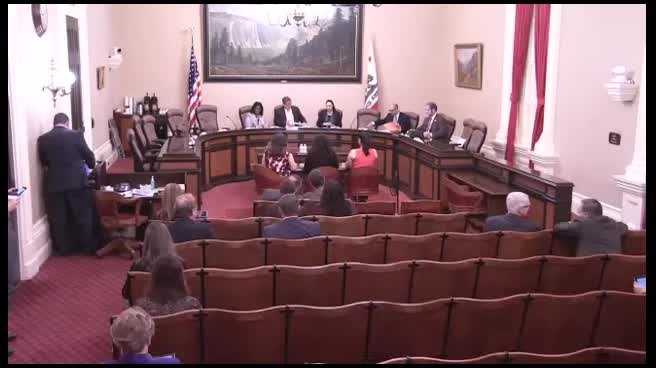 9MIN
Senate Standing Committee on Governance and Finance
Bill Author

Bill Co-Author(s):