SCA 9: Property taxation: base year value transfers.
- Session Year: 2015-2016
- House: Senate
- Latest Version Date: 2015-08-18
The California Constitution generally limits ad valorem taxes on real property to 1% of the full cash value of that property. For purposes of this limitation, full cash value is defined as the assessors valuation of real property as shown on the 197576 tax bill under full cash value or, thereafter, the appraised value of that real property when purchased, newly constructed, or a change in ownership has occurred. The California Constitution authorizes the Legislature to provide that a severely disabled person and a person over 55 years of age may transfer the base year value, as defined, of property that is eligible for the homeowners property tax exemption to a replacement dwelling that is of equal or lesser value located within the same county as the property from which the base year value is transferred and the replacement dwelling is purchased or newly constructed within 2 years of the sale of the original property, subject to certain conditions.
This measure would additionally authorize the Legislature to provide, commencing with the 201617 fiscal year, for the transfer of base year value to a replacement dwelling that is of greater value, and would require the base year value of the replacement dwelling to be calculated by adding the difference between the full cash value of the original property and the full cash value of the replacement dwelling to the base year value of the original property.
Resolved by the Senate, the Assembly concurring, That the Legislature of the State of California at its 201516 Regular Session commencing on the first day of December 2014, two-thirds of the membership of each house concurring, hereby proposes to the people of the State of California, that the Constitution of the State be amended as follows:
(a)(1)The full cash value means the county assessors valuation of real property as shown on the 197576 tax bill under full cash value or, thereafter, the appraised value of real property when purchased, newly constructed, or a change in ownership has occurred after the 1975 assessment. All real property not already assessed up to the 197576 full cash value may be reassessed to reflect that valuation. For purposes of this section, newly constructed does not include real property that is reconstructed after a disaster, as declared by the Governor, where the fair market value of the real property, as reconstructed, is comparable to its fair market value prior to the disaster. Also, the term newly constructed does not include the portion of reconstruction or improvement to a structure, constructed of unreinforced masonry bearing wall construction, necessary to comply with any local ordinance relating to seismic safety during the first 15 years following that reconstruction or improvement.
However
(2)However, the Legislature may provide that, under appropriate circumstances and pursuant to definitions and procedures established by the Legislature, any person over the age of 55 years who resides in property that is eligible for the homeowners exemption under subdivision (k) of Section 3 of Article XIII and any implementing legislation may transfer the base year value of the property entitled to exemption, with the adjustments authorized by subdivision (b), to in both of the following circumstances:
(A)To any replacement dwelling of equal or lesser value located within the same county and purchased or newly constructed by that person as his or her principal residence within two years of the sale of the original property. For
(B)Commencing with the lien date for the 201617 fiscal year, to any replacement dwelling of greater value located within the same county and purchased or newly constructed by that person as his or her principal residence within two years of the sale of the original property. The base year value of the replacement dwelling shall be calculated by adding the difference between the full cash value of the original property and the full cash value of the replacement dwelling to the base year value of the original property.
(3)For purposes of this section, any person over the age of 55 years includes a married couple one member of which is over the age of 55 years. For purposes of this section, replacement dwelling means a building, structure, or other shelter constituting a place of abode, whether real property or personal property, and any land on which it may be situated. For purposes of this section, a two-dwelling unit shall be considered as two separate single-family dwellings. This paragraph shall apply to any replacement dwelling that was purchased or newly constructed on or after November 5, 1986.
In
(4)In addition, the Legislature may authorize each county board of supervisors, after consultation with the local affected agencies within the countys boundaries, to adopt an ordinance making the provisions of this subdivision relating to transfer of base year value also applicable to situations in which the replacement dwellings are located in that county and the original properties are located in another county within this State. For purposes of this paragraph, local affected agency means any city, special district, school district, or community college district that receives an annual property tax revenue allocation. This paragraph shall apply to any replacement dwelling that was purchased or newly constructed on or after the date the county adopted the provisions of this subdivision relating to transfer of base year value, but shall not apply to any replacement dwelling that was purchased or newly constructed before November 9, 1988.
The
(5)The Legislature may extend the provisions of this subdivision relating to the transfer of base year values from original properties to replacement dwellings of homeowners over the age of 55 years to severely disabled homeowners, but only with respect to those replacement dwellings purchased or newly constructed on or after the effective date of this paragraph.
|
Date
|
Status
|
|---|---|
| Aug 18, 2015 | Introduced. Read first time. To Com. on RLS. for assignment. To print. |
| Aug 19, 2015 | From printer. May be acted upon on or after September 18. |
| Jan 6, 2016 | Referred to Coms. on GOV. & F., E. & C.A., and APPR. |
| Jan 8, 2016 | Set for hearing January 13. |
| Jan 12, 2016 | Set for hearing January 19 in E. & C.A. pending receipt. |
| Jan 13, 2016 | From committee: Be adopted and re-refer to Com. on E. & C.A. (Ayes 7. Noes 0. Page 2895.) (January 13). Re-referred to Com. on E. & C.A. |
| Jan 15, 2016 | Set for hearing January 21 in APPR. pending receipt. |
| Jan 19, 2016 | January 19 hearing postponed by committee. |
| Jan 21, 2016 | Set for hearing February 2. |
| Jan 27, 2016 | February 2 hearing postponed by committee. |
|
Date
|
Description
|
Location
|
Votes
|
|
|---|---|---|---|---|
| Jan 13, 2016 | Be adopted, but first be re-referred to the Committee on [Elections and Constitutional Amendments] | Senate Standing Committee on Governance and Finance |
Passed |
This list shows positions taken on this bill by organizations on the date displayed, which is linked to the original source.
Positions by individuals are not included.
SENATE COMMITTEE ON
ELECTIONS AND CONSTITUTIONAL AMENDMENTS
Senator Ben Allen, Chair
2015 - 2016 Regular
Bill No: SCA Hearing Date: 1/19/16
Author: | |||
Version: | 8/18/15 | ||
Urgency: | No | Fiscal: | No |
Consultant: | Darren Chesin | ||
Subject: Property taxation: base year value transfers
DIGEST
This measure amends the California Constitution to allow base year value transfers to properties of equal or greater value.
ANALYSIS
Existing law:
- Provides, pursuant to Article XIII of the California Constitution, that all property is taxable unless explicitly exempted by the Constitution or federal law. The Constitution limits the maximum amount of any ad valorem tax on real property at 1% of full cash value, and directs assessors to only reappraise property when newly constructed, or ownership changes (Proposition 13 of 1978).
Voters subsequently approved change in ownership exclusions to allow homeowners over the age of 55 and disabled persons (regardless of age) to transfer their home’s base year values to a replacement home of equal or lesser value within the same county (Proposition 60 of 1988 and Proposition 110 of 1990), or to homes in counties that adopt ordinances allowing the transfer (Proposition 90 of 1990). Ten counties currently allow these out-of-county transfers (Alameda, El Dorado, Los Angeles, Orange, Riverside, San Bernardino, San Diego, San Mateo, Santa Clara, and Ventura). Base year value transfers allow taxpayers to continue to pay property taxes at the factored base year value of their previous home, and not on the cash value of their newly purchased home, often resulting in tax savings, and is only available for a taxpayer’s principal place of residence.
This bill:
- Allows disabled persons and persons over the age of 55 to transfer their base year value to a home of greater value. The measure applies to transfers within the same county, or to transfers when the replacement property is located in a county that has enacted an ordinance to allow inbound out-of-county transfers. In the case of a transfer to a property of greater value, the taxpayer must add to the original base year value the difference in price between the full cash value of the original property and the full cash value of the replacement dwelling.
BACKGROUND
How It Works and Who Benefits. Proposition 13 provided property owners in California with substantial protections from higher property tax rates and annual reassessments. However, because the initiative generally set a property’s taxable value at its purchase price plus growth of up to 2% per year, taxpayers who sold their homes and purchased new ones will likely pay higher property taxes, thereby levying a tax penalty on those seeking to acquire housing that more closely meet their demands. For example, a four-bedroom single family home may be more house than an empty-nest couple need, but purchasing a two-bedroom condominium may lead to a tax increase, especially if the taxpayer’s current home has appreciated in value significantly during the time they owned it. Proposition 60 and 90 removed that incentive and allowed persons over 55 and the disabled to move without the tax consequence, so long as the value of the replacement home met the definition of “equal or lesser value” in statute. However, California already has the lowest property tax rates and most taxpayer-friendly reassessment triggers of almost any state in the nation, thereby providing significant benefits to property owners, especially those that have been in their homes for many years. SCA 9 expands those benefits to allow base year value transfers values when a taxpayer purchases a home at a higher price than for the one they sold.
SCA 9 grants taxpayers the ability to transfer base year values to homes of greater value, but not quite in the same way as transfers to properties with lesser values. Instead, the taxpayer must add the difference between the full cash value of the original property and the full cash value of the replacement property to the original base year value. For example, an eligible taxpayer who has a base year value of $200,000 and property taxes of $2,000 per year, sold her home for $300,000, and purchased a replacement home for $400,000. The new base year would be $300,000 (the $200,000 base year value of the original property plus the $100,000 difference in price between the original and replacement dwellings), resulting in a property tax difference of $1,000 ($3,000 in property tax from a base year of $300,000, instead of $4,000 in property tax resulting from the $400,000 purchase price of the new dwelling). By requiring the taxpayer to add the price difference between the new dwelling and the original property onto the base year, SCA 9 reduces the amount of property tax revenue that local agencies would have received had a taxpayer not eligible for the base year transfer purchased the home, but provides a more limited form of tax benefit than current base year transfers.
Currently, taxpayers can only transfer base year values to homes of equal or lesser value than the one they sold, under the assumption that taxpayers “downsizing” will sell their larger home at a price higher than what they pay for the smaller replacement. SCA 9 would allow transfers to properties with greater values, likely leading to more transfers, especially in areas of California where high local property values make finding homes at lower prices than their current ones difficult. Local agencies may receive less property tax revenue to the extent that a taxpayer taking advantage of SCA 9’s benefit buys a property instead of one who isn’t, but these losses can be offset if the taxpayer’s replacement property is sold at a higher price than its current assessed value. However, because SCA 9 applies to transfers within a county, as well as transfers to counties that enact an ordinance, the revenue loss and the offset may not occur in the same county. Additionally, the amount of SCA 9’s benefit depends on two variables: the difference between the fair market value and assessed value of the taxpayer’s original property, and the price of the replacement property. Using the example above, SCA 9 saves a taxpayer $1,000 in annual property taxes when transferring her base year value to a home with a sales price $100,000 higher than the price at which she sold her original property. However, that same taxpayer who sells her house for $1 million can transfer her base year value to a property worth $1.2 million, so long as the difference between the two prices is added back for an assessed value of $400,000. A taxpayer not eligible for a base year value transfer would pay three times as much, as the tax would be based on the $1.2 million value.
Current Subsidies. In the United States, federal and state governments offer substantial tax subsidies for owning or selling a home, such as:
- Mortgage Loan Interest: Taxpayers may deduct interest payments on up to $500,000 single/$1 million joint of indebtedness used to purchase a first and second home. Taxpayers may also deduct interest payments on up to $100,000 in home improvement loans.
- Capital Gains Exclusion: Taxpayers may exclude up to $250,000 single/$500,000 joint in income resulting from the sale of their principal residence.
- Deductibility of Property Taxes: Taxpayers may deduct property taxes and some other real estate taxes from federal income, although California’s low property tax rates limit the benefit for Californians compared to residents of other states.
COMMENTS
- According to the Author: Proposition 60 allows homeowners over the age of 55 and any severely or permanently disabled person to transfer the base year assessed value of their principal residence to a replacement home in the same county. For example, if an individual purchased their principal residence in 1985 for $100,000 and then sold the home for $200,000 in 2015, they would be able to transfer the $100,000 base year assessed value and be taxed on that value instead of on the assessed value of the replacement home. Proposition 90 allows such transfers to a home located in a different county so long as that county has agreed to participate in the transfer program.
In both cases, however, the value of the replacement home must be equal to or less than the value of the original principal residence. In the example above, if the value of the replacement home is greater than $200,000, the base year assessed value cannot be transferred. Due to the increased housing market, many seniors seeking to downsize to a newer, smaller home must buy a home with a value greater than that of their current residence. Current law would preclude them from benefitting utilizing Proposition 60 and thus, discourage them from moving.
SCA 9/SB 378 would, instead, allow a transfer to a replacement home with a value greater than that of the original residence. To ensure a homeowner doesn't receive more of a property tax benefit than that to which they are entitled, these bills require that the difference between the value of the replacement home and that of the original residence is added to the base year assessed value.
Returning to the example above, if a $210,000 replacement home is purchased, the $10,000 difference (between that purchase price and the sale price of the original home; $210,000 - $200,000 = $10,000) would be added to the base year assessed value of $100,000 for a total of $110,000. This would be the amount the homeowner's property taxes would be based upon.
This individual's property taxes would be based on a value $100,000 less ($110,000 as opposed to $210,000) than the sale price of the replacement home. This is no more a savings than if the individual had purchased a home of equal value ($200,000 as opposed to $210,000). In both cases the senior's property taxes would be based on a value $100,000 less than the value of the replacement home. In other words, under SCA 9/SB 378, the senior and any severely or permanently disabled person would not receive property taxes savings greater than that to which they would otherwise be entitled. - Argument in Opposition: According to the California State Association of Counties, this proposed measure represents a loss of general purpose revenue for local agencies at a time when counties are still working to return to pre-Great Recession levels of fiscal stability.
RELATED/PRIOR LEGISLATION
SB 378 (Beall), which makes statutory changes necessary to implement SCA 9, was recently approved by the Senate Governance and Finance Committee 7-0 and is now pending in the Senate Appropriations Committee.
This measure is similar to SCA 11 (Dutton) of 2009 which failed passage in the Senate Revenue and Taxation Committee.
PRIOR ACTION
Senate Governance and Finance Committee: | 7-0 |
POSITIONS
Sponsor: California Association of Realtors
Support: California Taxpayers Association
Oppose: California State Association of Counties
California Tax Reform Association
Rural County Representatives of California
SENATE COMMITTEE ON GOVERNANCE AND FINANCE
Senator Robert M. Hertzberg, Chair
2015 - 2016 Regular
Bill No: | SCA 9 | Hearing Date: | 1/13/16 |
Author: | Beall | Tax Levy: | No |
Version: | 8/18/15 | Fiscal: | No |
Consultant: | Grinnell | ||
PROPERTY TAXATION: BASE YEAR VALUE TRANSFERS
Amends the California Constitution to allow base year value transfers to properties of equal or greater value.
Background and Existing Law
Article XIII of the California Constitution provides that all property is taxable unless explicitly exempted by the Constitution or federal law. The Constitution limits the maximum amount of any ad valorem tax on real property at 1% of full cash value, and directs assessors to only reappraise property when newly constructed, or ownership changes (Proposition 13, 1978). Voters subsequently approved change in ownership exclusions to allow homeowners over the age of 55 and disabled persons (regardless of age) to transfer their home’s base year values to a replacement home of equal or lesser value within the same county (Proposition 60, 1988, and Proposition 110, 1990), or to homes in counties that adopt ordinances allowing the transfer (Proposition 90, 1990). Ten counties currently allow these out-of-county transfers (Alameda, El Dorado, Los Angeles, Orange, Riverside, San Bernardino, San Diego, San Mateo, Santa Clara, and Ventura). Base year value transfers allow taxpayers to continue to pay property taxes at the factored base year value of their previous home, and not on the cash value of their newly purchased home, often resulting in tax savings, and is only available for a taxpayer’s principal place of residence.
Proposed Law
Senate Constitutional Amendment 9 allows disabled persons or those over the age of 55 to transfer their base year value to a home of greater value. The measure applies to transfers within the same county, or to transfers when the replacement property is located in a county that has enacted an ordinance to allow inbound out-of-county transfers. In the case of a transfer to a property of greater value, the taxpayer must add to the original base year value the difference in price between the full cash value of the original property and the full cash value of the replacement dwelling.
State Revenue Impact
No estimate.
Comments
1. Purpose of the bill. According to the author, “Proposition 60 allows homeowners over the age of 55 and any severely or permanently disabled person to transfer the base year assessed value of their principal residence to a replacement home in the same county. For example, if an individual purchased their principal residence in 1985 for $100,000 and then sold the home for $200,000 in 2015, they would be able to transfer the $100,000 base year assessed value and be taxed on that value instead of on the assessed value of the replacement home. Due to the increased housing market and higher housing prices, many seniors seeking to downsize to a newer, smaller home that more appropriately suits their needs, must buy a home with a value greater than that of their current residence. These bills will allow seniors and any severely or permanently disabled person to transfer their property tax basis to another home, even if the home they purchase has a higher sales price than their original home. To ensure a homeowner doesn't receive more of a property tax benefit than that to which they are entitled, these bills require that the difference between the value of the replacement home and that of the original residence is added to the base year assessed value. By allowing and encouraging seniors to downsize to newer and smaller homes, these bills will also allow more homes to be available for families to move into.”
2. Too many benefits? Proposition 13 provided property owners in California with substantial protections from higher property tax rates and annual reassessments. However, because the initiative generally set a property’s taxable value at its purchase price plus growth of up to 2% per year, taxpayers who sold their homes and purchased new ones will likely pay higher property taxes, thereby levying a tax penalty on those seeking to acquire housing that more closely meet their demands. For example, a four-bedroom single family home may be more house than an empty-nest couple need, but purchasing a two-bedroom condominium may lead to a tax increase, especially if the taxpayer’s current home has appreciated in value significantly during the time they owned it. Proposition 60 and 90 removed that incentive and allowed persons over 55 and the disabled to move without the tax consequence, so long as the value of the replacement home met the definition of “equal or lesser value” in statute. However, California already has the lowest property tax rates and most taxpayer-friendly reassessment triggers of almost any state in the nation, thereby providing significant benefits to property owners, especially those that have been in their homes for many years. SCA 9 expands those benefits to allow base year value transfers values when a taxpayer purchases a home at a higher price than for the one they sold. The Committee may wish to consider adding to the benefits afforded property owners in California.
3. What’s different? SCA 9 grants taxpayers the ability to transfer base year values to homes of greater value, but not quite in the same way as transfers to properties with lesser values. Instead, the taxpayer must add the difference between the full cash value of the original property and the full cash value of the replacement property to the original base year value. For example, an eligible taxpayer who has a base year value of $200,000 and property taxes of $2,000 per year, sold her home for $300,000, and purchased a replacement home for $400,000. The new base year would be $300,000 (the $200,000 base year value of the original property plus the $100,000 difference in price between the original and replacement dwellings), resulting in a property tax difference of $1,000 ($3,000 in property tax from a base year of $300,000, instead of $4,000 in property tax resulting from the $400,000 purchase price of the new dwelling). By requiring the taxpayer to add the price difference between the new dwelling and the original property onto the base year, SCA 9 reduces the amount of property tax revenue that local agencies would have received had a taxpayer not eligible for the base year transfer purchased the home, but provides a more limited form of tax benefit than current base year transfers.
4. Who benefits? Currently, taxpayers can only transfer base year values to homes of equal or lesser value than the one they sold, under the assumption that taxpayers “downsizing” will sell their larger home at a price higher than what they pay for the smaller replacement. SCA 9 would allow transfers to properties with greater values, likely leading to more transfers, especially in areas of California where high local property values make finding homes at lower prices than their current ones difficult. Local agencies may receive less property tax revenue to the extent that a taxpayer taking advantage of SCA 9’s benefit buys a property instead of one who isn’t, but these losses can be offset if the taxpayer’s replacement property is sold at a higher price than its current assessed value. However, because SCA 9 applies to transfers within a county, as well as transfers to counties that enact an ordinance, the revenue loss and the offset may not occur in the same county. Additionally, the amount of SCA 9’s benefit depends on two variables: the difference between the fair market value and assessed value of the taxpayer’s original property, and the price of the replacement property. Using the example above, SCA 9 saves a taxpayer $1,000 in annual property taxes when transferring her base year value to a home with a sales price $100,000 higher than the price at which she sold her original property. However, that same taxpayer who sells her house for $1 million can transfer her base year value to a property worth $1.2 million, so long as the difference between the two prices is added back for an assessed value of $400,000. A taxpayer not eligible for a base year value transfer would pay three times as much, as the tax would be based on the $1.2 million value.
5. Current subsidies. In the United States, federal and state governments offer substantial tax subsidies for owning or selling a home, such as:
- Mortgage Loan Interest: Taxpayers may deduct interest payments on up to $500,000 single/$1 million joint of indebtedness used to purchase a first and second home. Taxpayers may also deduct interest payments on up to $100,000 in home improvement loans.
- Capital Gains Exclusion: Taxpayers may exclude up to $250,000 single/$500,000 joint in income resulting from the sale of their principal residence.
- Deductibility of Property Taxes: Taxpayers may deduct property taxes and some other real estate taxes from federal income, although California’s low property tax rates limit the benefit for Californians compared to residents of other states.
6. Companionship. SCA 9 changes California’s Constitution to allow base year value transfers to homes of equal or greater value. Constitutional amendments must be approved by 2/3 vote of each house of the Legislature, and receive majority voter approval at the next statewide election. SB 378 (Beall) makes statutory changes necessary to implement SCA 9, and will also be heard at the Committee’s January 13, 2016 hearing.
7. Triple-referred. The Senate Rules Committee has referred SCA 9 to the Committees on Elections and Constitutional Amendments, as well as to the Committee on Appropriations.
Support and Opposition
(1/7/15)
Support: California Association of Realtors.
Opposition: California State Association of Counties, California Tax Reform Association, Rural County Representatives of California.
-- END --
Discussed in Hearing
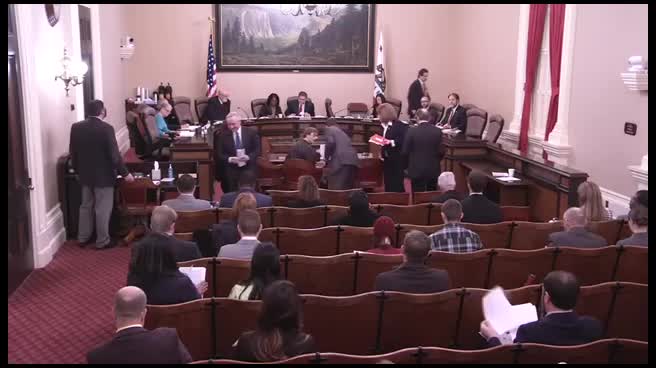 17MIN
Senate Standing Committee on Governance and Finance
Bill Author

Bill Co-Author(s):