AB 1512: Opioid Addiction Prevention and Rehabilitation Act.
- Session Year: 2017-2018
- House: Assembly
- Latest Version Date: 2017-05-09
Existing law imposes various fees and taxes, including taxes on the privilege of engaging in certain activities. The Fee Collection Procedures Law, the violation of which is a crime, provides procedures for the collection of certain fees and surcharges.
Under this bill, the Opioid Addiction Prevention and Rehabilitation Act would impose a tax on and after January July 1, 2018, upon the distribution of opioids by every person including, but not limited to, a manufacturer or wholesaler, that makes the first sale in this state of opioids, where the sale is for the purpose of resale in the regular course of business, a manufacturer to a wholesaler from the manufacturer, as those terms are defined, at the rate of $0.01 per milligram of active opioid ingredient. The bill would require the wholesaler to collect the tax and remit it to the State Board of Equalization. The tax would be administered by the State Board of Equalization and would be collected pursuant to the procedures set forth in the Fee Collection Procedures Law, which sets forth requirements for registration, returns, payments, penalties, interest, determinations and redeterminations, collections, overpayments and refunds, administration and confidentiality, and violations. By expanding the application of the Fee Collection Procedures Law, the violation of which is a crime, this bill would impose a state-mandated local program.
This bill would require the board to deposit all taxes, interest, penalties, and other amounts collected, less refunds, refunds and the boards costs of administration, into the Opioid Prevention and Rehabilitation Program Fund, which this bill would create. By authorizing the use of moneys collected pursuant to this bill for these purposes, the bill would make an appropriation. The bill would state the intent of the Legislature to enact legislation that would provide for distribution of the moneys in the fund for addiction prevention and rehabilitation programs.
This bill would include a change in state statute that would result in a taxpayer paying a higher tax within the meaning of Section 3 of Article XIIIA of the California Constitution, and thus would require for passage the approval of 2/3 of the membership of each house of the Legislature.
The California Constitution requires the state to reimburse local agencies and school districts for certain costs mandated by the state. Statutory provisions establish procedures for making that reimbursement.
This bill would provide that no reimbursement is required by this act for a specified reason.
This bill would take effect immediately as a tax levy.
Existing law imposes various fees and taxes, including taxes on the privilege of engaging in certain activities. The Fee Collection Procedures Law, the violation of which is a crime, provides procedures for the collection of certain fees and surcharges.
Under this bill, the Opioid Addiction Prevention and Rehabilitation Act would impose a tax on and after January 1, 2018, upon the distribution of opioids by every person including, but not limited to, a manufacturer or wholesaler, that makes the first sale in this state of opioids, where the sale is for the purpose of resale in the regular course of business, at the rate of $0.01 per milligram of active opioid ingredient. The tax would be administered by the State Board of Equalization and would be collected pursuant to the procedures set forth in the Fee Collection Procedures Law, which sets forth requirements for registration, returns, payments, penalties, interest, determinations and redeterminations, collections, overpayments and refunds, administration and confidentiality, and violations. By expanding the application of the Fee Collection Procedures Law, the violation of which is a crime, this bill would impose a state-mandated local program.
This bill would require the board to deposit all taxes, interest, penalties, and other amounts collected, less refunds, in into the Opioid Prevention and Rehabilitation Program Fund, which this bill would create. The bill would require all moneys in the fund, upon appropriation by the Legislature, to be transferred to the State Department of Health Care Services, which would allocate the moneys to counties to provide critical resources for addiction prevention and rehabilitation programs. The bill would state the intent of the Legislature that the funds be distributed based on need and population. The bill would state the intent of the Legislature to enact legislation that would provide for distribution of the moneys in the fund for addiction prevention and rehabilitation programs.
This bill would include a change in state statute that would result in a taxpayer paying a higher tax within the meaning of Section 3 of Article XIIIA of the California Constitution, and thus would require for passage the approval of 2/3 of the membership of each house of the Legislature.
The California Constitution requires the state to reimburse local agencies and school districts for certain costs mandated by the state. Statutory provisions establish procedures for making that reimbursement.
This bill would provide that no reimbursement is required by this act for a specified reason.
This bill would take effect immediately as a tax levy.
Existing law imposes various fees and taxes, including taxes on the privilege of engaging in certain activities. The Fee Collection Procedures Law, the violation of which is a crime, provides procedures for the collection of certain fees and surcharges.
ThisUnder this bill, the Opioid Addiction Prevention and Rehabilitation Act, Act would impose a tax on and after January 1, 2018, upon the distribution of opioids by every person including, but not limited to, a manufacturer or wholesaler, that makes the first sale in this state of opioids, where the sale is for the purpose of resale in the regular course of business, at the rate of $0.01 per milligram of active opioid ingredient. The tax would be administered by the State Board of Equalization and would be collected pursuant to the procedures set forth in the Fee Collection Procedures Law, which sets forth requirements for registration, returns, payments, penalties, interest, determinations and redeterminations, collections, overpayments and refunds, administration and confidentiality, and violations. By expanding the application of the Fee Collection Procedures Law, the violation of which is a crime, this bill would impose a state-mandated local program.
TheThis bill would require the board to deposit all taxes, interest, penalties, and other amounts collected, less refunds, in the Opioid Prevention and Rehabilitation Program Fund, which this bill would create. The bill would require all moneys in the fund, upon appropriation by the Legislature, to be transferred to the State Department of Public Health, Health Care Services, which would allocate the moneys to counties to provide critical resources for addiction prevention and rehabilitation programs. The bill would state the intent of the Legislature that the funds be distributed based on need and population.
This bill would include a change in state statute that would result in a taxpayer paying a higher tax within the meaning of Section 3 of Article XIIIA of the California Constitution, and thus would require for passage the approval of 2/3 of the membership of each house of the Legislature.
The California Constitution requires the state to reimburse local agencies and school districts for certain costs mandated by the state. Statutory provisions establish procedures for making that reimbursement.
This bill would provide that no reimbursement is required by this act for a specified reason.
This bill would take effect immediately as a tax levy, but its operative date would depend on its effective date.Existing law imposes various fees and taxes, including taxes on the privilege of engaging in certain activities. The Fee Collection Procedures Law, the violation of which is a crime, provides procedures for the collection of certain fees and surcharges.
This bill, the Opioid Addiction Prevention and Rehabilitation Act, would impose a tax upon the distribution of opioids by every person including, but not limited to, a manufacturer or wholesaler, that makes the first sale in this state of opioids, where the sale is for the purpose of resale in the regular course of business, at the rate of $0.01 per milligram of active opioid ingredient. The tax would be administered by the State Board of Equalization and would be collected pursuant to the procedures set forth in the Fee Collection Procedures Law, which sets forth requirements for registration, returns, payments, penalties, interest, determinations and redeterminations, collections, overpayments and refunds, administration and confidentiality, and violations. By expanding the application of the Fee Collection Procedures Law, the violation of which is a crime, this bill would impose a state-mandated local program.
The bill would require the board to deposit all taxes, interest, penalties, and other amounts collected, less refunds, in the Opioid Prevention and Rehabilitation Program Fund, which this bill would create. The bill would require all moneys in the fund, upon appropriation by the Legislature, to be transferred to the State Department of Public Health, which would allocate the moneys to counties to provide critical resources for addiction prevention and rehabilitation programs.
This bill would include a change in state statute that would result in a taxpayer paying a higher tax within the meaning of Section 3 of Article XIIIA of the California Constitution, and thus would require for passage the approval of 2/3 of the membership of each house of the Legislature.
The California Constitution requires the state to reimburse local agencies and school districts for certain costs mandated by the state. Statutory provisions establish procedures for making that reimbursement.
This bill would provide that no reimbursement is required by this act for a specified reason.
This bill would take effect immediately as a tax levy, but its operative date would depend on its effective date.
The Motor Vehicle Fuel Tax Law imposes a tax on each gallon of motor vehicle fuel removed from a refinery or terminal rack in this state, entered or sold into this state and provides for the deposit of all moneys received under that law into a specified fund.This bill would make nonsubstantive changes to the provision related to that fund.The Motor Vehicle Fuel Tax Law imposes a tax on each gallon of motor vehicle fuel removed from a refinery or terminal rack in this state, entered or sold into this state and provides for the deposit of all moneys received under that law into a specified fund.
This bill would make nonsubstantive changes to the provision related to that fund.
(a)There is hereby created in the State Treasury the Opioid Prevention and Rehabilitation Program Fund.
(b)It is the intent of the Legislature to enact legislation that would provide for distribution of the moneys in the fund for addiction prevention and rehabilitation programs.
SEC. 2.Part 14.3 (commencing with Section 33001) is added to Division 2 of the Revenue and Taxation Code, to read:14.3.Opioid Addiction Prevention and Rehabilitation Act33001.This part shall be known and may be cited as the Opioid Addiction Prevention and Rehabilitation Act.
33002.For purposes of this part:
(a)Active opioid ingredient means that portion of a product that is an opioid.
(b)Distribution means the sale of untaxed opioids in this state.
(c)In this state means within the exterior limits of the State of California and includes all territory within these limits owned by or ceded to the United States.
(d)Manufacturer means any person, whether or not located in this state, who manufactures opioids for distribution in this state.
(d)(e)Opiate means the dried, condensed juice of a poppy, Papaver somniferum, that has a narcotic, soporific, analgesic, and astringent effect.
(e)(f)Opioid means an opiate or any synthetic or semisynthetic narcotic that has opiatelike activities but is not derived from opium and has effects similar to natural opium alkaloids, and any derivatives thereof.
(f)(g)Person means person as defined in Section 55002.
(g)(h)Sale means any transfer of title or possession for a consideration, exchange, or barter, in any manner or by any means.
(h)(i)Untaxed opioid means any opioid which has not yet been distributed in a manner as to result in a tax liability under this part.
(j)Wholesaler means any person who engages in this state in the making of sales for resale of opioids.
33003.(a)On and after January July 1, 2018, a tax is hereby imposed upon the distribution of opioids by every person including, but not limited to, a manufacturer or wholesaler, that makes the first sale in this state of opioids, where the sale is for the purpose of resale in the regular course of business, a manufacturer to a wholesaler, at the rate of one cent ($0.01) per milligram of active opioid ingredient.
(b)The wholesaler shall collect the tax from the manufacturer and shall separately state the amount of the tax imposed under this part on the purchase order, which shall be given by the wholesaler to the manufacturer at the time of sale. The wholesaler shall remit the tax to the board.
33004.There shall be exempt from the taxes imposed by this part the distribution to a person if the state is prohibited from taxing that sale under the Constitution or laws of the United States or under the Constitution of this state.
33005.(a)The board shall collect the tax pursuant to the Fee Collection Procedures Law (Part 30 (commencing with Section 55001) of Division 2 of the Revenue and Taxation Code). For purposes of administration of the tax pursuant to this part, references in the Fee Collection Procedures Law to feepayer and fee shall include taxpayer and tax.
(b)The board may adopt any regulations necessary or appropriate to carry out the purposes of this part.
(c)The tax imposed by this part shall be due and payable to the board on or before the last day of the month next succeeding each calendar quarter, together with a return for that calendar quarter. Returns shall be filed with the board using electronic media and authenticated in a form or pursuant to methods as may be prescribed by the board.
33006.All taxes, interest, penalties, and other amounts collected pursuant to this part, less refunds, refunds and the boards costs of administration, shall be deposited into the Opioid Prevention and Rehabilitation Program Fund established by Section 11740 of the Health and Safety Code.
SEC. 3.No reimbursement is required by this act pursuant to Section 6 of Article XIIIB of the California Constitution because the only costs that may be incurred by a local agency or school district will be incurred because this act creates a new crime or infraction, eliminates a crime or infraction, or changes the penalty for a crime or infraction, within the meaning of Section 17556 of the Government Code, or changes the definition of a crime within the meaning of Section 6 of Article XIIIB of the California Constitution.
SEC. 4.This act provides for a tax levy within the meaning of Article IV of the California Constitution and shall go into immediate effect.
(a)There is hereby created in the State Treasury the Opioid Prevention and Rehabilitation Program Fund.
(b)All moneys deposited in the Opioid Prevention and Rehabilitation Program Fund, upon appropriation by the Legislature, shall be transferred to the State Department of Health Care Services, which shall allocate the moneys to counties to provide critical resources for addiction prevention and rehabilitation programs.(c)It is the intent of the Legislature that these funds be distributed based on need and population.(b)It is the intent of the Legislature to enact legislation that would provide for distribution of the moneys in the fund for addiction prevention and rehabilitation programs.
SEC. 2.Part 14.3 (commencing with Section 33001) is added to Division 2 of the Revenue and Taxation Code, to read:14.3.Opioid Addiction Prevention and Rehabilitation Act33001.This part shall be known and may be cited as the Opioid Addiction Prevention and Rehabilitation Act.
33002.For purposes of this part:
(a)Active opioid ingredient means that portion of a product that is an opioid.
(b)Distribution means the sale of untaxed opioids in this state.
(c)In this state means within the exterior limits of the State of California and includes all territory within these limits owned by or ceded to the United States.
(d)Opiate means the dried, condensed juice of a poppy, Papaver somniferum, that has a narcotic, soporific, analgesic, and astringent effect.
(e)Opioid means an opiate or any synthetic or semisynthetic narcotic that has opiatelike activities but is not derived from opium and has effects similar to natural opium alkaloids, and any derivatives thereof.
(f)Person means person as defined in Section 55002.
(g)Sale means any transfer of title or possession for a consideration, exchange, or barter, in any manner or by any means.
(h)Untaxed opioid means any opioid which has not yet been distributed in a manner as to result in a tax liability under this part.
33003.On and after January 1, 2018, a tax is hereby imposed upon the distribution of opioids by every person including, but not limited to, a manufacturer or wholesaler, that makes the first sale in this state of opioids, where the sale is for the purpose of resale in the regular course of business, at the rate of one cent ($0.01) per milligram of active opioid ingredient.
33004.There shall be exempt from the taxes imposed by this part the distribution to a person if the state is prohibited from taxing that sale under the Constitution or laws of the United States or under the Constitution of this state.
33005.(a)The board shall collect the tax pursuant to the Fee Collection Procedures Law (Part 30 (commencing with Section 55001) of Division 2 of the Revenue and Taxation Code). For purposes of administration of the tax pursuant to this part, references in the Fee Collection Procedures Law to feepayer and fee shall include taxpayer and tax.
(b)The board may adopt any regulations necessary or appropriate to carry out the purposes of this part.
(c)The tax imposed by this part shall be due and payable to the board on or before the last day of the month next succeeding each calendar quarter, together with a return for that calendar quarter.
33006.All taxes, interest, penalties, and other amounts collected pursuant to this part, less refunds, shall be deposited into the Opioid Prevention and Rehabilitation Program Fund established by Section 11740 of the Health and Safety Code.
SEC. 3.No reimbursement is required by this act pursuant to Section 6 of Article XIIIB of the California Constitution because the only costs that may be incurred by a local agency or school district will be incurred because this act creates a new crime or infraction, eliminates a crime or infraction, or changes the penalty for a crime or infraction, within the meaning of Section 17556 of the Government Code, or changes the definition of a crime within the meaning of Section 6 of Article XIIIB of the California Constitution.
SEC. 4.This act provides for a tax levy within the meaning of Article IV of the California Constitution and shall go into immediate effect.
(a)There is hereby created in the State Treasury the Opioid Prevention and Rehabilitation Program Fund.
(b)All moneys deposited in the Opioid Prevention and Rehabilitation Program Fund, upon appropriation by the Legislature, shall be transferred to the State Department of Public Health, State Department of Health Care Services, which shall allocate the moneys to counties to provide critical resources for addiction prevention and rehabilitation programs.
(c)It is the intent of the Legislature that these funds be distributed based on need and population.
SEC. 2.Part 14.3 (commencing with Section 33001) is added to Division 2 of the Revenue and Taxation Code, to read:14.3.Opioid Addiction Prevention and Rehabilitation Act33001.This part shall be known and may be cited as the Opioid Addiction Prevention and Rehabilitation Act.
33002.For purposes of this part:
(a)Active opioid ingredient means that portion of a product that is an opioid.
(b)Distribution means the sale of untaxed opioids in this state.
(c)In this state means within the exterior limits of the State of California and includes all territory within these limits owned by or ceded to the United States.
(d)Opiate means the dried, condensed juice of a poppy, Papaver somniferum, that has a narcotic, soporific, analgesic, and astringent effect.
(e)Opioid means an opiate or any synthetic or semisynthetic narcotic that has opiatelike activities but is not derived from opium and has effects similar to natural opium alkaloids, and any derivatives thereof.
(f)Person means person as defined in Section 55002.
(g)Sale means any transfer of title or possession for a consideration, exchange, or barter, in any manner or by any means.
(h)Untaxed opioid means any opioid which has not yet been distributed in a manner as to result in a tax liability under this part.
33003.A On and after January 1, 2018, a tax is hereby imposed upon the distribution of opioids by every person including, but not limited to, a manufacturer or wholesaler, that makes the first sale in this state of opioids, where the sale is for the purpose of resale in the regular course of business, at the rate of one cent ($0.01) per milligram of active opioid ingredient.
33004.There shall be exempt from the taxes imposed by this part the distribution to a person if the state is prohibited from taxing that sale under the Constitution or laws of the United States or under the Constitution of this state.
33005.(a)The board shall collect the tax pursuant to the Fee Collection Procedures Law (Part 30 (commencing with Section 55001) of Division 2 of the Revenue and Taxation Code). For purposes of administration of the tax pursuant to this part, references in the Fee Collection Procedures Law to feepayer and fee shall include taxpayer and tax.
(b)The board may adopt any regulations necessary or appropriate to carry out the purposes of this part.
(c)The tax imposed by this part shall be due and payable to the board on or before the last day of the month next succeeding each calendar quarter, together with a return for that calendar quarter.
33006.All taxes, interest, penalties, and other amounts collected pursuant to this part, less refunds, shall be deposited into the Opioid Prevention and Rehabilitation Program Fund created in established by Section 11740 of the Health and Safety Code.
SEC. 3.No reimbursement is required by this act pursuant to Section 6 of Article XIIIB of the California Constitution because the only costs that may be incurred by a local agency or school district will be incurred because this act creates a new crime or infraction, eliminates a crime or infraction, or changes the penalty for a crime or infraction, within the meaning of Section 17556 of the Government Code, or changes the definition of a crime within the meaning of Section 6 of Article XIIIB of the California Constitution.
SEC. 4.This act provides for a tax levy within the meaning of Article IV of the California Constitution and shall go into immediate effect. However, the provisions of this act shall become operative on the first day of the first calendar quarter commencing more than 90 days after the effective date of this act.(a)There is hereby created in the State Treasury the Opioid Prevention and Rehabilitation Program Fund.
(b)All moneys deposited in the Opioid Prevention and Rehabilitation Program Fund, upon appropriation by the Legislature, shall be transferred to the State Department of Public Health, which shall allocate the moneys to counties to provide critical resources for addiction prevention and rehabilitation programs.
SEC. 2.Part 14.3 (commencing with Section 33001) is added to Division 2 of the Revenue and Taxation Code, to read:14.3.Opioid Addiction Prevention and Rehabilitation Act33001.This part shall be known and may be cited as the Opioid Addiction Prevention and Rehabilitation Act.
33002.For purposes of this part:
(a)Active opioid ingredient means that portion of a product that is an opioid.
(b)Distribution means the sale of untaxed opioids in this state.
(c)In this state means within the exterior limits of the State of California and includes all territory within these limits owned by or ceded to the United States.
(d)Opiate means the dried, condensed juice of a poppy, Papaver somniferum, that has a narcotic, soporific, analgesic, and astringent effect.
(e)Opioid means an opiate or any synthetic or semisynthetic narcotic that has opiatelike activities but is not derived from opium and has effects similar to natural opium alkaloids, and any derivatives thereof.
(f)Person means person as defined in Section 55002.
(g)Sale means any transfer of title or possession for a consideration, exchange, or barter, in any manner or by any means.
(h)Untaxed opioid means any opioid which has not yet been distributed in a manner as to result in a tax liability under this part.
33003.A tax is hereby imposed upon the distribution of opioids by every person including, but not limited to, a manufacturer or wholesaler, that makes the first sale in this state of opioids, where the sale is for the purpose of resale in the regular course of business, at the rate of one cent ($0.01) per milligram of active opioid ingredient.
33004.There shall be exempt from the taxes imposed by this part the distribution to a person if the state is prohibited from taxing that sale under the Constitution or laws of the United States or under the Constitution of this state.
33005.(a)The board shall collect the tax pursuant to the Fee Collection Procedures Law (Part 30 (commencing with Section 55001) of Division 2 of the Revenue and Taxation Code). For purposes of administration of the tax pursuant to this part, references in the Fee Collection Procedures Law to feepayer and fee shall include taxpayer and tax.
(b)The board may adopt any regulations necessary or appropriate to carry out the purposes of this part.
(c)The tax imposed by this part shall be due and payable to the board on or before the last day of the month next succeeding each calendar quarter, together with a return for that calendar quarter.
33006.All taxes, interest, penalties, and other amounts collected pursuant to this part, less refunds, shall be deposited into the Opioid Prevention and Rehabilitation Program Fund created in Section 11740 of the Health and Safety Code.
SEC. 3.No reimbursement is required by this act pursuant to Section 6 of Article XIIIB of the California Constitution because the only costs that may be incurred by a local agency or school district will be incurred because this act creates a new crime or infraction, eliminates a crime or infraction, or changes the penalty for a crime or infraction, within the meaning of Section 17556 of the Government Code, or changes the definition of a crime within the meaning of Section 6 of Article XIIIB of the California Constitution.
SEC. 4.This act provides for a tax levy within the meaning of Article IV of the California Constitution and shall go into immediate effect. However, the provisions of this act shall become operative on the first day of the first calendar quarter commencing more than 90 days after the effective date of this act.
SECTION 1.Section 8351 of the Revenue and Taxation Code is amended to read:8351.The Controller shall transmit all money received by him or her in payment of taxes, interest, and penalties due under this part, and restitution orders or any other amounts otherwise authorized by law to be collected by the Controller, or any other amounts imposed by a court of competent jurisdiction to be paid to the Controller, to the State Treasurer who shall deposit it in the State Treasury and credit it to the Motor Vehicle Fuel Fund, which is continued in existence as the Motor Vehicle Fuel Account in the Transportation Tax Fund, which fund is hereby created. All fees paid and accepted for issuance or reinstatement of licenses under this part shall be deposited by the board in the State Treasury to the credit of the same account.Any reference in any law or regulation to the Motor Vehicle Fuel Fund shall be deemed to refer to the Motor Vehicle Fuel Account in the Transportation Tax Fund.Notwithstanding any other law, the Controller may use the funds in the Motor Vehicle Fuel Account in the Transportation Tax Fund for cashflow loans to the General Fund as provided in Sections 16310 and 16381 of the Government Code. Any such loan shall be exempt from paragraph (2) of subdivision (b) of Section 16310 of the Government Code. Interest shall be paid on all moneys loaned to the General Fund and shall be computed at a rate determined by the Pooled Money Investment Board to be the current earning rate of the fund from which the money is loaned. This subdivision shall not authorize any transfer that would interfere with the carrying out of the object for which these funds were created.The Controller shall transmit all money received by him or her in payment of taxes, interest, and penalties due under this part, and restitution orders or any other amounts otherwise authorized by law to be collected by the Controller, or any other amounts imposed by a court of competent jurisdiction to be paid to the Controller, to the State Treasurer who shall deposit it in the State Treasury and credit it to the Motor Vehicle Fuel Fund, which is continued in existence as the Motor Vehicle Fuel Account in the Transportation Tax Fund, which fund is hereby created. All fees paid and accepted for issuance or reinstatement of licenses under this part shall be deposited by the board in the State Treasury to the credit of the same account.
Any reference in any law or regulation to the Motor Vehicle Fuel Fund shall be deemed to refer to the Motor Vehicle Fuel Account in the Transportation Tax Fund.
Notwithstanding any other provision of law, the Controller may use the funds in the Motor Vehicle Fuel Account in the Transportation Tax Fund for cashflow loans to the General Fund as provided in Sections 16310 and 16381 of the Government Code. Any such loan shall be exempt from paragraph (2) of subdivision (b) of Section 16310 of the Government Code. Interest shall be paid on all moneys loaned to the General Fund and shall be computed at a rate determined by the Pooled Money Investment Board to be the current earning rate of the fund from which the money is loaned. This subdivision does shall not authorize any transfer that would interfere with the carrying out of the object for which these funds were created.
|
Date
|
Status
|
|---|---|
| Feb 1, 2018 | From committee: Filed with the Chief Clerk pursuant to Joint Rule 56. |
| Jan 31, 2018 | Died pursuant to Art. IV, Sec. 10(c) of the Constitution. |
| May 15, 2017 | In committee: Set, second hearing. Testimony taken. |
| May 10, 2017 | Re-referred to Com. on REV. & TAX. |
| May 9, 2017 | From committee chair, with author's amendments: Amend, and re-refer to Com. on REV. & TAX. Read second time and amended. |
| Apr 26, 2017 | Re-referred to Com. on REV. & TAX. |
| Apr 25, 2017 | From committee chair, with author's amendments: Amend, and re-refer to Com. on REV. & TAX. Read second time and amended. |
| Apr 24, 2017 | In committee: Set, first hearing. Hearing canceled at the request of author. |
| Apr 19, 2017 | From committee: Do pass and re-refer to Com. on REV. & TAX. (Ayes 11. Noes 2.) (April 18). Re-referred to Com. on REV. & TAX. |
| Apr 18, 2017 | Re-referred to Com. on HEALTH. |
| Apr 17, 2017 | From committee chair, with author's amendments: Amend, and re-refer to Com. on HEALTH. Read second time and amended. |
| Mar 29, 2017 | Re-referred to Com. on HEALTH. |
| Mar 28, 2017 | From committee chair, with author's amendments: Amend, and re-refer to Com. on HEALTH. Read second time and amended. |
| Mar 27, 2017 | Referred to Coms. on HEALTH and REV. & TAX. |
| Feb 19, 2017 | From printer. May be heard in committee March 21. |
| Feb 17, 2017 | Read first time. To print. |
|
Date
|
Description
|
Location
|
Votes
|
|
|---|---|---|---|---|
| Apr 18, 2017 | Do pass and be re-referred to the Committee on [Revenue and Taxation] | Assembly Standing Committee on Health |
Passed |
This list shows positions taken on this bill by organizations on the date displayed, which is linked to the original source.
Positions by individuals are not included.
|
Organization
|
Position
|
Date
|
|---|---|---|
| Aegis Treatment Centers | * Support | May 15, 2017 |
| California Chamber Of Commerce | * Against | Apr 18, 2017 |
| California Consortium of Addiction Programs and Professionals | ** Support | May 12, 2017 |
| California Council Of Community Behavioral Health Agencies | ** Support | Apr 14, 2017 |
| California Hospice and Palliative Care Association | ** Against | Apr 14, 2017 |
| California Life Sciences Association | ** Against | Apr 14, 2017 |
| California Society Of Addiction Medicine | ** Support | May 12, 2017 |
| California Taxpayers Association | ** Against | May 12, 2017 |
| County Behavioral Health Directors Association of California | ** Support | May 12, 2017 |
| Healthcare Distribution Alliance | ** Against | May 12, 2017 |
| Pharmaceutical Research And Manufacturers Of America | ** Against | Apr 14, 2017 |
| Sacramento County | * Support | Apr 18, 2017 |
| TEVA Pharmaceuticals | ** Against | Apr 14, 2017 |
| Transitions Clinic | ** Support | May 12, 2017 |
Date of Hearing: May 15, 2017
ASSEMBLY COMMITTEE ON REVENUE AND TAXATION
Sebastian Ridley-Thomas, Chair
ABPCA Bill Id:AB 1512 (
Author:McCarty) – As Amended Ver:May 9, 2017
2/3 vote. Fiscal committee. Tax levy.
SUBJECT: Opioid Addiction Prevention and Rehabilitation Act
SUMMARY: Establishes the Opioid Addiction Prevention and Rehabilitation Act and imposes a tax upon the distribution of opioids at the rate of $0.01 per milligram of active opioid ingredient. Specifically, this bill:
- Imposes a tax, on and after July 1, 2018, at the rate of $0.01 per milligram of active opioid ingredient upon the distribution of opioids by a manufacturer to a wholesaler.
- Establishes the Opioid Prevention and Rehabilitation Program (OPRP) Fund in the State Treasury. It is the intent of the Legislature to enact legislation that would provide for distribution of the moneys in the fund for addiction prevention and rehabilitation programs.
- Requires the wholesaler to collect the tax from the manufacturer and requires the wholesaler to separately state the amount of the tax imposed by the provisions of this bill on the purchase order. The purchase order shall be given by the wholesaler to the manufacturer at the time of sale.
- Requires the wholesaler to remit the tax to the State Board of Equalization (BOE).
- Provides an exemption from the tax if the state is prohibited from taxing that sale under the Constitution or laws of the U.S. or under the Constitution of this state.
- Requires the BOE to collect the tax pursuant to the Fee Collection Procedures Law. The BOE may adopt regulations necessary or appropriate to carry out the provisions of this bill.
- Defines "manufacturer" as any person, whether or not located in this state, that manufactures opioids for distribution in this state.
- Defines "wholesaler" as any person who makes sales of opioids for resale within this state.
- Defines an "active opioid ingredient" as the portion of a product that is an opioid.
- Defines "distribution" as the sale of untaxed opioids in this state.
- Defines "in this state" as within the exterior limits of the State of California and includes all territory within these limits owned by or ceded to the U.S.
- Defines "an opiate" as the dried, condensed juice of a poppy, Papaver somniferum, that has a narcotic, soporific, analgesic, and astringent effect.
- Defines an "opioid” as an opiate or any synthetic or semisynthetic narcotic that has opiate-like activities but is not derived from opium and has effects similar to natural opium alkaloids, and any derivatives thereof.
- Defines a "person" as an individual, trust, firm, joint stock company, business concern, corporation, including, but not limited to, a government corporation, partnership, limited liability company, and association. A "person" also includes any city, county, city and county, district, commission, the state or any department, agency, or political subdivision thereof, any interstate body, and the U.S. and its agencies and instrumentalities to the extent permitted by law.
- Defines a "sale" as any transfer of title or possession for a consideration, exchange, or barter, in any manner or by any means.
- Defines an "untaxed opioid" as any opioid which has not yet been distributed in a manner as to result in a tax liability under this bill.
- Requires the tax to be due and payable to the BOE on or before the last day of the month next succeeding each calendar quarter, together with a return for that calendar quarter. The returns shall be filed using electronic media and authenticated in a form or pursuant to methods as may be prescribed by the BOE.
- Requires that all taxes, interest, penalties, and other amount collected pursuant to this bill, less refunds and the BOE's costs of administration, be deposited into the Opioid Prevention and Rehabilitation Program Fund.
- Provides that that state is not required to reimburse local governments because this bill creates a new crime or infraction, eliminates a crime or infraction, changes the penalty for a crime or infraction, or changes the definition of a crime.
- Takes effect immediately as a tax levy.
EXISTING LAW:
- Imposes a sales tax on retailers for the privilege of selling tangible personal property (TPP), absent a specific exemption. The tax is based upon the retailer's gross receipts from TPP sales in this state. There is a complimentary use tax, imposed on the purchaser, on the storage, use, or other consumption of TPP purchased out-of-state and brought into California.
- Requires every person engaged in the business of selling TPP subject to sales tax to apply to the BOE for a seller's permit. Wholesalers, as well as retailers, must obtain a permit. Under the law, a person that engages in business as a seller in this state without a seller’s permit, and each officer of any corporation that so engages in business, is guilty of a misdemeanor.
- Provides a SUT exemption for medicines, when the medicines are:
- Prescribed by an authorized person and dispensed on a prescription filled by a pharmacist;
- Furnished by a licensed physician to his or her own patient; or,
- Furnished by a health facility for treatment pursuant to a licensed physician's order, or sold to a licensed physician. [Revenue and Taxation Code (R&TC) Section 6369.]
- Prescribed by an authorized person and dispensed on a prescription filled by a pharmacist;
FISCAL EFFECT: According to the BOE, "[b]ased on the proposed fee of $0.01 per milligram of active opioid ingredient, an estimated $88.1 million in fee revenues could be generated."
COMMENTS:
- The author has provided the following statement in support of this bill:
The opioid epidemic is an ongoing and growing problem that desperately needs assistance from both prevention and treatment. The funding that will be generated from this small surcharge on opioids could help fill the funding gap for treatment centers and save thousands of lives. Californians do not deserve to be put on long waiting lists or turned down from treatment due to a lack of availability. In addition to helping those who are currently in need, we must also focus funding towards creating public awareness to prevent future deaths.
- Supporters have state that "[g]iven the current prescription opioid misuse and heroin epidemic that is devastating many communities in California, and the fact that our state now suffers one of the highest numbers of annual opioid overdose deaths in the country, it is important that California address this growing public health crisis. According to the Centers for Disease Control and Prevention, 3 out of 4 heroin users began their addiction by misusing prescription drugs. Despite the claims made by some pharmaceutical companies that these opioid drugs are “non-addictive,” the National Institute on Drug Abuse estimates that up to 25% of people who use prescription pain pills over the long term become addicted to these medications. Although some federal funding is now available to states and counties through the Cures Act to address the opioid crisis, it is not nearly enough, and it is time-limited (2 years). The funds generated through AB 1512 will help insure that counties and providers will be able to sustain critical resources needed to expand treatment capacity in California’s communities, in order to curb the deadly cycle of opioid and heroin addiction."
- Committee staff comments:
- Negative externalities: This bill would impose a tax upon the distribution of opioids at the rate of $0.01 per milligram of active opioid ingredient. If this tax were to work as envisioned, funding for local addiction prevention and rehabilitation programs would reduce future opioid addiction and use, which, in turn, would reduce opioid sales and funding for these programs. In a way, this tax functions almost as a Pigouvian tax[1] (similar to the tax on tobacco products) although it is unclear if the purpose of the tax is meant simply to fund prevention and rehabilitation programs or if it is meant to decrease the use of opioids as a prescription drug. As currently drafted, this bill would accomplish both because a tax placed on the supplier will inevitably reduce opioid production and consumption.
- Federal funding: The Trump Administration has recently awarded grants for states to combat the opioid crisis. The funding, which is the first of two rounds, will be provided through the State Targeted Response to the Opioid Crisis Grants administered by the Substance Abuse and Mental Health Services Administration. To combat the ongoing opioid crisis, Health and Human Services has prioritized five specific strategies: strengthening public health surveillance, advancing the practice of pain management, improving access to treatment and recovery services, targeting availability and distribution of overdose-reversing drugs, and supporting cutting-edge research. Of the $485 million that will soon be provided to states and territories, California will receive $44,749,771. Unfortunately, the White House also recently revealed plans to dramatically reduce funding for the National Drug Control Policy from $388 million to just $24 million. The proposed budget would eliminate certain grant programs, including the High Intensity Drug Trafficking Areas Program and the Drug-Free Communities Support Program. In the end, the additional funding set aside to combat the opioid crisis may be offset by reductions in existing programs.
- Earmarking taxes: The modern criteria for tax design focuses on efficiency, equity, and simplicity. These principles tend to favor broad-based taxes in order to minimize economic efficiency costs and maximize simplicity[2]. Narrowly based taxes such as the one proposed in this bill are not used very often; but if one is to be enacted, a direct link between the tax source and the expenditure should exist. The National Institute for Drug Abuse has shown that prescription opioid use is a risk factor for heroin use. In fact, 75% of individuals entering treatment for heroine who began abusing opioids in the 2000s reported that their first opioid was a prescription drug; almost 80% of heroin users reported using prescription opioids prior to heroin[3]. Clearly, a link exists between prescription opioids and the possibility of future addiction. However, this bill only specifies that it is the intent of the Legislature to enact legislation to fund prevention and rehabilitation programs. In order to fully address the broader set of factors that lead to prescription drug abuse and heroin addiction, the author may wish to include educational outreach to physicians who prescribe opioids since prescription opioid abuse is a growing risk factor[4].
REGISTERED SUPPORT / OPPOSITION:
Support
California Consortium of Addiction Programs and Professionals
California Society of Addiction Medicine
County Behavioral Health Directors Association of California
Transitions Clinic
Opposition
California Taxpayers Association
Healthcare Distribution Alliance
Analysis Prepared by: Carlos Anguiano / REV. & TAX. / (916) 319-2098
A Pigouvian tax is a tax levied on any market activity that generates negative externalities (costs not internalized in the market price). The tax is intended to correct an inefficient market outcome, and does so by being set equal to the social cost of the negative externalities. ↑
Rober Carling. Tax Earmarking: Is It Good Practice? The Center for Independent Studies, (2007). ↑
Prescription Opioids and Heroin, National Institute on Drug Abuse: Research Report Series. ↑
Id. ↑
Date of Hearing: April 24, 2017
ASSEMBLY COMMITTEE ON REVENUE AND TAXATION
Sebastian Ridley-Thomas, Chair
ABPCA Bill Id:AB 1512 (
Author:McCarty) – As Amended Ver:April 17, 2017
2/3 vote. Fiscal committee
SUBJECT: Opioid Addiction Prevention and Rehabilitation Act
SUMMARY: Establishes the Opioid Addiction Prevention and Rehabilitation Act and imposes a tax upon the distribution of opioids at the rate of $0.01 per milligram of active opioid ingredient to fund addiction prevention and rehabilitation programs. Specifically, this bill:
- Imposes, on and after January 1, 2018, a tax on the distribution of opioids by every person including, but not limited to, a manufacturer or wholesaler, that makes the first sale in this state of opioids, where the sale is for the purpose of resale in the regular course of business, at the rate of $0.01 per milligram of active opioid ingredient.
- Establishes the Opioid Prevention and Rehabilitation Program (OPRP) Fund in the State Treasury. Funds deposited into the OPRP Fund shall, upon appropriation, be transferred to the State Department of Health Care Services (DHCS). DHCS shall allocate the funds to counties to provide critical resources for addiction prevention and rehabilitation programs. States legislative intent that the funds be allocated based on need and population.
- Provides an exemption from the tax if the state is prohibited from taxing that sale under the Constitution or laws of the U.S. or under the Constitution of this state.
- Requires the State Board of Equalization (BOE) to collect the tax pursuant to the Fee Collection Procedures Law. The BOE may adopt regulations necessary or appropriate to carry out the provisions of this bill.
- Defines an "active opioid ingredient" as the portion of a product that is an opioid.
- Defines "distribution" as the sale of untaxed opioids in this state.
- Defines "in this state" as within the exterior limits of the State of California and includes all territory within these limits owned by or ceded to the U.S.
- Defines "an opiate" as the dried, condensed juice of a poppy, Papaver somniferum, that has a narcotic, soporific, analgesic, and astringent effect.
- Defines an "opioid” as an opiate or any synthetic or semisynthetic narcotic that has opiate-like activities but is not derived from opium and has effects similar to natural opium alkaloids, and any derivatives thereof.
- Defines a "person" as an individual, trust, firm, joint stock company, business concern, corporation, including, but not limited to, a government corporation, partnership, limited liability company, and association. A "person" also includes any city, county, city and county, district, commission, the state or any department, agency, or political subdivision thereof, any interstate body, and the U.S. and its agencies and instrumentalities to the extent permitted by law.
- Defines a "sale" as any transfer of title or possession for a consideration, exchange, or barter, in any manner or by any means.
- Defines an "untaxed opioid" as any opioid which has not yet been distributed in a manner as to result in a tax liability under this bill.
- Requires the tax to be due and payable to the BOE on or before the last day of the month next succeeding each calendar quarter, together with a return for that calendar quarter.
- Provides that that state is not required to reimburse local governments because this bill creates a new crime or infraction, eliminates a crime or infraction, changes the penalty for a crime or infraction, or changes the definition of a crime.
EXISTING LAW:
- Imposes a sales tax on retailers for the privilege of selling tangible personal property (TPP), absent a specific exemption. The tax is based upon the retailer's gross receipts from TPP sales in this state. There is a complimentary use tax, imposed on the purchaser, on the storage, use, or other consumption of TPP purchased out-of-state and brought into California.
- Requires every person engaged in the business of selling TPP subject to sales tax to apply to the BOE for a seller's permit. Wholesalers, as well as retailers, must obtain a permit. Under the law, a person that engages in business as a seller in this state without a seller’s permit, and each officer of any corporation that so engages in business, is guilty of a misdemeanor.
- Provides a SUT exemption for medicines, when the medicines are:
- Prescribed by an authorized person and dispensed on a prescription filled by a pharmacist;
- Furnished by a licensed physician to his or her own patient; or,
- Furnished by a health facility for treatment pursuant to a licensed physician's order, or sold to a licensed physician. [Revenue and Taxation Code (R&TC) Section 6369.]
- Prescribed by an authorized person and dispensed on a prescription filled by a pharmacist;
FISCAL EFFECT: According to the BOE, "[b]ased on the proposed fee of $0.01 per milligram of active opioid ingredient, an estimated $88.1 million in fee revenues could be generated."
COMMENTS:
- The author has provided the following statement in support of this bill:
The opioid epidemic is an ongoing and growing problem that desperately needs assistance from both prevention and treatment. The funding that will be generated from this small surcharge on opioids could help fill the funding gap for treatment centers and save thousands of lives. Californians do not deserve to be put on long waiting lists or turned down from treatment due to a lack of availability. In addition to helping those who are currently in need, we must also focus funding towards creating public awareness to prevent future deaths.
- The County Behavioral Health Directors Association of California, in their letter of support, states that "3 out of 4 heroin users began their addiction by misusing prescription drugs. Despite the claims made by some pharmaceutical companies that these opioid drugs are 'non-addictive,' the National Institute on Drug Abuse estimates that up to 25% of people who use prescription pain pills over the long term become addicted to these medications." Supporters also note that some federal funding is now available but that it is not enough to address the opioid epidemic.
- The Healthcare Distribution Alliance opposes this bill because it imposes a regressive tax that disproportionately impacts low-income individuals; it would be administratively costly to implement; and because the tax would fall primarily on wholesale distributors, placing the burden of the tax on one industry sector.
- Committee staff comments:
- Negative externalities: This bill would impose a tax upon the distribution of opioids at the rate of $0.01 per milligram of active opioid ingredient. If this tax were to work as envisioned, funding for local addiction prevention and rehabilitation programs would reduce future opioid addiction and use, which, in turn, would reduce opioid sales and funding for these programs. In a way, this tax functions almost as a Pigouvian tax[1] (similar to the tax on tobacco products) although it is unclear if the purpose of the tax is meant simply to fund prevention and rehabilitation programs or if it is meant to decrease the use of opioids as a prescription drug. As currently drafted, this bill would accomplish both because a tax placed on the supplier will inevitably reduce opioid production and consumption.
- Federal funding: The Trump Administration has recently awarded grants for states to combat the opioid crisis. The funding, which is the first of two rounds, will be provided through the State Targeted Response to the Opioid Crisis Grants administered by the Substance Abuse and Mental Health Services Administration. To combat the ongoing opioid crisis, Health and Human Services has prioritized five specific strategies: strengthening public health surveillance, advancing the practice of pain management, improving access to treatment and recovery services, targeting availability and distribution of overdose-reversing drugs, and supporting cutting-edge research. Of the $485 million that will soon be provided to states and territories, California will receive $44,749,771.
- Earmarking taxes: The modern criteria for tax design focuses on efficiency, equity, and simplicity. These principles tend to favor broad-based taxes in order to minimize economic efficiency costs and maximize simplicity[2]. Narrowly based taxes such as the one proposed in this bill are not used very often; but if one is to be enacted, a direct link between the tax source and the expenditure should exist. The National Institute for Drug Abuse has shown that prescription opioid use is a risk factor for heroin use. In fact, 75% of individuals entering treatment for heroine who began abusing opioids in the 2000s reported that their first opioid was a prescription drug; almost 80% of heroin users reported using prescription opioids prior to heroin[3]. Clearly, a link exists between prescription opioids and the possibility of future addiction. However, this bill only focuses on prevention and rehabilitation programs. In order to fully address the broader set of factors that lead to prescription drug abuse and heroin addiction, the author may wish to include educational outreach to physicians who prescribe opioids since prescription opioid abuse is a growing risk factor[4].
REGISTERED SUPPORT / OPPOSITION:
Support
County Behavioral Health Directors Association of California
Opposition
Healthcare Distribution Alliance
Analysis Prepared by: Carlos Anguiano / REV. & TAX. /
A Pigouvian tax is a tax levied on any market activity that generates negative externalities (costs not internalized in the market price). The tax is intended to correct an inefficient market outcome, and does so by being set equal to the social cost of the negative externalities. ↑
Rober Carling. Tax Earmarking: Is It Good Practice? The Center for Independent Studies, (2007). ↑
Prescription Opioids and Heroin, National Institute on Drug Abuse: Research Report Series. ↑
Id. ↑
Date of Hearing: April 18, 2017
ASSEMBLY COMMITTEE ON HEALTH
Jim Wood, Chair
ABPCA Bill Id:AB 1512
Author:(McCarty) – As Amended Ver:April 17, 2017
SUBJECT: Opioid Addiction Prevention and Rehabilitation Act.
SUMMARY: Imposes a tax of one cent ($0.01) per milligram on the distribution of opioids and requires the amounts collected to be used for addiction prevention and rehabilitation programs. Defines various terms. Specifically, this bill:
- Imposes a tax, beginning on January 1, 2018, on the distribution of opioids by every person including, but not limited to, a manufacturer or wholesaler that makes the first sale in this state of opioids, where the sale is for the purpose of resale in the regular course of business, at the rate of one cent ($0.01) per milligram of active opioid ingredient. Specifies the method for collection of the tax by the State Board of Equalization.
- Exempts from the tax the distribution to a person if the state is prohibited from taxing that sale under the Constitution or laws of the United States or under the California State Constitution.
- Requires all taxes, interest, penalties, and other amounts collected, less refunds, to be deposited into the Opioid Prevention and Rehabilitation Program Fund (Fund), which is created in the State Treasury.
- Requires all money deposited in the Fund, upon appropriation by the Legislature, to be transferred to the Department of Health Care Services (DHCS). Requires DHCS to allocate the moneys to counties to provide critical resources for addiction prevention and rehabilitation programs. States Legislative intent that these funds be distributed based on need and population.
EXISTING LAW:
- Imposes various fees and taxes, including taxes on the privilege of engaging in certain activities.
- Provides, under the Fee Collection Procedures Law, procedures for the collection of certain fees and surcharges.
FISCAL EFFECT: This bill has not yet been analyzed by a fiscal committee.
COMMENTS:
- PURPOSE OF THIS BILL. According to the author, the opioid epidemic is an ongoing and growing problem that desperately needs assistance for both prevention and treatment. The funding that will be generated from the small surcharge on opioids in this bill could help fill the funding gap for treatment centers and save thousands of lives. Californians do not deserve to be put on long waiting lists or turned down from treatment due to a lack of availability. The author states that in addition to helping those who are currently in need, we must also focus funding towards creating public awareness to prevent future deaths. According to the author, this bill is a way to combat the opioid epidemic by funding educational campaigns on the risks of misuse of opioids and other illicit drugs. It is of major importance to promote safe usage and storage of prescription drugs. A lack of information can lead to medication sharing with someone who does not need the medication. More than half of prescription opioid users get them free from a friend or relative.
- BACKGROUND.
- Opioids. Opioids are a class of narcotic drugs that include medications such as hydrocodone, oxycodone, morphine, codeine, and other related drugs. Taken as prescribed, opioids can be used to manage pain safely and effectively. However, opioids may also produce other effects, and according to the National Institute on Drug Abuse (NIDA), some individuals experience a euphoric response to opioid medications since these drugs affect the regions of the brain involving reward response. NIDA states that those who abuse opioids may seek to intensify their experience by taking the drug in ways other than those prescribed. For example, OxyContin is an oral medication used to treat moderate to severe pain through a slow, steady release of the opioid. However, NIDA states that people who abuse the drug may crush or dissolve the drug in order to snort or inject it, thereby increasing their risk for serious medical complications, including overdose. NIDA states that when abused, even a single large dose of opioids can cause severe respiratory depression and death.
- Controlled Substances Act. Certain drugs are classified under the federal Controlled Substances Act of 1970 (CSA) into one of five schedules. Placement in a given schedule depends on whether a drug has a currently accepted medical use, its relative abuse potential, and its likelihood of causing either addiction or physical dependency when abused. Most opioid analgesics are schedule II drugs, in that they have a recognized medical use, but also have a high potential for abuse which may lead to severe psychological dependence or severe physical dependence. The CSA places a number of restrictions on prescribers and pharmacies that dispense controlled substances like opioids. For example, refills are not permitted and a new written prescription must be presented each time the drug is dispensed.
- Opioid Use and Consequences. According to a March 2015 federal Department of Health and Human Services issue brief on Opioid Abuse in the U. S., mortality data show that there was a 6% increase in drug overdose deaths between 2012 and 2013. Approximately 37% (16,235) of overdose deaths involved prescription opioids, a number essentially unchanged from 2012. According to the Department of Public Health (DPH) in the past, prescription opioids (such as hydrocodone, oxycodone, morphine and codeine) were prescribed for relieving short-term (acute) pain. Today, they are increasingly being used for long-term (chronic) pain management. As a result, sales of opioid pain relievers quadrupled in the past 10 years. By 2010, enough opioid pain relievers were sold to medicate every American adult every four hours for an entire month. In California, deaths involving opioid prescription medications have increased 21% since 2006. In 2013, there were more than 1,400 deaths from prescription opioids. In 2014, over 9,000 emergency department (ED) visits were related to prescription opiates, more than double the number in 2006. The highest rates of death and ED visits are found in several northern California rural counties. For example, Plumas and Lake Counties have age adjusted death rates more than seven times the state average. The problem of prescription opioid addiction is compounded by the fact that heroin has a highly similar chemical structure. Both chemicals bind to the same group of receptors in the brain. Heroin is usually cheaper than prescription drugs. According to a 2014 CNN report, opioid pain medication costs the uninsured about one dollar per milligram; so a 60-milligram pill will cost $60. The equivalent amount of heroin can be obtained for about one-tenth the price. Individuals who are addicted to prescription opioids can easily (and more cheaply) become heroin addicts.
- Treatment Capacity. Despite the high level of need, California’s treatment capacity is not keeping pace. According to the federal Substance Abuse and Mental Health Services Administration (SAMHSA), during the years 2010-2014, more than 87% of those dependent on or abusing illicit drugs were not accessing the care they needed. SAMHSA data show that California treatment facilities have some of the most severe capacity shortfalls in the nation. Close to 95% of all substance use disorder residential treatment beds and 102% of inpatient hospital beds in California were filled. That 102% number shows that hospitals are using beds not even intended for substance use disorder treatment just to keep up with demand. An American Journal of Public Health study found similar results, reporting that in 2012, 71% of California’s outpatient treatment facilities were at greater than 80% capacity.
- SUPPORT. The California Council of Community Behavioral Health Agencies (CCCBHA) argues in support that this bill would provide critical resources needed to help end California’s opioid addiction epidemic. CCCBHA cites reports that show that three out of four heroin users began their addiction by abusing prescription drugs, that up to 25% of people who use prescription pain pills over the long term become addicted to these medications, and that EDs across the state are flooded with opioid-related patient emergencies. According to CCCBHA, this bill will provide counties with critical resources needed to interrupt the cycle of opioid and heroin addiction in California.
- OPPOSITION. The Healthcare Distribution Alliance (HDA) argues that this bill creates a
new and onerous tax that will have a burdensome impact on the healthcare industry and ultimately the patient. HDA further argues that drug distributors and wholesalers do their part in the fight against drug abuse by maintaining highly secure facilities that are both state and federally inspected. Finally, HDA states that other states have considered implementing a similar tax, however after fully understanding the impact and unintended consequences these efforts have been abandoned. TEVA Pharmaceuticals argues that an additional tax will directly affect the health plans and ultimately the patients who require opioid medicines. The Pharmaceutical Research and Manufacturers of America (PhRMA) argues that this bill establishes a complicated, arbitrary regulation and tax on an already overtaxed sector.
- RELATED LEGISLATION.
- AB 715 (Wood) requires DPH to convene a workgroup to review existing prescription guidelines and develop a recommended statewide guideline addressing best practices for prescribing opioid pain relievers. AB 715 passed this Committee and is now pending in the Assembly Appropriations Committee.
- AB 182 (Waldron) requires DHCS, in consultation with the Coalition for a Drug Free California and the federal Drug Enforcement Administration, to develop, coordinate, implement, and oversee a comprehensive multicultural public awareness campaign, known as the Heroin and Opioid Public Education Program, to combat the growing heroin and opioid medication epidemic in the state. AB 182 passed this Committee and is now pending in the Assembly Appropriations Committee.
- AB 186 (Eggman) permits a city, county, or a city and county, with or without a health department, to approve entities to establish and operate a safer drug consumption program for persons 18 years of age or older, as specified. AB 186 passed this Committee and is now pending in the Assembly Public Safety Committee.
- SB 419 (Portantino) prohibits a person from prescribing oxycodone to a patient under 21 years of age, except as specified. SB 419 has been referred to the Senate Business, Professions and Economic Development Committee and the Senate Judiciary Committee.
- PREVIOUS LEGISLATION.
- AB 1977 (Wood) of 2016 would have established the Opioid Abuse Task Force to develop recommendations to the Legislature regarding the abuse and misuse of opioids in California. The provisions of AB 1977 were amended out in the Senate to deal with a different subject matter.
- AB 623 (Wood) of 2015 would have prohibited health care service plans or health insurers from requiring the use of opioids that have no abuse-deterrent properties; required pharmacists to provide patients receiving an opioid product information about proper storage and disposal; and, authorized providers to prescribe less than 30-day supplies of opioids. AB 623 was held in the Assembly Appropriations Committee.
- AB 831 (Bloom) of 2013 would have required the California Health and Human Services Agency (CHHSA) to convene a temporary working group to develop a state plan to reduce the rate of fatal drug overdoses and would have appropriated $500,000 from the General Fund to CHHSA to provide grants to local agencies to implement drug overdose prevention and response programs. AB 831 was held in the Assembly Appropriations Committee.
- DOUBLE REFERRAL. This bill has been double referred; upon passage of this Committee, it will be referred to the Assembly Revenue and Taxation Committee.
REGISTERED SUPPORT / OPPOSITION:
Support
California Council of Community Behavioral Health Agencies
Opposition
California Chamber of Commerce
California Hospice and Palliative Care Association
California Life Sciences Association
California Taxpayers Association
Healthcare Distribution Alliance
Pharmaceutical Research and Manufacturers of America
TEVA Pharmaceuticals
Analysis Prepared by: John Gilman / HEALTH / (916) 319-2097
Discussed in Hearing
 38MIN
Assembly Standing Committee on Revenue and Taxation
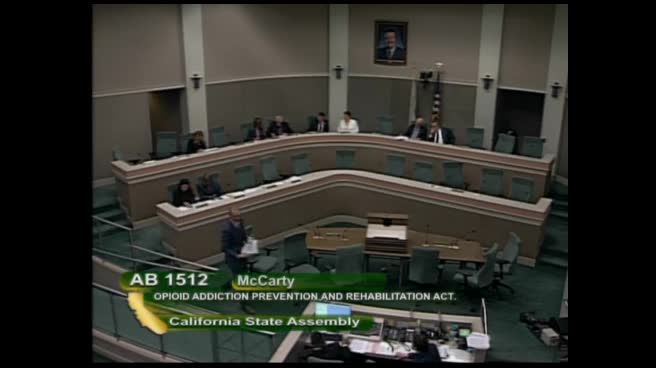 28MIN
Assembly Standing Committee on Health
Bill Author

Bill Co-Author(s):