AB 1983: School safety: school facilities and emergency practices: security assessment.
- Session Year: 2017-2018
- House: Assembly
- Latest Version Date: 2018-05-01
Existing law provides that school districts and county offices of education are responsible for the overall development of a comprehensive school safety plan for each of its schools, as provided. Existing law requires the schoolsite council of a school, except as provided for a small school district, to write and develop the comprehensive school safety plan relevant to the needs and resources of that particular school. Existing law requires the schoolsite council to consult with a representative from a law enforcement agency in the writing and development of the comprehensive school safety plan.
This bill would require each the governing board of a school district, a county board of education, and the governing body of a charter school, before the commencement of the 201920 school year, to contract with a local law enforcement agency to provide a full security assessment of the school districts facilities and emergency practices. practices of each school within its jurisdiction. By imposing additional requirements on governing boards of school districts, county boards of education, and governing bodies of charter schools, the bill would impose a state-mandated local program. The bill would authorize the governing board of a school district, a county board of education, and the governing body of a charter school to elect not to disclose the contents of the full security assessment.
The California Constitution requires the state to reimburse local agencies and school districts for certain costs mandated by the state. Statutory provisions establish procedures for making that reimbursement.
This bill would provide that, if the Commission on State Mandates determines that the bill contains costs mandated by the state, reimbursement for those costs shall be made pursuant to the statutory provisions noted above.
Existing law provides that school districts and county offices of education are responsible for the overall development of a comprehensive school safety plan for each of its schools, as provided. Existing law requires the schoolsite council of a school, except as provided for a small school district, to write and develop the comprehensive school safety plan relevant to the needs and resources of that particular school. Existing law requires the schoolsite council to consult with a representative from a law enforcement agency in the writing and development of the comprehensive school safety plan.
This bill would require each school district, before the commencement of the 201920 school year, to contract with a local law enforcement agency to provide a full security assessment of the school districts facilities and emergency practices. By imposing additional requirements on school districts, the bill would impose a state-mandated local program.
The California Constitution requires the state to reimburse local agencies and school districts for certain costs mandated by the state. Statutory provisions establish procedures for making that reimbursement.
This bill would provide that, if the Commission on State Mandates determines that the bill contains costs mandated by the state, reimbursement for those costs shall be made pursuant to the statutory provisions noted above.
The California Constitution requires the state to provide a subvention of funds to reimburse local government for the costs of a new program or a higher level of service, with specified exceptions, when the Legislature or a state agency mandates a new program or higher level of service on any local government, including school districts. Existing law authorizes a local agency or school district, by February 15, to file an annual reimbursement claim detailing these state-mandated costs, as specified.This bill would extend that date to March 1.The California Constitution requires the state to provide a subvention of funds to reimburse local government for the costs of a new program or a higher level of service, with specified exceptions, when the Legislature or a state agency mandates a new program or higher level of service on any local government, including school districts. Existing law authorizes a local agency or school district, by February 15, to file an annual reimbursement claim detailing these state-mandated costs, as specified.
This bill would extend that date to March 1.
A (a)The governing board of a school district district, a county board of education, and the governing body of a charter school shall, before the commencement of the 201920 school year, contract with a local law enforcement agency to provide a full security assessment of the school districts facilities and emergency practices. practices of each school within its jurisdiction.
(b)The governing board of a school district, a county board of education, and the governing body of a charter school, in consultation with a local law enforcement agency, may elect not to disclose the contents of the full security assessment provided pursuant to subdivision (a).
(c)Nothing in this section precludes the governing board of a school district, a county board of education, or the governing body of a charter school from conferring in a closed session with law enforcement officials pursuant to Section 54957 of the Government Code to review and accept the full security assessment provided by those officials pursuant to subdivision (a). Any vote to accept the full security assessment shall be announced in open session following the closed session.
SEC. 2.If the Commission on State Mandates determines that this act contains costs mandated by the state, reimbursement to local agencies and school districts for those costs shall be made pursuant to Part 7 (commencing with Section 17500) of Division 4 of Title 2 of the Government Code.
A school district shall, before the commencement of the 201920 school year, contract with a local law enforcement agency to provide a full security assessment of the school districts facilities and emergency practices.
SEC. 2.If the Commission on State Mandates determines that this act contains costs mandated by the state, reimbursement to local agencies and school districts for those costs shall be made pursuant to Part 7 (commencing with Section 17500) of Division 4 of Title 2 of the Government Code.
SECTION 1.Section 17560 of the Government Code is amended to read:17560.Reimbursement for state-mandated costs may be claimed as follows:(a)By March 1 following the fiscal year in which costs are incurred, file an annual reimbursement claim that details the costs actually incurred for that fiscal year.(b)If the Controller issues revised claiming instructions pursuant to subdivision (c) of Section 17558 between November 15 and March 1 a local agency or school district filing an annual reimbursement claim shall have 120 days following the issuance date of the revised claiming instructions to file a claim.Reimbursement for state-mandated costs may be claimed as follows:
(a)By February 15 March 1 following the fiscal year in which costs are incurred, file an annual reimbursement claim that details the costs actually incurred for that fiscal year.
(b)In the event If the Controller issues revised claiming instructions are issued by the Controller pursuant to subdivision (c) of Section 17558 between November 15 and February 15, March 1 a local agency or school district filing an annual reimbursement claim shall have 120 days following the issuance date of the revised claiming instructions to file a claim.
|
Date
|
Status
|
|---|---|
| May 25, 2018 | In committee: Held under submission. |
| May 16, 2018 | In committee: Set, first hearing. Referred to APPR. suspense file. |
| May 2, 2018 | Re-referred to Com. on APPR. |
| May 1, 2018 | Read second time and amended. |
| Apr 30, 2018 | From committee: Amend, and do pass as amended and re-refer to Com. on APPR. (Ayes 7. Noes 0.) (April 25). |
| Apr 2, 2018 | From committee: Be re-referred to Com. on ED. Re-referred. (Ayes 6. Noes 0.) (April 2). Re-referred to Com. on ED. |
| Mar 22, 2018 | Re-referred to Com. on RLS. pursuant to Assembly Rule 96. |
| Mar 19, 2018 | Re-referred to Com. on L. GOV. |
| Mar 15, 2018 | From committee chair, with author's amendments: Amend, and re-refer to Com. on L. GOV. Read second time and amended. |
| Mar 1, 2018 | Referred to Com. on L. GOV. |
| Feb 1, 2018 | From printer. May be heard in committee March 3. |
| Jan 31, 2018 | Read first time. To print. |
|
Date
|
Description
|
Location
|
Votes
|
|
|---|---|---|---|---|
| Apr 25, 2018 | Do pass as amended and be re-referred to the Committee on [Appropriations] | Assembly Standing Committee on Education |
Passed |
|
| Apr 2, 2018 | Be re-referred to the Committee on [Education] | Assembly Standing Committee on Rules |
Passed |
This list shows positions taken on this bill by organizations on the date displayed, which is linked to the original source.
Positions by individuals are not included.
Date of Hearing: May 16, 2018
ASSEMBLY COMMITTEE ON APPROPRIATIONS
Lorena Gonzalez Fletcher, Chair
ABPCA Bill Id:AB 1983
Author:(Waldron) – As Amended Ver:May 1, 2018
Policy Committee: | Rules | Vote: | 6 - 0 |
Education | 7 - 0 | ||
|
|
Urgency: No State Mandated Local Program: Yes Reimbursable: Yes
SUMMARY: This bill requires school districts and charter schools to contract with local law enforcement to conduct full security assessments of school facilities and emergency practices, by the end of the 2019-20 school year. The bill does not require school districts or charter schools to disclose the contents of the assessments.
FISCAL EFFECT:
- One-time Proposition 98 GF costs in the millions of dollars for all school districts and charter schools to contract with local law enforcement to conduct full security assessment of school facilities and emergency practices. The state has over 10,000 schools. If contracts with local law enforcement were $500 each, total costs would be $5 million. If the Commission on State Mandates determines the bill’s requirements to be a reimbursable state mandate, the state would need to reimburse these costs to school districts or charter schools or provide funding through the K-12 Mandate Block Grant, described in more detail below.
- Potential costs associated with making needed changes to address security issues identified by the assessments or increased liability for school districts that do not make needed changes. Schools would presumably either absorb the costs of these options within their Proposition 98 general purpose allocations or, if the change is facilities related, apply for school bond funds.
COMMENTS:
- Purpose. According to the author:
Law enforcement officers and school personnel represent highly trained professionals who have the welfare of students and school community in mind. Law enforcement officers and school personnel should be required to work together in conducting full security assessments and in creating and implementing feasible threat assessment procedures.
- K-12 Mandate Block Grant. To address various concerns with the traditional mandate claims process, such as the disincentive for LEAs to perform mandated tasks efficiently, the state created the K-12 Mandate Block Grant in the 2012-13 budget. The amount of funding available in the block grant annually is tied to the number of mandates the CSM has found to be reimbursable and the mandates’ statewide costs. (Typically, when the CSM has determined a claim filed by an LEA to be reimbursable, it has developed a statewide cost estimate for performing the mandate and the state has added the estimated amount or a portion of the estimated amount to the block grant as part of its annual budget process.) School districts that choose to participate in the block grant program receive per-student funding to cover the cost of state-mandated activities in lieu of submitting ongoing mandate claims for reimbursement. Charter schools also may participate in the block grant, but they may not submit mandate claims or receive reimbursement for mandate costs.
School districts receive from the block grant a per-student funding rate for K-8 students of about $30, with about $60 provided for high school students. Charter schools receive half the K-8 per-student funding rate of school districts, because about half of K-8 mandates apply to them. Similarly, about half of high school mandates apply to charter schools, but their grades 9-12 rate is more than half the district rate, or about $40, because of the treatment of certain mandates.
- Related Legislation. AB 1747 (Rodriguez), of this session, expands the required elements of school safety plans, including procedures to respond to active shooter situations, requires schools to conduct annual active shooter drills, and requires the CDE to provide additional guidance and oversight of safety plans. The bill is currently pending on this committee’s suspense file.
AB 3205 (O’Donnell), of this session, requires school districts to install indoor classroom locks in schools built before 2012. The bill is currently pending on this committee’s suspense file.
Analysis Prepared by: Natasha Collins / APPR. / (916) 319-2081
Date of Hearing: April 25, 2018
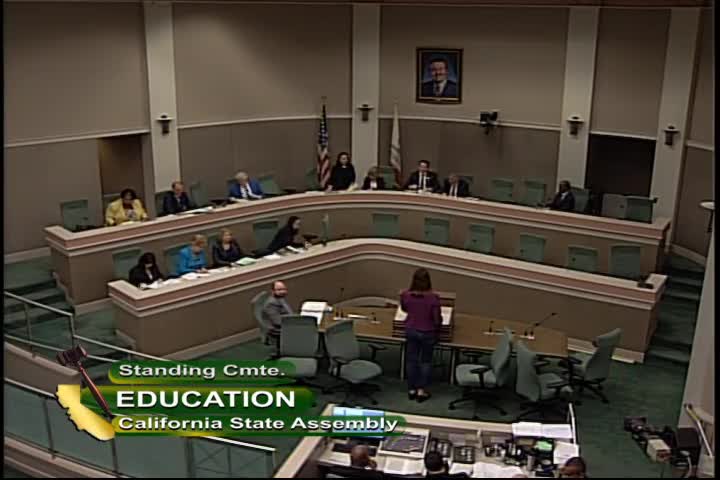
ASSEMBLY COMMITTEE ON EDUCATION
Patrick O'Donnell, Chair
ABPCA Bill Id:AB 1983 (
Author:Waldron) – As Amended Ver:March 15, 2018
SUBJECT: School safety: school district facilities and emergency practices: security assessment
SUMMARY: Requires school districts to work with local law enforcement to conduct full security assessments of school facilities and emergency practices. Specifically, this bill:
- Requires a school district, before the commencement of the 2019-20 school year to contract with a local law enforcement agency to provide a full security assessment of the school district’s facilities and emergency practices.
EXISTING LAW:
- Requires each school district or county office of education (COE) to be responsible for the overall development of all comprehensive school safety plans for its schools operating kindergarten or any of grades 1 through 12 (EC 32281).
- Specifies that the schoolsite council or a school safety planning committee is responsible for developing the comprehensive school safety plan (EC 32281).
- Specifies that the comprehensive school safety plan must include an assessment of the current status of school crime committed on school campuses and at school-related functions and identification of appropriate strategies and programs to provide or maintain a high level of school safety and address the school’s procedures for complying with existing laws related to school safety, including child abuse reporting procedures; disaster procedures; an earthquake emergency procedure system; policies regarding pupils who commit specified acts that would lead to suspension or expulsion; procedures to notify teachers of dangerous pupils; a discrimination and harassment policy; the provisions of any schoolwide dress code; procedures for safe ingress and egress of pupils, parents, and school employees to and from school; a safe and orderly environment conducive to learning; and rules and procedures on school discipline (EC 32282).
- Authorizes the portions of a school safety plan that include tactical responses to criminal incidents to be developed by school district or COE administrators in consultation with law enforcement officials and with a representative of an exclusive bargaining unit of school district or COE employees, if he or she chooses to participate. Authorizes the school district or COE to elect not to disclose those portions of the comprehensive school safety plan that include tactical responses to criminal incidents (EC 32281).
- Defines “tactical responses to criminal incidents” as steps taken to safeguard pupils and staff, to secure the affected school premises, and to apprehend the criminal perpetrators (EC 32281).
- Requires the comprehensive school safety plan to be evaluated at least once a year (EC 32282).
- Encourages that, as school safety plans are reviewed, plans be updated to include clear guidelines for the roles and responsibilities of mental health professionals, community intervention professionals, school counselors, school resource officers, and police officers on school campuses, if the school district uses these people (EC 32282.1).
- Requires the comprehensive school safety plan to be submitted annually to the school district or COE for approval and requires a school district or COE to notify the CDE by October 15 of every year of any school that is not in compliance (EC 32288).
FISCAL EFFECT: The Office of Legislative Counsel has keyed this as a state-mandated local program.
COMMENTS: Need for the bill. According to the author:
“A large majority of schools are not prepared for internal or external threats. California law requires a School Site Council or a Safety Planning Committee to create a Comprehensive School Safety Plan. However, safety plans are not required, but only recommended, to include procedures for threat assessments, lock downs, securing the school, and response to active shooters. Additionally, law enforcement officers are not a required member on safety committees and school personnel are not required to work with law enforcement agencies in implementing school safety plans, but are only required to consult with a law enforcement representative.
Law enforcement officers and school personnel represent highly trained professionals who have the welfare of students and school community in mind. Law enforcement officers and school personnel should be required to work together in conducting full security assessments and in creating and implementing feasible threat assessment procedures. The current lack of collaboration between schools and law enforcement agencies leads to confusion and chaos when responding to threats detailed within the safety plan and threats that are entirely excluded from a school’s safety plan. Additionally, new technologies are available, at reasonable cost, to enable secure perimeters and safe ingress/egress on campuses that may be properly utilized with the guidance of law enforcement.”
Comprehensive school safety plans requirements. School districts and county offices of education (COE) are responsible for the overall development of school safety plans. Each school is required to develop a school safety plan that includes procedures, and policies to ensure student and staff safety at a school site. The components of the plan range from procedures for safe ingress and egress of pupils, parents and school employees; to disaster and emergency procedures such as those during and after earthquakes; to behavioral policies such as discrimination and harassment policies.
The school safety plan is developed by a school site council or a school safety planning committee. Current law requires a school to submit the school safety plan to the school district or COE for approval. The SPI is authorized to impose a fine of not more than $2,000 against a school district or COE for any willful failure to make any required report. According to the CDE, there has been no report of noncompliance by schools and no district or COE has been fined for willfully failing to report a school that has not developed a school safety plan.
School violence prevention audit. An audit by the California State Auditor, released in 2017, cites FBI data showing that active shooter incidents became more common between 2000 and 2015, and kindergarten through grade 12 facilities and higher education institutions have been the second most common location for these shootings to occur, both nationally and within California.
Committee amendments. School districts and county offices of education have the authority to elect not to disclose those portions of the comprehensive school safety policy that include tactical responses to criminal incidents. Committee staff recommend that the bill be amended to authorize schools to elect not to disclose the results of the full security assessment, in the interest of protecting the pupils, staff, and school property.
State law does not require charter schools to have safety plans, but charter petitions must include procedures the school will follow to ensure the safety of pupils and staff. Committee staff recommend that the bill be amended to require the governing board of a charter school to conduct the full security assessment of the facilities and emergency practices of all schools within its jurisdiction.
Committee staff recommend that the bill be amended to also apply these provisions to schools operated by county offices of education.
Similar and prior legislation. AB 1747 (Rodriguez) of this session expands the required elements of school safety plans, including procedures to respond to active shooter situations, requires schools to conduct annual active shooter drills, and requires the CDE to provide additional guidance and oversight of safety plans. This bill is pending before the Assembly Appropriations Committee.
AB 3205 (O’Donnell) of this session requires school districts to install indoor classroom locks in schools built before 2012. This bill is pending before this committee.
AB 58 (Rodriguez) makes each COE the entity responsible for the overall development of all comprehensive school safety plans and requires school safety plans to include procedures in response to individuals with guns on school campuses. This bill was held in the Senate Appropriations Committee in 2015.
SB 49 (Lieu) requires school safety plans to include procedures related to response to a person with a gun on campus, extends from annually to every third year the frequency of review of safety plans, and requires charter school petitions to include a description of a school safety plan, as specified. This bill was held in the Assembly Appropriations Committee in 2013.
AB 549 (Jones-Sawyer), Chapter 422, Statutes of 2013, encourages all school safety plans, to the extent that resources are available, to include clear guidelines for the roles and responsibilities of mental health professionals, community intervention professionals, school counselors, school resource officers, and police officers on school campus, if the school district uses these people.
AB 680 (Block), Chapter 438, Statutes of 2011, authorizes a school district or COE, in consultation with law enforcement officials, to choose not to have its schoolsite council develop and write those portions of its comprehensive school safety plan that include tactical responses to criminal incidents that may result in death or serious bodily injury at the schoolsite and authorizes, instead, school district and COE administrators to write those portions of the school safety plan.
REGISTERED SUPPORT / OPPOSITION:
Support
None on file
Opposition
None on file
Analysis Prepared by: Debbie Look / ED. / (916) 319-2087
Bill Author

Bill Co-Author(s):