AB 2008: Income taxes: exclusion: Carl Moyer Memorial Air Quality Standards Attainment Programs grants.
- Session Year: 2017-2018
- House: Assembly
- Latest Version Date: 2018-03-20
The Personal Income Tax Law and the Corporation Tax Law define gross income as all income from whatever source derived, unless specifically excluded.
This bill would, under both laws, exclude from gross income any amount provided to a taxpayer pursuant to the Carl Moyer Memorial Air Quality Standards Attainment Program for the purchase of new zero or low-emission engines. Program, as provided, until January 1, 2024. The bill would require an air district to provide the taxpayer with a certification of the amount issued pursuant to the program, available upon request to the Franchise Tax Board, and to annually provide the Franchise Tax Board with a data file containing specified information relating to the program. By imposing new requirements on air districts, the bill would create a state-mandated local program.
The California Constitution requires the state to reimburse local agencies and school districts for certain costs mandated by the state. Statutory provisions establish procedures for making that reimbursement.
This bill would provide that, if the Commission on State Mandates determines that the bill contains costs mandated by the state, reimbursement for those costs shall be made pursuant to the statutory provisions noted above.
This bill would take effect immediately as a tax levy.
The Personal Income Tax Law and the Corporation Tax Law define gross income as all income from whatever source derived, unless specifically excluded.
This bill would, under both laws, exclude from gross income any amount provided to a taxpayer pursuant to the Carl Moyer Memorial Air Quality Standards Attainment Program for the purchase of new zero or low-emission engines.
This bill would take effect immediately as a tax levy.
(a)(1)Gross income shall not include any amount provided to a taxpayer pursuant to the Carl Moyer Memorial Air Quality Standards Attainment Program (Chapter 9 (commencing with Section 44275) of Part 5 of Division 26 of the Health and Safety Code), relating to the purchase of new zero or low-emission engines. Code).
(2)(A)The issuing air district shall provide to the taxpayer a certification of the monetary amount issued pursuant to the Carl Moyer Memorial Air Quality Standards Attainment Program.
(B)Upon request of the Franchise Tax Board, a taxpayer shall provide to the Franchise Tax Board a copy of the certification.
(3)The issuing air district shall provide the Franchise Tax Board annually, on or before January 1, 2020, and each January 1 thereafter, a data file containing the following information relating to the Carl Moyer Memorial Air Quality Standards Attainment Program:
(A)The names and addresses of recipients.
(B)The social security number, federal tax identification number, or federal employer identification number of recipients.
(C)Dollar amounts of payments made pursuant to the Carl Moyer Memorial Air Quality Standards Attainment Program in the preceding taxable year.
(b)Any deduction otherwise allowed under this part for any amount paid or incurred by the taxpayer for which the grant from the Carl Moyer Memorial Air Quality Standards Attainment Program is based shall be reduced by the amount of any grant excluded from gross income under this section.
(c)The amount of any grant received that is excludable from gross income under this section shall be taken into account in determining the basis of the property to which the grant relates and shall reduce the basis by the amount of the grant excluded from gross income under this section.
(d)This section shall remain in effect only until January 1, 2024, and as of that date is repealed.
SEC. 2.Section 24318 24311 is added to the Revenue and Taxation Code, to read:24318.24311.(a)(1)Gross income shall not include any amount provided to a taxpayer pursuant to the Carl Moyer Memorial Air Quality Standards Attainment Program (Chapter 9 (commencing with Section 44275) of Part 5 of Division 26 of the Health and Safety Code), relating to the purchase of new zero or low-emission engines. Code).
(2)(A)The issuing air district shall provide to the taxpayer a certification of the monetary amount issued pursuant to the Carl Moyer Memorial Air Quality Standards Attainment Program.
(B)Upon request of the Franchise Tax Board, a taxpayer shall provide to the Franchise Tax Board a copy of the certification.
(3)The issuing air district shall provide the Franchise Tax Board annually, on or before January 1, 2020, and each January 1 thereafter, a data file containing the following information relating to the Carl Moyer Memorial Air Quality Standards Attainment Program:
(A)The names and addresses of recipients.
(B)The social security number, federal tax identification number, or federal employer identification number of recipients.
(C)Dollar amounts of payments made pursuant to the Carl Moyer Memorial Air Quality Standards Attainment Program in the preceding taxable year.
(b)Any deduction otherwise allowed under this part for any amount paid or incurred by the taxpayer for which the grant from the Carl Moyer Memorial Air Quality Standards Attainment Program is based shall be reduced by the amount of any grant excluded from gross income under this section.
(c)The amount of any grant received that is excludable from gross income under this section shall be taken into account in determining the basis of the property to which the grant relates and shall reduce the basis by the amount of the grant excluded from gross income under this section.
(d)This section shall remain in effect only until January 1, 2024, and as of that date is repealed.
SEC. 3.If the Commission on State Mandates determines that this act contains costs mandated by the state, reimbursement to local agencies and school districts for those costs shall be made pursuant to Part 7 (commencing with Section 17500) of Division 4 of Title 2 of the Government Code.
SEC. 3.SEC. 4.This act provides for a tax levy within the meaning of Article IV of the California Constitution and shall go into immediate effect.
Gross income shall not include any amount provided to a taxpayer pursuant to the Carl Moyer Memorial Air Quality Standards Attainment Program (Chapter 9 (commencing with Section 44275) of Part 5 of Division 26 of the Health and Safety Code), relating to the purchase of new zero or low-emission engines.
SEC. 2.Section 24318 is added to the Revenue and Taxation Code, to read:24318.Gross income shall not include any amount provided to a taxpayer pursuant to the Carl Moyer Memorial Air Quality Standards Attainment Program (Chapter 9 (commencing with Section 44275) of Part 5 of Division 26 of the Health and Safety Code), relating to the purchase of new zero or low-emission engines.
SEC. 3.This act provides for a tax levy within the meaning of Article IV of the California Constitution and shall go into immediate effect.
|
Date
|
Status
|
|---|---|
| May 25, 2018 | In committee: Held under submission. |
| Apr 4, 2018 | In committee: Set, first hearing. Referred to suspense file. |
| Mar 21, 2018 | Re-referred to Com. on APPR. |
| Mar 20, 2018 | Read second time and amended. |
| Mar 19, 2018 | From committee: Amend, and do pass as amended and re-refer to Com. on APPR. (Ayes 7. Noes 0.) (March 12). |
| Feb 12, 2018 | Referred to Com. on REV. & TAX. |
| Feb 2, 2018 | From printer. May be heard in committee March 4. |
| Feb 1, 2018 | Read first time. To print. |
|
Date
|
Description
|
Location
|
Votes
|
|
|---|---|---|---|---|
| Mar 12, 2018 | Do pass as amended and be re-referred to the Committee on [Appropriations] | Assembly Standing Committee on Revenue and Taxation |
Passed |
This list shows positions taken on this bill by organizations on the date displayed, which is linked to the original source.
Positions by individuals are not included.
|
Organization
|
Position
|
Date
|
|---|---|---|
| California Air Pollution Control Officers Association | * Support | Mar 12, 2018 |
| California Trucking Association | * Support | Mar 12, 2018 |
| San Joaquin Valley Air Pollution Control District | * Support | Mar 12, 2018 |
| South Coast Air Quality Management District | * Support | Mar 12, 2018 |
| Western Propane Gas Association | * Support | Mar 12, 2018 |
Date of Hearing: April 4, 2018
ASSEMBLY COMMITTEE ON APPROPRIATIONS
Lorena Gonzalez Fletcher, Chair
ABPCA Bill Id:AB 2008
Author:(Salas) – As Amended Ver:March 20, 2018
Policy Committee: | Revenue and Taxation | Vote: | 7 - 0 |
|
| ||
|
|
Urgency: No State Mandated Local Program: Yes Reimbursable: Yes
SUMMARY:
This bill, until January 1, 2024, excludes from gross income, under both the Personal Income Tax (PIT) and the Corporation Tax (CT), amounts provided to taxpayers by the Carl Moyer Memorial Air Quality Standards Attainment Program (Carl Moyer Program). Local air districts must provide the Franchise Tax Board (FTB) with specified data related to Carl Moyer Program participation.
FISCAL EFFECT:
- Annual General Fund (GF) revenue loss of $4.5 million in 2018-19, $2.6 million in 2019-20, and $3.4 million in 2020-21.
- Potential GF costs to reimburse local air districts for administrative costs related to remitting appropriate data to FTB. However, it is unlikely that any such local public entity would bring a claim for reimbursement by the state before the Commission on State Mandates.
COMMENTS:
- Background. The Carl Moyer Program provides grant funding for cleaner-than-required engines and equipment. Local air districts administer the grants and decide which projects to fund, and eligible projects include cleaner on-road trucks, school and transit buses, and agricultural equipment. Since the Carl Moyer Program’s inception in 1998, nearly $1 billion has been granted, and the Carl Moyer Program continues to provide over $60 million in grant funding each year.
Under federal and state law, taxpayers must include in the calculation of their gross income all forms of income unless that income is explicitly excluded. Because Carl Moyer Program grants are not specifically excluded, these grants are considered taxable at the state and federal level.
- Purpose. According to the author, AB 2008 will make the Carl Moyer Program more accessible to smaller businesses and ensure that the state is maximizing the value of the dollars it invests in reducing air pollution.
- Fiscal implications of tax expenditures. Existing law allows for various tax expenditures such as credits, deductions, exclusions, and exemptions for particular taxpayer groups. These features of the tax code can result in significant state costs through foregone tax revenue and, in many cases, policymakers have little control over the revenue loss that occurs in any given year. As a result, many tax expenditure bills now include provisions designed to give the Legislature more control over costs. Examples of such provisions include placing a sunset date or making a bill’s provisions contingent upon a separate budget appropriation. AB 2008 includes a sunset date.
- Recent amendments. Recent policy committee amendments added a number of provisions meant to improve implementation of the proposed exclusion. Amendments include a new requirement for local air districts to provide the FTB information on who receives grants and provisions to prevent taxpayers from claiming multiple tax benefits for the same piece of equipment for which a Carl Moyer Program grant is provided.
Analysis Prepared by: Luke Reidenbach / APPR. / (916) 319-2081
Date of Hearing: March 12, 2018
ASSEMBLY COMMITTEE ON REVENUE AND TAXATION
Autumn R. Burke, Chairwoman
ABPCA Bill Id:AB 2008 (
Author:Salas) – As Introduced Ver:February 1, 2018
Majority vote. Tax levy. Fiscal committee.
SUBJECT: Income taxes: exclusion: Carl Moyer Memorial Air Quality Standards Attainment Programs grants
SUMMARY: Excludes from gross income any amount provided to a taxpayer under the Carl Moyer Memorial Air Quality Standards Attainment Program (Program), relating to the purchase of new zero or low-emission engines. Specifically, this bill:
- Provides a gross income exclusion, under both the Personal Income Tax (PIT) Law and the Corporation Tax (CT) Law, for amounts provided to a taxpayer under the Program, relating to the purchase of new zero or low-emission engines.
- Takes immediate effect as a tax levy.
EXISTING FEDERAL LAW:
- Defines "gross income" as, except as otherwise provided, all income from whatever source derived. (Internal Revenue Code (IRC) Section 61.) Among other things, gross income specifically includes compensation for services, business income, gains from dealings in property, interest, rents, royalties, dividends, and annuities.
- Excludes from gross income the value of any subsidy provided (directly or indirectly) by a public utility to a customer for the purchase or installation of any energy conservation measure, as defined. (IRC Section 136.)
EXISTING STATE LAW:
- Provides that IRC Section 61, relating to the definition of gross income, shall apply, except as specified. (Revenue and Taxation Code (R&TC) Section 17071.)
- Provides an exclusion, under both the PIT Law and the CT Law, for any rebate, voucher, or other financial incentive issued by the California Energy Commission, the Public Utility Commission, or a local publicly owned electric utility, for an expense incurred by a taxpayer to purchase or install a:
- Thermal system as defined in Public Resources Code (PRC) Section 25600;
- Solar system as defined in PRC Section 25600;
- Wind energy system device that produces electricity; or,
- Fuel cell generating system that produces electricity. (R&TC Sections 17138.1 and 24308.1.)
- Thermal system as defined in Public Resources Code (PRC) Section 25600;
- Provides an exclusion, under both the PIT Law and the CT Law, for any amount received as a rebate, voucher, or other financial incentive issued by a local water agency or supplier for participation in a turf removal water conservation program. The exclusion specifically applies for taxable years beginning on or after January 1, 2014, and before January 1, 2019. (R&TC Sections 17138.2 and 24308.2.)
FISCAL EFFECT: The Franchise Tax Board (FTB) estimates that this bill would result in revenue losses of $4.5 million in fiscal year (FY) 2018-19, $3.6 million in FY 2019-20, and $3.4 million in FY 2020-21.
COMMENTS:
- The author has provided the following statement in support of this bill:
Unlike other grant programs under the ARB that help businesses with the cost of meeting California's strict air quality standards, the success of the Carl Moyer program relies on a pool of applicants that are willing to exceed air quality standards by taking on the legally unrequired costs of upgrading their existing equipment to be even more environmentally friendly. Although the program has been quite effective at reducing air-pollution, accessing the grants has proven to be particularly difficult for small business owners who, for reasons of scale, are more sensitive to large increases in their tax burden as a result of accepting such a grant. Additionally, for those who are successful at receiving the grants, because these grants are taxed as income the purchasing power of the grants is also reduced which limits the impact they have on improving air quality. By making the grants tax-exempt it would not only reduce the tax burden of accepting the grant and make the program more accessible for smaller businesses, it would also ensure that the State is maximizing the value of the dollars it invests in the program, thereby increasing the program's effectiveness at improving the quality of our air.
- This bill is supported by the San Joaquin Valley Air Pollution Control District, which notes the following:
The District administers the Carl Moyer incentive program in the eight counties of the San Joaquin Valley. While this program has been successful at achieving significant emissions reductions over the years, the fact that these funds are subject to income tax has increasingly become an issue as more of these funds are being accessed by small businesses and individuals. In order to apply for funds project applicants must pay their portion of the project cost, pay sales tax on the equipment, and pay increased registration fees for mobile source equipment. In some instances applicants have indicated that they cannot afford to accept the grant funding, and purchase cleaner equipment, due to the large upfront cost.
- The FTB has identified the following implementation concerns in its analysis of this bill:
- "This bill uses terms that are undefined, i.e., 'related to the purchase,' 'new zero or low-emission engines.' The absence of definitions to clarify these terms could lead to disputes with taxpayers and would complicate the administration of this bill. The author may want to amend the bill to clearly define the terms."
- "This bill fails to specify how the [FTB] would determine or verify if payments provided by the Carl Moyer Program were related to the purchase of new zero or low-emission engines. To reduce disputes between the department and taxpayers, as well as to ease administration of this bill, the author may wish to amend the bill to: (1) require the issuing air district to provide certification to taxpayers that a payment is related to the purchase of new zero or low-emission engines, (2) require taxpayers to submit such certification to the FTB upon request, and (3) require the issuing air district to provide the FTB a data file annually containing information relating to the payments and the recipients."
- "This bill uses terms that are undefined, i.e., 'related to the purchase,' 'new zero or low-emission engines.' The absence of definitions to clarify these terms could lead to disputes with taxpayers and would complicate the administration of this bill. The author may want to amend the bill to clearly define the terms."
- Committee Staff Comments
- What is a "tax expenditure"? Existing law provides various credits, deductions, exclusions, and exemptions for particular taxpayer groups. In the late 1960s, U.S. Treasury officials began arguing that these features of the tax law should be referred to as "expenditures" since they are generally enacted to accomplish some governmental purpose and there is a determinable cost associated with each (in the form of foregone revenues). This bill enacts a new tax expenditure, in the form of a gross income exclusion, to encourage greater participation in the Program.
- How is a tax expenditure different from a direct expenditure? As the Department of Finance notes in its annual Tax Expenditure Report, there are several key differences between tax expenditures and direct expenditures. First, tax expenditures are reviewed less frequently than direct expenditures once they are put in place. This can offer taxpayers greater economic certainty, but it can also result in tax expenditures remaining a part of the tax code without demonstrating any public benefit. Second, there is generally no control over the amount of revenue losses associated with any given tax expenditure. Finally, it should also be noted that, once enacted, it takes a two-thirds vote to rescind an existing tax expenditure absent a sunset date. This effectively results in a "one-way ratchet" whereby tax expenditures can be conferred by majority vote, but cannot be rescinded, irrespective of their efficacy, without a supermajority vote.
- Existing law: Existing federal and state law excludes from gross income any subsidy provided by a public utility for the purchase or installation of any "energy conservation measure". An "energy conservation measure", in turn, is defined as any installation or modification primarily designed to reduce the consumption of electricity or natural gas or to improve the management of energy demand in a dwelling unit, as specified.
Existing state law also provides an exclusion for any rebate, voucher, or other financial incentive issued by the California Energy Commission, the Public Utility Commission, or a local publicly owned electric utility, for an expense incurred by a taxpayer to purchase or install a specified thermal system, solar system, wind energy system, or a fuel cell generating system.
Finally, existing law provides an exclusion for any amount received as a rebate, voucher, or other financial incentive issued by a local water agency or supplier for participation in a turf removal water conservation program.
- What are we covering? This bill would provide a new gross income exclusion, under both the PIT Law and the CT Law, for amounts provided to a taxpayer under the Program, relating to the purchase of new zero or low-emission engines.
- What is the Program? According to the California Air Resources Board (ARB), the Program provides grant funding for cleaner-than-required engines and equipment. Specifically, local air districts administer the grants and decide which projects to fund. The ARB, in turn, works collaboratively with local districts and other stakeholders to set guidelines and to ensure the Program reduces pollution. Eligible projects include cleaner on-road trucks, school and transit buses, off-road equipment, marine vessels, locomotives, agricultural equipment, light duty vehicle scrap, and lawn mowers. The FTB notes that, since the Program's inception in 1998, almost $1 billion has been granted to equipment owners, and the Program continues to provide over $60 million in grant funding each year.
- Are some grants more equal than others? State and local governments offer a variety of grant and financial incentive programs to encourage socially beneficial behavior. Indeed, the ARB notes that it oversees at least six grant programs specifically for clean on- and off-road vehicles and equipment, including the Program. This raises the question of whether it makes sense to treat all government grant programs the same for income tax purposes. Namely, should all grant proceeds be tax free to eligible recipients? If not, what criteria should be applied to determine which grants are subject to taxation and which are not?
- Absence of a sunset date: In its current form, this bill's proposed tax expenditure lacks an automatic sunset provision. This Committee has a longstanding policy favoring the inclusion of sunset dates to allow the Legislature periodically to review the efficacy and cost of such programs. The author may wish to consider the addition of appropriate sunset provisions.
- Issues of conformity: This bill would establish a gross income exclusion for which federal law has no counterpart, thus increasing nonconformity. California typically conforms to federal law for gross income exclusions for ease of administration. In addition, if a small business or individual cannot currently afford to accept a Program grant because of the attendant state income tax liability, the continued imposition of federal taxes (at significantly higher rates) may still present a barrier to Program participation.
- Double dipping: The FTB notes in its staff analysis that this bill would allow taxpayers to claim multiple tax benefits for the same item of expense. Committee staff suggests a standard amendment precluding a taxpayer from claiming more than one benefit for the same item of expense.
- Late breaking amendments: The author has requested amendments be taken in Committee to:
- Clarify that all monetary grants under the Program are exempt from state income tax;
- Allow the FTB to verify the exemptions claimed; and,
- Provide a sunset date to allow periodic review by the Legislature of this tax expenditure program.
- Clarify that all monetary grants under the Program are exempt from state income tax;
- Prior legislation:
- AB 2434 (Gomez), Chapter 738, Statutes of 2014, provided, for taxable years beginning on or after January 1, 2014, and before January 1, 2019, a gross income exclusion for amounts received as a rebate, voucher, or other financial incentive issued by a local water agency or supplier for participation in a turf removal water conservation program.
- SB 358 (Cannella), of the 2011-12 Legislative Session, would have excluded from gross income any amount provided to a person by the ARB, an air pollution control district, or an air quality management district, as defined, for the purpose of air pollution reduction. SB 358 was never heard by the Senate Governance and Finance Committee and was returned to the Secretary of the Senate.
- AB 1968 (Nation), Chapter 843, Statutes of 2002, provided an exclusion for specified rebates and vouchers issued for expenses paid or incurred by a taxpayer to purchase or install a thermal system, solar system, wind energy system, or a fuel cell generating system.
REGISTERED SUPPORT / OPPOSITION:
Support
California Air Pollution Control Officers Association
San Joaquin Valley Air Pollution Control District
Opposition
None on file
Analysis Prepared by: M. David Ruff / REV. & TAX. / (916) 319-2098
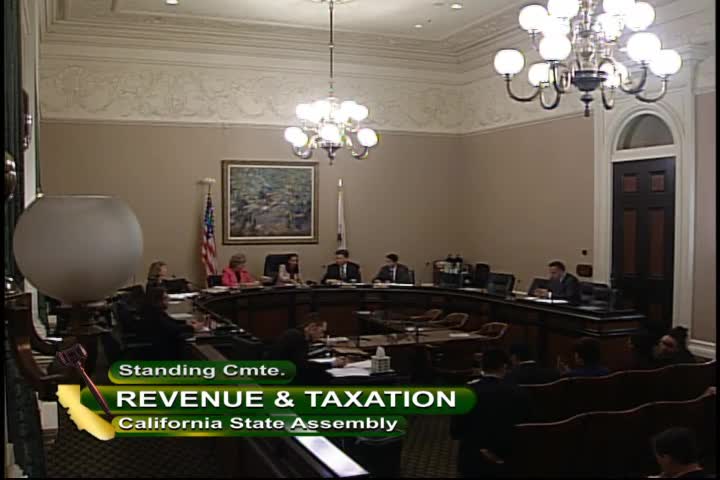
Discussed in Hearing
 7MIN
Assembly Standing Committee on Revenue and Taxation


Bill Co-Author(s):